POLITICO: How Bill Gates Took Over the Covid Pandemic
Bill Gates took over Covid just like he took over Operating Systems
By Igor Chudov | September 15, 2022
An amazing article from the least expected, mainstream source: Politico.
The title of the article was apparently edited in a hurry post-publication because Google News still lists it as “How Bill Gates and his partners took over the global Covid response”. Here’s the archive link to the original article with “Bill Gates” in the title — proving it was later edited in a hurry.
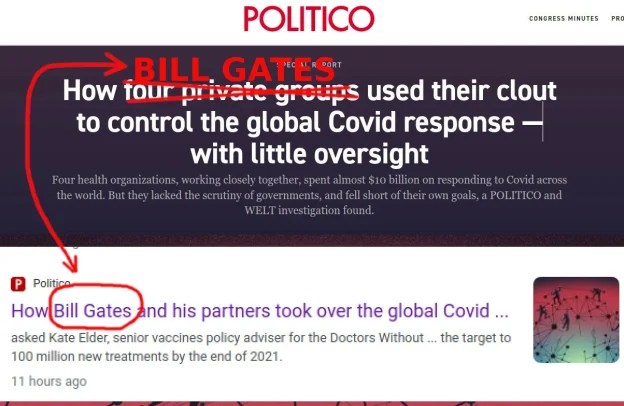
Even the article URL lists Bill Gates:
https://www.politico.com/news/2022/09/14/global-covid-pandemic-response-bill-gates-partners-00053969The article would be fascinating to read for people who were not previously aware of what most of us knew already — that the so-called “pandemic response” and global health are taken over by unaccountable private interest groups serving Bill Gates.
I highly recommend that you take a look!
The story given by the article is incomplete but very interesting.
It mentions that the pandemic response was taken over by the Bill and Melinda Gates Foundation, GAVI, CEPI, and the Wellcome Trust. All four organizations pretend to be independent, but all were financed by Bill Gates.
They participated in Event 201, planning out the pandemic, in October 2019.

“What makes Bill Gates qualified to be giving advice and advising the U.S. government on where they should be putting the tremendous resources?” asked Kate Elder, senior vaccines policy adviser for the Doctors Without Borders’ Access Campaign.
Several important items are glaringly missing from the article:
- Bill and Melinda Gates Foundation, along with the US government (Avril Haines representing the US intelligence community) and China CDC, planned out the pandemic in October of 2019 by means of an “exercise” called Event 201.
- Sars-Cov-2 is lab engineered and was designed intentionally
- As pointed out by our astute reader Mel, do not forget the 3.1 million shares of BioNTech that Gates bought in Sept 2019 for $18.10/share. That $55 million investment was worth $1.7 billion by Aug 2021.https://www.sec.gov/Archives/edgar/data/1776985/000119312519241112/d635330dex1036.htm
- Bill and Melinda Gates Foundation financed the organization that developed Sars-Cov-2 (EcoHealth Alliance) via grant INV-002838, and possibly more.
- Bill and Melinda Gates Foundation financed University of North Carolina, where Ralph Baric developed Sars-Cov-2 for EcoHealth Alliance, via 56 grants: INV-026327 INV-030330 INV-031704 INV-028991 INV-036494 INV-032887 INV-033909 INV-036560 OPP1192462 OPP1199232 OPP1201585 OPP1203327 OPP1195157 OPP1195363 OPP1191684 OPP1061107 OPP1090837 OPP1086528 OPP1108279 OPP1107923 OPP1235 OPP3436 OPP1142921 OPP38920 OPP38381 OPP23847 OPP17809 OPP1161858 OPP1158402 OPP1154943 OPP1172799 OPP1183027 OPP1181722 INV-006232 INV-001748 INV-005277 INV-016221 INV-019193 INV-016163 INV-003112 INV-001805 INV-003266 INV-002551 OPP1203712 OPP9404 OPP1014802 OPP1015539 OPP1024615 OPP1024664 OPP1015381 OPP1018000 OPP51976 OPP53107 OPP53450 OPP52037 OPP49260
- Bill Gates had close ties with Jeffrey Epstein and visited him numerous times
Nevertheless, the mere publication of this article has huge importance. The things that most of us know and talk about, are appearing in the so-called “mainstream press” — after the damage was all done, of course.
The virus was released; millions died; over a billion young people were force-vaccinated under false pretenses. When it is too late to change anything, Politico is finally stating the obvious. Still, it is better than nothing.
Almost everything in the Politico article was known a year ago. Where was Politico then? Busy taking government covid vaccine advertising money.
The pandemic was a crime, not an accident.
Climate Emergency Not Supported by Data, Say Four Leading Italian Scientists
BY CHRIS MORRISON | THE DAILY SCEPTIC | SEPTEMBER 14, 2022
Four leading Italian scientists have undertaken a major review of historical climate trends and concluded that a ‘climate emergency’ is not supported by the data. Reviewing data from a wide range of weather phenomena, they say the climate crisis that many say we are currently experiencing “is not evident yet”. The scientists suggest that rather than burdening our children with the anxiety of a climate emergency, we should allow them to face various problems such as energy, food and health with a more “objective and constructive spirit” and not waste limited resources on “costly and ineffective solutions”.
During the course of their recent work, the scientists found that rainfall intensity and frequency was stationary in many parts of the world. Tropical hurricanes and cyclones showed little change over the long term, and the same is true of U.S. tornadoes. Other meteorological categories including natural disasters, floods, droughts and ecosystem productivity showed no “clear positive trend of extreme events”. Regarding ecosystems, the scientists noted a considerable “greening” of global plant biomass in recent decades caused by higher levels of carbon dioxide in the atmosphere. Satellite data show “greening” trends over most of the planet, increasing food yields and pushing back of deserts.
The four scientists are all highly qualified and include physics adjunct professor Gianluca Alimonti, agrometeorologist Luigi Mariani and physics professors Franco Prodi and Renato Angelo Ricci. The last two physicists are signatories to the rapidly growing “World Climate Declaration”. This petition states that there is no climate emergency and calls for climate science to be more scientific. It also calls for a freeing from the “naïve belief in immature climate models”. In future, it says, “climate research must give significantly more emphasis to empirical science”.
‘Extreme’ weather events attributed by climate models – somehow – to humans changing the climate, are now the main staple of the climate alarmist industry. As the Daily Sceptic reported on Monday, Sir David Attenborough used a U.K. Met Office model forecast in Frozen Planet II to claim that summer Arctic sea ice could all be gone within 12 years. But the likelihood of hardy swimming galas over the North Pole by 2035 seems somewhat remote, not least because Arctic sea ice has been growing in many summers since 2012. According to a recent report from the U.S.-based National Snow and Ice Data Center, at the end of August, “sea ice extent is likely to remain higher than in recent years”.
Hurricane and cyclones are favourite scares that are frequently drummed up by green alarmists. It is unsurprising why they focus on these storms, since the scientists note that historically around 60% of all economic damage caused by global disasters is the consequence of U.S. hurricanes. On May 27th, the Met Office predicted that the 2022 Atlantic hurricane season, which runs from June to November, would “most likely” be above average, with a “likelihood” of 18 named tropical storms including nine hurricanes and four major hurricanes. In fact, the current Atlantic hurricane season has had its slowest start for 30 years. At the end of August there have been no hurricanes, and only three named storms, none of which produced winds of 74mph or higher.
In fact there is plenty of evidence that hurricane and cyclone intensity and frequency has changed little over the recent historical record. “To date, global observations do not show any significant trends in both the number and the energy accumulated by hurricanes,” note the Italian scientists. The two graphs below demonstrate this.
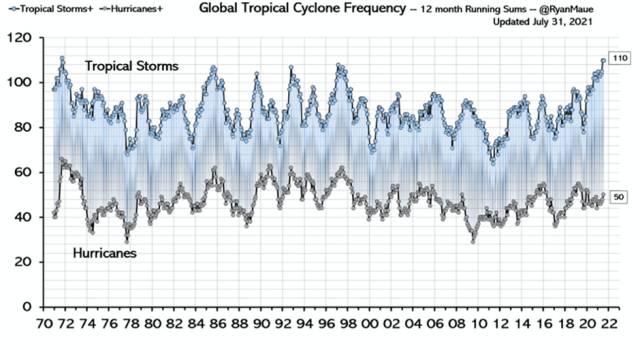
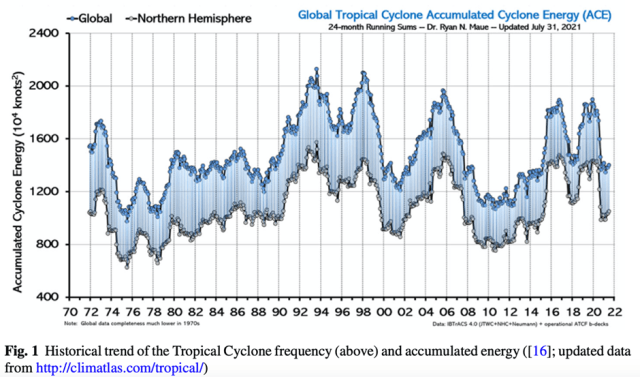
The IPCC has reported that hurricanes have increased strongly in the North Atlantic since 1878, but the scientists note that observations were relatively low during the first decades of the 20th century. After adjusting for lack of observational capacities in the past, there is a nominal upward trend. This trend, they explain, “is not significantly distinguishable from zero”.
The scientists accept that there has been a recent increase in heatwaves, which they attribute to the 1°C rise in global temperatures, although they note global heatwave intensity trends “are not significant”. They also note an increase in global rainfall, although an increase in extreme precipitation is observed only in a limited number of weather stations. Corresponding evidence for increases in flooding remains elusive, they say, “and a long list of studies shows little or no evidence of increased flood magnitudes, with some studies finding more evidence of decreases than increases”. So far as drought is concerned, the scientists note the AR5 finding of the IPCC that “conclusions regarding global drought trends increasing since the 1970s are no longer supported”. Several studies are said to show no increase in the main indices regarding global droughts.
In fact, a slightly warmer and wetter planet and a little extra CO2 seem to have done wonders for global crop yields. For the period 1961-2019, maize, rice, soyabean and wheat global average yields are reported to have grown every year by 3.3%, 2.4%, 2.6% and 3.8% respectively.
Well-researched, fact-driven, credible scientific papers such as this are crucial in the battle to stop green activists and rentiers having a free run to catastrophise every bad weather event in the interest of promoting a command-and-control Net Zero agenda. Attempting to attribute single weather events to humans burning fossil fuels is the product of feverish imaginations and garbage in, garbage out climate models. Rational, evidence-based science should be promoted at every opportunity.
Chris Morrison is the Daily Sceptic’s Environment Editor.
When will Covid reporting start to tell the truth?
By Guy Hatchard | TCW Defending Freedom | September 9, 2022
The writer is in New Zealand.
TWO and a half years into the Covid saga, the public is still faced with an information blackout. The data is very concerning indeed, but no one in parliament or the MSM wants to get in front of it. Instead many are still stuck stoking the fear factor. As Professor Vinay Prasad, an American haematologist-oncologist and health researcher, wrote a few days ago: ‘Legitimising irrational anxiety is bad medicine’.
Early on in our efforts to publicise the dangers of biotechnology medicine, I had an email exchange with Jesse Mulligan, a popular commentator with RNZ Afternoons. His perspective on Covid vaccination was as follows.
December 6, 2021: ‘I feel like anybody aiming to critique such an obviously positive public health measure should begin and end their messaging reminding people that any risks/flaws in the vaccine are minor compared to the horrific impacts of getting Covid . . . I don’t have the time to correspond with you on this at length but, for what it’s worth, if you’re putting people off getting a largely safe vaccine by what you’re writing about it, I think you need to review how you approach writing these messages.’
Mulligan quoted from Ministry of Health directives and had also read some questioning scientific articles, but he could not get past the conclusion that vaccination was an obvious public good and for this reason he declined to have me on his show.
The ‘obvious public good’ narrative has come in for some recent criticism. The BMJ printed an opinion piece in July entitled Time to assume that health research is fraudulent until proven otherwise? Or try this referenced substack article which reports that the negative harm/benefit ratio in the Moderna and Pfizer vaccine trials has been acknowledged in a scientific journal article. In other words there is more harm than benefit.
For me, the central early point of pandemic misinformation has been the underlying assumption that biotech medicine interventions could be safe. There really was little or no evidence to justify such an attitude, in fact, as I have discussed, there was a great deal of published pre-pandemic evidence to justify caution.
Given the central role of DNA in human physiology, altering its function was from the outset potentially catastrophic. We are now facing Covid vaccine outcomes which not only involve serious individual adverse effects, but also potentially affect whole populations into the longer term. These outcomes include:
· Elevated excess all-cause death rates and lowered longevity
· Lowered birth rates and fertility
The evidence for these is patchy because governments are not rushing to publish data, but it is still very convincing. So concerning in fact, that the Israeli government has covered up key data and scientific conclusions.
The latest comprehensive evidence for Covid vaccine-induced excess all-cause mortality can be found in this analysis: Excess mortality in Germany 2020-2022.
It is extraordinary that this perilous new normal has found its way into advertising messages, but not into serious commentary. Today I watched a TV ad for a funeral home which arranges alternative and appropriate funerals for those dying young, whilst a British Heart Foundation appeal featured a young woman collapsing on the football field. It did so to encourage donations.
Sudden deaths among all ages are being normalised in the public’s mind because they really are happening at a rate that dwarfs the past, as insurance data confirms. However here in New Zealand we are still being subjected to puerile government advertising devoid of scientific caution. Like this Ministry of Health promotion which turned up this morning:
GET YOUR SECOND BOOSTER – I’ve had three shots, do I really need another booster? Current evidence shows your protection against severe infection slowly decreases over time – GET YOUR SECOND BOOSTER
No mention of safety, no mention of efficacy, and the term ‘current evidence’ used as if this advert is scientifically up to date and reliable. It isn’t.
Why is it so unfashionable to be concerned about rising death rates and lowered birth rates? You might find a clue in this frightening pre-pandemic article from the government-owned Canadian Broadcasting Corporation Medically assisted deaths could save millions in health care spending: Report. Are higher death rates good news for people with this kind of perspective? We hope not.
We are clearly on a learning curve here. The poor vaccination outcomes were not anticipated, the adverse effects were initially disbelieved on principle and blamed on misinformation.
It is understandable that in the uncertain early days of Covid, people [trusted] the official MoH narrative, but continuing to do so now doesn’t fit the published scientific narrative or the public data. Caution was and is a very scientific strategy, it never deserved bad press.
Those offering advice to the public need to be more discerning if they wish to contribute to the well being and longevity of our society. MSM language has become extreme, and it is increasingly polarising without foundation in science.
There is still a chance for journalists to cover the pandemic with an open mind. It is happening elsewhere. GB News for example has gained one of the largest prime-time news audiences in the UK. Why not initiate a more open public debate? Cooling rhetoric and decreasing polarisation can only lead to better outcomes. Fresh air never harms anyone – it can save lives.
Wisconsin Healthcare Workers Who Had Religious, Medical Exemptions Must Get Novavax COVID Shot or Lose Job
By Suzanne Burdick, Ph.D. | The Defender | September 9, 2022
A Wisconsin hospital this week said it is withdrawing medical and religious exemptions for some employees from the hospital’s COVID-19 vaccine mandate, giving those employees until Sept. 21 to get the Novavax vaccine.
Froedtert & the Medical College of Wisconsin, which operates 11 hospitals and more than 45 health centers and clinics throughout the midwest and employs more than 2,000 physicians, in an email said the Novavax vaccine option “eliminates conflicts” for those who originally declined COVID-19 vaccination for religious or medical reasons.
The U.S. Food and Drug Administration in July granted Emergency Use Authorization of the Novavax COVID-19 vaccine for adults ages 18 and up. While the prior COVID-19 vaccines made by Pfizer, Moderna and Johnson & Johnson used fetal cell lines from unborn fetuses in various stages of development and testing, the Novavax vaccine is made differently and does not use human fetal cell lines.
Froedtert employees who don’t get the first Novavax dose by Sept. 21 will be terminated as Froedtert will consider them to have “voluntarily resigned,” the company said.
The hospital said in a statement:
“Froedtert Health requires staff and providers be fully vaccinated against COVID-19 as a federal requirement that is monitored for compliance. We join many other health systems around southeast Wisconsin and the U.S. that have made vaccination a condition of employment.
“The Novavax vaccination for COVID-19 is now available. This protein-based vaccination option eliminates conflicts for those staff with religious or medical exemptions caused by mRNA-based vaccines and other concerns.
“Since those staff are now eligible for a vaccination that does not conflict with their religious beliefs or medical situation, their exemption will expire. This affects a small percentage of staff with a vaccine exemption. Eligible staff continue to be exempt from a COVID-19 vaccine for religious and medical reasons.
“Froedtert Health respects the right of staff and providers to engage in activity protected by state and federal law.”
A Froedtert employee who spoke anonymously to WISN 12 News on Wednesday said Froedtert’s abrupt demand will have negative repercussions.
“Anyone in healthcare knows we’re very understaffed and overworked right now and this is just going to take away a lot of nurses from the bedside,” she said. “This will affect patient care and safety.”
Although according to Froedtert, as of October 2021 — their most recent count — nearly 99% of their employees had been vaccinated against COVID-19, the employee said she thought about 100 nurses would be affected.
The employee, a Catholic, said the previous vaccines were against her religious beliefs because of the ingredients. However, the Novavax vaccine also goes against her religious beliefs, she said.
“Now that we’re two, almost three years into this [COVID-19 pandemic] and we know more, we should be able to make our own educated decision,” she said.
She added:
“It’s my body, my temple. God is within us. If we’re uncomfortable, or not sure about something, then we shouldn’t do it.”
The employee said she’s presently unsure what she will do.
“I carry the health insurance for our family. I have a week to decide if I feel comfortable taking this vaccine otherwise I honestly don’t know. I don’t know if any other healthcare facilities in this area even take exemptions,” she said.
Froedtert officials said their recent exemption withdrawal complies with federal regulations that mandate all employees must be vaccinated against COVID-19 or have legitimate religious or medical exemptions.
Mark Goldstein, an employment lawyer, told WISN 12 News employees affected by the mandate could “attempt to recast their religious exemption as a more generalized claim.”
“Quite frankly,” he added, “some of it depends on how strident they are in that regard.”
The hospital’s requirement is that employees be fully vaccinated against COVID-19, but not that they have to get the new Omicron-specific booster shot made by Pfizer and Moderna.
Novavax pushed on unvaccinated despite safety concerns
As The Defender reported in late July when the Centers for Disease Control and Prevention (CDC) recommended the Novavax COVID-19 vaccine for adults age 18 and up, Operation Warp Speed in 2020 awarded Novavax — which like Moderna, had never brought a product to market before COVID-19 — a secret contract worth $1.6 billion (now being reported as $1.8 billion).
It was one of the largest taxpayer handouts channeled through Operation Warp Speed.
The media characterized the Novavax injection as a “game changer” in comparison to the mRNA and adenovirus-vectored gene therapy shots, claiming it should be “reassuring to those who are hesitant.”
In fact, according to the CDC’s advisors, the unvaccinated represent the “primary target population for Novavax.”
Some media outlets claimed Novavax — made with recombinant moth-cell-based nanoparticle technology, the problematic surfactant polysorbate 80 and a never-before-approved nanoparticulate adjuvant called Matrix-M — is “free of side effects.”
However, the day after the FDA issued its Novavax authorization, the European Medicines Agency (EMA) updated its product information for the Novavax shot to disclose “new” side effects.
The EMA’s list of side effects included “severe allergic reaction [anaphylaxis] and unusual or decreased feeling in the skin” (called paresthesia and hypoesthesia, respectively).
In addition, the EMA said it would assess myocarditis and pericarditis as Novavax side effects — safety signals that also were on display in the FDA’s briefing document on Novavax.
And in clinical trials, older adults who received the Novavax vaccine experienced an increased incidence of hypertension compared to those in the placebo group.
Not as ‘traditional’ as portrayed
The Novavax vaccine relies on a protein-based technology used for decades, leading some media outlets to portray it as a “traditional” vaccine compared with other COVID-19 vaccines that use newer technologies.
But according to Dr. Meryl Nass, an internist with a special interest in vaccine-induced illnesses, chronic fatigue syndrome and toxicology, the media’s portrayal of Novavax as a more traditional vaccine is not accurate.
Nass, a member of the Children’s Health Defense (CHD) scientific advisory committee, pointed out that the Novavax shot contains a novel adjuvant, Matrix-M, “so it is not really an old-fashioned shot.”
Nass raised safety concerns specific to the adjuvant, while others voiced concerns about Novavax being linked to heart inflammation and blood clots, and the fact that the vaccine was designed for use against the original Wuhan strain of SARS-CoV-2 — not the Omicron variants that are dominant today.
Adjuvant used in Novavax linked to autoimmune disease
Because Novavax is a protein subunit vaccine, it uses just the spike protein as the antigen rather than the whole pathogen (an inactivated or attenuated virus). Using the whole pathogen would expose the host to the virus’ entire protein coat instead of just one protein.
Protein subunit vaccines are often less immunogenic (less likely to provoke the immune system) than vaccines that use whole pathogens as the antigen, and may not generate a strong enough immune response.
That’s why they require the use of an adjuvant — in this case, Matrix-M — in addition to the antigen to get a stronger immune response.
However, few adjuvants are both potent and non-toxic enough for clinical use.
The proposed primary series for Novavax is two intramuscular injections 21 days apart at the dose level of 5 µg of the recombinant spike protein and 50 µg of the Matrix-M adjuvant.
Matrix-M, originally called QS-21, was one of the saponins derived from Quillaja saponaria, which is the soap bark tree native to Chile.
Some reports point out that the Matrix-M adjuvant — unlike the polyethylene glycol (PEG) lipid used in mRNA vaccines — is not linked to anaphylaxis (a severe allergic reaction), making it more attractive to people who are allergic to PEG.
But according to Nass, while it’s true that Matrix-M — which is not found in any other vaccines in the U.S. — isn’t linked to anaphylaxis, it is linked to autoimmune diseases.
“While touted as a replacement for the PEG lipid found in the mRNA vaccine, Matrix-M is less likely to cause anaphylaxis but more likely to cause autoimmune diseases,” Nass said.
Nass voiced other safety concerns about Novavax technology, including the use of moth cells.
According to the University of Nebraska Medical Center, where Novavax Phase 3 clinical trials were conducted, the Novavax vaccine uses moth cells to create a nanotechnology version of the COVID-19 spike protein.
Nass said insect cells can be used to grow proteins rapidly. “There is one flu vaccine made the same way: Flublok,” Nass said. Flublok is one of two egg-free flu vaccines licensed for use in the U.S.
“How many insect and viral proteins or other molecules are being injected into you when you get the Novavax vaccine — which is a function of how purified the vaccine is — is unknown,” Nass said.
Novavax still uses the spike protein
The SARS-CoV-2 virus encodes 29 proteins, but Novavax — like Pfizer, Moderna and Johnson & Johnson — chose to target only the spike protein.
As previously reported in The Defender, it is not known if the spike protein itself is safe.
“We have known for a long time that the spike protein is a pathogenic protein,” said Byram Bridle, Ph.D., associate professor of viral immunology at the University of Guelph, Ontario. “It is a toxin. It can cause damage to our body if it gets into circulation.”
According to Brian Hooker, Ph.D., P.E., CHD’s chief scientific officer, “If you wanted to pick the most toxic protein, you know what represents the highest virulence, the highest amount of damage on the COVID-19 virus? You would pick the spike protein.”
The spike protein “has been consistently shown to create clotting issues in the blood,” Hooker said.
Suzanne Burdick, Ph.D., is a reporter and researcher for The Defender based in Fairfield, Iowa. She holds a Ph.D. in Communication Studies from the University of Texas at Austin (2021), and a master’s degree in communication and leadership from Gonzaga University (2015). Her scholarship has been published in Health Communication.
This article was originally published by The Defender — Children’s Health Defense’s News & Views Website under Creative Commons license CC BY-NC-ND 4.0. Please consider subscribing to The Defender or donating to Children’s Health Defense.
400 Doctors and Professionals Declare International Medical Crisis Due to Covid Vaccine Injuries and Deaths
BY WILL JONES | THE DAILY SCEPTIC | SEPTEMBER 10, 2022
Over 400 doctors, scientists and professionals from more than 34 countries this morning declared an international medical crisis due to “diseases and death associated with the ‘COVID-19 vaccines’”.
Launched at a press conference on Saturday, September 10th, the declaration states: “We are currently witnessing an excess in mortality in those countries where the majority of the population has received the so-called ‘COVID-19 vaccines’. To date, this excess mortality has neither been sufficiently investigated nor studied by national and international health institutions.”
It continues:
The large number of sudden deaths in previously healthy young people who were inoculated with these ‘vaccines’ is particularly worrying, as is the high incidence of miscarriages and perinatal deaths which have not been investigated.
A large number of adverse side effects, including hospitalisations, permanent disabilities and deaths related to the so-called ‘COVID-19 vaccines’, have been reported officially.
The registered number has no precedent in world vaccination history.
The declaration, which originates among concerned medics and professionals in India, makes eight “urgent” demands, including an immediate stop to the vaccinations and investigation of all deaths in previously healthy people.
Read the full text below, and if you are a doctor, scientist or other professional, do consider signing.
DECLARATION OF INTERNATIONAL MEDICAL CRISIS DUE TO THE DISEASES AND DEATHS CO-RELATED TO THE ‘COVID-19 VACCINES’
We, the medical doctors and scientists from all over the world, declare that there is an international medical crisis due to the diseases and deaths co-related to the administration of products known as ‘COVID-19 vaccines’.
We are currently witnessing an excess in mortality in those countries where the majority of the population has received the so-called ‘COVID-19 vaccines’. To date, this excess mortality has neither been sufficiently investigated nor studied by national and international health institutions.
The large number of sudden deaths in previously healthy young people who were inoculated with these ‘vaccines’, is particularly worrying, as is the high incidence of miscarriages and perinatal deaths which have not been investigated.
A large number of adverse side effects, including hospitalisations, permanent disabilities and deaths related to the so-called ‘COVID-19 vaccines’, have been reported officially.
The registered number has no precedent in world vaccination history.
Examining the reports on CDC’s VAERS, the U.K.’s Yellow Card System, the Australian Adverse Event Monitoring System, Europe’s EudraVigilance System and the WHO’s VigiAccess Database, to date there have been more than 11 million reports of adverse effects and more than 70,000 deaths co-related to the inoculation of the products known as ‘Covid vaccines’.
We know that these numbers just about represent between 1% and 10% of all real events.
Therefore, we consider that we are facing a serious international medical crisis, which must be accepted and treated as critical by all states, health institutions and medical personnel worldwide.
Therefore, the following measures must be undertaken on an urgent basis:
- A worldwide ‘stop’ to the national inoculation campaigns with the products known as ‘COVID-19 vaccines’.
- Investigation of all sudden deaths of people who were healthy previous to the inoculation.
- Implementation of early detection programmes of cardiovascular events which could lead to sudden deaths with analysis such as D-dimer and Troponin, in all those that were inoculated with the products known as ‘COVID-19 vaccines’, as well as the early detection of serious tumours.
- Implementation of research and treatment programmes for victims of adverse effects after receiving the so-called ‘COVID-19 vaccine’.
- Undertaking analyses of the composition of vials of Pfizer, Moderna, Astra Zeneca, Janssen, Sinovac, Sputnik V and any other product known as ‘COVID-19 vaccines’,
by independent research groups with no affiliation to pharmaceutical companies, nor any conflict of interest. - Studies to be conducted on the interactions between the different components of the so-called ‘COVID-19 vaccines’ and their molecular, cellular and biological effects.
- Implementation of psychological help and compensation programmes for any person that has developed a disease or disability as a consequence of the so-called ‘COVID-19 vaccines’.
- Implementation and promotion of psychological help and compensation programmes for the family members of any person who died as a result of having been inoculated with the product known as ‘COVID-19 vaccines’.
Consequently we declare that we find ourselves in an unprecedented international medical crisis in the history of medicine, due to the large number of diseases and deaths associated with the ‘vaccines against COVID-19’. Therefore, we demand that the regulatory agencies that oversee drug safety as well as the health institutions in all countries, together with the international institutions such as the WHO, PHO, EMA, FDA, UK-MHRA and NIH respond to this declaration and act in accordance with the eight measures demanded in this manifesto.
This Declaration is a joint initiative of several professionals who have been fighting for this cause. We call on all doctors, scientists and professionals to endorse this statement in order to put pressure on the entities involved and promote a more transparent health policy.
MEDICAL FASCISM IN THE LANCET
By David Bell and Domini Gordon | PANDA | August 28, 2022
Medical ethics is about protecting society from medical malfeasance and the self-interest of the humans whom we trust to manage health. It is therefore disturbing when prominent people, in a prominent journal, tear up the concept of medical ethics and human rights norms. It is worse when they ignore broad swathes of evidence, and misrepresent their own sources to do so.
On July 8th 2022, The Lancet published a ‘Viewpoint’ article online: “Effectiveness of vaccination mandates in improving uptake of COVID-19 vaccines in the USA.” The article, which acknowledges the controversial nature of vaccine mandates, primarily concludes that coercing people to take a medical product, and reducing options for refusal, increases product uptake.
It further concludes that the best way to implement such mandates is for employers and educational institutions to threaten job security and the right to education.
The use of coercion goes against the established ethics and morals of Public Health, and could be argued to be anti-health. In this case, the article justifies it by stating that “the current evidence regarding the safety of COVID-19 vaccines in adults is sufficient to support mandates.” However, it offers scant evidence to back this assertion, and ignores all evidence to the contrary. They apparently consider the ability to work and support a family, or gain formal education, as something that is to be granted or taken away, not a human right.
The Lancet was once a credible journal with a rigorous policy of peer review. However, in this article it appears to have dropped its former standards, promoting medical fascism (coercion, threat and division to achieve compliance with authority) without insisting on a rigorous evidence base to justify such an approach. This suggests an attempt to normalize such approaches in mainstream public health.
Past experience has shown us where fascism behind a façade of public health can lead. The sterilization campaigns aimed at coloured and low-income populations of the US Eugenicist era, and the extensions of similar programs under Nazism in 1930s and 1940s Europe, relied heavily on the normalization of such approaches.
Leading public health voices from Johns Hopkins School of Public Health and other institutions championed a public health approach of sanitizing populations rather than environments, encouraging the idea of a tiered society where health ‘experts’ determine the rights and medical management of those deemed less worthy.
Avoiding the discomfort of evidence
The authors of this Lancet paper, ranging from academics and medical consultants to the daughter of a prominent politician, attempt to rewrite human rights in medicine as if precedent never existed. Their argument for coercion in mass vaccination recognizes that ‘vaccine mandates,’ whether issued by governments, employers or schools, all involve a loss of rights. No serious attempt is made to provide a medical justification for mass vaccination with a non-transmission-blocking vaccine.
The paper focuses on the premise that coercion, commonly considered a form of force, makes humans do things they would not otherwise do. Banning fellow humans from making their own health choices on pain of loss of normal participation in society has an impact on increasing vaccine uptake. This is hardly a revelation to any thinking human, but clearly important enough to justify publication in The Lancet.
The article links to evidence of vaccine mandates used for state school entry that show higher compliance when the right of religious and personal belief exemption is removed, or where onerous requirements for exemptions are put in place. Leaving ethical questions aside, the obvious lack of similarity between the authors’ predicate childhood vaccinations that block transmission and COVID-19 vaccines that have minimal impact on transmission, and may even promote it, is ignored. The one mandated adult vaccine predicate referenced in the article, the influenza vaccine, provides only a 2.5% reduction in pneumonia ‘when the (mandated) vaccine was well matched to circulating strains’ in the reference quoted.
When raising the sacking of non-vaccinated workers, the authors seem comfortable with the approach but coy in admitting its consequences. Their admission that “a few large US employers have terminated hundreds of workers for non-compliance references an article in Money magazine which actually paints a bleaker picture, characterizing it as a ‘great resignation.’
The authors will also have been aware of mass layoffs by large employers such as New York City (over 9,000 sacked or placed on leave), the US Department of Defense (DoD, which sacked 3,400), Kaiser Permanente (laid off 2,200), and the tens of thousands of staff lost from the UK care-home sector . Extrapolated across countries and society to actually provide credible data may have been too uncomfortable for the authors and Lancet editors.
High efficacy and safety are an obvious (though on their own, insufficient) prerequisite for any mandated product. This entire area of safety is dealt with by stating; “The current evidence on the safety of COVID-19 vaccines in adults is sufficient to support mandates,” supported by a single study comparing vaccinated individuals 1-3 weeks and 3-6 weeks post-vaccination, revealing low levels of myocardial infarction, appendicitis and stroke.
The claim that “widespread administration in adults has quickly generated a large evidence base supporting the vaccines’ safety, including evidence from active surveillance studies” suggests that both the authors and The Lancet are unaware of the VAERS and Eudravigilance databases set up for exactly this purpose. No mention is made of growing data on myocarditis, menstrual irregularities, or the excess all-cause mortality and severe outcomes in vaccinated groups in the Pfizer randomised control trials on which the FDA emergency registration was based. Were The Lancet’s reviewers unaware of these sources?
The sole reference to vaccine efficacy discusses COVID-19 ventilated patient outcomes, It ignores the period to 14 days post-previous dose that Pfizer acknowledges can be associated with immune suppression. Fenton et al. have noted that classing a vaccinated person as unvaccinated in the first 14 days post-injection has profound impacts on vaccine effectiveness data.
Ignoring the awkwardness of reality
Post-infection immunity in the unvaccinated is a threat to arguments for mandates. The authors disingenuously state that “evidence suggests that the immunity produced by natural infection varies by individual, and that people with previous infection benefit from vaccination. New variants further undercut the case for adequacy of previous infection.
Two references are used here: one from a study in Qatar and the other a study from Kentucky. The Qatar study finds that “the protection of previous infection against hospitalization or death caused by reinfection appeared to be robust, regardless of variant,” whilst the Kentucky study found Covid reinfection was reduced by vaccination over a 2-month period in the months soon after vaccination, prior to the waning and then reversal of this protection as demonstrated in studies of longer duration elsewhere.
The vast breadth of evidence on relative effectiveness of post-infection immunity is ignored. Either the authors failed to read their references and are unaware of waning and of the vast literature on post-infection immunity, or they do not consider demonstration of efficacy important for coerced medical treatments.
In a previous era, or in a previously credible medical journal, an argument for coercion to support a medical procedure would have required very high standards of evidence of efficacy and safety. It is arguing for the abrogation of fundamental principles such as informed consent that are at the core of modern medical ethics. Failure to address well-known contrary data should prevent an article from even reaching the peer-review stage.
Degrading public health degrades society
We are left with a paper stating that coercion is a good path to increase compliance for a product that does not reduce community infection risk, and has potentially serious side effects. Ignoring both of these aspects of COVID-19 vaccines is a poor approach to justifying mass vaccination. The sole nod to any human rights concern – “Some objectors argue mandates represent undue encroachment on individual liberty” – is an interesting way to characterize removal of the right to income, education and the ability to socialize with others.
Although all these rights are recognized under the Universal Declaration for Human Rights, the authors and The Lancet consider them insufficiently serious to dwell upon.
Public health has been down this road before. We have seen the path society takes when basic public health principles are subverted to achieve an aim that some perceive as ‘good.’ We have also seen how most health professionals will comply, however horrific the actions involved. There is no reason to believe that this round of medical fascism will end differently.
We rely on medical journals such as The Lancet to apply at least the same standards to the purveyors of such doctrines as they do to others and demand a rational and honest evidence base. Anything less would raise legitimate questions as to the role the journal is taking in promoting these doctrines, and their place in a free, evidence-based and rights-respecting society.
David Bell, Senior Scholar at Brownstone Institute, is a public health physician and biotech consultant in global health. He is the former Program Head for malaria and febrile diseases at the Foundation for Innovative New Diagnostics (FIND) in Geneva, Switzerland.
Domini Gordon is Open Science and Open Society Coordinator at Panda.
Featured Video

HE SAVED LIVES. NOW HE FACES PRISON.
or go to
Aletho News Archives – Video-Images
From the Archives
NATO Sanctions and the Coming Global Diesel Fuel Disaster
By F. William Engdahl – New Eastern Outlook – 11.04.2022
Amid the ongoing global inflation crisis, NATO heads of state and mainstream media repeat a mantra that high energy prices are a direct result of Putin’s actions in Ukraine since end of February. The reality is that it is the western sanctions that are responsible. Those sanctions including cutting SWIFT interbank access for key Russian banks and some of the most severe sanctions ever imposed, are hardly having an impact on the military actions in Ukraine. What many overlook is the fact that they are increasingly impacting the economies of the West, especially the EU and USA. A closer look at the state of the global supply of diesel fuel is alarming. But Western sanctions planners at the US Treasury and the EU know fully well what they are doing. And it bodes ill for the world economy.
While most of us rarely think about diesel fuel as anything other than a pollutant, in fact it is essential to the entire world economy in a way few energy sources are. The director general of Fuels Europe, part of the European Petroleum Refiners Association, stated recently, “… there is a clear link between diesel and GDP, because almost everything that goes into and out of a factory goes using diesel.” … continue
Blog Roll
 Aletho News
- Trita Parsi: Middle East Unraveling — Are We on the Path to World War?
- Iran FM meets with US envoy on UN meeting’s sidelines at American side’s insistence: Report
- Qatar PM calls for Gulf security framework with Iran, says war must be ‘wake-up call’
- China condemns US extortion of Iranian airlines, rejects Washington’s ‘illegal’ sanctions threats
- Italy to move military personnel from Taif base after missile strike
- Finland’s Stubb tells European leaders to calm down
- Defeating Russia on battlefield impossible – Fico
- Finland’s Gender Clinic Reversal
- Massachusetts Wants Mental Health Visits, Why Does Government Use ‘Health’ to Enter Our Homes & Families?
- US lawmaker admits American people footing bill for Trump’s failed aggression against Iran
- If Americans Knew
- Sanctions are collective punishment: immoral and self-defeating
- Phosphorus Munitions Fired by Israel Burn Groves, Orchards in Southern Lebanon
- Israel Carries Out New Ceasefire Violations Across Gaza
- AI – Emphasis on the ‘I’: Israel Is Funding AI Chatbot Propaganda
- Israel Blocking Hundreds of Wheelchairs for Injured Children From Entering Gaza
- Israel Is Expanding and Upgrading Compounds for Palestinian Militias in Gaza
- The Palestinian-American Residents of This West Bank Town Are Wondering: Where Is Trump?
- Gaza desperately needs tents, wheelchairs, fuel… and everything else (Israel blocks it all) – Daily Update
- Israeli Attacks in Gaza Kill at Least Seven Palestinians Over Three Days, including Woman and Child
- Trump’s militarization of Washington DC as he pursues Israel’s war against Iran
- No Tricks Zone
- 2025 Nature Paper Claiming Worsening Global Drought Gets RETRACTED …Heavily Flawed
- New Study: ‘Global Drought Shows No Detectable Recent Acceleration Under Climate Warming’
- Economic Masterminds: German Socialists Suggest Taxing Productivity Gains Stemming From Using AI
- The South China Sea Has Not Been Cooperating With The Climate Change Narrative
- Energy Crisis: Germany Enters Heating Season With Historically Low Gas Reserve Fill Levels
- New Study: The Antarctic Ice Sheet Gained Mass From 2020-2024 Due To Staggering Snow And Ice Accumulation
- Study: Ocean Heating Rates From Thousands Of Years Ago ‘Dwarf’ Modern Ocean Heating Rates
- Climate Extremists Target, Attack Large-Scale Power Grid Infrastructure In Germany!
- New Study: Antarctic Ice Melt Has Contributed Less Than 1 Centimeter To Sea Level Rise In The Last 30 Years
- Fear Of Debate: Alarmist German Climate Scientist Calls On Mainstream Media To Discredit Skeptic Voices

