The Polar-Bear-Gate Saga: How a picture is worth a thousand lies – Paul Nicklen and Michael Mann vs Susan Crockford
By Jim Steele | Watts Up With That? | December 16, 2017
What oddly seems to surprise so many people, reality can quickly disagree with the hypotheses and speculative models of scientists. The polar bear is a rich case in point. In 2008, the polar bear was listed as threatened under the Endangered Species Act as a result of the Center for Biological Diversity’s (CBD) petition. Due to hypotheses regards future effects of increasing CO2 on sea ice and polar bear health, CBD argued polar bears were endangered. However then Interior Secretary Kempthorne made it clear that “the ESA will not be used as a tool for trying to regulate the greenhouse gas emissions blamed for creating climate change.” But as seen in other memos and petitions, such as for the bearded seals, the CBD ultimately wants to use the ESA as a tool to regulate CO2.
So the CBD stepped up their demands and petitioned the Obama administration to list the bears as endangered. Climate scientists Ken Caldeira and Michael Mann co-authored a 2010 letter to Interior Secretary Salazar supporting CBD efforts. They warned “sea ice has been projected to disappear in the 2030s or before” and lost sea ice was both a future and “current threat to this important habitat of the polar bear.” The Polar Bear Specialist Group (PBSG) led by researchers like Andrew Derocher, Steve Amstrup and Ian Stirling warned the world that “two thirds of the world’s bears will be lost by mid-century due to climate change”. The PBSG published a status table for all the polar bear sub-populations showing in the best studied populations, 8 were declining.
However, since 2010 those predictions have been unraveling. All the evidence now reveals polar bears are thriving and increasing, and the PBSG’s recent status tables show just that. Research by Chambellant and Stirling determined it was heavy springtime ice that was most detrimental to bears and their main prey, the ringed seal. The loss of Arctic summer sea ice was happening faster than CO2 driven models had predicted, suggesting flawed models. Research revealed that in response to the natural Arctic Oscillation, thick sea ice had been blown into the warmer Atlantic due to a directional shift in freezing winds. Further loss of Arctic sea ice has recently been shown to be caused by cycles of intruding waters from the Pacific and the Atlantic resulting in heat that gets stored in the subsurface of the Arctic Ocean, dynamics that have not been accurately incorporated into global climate models. Accordingly, the loss of sea ice has not accelerated. Instead the loss has slowed considerably.
Skeptics argued such evidence challenges prevailing hypotheses about the polar bears’ demise, and question the contention that greenhouse gases are the primary cause of sea ice fluctuations. Driven by the hubris of scientists like Michael Mann whose careers are totally invested in the “dire predictions” of rising CO2, the normal scientific process of challenging a hypothesis was framed as an “attack on science”.
Again in 2010, in the paper Climate Change and the Integrity of Science Peter Gleick wrote, “We are deeply disturbed by the recent escalation of political assaults on scientists in general and on climate scientists in particular. Accompanying his paper (below) was a photo-shopped picture of a polar bear stranded on a shrinking piece of ice. A deception that skeptics quickly pointed out.

So the following correction was placed in the paper’s online version.
“Due to an editorial error, the original image associated with this Letter was not a photograph, but a collage. The image was selected by the editors [of Science, the journal of the American Association for the Advancement of Science], and it was a mistake to have used it. The original image has been replaced in the online HTML and PDF versions of the article with an unaltered photograph from National Geographic.”
That replacement picture (below) was from National Geographic photographer Paul Nicklin, who would become infamous for specializing in dead and skinny polar bear photos. If Gleick or his editors were pulling photos from an archive (National Geographic ?) of photographs, then the question arises if the fake collage was also the work of the same photographer. And if so, for what purpose were they creating such a dishonest photo? The timing of the article and fake photo also raised suspicions from skeptics as it coincided with the Center for Biological Diversity’s campaign to up-list the polar bear from threatened to endangered,

Despite having “carelessly” used a fake photo, Gleick was anointed the Chairman of the new task force on “scientific ethics and integrity” for the American Geophysical Union in 2011. Leading by example, in 2012 Gleick was outed in a flagrant attempt to anonymously smear the Heartland Institute’s climate skepticism by disseminating documents dishonestly obtained, including a damning but forged memo. Quickly identified by internet skeptics, Gleick finally confessed. Although the forged document was only being disseminated by Gleick, he denied any hand in forgery, and there was not enough evidence to convict him of forgery. In a KQED interview, Michael Mann, likely motivated by self-protection, downplayed Gleick’s underhanded actions as “poor judgement”. Mann then argued the release of the climate-gate emails, emails that had exposed Mann’s own underhanded methods, was a more dastardly deed. To this day, it is still unknown if the release of climate gate emails were the work of a whistle-blower or a hacker.
However, consistent with Mann’s efforts to promote polar bears as an icon of catastrophic global warming, Mann expressed no concern about Gleick’s fake polar bear picture. Indeed Mann was actively trying to pull on heart strings by mewing in the CBD release, “When I ventured up to Hudson Bay in mid-November and saw the undernourished polar bears with their cubs, sitting around at the shore of the Hudson Bay, waiting for the then month-overdue sea ice to arrive so they could begin hunting for food, it suddenly came home for me. For the first time in my life, I actually saw climate change unfolding before my eyes. It was a sobering moment, and one I’ll never forget.” In contrast to such storytelling, the unpublished research data from Stirling and Lunn, determined polar bear’s Body Condition Index for Hudson Bay bears had been improving since 1998 (in Landscapes and Cycles, p. 217). Improving body condition was also consistent with the increasing number of Hudson Bay bears estimated in subsequent surveys.
Susan Crockford runs the website polarbearscience.com, that aggregates the most up-to-date, peer-reviewed science and media releases by polar bear researchers. For example, Crockford reported the latest survey showing a healthy rebounding Western Hudson Bay population, months before the Polar Bear Specialist Group (PBSG) researchers publicized the increase. The PBSG had incorrectly predicted a dramatic decline in Hudson Bay bears, so their tardiness to expose their own shortcomings is understandable. Crockford also reported the lack of consensus among polar bear researchers. While Enviornment Canada agreed with the latest survey that estimated a healthy 1,030 Western Hudson Bay bears, PBSG alarmist Andrew Derocher was actively pushing a much lower estimate of 800 bears to the media and suggesting the bears were doomed. This too is understandable as Derocher was invested in his earlier predictions that “by the middle of this century, two-thirds of the polar bears will be gone from their current populations”
Nonetheless despite multiple surveys suggesting polar bear abundance was and is increasing, others tried to deny the evidence and suggest bears were starving and still on the brink of extinction. In 2015, photos by Kerstin Langenberger and once again by Paul Nicklin were pumped on social media, suggesting bears were suffering from a climate catastrophe. Who were these photographers?

The dying bear above was put on Facebook by Kerstin Langenberger whom internet articles referred to as just a German photographer. But a little digging revealed she is a Greenpeace activist, which is consistent with her catastrophic narratives that accompanied her photo and contradicted our best science. She stated, “With the pack ice retreating further and further north every year, they tend to be stuck on land where there’s not much food,” and “many times I have seen horribly thin bears, and those were exclusively females – like this one here” and “Only once I have seen a bear getting a big fat ‘5,’ but several times I have seen dead bears and bears like this one: a mere ‘1’ on the scale, doomed to death.” [polar bears’ body condition is often rated from 1(dangerously thin) to 5 (fat)].
However contradicting Langenberger’s narrative, Norwegian Polar Institute researcher Kit Kovacs stated there’s reason to question claims that the number of animals experiencing such hardships is increasing. Our monitoring work indicates that (on-average) bears in the Svalbard population have NOT declined in condition over the last two decades – based on male body masses and fat levels”. Similarly, in the South Beaufort Sea population, female body condition had improved despite reduced summer ice.

Also in 2015, Nicklin posted his photo of a dead bear that went viral. Journalist Andrew Freedman promoted the picture in Mashable writing, “Global warming may have led to the death of this polar bear.” Presenting a thin veneer of objectivity, he quotes polar bear researcher Ian Stirling who suggested that Nicklen’s photo shows a bear that most likely, but not certainly, died as a result of starvation related to sea ice melt. But Stirling’s remarks must be taken with a grain of salt as there is absolutely no evidence to support why the bear died. Furthermore, Stirling has appeared slightly schizophrenic lately as has been detailed. For example despite his research showing cycles of heavy spring ice had been most detrimental to seals and bears, Stirling and Derocher’s review of polar bear “science” used the very same research to falsely imply that less summer ice was the problem.
In contrast to those 2015 photos, Crockford’s website was one of the few places where scientific reports of a healthy bear population could be found. Contradicting Langenberger and Nicklin’s story-telling of dead bears strewn across Svalbard due to climate change, Crockford posted links to actual researchers from the Norwegian Polar Institute who reported fat bears in Svalbard.
Researchers were reporting:
“The polar bears on Svalbard is round and full, thanks to a good [ice year] and good hunting opportunities.” And “… Polar bears were fat, many looked like pigs”, says polar researcher at the Norwegian Polar Institute, Jon Aars to the High North News. Furthermore the Svalbard bears are part of the Barent Sea population and in 2017 Crockford relayed the most recent survey data showing Barent Sea Bears have been increasing. But such facts don’t have the emotional appeal as Nicklin’s fanciful pictorial story telling.
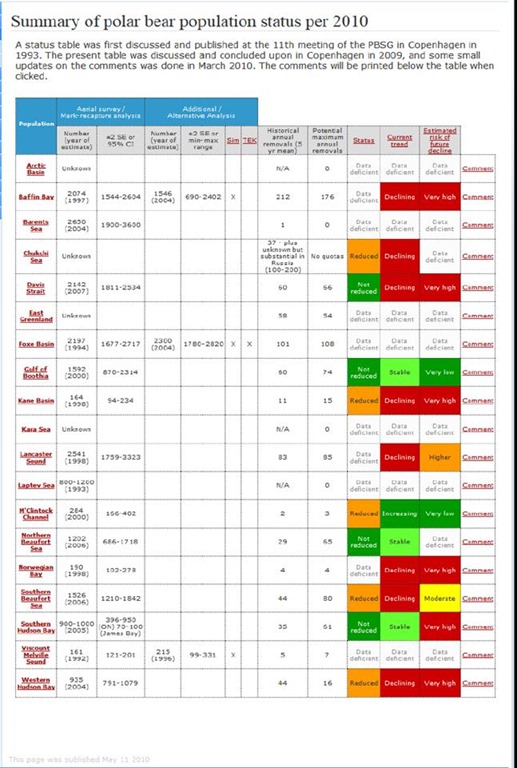
The Polar Bear Specialist Group (PBSG) had created a status table in 2009 to illustrate the trends of each polar bear population. Above is their 2010 version. The trends are boldly shown in red for declining and green for stable or increasing populations. Eight populations were believed to be declining of which 6 were considered very likely to decline further. Only 3 populations were considered stable and only 1 was increasing. These declining PBSG estimates also went viral, and websites such as the one run by psychologist John Cook, who is now part of the well-funded Center for Climate Change Communication, posted an article concluding, “Current analysis of subpopulations where data is sufficient clearly shows that those subpopulations are mainly in decline” and thus support the ESA listing of polar bears as threatened. In contrast in Landscapes and Cycles I documented how bear populations since 2010 were definitely increasing based on latest research. That analysis has been confirmed while earlier PBSG hype of declining populations and speculation of coming extirpations have not survived the test of time.
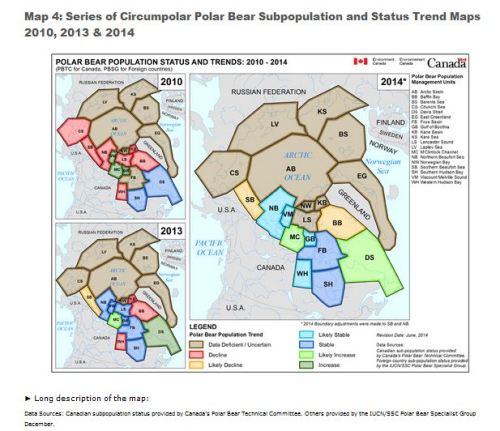
Fortunately Susan Crockford’s Polar Bear Science blog has continuously discussed population trends as reported by bear experts plus PBSG’s status updates. While the PBSG removes their old tables, Crockford’s website serves as an archive that allows the public to readily witness how the bears have been increasing. For example the 2014 table (below) revealed the good news that only 3 of the past 8 populations were still declining, one was still increasing, and the stable populatons had doubled to 6.
Oddly in 2017 the PBSG eliminated the trends from their population table. The most likely reason for this omission would be that none of the bear populations are currently declining. Every population would be green or data deficient. Despite rising CO2 and reduced summer sea ice, polar bears are doing quite well and that contradicted the their predictions.
Of the 3 previously declining populations listed in their 2014 status report, the Baffin Bay population has now increased from 1,546 in 2004 to 2,826 in the most recent survey. The Kane Basin bears, that suffer from heavy ice, were estimated at 167 in 1997 but rose to 357 in 2014. The South Beaufort Sea population estimation remained unchanged but this population has been heavily criticized for poor analyses of mark and recatpure data.


In the face of rapid increases in the Baffin Bay bear population, a social media splash of Nicklin’s starving bear on Baffin Island appears to be another orchestrated attempt to resuscitate the failing claim that climate change is killing bears. National Geographic who sponsored Nicklin reports by “telling the story of one polar bear, Nicklen hopes to convey a larger message about how a warming climate has deadly consequences.” The NY Times pushed the video with similar headlines: Video of Starving Polar Bear ‘Rips Your Heart Out of Your Chest’. The Washington Post hyped the bear as evidence of an environmental disaster with the headlines, ‘We stood there crying’: Emaciated polar bear seen in ‘gut-wrenching’ video and photos. If you searched the internet for an objective scientific examination, oddly no matter how many variations of “starving polar bears” are queried Google’s first link brings up the WWF’s plea for money to save the bears, and perhaps a violation of net neutrality.
Snopes who advertises itself as a fact-checker of truth, rated Nicklin’s starving bear video as “TRUE”. But Snopes’ bias is revealed by its discussion on the photo’s relevance, which pushes catastrophic climate change speculation. Snopes quotes polar bear researcher Steve Amstrup, who has flip flopped on several bear issues over his career and whose “expertise model” has been severely criticized by colleagues in released emails. Amstrup promotes the starving bear photo on his website, again with the obligatory thin veneer of objectivity stating, “we cannot say, from the footage captured here, that this bear’s malnutrition was caused by global warming and its associated sea ice loss”. He then launches his speculative catastrophic message, “The problem is that an ever-warmer future means polar bears will have less and less access to their seal prey, so the rate at which bears die from malnutrition/starvation will increase. So, regardless of the proximate cause of this bear’s condition, this heart-wrenching footage provides us with a warning about the future.” Yet not a word about the survey of Baffin Bay bears robustly increasing from 1,546 in 2004 to 2,826 today.

Amstrup and Mann are facing an embarrassing professional dilemma. With all the polar bear populations increasing or stable, their predictions that two-thirds of the polar bears will be gone by the middle of this century appears destined for utter failure. They had to do something. Otherwise who would trust a doctor whose past diagnoses were absolutely wrong. So, Harvey, Stirling, Amstrup, Mann and a professor of psychobabble Stephan Lewandowsky, banded together as coauthors of the paper Internet Blogs, Polar Bears, and Climate-Change Denial by Proxy that fortuitously gets publicized alongside Nicklin’s starving bear hype.
Their paper acknowledges observations that polar bears have yet to be harmed writing, “Although the effects of warming on some polar-bear subpopulations are not yet documented and other subpopulations are apparently still faring well.” But they then confuse speculation with proven facts by suggesting “the fundamental relationship between polar-bear welfare and sea-ice availability is well established.” Clearly the growing bear populations present an undeniable challenge to any belief in the “requirement” of summer ice.
Their paper argued, “a growing body of scientific research reports the wide array of negative effects of AGW on biodiversity” by citing Parmesan whose bogus claims about the negative effects of climate change on wildlife are well documented. Harvey, Stirling, Amstrup and Mann confuse speculative hypotheses with “fundamental relationship”. Published observations have shown heavy springtime ice is more harmful for seals and bears. Observations by Arrigo determined that reduced ice, whether natural or anthropogenic, has increased phytoplankton productivity and bolstered the Arctic food web, while fishery researchers find that less ice and warmer temperatures increase Arctic cod abundance that is required to sustain the seals that sustain the bears.
Because skeptic websites like Crockford’s polarbearscience.com, Anthony Watts’ WUWT, and many others are the best source for alternative explanations that challenge catastrophic hypotheses, they are denigrated by these supposed objective scientists. As mounting evidence continues to turn against their prior polar bear predictions Harvey, Stirling, Amstrup, Mann and Lewandowsky’s were running low on scientific ammunition. So now they chose to publish a paper, solely aimed at shooting the messengers. They offered no scientific facts about polar bears that contradicted anything Crockford had published. Their arguments were based solely on the fallacy of authority, authorities whose predictions are failing. Their paper is nothing more than a smear campaign hoping to suppress the upwelling call for more debate. Such tactics, tactics that try to obscure any evidence that challenges a failing hypothesis, are the real attacks on the scientific process. That is why Mann has been labeled by some as a disgrace to the profession. And whether or not Nicklin’s latest wretched polar bear photo is part of an orchestrated attempt to resuscitate their failed predictions, the media hype reveals that such photos, taken out of context, are worth a thousand lies.
Jim Steele is Director emeritus Sierra Nevada Field Campus, San Francisco State University and author of Landscapes & Cycles: An Environmentalist’s Journey to Climate Skepticism
Global Temperature Trends Based On Non-Existent Data
By Paul Homewood | Not A Lot Of People Know That | November 28, 2017

https://www.metoffice.gov.uk/hadobs/hadcrut4/diagnostics.html
We are all too familiar with graphs showing how much global temperatures have risen since the 19thC.
The HADCRUT version above is typical, and also very precise, with fairly tight error bars even in the early part of the record.
One wonders where they got the data to work all this out, because it certainly could not have come from thermometers.
All of the major global temperature datasets rely heavily on the Global Historical Climatology Network (GHCN). Yet as the “Overview of the Global Historical Climatology Network-Daily Database”, published by Matthew Menne et al in 2012, rather inconveniently showed, most of the world had little or no temperature data in the 19thC, and even up to 1950.

Density of GHCN-Daily stations with daily maximum and minimum temperature
http://journals.ametsoc.org/doi/full/10.1175/JTECH-D-11-00103.1
Prior to 1950, there were no more than a couple of hundred or so of GHCN stations outside of North America:

There are many competent scientists and statisticians who believe that even now it is not possible to measure the Earth’s average temperature, indeed that it is a meaningless concept.
Whether they are right or not, no serious scientist would claim to know the global temperature a century or more ago.
The big slide in renewable energy tells the real story
No, renewables are not taking over the world anytime soon.
By Bjørn Lomborg | Watts Up With That? | November 26, 2017
We have spent the last two centuries getting off renewables because they were mostly weak, costly and unreliable. Half a century ago, in 1966, the world got 15.6% of its energy from renewables. Today (2016) we still get less of our energy at 13.8%.
With our concern for global warming, we are ramping up the use of renewables. The mainstream reporting lets you believe that renewables are just about to power the entire world. But this is flatly wrong.
The new World Energy Outlook report from the International Energy Agency shows how much renewables will increase over the next quarter century, to 2040. In its New Policies Scenario, which rather optimistically expects all nations to live up to their Paris climate promise, it sees the percentage increase less than 6 percentage points from 13.8% to 19.4%. More realistically, the increase will be 2 percentage points to 15.8%.
Most of the renewables are not solar PV and wind. Today, almost 10 percentage points come from the world’s oldest fuel: wood. Hydropower provides another 2.5 percentage points and all other renewables provide just 1.6 percentage points, of which solar PV and wind provide 0.8 percentage points.
Neither will most renewables in 2040 come from solar PV and wind, as breathless reporting tends to make you believe. 10 percentage points will come from wood. Hydropower provides another 3 percentage points and all other renewables provide 6 percentage points, of which solar PV and wind will (very optimistically) provide 3.7 percentage points.
Oh, and to achieve this 3.7 % of energy from solar PV and wind, you and I and the rest of the world will pay – according to the IEA – a total of $3.6 trillion in subsidies from 2017-2040 to support these uncompetitive energy sources. (Of course, if they were competitive, they wouldn’t need subsidies, and then they will be most welcome.)
Most people tend to think about electricity for renewables, but the world uses plenty of energy that is not electricity (heat, transport, manufacture and industrial processes).
Actually, if the world miraculously could make the *entire* global electricity sector 100% green without emitting a single ton of greenhouse gasses, we would have solved just a third of the total global greenhouse gas problem.
As Al Gore’s climate adviser, Jim Hansen, put it bluntly:
“Suggesting that renewables will let us phase rapidly off fossil fuels in the United States, China, India, or the world as a whole is almost the equivalent of believing in the Easter Bunny and [the] Tooth Fairy.”
We need to get real on renewables. Only if green energy becomes much cheaper – and that requires lots of green R&D – will a renewables transition be possible.

References
Data for graph: “A brief history of energy” by Roger Fouquet, International Handbook of the Economics of Energy 2009; IEA data DOI: 10.1787/enestats-data-en, and World Energy Outlook 2017, unfortunately not free, https://www.iea.org/weo2017/
Hansen quote: http://www.columbia.edu/…/mail…/2011/20110729_BabyLauren.pdf
The world emitted 49Gt CO₂e in 2014, and all electricity/heat came to 15Gt or less than a third, http://cait.wri.org/profile/World.
Deconstructing the Climate Demagoguery of the Wine Country Wildfire Tragedies
By Jim Steele | Landscapes and Cycles | October 25, 2017
As sure as the winds will blow, climate demagogues hijack every human tragedy to amplify fears of rising CO2 concentrations. Despite that fact other critical factors were keys to understanding the devastation of the Wine Country fires, politicians like Hillary Clinton, Al Gore and Governor Jerry Brown were quick to proclaim climate change had made the fires worse than they would have been.
Climate researcher Kevin Trenberth has long tried to undermine the foundations of science by discarding the null hypothesis. Without formal testing whether a tornado, hurricane or wildfire event is within the expectations of natural variability, Trenberth simply asserts every tragedy is made worse by rising CO2. Accordingly, he is interviewed by climate change propagandists after every weather tragedy. In an interview with InsideClimateNews a few months before the Wine Country wildfires Trenberth continued to proselytize his views, “Whatever conditions exists, they’re always exacerbated by climate change. There’s always that heat variable, the increased risk.”
Indeed heat is always a variable, but usually it has nothing to do with CO2. Sadly, due to his extreme beliefs Trenberth often confuses climate with weather.
Similarly, Daniel Swain who authors a good California Weather Blog, unfortunately strays when he tries to interject CO2-climate change into an otherwise good weather analysis. Writing the fires should also be looked at from “the long-term climate context,” he argued the “record-hottest summer” dried out the vegetation exacerbating the fire conditions. But he too failed to separate natural climate and weather events from his hypothesized contributions from CO2. As will become clear from a more detailed analysis, climate change played no part in the wildfire devastation.
The Ignition Component
Fire danger rating systems analyze 1) an ignition component, 2) a fuel component and 3) a spread component to determine how to allocate fire-fighting resources and when to issue public alerts. Natural fires are caused by lightning, and so good weather models can forecast the short-term probability of lightning fires. Lightning fires are also more likely during warm and moist seasons enhancing their window of predictability. Unfortunately, Cal Fire reports 95% of California fires are unpredictably ignited by humans.
Climate alarmists like Dr. Trenberth have blithely suggested global warming is increasing the fire season stating, “In the West, they used to talk about a fire season, the fire season used to be 60 days, then 90 days, and now they think it’s year-round. There’s no pause.” Tragically that uncritical belief in a climate-related extended fire season has been parroted by lay person and scientists alike. But the facts show the observed extended fire season is due to human ignitions. Blaming climate change is fake news!
In a 2017 paper researchers reported that across the USA from 1992 to 2012, “human-caused fire season was three times longer than the lightning-caused fire season and added an average of 40,000 wildfires per year across the United States. Human-started wildfires disproportionally occurred where fuel moisture was higher.” Furthermore “Human-started wildfires were dominant (>80% of ignitions) in over 5.1 million km2, the vast majority of the United States, whereas lightning-started fires were dominant in only 0.7 million km2.”
We can reduce some human caused ignitions. The Wine Country fires were not ignited by lightning but all observations suggest they were started by downed power lines in high winds. A year ago, California legislators introduced a bipartisan bill aimed at reducing wildfire ignitions from powerlines. Although governor Brown hypes the unsubstantiated dangers of climate change, he vetoed the bill which would have promoted real action to prevent well-known human causes of wildfires. Preventing powerline ignition could have prevented the Wine Country tragedy.
The Fuel Component
Fire ecologists will estimate a fire’s potential intensity by calculating the Energy Release Component (ERC), a measure of the potential heat energy per square foot. ERC is a function of the biomass both dead and alive, and the biomass moisture content. As fuels increase and as fuels dry the ERC increases. Live fuels are modeled such that maximum moisture content coincides with the peak growing season, and declines thereafter as the plants go dormant. Moisture content of dead fuels are modeled according to their diameters.
Depending on their diameters, dead fuels will lose moisture as they equilibrate with their dry surroundings at rates that vary from 1 hour to 1000 hours or more. To aid in firefighting management decisions, fuels are categorized into 4 groups as described in Gaining an Understanding of the National Fire Danger Rating System published by the National Wildfire Coordinating Group
1-Hour Time-lag Fuels “consist of herbaceous plants or round wood less than one-quarter inch in diameter. Also included is the uppermost layer of litter on the forest floor.” The ERC of these fuels and thus the fire danger, can change throughout the day. Dead grass as well as twigs and small stems of chaparral shrubs are 1-hour fuels, and those fine fuels sustained the rapid spread of the Wine Country fires. Assertions that recent and past summer droughts or decades of climate change had dried the fuels and exacerbated the Wine Country fire danger have absolutely no scientific basis. The approach of the hot, bone-dry Diablo Winds would have extracted all the possible moisture from the dead grasses and chaparral twigs within hours, regardless of past temperatures. Trenberth and Swain simply confused rapid weather changes with climate change.
The critical “long-term context” they never discussed is that a century of fire suppression allowed destructive levels of fuel loads to develop, increasing the biomass component of the ERC estimate. As populations grew, so did the demand to suppress every small fire that could threaten a building. Natural small fires reduce the fuel load, whereas fire suppression allows fast drying fuels to accumulate. Unfortunately, fire suppression only delays the inevitable while stocking more fuel for a much more intense blaze. Local officials and preservationists have long been aware of this problem, and controlled burns to reduce those fuels were being increasingly prescribed. Tragically, it was too little too late.

Figure 1: A prescribed control burn in Wine Country
10-Hour Time-lag Fuels are “dead fuels consisting of round wood in the size range of one quarter to one inch in diameter and, very roughly, the layer of litter extending from just below the surface to three-quarters of an inch below the surface.” The fuel moisture of these fuels vary from day to day and modeled moisture content is based on length of day, cloud cover or solar radiation, temperature and relative humidity.
100-Hour Time-lag Fuels are “dead fuels consisting of round wood in the size range of 1 to 3 inches in diameter and, very roughly, the forest floor from three quarters of an inch to four inches below the surface.” Moisture content of these fuels are also a function of length of day (as influenced by latitude and calendar date), maximum and minimum temperature and relative humidity, and precipitation duration in the previous 24 hours.
Much of the chaparral shrubs produce twigs and stems in size ranges of the 1-hr, 10-hr and 100-hr fuels. These fuels were most likely the source of burning embers that high winds propelled into the devastated residential areas. Again, these dried out fuels are the result of a natural California summer drought and short term weather conditions such as the bone-dry Diablo Winds that arrive every year.

Figure 2 Moisture content of 3-8 inch diameter fuels from March to December
1000-Hour Time-lag Fuels are “dead fuels consisting of round wood 3 to 8 inches in diameter or the layer of the forest floor more than about four inches below the surface or both”. These larger fuels are more sensitive to drought conditions that existed months earlier, so it could be rightfully argued that a hotter drier July and August made these fuels more flammable in October and exacerbated the fires.
Fire ecologists planning prescribed burns to reduce fuel loads, wait until the 1000-Hr fuels’ moisture content is reduced to 12% or lower. If these larger fuels are dry, it is certain the smaller fuel categories are dry as well, so that all fuels will be highly flammable. As seen in the graph above (Figure 2) 1000-hr fuels reach that critical dryness threshold by July 1st and remain below that threshold until mid-October when the rains begin to return. Contrary to Trenberth’s blather, California’s fire season has always lasted 90+ days. Undoubtedly the unusually hot and dry 2017 summer would have lowered 1000-hr fuel moisture content even further. Nonetheless those fuels become naturally flammable every summer. Furthermore, these larger fuels were less often burned and thus insignificant factors in regard to the fires rapid spread. The rapid spread of the fires was due to consumption of the rapidly drying fuels.
Swain is fond of finding a “record setting” metric to bolster his climate change assertions. As such, he noted the “record-hot summer had dried out vegetation to record levels” and linked to a graph tweeted by John Badoglio showing October ERC values for the past 30 years were at a record high in 2017 (in part because of delayed rains). However, that “record” was also largely irrelevant. The ERC calculation is heavily biased by the greater biomass of the larger 1000-hr fuels that would indeed get drier as the autumn continued without rain. Still those larger fuels were insignificant contributors to the rapidly spreading fire. As seen below (Figure 3), the grasses have been entirely burnt while the larger shrubs and trees, as well as the woody debris near the base of the trees (in the upper left) have not been consumed. In fact many of the trees are still alive. The potential energy estimated by the “record ERC” was only partially realized. It was the fast-drying dead grass and chaparral shrubs that turned potential ERC into meaningful fiery heat.

Figure 3
The Spread Component
“The spread component is defined as “the theoretical ideal rate of spread expressed in feet-per-minute.” Wind speed, slope and fine fuel moisture are key inputs in the calculation of the spread component, thus accounting for a high variability from day-to-day.” Thus, a combination of dry fuels and high winds typically result in fire-watch and red-flag warnings one day and no warnings days later as the winds subside. Forest rangers are well aware that September and October bring the powerful Diablo Winds of Santa Rosa as well as the Santa Anas of southern California, and with those winds comes the highest fire danger.
Cliff Mass is an atmospheric scientist at the University of Washington and author of the superb Cliff Mass Weather and Climate blogs. An October 16th post provides an excellent summary of the metorological conditions that created the fierce winds driving the Wine Country fires. In essence, a strong approaching wind flow (the Diablo Winds) coupled with a thermal inversion near the top of the mountains that border the Santa Rosa valley, accelerated winds into a 60 to 90 mile per hour downslope wind event, a phenomenon known as a mountain wave. Those high winds snapped power line poles and ignited fires. The regional topography also funneled the winds and fire down the valley, taking dead aim at the heart of Santa Rosa. The topography had guided a similar fire in 1964, the Hanley fire, which was started by a carelessly discarded cigarette. Unfortunately without much concern, most of the burnt homes in the Tubbs fire had been built on top of the burnt grounds of that previous Hanley fire, despite public protests.
Were those high winds perhaps exacerbated by climate change? Highly unlikely!
The Diablo Winds affecting Santa Rosa or the Santa Annas of southern California are driven by cooling seasonal temperatures in the high deserts to the east. The inner continent cools faster than the oceans, setting up a pressure gradient driving the winds toward the coast. The winds then heat adiabatically rising 5 degrees Celsius for every 1000 feet of elevation descent. An adiabatic rise in temperature means no added heat from any source and basic physics tells us temperatures can rise adiabatically simply due to compression. Thus an air mass that originated near Flagstaff Arizona at a 6,900 foot elevation, could adiabatically warm by 30 degrees as it reaches sea level.
The flow direction of winds are largely driven by unequal seasonal changes in temperatures. During the summer the interior heats faster than the oceans, such that a cooling onshore wind reduces interior temperatures. This pattern reverses in the autumn as the interior lands cool faster than the ocean creating an inland high pressure that drives the Diablo and Santa Anna winds toward the coast. Despite declining solar insolation, this autumn wind flow causes coastal California to experience some of its hottest days of the year in September and October, commonly referred to as Indian summer. Similarly a pressure system that inhibited the cooling onshore winds around San Francisco, resulted in a record hot summer temperature. By simultaneously opposing cooling sea breezes while bringing warm winds that were adiabatically 5 to 10 degrees warmer, temperatures rise and relative humidity falls. The result is bone-dry hot Diablo winds that suck the moisture from land and vegetation wherever the winds pass.
To restate the forces driving the winds, the Diablo winds are the result of a pressure gradient resulting from an interior that cools cooler faster than the ocean. If CO2 is warming the earth to any significant extent, then we would expect that warming to prevent the inner continent from cooling as quickly as it did decades ago. Thus CO2-global warming would predict a decline in that pressure gradient and a weakening of these winds.
To summarize, none of the fire components- ignition, fuels, or spread – had been affected by climate changes.

Finally, keen observers will notice that entire blocks of houses, and entire neighborhoods were completely burnt to the ground, in contrast to neighborhood trees that often remained relatively unscathed. This suggests that the high winds rapidly carried burning embers from the grassland and chaparral into these developments. While the trees did not trap the embers, the buildings did. I would expect we will soon hear about investigations inquiring into why these residences were not required to erect more fire safe structures, especially when built in a known fire-prone habitat in a high wind corridor. The simple requirement of constructing eaves in such a manner that prevents the trapping of burning embers and fire-proof roofs may have saved many homes.
Indeed there are many lessons that will allow us to prevent such wildfire disasters in the future if we have accurately determined the causes of these fires. Cliff Mass notes that our short-term weather models had accurately predicted the time and place of the fiercest winds. That information could be used to temporarily shut down the electrical grid where power lines are likely to ignite fires. We can bury power lines below ground. We can remove the high fuels loads that accumulated during a century of misguided fire suppression. Insurance companies can demand higher rates unless proven precautions are undertaken. It is those lessons that Gore, Clinton, Brown should be promoting to inform the public. Trenberth and Swain should be informing the people of the natural weather dangers that are inevitable. There is no evidence that climate change, whether natural or anthropogenic, exacerbated the ignition, fuels or spread components of these deadly fires. And worse, their obsessed belief that rising CO2 concentrations worsen every tragedy only distracts our focus from real life-saving solutions.
Jim Steele is Director emeritus Sierra Nevada Field Campus, San Francisco State University and author of Landscapes & Cycles: An Environmentalist’s Journey to Climate Skepticism
Scientists and media continue to spread misinformation about polar bears & walrus
BY Susan Crockford | Polar Bear Science | November 5, 2017
“Lies” might be a better word to characterize the misinformation that scientists and the media have been busy spreading to the public over the last few weeks. The information is either known to be false (by scientists whose job it is to relay facts honestly) or is easily shown to be false (by journalists whose job it is to fact-check their stories).

Polar bear misinformation
Earlier this month, biologist Nick Lunn was interviewed by the CBC and for the news program The National. He stated outright, without qualification, that Western Hudson Bay polar bear numbers have dropped from about 1200 (in 1987) to about 800 now (a 33% decline).
However, it is not scientifically appropriate to compare these figures because they were based on different types of surveys conducted over different portions of the region (they are also statistically insignificant). Lunn should know better because the published reports (Dyck et al. 2017; Stapleton et al. 2014; Lunn et al. 2016) make it clear these numbers are not comparable.
The official Western Hudson Bay estimate accepted by the PBSG in 2014, and by the IUCN in 2015, is 1030 bears (range 754-1406), based on the survey conducted by Stapleton and colleagues in 2011. Environment Canada considered the subpopulation ‘likely stable’ in 2014, an assessment upheld by the 2016 survey.
Because even the 2011 and 2016 Western Hudson Bay aerial surveys used somewhat different methods, the only population size numbers (subsets of each total) that can be compared are these:
2011 (949, range 618-1280)
2016 (842, range 562-1121)
The slight apparent decline over 5 years (11%) was not statistically significant (Dyck et al. 2017, pg. 3, 37) and is therefore equivalent to no change.
Similarly, when differences in methodology and statistical significance are taken into account, the estimate for 2016 cannot be said to be different from the 2011 estimate of 1030 bears (Stapleton et al. 2014), which was not statistically different from the estimate of 935 (range 794-1076) calculated in 2004 (Regehr et al. 2007).
‘Likely stable’ is probably the best way to characterize this result.
However, biologist Andrew Derocher has also been guilty of misrepresenting the facts on the Western Hudson Bay population status over the last few weeks:
Western Hudson Bay #polarbears decline >30% & Nunavut increases harvest quota. “almost impossible, to recommend” says Wildlife Director. pic.twitter.com/ogdqZ14HhW
— Andrew Derocher (@AEDerocher) November 3, 2017
And…
Aerial surveys ==> large confidence intervals & we'd need > 50% decline for statistical significance. Not precautionary management to wait https://t.co/cMw61Rwg71
— Andrew Derocher (@AEDerocher) September 14, 2017
— Andrew Derocher (@AEDerocher) September 14, 2017
And…
Western Hudson Bay #polarbear population dropped from 1030 bears to 842 over 2011-2016. 18% decline. Not “slight”. https://t.co/AoVSqWSQjw pic.twitter.com/tmlgYlZ3a1
— Andrew Derocher (@AEDerocher) September 14, 2017
Bottom line: The 2011 estimate of 1030 cannot be compared to the 2016 estimate of 842 (or to the 1987 estimate of 1200) because these numbers were generated using different methods. Lunn and Derocher know this: it’s their job to know. But it’s their job to honestly relay scientific facts to the public, not an interpretation of those facts they’d prefer to be true.
Ironically, all this hype is being promoted as Hudson Bay seems gearing up for the earliest freeze-up in decades (here, here, and here).
In the chart below, grey ice (dark purple) is thick enough for an adult male polar bear to walk on. The new ice could still get blown out into the bay if the wind is right (from the south) but that does not seem likely under conditions of freezing cold temperatures, snow, and west and northwest winds at Churchill (for 5-8 November).

Walrus misinformation

Here is Christopher Booker (The Telegraph, 4 November 2017) on the walrus nonsense being told by the BBC via its news body and its documentary series, “Blue Planet II”.
“… the BBC yet again [claimed] that Arctic ice is rapidly vanishing, supported on BBC News by a clip from David Attenborough’s Blue Planet II series, intoning that, among species most “seriously affected” by global warming, are walruses, showing hundreds of them desperately squeezing on to a melting ice floe.
But there are one or two little problems with this BBC version of the facts. First, far from Arctic ice vanishing, there has been no further downward trend in the extent of its summer melting since 2006. Its lowest point this September was higher than in seven of the past 11 years.
The US Fish and Wildlife Service has found that there are so many more of them than there were 30 years ago that last month that it decided not to list Pacific walruses on its endangered species list.
Secondly, far from walruses being “seriously affected”, an exhaustive survey by the US Fish and Wildlife Service has found that there are so many more of them than there were 30 years ago that last month that it decided not to list Pacific walruses on its endangered species list.
Thirdly, what produced that 2016 spike in CO2 and global temperatures was not “human activity” but the unusual warming of the Pacific Ocean by an abnormally strong El Niño. It is this warming that causes the oceans to “outgas” more CO2, not the CO2 that causes the warming: as even the BBC was told when, in July last year, its website quoted the Met Office under the heading “El Niño likely to boost CO2 in 2016”.
Since that El Niño ended, however, the latest Met Office data show that ocean temperatures have dropped sharply, with global surface temperatures back to where they were in 2002. Which is why the BBC’s reporting of all this last week could scarcely have been a better example of what it likes to scorn as “fake news”.
I couldn’t have said it better myself, except to add that Atlantic walrus, which the Blue Planet II folks filmed for their documentary, also show no evidence of being negatively impacted by climate change or sea ice loss so far.
Such disgraceful journalist practice is no better than the reaction of the CBC Radio here in Canada last month (4 October) to the news that the USFWS would not list walrus as ‘threatened.’
Instead of getting a scientist on to explain to listeners the science backing the decision, it had a spokesperson from the litigious Centre for Biological Diversity advocacy organization on the show to present a boring and quite predictable rant about why she disagreed with the decision. Of course she’s disappointed: she authored the document that forced the USFWS to consider the listing!
Bottom line: Have journalists forgotten how to do their jobs or do they really believe their opinions on certain subjects give them free license to ignore the ethics of their profession?
Actually, I could ask the same question about the polar bear specialists.
References
Dyck, M., Campbell, M., Lee, D., Boulanger, J. and Hedman, D. 2017. 2016 Aerial survey of the Western Hudson Bay polar bear subpopulation. Final report, Nunavut Department of Environment, Wildlife Research Section, Iglolik, NU. http://www.gov.nu.ca/environnement/information/wildlife-research-reports#polarbear
Lunn, N.J., Servanty, S., Regehr, E.V., Converse, S.J., Richardson, E. and Stirling, I. 2016. Demography of an apex predator at the edge of its range – impacts of changing sea ice on polar bears in Hudson Bay. Ecological Applications, in press. DOI: 10.1890/15-1256
Regehr, E.V., Lunn, N.J., Amstrup, S.C. and Stirling, I. 2007. Effects of earlier sea ice breakup on survival and population size of polar bears in Western Hudson Bay. Journal of Wildlife Management 71:2673-2683.
Stapleton S., Atkinson, S., Hedman, D., and Garshelis, D. 2014. Revisiting Western Hudson Bay: using aerial surveys to update polar bear abundance in a sentinel population. Biological Conservation 170:38-47. http://www.sciencedirect.com/science/article/pii/S0006320713004618#
‘A Deceptive New Report on Climate’
By Judith Curry | Climate Etc. | November 3, 2017
Red-teaming the the U.S. government’s Climate Science Special Report on the topic of sea level rise.
Steve Koonin has a new op-ed in the WSJ : A Deceptive New Report on Climate, that clarifies the need for a Climate Red Team. Excerpts:
One notable example of alarm-raising is the description of sea-level rise, one of the greatest climate concerns. The report ominously notes that while global sea level rose an average 0.05 inch a year during most of the 20th century, it has risen at about twice that rate since 1993. But it fails to mention that the rate fluctuated by comparable amounts several times during the 20th century. The same research papers the report cites show that recent rates are statistically indistinguishable from peak rates earlier in the 20th century, when human influences on the climate were much smaller. The report thus misleads by omission.
This isn’t the only example of highlighting a recent trend but failing to place it in complete historical context. The report’s executive summary declares that U.S. heat waves have become more common since the mid-1960s, although acknowledging the 1930s Dust Bowl as the peak period for extreme heat. Yet buried deep in the report is a figure showing that heat waves are no more frequent today than in 1900. This artifice also appeared in the government’s 2014 National Climate Assessment, which emphasized a post-1980 increase in hurricane power without discussing the longer term record. The National Oceanic and Atmospheric Administration recently stated that it has been unable to detect any human impact on hurricanes.
Such data misrepresentations violate basic scientific norms. In his celebrated 1974 “Cargo Cult” lecture, the late Richard Feynman admonished scientists to discuss objectively all the relevant evidence, even that which does not support the narrative. That’s the difference between science and advocacy.
These deficiencies in the new climate report are typical of many others that set the report’s tone. Consider the different perception that results from “sea level is rising no more rapidly than it did in 1940” instead of “sea level rise has accelerated in recent decades,” or from “heat waves are no more common now than they were in 1900” versus “heat waves have become more frequent since 1960.” Both statements in each pair are true, but each alone fails to tell the full story.
Several actions are warranted. First, the report should be amended to describe the history of sea-level rise, heat waves and other trends fully and accurately. Second, the government should convene a “Red/Blue” adversarial review to stress-test the entire report, as I urged in April. Critics argue such an exercise would be superfluous given the conventional review processes, and others have questioned even the minimal time and expense that would be involved. But the report’s deficiencies demonstrate why such a review is necessary.
Finally, the institutions involved in the report should figure out how and why such shortcomings survived multiple rounds of review.
Mr. Koonin was undersecretary of energy for science during President Obama’s first term and is director of the Center for Urban Science and Progress at New York University.
Steve Koonin has written an essay Critique of the Draft of the CCSR discussion of post 1900 sea level rise [link CSSR on SLR]
Read the whole thing, it is very concise and packs a well-documented punch.
Russia-China Tandem Changes the World
By Gilbert Doctorow | Consortium News | October 23, 2017
Much of what Western “experts” assert about Russia – especially its supposed economic and political fragility and its allegedly unsustainable partnership with China – is wrong, resulting not only from the limited knowledge of the real situation on the ground but from a prejudicial mindset that does not want to get at the facts, i.e. from wishful thinking.
Russian President Vladimir Putin (UN Photo)
Russia may not be experiencing dynamic growth, but over the past two years it has survived a crisis of circumstance in depressed oil prices and economic warfare against it by the West that would have felled less competently managed governments enjoying less robust popularity than is the case in Vladimir Putin’s Russia. Moreover, as stagnant as Russia’s GNP has been, the numbers have been on a par with Western Europe’s very slow growth.
Meanwhile, Russian agriculture is booming, with the 2017 grain harvest the best in 100 years despite very adverse climatic conditions from early spring. In parallel, domestically produced farm machinery has been going from strength to strength. Other major Industrial sectors like civil aircraft production have revived with the launch of new and credible models for both domestic and export markets.
Major infrastructure projects representing phenomenal engineering feats like the bridge across the Kerch straits to Crimea are proceeding on schedule to successful termination in the full glare of regular television broadcasts. So where is this decrepit Russia that our Western commentators describe daily?
The chief reason for the many wrongheaded observations is not so hard to discover. The ongoing rampant conformism in American and Western thinking about Russia has taken control not only of our journalists and commentators but also of our academic specialists who serve up to their students and to the general public what is expected and demanded: proof of the viciousness of the “Putin regime” and celebration of the brave souls in Russia who go up against this regime, such as the blogger-turned-politician Alexander Navalny or Russia’s own Paris Hilton, the socialite-turned-political-activist Ksenia Sochak.
Although vast amounts of information are available about Russia in open sources, meaning the Russian press and commercial as well as state television, these are largely ignored. The sour grapes Russian opposition personalities who have settled in the United States are instead given the microphone to sound off about their former homeland. Meanwhile, anyone taking care to read, hear and analyze the words of Vladimir Putin becomes in these circles a “stooge.” All of this limits greatly the accuracy and usefulness of what passes for expertise about Russia.
In short, the field of Russia studies suffers, as it also did during the heyday of the Cold War, from a narrow ideological perspective and from the failure to put information about Russia in some factually anchored framework of how Russia fits in a comparative international setting.
Just what this means was brought into perspective last week by a rare moment of erudition regarding Russia when professor emeritus of the London School of Economics Dominic Lieven delivered a lecture in Sochi at the latest Valdai Club annual meeting summarizing his take on the Russian Revolution of 1917.
Lieven, arguably the greatest living historian of imperial Russia, is one of the very rare birds who brought to his Russian studies a profound knowledge of the rest of the world and in particular of the other imperial powers of the Nineteenth Century with which Russia was competing. This knowledge takes in both hard and soft power, meaning on the one hand, military and diplomatic prowess and, on the other, the intellectual processes which are used to justify imperial domination and constitute a world view if not a full-fledged ideology.
Self-blinded ‘Experts’
By contrast, today’s international relations “experts” lack the in-depth knowledge of Russia to say something serious and valuable for policy formulation. The whole field of area studies has atrophied in the United States over the past 20 years, with actual knowledge of history, languages, cultures being largely scuttled in favor of numerical skills that will provide sure employment in banks and NGOs upon graduation. The diplomas have been systematically depreciated.
The result of the foregoing is that there are very few academics who can put the emerging Russian-Chinese alliance into a comparative context. And those who do exist are systematically excluded from establishment publications and roundtable public discussions in the United States for not being sufficiently hostile to Russia.
If that were not the case, one could look at the Russian-Chinese partnership as it compares firstly with the American-Chinese partnership created by Richard Nixon and Henry Kissinger, which is now being replaced by the emerging Russian-Chinese relationship. Kissinger was fully capable of doing this when he wrote his book On China in 2011, but Kissinger chose to ignore the Russian-Chinese partnership though its existence was perfectly clear when he was writing his text. Perhaps he did not want to face the reality of how his legacy from the 1970s had been squandered.
What we find in Kissinger’s description of his accomplishments in the 1970s is that the American-Chinese partnership was all done at arm’s length. There was no alliance properly speaking, no treaty, in keeping with China’s firm commitment not to accept entanglement in mutual obligations with other powers. The relationship was two sovereign states conferring regularly on international developments of mutual interest and pursuing policies that in practice proceeded in parallel to influence global affairs in a coherent manner.
This bare minimum of a relationship was overtaken and surpassed by Russia and China some time ago. The relationship has moved on to ever larger joint investments in major infrastructure projects having great importance to both parties, none more so than the gas pipelines that will bring very large volumes of Siberian gas to Chinese markets in a deal valued at $400 billion.
Meanwhile, in parallel, Russia has displaced Saudi Arabia as China’s biggest supplier of crude oil, and trading is now being done in yuan rather than petrodollars. There is also a good deal of joint investment in high technology civilian and military projects. And there are joint military exercises in areas ever farther from the home bases of both countries.
I think it is helpful to look at this partnership as resembling the French-German partnership that steered the creation and development of what is now the European Union. From the very beginning, Germany was the stronger partner economically with France’s economy experiencing relative stagnation. Indeed, one might well have wondered why the two countries remained in this partnership as nominal equals.
The answer was never hard to find: with its historical burden from the Nazi epoch, Germany was, and to this day remains, incapable of taking responsibility in its own name for the European Union. The French served as the smokescreen for German power. Since the 1990s, that role has largely been transferred to the E.U. central bodies in Brussels, where key decision-making positions are in fact appointed by Berlin. Yet, France remains an important junior partner in the German-driven process.
The Russian-Chinese Tandem
One may say much the same about the Russian-Chinese tandem. Russia is essential to China because of Moscow’s long experience managing global relations going back to the period of the Cold War and because of its willingness and ability today to stand up directly to the American hegemon, whereas China, with its heavy dependence on its vast exports to the U.S., cannot do so without endangering vital interests. Moreover, since the Western establishment sees China as the long-term challenge to its supremacy, it is best for Beijing to exercise its influence through another power, which today is Russia.
Of course, in light of the E.U.’s Brexit troubles and Trump’s abandonment of world leadership, it is undeniably possible that China will step out of the shadows and seek to assume direction of global governance. But that would be problematic. China faces major domestic challenges including the transition of its economy from being led by exports to relying more on domestic consumption. That will absorb the attention of its political leadership for some time.
Kissinger, who has been an adviser to Trump, whispers in Trump’s ear about the importance of separating Russia from China, but Kissinger’s limited and outdated knowledge of Russia has caused him to underestimate the powerful motives behind the Russian-Chinese relationship. America’s less gifted and informed pundits are even more clueless.
For one thing, given the sustained hostility directed at Russia from the West in general and from Washington in particular, it is inconceivable that Putin would be wooed away from Beijing by some flirtatious “come hither” gestures from the Trump administration even if that were politically possible for Trump to do. One of Putin’s outstanding features is his loyalty to his friends and his principles as well as to his nation’s interests.
As Putin revealed during his address and Q&A at the Valdai Club gathering this past week, he now bears a deep distrust of the West in light of its having taken crude advantage of Russia’s weakness in the 1990s and by its expansion of NATO to Russian borders and other threatening actions. Whatever hopes Putin once may have held for warmer relations with the West, those hopes have been dashed over the past several years.
Putting personalities aside, Russian foreign policy has a commonality that is rare to see on the world stage: actions first, diplomatic charters later. Russia’s political relations with China come on top of massive mutual investments that have taken many years to agree on and execute.
In the same way, Russia is proceeding with Japan to work towards a formal peace treaty by first putting in place massive trade and investment projects. It is entirely foreseeable that the first step to the treaty will be the start of construction in 2018 of a railway bridge in the Far East linking the Russian island of Sakhalin with the mainland. The general contractor and engineering team is also in place: Arkady Rotenberg and his SGM Group. That bridge is the prerequisite for Japan and Russia signing a $50 billion deal to build a railway bridge linking Sakhalin and Hokkaido. This bridge will draw the attention of the whole region to Russian-Japanese cooperation. It could be the foundation for a durable and not merely paper peace treaty resolving the territorial dispute over the Kurile Islands.
Lost Opportunities
In light of these realities, it is puerile to speak of detaching Russia from China with the promise of normalized relations with the West. The opportunity to do that existed in the 1990s, when President Boris Yeltsin and his “Mr. Yes” Foreign Minister Andrei Kozyrev did everything possible to win U.S. agreement to Russian accession to NATO immediately following accession by Poland. To no avail.
Then again early in Putin’s presidency, the Russians made a determined effort to win admission to the Western alliance. Again to no avail. Russia was excluded, and measures were taken to contain it, to place it in a small box as just another European regional power.
Finally, following the confrontation with the United States and Europe over their backing of the 2014 coup in Ukraine, followed by the Russian annexation/merger with Crimea, and Russian support for the insurgency in Ukraine’s Donbas region, Russia openly was cast as the enemy. It was compelled to mobilize all of its friendships internationally to stay afloat. No state was more helpful in this regard than China. Such moments are not forgotten or betrayed.
The Kremlin understands full well that the West has nothing substantial to offer Russia as long as the U.S. elites insist on maintaining global hegemony at all costs. The only thing that could get the Kremlin’s attention would be consultations to revise the security architecture of Europe with a view to bringing Russia in from the cold. This was the proposal of then President Dmitry Medvedev in 2010, but his initiative was met by stony silence from the West. Bringing in Russia would mean according it influence proportionate to its military weight, and that is something NATO has opposed tooth and nail to this day.
It is for this reason, the failure to seek solutions to the big issue of Russia’s place in overall security, that the re-set initiative under Barack Obama failed. It is for this reason that Henry Kissinger’s advice to Donald Trump at the start of his presidency to offer relief from sanctions in return for progress on disarmament rather than implementation of the Minsk accords regarding the Ukraine crisis also failed, with Vladimir Putin giving a firm “nyet.”
Implicit in the few American “carrots” being extended to Russia these days is its acceptance of the anti-Russian regime in Ukraine and its authority over the heavily ethnic Russian areas of the Donbas and Crimea, concessions that would be politically devastating to Putin inside Russia. Yet, that “normalization” would still leave the much milder but still nasty “human rights” sanctions that the U.S. imposed in 2012 through the Magnitsky Act, driven by what the Kremlin regards as false propaganda surrounding the criminal case and death of accountant Sergei Magnitsky.
The sting of the Magnitsky Act was to discredit Russia and prepare the way for it being designated a pariah state. It came amidst an already longstanding campaign of demonization of the Russian president in the U.S. media. In fact, to begin to find a halfway normal period of bilateral relations, you would have to go back to before George W. Bush’s invasion of Iraq, which Russia denounced along with Germany and France. The latter two powers got a tap on the wrist from Washington. For Russia, it was the start of a period of reckoning for its uncooperativeness with American global domination.
Demonizing Russia
As for Europe and Russia, the question is very similar. To find mention of a strategic relationship, firstly from the German Foreign Ministry, you have to go back to before 2012. And what constituted normality then? At the time, renewal of the E.U.-Russia cooperation agreement was already being held up for years, nominally over a difference of views on the provisions of E.U. law governing gas deliveries through Russian-owned pipelines. Behind this difference was the total opposition of the Baltic States and Poland to anything resembling normal relations with Russia, for which they received full encouragement from the U.S.
The rallying cry was to put a stop to Russia’s status as “monopoly supplier” to Europe as regards gas, but also oil. Of course, no monopoly ever existed, nor does it exist today, but determined geopolitical actors never let such details stand in the way of policy formulation.
This hostility also played out in the contest of wills between the E.U. and Russia over introduction of a visa-free regime for travel by their respective citizens. Here the opposition of Germany’s Angela Merkel, justified by her vicious characterization of Russia as a mafia state, doomed the visa-free regime and by the same token doomed normal relations.
All of this unfinished business has to be addressed and put right for there to be any possibility of the U.S. and the E.U. ending their hostility toward Russia and for the Kremlin to regain any trust toward the West. Even then, however, Russia would not surrender its valued relationship with China.
In my view, the de facto Russian-Chinese alliance matches the de jure US-West European alliance. The net result of both is the partition of the world into two camps. We now have, in effect, a bipolar world that broadly resembles that of the Cold War, though still in a formative stage since many countries have not signed on definitively to one side or another.
Of course, more-or-less neutral states were also a feature of the Cold War, creating what was called the group of Nonaligned Nations, led back then by India and Yugoslavia. Yugoslavia no longer exists, but India has continued its tradition of let both poles court it, trying to eke out the greatest benefit to itself.
To be sure, a great many political scientists in the U.S., in Europe and in Russia as well, insist that we already have a multipolar world, saying that power is too diffuse in the world today, especially considering the rise of non-state actors after 1991. But the reality is that very few states or non-states can project power outside their own region. Only the two big blocs can do that.
The theoreticians defending multipolarity speak of a return to the balance of power of the Nineteenth Century, invoking the Congress of Vienna as a possible model for today’s world governance. This is an approach that Henry Kissinger laid out in 1994 in his book Diplomacy.
Within Russia, this concept has found support in some influential think tanks and is most notably associated with Sergei Karaganov, head of the Council of Foreign and Defense Policy. Nonetheless, I maintain that everyday realities of power will decide this question. And is there anything inherently wrong with this de facto bipolar world, assuming the tensions can be managed and a major war averted?
In my view, two large blocs are more likely to keep global order because the scope of activities by proxies can be reined in – as often happened during the Cold War – by big powers not wanting their various clients to disrupt a functioning world order. The tails are less likely to wag the dog.
Moreover, as regards the Russia-China strategic partnership or alliance, Western observers should take comfort and not take alarm. The rise of China is a given whatever the constellation of great powers may wish. The close embrace of Russia and China also can serve as a moderating influence on China, given Russia’s greater experience in world leadership.
For all of the above positive and negative reasons, the Russia-China relationship should be viewed with equanimity in Western capitals.
Gilbert Doctorow is an independent political analyst based in Brussels. His latest book, Does the United States Have a Future? was just published.
Single Payer and the Failure of Democrats in West Virginia
Morgan County USA | October 18, 2017
Congressman Alex Mooney is the former chair of the Republican Party in Maryland. But now he’s a congressman from the second Congressional district of West Virginia.

Talley Sergent
How did that happen? In 2014, Mooney saw that he wasn’t going to win anything in Maryland, so he crossed the bridge over the Potomac River and came on over to West Virginia.
Mooney should have been — and in 2018 should be — easily defeated. Mooney puts the interests of powerful out of state corporations over the interests of the people of his district. He is hardly ever seen in the district. (Instead, he does phone call town hall meetings.)

Aaron Scheinberg
Strike three and he should be out.
But he keeps winning.
Why?
Democrats in West Virginia are politically bankrupt.
Take for example the two declared Democratic candidates for the Mooney seat.
One is Talley Sergent. She’s a former public relations executive at Coca-Cola.
The other is Aaron Scheinberg. He has been endorsed by Congressman Seth Moulton of the New Democrat Coalition, a group that raises funds from Big Business and is seeking to move the Democratic Party to the right.
Both Sergent and Scheinberg refuse to take economic positions that would rile big business.

Both, for example, have refused to back the West Virginia Democratic Party platform’s call for a single payer, Medicare for All plan along the lines of HR 676.
HR 676 currently has 120 co-sponsors in the House of Representatives — none from West Virginia.
When asked about this, Scheinberg spokesperson Elizabeth Gale said that “Aaron believes that we have a duty to each other to ensure that all West Virginians have access to comprehensive health care.”
“As a veteran, Aaron is lucky to receive reliable, affordable health care through the VA,” Gale said. “He believes no one should to have to worry about losing or being denied health insurance. That will be a major focus of his agenda if he is elected. As far as commenting on specific bills, Aaron will wait until he can participate in the debate within Congress.”
But Margaret Flowers of Health Over Profit, said that the phrase “access to health care” is used by politicians across the spectrum to dodge the issue of single payer.
“Politicians will say that people have access to health care right now under the current system, it’s just that some people can’t afford it,” Flowers said. “Will Democrats say that a public option gives access to health care? The policies matter and candidates need to show that they understand what policies will solve the crises we face.”
“It is an unwillingness to take strong stances that is one of the reasons Democrats are doing so poorly. The majority of Democratic voters support single payer health care and it is a proven policy, so there is nothing controversial about supporting it. Voters are looking for candidates with the courage to take positions.”
While at Coca-Cola, Sergent worked to promote a Coca-Cola front group called the Global Energy Balance Network.
The message of the network? Exercise more and worry about calories less. Take the focus off of sugary drinks like Coke and put the focus on the couch potato behind the straw.
In August 2015, the New York Times exposed Coke’s front group in an article titled — Coca-Cola Funds Scientists Who Shift Blame for Obesity Away From Bad Diets.
The Times reported that Coca-Cola spent $1.5 million to start the organization.
“Health experts say this message [exercise more important than diet] is misleading and part of an effort by Coke to deflect criticism about the role sugary drinks have played in the spread of obesity and Type 2 diabetes,” the Times reported. “They contend that the company is using the new group to convince the public that physical activity can offset a bad diet despite evidence that exercise has only minimal impact on weight compared with what people consume.”
“This clash over the science of obesity comes in a period of rising efforts to tax sugary drinks, remove them from schools and stop companies from marketing them to children. In the last two decades, consumption of full-calorie sodas by the average American has dropped by 25 percent.”
“Coca-Cola’s sales are slipping, and there’s this huge political and public backlash against soda, with every major city trying to do something to curb consumption,” Michele Simon, a public health lawyer, told the Times. “This is a direct response to the ways that the company is losing. They’re desperate to stop the bleeding.”
One internal Coca-Cola email shows the head of Coke’s public relations department — Clyde Tuggle — reporting that “Talley has been leading some of our health and wellness work” and that “I’d like her to be my right hand and a core part of the team on this work going forward” — referring to the Global Energy Balance Network.
Gary Ruskin of the public interest group US Right to Know, which helped expose Global Energy Balance Network and make public the internal Coca-Cola emails, said that “Talley Sergent is perhaps the least qualified person in West Virginia to serve in Congress.”
“As a Coke public relations executive, Sergent helped perpetrate a deceit so egregious that it was exploded on the front page of the New York Times. She was a Coke handler for one of its front groups, the Global Energy Balance Network, and their efforts to snooker consumers and public health leaders, and to shield Coke from accountability for its role in helping to create the global obesity epidemic.”
“Now she wants to represent West Virginia in Congress. There is already enough deceit in Congress without her.”
“Coke’s role in West Virginia has been especially destructive of late. The state is suffering from some of the worst levels of obesity in the nation. In a notable insult to public health, the founding dean of the West Virginia University School of Public Health was a key Coke ally and a leader in Coke’s Global Energy Balance Network debacle. Gregory Hand left the deanship following the avalanche of negative news coverage about his role in the Coke deceit. And now comes Talley Sergent.”
Sergent now says it was a mistake for Coca-Cola to fund the Global Energy Balance Network and that after the Times article ran, she helped move Coca Cola into a new, more transparent direction.
In response to an inquiry, Sergent, a native of Huntington, West Virginia defended her work at Coca-Cola and took a barely veiled shot at Ruskin (based in Oakland, California), Scheinberg (who is originally from Cherry Hill, New Jersey) and Mooney (the former chair of the Republican Party in Maryland) as “outsiders.”
And Coca-Cola isn’t an outsider doing tremendous harm to the state?
“Isn’t West Virginia number one in obesity in the country?” Sergent was asked.
“We’re actually number two — behind Mississippi,” she said.
(Actually, according to a recent listing, West Virginia is number one — with a 37.7 percent obesity rate, with Mississippi coming in second with a 37.3 obesity rate.)
“Outsiders think they know voters here in West Virginia – shoot – we have folks from outside the state moving here just to run,” Sergent said. “But, like most West Virginians, I don’t take cues from special interests or outsiders, just the special people of my home state.”
“On my watch, the Coca-Cola Company transformed its approach to public health, owning up to its mistakes, becoming more transparent with its consumers and starting an open dialogue with the public health community. It wasn’t easy work but it was the right thing to do.”
“Now, I’m taking the same approach to Congress. We need a congresswoman who will take tough obstacles like health care head on, beginning with protecting and improving the Affordable Care Act, which will help break the cycle of opioid addiction, improve lives with preventive care and coverage for pre-existing conditions and encourage every West Virginian to live their best life. West Virginia needs a congresswoman who will stand up for the people and who welcomes an open dialogue with every West Virginian, no matter what. As congresswoman, I’ll do just that.”
But Sergent refused to commit to a public health campaign against sugary drinks or to a single payer, Medicare for All health program.
Some West Virginians aren’t giving up on Sergent or Scheinberg.
West Virginians Cathy Kunkel, Sally Roberts Wilson, and Lynn Moses Yellott, who are active members of grassroots organizations in the state advocating improved Medicare for All, have spoken with both Sergent and Scheinberg.
“We will continue to educate and push these candidates to support a single-payer Medicare for All system as the only real way to fix our broken healthcare system,” Kunkel, Wilson and Yellot said in a statement. “HR 676 is the only solution put forth that will enable the country to afford comprehensive care for everyone. We urge candidates to ask voters the question — ‘Since under expanded and improved Medicare for all, more than 95% of you will pay less through a fair tax than you now pay for premiums, co-pays, and deductibles, are you willing to convert the money you now pay for health insurance and out of pocket expenses to a fair tax so all in our country can have needed care?’ The grassroots will continue to educate and to push candidates to support National Improved Medicare for All.”
In addition to working for Coca-Cola, Sergent was the West Virginia director for Hillary Clinton’s 2016 campaign for President.
And unfortunately for the people of the second Congressional district, Sergent and Scheinberg appear to be playing by the same Clinton corporate playbook that brought us President Trump — and that will re-elect Congressman Mooney.
Featured Video

Dan Dicks with James Corbett on Solutions Watch
or go to
Aletho News Archives – Video-Images
From the Archives
MMR (Measles, Mumps and Rubella) – Vaccine Risk Statement
MMR Vaccine (Measles, Mumps, and Rubella) Is It Safer Than Measles, Mumps and Rubella?
Physicians for Informed Consent | December 2024
… It has not been proven that the MMR vaccine is safer than measles, mumps, and rubella. The vaccine package insert raises questions about safety testing for cancer, genetic mutations, and impaired fertility. Although VAERS tracks some adverse events, it is too inaccurate to measure against the risk of measles, mumps, and rubella. Clinical trials do not have the ability to detect less common adverse reactions, and epidemiological studies are limited by the effects of chance and possible confounders. Safety studies of the MMR vaccine are particularly lacking in statistical power. A review of more than 60 MMR vaccine studies conducted for the Cochrane Library states, “The design and reporting of safety outcomes in MMR vaccine studies, both pre- and post-marketing, are largely inadequate.”19 Because permanent sequelae (aftereffects) from measles, mumps, and rubella are so rare (especially in children with normal levels of vitamin A and infected after birth),6,15-17 the level of accuracy of the research studies available is insufficient to rule out the possibility that the MMR vaccine causes greater death or permanent disability than measles, mumps, and rubella. – Read full article
Blog Roll
 Aletho News
- The fallacy of US delusions about Iran’s economic collapse
- Hezbollah denies Syria cell link, warns of Israeli plan to sow discord
- The legacy of US sanctions, war, and occupation in Iraq
- Iraqi resistance group rejects disarmament, vows to maintain support for Lebanon
- Sheikh al-Asadi warns of Iraqi government compliance with US demands
- How to MAKE THE CONSPIRATORS PAY for their crimes! Dan Dicks with James Corbett on Solutions Watch
- There’s a drought in academia: A drought in honest research on the subject of drought and other weather extremes
- Department of War Awards $20.7 Billion Contract to Raytheon for Air-to-Air Missiles
- ‘Distance yourselves from Israel’: IRGC urges US population to question govt policies
- America’s Greenland deal has a radioactive backstory
- If Americans Knew
- New Report: “Scholasticide and Genocide in Gaza: Assessment, Testimonies and Legal Analysis”
- Ex-Biden officials are desperate for a Gaza scapegoat
- Israeli “settlers” Invade Al-Aqsa; Pour Boiling Water on 75-Year-Old
- Israel Has Kidnapped Another American Teenager
- US arms sales to Israel worth $21.6 billion in 20 months
- Three Palestinians Killed in Israeli Attacks on Gaza
- Revealed: German “Anti-Semitism Expert” Driving Crackdown on Palestine Solidarity is Former Israeli Spy
- Egypt’s Warning to Israel Before Oct 7
- Israel’s siege signals another cruel winter for 1.8 million Gazans – Daily Update
- Netanyahu Asked UAE Leader to Deny Report on Oct. 7 Warning in Secret Visit, Sources Say
- No Tricks Zone
- Two More Paleo Reconstructions Affirm Meters-Higher Sea Levels Across Ireland, Brazil 7000-6000 Years Ago
- New Study: Earth And Venus Surface Warmth Largely Explained By Convection And Lapse Rate, Not CO2 Or Radiation
- 2025 Nature Paper Claiming Worsening Global Drought Gets RETRACTED …Heavily Flawed
- New Study: ‘Global Drought Shows No Detectable Recent Acceleration Under Climate Warming’
- Economic Masterminds: German Socialists Suggest Taxing Productivity Gains Stemming From Using AI
- The South China Sea Has Not Been Cooperating With The Climate Change Narrative
- Energy Crisis: Germany Enters Heating Season With Historically Low Gas Reserve Fill Levels
- New Study: The Antarctic Ice Sheet Gained Mass From 2020-2024 Due To Staggering Snow And Ice Accumulation
- Study: Ocean Heating Rates From Thousands Of Years Ago ‘Dwarf’ Modern Ocean Heating Rates
- Climate Extremists Target, Attack Large-Scale Power Grid Infrastructure In Germany!

