Scrap Subs Say Scots

Press TV – March 28, 2013
Scottish anti-nukes campaigners are gearing up for a three-day showdown with the British government leading to the blockade of Faslane Naval Base, which is the Royal Navy’s Scottish headquarters and home of Britain’s Trident nuclear weapons.
The Scrap Trident campaigners have planned the blockade for April 15 that will follow two days of demonstration and anti-nukes workshops in the Scottish capital of Glasgow.
Scrap Trident is now calling for elimination of nuclear weapons in Scotland, Britain and around the world saying the social priorities in Britain should be “redefined” so that the huge cost of Trident goes into protecting the disabled in a “nuclear-free society”.
“Scotland and the UK have had nuclear weapons for 50 years. With spending on health, education, pensions and disability benefits being slashed, the government is replacing Trident at a cost of £100 Billion,” the campaign group said.
“We want Scotland and the world free of immoral nuclear weapons and call for Trident to be scrapped and human needs funded,” it added.
The Scrap Trident demonstration has been supported by 22 members of the Scottish Parliament.
The British government has announced annual welfare cuts of £18 billion until 2015 with a £10 billion-cutback also planned from 2017.
A research published in The Guardian on Wednesday revealed that British disabled people will lose an estimated £28 billion due to the welfare cuts by 2017-2018, with some people losing up to £23,000 each over five years.
Related article
- Nuclear Weapons Uncertain as Scots Weigh U.K. Exit (bloomberg.com)
BRICS plan new $50billion bank to rival World Bank and IMF
RT | March 26, 2013
The ‘big five’ of the developing world will discuss creating their own global World Bank as their 5th annual summit kicks off Tuesday in sunny Durban.
The move is linked to the developing world’s disillusionment with the status quo of world financial institutions. The World Bank and IMF continue to favor US and European presidents over BRICS nations, and in 2010, the US failed to ratify a 2010 agreement which would allow more IMF funds to be allocated to developing nations.
“Not long ago we discussed the formation of a developmental bank… Today we are ready to launch it,” South African President Jacob Zuma said on Monday.
The ‘big five’- Brazil, Russia, India, China, and its newest addition, South Africa, will come together for the annual conference this year in Durban, South Africa in hopes of establishing a new development bank which will fund infrastructure and development projects in the five member states, and will pool foreign currencies to fend off any impending financial crisis.
“We will discuss ways to revive global growth and ensure macroeconomic stability, as well as mechanisms and measures to promote investment in infrastructure and sustainable development,” Indian Prime Minister Manmohan Singh said on Monday, before heading to Durban.
The BRICS have called for a reconstruction of the World Bank and IMF, which were created in 1944, and want to put forth their own ‘Bretton Woods’ accord. And they are serious.
“Brics is not a talk show. It is a serious grouping,” Zuma told reporters at the presidential guest house in Pretoria.
The new bank will cater to developing world interests and will symbolize a great economic and political union.
“There’s a shift in power from the traditional to the emerging world. There is a lot of geo-political concern about this shift in the western world,” Martyn Davies, chief executive officer of Johannesburg-based Frontier Advisory, told Bloomberg.
“A future BRICS Investment Bank is seen as a mechanism that would help realize where money should go, agree development strategies and coordinate investment,” explained Georgy Toloraya, the executive director of Russia’s national committee for BRICS studies to SA News.
In its nebulous stage, the new BRICS bank is unanimously supported by all five member states. In Durban, problems will arise on how to govern, fund, and operate the grand venture.
“When you set up a bank like this it’s not just a question of opening the doors. There are some issues about where it is going to be located, what the capital contributions are going to be, the rules of deploying that investment. These are the sort of details that are in various stages of discussion and negotiation,” said South African Trade Minister Rob Davies, in a statement.
The leaders may not reach a specific agreement in Durban this week, as each country has its own stipulations on its creation. Russia, for example, wants to cap each side’s initial contribution to $10 billion, according to Mikhail Margelov, part of President Putin’s team in South Africa.
Emergency Currency Fund
Pooling currency to deflect a future crisis is also a high priority topic set for the conference.
Once a loose political affiliation, the BRICS bloc is now a serious economic contender in the world economy, representing 40 percent of the world’s population, and accounting for one fifth of global GDP.
Between the five countries, the bloc holds foreign-currency reserves of $4.4 trillion, and needs an institution to safeguard this amassing wealth. The reserve will also protect members from short-term liquidity volatility and balance-of-payment problems.
Presently, it is proposed the member states contribute an equal share to the fund, but there is still dispute over whether to involve IMF management. India has voiced support for IMF involvement, but other BRICS countries may resist.
“A reserve pool, I think, is still some way off, ” said Davies.
In October, Brazilian Finance Minister Guido Mantega suggested the pool be modeled after the Chiang Mai Initiative, which provides a financial safety blanket to south east Asian countries.
Trade within the group swelled to $282 billion last year and could very well reach $500 billion by 2015, according to Brazilian government data.
Many Firsts
The conference is a benchmark of many firsts. It is the first time the conference has been held on South African soil.
For China, it is President Xi’s first visit to South Africa, where China is a leading trading partner and investor. In 2012, the trade between the two countries was 201bln ZAR ($21bln), according to the South African Revenue Service.
The conference is also President Vladimir Putin’s first international visit in 2013.
For South Africa, which makes up just 2.5 percent of total gross domestic product in BRICS, the summit is a way to showcase its role as an investment gateway to Africa. South Africa is the newest and smallest member of the BRIC bloc. It has the 28th highest ranked GDP in the world: China is 2nd, Brazil 6th, Russia 9th and India 10th.
Related article
- BRICS Nations Plan New Bank to Bypass World Bank, IMF (bloomberg.com)
Activists join Guantanamo hunger strike in week of fast
RT – March 25, 2013
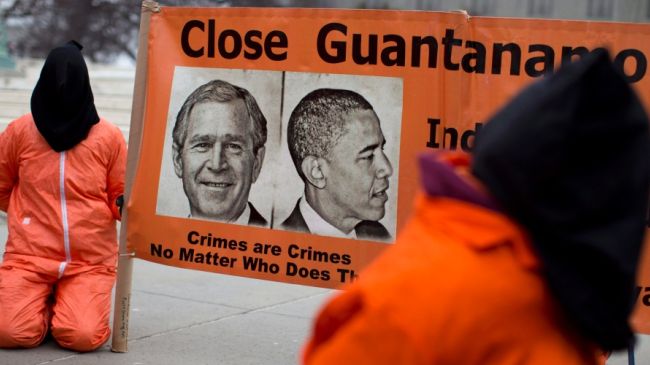
In a gesture of solidarity with Guantanamo Bay prisoners, who are continuing their month-long hunger strike, activists across the world have launched a week-long fast. The campaign will also include protest rallies and vigils.
The action, organized by the Guantanamo prisoners support group Witness Against Torture (WAT), began on Sunday and is to last through March 30. Some activists plan to continue fasting every Friday until the prison is closed, the group says.
The fast will be accompanied by public gatherings to protest against the existence of Guantanamo prison and the condition of people held there.
“We will gather for action in New York City, Chicago, Los Angeles, and other cities domestically and internationally next week to denounce the barbaric practice of torture and indefinite detention and to demand justice for the men at Guantanamo,” WAT says.
The activists also released a list of 166 names of Gitmo detainees, calling on supporters to flood the prison with letters of solidarity and remind the management “that the world has not forgotten the hunger strikers.”
Human rights advocate Andy Worthington believes demonstrations like the recent one are crucial for changing the situation in Guantanamo, stating inactivity “would be a victory” for those whose aim is to keep the prison open.
“Those of us working to close Guantanamo are up against powerful forces of indifference or hostility to our cause, despite the obvious justice of our position. People should not – must not – be put off by this indifference or hostility,” Andy Worthington told RT.
WAT organized similar fasts of solidarity annually since 2010. The group itself was formed back in 2005 and has since been trying to make the US government close the notorious prison through vigils, marches, nonviolent direct action and other measures.
Lawyers of the detainees say more than a hundred of Guantanamo prisoners have been on a hunger strike since early February, with some putting their health at considerable risk. The protest was reportedly caused by mistreatment on the part of the guards, including searches, confiscation of personal items and desecration of Korans.
Guantanamo Bay management has been downplaying the scale of the protest, saying that it considers only a handful of detainees to be genuine hunger strikers.
Related article
- Human rights watchdogs turn blind eye on Gitmo hunger strikers (alethonews.wordpress.com)
Related video
“Humanity Has Lost a Titan”: Interview with William I. Robinson on the Legacy of Hugo Chavez
Eleftherotypia | March 20, 2013
The progressive cause in Latin America but also worldwide has lost one of its most visible leaders. How would you describe the political ideology professed by Hugo Chavez and his Venezuelan United Socialist Party?
Humanity has lost a titan with the passing of Hugo Chavez. Without doubt Chavez is the most important revolutionary leader to have emerged in Latin America – indeed, from the Global South – in at least a generation, if not in a century. When Chavez came to power in 1999 it was the heyday of neo-liberal hegemony in Latin America and around the world. Chavez’ election irked the Venezuelan bourgeoisie and raised eyebrows in the halls of power in Washington and elsewhere. But it was not until the April 2001 Summit of the Americas meeting in Quebec, Canada, that the direction Chavez and the Bolivarian revolution would take became clear. Chavez was the only head of state among the 24 hemispheric leaders present at that meeting who refused to sign on to the declaration approving the creation of a Free Trade Area of the Americas that, if approved, would have created by 2005 a giant free trade zone from the Arctic Circle to Tierra del Fuego. It was at that moment that neo-liberalism definitively lost its hegemony.
But Chavez not only rejected neo-liberalism. He put socialism back on the public agenda at a time when apologists for global capitalism were still claiming it was “the End of History” and when the defeatist left was insisting that we had to be “realistic” and “pragmatic,” to renounce anti-capitalism, and to limit ourselves to putting a “human face” on the capitalist system. Chavez called for a renewed democratic socialism – what he and the PUSV called “21st century socialism” – a socialism based on the protagonism and democratic control of the popular classes from below, as evinced in the 40,000 Communal Councils, the tens of thousands of worker cooperatives, and the thousands of public enterprises run by workers councils in Venezuela. It is apropos to recall these experiences in Venezuela take place at a time when the Greek and other European peoples are reeling under the austerity imposed by the brutal dictatorship of transnational finance capital.
In an era in which socialists in the west have embraced wholeheartedly the neoliberal project, on Chavez’s watch, the oil industry in Venezuela was nationalized, government spending increased substantially (up to 40% in 2012), and welfare projects were initiated on a massive scale. What challenges did Chavez have to overcome in order to accomplish these goals?
The anti-Chavista forces, Washington, and the international media are fond of saying that Chavez “polarized” Venezuela. But Venezuela was polarized long before Chavez came to power, with a tiny capitalist class and state elite and a sizable middle class on the one side – approximately some 30 percent of the Venezuelan population – and the impoverished majority on the other side. Above all Chavez reverted the country’s oil wealth to this majority. The re-nationalization of the oil industry allowed the Chavez government to redirect state resources towards this poor majority. The social achievements of the Bolivarian revolution are now well known: poverty was cut by more than half, from over 60 percent to some 25 percent of the population, and extreme poverty dropped from 25 percent to some seven percent; health and education became universally accessible; life expectancy rose from 74.5 to 79.5 years; unemployment dropped from 12 percent to 6 percent; hundreds of thousands of new homes have been constructed ; and so on.
But these achievements, and more generally, the effort to reorient the country’s resources to the poor majority, came at the cost of the enmity of the bourgeoisie and much of the middle classes, of Washington, and of the Latin American oligarchies and capitalist classes. The Chavista government faced ever more intense destabilization campaigns, including attempted coups, military and paramilitary plots, political conspiracies, disinformation and misinformation (of which much of the international press has been willing accomplices), employee strikes and economic sabotage, and so on. The country has faced a war of attrition that has taken a heavy toll.
Moreover, the drive to construct socialism has taken place within a capitalist global economy. Some 70 percent of the Venezuelan economy is still in private hands, including the financial system, and the country remains dependent on international oil companies and markets. The material power of national and transnational capital translates into continued political and ideological influence. The law of value and its logic is still very much operative in the economy.
The strategy has been to develop and state and cooperative sector to compete with private national and transnational capital; it has not been to replace the logic of accumulation with a social logic as much as it has been to develop a social logic in the state and cooperative sector alongside the logic of accumulation that remains operative for the economy as a whole. This has generated structural as well as political and ideological contradictions. With regard to the former, for instance, inflation has become a serious problem as has a black market in the currency. This is the challenge of 21st century socialism “in one country.”
Under Chavez, Venezuela had established very special relations with Cuba. Was the relationship mutually beneficial to both countries?
Chavez developed a close friendship with Fidel Castro and the two have worked closely together in confronting Washington’s political and economic domination in the region. Economic relations between the two countries on not based on the criteria of profitability and trade advantage but on solidarity and complementarity. Cuba receives Venezuelan oil in exchange for Cuba sending medical brigades and other forms of social assistance. Yet Chavez stated on numerous occasions that Venezuela is constructing its own model of socialism. Sure the relationship has been mutually beneficial, but more to the point, that relationship reflects the broader matter of international political and economic relations among socialist-oriented countries, or countries whose governments are seeking relations based on cooperation and solidarity rather than on competition.
Venezuela (together with Cuba) has played a leadership role in Latin America in forging a political union, economic integration, and an alternative regional cooperation and development model based on solidarity rather than profit and driven by member states rather than transnational corporations and such international financial agencies as the IMF and the World Bank. In 2004 Venezuela and Cuba set up the Bolivarian Alliance for the Peoples of Our America, or ALBA to promote integration and solidarity on the principle of solidarity not competition. Bolivia, Ecuador, Nicaragua, and several other countries have joined ALBA. While Venezuela has provided oil on concessionary terms through ALBA, it has, more importantly, promoted projects such as a regional bank and currency, regional public agricultural and industrial enterprises, and joint infrastructural, social, and communications programs. In December 2011 the Community of Latin American and Caribbean States, or CELAC, held its inaugural summit in Caracas. The CELAC brings together every country in the hemisphere excluding the United States and Canada and is a direct political challenge to Washington’s historic domination in the region.
Beyond Latin America, Venezuela has diversified its international economic relations – China is becoming the major trading and investment partner – and promoted South-South cooperation. Venezuela has come out strongly in support of the Palestinian struggle and other such causes, and against U.S. intervention around the world, even when it has cost the country political capital and economic support internationally. In sum, Venezuela has pursued not a self-interested and opportunistic foreign policy such as that of the former Soviet Union but one based on what would be true socialist principles of solidarity and cooperation.
Socialism in Latin America is on an upwards spiral since the late 2000s. What explains its rise at this particular historical juncture?
It is not difficult to understand the rise of socialism, or certainly, the spiral of anti-capitalism. In the wake of the 1970s crisis of world capitalism the bourgeoisie in the centers of the system, together with state elites and organic intellectuals who serve that bourgeoisie, launched capitalist globalization and undertook a vast new round of “primitive accumulation” around the world, destabilizing hundreds of millions of people. One of the key vehicles for this new round of capitalist expansion was neo-liberalism, a program which has facilitated the transfer of resources from the poor and working classes everywhere to a new transnational capitalist class, especially transnational finance capital, and to emerging middle and professional strata enjoying the fruits of the new global capitalism. Very simply, global capitalism has thrown countless millions into misery and uncertainty. The system has demonstrated that it is a failure for a majority of humanity.
It is in this context that starting in the late 1990s resistance forces around the world began to coalesce into a critical anti-capitalist mass and the banner of “another world is possible” was raised. But what kind of a new world? It is in this context that the Bolivarian revolution and its worldwide impact must be understood. And it is in this context that the extraordinary vision, charisma, and foresightedness of Hugo Chavez must be appreciated. Venezuela under Chavez, much more than resistance to global capitalism, is an example that a new world truly can – and must – be created, once based on the principles and practices of democratic socialism, if not on the label.
Venezuela will hold presidential elections on April 14. Will the United Socialist Party manage to sustain the momentum without Chavez, especially since it is a well known fact that his party is fractured by intra-party rivalries?
The greatest danger to the Bolivarian revolution, in my view, has always come from within, from the “endogenous right,” or the “Chavista right-wing,” that is, from portions of the Chavista movement that wish to see in Venezuela a more mild social democratic project and also from bureaucratic state and party elites who are more interested in acquiring their own power, privilege, and authority, often through corruption, than in helping to develop the self-empowerment of the working and popular classes. Yes, there are intra-party rivalries but I think that in the larger political analysis these must be seen in light of the struggle to avoid a bureaucratic top-down hijacking of power-from-below.
Nicolas Maduro has been a leader of the radical left for several decades and comes from a trade-union background. The Chavista movement has rallied around his leadership and his candidacy. He has proven, since Chavez moved into a terminal state in December, that he is a capable leader and the Chavista mass base understands that its struggle to defend and to deepen its revolution is now tied to electoral support for Maduro’s candidacy in the upcoming vote.
William I Robinson is Professor of Sociology, Global Studies, and Latin American Studies at the University of California at Santa Barbara, and author among other books of Latin America and Global Capitalism (2008).
Related articles
- Chavez in the Crosshairs (alethonews.wordpress.com)
- Preparing for a Post-Chávez Venezuela (alethonews.wordpress.com)
Strike begins at Chinese uranium mine in Niger
Press TV – March 20, 2013
Workers at a China National Nuclear Corporation (SinoU) uranium mine in northern Niger have gone on a 72-hour strike, trade union officials say.
On Tuesday, Boubacar Mamane, a spokesman for the Syntramines labor union, said 680 workers at SinoU have gone on strike to demand better wages and bonus payments, Reuters reported.
“Management refused to pay our allowances and production bonus despite having promised to do so last year. If nothing is done, we will launch an unlimited strike,” Mamane said.
SinoU officials and the Nigerien government, which owns 33 percent of the mine, were not available to comment on the action.
SinoU and its partners have a majority stake in the 700 ton-per-year SOMINA mine, whose production kicked off in 2011 and is expected to increase its output to 2,500 tons annually in 2015.
In 2007, SOMINA was established 160 kilometers southwest of Arlit and 150 kilometers northwest of Agadez, in the Agadez region of northern Niger.
Niger is the top supplier of uranium to the nuclear power industry of France.
British anti-war activists blockade weapons manufacturing company

Press TV – March 20, 2013
British anti-war activists have sealed off a weapons manufacturing company in Brighton to mark 10 years after the UK government joined the U.S.-led invasion on Iraq on March 2003.
The protesters, who had gathered in front of the EDO MBM weapons manufacturing plant from dawn, fastened themselves to the front gates with superglue and bicycle locks.
Two arrests were made by police forces during the six-hour standoff, but the whole gathering continued without violence, according to British media reports.
The anti-war activists from Smash EDO lashed out at engineers of the factory for churning out millions of pounds worth of bomb racks, arming units and parts for aircraft weapon systems every year.
EDO MBM is one of several companies supplying Paveway missiles used in Iraq and Afghanistan, as well as a component for U.S. planes carrying cluster bombs banned under an international treaty signed by Britain in 2008.
Smash EDO’s Chloe Marsh described the day’s protest as a memorial to Iraq’s dead as well as a direct action.
“The case for war was put to people in the UK on the basis of an immediate threat from Iraqi ‘weapons of mass destruction.’
“This turned out, as expected, to be a lie. As a result, according to the Lancet, over a million Iraqi citizens have died.”
Fellow protester Andrew Beckett said: “We are here to commemorate those who died in the aerial bombardment of Iraq and to resist EDO MBM’s continued supply of components to the US/UK military.”
Related article
- Iraq: Decade of war ‘based on lies’ (morningstaronline.co.uk)
Palestinians erect new ‘village’ as Obama lands in Israel
Ma’an – 20/03/2013
BETHLEHEM – Palestinians on Wednesday erected a new “village” encampment in Eizariya to stake their sovereignty and claims to return to their towns and villages.
Activists said they set up 15 tents on a hillside near the original “Bab al-Shams” village that Israeli forces tore down two months earlier.
In a statement, the activists described the initiative as “first, to claim our right as Palestinians to return to our lands and villages, second, to claim our sovereignty over our lands without permission from anyone.”
The action coincided with US President Barack Obama’s arrival at Ben Gurion International Airport.
The activists said it aimed to highlight their opposition to the Obama administration’s policies in the region, saying in the statement that it has been “complicit in Israeli occupation and colonialism.”
“An administration that used the veto 43 times … in support of Israel and against Palestinian rights, an administration that grants military aid to Israel of over three billion dollars annually, can’t have any positive contribution to achieve justice,” the statement said.
Related article
- PressTV: Palestinians trample on Obama banner ahead of visit (jhaines6.wordpress.com)
Polls Show Maduro Leading Capriles for Venezuelan Presidential Elections
By Tamara Pearson | Venezuelanalysis | March 19, 2013
Merida – Private poll company Datanalisis has found that interim president Nicolas Maduro has a 14% lead over opposition candidate Henrique Capriles, with 16% of respondents still undecided, or intending to vote for other candidates.
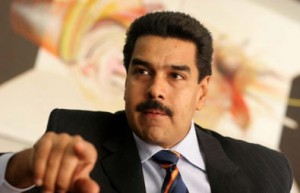 Yesterday Barclays/Datanalisis released a report in which 65% of respondents believe that pro-Chavez candidate Nicolas Maduro will win the 14 April presidential elections.
Barclays is a British multinational financial services company, and Datanalisis is a private Venezuelan company, whose poll results generally favour the opposition, but also tend to be closer to final election outcomes than some other private polling companies.
According to their poll, 49.2% of respondents intend to vote for Maduro, while 34.8% said they will vote for opposition contender Henrique Capriles, giving Maduro a prospective lead of 14.4%. Datanalisis conducted the poll from 11 March to 13 March; the days following the candidates’ registrations to run in the elections.
Only 15% of respondents believed Capriles would win the upcoming elections. Barclays identified this as a “risk” for the opposition, as a “lack of enthusiasm could lead to the abstention of voters”.
“In that sense, Capriles’s reaction has been an aggressive campaign to try to revitalize opposition voters. He is presenting the election in terms of a battle against adverse and unfair conditions, in which a significant portion of the country (roughly half of it) deserves to be heard,” the financial company’s report concluded.
The results also show that the passing of President Hugo Chavez only had a minor impact on voting intentions. Results from the same company, from a poll conducted on 20 February, show the voting intention for Maduro at 46.4%, just 2.8% less than the more recent poll. The voting intention for Capriles was 34.3%, 0.5% less than the recent poll.
The results suggest a high percentage of undecided votes, abstentions or intentions to vote for other candidates, at 16%.
Barclays argued, “Considering the short period for campaigning, the sympathy effect just after the death of Chavez, restrictions on the press, and the demobilisation of the opposition following two defeats last year, Maduro is still a favourite for the 14 of April presidential elections”.
It is not clear what “restrictions on the press” Barclays refers to. The National Electoral Council has increased the amount of electoral advertising time allowed by television and radio, given the short campaigning time. Television advertisements can last a maximum of four minutes, and radio advertisements five minutes. Official campaigning is allowed from 2 to 11 April.
“Maduro is still the favourite… however his popularity is volatile and relies on the emotional support that Chavez transferred to him,” Barclays stated in its report.
The financial transnational also concluded that the market is assuming Maduro’s victory, and that Venezuela still offers an “interesting asymmetric trade opportunity in the case of a black swan event”. A black swan event is an unexpected event with high impact, and the Barclay’s report says it sees an opposition win in this light.
Andres Izarra, a member of the team heading up the campaign ‘Hugo Chavez’ for Nicolas Maduro, criticised national and international “right wing media” for “ignoring” the poll results. He noted that at the time of speaking, yesterday, of Venezuelan media only newspaper Ultimas Noticias had reported the results.
As of today, newspaper El Universal and news website Noticias24 have also published the results, but TV channel Globovision and conservative paper El Nacional haven’t.
Today, another private, pro-opposition poll company, Hinterlaces also released its poll results. Based on a survey of 1,100 homes around the country, conducted on 16 March, 53% of respondents would vote for Maduro and 35% for Capriles, for a difference of 18 percentage points.
The poll also showed that 61% of Venezuelans think that Maduro will win the elections.
In October last year, Hugo Chavez won the presidential elections with 55.4% of the vote, to 45% by Capriles, with 81% participation. The September poll by Datanalisis gave Chavez a 13% lead.
Related articles
Featured Video
“Historic Russia”: The Land Putin Will Not Give Back
or go to
Aletho News Archives – Video-Images
From the Archive
How Ukraine Tortured and Slaughtered Donbass
By Kit Klarenberg | Al Mayadeen | July 11, 2024
Almost immediately after the proxy war erupted, ISIS-tier footage of the torture and murder of Russians in Ukrainian custody emerged.
On July 6th, the New York Times published an astonishing investigation: In Ukraine, Killings of Surrendering Russians Divide an American-Led Unit. The article documents in grim detail how Chosen Company, an international volunteer battalion for Kiev, routinely executes Russian prisoners of war. It is the very first mainstream admission that this practice – a brazen breach of the Geneva Conventions, and a grave war crime – is widespread among Ukraine’s fighters, both foreign and homegrown. … continue
Blog Roll
 Aletho News
- Record Oil, Empty Tanks: The UAE’s Miracle Recovery
- Burnham tackles Britain’s poverty with aggression in Yemen
- Peace in Ukraine: the easy way – or the hard way
- Trump & the Rrrrussians
- US taxpayer money laundered back through Ukraine – Musk
- Before COVID, an NIH lab chief proposed making a SARS-like bat virus more infectious
- Gates, Bourla on Trial in Netherlands Accused of ‘Great Reset’ Scheme at Vaccine Injury Hearing
- BRITAIN’S WARNING: PREPARE FOR WAR
- “Historic Russia”: The Land Putin Will Not Give Back
- How the Cambridge Analytica scandal still haunts Mark Zuckerberg
- If Americans Knew
- DAILY UPDATE: Latest essential news on Palestine, Israel, & region
- Damning report shows the media must confront its failures on Gaza
- BBC senior broadcaster speaks out on Gaza coverage
- Netanyahu vows vast West Bank invasion in response to 20-minute skirmish that left 2 Israeli soldiers and 2 Palestinian fighters dead
- Tied up and tortured: Israel using US-made electroshock weapons on Palestinian detainees
- The outsourced risk: how newsrooms rely on Gaza’s freelancers without protecting them
- Gaza bakeries forced to shut as Israel blocks flour shipments
- Gaza’s breast cancer patients face a deadly wait for treatment amid Israel’s genocide
- DAILY UPDATE: Latest essential news on Palestine, Israel, & region
- The Israel Lobby’s Changing Fortunes
- No Tricks Zone
- Two New Studies Find Thwaites Glacier Melt Cannot Be Driven By Human Activity Or A Warming Ocean
- E-Cars Reduce CO2 Emissions By Only 41% Compared To Internal Combustion Engine Vehicles
- Predictions Made By Renowned Climate Professor Over Past Decades Have Been Proven To Be Poor
- New Study Suggests Large Regions Of The Pacific Ocean Have Been Cooling For The Last 80 Years
- Germany’s Green Energy Debacle: High Energy Costs Force Kahla Porzellan to Close After 182 Years!
- New Study: 50 Years Of The Most Aggressive ‘Net Zero’ Policies Can Only Affect The Global Climate By 0.03°C
- US September “Heat” Was No Record…Many Records Set Decades Ago
- Latest European Green Energy Debacle; Portugal’s Largest Flagship Solar Park Insolvent!
- Green Energy Debacle: German Expert Professor Fritz Vahrenholt Warns Of Severe Economic And Social Consequences
- Two More Paleo Reconstructions Affirm Meters-Higher Sea Levels Across Ireland, Brazil 7000-6000 Years Ago

