FBI Documents Reveal Secret Nationwide Occupy Monitoring
Partnership for Civil Justice Fund | December 22, 2012
FBI documents just obtained by the Partnership for Civil Justice Fund (PCJF) pursuant to the PCJF’s Freedom of Information Act demands reveal that from its inception, the FBI treated the Occupy movement as a potential criminal and terrorist threat even though the agency acknowledges in documents that organizers explicitly called for peaceful protest and did “not condone the use of violence” at occupy protests.
The PCJF has obtained heavily redacted documents showing that FBI offices and agents around the country were in high gear conducting surveillance against the movement even as early as August 2011, a month prior to the establishment of the OWS encampment in Zuccotti Park and other Occupy actions around the country.
“This production, which we believe is just the tip of the iceberg, is a window into the nationwide scope of the FBI’s surveillance, monitoring, and reporting on peaceful protestors organizing with the Occupy movement,” stated Mara Verheyden-Hilliard, Executive Director of the Partnership for Civil Justice Fund (PCJF). “These documents show that the FBI and the Department of Homeland Security are treating protests against the corporate and banking structure of America as potential criminal and terrorist activity. These documents also show these federal agencies functioning as a de facto intelligence arm of Wall Street and Corporate America.”
“The documents are heavily redacted, and it is clear from the production that the FBI is withholding far more material. We are filing an appeal challenging this response and demanding full disclosure to the public of the records of this operation,” stated Heather Benno, staff attorney with the PCJF.
As early as August 19, 2011, the FBI in New York was meeting with the New York Stock Exchange to discuss the Occupy Wall Street protests that wouldn’t start for another month. By September, prior to the start of the OWS, the FBI was notifying businesses that they might be the focus of an OWS protest.
The FBI’s Indianapolis division released a “Potential Criminal Activity Alert” on September 15, 2011, even though they acknowledged that no specific protest date had been scheduled in Indiana. The documents show that the Indianapolis division of the FBI was coordinating with “All Indiana State and Local Law Enforcement Agencies,” as well as the “Indiana Intelligence Fusion Center,” the FBI “Directorate of Intelligence” and other national FBI coordinating mechanisms.
Documents show the spying abuses of the FBI’s “Campus Liaison Program” in which the FBI in Albany and the Syracuse Joint Terrorism Task Force disseminated information to “sixteen (16) different campus police officials,” and then “six (6) additional campus police officials.” Campus officials were in contact with the FBI for information on OWS. A representative of the State University of New York at Oswego contacted the FBI for information on the OWS protests and reported to the FBI on the SUNY-Oswego Occupy encampment made up of students and professors.
Documents released show coordination between the FBI, Department of Homeland Security and corporate America. They include a report by the Domestic Security Alliance Council (DSAC), described by the federal government as “a strategic partnership between the FBI, the Department of Homeland Security and the private sector,” discussing the OWS protests at the West Coast ports to “raise awareness concerning this type of criminal activity.” The DSAC report shows the nature of secret collaboration between American intelligence agencies and their corporate clients – the document contains a “handling notice” that the information is “meant for use primarily within the corporate security community. Such messages shall not be released in either written or oral form to the media, the general public or other personnel… ” (The DSAC document was also obtained by the Northern California ACLU which has sought local FBI surveillance files.)
Naval Criminal Investigative Services (NCIS) reported to the DSAC on the relationship between OWS and organized labor for the port actions. The NCIS describes itself as “an elite worldwide federal law enforcement organization” whose “mission is to investigate and defeat criminal, terrorist, and foreign intelligence threats to the United States Navy and Marine Corps ashore, afloat and in cyberspace.” The NCIS also assists with the transport of Guantanamo prisoners.
DSAC issued several tips to its corporate clients on “civil unrest” which it defines as ranging from “small, organized rallies to large-scale demonstrations and rioting.” It advised to dress conservatively, avoid political discussions and “avoid all large gatherings related to civil issues. Even seemingly peaceful rallies can spur violent activity or be met with resistance by security forces. Bystanders may be arrested or harmed by security forces using water cannons, tear gas or other measures to control crowds.”
The FBI in Anchorage reported from a Joint Terrorism Task Force meeting of November 3, 2011, about Occupy activities in Anchorage.
A port Facility Security Officer in Anchorage coordinated with the FBI to attend the meeting of protestors and gain intelligence on the planning of the port actions. He was advised to request the presence of an Anchorage Police Department official to also attend the event. The FBI Special Agent told the undercover private operative that he would notify the Joint Terrorism Task Force and that he would provide a point of contact at the Anchorage Police Department.
The Jacksonville, Florida FBI prepared a Domestic Terrorism briefing on the “spread of the Occupy Wall Street Movement” in October 2011. The intelligence meeting discussed Occupy venues identifying “Daytona, Gainesville and Ocala Resident Agency territories as portions … where some of the highest unemployment rates in Florida continue to exist.”
The Tampa, Florida FBI “Domestic Terrorism” liaison participated with the Tampa Police Department’s monthly intelligence meeting in which Occupy Lakeland, Occupy Polk County and Occupy St. Petersburg were discussed. They reported on an individual “leading the Occupy Tampa” and plans for travel to Gainesville for a protest planning meeting, as well as on Veterans for Peace plans to protest at MacDill Air Force Base.
The Federal Reserve in Richmond appears to have had personnel surveilling OWS planning. They were in contact with the FBI in Richmond to “pass on information regarding the movement known as occupy Wall Street.” There were repeated communications “to pass on updates of the events and decisions made during the small rallies and the following information received from the Capital Police Intelligence Unit through JTTF (Joint Terrorism Task Force).”
The Virginia FBI was collecting intelligence on the OWS movement for dissemination to the Virginia Fusion Center and other Intelligence divisions.
The Milwaukee division of the FBI was coordinating with the Ashwaubenon Public Safety division in Green Bay Wisconsin regarding Occupy.
The Memphis FBI’s Joint Terrorism Task Force met to discuss “domestic terrorism” threats, including, “Aryan Nations, Occupy Wall Street, and Anonymous.”
The Birmingham, AL division of the FBI sent communications to HAZMAT teams regarding the Occupy Wall Street movement.
The Jackson, Mississippi division of the FBI attended a meeting of the Bank Security Group in Biloxi, MS with multiple private banks and the Biloxi Police Department, in which they discussed an announced protest for “National Bad Bank Sit-In-Day” on December 7, 2011.
The Denver, CO FBI and its Bank Fraud Working Group met and were briefed on Occupy Wall Street in November 2011. Members of the Working Group include private financial institutions and local area law enforcement.
Jackson, MS Joint Terrorism Task Force issued a “Counterterrorism Preparedness” alert. This heavily redacted document includes the description, “To document…the Occupy Wall Street Movement.”
You can read the FBI – OWS documents below where we have uploaded them in searchable format for public viewing.
The PCJF filed Freedom of Information Act demands with multiple federal law enforcement agencies in the fall of 2011 as the Occupy crackdown began. The FBI initially attempted to limit its search to only one limited record keeping index. Recognizing this as a common tactic used by the FBI to conduct an inadequate search, the PCJF pressed forward demanding searches be performed of the FBI headquarters as well as FBI field offices nationwide.
The PCJF will continue to push for public disclosure of the government’s spy files and will release documents as they are obtained.
Click here to see the FBI documents obtained by the PCJF.
Related article and video
- Terrorists and criminals: Documents prove FBI monitored OWS (alethonews)
- Policing Dissent (video report)
Shireen Al-Issawi: PA did not take prisoners’ issue to the UN
Palestine Information Center – 27/12/2012
 OCCUPIED JERUSALEM — Shireen Al-Issawi, the sister of hunger striker Samer Al-Issawi, has called for greater support for the issue of hunger striking Palestinian prisoners in Israeli jails.
She told the PIC in an interview that the Israeli occupation authorities (IOA) refused to allow medical checkups on her brother, whose health condition is deteriorating.
Shireen, a lawyer, criticized the Palestinian Authority for not heading to the UN, human rights groups and the international criminal court and filing complaints against Israel’s practices and crimes and to demand freedom for the Palestinian prisoners.
The PA should exploit the hunger strike by a number of prisoners and expose the Israeli practices against them, she said, adding that the PA should also ask Cairo to intervene in the issue in its capacity as the patron of the prisoners’ exchange agreement that stipulated among other things that those freed in the agreement would not be re-arrested and also limited the use of the administrative detention policy.
Shireen said that the Israeli court decision banning her from attending her brother’s court hearings was part of the psychological pressures on him.
St. Louis Palestine Solidarity Committee Statement on Pending City Contract with Veolia Water
STL-PSC Blog | December 17th, 2012
We are a diverse group of Palestinians, Israelis, Muslims, Jews, Christians, students, professors, artists, writers, environmental activists, union organizers, bakers, grandparents, and others in St. Louis united by a commitment to a lasting peace in Israel/Palestine based on freedom, justice, and equality, as part of a larger commitment to global justice.
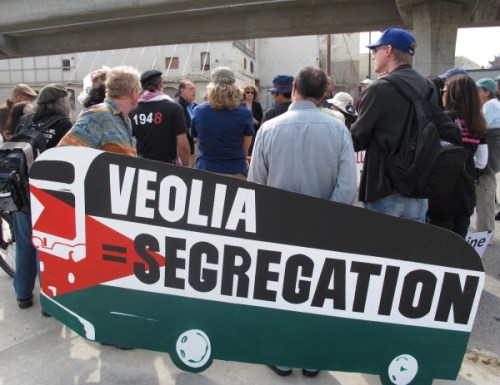
We were shocked to learn about private city negotiations with Veolia Water on a contract to guide cost-cutting for the St. Louis Water Division. Veolia Water – North America is a subsidiary of Veolia Environnement (VE), a Paris-based multinational corporation and the largest water privatization business in the world. It is infamous for poor environmental standards, anti-labor practices, privatizing public resources, mismanagement, corruption, bribery, embezzlement, fraud, and illegal activities in Israel/Palestine. Worldwide, consumers report that Veolia consistently charges high rates, provides poor service, causes staff turnover, discourages water conservation, and fails to implement promised improvements. Its history reveals consistent prioritization of private profit at the expense of the environment and public welfare.
In Israel/Palestine, VE is involved in a myriad of ways with Israel’s illegal military occupation of Palestinian land and its systematic ethnic discrimination against the Palestinian people.
VE’s Israeli subsidiary, Veolia Water – Israel, operates a wastewater treatment plant located in an illegal Jewish-only settlement called Modiin Ilit, built on internationally-recognized Palestinian land in the West Bank. The Palestinian owners of the land on which this settlement was built have been violently driven out. Two unarmed Palestinians from Bil’in, a Palestinian village on which Modiin Ilit was built, have been killed by the Israeli army as they protested nonviolently against the ongoing confiscation of their land and resources. Leaders and people of conscience from around the world, including the South African anti-Apartheid leader Archbishop Desmond Tutu, have visited Bil’in to stand in solidarity with the dispossessed villagers, yet Veolia continues to service the settlement and others like it.
An Israeli subsidiary of Veolia Transdev, named Connex – Israel, operates settler buses on segregated roads through the occupied West Bank, including two bus lines that use road 443, which is built partially on confiscated land with portions closed entirely to Palestinians. A separate but unequal Palestinian road system is made up of low grade roads cut by checkpoints and physical barriers restricting Palestinian freedom of movement. Last year, a group of Palestinian Freedom Riders attempted to board buses operating on their own land and were violently removed and arrested. Veolia is not only profiting from segregation in Israel/Palestine; they are enforcing it.
Another VE Israeli subsidiary, Veolia Environmental Services – Israel, supervises, consults for, and operates the Tovlan Landfill in the occupied Jordan Valley, collecting refuse from illegal settlements. Israel renders it almost impossible for Palestinians in the Jordan Valley to gain permits to build homes, toilets, wells, animal pens, or other vital infrastructure for local communities, which has forced almost all Palestinian families out, with those remaining living in dire conditions. Some are left with no alternative but to work on settlements that have taken their families’ land, for pay far below the minimum wage, unable to take bathroom breaks, and denied any rights to unionize. Veolia takes captured Palestinian land and natural resources to service the settlements exploiting or driving out Palestinians.
Finally, VE has also been involved in the construction and operation of a tramway linking illegal settlements in East Jerusalem with Israel. The tramway not only institutionalizes the occupation, but it is a settlement in itself, given that it is settler infrastructure built on occupied land.
UN Special Rapporteur Richard Falk recently recommended that Veolia “should be boycotted, until they bring their operations into line with international human rights and humanitarian law and standards.” VE’s immoral practices and extensive profiting from Israel’s illegal discriminatory practices have provoked global outcry and made the company a target for boycott and divestment campaigns around the world — costing it $16 billion to date in lost contracts. Recently, the Friends Fiduciary Corporation, which handles investments for hundreds of U.S. Quaker institutions, divested from VE following advocacy from Palestine solidarity groups. Now, VE is bringing its risky and immoral business to our backyard.
Veolia Water is the U.S. arm of VE. As St. Louisans, we do not feel that our tax dollars and water payments should go toward supporting a company profiting from environmental destruction, unfair labor practices, and the bloodshed of and systematic ethnic discrimination against the Palestinian people.
The St. Louis Palestine Solidarity Committee stands in solidarity with public workers, water and environmental justice activists, and the Palestinian people threatened by this contract. We call on the Board of Estimate & Appointment not to approve this public contract with Veolia.
Click here for more information and documentation on Veolia’s activities in Palestine.
Related articles
- South Africa’s ruling ANC officially endorses Palestine’s boycott movement (alethonews.wordpress.com)
- St. Louis City Board Votes to Investigate Veolia Following Public Outcry! (bdsmovement.net)
- Veolia to end sponsorship of major UK photography exhibition (bdsmovement.net)
- Pro-Palestine campaigners celebrate Veolia’s loss of £40million contract in Canterbury (bdsmovement.net)
South Africa’s ruling ANC officially endorses Palestine’s boycott movement
Al Akhbar | December 21, 2012
South Africa’s ruling party has officially endorsed Palestine’s Boycott, Divestment, and Sanctions campaign against Israel, making it the first major non-Muslim political faction to throw its weight behind the nonviolent resistance movement.
The African National Congress issued a resolution in support of the boycott campaign making it a part of its official policy, and specifically called for “all South Africans to support the programmes and campaigns of the Palestinian civil society which seek to put pressure on Israel to engage with the Palestinian people to reach a just solution.”
A press release issued by activist group BDS South Africa called the move “the most authoritative endorsement of the Boycott, Divestment and Sanctions (BDS) against Israel campaign.”
Previous moves to support Palestine’s nonviolent resistance movement from state actors have restricted their backing to the boycott of Israeli settlements, shying away from targeting the Jewish state. In September, the Irish parliament voted to ban Israeli settlement imports. Earlier this month, an Israeli newspaper reported that the EU was looking into boycotting settlement goods, after Israel defied calls to stem construction of the illegal houses.
Another clause of the resolution lashed out at Israel’s mistreatment of Africans, which culminated in the mass deportation of South Sudanese this year: “The ANC abhors the recent Israeli state-sponsored xenophobic attacks and deportation of Africans and request that this matter should be escalated to the African Union.”
The move is the latest in a series of actions by the ANC to pressure Israel into ending the Jewish state’s racist policies, particularly against indigenous Palestinians.
This August, South Africa’s Deputy Foreign Minister Ebrahim Ebrahim advised South Africans not to travel to Israel “because of the treatment and policies of Israel towards the Palestinian people.”
Palestine activists have long worked to draw attention to parallels between South Africa’s apartheid period and Palestinian repression under Israel’s ethno-religious-exclusive government system. Palestine’s BDS movement is said to be largely inspired by South Africa’s own boycott movement, which is credited with playing a major role in dismantling apartheid in that country in 1994.
South African Apartheid was declared official policy in 1948, the same year the state of Israel was created and thousands of Palestinians were expelled or put under martial rule.
In 2005, Palestinian civil society issued a call for a campaign of boycotts, divestment and sanctions against Israel until it complies with international law and Palestinian rights. The launch followed a historic ruling at the International Court of Justice that Israel’s apartheid wall, which greatly restricts movement in the West Bank and expropriates large swathes of Palestinian land, be demolished.
The BDS movement has garnered support from activists and labor unions worldwide, as well as from a growing list of artists, including Roger Waters, Elvis Costello, Santana, Cat Power and the late Gil Scott Heron.
Full BDS South Africa Press release
MEDIA RELEASE: S. Africa’s ruling party, the ANC, reaffirms boycott of Israel resolution
South Africa’s ruling party, the African National Congress (ANC), at its 53rd National Conference, reaffirmed a resolution supporting the Palestinian Boycott, Divestment and Sanctions (BDS) against Israel campaign.
In October 2012, the ANC’s International Solidarity Conference (ISC) declared its full support for the Boycott, Divestment and Sanctions (BDS) against Israel campaign (ISC Declaration, page 2, point 10).
Today, Lindiwe Zulu (member of the ANC’s International Relations Sub-Committee and special advisor to President Jacob Zuma) announced at the ANC’s 53rd National Conference plenary session, the ANC’s official endorsement, as captured in Resolution 39 (b), of the ANC’s October International Solidarity Conference (ISC) and all its resolutions, which includes a resolution on BDS. Giving muscle to resolution 39 (b), the ANC has committed to set up a steering committee to implement these ISC resolutions.
In addition, the ANC adopted resolution 35 (g) that specifically called for “all South Africans to support the programmes and campaigns of the Palestinian civil society which seek to put pressure on Israel to engage with the Palestinian people to reach a just solution.” In 2005 Palestinian civil society issued a call to the international community for a program and campaign of boycott, divestment and sanctions (BDS) to be applied against Israel as a way to pressure Israel to end its violations of international law, respect Palestinian human rights and engage in fair negotiations for a just peace.
Mbuyiseni Ndlozi of BDS South Africa welcomed today’s decision: “This reaffirmation by the ANC’s National Conference, its highest decision making body, is by far the most authoritative endorsement of the Boycott, Divestment and Sanctions (BDS) against Israel campaign. The ANC has now taken its international conference resolutions, and officially made it the policy of the ANC. We look forward to working with the ANC and specifically the ISC steering committee to expedite its implementation.”
Another hard-hitting decision on Israel that was adopted by the ANC was resolution 35 (j): “The ANC abhors the recent Israeli state-sponsored xenophobic attacks and deportation of Africans and request that this matter should be escalated to the African Union”. In June this year Israeli anti-African protests turned into full-fledged race riots. Israeli racism and xenophobia against Africans is shared and even encouraged by Israeli politicians including the Israeli Prime Minster, Benjamin Netanyahu, who has said: “If we don’t stop their [African immigrants’] entry, the problem that currently stands at 60,000 could grow to 600,000, and that threatens our existence…and threatens the social fabric of society.” Israel’s Minister of Interior, Eli Yishai, has said that African immigrants “think the country doesn’t belong to us, the white man.” And the Israeli parliamentarian, Miri Regev, has publicly compared Sudanese people to “a cancer”.
Finally, in a blow to the Israeli lobby, the ANC also adopted resolution 35 (c) stating: “The ANC is unequivocal in its support for the Palestinian people in their struggle for self-determination, and unapologetic in its view that the Palestinians are the victims and the oppressed in the conflict with Israel.” In the build up to the ANC’s National Conference the Israeli lobby, including the South African Jewish Board of Deputies, demanded a “balanced” and “nonpartisan” rather than a decisive and solidarity role by the ANC in the Palestinian-Israeli issue.
ISSUED BY MBUYISENI NDLOZI FOR BDS SOUTH AFRICA
Related articles
Why Is Cuba’s Health Care System the Best Model for Poor Countries?
By Don Fitz – Black Agenda Report – 12/12/2012

Furious though it may be, the current debate over health care in the US is largely irrelevant to charting a path for poor countries of Africa, Latin America, Asia and the Pacific Islands. That is because the US squanders perhaps 10 to 20 times what is needed for a good, affordable medical system. The waste is far more than 30% overhead by private insurance companies. It includes an enormous amount of over-treatment, making the poor sicker by refusing them treatment, creation of illnesses, exposure to contagion through over-hospitalization, and disease-focused instead of prevention-focused research. [1]
Poor countries simply cannot afford such a health system. Well over 100 countries are looking to the example of Cuba, which has the same 78-year life expectancy of the US while spending 4% per person annually of what the US does. [2]
The most revolutionary idea of the Cuban system is doctors living in the neighborhoods they serve. A doctor-nurse team is part of the community and know their patients well because they live at (or near) the consultorio (doctors’ office) where they work. Consultorios are backed up by policlínicos which provide services during off-hours and offer a wide variety of specialists. Policlínicos coordinate community health delivery and link nationally designed health initiatives with their local implementation.
Cubans call their system medicina general integral (MGI, comprehensive general medicine). Its programs focus on preventing people from getting diseases rather than curing them after they are sick
This has made Cuba extremely effective in control of everyday health issues. Having doctors’ offices in every neighborhood has brought the Cuban infant mortality rate below that of the US and less than half that of US Blacks. [3] Cuba has a record unmatched in dealing with chronic and infectious diseases with amazingly limited resources. These include (with date eradicated): polio (1962), malaria (1967), neonatal tetanus (1972), diphtheria (1979), congenital rubella syndrome (1989), post-mumps meningitis (1989), measles (1993), rubella (1995), and TB meningitis (1997). [4]
The MGI integration of neighborhood doctors’ offices with area clinics and a national hospital system also means the country responds well to emergencies. It has the ability to evacuate entire cities during a hurricane largely because consultorio staff know everyone in their neighborhood and who to call for help getting disabled residents out of harms way. At the same time New York City (roughly the same population as Cuba) had 43,000 cases of AIDS, Cuba had 200 AIDS patients. [5] More recent emergencies such as outbreaks of dengue fever are quickly followed by national mobilizations. [6]
Perhaps the most amazing aspect of Cuban medicine is that, despite its being a poor country itself, Cuba has sent over 124,000 health care professionals to provide care to 154 countries. [7] In addition to providing preventive medicine Cuba sends response teams following emergencies (such as earthquakes and hurricanes) and has over 20,000 students from other countries studying to be doctors at its Latin American School of Medicine in Havana (ELAM, Escuela Latinoamericana de Medicina). [8]
In a recent Monthly Review article, I gave in-depth descriptions of ELAM students participating in Cuban medical efforts in Haiti, Ghana and Peru. [9] What follows are 10 generalizations from Cuba’s extensive experience in developing medical science and sharing its approach with poor countries throughout the world. The concepts form the basis of the New Global Medicine and summarize what many authors have observed in dozens of articles and books.
First, it is not necessary to focus on expensive technology as the initial approach to medical care. Cuban doctors use machines that are available, but they have an amazing ability to treat disaster victims with field surgery. They are very aware that most lives are saved through preventive medicine such as nutrition and hygiene and that traditional cultures have their own healing wisdom. This is in direct contrast to Western medicine, especially as is dominant in the US, which uses costly diagnostic and treatment techniques as the first approach and is contemptuous of natural and alternative approaches.
Second, doctors must be part of the communities where they are working. This could mean living in the same neighborhood as a Peruvian consultorio. It could mean living in a Venezuelan community that is much more violent than a Cuban one. Or it could mean living in emergency tents adjacent to where victims are housed as Cuban medical brigades did after the 2010 earthquake in Haiti. Or staying in a village guesthouse in Ghana. Cuban-trained doctors know their patients by knowing their patients’ communities. This differs sharply from US doctors, who receive zero training on how to assess homes of their patients.
Third, the MGI model outlines relationships between people that go beyond a set of facts. Instead of memorizing mountains of information unlikely to be used in community health, which US students must do to pass medical board exams, Cuban students learn what is necessary to relate to people in consultorios, polyclínicos, field hospitals and remote villages. Far from being nuisance courses, studies in how people are bio-psycho-social beings are critical for the everyday practice of Cuban medicine.
Fourth, the MGI model is not static but is evolving and unique for each community. Western medicine searches for the correct pill for a given disease. In its rigid approach, a major reason for research is to discover a new pill after “side effects” of the first pill surface. Since traditional medicine is based on the culture where it has existed for centuries, the MGI model avoids the futility of seeking to impose a Western mindset on other societies.
Fifth, it is necessary to adapt medical aid to the political climate of the host country. This means using whatever resources the host government is able and willing to offer and living with restrictions. Those hosting a Cuban medical brigade may be friendly as in Venezuela and Ghana, hostile as is the Brazilian Medical Association, become increasingly hostile as occurred after the 2009 coup in Honduras, or change from hostile to friendly as occurred in Peru with the 2011 election of Ollanta Humala. This is quite different from US medical aide which, like its food aide, is part of an overall effort to dominate the receiving country and push it into adopting a Western model.
Sixth, the MGI model creates the basis for dramatic health effects. Preventive community health training, a desire to understand traditional healers, the ability to respond quickly to emergencies, and an appreciation of political limitations give Cuban medical teams astounding success. During the first 18 months of Cuba’s work in Honduras following Hurricane Mitch, infant mortality dropped from 80.3 to 30.9 per 1000 live births. When Cuban health professionals intervened in Gambia, malaria decreased from 600,000 cases in 2002 to 200,000 two years later. And Cuban/Venezuelan collaboration resulted in 1.5 million vision corrections by 2009. Kirk and Erisman conclude that “almost 2 million people throughout the world … owe their very lives to the availability of Cuban medical services.” [7]
Seventh, the New Global Medicine can become reality only if medical staff put healing above personal wealth. In Cuba, being a doctor, nurse or support staff and going on a mission to another country is one of the most fulfilling activities a person can do. The program continues to find an increasing number of volunteers despite the low salaries that Cuban health professionals earn. There is definitely a minority of US doctors who focus their practice in low income communities which have the greatest need. But there is no political leadership which makes a concerted effort to get physicians to do anything other than follow the money.
Eighth, dedication to the New Global Medicine is now being transferred to the next generation. When students at Cuban schools learn to be doctors, dentists or nurses their instructors tell them of their own participation in health brigades in Angola, Peru, Haiti, Honduras and dozens of other countries. Venezuela has already developed its own approach of MIC (medicina integral communitaria, comprehensive community medicine) which builds upon but is distinct from Cuban MGI. [10] Many ELAM students who work in Ghana as the Yaa Asantewaa Brigade are from the US. They learn approaches of traditional healers so they can compliment Ghanaian techniques with Cuban medical knowledge.
Ninth, the Cuban model is remaking medicine across the globe. Though best-known for its successes in Latin America, Africa and the Caribbean, Cuba has also provided assistance in Asia and the Pacific Islands. Cuba provided relief to the Ukraine after the 1986 Chernobyl meltdown, Sri Lanka following the 2004 tsunami, and Pakistan after its 2005 earthquake. Many of the countries hosting Cuban medical brigades are eager for them to help redesign their own health care systems. Rather than attempting to make expensive Western techniques available to everyone, the Cuban MGI model helps re-conceptualize how healing systems can meet the needs of a country’s poor.
Tenth, the new global medicine is a microcosm of how a few thousand revolutionaries can change the world. They do not need vast riches, expensive technology, or a massive increase in personal possessions to improve the quality of people’s lives. If dedicated to helping people while learning from those they help, they can prefigure a new world by carefully utilizing the resources in front of them. […]
Discussions of global health in the West typically bemoan the indisputable fact that poor countries still suffer from chronic and infectious diseases that rich countries have controlled for decades. International health organizations wring their hands over the high infant mortality rates and lack of resources to cope with natural disasters in much of the world. [3]
But they ignore the one health system that actually functions in a poor country, providing health care to all of its citizens as well as millions of others around the world. The conspiracy of silence surrounding the resounding success of Cuba’s health system proves the absolute unconcern by those who piously claim to be the most concerned.
How should progressives respond to this feigned ignorance of a meaningful solution to global health problems? A rational response must begin with spreading the word of Cuba’s New Global Medicine through every source of alternative media available. The message needs to be: Good health care is not more expensive — revolutionary medicine is far more cost effective than corporate controlled medicine.
Notes
1. Fitz, D. (December 9, 2010). Eight reasons US healthcare costs 96% more
than Cuba’s—With the same results.
http://www.alternet.org/health/149090/eight_reasons_us_healthcare_costs_96%25_more_than_cuba%27s–with_the_same_results
2. Dresang, L.T., Brebick, L., Murray, D., Shallue, A. & Sullivan-Vedder, L. (July-August, 2005). Family medicine in Cuba: Community-Oriented Primary Care and Complementary and Alternative Medicine, Journal of the American Board of Family Medicine 18 no. 4: 297-303.
3. Cooper, R.S., Kennelly, J.F. & Orduñez-Garcia, P. (2006). Health in Cuba, International Journal of Epidemiology, 35: 817–824.
4. Pérez, J. (May 15, 2012). Gender and HIV Prevention. Slide presentation at the Pedro Kouri Institute of Topical Medicine, Havana, Cuba.
5. Whiteford, L.M. & Branch, L.G. (2008). Primary Health Care in Cuba: The Other Revolution. Lanham: Rowman & Littlefield Publishers, Inc.
6. Fitz, D. (February 14, 2012). Med School Classes Cancelled in Havana.
http://blackagendareport.com/content/med-school-classes-cancelled-havana
7. Kirk, J.M. & Erisman, M.H. (2009). Cuban Medical Internationalism: Origins, Evolution and Goals. New York: Palgrave Macmillan.
8. Fitz, D. (March, 2011). The Latin American School of Medicine Today: ELAM. Monthly Review 62 no. 10: 50–62.
9. Fitz, D. (September, 2012). Cuba: The New Global Medicine. Monthly Review 64 no. 4: 37–46.
10. Brouwer, S. (2011). Revolutionary Doctors: How Venezuela and Cuba are Changing the World’s Conceptualization of Health Care. New York, Monthly Review Press.
Don Fitz can be contacted via fitzdon@aol.com
Related articles
- 80 percent of Cuban AIDS patients since 1986 alive (vancouverdesi.com)
Venezuela Abolishes Visa Formalities for Palestinians
Al-Manar | December 7, 2012
Venezuela has become the first country in the world to abolish entrance visas for citizens of Palestine recognized as an observer state by the UN, the Palestinian Foreign Ministry reported on Thursday.
The agreement on the abolition of visa formalities for holders of civil and diplomatic passports was signed in Caracas among other joint documents after talks between the Venezuelan and Palestinian foreign ministers.
The State of Palestine has signed ten agreements in the political, economic, health, agriculture, tourism, cultural, and sports sectors with the Venezuelan government.
Palestinian FM Riyad Al-Maliki thanked his Venezuelan counterpart for his country’s support of Palestine, and they agreed to hold an international solidarity meeting next February.
The meeting will be attended by the presidents of both Palestine and Venezuela as well as the United Nations Committee to support the inalienable Palestinian people’s rights.
Last Thursday the UN General Assembly granted Palestine the status of an observer state by an overwhelming majority of votes, ignoring Israeli and US objections.
Related articles
- Venezuela and Palestine to Strengthen Relations after Landmark UN Vote (venezuelanalysis.com)
- Palestinian delegation visits Venezuela (venezuelanalysis.com)
French activists campaign against Jewish Defense League
Press TV – December 7, 2012
Activists in France have launched a campaign to disband the French branch of the Jewish Defense League (JDL), which is reportedly protected by the French government, Press TV reports.
Pointing to numerous acts of violence committed by the JDL, the activists censured the French government’s tolerance of the Jewish group and reaffirmed their determination to continue their campaign to ban the JDL.
The United States considers the JDL as a terrorist group. It is a Jewish far-right organization whose stated goal is to expel Palestinians from their homeland and “protect Jews from anti-Semitism by whatever means necessary.”
Under former French President Nicolas Sarkozy, the group’s ties with the French government surfaced after French police allowed JDL members to use their sports facilities for military training.
The group has committed hundreds of violent acts in France, but their crimes have gone unpunished and even unreported, with merely a single conviction on record.
In a latest instance of violence, JDL thugs recently attacked Olivia Zemor, a leader of the non-violent Boycott, Divestment and Sanctions campaign, sprayed a very toxic paint all over her body and posted the video of the assault on their website. French police arrested no one with regard to the attack.
“Any time they see a Palestinian voice, they attack them and they run away, because the French government is an accomplice to that,” said Nicolas Shahshahani, Zemor’s husband.
The JDL also attacked Shahshahani’s bookstore in 2006, using tear gas and dousing his books with cooking oil, but none of the perpetrators was apprehended.
Related articles
- FBI files on Tupac Shakur murder show he received death threats from Jewish terrorist gang (theuglytruth.wordpress.com)
- Jewish Right Wing Extremists Suspected of Extorting Tupac Shakur (theageofblasphemy.wordpress.com)
- David Brotsky’s Romance With Guns, Violence and Pro-Israel Hate (richardsilverstein.com)
- long long ago, when kahanists started murdering people in the US (niqnaq.wordpress.com)
Jewish settlers commit vehicular assaults with impunity at peaceful roadblock protests in the West Bank
International Solidarity Movement | December 3, 2012
West Bank – On two different occasions while Palestinians, accompanied by international activists, peacefully blocked roads leading to illegal settlements to demonstrate against the occupation and settlements, settlers purposefully injured activists in hit and run incidents.
On November 14 while a group of protesters blocked a road leading to an illegal settlement, a settler tried to drive through the crowd, then accelerated, deliberately hitting an international activist, as the activist was trying to get out of the way. The activist hit the front of the car, then bounced off the windshield and hit the ground. The settler then drove away, careless about what he had just done. An ambulance was called, and the activist was treated for injuries to his head and arm.
A similar incident occurred on November 19, as a roadblock protest was held on another settler road. As a settler car approached the crowd, he accelerated into Palestinian popular struggle coordinator Abdallah Abu Rahmah, hitting him with his car, before fleeing the scene. Abdallah was treated in hospital but was released later that day. Israeli army soldiers were present at the scene, but didn’t do anything to prevent the settlers from acting in violent ways, and allowed them to flee the scene.
The settlers seem to be above the law. They continually get away with violence, destruction of property, and constant harassment against the Palestinians, while the soldiers usually protect them, because they have Israeli citizenship. Incidents similar to these happen constantly all throughout the West Bank, while soldiers and authorities turn a blind eye.
EUROPEAN FOOTBALLERS DECLARE SUPPORT FOR PALESTINE
Announcement – November 29, 2012
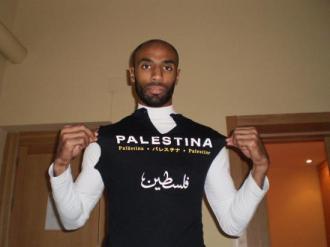
We, as European football players, express our solidarity with the people of Gaza who are living under siege and denied basic human dignity and freedom. The latest Israeli bombardment of Gaza, resulting in the death of over a hundred civilians, was yet another stain on the world’s conscience.
We are informed that on 10 November 2012 the Israeli army bombed a sports stadium in Gaza, resulting in the death of four young people playing football, Mohamed Harara and Ahmed Harara, 16 and 17 years old; Matar Rahman and Ahmed Al Dirdissawi, 18 years old.
We are also informed that since February 2012 two footballers with the club Al Amari, Omar Rowis, 23, and Mohammed Nemer, 22, have been detained in Israel without charge or trial.
It is unacceptable that children are killed while they play football. Israel hosting the UEFA Under-21 European Championship, in these circumstances, will be seen as a reward for actions that are contrary to sporting values.
Despite the recent ceasefire, Palestinians are still forced to endure a desperate existence under occupation, they must be protected by the international community. All people have the right to a life of dignity, freedom and security. We hope that a just settlement will finally emerge.
Signed by:
Gael Angoula, Bastia Sporting Club (France)
Karim Ait-Fana, Montpellier HSC (France)
André Ayew, Olympique de Marseille (France)
Jordan Ayew, Olympique de Marseille (France)
Demba Ba, Newcastle United (UK)
Abdoulaye Baldé, AC Lumezzane (Italia)
Chahir Belghazouani, AC Ajaccio (France)
Leon Best, Blackburn Rovers Football Club (UK)
Ryad Boudebouz, Football Club Sochaux Montbéliard (France)
Yacine Brahimi, Granada Football Club (Spain)
Jonathan Bru, Melbourne Victory (Australia)
Yohan Cabaye, Newcastle United (UK)
Aatif Chahechouche, Sivasspor Kulübü (Turkey)
Pascal Chimbonda, Doncaster Rovers Football Club (UK)
Papiss Cissé, Newcastle United (UK)
Omar Daf, Football Club Sochaux Montbéliard (France)
Issiar Dia, Lekhwiya (Qatar)
Abou Diaby, Arsenal Football Club (UK)
Alou Diarra, Olympique de Marseille (France)
Soulaymane Diawara, Olympique de Marseille (France)
Samba Diakité, Queens Park Rangers (UK)
Pape Diop, West Ham United (UK)
Abdoulaye Doucouré, Stade Rennais Football Club (France)
Didier Drogba, Shanghaï Shenhua (China)
Ibrahim Duplus, Football Club Sochaux Montbéliard (France)
Soudani El-Arabi Hilal, Vitoria Sport Club Guimares (Portugal)
Jires Kembo Ekoko, Al Ain Football Club (United Arab Emirates)
Nathan Ellington, Ipswich Town Football Club (UK)
Rod Fanni, Olympique de Marseille (France)
Doudou Jacques Faty, Sivassport Kulübü (Turkey)
Ricardo Faty, AC Ajaccio (France)
Chris Gadi, Olympique de Marseille (France)
Remi Gomis, FC Valenciennes (France)
Florent Hanin, SC Braga (Portugal)
Eden Hazard, Chelsea Football Club (UK)
Charles Kaboré, Olympique de Marseille (France)
Diomansy Kamara, Eskisehispor Kulübü (Turkey)
Frédéric Kanouté, Beijin Guoan (China)
Anthony Le Tallec, AJ Auxerre (France)
Djamal Mahamat, Sporting Braga (Portugal)
Steve Mandanda, Olympique de Marseille (France)
Kader Manganne, Al Hilal Riyad Football Club (Saudi Arabia)
Sylvain Marveaux, Newcastle United (UK)
Nicolas Maurice-Belay, FC Girondins de Bordeaux (France)
Cheikh M’bengué, Toulouse Football Club (France)
Jérémy Menez, Paris Saint-Germain Football Club (France)
Arnold Mvuemba, Olympique Lyonnais (France)
Laurent Nardol, Chartres Football Club (France)
Mahamadou N’diaye, Vitoria Sport Club Guimares (Portugal)
Mamadou Niang, Al-Sadd SC (Qatar)
Mbaye Niang, SM Caen (France)
Fabrice Numeric, FK Slovan Duslo Sala (Slovakia)
Billel Omrani, Olympique de Marseille (France)
Lamine Sané, FC Girondins de Bordeaux (France)
Mamady Sidibé, Stoke City Football Club (UK)
Momo Sissoko, Paris Saint-Germain Football Club (France)
Cheikh Tioté, Newcastle United (UK)
AdamaTraoré, Melbourne Victory (Australia)
Armand Traoré, Queen Park Rangers FC (UK)
Djimi Traore, Olympique de Marseille (France)
Moussa Sow, Fenerbahçe Spor Kulübü (Turkey)
Hassan Yebda, Granada Football Club (Spain)
Related
- Israel assassinated 13yr old Hamid from Gaza, fan of @realmadrid while playing football. ~ Live Blog by occpal
Featured Video

Genocide-linked firm handles Britons’ NHS data
or go to
Aletho News Archives – Video-Images
Book Review
Book review: Boiling Point, How America Brought War to Ukraine
By Tim Kirby | Strategic Culture Foundation | November 14, 2026
Did Vladimir Putin just wake up one day on the wrong side of the bed and decide to invade Ukraine in February of 2022 or is there a lot more to this single decision that has been reshaping the 21st century geopolitical landscape?
Obviously, from the way that I just posed the question you can see that I am on the side that views the causes for the war in Ukraine to be very deep, long-term, historical and consciously nefarious, and most importantly, not from within the halls of the Kremlin. So it was a pleasure to take a look at the book “Boiling Point, How America Brought War to Ukraine” by author Stephen Kinzer, who like myself, also believes that the real reasons behind military conflicts around the world are not what CNN and the BBC have been telling you. The main thesis of this book was stated clearly by its creator; the war “may have been illegal, but it was definitely not unprovoked.” … continue
Blog Roll
 Aletho News
- The 10 Disease Renamings That Rescued the Vaccine
- NATO cancels 2027 leaders’ summit
- IAEA’s politicized use of safeguards undermines its impartiality: Russian envoy
- UK must be ready to strike Russian Arctic – ex-PM
- Fico’s Two Red Lines: Russian Energy and the Next Ukraine Loan
- Thousands rally for banned NATO-skeptic presidential candidate
- Ukraine Settlement and New European Security Architecture Must Go Hand in Hand – Kremlin
- Book review: Boiling Point, How America Brought War to Ukraine
- Israel Revives The ‘Iranian Assassination Threat Against Trump’ Deception In A Desperate Bid To Restart The War
- US rewrites history to dodge blame for illegal war on Iran: Foreign Ministry spokesperson
- If Americans Knew
- An error has occurred; the feed is probably down. Try again later.
- No Tricks Zone
- New Study: Barents Sea Temperatures Were Warmer And Sea Ice Less Extensive In The 1700s Than Today
- German Authorities Start Initiative To Evaluate Public Register For Climate “Disinformation” Spreaders!
- Zonal Asymmetry of Temperature Change in the Antarctic Circumpolar Current
- New Study: The Net Fossil Fuel Contribution To Rising Atmospheric CO2 Has Been Zero For 500 Years
- Germany’s Green Energy Transition Becoming Increasingly Expensive…Another 6 Trillion Euros!
- Sudden Stratospheric Warming, Powerful El Niño Combination May Lead To Extreme Europe Cold, Energy Crisis!
- Two New Studies Find Thwaites Glacier Melt Cannot Be Driven By Human Activity Or A Warming Ocean
- E-Cars Reduce CO2 Emissions By Only 41% Compared To Internal Combustion Engine Vehicles
- Predictions Made By Renowned Climate Professor Over Past Decades Have Been Proven To Be Poor
- New Study Suggests Large Regions Of The Pacific Ocean Have Been Cooling For The Last 80 Years

