South Koreans protest movement of US THAAD Missile System
By Adam Garrie | The Duran | April 25, 2017
In a further sign that the political climate of South Korea has turned increasingly anti-American/anti-militaristic since the impeachment and arrest of President Park in March of this year, South Koreans took to the streets to protest the arrival of the US THAAD Missile System in North Gyeongsang Province.
The THAAD system arrived in the country in March and is now being positioned at its permanent installation point in Seongju in the south east of the country.
The Duran has previously published a piece speculating that increased pressure from the US directed to North Korea, may actually be an attempt to meddle in the South Korean political process as special Presidential elections are to take place on the 9th of May. A war could possibly dispute those elections.
Initial reports state that 200 people blocked the entrance to the site where THAAD will be set-up and over 8,000 locals came out to protest. Local police who were escorting the US military convoy came under attack from outraged locals.
One must consequently question the following: with US rhetoric constantly stating how little the North Korean’s support their government. How much do South Korean’s support their government?
READ MORE:
Could the US go to war with North Korea to stop democracy in SOUTH Korea?
Badee Dwaik of the #AlKhalil4 on the “daily torture” of Israeli imprisonment

Photo via Badee Dwaik
Samidoun Palestinian Prisoner Solidarity Network – April 15, 2017
Palestinian organizer Badee Dwaik, co-founder of the Human Rights Defenders group that has been coordinating actions and popular organizing to confront settlements and occupation in al-Khalil, was recently seized by Israeli occupation forces with three of his colleagues in the #DismantleTheGhetto movement, Anan Odeh, Ishaq al-Khateeb and Younis Arar.
The four organizers, swiftly known as the #alKhalil4, were participating in a Land Day protest on Thursday 30 March when they were attacked by occupation forces. Following his release, Dwaik spoke with Samidoun Palestinian Prisoner Solidarity Network about his experience under arrest and interrogation. He noted that he had previously been arrested, interrogated and jailed on multiple occasions, but that this experience highlighted intensified repression. In fact, only one month prior, on 24 February 2017, Israeli occupation forces had invaded Dwaik’s home and threatened him with arrest.
The four organizers were part of an action that involved planting olive trees, where they were attacked by settlers. Despite the attack, they continued marching to the center of their city of al-Khalil, which has been subject to forcible closure by the Israeli occupation and its settlers. As the demonstration continued, occupation forces declared the area a closed military zone and picked Dwaik, Dana, Arar and Khateeb out of the crowd of about 50, accusing them of participating in an “illegal demonstration.”
Dwaik noted the presence among the harassing settlers of the notorious Ofer Ohana, who was also present for the extrajudicial execution of Abdel-Fattah Al-Sharif by Israeli occupation soldier Elor Azariya. The murder of al-Sharif came to light as it was videotaped by Imad Abu Shamsiya, co-founder of Human Rights Defenders. Ohana was videotaped kicking a knife near the body of Sharif and referring to Sharif and his fellow slain Palestinian, Ramzi al-Qasrawi, as “the trash.” Dwaik noted that Ohana has threatened Abu Shamsiya and Dwaik and repeatedly harasses them as they carry out tours of al-Khalil with internationals.
The four were arrested under false pretenses, Dwaik said. They were accused of being in the street, said Dwaik, even though three of the four were standing on a grassy hill and one of the four, Anan Odeh, was off to the side of the road. At the present time, while the four were released on bail, they continue to face allegations in Israeli military court – where Palestinians are convicted at a rate of over 99 percent – of “disturbing the public peace of the area,” organizing an “illegal action,” attempting to escape from the army, and “blocking the street.”
Dwaik noted that he denied all allegations under interrogation and refused to sign any paperwork or confessions. He and his fellow organizers were taken by occupation forces to the Kharsina military camp near Kiryat Arba settlement. Dwaik, who has diabetes, was sent to a medical worker; he stated that he needed medicine for his diabetes, but that the medical worker gave him two cold tablets but nothing to address his actual medical condition.
Later, Dwaik reported, he was taken to Shaare Tzedek hospital from 11:00 pm to 3:30 am, during which he received medical tests. He was told that he would receive insulin, but when Dwaik explained that his diabetes is treated with medication, they told him they would sell him a tablet. However, they still did not provide his medication and he was instead told that he would receive medication in jail.
Dwaik was then sent to the Etzion detention center (jail), where he reported that he was subject to an experience seemingly designed for humiliation and subjugation. The jail officers demanded Dwaik strip down, including removing his underwear. As he refused to remove his underwear, the jail officers demanded him to repeatedly move about and stand up and sit down in an attempt to humiliate him. He was then told that he would be left there until the morning without clothes. However, when he still refused to remove his underwear, he was finally given his clothes and put in the room with his fellow detainees.
The conditions at Etzion and other detention centers, where Palestinians are often held under interrogation and prior to being transferred to the major prisons, have been repeatedly highlighted by former prisoners for their unsuitability for human life. Palestinian prisoners have even launched hunger strikes to demand to be moved to regular prisons and have repeatedly reported beatings and assaults in the Etzion jail.
When he arrived in Etzion, he was told that his belongings would be registered; however, the jailers refused to register his belt and instead confiscated it; Dwaik noted, “I have been arrested many times before, but was never ordered to remove underwear or had my belt confiscated.” Among his belongings was also 42 NIS ($11.50 USD), which was registered at the time. Dwaik noted that he was denied cigarettes despite being registered as a smoker; when he questioned this, he was told that he was “being punished” because he refused to remove his underwear the night before.
Dwaik particularly highlighted the unlivable conditions in Etzion. The room where he was sent contained five or six bunk beds, but the beds were blank and had no mattresses; instead, Dwaik said, prisoners are forced to fold blankets beneath them to serve as makeshift mattresses. These blankets, Dwaik noted, are unclean and pose a danger to health; they are used by many prisoners and are rarely washed. The Palestinians detained in Etzion are served leftover food from the army’s meals, often significantly later when the food is sparse and cold. The cells themselves are in a very poor condition and insects are visible inside the room, as well as mice and other vermin. “Some people get stuck in the detention centers for long periods of time, even 2 months, and it is a form of daily torture,” Dwaik said.

Photo via Badee Dwaik
Dwaik noted that there are no books or recreation time for detainees held in Etzion, and that some other prisoners had reported the shower areas being closed for four or five days at a time. Despite the earlier interactions with medical staff, he still did not receive diabetes medication. Instead, he was told that he would be sent to Ofer prison in the afternoon.
He noted that Palestinian prisoners are often left without food because they are transported to the military court or from jail to jail during mealtimes; no replacement meals are provided. This is such a common problem that it is even included among the demands of Palestinian prisoners in the large hunger strike planned to begin on 17 April, Palestinian Prisoners’ Day.
Ofer is a large Israeli prison and the only major Israeli occupation prison (rather than detention centers and interrogation centers) inside the West Bank. The prison has 10 sections of about 120 people each, for a total of approximately 1,200 prisoners, Dwaik reported. Most are political prisoners, but Palestinians arrested for “non-political” charges by the Israeli occupation – such as, for example, Palestinian workers seized for working inside Palestine ’48 without a permit – are also held in the prison. During his short time in Ofer, he was repeatedly transferred from one section to another. While in the prison, he saw a number of fellow Palestinian prisoners, including imprisoned BDS campaigner Salah Khawaja and youth organizer Hassan Karajah, both of whom greeted the international activists working for their freedom and that of their fellow prisoners.
The case of the four was brought before the military court in Ofer on Sunday, 2 April. While Dwaik and Dana were brought to the military court, he noted that their fellow #alKhalil4 detainees, al-Khateeb and Arar, weren’t even brought before the military court. During the hearing, the military prosecutor urged that the four be held for five additional days for further interrogation, stating that there is a “secret file against” Dwaik, the framework that is used to order Palestinians to imprisonment without charge or trial under administrative detention. Dwaik noted that this was also the first time that a “secret file” had been raised against him despite numerous arrests. While the military court judge refused to release the four – as demanded by their lawyer – he ordered them held only one more day and a new military court hearing the following day, Monday, 3 April.
He noted the degrading experience of waiting for a military court hearing to begin. “You are moving from room to room all the time and you are shackled hand and foot all the time. We had to wait on Monday from 8 am to 3 pm as we are handcuffed. They only take off the handcuffs when you’re in the military court, then they handcuff you again and shackle your feet. It is a system that is meant to humiliate,” Dwaik said.
Dwaik noted that on Monday, as he entered the military court in Ofer, he saw Palestinian student Kifah Quzmar, who was exiting the military court, having been ordered to six months in administrative detention. Quzmar told Dwaik of his sentence and expressed his greetings to the organizations and people around the world engaged in the campaign for his release.
In addition, Dwaik noted, some international observers in Palestine attempted to attend the military court hearing for the four, but were barred from entering. Journalist Amira Hass attended the hearing along with the representative of Defence for Children International in al-Khalil. In the military court hearing on Monday, the alleged “secret file” went unmentioned; instead, the military prosecutor now demanded 7,000 NIS ($1912 USD) from each of the four as bail. Dwaik stated that he does not have the money for such a high bail and that he would stay in jail instead; negotiations then ensued and a bail of 3,500 NIS ($956 USD) was set for each of the four. He noted that #DismantleTheGhetto campaigners and supporters donated to cover the bail, which was paid around 3:00 pm; however, the four were not released until 10:30 pm.
During their release, Dwaik noted, “they push you with their guns and don’t let you check that you even have your belongings.” He lost his belt, and the 42 NIS ($11.50) he had when entering prison was stolen. Throughout his time in Israeli jail, he never received any medicine for his diabetes.
Dwaik noted that “all of the Palestinian political organizations support the #DismantleTheGhetto campaign, and all of the NGOs that support human rights. This is why we were targeted, because this is a unified Palestinian campaign with many actions.”
“We need more work for the Palestinian cause and people to keep building support for Palestine. The #DismantleTheGhetto campaign in al-Khalil is part of these efforts,” Dwaik said. He stated that Palestinian prisoners need international support and that many will be launching a strike on 17 April, noting that Samidoun and other groups have an important role to play in building solidarity with the prisoners. “Palestinian prisoners are struggling for their dignity and freedom every day,” Dwaik said, “from the 13-year-old children like Shadi Farrah to the veterans who have spent 30 years behind bars.”
Japanese scientists reject lifting of ban on military research at universities
RT | March 26, 2017
The influential Science Council of Japan (SCJ) adopted a statement rejecting research at civilian institutions for military purposes. It comes in response to government investment in dual-use technologies.
The SCJ, which was created in 1949 as an independent body representing academia, warned Japanese universities and research institutions against participating in military-related research, the Japan Times reported. In a statement adopted by the council’s executive body on Friday, it said taking grants from the defense ministry would compromise scientific independence.
It comes after 10 months of deliberation by a 15-member committee, which was formed in May 2016 to consider whether the long-held opposition to military research should be overturned. The SCJ previously rejected military research in 1950, and again in 1967.
The policy statement carries no legal force, but the council’s opinion carries great weigh in Japanese scientific circles and the government.
The council was called to revise its policy, after Japan’s Defense Ministry boosted its funding of research into dual-use technologies, which can have both civilian and military applications. The funding almost doubled for 2017 to $96 million, compared to the previous year, according to The Asahi Shimbun.
The decision to reject military research came earlier in March. At the meeting on Friday, the council’s board debated on whether to adopt the statement directly or submit it to the SCJ General Assembly, which is to convene next month. The executives chose the former.
Japanese academia remains reluctant to deal with military technologies for historical reasons. Imperial Japan rounded up scientists to participate in the war effort during World War II.
Read more:
Jordanian protesters urge government to scrap gas deals with Israel
Press TV – March 25, 2017
Hundreds of Jordanians have staged a protest rally to voice their outrage at Amman’s gas agreements with the Israeli regime, calling on the government to scrap the ‘deals of shame.’
The protesters took to the streets of the capital, Amman, on Friday, carrying national flags and holding signs to decry Israel-Jordan gas deals, the latest of which was inked in September last year.
During the march, the Jordanian demonstrators chanted slogans such as “Our dignity is dropping from deals of shame,” with some holding posters that read, “USA stop commissioning on our blood.”
The Jordanian National Campaign also joined voices with the protesters, calling on the government to drop the 2016 deal as it represents an obstacle to the country’s independence and economic development.
Besides the dependency aspect, activists argue that the money, which will be paid to Israel by Amman under such accords, will be used to finance Tel Aviv’s military and its occupation of Palestinian lands.
In September 2016, a deal was struck between an Israeli gas consortium and the Jordan Electric Power Company, valued at $10 billion (€9.25 billion).
Under the deal, the US-based Noble Energy company and other investors in Israel’s largest gas field will supply Jordan’s national electric company with 8.5 million cubic meters of gas over 15 years.
The agreement was quickly met with widespread popular opposition in Jordan, promoting thousands of people to fill the streets and slam the government over “gas imports from the Zionist enemy.”
The new turnout on Friday came weeks after Israeli newspaper Haaretz reported that the regime in Tel Aviv has been quietly exporting natural gas to Jordan through an American intermediary firm.
According to the report, gas deliveries to two Jordanian companies, the state-owned Arab Potash and Jordan Bromine, started in January. The firms had signed a 500-million-dollar, 15-year deal three years ago to purchase gas from Israel’s Tamar partners. The US State Department had acted as a mediator to forge the deal.
Over the past months, Jordan has been rocked by separate rallies held in protest at high living expenses and unemployment.
The Jordanian government is one of the only two Arab regimes that have open, diplomatic relations with Israel — the other being Egypt.
Tel Aviv and Amman signed a peace agreement in 1994, but many Jordanians are firmly opposed to normalization of ties with the occupying regime of Israel.
Leuven protest demands Belgian university end collaboration with Israeli police

Samidoun Palestinian Prisoner Solidarity Network – March 17, 2017
Activists gathered in Leuven’s crowded Oude Markt in the Belgian university city on Thursday, 16 March, to demand an end to participation by KU Leuven (the Catholic University of Leuven) and Belgian police and prosecutors in an EU-funded collaboration with Israeli police. Titled LAW-TRAIN, the project aims to “develop interrogation techniques.” A coalition of groups in Belgium have come together to oppose participation in LAW-TRAIN and end such collaborations with Israeli institutions through the European Union’s Horizon 2020 research fund.
 Organized by Leuven-based groups, including Comac Leuven, Intal and the Leuven Palestine Action Group, participants from a number of organizations, including Palestina Solidariteit and Samidoun Palestinian Prisoner Solidarity Network, joined in the awareness-raising street theater-style protest calling on KU Leuven’s rector, Rik Torfs, to pull out of the project.

Students representing ‘detainees’ were tied to chairs in front of a university building in the square as ‘Israeli soldiers’ paced menacingly behind them. Other participants held signs and placards calling on KU Leuven to get out of the LAW-TRAIN project and support Palestinian human rights, while speakers addressed students and others in the busy square in Dutch and English about the LAW-TRAIN program and Israeli torture and ill-treatment of Palestinian prisoners. Activists distributed flyers and information and gathered signatures on the petition demanding Belgian institutions stop participating in LAW-TRAIN.
 Activists across Belgium have emphasized the involvement of the Israeli police in the torture, repression and interrogation of Palestinians from Jerusalem and Palestine ’48, as well as their involvement in home demolitions and destruction of Bedouin Palestinian communities in the Naqab. The Israeli Ministry of Public Security, presided over by far-right minister Gilad Erdan, who also holds the state’s anti-BDS portfolio seeking to suppress the international campaign for boycott, divestment and sanctions, is also a partner in the project, along with Bar-Ilan University.
 “We are protesting the collaboration between KU Leuven and, among others, the Israeli police and Bar-Ilan University. KU Leuven now has ties with the Israeli police and the Israeli security forces, who have been condemned by organizations such as Amnesty International on numerous occasions for their human rights violations and torture practices. We believe it is not OK for a university such as KU Leuven to continue this collaboration. It is condoning and accepting these human rights violations so long as this continues. We want to call on our Rector, who’s been ignoring this whole matter, to end this collaboration,” said Casper Mullie, a student of philosophy at KU Leuven participating in the protest.
 “As students, we cannot accept that our universities and institutions where we pay fees every year, to participate in projects that violate Palestinian human rights. In this case, the human rights violations are particularly egregious,” said Ibrahim, a student organizer with Rise Up who traveled from Brussels to participate in the protest in Leuven.

Hundreds of Belgian academics and cultural workers have signed an open letter organized by BACBI,
the Belgian Campaign for the Academic and Cultural Boycott of Israel, calling on the Belgian government and universities to break with the project. In addition, a delegation of high-profile Belgian lawyers and human rights experts traveled to Palestine to study the use of torture by Israeli police and security forces. Israeli Apartheid Week events organized by students at campuses across Belgium had a strong focus on Palestinian prisoners and the campaign to stop LAW-TRAIN.
 Samidoun is a member of the coalition against LAW-TRAIN, along with Intal, Comac, Palestina Solidariteit, BACBI, Medicine for the Third World, Vrede, CNAPD, Broderlijk Delen, 11.11.11, Solidarite Socialiste, Een Andere Joodse Stem (Another Jewish Voice), EcoloJ, CNCD 11.11.11, Plate-forme Charleroi-Palestine, Association Belgo-Palestinienne, Leuven Palestine Action Group, Pax Christi Vlaanderen and the European Coordination of Committees and Associations for Palestine (ECCP).
TAKE ACTION: Sign the petition against LAW-TRAIN at http://stop-law-train.be
Major LAW-TRAIN resources include:
- Belgian Coalition against LAW TRAIN
- BACBI archive of LAW TRAIN resources
- BACBI dossier, “The LAW-TRAIN Project: Why a Partnership with the Israeli Police is Indefensible”
- Stop the Wall Campaign, LAW-TRAIN: European License for Israeli Torture
- Stop the Wall Campaign, ECCP, Belgian Coalition Against LAW-TRAIN, “The LAW TRAIN Project: Concerns go Unaddressed“
US Citizens to Join Protests of US Nuclear Weapons Deployed in Germany

Blockaders cover the Front Gate at the Luftwaffe’s Buchel Air Base in Germany, which deploys and trains to use up to 20 U.S. B61 hydrogen bombs on Germany Tornado jet fighter
By John Laforge | CounterPunch | March 17, 2017
On March 26, nuclear disarmament activists in Germany will launch a 20-week-long series of nonviolent protests at the Luftwaffe’s Büchel Air Base, Germany, demanding the withdrawal of 20 U.S. nuclear weapons still deployed there. The actions will continue through August 9, the anniversary of the US atomic bombing of Nagasaki, Japan in 1945.
For the first time in the 20-year-long campaign to rid Büchel of the U.S. bombs, a delegation of U.S. peace activists will take part. During the campaign’s “international week” July 12 to 18, disarmament workers from Wisconsin, California, Washington, DC, Virginia, Minnesota, New Mexico and Maryland will join the coalition of 50 German peace and justice groups converging on the base. Activists from The Netherlands, France and Belgium also plan to join the international gathering.
The U.S. citizens are particularly shocked that the U.S. government is pursuing production of a totally new H-bomb intended to replace the 20 so-called “B61” gravity bombs now at Büchel, and the 160 others that are deployed in a total of five NATO countries.
Under a NATO scheme called “nuclear sharing,” Germany, Italy, Belgium, Turkey, and The Netherlands still deploy the U.S. B61s, and these governments all claim the deployment does not violate the Non-Proliferation Treaty (NPT). Articles I and II of the treaty prohibit nuclear weapons from being transferred to, or accepted from, other countries.
“The world wants nuclear disarmament,” said US delegate Bonnie Urfer, a long-time peace activist and former staffer with the nuclear watchdog group Nukewatch, in Wisconsin. “To waste billions of dollars replacing the B61s when they should be eliminated is criminal — like sentencing innocent people to death — considering how many millions need immediate famine relief, emergency shelter, and safe drinking water,” Urfer said.
Although the B61’s planned replacement is actually a completely new bomb — the B61-12 — the Pentagon calls the program “modernization” — in order to skirt the NPT’s prohibitions. However, it’s being touted as the first ever “smart” nuclear bomb, made to be guided by satellites, making it completely unprecedented. New nuclear weapons are unlawful under the NPT, and even President Barak Obama’s 2010 Nuclear Posture Review required that “upgrades” to the Pentagon’s current H-bombs must not have “new capabilities.” Overall cost of the new bomb, which is not yet in production, is estimated to be up to $12 billion.
Historic German Resolution to Evict US H-bombs
The March 26 start date of “Twenty Weeks for Twenty Bombs” is doubly significant for Germans and others eager to see the bombs retired. First, on March 26, 2010, massive public support pushed Germany’s parliament, the Bundestag, to vote overwhelmingly — across all parties — to have the government remove the U.S. weapons from German territory.
Second, beginning March 27 in New York, the United Nations General Assembly will launch formal negotiations for a treaty banning nuclear weapons. The UNGA will convene two sessions — March 27 to 31, and June 15 to July 7 — to produce a legally binding “convention” banning any possession or use of the bomb, in accordance with Article 6 of the NPT. (Similar treaty bans already forbid poison and gas weapons, land mines, cluster bombs, and biological weapons.) Individual governments can later ratify or reject the treaty. Several nuclear-armed states including the US government worked unsuccessfully to derail the negotiations; and Germany’s current government under Angela Merkel has said it will boycott the negotiations in spite of broad public support for nuclear disarmament.
“We want Germany to be nuclear weapons free,” said Marion Küpker, a disarmament campaigner and organizer with DFG-VK, an affiliate of War Resisters International and Germany’s oldest peace organization, this year celebrating its 125th anniversary. “The government must abide by the 2010 resolution, throw out the B61s, and not replace them with new ones,” Küpker said.
A huge majority in Germany supports both the UN treaty ban and the removal of US nuclear weapons. A staggering 93 percent want nuclear weapons banned, according to a poll commissioned by the German chapter of the International Physicians for the Prevention of Nuclear War published in March last year. Some 85 percent agreed that the US weapons should be withdrawn from the country, and 88 percent said they oppose US plans to replace current bombs with the new B61-12.
U.S. and NATO officials claim that “deterrence” makes the B61 important in Europe. But as Xanthe Hall reports for the International Campaign to Abolish Nuclear Weapons, “Nuclear deterrence is the archetypal security dilemma. You have to keep threatening to use nuclear weapons to make it work. And the more you threaten, the more likely it is that they will be used.”
For more information and to sign a “Declaration of Solidarity.”
Additional information about the B61 and NATO’s “nuclear sharing” at CounterPunch:
“Wild Turkey with H-Bombs: Failed Coup Brings Calls for Denuclearization,” July 28, 2016.
“Undeterred: Amid Terror Attacks in Europe, US H-bombs Still Deployed There,” June 17, 2016.
“Nuclear Weapons Proliferation: Made in the USA,” May 27, 2015.
“US Defies Conference on Nuclear Weapons Effects & Abolition,” Dec. 15, 2014.
“German ‘Bomb Sharing’ Confronted with Defiant ‘Instruments of Disarmament”, Aug. 9, 2013.
John LaForge is a Co-director of Nukewatch, a peace and environmental justice group in Wisconsin, and edits its newsletter.
1 Year After Berta Caceres’ Murder, Activists Demand US Stop Funding Abusive Honduran State Forces
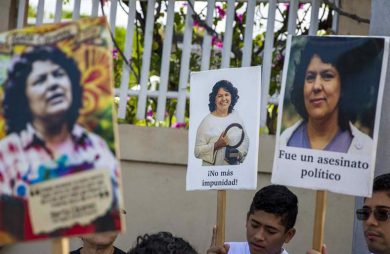
Photo: EFE
teleSUR | March 2, 2017
One year after the assassination of Honduran Indigenous leader Berta Caceres, human rights organizations and Indigenous communities continue to demand justice in the case, while the international branch of the struggle pressures to an end of U.S. funding for police and military forces accused of human rights abuses in the Central American country.
Caceres’ family sent a letter Thursday to U.S. Representative Norma Torres to ask for her support for the Berta Caceres Human Rights in Honduras Act, which was reintroduced the same day to the House of Representatives after stalling without adequate support since last year. The bill seeks the suspension of Washington’s security aid to Honduras until the country fulfills more rigorous human rights conditions — including an end to abuses by the police and military and justice in cases like Berta Caceres’ murder.
“It is increasingly clear that the government of Juan Orlando Hernandez is unwilling to act decisively to stop the killings of social activists in Honduras and to conduct honest and thorough investigations of killings and attacks,” Caceres’ family members state in the letter to Torres, urging her to “stand with” them and with Honduras. “In addition, the government has consistently failed to respect basic indigenous land rights, as it is required to do under its international treaty obligations.”
The original U.S. bill inspired by Caceres’ murder paints a grim picture of Honduras’ grave human rights situation, including the lack of justice in cases like Caceres’ murder. “Impunity remains a serious problem, with prosecution in cases of military and police officials charged with human rights violations moving too slowly or remaining inconclusive,” it states, adding that the U.S. State Department itself reported in 2015 problems of “corruption, intimidation, and institutional weakness of the justice system” in Honduras.
Caceres’ family addressed the letter to Torres to ramp up individual pressure for support of the bill. Torres, the first and only Central American in Congress and the founder of the bipartisan Central American Caucus, has faced criticism for aligning herself with the Honduran government, backing Washington’s controversial Alliance for Prosperity security aid package for Central America’s Northern Triangle and for refusing to support the Berta Caceres bill.
“We believe that your support for the Berta Caceres Human Rights Act will further strengthen your standing as an advocate for Central Americans and human rights, both in the U.S. and Honduras,” the family wrote in its letter to Torres, imploring her endorsement of the bill.
Caceres’ family also highlighted in the letter the involvement of active and former members of the military — including suspects trained at the infamous U.S. School of the Americas — in her murder, underlining the urgent need for more rigorous conditions on security aid to Honduran state forces. A former member of the military police in Honduras revealed to the Guardian that her name had been at the top of a “hit list” that a U.S.-trained unit received.
“A government that fails to protect its citizens and whose security forces are implicated in attacks and killings of activists should not be receiving security funding and training from the U.S. government,” the letter stressed, adding that Caceres’ murder is only one example among scores of assassinations, attacks and other forms of intimidation targeting activists in the country.
According to a recent report by the international rights organization Global Witness, 120 land and environmental defenders have been killed in Honduras since 2010 after an increase in state-sanctioned abuses in the wake of the 2009 U.S.-backed military coup.
Meanwhile, in Honduras, members of the organization that Caceres founded — the Civic Council of Popular and Indigenous Organizations of Honduras or COPINH — held a march Wednesday in the capital city Tegucigalpa demanding justice one year after her death.
They blasted Honduran authorities over the fact that, to this day, the motive for her assassination has not been identified and perpetrators in the killing not brought to justice. Demonstrators with banners shouted slogans demanding that authorities arrest the masterminds behind Caceres’ murder.
Caceres rose to international prominence for leading the Indigenous Lenca people in a struggle against a controversial hydroelectric dam project in the community of Rio Blanco that was put in motion without consent from local communities. She was also a key leader in the post-coup resistance movement that demanded a constituent assembly to rewrite the Honduran Constitution.
For her environmental and land defense work, she was awarded the prestigious 2015 Goldman Environmental Prize, while at the same time suffering dozens of death threats and other forms of harassment. Berta Caceres was shot dead just before midnight March 2, 2016, when gunmen stormed her house and attacked her.
Caceres’ family claim that the Honduran company behind the hydroelectric project she fought against, Desarrollos Energeticos or DESA, and the Honduran government hired contract killers to murder her and other activists.
Her family and fellow activists insists that her legacy will continue to inspire a movement for rights and justice.
In a statement ahead of the anniversary of her murder, Caceres’ COPINH reiterated calls for justice and an end to unwanted corporate projects on Indigenous land and vowed to forge on in the struggle that Caceres championed in the name of a “just society where life is respected.”
“One year after Berta’s murder, she continues teaching us that ideas cannot be killed and the processes of the people cannot be stopped,” the organization said. “May she continue to be present and our task continue with her legacy of resistance and struggle against injustice.”
RELATED:
Honduras Is the Deadliest Country for Environmental Activists
Ekos Poll: Canada Should Support Israeli Sanctions Not Demonize Them
By Murray Dobbin | CounterPunch | March 3, 2017
Foreign policy is one of those areas of democratic governance that doesn’t often get on the public’s radar. But when it does it provides citizens with a kind of unsullied opportunity to apply their values. That is, unsullied by considerations of self-interest, we get to ask what is the right thing to do?
Governments, of course, aren’t quite as free to make such decisions given that they have so-called “national interests” to consider. But Canadians should be able to expect from their federal government that their foreign policy conforms closely to their values.
When it comes to Canada’s policy towards Israel the Trudeau government, aping its predecessor, is several country miles from reflecting Canadian values. That is the irrefutable conclusion of an Ekos poll whose partial results were released February 16th. A second batch of survey results released yesterday (all survey results can be found here: focussed on the issue of whether or not Canadians think it is appropriate to use sanctions and/or boycotts to pressure Israel to obey international law.
The results demolish conventional wisdom on this question. Respondents were asked – in the context of the UN Security Council denunciation of settlement building in the West Bank – “… do you believe that some sort of Canadian government sanctions on Israel would be reasonable?” Overall, 66% expressing an opinion answered yes. But that number is heavily skewed by Conservative supporters, 70% of whom reject sanctions on Israel. Openness to sanctions on Israel by supporters of other federal political parties ranged from 75% for Liberals to 94% for Bloc Quebecois supporters. Eighty-four percent of NDP supporters believed sanctions on Israel would be reasonable.
Levels of acceptance for the Palestinian call for a boycott of Israel was even higher with fully 78% of those with an opinion stating they believe the Palestinians’ call for a boycott is “reasonable.” Again, Conservative supporters expressed radically different views from respondents supporting other parties: 51% rejected a boycott. Supporters of other parties who were receptive to the Palestinian call for a boycott ranged from 88% for Liberal supporters to 94% for the Bloc Quebecois.
Flashback to February 2016, when Parliament adopted a Conservative motion (by a vote of 229-51) condemning Canadian individuals and organizations who promote the Palestinian call for a boycott. That shameful assault on freedom of expression was supported by the Trudeau government. Only the NDP and Bloc opposed it.
When asked if they supported the passing of this resolution a majority of respondents expressing an opinion – 53% – said no while half that that number, 26%, said yes. Only 20 % of Liberal supporters supported the resolution while 55% disagreed with it.
Most Canadians still have little idea of just how sycophantic the Trudeau Liberals are when it comes to support for the right-wing government of Benjamin Netanyahu, particularly when it comes to U.N. votes on Palestinian rights and Israel’s violations of international law.
The Trudeau government has cemented Canada’s reputation as an embarrassing outlier when it comes to UN votes on Israel. Since October, 2015 when it came to power, the Liberal government has voted against United Nations resolutions that were critical of Israel on over 25 occasions. In fact, it has never voted in favour of a U.N. resolution that is critical of Israel. Which illustrious democracies does Canada find itself allied with in these votes? Besides Israel and the US, it’s loyal benefactor, our fellow-travellers are normally Micronesia, Palau and the Marshall Islands. Most of these resolutions pass by a vote of 156 or 158 to six or eight (with our EU allies voting for or abstaining).
Some of the resolutions Canada actively opposed should shock Canadians. The Trudeau government opposed a U.N. resolution that reaffirmed “… the importance of Israel’s accession to the Treaty on the Non-Proliferation of Nuclear Weapons [NPT].” Another resolution, supporting “The right of the Palestinian people to self-determination…” was opposed by the Liberals as was a resolution that almost precisely reiterates the government’s official policy – that “Israeli settlements in the Occupied Palestinian Territory, including East Jerusalem…” are an obstacle to peace.
Last December the U.N. Security Council voted unanimously (with the US abstaining) to declare that Israeli settlements on territory intended for a Palestinian state were a “flagrant violation under international law and a major obstacle to the achievement of… peace” between Israel and Palestine. Canada remained absolutely silent as it was (effectively) when Israel passed its “land grab” law which retroactively legalises settler homes on private Palestinian land.
What could possibly justify Trudeau’s immoral and frankly irrational stance when it comes to promoting peace between Israel and the Palestinians? In determining its policy towards Israel the Trudeau government has three apparent motivations at play: defending Israel’s right to exist, tending to Canada’s specific national interests and reflecting Canadian values.
None of these shine any real light on Canada’s continued blanket support for the Netanyahu government. It is being increasingly argued by Israel’s friends that the trajectory of that country today is in fact the biggest threat to Israel’s existence: a one-party state that can be Jewish or democratic, but not both. Canada on its own has no compelling “national interests” in the Middle East – except as a yes man for the US Empire.
And lastly, Trudeau’s inexplicable stance is overwhelmingly at odds with Canadian values. Not only do large majorities see Israel in a negative light, they reject by 91% the notion that criticism of Israel is necessarily anti-Semitic as implied in the Commons resolution. Flying in the face of Trudeau’s cowardly denunciation of BDS supporters are 75% of his own party supporters who are open to sanctions and 88% who say the same of boycotts.
Justin Trudeau has a lot of explaining to do.
MURRAY DOBBIN, now living in Powell River, BC has been a journalist, broadcaster, author and social activist for over forty years. He now writes a bi-weekly column for the on-line journals the Tyee and rabble.ca. He can be reached at murraydobbin@shaw.ca
Israel’s Anti-Semitism Smears Backfire
By Ann Wright | Consortium News | March 1, 2017
An often-used tactic to squelch criticism of Israeli state policies toward the Palestinians is to call the criticism anti-Semitic. The sponsors of the event become afraid of the label, anti-Semitism, false as it is, and cancel the event to avoid any controversy. The tactic is used widely across Europe and the United States.
This week, the talk that I was to give in a room at the Rome City Hall about the Women’s Boat to Gaza and the conditions in Gaza was cancelled 24 hours before the event by the council member who had agreed to arrange for the room. His staff revealed that he had gotten intense pressure from the Israeli Embassy and Rome’s Jewish Community Association to stop the presentation.
But that was not the end of the story. In a fast-moving media blitz, organized by Italy’s Boycott, Divestment and Sanctions program, two of Rome’s newspapers wrote of the cancellation and several radio stations reported on it. BDS Italy scheduled a press conference about the cancellation in the plaza in front of the City Hall at the time the talk was scheduled. About 20 representatives of the news media attended, a much larger number than would have attended the talk itself.
Due to the number of media and the questions concerning the cancellation, Marcello de Vito, President of the Rome City Council, invited three of us to come into the City Hall to discuss the cancellation. This invitation provided us with the opportunity to discuss the conditions in Gaza and the West Bank and the nonviolent tactics such as BDS and Boats to Gaza to bring international attention to the harmful policies of the State of Israel.
From the questions, it was apparent that the President, another City Council member and their staff knew little about the Israeli blockade of Gaza, the illegal settlements, the apartheid wall, the numbers of Palestinian children and youth held in Israeli jails, and the theft of Palestinian resources by Israeli companies.
Something similar happened last year in Bayreuth, Germany, when the prize for Tolerance and Peace, which had been awarded to CODEPINK: Women for Peace, was cancelled by the Mayor after two reporters, known for writing spurious articles, alleged that CODEPINK was an anti-Semitic organization. Following an extensive letter-writing campaign from members of the German Parliament and others who know that CODEPINK’s actions challenging the policies of the State of Israel are not anti-Semitic, the Bayreuth City Council voted to reinstate the award amid much publicity.
Also, last year, a conference in which grandmothers who had been through World War II were to speak was cancelled because of similar allegations. Defenders of Israeli policies targeted 90-year old Hedie Esptein, a vocal critic of Israeli treatment of Palestinians, although her parents had been killed in the Holocaust and she had survived by being sent to England as a part of the Kindertransport,
Responding quickly to false allegations of anti-Semitism is key to blunting the Israeli government’s offensive toward those who challenge the illegal and inhumane policies toward Palestinians. In the case of the Rome cancellation, the pushback from BDS Italy created more publicity about the plight of the Palestinians than the event itself would have.
Ann Wright served 29 years in the U.S. Army/Army Reserves and retired as a Colonel. She was a U.S. diplomat and served in U.S. embassies in Nicaragua, Grenada, Somalia, Uzbekistan, Kyrgyzstan, Sierra Leone, Micronesia, Afghanistan and Mongolia. She resigned from the U.S. government in March, 2003 in opposition to President Bush’s war on Iraq.
Two British universities halt pro-Palestinian events
Press TV – February 28, 2017
Two British universities have been accused of undermining freedom of speech after cancelling an annual pro-Palestinian event aimed at raising awareness about human rights violations in the occupied territories.
The accusation was leveled on Monday after the University of Exeter and the University of Central Lancashire (UCLan) announced the cancellation of a pro-Palestinian student-run event called Israel Apartheid Week.
Students at Exeter were barred from giving a street theater performance called Mock Checkpoint, in which some participants were to dress up as Israeli soldiers while others performed the roles of Palestinian victims.
The event had been approved by the student union at the university but was banned for “safety and security reasons” less than 48 hours before commencement. An appeal against the decision was also refused.
Members of Friends of Palestine Society at Exeter accused the university of censoring students, saying, “They are not allowing freedom of speech – by cancelling an event that was in support of Palestinian activism and for Palestinian rights; they are directly censoring us.”
Professors react
The move prompted almost 250 academics, including 100 professors, to sign a letter denouncing attempts by university officials to silence campus discussion about Israel and its treatment of Palestinians.
“These are outrageous interferences with free expression, and are direct attacks on academic freedom,” the letter noted. “As academics with positions at UK universities, we wish to express our dismay at this attempt to silence campus discussion about Israel, including its violation of the rights of Palestinians for over 50 years.
“It is with disbelief that we witness explicit political interference in university affairs in the interests of Israel under the thin disguise of concern about anti-semitism,” it added.
More than half a million Israelis live in over 230 illegal settlements built since the 1967 Israeli occupation of the Palestinian territories of the West Bank and East Jerusalem al-Quds.
Much of the international community regards the Israeli settlements as illegal because the territories they are built on were captured by Israel in a war and are hence subject to the Geneva Conventions, which forbid construction on occupied lands.
Nevertheless, the Israeli regime continues to build more settlements and expand the existing ones.
Featured Video

Trita Parsi: Israel Set a Trap for Total War in the Region
or go to
Aletho News Archives – Video-Images
From the Archive
Zionism’s Violent Legacy
By Donald Neff | Washington Report On Middle East Affairs | January 1996
On January 4, 1948, Jewish terrorists drove a truck loaded with explosives into the center of the all Arab city of Jaffa and detonated it, killing 26 and wounding around 100 Palestinian men, women and children.[1] The attack was the work of the Irgun Zvai Leumi – the “National Military Organization,” also known by the Hebrew letters Etzel – the largest Jewish terrorist group in Palestine. The Irgun was headed by Revisionist Zionist Menachem Begin and had been killing and maiming Arabs, Britons and even Jews for the previous ten years in its efforts to establish a Jewish state.
This terror campaign meant that at the core of Revisionist Zionism there existed a philosophical embrace of violence. … continue
Blog Roll
 Aletho News
- Trita Parsi: Israel Set a Trap for Total War in the Region
- Trump’s Iran war is on an Israeli leash
- Saudi oil boss issues global supply warning
- Riyadh Says Its Oil System Is Intact. The Numbers Say Otherwise.
- Trump and Netanyahu Want to “Finish the Job” on Iran
- US ‘one-sided dictation’ not Iran’s beliefs makes rational talks impossible: Baghaei
- Iran’s Next Strike May Not Explode. It Could Shut You Down /Col Doug Macgregor
- Iran: US political targets legitimate if assassinations return
- Iraq shuts key border crossing with Iran under US pressure: Report
- Undersea Internet cables could be targeted in retaliation for attacks on Iran: IRGC deputy chief
- If Americans Knew
- The Israel Lobby’s Changing Fortunes
- AIPAC has become such a political liability that it’s shifting to a more “nimble” approach to buying politicians
- At least 160 Israeli settler attacks in 2 weeks
- Will Gaza’s Ancient Christian Community Disappear Forever?
- Israel’s vision of regional security rests on keeping Arab states weak
- Heidi Levine recounts how Palestinian youths helped save her in settler attack
- DAILY UPDATE: Latest essential news on Palestine, Israel, & region
- Trump’s Intensifying Sabotage of the ICC, for Israel’s Sake
- Israeli military detain US and UK volunteers in West Bank including Democratic NY politician Brad Lander
- Americans at National Conservatism Conference held in Israel this year criticize Israel
- No Tricks Zone
- E-Cars Reduce CO2 Emissions By Only 41% Compared To Internal Combustion Engine Vehicles
- Predictions Made By Renowned Climate Professor Over Past Decades Have Been Proven To Be Poor
- New Study Suggests Large Regions Of The Pacific Ocean Have Been Cooling For The Last 80 Years
- Germany’s Green Energy Debacle: High Energy Costs Force Kahla Porzellan to Close After 182 Years!
- New Study: 50 Years Of The Most Aggressive ‘Net Zero’ Policies Can Only Affect The Global Climate By 0.03°C
- US September “Heat” Was No Record…Many Records Set Decades Ago
- Latest European Green Energy Debacle; Portugal’s Largest Flagship Solar Park Insolvent!
- Green Energy Debacle: German Expert Professor Fritz Vahrenholt Warns Of Severe Economic And Social Consequences
- Two More Paleo Reconstructions Affirm Meters-Higher Sea Levels Across Ireland, Brazil 7000-6000 Years Ago
- New Study: Earth And Venus Surface Warmth Largely Explained By Convection And Lapse Rate, Not CO2 Or Radiation

