269 die in Egypt jails after Morsi ouster: Rights body
Press TV – June 27, 2015
A Cairo-based rights group has revealed that as many as 269 people have lost their lives in Egyptian custody since the 2013 ouster of Mohamed Morsi, the country’s first democratically-elected president.
The Egyptian Commission for Rights and Freedoms (ECRF) disclosed the data in a report issued on Friday to mark the United Nations International Day in Support of Victims of Torture.
The group said 130 of the fatalities, which comprised 68 political detainees and 62 criminal defendants, had occurred under Egypt’s military-appointed interim President Adly Mansour, who was trusted with the country’s leadership after Morsi’s overthrow from July 3, 2013, to early June 2014.
The report also noted that among the deaths, 143 had occurred due to systematic medical negligence and 32 others as a result of torture practices.
The ECRF also documented 139 deaths in Egyptian prisons and detention facilities since President Abdel-Fattah el-Sisi ascended to power last year.
Morsi, affiliated with Egypt’s Muslim Brotherhood movement, was elected as the country’s president in 2012 but was ousted only a year later in a military coup led by the then army chief, Sisi.
Sisi, who had also served as military chief under former dictator Hosni Mubarak, later campaigned for and won the country’s presidency in controversial elections in June 2014.
The Sisi administration has been cracking down on any opposition since Morsi was ousted, banning the Muslim Brotherhood movement.
Thousands of the supporters of Morsi and the Muslim Brotherhood movement have also been jailed, with many of them, including Morsi, receiving death penalties in mass trials.
Report: 90% of Palestinian prisoners suffer continuous, systematic torture in Israeli jails
MEMO | June 26, 2015
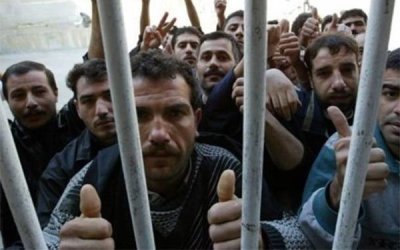
As many as 90 per cent of Palestinian prisoners have been subjected to various types of torture and abuse in Israeli jails, a report revealed yesterday.
The report by the Palestinian Committee for Prisoners’ and Ex-Prisoners Affairs, which came on the occasion of the International Day in Support of Victims of Torture, highlighted the increasing practice of torture against Palestinian prisoners after the kidnapping of three settlers in June 2014.
According to the report, torture is systematically practiced by the Israeli Security Agency, Shin Bet, under legal cover from the Israeli government, the Israeli Legal Counsel and the Supreme Court who allow investigators to use violence and internationally prohibited means during interrogations under the pretext that the detainees pose a “security risk for the state of Israel”.
The Committee’s report points out that Israel’s use of torture is considered a war crime according to the Geneva Convention and the International Criminal Court, however the Israeli penal code gives immunity for Shin Bet interrogators.
Earlier this week, the Israeli Knesset extended a law which allowed security officials not to record the interrogation of detainees held on security charges, which many believe leaves them open to being tortured and forced to confession under duress.
The report said the Israeli intelligence used brutal and immoral methods of torture during interrogations including: severe beatings, insults and curses, isolation in solitary confinement, no access to lawyers, arrest of family members as a means of pressure, sexual harassment, sleep deprivation, violent shaking, electric shocks and stress amongst others.
According to the report, the percentage of complaints on the use of torture increased after mid-2014 to reach twice the number documented in 2013.
Human rights organisations point out that as many as 850 complaints were filed by Palestinian prisoners against the practice of torture; however the cases were rejected by the Israeli judiciary.
Israel’s Civil Wrongs Law passed on 23 July 2012 prevents Palestinian victims from filing complaints against Israeli officials who committed crimes including torture against them.
New documents yet more evidence of UK & European role in US drone strikes
Reprieve | June 24, 2015
The Guardian and the New York Times have today revealed the existence of documents showing the contribution made by UK intelligence agency GCHQ to US drone strikes in Yemen.
The British Government has to date refused to comment on its role in such strikes, describing them consistently as “a matter for the Yemeni and US Governments.”
However, legal charity Reprieve has previously raised concerns over European complicity in covert drone strikes – considered by many experts to be in violation of international law – through the sharing of intelligence and the provision of infrastructure.
In Germany, Reprieve has helped civilian drone strike victim Faisal bin ali Jaber to bring a case against the Government over the role played in Yemen strikes by the military base at Ramstein.
Meanwhile, in the UK, Reprieve unearthed a contract showing that a high-tech data link had been provided between RAF Croughton – a base leased by the US in Lincolnshire – and Camp Lemonnier in Djibouti, from where US strikes against Yemen have reportedly been launched.
Commenting, Reprieve legal director Kat Craig said: “This is yet more damning evidence of the key role played by the UK in the illegal US drone war. This campaign has taken place in the shadows, killing hundreds of civilians while leaving their families with no access to justice. President Obama won’t even confirm it is taking place; while the UK and Germany follow his lead by stonewalling questions on the part they play. It is time Europe came clean on the support it provides to this misguided campaign, which the evidence suggests is making the world a more dangerous place for all of us.”
Israel backs bill to allow secret police interrogations to continue
MEMO | June 24, 2015
The Israeli Knesset is to extend a temporary bill that permits police interrogators not to use audio or video recordings to document interrogations of people suspected of security offences, Arab48.com reported yesterday.
The Legal Centre for Arab Minority Rights in Israel (Adalah) condemned the measure and sent a letter to the Israeli Public Prosecutor and the government’s Judicial Advisor demanding they appeal against the bill.
“This amounts to severe violation of basic prisoners’ rights, including the legal right to remain dignified and have just judicial measures,” Adalah said. “Extending this bill clearly undermines any opportunity to monitor the legality of interrogation measures and confessions raised to the court.”
The Israeli Knesset approved a bill in 2002 demanding security services document the questioning of any prisoner who may get more than ten years in prison for his crimes. The bill included an article which made such documentation unnecessary in cases of security-related offences.
According to Adalah, this article was a temporary measure agreed to remain in place for six years. In 2008, the Knesset extended it until 2012 and then it was extended to 2015. Adalah said Palestinian prisoners are affected most by this article.
Israel issues 30 administrative detention orders during June
Palestine Information Center – June 24, 2015
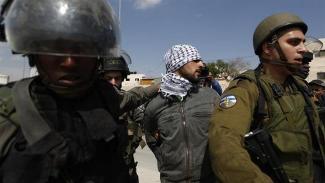 AL-KHALIL – Israeli courts issued, since the beginning of June, 30 administrative detention orders against Palestinian prisoners from al-Khalil, Prisoners Media Center said.
The center stated that 43% of administrative detainees held currently without charge or trial in Israeli jails are from al-Khalil.
As a whole, there are 450 administrative detainees in Israeli jails including four MPs.
The center pointed out that Israeli administrative detention policy mainly targets youth activists, students, MPs, and prisoners’ defenders as an attempt to prevent them from exposing the reported Israeli human rights violations.
“Lack of public interest” in Jewish nationalist crimes

Yesh Din | June 23, 2015
We can see just how seriously the Israeli government takes nationalist crimes from the following case.
On July 26, 2010, a large group of Israeli marauders, whom eyewitnesses said came from the direction of the settlements of Yitzhar and Bracha, allegedly made their way to land belonging to the nearby Palestinian village of Burin. According to witnesses, the marauders burned hundreds of olive trees, some of them more than a century old. Furthermore, they attacked the villagers with stones and in a few cases with clubs, and stoned the houses of the village.
On that same day, some of the victims lodged a complaint with the Israeli police.
In August 2011, i.e. more than a year after the incident, the police informed Yesh Din that the case was turned to the attention of a prosecutor – that is the last we heard of the story for two years. In August 2013, the Shomron Prosecution Unit bothered to update us saying that they had closed the case back in December 2012. Three months later, we received the investigation material of a three-year-old incident, and tried to see whether there is any point in appealing the decision to close the case.
To the utter surprise of our attorneys, who were under the impression that the police closed the case for lack of evidence, the case files contained quite a bit of evidence. At the same time and place of the incident, three Border Policemen detained two Israeli civilians – A. and M. – after police officers testified that they saw them throwing stones at Palestinians.
The testimony of a cop, as well as the detention of suspects at the scene, is generally enough cause for prosecutorial action, particularly since the government takes nationalist crime seriously, as it keeps claiming. Therefore, we appealed the decision to close the case in December 2013, demanding of A. and M. be prosecuted on suspicion of throwing stones and assaulting an officer; we also demanded that the investigation into the question of who attacked one of our clients with an iron rod and set his olive grove on fire continue.
That’s when events took a surrealistic turn. In response to our appeal, the prosecution claimed that they are well aware that there is enough evidence to indict A. and M., but said it would not do so – since it sees no reason to interfere with the decision of the Police Prosecution Unit, which closed the case for lack of public interest.
According to the prosecution, since both sides engaged in stone throwing, and since there is no precise information about how the incident began, and since there was no equivalent interrogation of Palestinian suspects, there is simply no public interest in putting the Israeli marauders on trial.
To quote our sarcastic reply, sent in April by Attorney Noa Amrami:
“To sum, two Israeli civilians woke up one morning, arrived at the village of Burin and the homes and land of our clients, threw stones at them and beat them. Is there any doubt here as to who is the attacker and who the defender? With all due respect, we are not dealing with a kids’ squabble at school here, but with a criminal, methodical action of terrorizing the villagers of Burin, who suffer from the violence of the Israeli civilians residing in the region.”
What the government prefers to call nationalist crimes — and we call ideological crimes — has become a national scourge. As we emphasize here repeatedly, this is not an incident of random violence, but rather violence with a clear political goal: dispossessing Palestinians of their land so it may be transferred to Israeli civilians. The police’ failure at resolving these crimes is systematic and well documented: out of 1,045 investigation cases reviewed by Yesh Din in 2005-2014, only 7.4 percent turned into indictments. 85.2 percent of the cases were closed due to the police’s investigative failure, usually because the police failed in finding suspects or gathering enough evidence to try them.
The village of Burin is a stark example of criminal actions carried out by Israeli civilians: in the years 2005-2013 Yesh Din documented 103 incidents of criminal activity, mostly violent, by Israeli civilians against Palestinians from the village. Yesh Din documented a series of violent actions – both by Israeli forces and Israeli civilians – toward the villagers. If we were to take the official rhetoric about the need to fight ideological crime seriously, we would expect any incident in Burin would be dealt with to the fullest extent of the law.
Yet in practice, even when the police detain suspects and the prosecution has enough evidence to indict them, the case is somehow closed. This time the excuse was “lack of public interest.” Bear this in mind during the next press conference when solemn promises that the police will do its best will be made.
We have asked that the appeal be reconsidered. We’ll keep you posted.
Egypt builds trench along Gaza border
Ma’an – June 22, 2015
CAIRO – The Egyptian military has constructed a trench along the border of Rafah to prevent smugglers from operating in the area, the army said.
The trench is 20 meters deep and 10 meters wide and is located two kilometers from the border with Gaza outside of Rafah city.
The new infrastructure — part of a larger buffer zone being constructed in the area — is intended to prevent smugglers from driving their vehicles to the opening of tunnels along the border.
A military official said that the army plans to expand the trench and install watchtowers along its length.
Work on the buffer zone on the Egyptian side began in February 2014, but was at the time slated to extend only about 300 meters in urban areas and 500 meters in rural areas.
After a bombing killed more than 30 Egyptian soldiers in the Sinai in October 2014, however, the military stepped up a campaign to build the buffer zone amid accusations of Hamas support for the group that carried out the attack.
Hamas, which denies Egyptian accusations, has suffered poor relations with the Egyptian government ever since the democratically-elected Muslim Brotherhood, with whom they were closely allied, was thrown out of power in July 2013.
Deteriorating relations between Egypt and Hamas come at a high price to Gaza’s 1.8 million residents for whom the smuggling tunnels have served as a lifeline to the outside world since Israel imposed a crippling siege on the coastal enclave in 2007.
Bush-era officials can be sued for abuse of 9/11 detainees – court
RT | June 18, 2015
A federal appeals court reinstated a lawsuit against former Justice Department and law enforcement officials for violating the rights of men perceived as Arab or Muslim who were rounded up after 9/11 and held for months, sometimes in solitary confinement.
In a 2-1 ruling, the Second Circuit Court of Appeals decided that Bush-era heads of the Department of Justice, FBI and Immigration and Naturalization Service (INS), can be sued for violating the constitutional rights of 762 men, described as “out-of-status aliens” because they either overstayed their visas or worked without permits.
The case, known as Turkmen v. Ashcroft, was filed in 2002 by the Center for Constitutional Rights (CCR). It names as defendants the former Attorney General John Ashcroft, former FBI Director Robert Mueller and former commissioner of the Immigration and Naturalization Service James Ziglar. The CCR is also suing the officials in charge of the Metropolitan Detention Center (MDC) in Brooklyn, New York, and the Passaic County Jail in Paterson, New Jersey, where the plaintiffs were being held for anywhere from three to eight months.
A federal court dismissed the case in 2013, after concluding there was no evidence the officials had any “intent to punish” the plaintiffs. However, the Second Circuit Court of Appeals reversed that decision, ruling that the Justice Department officials were not entitled to “qualified immunity,” and that the confinement conditions of the immigrants were actually established with “punitive intent.”
“We believe, then, that the challenged conditions—keeping detainees in their cells for twenty‐three hours a day, constructively denying them recreation and exposing them to the elements, strip searching them whenever they were removed from or returned to their cells, denying them sleep by bright lights—were not reasonably related to a legitimate goal, but rather were punitive and unconstitutional,” judges Rosemary Pooler and Richard Wesley wrote in the majority opinion.
Pooler and Wesley said the government officials presumed that “all out‐of‐status Arabs or Muslims were potential terrorists until proven otherwise,” and justified the detentions on national security grounds.
The lawsuit claims the mass detentions were part of the FBI’s “hold-until-cleared policy,” holding the men described as “potential recruits” for Al-Qaeda solely because of their Middle Eastern, North African, or South Asian origin. Of the eight current plaintiffs, six are Muslim, one is Hindu, and one is Buddhist.
“It might well be that national security concerns motivated the defendants to take action, but that is of little solace to those who felt the brunt of that decision,” the two judges wrote.
“We are thrilled with the court’s ruling,” said CCR attorney Rachel Meeropol. “The court took this opportunity to remind the nation that the rule of law and the rights of human beings, whether citizens or not, must not be sacrificed in the face of national security hysteria.”
Benamar Benatta, one of the plaintiffs, said he was “delighted” by the ruling. Cleared for release on November 14, 2001, Benatta remained in solitary confinement until April 30 the following year. … Full article
Israeli forces raid homes in Qaryut to intimidate local activists
International Solidarity Movement | June 17, 2015
Qaryut, Occupied Palestine – In the early hours on Tuesday 16th of June Israeli occupation forces raided several Palestinian homes in the village of Qaryut, near Nablus. The soldiers invaded the homes in search of the Palestinian activist Bashar al-Sadiq Yusuf Moammar (Bashar Qaryouti).
The incident is possibly sparked by the fact that villagers of Qaryout have recently taken up weekly demonstrations, arranged by the PSCC, which Bashar Qaryouti is part of. These are demonstrations against the illegal Israeli settlements that surround the city and continue to annex Palestinian land.
Soldiers invaded at least five different houses in order to find Bashar, and trashed the family homes in the process. Abdullah Qaryouti, whose family fell victim to one of these raids, explained how this included the soldiers locking up the family in one room whilst ransacking the rest of their house using K9’s.
According to Abdullah Qaryouti this is common behaviour for the occupation forces, who invade and ruin Palestinian homes on a regular basis.
The local activists presume the most recent house raids to be part of the ongoing efforts of Israeli forces to intimidate and threaten any resident that participates in non-violent resistance.
 Bashar Qaryouti


Credit to PSCC for the photos, they do not belong to ISM.
Policing and Defending Then and Now
The military and police have become two sides of the same coin
By Philip Giraldi • Unz Review • June 16, 2015
Inevitably the debate over issues that relate to both national security and domestic law enforcement often become mired down in wrangling over legal or constitutional niceties, which the public has difficulty in following as it fixates instead on the latest twist in the Bruce Jenner saga. That means that the punditry and media concentrate on easily digestible issues like potential bureaucratic fixes, budgeting, equipment and training, which presumably are both simpler to understand and also more susceptible to possible remedies. But they ignore some basic questions regarding the nature and viability of the actual threat and the actual effectiveness of the response even as the dividing line between military and law enforcement functions becomes less and less evident.
There has been a fundamental transformation of the roles of both police and the armed services in the United States, a redirection that has become increasingly evident since the 1990s when the conjoined issues of national security and crime rates became political footballs. Response to terrorism and “tough on crime” attitudes frequently employ the same rhetoric, incorporating both political and social elements that place police forces and the military on the same side in what might plausibly be described as a version of the often cited clash of civilizations.
A nation’s army traditionally exists to use maximum force to find and destroy enemies that threaten the homeland. A police force instead serves to protect the community against criminal elements using the minimum force necessary to do the job. Those roles would appear to be distinct but one might reasonably argue that the armed forces and the police in today’s America have become the two major constituents of the same organism more-or-less connected by a revolving door, dedicated to combating a new type of insurgency that comprises both global and domestic battlefields and is no respecter of borders. This has meant at its most basic that there has been a major shift in perception on the part of the security community. Community policing and national defense have abandoned relatively reactive interactions with the community and world for more assertive preemptive roles that see their areas of operation as theaters of conflict analogous to war zones, suggesting to some law enforcement officers that Baltimore is at least occasionally somewhat like Fallujah.
That means that some police forces have allowed considerable space to develop between themselves and the communities they are supposed to guard. Many now see themselves less as crime solvers and protectors of the public, instead increasingly embracing their role as a first line of defense against terror and social unrest. As a consequence, police in today’s America are inevitably tasked with maintaining public order in a fashion that once upon a time would have likely been the responsibility of the military equipped and trained as well as far more numerous National Guard.
This tendency to expand and redirect the police role gained momentum in the early 1990s, when law enforcement began to focus on terrorism in the wake of Oklahoma City and the first World Trade Center bombing. After 9/11 it picked up speed when the Bush Administration rushed to adopt a preemptive foreign policy that fit in nicely with a more assertive role by police. Special Weapons and Tactics (SWAT) teams were symptomatic of the change. Originating in Los Angeles in the 1960s, SWAT units spread to nearly every major and many minor police departments whether there was or is any need for them or not. Police departments, embracing having an exciting new weapon and looking for excuses to use it, began to allocate tasks that normally had been the responsibility of beat or patrol officers, including serving warrants. SWAT delivery of what are described as “no-knock” warrants that are frequently issued without any real justification and sometimes based on faulty intelligence has consequently become a bete noire for critics of police overreach. The warrants are sometimes served in the middle of the night by heavily armed officers and might well be preceded by the use of battering rams and “flashbang” grenades, resulting in numerous tragedies for those on the receiving end. With SWAT teams attracting the elite police officers, community policing inevitably has suffered, frequently being assigned to new and less experienced officers.
Police and the military now share equipment, training and doctrine. The equipment, most of which is useful for fighting a war but of marginal utility for police work, is frequently highly visible and changes both how local law enforcement is perceived and how it operates. Arizona alone has received 29 armored personnel carriers, 9 military helicopters, 800 M-16 automatic rifles, 400 bayonets, and 700 pairs of night-vision goggles.
Morven, Georgia, population 600 and blessed by a low crime rate, has received over $4 million worth of military equipment. This led to the formation of a SWAT team supported by a Humvee and an armored personnel carrier. Boats and scuba gear came together to form a dive team, even though Morven city limits incorporate no body of water deep enough to exploit that capability. The Morven police chief boasts that the equipment would enable him to “shut this town down” and “completely control everything.”
The direct transfers of $5.4 billion worth of surplus equipment from the Pentagon through program 1033 and the purchase of additional hardware by way of grants from the Department of Homeland Security operate with almost no oversight over the actual need for the equipment and little accountability afterwards regarding where it winds up. It has spawned what some have described as a police-industrial complex, which is frequently justified by the alleged terrorist threat even though the equipment is in fact almost never used in response to terrorism related situations.
Today’s police approach every potential conflict situation with overwhelming force because that is what the military does, considering “force protection” as its number one priority. The army and law enforcement also share employees, guaranteeing that the mindsets within the two organization will be highly compatible. There are no national figures compiled on how many policeman have been in the military, but anecdotal evidence from various departments suggest that the percentage is somewhere between 20 and 60 per cent, many of whom also continue to serve in the Reserves or National Guard. A veterans’ placement service called Hire Heroes estimates that fully twenty per cent of all ex-soldiers seeking civilian employment look for work in law enforcement as a first choice.
The Federal government also encourages police departments to hire veterans through its Community Oriented Policing Services (COPS), which has provided $114.6 million in incentive grants to 220 cities nationwide. There is frequently a comfortable fit psychologically. The transition from military to police is particularly smooth currently because their self-perceptions as “forces for peace and security” working in environments where they are not appreciated or even welcomed is nearly identical.
On the plus side when turning soldiers into cops, former military are accustomed to operating in a highly disciplined and rule-driven top-down organization, but on the negative side veterans who actually experienced significant combat are much more accustomed to rely on their weapons than are policemen in most working environments, a predilection that sometimes produces avoidable fatal consequences. The window of aggression acceptable to a soldier on a combat patrol is and should be radically different than that of a policeman in an American city.
Returning soldiers who experienced significant combat sometimes come home with mental health issues to include Post Traumatic Stress Disorder (PTSD), with many veterans conceding that after discharge from the service there are sometimes numerous psychological issues that have to be worked through. Police departments do their best to manage that issue through psychiatric screening, but detection of problems is not always that easy, particularly if the job applicant wants the job and is not being particularly forthcoming. Many concede that for ex-soldiers thus afflicted leaving one environment full of “violence, tension, stress [and] anxiety” and landing into something similar would not exactly be therapeutic.
Law enforcement in the United States has also benefited not only from the surplus weapons it receives from the Pentagon but also from training grants and logistical support from the Department of Homeland Security. Many SWAT teams are trained by and often include former or current Special Forces soldiers. Some departments even use both public and private grant money to send officers to Israel to train with the Israeli National Police and that country’s Defense Force. The training inevitably focuses on counter-terrorism, anti-riot procedures, intelligence gathering and crowd control, reinforcing the impression that such activities that once upon a time might have been regarded as peripheral to police work are now the first priority. There are also reports that some American police forces are interested in buying an Israeli high tech export called “Skunk,” which is a liquid that can be sprayed from water cannons that allegedly smells like raw sewage and putrefying flesh. It has been used on Palestinian protesters.
But perhaps the biggest unanswered question is “Does terrorism in its many guises actually threaten the United States and will that threat be diminished by more equipment and training as well as a more militarized police force here at home?” Addressing the threat issue is critical as it presents a steady drumbeat for action “to defend the nation” and actually provides much of the popular support for an increasingly robust police response. To be sure, there undoubtedly exists a growing critical consensus that the terrorist threat is largely phony, having been inflated by both political parties for political reasons. Certainly the record of terrorism related arrests suggests that the danger is minimal and those detained in the process are often the product of what many would call law enforcement entrapment. There is actually no evidence that a more militarized police has thwarted terrorist attacks or led to any significant arrests, which rather suggests that the real motive for the increasingly assertive profile for law enforcement might just be to have the tools on hand to intimidate or even put down domestic dissent. If that is so, every American should be concerned about what might be coming down the road.
Featured Video

Trita Parsi: Middle East Unraveling — Are We on the Path to World War?
or go to
Aletho News Archives – Video-Images
New Book
Trans agenda is ‘normalization of sadism’ – US author

RT | September 23, 2026
The US Democratic Party has embraced a transgender agenda that amounts to “the normalization of sadism,” author A.J. Rice has said, warning that radical trans policies would return if the party is allowed to regain power.
Speaking to RT’s America First host Scotty Nell Hughes about his new book, ‘The Curse of the Bearded Lady: How the Trans Mafia Whacked American Sanity’, Rice argued that activists have gained significant influence in schools, medicine, and corporate America while people who questioned the agenda have faced pressure to stay silent.
The author described the “trans mafia” as the sprawling network of people and institutions that have helped the movement gain influence. He singled out parts of academia, wealthy backers, and corporations, and stated that providers of transition-related treatment also have a financial incentive to keep young people in their care indefinitely.
Rice argued that the consequences of these policies ultimately fall on children who are being drawn toward gender-affirming medical treatments and on girls who are expected to share locker rooms or compete in sports with biological males.
He noted that while voters rejected the Democrats’ approach to gender in 2024, the party, which has been “captured by madness,” has since only doubled down and is seeking what is effectively “the normalization of sadism.” … Full report
Blog Roll
 Aletho News
- Refaat Al-Areer Was The Canary In The Coal Mine In Israel’s War On The Truth
- Israeli election committee bars candidate from Knesset race over Gaza war opposition
- French-Lebanese man files war crimes complaint over Israeli attacks
- Mahan Air Flight Lands in China Despite US Threat against Iranian Airlines
- US eyes $10bn fund to rebuild war-battered Gulf infrastructure
- Trump meets Rodríguez near Maduro’s prison as Venezuela’s oil flows to US
- Trita Parsi: Middle East Unraveling — Are We on the Path to World War?
- Iran FM meets with US envoy on UN meeting’s sidelines at American side’s insistence: Report
- Qatar PM calls for Gulf security framework with Iran, says war must be ‘wake-up call’
- China condemns US extortion of Iranian airlines, rejects Washington’s ‘illegal’ sanctions threats
- If Americans Knew
- An error has occurred; the feed is probably down. Try again later.
- No Tricks Zone
- New Study: Earth And Venus Surface Warmth Largely Explained By Convection And Lapse Rate, Not CO2 Or Radiation
- 2025 Nature Paper Claiming Worsening Global Drought Gets RETRACTED …Heavily Flawed
- New Study: ‘Global Drought Shows No Detectable Recent Acceleration Under Climate Warming’
- Economic Masterminds: German Socialists Suggest Taxing Productivity Gains Stemming From Using AI
- The South China Sea Has Not Been Cooperating With The Climate Change Narrative
- Energy Crisis: Germany Enters Heating Season With Historically Low Gas Reserve Fill Levels
- New Study: The Antarctic Ice Sheet Gained Mass From 2020-2024 Due To Staggering Snow And Ice Accumulation
- Study: Ocean Heating Rates From Thousands Of Years Ago ‘Dwarf’ Modern Ocean Heating Rates
- Climate Extremists Target, Attack Large-Scale Power Grid Infrastructure In Germany!
- New Study: Antarctic Ice Melt Has Contributed Less Than 1 Centimeter To Sea Level Rise In The Last 30 Years

