Israel refuses Turkish offer to supply Gaza with electricity
MEMO | December 3, 2014
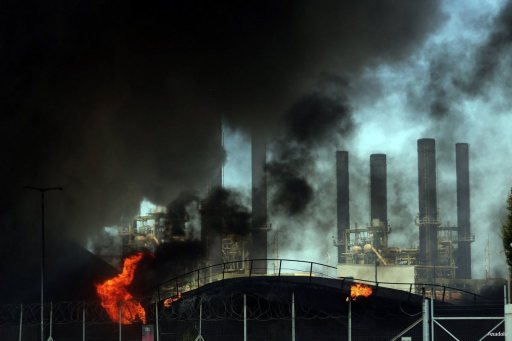
Israel has refused a Turkish offer to send a floating power-generating ship to the Gaza coast to supply the coastal enclave with electricity, Arabs48 reported yesterday.
In the wake of the recent Israeli war on the Gaza Strip, Israel targeted the sole electricity plant in the Strip and massively damaged electricity infrastructure, Turkey offered to cover the electricity shortage.
According to Israeli reports, Turkey has officially asked Israel to issue a permit for a Turkish ship carrying huge electricity generators to be stationed off the Gaza coast.
Arabs48 reported Israeli security sources saying that specialists had found that the infrastructure in the Gaza Strip is not suitable for such a connection and that is why the Turkish offer was refused.
The same sources said that other ideas to solve the electricity crisis in Gaza were proposed, including mobile generators.
Obama appeals order to publish Guantanamo force-feeding tapes
Reprieve | December 2, 2014
The Obama administration has today appealed against a federal judge’s ruling that videotapes showing force-feeding of a Guantanamo prisoner should be released.
The ruling, made by Judge Gladys Kessler in October this year, was the first of its kind and came after sixteen major US media organizations, including the New York Times, AP, and McClatchy newspapers, asked for the tapes to be made public under the First Amendment of the US Constitution.
The tapes show the force-feeding and ‘forcible cell extraction’ of Abu Wa’el Dhiab, who has long been cleared for release. Mr Dhiab is represented by international human rights NGO Reprieve. Reprieve lawyers are virtually the only people outside government to have seen the footage and have described it as ‘disturbing’, but are forbidden under classification rules from revealing its contents.
Cori Crider, a director at Reprieve and Mr Dhiab’s attorney, said: “President Obama promised us the most transparent administration in history – at this point is that promise anything other than a joke? You have to ask who actually watched this footage when making the decision to hide this evidence from the American people. It boggles the mind that the same President who makes speeches asking whether force-feeding is ‘who we are’ can ask a Court, with a straight face, to hide the reality of force-feeding from the press and public.”
“The tapes are a national scandal – but the best approach is to rip off the Band-Aid, confess the mistake, and fix the abuse going on at the base. Obama made the wrong call today, but Reprieve will keep fighting to get the truth in these videotapes out. We believe Americans can handle the truth. They have the right to see the tapes.”
The US Government’s brief is available here.
US protesters demand the right to live
By Eric Sommer | China Daily USA | December 1, 2014
A UN anti-torture panel that is investigating the United States said on Friday it was deeply concerned by what it described as the high incidence of police brutality and shootings – especially against African-Americans – in the US.
The most basic human right is the right to remain alive. The anger which has swept through Ferguson, Missouri, and has boiled over to other cities across the United States, is an elemental protest against those who have been gradually taking away this right.
The killing of unarmed African-American teenager Michael Brown in Ferguson is only the most publicized instance of daily police killing of unarmed people in the US. Statistically, American citizens are much more likely to be killed by a police officer than by a terrorist.
No complete record of police killings in the US is available. But about 400 police killings a year were listed in a US federal database covering only a fraction of the country during a seven year period ending in 2012. Worse, nearly two times a week a black person was killed by the police in the cities listed in the incomplete report.
Among those killed by US police in the past week or so are Tamir Rice, a 12-year-old boy in Cleveland, Ohio, who was shot while playing in a park with a toy gun; Akai Gurley, whose only crime was walking down a dark staircase in his own apartment building in New York City; and Leonardo Marquette Little at a traffic signal in Jacksonville, Florida, who police claimed turned violent while resisting arrest.
To fully understand the epidemic of police killings, we have to see them in the broader context of the progressive militarization of US society. In the past 15 years the US has engaged in a series of wars, military occupations, bombings, air strikes and destabilization of other countries. These wars have inured a large part of the population, and of the police, to endless waves of military activities and related violence. Government reports show that about 20 percent of the US federal government budget is devoted to military costs. But the US War Resistors’ League, taking into account a broader set of military-related costs, estimates that about half the federal budget is devoted to the military.
A large amount of military equipment bought with this money has been turned over to civilian police departments, perhaps out of fear that declining living standards in the US could lead to mass unrest by American working people. … Full article
Several More Abducted in West Bank, Settler Assaults Taxi Driver with Pepper Spray
IMEMC News & Agencies | December 2, 2014
An Israeli settler, Monday, reportedly attacked a Palestinian taxi driver in Jerusalem with pepper spray before fleeing the scene, according to Israeli media sources. Additionally, several more Palestinians were abducted by Israeli forces between Sunday evening and Monday morning.
The Jerusalemite was driving on King George Street when he was attacked by the settler with pepper spray, according to WAFA Palestinian News Agency. He was transferred to hospital for exposure to pepper spray fumes.
Police said a search is underway to locate the whereabouts of the assailant.
In related news, Ynet reports that a 50-year-old Israeli settler was knocked down by a car and critically injured on Monday, to south of Nablus, near the northern West Bank checkpoint known as “Zaatara”.
The vehicle fled the scene of the incident, leaving the man critically injured.
An Israeli army spokesman could not confirm the nature of the incident.
A Ma’an reporter said that Israeli forces closed the Huwwara and Zaatara military checkpoints, following the incident, as Israeli forces search for the driver.
— —
Updated from: 12/1/14 Soldiers Kidnap Six Palestinians In The West Bank
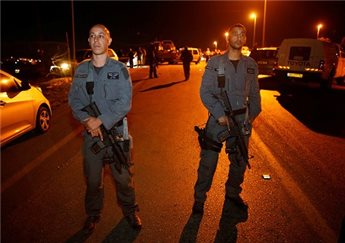 Israeli forces abducted, early Monday and Sunday night, at least 12 Palestinians, including a minor, from occupied West Bank districts, including Jerusalem.
WAFA further reports that Israeli police raided Ras al-Amud neighborhood in East Jerusalem, where they arrested three Palestinians from the Najdi family; Sa’ed, Yazan and Rami, after breaking into and ransacking their families’ houses.
Meanwhile, Israeli forces took into custody three Palestinians while they were attending a trial for their arrested relative, Omar al-Abbasi, in Jerusalem District Central Court.
Forces assaulted ‘Ali Ibrahim al-‘Abassi, 25, for attempting to take a photo of his brother Omar during his court session, triggering a scuffle with al-‘Abbasi’s relatives. As a result, ‘Ali al-‘Abbasi, the uncle, 38, and ‘Imad Mhanna, 27, were arrested along with ‘Ali Ibrahim.
Israeli police also raided al-‘Issawiya, to the north of the city, where troops deployed in streets, assaulting and kidnapping 13-year-old Haitham ‘Ibaid.
According to Ahrar Center for Detainees’ Studies and Human Rights, out of 650 people taken from the occupied West Bank, Gaza and Jerusalem in November, 42 were documented as minors, with 30 having been taken from the city of Jerusalem.
Meanwhile, in the Hebron district, forces raided Beit Kahel village to the northwest of the city, where they kidnapped ‘Imad-addin ‘Asafra, after breaking into his house. They also set up a road block at Halhul Bridge, where they stopped vehicles holding Palestinian-registered plates and examined passengers’ ID cards.
In the Nablus district, Israeli Special Forces raided al-Jabal al-Shamali neighborhood in the city, where they nabbed Tamer Sharaf, age 24.
Soldiers stationed near Zaatara checkpoint, to the south of the city, took one Palestinian under the pretext of carrying a knife. The man has not been identified, as of yet.
In Jenin district, forces set up a flying checkpoint near ‘Arraba, where they abducted Nimr al-Damaj, age 23, a resident of Jenin refugee camp.
Furthermore, in the Ramallah district, forces raided Silwad village to the east of the city, where they broke into and ransacked the house of Bassam Hamed, 40, a former prisoner, and detained the family members in one room before re-arresting Bassam. Forces also handed ‘Anwar Hamed a notice to appear before Israeli intelligence for interrogation.
Forces also raided the Ramallah areas of Deir ‘Ammar and Beitillu, where they broke into several houses, occupied their rooftops, and set up a road block at the villages entrances.
No further kidnappings were reported.
Israeli Forces Kill 9 Palestinians, Kidnap 650, in November
IMEMC News & Agencies | December 01, 2014
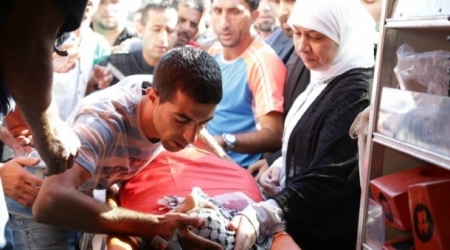
In a report issued on Monday, by Ahrar Center for Detainees’ Studies and Human Rights, Israeli occupation forces were said to have killed 9 Palestinians and detained 650 others, over the month of November.
According to Al Ray, the report noted that 42 out of 650 people taken from the occupied West Bank, Gaza and Jerusalem, were minors, in addition to 17 women. 30 of the minors were taken from Jerusalem.
The report also mentioned that six journalists and two cameramen were taken from Jerusalem, as well, while lawyer Ibrahim Nawaf Al Amer was abducted from the city of Nablus, after a raid on his family’s home.
Fuad Khafsh, director of Ahrar, said that Israeli forces storm the cities of the occupied West Bank when and wherever they please, every day and night.
He noted that the reported numbers are documented by the center, and that it was possible for there to be other cases which could not be documented by the center.
See PCHR reports on Israeli violations in the oPt for further documentation.
Texas Cop Places Woman in Chokehold for Video Recording
UPDATE: Texas Cop Loses Job for Chokehold on Woman, 2nd Cop Disciplined for Ordering Footage Deleted
By Carlos Miller | PINAC | November 30, 2014
A Texas cop placed a woman in a chokehold because she was video recording some type of police activity in the parking lot of what appears to be a fast food restaurant after she refused to provide identification.
It started when Corpus Christi Sergeant J.E. Lockhart stormed up to Lanessa Espinosa, who was standing a good distance away from the investigation, accusing her of interfering – after a nearby cop from another agency accused her of being a “jailhouse lawyer.”
“There is a probable cause for us to be out here,” Lockhart said. “I want to know who you are, so I’m requesting your ID. You fail to ID, I’m going to take you into jail. And that’s law.”
“What’s my charge?
“You’re not being charged with anything.”
“Then I don’t have to show you my ID, sir.”
“You’re involved in an investigation. You want to interfere with an investigation, you’re going to jail for interfering with a police officer in performance of his investigation. Do you understand that? DO YOU UNDERSTAND THAT?”
Espinosa understood that Lockhart was out of line, so she said she was in fear for her safety and took a step back, which was when another cop placed her in a chokehold.
Espinosa turned the camera on herself as she was getting chokehold by the cop from the other agency, whose agency has not been determined because Corpus Christi runs into four counties and I haven’t been able to make the patch out.
That cop then turned her over to Lockhard, who handcuffed her.
Espinosa has not responded for comment from PINAC over the incident, but public records show she was not arrested.
UPDATE:
The video of a Texas woman getting placed in a chokehold and handcuffed for refusing to provide her identification ended up going viral where it was covered by a local television news station at the top of the news hour Monday night.
However, KIII-TV reporter Bill Churchwell finished the segment by providing misinformation about the law when it comes identifying yourself to police, informing viewers that citizens are required to identify themselves whether or not they have been lawfully arrested.
Nothing could be further from the truth.
The Texas Failure to Identify law makes it a crime for people to refuse to identify themselves if they have been lawfully arrested or if the person provides false information if they have been lawfully detained.
However, when news anchor Joe Gazin asked Churchwell about this law, the reporter stated the following:
“Well that is required whether you are a witness or involved in an incident, you are required to tell officers who you are,” Churchwell said.
Churchwell is most likely getting his information from police without bothering to look at the actual statute, which is a big mistake because we all know police are clueless about the laws they are supposed to enforce.
But that is the norm for mainstream media reporters who don’t want to risk questioning their local police department and therefore lose access to the daily information that enables them to report the news without putting in much effort.
However, it didn’t take long for a viewer to set the record straight on KIII-TV’s Facebook page about the law.

Blogger ExCop-LawStudent, a former Texas cop turned law student, also elaborated about the law on his blog.
In the video, a police officer with an unknown police department† claims that Lanessa Espinosa is a “jailhouse lawyer” because she actually knows what the law says. She pointed out that she did not have to identify herself unless she was “being charged.” At that point Corpus Christi Senior Officer‡ J.E. Lockhart comes up and demands ID and tells her that he will arrest her if she doesn’t provide ID.
The problem is that § 38.02, Texas Penal Code, does not authorize an arrest for failure to ID on a mere detention unless the person provides a fictitious name. We’ve covered that several times, here, here, here, here (also in Corpus), here, here, here, and here.
There are several things wrong with the video. First, the officer from the unknown department is choking Espinosa with an arm-bar choke hold. If you look at the video at 1:12, you’ll see the officer’s forearm cutting directly over Espinosa’s adam’s apple in the same manner that killed Eric Garner in New York. The arm-bar choke hold is almost universally viewed as deadly force, and completely inappropriate here when the crime is at best, a misdemeanor under the officer’s mistaken idea of the law.
Second, it is a false arrest. Even more so, it is an arrest because she is exercising her right not to provide identification when he knows (or should have known) that the arrest is unlawful, and that he intentionally denied her of her freedom when he knew (or should have known) that his conduct was unlawful. Folks, that the definition of Official Oppression, § 39.03, Texas Penal Code, and is a Class A misdemeanor.††
Some states have what are called “stop and identify” laws, which requires citizens to identify themselves if they have been detained, but Texas is not one of those states, which is why it only requires a citizen to identify themselves if they’ve been arrested.
There is no state where citizens are legally required to provide identification merely because a cop demands it unless the cop has detained you because he had a reasonable suspicion that you committed a crime.
That doesn’t mean cops won’t demand your identification because they do it all the time, many times under intimidating threats of arrest, which is why we must remain recording in these situations.
And if a cop tells you he has the right to ask you for your identification, tell him you have the right not to provide that identification. … Full article
Hearing collapses in Egypt trial of 494, including Irish teen
Reprieve | December 1, 2014
A mass trial hearing for almost 500 people collapsed this morning in Cairo, with the judge failing to attend and defendants unable to enter a court packed with masked pro-Government supporters.
Reports from the makeshift courtroom in Tora prison suggest that there was no judge in attendance throughout, and the room was full of supporters of the Government – many wearing masks in an apparent attempt to intimidate defence lawyers. The families of the 494 defendants were reportedly barred from entering the room, while the prisoners themselves were not called in.
The group of 494, arrested in August 2013 in a sweeping crackdown on protests, includes several juveniles being tried in violation of Egypt’s Child Laws – among them Irish teenager Ibrahim Halawa, who was 17 at the time of his arrest. Mr Halawa has reported being tortured and denied medical attention during his 18-month detention.
The 494 face potential death sentences, in the latest in a series of mass trials that has attracted condemnation from the UN, US, and Egyptian rights groups.
Today’s hearing has been postponed for another month – continuing a long hiatus in effect since August this year, when a three-judge panel resigned mid-hearing citing their ‘unease’.
The proceedings come days after another court handed down sentences totalling 340 years to 78 children in a mass trial at which their lawyers were not allowed to be present.
Maya Foa, head of the death penalty team at legal charity Reprieve, which is assisting Mr Halawa, said: “The chaos at today’s hearing shows this mass trial for what it is – a mockery of justice. The defendants and their families were shut out of the room, but masked Government supporters were allowed to attend in droves – and the judge didn’t even turn up. Meanwhile, these 494 people have already spent 18 months in prison, and been told they could face death at any time. The international community must intervene now to prevent this travesty from going any further.”
Darren Wilson Investigation Swayed by Favoritism from Start
By William N. Grigg | PINAC | November 25, 2014
“Any time I’m involved in an officer-involved shooting, be it a fatal one or non-fatal, it is always during my initial investigation listed as an assault on law enforcement,” explained the St. Louis County Police Detective who inaugurated the investigation of the Michael Brown shooting. “Officer Wilson … was the victim of the assault we were investigating.”
Once it had been established that the living, armed individual was the “victim” and the dead, bullet-ridden body had belonged to the “assailant,” continued the detective in his September 3 grand jury testimony, “One of the sergeants with Ferguson [gave] me a brief walk-through to start my investigation so I [could] have a logical starting point from where I would start my video, photographs, and looking for evidence.”
That unnamed sergeant, most likely, was the supervisor who had told Darren Wilson to leave the scene after the shooter told him that Brown had tried to take his gun.
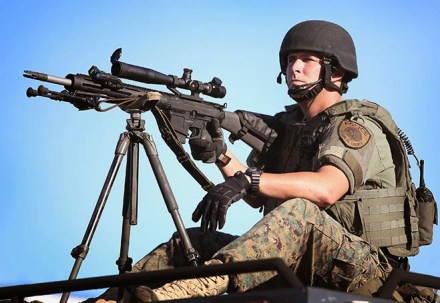
From its inception, the shooting of Michael Brown was not investigated as a potential criminal homicide, and the inquiry was an exercise in validating the killer’s story, rather than testing it against the available evidence. The assumption was that killing was part of his job description – or, as Wilson has subsequently told George Stephanopoulos, “I did what I was paid to do.”
If Wilson had been a member of the productive class, rather than a state employee licensed to dispense aggressive violence, he would have been presumed legally innocent, but required to justify his actions. Because of his occupation, however, Wilson was considered both legally innocent and presumptively correct, and the investigation became an exercise in justifying the shooter’s actions, rather than an inquiry into their propriety.
If Officer Wilson had been “merely” Darren Wilson, the deceased Michael Brown would have been identified as the presumptive “victim.” The shooter would not have been allowed to leave the scene without making a statement to the police, and his associates would not have been allowed to frame the crime scene for the benefit of the investigating detective.
Most importantly, if Wilson had been treated as a homicide suspect, rather than the “victim” of an “assault on law enforcement,” he would not have had the luxury of composing his story at leisure, in consultation with his attorney, to fit the facts as they emerged from the investigation.
“When you got back to the police department, after you washed off and everything, did you ever think at what time that I needed to write a report while it is fresh in my mind?” asked assistant St. Louis County prosecutor Kathi Alizadeh.
“No,” Wilson replied. “The protocol is whenever you are involved in a significant use of force, that you contact your FOP [Fraternal Order of Police] representative and then he will advise you of what to do step by step because they are the clear head in that situation. They have not been through a traumatic experience.” (See the transcript of Darren Wilson’s grand jury testimony, pages 77-78.)
When the shooter is a Mundane – that is, a common citizen, rather than a police officer – he may be similarly traumatized, but he can’t count on the “step-by-step” guidance of clear-headed police officers who have identified him as the victim. One of the first priorities for investigators in non-“officer involved” shootings is to get the original story from the shooter, and compare it against the evidence. As a police officer, however, Wilson wasn’t required to make an initial statement of any kind – either in an incident report, or to any of the investigating officers.
Asked by Alizadeh if he had committed his recollections to paper in a diary or journal, Wilson replied: “My statement has been written for my attorney.”
“And that’s between you and your attorney, then?” asked the unusually helpful prosecutor, who received an affirmative reply.
“So no one has asked you to write out a statement?” the assistant DA persisted.
“No, they haven’t,” Wilson acknowledged. He made one brief reference to speaking with a detective while in the hospital, but that communication was protected by Wilson’s “Garrity” privileges, which means that it could be used only for the purposes of an internal investigation, not in a criminal or civil proceeding.
In his November 24 press conference, St. Louis County DA Robert McCulloch made conspicuous mention of the fact that some witnesses had changed their testimony once their original story was found to be in conflict with subsequently discovered evidence. This is something that happens frequently to homicide suspects, as well. Wilson was never in danger of being caught in that contradiction because he was not treated as a suspect, nor was he required to make a statement to criminal investigators.
During Wilson’s examination before the grand jury, McCulloch’s deputy prosecutors were gentle and deferential, rather than being adversarial. This is to be expected, given that this was a conversation among colleagues.
At several points in his testimony, Wilson made statements that a motivated prosecutor would have aggressively pursued. For example: Wilson – who at 6’4” and roughly 225 pounds is no small man – said that when he grappled with Brown, he felt like a “five-year-old” who was trying to restrain “Hulk Hogan.” He likewise claimed that he had been struck twice by Brown with such force that he was concerned a third blow would be “fatal” – yet the medical examination displayed no evidence of corresponding trauma to his face.
Wilson didn’t explain how the right-handed Michael Brown could have punched the right side of his face while the officer was sitting in the driver’s side of his vehicle. Although Wilson claimed that the initial blows were inflicted while Brown was holding stolen cigarillos in his right hand, no broken cigars were ever recovered, either in the SUV or the surrounding area. The stolen cigars were not found by the medical examiner who arrived on the scene after the shooting. (Interestingly, that examiner never took photos of the deceased, because “My battery in my camera died,” nor did he take any measurements at the crime scene.)
A well-known and highly respected forensic analyst and expert witness on biomechanics and accident reconstruction takes note of several points the prosecution either ignored or minimized to the point of invisibility.
“The big issue as I see it, is how do the cops justify provoking a lethal confrontation with a kid over some damned cigarillos?” the analyst pointed out in an email to me. “Why not wait for ample backup and use non-lethal methods to subdue and arrest for shoplifting? This of course assumes grounds for an arrest. Why were the alleged cigarillos not found? And what did the DA mean when he stated on TV that Brown’s body was on the road 150 feet from the police car? How does an unarmed kid that far away with no weapons constitute an immediate threat to life?”
He also underscores the fact that the unarmed pedestrian Brown, rather than Wilson, may have had the stronger case for self-defense:
“As for what supposedly went on in the passenger compartment with the alleged grabbing of the cop’s arm – this is “consistent with” a kid whose life was threatened by an overly aggressive cop with a gun aimed at him and where the kid was so terrified of an immediate shooting that he felt compelled to take preemptive action to protect himself by disarming the cop.”
If Darren Wilson had been part of the wealth-producing class, as opposed to an armed emissary of the tax-consuming elite, those questions most likely would have been examined in a criminal trial. But, once again, owing to his occupation, this was never going to happen.
Robert McCulloch has a well-earned reputation for deference to the police, and a well-established habit of justifying every use of lethal force, no matter how questionable. Rather than simply seeking an indictment, McCulloch presented the case for the “defense” as well – a characterization that is an odd fit here, given that Wilson – it bears repeating – had been treated as the “victim” in this incident from the beginning.
“Had the prosecution desired an indictment against Ferguson Police Officer Darren Wilson, the presentment would have taken an hour, maybe two, and there would have been a true bill by close of business the next day, well before Michael Brown had been laid to rest,” points outattorney and civil rights advocate Scott Greenfield. “The grand jury isn’t the venue to present `all the evidence.’ That’s what trials are for. The grand jury serves a very limited function, to determine whether sufficient evidence exists so that there is probable cause to proceed to trial.”
A great deal of the media coverage has referred to the Grand Jury’s decision as a “verdict,” which is both technically incorrect and substantively true: Rather than seeking probable cause to indict Wilson, McCulloch and St. Louis County law enforcement built a case to convict Michael Brown of “an assault on law enforcement.”
Given the ambiguity of the evidence, Darren Wilson as a private citizen likely would not have been convicted of murder if the case had gone to trial, but a conviction on a lesser count would be a possibility. Under Missouri’s constitutionally perverse statute dealing with police homicide – which has been criticized by former federal judge Paul Cassell, who is broadly indulgent of killer cops – Officer Wilson was never in danger of being convicted of a crime.
It is not necessary to believe that Michael Brown was the embodiment of winsome innocence (it’s pretty clear that he was not) to take issue with the architecture of official privilege that protects Darren Wilson – and the other armed representatives of the political class – from accountability. The problem, in a single phrase, isn’t “white privilege,” but rather “blue privilege.”
Edmund Burke could have had this case in mind when he wrote these lines from his neglected essay “A Vindication of Natural Society”: “In a State of Nature, it is true, that a Man of superior Force may beat or rob me; but then it is true, that I am at full Liberty to defend myself, or make Reprisal by Surprise or by Cunning, or by any other way in which I may be superior to him. But in Political Society … if I attempt to avenge myself, the whole Force of that Society is ready to complete my Ruin.”
Egypt mass trial tomorrow could see death sentences for 500, including Irish teen
Reprieve | November 30, 2014
A mass trial for almost 500 people will resume tomorrow in Egypt, and could see death sentences handed down to the defendants – including an Irish teenager arrested last year while on holiday.
Ibrahim Halawa, from Dublin, was 17 at the time of his arrest during a military crackdown on protests in the city last August. He is one of 494 defendants who could face a death sentence in a makeshift courtroom expected to convene in the Tora prison complex in Cairo. It’s emerged that several other minors are also among the hundreds due in court.
Tomorrow’s hearing follows a mass trial several days ago at which authorities handed down sentences totalling 340 years to 78 children. At that hearing, lawyers were reportedly barred from entering the court.
At the last hearing for Mr Halawa’s mass trial in August this year, a three-judge panel resigned from the case mid-hearing, citing ‘unease’ with the proceedings amid protests from lawyers and defendants alike.
Egypt’s mass trials have been condemned by the UN as illegal and “rife with procedural irregularities”, and by Egyptian rights groups as “a grave violation of… the right to a fair trial”. A report published days ago from the UK Parliament’s Foreign Affairs Committee, meanwhile, criticised the UK Government for failing to list Egypt as a ‘country of concern’ in light of the mass trials and the handing down of death sentences.
Maya Foa, head of the death penalty team at legal charity Reprieve, which is assisting Mr Halawa, said: “It is extremely worrying that the mass trial appears to be going ahead as planned. This is a clear violation of internationally-accepted fair trial standards, and the international community must do all it can to halt them and prevent hundreds of people from potentially being sentenced to death.”
UN panel slams US for police brutality, torture, botched executions
RT | November 29, 2014
A UN report has condemned the United States for violating the terms of an international anti-torture treaty. The panel took Washington to task for police brutality, military interrogations, and capital punishment protocols.
“The Committee is concerned about numerous reports of police brutality and excessive use of force by law enforcement officials,” the paper released by the UN Committee Against Torture says, adding that in particular this brutality is seen against persons belonging “to certain racial and ethnic groups, immigrants and LGBTI individuals.”
The document was released on Friday, just days after the contentious decision of a Missouri grand jury not to indict a white officer accused of shooting Michael Brown, an unarmed black teen. The decision triggered a wave of protests nationwide.
Although the report didn’t specifically mention the events in Ferguson, Mike Brown’s parents met with the committee to discuss their son’s case in Geneva earlier this month.
The UN watchdog expressed “deep concern at the frequent and recurrent police shootings or fatal pursuits of unarmed black individuals.”
The 10-person panel, which periodically reviews the records of the 156 countries which ratified the Convention Against Torture – a non-binding international human rights treaty – cited mounting concerns over “racial profiling by police and immigration offices, and growing militarization of policing activities.”
The committee called on US authorities to “prosecute persons suspected of torture or ill-treatment and, if found guilty, ensure that they are punished in accordance with the gravity of their acts.”
“We recommend that all instances of police brutality and excessive use of force by law enforcement officers are investigated promptly, effectively and impartially by an independent mechanism,” said panel member, Alessio Bruni, at a news conference in Geneva.
Urging for tougher laws to define and ban torture, the committee called on Washington to reevaluate the treatment of detainees at the infamous Guantanamo Bay detention facility, which currently houses 148 prisoners.
“The Committee is particularly disturbed at reports describing a draconian system of secrecy surrounding high-value detainees that keeps their torture claims out of the public domain.”
In addition, the committee criticized the recent spate of botched executions, especially in Arizona, Oklahoma, and Ohio, citing reported cases “of excruciating pain and prolonged suffering that procedural irregularities have caused to condemned prisoners in the course of their execution.”
The UN body further highlighted “continued delays in recourse procedures which keep prisoners sentenced to death in a situation of anguish and incertitude for many years.”
“The Committee notes that in certain cases such a situation amounts to torture in so far as it corresponds to one of the forms of torture (i.e. the threat of imminent death) contained in the interpretative understanding made by the State party at the time of ratification of the Convention.”
The report urges US authorities to establish “a moratorium on executions with a view to abolish the death penalty” and “to commute the sentences of individuals currently on death row.”
US activists welcomed the findings as a call to action for the federal government.
“This report – along with the voices of Americans protesting around the country this week – is a wake-up call for police who think they can act with impunity,” said Jamil Dakwar of the American Civil Liberties Union (ACLU), as quoted by Reuters.
READ MORE: ‘We crossed the line’: US mea culpa at UN panel on use of torture
Israeli soldiers shoot Italian in the chest at Kafr Qaddum rally
Al-Akhbar | November 29, 2014
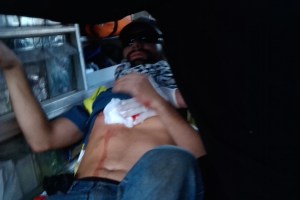
A pro-Palestinian Italian activist was shot and seriously wounded by Israeli gunfire during a Friday protest in the northern West Bank, medics and the activist’s organization said.
Palestinian security sources said Patrick Corsi, a 30-year-old member of the International Solidarity Movement (ISM), was shot during the weekly demonstration at Kafr Qaddum, west of Nablus.
Eyewitnesses said Corsi, who had participated in last week’s protest as well, had been documenting the event with a camera.
ISM, an activist group whose members frequently attend Palestinian protests to monitor the actions of Israeli soldiers, confirmed the shooting in a statement.
“The Italian activist, known as Patrick, was wearing a yellow high visibility jacket when he was shot with .22 live ammunition,” the statement said.
The statement added that 10 Palestinian protesters were wounded by rubber-coated steel bullets at the protest, in addition to 18-year-old Sami Jumma who was struck by live fire.
“We were standing with a group of Palestinian demonstrators when Patrick was shot. The military had fired three rounds of tear gas, and then a shot rang out and Patrick stumbled back. There was between five and ten minutes from the last tear gas canister fired and the bullet that shot Patrick.”
“He was just standing there, peacefully protesting, wearing a hi-viz jacket, he wasn’t doing anything and they just decided to shoot him,” the statement quoted an ISM volunteer at the scene as saying.
“The bullet entered Patrick’s chest near a main blood vessel, but thankfully did not puncture it. If God forbid it had, the lengthened journey to the hospital because of the closed road could have cost Patrick his life,” ISM media coordinator Ally Cohen was quoted in the statement as saying.
Due to an Israeli closure of Kafr Qaddum’s main road to Nablus, the travel time to the nearest hospital is around 30 minutes instead of 10.
Khaldoun Ishtewi, media coordinator for public campaigns in Kafr Qaddum, told Ma’an news agency that the Italian national was taken to the Rafidia Public Hospital in Nablus for treatment.
Ishtewi added that several Palestinians suffered from excessive tear-gas inhalation as a result of canisters fired by Israeli soldiers during the clashes.
An Israeli military spokesman did not immediately return a request for comment.
Palestinian Minister of Health Jawad Awwad told Ma’an that “shooting live fire at the upper part of the bodies of protesters is directly targeting them and is a deliberate attempt at murder.”
“Israel does not differentiate between foreign solidarity activists, Palestinians, or even journalists,” he added.
An Israeli army spokesman described the event as a “riot” during which 100 Palestinians allegedly hurled rocks at troops and burnt tires.
After failing to disperse people and “due to increased violence,” soldiers “fired small caliber rounds toward main masked instigators,” the spokesman said.
In the West Bank at the Qalandiya crossing between Jerusalem and Ramallah, Israeli border policemen “fired small caliber rounds toward two main instigators’ lower extremities” during a violent clash with some 150 Palestinians, the spokesman said.
There was no immediate report on their condition.
Protests are held every Friday in Kafr Qaddum against Israel’s closure of a main road linking the village to its nearest city, Nablus, as well as against the Israeli occupation more generally.
The West Bank and annexed East Jerusalem have been occupied by the Israeli military since 1967.
(AFP, Ma’an, Al-Akhbar)
Photo credit – ISM
Featured Video

Racist Seinfeld Dances for Joy as Bibi Unveils His New Map
or go to
Aletho News Archives – Video-Images
TV Drama Review
Japanese drama projects Japan’s wartime atrocities onto Chinese characters

Global Times | October 25, 2026
By portraying Chinese characters as perpetrators of ruthless violence while casting Japanese Self-Defense Forces (SDF) intelligence operatives as defenders, the season 2 of the Japanese drama Vivant has recently drawn criticism from Chinese netizens, who argue that its depiction turns historical reality on its head while ignoring Japan’s wartime atrocities.
The TBS drama series – a spy suspense story in which an alleged unofficial intelligence unit of the SDF operates across the globe — has attracted a passionate fanbase. Its currently airing season 2 opened with a household rating of 18.8 percent, the highest for a TV drama this year, according toa commentary article by Japanese media Toyo Keizai.
What draws attention is the portrayal of the enemies in the series, the article noted. Scenes in which the Chinese organization subjects kidnapped members of the SDF unit to brutal torture are repeated with unrelenting intensity.
It is rare for Japanese TV dramas to explicitly portray a real-life country as the enemy, the article noted.
Japanese Prime Minister Sanae Takaichi also made a reference to the drama, saying that she has been recording Vivant and hopes to binge-watch it over the year-end and New Year holidays, according to Japanese media outlets.
China’s CCTV News report on Sunday revealed that the drama features scenes in which Chinese personnel cut off the fingers of and stab Japanese intelligence operatives in the abdomen. Such acts bear striking similarities to the torture inflicted on Chinese nationals by invading Japanese troops during the World War II.
The drama distorts the truth by attributing these atrocities to modern Chinese characters. Beneath the surface, it subtly glorifies Japan’s cross-border overseas operations, blurs the functional boundaries of the SDF and implicitly promotes an expansionist narrative, per CCTV News. … continue
Blog Roll
 Aletho News
- Iran FM Araghchi: “Hormuz Will No Longer Be the Same”
- EU facing trillion-euro debt hole while seeking more cash for Kiev
- How US, Europe, Persian Gulf states exhausted missile stockpiles, splurged billions to defend Israel
- Up in arms… Koreans reject U.S. empire’s plan to make South Korea the next Ukraine
- Iran, Turkey, Pakistan, Saudi Arabia could advance region-led security framework in Tehran: FM spox
- Netizens condemn Japanese drama for projecting Japan’s wartime atrocities onto Chinese characters
- Racist Seinfeld Dances for Joy as Bibi Unveils His New Map
- A West Bank War for Netanyahu’s Election Campaign, Could It Backfire?
- Yemen denounces European Parliament’s ‘hypocritical’ push to blacklist Ansarullah
- Qalibaf: UAE’s UN bid aims to ‘clear the runway’ for ‘Greater Israel’, whitewash genocide
- If Americans Knew
- Israel punishes Palestinian prisoners with solitary confinement for making a cake
- US midterms: Where do candidates in key Senate races stand on Israel, Gaza, and Iran?
- Israeli forces demolish Hebron homes, displace thousands of Palestinians as raids expand
- Their Son Died in Israeli Prison. No Answers. No Body
- Biden’s Israel Catastrophe
- Why Israel’s latest assault on Hebron is so significant for the West Bank
- Israel Used “Where’s Daddy?” AI to Relentlessly Murder Palestinian Journalists and Their Families in Their Homes from October to December 2023
- DAILY UPDATE: Latest essential news on Palestine, Israel, & region
- Netanyahu Says Israel Must Prepare for Banking Sanctions, Floats Crypto as a Possible Bypass
- Latest updates from Israeli assault on West Bank
- No Tricks Zone
- Sudden Stratospheric Warming, Powerful El Niño Combination May Lead To Extreme Europe Cold, Energy Crisis!
- Two New Studies Find Thwaites Glacier Melt Cannot Be Driven By Human Activity Or A Warming Ocean
- E-Cars Reduce CO2 Emissions By Only 41% Compared To Internal Combustion Engine Vehicles
- Predictions Made By Renowned Climate Professor Over Past Decades Have Been Proven To Be Poor
- New Study Suggests Large Regions Of The Pacific Ocean Have Been Cooling For The Last 80 Years
- Germany’s Green Energy Debacle: High Energy Costs Force Kahla Porzellan to Close After 182 Years!
- New Study: 50 Years Of The Most Aggressive ‘Net Zero’ Policies Can Only Affect The Global Climate By 0.03°C
- US September “Heat” Was No Record…Many Records Set Decades Ago
- Latest European Green Energy Debacle; Portugal’s Largest Flagship Solar Park Insolvent!
- Green Energy Debacle: German Expert Professor Fritz Vahrenholt Warns Of Severe Economic And Social Consequences

