What next for Gaza?
By Robert Turner | Ma’an | July 16, 2014
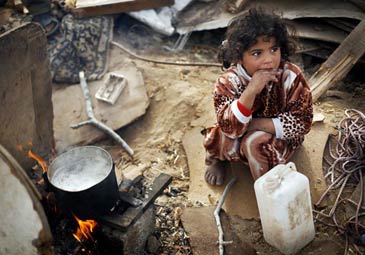
As I sit here in my office cum bedroom in Gaza City, listening to the airstrikes and rocket fire, there is talk of how to bring the violence to an end. This is to be eminently desired, particularly for the civilian population in Gaza who have suffered the brunt of this escalation.
But when I think of the 17,000 displaced people sheltered in our schools, some of whom I spoke with yesterday, I wonder what they would think of this. Because they have seen it all before, for most this was their third displacement since 2009; many having returned to the exact same classroom.
If this prospective cease-fire ends the same way as those before it, would they think this is anything other than a brief respite from violence?
For Gaza, a return to ‘calm’ is a return to the eighth year of blockade. It is a return to over 50 percent of the population either unemployed or unpaid. It is a return to confinement to Gaza and no external access to markets, employment, or education – in short, no access to the outside world.
For example, if one of the grandmothers I spoke to yesterday should wish to go to Birzeit University in the West Bank to study, she cannot.
The Israeli government need not demonstrate this grandmother poses any specific threat to security as they have approved a blanket ban on Gazans studying in the West Bank based on an undefined security threat. The vast majority of the population are prevented from leaving this 365 square kilometer sliver of land.
If one of the tomato farmers I met yesterday can find a buyer for his product in Paris, Peoria or Prague under certain conditions he can box up his tomatoes, ship them through the one open commercial crossing and on to Ashdod port or Ben Gurion airport – two of the most sensitive security sites in Israel.
Unfortunately there is no market for Gazan tomatoes in Paris, Peoria or Prague. There is a market for Gazan tomatoes in Israel and the West Bank, but this farmer is not allowed to sell his tomatoes there because of that same undefined security threat.
The elderly I met yesterday wonder how they will access health care after this cease-fire. Other than the services provided by us at the United Nations Relief and Works Agency and some private and NGO facilities, the government health care system is collapsing. Infrastructure has been damaged and the people wonder who will take responsibility to fix it.
If the Palestinian Authority is not permitted or is unable to do that is the international community expected to? Or will Israel, the occupying power, assume that responsibility?
The mothers I met yesterday wonder where their children will go to school in six short weeks if not in one of UNRWA’s 245 schools. Who will repair the government schools, deliver the textbooks, pay the teachers? If government schools do not open will UNRWA be expected to fill that void?
We lack the physical capacity, human and financial resources to accept tens, or even hundreds, of thousands of additional students in our schools.
UNRWA and the UN family, including WFP, UNICEF, OCHA and UNDP, remain engaged in meeting the humanitarian needs of the people of Gaza. Amongst the areas in which UNRWA has scaled up its work in recent years is construction, where we have a very large portfolio.
This is predominantly schools for our education program, in which we taught over 230,000 children last year, and houses for those whose homes were destroyed in previous conflicts or demolished by Israel.
If we want to build something we have to submit a detailed project proposal to Israel with the design, location and a complete bill of quantities. The Israelis then review the proposal, a process that is supposed to take not more than two months but on average takes nearly 20 months.
We received no project approvals between March 2013 and May 2014, during the last ‘calm’, despite having nearly USD 100 million worth of projects awaiting approval. Will this ‘calm’ be any better?
More importantly, the people here wonder who will govern Gaza? No one has an answer to that question. I think the people of Gaza would say that if this is the form of ‘calm’ people have in mind, while preferable to the current violence, it cannot last. It will not last.
Robert Turner is Gaza Director of Operations for UNRWA.
Gaza faces water crisis amid Israeli strikes: Red Cross
Press TV – July 16, 2014
The International Committee of the Red Cross (ICRC) has warned that hundreds of thousands of people in Gaza are without water as a result of Israel’s repeated airstrikes on the enclave.
The ICRC said on Wednesday that Gaza’s already vulnerable water system is being destroyed after days of deadly airstrikes by Israel.
“Hundreds of thousands of people in Gaza are now without water. Within days, the entire population of the Strip may be desperately short of water,” Jacques de Maio, the head of the ICRC delegation in the Palestinian occupied territories said.
“If they do not stop, the question is not if, but when an already beleaguered population will face an acute water crisis,” he added.
ICRC water and sanitation expert Guillaume Pierrehumbert also warned that the coastal enclave’s water system had been deteriorating for years, saying “the latest attacks are the last straw.”
The water crisis comes as temperatures are on the rise in Gaza.
Since July 8, Israeli warplanes have struck more than 1,300 targets across Gaza, which is home to around 1.8 million Palestinians.
At least 205 Palestinians have been killed and 1,500 others wounded since last week. Reports show that more than 30 percent of people killed in Gaza were women and children.
Israel has blockaded Gaza since 2007, denying the Palestinian people there of their basic rights, such as freedom of movement, jobs that pay proper wages, and adequate healthcare and education.
Gaza also often faces electricity and fuel shortages.
Guantanámo Judge to Prosecution: Turn Over the Torture Evidence
By Marcellene Hearn | ACLU | July 14, 2014
Last month, a military judge dealt a significant blow to U.S. prosecutors’ efforts to suppress torture evidence in the Guantanámo military commissions.
In a ruling in the U.S.S. Cole case, unsealed last week, Judge James Pohl told prosecutors they must hand over CIA black site information to the defense attorneys of Abd al-Rahim Hussayn al-Nashiri. Back in April, Judge Pohl similarly ordered the prosecution to give extensive information to Mr. al-Nashiri’s lawyers about his “4-year odyssey” through the CIA’s rendition and torture program. In the new ruling, Judge Pohl confirmed the core of the earlier order and issued important findings that will reverberate not only in Mr. al-Nashiri’s case but also in the 9/11 case, where one of the five defendants has already asked for similar information.
Judge Pohl found that Mr. al-Nashiri was subjected to “enhanced interrogation techniques” – the government’s euphemism for torture and cruel treatment, such as waterboarding and stress positions. More importantly, he ruled that information about that abuse is relevant and helpful to the defense. In particular, it will be relevant at sentencing because Mr. al-Nashiri faces the death penalty. His lawyers have said they will argue that he cannot be executed because he was tortured by the CIA – an argument that 9/11 defense lawyers will also likely make for their own clients.
Judge Pohl also said that the use of torture techniques will impact whether any statements Mr. al-Nashiri made afterwards are too tainted to be used at trial. Under the military commissions rules, the prosecution must convince the judge that the statements were “voluntarily given” in order to use them. The prosecution has already indicated that it will seek to use statements Mr. al-Nashiri made to the FBI after he arrived at Guantánamo. But with the new ruling, the prosecution will be required to turn over the information the defense says it needs to argue that these statements were tainted by the CIA’s earlier torture and abuse.
Judge Pohl’s order requires the prosecution to give the defense lawyers 10 categories of information, including where Mr. al-Nashiri was held, the conditions in each site, whom he interacted with, and how he was rendered from site to site. What’s not clear is the extent to which the prosecution will seek to provide summaries or other substitutes for some documents or to redact the names of personnel. According to Mr. al-Nashiri’s lawyers, this will be litigated in the coming months. Still, the ruling has definitively established that the information is relevant and helpful to the defense, and any new requests by the prosecution to narrow what it has to turn over will be limited by the ruling.
That’s a sea change, although a long-delayed one on a fundamental fair trial right: access to evidence. Judge Pohl has decided to step down from this case to concentrate on the commission trial of the 9/11 defendants. It’s now up to his successor to ensure this important decision is properly implemented.
Abu Khdeir suspects to plead insanity
By Jonathon Cook | July 14, 2014
Three Israeli suspects who have confessed to the gruesome killing of 16-year-old Mohammed Abu Khdeir, who was abducted in East Jerusalem and later burnt to death, are going to plead “temporary insanity”, according to Haaretz. Mohammed’s father guessed as much last week, when asked whether he trusted Israel’s judicial system: “I think they will say that [the murderers] were insane and give them a year or two and that’s all.”
That’s not because Hussein Abu Khdeir has incredible prescience; it’s because this is how it works in Israel. Palestinians who kill Israelis are terrorists, and Israelis who kill Palestinians are either heroes, if they are doing it in an official capacity, or deeply damaged individuals on the “fringes of society”, if they act on their own. Either way, they are not meaningfully held to account.
As Hussein also implies, the three, if convicted, will probably get a lenient sentence and then be pardoned when the fuss dies down in a year or two.
Notice also that the three other suspects arrested last week have been released, even though the police say they were part of the cell believed to have organised the kidnapping. So why not charge them with conspiracy to murder, or membership of a terrorist organisation, or one of the other charges that would be used if the suspects were Palestinian, including Palestinian citizens of Israel?
And here’s another question: how can we take seriously a claim of “temporary insanity” among an organised group (“a cell”) that has a wider membership and whose creation presumably predated the general mood of revenge that permeated Israeli society following news that three Israeli teens had been abducted on June 12? What was this cell organised to do if not to harm Palestinians? And if this is the case, how can “insanity” apply to the group collectively and how can it be termed “temporary”?
I expect none of these questions to be addressed, let alone answered, in the trial – assuming, of course, we get one and this is not hushed up in a closed hearing at which they are committed to psychiatric care.
Instead, Israeli officials will doubtless assent to the deranged notion of “insanity” propagated by the far-right legal group, Honenu, defending the three suspects. It says:
Given the crazy, abnormal situation in the country, it’s natural that among the many people who approach us, some have been emotionally scarred by the security situation or by difficult personal circumstances and responded accordingly.
Remember, “accordingly” here refers to a decision to abduct a child, force-feed him a flammable liquid and then set him on fire. Maybe “insanity” in this case has a much wider application than just to three individuals.
British Foreign Office Claims Documents Relating to CIA Abduction Program were “Accidentally” Destroyed
By Noel Brinkerhoff | AllGov | July 11, 2014
The British government has resorted to what some critics are calling a pathetic excuse to explain why it will not be turning over documents that could show officials were more involved last decade in the United States’ secret rendition program targeting terrorist threats than previously known.
Just how involved may never be known, now that the British Foreign Office has said that secret files documenting Britain’s role in the Central Intelligence Agency (CIA) program were destroyed by “water damage.”
The information in question purportedly contained details about CIA flights in 2002 carrying detainees to and from the secret military installation known as Diego Garcia, located in the middle of the Indian Ocean.
The British-controlled island, which the U.S. has long used for military operations, may have also housed a “black site” prison operated by the CIA for the purpose of interrogating detainees.
London has long insisted that it was unaware of any rendition activity on Diego Garcia until 2008, the last year of the George W. Bush administration that launched the war-on-terror program. At that time, the British Labour party admitted that assurances given by Tony Blair, while serving as Prime Minister, and by Jack Straw while Foreign Secretary, that the island had not been used for the U.S. rendition program were wrong. In fact, two rendition flights had stopped at the island, but only to refuel, reported the British government in its correction.
The timing of the latest British announcement was particularly alarming to critics, including human rights groups that have sought a full accounting of the country’s role in the renditions.
A U.S. Senate committee that investigated the CIA’s clandestine counterterrorism efforts is expected to release its findings soon, and with it, more news about Britain’s level of knowledge and participation in the controversial effort to neutralize al Qaeda operatives.
The Senate report, in fact, may even reveal that the shadowy activities on Diego Garcia were carried out with the “full co-operation” of the British government, The Independent reported.
“It’s looking worse and worse for the UK government on Diego Garcia,” Cori Crider, a director of the legal charity Reprieve, told the British newspaper. “First we learn the Senate’s upcoming torture report says detainees were held on the island, and now, conveniently, a pile of key documents turn up missing with ‘water damage?’”
Crider added: “The Government might as well have said the dog ate their homework. This smacks of a cover up. They now need to come clean about how, when and where this evidence was lost.”
To Learn More:
Government Needs to ‘Come Clean’ about Extent of Its Knowledge of US Activities on UK Soil, Campaigners Say (by Cahal Milmo, The Independent)
Files on UK Role in CIA Rendition Accidentally Destroyed, Says Minister (by Ian Cobain and Richard Norton-Taylor, The Guardian)
Newly-Discovered Documents Reveal CIA Helped Gaddafi against His Opponents (by Noel Brinkerhoff and David Wallechinsky, AllGov)
Egypt closes Rafah crossing
Ma’an – July 11, 2014
GAZA CITY – Egyptian authorities closed the Rafah crossing with Gaza on Friday, having opened it for one day to allow Palestinians injured in Israel’s military assault to seek treatment.
“We received orders from the Egyptian authorities to close the Rafah crossing after we partially opened it on Thursday,” spokesman for Gaza’s interior ministry Iyad al-Buzm told Ma’an.
The ministry strongly condemned the decision by Egypt as it had prepared buses and ambulances to take wounded Palestinians to the crossing.
Only 11 Palestinians were able to cross Rafah on Thursday when Egypt opened the crossing, al-Buzm added.
Over 600 Palestinians have been injured in Israel’s assault on Gaza with hospitals in the besieged enclave struggling to cope with the amount of casualties.
During Israel’s 2012 assault on Gaza, Egyptian president Mohamed Morsi condemned “Israeli aggression” and sent his prime minister to Gaza in a show of support for the Palestinians.
Since the military overthrew him in July 2013, Cairo has cracked down on smuggling tunnels to the Gaza Strip and accused Hamas of aiding the Brotherhood in militant attacks inside Egypt.
UN chief calls for ceasefire in Gaza Strip
Israeli Prime Minister Netanyahu: a ceasefire with Palestinians is not “even on the agenda”

Press TV – July 10, 2014
UN Secretary General Ban Ki-moon has called for a ceasefire between Israelis and Palestinians, asking the international community to take actions to stop the violence in Gaza.
“It is now more urgent than ever to try to find common ground for a return to calm,” Ban said at a meeting of the UN Security Council on Thursday.
The UN chief expressed his concerns over the “Palestinian deaths and injuries as a result of Israeli operations.” He said, Israel has carried out more than 500 air strikes and that the Palestinian resistance movement Hamas responded with firing more than 550 rockets.
Ban said some 900 Palestinians have been displaced in the besieged Gaza Strip since Israel began its offensive on Tuesday, while 150 homes were destroyed. He put the death toll at 88 and noted that about 340 others were injured.
“It is clear that the international community must accelerate efforts to achieve an immediate halt to this escalation and reach a durable ceasefire,” he also told the council.
Ban’s remarks came only hours after Israeli Prime Minister Benjamin Netanyahu told Knesset’s foreign affairs and military committee that a ceasefire with Palestinians is not “even on the agenda.”
Palestinian ambassador to the UN Riyad Mansour has said Tel Aviv began the violence in the enclave.
“They started the attack against our people … and the rockets started after that,” he said after briefing the council.
He stressed that Palestinians would honor any ceasefire in Gaza, but it is clear that Israelis “are not interested in a ceasefire and stopping the rockets.”
“The Palestinian people are united … and we hope the Security Council can act in accordance with its responsibilities,” Mansour added.
Israeli-Palestinian MKs cower to Netanyahu’s calls to end the protests
By Jamal Sweid | Al-Akhbar | July 8, 2014
The sight of protests and burning garbage containers bothered some Israeli-Palestinian MKs in the Israeli Knesset, who made a call to “stop the violence and put an end to the protests.” Along with several party leaders and municipality officials, they responded to Netanyahu’s calls to pacify the street despite popular demands.
Haifa – The charred body of Mohammed Abu Khudair from Jerusalem, which was left outside of Deir Yassin, brings back memories of the massacre in the same village which took place in 1948. The slaughter symbolized Israel’s brutality in the Palestinian psyche, causing popular unrest from Jerusalem to the occupied territories.
Clashes erupted in the occupied capital’s neighborhoods before Abu Khudair’s body was recovered and continued after his funeral. They quickly spread to the cities of 1948 occupied Palestine, but remained subject to a relative media blackout in an effort to contain them.
However, with the continued and escalating clashes in Jerusalem, the demonstrations in the cities and towns near Haifa turned into real clashes. They spread north to Umm al-Fahm and Wadi Ara, whose main road – considered a main artery linking central occupied Palestine with its north – was blocked.
On Saturday, confrontations between Palestinian youths and the occupation police extended to Nazareth in northern occupied Palestine. The streets of Nazareth seemed to be witnessing a war. By Sunday night, Israeli police were deployed in the remaining villages and cities of Galilee, such as Shafa Amr, Tamra, Arraba, Kfar Manda, and others.
This brought back memories of al-Aqsa [second] intifada in the minds of Israelis, who fell into a state of confusion following the end of the 48-hour ceasefire in the Gaza Strip. This forced them to extend the deadline as they looked for a solution in what they call [in reference to Gaza] the “soft spot,” which threatened to evolve into a full-blown intifada and spread to the West Bank.
As a result of this pressure, the conflict between Israeli Prime Minister Benjamin Netanyahu and his Foreign Affairs Minister Avigdor Lieberman became public. “Throwing rocks at soldiers and the police in the state of Israel will not be allowed,” Netanyahu warned in a strongly worded statement addressed to Palestinians with Israeli citizenship. He requested from “leaders of the Arab community in Israel” to “restore the calm to its previous state.”
Netanyahu’s orders were implemented immediately. Successive statements were issued by Arab parties and movements calling for calm in the streets. They denounced what they termed “violence and destruction of public property.”
While there was no evidence of a single assault by demonstrators against public utilities, some Israeli-Palestinian Knesset members strongly denounced setting garbage containers on fire. Similarly, Nazareth Mayor Ali Salam described the confrontations as “rioting carried out by thugs,” calling for “calm and an end to the vandalism.”
On the other hand, head of the national committee of the High Follow-up Committee for Arab Citizens of Israel, Mazen Ghanayem, called on Netanyahu to take measures against “members of the mini-cabinet who incite against the Arab public in Israel.” He was referring to ministers such as Lieberman during a meeting with Justice Minister Tzipi Livni, who promised to inform the cabinet of financial troubles faced by Arab local authorities.
Commenting on the situation, secretary of the Popular Committee for Solidarity with the Leadership and People of the Interior, Wasfi Abdul-Ghani, described such calls as “attempts to silence the streets.” However, he was confident about “the awareness of our youth and our people and their ability to separate the wheat from the chaff.”
The Palestinian reaction “was in condemnation of the heinous crime and to prevent the occupation authorities from covering up the scene as usual when it comes to crimes by settler gangs,” Abdul-Ghani explained to Al-Akhbar. “The reaction was spontaneous and not supported by the [Palestinian National] Authority or the leaders of the interior of all backgrounds.”
The anger in the streets seemed to embarrass Arab officials in the national committee and the various parties. Their statements seemed shy and awkward, squeezed between public fury and Netanyahu’s threats.
The recent events over the weekend led to hundreds detained and large numbers of people injured. No martyrs have fallen yet, due to fears by Israeli police that this would ignite an intifada. However, the Israeli government as a whole is demanding that Arab leadership stifle any popular mobilization, preventing from spreading and continuing.
In an attempt to calm the situation, Israeli radio mentioned that Netanyahu had called Hussein Abu Khudair, Mohammed’s father, and expressed “his shock and the shock of Israeli citizens for the abominable killing of his son.” Netanyahu promised to prosecute the killers and “rejects their brutal behavior.”
Abu Khudair commented on the news, telling the media the he “received dozens of calls from foreigners and Israelis,” but was not aware that the Israeli prime minister was one of them. He was surprised to see the story in the news. However, he rejected Netanyahu’s condolences since “he is the one giving the orders to kill Palestinians.”
Jewish settlers attack Palestinian villages in Nablus, Ramallah
Ma’an – 07/07/2014
RAMALLAH – Settlers attacked Palestinian villagers in Ramallah and Nablus late Sunday and early Monday, locals said.
Witnesses told Ma’an that settlers began hurling stones at Palestinian vehicles traveling near the illegal Halamish settlement, located opposite the village of Deir Nidam.
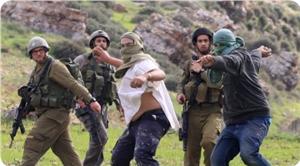 Dozens of settlers then raided the village, but were confronted by Palestinian villagers, who threw stones and empty bottles.
Israeli forces were present at the scene and opened fire at the villagers, locals said.
On Sunday, settlers from Halamish attempted to raid the nearby Nabi Saleh village but were blocked by locals.
Meanwhile, fierce clashes broke out late Sunday between Palestinians and settlers in the Nablus village of Einabus.
Dozens of settlers from Yizhar raided the village and attempted to attack houses, but were chased away by villagers.
Israeli military vehicles arrived at the scene and fired tear gas canisters at Palestinian residents, lightly injuring several people.
In 2013, there were 399 incidents of settler violence against Palestinians in the occupied West Bank, according to the UN Office for the Coordination of Humanitarian Affairs.
Nearly all settler attacks go unpunished by Israeli authorities.
See also:
Jewish Mob in Jerusalem: ‘Death to Arabs!’
9 Palestinians killed, several injured in Israeli airstrikes on Gaza
By Saed Bannoura | IMEMC News | July 7, 2014
Palestinian medical sources have reported that nine Palestinians have been killed by Israeli missiles and shells in the Gaza Strip on Sunday, and Monday at dawn.
Seven of the slain Palestinians are members of the al-Qassam Brigades of the Hamas movement.
The Brigades stated the six fighters have been killed when the Israeli army fired missiles into a siege-busting tunnel in Rafah, in the southern part of the Gaza Strip. Their bodies were found on Monday, at dawn.
The fighters have been identified as Ibrahim al-Bal’aawy, 24, Abdul-Rahman az-Zamely, 22, Mustafa Abu Morr, 22, his twin brother Khaled, Yousef Sharaf Ghannam, 22, and Jom’a Abu Shallouf, 24.
A Qassam fighter, identified as Ibrahim ‘Abdeen, died of wounds suffered during an earlier shelling in Rafah.
Sami Abu Zohri, spokesperson of the Hamas movement, stated the assassination of the fighters is a serious escalation, adding that “the enemy will pay a heavy price”.
Dr. Ashraf al-Qodra, spokesperson of the Ministry Of Health in Gaza, stated that five Palestinians, including a child and two young girls, have been injured when an Israeli missile detonated near their homes, in Beit Hanoun, in northern Gaza.
Another airstrike targeted al-Qarara town, east of Khan Younis in the southern part of the Gaza Strip.
Missiles have also been fired into agricultural lands in Shekh Radwan in Gaza, causing damage but no injuries.
Two fighters, identified as Mazen al-Jedya and Marwan Salim, have been killed by Israeli missiles in al-Boreij refugee camp. Their bodies have been severely mutilated.
Palestinian resistance groups in Gaza claimed responsibility for firing dozens of shells into adjacent Israeli areas in retaliation to the Israeli military escalation.
Hamas calls on Abbas to cancel participation in Israeli conference
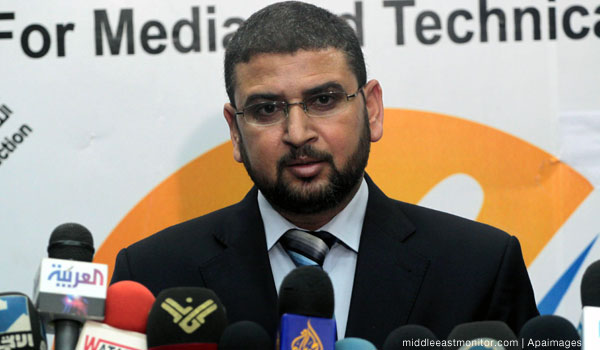
Hamas’ Sami Abu Zuhri
MEMO | July 6, 2014
Hamas has called on Palestinian President Mahmoud Abbas to withdraw from participation at the Israel Peace Conference scheduled for Tuesday in Tel Aviv.
In a press statement on Saturday, Hamas spokesman Sami Abu Zuhri said that Abbas’s participation “would constitute an insult to the feelings of the Palestinian people,” in the aftermath of the lynching of a Palestinian boy in occupied East Jerusalem last Tuesday, as well as the ruthless beating of his cousin two days later.
Abu Zuhri added that Abbas’s participation would give Israel a chance to “beautify its image” after international anger at its “heinous crimes.”
Haaretz has published the agenda of the conference, which includes a pre-recorded speech by Abbas.
Palestinian chief negotiator and senior Fatah official Saeb Erekat turned down an invitation to attend the same conference “out of respect for the feelings of Palestinians and their plight”.
The Israel Peace Conference is an annual event organised by Haaretz to discuss the Israeli-Palestinian conflict and how to bring about peace.
Featured Video

Iran FM Araghchi: “Hormuz Will No Longer Be the Same”
or go to
Aletho News Archives – Video-Images
From the Archives
Sam Husseini: The entire US establishment helped lie their way into the Iraq war
By Slava Zilber | American Herald Tribune | October 14, 2019
Sam Husseini is a senior analyst with the Institute for Public Accuracy, independent journalist and contributor to The Nation and FAIR.
Slava Zilber: Sam, three years ago, you appeared on Talk Nation Radio with David Swanson and spoke about the case of the GCHQ whistleblower Katharine Gun. You pointed out that the people involved in the spying on the UN and the people authorizing the Iraq War were not held accountable:
“Virtually everybody who went along with the war, whether it is Kerry or Clinton, of course, the Bush administration themselves has falsified their own records in terms of why, what they did, when they did, why they did it, to the extent that they’ve been scrutinised at all.”
You also address it in a recent article. And recently, Joe Biden has been lying about his position on the Iraq War. How can such an important issue escape meaningful scrutiny? … continue
Blog Roll
 Aletho News
- The Mecca Pact Courts Iran: Containment Comes Full Circle
- Oman FM: Persian Gulf states, Iran, Iraq should form security pact excluding US
- Trump peddles fresh falsehoods, claims Iran ‘started the war’ as US aggression drags on
- Ukraine quagmire? Yes, but it’s for NATO, not Russia
- US intelligence hypes Chinese, Russian space threats while accelerating its own military buildup in orbit
- Iran FM Araghchi: “Hormuz Will No Longer Be the Same”
- EU facing trillion-euro debt hole while seeking more cash for Kiev
- How US, Europe, Persian Gulf states exhausted missile stockpiles, splurged billions to defend Israel
- Up in arms… Koreans reject U.S. empire’s plan to make South Korea the next Ukraine
- Iran, Turkey, Pakistan, Saudi Arabia could advance region-led security framework in Tehran: FM spox
- If Americans Knew
- An error has occurred; the feed is probably down. Try again later.
- No Tricks Zone
- Sudden Stratospheric Warming, Powerful El Niño Combination May Lead To Extreme Europe Cold, Energy Crisis!
- Two New Studies Find Thwaites Glacier Melt Cannot Be Driven By Human Activity Or A Warming Ocean
- E-Cars Reduce CO2 Emissions By Only 41% Compared To Internal Combustion Engine Vehicles
- Predictions Made By Renowned Climate Professor Over Past Decades Have Been Proven To Be Poor
- New Study Suggests Large Regions Of The Pacific Ocean Have Been Cooling For The Last 80 Years
- Germany’s Green Energy Debacle: High Energy Costs Force Kahla Porzellan to Close After 182 Years!
- New Study: 50 Years Of The Most Aggressive ‘Net Zero’ Policies Can Only Affect The Global Climate By 0.03°C
- US September “Heat” Was No Record…Many Records Set Decades Ago
- Latest European Green Energy Debacle; Portugal’s Largest Flagship Solar Park Insolvent!
- Green Energy Debacle: German Expert Professor Fritz Vahrenholt Warns Of Severe Economic And Social Consequences

