Podcast: Play in new window | Download | Embed
Today on the program James celebrates the life and work of Dr. Tim Ball, a man who devoted his retirement years to fighting the good fight against the agents of the climate scam and the green enslavement agenda. His fearless truth-telling in the face of so much adversity serves as an example to us all.
Watch on Archive / BitChute / Odysee / Substack or Download the mp4
For those with limited bandwidth, CLICK HERE to download a smaller, lower file size version of this episode.
For those interested in audio quality, CLICK HERE for the highest-quality version of this episode (WARNING: very large download).
DOCUMENTATION
| Documentation – Interview 006 Dr. Tim Ball |
| Time Reference: |
00:00 |
| Description: |
Interview #006 from the archives was my first conversation with Dr. Tim Ball |
| Link To: |
The Corbett Report |
| Documentation – Timothy Francis Ball Obituary |
| Time Reference: |
04:18 |
| Description: |
RIP Dr. Tim Ball (1938-2022) |
| Link To: |
Generalist Journal |
| Documentation – Flashback: Climategate (2009) |
| Time Reference: |
12:40 |
| Description: |
A visualization of Episode 110a of The Corbett Report podcast from November 2009. |
| Link To: |
The Corbett Report |
| Documentation – Climategate Exposes the Alarmist Machine |
| Time Reference: |
12:48 |
| Description: |
A dissection of the “alarmist machine” myth by recourse to my experience meeting Dr. Ball. |
| Link To: |
The Corbett Report |
| Documentation – Episode 282 – The IPCC Exposed |
| Time Reference: |
17:53 |
| Description: |
A podcast on how the IPCC sausage is made (featuring an interview with Dr. Ball discussing how commissions of inquiry can become cover-ups. |
| Link To: |
The Corbett Report |
| Documentation – Climategate: The Backstory |
| Time Reference: |
27:33 |
| Description: |
Prescient video on the CRU released by The Corbett Report just weeks before the Climategate story broke. |
| Link To: |
Odysee |
| Documentation – Droughts, Cloud Seeding and The Coming Water Wars |
| Time Reference: |
39:05 |
| Description: |
A recent James Corbett editorial on the question of weather modification, geoengineering, and the increasing importance of water in the realm of geopolitics. |
| Link To: |
The Corbett Report |
| Documentation – Corbett Report Radio 078 – Peak Water and Agenda 21 with Dr. Tim Ball |
| Time Reference: |
31:25 |
| Description: |
In 2012, Dr. Ball appeared on Corbett Report Radio to debunk the next environmental alarmist scare: water scarcity. |
| Link To: |
The Corbett Report |
| Documentation – Generalist Journal |
| Time Reference: |
44:08 |
| Description: |
Dr. Ball’s home page (still being maintained and updated by the Ball family). |
| Link To: |
generalistjournal.com |
| Documentation – Ball’s Bearing by Mark Steyn |
| Time Reference: |
46:20 |
| Description: |
Mark Steyn’s summary of Dr. Ball’s legal saga with Michael Mann. |
| Link To: |
Steyn Online |
| Documentation – Please Donate Towards Dr. Tim Ball’s Funeral Expenses |
| Time Reference: |
52:06 |
| Description: |
A fundraiser HAS been set up to help Dr. Ball’s widow, Marty, cover the funeral expenses. Please donate if you are able. |
| Link To: |
Watts Up With That? |
| Documentation – Tim Ball – The Deliberate Corruption of Climate Science |
| Time Reference: |
39:41 |
| Description: |
Dr. Tim Ball delivers a lecture, answers questions, and calls out the Malthusian, anti-human, globalist ideology of the alarmists as he discusses The Deliberate Corruption of Climate Science in 2014. |
| Link To: |
YouTube |
October 5, 2022
Posted by aletho |
Malthusian Ideology, Phony Scarcity, Science and Pseudo-Science, Timeless or most popular, Video | Canada |
Leave a comment
It is now nearly 11 months since Gillian Dymond started asking Dame June Raine, head of the Medicines and Healthcare products Regulatory Authority (MHRA), to explain what the organisation is doing to investigate the deaths and injuries occurring shortly after Covid-19 vaccination, and this open letter is her latest attempt to get an answer. You can read previous instalments in the saga here, here, here, here and here.
Dear June Raine,
You have not replied to any of the previous letters I have written you regarding the nationwide rollout of novel medications against SARS-CoV-2. I suppose I should simply accept your confident public assertion that these injections are, indeed, ‘safe and effective’: but how can I, when this is contradicted by so many disturbing post-injection reactions among my friends and family? So please excuse me for writing to you again. I am writing because I want to understand. I want to understand why you are doing this. I want to understand why you think it is right to enable the mass prescription of pharmaceutical products whose short-term testing was questionable, and whose medium- and long-term effects are entirely unknown.
You enjoyed an Oxford education, and I want to understand why, with your academic training, you are choosing to ignore the caveats of numerous high-quality experts by giving these injections your blessing. My own experience of university was that an essay which failed to take a balanced overview of any question would receive short shrift. Why, my tutor would ask, had I not considered this or that other important fact or perspective, this or that other authority, before drawing my conclusions?
You are a doctor, and I want to understand why you continue to authorise the emergency use of inadequately tested medications despite the availability of successful protocols involving the early use of tried-and-trusted treatments. I want to understand why, after the emergence of viable alternatives to the novel injections in the summer of 2020, well before any ‘vaccine’ came on to the market, you chose to risk violating the basic requirement of the Hippocratic Oath, ‘First do no harm’, by blacklisting these safe and effective treatments and advocating ‘emergency’ use of the questionable and the unknown.
Of course, both as an academic and as a doctor, you have done no more than fall into line with the vast majority of your peers. From your point of view, it would certainly have been a bad career move to announce that the new pharmaceuticals produced at such speed and such expense had proved to be unnecessary. For ordinary doctors, things were even worse: they faced disgrace and expulsion from their profession if they failed to jab as required. As for academics, even those unblinkered by ideology kept their heads down and played along with censorship of their few dissenting colleagues, on pain of jeopardising valuable funding. Only those who had already retired, secure in an unblemished record and a reliable income, had nothing but comparatively harmless attacks on their reputations to fear when they questioned the ‘settled science’ – indeed, the very idea of ‘settled science’. No wonder the institutions dishonoured by so much mindless kow-towing to the state-sponsored authorities who ordered them to betray their raison d’être have fallen into widespread contempt! How is it possible to respect an academic who acquiesces in censorship? How is it possible to respect doctors who fail to ensure informed consent prior to the injection of a potentially dangerous substance, or who refuse to see their unmasked patients face to face?
But, June, you are not just an academic and a doctor; you are not even just a civil servant; like me, you are a mother: and it is as a mother, above all, that I cannot understand why you have authorised the rollout of these inadequately-tested concoctions to children as young as five; children who stand in far greater danger from the injections than from the illness itself. How do you reconcile the fact that nobody has the least idea of the long-term effects of these treatments with your insistence that they are ‘safe’? How can you be sure that the risks are outweighed by the benefits, when the benefits are proving ever more debatable and the risks of long-term, potentially devastating, injury are unknown? Your own children must be well into adulthood, but would you really have advised your pregnant daughter or daughter-in-law to be injected? Perhaps you have young grandchildren. If so, have you urged them to roll up their little sleeves and be jabbed, without any qualms regarding their future health and reproductive ability?
Perhaps you are, indeed, as enthusiastic about the alleged life-saving qualities of the new medications in your private life as you are in public: in which case, given the mounting evidence against them, I sincerely wish to understand why. What do you know that is sufficient to countermand the indications of the Yellow Card scheme and justify the accumulating tragedies of those suffering serious adverse effects? Presumably you have really convinced yourself that the computer models (rubbish in, rubbish out?) are right, and that your emergency authorisation of the novel injections has saved billions of lives. If so, I would like you to help me understand why.
This issue does, after all, have wider ramifications. It is not a one-off. You have made it clear that the current roll-out is merely a precedent to similar population-wide prescriptions of mRNA medications to similar population-wide prescriptions of mRNA medications, and that the MHRA is busy ‘transforming’ itself into an enabler, rather than a regulator, of new medicines. At the very least the public deserve to be made aware that your agency is now working with the pharmaceutical industry to speed the entry of new drugs on to the market within 100 days of any proclaimed ‘emergency’, using the public as guinea pigs in ‘real-time’ testing. Since very few of us watch MHRA board meetings, and no mention is made of such a transformation in the highly selective news bulletins fed to the public by the mainstream media, this strange departure from the precautionary principle is, like the long-term effects of the medications which will be ‘offered’ to us, largely unknown. If it were better publicised, the public might well insist that the MHRA take its place openly as an ancillary of the drug manufacturers, and demand that a genuine regulatory body, working on the time-honoured principles of long-term testing and ‘First do no harm’, take its place.
It seems to me that your transformation into an ‘enabling agency’, on the back of the ‘pandemic’, is a transformation for the worse, to the point of being a threat to the lives and health of the population. Covid-19 was struck off Public Health England’s list of high consequence infectious diseases on February 19, 2020, even before the first lockdown. Off-label remedies were speedily found to treat the illness successfully. The ‘pandemic’ existed only because it was redefined as such by the WHO and industriously promoted and kept alive by government misinformation. I want to understand why you, an intelligent woman, so easily accepted this misinformation; I want to understand why you chose to abandon academic rigour and the provisions of the Hippocratic Oath when no emergency required you to do any such thing; and I want to understand why you are proposing to repeat this recklessness in relation to a steady stream of future products.
Please enlighten me.
Yours sincerely,
Gillian Dymond
Footnote: The now monthly (formerly weekly) Yellow Card report is a week overdue from the well-funded (by drug manufacturers, the World Health Organisation and the Bill and Melinda Gates Foundation as well as the Department of Health and Social Care) and well-staffed MHRA.
October 4, 2022
Posted by aletho |
Science and Pseudo-Science, Timeless or most popular, War Crimes | Covid-19, COVID-19 Vaccine, UK |
Leave a comment
On October 11th a Bill is to be presented to the Queensland Parliament which would impose draconian limits on what doctors can say to their patients. If passed, doctors will no longer be able to express their opinion or use their experience, training and education, if that opinion goes against what the Government health bureaucrats determine to be in the general interests of the public.
The National Law originally came into being after the Commonwealth, States and Territories all entered into an intergovernmental agreement in 2008. By that agreement it was established the Health Practitioner Regulation National Law (the National Law) would first become legislation passed by the Queensland parliament (s.6.3), which the other States and Territories would then mirror and pass via each of their parliaments (s.6.4), The same intergovernmental agreement established the Australian Health Workforce Ministerial Council (s.7.1) charged with overseeing the National Law.
Once passed into law by the Queensland parliament, all the other States and Territories are required to create virtually identical Bills and submit to their parliaments to be made law, thereby effecting the same amendments to the National Law of their State or Territory (s.13.4).
Australian doctors will be bound to follow Government policy regardless of countervailing evidence, which means that Government health bureaucrats will determine how doctors should approach treatment recommendations for their patients.
The Health Practitioner Regulation National Law and Other Legislation Amendment Bill 2022 proposes changes which would give the Queensland Health Ombudsman, the Australian Health Practitioner Regulation Agency (AHPRA) and the Medical Board of Australia unprecedented powers to sanction doctors for expressing their professional opinion based on their assessment of the best available science.
This amendment to the Bill is clearly designed to destroy our healthcare system. A patient visits their doctor for an ‘opinion’, which will be obliterated by the act. Healthcare is nuanced, almost every day I ‘violate’ textbook recommendations because patients do not conform to idealised representations, each has unique features. Those deviations come down to experience, which is the patient’s and doctor’s most powerful asset.
Medicine will cease to evolve. It will become fossilised in the Covid Ice Age. Minor indiscretions like prescribing antibiotics when the indications are blurred could be subject to disciplinary action. Guidelines are contradictory so it would be almost impossible to practise medicine without contravening dictates. Most disease classification is already antiquated with diagnostic definitions set down sometimes 100 years ago or more. This legislation would lead to disastrous consequences for all Australians.
The aim of the Act must be to pave the way for multi-corporate management of healthcare. With 96% of the revenue of the Therapeutic Goods Administration, which is responsible for approving all pharmaceutical products including vaccines, coming from the pharmaceutical industry, the potential for conflicts of interest is self-evident. Therapeutic interventions will become legislated in the interests of big pharma. mRNA vaccines could be delivered unopposed on ‘conscience’ grounds, including to children. The cargo in the mRNA vaccines can be changed at will without going through full regulatory approval. By the time our children turn five, they would be comprehensively ‘protected’ by the ‘Pharma Ring of Protection’, vaccinated against everything from diabetes to in-growing toenails, all without the constraints of clinical opinion.
In the absence of a functioning healthcare system, individuals will be encouraged by authorities to seek their healthcare online from approved ‘trusted sources’. Doctors will become demonised as pariahs, depicted as being left behind in the high tech era. We will doubtless be receiving a concoction of ‘junk food’ medicine upsold with pharma fries. For every thought, action and movement there will be a pharmaceutical solution, requirement even. Your mere existence will demand so, for the safety of others.
This obscene piece of legislation paves the way to an Orwellian nightmare, with consequences that go far beyond healthcare, to the very core of our humanity. It’s the desecration of our rights to autonomous existence, it’s the Monty Python boot trampling in the face of every individual Australian. Our children will be stamped, sealed and delivered from birth, with profit potential identified and catalogued.
For the Australian citizen this is our Stalingrad. Defeat here will open the field to unlimited human resources for oppressive forces that can never be turned back. We must oppose this with all our resolve.
‘Frank Mercy’ is a pseudonym for a doctor with a clinical practice who also holds an appointment at an Australian university.
October 4, 2022
Posted by aletho |
Civil Liberties, Science and Pseudo-Science, Timeless or most popular, War Crimes | Australia, Covid-19, COVID-19 Vaccine, Human rights |
Leave a comment

This is the weirdest part of the PSYOP. It’s like the morning after an office party on which you wake up almost terminally hungover to hazy memories of having performed a Tequila-fuelled blowjob on Bob in Accounting in what was either the 9th Floor Reception Area or possibly the downstairs lobby of your building while someone vaguely resembling that smirking kid in the Mail Room filmed it on his phone.
Yes, it’s the Morning After … that revolting regurgitant chorus you’re hearing is the sound of millions of Covidian Cultists down on their knees in their gender-neutral bathrooms praying to the Porcelain God.
It has been quite a trip these last two and a half years, but the orgy of fear and hatred is over, the mass hysteria is wearing off, and the reality of the damage they have done is beginning to become undeniable.
Countless thousands of people have been killed, seriously injured, and permanently disabled, victims of experimental “vaccines” they did not need but were coerced into taking. Societies have been torn apart, economies crippled, institutions discredited, democratic precepts like the rule of law and constitutional rights made mockeries of themselves, friends and families turned against each other, and so on, and the dust hasn’t even settled yet. It will take many years to assess the damage … or, rather, to recontextualize, rationalize, deny, and memory-hole the damage (while simultaneously “normalizing” the fascistic biosecurity dystopia the damage made it possible to implement).
This process is now well underway. As I’m sure you’ve noticed over the past several months, governments, global health authorities, the corporate and state media, the culture industry, and other key components of “The New Normal Reich” have been quietly phasing out their “Covid restrictions,” rewriting “The Science,” rewriting history (i.e., the science and history they had previously rewritten), executing limited hangouts, and otherwise transitioning the masses out of “emergency” mode and into the New Normal.
In other words, everything is going to plan.
You can’t keep people whipped up into a state of full-blown hysteria indefinitely. When you’re radically destabilizing and restructuring a society, you hit them hard with the Shock-and-Awe for a few weeks, or months (or years in this case), and then you gently ease them into the new “reality.” Which, after being systematically terrorized, gaslighted, threatened, and otherwise tormented for however long you did that to them, they’ll be grateful for anything resembling “normality,” no matter how fascistic it turns out to be.
You have to be delicate executing this phase, in which the vast majority of the masses, having forced themselves to believe whatever you needed them to believe during the Shock-and-Awe phase, have to force themselves to believe they never believed whatever you needed them to believe then, and believe whatever you need them to believe now, which typically completely contradicts whatever they had previously forced themselves to believe (and actually, literally, believed) in a desperate attempt to keep you happy, so that maybe you would eventually stop beating on them, and relentlessly gaslighting and terrorizing them.
Now, a lot people seem to be having trouble understanding or accepting this fact, i.e., the fact that human beings are capable of forcing themselves to believe whatever they need to believe in order to survive or remain in good standing with “normal” society (or whatever social body they are members of and depend on to meet their basic needs). Not pretend to believe, literally believe, the way that religious converts believe, the way we believe whatever we believe today that we didn’t believe ten years ago.
I must say, I find it rather baffling, people’s lack of understanding and acceptance of this fact, as this capability is a fundamental human attribute that has been documented, over and over, throughout the course of human history. It is not some “theory” I just made up. It is how we maintain social cohesion. It is how we socialize our children. It is how armies and university departments work. It is a basic part of how social bodies function; conformity is rewarded and non-conformity is punished. There’s nothing new about this phenomenon. People have been conforming to new official “realities” and making themselves believe whatever they have to believe to survive within them for approximately five thousand years.
It is, however, a rare occasion when we are able to observe the process this clearly. It usually takes place more or less invisibly within the context of normal everyday life. It is only during sudden radical shifts from one “reality” to another “reality” that we can watch people force themselves to believe whatever they perceive they need to believe, or are instructed by their rulers to believe, in order to survive and thrive in society (e.g., cult indoctrinations, religious conversions, the outbreak of war, physical torture, or in the wake of political revolutions).
This is what we’ve been watching since March 2020, not mass hypnosis, or mass formation psychosis, but the masses forcing themselves to believe whatever they sensed they needed to believe (or were instructed by the authorities to believe) in order to remain parts of “normal” society and not be demonized by their governments and the media, ostracized by their friends and family, fired from their jobs, segregated, censored, beaten and arrested by the police, and otherwise punished for non-conformity as a new “reality” was manufactured and imposed on societies throughout the world.
And now their “reality” is changing again, or “The Science is evolving,” or whatever, and the absurdities they forced themselves to believe are being exposed as … well, as absurdities, and their fanatical and often fascistic behavior, as it turns out, was based on absolutely nothing.
Many of them couldn’t care less, as their behavior was never “based” on anything other than going along with the herd, and so they have simply transitioned from fanatically hating “the Unvaccinated” to fanatically hating “the Russians,” and fanatically supporting Ukrainian neo-Nazis, and fanatically doing whatever else the GloboCap puppets on their televisions instruct them to fanatically do. However, a significant number of them have retained enough of their critical faculties that being yanked back and forth from “reality” to “reality” is causing them to experience mild cognitive dissonance, and confusion, and shame, or borderline psychosis.
Believe it or not, my heart goes out to them … these formerly fanatical Covidian Cultists that wanted me segregated from society, and silenced, and locked up in an internment camp. I cannot make it easier for them by pretending they didn’t do what they did (and in too many cases are still actively doing), or pretending they were hypnotized, or in some other altered state of consciousness, while they did what they did for the past two and half years, but just imagine how they must be feeling now that the party is finally over and the brutal morning after has arrived.
Imagine realizing at this late stage of things that everything you believed, thought, and said, the incalculable harm you have done to people, and to society, was never about a pandemic, but was always about conditioning the masses to respond to fear, coercion, and control like some global Pavlovian behavioral experiment.
Or just take it from actress Jennifer Gibson …
And now comes the really nauseating part, the part where the New Normal authorities admit that they “overreacted,” and that “mistakes were made,” and that they deeply regret having needlessly murdered and seriously injured God knows how many people, and psychologically crippled countless children, and accidentally totally destabilized and restructured the entire global economy, and explain in a lengthy piece in The New Yorker how they’re sorry, but they were drunk at the time, and swear they will never do it again.
You remember this part from 2004 after the invasion and occupation of Iraq when the photos of Abu Ghraib were published, and the American masses who had been hooting and hollering and waving American flags around, and calling people “ragheads” and “sand niggers,” and so on, had to stare themselves and their war crimes in the face.
You recall how the Americans dealt with their shame. That’s right, they reelected George Bush and carried on murdering and torturing Iraqis, and Afghans, and assorted other brown people, and hooting and hollering “we’re number one,” and waving American flags around, because in for a penny, in for a pound.
You see, another fundamental human attribute (in addition to our ability to force ourselves to believe whatever we need to believe in order to survive and thrive in society) is that we don’t tend to deal with shame very well. We tend to repress it and react aggressively to anyone who tries to force us to face it. If you don’t believe me, ask anyone you know who has been (or still is) in an abusive relationship. Ask them how their abuser reacts when they try to get them to take responsibility for their abusive behavior.
I can’t tell you exactly what’s going to happen over the coming months, but I told you back in January that there was going to be wailing and gnashing of teeth, and wailing and gnashing of teeth there has been, and there is certainly going to be a lot more of it … and probably not just wailing and gnashing.
This is just the dawn of the Morning After. I have a feeling we ain’t seen nothing yet.
October 4, 2022
Posted by aletho |
Science and Pseudo-Science, Timeless or most popular, War Crimes | COVID-19 Vaccine |
Leave a comment
As many people are beginning to realize but would rather not think about, the United States and Russia are moving perilously close to nuclear war. Russian President Putin has now openly pledged to defend Russian territory with “all the forces and means at our disposal.” U.S. President Biden has responded that Russia will suffer “catastrophic consequences” if it resorts to the use of nuclear weapons.
As Putin has correctly pointed out, it is the U.S. government that has established the precedent for the wartime use of nuclear weapons. That, of course, was the U.S. atomic bombings of the Japanese cities of Hiroshima and Nagasaki in World War II.
Let’s review the justification that U.S. officials cite for targeting those two cities with nuclear bombs.
U.S. officials, as well as many of their supporters in the mainstream press, have long maintained that the U.S. government was justified in nuking those two cities because, they say, it shortened the war. In the process, they say that the bombings saved thousands of American men whose lives would have been lost if it had become necessary to invade Japan.
That, however, is an invalid legal and moral justification for nuking Hiroshima and Nagasaki. After all, it’s a war crime for soldiers to target civilians in wartime. That’s precisely what U.S. officials did with their atomic bombing of those two cities. There is no difference between, say, what Lt. William Calley did in Vietnam when he killed innocent civilians and what U.S. officials did to the people living in Hiroshima and Nagasaki.
Moreover, soldiers die in war. That’s the nature of war. To target women, children, seniors, and other civilians as a way to save soldiers from dying in an invasion is totally illegitimate.
It is important to note that to this day U.S. officials and their acolytes in the mainstream press continue to defend their atomic bombing of Hiroshima and Nagasaki based on that particular justification — that it shortened the war and, in the process, saved the lives of U.S. soldiers.
Given such, how can Biden threaten “catastrophic consequences” on Russia if Russia employs nuclear weapons in its war with Ukraine? What if Russia says that it is using nukes to shorten the war and thereby save the lives of Russian soldiers? In other words, what if Russia uses the exact same justification for using nuclear weapons in wartime that the U.S. used — and continues to use — for its use of nuclear weapons in Japan? What does Biden say: that we can do it but you can’t?
In fact, what if Russia, unlike the United States, limits its use of nuclear weapons to enemy troops rather than on innocent civilians? What does Biden say then — that the U.S. has the authority to nuke whoever it wants, including innocent civilians, but that Russia has no legitimate authority to use nuclear weapons against enemy troops?
Who would have ever thought that the war crime that President Truman committed in World War II would come back to haunt the United States some 75 years later? It might not do any good at this point, but among the best things Biden could do at this point is to openly and publicly acknowledge that the atomic bombings of Hiroshima and Nagasaki were, in fact, war crimes and then issue a genuine and contrite apology.
With its use of its old Cold War dinosaur NATO to provoke the Russian invasion of Ukraine, the Pentagon bears responsibility for moving America and Russia perilously close to nuclear war, even if it happens by miscalculation or accident. The best thing President Biden could do at this point (in addition to apologizing for the U.S. war crimes in Hiroshima and Nagasaki) would be to immediately stop furnishing weaponry and other support to Ukraine, withdraw from NATO, bring all U.S. troops stationed overseas home and discharge them into the private sector, and abandon all foreign military bases, especially those in Eastern Europe and Western Europe.
In other words, the U.S. government should leave the world alone. It has done enough damage already, including moving America and the rest of the world perilously close to a nuclear holocaust.
October 4, 2022
Posted by aletho |
Progressive Hypocrite, Timeless or most popular, War Crimes | United States |
Leave a comment
Samizdat – 04.10.2022
Kiev has never demanded that sanctions be imposed or a trial be held for those involved in the NATO bombing of Yugoslavia, but at the same time demands punishment for Russia for its military operation in Ukraine, Serbian Interior Minister Aleksandar Vulin said on Tuesday.
Earlier in October, Ukrainian Ambassador Volodymyr Tolkach told the N1 broadcaster that Kiev didn’t understand Belgrade’s position on sanctions against Russia and urged Serbia to join the Western policy regarding Moscow.
“Dozens of Serbian boys and girls were killed during the NATO bombing. I cannot recall Ukraine’s demand that a special meeting of the UN Security Council be held or sanctions be imposed on the aggressor against Serbia. It is not too late for Ukraine and all countries demanding trial for crimes in the Russian-Ukrainian conflict, to demand a trial of the murderers of Serbian children during the NATO aggression,” Vulin was quoted as saying by the Serbian Interior Ministry.
In addition, the official recalled Russia’s principled and consistent support for Serbia’s territorial integrity.
“Russia will never change its position on the false ‘state’ of Kosovo. And no statement or step by Russian officials is aimed at the opposite, just as no statement or step by EU or US officials is aimed at withdrawing the recognition of [the independence of] Kosovo or respecting Serbia’s territorial integrity,” Vulin said.
On February 24, Russia began a military operation in Ukraine responding to calls for help from the Donetsk and Lugansk people’s republics. Western countries responded by imposing comprehensive sanctions against Moscow while also ramping up their military and financial support for Kiev. Serbia is among the countries maintaining a neutral position on the issue and not joining most restrictions on Moscow despite growing pressure from Brussels and Washington.
October 4, 2022
Posted by aletho |
Timeless or most popular, War Crimes | NATO, Serbia, Ukraine |
Leave a comment
Via: Quoth the Raven :
… And so imagine my surprise when browsing Twitter this weekend and stumbling upon Alex Berenson’s feed, wherein he pointed out that the NIH was giving new funding to Peter Daszak for continued bat coronavirus research.
I couldn’t believe it, so I had to check it out myself. Straight from the NIH website, there it was: a $653,392 tranche of funding for none other than “EcoHealth Alliance, Inc.” led by Peter Daszak and beginning on September 21, 2022.
The project is titled “Analyzing the potential for future bat coronavirus emergence in Myanmar, Laos, and Vietnam”. …
…
What Berenson didn’t point out is that it seems Daszak may have also been awarded an additional $1.5 million from the NIAID this year also, for a project entitled “Understanding Risk of Zoonotic Virus Emergence in EID Hotspots of Southeast Asia”.
In other words, the EcoHealth Alliance may have received over $2 million in funding this year so far, despite mountains of circumstantial evidence surfacing that Daszak may have knowingly led a cover-up about Covid-19’s true origins.
October 3, 2022
Posted by aletho |
Timeless or most popular, War Crimes | NIH, Peter Daszak |
Leave a comment
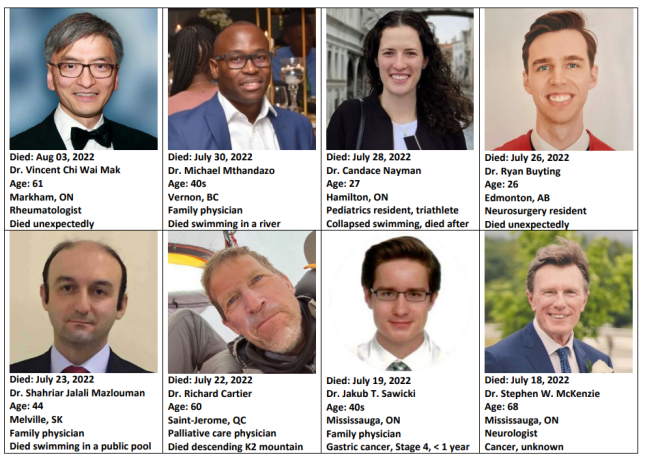
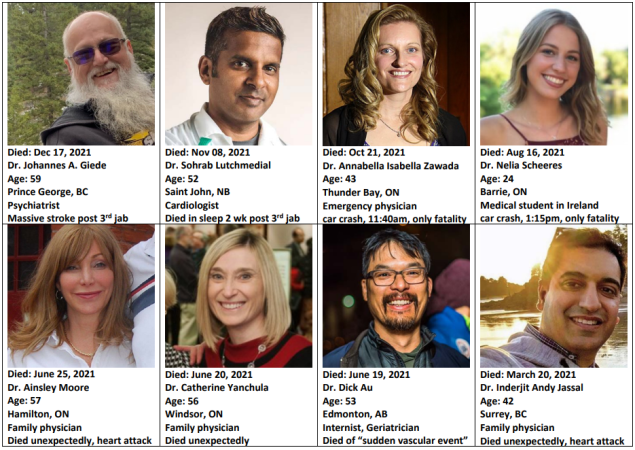
Dr. William Makis, a doctor in Canada, has written to the Presidents of the Canadian Medical Association to draw their attention to what appears to be an extraordinarily high death rate among doctors in Canada, 32 of whom died “suddenly and unexpectedly” in the past 16 months.
Dr. Makis points out that all of them were double, triple or quadruple COVID‐19 vaccinated, and argues each death is “highly suspicious for COVID‐19 vaccine injury, as these previously healthy doctors died suddenly while engaging in regular physical activity, died unexpectedly in their sleep, suffered heart attacks, strokes, unusual accidents, or developed sudden onset aggressive cancers”.
Steve Kirsch reports that Dr. Makis has received no response to his letter sent four weeks ago.
While the letter’s sample lacks a control group to compare how many such deaths would be expected among the cohort during the period, the figure does seem to be extremely high given the age of the doctors, and the circumstances of the deaths are indeed consistent with vaccine injury. It’s certainly not proof of causation, but it’s something that warrants urgent investigation, and the CMA’s silence is disturbing.
September 3rd 2022
Canadian Medical Association (CMA)
Dear CMA Presidents Dr. Alika Lafontaine (2022‐23) and Dr. Katharine Smart (2021‐22)
Re: Sudden deaths of 32 young Canadian doctors since rollout of COVID‐19 vaccines
CMA’s Mission Statement is: “Empowering and caring for patients.” CMA’s Vision Statement is: “A vibrant profession and a healthy population.” Since the rollout of COVID‐19 vaccines in Canada starting in December 2020, CMA has aggressively and unethically promoted the use of experimental COVID‐19 vaccines in populations where risks of serious vaccine injury far outweighed any potential benefits (including children of all ages, teens, pregnant women, healthy adults under age 70).
CMA also supported illegal and unscientific COVID‐19 vaccine mandates that were forced upon Canada’s 92,000 doctors by corrupt health bureaucrats. CMA did so in violation of its own CMA Code of Ethics, and both of you participated in these ethics violations. You betrayed not only your physician members but the Canadian public that CMA serves. This is unprecedented in CMA’s 155‐year history.
I am attaching photos and information of 32 young Canadian doctors who died suddenly and unexpectedly in the past 16 months, all of whom were double, triple or quadruple COVID‐19 vaccinated. Each of these deaths is highly suspicious for COVID‐19 vaccine injury, as these previously healthy doctors died suddenly while engaging in regular physical activity, died unexpectedly in their sleep, suffered heart attacks, strokes, unusual accidents, or developed sudden onset aggressive cancers.
Pfizer and Moderna may not be legally liable for their defective pharmaceutical products, but in publicly promoting their forceful use on Canada’s doctors, you are both legally liable, and so is CMA.
You cannot stay silent while illegally mandated COVID‐19 vaccines may be killing dozens of young Canadian doctors and putting thousands of doctors at high risk of severe injury and death. I am urging you to remember your ethics and Oath, and use your platform as Presidents of CMA to publicly call for the immediate termination of all COVID‐19 vaccine mandates in Canada’s healthcare, and call for urgent investigations and public inquiries into what is killing fully COVID‐19 vaccinated young Canadian doctors.
Thank you,
Dr. William Makis MD, FRCPC


October 2, 2022
Posted by aletho |
Timeless or most popular | Canada, COVID-19 Vaccine |
Leave a comment
Samizdat | October 2, 2022
US chief medical officer Anthony Fauci’s net worth surged to $12.6 million in 2021, nearly twice the $7.6 million it had been in 2019, watchdog group OpenTheBooks revealed on Friday, citing financial disclosures it obtained from Fauci’s employer, the National Institutes of Health.
Already the highest-paid employee in the federal government before the pandemic as director of the National Institutes for Allergies and Infectious Diseases, Fauci pulled down a salary of $456,000 in 2021 and $480,000 in 2022. However, that paycheck represents just a fraction of the money he made while his Covid-19 policies helped push the US economy into a recession.
The disclosures show multiple trusts, retirement accounts, and other financial assets, all of which seem to have appreciated in value during the pandemic even as much of the real economy suffered. Book royalties and the $1 million Dan David Prize from Israel, as well as appearances and speaking fees, round out Fauci’s Covid-19 windfall. When OpenTheBooks asked the NIH to see all royalties paid to the doctor, however, the document they received – which would have shown exactly how much Fauci was financially benefiting from drugs and other patents – was reportedly heavily redacted.
“While Dr. Fauci has been a government bureaucrat for more than 55 years, his household net worth skyrocketed during the pandemic,” OpenTheBooks CEO Adam Andrzejewski told Fox News, attributing the doctor’s wealth spurt to “career-end salary spiking, lucrative cash prizes awarded by nonprofit organizations around the world, and an ever-larger investment portfolio.”
Fauci has been criticized throughout the pandemic for allegedly profiting off the pricey antiviral medication remdesivir, which he proclaimed the standard for treating Covid-19 despite lackluster clinical trial results and having been against the initial advice of the World Health Organization.
Fauci appears to dislike discussing his finances in public, having been caught on a hot mic describing Republican Senator Roger Marshall as a “moron” for merely asking to see what were supposed to be publicly available documents. The Kansas senator, who is also a doctor, asked to see Fauci’s financials during a January hearing only for the NIAID chief to insist they were already public – a statement that was not true at the time. OpenTheBooks sued for access in January and only recently received the documents it posted on Friday.
Following the hearing, Marshall introduced the FAUCI Act (Financial Accountability for Uniquely Compensated Individuals) to require that government employees’ financial disclosures be publicly accessible on the Office of Government Ethics website.
October 2, 2022
Posted by aletho |
Corruption, Deception, Science and Pseudo-Science, Timeless or most popular | Covid-19, COVID-19 Vaccine, Dan David Prize, NIH, United States |
Leave a comment
Podcast: Play in new window | Download | Embed
Watch on Archive / BitChute / Odysee / Substack
FROM 2009: Just as the oligarchs are moving to consolidate their power in a new global governmental scheme based on the manmade climate change scare, their fraud has been exposed. The source code doesn’t lie, unlike the scientists who have perverted the good name of science in the pursuit of their political goals.
DOCUMENTATION
| Documentation – Corbett Report 2009 Data Archive (USB Flash Drive) |
| Time Reference: |
00:20 |
| Description: |
Get your copy today from the New World Next Week store! |
| Link To: |
New World Next Week |
| Documentation – FLASHBACK: The Bankster Bailouts (2009) |
| Time Reference: |
00:45 |
| Description: |
In this flashback to the Economics 101 series, Michel Chossudovsky of globalresearch.ca explains the circular mechanism by which the banks become creditors of the very government that is bailing them out and thus leverage financial power over the political system itself. |
| Link To: |
The Corbett Report |
| Documentation – Timothy Francis Ball Obituary |
| Time Reference: |
01:51 |
| Description: |
RIP Dr. Tim Ball (1938-2022) |
| Link To: |
Generalist Journal |
| Documentation – Intervention of H.E. Mr. Herman Van Rompuy, New President of EU Council |
| Time Reference: |
03:05 |
| Description: |
“The climate conference in Copenhagen is another step towards the global management of our planet.” |
| Link To: |
EU@UN |
| Documentation – How & Why Big Oil Conquered the World |
| Time Reference: |
05:10 |
| Description: |
The overview and history of how the oiligarchy is transitioning us into a global system of technocratic governance. |
| Link To: |
The Corbett Report |
| Documentation – Interview 1676 – Whitney Webb Exposes How Green Finance is Monopolizing the Planet |
| Time Reference: |
07:00 |
| Description: |
Meet GFANZ and the latest plan to take over the planet in the name of appeasing the weather gods. |
| Link To: |
The Corbett Report |
| Documentation – Corbett Report Podcast Episode 110a – Climategate |
| Time Reference: |
07:54 |
| Description: |
Original podcast of this episode (mp3 and show notes) |
| Link To: |
The Corbett Report |
| Documentation – WTO Director General: Global Governance Based on the EU Model |
| Time Reference: |
09:02 |
| Description: |
Daniel Taylor connects the dots on the global governance agenda. |
| Link To: |
OldThinkerNews.com |
| Documentation – UK and France propose climate fund for poor |
| Time Reference: |
09:38 |
| Description: |
What? You don’t think it’s actually going to end up going to the poor? |
| Link To: |
BBC News |
| Documentation – Global Warning: Leaked “Climate Fraud” emails under probe |
| Time Reference: |
11:11 |
| Description: |
A (mostly) fair piece on the Climategate scandal from Russia Today. |
| Link To: |
RT.com |
| Documentation – CLIMATE BOMBSHELL: Hacker leaks thousands of emails showing conspiracy to “hide” the real data on manmade climate change |
| Time Reference: |
15:47 |
| Description: |
My first article on the subject as the story was breaking. |
| Link To: |
The Corbett Report |
| Documentation – The warming conspiracy’s most damning emails |
| Time Reference: |
18:57 |
| Description: |
Highlights some of the more interesting parts of the leaked CRU correspondence. |
| Link To: |
Herald Sun |
| Documentation – climategate: hacked emails expose climate control schemes |
| Time Reference: |
19:08 |
| Description: |
Data dump on the Climategate affair. |
| Link To: |
MediaMonarchy |
| Documentation – ClimateGate for Dummies |
| Time Reference: |
19:35 |
| Description: |
Master article with links to dozens of other articles and videos on the subject. |
| Link To: |
Infowars.com |
| Documentation – CRU Emails may be open to interpretation, but commented code by the programmer tells the real story |
| Time Reference: |
20:16 |
| Description: |
The code spills the beans. |
| Link To: |
WattsUpWithThat |
| Documentation – Climategate: The Backstory |
| Time Reference: |
21:32 |
| Description: |
Prescient video on the CRU released by The Corbett Report just weeks before the Climategate story broke. |
| Link To: |
Odysee |
| Documentation – Climategate: Dr. Tim Ball on the hacked CRU emails |
| Time Reference: |
24:12 |
| Description: |
Interview with historical climatologist about the climategate scandal. |
| Link To: |
Odysee |
| Documentation – Ed Begley, Jr. Loses Control Over ClimateGate |
| Time Reference: |
31:25 |
| Description: |
Begley blows a gasket and becomes a broken record: peer-review, peer-review, peer-review. |
| Link To: |
YouTube |
| Documentation – The Wegman Report |
| Time Reference: |
34:43 |
| Description: |
Ad Hoc Committee Report on the ‘Hockey Stick’ Global Climate Reconstruction |
| Link To: |
UTDalls.edu |
| Documentation – Climategate: how the MSM reported the greatest scandal in modern science |
| Time Reference: |
35:09 |
| Description: |
That headline should read: “FAILED to report.” |
| Link To: |
James Delingpole |
| Documentation – BBC Climate Correspondent Was Forwarded CRU Emails Five Weeks Before They Were Made Public |
| Time Reference: |
39:41 |
| Description: |
A BBC Weather presenter who was discussed by scientists in the “climategate” emails says he was forwarded the material more than five weeks before it was made public on the internet. |
| Link To: |
Infowars.com |
| Documentation – NY Times reporter whitewashes Climategate story he is part of |
| Time Reference: |
41:01 |
| Description: |
What will the ombudsman say? |
| Link To: |
GreenHellBlog |
| Documentation – Pretending the climate email leak isn’t a crisis won’t make it go away |
| Time Reference: |
43:21 |
| Description: |
I actually agree with Monbiot on that headline’s injunction. |
| Link To: |
Guardian |
October 2, 2022
Posted by aletho |
Science and Pseudo-Science, Timeless or most popular, Video |
Leave a comment
GlaxoSmithKline (GSK), which is not a manufacturer of a Covid vaccine and thus did not benefit from Covid vaccine sales, recently announced second quarter 2022 results that surpassed expectations. This has enabled an upward adjustment in the profit forecast for the full year 2022. The Telegraph reported that GSK shares are up 44% from last spring.
Sales of GSK’s shingles vaccine, Shingrix, was the main driver of growth. Shingrix sales more than doubled in the second quarter, being April to June 2022, pushing up total GSK sales by 13%.
Shingrix is a relatively new shingles vaccine that my doctor tells me is considered an improvement on Zostervax, the traditional shingles vaccine. However, Shingrix is not cheap. A two dose course in Hong Kong costs £600, in the U.K. £440 and in the U.S. around $300. Allowing for distributor and retail margins, I estimate that GSK’s income would be about one third of the retail price. Let’s assume therefore that GSK earns £150 per two dose course on a worldwide average basis.
According to GSK, sales of Shingrix doubled to £731M, an increase of £366M in one fiscal quarter. At £150 per course, this equates to an unexpected increase in sales and thus vaccine recipients in one fiscal quarter of 2.4 million from the expected quarterly run rate.
When asked the reason for this surprising jump in Shingrix sales, GSK’s CEO stated: “It comes after countries started to shift their focus away from Covid towards other jab campaigns.”
Nobody seems to have questioned this statement. In the period in question, April to June 2022, Covid vaccine programmes were still highly active and indeed many programmes across the world were on to their third or fourth booster.
Though extremely painful, shingles is not life threatening and generally affects people over 50. It affects persons who have previously had chickenpox, often in their childhood, and is triggered mainly by overwork, lack of sleep or similar stress-related reasons. Shingles attacks the nervous system, especially nerve endings, and hence is often intensely painful.
Vaccination against shingles is not routinely given to all over-50s in most countries. Despite this, according to GSK, in the middle of a continuing Covid campaign, countries opted to shift their focus to vaccinating against shingles?
Is this likely? If indeed there was a shift to more usual vaccination programmes, would vaccination against shingles have been prioritised? Additionally, given the cost of this vaccine, and weighing up the public benefit, would most countries or patients really switch to Shingrix from the much cheaper Zostervax?
All of this seems unlikely. So what has driven a 50% increase in sales of a very expensive vaccine not part of the usual standard vaccination programme?
Further, taking the USA as an example, the ratio of Shingrix to Zostervax sales is 50-50. In most other countries, Shingrix has less than 50% of the market. If 2.4 million people in one quarter had the Shingrix vaccine, how many more had Zostervax? It is not inconceivable that some 5 million more people than usual were vaccinated against shingles in one quarter.
Can this really be explained by countries restarting their normal vaccination programmes, and for no particular reason adding a shingles vaccines into the standard mix?
I may have the answer. In my 50s I twice had shingles. I can vouch for how painful it is. Since then I have had the traditional shingles vaccine jab every few years and had been shingles free for 15 years. I have also consciously improved how I manage my business travel and lifestyle to reduce travel stress and tiredness, which had been the previous drivers in my case.
In March and April 2021 I had my first and second Pfizer Covid jabs. On the day following the second jab I developed a chickenpox like rash and started to experience nerve pain. As I am something of a shingles veteran, I immediately thought “I am getting shingles!” And this is, indeed, what developed quite badly over the next few days.
I rang my doctor who said, “It can’t be shingles, you are vaccinated.” However, after examining me the next day he agreed I was right. I asked what had brought this on? Could it be the Covid jabs? He replied: “I cannot explain why, but it is not likely to be connected to the Covid jab. Just unfortunate timing.”
My doctor then prescribed the usual medication for shingles and it cleared up in a week or so (for some it can take many weeks). My doctor then suggested I spend £600 having the new and better Shingrix vaccine, “as obviously your body is now immune to the traditional vaccine”. In his defence, this was very early days for assessing vaccine side-effects.
I decided I would not spend £600. Instead, I set about researching on the internet.
Since then it has transpired that shingles is a recognised reaction to the Pfizer vaccine in older people. Shingles is an inflammation of the nerves and nerve endings. The mRNA vaccines are now known to affect the nervous system in a number of different ways. It appears that triggering shingles is one of them (or else it is a result of a temporary depression of the immune system, as some have suggested).
Significantly, my doctor has confirmed he has now had other patients who contracted shingles after Covid vaccination. Most took up his £600 offer of Shingrix. It does not take much to imagine what a multiplier effect such advice and take-up across the world would have on the sales of Shingrix and the profits of GSK.
Something must be happening across the world for sales of an existing single product to double in a quarter by 2.4 million. In the absence of any other new factors, one can conclude that the drive in sales must have been due to one side-effect of the Covid vaccines. Equally one can imagine the booster effect for the makers of Zostervax too.
Whilst not all pharmaceutical companies have produced enormously profitable Covid vaccines, the emerging medical toll, side-effects and general aftermath of these vaccines and lockdowns is only just emerging. I suspect all pharmaceutical companies will now share in a second Covid profits bonanza driven by medications prescribed to deal with the collective aftermath of Covid. GSK has lit the way.
October 1, 2022
Posted by aletho |
Corruption, Timeless or most popular | COVID-19 Vaccine, GSK, Shingles, Shingrix |
Leave a comment

 Aletho News
