You do the math
A man takes out a lavish, grossly excessive insurance policy on his wife. The next day she keels over dead. Which hypothesis should guide the detective assigned to the case? (A) It’s probably just a coincidence, no need to investigate. (B) There’s a significant probability of foul play, so the husband should be considered a suspect, at least until a thorough investigation definitively clears him.
Intuitively, most of us know that the correct answer is “B.” We don’t need probability theory to tell us that, any more than we need Einstein to tell us that Jeffrey Epstein didn’t kill himself.
But wait! Here comes a mathematically-inclined professional debunker, who explains: “Actually, more than ten million life insurance policies are taken out every year, with the insured person averaging 19.2 years of life expectancy after the initial policy purchase, so 500,000 annually-insured people die each year which means more than 1300 annually-insured people die each day. The insured wife in your example could easily have been one of those 1300 people who just happened to die on that particular day, which just happened to be the day after the husband bought the policy. So it must have been a coincidence. No need to investigate.”
Wikipedia, The New York Times, Snopes, DHS’s Disinformation Governance Board, and assorted fact-checkers all agree. Social media labels people who suspect the husband of murder and insurance fraud “conspiracy theorists” and disables the accounts of those who voice their suspicions.
And then it gets worse. The husband uses part of his gargantuan insurance settlement (with additional help from unknown but very wealthy parties) to sue selected alternative media outlets for libel. He says the alternative media has tormented him by reporting on the people who want him investigated for murder and insurance fraud. He says his feelings have been hurt and he has had to move and change his phone number and seek psychological counseling. He says the “conspiracy theorists” are tormenting him by being so disrespectful of the dead (his wife) and the grieving survivor (himself).
A reasonable judge and/or jury might rule:
“We’re terribly sorry, Mr. Innocent Widower, but even assuming that you really are innocent, it was and remains entirely reasonable for alternative media outlets to voice their suspicions based on the undeniable fact that you bought a grossly excessive insurance policy on your wife the day before she keeled over dead.”
But what if Mr. Innocent Widower could produce an expert witness: a mathematician who swears on a stack of Principia Mathematicas that probability theory proves the odds are over 95% that Mr. Widower is innocent, and the timing of the insurance purchase was just a coincidence? In the absence of expert testimony to the contrary, and with the entire mainstream media supporting poor bullied Mr. Widower, the judge and jury might jettison common sense and say: “Jeepers, that pretty much proves the guy’s innocent! Those conspiracy theorists sure are a stupid, nasty bunch of reality deniers! Why won’t they just ‘trust the science’?”
The above example is, of course, fictitious and hypothetical. But its resemblance to actual events is more than coincidental.
Take Richard Gutjahr—please! Gutjahr has a way of popping up in the strangest places. As I wrote in 2018:
Remember the amazing “terror journalist” Richard Gutjahr? The man with the uncanny ability to show up, pre-positioned, to take iconic footage of “Islamic terror” attacks?
Gutjahr, married to Israeli black ops specialist Einat Wilf, just happened to be on a balcony in Nice, France to film the beginning of the “truck attack.” His footage was essentially the ONLY footage of the event ever seen by the world.
Then one week later, Gutjahr and his daughter both just happened to be at the shopping mall in Munich where the next big “Islamic terror” event burst into the headlines. Once again, the MSM led with Gutjahr’s (and his daughter’s) footage.
It takes chutzpah to pre-position yourself to get the lead footage of two “terror attacks” one week, and 800 km, apart. But it takes even more chutzpah to sue journalists who report your apparent foreknowledge.
Gutjahr, apparently not lacking in chutzpah, sued German journalist Gerhard Wisnewski for reporting the highly suspicious facts. But even in Zionist-owned-and-operated Germany, such chutzpah was too much for the courts to stomach. Below is Wisnewski’s report on his legal victory over the hapless Gutjahr, a more obvious terror suspect than Bin Laden ever was, who obviously needs to be arrested and interrogated. Anybody out there who can rendition him?
I stand by my 2018 statement that Gutjahr is an obvious terror suspect. But he’s just a suspect. He could be innocent. It could be just a coincidence that he happened to be perfectly positioned to film the most-used media footage of two spectacular, ultra-media-hyped “Islamist terror attacks,” in two different nations, in the same week…and that he also just happens to be married to an Israeli intelligence officer. But… what are the odds?!
Now here is where it really gets weird. Gutjahr has just “shown up” at another “suspicious location”: A seemingly well-financed website called Rootclaim that pretends to have developed an app for determining the odds that any given “conspiracy theory” is true:

Rootclaim was developed by one of Gutjahr’s in-laws, a certain Saar Wilf, who is presumably related to Gutjahr’s wife Einat. (These people know how to keep it in the family!) Saar and Einat Wilf not only share a last name, but have co-authored an article on COVID. Of course that might be mere coincidence; they could be completely unrelated. But…what are the odds?
Rootclaim seems reasonably open to non-mainstream perspectives… at least on issues where the Wilf-Gutjahr family doesn’t have skin in the game. It tells us there is an 86% chance that Putin does not have cancer, a 96% chance that the anti-Assad US-NATO backed forces (not Assad) attacked al-Ghouta with chemical weapons, and an 86% chance that COVID-19 “was developed during gain-of-function research and was released by accident.”
That’s all well-and-good. But again: What are the odds that Richard Gutjahr, or any TV host for that matter, would just happen to be the unique person in position to shoot the first and most-used footage of two successive major terror attacks? For some strange reason, Rootclaim hasn’t run those calculations.
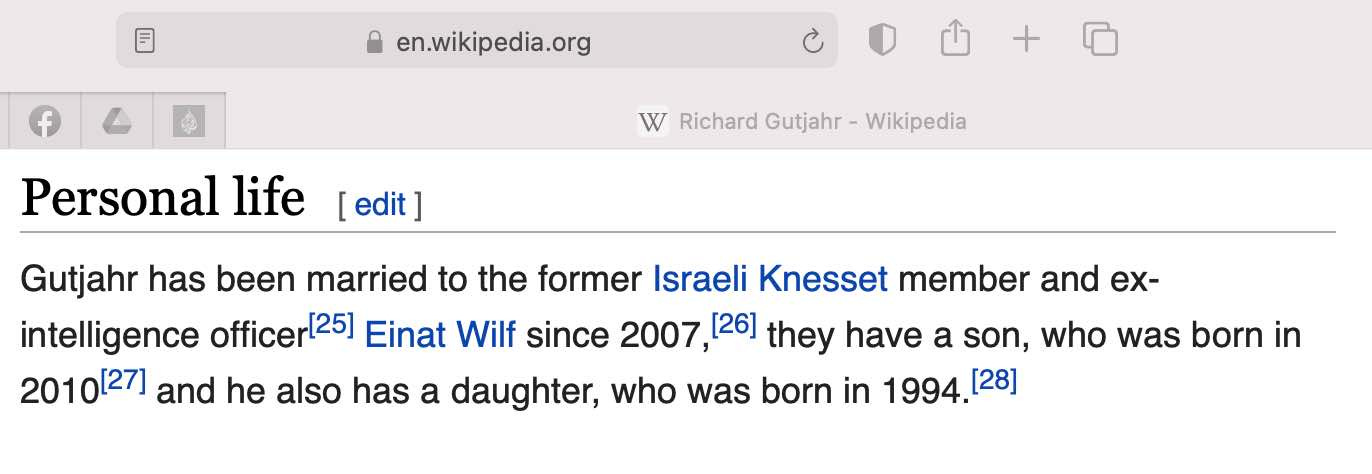
When we estimate the odds of such things, we need to consider background information. For example: How relevant is the fact, attested to by Wikipedia, that Richard Gutjahr is married to a former Israeli intelligence officer?

Wikipedia tells us that Gutjahr’s “coincidental presence at events gave rise to conspiracy theories, alleging his presence at both events could not have been a coincidence. Gutjahr has pressed charges against those who make the allegations,[21][22] which he sees mostly motivated by antisemitism against his wife considering the often antisemitic nature of the hostilities.” (Funny how Wikipedia tells us that Gutjahr “pressed charges” against journalists like Gerhard Wisnewski but fails to mention the outcome: Gutjahr suffered a crushing defeat in court.)
And then…bring on the obligatory charges of anti-Semitism! Whoever is editing Wikipedia apparently thinks it is “anti-Semitic” to notice that Israel is the only nation that has benefited from the “war on terror,” an episode of international mass hysteria elicited by a string of alleged “Islamic terror attacks” in which the Israeli government in general, and its intelligence community in particular, is the leading suspect.
Was it just a coincidence that the people who happened to be pre-positioned near the New Jersey waterfront at the perfect spot to film the attack on the Twin Towers, and who filmed and wildly celebrated the attacks before being arrested, were Israeli spies who later confessed they had been sent there “to document the event”?
Was it just a coincidence that the mysterious “Janek” who was pre-positioned on a rooftop to film the iconic footage of “the Charlie Hebdo terrorists’ escape” turned out to be an Israeli agent? As Hicham Hamza wrote:
At the origin of this (iconic Charlie Hebdo) video – filmed, oddly enough, without apparent fear of being hit by a stray bullet – in which one of the Charlie Hebdo attackers (who would soon flee in the direction of a Parisian establishment used by the Israeli army) declaims, with his left index finger pointed towards the sky, that he had “avenged the Prophet” – is a mysterious anonymous Pole, blurred by the television media, who vanishes without a trace – having been employed by a long-standing family enterprise of Laurent Dassault, ultra-Zionist multimillionaire connected to the military and radical wing of the Tel Aviv regime.
There is a mass of evidence, circumstantial and otherwise, that implicates Israel in 9/11, the 7/7/2005 London bombings, the Paris attacks of January and November 2015, and indeed most of the highest-profile GWOT terror incidents attributed to “Islamic extremists.” So Richard Gutjahr’s being married to an Israeli intelligence officer, and then magically showing up to film the beginnings of two successive terror attacks, does seem a tad suspicious. And his presence at a website selling an app that claims to mathematically arbitrate between mainstream and non-mainstream narratives seems not just suspicious, but bizarre… if not downright absurd. If noticing such things makes you “anti-Semitic,” then the alternative to “anti-Semitism” is sheer unmitigated idiocy.
Is mainstream media idiotic… or complicit? What are the odds?
August 4, 2022
Posted by aletho |
Deception, False Flag Terrorism, Timeless or most popular, Wars for Israel | Israel, Zionism |
Leave a comment
I BET YOU DON’T KNOW THIS ABOUT THE SCARF LADY
Birx is a pivotal member of the Medical Mafia – here are some stories you might not know about the evil scarf lady. Can you support this channel with a financial gift? Visit my website: https://amazingpolly.net/contact-support.php Birx now says she knew all along that the Covid vaccines wouldn’t work and admitted to subverting the US government (and tricking the world!) in multiple ways while on the COVID-19 Task Force.
Michael Senger’s Substack: https://michaelpsenger.substack.com/p/deborah-birxs-silent-invasion-a-guide
National File report on Birx’s Book: https://thenationalpulse.com/2022/07/17/sabotage-dr-birx-admits-to-revising-and-hiding-info-from-trumps-covid-team-while-altering-cdc-guidelines-without-approval/
Ivanka cheers for Birx, convincing Trump to keep her: https://www.one.org/us/press/one-applauds-trump-decision-to-retain-deborah-birx-as-interim-global-aids-coordinator/
Corey’s Digs AIDS $90billion dollar slush fund: https://www.coreysdigs.com/health-science/is-aids-us-90b-taxpayer-dollars-a-global-slush-fund/
PEPFAR Ukraine State Department Memo for FY 2019 funding: https://www.state.gov/wp-content/uploads/2019/08/Ukraine.pdf
Soros Embezzlement Investigation, Ukraine AIDS dollars: Judicial Watch: https://www.judicialwatch.org/corruption-chronicles/u-s-soros-funded-ukrainian-hiv-charity-under-criminal-probe-for-embezzlement/
Paige Reffe worked as Clinton’s Advance Man: https://heavy.com/news/2020/04/deborah-birx-husband-paige-reffe/
Fauci #pepfar #aids #taintedblood #trump #covid19
August 4, 2022
Posted by aletho |
Deception, Science and Pseudo-Science, Timeless or most popular, Video, War Crimes | Covid-19, COVID-19 Vaccine, Ukraine, United States |
Leave a comment
Podcast: Play in new window | Download | Embed
We stand at a precipice. On one side is “reality”: the original, authentic, lived human experience. And on the other side is the metaverse: the world of constantly mediated experience. In the middle is hyperreality, that blurry space between the real world and the mediated world. And, living as we do on this side of the electronic media revolution, it is the only place we have ever known.
Watch on Archive / BitChute / Odysee or Download the video
For those with limited bandwidth, CLICK HERE to download a smaller, lower file size version of this episode.
For those interested in audio quality, CLICK HERE for the highest-quality version of this episode (WARNING: very large download).
TRANSCRIPT
VOICEOVER: Media. It surrounds us. We live our lives in it and through it. We structure our lives around it. But it wasn’t always this way. So how did we get here? And where is the media technology that increasingly governs our lives taking us? This is the story of The Media Matrix.
PART 3: INTO THE METAVERSE
At the dawn of the twenty-first century, if you saw anything, read anything, listened to anything, it was, more likely than not, placed in front of you by one of the handful of corporations that controlled the major television and radio networks, newspaper syndicates, film studios and music companies. These companies didn’t control what people thought; it was more subtle than that. These companies controlled what people thought about.
We all knew the daily news from the newspapers. We all heard the latest Billboard chart topper. We all saw the latest episode of Must See TV and we all knew about the latest Hollywood blockbuster. Even if we managed to avoid these media ourselves, we knew them anyway from cultural osmosis.
Yes, by the year 2000 we had arrived at the pinnacle of mediated reality. The media oligopoly’s control of society was complete, and nothing could ever come along to change it.
And then something did.
SINGER: You’re riding on the internet! Cyberspace, set us free! Hello, virtual reality! Interactive appetite, searching for a website, a window to the world that to get online. Take the spin now you’re in with the techno set, you’re going surfing on the internet!
SOURCE: Kids Guide to the Internet (1995)
Given that the only thing most people can agree on these days is that the internet is ruining society, it’s difficult to remember that the general public’s introduction to the World Wide Web was accompanied by a torrent of hyperbole and over-the-top enthusiasm that would make a pimply-faced teenager blush.
The internet was going to solve all of our problems! It was going to democratize information. It was going to give a voice to the voiceless. It was going to bring the world together. And most importantly, it was going to help us order pizza without having to pick up our phone!
[Sandra Bullock orders pizza on the internet.]
SOURCE: The Net (1995)
It’s easy to laugh at the gee-whizery and pie-in-the-sky promises of the Information Superhighway hype. But make no mistake: the advent of the web was a revolution. It did upend the economic model that had given rise to the media oligopoly in the first place. And it did give a voice to countless millions around the globe who would never have been heard at all if it weren’t for the advent of new media platforms.
JAMES CORBETT: This is James Corbett of corbettreport.com, and I’d like to welcome you to a new episode of a completely new news update series that I’m doing with my good friend, and the host and webmaster of mediamonarchy.com, James Evan Pilato. James, it’s great to have you on the program today.
JAMES EVAN PILATO: Thanks a lot, man. I’ve looked forward to doing this.
CORBETT: Yeah, me too. . . .
SOURCE: New World Next Week Pilot Episode — Oct. 11, 2009
As the general public started to get online in the 1990s, not even the wildest flights of cyber-utopian fancy could have imagined the sea change in news and information that was about to sweep over the public. As the printing press had given birth to our very concept of “the news” and as radio and then television again transformed our understanding of what it meant to hear or see the news, so, too, did this new medium change our perceptions of world events and our relationship to them.
Suddenly, “the news” was not something you heard a well-coiffed elderly man in a three-piece suit in a million dollar studio reading to you from a teleprompter. In the online age, the news was as likely to be a story written from home by a guy in his pajamas or a video of a protest uploaded from someone’s smartphone or a tweet by an anonymous account. Blogs and websites, and, later, Facebook feeds and Reddit posts, became places people went for news and analysis on breaking events. Information was condensed into memes, and meme literacy became necessary to even understand what was happening online.
And all the while, the media whose hold over the public mind had seemed so unassailable mere decades ago was now old hat, reduced to just another stream of information accessible on the always on, infinite scrolling online content feeds.
But if we have learned anything from this study of mass media history by now, it’s that a predictable pattern is at play: a new technology transforms the way people communicate and promises a flowering of knowledge and understanding. The existing power structure then spends all of its considerable resources censoring or co-opting that technology and, ultimately, using the new media as an even more effective tool for spreading propaganda.
As we saw in Part 1 of this series, the Gutenberg press sparked a true revolution, overturning the social, political and economic order and empowering individuals to share ideas on a scale never before imaginable. But we also saw the censors swooping in to repress those ideas before the corporatization of the press finally tamed the mighty juggernaut that Gutenberg had unleashed.
And, as we saw in Part 2 of this series, the commercial radio revolution prompted the Rockefellers and other entrenched financial interests to begin studying how best to use the electronic media to shape the public consciousness. And television, with its ability to put its viewers into an alpha brainwave state of susceptibility, proved to be an even more effective tool for the corporate interests that soon monopolized the public airwaves.
The story of the World Wide Web follows a depressingly similar trajectory. Whatever promise the internet held to kick off a new Gutenberg revolution—putting the power of the press back in the hands of the average person—that promise has been consistently betrayed by the the centralization of online discovery and identity into corporations, as even Twitter founder Jack Dorsey now admits.
Perhaps the fact that the web has been so quickly co-opted into a medium of control isn’t surprising. After all, the internet is no movable type printing press. However much work went into the design of the printing press, it was still possible for a skilled fifteenth century craftsman to create and operate one with nothing more than the knowledge of the latest technologies and the capital of a few business partners. But the internet arose not from a medieval tinkerer’s workshop, but from the bowels of the Pentagon.
The long history of collusion between Big Tech, the Pentagon and the US intelligence community is by now a well-documented one. The story leads from Silicon Valley—home of Big Tech and the site of much of the research that helped birth the personal computer revolution and the internet—through Pentagon research grants and In-Q-Tel investments to the development of the ARPANet, the birth of the internet, and, eventually, the rise of Google and Facebook and the World Wide Web as we know it today.
The result of that history is apparent to all by now. A medium that should be the most participatory medium ever invented has become a web to trap its audience in an infinite scroll of social media distraction, one designed specifically to keep its users seeking the scientifically scheduled hit of their next dopamine reward.
SEAN PARKER: If the thought process that went into building these applications—Facebook being the first of them to really understand it—that thought process was all about “How do we consume as much of your time and conscious attention as possible?” And that means that we need to sort of give you a little dopamine hit every once in a while because someone liked or commented on a photo or a post or whatever, and that’s gonna get you to contribute more content, and that’s gonna get you more likes and comments. So it’s a social validation feedback loop. I mean, it’s exactly the kind of thing that a hacker like myself would come up with, because you’re exploiting a vulnerability in human psychology. And I think that we—the inventors/creators, you know, it’s me, it’s Mark, it’s Kevin Systrom at Instagram, it’s all of these people—understood this consciously and we did it anyway.
SOURCE: Sean Parker – Facebook Exploits Human Vulnerability
The results of Big Tech’s experiment are now in: the would-be social engineers were successful beyond their wildest expectation. The zombie apocalypse has already happened; in its wake lay the increasingly mechanistic automatons of the social media revolution, eschewing the dull world of human interaction for the cyber world of likes, shares and dopamine rewards. The smartphone has become the digital god of the zombie hordes, demanding we bow down in prayer at every free moment.
Perhaps most frightening of all is the astonishing speed with which this revolution is taking place. As transformative as Gutenberg’s press was, it took decades for the technology to propagate out across Europe, and it took centuries for the effects of that technological upheaval to play itself out in the body politic. The electronic media revolution took the better part of a century of development from its earliest iteration, the telegraph, to its introduction to the average person’s living room in the form of radio sets, and, later, televisions.
But the online media revolution has happened with astonishing speed. In the span of one decade, smartphones went from curious novelties to ubiquitous items, and they are now on the cusp of being made mandatory for participation in everyday life. This incredible change is already manifesting in a world of profound and rapid dislocations in every facet of our lives: political, economic and social.
So where is this revolution taking us? Can we learn to navigate this new world of nearly constant mediated experience? Should we?
To answer that, we need to look at the nature of media itself.
Media, from the earliest smoke signals and scratches in clay tablets to the printed page to the recorded images and sounds of the modern era, has always existed as a means for extending our bodies in space and time. The written word is an extension of our mind out into the world, allowing people in far-distant places and far-off times to read our innermost thoughts. The phonograph was an extension of our voice, the filmed image an extension of our bodies themselves, permitting them a type of 2D immortality.
But somewhere along the way, the balance between the media and the real world that it represents began to shift. We went from this world to this world, where most of what we see, most of what we hear, most of what we think we know about the world comes not from the people and places that populate our direct, lived experience, but from mere representations.
We have our friends, of course, but we also have Friends. We have neighbours, but we also have Neighbours. We have something better than real life. We have reality TV!
We have entered the world of the simulacrum.
JEAN BAUDRILLARD: Mais dans la définition que j’ai du réel, au sens où je l’ai dit : c’est-à-dire faire advenir un monde réel, c’est déjà le produire, c’est déjà quelque-chose comme un simulacre.
Pour moi, le réel n’a jamais été qu’une forme de simulation. Le principe de réalité, c’est la première phase, si on veut, du principe de simulation, quoi . . . Mon postulat ce serait : il n’y a pas de réel, le réel n’existe pas. On peut objectivement le cadrer, faire qu’il existe un effet de réel, un effet de vérité, un effet d’objectivité, et cetera . . . mais moi je n’y crois pas au réel.
SOURCE: Jean Baudrillard — Mots de passe (documentaire 1999)
At a certain point, the boundaries between the real world and the world of media begin to blur. Is television reflecting the types of people we are, or are we emulating the characters we see on TV? Are the sad songs we listen to the product of broken-hearted people or the cause?
But if nothing is less real than reality TV, what is the reality that that TV is attempting to portray? Does it even exist anymore?
This is no idle question. As pervasive as the online media has become, as important as our participation in that mediated world has become for our daily lives, a new medium has already appeared. The metaverse. Introduced to the public consciousness by the likes of Mark Zuckerberg, the metaverse represents the apotheosis of the media revolution. Soon, the internet will not exist as a cyperspace that we access through our clunky smartphone gadget. Instead, it will be a fully realized, immersive, 3D virtual world that we can literally step into.
No matter our reluctance to enter this virtual world, we will soon, all of us, have the opportunity to enter the metaverse for ourselves, whether by putting on the glasses and adding an augmented reality layer to the world as we know it, or by strapping on the goggles and entering the cyber domain completely. And, after we do so, we may find the idea of living our lives in bare, unmediated reality will be as quaint, as unthinkable, as living in a world of smoke signals and clay tablets.
[Scenes from HYPER-REALITY]
We stand at a precipice. On one side is “reality”: the original, authentic, lived human experience.
And on the other side is the metaverse: the world of constantly mediated experience.
In the middle is hyperreality, that blurry space between the real world and the mediated world. And, living as we do on this side of the electronic media revolution, it is the only place we have ever known.
It has been suggested that the metaverse is not a space—not a virtual world that we can jack ourselves into and live a virtual life, like in The Matrix—but a time. Specifically, the metaverse is that time when our digital lives become more meaningful to us than our “real” lives. If that is the case, then who can deny that, for an increasing number of people around the world, that time has already arrived?
In this series we have examined the history of the mass media, from the Gutenberg Revolution to today. But if we don’t understand that history, then we will be like the ignorant masses identified by George Santayana, condemned to repeat a past that we cannot remember.
From one perspective, the history of media is merely the story of the development of the machinery of communciation. The movement from the printing press to the telegraph to the radio to the television to the internet to the metaverse is a story of technological progress, and each new technology brings us closer to the ideal of total communication.
But there is a more fundamental perspective, one that sees media not as a technology, but as the expression of our need as human beings to connect with others, to fight off our original state as beings cast alone and naked into the world through communion with others. But as our technology of communication begins to create its own world and as we increasingly place ourselves inside that media world, we would do well to ask ourselves, “At what point do we lose our essential nature as human beings? Once we’re jacked into the metaverse, are we still homo sapiens, or will we have become homo medias? Have we considered what that means? Do we care?”
Perhaps it’s inevitable that the curved mirror of the Gutenberg conspiracy has finally brought us here, to the black mirror at the doorway to the metaverse. Perhaps we were destined to end up here. Perhaps this is an expression of a fundamental urge that is part of human nature.
Perhaps. But it’s also good to know that this has an “off” button. That the real world still exists. That you are watching an image on a screen. And that the power to turn it all off is still in our hands.
The Media Matrix
Written, Directed and Presented by James Corbett
Video Editing and Graphic Design by Broc West
Recording Assistance: Murray Carr
Special Guest Appearance by James Evan Pilato
Series Title Theme “What Hath God Wrought” by KODOMOSAN
Transcript and links: corbettreport.com/media
August 2, 2022
Posted by aletho |
Mainstream Media, Warmongering, Timeless or most popular, Video |
Leave a comment
Samizdat | August 2, 2022
Washington bears “political, criminal, and moral responsibility” for “war crimes” committed by the Ukrainian military, Russia’s Defense Ministry said on Tuesday. The statement came in response to an interview by a top Ukrainian spy, who revealed that Kiev consults with Washington before using US-made HIMARS multiple launch rocket systems and that Washington actually has veto power over decision-making.
“All this irrefutably proves that Washington, contrary to the statements of the White House and the Pentagon, is directly involved in the conflict in Ukraine. It is the Biden administration that is directly responsible for all the Kiev-approved missile attacks on residential areas and civilian infrastructure in the settlements across Donbass and other regions that caused mass civilian casualties,” Defense Ministry spokesman Igor Konashenkov has said.
According to Moscow, US-supplied HIMARS systems have repeatedly been used by Kiev forces to target facilities that were not legitimate military targets. Arguably the most dire recent example of this strategy was an attack on a penal colony in Elenovka in the Donetsk People’s Republic, which was housing Ukrainian POWs, including fighters with the notorios neo-Nazi Azov regiment. The attack left at least 50 prisoners dead and another 73 injured.
“The Biden administration, together with Zelensky, bears political, criminal, and moral responsibility for the massacre in Elenovka and other war crimes in Ukraine,” Konashenkov said.
The explosive interview with a Ukrainian senior intelligence official, Major General Vadim Skibitsky, was published by The Telegraph newspaper on Monday. The spy revealed Kiev’s troops were getting feedback from Washington and London before launching HIMARS rockets. This allows “Washington to stop any potential attacks if they were unhappy with the intended target,” The Telegraph noted.
Russia sent troops into Ukraine on February 24, citing Kiev’s failure to implement the Minsk agreements, designed to give the regions of Donetsk and Lugansk special status within the Ukrainian state. The protocols, brokered by Germany and France, were first signed in 2014. Former Ukrainian president Pyotr Poroshenko has since admitted that Kiev’s main goal was to use the ceasefire to buy time and “create powerful armed forces.”
In February 2022, the Kremlin recognized the Donbass republics as independent states and demanded that Ukraine officially declare itself a neutral country that will never join any Western military bloc. Kiev insists the Russian offensive was completely unprovoked.
August 2, 2022
Posted by aletho |
Timeless or most popular, War Crimes | Ukraine, United States |
Leave a comment
On Friday, archives of the Israeli occupation forces released court documents related to the trial of Israeli soldiers who brutally massacred 49 Palestinians on 29 October, 1956. The massacre took place in the Palestinian town of Kafr Qasem.
It was the first day of the Israeli, British and French invasion of Sinai, which came in response to Egypt’s closure of the Suez Canal. Israel imposed night curfew on most of the areas with high Palestinian (Arab) populations in Israel.
Late Brigadier General, Issachar Shadmi, was the commander of the Israeli army brigade which was in charge of Kafr Qasem, located in the centre of the recently occupied Palestine that became Israel, or close to the Armistice Line with Jordan, which controlled to West Bank at the time. He ordered the curfew to start earlier that day and ordered his officers to strictly implement it.
Palestinian or Arab farmers, who were at their farms outside the village, returned home without knowing anything about the updates related to the curfew. The Border Police officers commanded by Shadmi mercilessly opened fire at the unarmed farmers, killing 49, including the elderly, women and children.
The massacre was widely condemned, even by officials from the Israeli occupation government, which sent Shadmi and the other officers involved in the massacre to trial and sentenced all of them. The officers spent a very short time in prison before they had a presidential pardon.
Regarding Shadmi, the highest commander of the area at the time, the judges ordered him to pay a fine of 10 cents, according to Haaretz, for pushing up the curfew without the approval of the military governor. The judges claimed he did so “in good faith”. This way, the issue of the massacre was closed, but the court documents revealed on Friday disclosed new facts about it.
The transcript of Haim Levy, who was a company commander, showed that there was a clear order to shoot Palestinians who broke the curfew without knowing about the change of its starting time. Levy also said, according to the court documents, he had been told by battalion commander, Shmuel Malinki: “It is desirable that there be a number of casualties.”
Milinki told the court that he answered the soldiers, who asked him how they should deal with the Palestinians who did not know about the change in the timing of the curfew, that they should kill them. “Allah yerhamu,” he said in Arabic. It means, “May God have mercy on them.” This proves that there were plans to kill Palestinians, prepared before the massacre took place.
To prove that the intentional killing of Palestinians was a major order related to the situation at Kafr Qasim, Commander Gabriel Dahan, said, according to the Jerusalem Post, he was told by Melinki “without sentiments, it is better to have a few dead, so that there will be peace in the area”.
During the hearings, the Israeli soldiers mentioned, several times, a plan called “Hafarferet” (“Mole”), which was prepared to be implemented during the invasion of Sinai, but Israel wanted it to start spontaneously, not to be initiated by its army, like the invasion of Egypt.
As part of this operation, Levy said that there were measures meant to move the Palestinians from their homes, including curfew imposition, property confiscation and moving entire villages from place to place. According to the Jerusalem Post, Levy said, the case of Kafr Qasim, “the entire population of the village was to be moved to Tira.”
The aim was not only to move Palestinians from one area to another area inside Palestine or Israel, but to move them out of the country. Levy said that the Israeli occupation forces were told “not to put lookouts and checkpoints on the eastern side [of Kafr Qasim] so that if the Arabs decided to flee, they could and would be allowed to go over the Jordanian border [Armistice Line].”
Levy also said he understood there was a direct link between shooting the Palestinians, who violated the curfew, and changing Israel’s demographic makeup. “The connection is that, as a result, part of the population would get scared and decide that it is best to live on the other side. That’s how I interpret it,” he told the judges, according to Wafa news agency.
All of these issues prove that Kafr Qasim massacre was part of an ethnic cleansing operation and the following court proceedings, which were kept secret for more than six decades, were just an attempt to whitewash the Israeli occupation army crimes.
This is normal in Israel, which has a track record of this injustice. Shadmi, who was fined to pay only 10 cents over brutally commanding the massacre of 49 Palestinians, was found by the Israeli court to be acting “in good faith”.
His colleague at Kadoorie Agricultural High School, Yitzhak Rabin, whose bloody history including the killing of about 1,000 Egyptian prisoners when he was chief commander during the 1967 war, was nominated a Nobel Peace Prize winner, just for claiming to have reached a peace deal with the Palestinians.
Moshe Dayan, Menachem Begin, Yitzhak Shamir and others massacred Palestinians and shed plenty of Palestinian blood and they are being referred to by Israelis and non-Israelis as heroes. Even today’s Israeli leaders are doing the same. Current Israeli Defence Minister, Benny Gantz, who took pride in bombing Gaza to the Stone Age, is still portrayed as a ‘dove of peace’.
August 1, 2022
Posted by aletho |
Ethnic Cleansing, Racism, Zionism, Timeless or most popular, War Crimes | Human rights, Israel, Palestine, Zionism |
Leave a comment
In October 2019, Jake Sullivan, who became U.S. National Security Advisor in 2021, stated in an interview that the U.S. needed a clear threat to rally the world and play the role of saviour of mankind and that China could be that organizing principle for U.S. foreign policy. In the 2019 interview, he acknowledges that the problem was that people were not going to believe that China is a global threat, that their view of China is too positive and that the United States would need a “Pearl Harbour moment,” a real focusing event to change their minds, something he calmly stated that “would scare the hell out of the American people.”
According to Sullivan, from the same man who called for Libyan and Syrian military interventionism, American exceptionalism needed “rescuing” and “reclaiming,” not of course with actual qualitative actions that would earn one’s position as a model of true democratic governance with American citizens and the world, but rather through ever aggressive PR and media shame-based social conditioning, labeling whoever points out the clear hypocrisy of these statements as “threats to national security.” Actors like Sullivan have shown that they are willing to do anything to achieve that “Pearl Harbour moment,” even if acts of terrorism on their own people are required in order to paint their “enemy” as a monster in the eyes of their citizens.
This is by no means a new strategy. Operation Gladio is a perfect example of how NATO conducted a decades-long secret war against its own European citizens and elected governments under the guise of “communist terrorism.”
In 1962, General Lyman L. Lemnitzer, head of the Joint Chiefs of Staff, proposed Operation Northwoods, which was a proposed false-flag operation against American citizens, which called for CIA operatives to both stage and actually commit acts of terrorism against American military and civilian targets and subsequently blame the Cuban government in order to justify a war against Cuba. The plan was drafted by General Lemnitzer specifically and has a striking similarity with NATO’s Operation Gladio.
The logic of Northwoods was the stripe of Gladio. The general staff inclined towards prefabricated violence because they believed benefits gained by the state count more than injustice against individuals. The only important criterion is reaching the objective and the objective was right-wing government.
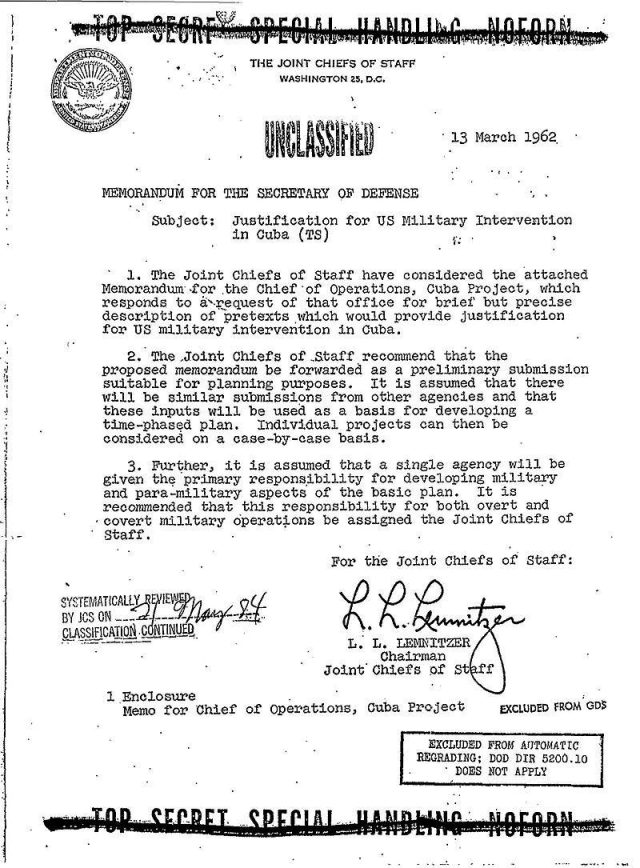
There was not a single item in the Northwoods manual that did not amount to a blatant act of treason, yet the U.S. military establishment dispatched “Top Secret – Justification for U.S. military Intervention in Cuba” straight to the desk of Secretary of Defense Robert McNamara, for onward transmission to President Kennedy.
Needless to say, President Kennedy rejected the proposal and a few months later General Lemnitzer’s term was not renewed as chairman of the Joint Chiefs of Staff, having served from October 1st 1960 to September 30th 1962.
However, NATO lost no time, and in November 1962 Lemnitzer was appointed commander of U.S. European Command and as Supreme Allied Commander Europe of NATO, the latter to which he served from January 1st, 1963 to July 1st, 1969.
Lemnitzer’s was a perfect fit to oversee the cross-continental Gladio operations in Europe. Lemnitzer was a prime motivating force in setting up the Special Forces Group in 1952 at Fort Bragg, where commandos were trained in the arts of guerilla insurgency in the event of a Soviet invasion of Europe. Before long, the men who proudly wore distinctive green berets were cooperating discreetly with the armed forces of a string of European countries and participating in direct military operations, some of them extremely sensitive and of highly dubious legality.
The New American Century
Jake Sullivan’s statement that we need a “Pearl Harbour moment” is nothing new.
In September 2000 a report titled “Rebuilding America’s Defenses: Strategy, Forces and Resources For a New Century” was published by none other than The Project for the New American Century. In the report it is written (pg. 51):
“… the process of transformation, even if it brings revolutionary change, is likely to be a long one, absent some catastrophic and catalyzing event – like a new Pearl Harbor.”
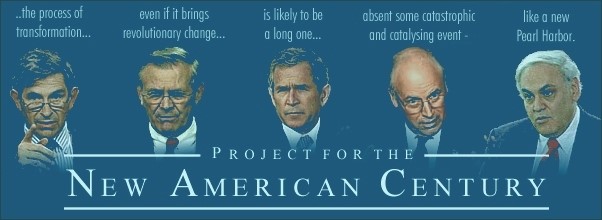
Interestingly, within this same report, published by The Project for the New American Century, it is written (pg. 60):
“Although it may take several decades for the process of transformation to unfold, in time, the art of warfare on air, land, and sea will be vastly different than it is today, and ‘combat’ likely will take place in a new dimensions: in space, ‘cyber-space,’ and perhaps the world of microbes… advanced forms of biological warfare that can ‘target’ specific genotypes may transform biological warfare from the realm of terror to a politically useful tool.”
Richard Perle, called the “Prince of Darkness,” by his adversaries and the “Pentagon’s Brains” by his admirers was an acolyte of Albert Wohlstetter, you could say the “brains” behind the RAND Corporation (for more on this refer here). Paul Wolfowitz was another of Wohlstetter’s acolytes. The followers of Wohlstetter were so numerous, whom Perle said Donald Rumsfeld was among (1), that they called themselves “the St. Andrews prep” boys. (2)
Perle stated (3) the 2003 invasion of Iraq was “the first war that’s been fought in a way that would recognize Albert [Wohlstetter]’s vision of future wars. That it was won so quickly and decisively, with so few casualties and so little damage, was in fact an implementation of his strategy and his vision.”
In fact, this call for the need of a “Pearl Harbour moment” originally came from the Wohlstetters themselves.
A New Pearl Harbour Moment
In the mid-1950s, Roberta Wohlstetter, Albert’s wife and RAND peer, produced her seminal analysis of Pearl Harbour, recognised by the Pentagon as a definitive work of twentieth-century American military history. The study began as an internal RAND document based on unclassified documents drawn from the congressional record.
Warner Schilling noted in his perceptive review of Roberta’s work on Pearl Harbour that “The main concept that Mrs. Wohlstetter brings to bear on these events [is that]… the pictures of the world that government officials build from intelligence… are not so much a matter of the ‘facts’ their sources make available as they are a function of the ‘theories’ about politics already in their minds which guide both their recognition and their interpretation of said ‘facts’.”
The primary practical lesson of Roberta’s Pearl Harbour was that the United States should invest in rapid and aggressive means for responding to surprise attacks (for more on this story refer here).
On January 12, 2003, Los Angeles Times published an article titled “Agenda Unmasked,” where they write:
“In the hours immediately after the Sept. 11 attacks, long before anyone was certain who was responsible for them, Secretary of Defense Donald H. Rumsfeld reportedly asked that plans be drawn up for an American assault on Iraq…
At first consideration, Rumsfeld’s early targeting of Iraq seems odd. Too little was known, too much uncertain. But the Defense secretary’s desire to attack Iraq was neither impulsive nor reactive. In fact, ever since the first American war against Iraq in 1991, Rumsfeld and others who planned and executed that war have wanted to go back and finish what they started. They said so in reports written for then-Secretary of Defense Dick Cheney in the last years of the George H.W. Bush administration, and they continued the push when they were out of power during the Clinton years. In the spring of 1997, their efforts coalesced when Rumsfeld, Cheney and others joined together to form the Project for the New American Century, or PNAC, and began concerted lobbying for regime change in Iraq.
In an open letter to President Clinton dated Jan. 26, 1998, the group called for “the removal of Saddam Hussein’s regime from power,” and in a letter dated May 29, 1998, to then-Speaker of the House Newt Gingrich (R-Ga.) and then-Senate Majority Leader Trent Lott (R-Miss.)… Signatories to one or both letters included Rumsfeld; William Kristol, editor of the conservative Weekly Standard magazine and chairman of the PNAC; Elliott Abrams, the convicted Iran-Contra conspirator whom President Bush last year named director of Middle Eastern policy for the National Security Council; Paul D. Wolfowitz, now Rumsfeld’s deputy at the Pentagon; John R. Bolton, now undersecretary of state for arms control; Richard N. Perle, now chairman of the Defense Science Board; Richard Armitage, now Colin Powell’s deputy at the State Department; and Zalmay Khalilzad [another Wohlstetter acolyte(4)], former Unocal Corp. consultant and now special envoy to Afghanistan.
… They expected that the radical changes in U.S. military policy they favored would have to come slowly in the absence of, as the PNAC report “Rebuilding America’s Defenses” put it, a “catastrophic and catalyzing event – like a new Pearl Harbor.” On Sept. 11, 2001, they got their Pearl Harbor.”
As the Los Angeles Times article also observes, without 9/11 as their Pearl Harbor, their entire campaign against terror in the Middle East could never have been justified.
In fact, since the disastrous PR campaign of the Vietnam War, most Americans had become horrified at the prospect of entering any more foreign wars on the clearly false and hypocritical terms of bringers of “peace” and “freedom.”
9/11 changed all that.
Thus, when Jake Sullivan observes that there is not enough anti-China sentiment to bolster an image of the United States as a “saviour of mankind” against China and that America is in need of a “Pearl Harbour moment” I would be very wary.
The circus around Pelosi’s trip to Taiwan in the coming days, and evident glee that is coming forth from many of these neocons frothing at the mouth over this prospect is a clear sign that something incredibly reckless and stupid is about to happen.
Pelosi’s airplane might indeed be shot down on her completely irrelevant and unnecessary trip to Taiwan, and if it is, don’t be surprised if it was the Americans themselves who are behind it, who have shown they are willing to do anything for that “Pearl Harbour moment.”
August 1, 2022
Posted by aletho |
False Flag Terrorism, Timeless or most popular | China, NATO, United States |
Leave a comment
The poverty-stricken Caribbean countries of Guyana and Suriname have hit the jackpot with the discovery of huge offshore oil reserves that are on track to produce revenue for decades.
Opposition from the United Nations and other anti-hydrocarbon entities might hamper the pace of production but won’t stop it. The global need for more crude is too great, and the economic situation of the two South American nations is too dire.
Suriname has been experiencing double-digit inflation for a while now (35 percent in 2020). The inflation rate is now above 50 percent due to the ongoing global energy crunch. Suriname’s economy shrank by 3.5% in 2021. Guyana’s economy is in a similar situation, with 40 percent of Guyana’s 800,000 living in poverty.
All this could change now, thanks to the oil discovery.
Equatorial Guyana and Suriname—situated side-by-side and bounded by the equator and Atlantic Ocean — have combined oil reserves estimated to be 17 billion barrels of oil equivalent. Together this represents the world’s largest oil discovery in the last two decades. Some call it the “the most promising oil discovery hotspot on earth.” Others say it is “the most exciting oil frontier on earth.” In addition, there are gas reserves of more than 30 trillion cubic feet.
According to a Hess Corporation report, the biggest Guyanese oil block—the Stabroek—“is operated by ExxonMobil subsidiary Esso Exploration and Production Guyana” with a 45 percent stake while Hess Guyana Exploration and CNOOC Petroleum Guyana hold 30 and 25 percent stakes, respectively. Guyana will deliver 1 million barrels per day (bpd) in 2027.
In Suriname, TotalEnergies and its partner Apache made discoveries of large oil reserves in what is known as the Block 58 offshore site. Block 58 is “situated on the same petroleum fairway which runs through Guyana’s Stabroek Block.”
Around 2035, the output from Guyana is expected to be around 1.4 bpd and that from Suriname 650,000 bpd, which would put them in the top five oil-producing countries in South America.
Still, analysts believe that output from Guyana could be much higher: “there is every indication, based on the latest developments, that output will be far higher by” 2027. “Government officials in Georgetown [Guyana’s capital] believe crude oil production could reach 1.5 million barrels per day, or more, from as many as 12 Floating Production Storage and Offloading facilities in five years.”
The biggest hurdle to the extraction of these reserves could come from lack of capital. Both Suriname and Guyana have an “underdeveloped capital market with limited financing options” for new projects. These nations will be under severe financial stress if the international climate-industrial complex takes a strong stand against their extraction plans and their own governments acquiesce.
But awareness of this is increasing among leaders who are rushing to cut red tape for foreign investment. Last week, Guyana President Mohamed Irfaan Ali promised that his “government will remove bureaucratic hurdles to smooth the journey for Saudis looking to invest in his country.”
Common sense suggests that the global markets will dictate the development of oil fields in these countries. With a continuing rise in demand for oil forecast by the International Energy Agency, one would expect crude from Guyana and Suriname to sell fast.
This will prove to be a win-win for global supply and the development of local economies. “Suriname’s nascent oil boom is gaining momentum” and will deliver a “significant fiscal and economic windfall,” says Matthew Smith at Oilprice.com.
“Guyana will materialize as a leading global oil exporter with its petroleum output far exceeding domestic demand, while government coffers will swell with annual income expected to be over $10 billion annually in less than a decade,” he says.
The ability of Guyana and Suriname—and their right—to develop economically by utilizing their oil reserves should not be impeded by the climate-frenzied.
Vijay Jayaraj is a Research Associate at the CO2 Coalition, Arlington, VA, and a Contributing Writer with the Cornwall Alliance for the Stewardship of Creation. He holds a master’s degree in environmental sciences from the University of East Anglia, UK, and resides in Bengaluru, India.
July 31, 2022
Posted by aletho |
Economics, Malthusian Ideology, Phony Scarcity, Timeless or most popular | Guyana, Suriname |
Leave a comment
If my posting has been a little light for the last month or so, it’s because I’ve been working on a big Report for the Global Warming Policy Foundation on the subject of energy storage as a means to back up electricity generation from wind and solar facilities. The Report is basically finished, and now going through an editing process. It will probably be published some time in September.
In doing the research for the Report, I have had occasion to look carefully into the plans of many countries and U.S. states that claim to be the “leaders” in climate virtue, specifically on the subject of how they intend to reach the goal of Net Zero carbon emissions from generation of electricity. These climate “leaders” include, in Europe, Germany and the UK, and in the U.S., California and New York. One would think that for any jurisdiction pursuing Net Zero ambitions, and seeking to abolish use of fossil fuels, it would be completely imperative that some energy storage solution absolutely must be found to provide back-up for the electricity system when the wind and sun are not producing. But what my research has shown is that every one of these jurisdictions seeking to be the leader toward Net Zero has given astoundingly insufficient consideration to the energy storage problem.
I previously have covered some of the more incredible deficiencies in the Net Zero planning of these places, for example in “Can California Really Achieve 85% Carbon-Free Electricity By 2030?” on May 16, and “And The Winner Is, Germany!” on June 29.
The single most astounding universal failure of all jurisdictions pursuing Net Zero is the failure to pursue any sort of working prototype or demonstration project of a Net Zero electricity system before committing the entire jurisdiction to the project on the basis of a blank check to be paid by the taxpayers and ratepayers. Who has ever heard of such a thing? in the 1880s, when Thomas Edison wanted to start building central station power plants to supply electricity for his new devices like incandescent lightbulbs, he began by building a prototype facility in London under the Holborn Viaduct, and followed that with a larger demonstration plant on Pearl Street in Lower Manhattan that only supplied electricity to customers within a few square blocks. Only after those had been demonstrated as successful did a larger build-out begin. Similarly, the provision of nuclear power began with small government-funded prototypes in the late 1940s and early 1950s, followed by larger demonstration projects in the late 1950s and early 1960s. Only in the late 1960s, twenty years into the effort and after feasibility and cost had been demonstrated, were the first large-scale commercial nuclear reactors built. No competent person would take any other approach.
But somehow our politicians have now become so filled with hubris that they think they can just order up a functioning wind/solar electricity system and assume that backup energy storage devices will magically get invented and it will all work fine and not be financially ruinous, all by some arbitrarily-ordered date in the 2030s.
Today, all the mentioned jurisdictions and many more have embarked on ambitious Net Zero plans, and yet there does not exist anywhere in the world a functioning prototype or demonstration project that has actually achieved Net Zero in electricity generation, or anything even close. Indeed, it’s worse than that. There is a fairly substantial project that set out to achieve Net Zero (although they weren’t using the term at the time, which was 2014), and has fallen remarkably short. That project is on the island of El Hierro, one of the Canary Islands off the coast of Spain. El Hierro installed a collection of wind turbines and a pumped storage/hydro reservoir as back-up to great fanfare, but it struggles to achieve 50% of the electricity from the wind/storage system over the course of a year. The rest comes from a diesel generator. The system operator puts out monthly statistics (with substantial lag), typically with excited verbiage about “tons of carbon emissions saved,” without ever admitting that the system has totally failed in its original goal of getting rid of the fossil fuel piece. Instead they now have three redundant systems for providing the electricity — wind turbines, hydro reservoir and turbines, and the diesel generator — all of which must be paid for, and all to provide the same electricity that the diesel generator was fully capable of providing on its own. The cost has been calculated at about 80 euro cents per KWh, roughly 7 to 8 times average U.S. consumer rates; but the cost is largely hidden from El Hierro ratepayers by subsidies from the EU and government of Spain.
My research also covered in depth the question of how much energy storage would be needed for various jurisdictions to fully back up a predominantly wind/solar generation system without any use of fossil fuels. Credible calculations previously discussed here have included the calculation of Roger Andrews, done in 2018, that either California or Germany would require at least about 25,000 GWh of energy storage to back up a fully wind/solar generation system for a year without use of fossil fuels; and a calculation by Ken Gregory done on very similar methodology in late 2021 showing that the full U.S. (lower 48 states) would require about 250,000 GWh of storage for the same purpose. These are truly huge numbers.
Facing such requirements to reach Net Zero and banish fossil fuels from the electricity system, the plans of these jurisdictions for acquisition of storage are quite shocking. The consultancy Wood Mackenzie reported on April 11, 2022 that Germany had announced plans to acquire all of 8.91 GWh of energy storage by 2031 — a ridiculously puny amount if Germany is actually serious about Net Zero. Utility Dive reported on April 12, 2022 that New York had plans to acquire all of 6 GW of storage (likely corresponding to about 24 GWh, since the batteries are to be of the lithium-ion type that generally have capacity for four hours of discharge at full capacity). This figure is only slightly less puny than Germany’s. Another piece from Utility Dive on April 6, 2022 reported that California’s regulators had ordered utilities to acquire what would be the equivalent of about 42 GWh of storage as part of the Net Zero plans of that jurisdiction. All of these storage acquisition plans are in the range of about 0.1% to 0.2% of the storage that would actually be needed to achieve the Net Zero goal.
So what will the future of energy usage actually look like in these places as fossil fuels get phased out and wind and solar take over, with woefully insufficient energy storage to cover the intermittencies? To get an idea, let’s take another look at the Report for California put out by consultancy Energy Innovations on May 9, with the title “Achieving an Equitable and Reliable 85 Percent Clean Electricity System by 2030 in California.” Note that this in not actually Net Zero, but only 85% of same. Here are a few tidbits. First, their graphic on the nature of the transition:
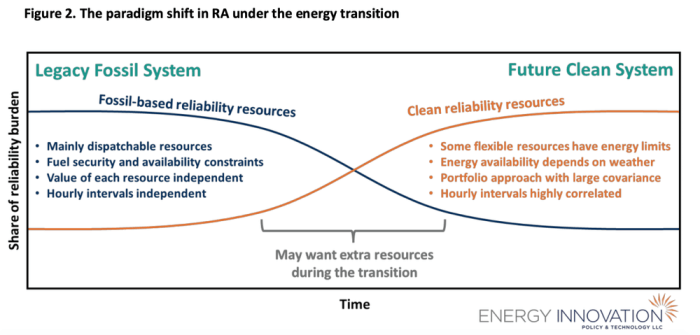
We’re going to have a “paradigm shift” in “RA,” which seems to mean “Resource Adequacy.” Check out that list on the right under “clean reliability resources” — “Energy availability depends on weather.” Are you starting to get the picture now?
Read through the report until you get into pages in the mid-30s, where the subject becomes what they euphemistically call “demand response.” It’s a lot of bafflegab to make it seem oh so pleasant. Excerpt:
Demand-side measures can substitute for supply-side resources and therefore contribute to resource diversity; their increased availability hedges against the risk of deploying new clean supply-side resources too slowly (including generators and storage). For example, the technical report finds that deploying Load Shift could reduce load by 1,500 MW in the early evening hours solar output falls, hedging against battery deployment challenges such as supply chain. . . . Demand-side measures also provide complementary reliability, resiliency, and public safety benefits to supply-side solutions or imports, as they lie closest to the affected load. While centralized generators provide the bulk of our power under most system conditions, they can be rendered less effective or useless under certain disaster conditions.
This is bureaucratese meaning “we’ll turn off your electricity at random times when we feel like it.” Get ready for this, California, Germany, et al. I guess New York is on the same path too, but I have my secret escape plans ready.
July 31, 2022
Posted by aletho |
Economics, Malthusian Ideology, Phony Scarcity, Science and Pseudo-Science, Timeless or most popular | California, Germany, New York |
Leave a comment
‘Few will have the greatness to bend history itself, but each of us can work to change a small portion of events. It is from numberless diverse acts of courage and belief that human history is shaped. Each time a man stands up for an ideal, or acts to improve the lot of others, or strikes out against injustice, he sends forth a tiny ripple of hope, and crossing each other from a million different centers of energy and daring those ripples build a current which can sweep down the mightiest walls of oppression and resistance.’ ― Robert F Kennedy
The last two years have taught us many things – to question everything we thought we knew; to do our own research and listen to many voices; to switch off the narrative and think for ourselves; to reflect on our own personal morals/values, our lines in the sand. In extremis, what we would go to prison for, what we would die for?
For many of us it has brought a spiritual reawakening, a peaceful calmness that helps us rise above the fray and find the courage to speak our truth to those around us.
Many of us have discovered we have little in common with those we once considered close, while finding new friends who seem to be on the same wavelength as us. Whether healers or gardeners, artisans or unemployed, technology folk or lawyers, my new friends share a desire to focus our energies on creating a better world than the one currently being destroyed or that envisaged by the Great Reset.
Because of a medical condition I cannot wear a mask so July 24, 2020, was one of my red lines. I started listening to doctors, scientists and lawyers, realising that those putting career, reputation, wealth in jeopardy spoke more sense than those profiting from the Covid response.
I silently thank those who raised awareness of our inalienable rights to bodily autonomy, freedom of speech, assembly and association; of our individual sovereignty as a living man or woman; of the hierarchy of laws and the difference between the law of this land and that of the sea; who helped us understand the scientific arguments against masks, PCR tests, social distancing, lockdowns, use of midazolam, remdesivir and experimental gene therapies; and reminded us of the importance of boosting our immune systems, natural immunity and cheap, effective early treatments.
This year I complained to my GP about the practice’s behaviour towards us maskless ones. Despite being polite, I was subjected to hostility and rudeness when I went for routine blood tests or to pick up my medical record. I was treated like a bio-hazard by the nurse, even as she drew blood, and told never to return. I pointed out the evidence that masks do not stop a virus but can cause physical, mental and psychological harms, the unlawfulness of denying my right to bodily autonomy, the illegality of denying my right to informed consent, and the NHS guidance which highlights that there are many reasons people cannot wear a mask and that these should be respected.
The practice subsequently de-registered me, having neither denied the behaviours nor apologised for them. I was offered no advice about my existing medical condition or what I should do without access to medication. How many others now avoid GPs altogether, regardless of the health implications? How many of the rising deaths at home are due to people avoiding the totalitarian dictatorship their practice has become?
The caring profession? Not any more.
We all choose how we react – that is a power they cannot take from us. I could have chosen to be bullied into compliance, to get angry, to join a different Covid-obsessed practice. Instead I found natural remedies and weaned myself off the pills. Seven months later I have no symptoms of the illness. I am not suggesting everyone could or should ditch their meds – just that everyone has choices and more power than we realise.
The decision to throw away all previously agreed pandemic preparedness plans in favour of treating the entire population as though sick is surely one of the most dangerous and diabolical experiments ever inflicted on humanity.
A GP recently blogged anonymously about medical ethics as he feared his profession had forsaken them. I find the words powerful and relay some of them below. How many doctors reading this could truthfully say they have honoured their oaths over the past two years?
The health and wellbeing of my patient will be my first consideration;
I will not use my medical knowledge to violate human rights and civil liberties even under threat.
A physician will:
– Respect a competent patient’s right to accept or refuse treatment.
– Not allow his/her judgment to be influenced by personal profit or unfair discrimination.
– Certify only that which he/she has personally verified.
– Act in the patient’s best interest when providing medical care.
Any (all) preventive, diagnostic and therapeutic medical intervention is only to be carried out with the prior, free and informed consent of the person concerned, based on adequate information.
The Nuremberg Code ….
We could be cowed into submission yet, every day, more question how we allowed ourselves to:
– be muzzled
– accept that non diagnostic test results equal a pandemic
– allow loved ones to die alone
– deny natural immunity
– accept a Covid-only ‘health’ service
– reject the benefits of early treatment
– become guinea pigs in a dangerous experiment
– allow our economy to be destroyed
– submit to a 24/7 fear based, media led psy-op.
Every time we speak out or write something, we are creating ripples in their narrative. I have given feedback to the Care Quality Commission and the Royal College of General Practitioners. Perhaps those reading such letters will find the courage to speak out and honour the principle to First Do No Harm. One can but hope.
July 30, 2022
Posted by aletho |
Civil Liberties, Science and Pseudo-Science, Timeless or most popular | Covid-19, COVID-19 Vaccine, UK |
Leave a comment
Dr. Michelle Perro, pediatrician, executive director of GMO Science and author, is today’s guest on “Against the Wind.” She provides key highlights from her book, ‘What’s Making Our Children Sick?’ and shares her perspective on environmental medicine and other hot topics — Monkeypox, GMO issues and more. Don’t miss this eye-opening interview!
References:
https://live.childrenshealthdefense.org/shows/against-the-wind-with-dr-paul-thomas/-T_fehmhUF
July 30, 2022
Posted by aletho |
Environmentalism, Science and Pseudo-Science, Timeless or most popular, Video | COVID-19 Vaccine |
Leave a comment