Today I’m publishing the first draft of a guide I’ve prepared to help with all the Covid hospitalization problems, based on my legal and practice experience dealing with clients and help-seekers from all over the country. The guide is meant to be studied BEFORE you get to the hospital, and provides suggestions for folks who are already hospitalized.
I hope this helps save someone’s life.
This is a first draft. I will be refining and expanding this guide, and will post subsequent versions when they are available. If you have any suggestions for improvements to the guide, post them in the comments.
The single most common call we are getting in our office these days is the scenario where a loved-one has been admitted to the hospital, diagnosed with SARS-CoV-2 infection, often attached to a ventilator, and has become concerned about their course of treatment. In many cases the hospitals have refused to release the patient, citing their unstable condition, meaning that at some point, it can become impossible to get off the Covid express.
The most common complaints we get include that patients are being pressured to accept Remdesivir, have been given Remdesivir even though they objected to it, or the hospital will not administer alternative widely-used treatments even though the patient is in critical condition where side effects are less risky than imminent death. I have personally seen hospitals spend tens of thousands of dollars on lawyers to keep patients in their facility.
Here are some suggestions, starting with the time before admission. You should read this now and you might want to bookmark it for later. It could save your life.
## Common Suggestions
[1] Document everything when working with a hospital. Keep or make all paperwork. Take pictures and video of everything. Be organized.
[2] Determine whether you are in a one-party consent or two-party consent state for recordings, and then record meetings with hospital staff. If in a two-party state, you must notify the other party they are being recorded or it may be a felony. Record everything. One option for notice is to just put up a handwritten sign near the patient’s bed notifying folks that recordings are being made for quality assurance. Obviously document the existence of the sign.
[3] Keep a log of the names of all hospital staff involved in the patient’s care.
[4] Before getting anywhere near the hospital, or as soon as you read this if in the hospital, you MUST complete a medical health surrogacy form. This will legally designate the person who can direct your care if you become unable to do so.
[5] If you’re in the hospital, or are considering admission, request a copy of the hospital’s current Covid protocol IN WRITING.
[6] Allied doctors have suggested that if you are in the hospital for Covid treatment, the things to focus on are the optimal use of anticoagulants, steroids, and the inpatient setting, meaning the overall day-to-day care (hydration, bedsore prevention, nutrition, etc.).
[7] Consider researching whether you want to receive glucose (sugar water) at all, since some studies suggest this can worsen Covid outcomes. This may be particularly important for diabetics and pre-diabetics. If not, make your wishes known in writing as described above.
[8] If any treating staff — nurses or doctors — make disparaging comments about your vaccination status, directly or indirectly, consider immediately instructing the hospital in writing that person may NOT be involved in your care.
[9] Always remember the old saw about catching more flies with honey. Hospital staff are stressed and unhappy about Covid; I know of many who feel they cannot speak or act freely out of fear of professional reprisal. So the nurse or doctor that you think is an opponent may in fact be an ally willing to help wherever possible, but having to parrot the party line in the meantime. Never show anger or frustration. Keep it together. This is important.
## Emergency Room
The most common scenario that we are hearing is that folks go to the ER for Covid infection and are sent home without treatment if the symptoms aren’t serious enough, and then later are admitted after the patient’s condition has worsened to the point they require hospitalization. An increasing number of reports include folks who go to the ER for a separate reason and wind up testing positive in the ER, or become positive after admission — then get bunged right into the Covid ward and — boom! — they’re on the Covid express.
[1] If you test positive in the ER, whether you were there FOR Covid or for a different reason, and are told you will be admitted, ask about at-home care alternatives. Most corporate hospitals do NOT have home-care protocols. I’ve listed websites below that provide information about alternatives for home treatment. With a little effort, you can find a local doctor or community hospital who will arrange and oversee at-home oxygen if needed.
Ask about the hospital’s Covid protocol BEFORE you agree to be admitted. Is it based on remdesivir and the ventilator? If so, you may want to review the literature on those two treatments before you agree.
[2] If you’re in the ER for a non-Covid critical condition but test positive, you’ll be admitted to the Covid ward. See the notes below, and consider discharging yourself for at-home Covid care the instant your primary issue has been stabilized.
## Pre-Surgery
If you are going in for a non-Covid-related surgery, be aware that nosocomial (hospital-acquired) Covid infections appear to be very common. In other words, even though you are there to have your appendix out, the hospital is going to start testing you for Covid about every ten seconds from the time you arrive until discharge. If you test positive, you’ll be on the Covid express before you know what happened.
It doesn’t matter whether you’ve been vaccinated. You can still test positive and will be treated for Covid infection.
You need to consider this risk in planning your surgery. If you test positive but don’t want remdesivir or ventilation, you need to make that clear in WRITTEN INSTRUCTIONS provided to the hospital IN ADVANCE of your surgery. They need to be part of your medical record. Otherwise you could be on remdesivir even before you come out of anesthesia.
Some people may not have options because of insurance constraints and so forth. Explore your options. And if you DO have options, consider whether your surgery would be better handled in a facility where they don’t also provide Covid treatment, in order to reduce the risk of Covid hospitalization.
Finally, can your surgery be safely deferred? Don’t defer necessary surgery unnecessarily. But if you can wait, that might be a good idea.
## Early Interventions (post-admission)
This section applies to folks or their loved ones who are in the hospital with a Covid diagnosis but remain conscious.
[1] If you haven’t yet received Remdesivir, and DO NOT want it, state that in writing and give it to your doctors. Post a copy by your hospital bed.
[2] If you DO NOT want to be placed on a ventilator, state that in writing and give it to your doctors. Post a copy by your hospital bed.
Be prepared for the hospital to try, hard, to change your mind about those two treatments. This pressure may come when you are weakest. Be ready.
[3] Many people believe that Covid is best treated at home. Your circumstances may vary. Get an opinion from a telemedicine specialist in at-home Covid care like www.jamesclinic.com, or consult www.myfreedoctor.com.
[4] If you decide that you prefer to treat your Covid at home, or can find a non-corporate independent clinic somewhere that will accept you, discharge yourself. If the hospital pushes back on discharge, you may need to discharge yourself “Against Medical Advice,” or AMA. Ask if your hospital has its own form, otherwise google one.
## Late Interventions
In this section, the patient is no longer conscious or capable of directing their own care. Many times these patients are, unfortunately, already on the ventilator. Therefore relatives or a surrogate are making decisions for the patient. Many patients in this condition are essentially just waiting to die.
[1] If you are concerned about the quality of care, immediately get the hospital’s “Patient Advocate” involved. Most hospitals have one.
[2] Get a second opinion. You’ll need to find a local independent doctor to provide a second treatment opinion. Obviously you will need a doctor who specializes in Covid treatment. You should request the doctor be allowed to evaluate the patient even if they lack admitting privileges for purposes of a second opinion. Request that the doctor be permitted to participate in patient conferences even if by phone.
[3] If at all possible, arrange for someone to be in the room with the patient at all times to ensure consistent high quality of care. At ALL times. Do it in shifts. Even in the middle of the night. Things can happen over the night shift. This person should be checking hydration levels and conferring when possible with nurses and doctors assigned to the patient.
[4] Advocate continually for alternative treatments (iv.mectin, fluvoxamine, and/or monoclonal antibody treatments), if approved by the outside physician.
[5] Some people have successfully arranged to have alternative treatment providers see the patient; or have managed transfers to other hospitals with more flexible Covid treatment, specialized clinics, or even at-home treatment. You may have to insist on the patient being discharged AMA.
[6] Right-To-Try. Consider drug treatments still in clinical trials with right-to-try programs. You MUST use the magic words “I am requesting this against medical advice,” or the hospital will usually reject or ignore your request. Note that iv.mectin and fluvoxamine are APPROVED drugs and are excluded from right-to-try.
For example, one drug in this category that has been frequently mentioned is Zysemi. See (https://tinyurl.com/2p84528z).
[7] You might want to familiarize yourself with successful hospital protocols from 2020, like placing ventilated patients on their stomach.
[8] Your primary goal is to wean the patient off the ventilator. The longer they are on the ventilator, the more likely it is that their condition will continue to deteriorate. Once off the ventilator, you can transition to at-home care.
## Legal Options
[1] Court Options. Court options are limited, and expensive, but have worked in some places. Laws vary widely state-by-state. In Florida, the applicable law is Probate Rule 5.900, which provides for an emergency hearing about patient treatment within 72 hours. My suggestion is that the Court be asked ONLY that the patient (a) be allowed to be treated by the outside physician, or (b) that the patient be released AMA.
Your lawyer should carefully consider that asking a Court to order administration of iv.mectin is a risky ask. There have been some successes with this approach, but also many, many failures. Courts have wide latitude in what they can do (or not do) in these situations. Adding a controversial drug into the equation makes the case significantly harder, and since judges are people too, the judge’s preconceived notions about iv.mectin will be a factor. You do NOT want to get into a giant evidentiary battle over the efficacy of iv.mectin.
In other words, simpler and less intrusive requests are more likely to be granted by the Court.
[2] Police Reports. If the patient was given Remdesivir against instructions, that may be a battery, and you might want to consider filing a police report against the hospital and involved staff. If the patient passed away, the stakes are even higher. Although it is hard to say whether the police report will amount to anything, it may be very helpful documentation later. Obviously, provide the police with all paperwork and evidence that you have and keep a file copy of the police report.
I hope this helps. These cases are the worst, most heart-breaking cases I have ever handled in my career. The stakes are literally life-and-death. I don’t mean this guide to be critical of well-meaning doctors and nurses in corporate hospitals — many, if not most are heroic professionals who want the best for patients. Unfortunately, the incentives (e.g. government payments to hospitals) are totally perverse.
Finally, remember that you are not alone! There are more and more advocacy groups forming to help people trapped in hospitals receiving ineffective or harmful treatment. But time is short. The best defense is a good offense; be prepared BEFORE you reach the emergency room.
DISCLAIMER: This is not medical advice. I’m a lawyer, not a doctor. You should always follow the advice of a trusted physician and make your own independent decisions about your healthcare, especially when it is critical. This guide is presented only as an outline to help inform you about options that may be available.
While the decision to eliminate President Kennedy undoubtedly took place after his resolution of the Cuban Missile Crisis, it was without a doubt solidified when Kennedy ambushed his enemies within the U.S. national-security establishment with his Peace Speech at American University on June 10, 1963. With his Peace Speech, JFK was upsetting the Cold War apple cart that the Pentagon and the CIA were convinced would last forever.
What was so significant about that speech?
After the end of World War II, the U.S. government was converted from its founding system of a limited-government republic to a governmental structure called a national-security state. The justification for this radical change, which was accomplished without even the semblance of a constitutional amendment, was that the United States now faced an enemy that was said to be even more threatening than Nazi Germany. That new enemy was “godless communism” as well as a supposed international communist conspiracy to take over the United States and the rest of the world — a conspiracy that was supposedly based in Moscow, Russia — yes, that Russia!
With the conversion to a national-security state, the U.S. government acquired many of the same totalitarian powers that were being wielded by the totalitarian communist states, such as the Soviet Union and Red China — powers that had been prohibited when the government was a limited-government republic. Such powers included state-sponsored assassinations, torture, kidnapping, indefinite detention, and coups.
Equally important, the Cold War brought ever-increasing taxpayer-funded largess flowing into the coffers of the “defense” industry, along with the ever-increasing power and influence of the Pentagon, the CIA, and the NSA within the overall federal structure. Over time, the national-security branch of the federal government would become the most powerful branch, the one to which the other three would inevitably defer.
After the Cuban Missile Crisis, Kennedy achieved a breakthrough, one that threatened not only the ever-increasing power, money, and influence of the national-security branch, but also its very existence. Kennedy came to realize that the Cold War was just one great big racket — and a highly dangerous one at that.
That danger was manifested during the Cuban Missile Crisis. U.S. officials and their loyalists in the mainstream press have always maintained that the crisis was brought on by the Soviet Union and Cuba. Not so! It was brought on by the Pentagon and the CIA. It was those two entities that brought the world to within an inch of all-out nuclear war.
The Soviets and the Cubans knew that the Pentagon and the CIA wanted to invade Cuba and effect a regime-change operation there, one that would oust Cuban leader Fidel Castro from power and replace him with another pro-U.S. dictator, similar to Fulgencio Batista, the corrupt pro-U.S. brute that ruled Cuba before the revolutionaries ousted him in 1959.
That was why the Soviets installed those nuclear missiles in Cuba — to deter U.S. officials from attacking or, if deterrence failed, to enable Soviet and Cuban forces to defend themselves from a U.S. attack.
There is something important to note about the invasion that the Pentagon and the CIA wanted Kennedy to initiate against Cuba: It was illegaL The U.S. had no legal right to invade the island either before the crisis or during the crisis.
What was the justification for invading Cuba before the Cuban Missile Crisis? They said that because Cuba was befriending the Soviet Union, that constituted a grave threat to U.S. national security. But the fact is that under international law, Cuba had the right to befriend anyone it wanted. Its decision to befriend the Soviet Union did not constitute legal justification for invading the island and effecting regime change there.
What about during the crisis? Well, here is where the irony appears with respect to what it happening in Ukraine today. Throughout the crisis, the Pentagon and the CIA were pressuring Kennedy to bomb Cuba and follow up the bombing with a ground invasion. Their position was that America could not permit the Soviet Union to install nuclear missiles pointed at the United States from only 90 miles away.
But the fact is that Cuba was a sovereign and independent regime. Under international law, it had the authority to invite the Soviet Union to install whatever missiles it wanted on the island.
But from a practical standpoint, U.S. officials said no — that the United States would not permit Soviet nuclear missies to be installed so near to America’s borders. Obviously, it is a rather ironic position, given that that’s precisely why Russia today does not want Ukraine to be admitted into NATO, which would enable the Pentagon and the CIA to install their nuclear missiles pointed at Russia on Russia’s border.
Kennedy had a unique ability to put himself into the shoes of his opponent in order to figure out a satisfactory resolution to a crisis. He figured out that if he pledged that the U.S. would not invade Cuba, the Soviets would not need to keep their missiles in Cuba. Thus, after tense negotiations, that was the deal that he struck with Soviet leader Nikita Khrushchev — except for one thing.
It turned out that the Pentagon had U.S. nuclear missiles stationed in Turkey that were pointed at the Soviet Union. Yes, you read that right: The Pentagon’s position was that it was okay for the Pentagon to have U.S. nuclear missiles pointing at the Soviet Union in a country bordering the Soviet Union but it was not okay for the Soviet Union to have missiles pointing at the U.S. in a country 90 miles away from America’s borders.
Unlike President Biden, who would never think of bucking the Pentagon and the CIA, Kennedy saw the hypocrisy of that position. He secretly agreed with the Soviets that he would quietly withdraw the missiles from Turkey later on.
The crisis was over. The U.S. would not invade Cuba. The Soviets withdrew their missiles. Kennedy withdrew the U.S. missiles from Turkey six months later.
But the Pentagon and the CIA were livid. They considered Kennedy’s resolution of the crisis to be the “biggest defeat in U.S. history.” Those were the words of Gen. Curtis LeMay, chief of staff of the Air Force. During the crisis, LeMay compared Kennedy’s handling of it to Neville Chamberlain’s appeasement of Hitler at Munich.
Why was the national-security establishment so filled with rage? Because Kennedy essentially agreed that Cuba would remain permanently under communist rule and, even worse, headed by a regime that would continue befriending the Soviet Union. In other words, in their eyes, with his agreement with the Soviets, Kennedy had ensured that Cuba would pose a permanent grave threat to U.S. national security.
By the time the missile crisis was over, however, Kennedy had achieved his breakthrough. Determined to bring an end to the national-security establishment’s Cold War, Kennedy went to American University and essentially declared an end to the Cold War racket. He announced that from that day forward, the United States would live in peaceful and friendly coexistence with the Soviet Union and the rest of the communist world. Reflecting his new vision for America, he entered into a nuclear test-ban treaty with the Soviets, ordered a withdrawal of U.S. troops from Vietnam, and proposed a joint trip to the moon with the Soviets. At the moment he was assassinated, he had an emissary meeting with Fidel Castro, while the CIA was conspiring to commit yet another assassination attempt against Castro without JFK’s knowledge or consent.
After JFK’s Peace Speech, the war between him and the U.S. national-security establishment over the future direction of the United States was on. There could be no compromise. There was going to be a winner and a loser. Kennedy’s enemies in the national-security establishment hated him for what he was doing. In their eyes, this neophyte, incompetent, naive, womanizing president was leading America to a communist takeover of the United States. In their eyes, what Kennedy was doing as president, after all, constituted a much graver threat to national security than President Arbenz in Guatemala, who the CIA had violently ousted in a coup in 1954 because Arbenz, like Kennedy, was befriending the Soviet Union and the communist world. (See FFF’s book JFK’s War with the National Security Establishment: Why Kennedy Was Assassinated by Douglas Horne, who served on the Assassination Records Review Board in the 1990s.)
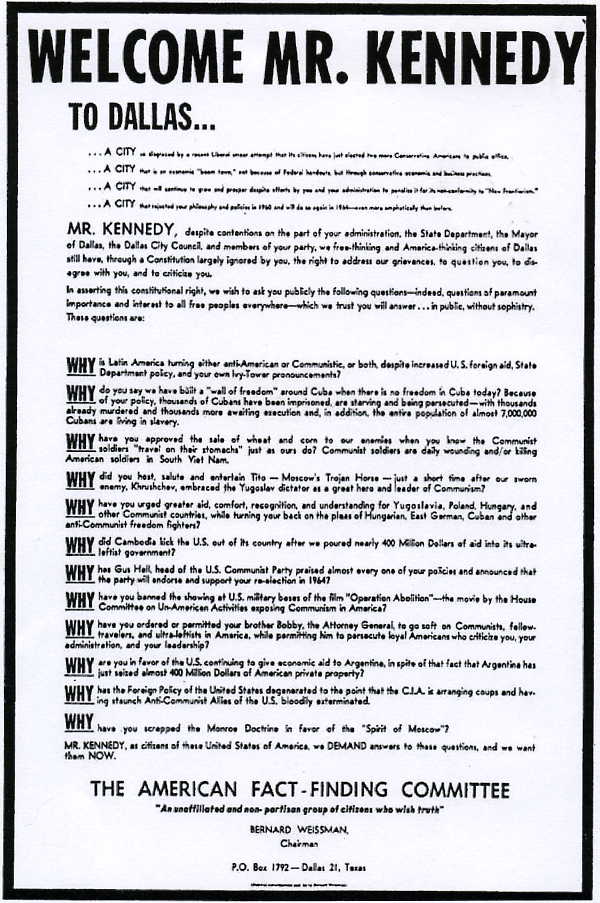
Take a look at this advertisement in the Dallas Morning News on the morning of JFK’s assassination. And then take a look at this flier that was being circulated in Dallas on the day of his assassination. The sentiments expressed in those two documents reflected the views of the U.S. national-security establishment. In their eyes, Kennedy was a cowardly traitor whose policies of appeasement were leading America to doom.
They knew that it was a virtual certainly that Kennedy would win the 1964 election. They also knew that he would never permit them to go into the Middle East and begin killing people, thereby producing terrorist blowback that would justify a perpetual “war on terrorism” to replace the “war on communism.”
They knew that if Kennedy’s vision were to prevail, the national-security establishment would have nothing to do. With no big official enemy, they would be left twiddling their thumbs. People would begin wondering about all that taxpayer-funded largess flowing into the “defense” industry. Even worse, the American people might begin demanding the restoration of their founding governmental system of a limited-government republic.
But as we all know, Kennedy’s vision did not prevail. He lost the war against his enemies within the military and the CIA when they killed him just 5 1/2 months after his Peace Speech. His assassination elevated to the presidency Lyndon Johnson, whose Cold War mindset matched that of the Pentagon, the CIA, and the NSA. The taxpayer-funded largess continued flowing into the coffers of the “defense” industry. The war on communism was ultimately replaced by the war on terrorism. And now, with its NATO machinations in Eastern Europe, the national-security establishment has succeeded in achieving Cold War II.
Who says the Kennedy assassination isn’t relevant today?
Historically, the claim of consensus is the first refuge of the scoundrel; it is a way to avoid debate by claiming the matter is already settled. Whenever you hear the consensus of scientists agrees on something or other, reach for your wallet, because you’re being had. Let’s be clear: the work of science has nothing whatever to do with consensus. Consensus is the business of politics.
Michael Crichton, PhD, MD, author, screenwriter and academic
Humans cause all or most of the changes in the climate by burning fossil fuel. We must stop using the most efficient fuel we have, one that supplies 85% of our energy needs, and sign up for a so-called Net Zero future. The rich will get richer, since they will control state-mandated transfers of once-productive capital into new untried technologies, and the poor will get poorer. Holidays, personal travel and energy will be rationed (for the masses), while meat-free diets will be the order of the day. There are disadvantages, admit the green, politically motivated zealots, but it has to be done. The Earth is on fire – the science is settled.
Except that it isn’t. The idea that humans are largely responsible for climate change is an unproven hypothesis. The claim that it is ‘settled science’ on which all specialists in the field agree is a political con. Over 40 years, climate models have produced wildly inaccurate warming forecasts that have never been right.
The political narrative of global warming got going in the 1980s, following the failure of the 1970s global cooling scare. The warming narrative had a good ride for 15 years, until the recent warming started to run out of steam. Over the last seven years, there has been a standstill in temperatures. This is part of what lies behind the recent rebranding of bad weather as ‘extreme’, and unscientific attempts to link solo events to long-term aggregate climate change. Record high temperatures among the jet aircraft at Heathrow, record “gusts” of wind off isolated sea cliffs – all are used to craft a political Armageddon narrative.
At the heart of the debate, or rather the public non-debate, is the role of carbon dioxide as a warming gas. CO2 does warm the planet and the Earth would be about 33°C cooler without it and the other greenhouse gases. But its warming properties become less effective as more of it enters the atmosphere. Doubling atmospheric CO2 does not double the warming – a point which the IPCC accepts. Climate models guess that such doubling causes global temperature to rise in a range from 1.5°C to 6°C. Recent scientific work suggests this estimate is way too high. The simple ‘settled’ science deduction that rising CO2 levels automatically lead to significantly higher temperatures fails to take much account of natural climatic variations. In addition, little cause and effect between CO2 and temperature can be seen in current, historical or geological records.
CO2, methane and ozone, along with the much more common water vapour, produce a greenhouse effect of reflecting heat back to the Earth only within certain bands on the infrared spectrum. This has led some scientists to suggest that CO2 becomes ‘saturated’ once it reaches a certain level. Most of the heat that is going to be trapped is already being radiated back by the CO2 molecules evenly distributed in the existing atmosphere.
It is fascinating science, but it is conducted away from mainstream media, most political circles and the Earth Sciences/Geography university departments. It is the last that seem to provide many of the vocal scientists promoting the ‘settled science’ narrative. Such ground-breaking work holds out the promise of a better understanding of the role of CO2 in the atmosphere. Only a blinkered following of a political agenda can explain why it is ignored.
The idea that the science surrounding changes in the climate is settled goes back a long time. In 2006, the BBC ran a one day seminar in secret to decide on its future climate editorial policy. The meeting was crucial in plotting future editorial guidelines. According to the former Sunday Telegraph journalist Christopher Booker, the new guidelines “would allow it to make its coverage of any issues relating to climate change more actively partisan than ever”. Booker continued: “Its obligations to remain impartial could be put aside, it argued, on the grounds that the official orthodoxy was now so overwhelmingly accepted that any dissent from it could be dismissed as too insignificant to be worthy of notice.”
In 2013, John Cook came up with the suggestion that 97% of scientists believed that humans cause global warming. Mr. Cook is a green activist, who runs a site called Skeptical Science with the intriguing strapline: “Getting sceptical about global warming scepticism”. His notion was given a huge boost when Barack Obama tweeted that 97% of scientists agree that climate change is “real, man-made and dangerous”. In fact the 97% figure, which is still widely quoted today, was quickly debunked. It was found that of the 12,000 abstracts rated, only 0.5%, or 65 papers, suggested that humans were responsible for more than 50% of global warming.
Since scientists differ widely in their view on the human contribution to climate change, the attempt to put a number on a so-called consensus is futile and meaningless. But it makes a good headline. Step forward Mark Lynas, with a recent raise on 97% to 99%. In fact, his study found only that 99% of scientists failed to explicitly quantify the effect humans were having on the climate.
Mr. Lynas has had a lively career in green activism and journalism, first coming to attention in 2001 when he threw a pie into the face of the sceptical climate economist, Bjørn Lomborg. He was behind the PR stunt in 2009 when the Government of the Maldives met under water to draw attention to rising sea levels. Happily, this is not a problem for the Maldives, since overall the islands have grown in recent years. In 2007 he wrote an article in the Guardian reporting on the possibility of global warming producing fuel air bombs caused by oceanic methane eruptions. These would be equivalent to 10,000 times the world’s stockpile of nuclear weapons, he claimed.
These days, Mr. Lynas is the Communications Strategist and Climate Lead for the Alliance for Science, a non-profit operation linked with Cornell University. Its primary source of funding is said to be the Bill and Melinda Gates Foundation – another case, it appears, of following the money to find the billionaires pushing their pet green narratives and causes.
The 2020-2022 pandemic split parties and ideologues, separated friend from friend and family members from family members. Neighbors were dangerous, and strangers even more so: the invisible enemy stalking our lands overturned every other concern in life: The conflicts it spurred replaced bonds of affection with fear and hatred.
More than ever, we need calm and level-headed thinkers, honest and willing to admit past errors, with eyes wide open for the corruption of industry or government itself. In other words, we need as little politics as humanly possible. As I wrote in a previous piece: we need “people without a clear ideological position, and who can thus appeal to audiences across the political spectrum.”
Two sane figures recently attempted the impossible: to speak calmly to the other side, trying earnestly to explain what happened – Konstantin Kisin, of the popular show Triggernometry, and Columbia sociology professor Musa al-Gharbi.
Kisin begins his monologue with “You’re struggling to understand why some people are vaccine hesitant. Let me help you.”
He uses no study result, no appeal to the biological effect of the drug that has become the main symbol of the Covid conflict; no death rates or R0; no projection of spread or what number of lives lockdowns may or may not have saved. Instead Kisin, for 13 spellbinding minutes, walks us through the many good reasons that people had – before and during Covid – to distrust the elites in politics, business, and media. If this is a question of (dis)trusting the establishment (including “the” Science), you must ask what the establishment did to no longer deserve that trust.
The tale begins years ago, with the Brexit vote and with the election of Donald Trump. Those events shocked the pompous leaders of the universities, the pollsters who confidently said it wouldn’t happen, the media pundits who so convincingly described to us the madness of such prospects.
For a brief moment after the unthinkable had happened, if you recall, there was an earnest desire for inclusivity – for inviting in the views that had gone overlooked in the other half of these countries. Outlets like the New York Times made an effort to portray conservative views and show the kinds of people who had long felt alienated and ostracized from civilized society. As despicable and difficult it was for their core audience to see, revealing perspectives and objections is better than silencing and hiding them.
The efforts didn’t last long and in 2019 and 2020, the monolithic thoughts that dominate these institutions willingly put their blinders on – tighter and more aggressively than before.
Kisin’s final minute is the most powerful thing in these disease-ridden past two years:
“The same people who told you Brexit would never happen; Trump would never win, and that when he did win, it was because of Russian collusion, then because of racism; that you must follow lockdown rules while they don’t; that masks don’t work and then that they do; that protests during lockdowns are a health intervention; that ransacking Black communities in the name of fighting racism is mostly peaceful justice; that Jussie Smollett was the victim of a hate crime; that men are toxic; that there’s an infinite number of genders; that Covid didn’t come from a lab, and then that it probably did; that closing borders is racist, and then that it’s the most important thing to do; that the Hunter Biden story is Russian disinformation, and then that it’s not; that they would not take Trump’s vaccine, and then that you must take the vaccine; that Governor Cuomo is a great Covid leader, and then that he’s a granny killer and a sex pest; that the number of Covid deaths is one thing and then another; that hospitals are filled with Covid patients, and then that many of them caught Covid in hospital.
These are the same people now telling you that the vaccines are safe, you must take it, and if you don’t you will be a second-class citizen.
The long-read for the British newspaper The Guardian by Musa al-Gharbi is even more important, partly because he speaks to his own side and partly because the piece runs in an outlet that has been heavily on the vaccine-cherishing train. Building bridges begins by showing those on your own side of the river what the land looks like on its far side.
And al-Gharbi perfectly captured the mind of the current skeptic. He lists, bullet-point by bullet-point, the clear and sensible reasons why anyone would refuse to follow along. To most of his audience, these vaccines are fantastic miracles, life-saving devices, their impact ending the pandemic in one fell swoop: “failure to comply with the directives of public health officials,” writes al-Gharbi, has thus seemed insane to the audience he addresses – probably “driven by some pathology or deficit.”
“debates turn around identifying the primary malfunction of ‘those people’: Are they ignorant? Brainwashed? Stupid? Selfish and apathetic? All of the above? Left off the menu is the possibility that hesitancy and non-compliance may actually be reasonable responses to how experts and other elites have conducted themselves, both before and during the pandemic.”
The vaccines were developed too fast, without the long and rigorous testing regimes we usually apply to pharmaceuticals to ensure efficacy, correct dosage, the target demographics, safety, and observation of long-term harm (if those safeguards are optional and superfluous, why do we have them in normal times…?). Both Biden and Harris vocally pushed against “Trump’s vaccine,” but when the power of government passed into their hands, the tune was suddenly very different. Many people smelled a political rat.
Dr. Fauci himself has engaged in noble lie after noble lie to get people to do what he says is crucial for them: if he lied about the masks and then the Wuhan lab financing and then herd-immunity targets, why should anyone believe that he hasn’t lied about more things? That the advice his agency gives out is sound? That the science he says he represents is as all-encompassing and definitive as he and others deferring to him let on?
Step by step, month by month, and variant by variant, writes al-Gharbi, the figures of vaccine efficacy kept dropping:
“the main benefit of vaccination has been revised down dramatically – from outright preventing infections to reducing severe infections – even as people are encouraged to get more and more shots in order to achieve that benefit.”
But the official advice remained, intensified even, as did the public’s discourse. Somehow, the anger against the unvaccinated strengthened.
This is not what we were promised when, in early 2020, we stoically and proudly began sacrificing aspects of our personal lives for the public good. On top of that al-Gharbi points to the billions that Big Pharma makes out of vaccines – a point that should weigh heavily on The Guardian’s readership. And harms stemming from vaccines cannot be pursued in court, as the US government shielded the companies from liabilities in order to speed up the vaccine-creation process.
Add misleading statistics, former MSNBC hosts losing their minds, modeling predictionsgone haywire and it isn’t hard to see why many people want to opt out. Something is rotten in the state of Denmark, and the only tangible act of dissent that most people have is refusing a needle in their arm.
In genuine scientific efforts, admits al-Gharbi, people are routinely wrong – that’s how the process works and how the sum knowledge of humanity improves. Instead, in the plague years we received
“spokespeople (and “Trust the Science” stans) [who] regularly concealed uncertainties, suppressed inconvenient information and squashed internal dissent in an ill-conceived effort to seem maximally authoritative. Rather than enhancing confidence among skeptics, these moves often made authorities seem incompetent or dishonest when they were forced to change their positions.”
There are few public officials who haven’t shunned the rules they themselves made, but of course we all shun the rules – they’re impossible to live under. The hypocrisy just looks so much worse when it’s the rulemaker himself or herself doing it. al-Gharbi’s summarizing paragraph is almost as powerful as Kisin’s:
“In a world where the experts are regularly wrong but continue to project high levels of confidence even as they change their minds and update their policies, where elite narratives about the crisis often seem to be inappropriately colored by political and financial considerations, where those who share one’s own background, values and interests do not seem to have a seat at the table in making the rules – and especially among populations that have a long history of neglect and mistreatment by the elite class (leading to high levels of pre-existing and well-founded mistrust even before the pandemic) – it would actually be bizarre to unquestioningly believe and unwaveringly conform to elite guidance.”
This is the story that those skeptical of vaccines see: a dissonance between official words and reality that no amount of social ostracism or edicts from on high can eliminate. This is the story of a tribe of navel-gazing authoritarians imposing rules on the rest of us, rules that don’t make sense, that are routinely flaunted by their proponents, and in aggregate don’t achieve the goals they’re said to achieve.
There is no reason to puzzle about the loss of trust and the rise of grave skepticism about elite plans for our lives.
The World Economic Forum (WEF), an international organization that works to “shape global, regional and industry agendas,” recently published its latest dystopian proposal – a far-reaching digital ID system that will collect as much data as possible on individuals and then use this data to determine their level of access to various services.
Under this framework, the WEF proposes collecting data from many aspects of people’s “everyday lives” through their devices, telecommunications networks, and third-party service providers.
The WEF suggests that this data collection dragnet would allow a digital ID to scoop up data on people’s online behavior, purchase history, network usage, credit history, biometrics, names, national identity numbers, medical history, travel history, social accounts, e-government accounts, bank accounts, energy usage, health stats, education, and more.
Once the digital ID has access to this huge, highly personal data set, the WEF proposes using it to decide whether users are allowed to “own and use devices,” “open bank accounts,” “carry out online financial transactions,” “conduct business transactions,” “access insurance, treatment,” “book trips,” “go through border control between countries or regions,” “access third-party services that rely on social media logins,” “file taxes, vote, collect benefits,” and more.
In this Advancing Digital Agency: The Power of Data Intermediaries report, the WEF positions this digital ID framework as the part of the solution to a “trust gap in data sharing” and notes that vaccine passports, which were mandated across the world during the COVID-19 pandemic, do “by nature serve as a form of digital identity.”
The WEF also praises the way vaccine passports have allowed governments to harvest data from their populations without “notice and consent”:
“At a collective level, vaccine data is an incredible public health asset. The United Kingdom Government in particular has acknowledged this and has suggested that anonymization, pseudonymization and data shielding techniques could be harnessed in a controlled environment to allow for the reuse of that highly sensitive data. In such cases, notice and consent is not required per se for the reuse of the data but the intermediary processes the data undergoes must be done in a controlled environment so that the findings of the data set are made available rather than the data itself.”
Additionally, the WEF provides a specific example of how digital IDs could be used to authenticate a user (by using fingerprints, a password, or identity verification technology) and decide whether they should be granted access to a bank loan by judging their profile (which may include their biometrics, name, and national identity number) and history (which may include their credit, medical, and online purchasing history).
The WEF goes on to suggest that digital IDs will “allow for the selection of preferences and the making of certain choices in advance” and ultimately pave the way for “automated decision-making” where a “trusted digital assistant” “automates permissions for people and effectively manages their data across different services” to “overcome the limitations of notice and consent.”
Beyond these specific proposals, the WEF is infamous for its globalist and transhumanist agendas such as the “Great Reset” (which proposes that people will “own nothing” and “be happy”) and the “Fourth Industrial Revolution” (which, according to WEF founder and chairman Klaus Schwab, will lead to “a fusion of our physical, our digital, and our biological identities”).
Governments and private corporations are increasingly embracing digital IDs. Some governments are also pushing a similar notion – social credit-style apps that monitor citizens’ behavior and reward them for engaging in state-approved actions.
Eight years ago, a democratically elected president was removed from office by protesters waving European Union flags. Viktor Yanukovych had been elected as president of Ukraine in 2010 to serve a five-year term. His time in office was, however, brought to an abrupt end when he was removed for his refusal to sign an association agreement with the EU.
The first decade of the 21st century was a golden period for the EU. The euro currency had been launched, the bloc was expanding, and Eurosceptic movements in its existing member states had barely got off the ground. The federalist ideologues in Brussels confidently believed that this was to be the EU’s century, and nothing could prevent it from accruing more powers and expanding further eastwards.
After the accession of central European countries and the Baltic states, Ukraine was the next logical step –highlighted by a vote in the European Parliament in 2005, which floated the possibility of Ukraine eventually joining the bloc.
As a consequence, EU cash was poured into Ukraine as a precursor to eventual accession. The first step towards this eventuality was a deepening of economic ties, and to this end an association agreement was initiated in 2012. However, after more than a year of protracted negotiations, Yanukovych refused to sign the agreement in November 2013, which set off a chain of events that eventually led to his downfall.
Protests erupted because of the president’s refusal to sign. Kiev became the center of the uprising and the city’s Independence Square was occupied by demonstrators waving EU flags, leading to the protests becoming known as ‘EuroMaidan’. By early 2014, however, the protests were turning into violent clashes with the authorities, and law and order was clearly breaking down. As a result, many people sadly lost their lives.
On February 21, a compromise was reached between Yanukovych and opposition politicians, and it was agreed that early elections would be held. This was to prove insufficient, and the following day the police gave up attempting to guard the presidential palace and the parliament buildings. The protesters therefore freely made their way in unmolested. In what became known as the Revolution of Dignity, Yanukovych was removed as president by the Ukrainian parliament and forced to flee.
This was all reported as some great upswell of the people – a democratic uprising against an oppression. Yet when something similar happened in the US on Capitol Hill in January 2021, the same liberal media went berserk and denounced President Trump’s supporters as dangerous fascists. Can anyone else spot the double standards here?
Now Yanukovych may have been a bad president, but that is not really the point. He was elected to serve a five-year term, and if the electors wanted rid of him, and it seems a sizeable number did, then they could have waited another year and voted him out of office. That is, after all, how democracy works. Nevertheless, with Yanukovych out of the way, the Ukrainian government signed the association agreement with the EU in March 2014.
The EU proudly holds itself up as a defender of democracy – although anyone who understands how it really works knows what a contradiction this is – so you would assume that Brussels would have roundly denounced these ugly scenes in Kiev. But no, EU chiefs instead acted as enthusiastic cheerleaders.
Jerzy Buzek, the then-head of the powerful European People’s Party in the European Parliament, travelled to Ukraine “to express the support of the EPP family for the Ukrainian people and their European aspirations in light of the Euromaidan protests.” Similarly, Guy Verhofstadt, the former Belgian prime minister and uber-EU federalist MEP, turned up in Kiev and praised the protesters as “brave and courageous” for supporting “European values, European principles and democracy.” Moreover, a week after the toppling of Yanukovych, the European Parliament passed a resolution which “pays tribute to those fighting and dying for European values” and “commends the people of Ukraine on the orderly change in power and on their civic resilience in the past few months.”
I was an MEP at the time and in Brussels we were given a binary choice: you either supported the EU’s eastward expansion and the eventual accession of Ukraine, or you were denounced as a Russian sympathiser or even worse. The easy thing to do would have been to stay quiet and not speak out, but a few of us could see that the move eastward was provocative and foolish, and we said so.
My old party leader, Nigel Farage, made this point in a televised debate with the then British Deputy PM Nick Clegg. He said that in his opinion the EU had “blood on its hands” for “destabilising” Ukraine. Statements like this, which certainly had their roots in a most inconvenient truth, were met with howls of derision. We were also accused of letting our dislike for the EU cloud our judgement. Nothing, however, could have been further from the truth. We could see that the EU’s ambition to incorporate Ukraine was only serving to fan the flames and create a fissure from east to west in an already divided country.
Additionally, we knew that although the politicians wanted the EU to expand further eastwards, the people did not. We had witnessed first-hand the huge influx of central Europeans into our countries and thought that adding another 45 million Ukrainians to the bloc would only exacerbate the problem.
Proof that we were correct on this point was provided in the Netherlands in April 2016, when the Dutch people rejected the EU’s association agreement with Ukraine in an ‘advisory referendum’. Indeed, over 60% voted against the agreement, which had already been signed. The result, however, was largely ignored and the Ukraine-EU association agreement came into force in September 2017.
The EU therefore cannot escape shouldering its portion of responsibility for what is happening today in Ukraine. The bloc’s desire to drive further eastwards was always going to cause friction, and it was obvious that Ukraine was going to end up being stuck between a rock and a hard place.
In 2014, the EU turned a blind eye to the mob because it suited its objectives, and in doing so it helped lay the foundations for the horrible situation we find ourselves in today. It is not as if some of us didn’t raise warnings at the time – but unfortunately it seems no one was listening.
Paul A. Nuttall is a historian, author and a former politician. He was a Member of the European Parliament between 2009 and 2019 and was a prominent campaigner for Brexit.
One can frequently disagree with government policies without necessarily regarding them with disgust, but the Joe Biden Administration has turned that corner, first with its senseless promotion of a new Cold War that could turn hot with Russia and, more recently, with its actions undertaken to undermine and punish Afghanistan. The fact that the White House wraps itself in the sanctimonious, self-righteous twaddle that is so much the hallmark of the political left is bad enough, but when the government goes out of its way to harm and even kill people around the world in pursuit of an elusive global dominance it is time for the American people to rise up and say “Stop!”
As a former CIA operations officer, I departed government service in 2002 in part due to the impending invasion of Iraq, which I knew was completely unjustified by the web of largely fabricated information that was flowing out of the Pentagon to justify the attack. In the years since I have been appalled by the Obama era attacks on Syria and Libya as well as by the assassinations and cruise missile strikes carried out under Donald Trump. But all of that was a Sunday in the park compared to the hideous nonsense being pursued by Biden and his crew of reprobates. Trifling with the use of force as part of negotiations intended to go nowhere over Ukraine could well by misstep, false flag or even design escalate into nuclear war ending much of the life on this planet as we know it, and we are now also witnessing the cold, calculated slaughter of possibly hundreds of thousands of civilians just because we have the tools at hand and believe that we can get away with it. What we are seeing unfold right in front of us goes beyond appalling and it is time to demand a change of course on the part of a runaway federal government that is drunk on its own self-assumed unbridled right to exercise total executive authority over vital issues of war and peace.
I am most particularly shocked and dismayed over what the Biden Administration did to Afghanistan on February 11th, which is unambiguously a crime against humanity. On that day the President of the United States Joe Biden, still smarting from the botched departure from Afghanistan and low approval ratings, issued an executive order invoking emergency powers stipulating that the $7 billion in Afghan government money being held and frozen in the Federal Reserve Bank of New York would be retained by the US and divided in two.
Half of the $7 billion would be placed in a US government administered trust fund. The money would in theory go to fund humanitarian relief in Afghanistan to be carried out by agencies unidentified but presumed to be acting in coordination with the barracudas at the Treasury Department while the other half would go to benefit the victims of 9/11. This money is not just “frozen assets,” it is the entire reserve of the Afghan central bank, and its appropriation by the US will destroy whatever remains of the formal Afghan economy, making Afghanistan entirely reliant on small rations of foreign aid that come through channels unconnected with the Afghan government.
The other half of the story is that Afghanistan had nothing to do with 9/11 but instead became a victim of the US lust for revenge. After 9/11, the Taliban government offered to turn over Osama bin Laden to the United States if Washington were able to provide evidence that he was somehow involved in the attacks in New York and Virginia. The George W. Bush Administration was unable to do so, but chose to invade instead.
Afghanistan now has a government that is recognized by the United Nations and many other countries, though not by Washington, which insists that the Taliban are terrorists. Sanctions pressure being exerted by Washington on the new Taliban dominated regime has inter alia brought about a major humanitarian disaster, with various international agencies predicting that many thousands of Afghan civilians will die of starvation because there is no money available to provide relief. The United Nations has reported that three-quarters of Afghanistan’s population has plunged into acute poverty, with 4.7 million people likely to suffer severe or even fatal malnutrition this year.
The money in New York unambiguously belongs to the Afghan government and the country’s central bank. It is not money that came from the United States, which means that what Biden, who is already stealing Syria’s oil, is engaging in yet one more large scale theft, this time from people dying from famine and disease. Furthermore, as the US was de facto an occupying military power in Afghanistan, the responsibility to protect the civilian population is explicitly required under the articles of the Geneva Convention, to which the US is a signatory. That Washington will watch many thousands of civilians die because it has used its position as an occupying power to steal money that might alleviate the suffering is unconscionable and amounts to a war crime.
Undoubtedly the half of the money allegedly allocated for humanitarian relief will be directed to organizations that will do Washington’s bidding in terms of how the aid is distributed and who gets it. It is being reported that it will take months to set up the aid network, by which time thousands will die. That is to be expected and may have been intentional. And as for the other half of the money directed towards 9/11 “victims,” just watch how that plays out. There are undoubtedly instances of Americans who lost multiple and even cross generational family members at 9/11 and are still in need of assistance. Fine, that is a given, but why punish the Afghans to deal with that? And as soon as the money is on the table you know exactly what will happen. All the shyster lawyers working on a percentage of the payoffs will come out of the woodwork and the major beneficiaries of all the loot will be people who know how to manipulate and game the system. That is what happened to the billions that came raining down as a consequence of the insurance claims on the World Trade Center and also in the distribution of other monies that followed. You can bank on it.
Washington has become adept at lying to cover up its crimes overseas, but foreigners, who are not likely inclined to read the Washington Post and are directly affected by the deception, frequently have a more facts-based understanding of what exactly is going on. And it is why no one any longer trusts the United States. And, it is interesting to note how inevitably the lying by the US government is both bipartisan and inclined to blame the victim as a fallback position. This was seen in Donald Trump’s assassination of Iranian general Qassem Soleimani over two years ago. Soleimani was in Baghdad for peace talks and was falsely accused by the White House of preparing to attack American soldiers. There is also the more recent assassination of alleged ISIS leader Abu Ibrahim al-Hashimi al-Qurayshi and killing of 13 additional women and children in Syria where accounts of villagers don’t quite square with the Pentagon version of what allegedly took place.
And then there is a long-concealed atrocity also in Syria which took place in the town of Baghuz in March 2019. At least 80 mostly women and children died in an attack by American F-15 fighter bombers, which was only reported in the media in November 2021. Reportedly, a large crowd of women and children were seen by photographic drones seeking shelter huddled against a river bank. Without warning, an American attack jet dropped a 500-pound bomb on the group. When the smoke cleared, another jet tracked the running survivors and dropped one 2,000-pound bomb, then another, killing most of them. Military personnel at the Udeid Airbase in Qatar watching the attack by way of the drone camera reportedly reacted in “stunned disbelief” at what they were witnessing. A Pentagon cover-up followed and to this day the official comment on the attack is that it was “justified.”
So, by all means go and listen to lying Jen Psaki and pencil neck Ned Price or to Secretary of State Tony Blinken and possibly to the ultimate nitwit himself, President Honest Joe Biden. Or you can just pick up a New York Times or Washington Post where deliberately leaked government lies are backed up by what the newspapers pretend to be editorial integrity. These folks just might drop us into a nuclear war or could possibly continue in their larcenous ways to rob the world. Sooner or later the chickens will be coming home to roost and accountability for America’s war crimes will be demanded. Stay tuned.
Philip M. Giraldi, Ph.D., is Executive Director of the Council for the National Interest, a 501(c)3 tax deductible educational foundation (Federal ID Number #52-1739023) that seeks a more interests-based U.S. foreign policy in the Middle East. Website is councilforthenationalinterest.org, address is P.O. Box 2157, Purcellville VA 20134 and its email is inform@cnionline.org.
Prime Minister Justin Trudeau‘s underage accuser was much younger at the time of their relationship than was first thought, her father tells The Chronicle. Some in the public discourse pegged the accusor at 17 years old. That is inaccurate.
“She was much, much younger than that,” the wealthy Canadian businessman told The Chronicle yesterday. He was not a party to the $2.25 million mutual non-disclosure non-disparagement agreement that she signed, in exchange for her continued silence, on the Wednesday evening of October 9th.
The terms of that agreement prevent both the accuser and Trudeau from acknowledging “any aspect” of that relationship, without triggering a six-to-seven-figure liquidated damages clause. That penalty starts at $500,000 and scales up, depending on the magnitude of the breach.
The accusor’s father shared with The Chronicle a password-protected digital copy of that agreement, giving us limited access to it for several hours on the condition we would make no copies and not distribute. Doing so could have jeopardized the terms of the agreement, which imposes damages on either party in the event they acknowledge or discuss the relationship publicly.
He does not believe his discussion of that agreement’s existence is a violation of its terms since he was not a party to it. He did not acquire the document from his daughter; it was incorrectly CC’d to him on an email between the negotiating parties.
The two engaged in a long and steamy affair on- and off-campus while Trudeau taught drama and French at Vancouver’s prestigious West Point Grey Academy. He was discovered by his accusor’s father at their family home, which prompted private demands to school administrators that he be removed from his position immediately.
“There was a ‘small settlement’ at the time,” he says, but declined to elaborate.
The relationship was discovered several months after Pierre Trudeau‘s death. He died on September 28th, and was eulogized by his son on October 3rd — an event that made him a rising political star, around whom much of Canada would swoon. His students were particularly fawning, friends say.
At the time, the family was told that the school’s standard employment agreement included confidentiality terms that would be binding on Trudeau after his departure. As a matter of policy, the school does not comment on personnel matters.
Trudeau’s friends at the time say that the typically outgoing and exuberant young man was suffering through a bout of depression following his father’s death in 2000, and his brother’s death in 1997. They postulate that anything improper was likely a result of his fragile emotional state at the time, not because of any nefarious character trait.
“He was lonely and depressed for months,” one friend told The Chronicle.
At the time, Canada’s age of consent was 14 years old.
In 2008, Prime Minister Stephen Harper had that law changed, raising the age to 16, where the law sits today. Still, Canada outlaws sex between adults and people younger than 18 when the adult is in a position of responsibility for the wellbeing of that child.
Trudeau’s behavior would have been illegal at the time.
To date, Trudeau has not offered a public denial of The Buffalo Chronicle’s reporting. Instead, he has instructed his communications staffers to decline to answer those questions and to attack the credibility of this publication.
The Buffalo Chronicle has never — in our entire operating history — been sued for defamation or any other matter. We have never once received a cease and desist letter from the subjects of any article since we began publishing in 2014.
We have not received such a cease and desist letter from Mr. Trudeau.
Trudeau has used his relatively brief time as a teacher to shape his personal narrative when he first got into politics in 2008. He has used the experience to shape his political brand, often claiming to have ‘taught math’.
The New York Timesreported this past weekend that the CDC has chosen not to publish huge amounts of COVID data, instead keeping it secret, because it fears that the information would cause ‘vaccine hesitancy’ among the American public.
The report notes that the withheld data includes information on boosters, hospitalizations, wastewater analyses, as well as critical information on COVID infections and deaths broken down by age, race, and vaccination status.
The justification for holding the information back? Fears that the data would be “misinterpreted” and lead to “vaccine hesitancy,” according to the report.
In other words, it didn’t fit into the narrative that everyone must get vaccinated and boosted no matter who they are and what their situation is.
The report notes:
“Kristen Nordlund, a spokeswoman for the C.D.C., said the agency has been slow to release the different streams of data “because basically, at the end of the day, it’s not yet ready for prime time.” She said the agency’s “priority when gathering any data is to ensure that it’s accurate and actionable.”
Ahhh, the plebs are not ready to know the truth.
Another reason is fear that the information might be misinterpreted, Ms. Nordlund said.”
The data has been withheld for more than a year, the report notes:
… the C.D.C. has been routinely collecting information since the Covid vaccines were first rolled out last year, according to a federal official familiar with the effort. The agency has been reluctant to make those figures public, the official said, because they might be misinterpreted as the vaccines being ineffective.
As we have previously reported, CDC director Rochelle Walensky admits that the agency’s guidance on COVID has been based on what the government perceived people would accept.
“It really had a lot to do with what we thought people would be able to tolerate,” Walensky starkly admitted during an interview in December.
Walensky also acknowledged for only the first time last month that over 75% of COVID deaths were people “who had at least four comorbidities” and were “unwell to begin with.”
The comments were later edited by the media to make it seem like there have been fewer deaths related to comorbidities.
The CDC also for more than two years based its guidance on PCR tests, which it recently admitted are producing massive amounts of false positives.
UNLESS rampant genetic experimentation is regulated, the whole population of the world will continue on a risky journey towards an unknown destination somewhere in a biotechnology future.
Today I want to reach out across a divide and back in time. At the beginning of the pandemic, the origin of Covid-19 was of concern to everyone – the question was ‘who was ultimately to blame?’ The dialogue was between those who thought its origin was zoonotic (jumped from an animal) and those thinking it was made in a laboratory. We never received a definitive answer to this debate, but nevertheless the New Zealand government decided in mid-2020 that the idea that Covid-19 came from a laboratory was a conspiracy theory.
The immediate value to Jacinda Ardern’s government should be obvious: if Covid-19 came from an animal it was a natural virus requiring the time-honoured solution of a vaccine. If it came from a biotechnology laboratory, there would be an issue of trust – could the same people who created Covid-19 be trusted to cure it?
Moving to the present day, genomists have made real progress in resolving the debate around the origins of Covid-19. Some genetic sequences in Covid-19 have been found in mutated strains of HIV which appear to have no place in any animal viruses and some genetic constructs of Covid-19 are not natural at all, but are identical to genetic sequences patented before the pandemic by Moderna – a company who created a Covid-19 mRNA vaccine. The details are technical but the process of researching the connections has been rendered accessible to a lay person.
In general, the debate about Covid-19 origins has swung strongly back towards a laboratory origin, especially considering that it is now clear that the early insistence on a zoonotic origin was mainly from scientists involved in the experiments at the Wuhan lab.
This gives us all a completely different perspective about that other crucial debate between the pro-vaxx and anti-vaxx camps (let’s leave aside for a moment the supporters from both camps who are anti-mandate). Both the vaccinated and the unvaccinated are facing a common foe – risky biotechnology experimentation leading either to a virulent illness or a novel vaccine with a high rate of adverse reactions. Whatever political end game emerges, both camps are left with a common problem: how to control biotechnology experimentation that threatens the stability of life itself (see my YouTube video The Pandemic of Biotechnology).
We are up against formidable obstacles:
Military interest in biotechnology continues for reasons of both offence and defence. More accidents are inevitable. No weapon ever invented remains unused.
Commercial investment in biotechnology is huge: there are fortunes to be made and lost depending on the outcomes of experimentation and regulation. Inevitably this means political lobbying and donations with strings attached.
There is a massive academic class of trained biotechnology researchers looking for employment and professional kudos who are dominating research perspectives and calling for more biotech funding in universities.
There are popular myths carefully curated through media support that biotech will ultimately cure all diseases and feed the world. As a result, biotechnology is seen by the public and medical professionals as the new frontier of medical and social miracles, but without any understanding of the huge risks and historical accidents. This has led to political myopia concerning biotech risk.
It is time to recognise that both the vaccinated and unvaccinated have been relying on the same pandemic exit strategy. The unvaccinated are trusting their natural immune system to protect them. The vaccinated are trusting their natural immune system to react appropriately to a vaccine and thereby protect them. So both groups are trusting their natural immune system. Perhaps what neither group fully realised was that biotech manipulation is a common foe which is busy offering novel products, some of which are capable of overwhelming our natural immune system whether we are vaccinated or not.
No exit strategy from the divisive horrors of the pandemic will be complete without instituting limitations on biotechnology experimentation. For that, the political myopia concerning biotech dangers needs to be overcome. This will require a massive educational effort and inviolable constitutional safeguards.
As the old says goes: “there’s no rest for the wicked.”
That’s certainly the case with vaccine mogul Bill Gates.
As the world finally gets an opportunity to take a breath easy – after being suffocated by two years of pandemic theatre and 24/7 government and corporate pharmaceutical propaganda, the notorious architect the global COVID-19 ‘vaccine’ roll-out, billionaire tech monopolist turned pharmaceutical scion, Bill Gates, is still determined to realize his life’s ambition of achieve 100% global vaccine compliance.
To keep the game going, Gates has reemerged from the shadows this week to prepare the public for “the next pandemic.”
Bill Gates said Friday that the risks of severe disease from Covid-19 have “dramatically reduced” but another pandemic is all but certain.
Speaking to CNBC’s Hadley Gamble at Germany’s annual Munich Security Conference, Gates, co-chair of the Bill & Melinda Gates Foundation, said that a potential new pandemic would likely stem from a different pathogen to that of the coronavirus family.
But he added that advances in medical technology should help the world do a better job of fighting it — if investments are made now.
“We’ll have another pandemic. It will be a different pathogen next time,” Gates said.
Initially, Gates had been actively promoting each and every ‘variant’ – constantly talking-up the crisis in order to help maintain the perception of a constant demand for the highly controversial experimental COVID-19 ‘vaccine’ gene-jabs. This includes the most recent media creation known as the “Omicron” variant. But as the public began shunning the booster shots en masse, the media gradually began the abandon the Omicron narrative. Gates has clearly read the propaganda tea leaves, and has since started backtracking from some of his previous positions – and is even admitting that natural immunity is more effective than the dubious pharmaceutical-based synthetic immunity he’s been pushing for the last two years through the media and his proxy organizations the World Health Organization (WHO) and the GAVI vaccine alliance.
Two years into the coronavirus pandemic, Gates said the worst effects have faded as huge swathes of the global population have gained some level of immunity. Its severity has also waned with the latest omicron variant.
However, Gates said that in many places that was due to virus itself, which creates a level of immunity, and has “done a better job of getting out to the world population than we have with vaccines.”
In order to further shield him from an increasing public backlash for his role in shamelessly promoting the ‘global pandemic’ and vaccine narratives, Gates has also carefully admitted the existence of comorbidities among the alleged COVID deaths.
“The chance of severe disease, which is mainly associated with being elderly and having obesity or diabetes, those risks are now dramatically reduced because of that infection exposure,” he said.
However, the vaccine kingpin is still lamenting his failure to reach 70% ‘penetration’ of the experimental mRNA toxic injections into the arms of the global population.
Gates said it was already “too late” to reach the World Health Organization’s goal to vaccinate 70% of the global population by mid-2022. Currently, 61.9% of the world population has received at least one dose of a Covid-19 vaccine.
He added that the world should move faster in the future to develop and distribute vaccines, calling on governments to invest now.
“Next time we should try and make it, instead of two years, we should make it more like six months,” Gates said, adding that standardized platforms, including messenger RNA (mRNA) technology, would make that possible.
It’s important for people to realize that Gates and his network are not finished in their plan to establish a global conveyor belt for experimental gene-based pharmaceutical injections – and he is already eyeing ‘the next pandemic’ in order to roll out the next phase of this globalist agenda. There is no shortage of funds either:
“The cost of being ready for the next pandemic is not that large. It’s not like climate change. If we’re rational, yes, the next time we’ll catch it early.”
Gates, through the Bill & Melinda Gates Foundation, has partnered with the U.K.’s Wellcome Trust to donate $300 million to the Coalition for Epidemic Preparedness Innovations, which helped form the Covax program to deliver vaccines to low- and middle-income countries.
The CEPI is aiming to raise $3.5 billion in an effort cut the time required to develop a new vaccine to just 100 days.
“I’ve been following COVID since the early days of the outbreak, working with experts from inside and out of the Gates Foundation who are championing a more equitable response and have been fighting infectious diseases for decades. I’ve learned a lot in the process—both about this pandemic and how we stop the next one—and I want to share what I’ve heard with people. So, I started writing a book about how we can make sure that no one suffers through a pandemic ever again.”
To mark the occasion, Gates released this disturbing propaganda video – littered with many of the staged images and government tropes used to reinforce the COVID ‘global pandemic’ crisis narrative since the winter of 2020. Watch:
MMR Vaccine (Measles, Mumps, and Rubella) Is It Safer Than Measles, Mumps and Rubella?
Physicians for Informed Consent | December 2024
… It has not been proven that the MMR vaccine is safer than measles, mumps, and rubella. The vaccine package insert raises questions about safety testing for cancer, genetic mutations, and impaired fertility. Although VAERS tracks some adverse events, it is too inaccurate to measure against the risk of measles, mumps, and rubella. Clinical trials do not have the ability to detect less common adverse reactions, and epidemiological studies are limited by the effects of chance and possible confounders. Safety studies of the MMR vaccine are particularly lacking in statistical power. A review of more than 60 MMR vaccine studies conducted for the Cochrane Library states, “The design and reporting of safety outcomes in MMR vaccine studies, both pre- and post-marketing, are largely inadequate.”19 Because permanent sequelae (aftereffects) from measles, mumps, and rubella are so rare (especially in children with normal levels of vitamin A and infected after birth),6,15-17 the level of accuracy of the research studies available is insufficient to rule out the possibility that the MMR vaccine causes greater death or permanent disability than measles, mumps, and rubella. – Read full article
This site is provided as a research and reference tool. Although we make every reasonable effort to ensure that the information and data provided at this site are useful, accurate, and current, we cannot guarantee that the information and data provided here will be error-free. By using this site, you assume all responsibility for and risk arising from your use of and reliance upon the contents of this site.
This site and the information available through it do not, and are not intended to constitute legal advice. Should you require legal advice, you should consult your own attorney.
Nothing within this site or linked to by this site constitutes investment advice or medical advice.
Materials accessible from or added to this site by third parties, such as comments posted, are strictly the responsibility of the third party who added such materials or made them accessible and we neither endorse nor undertake to control, monitor, edit or assume responsibility for any such third-party material.
The posting of stories, commentaries, reports, documents and links (embedded or otherwise) on this site does not in any way, shape or form, implied or otherwise, necessarily express or suggest endorsement or support of any of such posted material or parts therein.
The word “alleged” is deemed to occur before the word “fraud.” Since the rule of law still applies. To peasants, at least.
Fair Use
This site contains copyrighted material the use of which has not always been specifically authorized by the copyright owner. We are making such material available in our efforts to advance understanding of environmental, political, human rights, economic, democracy, scientific, and social justice issues, etc. We believe this constitutes a ‘fair use’ of any such copyrighted material as provided for in section 107 of the US Copyright Law. In accordance with Title 17 U.S.C. Section 107, the material on this site is distributed without profit to those who have expressed a prior interest in receiving the included information for research and educational purposes. For more info go to: http://www.law.cornell.edu/uscode/17/107.shtml. If you wish to use copyrighted material from this site for purposes of your own that go beyond ‘fair use’, you must obtain permission from the copyright owner.
DMCA Contact
This is information for anyone that wishes to challenge our “fair use” of copyrighted material.
If you are a legal copyright holder or a designated agent for such and you believe that content residing on or accessible through our website infringes a copyright and falls outside the boundaries of “Fair Use”, please send a notice of infringement by contacting atheonews@gmail.com.
We will respond and take necessary action immediately.
If notice is given of an alleged copyright violation we will act expeditiously to remove or disable access to the material(s) in question.
All 3rd party material posted on this website is copyright the respective owners / authors. Aletho News makes no claim of copyright on such material.

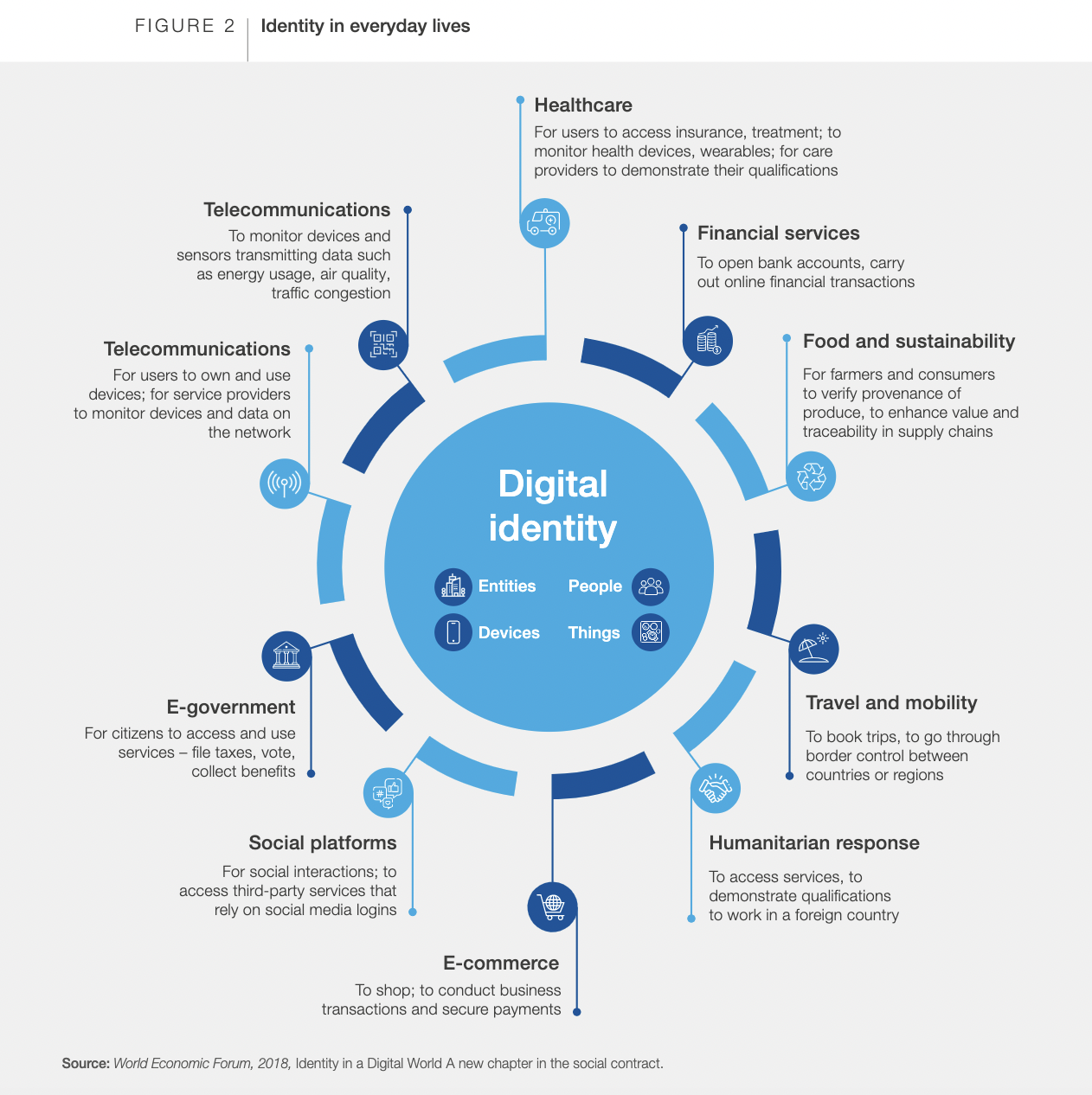
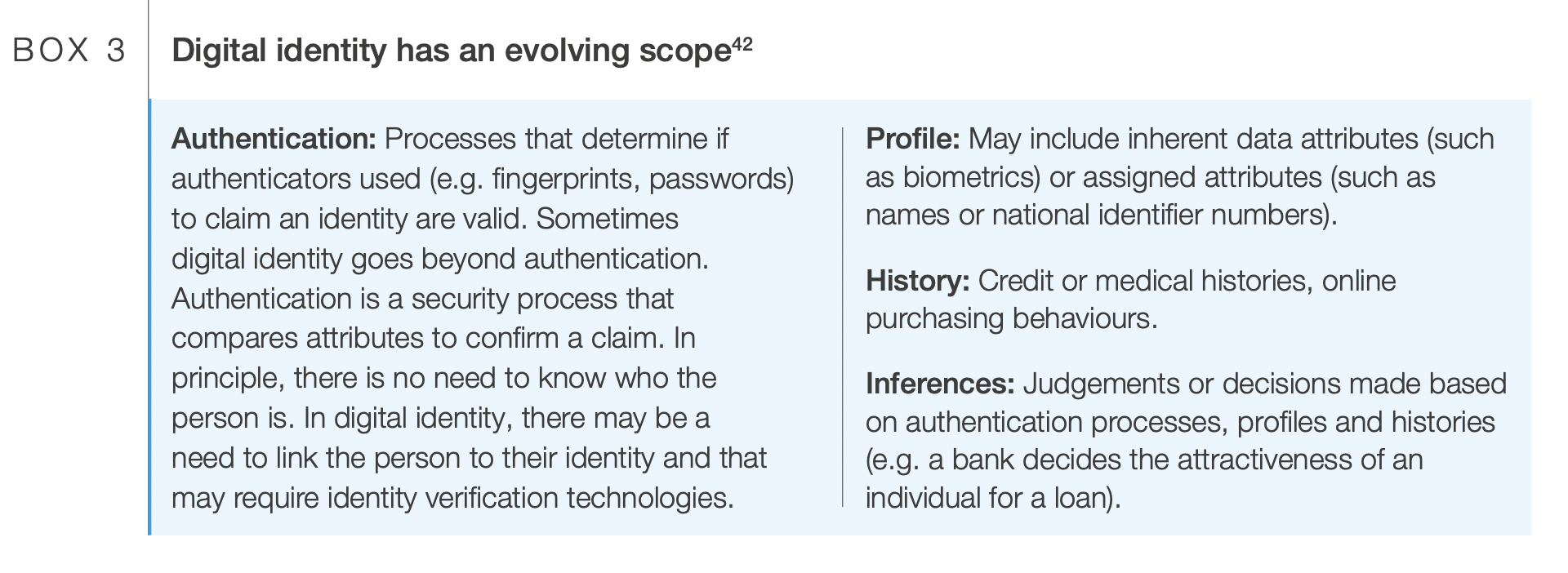

 “There was a ‘small settlement’ at the time,” he says, but declined to elaborate.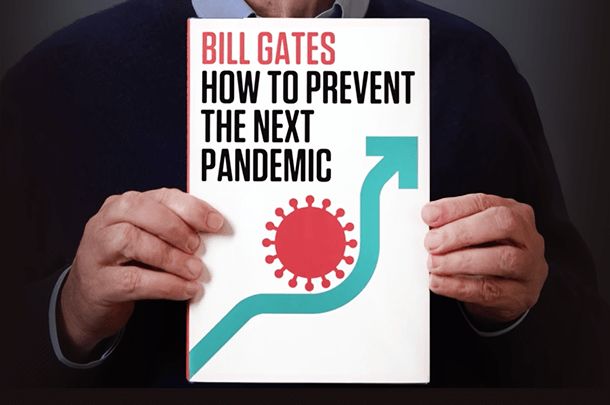

 Aletho News