There are ways to ensure any trial will give you the results you want. Here are the top six methods used to manipulate covid research results.
1.Carry out the study when cases are falling
A favourite trick that has been used repeatedly throughout the pandemic.
Vaccination is a process that takes time. At the beginning of the study all participants are enrolled as unvaccinated. People move into the vaccinated cohort over time. The result is that the unvaccinated are exposed at periods of higher prevalence and for a longer time. The vaccinated are only exposed from a period later on and further down the curve. The vaccinated will therefore be less likely to catch covid and the vaccine can be made to look like it worked.
The ONS recently deployed this trick to claim a 32 fold lower mortality among the vaccinated. It was extreme data manipulation whereby they included the majority of deaths in winter prior to vaccination instead of starting from spring when a fairer comparison could have been made. The Office for Statistics Regulation has upheld a complaint about the ONS’s manipulation of data in this case.
2. Don’t include meaningful outcome measures like death
The vaccine trials have not demonstrated prevention of death.
Death from covid was too uncommon for the trials to be able to show an effect. Among 44,000 participants in the Pfizer trial, for example, there were a total of
29 deaths before the placebo group were themselves vaccinated. 15 of these were in the vaccinated including one of the three covid deaths. There were only 20 severe covid cases reported in the Pfizer submission to the FDA for Emergency Use Authorisation, including those that did not need hospital care.
Instead of using outcomes which are hard to distort, like death, the outcomes used were based on test results.
3. Only measure outcomes for part of the time after vaccination
Vaccinated people are at increased risk of covid infection in the first two weeks after vaccination. After the first two weeks the susceptible will have acquired natural immunity. By ignoring the first two weeks, a distorted picture of the overall impact of vaccinations can be presented. If all the vaccines are doing is causing the susceptible to have their infections earlier then the whole period from the date of vaccination needs to be included in assessing any benefit.
4. Use modelled data
The most reliable scientific papers ensure that the population being studied is representative of the population as a whole. Sometimes that is hard to achieve and adjustments need to be made afterwards to account for any differences e.g. the sample may be younger than the population as a whole. These adjustments are a reasonable thing to do to correct for small problems in the sample.
However, if the sample is so different to the general population that massive adjustments need to be made then effectively the study is no longer based on real world evidence. Instead it has become yet another prediction based on modelled data.
For example, this CDC study claimed, contrary to all other evidence, that people with a prior infection were 5 times more likely to become infected than those who had been double vaccinated. The actual results from the study showed a 70% higher rate but their adjustments made this into 500%. There were other serious flaws in the study which makes even the 70% claim highly dubious.
5. Ignore a crucial subgroup
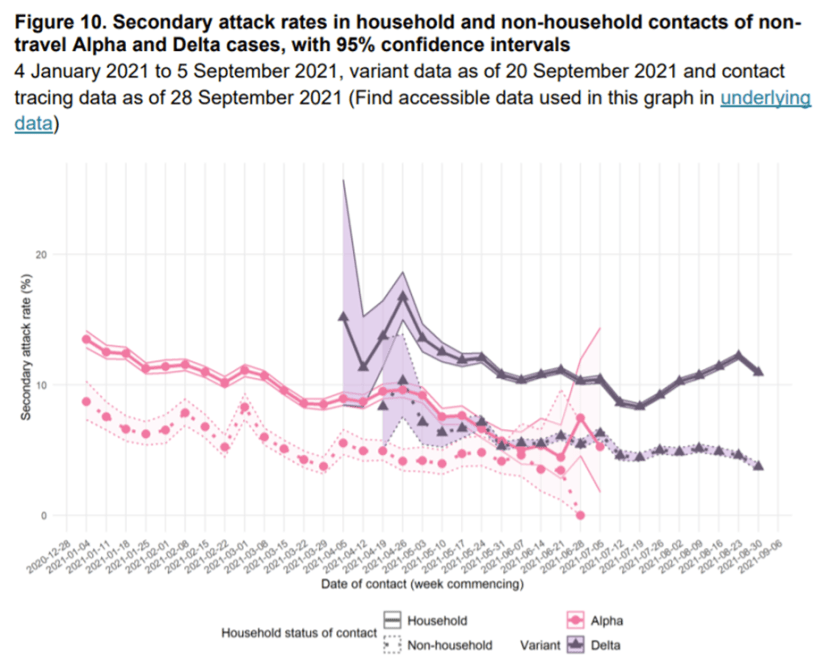
If the findings are equivocal in most of the population then modelling might be enough to get the result you want. However, if there is a subgroup which has clearly contrary results then they can be left out entirely. When trying to calculate the impact of vaccination on transmission in winter the most obvious group to study would have been the heavily vaccinated care home residents. PHE omitted this group from their paper with no reason given. The consequence was that the overall household transmission rate was much higher in the real world (see figure 1) than in the study. Using published data on mean national transmission rates each week the expected rates in the study would have been 12.4% in the unvaccinated (who were overrepresented when transmission rates were highest) and 11.7% in the vaccinated cohorts. However, the study reported a rate of only 10.1% in the unvaccinated and only 6% in the vaccinated. The population excluded from the PHE study clearly contributed to the much higher real world transmission rates for both the unvaccinated and the vaccinated.
Figure 1: Real world transmission rates as measured by the proportion of contacts that become infected, the secondary attack rate.
6. Use the wrong dose of the drug
A drug can be discredited in a trial where the protocol is deliberately designed to give a drug at an inappropriate time or dose. For example, the RECOVERY trial was said to show that hydroxychloroquine treatment was not helpful in covid. The trial design used a dose of hydroxychloroquine that was in the toxic range and may well have been responsible for the deaths of participants in the treatment arm of the trial. Hydroxychloroquine doses over 1500mg are associated with cardiovascular and neurological harms that can be potentially fatal. The trial used a dose of 2000mg in the first 18 hours and 400mg every 12 hours thereafter.
Conclusion
Scientists are human and are under pressure to produce results in their papers as that increases the chances of publication which is needed for career progression and securing funding for research. There are numerous ways in which data can be altered to tell a story and many of them have been put to use during the pandemic. Dramatic results have become headline grabbing news but often the truth was far more mundane. If a result sounds too good to be true, don’t believe it.
The Central Intelligence Agency (CIA) allegedly backed secret experiments into schizophrenia on 311 Danish children, many adopted or from orphanages, during the early 1960s, according to a newly released documentary.
Danish Radio’s documentary ‘The Search for Myself’ accuses the US spy agency of supporting the experiments at the Municipal Hospital in Cophenhagen. The studies were reportedly investigating the link between schizophrenia and heredity or the environment.
Per Wennick, who claims to have been a participant in the experiments as a child, alleged that he was placed in a chair, with electrodes strapped to him and forced to listen to loud, shrill noises. The aim of the test was supposedly to find out if a child had psychopathic traits.
“It was very uncomfortable. And it’s not just my story, it’s the story of many children,” Wennick said, describing his experience.
I think this is a violation of my rights as a citizen in this society. I find it so strange that some people should know more about me than I myself have been aware of.
The project was co-financed by a US health service, receiving support from the Human Ecology Fund, which is operated on behalf of the CIA, according to Wennick and the National Archives.
While the children were not told what the experiments were for, during or after the research, a dissertation was published in 1977 by Danish psychiatrist Find Schulsinger detailing the study.
The Danish Welfare Museum’s Jacob Knage Rasmussen said that this is the first documented time where children under care were used for research purposes in the country.
“I do not know of similar attempts, neither in Denmark nor in Scandinavia. It is appalling information that contradicts the Nuremberg Code of 1947, which after World War II was to set some ethical restrictions for experiments on humans” Rasmussen stated.
Not merely the validity of experience, but the very existence of external reality was tacitly denied by their philosophy. The heresy of heresies was common sense.”
George Orwell, 1984
The “Covid pandemic” narrative is insane. That is long-established at this point, we don’t really need to go into how or why here. Read our back catalogue.
The rules are meaningless and arbitrary, the messaging contradictory, the very premise nonsensical.
Every day some new insanity is launched out into the world, and while many of us roll our eyes, raise our voices, or just laugh… many more accept it, believe it, allow it to continue.
Whether or not you believe the test means anything, they notionally do. In the reality they try to sell us every day, testing positive means you are carrying a dangerous disease.
So they are requesting people allegedly carrying a “deadly virus” work, rather than letting perfectly healthy unvaccinated people simply have their jobs back.
This is insanity.
But could anything more perfectly illustrate the priorities of those running the game?
We already know it’s not about a virus, it’s not about protecting the health service and it’s not about saving lives. Every day the people running the “pandemic” admit as much by their actions, and even their words.
Rather, it seems to be about enforcing rules that make little to no sense, requiring conformity at the price of reason, drawing arbitrary lines in the sand and demanding people respect them, making people believe “facts” that are provably untrue.
But why? Why is the story of Covid irrational and contradictory? Why are we told on the one hand to be afraid, and on the other that there is nothing to be afraid of?
Why is the “pandemic” so completely insane?
You could argue that it’s simple happenstance. The by-product of a multi-focused evolving narrative, a story being told by a thousand authors all at once, each concerned with covering their own little patch of agenda. A car with multiple drivers fighting over a single steering wheel.
There’s probably some truth to that.
But it’s also true that control, true control, can only be achieved with a lie.
In clinical psychology one of the diagnostic signs of the psychopath is that they tell elaborate lies, compulsively. Many times they will tell a lie even if the truth would be more beneficial.
Nobody knows why they do this, but I have a theory, and it applies to the swarming groups of little rat minds running the sewers of power as much as it does any individual monstrosity.
If you want to control people, you need to lie to them, that’s the only way to guarantee you have power.
If you are standing in the road, and I yell “look out, there’s a car a coming”, and you move just as a car whips past, I will never know if you moved because I said so, or because there actually was a car.
If my interest is in making sure you don’t get hurt, this would not matter to me either way.
But, what if my only true aim is the gratification of watching you do what I say, simply because I said it?
… well, then I need to scream out a warning of a car that does not exist, and watch you dodge an imaginary threat. Or, indeed, tell you there is no car, and watch you get run over.
Only by doing this can I see my words mean more to you than perceivable reality, and only then do I know I’m truly in control.
You can never control people with the truth, because the truth has an existence outside yourself that cannot be altered or directed. It may be the truth itself that controls people, not you.
You can never force people to obey rules that make sense, because they may be obeying reason, not your force.
True power lies in making people afraid of something that does not exist, and making them abandon reason in the name of protecting themselves from the invented threat.
To guarantee you have control, you must make people see things that are not there, make people live in a reality you build around them, and force people to follow arbitrary, contradictory rules that change day by day.
To truly test their loyalty, their hypnosis, you could even tell them there’s nothing to be afraid of anymore, but they need to follow the rules anyway.
Maybe that’s the point. Maybe the story isn’t supposed to be believable. Maybe the rules aren’t meant to make sense, they are meant to be obeyed.
Maybe the more contradictory & illogical the regulations become, the more your compliance is valued.
Maybe if you can force a person to abandon their judgment in favour of your own, you have total control over their reality.
We started with an Orwell quote, so let’s end with one too:
Power is in tearing human minds to pieces and putting them together again in new shapes of your own choosing.”
Isn’t that what we’re seeing now? What we’ve been seeing since the beginning?
People being mind broken into being afraid of something they are told isn’t frightening, following rules they are told are not necessary, taking “medicine” they are told does not work.
Maybe forcing people to believe your lies, even as you admit you are lying, is the purest expression of power.
While in the West mostly speech and movement of people are policed through automated “AI” censorship and surveillance systems, in China, work appears to be well under way to create a machine that would act as an AI-powered prosecutor.
The product, which has already been tested by the busy Shanghai Pudong prosecutor’s office, is able to achieve 97 percent accuracy in charging people suspected of eight criminal acts, researchers developing it have alleged.
According to the South China Morning Post, the cases that the “AI prosecutor” is allegedly highly competent in handling involve crimes like credit card fraud, dangerous driving, gambling, intentional injury, obstructing officials, theft, but also something called “picking quarrels and provoking trouble.”
The last one is considered particularly “problematic” since its definition, or lack thereof, can cover different forms of political dissent.
And now the plan is to introduce a machine that would be given decision-making powers, such as whether to file charges, and what sentence to seek on a case-to-case basis.
That, said Professor Shi Yong, who heads the Chinese Academy of Sciences’ big data and knowledge management lab that is behind the project, is a marked difference between this and other “AI” tools that have already been in use in China for years. One of them is System 206, whose tasks are limited to assessing evidence, the danger a suspect poses to the public, and conditions under which they may be apprehended.
But the tech behind the new artificial prosecutor looks to be at the same time far more ambitious, and advanced. What has been disclosed is that it can be run on a desktop PC, processing 1,000 traits extracted from case description filed by humans, and based on that press a charge.
It’s unclear if the database of 17,000 cases spanning five years used to train the algorithms is enough to consider the project as true AI – and if the same result can be achieved by rule-based algorithms.
Either way, not all human prosecutors are thrilled about having some of their workload replaced in this way – although precisely this has been given as the motive for developing the tech.
“The accuracy of 97 per cent may be high from a technological point of view, but there will always be a chance of a mistake. Who will take responsibility when it happens? The prosecutor, the machine or the designer of the algorithm?,” one Guangzhou-based prosecutor noted, speaking on condition of anonymity.
At the end of 1991, the Soviet Union dissolved — a surprisingly peaceful end to a brutal empire. Russia, as the principal successor state, sought to join the democratic West, and the United States and its European allies officially welcomed that aspiration. Three decades later, however, the West and Russia are locked in an increasingly acrimonious cold war struggle. It is a tragic development, and one that could escalate into a catastrophic armed conflict. Neither side is blameless for the onset of a new cold war, but there is a substantial difference in the degree of culpability. Provocations by the United States and NATO were more numerous, more egregious, and began earlier.
U.S. and NATO officials, as well as most of the Western news media, contend that Russia is to blame for the current ugly confrontation. They highlight four Kremlin actions that severely spiked East-West tensions. The first episode, according to that version of history, occurred in 2008 when Russian forces invaded Georgia and advanced to the outskirts of the capital, Tbilisi. A second, even more serious offense, took place in 2014 when Russia seized Crimea from Ukraine and annexed that strategic peninsula after holding a bogus referendum. The third incident followed just months later when Russia orchestrated a separatist insurgency in Ukraine’s eastern Donbas region and then sent in troops to assist the rebellion. During the years that followed, Vladimir Putin’s government exacerbated the emerging cold war by interfering in the internal political affairs of numerous Western countries, especially the United States.
Those allegations contain some truth, but all of them conveniently omit crucial context. For example, the 2008 invasion of Georgia occurred only after the Georgian military fired on Russian peacekeeping troops that had been in the secessionist region of South Ossetia since the early 1990s. Even a European Union investigation concluded that Georgian forces had initiated the fighting. The conflict also occurred in large part because President George W. Bush encouraged Georgia’s president, Mikheil Saakashvili, to believe that the United States and NATO would support his country if it became embroiled in a conflict with Russia.
Putin’s seizure of Crimea was indeed a blatant violation of international law, but it occurred only after the United States and key EU allies had shamelessly assisted demonstrators to overthrow Ukraine’s elected pro-Russia president, Viktor Yanukovych. That thinly disguised coup triggered Russian fears that Ukraine was about to become a forward staging area for NATO military power. Among other worries, the Kremlin suspected that it would lose access to its crucial naval base at Sevastopol on the Crimea peninsula and watch that facility become a hostile NATO base.
The one-sided, self-serving indictments of Russia’s behavior invariably ignore the numerous Western provocations that took place long before Moscow engaged in disruptive measures. Indeed, the deterioration of the West’s relations with post-communist Russia began during Bill Clinton’s administration.
Western provocation number 1: NATO’s first eastward expansion.
In her memoir “Madame Secretary,” former U.S. ambassador to the United Nations and secretary of state Madeleine Albright concedes that Clinton administration officials decided already in 1993 to endorse the wishes of Central and East European countries to join NATO. The Alliance proceeded to add Poland, the Czech Republic, and Hungary in 1998. Albright admitted that Russian President Boris Yeltsin and his associates were extremely unhappy with that development. The Russian reaction was understandable, since the expansion violated informal promises that President George H. W. Bush’s administration had given Moscow when Mikhail Gorbachev had agreed not only to accept a unified Germany but a united Germany in NATO. The implicit quid pro quo was that NATO would not move beyond the eastern border of a united Germany.
Western provocation number 2: NATO’s military intervention in the Balkans.
NATO’s 1995 air war against Bosnian Serbs seeking to secede from the newly minted country of Bosnia-Herzegovina and the imposition of the Dayton Peace Accords greatly annoyed Yeltsin’s government and the Russian people. The Balkans had been a region of considerable religious and strategic interest to Moscow for generations, and it was humiliating for Russians to watch impotently as a U.S.-led alliance dictated outcomes there. The Western powers conducted an even greater provocation four years later when they intervened on behalf of a secessionist insurgency in Serbia’s restless Kosovo province. Detaching that province from Serbia and placing it under U.N. control not only set an unhealthy international precedent, but the move also displayed utter contempt for Russia’s interests and preferences in the Balkans.
The Clinton administration’s decisions to expand NATO and meddle in Bosnia and Kosovo were crucial steps toward creating a new cold war with Russia. Former U.S. Ambassador to the Soviet Union Jack F. Matlock Jr. cites the negative impact that NATO expansion and the U.S.-led military interventions in the Balkans had on Russian attitudes toward the United States and the West: “The effect on Russians’ trust in the United States was devastating. In 1991, polls indicated that about 80 percent of Russian citizens had a favorable view of the United States; in 1999, nearly the same percentage had an unfavorable view.”
Western provocation number 3: NATO’s subsequent waves of expansion.
Not content with how the Clinton administration antagonized Moscow by moving NATO into Central Europe, George W. Bush’s administration pushed the allies to give membership to the rest of the defunct Warsaw Pact and to the three Baltic republics. Admitting the latter in 2004 dramatically escalated the West’s military encroachment. Those three small countries had not only been part of the Soviet Union, they also had spent most of their recent history as part of Czarist Russia’s empire. Russia was still too weak to do more than present feeble diplomatic protests, but the level of anger at the West’s arrogant disregard of Russia’s security interests rose.
Expanding NATO to Russia’s border was not the only provocation. Increasingly, the United States was engaging in “rotational” deployments of its military forces in the new alliance members. Even George Bush’s secretary of defense, Robert Gates, expressed worries that such actions were creating dangerous tensions. Putin’s February 2007 speech to the annual Munich Security Conference made it extremely clear that the Kremlin’s patience with U.S. and NATO arrogance was coming to an end. Bush, tone-deaf as ever, even tried to secure NATO membership for Georgia and Ukraine — a policy that his successors have continued to push, despite resistance from France and Germany.
Western Provocation number 4: treating Russia as an outright enemy in Ukraine and elsewhere.
Western leaders did not take Putin’s warnings seriously enough, however. Instead, the provocations on multiple fronts continued and, in some cases, even accelerated. The United States and key NATO powers bypassed the U.N. Security Council (and a certain Russian veto) in early 2008 to grant Kosovo full independence. Three years later, Barack Obama’s administration misled Russian officials about the purpose of a “humanitarian” U.N. military mission in Libya, convincing Moscow to withhold its veto. The mission promptly turned into a U.S.-led regime-change war to overthrow Libyan leader Muammar Qaddafi. Shortly thereafter, the United States worked with like-minded Middle East powers in a campaign to oust Russia’s client, Bashar al-Assad, in Syria. The egregious U.S.-EU meddling in Ukraine’s domestic politics followed.
It is unfair to judge Russia’s aggressive and destabilizing actions, including the annexation of Crimea, the ongoing military intervention in Syria, continuing support for separatists in eastern Ukraine, and attempted interference in the political affairs of other countries, without acknowledging the multitude of preceding Western abuses. The West, not Russia, is largely responsible for the onset of the new cold war.
There is a book, “Evidence of harm” that talks about what happened there in detail. Some people think the author wasn’t sure who was telling the truth. That’s not true. The book author takes an objective viewpoint, leaving it to the reader to determine who was telling the truth. If your brain is working, it’s easy to figure out.
Basically, Simpsonwood was a meeting where the CDC was scrambling to figure out how to cover up the “signal” caused by thimerosal in vaccines.
Here is the original Verstraeten study which shows the connection with autism. RR=7.6 is huge. It means mercury causes autism.
It’s a long read, so this excerpt gives you the highlights in a much shorter amount of time. The key thing was the study by Verstraeten. Version #3 was presented at that meeting.
This web page describes each version of the Verstraeten study. Search for “A “SIGNAL” DISAPPEARS ACROSS FIVE GENERATIONS OF STUDY.” In that section they’ll talk about a signal that “won’t go away.” They basically massaged the numbers to make the association “go away” so they wouldn’t have to admit making a mistake which would be a PR disaster.
In short, the CDC was more interested in covering their ass (making the signal go away) than protecting kids.
That was all 20 years ago. Why is this relevant today?
Because it shows the agency was corrupt 20 years ago and they haven’t changed. Today, they can ignore all the deaths in VAERS saying “there is no causality.” Bullshit. This is why they don’t debate any of us.
Sure, it’s true that Thimerosal doesn’t stay in your blood a long time; but it’s not true that it doesn’t stay in your body a long time. In fact, it stays in your brain for the rest of your life (unless you use some special methods to remove it over time using chelation). They are not admitting established facts even today. They are still hiding that it stays in your body forever.
In total, these studies indicate that ethylmercury-containing compounds and Thimerosal readily cross the BBB, convert, for the most part, to highly toxic inorganic mercury-containing compounds, which significantly and persistently bind to tissues in the brain, even in the absence of concurrent detectable blood mercury levels.
So the CDC is clearly lying to the public 15 years later about what happened back then, even after the science is completely settled.
They covered up the dangers of thimerosal back in 2000… the five generations of the Verstraeten study shows that.
But more importantly, and more clearly, they are still covering up the dangers of thimerosal today, claiming it leaves your body when they know it doesn’t. It is obvious to anyone doing a literature search.
So, do you think they are levelling us now about the safety of the COVID vaccines?
I’ve already covered three studies that found natural immunity protects better against infection than the vaccines. These comprise two fromIsrael, and one from Denmark. In each case, individuals who’d already had Covid were much less likely to become infected than those who’d been vaccinated.
Now a fourth study has come to my attention; this time from India. (The study was published as a preprint back in August.)
Malathi Murugesan and colleagues monitored infections in a cohort of healthcare workers between April and June of this year, during the country’s second wave. They compared four groups, corresponding to the different combinations of previously infected or not, and vaccinated or not.
Note: the vast majority of participants had received the AstraZeneca vaccine. This is in contrast to the Israeli and Danish studies, where most individuals had received another vaccine (mainly Pfizer).
Among those who hadn’t been previously infected or vaccinated, the cumulative infection rate was 14.9%. It was slightly lower among those that had been vaccinated but not previously infected, namely 11.1%. And it was dramatically lower among those who had been previously infected: 2.1% among those who hadn’t been vaccinated, and 1.4% among those who had.
To check that these results were robust, the authors ran a statistical model controlling for age, sex, type of work, and the daily incidence of Covid in the surrounding area (the city of Vellore in Southern India).
They estimated the protective effect of natural immunity to be 86% (which is consistent with a recent systematic review). By contrast, vaccine effectiveness was only 32%. As expected, the protective effect of hybrid immunity was 91% – slightly better than that of natural immunity alone.
There are now four separate studies all showing the same thing: several months after the corresponding event, natural immunity provides substantially better protection against infection than the vaccines.
“Vaccination efforts,” the Indian researchers note, “should be optimised by directing vaccination towards the areas where individuals are non-immune.” In other words, there was no need to vaccinate healthy people who’d already had Covid; those vaccines should have gone to the clinically vulnerable in poor countries.
This is the second of two parts. The first appeared yesterday.
THE revelations in Robert F Kennedy Jnr’s book about Anthony Fauci’s handling of the Covid crisis are damning. That is putting it politely.
He illustrates how the United States chief medical adviser, in charge of healthcare for the American people for over 40 years, presided over the worst coronavirus death rate in the world, nearly double that of many countries. The US suffered 2,107 deaths per 100,000 citizens, while Sweden, who accidentally became the world’s control group by ignoring damaging lockdown and mask mandates, had 1,444 deaths per 100,000.
Fauci is blinkered to affordable treatments, and inexplicably banned them. The rest of the world followed suit with the result that thousands who tested positive for SARS-CoV-2 were left to deteriorate at home until gasping for breath, when they were finally admitted to hospital and ventilated. Many never came home.
RFK Jnr, 67, son of assassinated US attorney general Bobby Kennedy and nephew of assassinated President John F Kennedy, began his legal career as an environment lawyer. Time.com named him ‘hero for the planet’. These days he is accused of being an antivaxxer, but like most activists in this arena he is simply pro-vaccine safety.
As he says at the beginning of his book The Real Anthony Fauci: Bill Gates, Big Pharma and the Global War on Democracy and Public Health: ‘Complex scientific and moral problems are not resolved through censorship of dissenting opinions, deleting content from the Internet, or defaming scientists and authors who present information challenging to those in power. Censorship leads instead to greater distrust of both government institutions and large corporations.’
Many formerly respected medics, as well as RFK Jnr, now find they are victims of cancel culture, while those in power are able to dictate undemocratic, unproven and draconian measures with the capability to destroy our lives and economies without censure or challenge.
Here is an edited extract from chapter 1:
‘Peer-reviewed science offered anaemic if any support for masking, quarantines and social distancing, and Dr Fauci offered no citations or justifications to support his diktats. Both common sense and the weight of scientific evidence suggest that all these strategies, and unquestionably shutting down the global economy, caused far more injuries and deaths than they averted.
‘During a speech to HHS [Health and Human Services] regulators, Fauci explained the fruitlessness of masking asymptomatic people. “The one thing historically people need to realise, that even if there is some asymptomatic transmission, in all the history of respiratory borne viruses of any type, asymptomatic transmission has never been the driver of outbreaks. The driver of outbreaks is always a symptomatic person. Even if there’s a rare asymptomatic person that might transmit, an epidemic is not driven by asymptomatic carriers.”
‘Dr Fauci observed in March 2020 that a mask’s only real efficacy may be in “making people feel a little better”. Perhaps he recognised that what masking lacked in efficacy against contagion, it compensated for with powerful psychological effects. These symbolic powers demonstrated strategic benefits for the larger enterprise of encouraging public compliance with draconian medical mandates. Dr Fauci’s switch to endorsing masks after first recommending against them came at a time of increasing political polarisation, and masks quickly became important tribal badges – signals of rectitude for those who embraced Dr Fauci, and the stigmata of blind obedience to undeserving authority among those who balked. Moreover, masking, by amplifying everyone’s fear, helped inoculate the public against critical thinking.
‘By serving as persistent reminders that each of our fellow citizens was a potentially dangerous and germ-infected threat to us, masks increased social isolation and fostered divisions and fractionalisation – thereby impeding organised political resistance.
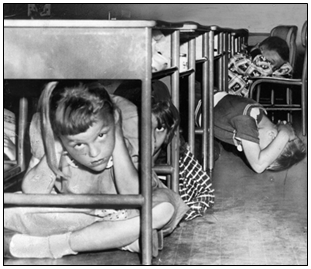
‘The impact of masking on the national psyche reminded me of the subtle contribution of the “duck and cover drills” of my youth, drills that sustained and cemented the militaristic ideology of the Cold War. Those futile exercises reinforced what my uncle John F Kennedy’s Defense Secretary, Robert McNamara, called “National Mass Psychosis”. By suggesting to Americans that full-scale nuclear war was possible, but also survivable, ruinous investments in that project were justified. For the government and mandarins of the Military Industrial Complex, this absurd narrative yielded trillions in appropriations.
‘Social distancing mandates also rested on a dubious scientific footing. In September 2021, former FDA Commissioner Dr Scott Gottlieb admitted that the six-foot distancing rule that Dr Fauci and his HHS colleagues imposed upon Americans was “arbitrary,” and not, after all, science-backed. The process for making that policy choice, Gottlieb continued, “is a perfect example of the lack of rigour around how CDC made recommendations”.
‘Finally, the lockdowns of the healthy were so unprecedented that the World Health Organisation’s official pandemic protocols recommended against them. Some WHO officials were passionate on the topic, among them Professor David Nabarro, Senior Envoy on Covid-19, a position reporting to the Director General.
‘On October 8, 2020, he said, “We in the World Health Organisation do not advocate lockdowns as a primary means of controlling this virus. We may well have a doubling of world poverty by next year. We’ll have at least a doubling of child malnutrition because children are not getting meals at school and their parents in poor families are not able to afford it. This is a terrible, ghastly, global catastrophe, actually, and so we really do appeal to all world leaders: Stop using lockdown as your primary control method . . . lockdowns just have one consequence that you must never ever belittle – and that is making poor people an awful lot poorer.”
‘Dr Fauci and other officials made no inquiry or claims as to whether lockdowns would cause more harm and death than they averted. Subsequent studies have strongly suggested that lockdowns had no impact in reducing infection rates. There is no convincing difference in Covid infections and deaths between laissez-faire jurisdictions and those that enforced rigid lockdowns and masks. Dr Fauci’s mask deceptions were among several “noble lies” that, his critics complained, revealed a manipulative and deceptive disposition undesirable in an even-handed public health official. Dr Fauci explained to the New York Times that he had upgraded his estimate of the vaccine coverage needed to insure “herd immunity” from 70 per cent in March to 80-90 per cent in September not based on science, but rather in response to polling that indicated rising rates of vaccine acceptance.
‘He supported Covid jabs for previously infected Americans, defying overwhelming scientific evidence that post-Covid inoculations were both unnecessary and dangerous.’
‘In September 2021, in a statement justifying Covid vaccine mandates to school children, Dr Fauci dreamily recounted his own grade-school measles and mumps vaccines – an unlikely memory, since those vaccines weren’t available until 1963 and 1967, and Dr Fauci [who is 80 years old] attended grade school in the 1940s. Dr Fauci’s little perjuries about masks, measles, mumps, herd immunity, and natural immunity attest to his dismaying willingness to manipulate facts to serve a political agenda.’
It is difficult to discuss the Vietnam war since most Americans have been misled by myths. These are so common that they appear in documentaries about the war. As a result, many Americans become angry when facts are presented.
“The Viet-Nam Demarcation Line is not an international boundary in the traditional sense; rather it is a provisional military demarcation line. As such, it should never be shown on official maps by the standard symbol for an international boundary.” US State Department; September 10, 1962; http://library.law.fsu.edu/Digital-Co…
After the Conejo Guardian’s report on alarming trends in Ventura County hospitals, more nurses have come forward to affirm the rise in unexplained heart problems, strokes and blood clotting in local vaccinated patient populations. They also say doctors refuse to consider that these could be adverse reactions to Covid shots.
Sam, a critical care nurse at an ICU in a Ventura County hospital, came forward because, “I’m tired of all the B.S. that’s going on,” he told the Guardian. “It’s crazy how nobody questions anything anymore.”
“NONE [OF THE DOCTORS] QUESTION WHETHER THE VACCINE CAUSES MYOCARDITIS, PERICARDITIS AND THE STROKES THAT ARE COMING IN. IF THEY DON’T TOE THE LINE, THEY COULD LOSE THEIR MEDICAL LICENSE.”
He has witnessed a surge in numbers of young people experiencing severe health problems after receiving Covid shots.
“We’ve been having a lot of younger people come in,” Sam says. “We’re seeing a lot of strokes, a lot of heart attacks.”
One 38-year-old-woman came in with occlusions (blockages of blood flow) in her brain.
“They [doctors] were searching for everything under the sun and documenting this in the chart, but nowhere do you see if she was vaccinated or not,” Sam says. “One thing the vaccine causes is thrombosis, clotting. Here you have a 38-year-old woman who was double-vaccinated and she’s having strokes they can’t explain. None of the doctors relates it to the vaccine. It’s garbage. It’s absolute garbage.”
Another woman, age 63, came in the day she took the Moderna Covid shot. With no previous cardiac history, she suffered a heart attack. Tests revealed her coronary arteries were clean.
“One doctor actually questioned the vaccine, but they didn’t mention it in the chart because you can’t prove it,” Sam says.
While hospitals are seeing more myocarditis, an associated side effect of the Covid shots, “Everyone wants to downplay it — ’It’s rare, it’s rare,’” Sam says. “Doctors don’t want to question it. We have these mass vaccinations happening and we’re seeing myocarditis more frequently and nobody wants to raise the red flag. When we discuss the case, they don’t even discuss it. They don’t mention it. They act like they don’t have a reason, that it’s spontaneous.”
‘Survival mode’
“I FEEL LIKE OUR HOSPITAL IS … BARELY ABLE TO FUNCTION RIGHT NOW. THAT’S HOW BAD IT IS.”
Dana, another ICU nurse, says the number of sick, critically ill people in her Ventura County hospital has become “overwhelming,” pushing her facility’s patient census to the highest levels she has ever seen.
“It has never been this busy, and none of it is Covid-19,” Dana says. “We don’t normally see this amount of strokes, aneurysms and heart attacks all happening at once. … Normally we’ll see six to ten aortic dissections a year. We’ve seen six in the last month. It’s crazy. Those have very high rates of mortality.”
But doctors almost never bring up the possibility of adverse reactions due to Covid vaccinations.
“Doctors are like, ‘It’s probably the holidays,’” Dana says. “I don’t understand how you can look at what’s going on and come up with just, ‘Yeah, it’s the holidays.’ There’s been a big change in everybody’s life, and it’s the vaccine.”
Covid infection numbers remain small, and most patients who come in with Covid have already been vaccinated, she says. Rather, an unprecedented number of patients are “on pressers to keep their blood pressure up, people on ventilators, clotting issues, so we have a lot of Heparin drips to make sure they don’t stroke out,” Dana says.
Meanwhile, “Everybody’s in survival mode because of staffing.”
Nurse shortages, caused by people fleeing California and the health care profession, have local hospitals scrambling to provide care. Dana has been “out of ratio” for the last three shifts, based on the State of California’s maximum allowable nurse-to-patient ratio for safely delivering care.
That is leading to serious lapses.
“Because we’re short-staffed, they are hiring new nurses and I’m seeing mistakes in the hospital that are not even funny — medical errors,” Dana says. “[Hospitals] are trying to fill these spots and are getting any warm body to do the bare minimum. I think it’s terrible what’s happening.”
Recently, Dana took care of a patient who was mistakenly given massive amounts of a certain hormone by a different nurse.
“Now their brain is fried,” she says. “The patient is screwed.”
Unfortunately, most newly-hired nurses “are not capable of safely managing patients,” and yet are being thrust early into this environment, she says.
“The hospital is like, ‘We need to fill these spots. We’re getting killed.’ So they release all these people who’ve been training for two to three months. Normally you train four to six months,” Dana says. “To be honest, I feel like our hospital is on the brink of — we’re barely able to function right now. That’s how bad it is.”
Even the physical space is taxed by the influx of patients with life-threatening health conditions. Dana’s hospital is so packed that they are putting patients in staging areas of operating rooms.
As a result of crowding, equipment is not always where it should be and “when someone takes a dump on you and goes into cardiovascular collapse, you don’t know where your stuff is — and time is tissue,” she says. “Their blood pressure starts dropping, their respiratory rate goes up, and because we’re having to shuffle patients and staff around, equipment is in different spots. Sometimes you need to respond in minutes, and if a nurse doesn’t know where stuff is and is not used to dealing with the numbers of people and the types of critical problems — every second of delay in therapeutic treatment causes more tissue to get damaged and die, whether it’s heart tissue, brain tissue, muscle tissue. Every second counts.”
Green nurses managing more patients, with more serious problems, is forcing unpleasant choices.
“It’s setting up the patients for failure,” Dana says. “How can you manage four to five critically ill patients effectively? You have to pick winners and losers.”
Pressuring the ‘unvaccinated’
Meanwhile, doctors seem obsessed with getting people to take Covid shots.
Sam took the first two Covid shots while working in Los Angeles during the pandemic, but is shocked at how medical professionals and political leaders are demanding universal acceptance of what he says is “not really a vaccine. It’s experimental.”
“They shouldn’t be forcing it on everyone,” he continues. “There isn’t a lot of data. There are risks associated with it and you should be able to turn it down. Now if you don’t take the vaccine, people shun you.”
Hostility toward those who don’t go along runs high among medical co-workers.
“You’re not allowed to say you don’t want it,” Sam says. “Coworkers will talk [trash] about you, they’re so adamant about it. It’s frustrating. … You always hear the conversations behind their backs. ‘She’s not vaccinated, blah blah blah.’ I’m like, who gives a [care]? It’s none of your business. It’s their choice. Before, medical information was really private. Now it’s like, ‘What’s you’re Covid status?’”
Even patients coming into his hospital who have not taken the Covid shots are flagged and treated with disdain, he says.
“The first thing [nurses] say in the history and physical is, ‘He’s not vaccinated. He’s got Covid,’” he says. Meanwhile, “The Covid numbers in ICU are zero.”
As for the Vaccine Adverse Event Reporting System (VAERS), it may as well not exist. In his hospital, “There’s no protocol [for reporting to VAERS]. Nobody ever talks about that,” he says.
Even those who have strong natural immunity after overcoming the virus naturally are being pressured to take Covid shots.
“If this is about science, why on earth are we pushing people to get the vaccine?” Sam says. “We have rights, but they’ve taken that away. If you don’t get the shot, you lose your job.”
Informed consent also seems to have gone by the wayside.
“When you give someone informed consent, you are supposed to give them all the risks and benefits, and all options,” he says. “I feel like with the vaccine, they don’t give you the risks. They say, ‘Take this vaccine. It’s for the good of the community.’ They won’t be honest about it because it will drive down vaccination numbers. Every other medical product we give, we inform them fully. I don’t understand what it is about the Covid vaccine. They are so adamant about giving it.”
‘No boosters’
“I DON’T WANT TO KEEP INJECTING MYSELF WITH SOMETHING EVERY SIX MONTHS WHEN I DON’T HAVE DATA.”
Sam is most disappointed with doctors and nurses.
“The doctors don’t question anymore,” he says. “None question whether the vaccine causes myocarditis, pericarditis and the strokes that are coming in. If they don’t toe the line, they could lose their medical license. They do what they do because they have bills to pay. I’m disappointed because you have a handful of doctors who will question the narrative, but the rest go along.”
The level of propaganda, in his view, is “out of control.”
“Propaganda creates doubt,” he says. “Half the country buys it and the other half distrusts the system. They [doctors] are smart people but they don’t think for themselves anymore. It’s the propaganda, the repetition of the lie. It’s very effective.”
For his part, Sam has decided not to take any boosters.
“I don’t want to keep getting this thing. What if I clot off and get a heart attack?” he says. “Health care professionals are evidence-based people — or we used to be — and there’s just no evidence what this thing’s going to do in 10 years. We have no evidence what it does to the immune system and clotting system. I don’t want to keep injecting myself with something every six months when I don’t have data.”
He and his wife have decided they will leave the state if they can’t afford to homeschool their child, when the child reaches school age.
“My [child] will never get the vaccine. We will leave,” Sam says. “They are out of their minds to vaccinate these children. Their immune systems are immature. They are growing. I’m not willing to take the risk. No way. Me and my wife feel the same way.”
Florida, which is maintaining medical freedom and privacy, is also their preferred destination if and when he loses his job once governments change the definition of “vaccinated” — leaving him in the same category as those who never took Covid shots in the first place.
“I may end up getting a lawyer if they change the definition of ‘vaccinated’ and you need a third shot,” he says. “California law allows for religious exemptions and hospitals are denying them. That’s discrimination.”
Like all the nurses interviewed by the Guardian, he says he is “sick and tired of the coercion.”
“If you’re vaccinated and I’m not, what the heck are you worried about? It’s my choice, right?” he says. “If I get sick and die, that’s the price of freedom. That’s what we’re built on. In America, we don’t force people to take injections and medical products against their will.”
THE Real Anthony Fauci, a number-one best-selling book by Robert F Kennedy Jnr, is so explosive you wonder how it got past the lawyers at Skyhorse Publishing.
Skyhorse, launched in 2006 by Tony Lyons and a subsidiary of literary giants Simon and Schuster, are not afraid to challenge authority and explore alternative narratives but cannot afford to upset their parent company who would be furious if their 100-year-old reputation was damaged. Therefore, RFK’s information, however seemingly defamatory, had to be solid and able to stand up to legal challenge.
Robert Kennedy Jnr – the son of Democrat Robert ‘Bobby’ Kennedy who served as US Attorney General in the early 1960s under his brother John F Kennedy’s administration – is a successful lawyer like his father was. This means every accusation levelled at Fauci, the 80-year-old chief medical adviser to the President of the United States, is fully referenced and backed by scientific papers and credible medical professionals. Dr Robert Malone, inventor of the mRNA technology used in Pfizer and Moderna’s Covid jabs, edited it twice.
The list of the book’s contributing doctors and scientists includes many who have spent their lives developing or advocating vaccines but find themselves appalled by the damage wreaked by experimental Covid jabs.
Many names from this international community welcomed the chance to reiterate their views, including Dr Tess Lawrie in the UK, an advocate for early Covid treatments such as ivermectin; former Bill and Melinda Gates Foundation vaccine developer Dr Geert Vanden Bossche, who says vaccinating during a pandemic is a recipe for disaster; former British Pfizer vice-president and Covid response critic Dr Mike Yeadon; and Dr Peter McCullough, the US’s foremost cardiac authority. They all spoke to Kennedy and are quoted in the book, full title: The Real Anthony Fauci: Bill Gates, Big Pharma and the Global War on Democracy and Public Health.
It is a riveting read that leaves you slack-jawed at the sheer recklessness of the vaccine rollout. It is also an invaluable source of reference material to all those following the alternative narrative.
I caught up with Kennedy last week and found out why a legal challenge from Fauci or Gates would make him extremely happy.
SB: Have you received any legal challenges from Anthony Fauci or Bill Gates?
RFK: There is nothing in that book that is untruthful. Secondly, I would welcome a lawsuit from Bill Gates and Tony Fauci, and they know that that would be a giant strategic mistake. Even if I did put something in that book that was defamatory, I don’t think they would challenge it. They’ve got so much to lose from the truth. Their only viable strategy is silence.
SB: What kind of reaction have you had from MSM?
RFK: There’s no reviews in the papers [despite the book’s No 1 best-seller status]. I am now being targeted with a barrage of ad hominem articles about me, but they don’t even mention the book, which is weird. They do not want to talk about this book because it’s full of truth. The truth is their deadliest enemy.
SB: Have you ever met either Fauci or Gates?
RFK: I’ve met Tony Fauci. Our paths have crossed for many years. I’ve been working on vaccine issues since 2005 so I’ve seen him in action on many occasions.
In 2016, President Trump asked me to run a vaccine safety commission. To do that I had a series of meetings with the regulatory leadership including Fauci and Gates. One of my challenges to them was to say: ‘You have never done a single double-blind placebo-controlled trial for any of the 72 recommended vaccines being given to children.’ Publicly, Fauci was saying I had not been telling the truth about this. I said to him: ‘Show me one trial for any of those 72 jabs.’ He made a show of looking through the files he’d brought with him. He said: ‘We don’t have them here; we’ll send them to you.’ He never did send them to me and a year later I sued them. We filed a suit asking them to show us any of those studies they had and after a year of litigation they came back and said we don’t have any.
Ironically, Fauci is now saying that he can’t use ivermectin or hydroxychloroquine to treat Covid without back-up from a double-blind placebo-controlled trials.
SB: The impression I get of Fauci is that he knows what to say in public but he seems like he has a dark side to him. The only reason for providing toxic drugs to people, like remdesivir,that has been so harmful to people with Covid, is because you know many who receive it will die. Does he know that?
RFK: Of course he does. He had remdesivir in a study in Africa to see if it worked against Ebola. In 2019, the Data and Safety Monitoring Review Board (DSMB) monitored his work. Two months later, the board was saying it’s not safe, it’s killing people. It’s produced by the pharmaceutical company Gilead which Bill Gates has a huge stake in. Coronavirus does not kill 50 per cent of people who get it whereas trials show that over 50 per cent of people treated with remdesivir died.
SB: In your book you talk about two types of scientists, those who allow Fauci to dictate their careers and those who don’t want to be compromised, but he seems to be very effective at crushing dissent.
RFK: Between him, Gates and Jeremy Farrar, director of the Wellcome Trust [part of the Trust’s £29.1billion annual budget comes from Gates], they control 61 per cent of the biomedical research on earth, so they control pretty much what gets funded. Also, that funding power gives them the power to kill studies they do not want and to ruin scientists who are trying to do those studies and to bankrupt universities. I show how that works in the book. If you had a young scientist at let’s say UCLA Medical School, [University of California, Los Angeles] who says why don’t we study whether the vaccines are causing injury by doing a cluster analysis of medical records? That’s an easy study to do. His dean will get a call from one of Tony Fauci’s flunkeys at the NIH [National Institutes of Health run by Fauci] saying you’d better stop that guy from doing the study, Tony doesn’t want it done. UCLA, like all the medical schools in this country, is getting hundreds of millions of dollars from Fauci and the NIH and are completely dependent on the royalties from pharmaceutical products that Fauci develops in his lab, farms out to the universities for phase 1 and phase 2 trials, then brings in a pharmaceutical company to produce the drug who then shares the patent with the university. Everybody is on the hook; everybody is making money and all of them have a huge incentive not to talk.
It is now nearly three decades since the Unites States adopted the policy of dual containment of Iran and Iraq. While much has been written about the containment of Iraq, there has been very little in-depth analysis of this policy when it comes to Iran. In a book that is going to be released on March 31, 2008, entitled The United States and Iran: Sanctions, Wars and the Policy of Dual Containment (Routledge), I attempt to address this shortcoming by investigating when and why the US policy of containment of Iran came about, how it evolved, and where it stands today.[1] To the extent that Israel has been involved in US policy making, the study will also include the role that Israel has played in the containment of Iran. Also, since the fate of Iran has been inextricably linked to that of Iraq, occasionally the investigation will overlap with the containment of Iraq.
The policy of dual containment of Iran and Iraq originated during the Carter Administration, but it was not until the Clinton Administration that the expression “dual containment” became popular. … continue
This site is provided as a research and reference tool. Although we make every reasonable effort to ensure that the information and data provided at this site are useful, accurate, and current, we cannot guarantee that the information and data provided here will be error-free. By using this site, you assume all responsibility for and risk arising from your use of and reliance upon the contents of this site.
This site and the information available through it do not, and are not intended to constitute legal advice. Should you require legal advice, you should consult your own attorney.
Nothing within this site or linked to by this site constitutes investment advice or medical advice.
Materials accessible from or added to this site by third parties, such as comments posted, are strictly the responsibility of the third party who added such materials or made them accessible and we neither endorse nor undertake to control, monitor, edit or assume responsibility for any such third-party material.
The posting of stories, commentaries, reports, documents and links (embedded or otherwise) on this site does not in any way, shape or form, implied or otherwise, necessarily express or suggest endorsement or support of any of such posted material or parts therein.
The word “alleged” is deemed to occur before the word “fraud.” Since the rule of law still applies. To peasants, at least.
Fair Use
This site contains copyrighted material the use of which has not always been specifically authorized by the copyright owner. We are making such material available in our efforts to advance understanding of environmental, political, human rights, economic, democracy, scientific, and social justice issues, etc. We believe this constitutes a ‘fair use’ of any such copyrighted material as provided for in section 107 of the US Copyright Law. In accordance with Title 17 U.S.C. Section 107, the material on this site is distributed without profit to those who have expressed a prior interest in receiving the included information for research and educational purposes. For more info go to: http://www.law.cornell.edu/uscode/17/107.shtml. If you wish to use copyrighted material from this site for purposes of your own that go beyond ‘fair use’, you must obtain permission from the copyright owner.
DMCA Contact
This is information for anyone that wishes to challenge our “fair use” of copyrighted material.
If you are a legal copyright holder or a designated agent for such and you believe that content residing on or accessible through our website infringes a copyright and falls outside the boundaries of “Fair Use”, please send a notice of infringement by contacting atheonews@gmail.com.
We will respond and take necessary action immediately.
If notice is given of an alleged copyright violation we will act expeditiously to remove or disable access to the material(s) in question.
All 3rd party material posted on this website is copyright the respective owners / authors. Aletho News makes no claim of copyright on such material.

 Aletho News
