Weaving Impunity for Dictatorship Crimes in Chile
By Ramona Wadi | Strategic Culture Foundation | July 25, 2020
In 1968, the U.S. backed a covert intelligence surveillance campaign in which Latin American right-wing governments conspired to annihilate socialist and communist influence in the region. The plan, known as Operation Condor, was formally implemented in 1975, two years after dictator Augusto Pinochet took power in Chile through a military coup supported by the U.S. Up to 80,000 left wing opponents are estimated to have been killed; 30,000 of them disappeared by right-wing governments in Latin America by 1989, when Operation Condor was officially terminated. Over 400,000 people were detained as political prisoners.
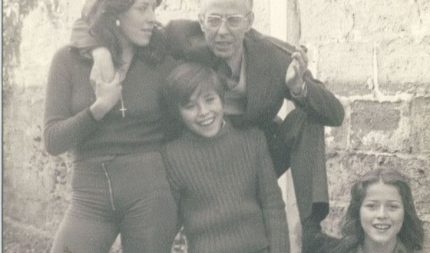 This month marks 44 years since the kidnapping and murder of Spanish-Chilean diplomat Carmelo Soria; also a victim of Operation Condor. Soria, who worked as a UN civil servant and became advisor to the Unidad Popular between 1971 and 1973 when Chile was ruled by socialist President Salvador Allende, became a target for Chile’s National Intelligence Directorate (DINA) during the Pinochet dictatorship. Through his diplomatic immunity as a UN official, Soria aided individuals to seek refuge in embassies until plans for exile could be made.
Soria was kidnapped by DINA agents pertaining to the Brigada Mulchen under the command of Captain Guillermo Salinas at the time, on July 14, tortured at Via Naranja and Villa Grimaldi, and murdered. His body was discovered in Santiago de Chile, dumped in a car that was pushed into a ditch, to cover up the murder as an apparent drunk driving accident.
Little is known about Brigada Mulchen – a secret operatives network with direct links to DINA’s chief Manuel Contreras. The agents comprising Brigada Mulchen have been described by Chilean researcher and author Javier Rebolledo as being part of Pinochet’s inner circle. Michael Townley, a CIA and DINA agent who was tasked with the production and experimentation of sarin gas, together with the biochemist Eugenio Berrios, was involved in Soria’s murder. Townley, who is under the Witness Protection Program in the U.S., was one of the agents requested for extradition by Chile’s Supreme Court for involvement in Soria’s murder. Soria’s remains were exhumed and identified in 2002 by Chile’s Servicio Medico Legal (SML). In 2015, 15 former DINA agents were indicted for Soria’s murder.
In 2019, 43 years after the murder, Chile’s Supreme Court sentenced Pedro Espinoza Bravo, Raul Iturriaga Neumann, Jaime Lele Orellana and Juan Morales Salgado, to a mere six years in prison for Soria’s murder – a travesty of justice which does not even reflect the crime. However, the impunity built through Pinochet’s dictatorship legacy still has a stronghold on Chile. Earlier this year, the Santiago Court of Appeals reduced the prison sentences of 17 former DINA agents who were involved in the murder and disappearances of Communist party members; the latter including Luis Emilio Recabarren.
Espinoza Bravo, sentenced for his involvement in Soria’s murder, is one of the DINA agents whose prison sentences have been reduced. The decision indicates the absence of separation between law and politics in Chile. In his presidential campaign, Chile’s right-wing President Sebastian Pinera had publicly spoken of amnesties for former DINA agents incarcerated for crimes against humanity. The suggestion was well received by the military and right-wing dictatorship supporters, while victims of the dictatorship and their relatives, in a struggle for reclaiming memory and justice since the dictatorship era, had to contend with yet another political impediment – the political manoeuvring at a legal level.
Chile is governed by silence and complicity – the Pinochet legacy, together with the military’s “pact of silence” – remain perpetual obstacles. What has changed since Soria’s murder was passed off as a drunk driving accident at a time when dictatorship opponents were being tortured and disappeared? While the Chilean military has not been averse to such tactics as seen in last year’s protests, it must be said that since Chile’s transition to democracy, subsequent governments have thoroughly failed the cause of human rights and collective memory in the country.
Was Jeffrey Epstein’s Boss Ghislaine Maxwell Helping Mossad Run Pedophile Rings for Prince Andrew and the Ruling Elite?

By Marco de Wit | Laiton Lehti | October 13, 2019
Video introduction to this article. (If the video is deleted by Youtube you can find it also here in Bitchute.)
The Epstein Pedoscandal Mossad Timeline shows in detail how Jeffrey Epstein and Ghislaine Maxwell were working for the Israeli intelligence agency, Mossad.

Link to Unz.com article
The timeline generated many comments at Unz.com but surprisingly most of them dealt whether Epstein was a pedophile or not. This despite the overwhelming evidence of pedophilia.
Many have also totally missed – or are afraid to notice – the big picture: Israeli intelligence agencies and especially Mossad seem to be running pedophile rings that blackmail Western political, business and scientific leaders.
Furthermore, it seems that Ghislaine Maxwell was and still is the master mind behind many of these pedophile rings.
One of the reasons Epstein and Ghislaine were able to continue sex trafficking with impunity for so long was the appearance that Epstein was a victim of jealous people and overzealous police. Many people thought that Epstein had only had sex with a 17-year old girl who had lied about her age.
This excuse worked well because in Florida the age of consent is 18 while in most other American states it is 16.
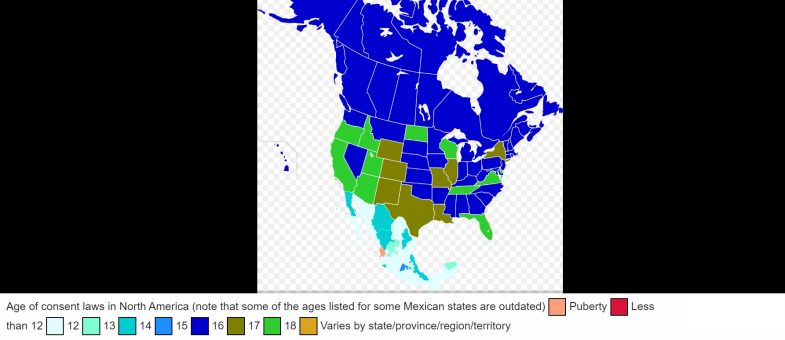
Link to Wikipedia
Epstein was able to play the martyr by not only claiming that unscrupulous girls had lied their age but also by implying that the age of consent is too high anyway in Florida.
This was also one reason why in New Mexico where Epstein had his Zorro Ranch the officials refused to register him as a sex offender. In New Mexico the age of consent was 16 until in 2018 it was raised to 18.
Furthermore, unlike in many other states, in New Mexico the courts recognize a mistake of age defense.
New Mexico courts recognize a mistake of age defense. The mistake of age defense is basically ”I thought she was 17.” However, this is no guarantee that this defense will work in court. Moreover, the mistake of age is the creation of judges in the absence of a direct statute addressing the defense. State lawmakers may pass a law overriding the courts on this issue at any time. (LegalMatch)
In reality the Epstein-Ghislaine case is not whether it is wrong for an adult to have sex with a 17 year old. Instead it is about many other things such as prostitution, grooming, pedophilia and the exploitation of children.
This all is connected to global politics involving sex trafficking, drug and arms trade, money laundering, Ponzi schemes, spy networks and blackmailing for Mossad.
Epstein’s victims were caught in a web of international spy network that used them as pawns for blackmail operations. The younger the girls were, the more leverage Israel would have over politicians, billionaires and scientists. Thus Epstein and Ghislaine tried to also recruit girls who were well under the age of 16.
What is more, they personally enjoyed having sex with these very young girls. Both Epstein and Ghislaine seem to have been pedophiles who were attracted to prepubescent girls and boys, i.e. small children.
Pedophilia is defined as:
Pedophilia (alternatively spelt paedophilia) is a psychiatric disorder in which an adult or older adolescent experiences a primary or exclusive sexual attraction to prepubescent children.[1][2] (Wikipedia)
Note that in order to be a pedophile it is enough to have merely occasional sexual attraction to prepubescent, i.e. sexually immature children who have not yet developed secondary sex characteristics, such as breasts.
Julie Brown from Miami Herald notes that Courtney Wild was only 14 when she was recruited into Epstein’s sex ring.
Wild still had braces on her teeth when she was introduced to him in 2002 at the age of 14.
She was fair, petite and slender, blonde and blue-eyed. (emphasis added. Miami Herald)

Link to Miami Herald
Julie Brown also notes that Epstein preferred girls who were not only white [and non-Jewish] but also appeared prepubescent.
Wild, who later helped recruit other girls, said Epstein preferred girls who were white, appeared prepubescent and those who were easy to manipulate into going further each time. (Emphasis added. Miami Herald)
For Epstein and Ghislaine it was important that the girls at the very least looked like small children. This is obviously why they preferred girls who were under 16.
Courtney Wild told the police that she brought Epstein over 70 girls and they were all under 16.
By the time I was 16, I had probably brought him 70 to 80 girls who were all 14 and 15 years old… (Emphasis added. Miami Herald)
Some girls were even younger. According to the police many were 13 year old.
The girls — mostly 13 to 16 — were lured to his pink waterfront mansion by Wild and other girls, who went to malls, house parties and other places where girls congregated, and told recruits that they could earn $200 to $300 to give a man — Epstein — a massage, according to an unredacted copy of the Palm Beach police investigation obtained by the Herald. (Emphasis added. Miami Herald)
It is also important to note that even 13 was not the minimum age for Epstein and Ghislaine. In fact, there was no limit to how young the girls could be. Both Epstein and Ghislaine Maxwell emphasized that the younger the better.
Eventually, she said Maxwell trained her to recruit new girls for Epstein.
“Jeffrey was very particular in the kind of girls he wanted. First off, the younger the better.”
Epstein said that to her, Giuffre claimed, and “Maxwell said that too. During the training and telling me how to do it, she said ‘You always have to go for the youngest-looking ones.’” (Emphasis added. The Daily Beast)
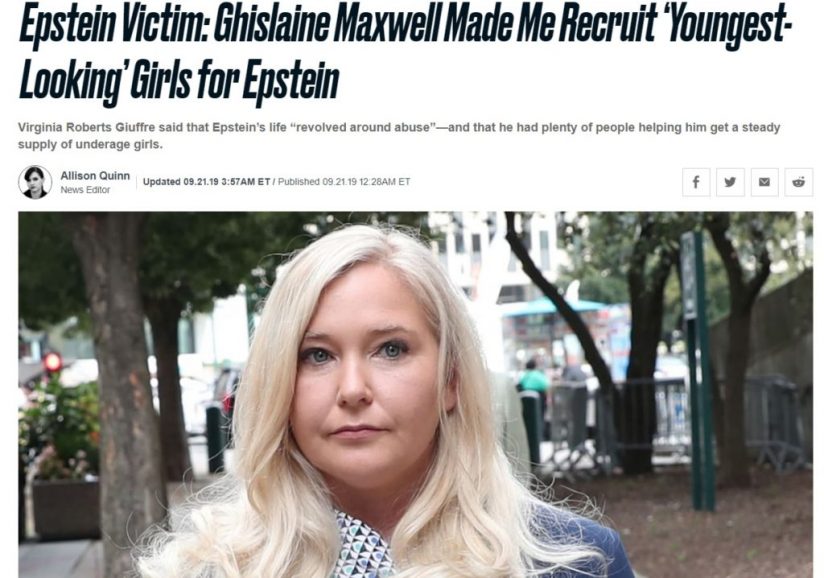
Link to The Daily Beast
It seems the primary purpose was not even blackmail since especially Epstein was having sex with these young girls all the time. On some days Epstein was having sex several times a day.
Sex games were more important for Epstein than work. Obviously, he was extremely attracted to these young girls.
Palm Beach multimillionaire Jeffrey Epstein, 54, was accused of assembling a large, cult-like network of underage girls — with the help of young female recruiters — to coerce into having sex acts behind the walls of his opulent waterfront mansion as often as three times a day, the Town of Palm Beach police found. (Emphasis added. Miami Herald)
In six months, I never saw him do a day’s work,” Ransome told The Telegraph. ”I never saw him work. He was literally sexually abusing us all day long. (Emphasis added. Business Insider)
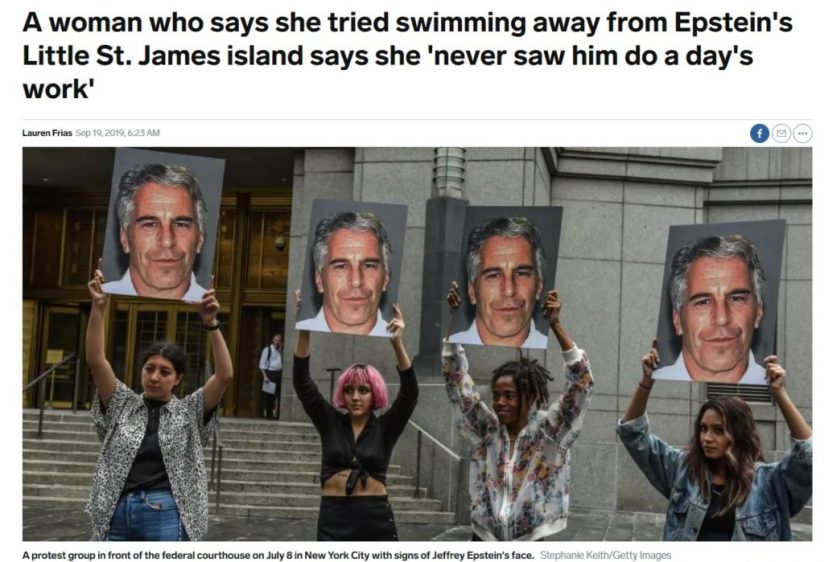
Link to Business Insider
Ghislaine also seemed to be obsessed with sex. Just like her father, Robert Maxwell she was rumored to be interested in unconventional sex which includes also sex with young children.
As she [Ghislaine] posed for the pics, which ran in a publication meant to promote Sotheby’s vintage fashion collection, she allegedly let slip comments that hinted at a twisted double life.
“She didn’t talk about Epstein, but during the shoot she did tell a story about how she just hosted a dinner party for a number of young girls, and she put dildos at each place setting,” the source said. “Ghislaine then described how during the dinner two guests, who were a couple, began demonstrating how to do the perfect fellatio on a man for all at the table. She was laughing about it.” …
“A friend of mine has a whole theory about her, that Epstein was like her father Robert Maxwell, who himself is believed to have had some strange sexual practices.” (Page Six)
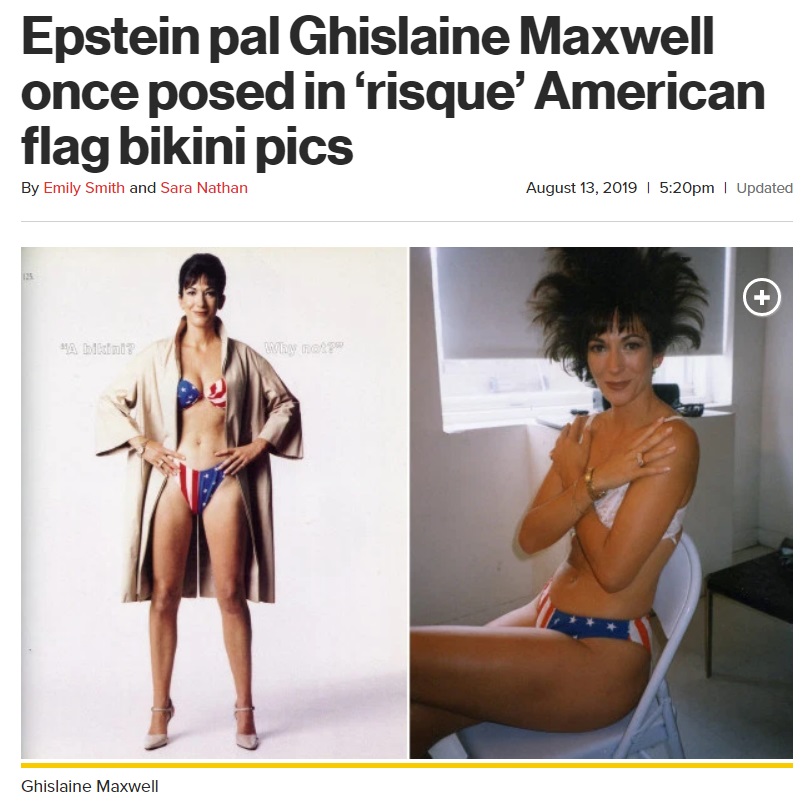
Link to PageSix
The Epstein Mossad-Timeline shows how Ghislaine was most probably trained by Mossad to use sex to gather information. That training would not have been too difficult for her since she was hypersexual. Many even considered her a nymphomaniac.
In fact, even many Israeli Jews – who usually have much fewer sexual taboos than puritan English and Americans – were shocked by her raunchy sexuality.
Flirtatious indeed: I understand from a mutual friend that after school she travelled to Israel and visited a kibbutz; she was immediately ostracised by the other girls for making a rather-too-obvious beeline for the Adonis-like lifeguard at the kibbutz pool. Very quickly she got her way, as she would with much in her life. (Tatler. Emphasis added.)
Even Ghislaine’s friend were sometimes shocked by her open sexuality that so often contrasted with her otherwise lady-like behavior and position in high society.
Ghislaine was, added Mason, ‘fantastically entertaining’ and ‘saucy’ – the paper said that she talked openly about sex.
In fact, said another acquaintance who saw her often at parties, she was ‘obsessed by sex. She’s Sphinx-like, mysterious. The last time I saw her, five, 10 years ago, I said what are you up to? And she said “I’m selling this product – stainless-steel mini dumb-bells – that you put up your fanny. For exercising your vaginal muscles, exercise your pelvic floor, learn the Singapore Grip. I’m giving seminars in LA and they all turn up and I tell them, this is how you keep your man.”’ (Tatler. Emphasis added.)
Epstein and Ghislaine were both hypersexual. All kind of sex interested them. Little girls were just part of the menu. Or more specifically, the best – and most profitable – part.
Epstein and Ghislaine were so attracted to young girls that nothing seemed to satisfy them. Perhaps this is why Epstein and Ghislaine created the highly risky sexual pyramid scheme. The girls were offered two alternatives: Either satisfy Epstein and Ghislaine sexually or get more girls to satisfy them.
In this way Epstein and Ghislaine were able to recruit literally hundreds of young girls. However, some of these girls went to the police and the sexual pyramid scheme collapsed.
When Epstein got out of jail in 2009 he had half-learned his lesson: American girls are too risky.
Now Epstein and Ghislaine would only concentrate on East European girls with the help of their Jewish-Ukrainian friend Peter Listerman.
One of the lesser-known shadowy figures linked to Jeffrey Epstein and his sex ring of teenage girls and young women is Ukrainian-born Peter Listerman, who has worked as a businessman and television presenter but is most known for his “match-making” abilities.
What match-making really means is that Listerman procures women, often underage, for the jet-set society to use for sexual purposes. His “clients” include Russian oligarchs and American businessmen and seems to have also included Jeffrey Epstein. (Citizen Truth)
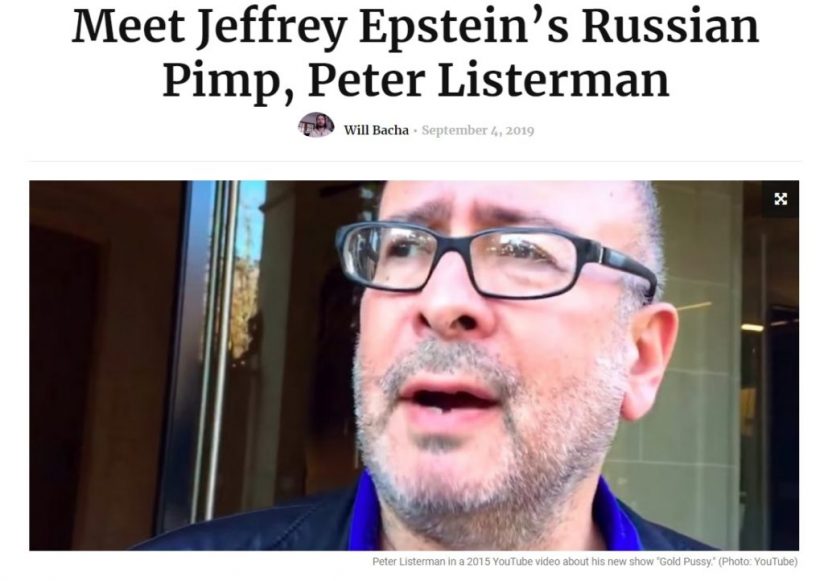
Link to the Citizen Truth.org
Listerman has such a bad reputation that he is shunned even in Ukraine!
Tatiana Savchenko, who founded the first modeling school in Odessa, Ukraine explained to the Daily Beast the lengths she had to go to keep Listerman from getting his hands on young women and trafficking them for sex work.
She claimed that he would frequently approach her students and attempt to lure them with promises of a luxurious lifestyle, and that “It took a lot of work to keep him from tricking our teen models in his traps.” (Citizen Truth)
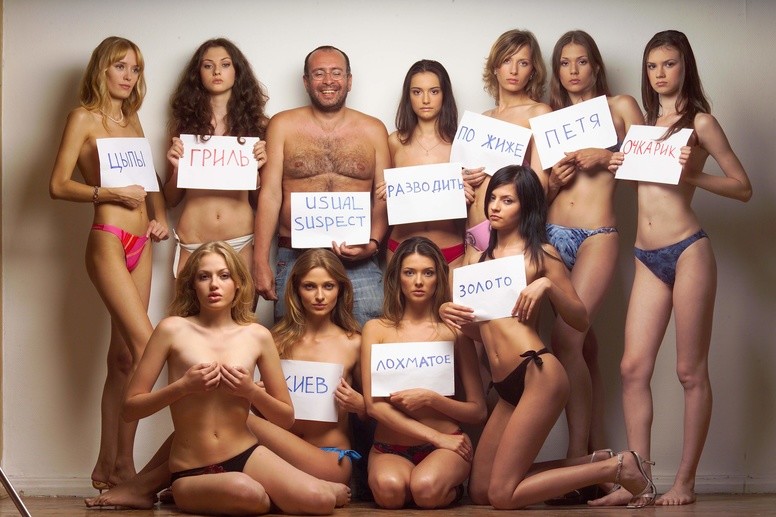
Peter Listerman is the usual suspect. Link to Fishki.net
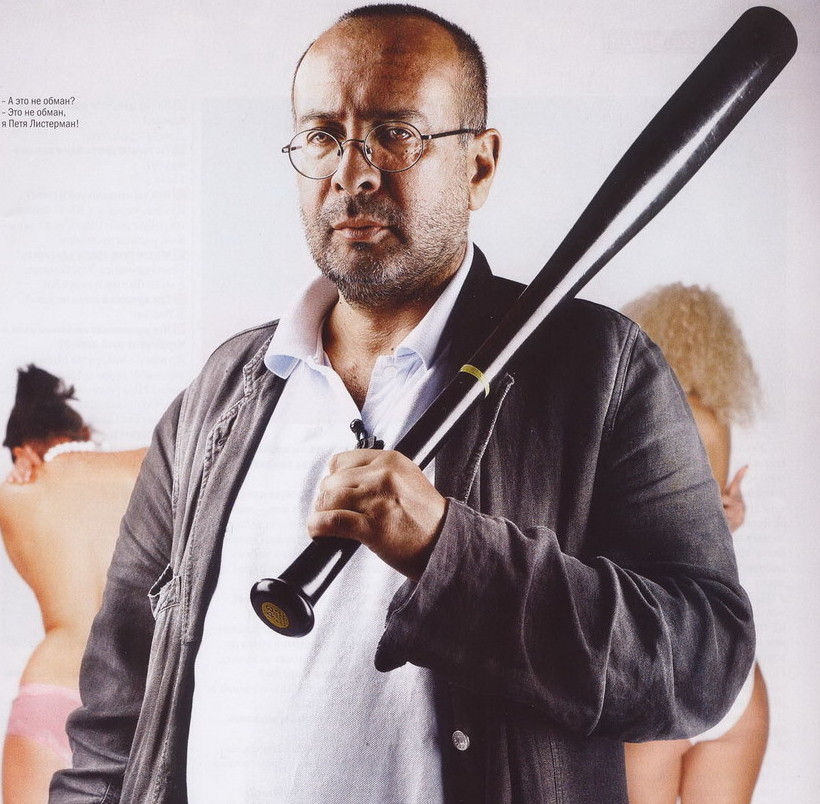
Do you think I am kidding? I am Peter Listerman! Link to Fishki.net
Both Epstein and Listerman were attracted to very young girls. Neither even tried to hide it much. In fact, Epstein was quite open about his attraction to tweens.
Just three months ago, as federal prosecutors were closing in with new charges, Mr. Epstein had a conversation with R. Couri Hay, a publicist, about continuing to improve his reputation. Mr. Epstein asserted that what he was convicted of did not constitute pedophilia, said Mr. Hay, who declined to represent him.
The girls he had sex with were “tweens and teens,” Mr. Epstein told him. (The New York Times)
But what is a tween?
Preadolescent is generally defined as those ranging from age 10 to 13 years.[4][6] … While known as preadolescent in psychology, the terms preteen, preteenager or tween are common in everyday use. (Wikipedia)
Epstein was right, of course. What he was convicted of in 2007 did not constitute pedophilia. However, that is precisely one reason why people are so outraged!
Epstein and Ghislaine did not see any problem of recruiting, grooming and having sex also with tweens. And apparently neither did the Justice Department and the FBI led by Robert Mueller!
But it gets even worse. As pointed out in the Epstein Pedoscandal Mossad Timeline, it seems that Epstein and Ghislaine were after even younger girls.
In 2003 Epstein financed Jean-Luc Brunell’s(?) and Jeff Fuller’s(J) new modelling agency MC2 that seemed to have worked with Peter Listerman.
MC2 obviously refers to the famous Einstein equation E = MC2, the energy-mass equivalence. Equally obviously, E equals Epstein, the energy, whereas the girls equal MC2, the mass energized by Epstein.

Jean-Luc Brunell
Brunell is generally known as the sleaziest man in model business who has long faced accusations that girls were drugged and raped in his employ. Already in the 80s he was the subject of a famous 60 Minutes expose on sexual abuse in the modeling industry
Despite all this – or for the very reason – Epstein invested in MC2 and became particularly close to its founders Brunel and Fuller.
The agency operates in New York, Miami and Tel Aviv. It’s in practice half-Israeli.
Many call Israel the capital of human trafficking and organ harvesting.

MC2 concentrates on importing East European girls to Israel and America. The younger the better.

Marina Lynchuk of MC2

Lolita Lvola from MC2

Linta Lapinda from MC2
Brunel seems to have given 12-year old triplets to Epstein as a birthday present.
’Jeffrey bragged after he met them that they were 12-year-olds and flown over from France because they’re really poor over there, and their parents needed the money or whatever the case is and they were absolutely free to stay and flew out,’ Giuffre said.
She said she saw the three girls with her own eyes and that Epstein had repeatedly described to her how the girls had massaged him and performed oral sex on him. They were flown back to France the next day.

Link to Daily Mail
It seems that even tweens were not young enough for Epstein.
According to court papers in 2005 Brunel called Epstein and left a message that “he is sending him a 16-year-old Russian girl for purposes of sex”. However, the written message says something even worse.
The message, filed as an exhibit in the case, was written on an office message pad, partly in code, and read: “He [Brunel] has a teacher for you to teach you how to speak Russian. She is 2×8 years old not blonde. Lessons are free and you can have your 1st today if you call.” (New York Post)
Does it mean that two eight year olds are involved? Or does 2 x 8 mean to sex 8 year old? (2=to, x=sex)
Why would the lessons be free and why is it relevant that the ”teacher” is not a blond?

There is no denying that Epstein and Ghislaine sexualised even small children. This became clear in 2005 when police raided Epstein’s Palm Peach mansion.
In one photo that was hanging on the wall a small six or seven year old girl was bending over in a tiny dress. Police blurred out the photo in the video taken during the raid.

Link to The Daily Mail
Despite all this only the Russian Television was actively trying to expose Epstein and Ghislaine.
RT aired this video already nine years ago!
The description on the video is even more revealing. It even mentions the 12-year old triplets.
The American TV networks were actively suppressing the story for years.
The American media has also been trying to cover up the fact that Jeffrey Epstein was most probably murdered in his cell. He had to be silenced.
But it gets even worse.
This hung on Ghislaine’s home wall.

NEW YORK CITY, NY – MARCH 13: Atmosphere at Hamish Bowles, Ghislaine Maxwell and Lillian von Stauffenberg dinner for ALLEGRA HICKS at Home of Ghislaine Maxwell on March 13, 2007 in New York City. (Photo by Patrick McMullan/Patrick McMullan via Getty Images). Link to Getty Images.
The so called artwork seems to be full of pedophile symbols.


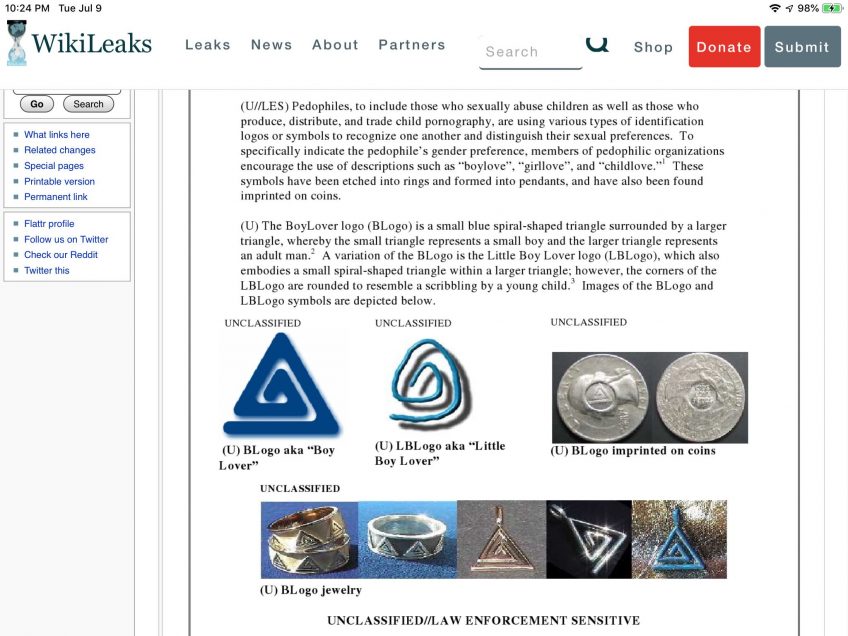
Link to Wikileaks.org
The quality of the photos taken at Ghislaine’s home are so good that even more symbols have been found in her artwork.
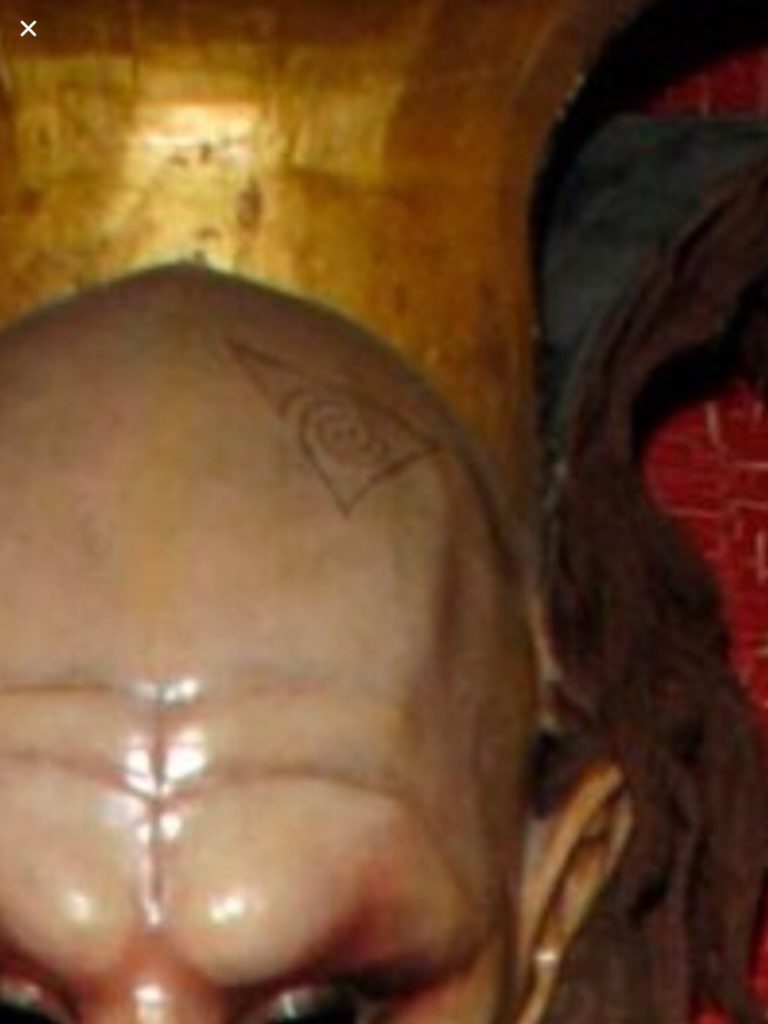
For some reason the mainstream media has not picked up on this pedophilia angle. No mainstream media journalist has even tried to ask why would Ghislaine have such art and symbols on her home wall.
This despite the fact that Ghislaine is most probably an Israeli superspy just like was her father, Robert Maxwell. She probably has been trained to use sex – including pedophilia – as a tool for blackmail and manipulation.
At the time in Israel females molesting little boys was not even considered rape.
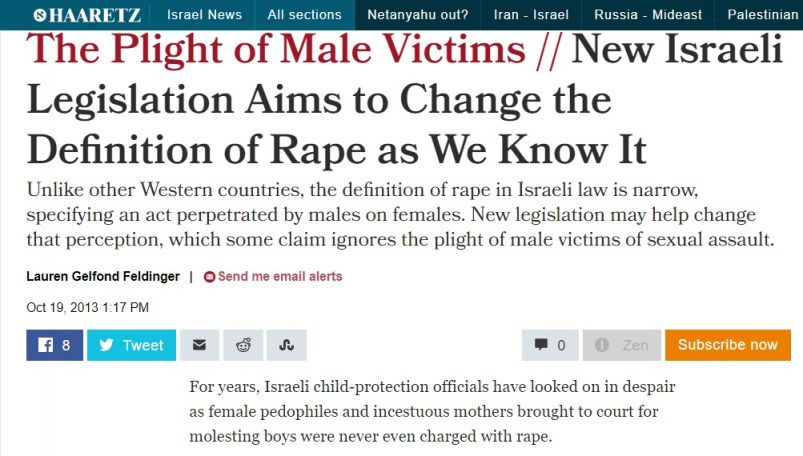
Link to Haaretz.com
Nor have mainstream journalists asked where was Ghislaine when Madeline McCann was abducted.
That would not be an unreasonable question since one of the E-Fit images looks a lot like Ghislaine.

Link to Enchanted Life Path.com
Furthermore, two of the E-Fit images (1A, 1B) look like the Podesta brothers. John Podesta was White House Chief of Staff to Bill Clinton and the Chairman of the 2016 Hillary Clinton presidential campaign.
Ghislaine and Epstein were close to the Clintons and the Podesta brothers have been directly linked also to Pizzagate.

Link to Pizzagate Map created by Tuukka Pensala
Was Ghislaine helping to run also Pizzagate and other pedophile rings for Mossad?
At least she seems to be perfectly trained to do just that. First, her own hypersexuality, family background and possible training by Mossad made it easy for her to master mind the pedophilia ring she run with Epstein.
Second, Ghislaine and Epstein had all the apparel to help run also other pedophile rings: Lolita express airplanes and helicopters, Zorro Ranch in New Mexico and luxury mansions in New York, Palm Peach and Paris.
Even more importantly they had their own island in the Virgin Islands.
In the 90s Epstein bought Little St. James island from the Virgin islands. It had a mansion which Epstein expanded.
Soon locals started to call it the Pedophile Island.
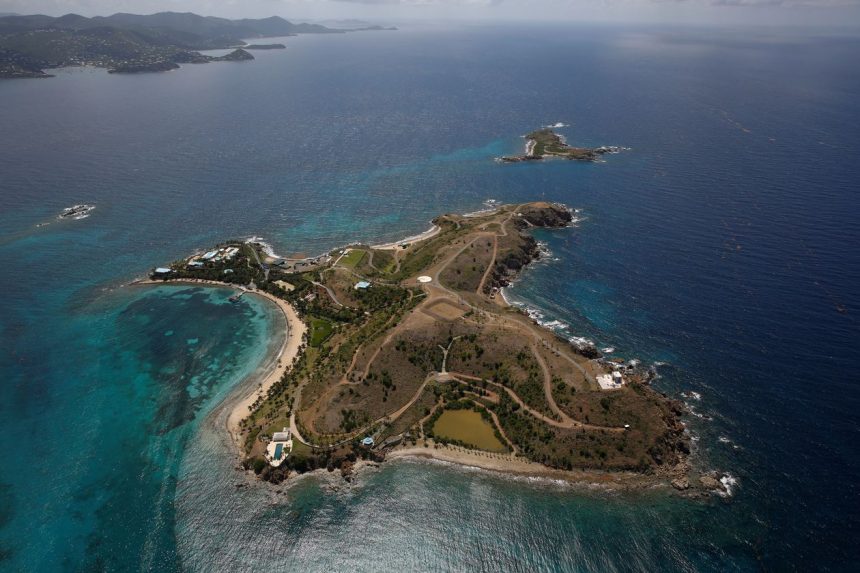
Little St. James island. Link to Wall Street Journal article
The island seems to have tunnels with several underground entrances.
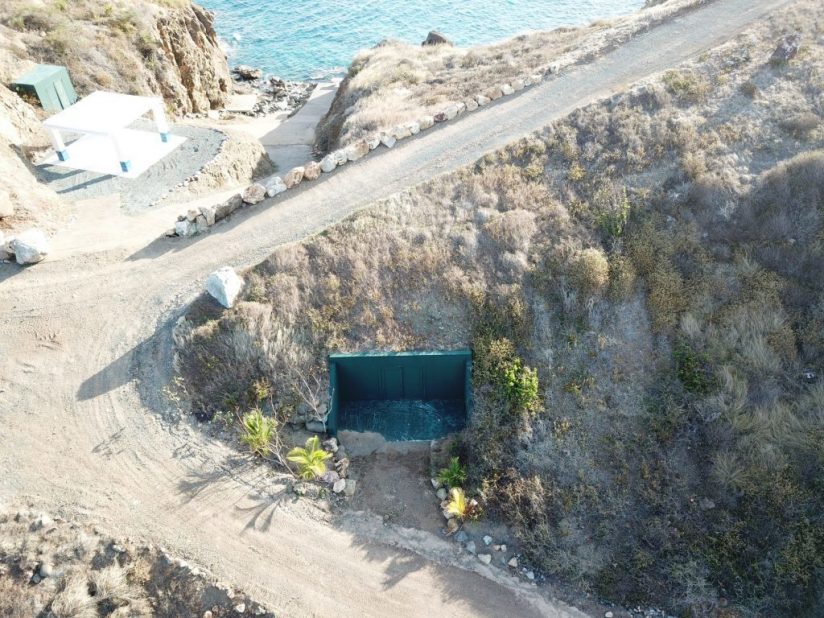
Underground entrance
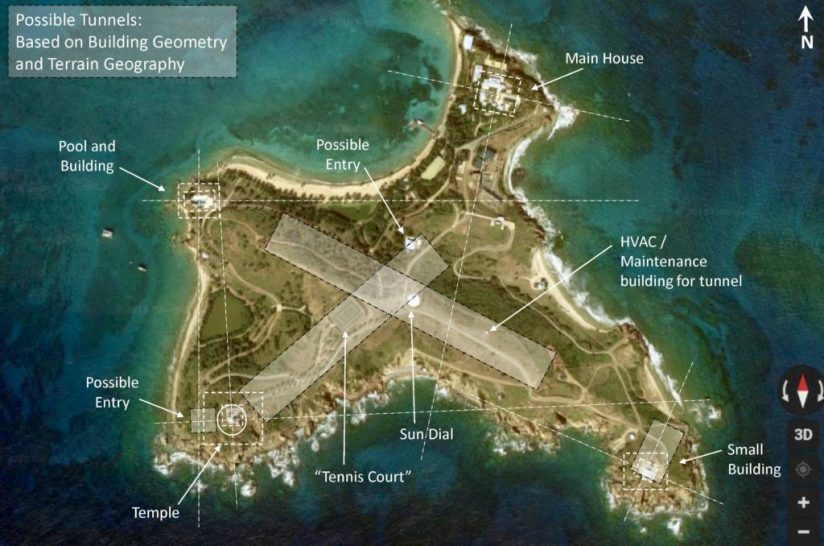
Link to Twitter
The island also has a strange temple.
We Are Change’s Luke Rudkowski and the Dollar Vigilante’s Jeff Berwick secretly visited the island but were soon chased out.
Ghislaine has a Helicopter Pilot License and often transported quests to the island.
On the weekends in the 1990s, Maxwell would have her Rollerblades FedExed to Epstein’s island in the Caribbean, and said she got her helicopter’s license so she could transport anyone she liked without pilots knowing who they were.
Maxwell also said the island had been completely wired for video; the friend thought that she and Epstein were videotaping everyone on the island as an insurance policy, as blackmail.
A source close to Maxwell says she spoke glibly and confidently about getting girls to sexually service Epstein, saying this was simply what he wanted, and describing the way she’d drive around to spas and trailer parks in Florida to recruit them. She would claim she had a phone job for them, “and you’ll make lots of money, meet everyone, and I’ll change your life.” …
Maxwell had one other thing to tell this woman: “When I asked what she thought of the underage girls, she looked at me and said, ‘they’re nothing, these girls. They are trash.’” (Emphasis added. Vanity Fair)
Ghislaine was naturally using Epstein’s helicopters. Some of them shared their FAA tail number with a US contractor, Dyncorp. That would have helped Ghislaine and Epstein to fly drugs and children.
FAA records and Epstein’s pilot’s flight manifest indicate that Epstein’s Bell helicopter used the same tail number of N474AW. This was the same tail number used until 2006 by State Department contractor Dyncorp for counter-insurgency operations in Latin America.
The congruence of Epstein’s Bell N474AW and Dincorp’s Bronco N474AW is noteworthy. In 2002, the year Epstein’s aircraft fleet stands accused of flying underage teen girls, some between the ages of 12 and 15, coincided with Dyncorp’s trafficking in underage females between the ages of 12 and 15 from Kosovo and Bosnia in the Balkans.
One Dyncorp whistleblower reported to The Washington Times’s Insight magazine’s Kelly O’Meara in 2002 the following on one Dyncorp employee in Bosnia:
[he] owned a girl who couldn’t have been more than 14 years old. It’s a sick sight anyway to see any grown man [having sex] with a child, but to see some 45-year-old man who weights 400 pounds with a little girl, it just makes you sick.”
Tail number N474AW has been shared between Epstein’s Bell helicopter like the one in this photo. (Emphasis added. Political Bull Pen)

DynCorp’s pedophilia ring became internationally infamous with the release of the movie Whistleblower.

Link to Wikipedia
Helicopters can always be seen. However, Ghislaine also has a license to operate submarines!
In 2012 – three years after Epstein got out of jail – Maxwell founded The TerraMar Project,[51] a nonprofit organization that advocated protecting ocean waters.
She gave a lecture for TerraMar at the University of Texas at Dallas and a TED talk, at TEDx Charlottesville in 2014.[52] Maxwell accompanied Stuart Beck(J), a 2013 TerraMar board member, to two United Nations meetings to discuss the project.[17] (Wikipedia)
In 2014, a United Nations event featured Maxwell as a speaker. According to her bio in the program, Maxwell’s “web-based non-profit” aimed “to protect the Oceans by empowering a global community of ocean citizens.” It further described Maxwell as “a private helicopter pilot and an Emergency Medical Technician and a qualified ROV and Deepworker submarine pilot.”
A former Coast Guard officer, Borgerson was also a fellow at the Council on Foreign Relations, which featured Borgerson and Maxwell as speakers during one 2014 talk titled “Governing the Ocean Commons: Growing Challenges, New Approaches.” Friends of Maxwell, according to The New York Times, said Borgerson became her boyfriend. Maxwell had allegedly described Borgerson as a “Navy SEAL” to her pals.
Maxwell’s dubious charity also roped in the Clinton Global Initiative, the now-defunct networking platform for the Clinton Foundation. In the fall of 2013, CGI named TerraMar as one of the “commitments to action” at their annual meeting. (Emphasis added. Daily Beast)
Did the Pedophile Island have an underground submarine base? Was it a part of global pedophile network?
And was the Ocean Citizens project an attempt to escape national jurisdictions and thus gain at least a partial immunity from police investigations and prosecutions?

Link to TerraMar Project
Interestingly, as late as 2016 Epstein bought also the nearby Great St. James Island. He started to build on the island without permits.
There were rumors that he was building underground. For some reason the mainstream media has had no interest in this second island.
Why is the mainstream media not interested in Ghislaine’s many links to pedophilia?
Perhaps because Ghislaine has so many powerful friends. The photo of the pedophile artwork on Ghislaine’s wall was taken 13 March 2007 during a party at Ghislaine’s New York townhouse. The guest list included a curious combination of elite Jews, aristocratic Brits and American WASPs.

Atmosphere==
Hamish Bowles, Ghislaine Maxwell and Lillian von Stauffenberg dinner for ALLEGRA HICKS. Home of Ghislaine Maxwell. March 13, 2007©Patrick McMullan. Photo-Patrick McMullan/Patrick McMullan.com. Link to Quick N Dirty
The party was in Ghislaine’s huge 7000-square-foot townhouse. It is located in the most opulent and prestigious neighborhood of America, the Upper East Side, New York on East 65th Street just off Park Avenue. Epstein’s townhouse was only 10 blocks away.
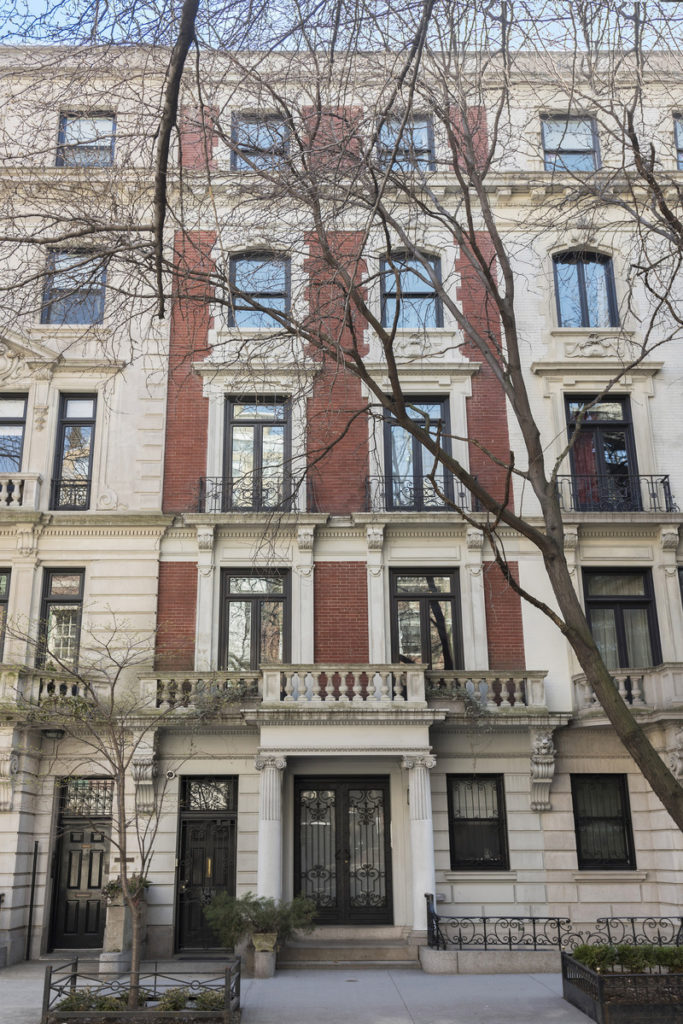
Ghislaine’s five story townhouse. Link to Street Easy

Ghislaine’s townhouse floor plan. Link to Street Easy
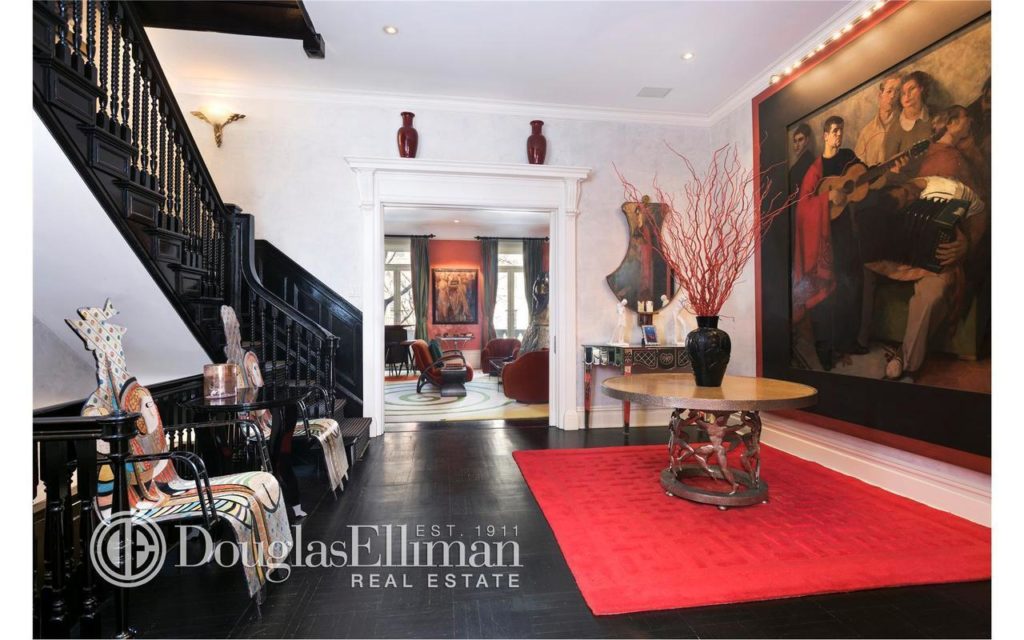
Ghislaine’s townhouse 2nd floor gallery. Link to Street Easy
There are reports from reliable sources that the townhouse was sold in 2000 to Ghislaine by Lynn Forester de Rothschild. The very same woman who had introduced Epstein and Ghislaine to Alan Dershowits and the Clintons in the 90s.
The Manhattan property, which is close to Epstein’s mansion, is owned by Lynn Forester de Rothschild, wife of British financier Sir Evelyn de Rothschild. (See The Times and the original article.)
According to Business Insider Forester sold the townhouse to Ghislaine for less than half the price.
Forester sold the mansion for about $8.5 million less than its assessed market value, which was more than $13.4 million.
Was this a pay-off to Ghislaine from the King of Jews, the Rothschilds for services rendered?

Hillary Clinton, Evelyn de Rothschild, Bill Clinton and Lynn Forester de Rothschild. Link to Mint Press
It probably is also relevant that at the time of the sale of the townhouse the Prime Minister of Israel was Ehud Barak. In the 80s he had been the head of Aman, the Israeli Military Intelligence Agency. As the Epstein Pedoscandal Mossad Timeline revealed, both Epstein and Ghislaine worked for the Israeli intelligence agencies already in the 80s during the Iran-Contra operation.
Note that it was around year 2000 that Epstein and Ghislaine started the pedophile operation in earnest. In the 80s and 90s blackmail operations were a side show but now it became the main show involving hundreds of young girls.
Sexual blackmail – especially involving little children – can be an extremely efficient way to influence key politicians and even military officials. A successful blackmail operation can achieve more than several army divisions. No wonder Barak was so close to Epstein and Ghislaine.
Furthermore, in 2000 the president of Israel was Moshe Katsev who was sexually harassing and even raping his female subordinates. Later Katsev would be convicted of rape.
It was also in 2000 when the Israeli Vice-Consul of Rio de Janeiro, Arie Scher and Hebrew language Professor George Schteinberg were running a pedophile ring for Israeli tourists. When the Brasilian police started to investigate the Israeli consulate Scher managed to flee back to Israel.

In Israel Scher was not prosecuted. Instead in 2005 he was promoted to Consul of Canberra, the capital of Australia. A spokesman for the Israeli Foreign Ministry in Jerusalem, Mark Regev explained:
He [Arie Scher] was a young and single man at the time [in Brazil]. Now he is married and he’s six years older and there is no reason why he shouldn’t make an excellent diplomatic appointment in Australia.
Australia refused to let Scher enter the country.

Link to William Bowles Info
The most shocking part of the Arie/Aryeh Scher story is that the mainstream media was not interested. Either the stories have been scrubbed from the internet or no stories were ever written by mainstream journalists except one short story by BBC in 2000 and one even smaller story by The Sydney Morning Herald in 2005. Even more surprisingly Youtube does not seem to have any videos about the Scher case.
No wonder Barak was absolutely convinced that the Western mainstream media would never dare to criticize Israel and its intelligence agencies. Not even when Mossad was running pedophile rings.
It was probably the Israeli leaders Shimon Peres, Ehud Barak and Moshe Katsev together with the ultra-Zionist Mega Group who made sure Epstein and especially the Maxwell family had not only immunity from prosecution but also all the blackmail apparel necessary including luxury townhouses, airplanes, yachts, submarines, ranch and a private island. All, of course, bugged to the hilt.

Israeli Prime Minister Ehud Barak (R) talks to Shimon Peres, Minister of Regional Planning, after Barak’s speech at the opening session of parliament in Jerusalem 30 October 2000. Barak said that he believed peace was still possible in the Middle East but that Israel did not have a partner prepared to make compromises. AFP PHOTO / SVEN NACKSTRAND (Photo credit should read SVEN NACKSTRAND/AFP/Getty Images)
Here the pedophile artwork at Ghislaine’s New York townhouse can be seen behind Lillian von Staufenberg who in March 2007 together with Ghislaine and Hamish Bowles organized a dinner party in honor of Allegra Hicks. This at a time when Epstein had already been charged with abusing young girls.
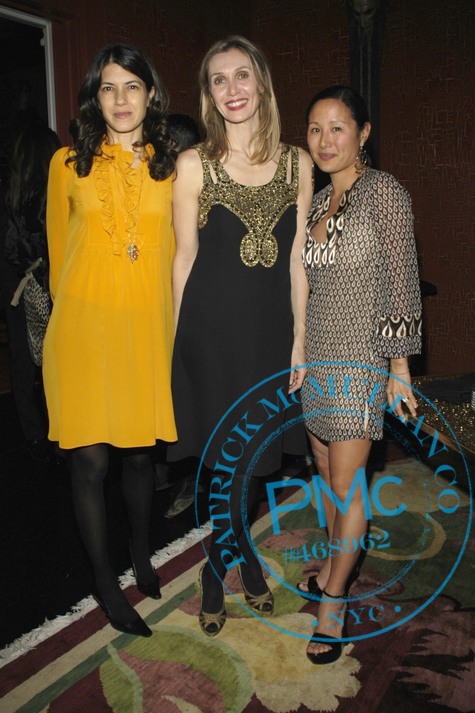
Karen Groos, Allegra Hicks, Lillian von Stauffenberg==
Hamish Bowles, Ghislaine Maxwell and Lillian von Stauffenberg dinner for ALLEGRA HICKS==
Home of Ghislaine Maxwell, NYC==
March 13, 2007==
©Patrick McMullan==
Photo-Patrick McMullan/Patrick McMullan.com==
Link to QuickNDirty
Why would Ghislaine have such a suspicious artwork on her wall knowing that it would probably be photographed during the parties?
Why would Ghislaine and her quests take such a huge risk? Or was it a sign meant to be seen? Was Ghislaine flaunting her power?
Ghislaine and her quests seemed to be absolutely sure that the mainstream media would not dare to ask embarrassing questions.
They were right, of course. The mainstream media knows its place.
However, occasionally some courageous mainstream journalist or editor does try to give hints. Some have even reported on Ghislaine’s hyper-sexual reputation and her orgies. It is just that the stories have mostly been scrubbed from the internet.
Fortunately, Whitney Webb from Mintpress has found many of the scrubbed stories. Some of them mention the Mossad connection and others note the orgies. For example, in 2003 a British newspaper, The Evening Standard reported a revealing rumor.
Salacious reports have crossed the Atlantic about Ghislaine hosting bizarre parties at her house to which she invites a dozen or so young girls, then brandishes a whip and teaches them how to improve their sexual techniques.
It seems that Ghislaine was not only a madame to Epstein but also to the ruling elite. This would both explain her popularity and the fact that the media – and especially the American media – dares not to criticize her too much. Not even after her boyfriend Epstein was charged with sex trafficking minors!
Ghislaine’s friends are just too powerful. After the March 2007 party the British Daily Mail newspaper was amazed how Ghislaine could still have attracted such creme de la creme of the highest elite. Even more amazingly, the elite was practically swooning over her.
The night before the party, the hostess [Ghislaine] had been inundated with calls from disgruntled socialites, irked that they hadn’t received an invitation.
The hostess greeted their objections with her customary charm, but remained unmoved. As always, her list had been carefully edited, and she intended it to stay that way.
Among the select few were Hollywood star Matthew Modine, Kennedy family member Mrs Anthony Radziwill, Peggy Siegel, PR consultant to the stars, and Julie Janklow, heir to a literary dynasty.
There was a Rockefeller on the list, as well as the inevitable countesses, billionaires and New York luminaries.

Link to Daily Mail
The guests at the party included also Renee Rockefeller who is married to Mark Rockefeller, the son of ex-Vice President Nelson Rockefeller and nephew of David Rockefeller.

Allegra Hicks, Renee Rockefeller==
Hamish Bowles, Ghislaine Maxwell and Lillian von Stauffenberg dinner for ALLEGRA HICKS. Home of Ghislaine Maxwell, NYC. March 13, 2007 ©Patrick McMullan/Patrick McMullan.com. Link to QuickNDirty
David Rockefeller lived at 146 East on the same 65th Street in the Upper East Side as Ghislaine. They were practically neighbors. Ghislaine would have to walk only two minutes to visit David.
David liked to pose for photos in his Beetle Room next to his favorite Picasso painting depicting a nude child ”prostitute”.

David Rockefeller. Link to Jeffrey Harris Desing.com
David was often visited by his close friend Jacob Rothschild, the patriarch of the Rothschild family.
The very same family that got Ghislaine her luxury townhouse next door.
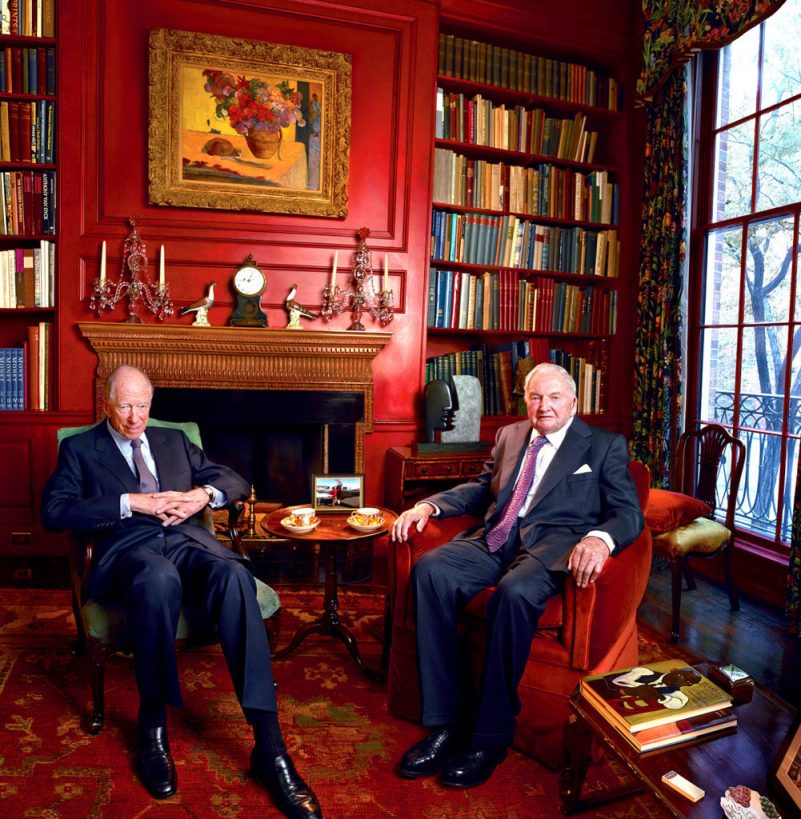
The patriarchs, Jacob Rothschild and David Rockefeller. Link to Jeffrey Harris Design.com
As shown by the Epstein Pedoscandal Mossad Timeline both Epstein and Ghislaine continued to move in the highest circles long after Epstein got out of jail. In fact, only last year Ghislaine was invited to a secret writers’ retreat hosted by the richest man in the world, Jeff Bezos.
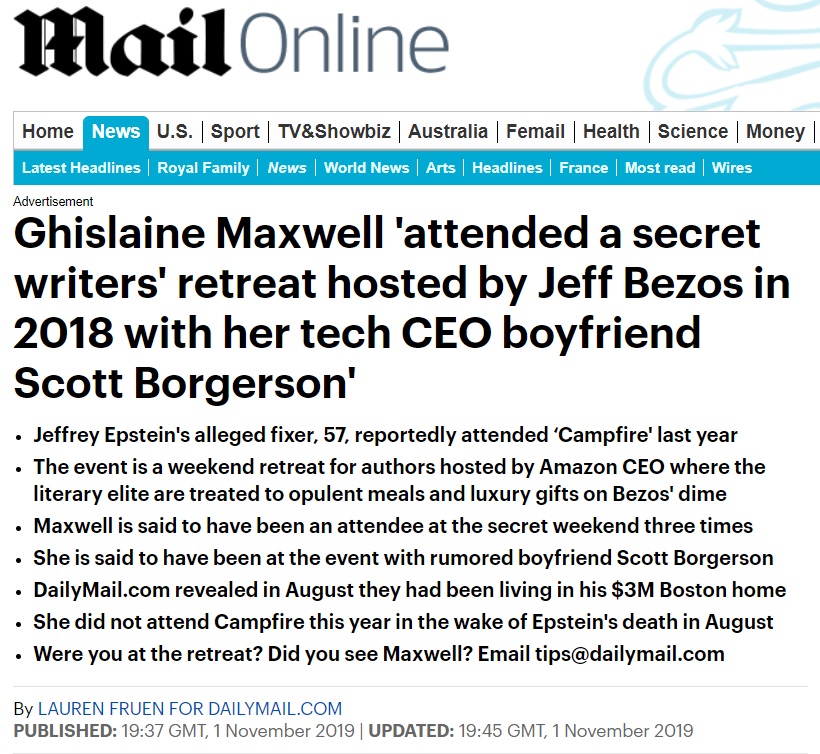
Link to The Daily Mail
Not only billionaires but also royalty kept in close contact with Ghislaine.
Prince Andrew was recently interviewed by the BBC about his relationship with Epstein, Ghislaine and their sex slave Virginia Roberts.
Amazingly, Andrew claimed she has no recollection of Epstein’s and Ghislaine’s sex slave, Virginia Roberts. This despite the fact that they were photographed together!
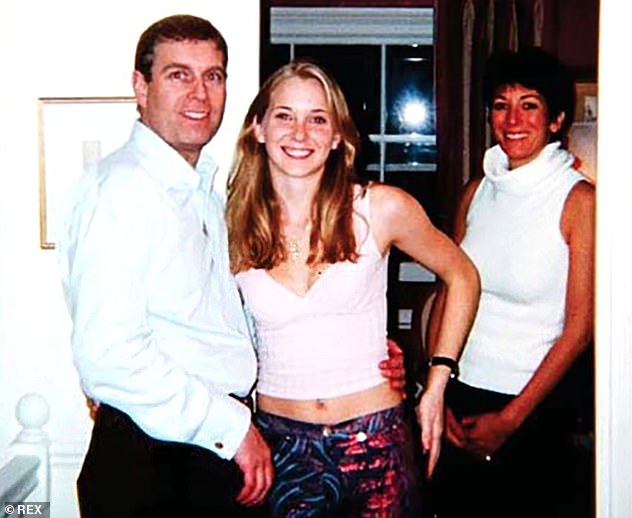
Prince Andrew, Virginia Roberts and Ghislaine Maxwell. Link to Daily Mail

Link to The Sun.com
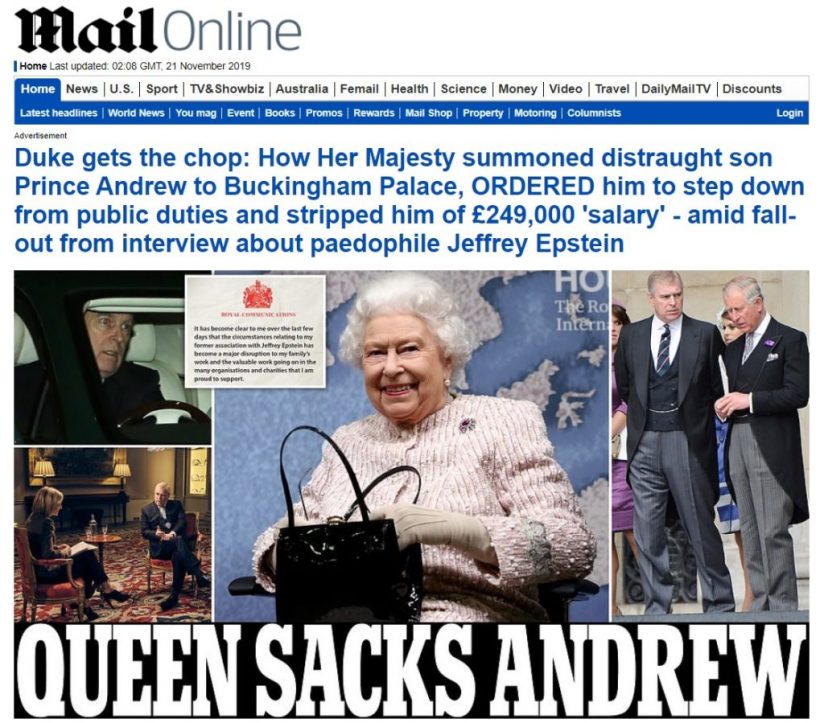
Hardly anybody believes Andrew. The queen had no choice but to sack his own son.
Link to Daily Mail
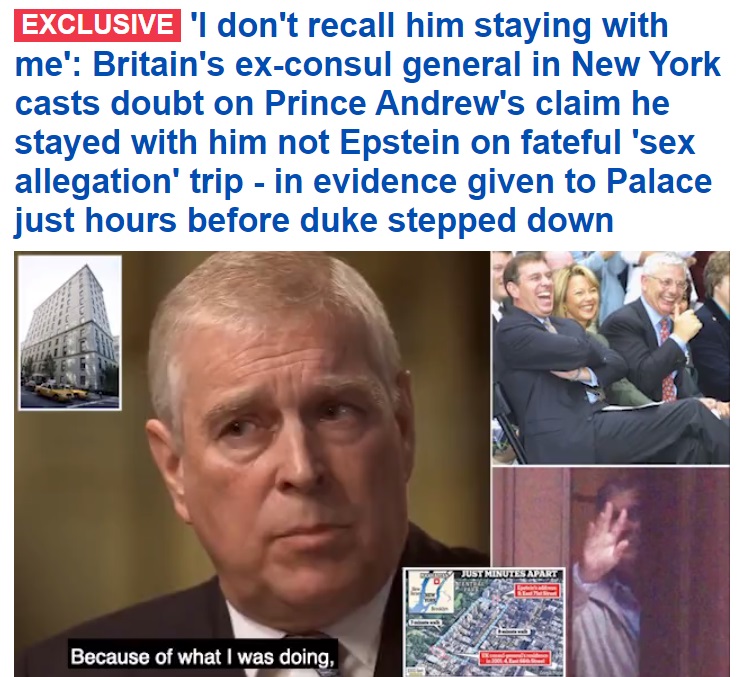
Andrew got sacked because he was caught in a lie.
Andrew claimed he could not have had sex with the 17-year old Virginia in 2001 because he had stayed with the British consul general.
The problem is the consul general does not recall Andrew staying with him.
Link to Daily Mail
Curiously, most of the mainstream media has forgotten that it was Ghislaine who recruited and manipulated Virginia Roberts to become a sex slave.
Even the BBC forgot this crucial fact despite Andrew mentioning Ghislaine many times during the interview.
Time and again, the Prince invoked his friendship with Maxwell, 57, daughter of disgraced media tycoon Robert Maxwell, as the reason he came into paedophile Epstein’s orbit.
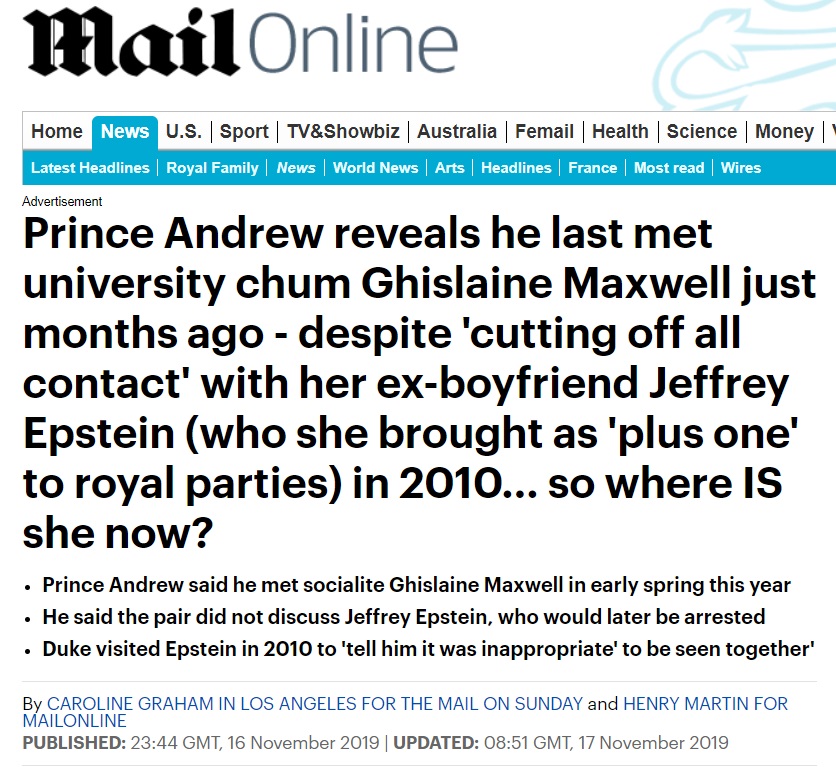
Asked when he last saw Maxwell, Andrew said his last contact was ’earlier this year, funnily enough’, when she ’was here doing some rally’. (Daily Mail)
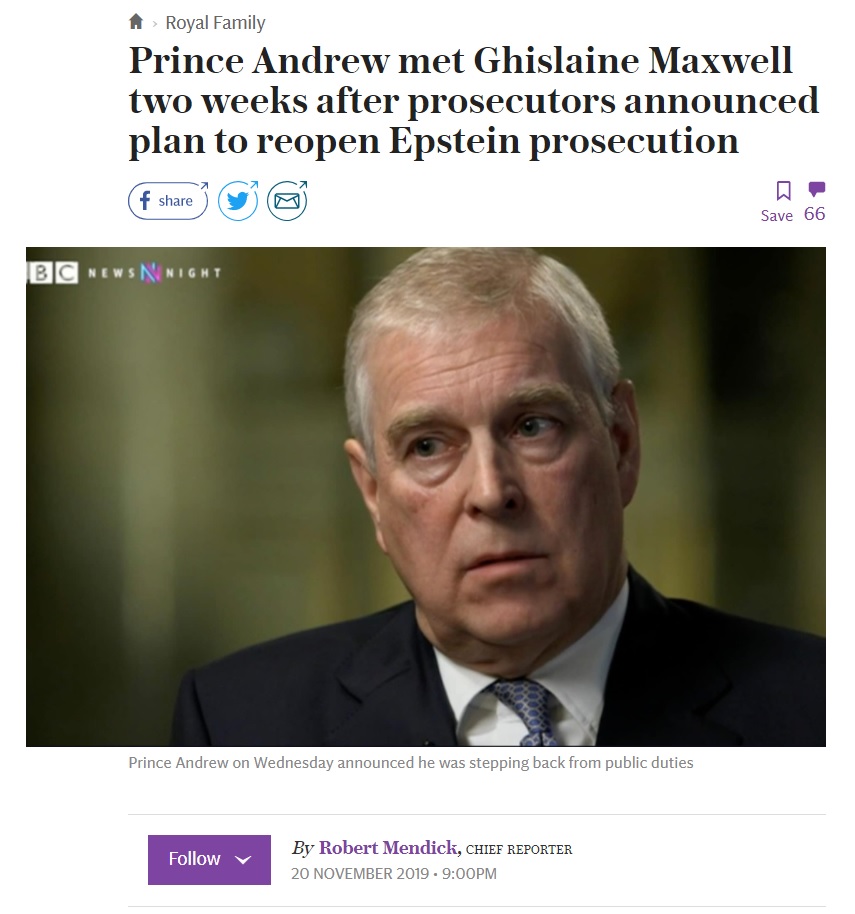
Andrew claimed to have met Ghislaine last spring. In fact, they met in June just after US prosecutors reopened the case against Epstein.
The Duke of York held a meeting with Ghislaine Maxwell in London two weeks after US prosecutors announced they wanted to reopen their investigation into Jeffrey Epstein. …
The meeting took place on or about June 5, the day before Ms Maxwell took part in a four-day charity motoring rally from London to Monte Carlo.
Did Ghislaine demand that Andrew help make sure that the her own parallel case would not be reopened?
After meeting Andrew she literally disappeared from the face of the earth.
The ex-socialite has not been seen since although rumours have placed her in Brazil, France, the American mid-West and even the UK.
‘No one knows where she is,’ a lawyer for one of Epstein’s victims said last night. ‘She’s done the greatest disappearing act known to man – or woman.’ (Daily Mail)
Link to Daily Mail
Shockingly, during the BBC interview Prince Andrew mentioned Ghislaine many times and seemed to be proud of their friendship. Despite this the interviewer did not dare to ask questions about their relationship.
Was this a message to all: Leave Ghislaine alone.
Ghislaine is obviously protected not only by the royal family but also by the whole ruling elite. No wonder that she has the Get-Out-of-Jail-Free card.
Ghislaine also tries to protect other Epstein associates.
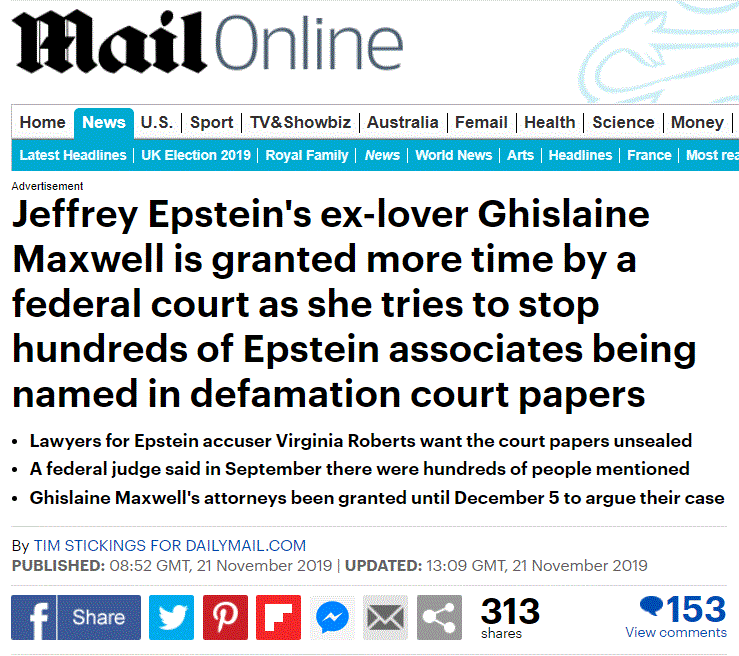
Link to Daily Mail
Prince Andrew is now afraid to go to the US.
Five women who accuse Jeffrey Epstein of abusing them say Prince Andrew witnessed how people were given massages at the sex offender’s homes.
The lawyer for the women has told BBC Panorama he plans to serve subpoenas to force the Duke of York to testify as a witness in all five cases.
He says the prince could have important information about sex trafficking. (BBC)
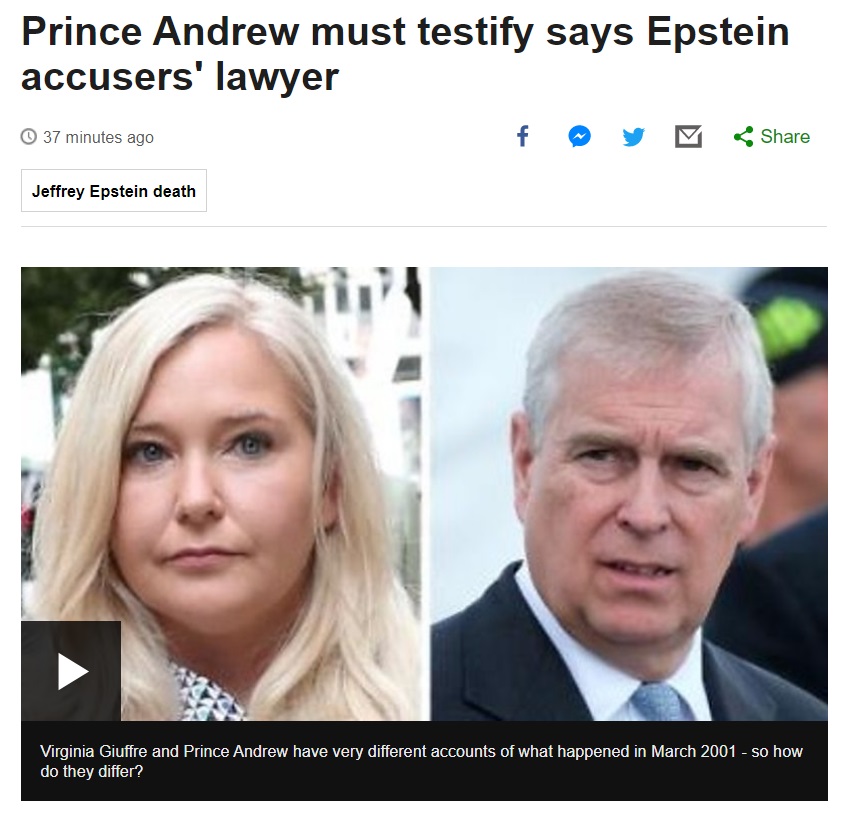
Link to BBC story and video
The BBC has now finally zoomed in on Ghislaine.
Another Epstein victim, Sarah Ransome told Panorama Ghislaine Maxwell, one of Prince Andrew’s oldest friends, worked hand in hand with Epstein.
”Ghislaine controlled the girls. She was like the Madam,” she said.
”She was like the nuts and bolts of the sex trafficking operation and she would always visit Jeffrey on the island to make sure the girls were doing what they were supposed to be doing.
”She knew what Jeffrey liked. She worked and helped maintain Jeffrey’s standard by intimidation, by intimidating the girls, so this was very much a joint effort.”
Ms Maxwell could not be reached for comment but has previously denied any involvement in or knowledge of Epstein’s abuse. (BBC)
But the American media is still not interested in Ghislaine.
What the American mainstream media always willfully forgets is that Ghislaine Maxwell is the key person and mastermind behind the whole pedo sex trafficking operation.
The key role of Ghislaine is not surprising. After all, her father was an Israeli super spy, Robert Maxwell.
But perhaps this is the very reason why the American media is not interested.
For years Ghislaine has been at the center of a vast pedophile sex trafficking network. But still to this day the American police has never dared to even interview her.
She simply knows too much.
Precedents for Pizzagate
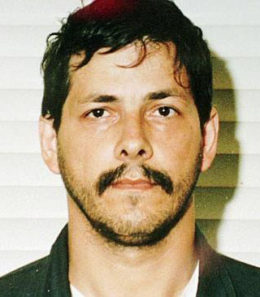
Marc Dutroux, Belgian pedophile, sadist, and serial killer with friends in high places
By Aedon Cassiel | Counter – Currents | December 23, 2016
To reiterate a point that should be clear to the more astute reader, my goal in this series (part 1, part 2) has not been to defend “Pizzagate” as such. My goal has been to defend the people who want to investigate it against specific accusations levied against them by people who think Pizzagate has revealed no intriguing information at all—for a specific reason, which I will be honing in and focusing on much more directly in this closing entry.
Whereas the mainstream critics of Pizzagate would have you believe that the dividing line is between paranoid conspiracy theorist followers of “fake news” and level-headed people who follow trustworthy news sources and rely on cold, hard reason to determine the truth, my goal has been to show that—whatever is or is not happening with Pizzagate itself—this framing of the issue is arrogant, insulting, and the product of extremely narrow tunnel vision.
When I have referred to what I see as the more compelling pieces of evidence uncovered by the crowd-sourced investigation into Pizzagate, my point has not been to use these to say “Pizzagate is true and every single person looking into it is a hero,” but to say “the people investigating it are not idiots, and the facts they’ve been uncovering are not all worthless. Reasonable people could very well look at this and think that it gives us reason to be concerned that there may be something behind it. And if the media is telling you only about the most bizarre, reaching accusations without telling you any of the more interesting points that have been uncovered (which it is), it is not doing its proper job.”
To those who think I am demonstrating an inclination towards conspiracy theories in this series, allow me to quote directly from the two previous essays:
The evidence [in Pizzagate] is of wildly varying levels of quality . . . [and much of it is] the pareidolia of “Jesus is appearing to me in my toast” . . . many of these claims arewild speculation over coincidences . . . Could [this evidence] have an innocent explanation? Sure, maybe. . . . some of the supposed “codewords” people have claimed to have identified in Pizzagate appear to be made up . . . Could all of this turn out to be nothing? Of course it could. . . . Have we identified [evidence of a high–level sex ring] here? Only time will tell. . . . Am I trying to make the argument that if one conspiracy theory is true, all the others must be, too? No . . .
Clearly, anyone who thinks my purpose in any of these essays has simply been to try to validate the truth of every conspiratorial speculation anyone has made around Pizzagate is not paying any attention to my actual words at all. They’ve completely missed the real point, and the problem is not that I haven’t expressed my argument clearly, because words can’t get much clearer than these.
However, I do want to dedicate this final entry to refining and adding bulk to a key step in the core of that argument: namely, the step that emphasizes that no matter how compelling any of the evidence that turns up in Pizzagate in particular may or may not be, we know that high-level sex abuse is in fact a thing that happens in the upper echelons of power, and we know that it gets covered up when it occurs, and we know that the media is often complicit in the cover-up as well. This is why I introduced my first entry to the series with a discussion of the Rotherham child abuse scandal, and the second entry to the series with a brief discussion of MK Ultra, a program that was publicly confirmed to have gone on for some twenty years and involved the highest halls of power subjecting innocent civilians and mentally disabled children to the worst kinds of psychological abuse and manipulation without consent before any public evidence ever even emerged. Part of the point in these examples is to demonstrate that the basic mistrust of our elites that people investigating Pizzagate are demonstrating is entirely justified by facts that are known.
Now, my other point in including these cases in the conversation is that there is a drastic difference between someone who believes he has reason to think something has happened that is unprecedented—say, that there are aliens in Area 51—and someone who believes he has reason to think something has happened that we know for a fact has happened, and that we know for a fact continues to happen, where—if they had found evidence of it happening, it would indeed look very much like what they’ve found.
Imagine you are walking down the street in a quiet small town, and a stranger tells you that the way someone has his handkerchief stuffed into his pocket is a sign that he’s just killed someone. But you investigate that individual, and it turns out that he’s entirely clean and that the handkerchief has a perfectly innocent explanation. You might have valid grounds to infer that the accuser could just be a paranoid schizophrenic who sees demonic symbolism everywhere, even when none exists.
But if a detective is working in a gang-infested area, and he has identified people using handkerchiefs to signify that they’ve just killed members of rival gangs, and he tells you that he thinks the way a certain individual has a handkerchief stuffed in his pocket might be evidence he’s just killed someone, then even if you investigate that individual and he turns out to be innocent, it would not be legitimate to suspect the detective of insanity just because he got it wrong. In fact, the reasoning he followed would be entirely legitimate, even though he turned out to be wrong in this particular case.
Why? Because he would know that there are in fact gangs operating in this area, and he would know that they have in fact used handkerchiefs to signal their recent killings, and he would know that if indeed this were someone committing an act that he knows has occurred before and that he knows in fact continues to occur, then this is exactly what the evidence for it would look like.
The point of this analogy is not to say that everyone looking at Pizzagate is just like a detective—but it is to say that the upper levels of our government are a gang-infested area. And that is why I have entered the arena, not to say “Pizzagate is obviously real!!!” but to say “The people investigating Pizzagate do not deserve to be treated like kooks. They do not deserve to be called idiots or paranoid freaks. Because in fact even if they are wrong, the instincts they are demonstrating are clearly instincts our political situation calls for in general whether something is happening in this particular instance or not.”
If any compelling evidence were to come out of Pizzagate—and, as I have said in this series, I do think at least some of it is—who would catch on and express concern about it first? The record very clearly shows that it would not be the mainstream media. As the first article made a clear effort to point out, it was the far-Right blogosphere that caught wind of the Rotherham scandal well before the mainstream media did; and during his time at the BBC, Mark Thompson was credibly accused of lying to cover up evidence of the Jimmy Savile sex scandal. Jimmy Savile managed to abuse hundreds of young children, and associates and friends were accused of acting in complicity with the rapes and even sentenced for raping the very same victims. And that same Mark Thompson who helped cover up the Savile scandal now runs the New York Times which was so quick to dismiss Pizzagate in its entirety as a hoax as well.
Liberal feminists claim to be concerned about “rape culture” (on which, see my essay on “Diversity & The Rape of Justice”), yet we have actual hard solid evidence here of a “child rape culture” within the upper echelons of power—which targets young boys at least as often as young girls—and their voices can barely be heard, even as they heap scorn upon the “conspiracy theorists” in cases like this one. Yet, the evidence they want us to believe holds true for rape across society in general as a whole (where, generally, it doesn’t) actually does hold for child rape in positions of power.
In what follows, I’m simply going to give overviews of some known, documented cases of this in haphazard order. I’m going to set my search bar in the right direction, spend an hour or two compiling sources that stand out to me, and list everything I find simply from looking around for a few minutes. So this won’t even be anywhere near the most compelling research on the topic that I could do. The brevity of these research methods should only serve to highlight even more clearly how pervasive this problem really is, if I can find this much with so little effort. It also underscores the irresponsibility and dishonesty of the mainstream media, who either have not done even cursory investigation or are simply shills trying to cover up the truth.
In 2011,
The OIG conducted an investigation concerning allegations that an AUSA [Assistant United States Attorney under Eric Holder] was using his government computer to view inappropriate material on his government computer. The investigation determined that the AUSA routinely viewed adult content during official duty hours, and that there was at least one image of child pornography recovered on the AUSA’s government computer. The AUSA acknowledged that he had spent a significant amount of time each day viewing pornography. The U.S. Attorney’s Office [Eric Holder] declined prosecution.
Senator Chuck Grassley of Iowa sent a letter to Eric Holder asking why the lawyer was not punished, and why he remained on the taxpayer dime for at least two months after being caught. I was able to find a copy through the Internet Wayback machine.
In 2006, the DHS’s Department of Immigrations and Customs Enforcement (ICE) ran an internationally cooperative investigation into the purchase of subscriptions of child pornography online. Code-named Project Flicker, the investigation uncovered the identities of 30,000 child porn subscribers in 132 different nations. Some 250 of these identities belonged to civilian and military employees of the U.S. Defense Department, who gave their real names and purchased the porn with government .mil email addresses—some with the highest security clearances available. In response, the Pentagon’s Department of Criminal Investigative Services (DCIS) cross-referenced ICE’s list with current employment roles and began a series of prosecutions.
A DCIS report from July 2010 shows that 30 of these individuals were investigated, despite uncovering a new total of 264 Defense employees and contractors who had purchased child pornography online. 13 had Top Secret security clearance. 8 had NATO Secret security clearance. 42 had Secret security clearance. 4 had Interim Secret security clearance. A total of 76 individuals had Secret security clearance or higher.
Yet, the investigations were halted entirely after only some 50 total names were investigated at all, and just 10 were prosecuted. A full 212 of the individuals on ICE’s list were never even given the most cursory investigation at all. (Note: The number 5,200 keeps popping up in sources covering this—for instance, see here—and I’m not sure what that number is for: American subscribers? Pentagon email addresses that weren’t confirmed to have actually been used by Pentagon employees, but still may have been? I’ll leave it to anyone interested enough to pursue these individual leads to see if they can figure that out and get back to us.)
In 2011, the story resurfaced when Anderson Cooper covered it with (again) Senator Chuck Grassley on CNN. After this, the story appears to have sunk straight back down into the memory hole yet again. Neither Anderson Cooper nor CNN appear to have given a follow–up in the five years since the story of the failed investigation first aired—why not? And why wasn’t the first airing enough to lead to mass outrage and calls for action anyway? See here for another summary of the squashed investigation from 2014.
Here’s a headline from The Washington Times dated June 29, 1989: “Homosexual prostitution inquiry ensnares VIPs with Reagan, Bush.” From the article:
A homosexual prostitution ring is under investigation by federal and District authorities and includes among its clients key officials of the Reagan and Bush administrations, military officers, congressional aides and U.S. and foreign businessmen with close social ties to Washington’s political elite, documents obtained by The Washington Times reveal. One of the ring’s high-profile clients was so well-connected, in fact, that he could arrange a middle-of-the-night tour of the White House for his friends on Sunday, July 3, of last year. Among the six persons on the extraordinary 1 a.m. tour were two male prostitutes.
Can anyone find a follow-up clarifying what happened as a result of that investigation? I can’t find one here either, though once again I’d appreciate if someone else was able to.
In the infamous Jimmy Savile sex abuse scandal in Britain, we now know that Savile’s coworkers at the BBC knew that Savile was committing many of his sexual offenses right on BBC campuses. Paul Gamboccini, who worked next door to him, said “The expression which I came to associate with Savile’s sex partners was . . . the now politically incorrect ‘under-age subnormals’. He targeted the institutionalized, the hospitalized – and this was known. Why did Jimmy Savile go to hospitals? That’s where the patients were.”
Yet, the BBC’s official statement was that there was “no evidence” of misconduct, and they even dismissed claims that there was a cover-up. But now that Savile’s offenses have been confirmed, we know that indeed there was.
Significantly, victims claimed that Savile was not just an isolated abuser, but part of an organized—and Satanically-themed—ring.
And victims in the Jerry Sandusky case also claimed that Sandusky was not just an isolated abuser, but part of an organized ring, as well.
Come to think of it, it does make sense that if there were rings operating, they would have reason to designate “fallboys” to take the blame if enough evidence of abuse ever began to emerge (or perhaps they would end up choosing their fallboys in the moment, for whatever reason, to the same effect).
Many people refer to the so–called “Satanic Panic” from the late 80’s and early 90’s to claim that the probability of hysteria around false allegations is more likely, and an even greater threat to society, than actual ritualized sexual abuse. However, this appears to be rather convenient for actual pedophiles—because according to Kenneth Lanning, an FBI expert on both cult crime and child abuse, often child sex offenders “introduce occult into the abuse so the kids won’t be believed . . . That is their M.O. (mode of operation) . . . People are getting away with molesting children because we can’t prove there are satanic devil worshippers eating people. Pretty soon it becomes unprosecutable.”
The False Memory Syndrome Foundation gained prominence thanks in large part to the “Satanic Panic” (it’s members were even involved in the legal defense of individuals accused during the Satanic Panic). In 1993 Ralph Underwager, a key member of its “scientific advisory board”, was forced to resign after making the following statement in an interview with Paidika: The Journal of Pedophilia:
What I have been struck by as I have come to know more about and understand people who choose paedophilia is that they let themselves be too much defined by other people. That is usually an essentially negative definition. Paedophiles spend a lot of time and energy defending their choice. I don’t think that a paedophile needs to do that. Paedophiles can boldly and courageously affirm what they choose. They can say that what they want is to find the best way to love. I am also a theologian and as a theologian, I believe it is God’s will that there be closeness and intimacy, unity of the flesh, between people. A paedophile can say: “This closeness is possible for me within the choices that I’ve made.”
Paedophiles are too defensive. They go around saying, “You people out there are saying that what I choose is bad, that it’s no good. You’re putting me in prison, you’re doing all these terrible things to me. I have to define my love as being in some way or other illicit.” What I think is that paedophiles can make the assertion that the pursuit of intimacy and love is what they choose. With boldness, they can say, “I believe this is in fact part of God’s will.” They have the right to make these statements for themselves as personal choices. Now whether or not they can persuade other people they are right is another matter. (laughs)
Jennifer Freyd, daughter of the foundation’s founder Peter Freyd, continues to maintain that she was sexually abused by him, and has even published works on the topic of memories of child abuse herself. While the FMSF maintains that a full 65% of allegations of abuse are unsubstantiated, other research reported, for instance, in the Harvard Mental Health Letter finds that false abuse allegations by children “are rare, in the range of 2-8% of reported cases. False retractions of true complaints are far more common, especially when the victim is not sufficiently protected after disclosure and therefore succumbs to intimidation by the perpetrator or other family members who feel that they must preserve secrecy.”
And it bears remembering that not all accusations of institutionalized child sex abuse were bogus even during the very years of the “Satanic Panic” itself.
Throughout this series, I’ve mentioned the Franklin Scandal, at the center of which was Larry King—leader of the Black Republican Caucus, who sang the national anthem at the Republican convention in 1984, and worked heavily with a charity called Boys Town. I had planned to write a whole essay on this scandal, but having now read Nick Bryant’s book there is so much information that it’s hard to even fathom where to begin—and there’s a fine line between not giving enough compelling evidence and copying and pasting the entire book. So the best way to learn about this incident is to watch the Conspiracy of Silence documentary and then contact me at www.zombiemeditations.com if you need help obtaining a copy of Nick Bryant’s book.
The one most striking line of evidence in the case I will mention is this: the head of the investigative Franklin committee, Gary Carodori, was convinced that the victim’s allegations of rampant child abuse were true. You can see his interviews with the victims here. On the way to Chicago to reopen evidence, Carodori met an untimely death when his plane crashed, and his briefcase of evidence vanished without a trace. According to the Omaha World-Herald, investigators with the National Transportation Safety Board concluded that the “scattered wreckage pattern . . . certainly demonstrates that [the plane] did break up in flight,” which in other words means that it didn’t fall apart on impact because of a crash—the plane crashed because it fell apart.
State Sen. Loran Schmit of Bellwood, chairman of the Franklin legislative committee, told The Associated Press in Lincoln that he had no doubt there were people who wanted to see Caradori dead.
“They got their wish,” he said. “. . . The question to be answered is whether it was a coincidence.”
Schmit, himself a pilot with 40 years’ flying experience, stopped short of saying he thought Caradori’s plane was sabotaged, but he added in an interview with AP :
“A small plane is the perfect thing to use to get at someone. . . . They tend to burn when they crash, and things get burned, destroyed, scattered. You don’t need a bomb. A fuel line could be tampered with. Any number of possibilities are there.”
. . . Scott Caradori of Ralston told the World-Herald that his brother was a careful flier of more than 15 years who would not take chances, especially with his son on board, and had never had a mishap.
He said he did not rule out sabotage, given the nature of his brother’s work with the Franklin committee. “Our family received numerous threats over that, telling him to back off,” he said . . .
John DeCamp is the man who appears along with the victims in the Conspiracy of Silence documentary. He’s the author of The Franklin Coverup, the most thorough book on the Franklin case to appear in print before Nick Bryant’s more recently published update. DeCamp is a former state Senator, listed as one of eight ‘outstanding’ Vietnam veterans (he helped Operation Baby Lift, which evacuated thousands of Vietnamese children from the war-torn area), and now in his work as a lawyer has, among other things, provided legal representation to the children in the Columbine shooting.
Though Jerry Sandusky’s criminal trial did not begin until 2012, John DeCamp began discussing how he was contacted by victims and was linking the figures involved in the Franklin case to the sex abuse happening at Penn State all the way back in 2004.
“I had done something back then [when I wrote the original book on Franklin] linking the football coach [Jerry Sandusky] with Franklin . . . [and] I got call after call after call from Pennsylvania . . .”
Nick Bryant can also be heard discussing the links between the Franklin and Penn State abuses here, here, here, here, and here (part 1, part 2).
Speaking of Sandusky, few people are aware that Sandusky was actually first charged with sexual abuse of a minor all the way back in 1998. The Centre County’s District Attorney Ray Gricar at first refused to press charges. In 2005, Gricar disappeared under bizarre circumstances. “. . . After telling his girlfriend he was going for a drive . . . His body was never found, only his abandoned car and his laptop which had been tossed in the Susquehanna River in Pennsylvania without its hard drive.”
Then there’s the Dutroux Affair—a perfect example of the capacity of high–level pedophiles to destroy investigations by placing the right people in the right positions of power to protect themselves. In Belgium, a nation of just 10 million people, 350,000 people took to the streets in an event known as the White March to protest the handling of the case (in other words, that’s approximately 1 out of every 30 citizens of Belgium, including the elderly and children). Around 1995, multiple young girls began disappearing around the municipality of Bertrix. Headway in the investigation was finally made when a white van was reported that the police were able to trace back to Marc Dutroux. Marc Dutroux was a previously convicted pedophile who was released after serving just a third of his sentence despite the fact that his own mother had testified to the parole board that he would unquestionably offend again. Though unemployed and receiving welfare, Dutroux was able to live quite lavishly thanks to selling children—he owned seven homes, and used four of them as bases for kidnappings.
But the most disturbing part of this case isn’t even the offenses—it’s how deliberately inept the prosecution was. Police not only investigated Dutroux repeatedly without pressing charges, they even reported hearing voices —and accepted Dutroux’s story that the voices came from the street outside. They ignored a tip from an informant claiming Dutroux offered him thousands of dollars to participate in a kidnapping. They even sat on a video tape showing Dutroux building a makeshift dungeon in his basement, and could have saved the lives of the two girls who were then being tortured there had they acted on it.
Once the case was transferred from police to the courts, the initiative of lead prosecutor Jean-Marc Conorrette led to the rescue of two girls and the discovery of four bodies. Conorrette was inexplicably dumped from the case, and later broke down in tears in court describing the constant death threats he received while still on the case. Obviously there were other interested parties, some at least with influence in the government.
When a parliamentary panel revealed the names of 30 government officials who were complicit in hiding the misdeeds, none were punished. Nine police officers were eventually detained, but though a full 100 people in government, finance, and the media were accused of involvement, no one other than Dutroux ever made it to jail. (Edit 6:40PM EST 12/24: A friend with connections to intelligence agencies sent me a message in response to this article to tell me that this post is a solid summary of the amount of coverup involved in the Dutroux Affair, despite the overall conspiratorial leanings of the site itself. He also tells me that the case of Peter Scully is one that’s too little known that has well–documented evidence of institutional involvement and cover–up.)
In Italy, Alfredo Ormanni who led an investigation into child porn claimed that a “paedophile lobby that acts in broad daylight and probably with the support, which”—he politely added—he “could consider unwitting, of certain political parties” was actively disrupting the efforts of his investigation.
In 1987, allegations of abuse involving dozens of children surfaced at the Presidio military base in San Francisco. The American Journal of Orthopsychiatry analyzed the victims, and claimed that:
The severity of the trauma for children at the Presidio was immediately manifest in clear cut symptoms. Before the abuse was exposed, parents had already noticed the following changes in their children: vaginal discharge, genital soreness, rashes, fear of the dark, sleep disturbances, nightmares, sexually provocative language, and sexually inappropriate behavior. In addition, the children were exhibiting other radical changes in behavior, including temper outbursts, sudden mood shifts, and poor impulse control. All these behavioral symptoms are to be expected in preschool children who have been molested.
Lt. Col. Michael Aquino, who ended up at the center of the investigation, had previously appeared on the Oprah Winfrey show to discuss his views on Satanism (Aquino founded a group called The Temple of Set). Records showed that the children were taken on unannounced trips outside the center.
One child positively identified Aquino and his wife, Lilith (known to the kids as ‘Mikey’ and ‘Shamby’), and was also able to identify the Aquinos’ private home and to describe with considerable accuracy the distinctively satanic interior décor of the house. The young witness claimed to have been photographed at the Aquinos’ home. On August 14, 1987, a search warrant was served on the house. Confiscated in the raid were numerous videotapes, photographs, photo albums, photographic negatives, cassette tapes, and name and address books. Also observed was what appeared to be a soundproof room.
Perhaps uncoincidentally, Cathy O’Brien—who claims to have been a victim of MK Ultra programming as a child, and who I mentioned in the second entry to the series—also claims Aquino was involved in her brainwashing. I have no idea whether O’Brien is a credible witness or not. But her allegations do line up with a striking amount of consistency with other evidence. Given Aquino’s known involvement in mind control programs—here is the full text of his “From PSYOP to Mind War”—this isn’t inherently implausible.
Nonetheless, the case was “quietly closed” after suspected offenders, including Aquino, were simply moved to different facilities
And yet again, the leads in these supposedly separate cases come full circle: Michael Aquino was also linked to the kidnapping of Johnny Gosch in the case of the Franklin scandal (according to an interview with the boy’s mother, Noreen Gosch).
I’m approaching 5,000 words now, so I’m just going to dump some of the other mainstream–media headlines I found here without further elaboration.
- In the UK, MP Tom Watson confronts PM Cameron in Parliament with evidence of an elite pedophile ring at high levels (Video of speech).
- British pedophile ring ‘protected by Parliament and Downing Street’ (Belfast Telegraph)
- Panic among UK leaders as high-level pedophile network is covered up: BBC Newsnight program suspended for naming senior Conservative pedophile (The Guardian)
- Wikileaks cables reveal DynCorp employees purchased child prostitutes in Afghanistan and the US State Department helped cover it up (Huffington Post)
- Savile ‘had accomplice who would supply girls to sex ring inside BBC’ (The Sun)
- Jimmy Savile is the Tip of the Iceberg (This one is a blog, but it references several worthwhile mainstream sources)
- France’s most notorious serial killer has claimed that he murdered at least one victim on the orders of highly placed personalities in Toulouse because of a blackmail threat linked to sadomasochistic orgies involving politicians, judges and police. (The Guardian)
- Tebbit hints at sex abuse cover-up as pressure over missing files intensifies (The Guardian)
- My Name Is Anneke Lucas and I Was a Sex Slave to Europe’s Elite at Age 6 (Global Citizen)
For more sources like these, there are collections here and here and here — I share these with the caveat, as always, that I don’t necessarily endorse everything there, but I have found plenty that is useful within them.
To repeat the conclusion I reached earlier: child sex abuse is, without question, a rampant, institutional, and high-level phenomena. It occurs on a large scale in the highest levels of power—in the fields of entertainment, government, and law enforcement—and members of these rings have been well-known to gain handles on the relevant positions of power to ensure their actions are successfully covered up. Whether anything unique or original comes out of Pizzagate or not, then, my take is that the basic spirit of concern and distrust towards the elite halls of power that Pizzagaters have demonstrated is their general disposition is still far closer to the spirit of the truth than the basic attitude of dismissiveness that such a thing could even occur being demonstrated by those who find it too quick and easy to dismiss all of Pizzagate in its entirety as nothing more than a hoax—and I would stand by this statement even if it turned out that the latter were right.
Given that we know how rampant the problem of institutionalized child sex abuse in upper levels of power really is, with mounds of unquestioned public evidence stretching back decades across the world, the amount of evidence it takes to justify suspicion of people in positions of power drops.
But some question whether it is even appropriate to use words like “evidence” when speaking of cases like these in reference to Pizzagate. The answer is yes. Logicians call cases like this “background evidence,” which means facts that raise the prior probability that a thing being alleged could happen, by showing that it does happen, and therefore increasing the plausibility—to whatever extent—that it could have happened in this particular case. If things like Pizzagate have already happened, then Pizzagate is at least possibly true as well. If something is actual, that proves that things like it are possible and thus cannot be simply dismissed as impossible or implausible.
It is important to understand that “evidence” is not the same thing as “proof.” For example, if we know that a man molested every child he had prior to this one, that doesn’t prove that he molested this one. But we would absolutely be interested in knowing that in a court of law, and specifically it would count as “background evidence” that raises the prior probability that the claim that he molested this child could be true.
To continue the example, here’s what background evidence does: if we know the man has molested all of his previous children, then we are justified to give increased weight to whatever direct evidence exists indicating he may have molested this one. If we know the man has never molested a previous child, then we are justified to give less weight to whatever direct evidence exists indicating he may have molested this one.
On the other hand, if we knew the child had a history of lying for various reasons, that wouldn’t prove they were lying for those reasons this time too, but it would count as “background evidence”: relatively speaking, it would cause us to give less evidentiary weight to the child’s statements alone, if those were all we had as evidence.
If the father also molested every child he had previously, those two pieces of background evidence might basically cancel out. But if we knew the father had never molested any previous child (background evidence), and we knew the child had a strong history of lying about similar claims (background evidence), then the two facts put together would suddenly become enough to make a pretty compelling legal argument all by themselves, even though they have nothing to do with the specific facts at stake in this specific case, and they do nothing to deductively refute whatever claims against the father the child might have made.
In the real world, we often don’t have access to the kind of information we would need to deductively prove or refute things one way or another, so background evidence is sometimes the only evidence we have to go on, and it is in fact defined as a form of evidence (again, in court, if you knew that the child had previously made very similar lies and that the father had never molested a previous child, you would submit that information to the court “as evidence”).
So, whether or not we know high-level sex rings exist, and whether or now we know that they get covered up, influences how we ought to evaluate the evidentiary relevance of things we do or do not know when it comes to Pizzagate in particular. You might find similarities between the way people respond, or in the particular people taking the effort to respond, to Pizzagate and the way coverups of other cases took place.
For instance, if someone we now know was very active in denying allegations about a case that later turned out to be true is doing the same in Pizzagate (and for instance, Mark Thompson of the BBC was credibly accused of helping cover up the Savile scandal, and now runs the NYT ), then we have evidence in the form of recognizing that what’s in front of us fits a certain pattern. Previous cases establish the “patterns” that take place when one thing or another happen, and therefore influence how we ought to interpret the patterns we see in front of us in a given case. If the patterns start to match, then that qualifies as evidence.
So, do high-level sex trafficking rings or organized forms of pedophilia exist in upper levels of government? How prevalent does it appear to be? As best we can tell, how many of them are there? How do things tend to go at first when they’re exposed? Can we confirm with prior evidence that they can be and are successfully covered up? All of this directly influences the likelihood that Pizzagate could be on to something. The more prevalent these things are, the less overwhelming the direct evidence needs to be to justify concern. The less prevalent they are, the more overwhelming it needs to be. Just like the history of how many previous children a man has molested influences how we evaluate the evidence at play when someone claims he’s molesting this one: if he’s never done anything of the sort, you’re going to need a lot of evidence before you take the accusation seriously. If you know that he’s even had a history of glancing at child porn, the more of that kind of background evidence you get, the less direct evidence you need to say that the accusation that he molested this child should be taken seriously.
Thus, to close, there are two responses we could take to someone who has latched on to a particular claim involving child sex abuse that turns out not to be accurate: First, we can call them paranoid idiots and move on with our day, conveniently forgetting about all of the rampant evil that does in fact exist, comforted by the fact that we could shut someone up for making us feel uncomfortable—because, after all, it turns out they actually were wrong about this particular claim. This appears to be the standard mainstream approach. Second, we can appreciate the basic human concern that motivates their interest in the subject and point them in the direction of better evidence for the very thing they’re ultimately concerned about, because the basic thing they are concerned about—institutionalized child sex abuse in upper reaches of power—absolutely is, in fact, real, whether they have the exact details right or not.
The dry intelligence of skeptics is utterly and entirely useless if it isn’t paired with a natural human drive to care. But the passion of the concerned just might be invaluable if only it can be paired with a more accurate picture of the facts. And this is the basic reason why some people have misread the intentions behind this series, even despite the clarity of my direct words stating that—again:
The evidence [in Pizzagate] is of wildly varying levels of quality . . . [and much of it is] the pareidolia of “Jesus is appearing to me in my toast” . . . many of these claims are wild speculation over coincidences . . . Could [this evidence] have an innocent explanation? Sure, maybe. . . . some of the supposed “codewords” people have claimed to have identified in Pizzagate appear to be made up . . . Could all of this turn out to be nothing? Of course it could. . . . Have we identified [evidence of a high–level sex ring] here? Only time will tell. . . . Am I trying to make the argument that if one conspiracy theory is true, all the others must be, too? No . . .
I have found it less important to address myself in tone to the dry intelligence of dispassionate skeptics than to the passion of the concerned, because theirs is the only energy that even expresses the desire to do something about what is, one way or another, a real, serious, and massive problem. Only for those who have it within them by nature to recognize that there are problems, untrustworthy elites, and a need to take some kind of action is there any purpose in discussing where to aim.
Additional “Pizzagate” videos by “Reality Calls” vlogger.
https://www.youtube.com/watch?v=oA2BocJLGb8
https://realitycallsshow.com/banned-from-youtube-james-alefantis-instagram-account-images-pizzagate/
#PizzaGate Images BANNED From YouTube
Featured Video

or go to
Aletho News Archives – Video-Images
Book Review
The Maidan Killings and the False-Flag Case
By Freddie Ponton | 21st Century Wire | September 5, 2026
Before the killings that helped bring down Ukraine’s president in February 2014, American diplomats were discussing who should enter its government. In a leaked telephone call, senior State Department official Victoria Nuland told US ambassador Geoffrey Pyatt, “I think Yats is the guy,” referring to opposition leader Arseniy Yatseniuk. Washington had clear preferences and was working to advance them. Later that month, Yatseniuk became prime minister.
Ivan Katchanovski’s The Maidan Massacre in Ukraine examines the violence that preceded that transfer of power. Drawing on television footage, witness testimony, forensic examinations and Ukrainian court proceedings, he argues that elements of the opposition shot protesters and police in a false-flag operation. His case centres on evidence of protesters being shot from opposition-controlled locations, including Hotel Ukraina, overlooking the killing ground. … continue
Blog Roll
 Aletho News
- The Maidan Killings and the False-Flag Case
- Georgia’s Largest Healthcare System Will Fire Employees Who Refuse Flu Vaccine
- The Five-Year Fuel Crisis: Why the World Economy Is Paying for a War It Thinks Is Ending
- Trump’s Big Bluff on Iran
- Swiss scammed out of millions by Ukraine-linked call centers – media
- Germany facing potential ‘violent conflict’ with Russia – spy chief
- Ukraine’s EU neighbors reject new plea from Kiev – Politico
- British Transport Police Facial Recognition Trial Scanned 926,912 People With Zero Arrests
- House Bill Would Ban Federal Use of Flock ALPR Data
- Can a Spice Rival a Drug? 10 Head-to-Head Trials Put It to the Test.
- If Americans Knew
- “We See Our Homes Now From A Satellite, Like Strangers”
- Watch “Gaza: Doctors Under Attack”, originally censored by BBC
- NAZA: Israeli embassies in UK and US promote rival documentary to challenge Gaza genocide allegations
- David Ellison appoints Israeli to lead merged Paramount-Warner studios
- Turkish Red Crescent helps elderly Gaza man walk again after Israel confiscates his prosthetic limb
- Four Palestinians Killed in Israeli Attacks in Gaza
- Two Palestinian youths killed and village razed as Israeli attacks on West Bank continue
- Two more Christian women victims of Israeli raids on Gaza
- Cruelty, Deprivation, Indignity: A Journalist’s 22 Months in Israeli Prison
- New IDF Website Frames Slain Gaza Journalists as Terrorists
- No Tricks Zone
- Latest European Green Energy Debacle; Portugal’s Largest Flagship Solar Park Insolvent!
- Green Energy Debacle: German Expert Professor Fritz Vahrenholt Warns Of Severe Economic And Social Consequences
- Two More Paleo Reconstructions Affirm Meters-Higher Sea Levels Across Ireland, Brazil 7000-6000 Years Ago
- New Study: Earth And Venus Surface Warmth Largely Explained By Convection And Lapse Rate, Not CO2 Or Radiation
- 2025 Nature Paper Claiming Worsening Global Drought Gets RETRACTED …Heavily Flawed
- New Study: ‘Global Drought Shows No Detectable Recent Acceleration Under Climate Warming’
- Economic Masterminds: German Socialists Suggest Taxing Productivity Gains Stemming From Using AI
- The South China Sea Has Not Been Cooperating With The Climate Change Narrative
- Energy Crisis: Germany Enters Heating Season With Historically Low Gas Reserve Fill Levels
- New Study: The Antarctic Ice Sheet Gained Mass From 2020-2024 Due To Staggering Snow And Ice Accumulation


