Jacob Cohen: “The Zionists Have Become Masters in The Art of Propaganda”
Interview realized by Mohsen Abdelmoumen | American Herald Tribune | June 12, 2020
Mohsen Abdelmoumen: What is your analysis of the annexation of the West Bank this July 1?
Jacob Cohen: The Zionist regime is not crazy enough to annex the entire West Bank, because then it would have to naturalize all Palestinians. It only wants to annex the “useful” West Bank, i.e. the Jordan Valley, thus preventing a possible Palestinian State to control its own borders and the large Jewish settlement blocs. It would thus continue to have a submissive and cheap labor force at its disposal, and the cooperation of a docile Palestinian police force to maintain colonial order.
It is not sure that this annexation will take place on July 1. Zionists are pragmatic people and know how to step back to jump better.
But in any case, annexation or not, the Zionists will never give up these territories they claim. The Jordan Valley is already implicitly recognized to them by all the great powers, even Russia, to ensure “the security of Israel”. And no one can imagine that the Zionist regime would bring 700,000 settlers below the Green Line.
These are the main lines of a possible Israeli-Palestinian agreement, and the Palestinian Authority pretends to believe, madly or stupidly, that it could recover the whole of the West Bank.
How do you explain that twenty ministers of the Israeli government are of Moroccan origin? Israeli security and defense companies are based in Morocco. How do you analyze these facts? Is not Morocco a real launching pad for the normalization policy advocated by the Zionist entity of Israel?
Only ten ministers have a distant connection with Morocco, which they do not care about. It is the Judeo-Zionist lobby in Morocco, led by the “sayan” (Mossad agent) André Azoulay, advisor to the monarchy for forty years, who does everything to maintain the illusion of perfect understanding between Morocco and its former Jewish citizens. Everything is done in Morocco to rekindle an almost extinguished flame. This to allow the visit of Israelis to Morocco, tourists, artists, businessmen, to push towards an official normalization of Israeli-Moroccan relations.
It is true that Morocco, since the installation of Mossad in that country in the 1950s to send Moroccan Jews to Israel, and the agreement obtained from Hassan II in 1961 for this purpose, is Israel’s de facto ally and support for its legitimization in the Arab world. In 1986, in the middle of the Intifada, the King received with great pomp the Israeli leaders Rabin and Peres.
Furthermore Morocco, on the other hand, which needs American diplomatic support to ensure its stranglehold on Western Sahara, does everything possible to please Israel, whose influence on American institutions is known.
How do you explain the strategic redeployment of the Zionist entity of Israel throughout Africa?
This redeployment had begun in the fields of construction and agriculture as early as the 1960s, after African independences. A redeployment stopped by the June 1967 war and the military occupation of vast Arab territories. The non-aligned movement at the time was still very influential.
The Oslo Accords restored some good repute to the Zionist regime, because it was assumed that it would give a State to the Palestinians in the long run.
Africa from the 1990s was no longer this non-aligned bloc sensitive to a form of international justice. It had joined the globalist circuit and security issues had become paramount.
Israel had become an important and feared partner. Did it not contribute to the amputation of the southern part of Sudan? Its networks in East Africa are very active and their strike force is well known.
Finally, little by little, the Zionist regime has managed, something inconceivable 20 years ago, to win the diplomatic support of many African countries in crucial votes in international institutions.
Algeria is one of the few countries that does not recognize Israel. Doesn’t Algeria still remain a permanent target of the Zionist entity of Israel?
All Arab countries are a permanent target of the Zionist entity. Even countries that submit are not definitively spared. Thus, even Morocco is not immune to Mossad’s attempts to stir up separatism in the Berber areas. If for no other reason than to keep the pressure on this country and make it understand that it has an interest in keeping its nose clean.
Let us remember the fate of Iraq and Syria, which the Zionist regime contributed to destroying.
Algeria will not escape the Zionist vindictiveness, which will try to reach it in one way or another. But this country is far away, not very sensitive to foreign influence, sitting on a large income, with a long history of national resistance, and a strong sense of patriotism. This is what makes it one of the few countries to stand up to the Zionist entity. And because of its geographical position and size, it is a country that is essential to regional security and therefore preserved.
We know the weight of the Zionist lobby in the United States through AIPAC. What is the weight of the Zionist lobby in Europe?
No difference except from a formal point of view. In the United States, the Zionist lobby has a legal existence, with its recognized networks of influence, its buildings in Washington and elsewhere, its congresses, where any candidate for an important post, be it senator or president, must appear and express his support to Israel.
Whereas in Europe, the lobby is more discreet but no less effective. Practically all European countries have banned the BDS movement, and adopted the definition of anti-Semitism proposed by a Jewish organization fighting against the “Shoah”. With this in particular that any criticism of Israel is equated with anti-Semitism. European countries have not even been able to implement their resolution to label products that come from the Zionist settlements in the West Bank.
In France, at the CRIF (note: Representative Council of Jewish Institutions in France) dinner, the entire establishment of the French Republic, including the President, bowed down and received instructions from the Judeo-Zionist lobby.
The European Union has set up a body to combat anti-Semitism headed by the German Katharina Von Schnurbein. How do you explain the fact that the European Union is setting up a body to defend Israel’s interests with European taxpayers’ money and that there is no hesitation in condemning all those who are against the criminal and fascist policies of Israel by calling them anti-Semites?
“Antisemitism” has been an extraordinary discovery of the Judeo-Zionist lobby in Europe. Of course, we know the history of the Second World War. But for the past 30 years or so, this lobby has been working hard to make it the greatest scourge of the 21st century. A few arranged or staged attacks, a few so-called verbal aggressions, a few desecrations that come in at the right time, a swastika lost here or there, and all the media networks are being used to make it look like there’s a resurgence of anti-Semitism. European governments are under pressure. They cannot afford any weakness.
But from criticism of Israel, we move on to anti-Semitism. The argument is fallacious, but it works. When you criticize Israel, you stir up “hatred” against that country and European Jewish citizens, and thus anti-Semitic aggression. Therefore, Israel should not be criticized. Anti-Zionism becomes an offense because it is equated with anti-Semitism. Pro-Palestinian demonstrations are banned because they lead to anti-Semitism.
Anti-Semitism has become a kind of blank cheque given to the Zionists to do whatever they like in Palestine without being worried, condemned or criticized.
You are a great anti-Zionist activist and a defender of the just cause of the Palestinian people. In your book “Le printemps des Sayanim” (The Spring of the Sayanim), you talk about the role of the sayanim in the world. Can you explain to our readership what sayanim are and what exactly is their role?
The “sayanim”, in Hebrew “those who help”, are Jews who live outside Israel and who, by Zionist patriotism, collaborate with the Mossad in their fields of activity.
They were created as early as 1959 by the Mossad chief at the time, Méir Amit. They’re probably between 40,000 and 50,000. Victor Ostrovsky, a former Mossad agent and refugee in Canada, talks about it for certain cases. He estimated that in the 1980s, in London alone, there were 3,000 sayanim.
What is their utility? Mossad recruits sayanim who work voluntarily in all major areas. For example, the media: these Jewish journalists or press bosses around the world will orient information in such a way as to favor Israel at the expense of Arabs.
In the United States, the Jewish power in the film industry is well known. Just an example. In 1961, Hollywood produced the film “Exodus” with Paul Newman, which tells the story of the birth of Israel in 1948 from a Zionist point of view. This film has shaped Western consciousness for at least a generation.
The same could be said for the financial institutions based in New York and dominated by Judeo-Zionists.
In France, advertising, publishing, the press, television, university, etc. are more or less controlled by “sayanim”.
It is therefore easy to understand the Zionist lobby’s strike force, a strike force that remains moreover invisible.
Isn’t Zionism, which is the direct product of the Talmud and the Jewish Kabbalah, an ideology that is both racist and fascist?
If we take Zionism in its political sense, that is, in the nationalist vision of the political movements of the 19th century, it was a secular and progressive ideology. It had seduced tens of thousands of activists, particularly in Russia and Poland, who sought to realize their revolutionary ideal outside the progressive movements of the time. They wanted to transform the Jewish people, to make it “normal”.
Despite these characteristics, these activists, upon arriving in Palestine, had excluded the Arabs from their national project from the outset. The seeds of racism were already planted. The Arabs had to be expelled or got rid of somehow. Even the kibbutzim, the flagships of “Zionist socialism”, did not admit Arabs within them.
Wars and conquests, especially of the “biblical” cities in the West Bank, have plunged Israeli society into a messianic fascism and racism that is no longer even hidden. The latest “Law on the Nation of the Jewish People” clearly establishes racist elements, such as the possibility for a Jewish municipality to refuse Arab inhabitants, even though they have Israeli nationality.
Doesn’t the just cause of the Palestinian people need a more intense mobilization in the face of the criminal offensives of the fascist Israeli colonial army? Don’t you think that the role of BDS is very important to counter Israeli fascism?
For the reasons I mentioned earlier, the Zionist regime has managed to stifle, at least in part, the legitimate demands of the Palestinian people. As far as the media and relations with the governments of the major powers are concerned, the balance is tipped in favor of Zionism. That’s a fact. Even the majority of Arab countries, for reasons that cannot be confessed, are turning away from it.
BDS is an extraordinary weapon, but as I said, it is increasingly banned in the West because it is considered as an ” anti-Semitic ” movement. It’s absurd, sure, but it’s so. Example: Germany withdrew a European prize from a woman writer because she had tweeted pro-BDS a few months before.
How do you explain that at a time when freedom-loving Westerners support BDS, Arab countries such as Saudi Arabia, Emirates, Qatar, etc. are normalizing their relations with the Zionist entity of Israel as part of the “deal of the century” spearheaded by Jared Kushner?
Historically, these monarchies have never supported the Palestinians, or at least with lip service, because they feared the revolutionary potential of the Palestinian movements in the 60s and 70s. The Arab world was then divided between “conservatives” and “progressives”. Following the example of Hassan II mentioned above, these monarchies were just waiting for the historic opportunity to normalize their relations with the Zionist regime. It is in their interest, the interest of the castes in power. We have seen what could happen to nationalist or progressive Arab regimes (Iraq, Syria, Libya). They were given a choice: fall in line and collaborate with Israel or some “Daesh” or separatist movements will drop on them. These monarchs do not have the suicidal instinct for a Palestine that has become an increasingly evanescent myth.
What is your opinion about the infamous blockade that the Palestinian people are suffering in Gaza while the world is in the midst of the Covid-19 pandemic?
The Zionist regime is submitting the people of Gaza to a concentration camp quasi-regime. Why quasi? Because the Zionist conqueror remains just below, cynically and intelligently, the level that could no longer leave the world indifferent. The blockade is not hermetic, allowing to pass through it in dribs and drabs at the occupant’s discretion, just enough to not sink. The fishing area is reduced or increased so as to keep this sword of Damocles on any fisherman who dares to go out. Electricity is limited to a few hours a day. Information from the inside is reduced, travels are limited. Israel even took the liberty about two years ago of banning European parliamentarians from entering the Gaza Strip. All the more so as Egypt’s complicity makes it possible to maintain this situation, and the Palestinian Authority withhold all payments to officials in Gaza. The world is given the impression that the Gazans are struggling, indeed, but that they had something to do with it, because they launch a few rockets from time to time and Hamas is considered a “terrorist” organization. The Zionists have become masters in the art of propaganda, with the complicity of Western governments. And Gaza is paying a terrible price.
You have been threatened and attacked on several occasions, including by the LDJ (Jewish Defense League), for supporting the cause of the Palestinian people and for being anti-Zionist. How do you explain the fact that in France, a country that prides itself on being a State governed by the rule of law and which is a champion of human rights and freedom of speech, fascist militias like Betar (note: radical Zionist Jewish youth movement), LDJ, CRIF, which defend the interests of Israel can act with impunity?
First there is the history of the Second World War and the Vichy regime, which leaves a sense of guilt, a feeling cleverly exploited by the Judeo-Zionist lobby with the multiplication of films on the Shoah which are shown over and over again on French channels.
Then there is the action of the “sayanim” very presents in the media and other institutions, and who terrorize, the word is not too strong, all those who deviate even a little. Take Dieudonné (note: French humorist, actor and political activist), he has been made the devil to such an extent that he can be assassinated with impunity. On the other hand, saying two or three wrong words to Eric Zemmour (note: French political journalist, writer, essayist and polemicist) in the street, and the President of the Republic calls him on the phone for 40 minutes.
Finally, there is great cowardice on the part of French intellectuals, journalists and politicians who do not say what they think. The fear of the CRIF is paralyzing them. Remember Etienne Chouard, a very famous intellectual who became well known during the referendum on Europe in 2005 and for his support for Yellow Vests. He was summoned to explain himself about the gas chambers on the site “Le Média“. The unfortunate man tried to clear out. He’s been bombarded with insults. He went to apologize on “Sud Radio“. He has since lost all credibility.
How do you explain the fact that all the media remain silent about the crimes of the Zionist entity of Israel and do not give voice to people like you? Where is the freedom of speech those western countries brag about? In your opinion, doesn’t the mass media serve an oligarchy?
Modern media are not supposed to track down the truth and proclaim it. See the way they treated covid19 and big-pharma. See also the coverage of Presidents Trump and Putin by these media, or the Syrian case. The major media belong either to the State (public radio and television) or to the financial oligarchies, all of which are, as I have shown, close to the interests of the Zionist lobby. So, when they boast about being free and promoting freedom of speech, they’re just self-promotion by brazenly lying. Moreover, the tendency in the name of this “freedom to inform” is to track down the so-called fake news, in fact the information that don’t fit the mould. And as long as this balance of power lasts, the crimes of the Zionist entity will be silenced or diminished, and the rights of the Palestinian people will be ignored.
In your opinion, weren’t the Oslo Accords a big scam that harmed the Palestinians by depriving them of their rights?
The Oslo Accords were one of the finest diplomatic scams of the century. With the Palestinians’ consent. In a SM (sadomasochistic) relationship, the master and the slave freely assume their role. The Zionist master found in Arafat the ideal slave to play the role.
I say this with great sadness and rage. But the reality is there. Arafat disappeared from the international scene in 1992. When Rabin beckons him, he no longer holds back. He was about to come back into the limelight.
It’s Rabbi’s stroke of genius. Israel was in a very difficult, let’s say catastrophic situation. The Intifada showed an over-armed and brutal army of occupation in the face of stone-throwing kids. The Palestinian cause was at the top. If Rabin had contacted Barghouti, the leader of the Intifada, the latter would have had strict and inflexible demands: Independence or nothing.
Arafat has given up everything. On all the sensitive issues, the refugees, Jerusalem, the settlements, the borders, the independent State, Rabin told him: “we will see later”. And Arafat agreed.
And furthermore, he delivered 60 % of the West Bank under the total sovereignty of Israel. This is the Zone C, on which the major cities of occupation are built.
Ultimately, Arafat could have realized after 2 or 3 years that he had been manipulated, that the Zionists will never give him a State, and slam the door, and put the occupier back in front of his responsibilities. But no, he continued until his death and Mahmoud Abbas is continuing along the same path, which lead to the progressive strangulation of what remained of Palestine.
But for Rabin, and the Zionist regime, the gain was fantastic. Israel was no longer the occupant. The whole world was pretending to proclaim the need for 2 States. It was just a matter of being patient and negotiating. The Zionist regime has thus restored much of its international credibility and legitimacy.
We saw the United States and the whole world shocked by the way George Floyd was murdered by a police officer. However, Palestinians suffer the same abuses on a daily basis, as this hold (a technique known as strangulation) is often used by the Israeli army, Tsahal. How do you explain the fact that nobody protests this? The world was rightly moved by the murder of George Floyd, why does it not react when Palestinians are murdered?
We keep coming back to the same problem. It is the media that make the news. And who controls the media? The Palestinians do not have a voice for the reasons mentioned above. Because when the media decides to inflate a problem, they do.
Who is Jacob Cohen?
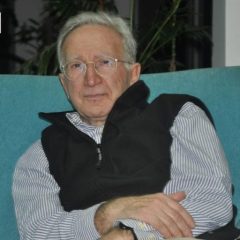 Jacob Cohen is a writer and lecturer born in 1944. Polyglot and traveler, anti-Zionist activist, he was a translator and teacher at the Faculty of Law in Casablanca. He obtained a law degree from the Faculty of Casablanca and then joined Science-Po in Paris where he obtained his degree in Science-Po as well as a postgraduate degree (DES) in public law. He lived in Montreal and then Berlin. In 1978, he returned to Morocco where he became an assistant lecturer at the Faculty of Law in Casablanca until 1987. He then moved to Paris where he now focuses on writing. He has published several books, including « Le commando de Hébron » (2014), « Dieu ne repasse pas à Bethléem » (2013), « Le printemps des Sayanim » (2010), « L’espionne et le journaliste » (2008), « Moi, Latifa S. » (2002).
He has a blog and performs on YouTube where he discusses various topics.
Mohsen Abdelmoumen is an independent Algerian journalist. He has written for several Algerian newspapers such as Alger Républicain and in different sites of the alternative press.
Palestinian Christians
By Jonathon Cook | Americans for Middle East Understanding | Volume 53 2020
It was inevitable that when the coronavirus pandemic reached the occupied Palestinian territories, as it did in early March, it would find its first purchase in Bethlehem, a few miles south-east of Jerusalem in the occupied West Bank.
Staff at the Angel Hotel in Beit Jala, one of Bethlehem’s satellite towns, tested positive after they were exposed to a group of infected Greek tourists. Israel worked hurriedly with the Palestinian Authority – the Palestinians’ permanent government-in-waiting in the occupied territories – to lock down Bethlehem. Israel was fearful that the virus, unlike the city’s Palestinian inhabitants, would be difficult to contain. Contagion might spread quickly to nearby Palestinian communities in the West Bank, then to Jewish settlements built illegally by Israel on Bethlehem’s lands, and finally on into Israel itself.
The Palestinian territories were under a form of lockdown long before the arrival of the coronavirus, however. Israel, the occupying power, has made sure that the entire Palestinian population is as isolated from the world as possible – their voices silenced, their experiences of oppression and brutality at Israel’s hands near-invisible to most of the Israeli public and to outsiders.
But Bethlehem, the reputed site of Jesus’s birth 2,000 years ago, is the one Palestinian area – outside East Jerusalem, which has been illegally annexed by Israel – that has proved hardest for Israel to hermetically seal off. During visits to the Church of the Nativity, tourists can briefly glimpse the reality of Palestinian life under occupation.
Some 15 years ago Israel completed an 26 foot-high concrete wall around Bethlehem. On a typical day – at least, before coronavirus halted tourism to the region – a steady stream of coaches from Jerusalem, bearing thousands of Christian pilgrims from around the world, came to a stop at a gap in the concrete that served as a checkpoint. There they would wait for the all-clear from surly Israeli teenage soldiers. Once approved, the coaches would drive to the Nativity Church, their passengers able to view the chaotic graffiti scrawled across the wall’s giant canvas, testifying to the city’s imprisonment and its defiance.
Like the plague-bearing Greeks, visitors to Bethlehem could not avoid mixing, even if perfunctorily, with a few locals, mostly Palestinian Christians. Guides showed them around the main attraction, the Church, while local officials and clergy shepherded them into queues to be led down to a crypt that long ago was supposedly the site of a stable where Jesus was born. But unlike the Greek visitors, most pilgrims did not hang around to see the rest of Bethlehem. They quickly boarded their Israeli coaches back to Jerusalem, where they were likely to sleep in Israeli-owned hotels and spend their money in Israeli-owned restaurants and shops.
For most visitors to the Holy Land, their sole meaningful exposure to the occupation and the region’s native Palestinian population was an hour or two spent in the goldfish-bowl of Bethlehem.
In recent years, however, that had started to change. Despite the wall, or at times because of it, more independent-minded groups of pilgrims and lone travelers had begun straying off grid, leaving the Israeli-controlled tourism trail. Rather than making a brief detour, they stayed a few nights in Bethlehem. A handful of small, mostly cheap hotels like the Angel catered to them, as did restaurants and souvenir stores around the church.
In tandem, a new kind of political tourism based in and around Bethlehem had begun offering tours of the wall and sections of the city, highlighting the theft of the city’s land by neighboring Jewish settlements and the violence of Israeli soldiers who can enter Bethlehem at will.
 A few years ago, the famous anonymous British graffiti artist Banksy gave a major boost to this new kind of immersive tourism by allying with a Bethlehem tour guide, Wisam Salsa, to open the Walled-Off Hotel. They converted an old building boxed in by the wall, liberally sprinkling it with Banksy’s subversive artworks about the occupation, as well as installing a gallery exhibiting the work of Palestinian artists and a museum detailing the occupation’s history and Israel’s well-tested methods of control and repression.
Admittedly, few visitors managed to get a room in Banksy’s small hotel, but many more came to sit in the lobby and sip a beer, produced by one of a handful of newly emerging breweries run by Christian Palestinians, or add some graffiti to the wall just outside with the help of a neighboring art supplies shop.
Before coronavirus, the Walled-Off offered daily tours of Aida, a refugee camp attached to Bethlehem, whose inhabitants were expelled from some of the more than 500 Palestinian communities Israel erased in 1948 – in the Nakba, or Catastrophe – to create a Jewish state on their homeland. There, visitors not only learned about the mass dispossession of Palestinians, sponsored by the western powers, that made Israel’s creation possible, but they heard the camp’s inhabitants tell of regular violent, night-time raids by Israeli soldiers and of the daily struggle for survival when Israel tightly controls and limits essentials like water.
Until the coronavirus did Israel’s work for it, Israeli authorities had noted with growing concern how more tourists and pilgrims were staying in Bethlehem. According to Israeli figures, there are about a million tourist overnights annually in Bethlehem. And that figure was growing as new hotels were built, even if the total was still a tiny fraction of the number of tourists staying in Israel and Israeli-ruled East Jerusalem.
The new trend disturbed the Israeli authorities. Bethlehem was proving an Achilles’ heel in Israel’s system of absolute control over the Palestinians for two reasons.
First, it brought money into Bethlehem, providing it with a source of income outside Israel’s control. The Israeli authorities have carefully engineered the Palestinian economy to be as dependent on Israel as possible, making it easy for Israel to punish Palestinians and the PA economically for any signs of disobedience or resistance. Aside from its tourism, Bethlehem has been largely stripped of economic autonomy. After waves of land thefts by Israel, the city now has access to only a tenth of its original territory, and has been slowly encircled by settlements. The city’s residents have been cut off from their farmland, water sources and historic landmarks. Jerusalem, once Bethlehem’s economic and cultural hinterland, has become all but unreachable for most residents, hidden on the other side of the wall. And those working outside the tourism sector need a difficult-to-obtain permit from Israel’s military authorities to enter and work in low-paying jobs in construction and agriculture inside Israel, the settlements or occupied Jerusalem. Israel’s second ground for concern was that foreign visitors staying in Bethlehem were likely to learn first-hand something of the experiences of the local population – more so than those who simply made a brief detour to see the church. A self-serving narrative about Palestinians central to Israeli propaganda – that Israel stands with the west in a Judeo-Christian battle against a supposedly barbaric Muslim enemy – risked being subverted by exposure to the reality of Bethlehem. After all, anyone spending time in the city would soon realize that it includes Palestinian Christians only too ready to challenge Israel’s grand narrative of a clash of civilizations.
From Israel’s point of view, a stay in Bethlehem might also open tourists’ eyes in dangerous ways. They might come to understand that, if anyone was behaving in a barbaric way and provoking an unresolvable, religiously inspired clash, it was not Palestinians – Muslim or Christian – but Israel, which has been brutally ruling over Palestinians for decades.
For both reasons, Israel wished to prevent Bethlehem from becoming a separate, rival hub for tourism. It was impossible to stop pilgrims visiting the Church of the Nativity, but Israel could stop Bethlehem developing its own tourism industry, independent of Israel. The wall has been part of that strategy, but it failed to curb the development of new tourism ventures – and in some cases, as with the Banksy hotel, had actually inspired alternative forms of tourism.
In early 2017 the Israeli authorities finally acted. The daily Haaretz newspaper revealed that the interior ministry had issued a directive to local travel agencies warning them not to allow their pilgrimage groups to stay overnight in Bethlehem, with the implication that the firms risked losing their licenses if they did so. According to Haaretz, the government claimed that “potential terrorists were traveling with groups of tourists”.
Bethlehem is lucky that, unlike other Palestinian communities, it has allies Israel cannot easily ignore. Haaretz’s exposure of the new policy led to a rapid backlash. International churches, especially the Vatican, were worried that it was the thin end of a wedge that might soon leave the City of the Nativity off-limits to its pilgrims. And Israeli travel agencies feared their business would suffer. Pilgrim groups from poorer countries that could not afford Jerusalem’s high prices, especially for accommodation, might stop coming to the Holy Land.
As one agent told Haaretz : “The meaning of a letter like this is the end of incoming tourism from India, Sri Lanka, Indonesia and eastern European countries like Poland, Slovakia and Ukraine. All the tourists who visit Israel and sleep in Bethlehem are doing that primarily to reduce costs.” The loss of such tourists not only threatened to deprive Bethlehem of the benefits of tourism but threatened Israel’s much larger tourism sector. Soon afterwards, the Israeli authorities backtracked, saying the directive had been a draft issued in error.
Why the Shrinkage?
Bethlehem’s plight – a microcosm of the more general difficulties faced by Palestinians under occupation – offers insights into why the region’s Palestinian Christian population has been shrinking so rapidly and relentlessly.
The demographics of Bethlehem offer stark evidence of a Christian exodus from the region. In 1947, the year before Israel’s creation, 85 percent of Bethlehem’s inhabitants were Christian. Today the figure stands at 15 percent. Christians now comprise less than 1.5 percent of the Palestinian population in the West Bank – some 40,000 of a population of nearly 3 million – down from 5 percent in the early 1970s, shortly after Israel occupied the territory in 1967.
In 1945 Bethlehem had nearly 8,000 Christian residents, slightly more than the 7,000 who live there today. Natural growth should mean Bethlehem’s Christian population is many times that size. There are, in fact, many times more Palestinian Christians overseas than there are in historic Palestine. The 7,000 Christians of Beit Jala, next to Bethlehem, are outnumbered by more than 100,000 family members who have moved to the Americas.
Israel ostensibly professes great concern about this decline, but actually it is only too happy to see native Christians depart the region. Their exodus has helped to make Israel’s clash of civilizations narrative sound more plausible, bolstering claims that Israel does indeed serve as a rampart against Muslim-Arab terror and barbarism. Israel has argued that it is helping Christian Palestinians as best it can, protecting them from their hostile Muslim neighbors. In this way, Israel has sought to mask its active role in encouraging the exodus.
The rapid decline in the numbers of these Christians reflects many factors that have been intentionally obscured by Israel. Historically, the most significant is that Palestinian Christians were nearly as badly impacted as Palestinian Muslims by the mass expulsions carried out by Zionist forces in 1948. In total, some 80 percent of all Palestinians living in what became the new state of Israel were expelled from their lands and became refugees – 750,000 from a population of 900,000. Those forced into exile included tens of thousands of Christians, amounting to two-thirds of the Palestinian Christian population of the time.
Palestinian Christians who remained in historic Palestine – either in what had now become Israel or in the territories that from 1967 would fall under Israeli occupation – have naturally shrunk over time in relation to the Muslim population because of the latter’s higher birth rates. Palestine’s Christians mostly lived in cities. Their urban lifestyles and generally higher incomes, as well as their greater exposure to western cultural norms, meant they tended to have smaller families and, as a result, their community’s population growth was lower.
But rather than acknowledge this historical context, Israeli lobbyists seek to exploit and misrepresent the inevitable tensions and resentments caused by the mass displacements of the Nakba, developments that had a significant impact on traditionally Christian communities like Bethlehem. During the events of 1948, as rural Palestinian villages were ethnically cleansed by Zionist forces, the refugees sought shelter either in neighboring states like Lebanon, Syria and Jordan, or in West Bank cities.
Bethlehem found its demographics transformed: an 85 percent Christian majority before the Nakba has been reversed into an 85 percent Muslim majority today. These dramatic social and cultural upheavals – turning the city’s majority population into a minority – were not easy for all Bethlehem’s Christian families to accept. It would be wrong to ignore the way these changes caused friction. And the resentments have sometimes festered because they are incapable of resolution without addressing the source of the problem: Israel’s mass dispossession of Palestinians, and the continuing tacit support for these abuses by the international community.
Given this context, it has been easy for inter-family rivalries and conflicts that are inevitable in a ghettoized, overcrowded community like today’s Bethlehem to be interpreted by some members of the minority group as sectarian, even when they are not. The lack of proper law enforcement in Palestinian areas in which Israel rather than the PA is the ultimate arbiter of what is allowed has left smaller Christian families more vulnerable in conflicts with larger Muslim families. In the competition for diminishing resources, family size has mattered. And whereas globalization has tended to encourage increased identification among Palestinian Christians with the west and its more secular norms, the same processes have entrenched a religious identity among sections of the Muslim population who look to the wider Middle East for their ideas and salvation. Consequently, a cultural gap has widened.
These problems exist but it would be wrong to exaggerate them – as Israel’s loyalists wish to do – or to ignore who is ultimately responsible for these tensions. That is not a mistake most Palestinian Christians make. In a recent survey of Christians who have emigrated, very few pointed to “religious extremism” as the reason for leaving the region – just 3 percent. The overwhelming majority cited reasons relating in some way to Israel’s continuing malevolent role in controlling their lives. A third blamed a “lack of freedom”, a quarter “worsening economic conditions”, and 20 percent “political instability.”
To make sense of the specific problems faced by the Christian community, other historical contexts need to be understood. Palestinian Christians break down into four broad communities. The first is the Eastern Orthodox Churches, dominated by the Greek Orthodox. The second is the Catholic Churches, led by the “Latin” community that looks towards Rome, although they are outnumbered among Palestinians by Greek and Syrian Catholics. The third category is the Oriental Orthodox churches, which include the Copts, Armenian and Syrian Orthodox. And finally, there are various Protestant Churches, including the Anglicans, Lutherans and Baptists.
Long before Israel’s creation on most of the Palestinians’ homeland, Christians were concentrated in and around Palestine’s urban centers. In Jerusalem, Bethlehem and Nazareth, large numbers of Christians coalesced around sites associated with Jesus’s life. This tendency was reinforced as Palestine’s cities flourished and expanded from the 18th century onwards under Ottoman rule. The Ottomans encouraged the immigration of Christians to these centers of worship and cultivated a confessional system that made conditions attractive for the foreign Churches.
The result was a relatively privileged urban Christian population that consisted largely of merchants and traders, and benefited from the resources poured in by the international Churches as part of their missionary work, including schools and hospitals. Christians were typically wealthier, better educated and healthier than their Muslim counterparts often living nearby in isolated rural communities as peasant farmers. In addition, Christian families had good connections to the international Churches through local clergy, as well as the staff of Church-run schools and hospitals.
Those differences have proved significant as Palestinian Christians and Muslims alike have struggled under Israeli colonization, whether inside Israel’s internationally recognized borders or in the occupied territories.
Israel’s institutionalized racism towards Palestinians – systematic land thefts, uninhibited state and settler violence, as well as restrictions on movement and the denial of educational and employment opportunities – have put pressure on all Palestinians to leave. But Christians have enjoyed significant advantages in making their escape. They could tap their connections in the Churches to help them settle abroad, chiefly in the Americas and Europe. And that path was made easier for many given that relatives had already established lives overseas following the mass expulsions of 1948. As a result, the emigration of Palestinian Christians is generally reckoned to have been around twice that of Muslims.
Israel’s oft-repeated claim that Hamas and the Palestinian Authority are responsible for the exodus of Christians out of the Holy Land is given the lie simply by examining the situation of Palestinian Christians both inside Israel, where neither Hamas nor the PA operate, and in East Jerusalem, where the influence of both has long been negligible. In each of those areas, Israel has unchallenged control over Palestinians’ lives. Yet we can see the same pattern of Christians fleeing the region.
And the reasons for Gaza’s tiny Palestinian Christian population, today numbering maybe only 1,000, to leave their tiny, massively overcrowded enclave, which has been blockaded for 13 years by Israel, barely needs examining. True, it has been hard for these Christians – 0.0005 percent of Gaza’s population – to feel represented in a territory so dominated by the Islamic social and cultural values embodied by the Hamas government. But there is little evidence they are being persecuted.
On the other hand, there is overwhelming proof that Gaza’s Christians are suffering, along with their Muslim neighbors, from Israel’s continuing violations of their most fundamental rights to freedom, security and dignity.
The picture in the West Bank, meanwhile, needs closer study. As noted, Palestinian Christians have generally enjoyed historic privileges over their Muslim compatriots that derive from their historic connections to the Churches. They have been able to exploit tourism as guides, drivers and guesthouse owners. They enjoy greater access to church-run schools and, as a consequence, improved access to higher education and the professions. They possess more valuable urban land, and many own shops and businesses in the cities. There are both Muslim and Christian lawyers, shopkeepers and business owners, of course, but proportionately more Christians have belonged to the middle classes and professions because of these various advantages.
While Israel’s occupation policies have harshly impacted all Palestinians, some have been hit harder than others. And those who have tended to suffer most live not in the main cities, which are under very partial Palestinian rule, but in rural areas and in the refugee camps. Those in the camps, in places such as Aida, next to Bethlehem, lost their lands and property to Israel and have had to rebuild their lives from scratch since 1948. Those living in isolated farming communities designated by the Oslo accords as “Area C” (a temporary designation that has effectively become permanent) are fully exposed to Israel’s belligerent civil and military control.
The residents of these communities have few opportunities to earn a living and have been most vulnerable to Israeli state and settler violence, as well as land thefts and the severe water restrictions imposed by Israel. In practice, these precarious conditions are endured disproportionately by Muslim Palestinians rather than Christians.
Nonetheless, Israel’s policies have increasingly deprived urban Christian families of the opportunities they had come to expect – the kind of opportunities westerners take for granted. And significantly, unlike many Muslim Palestinians, Christians have continued to enjoy one privilege: an escape route out of the region to countries where they have a chance to live relatively normal lives.
The damage to Christian life has been felt particularly keenly in relation to movement restrictions – one of the ways Israel has established a system of near-absolute control over Palestinian life. Those involved in trade and business, as many Christians are, have struggled to succeed as those restrictions have intensified over the past quarter-century, since the introduction of measures under the Oslo accords. An elaborate system of checkpoints and permits was established to control Palestinians’ freedom to move around the occupied territories and to enter Israel in search of work. Over time the system was enforced by a lengthy steel and concrete “separation barrier” that Israel began building nearly two decades ago.
Taybeh’s Beer Challenge
Typifying the difficulties of trading under these circumstances is the Taybeh micro-brewery in a West Bank village of the same name, in a remote location north of Ramallah overlooking the Jordan Valley. Taybeh is exceptional: its 1,300 inhabitants comprise the last exclusively Christian community in the occupied territories. The village – its name means both “good” and“delicious” in Arabic – is reputedly on the Biblical site of Ephraim. A small church marks the spot where Jesus reputedly retired with his disciples shortly before heading to Jerusalem, where he would be crucified. Taybeh has its own Roman Catholic and Greek Orthodox schools, and a Catholic nursing home.
 Nonetheless, Taybeh has long been in demographic meltdown. Today, its population is dwarfed by those of its diaspora: some 12,000 former residents and their descendants live abroad, mostly in the United States, Chile and Guatemala. Daoud and Nadim Khoury, two brothers who were themselves raised in the US, established the Taybeh brewery shortly after their return to the West Bank village under the Oslo accords. The business depended on the experiences and connections they had gained abroad.
For them, developing a sustainable business like the brewery was a way to halt and reverse the gradual demise of their village and the loss of its Christian heritage. They feared that any further decline in numbers would leave Taybeh’s lands and its ancient olive groves vulnerable to takeover by the three Jewish settlements that surround the village. The business was seen as a way to save Taybeh.
Maria Khoury, Daoud’s Greek wife, whom he met at Harvard, says the conditions of village life have continued to deteriorate. Unemployment stands at 60 percent, and Israel shuts off the water four times a week to preserve supplies for the Jewish settlements. The drive to the nearest Palestinian city, Ramallah, takes five times longer than it did 20 years ago – when it took little more than 15 minutes. That was before checkpoints and roadblocks were established on local roads to protect the settlers.
The Khourys have succeeded in their ambition to develop a range of award-winning beers made to the highest purity standards. The family has expanded into making boutique wines, and has built a prestige hotel in the village center, belying Taybeh’s small size. An annual Oktoberfest, modeled on German beer-drinking celebrations, has helped to put the remote village on the map. And a few restaurants have opened as Taybeh has tried to reinvent itself, with limited success, as a weekend-break destination.
But despite all these achievements, their larger ambitions have been foiled. Movement restrictions imposed by Israel’s military authorities have stymied efforts at growing the business. With a domestic market limited by opposition to alcohol consumption among most of the Palestinian population, Taybeh brewery has depended chiefly on exports to Europe, Japan and the US. But the difficulties of navigating Israel’s hostile bureaucracy have sapped the business of money, time and energy, making it hard to compete with foreign breweries.
Daoud told me at one Oktoberfest that the brewery faced Israeli “harassment in the name of security.” He noted that even when the crossing points were open, Israel held up the company’s trucks for many hours while bottles were unloaded and individually inspected with sniffer dogs. Then the bottles had to be reloaded on to Israeli trucks on the other side of the checkpoint. Apart from local spring water, all the beer’s ingredients and the bottles have to be imported from Europe, adding further logistical problems at Israeli ports. The ever-creative Khourys have been forced to circumvent these problems by licensing a plant in Belgium to produce its beers for foreign export. But that has deprived the village of jobs that could have gone to local families.
And while the Khourys struggle to get their products into Israel, Israel has absolute freedom to flood the occupied territories with its own goods. “The policy is clearly meant to harm businesses like ours. Israel freely sells its Maccabee and Goldstar beers in the West Bank,” Daoud told me.
Such experiences are replicated for Palestinian businesses, big and small, across the West Bank.
In Jerusalem, the Christian population has been shrinking too, even though the city has been entirely under Israeli control since its eastern neighborhoods were occupied and illegally annexed by Israel in 1967. The Palestinian Authority was briefly allowed a minimal presence in East Jerusalem in the late 1990s, but was effectively banished when the second intifada erupted a few years later, in 2000. A similar fate soon befell Jerusalem’s politicians associated with Hamas. After they won the Jerusalem seats in the 2006 Palestinian legislative elections, Israel expelled them to the West Bank.
Perhaps unsurprisingly, Israel has not been keen to provide official figures for the exodus of Christians from Jerusalem. However, rather than growing, as one would have expected over the past five decades, the numbers have dropped significantly – from 12,000 in 1967 to some 9,000 today, according to Yousef Daher, of the Jerusalem Interchurch Center, located in Jerusalem’s Old City. Of those, he estimated that no more than 2,400 remained in the Christian Quarter of the Old City, where Israel has made life especially difficult.
Jerusalem is historically, symbolically, spiritually and economically important to the Palestinian people, and houses key Muslim and Christian holy sites. It has long been regarded by Palestinians as the only possible capital of their future state. But Israel views the city in much the same terms – as the religious and symbolic heart of its hybrid religious and ethnic national project. It has shown no interest in sharing the city as a capital, and has instead viewed it in zero-sum terms: whatever benefits Israel requires a loss to the Palestinians.
Gradually Israel’s stranglehold over Jerusalem has become complete. The wall it began building through the city more than 15 years ago has not only separated Palestinians in Jerusalem from Palestinians in the West Bank but has divided the city itself, placing more than 100,000 Palestinians on the wrong side, cutting them off from the city of their birth.
Two years ago, President Donald Trump added a US seal of approval by recognizing Jerusalem as Israel’s capital and moving the US embassy there.
Those Palestinians in occupied East Jerusalem still on the “Israeli” side of the wall have found themselves isolated and ever more vulnerable to the abuses inherent in Israel’s system of control. They have suffered planning restrictions that make it almost impossible to build homes legally. Israel demolishes dozens of Palestinian houses every year in the city, leading to ever greater overcrowding. Meanwhile, Israel has seized vast tracts of land in East Jerusalem for its illegal settlements and has helped Jewish settlers take over Palestinian homes.
The city’s security forces act as an occupying power in Palestinian neighborhoods, while city authorities pursue an official policy of “Judaization,” making Jerusalem more Jewish. Israel has accorded the city’s native Palestinian population a “residency” status that treats them as little more than immigrants. Many thousands who have left the city for extended periods to study or work abroad have returned to find their residency permits revoked.
The city’s Christian residents face similar problems to Muslims. But as a very small community, they have also faced specific pressures. Israel’s policy of cutting off Jerusalem from the West Bank, and especially from the nearby cities of Bethlehem and Ramallah, has left the city’s Christians particularly isolated. With many working as merchants and traders, the so-called “separation” policy has hit them hard economically.
Similarly, because the communal marriage pool is small for Christians in Jerusalem, many have been forced – at least, before the wall was erected – to search for a spouse among Christian populations nearby in the West Bank. That now leaves them disproportionately exposed to Israel’s increasingly draconian family unification policies. Typically Jerusalem’s Palestinians are denied the right to live with a West Bank spouse in the city, or to register the children of such marriages as Jerusalem residents. That has forced many to move into the West Bank or abroad as the only way to stay together.
As in Bethlehem, many of Jerusalem’s Christians work in tourism, either as tour guides or as owners of souvenir shops in the Old City’s Christian Quarter. That has proved a particularly precarious way to make a living in recent decades, with tourism collapsing on repeated occasions: during two lengthy intifadas, during Israel’s attacks on Gaza, and now from the coronavirus.
Israel will soon make it even harder for the Old City traders to make a living, when it completes a cable car into East Jerusalem. Currently many tourists enter via Jaffa Gate into the Christian Quarter, where shopkeepers have a chance to sell them goods and souvenirs. But the cable car will “fly in” tourists from a station in West Jerusalem directly to an illegal settlement complex at the City of David in Silwan, just outside the Old City walls. From there, either they will be guided straight into the Jewish Quarter through Dung Gate or they will pass through a network of underground passages lined with settler-owned shops that will take them to the foot of the Western Wall. The aim appears to be not only to make the Old City’s Palestinian population invisible but to deprive them of any chance to profit from tourism.
Land Sales by Churches
But the problem runs deeper still for Palestinian Christians – and is felt especially acutely in Jerusalem. Local Christians have found themselves effectively pawns in a three-way international power-play between Israel, the established, land-owning Churches in the region, primarily the Vatican and Greek Orthodox Churches, and the evangelical movements. None of the parties represent their interests.
It is easy for pilgrims to ignore the fact, as they tour the Holy Land, that the Roman Catholic and Greek Orthodox Churches are not local. They are vast foreign enterprises, based out of the Vatican and Greece, that are as concerned with their commercial viability and diplomatic influence on the global stage as they are with the spiritual needs of any specific flock, including Palestinian Christians. And in recent years that has become increasingly evident to local congregations.
The problems were symbolized two years ago when, for the first time in living memory, the main Churches shuttered the doors of the Church of the Holy Sepulcher, the presumed site of Jesus’ crucifixion in Jerusalem. Church leaders said their actions were in response to Israel launching a “systematic and unprecedented attack against Christians in the Holy Land.” In that way, they mobilized international sympathy, and Israel quickly backed down. But only in the most tangential sense were the Churches looking out for the interests of local Christians. Their show of force was actually motivated by concern for their business interests.
The then mayor of Jerusalem, Nir Barkat, had sought to impose back taxes on the Churches’ substantial land-holdings in Jerusalem, hoping to recoup $180 million. Despite the impression presented by Church leaders, the row was not really about holy sites. Over the centuries, the Churches have become major real-estate enterprises in the Holy Land, benefiting from donations of land and properties in Jerusalem and elsewhere that have been made by Palestinian Christians and overseas pilgrims. The Greek Orthodox Church, for example, is the largest land-owner in the region after the Israeli state.
Historically, the Churches enjoyed a tax exemption derived from the charitable status of their spiritual mission and outreach work with Palestinian communities, including the provision of schools and hospitals. But increasingly the Churches have downgraded their charitable works and diversified into other, more clearly commercial ventures, such as shops, offices and restaurants. Pilgrimage hostels have been redeveloped into well-appointed and profitable hotels. Part of the income has then been siphoned off to the Church authorities in the mother countries rather than reinvested in strengthening local Palestinian communities.
That was why Aleef Sabbagh, a Palestinian member of the Orthodox Central Council, described the Holy Sepulcher protest as a “charade.” The Church had not been closed to protest Israel’s savagery towards Palestinians during either of the two intifadas, or in protest at the exodus of local Christians from the region. The foreign Churches found their voice only when they needed to protect their profits from real-estate and investment deals.
That does not, however, mean that Palestinian Christians have no reason to be concerned about Israel’s efforts to bully the Churches’ into paying more taxes, or that they were indifferent to the brief stand-off at the Sepulcher Church. The Vatican and Orthodox Patriarchate have become increasingly cowed in relation to Israel in recent decades, both as Israel has become ever more assertive of its powers in the region and as western states have shown they will support Israel however badly it treats Palestinians.
Israel has many points of leverage over the international Churches. It can, and has, frozen clerical work visas needed by their thousands of staff in the Holy Land. Israel regularly obstructs planning permits for the Church needed to build or renovate properties. And far-right groups close to Israel’s governing coalition regularly menace clergy in the streets and vandalize Church property, including cemeteries, under cover of dark. Israeli police have rarely caught or punished the perpetrators of such attacks.
 Most notable of these attacks was a fire set by arsonists in 2015 that gutted sections of the Church of the Multiplication, the site on the shore of the Sea of Galilee where Jesus is reputed to have fed a large crowd with loaves and fishes. Graffiti in Hebrew scrawled on a church wall read: “Idol-worshippers will have their heads cut off.”
This strategy of weakening and intimidating the international Churches has been particularly glaring in relation to Orthodoxy. Each new Patriarch, the highest Orthodox figure in the region, must be jointly approved by the Palestinian Authority, Jordan and Israel. And in the case of the last two Patriarchs, Irineos I and Theophilos III, Israel, unlike the PA and Jordan, has dragged its heels before approving their appointment. Irineos had to wait nearly four years, and Theophilos two and a half. The reason why has gradually become clear to local Christians.
Shortly after each Patriarch has belatedly received approval, evidence has come to light that his advisers have overseen the sale of some of the Churches’ vast landholdings in Israel and the occupied territories. These shadowy deals, usually selling invaluable land for a comparative pittance, have been made to Israeli companies or overseas organizations that it has later emerged acted as a front for Jewish settler groups.
The most infamous case concerns the sale to settlers of two large properties, serving as Palestinian-run hotels, at a highly strategic location by Jaffa Gate, the entrance into the Christian Quarter of Jerusalem’s Old City. These sales appear to be part of the price paid for Irineos to win Israeli approval. Israel has long been keen to Judaize Jaffa Gate because it effectively serves as a bridge between West Jerusalem, in Israel, and the Jewish Quarter, the main settler colony in the occupied Old City. Reporting on the land sales at Jaffa Gate, the Haaretz newspaper revealed tape recordings of a Jerusalem settler leader boasting that his organization, Ateret Cohanim, had a veto over the appointment of each Patriarch. He said Ateret Cohanim would only give its blessing once the Patriarch had sold it land.
The pattern appears to have repeated with Theophilos, who is accused of selling numerous plots of land near Bethlehem, West Jerusalem, Jaffa, Haifa, Nazareth and Caesarea. The Church is reported to have pocketed more than $100 million from the deals. In 2017 some 300 Palestinian Christians filed a criminal complaint to the Palestinian attorney general in Ramallah, accusing the Patriarch of “treason.” The same year, 14 local Orthodox institutions – representing many of the half a million Greek Orthodox Christians in the occupied territories, Israel and Jordan – severed ties with Theophilos and his synod, and demanded his removal.
Palestinian Christians have increasing grounds for concern that the Churches are not looking out for their interests when they make these deals. Historically, lands were donated to the Greek Orthodox Church as an endowment, and the income used for the collective good of the Orthodox community in the Holy Land. But local communities say the money is nowadays siphoned off to the foreign Church authorities.
Further, nearly a quarter of land in East Jerusalem is reported to be Church-owned, including the Mount of Olives, Sheikh Jarrah and large swaths of the Old City. Many Palestinian Christians live in these areas, which are being aggressively targeted by the settler movement. Local Christians have little faith that the Church will not sell these lands in the future, leaving them vulnerable to eviction by settlers.
Atallah Hanna, the only Palestinian serving as a Greek Orthodox archbishop, has been repeatedly punished for speaking out against the Patriarch’s policies. He issued a statement about the land sales at Jaffa Gate: “Those who sell and forfeit our real estate and Orthodox endowments do not represent our Arab Church, its heritage, identity and historical presence in this holy land.”
The effort to financially “squeeze” the Churches by the Jerusalem mayor in 2018 should be seen in this light. If the Churches face big new tax bills, the pressure will increase on them over the longer term either to be more submissive to Israel, for fear of attracting additional taxes, or to sell off yet more land to cover their debts. Either way, Palestinian Christians will suffer.
An Obstacle to the End-Times
A separate essay could be written about the role of overseas Christian evangelical movements in damaging the situation of Palestinian Christians. Suffice it to point out that most evangelical Christians are largely indifferent to the plight of the region’s local Christian population.
In fact, Zionism, Israel’s state ideology, draws heavily on a Christian Zionism that became popular among British Protestants more than 150 years ago. Today, the heartland of evangelical Zionism is the United States, where tens of millions of believers have adopted a theological worldview, bolstered by prophecies in the Book of Revelation, that wills a Jewish “return” to the Promised Land to bring about an apocalyptic end-times in which Christians — and some Jews who accept Jesus as their savior — will be saved from damnation and rise up to Heaven.
Inevitably, when weighed against a fast-track to salvation, the preservation of Palestinian Christians’ 2,000-year-old heritage matters little to most US Christian Zionists. Local Christians regularly express fears that their holy sites and way of life are under threat from a state that declares itself Jewish and whose central mission is a zero-sum policy of “Judaization”. But for Christian Zionists, Palestinian Christians are simply an obstacle to realizing a far more urgent, divinely ordained goal.
US evangelicals have, therefore, been pumping money into projects that encourage Jews to move to the “Land of Israel,” including in the settlements in the occupied West Bank and East Jerusalem. Their leaders are close to the most hawkish politicians in Israel, such as Prime Minister Benjamin Netanyahu.
The political clout of the evangelical movements in the US, the world’s only superpower and Israel’s chief patron, has never been more evident. The vice-president, Mike Pence, is one of their number, while President Donald Trump depended on evangelical votes to win office. That was why Trump broke with previous administrations and agreed that the US would become the first country in modern times to move its embassy from Tel Aviv to Jerusalem, effectively killing any hope for the Palestinians of securing East Jerusalem as their capital.
Given this international atmosphere, the isolation of Palestinian Christians and their leaders is almost complete. They find themselves marginalized within their own Churches, entirely ignored by foreign evangelical movements, and an enemy of Israel. They have therefore tried to break out of that isolation both by forging greater unity among themselves and by setting out a clearer vision to strengthen ties to Christians outside the Holy Land.
One important milestone on that path was the publication of the Kairos Palestine document in December 2009, drawing on a similar document drafted by mainly black theologians in apartheid South Africa in the 1980s. Kairos Palestine, which describes itself as “the Christian Palestinians’ word to the world about what is happening in Palestine,” has been signed by more than 3,000 leading Palestinian Christian figures, including Atallah Hanna, the Greek Orthodox Archbishop for the Sebastiya diocese; Naim Ateek, a senior Anglican priest; Mitri Raheb, a senior Lutheran pastor; and Jamal Khader, a senior figure in the Latin Patriarchate.
The Kairos document calls unequivocally on “all the churches and Christians in the world … to stand against injustice and apartheid” and warns that “any theology, seemingly based on the Bible or on faith or on history, that legitimizes the occupation, is far from Christian teachings”. It asks Christians abroad to “revisit theologies that justify crimes perpetrated against our people and the dispossession of the land”. And further, it supports the wider Palestinian BDS call to boycott, divest and sanction Israel and those who conspire with the oppression of Palestinians. It describes non-violent resistance as a “duty” incumbent on all Palestinians, arguing that such resistance should end only when Israeli abuses end, not before.
Faced with inevitable accusations of antisemitism from Israel partisans in the west, most of the overseas Churches – including importantly, the World Council of Churches – have failed to respond to this Palestinian Christian call. Only the Presbyterian Church in the US has endorsed the document, while the United Church of Christ has praised it. Predictably, Israel lobbyists have tried to undermine the document’s significance by correctly highlighting that the foreign Church leaderships in Palestine, such as the Greek Orthodox Patriarch, have refused to endorse it. But then, these kind of Church leaders have rarely had the interests of their Palestinian congregations foremost in their minds.
Nonetheless, Israel is deeply concerned by the document. Were it to be accepted, it would bring the international Churches onboard with the wider Palestinian BDS movement, which calls for an international boycott of Israel. Israeli leaders deeply fear the precedent set by the international community’s treatment of apartheid South Africa.
Of the three planks of the BDS campaign, the most troubling for Israel are not the boycott or sanctions components, but the threat of divestment – the withdrawal of investments from Israel by Churches, civil society organizations, trade unions and pension funds. Were the Churches to adopt BDS, such actions could quickly gain a moral legitimacy and spread. The Kairos document is therefore viewed as the thin end of a very dangerous wedge.
 Atallah Hanna, as the most senior cleric to have signed the document, has found himself particularly in the crosshairs from Israel. In December last year he ended up in hospital in Jordan, treated for “poisoning by chemical substance,” after a tear gas canister was reportedly thrown into the grounds of his church in Jerusalem. In the circumstances, Hanna’s claim that Israel had tried to “assassinate,” or at the very least incapacitate, him resonated with many Palestinians.
Certainly Hanna has found himself repeatedly in trouble with the Israeli authorities for his Palestinian activism. In 2002, during the second intifada, for example, he was seized at his home in the Old City of Jerusalem and charged with “suspicion of relations with terrorist organizations,” a trumped-up allegation relating to the fact that he had spoken in favor of the popular uprising against Israeli occupation.
In a meeting with a foreign delegation last year, Hanna warned that Israel, with the support of the international community, was being allowed to gradually transform Jerusalem: “The Islamic and Christian holy sites and endowments are targeted in order to change our city, hide its identity and marginalize our Arabic and Palestinian existence.”
Unwelcome Israeli Citizens
The final community of Palestinian Christians to consider is the largest group, and the one most often overlooked: the 120,000 living in Israel with a degraded form of citizenship. These Palestinians have been exclusively under Israeli rule for more than 70 years. Israel falsely trumpets the claim that its Palestinian minority enjoys exactly the same rights as Jewish citizens. And yet the decline in the number of Palestinian Christians in Israel closely mirrors the situation of those in the occupied territories.
The Palestinian Christian population emerged from the events of 1948 in relatively better shape than their Muslim compatriots inside the territory that was now considered Israel. Aware of western states’ priorities, Israel was more cautious in its approach to the ethnic cleansing of communities with large numbers of Christians. As a result, the 40,000 Christians in Israel at the end of the Nakba comprised 22 per cent of the country’s new Palestinian minority. A few years later members of this minority would gain a very inferior form of Israeli citizenship.
Israel’s early caution in relation to Palestinian Christians was understandable. It feared antagonizing the western, largely Christian states whose backing it desperately needed. That policy was typified in the treatment of Nazareth, which was largely spared the wider policy of expulsions. However, as with Bethlehem, Nazareth’s Christian majority began to be overturned during 1948, as Muslims from neighboring villages that were under attack poured into the city, seeking sanctuary. Today, Nazareth has a 70 per cent Muslim majority.
The proportion of Christians among the Palestinian population in Israel has fallen more generally too – from nearly a quarter in the early 1950s to about 9 percent today. There is a similar number of Druze, a vulnerable religious sect that broke away from Islamic orthodoxy nearly 1,000 years ago. The rest of Israel’s Palestinian population – over 80 per cent – are Sunni Muslim.
The Christian exodus has been driven by similar factors to those cited by Palestinians in the West Bank. Within a self-declared Jewish state, Christians have faced diminished educational and employment opportunities; they must deal with rampant, institutional discrimination; and, after waves of land confiscations to Judaize the areas they live in, they can rarely find housing solutions for the next generation. Israel has encouraged a sense of hopelessness and despair equally among Christians and Muslims.
Problematic for Israel has been the fact that Palestinian Christians have played a pivotal role in developing secular Palestinian nationalism in both the occupied territories and in Israel. For obvious reasons, they have been concerned that Palestinian national identity should not deform into a divisive Islamic identity, mirroring Israel’s own hybrid ethnic and religious nationalism.
Given the difficulties of political activism for Palestinians inside Israel — for decades it could lead to jail or even deportation — many, especially Christians, joined the joint Jewish-Palestinian Communist party, on the assumption that its Jewish cadre would ensure protection. The most prized benefit of membership of the Communist party were scholarships to universities in the former Soviet bloc. Israel’s segregated school system, which included a near-dysfunctional state system for Palestinians, ensured higher education in Israel was mostly off-limits.
The scholarships were a boon to Christians because they enjoyed access to surviving, private Church-run schools in cities like Nazareth, Haifa and Jaffa that offered a better education. But Israel’s hope was that, once outside the region, many would never return — and indeed, this did become an additional factor in the decline of Israel’s Palestinian Christian population.
Onward Christian soldiers
But the advantages enjoyed by Palestinian Christians soon came to be seen by Israel as a liability. The Christians lived mostly in cities. Many had the advantages of access to good schools and higher education. Some had been exposed to the wider world through attending universities abroad. And Christians enjoyed connections to sympathetic communities abroad. Their continuing presence in the Holy Land, as well as their articulation of Palestinian nationalism to outsiders, served to undermine Israel’s claims of a simple Judeo-Christian clash of civilizations with Islam.
It was in this context that in late 2012 Israel secretly revived plans to recruit into the Israeli army Christian youth in Nazareth and its environs, using Christian Scout groups as the vehicle. Neither Muslims nor Christians in Israel are drafted into the army on leaving school, unlike Jewish and Druze youngsters. However, they can volunteer, though in practice only a tiny number do. Figures suggest there are a few dozen Christian families, typically poorer ones, whose sons join the army. But from 2012 onwards, the Netanyahu government worked hard to introduce a draft for Christians, hoping to drive a wedge between Christians and Muslims in Israel.
Netanyahu schemed on several fronts. He aggressively promoted the small number of Christian families with children in the army to suggest that they were representative of the wider community. Meanwhile, he claimed that the overwhelming majority of Christians who publicly opposed his plan did so only because they had been intimidated by their Muslim neighbors.
 The Israeli media trumpeted too the fact that Netanyahu had recruited a “religious leader” – Jibril Nadaf, a Greek Orthodox bishop in Nazareth – to support the draft of Christians. In fact, it was widely rumored in Nazareth at the time that Nadaf was being pressured by Israel’s secret police, the Shin Bet, to offer his support. Only much later did the Israeli media report that Nadaf had been investigated for sexual assaults on young men, and that the Shin Bet had hushed up his case.
At around the same time Israel introduced the option of registering a new nationality, “Aramaic”, on Israeli identity cards. Israel has always refused to recognise an “Israeli” nationality because it would risk conferring equal rights on all Israeli citizens, Jews and Palestinians alike. Instead many rights in Israel are accorded to citizens based on their assigned nationalities – with the main categories being “Jewish”, “Arab” and “Druze”. “Jewish” nationals receive extra rights unavailable to Palestinian citizens in immigration, land and housing, and language rights. The new “Aramaic” category was intended to confer on Christians a separate nationality mirroring the Druze one.
The obscure “Aramaic” identity was chosen for two reasons. First, it referred to a time 2,000 years ago when Jews like Jesus spoke Aramaic – now almost a dead language. Aramaic therefore fused Jewish and Christian identities, replicating the claim of “blood ties” Israel had fostered with the Druze community. And second, Aramaic had already been cultivated as an identity by the handful of Palestinian Christian families that volunteered to serve in the army. For them, Aramaic lay at the heart of a pure, proud, supposedly original Christian nationalist identity. They argued that their forefathers’ Aramaic heritage and language had been usurped and corrupted by the arrival of Arab and Islamic identities in the region during the Arab conquests in the seventh century.
For those who promoted it, including the Israeli government, “Aramaic” was not a neutral Christian identity but consciously intended as an anti-Arab, anti-Muslim identity. It was intimately tied to the government’s larger, fanciful agenda of turning the local Christian population into Palestinian Christian Zionists.
In tandem with these developments, Netanyahu’s government also began aggressively squeezing the resources available to Church schools operating in Nazareth and elsewhere. An arrangement that had historically provided partial state funds for private religious schools, primarily to help the Jewish ultra-Orthodox, began to be progressively withdrawn from Church schools. Pupils in the dozen such schools in Nazareth, which serve both Christians and Muslims, staged an unprecedented strike in 2014 as it became harder for the schools to cover costs. The government offered a way out: the schools, it proposed, should come under the umbrella of the state education system. So far the Church schools have managed to resist.
Although the policy has not been implemented yet, there are indications of what Israel ultimately hoped to achieve. The aim, it seems, was to reinvent the Church schools as “Aramaic” schools, limiting the intake to Christians and teaching a curriculum, as with the Druze, that emphasized the “blood ties” between Jews and Christians and prepared pupils for the army draft. The first such school, teaching in Aramaic, has opened in Jish, a village in the central Galilee that is home to some of the main families that volunteer to serve in the Israeli army.
In fact, Israel failed dismally in its efforts to persuade Christians to accept the draft, and appears to have largely abandoned the plan, even after dedicating several years to bringing it to fruition. Israel should have guessed that such a scheme was unlikely to succeed. In a city like Nazareth, too many Christians are professionals – doctors, lawyers, architects and engineers serving their community – and have no interest in gaining the sole advantage of military service the poorer Druze have depended on: lowly jobs after the draft in the security sectors, as prison wardens or security guards.
But that may not have been Israel’s only goal. In line with its long-standing ambitions, Israel also doubtless wanted to intensify sectarian tensions between Christians and Muslims in places where the two communities live in close proximity, especially Nazareth. And for a variety of reasons, sectarian divisions have started to emerge over the past few years. The causes are manifold, but Israel’s efforts to recruit Christians to the army – to divide them from Muslims – undoubtedly exacerbated the problem.
Another significant factor was the gradual demise of the Communist party, especially in Nazareth, after it came to be too closely identified with Christians and was seen as playing a role in maintaining their relative privileges. That led to a backlash in Nazareth that saw Ali Salam, a populist politician who revels in comparisons with Donald Trump, becoming mayor after subtly exploiting these sectarian tensions.
It also did not help that for nearly two decades nihilistic Islamic movements edged ever closer to Israel’s borders – first with al-Qaeda, and later with Islamic State. That has unnerved many Palestinian Christians and Muslims in Israel. In recent years it has provoked a political reaction from some who have begun to wonder whether a militarily strong, western-backed Israel was not the lesser regional evil.
Israel has every interest in reinforcing such developments, exploiting tensions that shore up its clash of civilizations narrative. Paradoxically, it is Israel’s long-term interference in the region and a more recent policy of direct military intervention by the US in places such as Iraq, Afghanistan, Libya, Syria and Iran that has created the very conditions in which Islamic extremism has prospered. Between them, Israel and the US have sown despair and generated political voids across the Middle East that groups like Islamic State have filled with their own narrative of a clash of civilizations.
For Israel, recruiting Palestinian Christians to its side of this self-serving clash narrative – even if it is only a few of them – is helpful. If Israel can muddy the waters in the region by finding enough allies among local Christians, it knows it can further dissuade the international Churches from taking any substantive action in addressing the crimes it has perpetrated against Palestinians unhindered for more than seven decades.
Israel’s great fear is that one day the international Churches may assume moral leadership in resolving the Israeli-Palestinian conflict and ending the traumas set in train by the Nakba.
Judging by the Churches’ current record, however, Israel appears to have little reason to worry. ■
The Media Has Conveniently Forgotten George W. Bush’s Many Atrocities
By James Bovard | Mises Wire | June 4, 2020
Former president George W. Bush has returned to the spotlight to give moral guidance to America in these troubled times. In a statement released on Tuesday, Bush announced that he was “anguished” by the “brutal suffocation” of George Floyd and declared that “lasting peace in our communities requires truly equal justice. The rule of law ultimately depends on the fairness and legitimacy of the legal system. And achieving justice for all is the duty of all.”
Bush’s declaration was greeted with thunderous applause by the usual suspects who portray him as the virtuous Republican in contrast to Trump. While the media portrays Bush’s pious piffle as a visionary triumph of principle, Americans need to vividly recall the lies and atrocities that permeated his eight years as president.
In an October 2017 speech in a “national forum on liberty” at the George W. Bush Institute in New York City, Bush bemoaned that “Our politics seems more vulnerable to conspiracy theories and outright fabrication.” Coming from Bush, this had as much credibility as former president Bill Clinton bewailing the decline of chastity.
Most media coverage of Bush nowadays either ignores the falsehoods he used to take America to war in Iraq or portrays him as a good man who received incorrect information. But Bush was lying from the get-go on Iraq and was determined to drag the nation into another Middle East war. From January 2003 onward, Bush constantly portrayed the US as an innocent victim of Saddam Hussein’s imminent aggression and repeatedly claimed that war was being “forced upon us.” That was never the case. As the Center for Public Integrity reported, Bush made “232 false statements about weapons of mass destruction in Iraq and another 28 false statements about Iraq’s links to Al Qaeda.” As the lies by which he sold the Iraq War unraveled, Bush resorted to vilifying critics as traitors in a 2006 speech to the Veterans of Foreign Wars.
Bush’s lies led to the killing of more than four thousand American troops and hundreds of thousands of Iraqi civilians. But since those folks are dead and gone anyhow, the media instead lauds Bush’s selection to be in a Kennedy Center art show displaying his borderline primitive oil paintings.
In February 2018, Bush was paid lavishly to give a pro-democracy speech in the United Arab Emirates, ruled by a notorious Arab dictatorship. He proclaimed: “Our democracy is only as good as people trust the results.” He openly fretted about Russian “meddling” in the 2016 US election.
But when he was president, Bush acted as if the United States were entitled to intervene in any foreign election he pleased. He boasted in 2005 that his administration had budgeted almost $5 billion “for programs to support democratic change around the world,” much of which was spent on tampering with foreign vote totals. When Iraq held elections in 2005, Bush approved a massive covert aid program for pro-American Iraqi parties. The Bush administration spent over $65 million to boost their favored candidate in the 2004 Ukraine election. Yet, with boundless hypocrisy, Bush proclaimed that “any (Ukrainian) election… ought to be free from any foreign influence.” US government-financed organizations helped spur coups in Venezuela in 2002 and Haiti in 2004. Both of those nations, along with Ukraine, remain political train wrecks.
In that October 2017 New York speech, Bush proclaimed: “No democracy pretends to be a tyranny.” But ravaging the Constitution was apparently part of his job description when he was president. Shortly after 9-11, Bush turned back the clock to before 1215 (when the Magna Carta was signed), formally suspending habeas corpus and claiming a prerogative to imprison indefinitely anyone he labeled a terrorist suspect. In 2002, Justice Department lawyers informed Bush that the president was entitled to violate the law during wartime—and the war on terror was expected to continue indefinitely. In 2004, Bush White House counsel Alberto Gonzales formally asserted a “commander-in-chief override power” entitling presidents to ignore the Bill of Rights.
Under Bush, the US government embraced barbaric practices which did more to destroy America’s moral credibility than all of Trump’s tweets combined. Bush’s “enhanced interrogation” regime included endless high-volume repetition of a Meow Mix cat food commercial at Guantanamo, head slapping, waterboarding, exposure to frigid temperatures, and manacling for many hours in stress positions. After the Supreme Court rebuffed some of Bush’s power grabs in 2006, he pushed through Congress a bill that retroactively legalized torture—one of the worst legislative disgraces since the Fugitive Slave Act of 1850. During his years in the White House, Bush perennially denied that he had approved torture. But in 2010, during an author tour to promote his new memoir, he bragged about approving waterboarding for terrorist suspects.
Is Bush nominating himself to be the nation’s racial healer? When he was president, Bush inflicted more financial ruin on blacks than any president since Woodrow Wilson (who brought Jim Crow barbarities to the federal government). Bush trumpeted his plans to close the gap between black and white homeownership rates and promised in 2002 to “use the mighty muscle of the federal government” to solve the problem. Bush was determined to end the bias against people who wanted to buy a home but had no money. Congress passed Bush’s American Dream Downpayment Act in 2003, authorizing federal handouts to first-time homebuyers of up to $10,000 or 6 percent of the home’s purchase price. Bush also swayed Congress to permit the Federal Housing Administration to make no–down payment loans to low-income Americans. Bush proclaimed: “Core American values of individuality, thrift, responsibility, and self-reliance are embodied in homeownership.” In Bush’s eyes, self-reliance was so wonderful that the government should subsidize it. And it didn’t matter whether recipients were creditworthy, because politicians meant well. Bush’s 2004 reelection campaign trumpeted his down payment giveaways, a shining example of “compassionate conservatism.”
Thanks in large part to his policies, minority households saw the fastest growth in homeownership leading up to the 2007 recession. The housing collapse ravaged the net worth of black and Hispanic households. “The implosion of the subprime lending market has left a scar on the finances of black Americans—one that not only has wiped out a generation of economic progress but could leave them at a financial disadvantage for decades,” the Washington Post reported in 2012. The median net worth for Hispanic households declined by 66 percent between 2005 and 2009. That devastation was aptly described in a 2017 federal appeals court dissenting opinion as “wrecking ball benevolence” (quoting a 2004 Barron’s op-ed I wrote). But almost none of the media coverage of the ex-president reminds people of the economic carnage of this Bush vote-buying binge.
It is possible to condemn police brutality and, even more importantly, the evil laws and judicial doctrines that enable police to tyrannize other Americans without any help from a demagogic ex-president who ravaged our rights, liberties, and peace. As I commented in an August 2003 USA Today op-ed, “Whether Bush and his appointees will be held personally liable for their [Iraq War] falsehoods is a grave test for American democracy.” The revival of Bush’s reputation vivifies how our political media system failed that test. As long as George Bush doesn’t turn himself in for committing war crimes, all of his talk about “achieving justice for all” is rubbish.
James Bovard is the author of ten books, including 2012’s Public Policy Hooligan, and 2006’s Attention Deficit Democracy. He has written for the New York Times, Wall Street Journal, Playboy, Washington Post, and many other publications.
The Next American Revolution? Anticipated Civil Unrest
“Warning shots will not be fired”
By Larry Romanoff – Global Research – November 27, 2019
Preparing For Civil War?
US authorities have for decades become increasingly prepared for mass civil disturbances resulting from government and corporate attacks on American society. We can recall that in the early 1980s the Hidden State launched its open war on the middle class by the savage FED-induced recession and the unilateral revocation of the social contract that had existed since 1946. At that time, the US government had already anticipated widespread public unrest, fully expecting mass protests and riots, and had made preparations to deal with them in the form of internment camps. In a real sense, the government had prepared for another civil war.
Like most of the “Great Transformation”, it began during Reagan’s reign with what was called “Rex 84”, an abbreviation for Readiness Exercise 1984, a plan by the US government to detain large numbers of American citizens in case of civil unrest. This master plan involved the FBI, Department of Defense, the Emergency Measures group, the Secret Service, the CIA and altogether 34 government agencies.
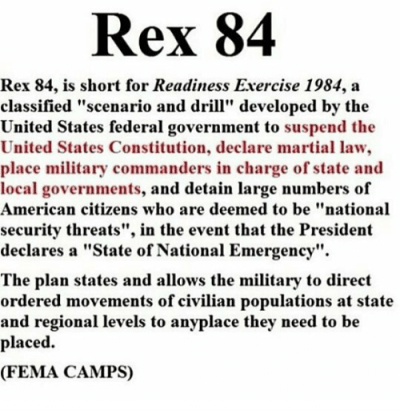
It was presented as an exercise to test military assistance in civil defense in times of national emergency, but in fact the plan was anticipating civil disturbances, major demonstrations and labor strikes that would affect continuity of government. The anticipated civil unrest from the FED-induced financial crisis that devastated the middle class was considered “subversive”, REX-84 being an authorisation for the US military to implement government-controlled movements of civilian populations at both state and regional levels, the arrest of many segments of the American population, and the imposition of martial law. (1) (2)
The Rex-84 program was created under the pretense of a possible mass exodus of illegal aliens attempting to cross into the US from Mexico, but when the program accidentally became public during the Iran-Contra Congressional hearings in 1987 it was revealed that it was in fact a secret federal government program
“to suspend the Constitution, declare martial law, assign military commanders to take over state and local governments, and detain large numbers of American citizens determined by the government to be ‘national security threats’.”
This was part of a master contingency plan for which the FBI today has a primary list of more than 100,000 Americans, and a secondary list ten times larger, who are targeted to be rounded up as subversives, including labor leaders, scholars and public figures, the incarceration designed to isolate political dissidents and to contain civil unrest.
And these are prison camps, ringed with fences, barbed wire and armed guards, not places from which escape would be likely, and they were designed to hold Americans, not Mexicans. (3)
There is no question the US government is prepared for the possibility of widespread and uncontrollable domestic disorder. This program in place and building for years was encouraged by fears of a massive public uprising in the wake of the 2008 banking fraud.
 US Supreme Court Justice Antonin Scalia said some years ago that concentration camps were a likely future reality for Americans and that the Supreme Court would not do anything about the tyranny should the executive branch think it necessary. He mentioned the World War II internment of Japanese in the US and said of these camps,
“you are kidding yourself if you think the same thing will not happen again”. (4) (5)
In 2009, as the US financial crisis deepened and concern about public unrest was increasing, the US National Guard was posting job opportunities for “Internment/Resettlement Specialists” to work in “civilian internee camps” within the United States, and Halliburton [former] subsidiary KBR was seeking subcontractors to staff “emergency environment” camps located in five regions of the US. Earlier, in 2006, KBR was contracted by Homeland Security to build detention centers designed to deal with “the rapid development of unspecified “new programs” that would require large numbers of people to be interned.” (6) (7)
The US has for many years been dangerously close to a situation where, if the American people take to the streets in protest, these internments can be easily carried out. By 2004, there were more than 800 of these internment camps in the US, all empty, but all fully operational, staffed, and surrounded by full-time guards, ready to receive prisoners. I have seen photos. As well, many military bases are slated to be closed down and used as extra civilian prisons if the need arises, all intended for the internment of dissidents and others deemed “potentially harmful to the state”. Some camps can each hold 20,000 or more prisoners, a massive effort at civilian population control, and the program is still expanding. The US is very near the point today where political dissidents questioning the actions of their government will risk being rounded up and forced into these prison camps, essentially a government plan to forcibly suppress political dissent under the guise of rooting out domestic “terrorism”.
The US government defines many Americans as having become “pre-revolutionary” from their outrage at the 2008 government-approved housing collapse, with increasing concern that massive civil unrest would emerge from both the poverty-stricken lower classes and the eviscerated middle class, leading to what would become an internal civil war. This is the reason that the FBI and DHS increasingly focus their “anti-terror” apparatus on white middle-class Americans like the Occupy Wall Street protestors who were categorised as “low-level terrorists”.
In 2008, the Washington Post reported government plans to station many tens of thousands of troops inside the country for purposes referred to as “domestic security” in the light of massive civil unrest that would follow an economic collapse or serious financial crisis, perhaps stemming from 2008.
According to the government document,
“Widespread civil violence inside the United States would force the defense establishment to reorient priorities in extremis to defend basic domestic order and human security”,
stating that the military may be needed to quell “purposeful domestic resistance”. To prepare for this quelling of resistance, the US has resorted to demonising its own citizens, a recent study funded by DHS conveniently identifying those Americans who are “suspicious of centralized federal authority” and who exhibit signs of being “reverent of individual liberty”, and re-categorising them as “extreme right-wing” terrorists. (8) (9) (10)
The program is designed to “reduce and eliminate” all domestic resistance to the US government. “Crowd control agents” will be used for this purpose, and government agencies will be involved in “gathering information on dissidents” to identify all those who have either “threatened or are creating disturbances”. The US military produced a manual on what it termed “Civil Disturbance Operations” that outlines how military assets will be used to “help local and state authorities to restore and maintain law and order” in the event of mass riots and civil unrest. Military and other law-enforcement will be tasked with “breaking up unauthorized gatherings” and restoring order by
“presenting a show of force, establishing roadblocks, breaking up crowds, employing crowd control agents, and other operations as required”.
The same government manual describes how prisoners will be processed through these internment camps, and outlines how these internees would be “re-educated” while detained in prison camps inside their own country by their own government. A leaked military document titled ‘FM 3-39.40 Internment and Resettlement Operations’, outlined a program for “re-education camps” in the US which contained plans for “political activists” to be “pacified” by various psychological officers into “sympathising” with the government and into “developing an appreciation of US policies” while detained in prison camps inside the US. The document was restricted to Department of Defense personnel but was been leaked and posted online. It outlined policies for “processing detainees into internment camps” and made clear these operations would be used for domestic civilian situations. (11) (12) The full document is available here: (13)
“Once the detainees have been processed into the internment camp, the manual explains how they will be “indoctrinated”, with a particular focus on coercing political dissidents into expressing support for U.S. policies.”
Part of the stated role of the psychological officers would be to identify political activists, political leaders, ‘malcontents’, and other agitators, and to develop and execute appropriate
“indoctrination programs to reduce or remove antagonistic attitudes”.
However, their first task would be to “pacify and acclimate detainees to accept the internment facility’s authority and regulations”.
There are also disturbing insights into the government’s intention to use brutal force to violently quell any civil political unrest. The manual includes a long list of weapons meant to be used against protesting American civilians, including anti-riot grenades. Page 20 of the manual authorises the use of “deadly force” in confronting these peaceful political “dissidents”, the murderous intent made disturbingly clear with the directive that “Warning shots will not be fired” first. Northcom itself, in a September 8, 2008 Army Times article, said the first wave of the deployment, which was put in place on October 1st at Fort Stewart and at Peterson Air Force Base in Colorado Springs, would be aimed at tackling “civil unrest and crowd control”.
In November of 2013, Forbes Magazine ran an article based on the AP newswire, detailing that DHS had been assembling a massive weapons arsenal since 2011 or 2012. (14) The AP reported that Homeland Security had been stockpiling ammunition by buying more than 1.6 billion rounds of ammunition in addition to a prior purchase of 1.5 billion rounds, for a staggering total of more than three billion rounds. This is more ammunition than the US military used collectively in all its wars in the last decade, and represents about ten shots for every man, woman and child in America. There were also confirmed purchases by various government agencies, of hundreds of millions of hollow-point rounds to be delivered to dozens of locations around the US. These bullets are so lethal they are banned for battlefield use during wars because they mushroom and fragment on impact, their only purpose being to cause the maximum possible damage to internal organs. Also purchased were large numbers of magnum rounds with the power to penetrate walls, and a frightening hundreds of millions more rounds of specialty sniper ammunition.
Even more, it was reported in early 2015 that DHS had placed orders for massive amounts of other kinds of anti-civilian weaponry termed “Less Lethal Specialty Munitions”, which were described as “an arsenal of specialized weaponry for training and deployment against crowds”. These included flash grenades, light bursts, gas and chemical grenades, riot rounds, rubber bullets, and much more. These are all heavy-duty crowd control and civilian intimidation weapons. They have no other purpose and, in the volume in which they are being purchased, it is clear the US government is expecting some very serious civil disturbances, possibly a revolution, and soon.
As recently as 2018, Forbes was reporting more of the same, that these purchases have reached an astonishing ubiquity. It isn’t only Homeland Security who is arming to the teeth. Thousands of agents at the IRS now have tactical assault rifles and heavy weaponry.
Screenshot Forbes, October 20, 2017
The Small Business Administration and the Department of Veterans Affairs have purchased thousands of Glock handguns. The Health Services agencies purchased millions of dollars worth of Glock handguns – equipped with silencers. The US Geological Survey, which is a weather bureau, purchased millions of dollars worth of Winchester Black Shadow shotguns with large bulk ammunition orders in addition to Glock handguns. Even the Department of Education purchased millions of dollars worth of Glock handguns, shotguns and body armor. I am unaware of any nation in the world where the income tax department or the departments of education and health care require huge amounts of military-grade weapons, much less body armor and gun silencers.
In June of 2016, RT reported that non-military federal agencies had more firepower than the entire US Marine Corps, this including agencies like education, health and income tax. (15) RT documented, a new report where 67 non-military federal US agencies spent $1.50 billion purchasing guns, ammunition and military-style equipment. The details came from the Militarization of America: non-military federal agencies purchases of guns, ammo, and military-style equipment, published by the non-profit good government group OpentheBooks.com. (16) (17)
In addition to the massive purchase of ammunition, DHS was showing off its acquisition of heavily armored and mine-resistant personnel carriers which have been seen on streets all across America and verified with photos and video. Forbes noted that these vehicles are equipped with gun ports and are “designed to withstand IEDs, mine blasts and 50 caliber hits to bullet-proof glass”, and asked why they would be necessary on American streets. The DHS also purchased large amounts of riot gear and bullet-proof checkpoint booths, as well as a purchase of 7000 automatic rifles, and 2700 armored vehicles, and the deployment of drones with allowance for their use on US citizens.
The DHS is becoming a massive domestic army to handle domestic conflict. In the words of Ellen Brown,
“somebody in government is expecting some serious civil unrest …”
DHS chief Janet Napolitano claimed this was to prepare for a mass influx of immigrants into the United States that would require the “shelter and processing” of large numbers of people, but this is nonsense. By whom will the US be attacked that Homeland Security would be responsible for defense, and from where would arise a mass of peaceful immigrants so large as to require more than three billion bullets to repel them?
This is the same government that recently shut down many of its operations including most of the National Parks, for lack of funds, yet had sufficient money to purchase billions of bullets for a non-existent civilian army. A spokesperson was quoted as justifying this massive purchase to “help the government get a low price for a big purchase”, and claimed DHS used “as many as 15 million rounds every year in training exercises”. Someone should ask DHS to divide 3 billion by 15 million, which tells us the ammunition purchase will supply DHS needs for the next 200 years. The authorities naturally attribute criticism and hard questions to mentally-unbalanced ‘conspiracy theorists’, but this is one more instance where actions appear irrational and the official story is so full of holes that it makes no sense.
Another DHS purchase that produced a firestorm of anger when its news went viral, was the supply of what we might call ‘unconventional’ paper targets which were used as practice shooting targets in ‘training exercises’. These targets consisted of figures of American civilians in residential settings. They included small children, a young pregnant mother, old women in robes, grandmothers and grandfathers in their kitchens and front yards, teenagers in parks, little girls and more, perhaps the most frightening part being that all these were termed “no hesitation targets”, meaning to fire without hesitation at the sight of these enemies. What could possibly justify the supply of such targets to a military force, with such an instruction? The US fedbiz.op website took down the solicitation after Infowars broke the story, and eventually apologized publicly for creating these targets of small children.
In early 2014 it was reported that the US military had built a $100 million fake city of about 300 acres in Virginia, for use in training troops for the occupation of cities, complete with a sports stadium, bank, school, and an underground subway in order to train for future combat scenarios in American urban areas. The subway carriages even carry the same logo as those in Washington DC. More disturbingly, it was reported that
“soldiers are being taught that Christians, Tea Party supporters and anti-abortion activists represent a radical terror threat, mirroring rhetoric backed by the Department of Homeland Security which frames “liberty lovers” as domestic extremists.”
The DHS is also building a 176-acre secure compound in the lowest-income area of Washington, DC, which seems almost certainly a preparation for civil war. (18) (19)
The trigger could be an economic collapse that causes angry Americans to flood the streets similar to the Occupy Wall Street and other scenes witnessed across both the US and Europe during the last FED-induced economic crisis. It is worth noting that the Occupy Wall Street protest had the right idea but the wrong target. Wall Street is just an idea, and a bit player. The ultimate cause is the FED, and that should have been their focus. But the FED, the bankers and the FBI saw this coming and infiltrated and financed the protest groups as a way to take control and deflect them from any useful action or focus.
In the middle of 2013 several US local media reported the DHS was conducting widely public but still “top secret” exercises categorised as “full scale terrorism drills” across the entire nation with the stated purpose of making citizens “feel safe”, but which resulted in thousands of terrified people not knowing how to respond to what appeared as a domestic invasion by the US military. People were capriciously apprehended and released after having their belongings searched, but nevertheless urged to celebrate their “independence” from tyranny. These drills were presented as readiness training for potential terrorist incursions, though DHS failed to mention the New York Times observation that all the domestic terror plots in the United States over the last decade were “hatched by the FBI”.
One other worrying development was the appearance of US military C-130 cargo planes apparently spraying mosquitoes over various Florida cities at an altitude of less than 50 meters. Pest control is hardly a military duty, these events immediately reminding me of the US military spraying bacterial and other pathogens over many parts of the US in various CIA-related experiments on the domestic population. These low-altitude overflights are almost certainly practice runs for potential crowd control in the future, for dispensing tear gas or other non-lethal (or lethal) material that would disperse or disorient protestors. I cannot imagine all the possibilities, but the US military most certainly is not going into the mosquito-spraying business. (19) (20)
US Major General Curry was quoted as stating,
“We have local police, backed up by each state’s National Guard, backed up by the Department of Defense. So in addition to all these forces why does Homeland Security need its own private army? Why do the SSA, NOAA and other government agencies need to create their own civilian security forces armed with hollow nose bullets?”
Some may want to dismiss this as just another conspiracy theory, but we might recall the words of Senator Daniel Inouye in 1987,
“There exists a shadowy Government with its own Air Force, its own Navy, its own fundraising mechanism, and the ability to pursue its own ideas of national interest, free from all checks and balances, and free from the law itself.”
The threats to civil liberties go much farther and are much more ominous than I’ve related so far. Another factor is the spate of secret Executive Orders that Obama signed without Congressional approval, observers claiming those orders violated existing laws and were therefore illegal but that the powers behind the White House considered themselves above all law. One of the most sinister was Executive Order 13603 which granted authorization to seize possession of every possible resource, including property and “all food storage facilities”. One author wrote that “This extremist, maniacal edict is designed to enforce our submission, rendering us totally dependent on Big Brother government or face the obvious – starvation and extermination.”
What could possibly have instigated such an order, unless the government is preparing for an all-out war against the American people? What possible excuse, during peace-time, would a “democratic” government have, for the initiation of a program to seize all the “food, water and food storage facilities” of a nation? If we add these to the internment camps and the bullets, what conclusions are possible?
Another ominous threat is that much of the NSA’s illegal intelligence-gathering activities were transferred to the Department of Homeland Security, the same people with the 800 internment camps and the 3 billion bullets. The apparent reason is that the NSA can collect information on domestic political dissidents but has no police powers to act on them, whereas DHS has legislative authority to gather, arrest and incarcerate anyone on their watch lists. DHS is apparently creating a “graded list” of these targeted so-called “security threats”, with those at the top of this list assessed according to how widely disseminated are their anti-establishment views, the followers they appear to have, and these will be the first to disappear into the internment maze. This new policy gives Homeland Security full authority to effectively terrorise the American people under a pretense of controlling domestic terrorism. When we consider these two items, Executive Order 13603 and the new powers granted to DHS, the only possible response can be fear.
If all this isn’t enough, DHS was revealed to have a secret procedure for the instant shutting down of all private communications in America, including mobile phone networks, a program accidentally revealed when government officials in San Francisco disabled all mobile phone calls during a peaceful protest against yet another man shot dead by the police. The administration insisted it had the legal authority to control these communications “during times of national crisis”, “for the purpose of ensuring public safety”, but it has also given DHS the power to actually “seize” all privately-owned communications facilities in order to prevent any civilian communications occurring. Some individuals applied to the courts for further information on these new procedures and policies, but DHS claimed it was “unable to locate or identify any records” in relation to the matter. Nothing more to be said, but it’s difficult to avoid the conclusion that the US government is quickly becoming fully prepared for war against its civilian population.
With the NSA revelations by Edward Snowdon, there is no longer any question that many US government agencies have been monitoring and gathering information on large numbers of known American political dissidents, these agencies including the NSA, FBI, CIA, DHS, various military groups and another 70 or 80 so-called “public-private fusion centers” scattered around the US. Former NSA Technical Director William Binney claimed in an interview that the NSA had a list of 500,000 to one million people in the US who were closely watched and whose every communication and bit of personal data were recorded. These are not terrorists in any sense, but potential leaders of political dissension and therefore potential suspects in the event of civil disturbances.
There also exists a database known as “Main Core”, containing names of Americans who might be considered troublesome, and which knowledgeable sources claim contains the names and communication information of more than eight million Americans who would be potential suspects of political activism, which would include “national opposition to US military invasion abroad”. It includes political dissidents, environmental and other activists, political and tax protesters, lawyers and professors, publishers and journalists, and many more who are most likely harmless, average people.
The database apparently contains all to and from email addresses, all email content, all in and out phone numbers plus duration of calls, the amounts and locations of ATM withdrawals, all credit card purchases and much more. It appears that this dissident surveillance program dates back to the early 1980s, the time of our Great Transformation, when it was revealed that Oliver North, operating from a secure White House site, had been using a database called PROMIS which was part of the REX-84 plan, to track dissidents and potential troublemakers within the United States. This database was meant to identify and immediately locate perceived “enemies of the state” if mass civil disturbances were to break out. (21) (22)
The Middle-Class Revolt
In late 2008 a leaked internal memo from Tom Fitzpatrick, Citibank’s chief technical strategist, contained ominous predictions for American civil society after the vicious financial crisis. He wrote,
“The world is not going back to normal ‘after the magnitude of what they have done’”.
Fitzpatrick claimed that the massive destruction of the middle class, the draining of all the wealth from the population, and the QE money creation by the FED would either bring about a resurgence of inflation or that the US would fall into “depression, civil disorder and possibly war”. He claimed that with the passing of each week and month there was a growing danger that could lead to political instability, a risk of domestic unrest because people were becoming increasingly disenfranchised and impoverished.
Lest we succumb to the temptation of accepting the 2008 financial crisis and the resulting loss of homes as an accident of fate, it would be wise to consider these quotes by Montagu Norman, Governor of The Bank of England prior to the crash of 1929, addressing the United States Bankers’ Association, New York, Idaho Leader, 26 August 1924.
“Capital must protect itself in every possible way, both by combination and legislation. Debts must be collected, mortgages foreclosed as rapidly as possible. When, through process of law, the common people lose their homes, they will become more docile and more easily governed through the strong arm of the government applied by a central power of wealth under leading financiers. These truths are well known among our principal men, who are now engaged in forming an imperialism to govern the world.”
And his thoughts on democracy:
“By dividing the voters through the political party system, we can get them to expend their energies in fighting for questions of no importance.” “It is thus, by discrete action, we can secure for ourselves that which has been so well planned and so successfully accomplished.”
The US government has developed an increasing fear of its own middle class, wide awake to the protests and uprisings in other nations where governments have colluded with the international bankers and large multi-nationals to gut their middle classes and effect the same transfer of wealth to the top 1% as occurred in America. People in many Western societies have become disgruntled and bitter at the increasing evidence that their vaunted democracies have been usurped by the unrestrained capitalists, creating intolerable situations where the people are sacrificed for the increasing wealth of that same top 1%.
At first, the US government exhibited a grim and rather reprehensible kind of satisfaction at watching the misery in other nations where the FED and IMF and the International Bankers had succeeded in their aims of wealth transference, but it also realised that the same boiling rage existed in America and perhaps much less controllable.
US citizens were protesting against a government that was no longer democratic in any sense, and was both unwilling and unable to repair a hopelessly corrupt and inefficient system. They finally awoke en masse and objected to ingrained corruption, shoddy public services, high taxes, homelessness, unemployment, rising inflation, the development of a police state, and more. It is public rage at the realisation of having been betrayed by a “democratic” government that converts civil unrest into political activism and revolution, and it is this that lies at the heart of the FBI’s categorisation of US political dissent as “domestic terrorism”. This terminology is important because the US, in all its hypocrisy for democracy, free speech and freedom of assembly, cannot face the world with open and apparent suppression of political dissent. Therefore, US citizens protesting against their own government cannot be exercising free speech but rather anarchy and terrorism, thereby justifying the use of deadly force to control dissension. The powers that control America have no interest in fairy-tales of freedom. They are interested in wealth and control, and the people in any country are irrelevant – including those in the US.
Americans have experienced first-hand the destruction of their quality of life; they see clearly the disappearance of future opportunity for their children, and they recognise better than most the loss of their freedom of expression which they have so valued. And they know it is precisely the retraction of that expression that is necessary for their no-longer-democratic government to maintain control. This is where their economic and social dissatisfaction mutates into political activism – revolution, in fact – and it is this realisation among the authorities that has spawned the internship camps, the billions of bullets purchased, and the “shoot to kill” orders.
Revolution – The Struggle for Class Power
Buried in the litany of troubles the US is facing today is the primary fact that the nation is engaged in a brutal class war, a struggle for class power that the bottom 99% are losing. This war was declared in the late 1970s, gained great momentum in the 1980s and 1990s, and is still accelerating toward its final desperate conclusion. There are few signs on the horizon that cause hope for a change in direction, and I fear it may be too late.
There is still power with the people themselves, and indeed without the both active cooperation and silent complicity of the people, none of the pathological descent into despair would have been possible. Probably the only force in America that can change what is happening is the combined force of labor. This isn’t so easy today, since the government killed most labor organisations and there is now little if any leadership. A total withdrawal of labor succeeded in forcing a new social contract in 1946 and may be the only power remaining today, but times have changed and tactics must change too. If all unions withdrew their services with the full cooperation of unorganised labor, change might be possible.
But realistically, there is no hope that such a mass protest could be organised even though it is the only possible way to get the attention of whatever remains of a conscientious government and force through a reversal of the tide. In any case, taking to the streets is unlikely to produce pleasant results. If the police don’t have enough bodies to beat up and arrest everyone, DHS has its internment camps, its 3 billion bullets, its years of practice with “no-hesitation” human targets, and it will use all of them.
The only safe way for Americans to go on strike today is to stay at home. On this topic, one internet commenter wrote,
“Just don’t go to work. There is no need to picket in the streets to be on strike, and the factories and offices will be just as quiet and empty, and the profits just as non-existent. The police cannot possibly conduct home-by-home visits to beat up strikers one by one, and no military, even the DHS, is efficient when trying to blow up houses scattered all over the county, one by one. Strikers are probably safe if they stay at home and lock their door.”
Another wrote,
“Another tactic is for Americans to simply quit shopping. They don’t have the money anyway, and don’t need all that useless junk. Don’t buy anything you don’t actually need, and delay even those purchases as long as possible, especially the big-ticket items like cars and furniture. If at all possible, delay every purchase for at least one year. As much as is practicable, stop driving your car. Cancel your cable TV and read a book.” Your grandmother gave you advice 100 years ago that is still valid today: “Use it up, wear it out. Make it do. Do without.”
A third commenter gave this advice:
“One thing you can do to get their attention is to stop paying your bills. VISA and MasterCard can’t cancel 800 million credit cards at the same time, and no bank can process 100 million mortgage defaults. No system can cope with massive non-payment of debt. You are their only source of money and you can ensure they don’t get any of it. That will wake them up. Tell them you’ll begin paying when the overseas corporate tax holiday is over, when high income taxes are reinstated for the rich, when the individual bankers are in prison and when the lost jobs begin returning. This isn’t foolproof, but it’s the best I can do.”
And finally, a more ambitious poster offered these comments:
“Today, the US State Department, the CIA and the FBI pride themselves on their ability to use Twitter and Facebook to cause civil unrest, chaos, violence, and even revolutions, in other countries. It may not have occurred to them that the same tools they use against everyone else can be just as easily used against them. The CIA used Gene Sharp and his Einstein Institute to prepare the Otpor civil disobedience manuals that our government used as the gunpowder to destroy Jugoslavia, and as the template for a dozen other “color revolutions” of which it was so proud. Copies are freely available on the internet.”
William Blum again:
“As I’ve said before: Inasmuch as I can’t see violent revolution succeeding in the United States (something deep inside tells me that we couldn’t quite match the government’s firepower, not to mention its viciousness), I can offer no solution to stopping the imperial beast other than this: Educate yourself and as many others as you can, raising their political and ideological consciousness, providing them with the factual ammunition and arguments needed to sway others, increasing the number of those in the opposition until it raises the political price for those in power, until it reaches a critical mass, at which point … I can’t predict the form the explosion will take or what might be the trigger … But you have to have faith. And courage.”
Rebuilding America
 This is an amended list of actions Americans must take if they want to bring their country into the community of nations as a civilised member instead of its present status as a genocidal bully, and to begin healing the nation itself. It is compiled from my own notes with the inclusion of excerpts from a speech made by Chris Hedges at Northeastern University. (23)
Discard the existing two-party political system as diseased and useless, and form one new party with a totally new slate of legislators not formerly involved in government. Their first tasks would be to:
1. Arrest all war criminals on American soil. Begin with both Bushes, Cheney and Rumsfeld, Powell and Rice, both Clintons, Kissinger, Albright, and a long list of other White House and Congressional staff, on charges of treason, war crimes and crimes against humanity.
2. Disband the Federal Reserve Banking System and repudiate all outstanding debt to the FED. The government would, according to the law and constitution, issue its own currency from this point forward.
3. Force the break-up of all the big banks and eliminate interstate banking. Nationalise the so-called investment banks like Goldman Sachs, confiscate their assets and shut them all down. Reintroduce banking sector regulations as was done after the 1930s, to ensure a catastrophe cannot recur, with violations punished by mandatory prison sentences. Outlaw program stock trading by the banks. Force the banks to revert to simple banking functions to serve the economy.
4. Disband the CIA and all its clandestine projects by cutting off all funding. Confiscate all CIA records, files, computers, data, and make the details public. Emasculate the FBI and all its executives and officers. Arrest the planners and perpetrators of all false-flag ops. Kill the NSA. Immediately cease all domestic espionage on US citizens. Cut off all funding, seize all bank accounts and confiscate all records and documents. Bomb the Arizona data storage facility to rubble. Kill the Department of Homeland Security and dismantle and close all internment camps within the continental US.
5. Disband the NED, USAID, the VOA and the 100+ other subversive NGOs that are used today to destabilise the governments and societies of other nations. Recall all CIA espionage agents from foreign embassies and consulates, who constitute about 80% of all US foreign “diplomatic” staff. Designate all Foundations and Think Tanks as enemy aliens, and shut them down.
6. Reduce the military budget by 85% and close all foreign military bases. Bring home all foreign-based military personnel and give them jobs guarding the bankers.
7. Totally eliminate the private sector from infrastructure and social services and confine it to commerce where it belongs. Roll back deregulation and privatisation, reclaiming all public infrastructure to be operated by the government for the common good. Especially kill the despicable private prison system, and free the more than one million who should never have been in prison at all. Kill the movements to debtor’s prisons and civil forfeiture before they gain any more momentum, and pass harsh legislation that holds policemen individually responsible for their crimes.
8. Begin immediate construction of a system of publicly-owned and operated hospitals and medical clinics, and guarantee that all citizens have access to free or easily-affordable health care. Eliminate all insurance companies from the health-care process. Restore funding for universal education.
9. Make all lobbying illegal, with automatic prison sentences for influence-peddling. Designate lobby groups like AIPAC as criminal organisations and hostile enemy aliens, and treat them accordingly. Kill the SuperPacs and corporate donations. Eliminate all corporate contributions to election campaigns, and limit individual contributions to $1,000 maximum. Break the corrupt Zionist control of Congress, Wall Street, the media, the World Bank and the IMF. Terminate their globalism and any reference to a New World Order. Eliminate immediately all funding and financial support for Israel.
10. Eliminate legal immunity for the elites. Make illegal the payment of corporate fines for personal crimes. Put the people in prison. Levy an 85% income tax on all corporate profits being held outside the country by US-based multinationals. Reinstate the taxes on the rich and very rich. Eliminate personal tax breaks on capital gains and institute an 85% tax on all income over $500,000 per year.
11. The media monopoly must be broken by forcing de-centralisation and pushing the ownership once again into thousands of individual companies owned by totally unrelated parties. The current control of the media must be dismantled because of the Zionists’ propaganda and the Hidden State’s political agenda. Force the disintegration of all media holding groups and wide dispersion of all media, restricting ownership to only one newspaper or TV station per market. Outlaw opinion-based journalism and make untruthful news reports punishable by public flogging.
12. Eliminate GM food, or at least legislate full disclosure on food labels. Eliminate factory farms; institute extensive monitoring and harsh penalties for food chemical violations.
13. Use the money collected from the rich, the bankers and the FED to begin repairing America’s dilapidated infrastructure before any more dams and bridges collapse.
14. Close all the torture prisons. Close Guantanamo, Diego Garcia, Abu Ghraib, and the other torture prisons and demand an accounting of all prison ships and their human cargo. Close the School of the Americas and destroy all the torture manuals.
15. Emasculate the US President, the Presidency, and the White House, and return all power to Congress because it is the concentration of power in the office of the President that has permitted the total alien control of all vital parts of the US government.
16. Eliminate all US-sponsored sanctions against other nations, especially China, Russia, Syria and Iran. End the illegal occupation of Hawaii, Puerto Rico, Afghanistan, Iraq and Libya. Get out of the Ukraine. Dismantle immediately all organised interference in the internal affairs and elections of other nations. Refund the $100 billion of Iraqi gold and cash seized, and the similar amount from Libya.
*
Note to readers: please click the share buttons above or below. Forward this article to your email lists. Crosspost on your blog site, internet forums. etc.
Larry Romanoff is a retired management consultant and businessman. He has held executive positions in international consulting firms, and owned an international import-export business. He lives in Shanghai and is currently writing a series of ten books generally related to China and the West. He can be contacted at: 2186604556@qq.com
Notes
(1) Rex 84: FEMA’s Blueprint for Martial Law in America
(2) Rex 84 – Your Internment Camp Awaits You
(3) U.S. Concentration Camps: FEMA and the REX 84
(5) https://www.washingtontimes.com/news/2014/feb/3/justice-scalia-to-lecture-at-univ-of-hawaii/
(6) Army National Guard Advertises for “Internment Specialists”
(7) Video: Become a FEMA Camp Internment/Resettlement Specialist
(8) http://www.washingtonpost.com/wp-dyn/content/article/2008/11/30/AR2008113002217_2.html?hpid=topnews
(9) Pentagon Plans To Keep 20,000 Troops Inside US To Bolster domestic security
(10) Washington Post: 20,000 More U.S. Troops To Be Deployed
(11) FM 3-39.40 INTERNMENT AND RESETTLEMENT
(12) FM 3-39.40 INTERNMENT AND RESETTLEMENT OPERATIONS
(13) https://www.infowars.com/yes-the-re-education-camp-manual-does-apply-domestically-to-u-s-citizens/
(14) Why Are Federal Bureaucrats Buying Guns And Ammo? $158 Million Spent By Non-Military Agencies
(15) 24 Jun, 2016; Non-military federal agencies have more firearm authority than entire US Marine Corps
(16) https://www.openthebooks.com/the-militarization-of-america–open-the-books-oversight-report/
(17) https://www.openthebooks.com/openthebooks_oversight_report_-_the_militarization_of_america/
(17) Asymmetric Warfare Group Built a Fake City in Virginia
(18) US army builds fake city to shoot at during training
(19) https://www.cbsnews.com/news/texas-enlists-u-s-air-force-to-spray-for-mosquitoes-after-harvey/
(20) Pentagon Misinformation Ops Target Press and Public
(23) http://calendar.northeastern.edu/event/political_economy_forum_presents_chris_hedges
Copyright © Larry Romanoff, Moon of Shanghai, 2020
Foiling Predictions, Russians Did Not Go Hungry After 2014
Natylie Baldwin, in this excerpt from her new book, describes what happened after the U.S. and EU sought to punish Moscow with agricultural sanctions.
2019 view of Moscow International Business Center. (Dzasohovich, CC BY-SA 4.0, Wikimedia Commons)
By Natylie Baldwin | Consortium News | June 3, 2020
A common response in the Anglo-American media to Russia’s counter-sanctions against agricultural imports from the United States and EU in 2014 was that Russians would go hungry and were, therefore, shooting themselves in the foot. Within a matter of days of the announcement, however, numerous Latin American countries, namely Argentina and Brazil, got in line to fill the gap, as well as China, which started selling produce directly to Russia.
More importantly, according to the Food and Agriculture Organization, Russia ranked as one of the top three producers in the world for a range of agricultural products at the time, from various fruits and vegetables to grains, potatoes and poultry. As of 2018, it was the world’s top exporter of wheat. The government has also had plans in place since 2013 to significantly boost the country’s already respectable production of organic produce from small farms and gardens.
Natural Society reported in May 2014 that 35 million Russian families are growing an impressive percentage of Russia’s fruits and vegetables on 20 million acres:
According to some statistics, they grow 92% of the entire countries’ potatoes, 77% of its vegetables, 87% of its fruit, and feed 71% of the entire population from privately owned organic farms or house gardens all across the country. These aren’t huge Agro-farms run by pharmaceutical companies; these are small family farms and less-than-an-acre gardens.
By autumn 2017, Vladimir Putin had publicly set a goal for Russia to become the world’s top producer and exporter of organic agriculture. In the summer of 2018, the Russian president signed legislation creating official standards, labeling and certification procedures for organic products produced for commercial sale in Russia that went into effect in 2020. Government support will be available to organic farmers, and a public registry will be created listing certified producers.
The agricultural sanctions created some immediate problems, mainly temporary shortages of some meat products and price increases due to the need to work out infrastructure issues to accommodate imports from countries at greater distances.
But Russians did not go hungry, as I witnessed plenty of food in markets, from street vendors, and in restaurants in all cities I visited during my trips in 2015 and 2017. There was, however, concern over price increases.
Author Sharon Tennison, who has traveled throughout Russia extensively since 1983, reported the general attitude of most Russians toward Western sanctions during her trip to Moscow and St. Petersburg in September 2014:
The general outlook of Russians I spoke with is one of quiet confidence, saying that sanctions will turn out good for Russia in the long run––that Russia must become self-sufficient––remarking that Russia became infatuated with foreign products in the 1990s. At that time they felt Russia didn’t need to manufacture high-end products that they could purchase them from other countries. However, the situation has changed. Today production has become the “in” discussion wherever one goes. The sanctions have helped bring this about. Several Russians remarked that they hoped the sanctions lasted for three years or more, since that would give Russians sufficient time to learn to manufacture formerly imported items themselves. The Russian government is offering financial support to entrepreneurs who are ready to move into consumer production.
Sanctions Imposed
In March of 2014, the U.S. and the European Union (EU) began imposing sanctions on Russia in retaliation for its “annexation” of Crimea. These initial sanctions were largely comprised of asset freezes and visa restrictions on certain Russian officials. As the situation in Eastern Ukraine escalated, with rebels taking over local government buildings and demanding autonomy from what they perceived as a coup government in Kiev, the list of individuals targeted for sanctions grew.
After the downing of the Malaysia Airlines flight MH-17 in July 2014, the west imposed more wide-ranging sanctions, which included several Russian banks as well as the defense and energy sectors. In March of 2018, there were diplomatic “sanctions” (expulsions) for the alleged Skirpal poisoning, which Russia responded to with its own expulsions. That same month, there were business/personal sanctions against a number of Russians for their alleged interference in the 2016 elections.
In order to provide the most accurate and comprehensive assessment of the effect of Western sanctions on Russia over the past five years, University of Birmingham professor Richard Connolly, in his 2018 book, “Russia’s Response to Sanctions: How Western Economic Statecraft is Reshaping Political Economy in Russia,” describes how Russia’s economy actually works in order to provide a contextual framework for understanding the success or failure of the West’s policy. He concluded that the ultimate effect of the sanctions is likely not what was intended by Washington policymakers.
Economy with Four Sectors
Connolly explains that the Russian economy can be divided up into roughly four sectors.
Sector A generates revenue, or “rents,” in the form of taxes, fees and other benefits that support Sector B. Sector A is comprised largely of fossil fuel and mineral extraction industries but also includes large “agricultural conglomerates,” manufacturers of nuclear power generation equipment, and some defense industry manufacturers. Economic actors in Sector A are highly profitable and competitive in the global market, into which they are successfully integrated. The state also plays a strong role in Sector A industries either through significant ownership stakes, as is the case with Gazprom, Rosneft, and Rosatom, or through strong personal ties among private owners and the political class, as is the case with Lukoil and Novatek.
Sector B is comprised of economic actors that are dependent upon the rents generated by Sector A. This includes companies that are generally not competitive globally and provide goods and services to the domestic market rather than for export. Despite state assistance, they do not always generate consistent profits. Examples include automotive manufacturing, shipbuilding, fossil fuel equipment and some defense manufacturing. Other beneficiaries of Sector A include state bureaucracy workers and pensioners. It is estimated that Sectors A and B together comprise around 70 percent of the Russian economy.
Sector C is independent of Sectors A and B and includes large construction companies, retail and business services, and various small- to medium-sized enterprises (SMEs) in retail, transportation, business support and communications technology. Because these businesses are outside of the Sector A and B relationship, they’re dependent upon successful profit-making and tend to encourage more competition, innovation and productivity, though they are vulnerable to various forms of outside corruption and unfair takeovers. One successful example of a Sector C industry that enjoys significant and growing export rates is computer software.
 The last sector is the financial sector, which, as Connolly points out, developed virtually out of nothing over the past three decades into a system of numerous, largely state-owned or state-influenced banks that provide a wide range of services. However, Russia’s overall financial sector is small in comparison with other middle-income countries, with Sector A and B entities getting preferential treatment in receipt of the limited credit that is available. There are few small banks or other financial institutions that can provide SMEs with credit, as is reflected in the fact that, as of 2016, two-thirds of assets and liabilities were owned by large state-controlled banks.
As Connolly notes, the obvious disadvantages of this system of political economy are hobbled competition, innovation and productivity. It also limits the development of SMEs.
The advantages, however, include support of domestic employment and the funding of social programs. Perhaps most importantly, this system has also enabled the Russian state to cushion the country from the worst potential effects of Western sanctions and even encourage the stimulation of alternative economic investment, which has strengthened agriculture and some industry and finance.
In terms of how Russia responded to Western sanctions, Connolly provides the following summary:
The Russian response was multifaceted and included the securitization of strategic areas of economic policy, a concerted effort to support import substitution in strategic sectors of the economy, and vigorous efforts to cultivate economic relations with non-Western countries, especially in Asia.
Policy of Diversification
Securitization officially justified certain policies using national security and subordinating certain other objectives in the economic realm that might be prioritized under “normal” circumstances. In order to increase Russia’s economic independence or sovereignty, policies of import substitution and “diversifying” its range of foreign economic partners and the extent of those relations were implemented.
Import substitution involved increasing the proportion of goods and services in Russia that were produced domestically. As an official policy, it was begun in earnest after the imposition of Western sanctions. By 2015, the government was providing federal budget funding, facilitation of loans and access to state procurement funds as well as institutional support to specific sectors of the economy, which included the provision of legal and regulatory frameworks for such policies. In 2016, a plan was presented by Russia’s minister for industry and trade that encompassed “2,000 projects across nineteen branches of the economy. These projects were to be carried out between 2016 and 2020.”
By early 2018, there were 2,500 projects worth $38 billion that were to be completed by 2020. The areas of priority for industrial manufacturing included power equipment, oil and gas equipment, machine tool and civil aviation manufacturing, and agricultural machinery, all of which had import levels between 50 percent and 90 percent.
Gains in domestic food production were seen quickly as Russia became the world’s No. 1 supplier of wheat in early 2018, subsequently capturing over half of the world’s market. Wheat exports continue to increase; sales to other nations increased by 80 percent during the first half of 2018 over the same period in 2017.
Diversifying foreign economic relations is pretty self-explanatory, and in this case it focused heavily on countries in Asia such as China, India, Vietnam and South Korea, as well as Turkey and Latin America. Connolly points out that Russia did not present this as a “zero-sum” action and still conducts most of its trade with various European countries (46 percent of exports and 38 percent of imports). This fact should be considered when assessing the credibility of accusations against Putin that he wants to destroy the EU.
President Vladimir Putin meeting with German business executives, Nov. 1, 2018. (The Kremlin)
China, however, has now become Russia’s single largest trading partner, accounting for 10 percent of Russia’s exports and 22 percent of its imports. But this figure alone does not begin to provide the full picture of Russia’s increasing partnership with Eurasia in general and China in particular.
According to Asia Times correspondent Pepe Escobar, who has been closely following the trend of Eurasian economic integration for several years, what’s known in Russia as the “Greater Eurasia” project was recently presented to the Council of Ministers in Moscow and is now largely accepted as an entrenched foreign policy guide for Russia’s future.
After interviewing three top Russian academics and policymakers who have been championing the Greater Eurasia project for years, Escobar explained that the policy would not preclude continuing a relationship with Europe, recognizing that the Russian elite has been intimately influenced by European culture and trade and technology since the time of Peter the Great, but is meant to be a rebalancing toward the inevitable economic center that will soon be led by Asia and to serve as a “civilizational bridge” between east and west.
The New Silk Road
Situated as it is geographically, Russia is in a perfect position to play this role, serving as a cultural connector between the Enlightenment and the Mongols and as a physical connector between Europe and Asia. In terms of the latter, Russia will play a pivotal role in connecting China’s New Silk Road (aka Belt and Road Initiative, or BRI) through Russia and Central Asia and into Europe.
Escobar writes:
Greater Eurasia and the Belt and Road Initiative are bound to merge. Eurasia is crisscrossed by mighty mountain ranges such as the Pamirs and deserts like the Taklamakan and the Karakum. The best land route runs via Russia or via Kazakhstan to Russia. In crucial soft power terms, Russia remains the lingua franca of Mongolia, Central Asia and the Caucasus.
And that leads us to the utmost importance of an upgraded Trans-Siberian railway—Eurasia’s current connectivity core. In parallel, the transportation systems of the Central Asia “stans” are closely integrated with the Russian network of roads; all that is bound to be enhanced in the near future by Chinese-built high-speed rail.
. . . And all across the spectrum, Moscow aims at maximizing return[s] on the crown jewels of the Russian Far East: agriculture, water resources, minerals, lumber, oil and gas. Construction of liquefied natural gas (LNG) plants in Yamal vastly benefits China, Japan and South Korea.
Iran, Turkey, and India are all pivoting toward Eurasia as well, with a free trade agreement between Iran and the Russian-led Eurasian Economic Union having been recently approved. Iran is also playing a role in the International North-South Transport Corridor (INSTC) to facilitate closer economic cooperation between Russia and India, who have enjoyed cordial relations and strong trade in defense for decades.
But Russia and China’s “comprehensive strategic partnership” — as it is referred to officially by both countries — is much more than economic. In an unprecedented move, China sent 3,000 troops to join Russia in a 2018 military exercise to practice countering NATO in Eastern Europe. In July of 2019, “Russian and Chinese bombers conducted their first long-range joint air patrol in the Asia-Pacific.” To reinforce the strategic importance of Russian-Chinese relations, the day after these maneuvers, the Chinese government published a “white paper” in which it promised to further increase military cooperation between the two countries, partly as a result of the United States’s “undermining” of regional stability.
A former senior national security official in Russia described the relationship to National Interest correspondent Graham Allison as a “functional military alliance.” Allison elaborated that “Russian and Chinese generals’ staffs now have candid, detailed discussions about the threat US nuclear modernization and missile defense pose to each of their strategic deterrents.”
S-400 surface-to-air missile systems during the Victory parade 2010. (Wikimedia)
Allison also reiterated that Russia has lifted its decades-long withholding of advanced military technologies to its eastern neighbor, selling China the S-400 air defense system and partnering in research and development on rocket engines and drones. Furthermore, Russia and China vote the same on the UN Security Council 98 percent of the time, and Russia has supported all Chinese vetoes since 2007.
As evidence that the Russian public will likely support the Greater Eurasia project and Russia’s diversifying of economic partnerships in an eastern direction, recent polling reveals that 69 percent of Russians hold a positive view of China — the exact same percentage that hold a negative view of the United States. Two-thirds of Russians identify the United States as their nemesis, while only 2 percent identify China that way.
Now that we’ve explored how Russia has actually responded to Western sanctions, we can turn to the question of how effective those sanctions have been in terms of what their presumed intent was. As Connolly enumerates, in addition to sending a symbolic message of disapproval of Russia’s actions and to show a united front among Western allies, the intent among some policymakers was to cause significant economic harm to Russia—not just as a deterrent to further “bad behavior,” but with the idea that this would encourage political revolt among targeted Russian elites that would endanger Putin’s government and result in regime change with the installment of a new Russian leader that would be more amenable to Washington’s desires.
The answer is that Washington has once again — in its hubris and ignorance — been hoist with its own petard. As British scholar on Russia Paul Robinson sums up in his review of Connolly’s book:
First, it [sanctions] has created a system that “is less vulnerable to external pressure” than that which existed before, in that it is more independent from the West. Second, it has accelerated a shift in Russia’s place in the global economy towards the East. This obviously has political ramifications which Connolly does not explore. Somewhat perversely, Western sanctions have reduced, not increased, Western leverage over Russia. This is probably permanent.
Moreover, since Russia has weathered the sanctions reasonably well, even using them to strengthen certain sectors of its economy in the long term, the sanctions have likely failed as a tool of deterrence. As Connolly states:
How can policymakers expect sanctions to act as a credible deterrent to third countries when the target country in any given instance might appear to be coping or even flourishing under sanctions? In short, a significant and negative impact on the target economy is a necessary, although not sufficient, condition of sanctions to be effective.
For the policymakers implementing sanctions, it might have been worthwhile to have been briefed by real experts on what Russia’s economy is actually like. If they’d done so, they might have realized that sanctions were likely to have a limited effect on a country that, as analyst Patrick Armstrong has pointed out, has a “full-service economy.” In other words, Russia has demonstrated that it has both the natural and human resources to build sophisticated infrastructure, weapons and defense capabilities, a space station, military and commercial aircraft, heavy trucks and passenger cars, to provide energy and the attendant infrastructure, and to feed its people.
Instead, beliefs that Russia is a “gas station posing as a country,” or that it was still somehow frozen in the 1990s, underpinned policy decisions that ultimately failed.
Natylie Baldwin is author of “The View from Moscow: Understanding Russia and U.S.-Russia Relations,” from which this article is excerpted. “The View from Moscow” is available in e-book and print. She is co-author of “Ukraine: Zbig’s Grand Chessboard & How the West Was Checkmated.” She has traveled throughout western Russia since 2015 and has written several articles based on her conversations and interviews with a cross-section of Russians. She blogs at Natyliesbaldwin.com .
Featured Video
Nima R. Alkhorshid: US military bombs multiple targets on Iran’s Qeshm Island
or go to
Aletho News Archives – Video-Images
From the Archives
British Intel Tried to Make N Irish Gang ‘Shoot Up’ School, Documentary Claims
Sputnik – 23.02.2019
A new documentary, based on an interview with a self-confessed member of the Glennane Gang, gives some insights into allegations that British military intelligence was behind a shocking murder plot to cause the situation in Northern Ireland to “spiral out of control”.
In a documentary, Unquiet Graves: The Story of the Glennane Gang, John Weir, a former officer from the Royal Ulster Constabulary (RUC), alleges that British intelligence tried to persuade paramilitary group Ulster Volunteer Force (UVF) to attack a Catholic primary school at Belleeks in County Armagh.
Weir claimed that the UVF was urged to kill children and teachers in retaliation for the 1976 Kingsmill massacre, in which gunmen stopped a minibus carrying twelve workmen and shot them; only one person survived despite having been shot 18 times.
“The plan that was decided on was to shoot up a school in Belleeks”, he said, adding that the British intelligence plot was to make the situation in Northern Ireland “spiral out of control”. … continue
Blog Roll
 Aletho News
- Nima R. Alkhorshid: U.S. Military Bombs Multiple Targets on Iran’s Qeshm Island
- Iran-Linked Ships Spotted Hovering over Subsea Cables: Report
- New attack on Iran could devastate ‘Israel’, IOF general warns
- Nuclear deterrence: The US-Israeli military aggression against Iran made the unthinkable legitimate
- U.S. Midterms – a Referendum on Israel and Zionist Power
- Twice as many Canadian Jews serve in Israeli military as Canada’s armed forces: Report
- Thousands of Syrian troops set to join Saudi war on Yemen
- Jared Kushner’s Diplomacy for Hire
- Russia backs Tehran’s conditions in talks with US, Iran’s envoy says
- Irish ‘fake news’ expert exposed as fake
- If Americans Knew
- An error has occurred; the feed is probably down. Try again later.
- No Tricks Zone
- Zonal Asymmetry of Temperature Change in the Antarctic Circumpolar Current
- New Study: The Net Fossil Fuel Contribution To Rising Atmospheric CO2 Has Been Zero For 500 Years
- Germany’s Green Energy Transition Becoming Increasingly Expensive…Another 6 Trillion Euros!
- Sudden Stratospheric Warming, Powerful El Niño Combination May Lead To Extreme Europe Cold, Energy Crisis!
- Two New Studies Find Thwaites Glacier Melt Cannot Be Driven By Human Activity Or A Warming Ocean
- E-Cars Reduce CO2 Emissions By Only 41% Compared To Internal Combustion Engine Vehicles
- Predictions Made By Renowned Climate Professor Over Past Decades Have Been Proven To Be Poor
- New Study Suggests Large Regions Of The Pacific Ocean Have Been Cooling For The Last 80 Years
- Germany’s Green Energy Debacle: High Energy Costs Force Kahla Porzellan to Close After 182 Years!
- New Study: 50 Years Of The Most Aggressive ‘Net Zero’ Policies Can Only Affect The Global Climate By 0.03°C

