Assassination Nation
By Jacob G. Hornberger | FFF | January 13, 2020
We are all familiar with the Pentagon’s and CIA’s torture center and prison camp at Guantanamo Bay Cuba, where the U.S. national-security establishment has knowingly, intentionally, and deliberately destroyed protections guaranteed by the Bill of Rights. Those include the right to a speedy trial, right to effective assistance of counsel, right to be remain silent, right to trial by jury, and right to confront adverse witnesses.
It’s worth noting that that the national-security state’s power to assassinate people also violates the Bill of Rights, specifically the Fifth Amendment, which reads in part as follows:
“No person shall be … deprived of life … without due process of law.”
There are two important points to note about that restriction on the power of the federal government:
One, the restriction is not limited to American citizens. By the use of the word “person,” rather than “citizen,” the protection extends to everyone in the world. The federal government is prohibited from killing anyone, citizen or foreigner, without due process of law.
Two, notice that our ancestors included no exceptions to this restriction. That is, the restriction does not say: “No person shall be deprived of life without due process of law, unless the federal government deems it necessary to protect national security.” There are no exceptions whatsoever.
What is due process of law? The term stretches all the way back to Magna Carta, when the barons of England forced their king to acknowledge that his powers over the people were limited, as compared to omnipotent.
Over the centuries, due process of law has come to mean notice and hearing. When it comes to the government’s power to kill people, that means (1) a formal indictment notifying the person what he is being accused of; and (2) a trial, usually a jury of regular citizens in the community, in which the government must prove guilt beyond a reasonable doubt and in which the accused is free to defend himself.
So, there it is, in clear and succinct language: Our ancestors expressly prohibited U.S. officials from killing people without first providing them formal notice of charges and a trial.
That was America’s established system for more than 150 years. No program of state-sponsored assassinations. No federal program for killing people without due process of law.
That all changed after World War II, when the federal government was converted from a limited-government republic type of governmental system to a national-security state form of governmental system.
A national-security state is a totalitarian type of governmental system. North Korea is a national-security state. So is Egypt. And China, Russia, Cuba. And post-World War II United States.
A national security state is composed of a vast and powerful military establishment, an intelligence agency with omnipotent powers, including the power to assassinate people, and a surveillance agency that has the power to maintain a vast system of secret surveillance over the citizenry and others.
In the early days of the national-security state, the CIA just assumed the power of assassination. There was no congressional law delegating that power to the CIA. The CIA began wielding and exercising the power of assassination on its own, as part of the new national-security state form of governmental structure that had been adopted after World War II.
Almost from its beginning, the CIA established an assassination program, which included the preparation of an assassination manual. The manual trained CIA personnel in the art of assassination and, equally important, in ways to prevent people from recognizing the assassination as being state-sponsored. Making killings look like accidents was one of the methods in which CIA assassins would be trained.
Central to this assassination program was secrecy. The national-security state essentially made an implicit deal with the American people: we will exercise dark-side, totalitarian-like powers, including the power to kill people without due process of law, in order to keep you safe, but we will also keep it secret so that you don’t have to be bothered about what we are having to do to protect national security.
As early as 1953, the CIA assassinated federal military scientist Frank Olson because, they felt, he posed a threat to national security. One year later, it had a list of people targeted for assassination as part of its coup in Guatemala, which ousted the democratically elected president of the country, Jacobo Arbenz, and replaced him with an unelected military dictator. That kill list is still classified by the CIA as top secret. In 1961, there was the CIA conspiracy to assassinate Congo leader Patrice Lumumba. In the early 1960s, there were the repeated CIA attempts to assassinate Cuban leader Fidel Castro. In 1963, there was the CIA assassination of President John F. Kennedy. In 1973, there was the CIA orchestration of a military coup in Chile, during which the Chilean national-security establishment tried to assassinate the democratically elected president of the country, Salvador Allende, with missiles fired from the military’s jet planes.
It was all kept top secret, until the 9/11 attacks. From that day forward, the national-security establishment’s program of state-sponsored assassinations came out into the open and became recognized as an official program of the U.S. government, one fully confirmed by the federal judiciary. That’s how the Pentagon and the CIA have turned America into an assassination nation, one in which the U.S. government wields and exercises the power to deprive anyone it wants, including both American citizens and foreign citizens, of life without due process of law, in violation of the Fifth Amendment to the U.S. Constitution.
January 13, 2020 Posted by aletho | Civil Liberties, Timeless or most popular | CIA, Human rights, United States | Leave a comment
After the Assassination of Soleimani, Can We Just Admit that the United States Has No Morality at All?
By Dr. Robert P. Abele | Global Research | January 10, 2020
Qassem Soleimani, the top Iranian military commander, who was assassinated this week by the United States in Baghdad, while he was on a peaceful mission, is just the latest, but perhaps most brazen and alarming, declaration by the United States that it is bound by no law and no moral principles. That is the sign of a morally bankrupt government and a similar culture that would support such actions.
This reflection will examine these two issues: the moral codes and the legal codes that do and necessarily must exist between nations and peoples that the U.S. blithely ignores, most horrendously in the case of the Soleimani assassination. I will assume that we can agree that morality is the condition of legality. If one has no concern for the former, there will be no concern for the latter, except what the law allows one to get away with.
For brevity’s sake, let us limit our moral examination to two moral codes: the U.S. Declaration of Independence, and its underpinnings in John Locke’s philosophy. The Declaration says that it is “self-evident” that all people are have equal moral standing, “unalienable rights,” that “among these are Life, Liberty and the pursuit of Happiness.” To secure these rights is the prupose of government, according to the Declaration. Thomas Jefferson openly admitted to borrowing from the philosopher John Locke to write these words. Locke’s moral concerns were with the freedom of people “to order their actions, possessions, and persons as they think fit,” and with the “state of equality”—i.e., no one has more power than another (i.e., no one has more power over another). Locke stipulated that the “state of liberty…[is] not a state of license”—i.e. no one has the liberty to destroy any other creature beyond what preservation calls for.
The second moral code concerns the morality of war and violence against another country. This is not discussed anymore in the U.S. political arena, and certainly not in the U.S. media. But this does not imply that leaders and media are exempt from moral laws of conduct, even if they choose to ignore them. We should keep them in the public debate arena.
These two principles of morality—one domestically originated, the other internationally—are what keeps governments in check. From the moral realm there are specific issues concerning the use of violence by the State that leaders are called to account for. Especially given current events in the U.S. meddling in the Middle East, we should call them to account for these moral failings.
Just Cause. This refers to an imminent attack by another country on one’s own. Short of this requirement, a just cause is not only lacking, but a military action is not a war. Rather, it is an immoral attack on another nation’s sovereignty. What is the moral cause of Soleimani’s assassination? Our government doesn’t have one. They don’t even appeal to one; they just act as they will. This is the very definition of a “rogue state,” one that has lost the moral authority to be followed by its citizens. By any definition of such a state, it is one that is a threat to the world’s peace. The criteria used to define such a state varies, but it is safe to maintain that any State that ignores or rejects another state’s sovereignty by invasion or assassination of its leaders cannot have a moral standing. Therefore, it cannot claim the assent of its people. Further, those so attacked have a right to fight back, as we now see Iran has done in its missile attack on American installations in Iraq. This “return fire” toward a nation that has attacked them is part of the definition of a “just cause.”
Proper Intention. Intention deals with the principle justifying the goals of contemplated action. As far as we know and can surmise, the only plausible intention of the U.S. in its actions with other nations and with the killing of Soleimani is to exert its own hegemony in the region. This is not a moral principle, and not even a pragmatic one. It is an imperialist one, and thus to be condemned by any moral analysis.
Proper Authority. In the U.S., only Congress can declare war. Further, only Congress can fund war. It has taken responsibility for neither.
Last Resort. War is to be the resort only when all attempts at negotiation have failed. But Trump never negotiated with Iran at all.
Discrimination. Civilians are exempt from military attacks. How many civilians have been killed without discrimination by the war actions of Obama, Trump, and other Presidents?
Proportionality. Proportionality requires that the good that results must outweigh the evils of the war. By all accounts, the results of killing Soleimani are far likelier to be negative than positive.
It takes only a cursory glance to see that the U.S. Congress has long since abdicated its moral and legal role in refusing to take responsibility for its fulfillment of its constitutional mandate to both take back its power declare war, and to control the budget, including the military monies it showers on the Pentagon (both of these mandates and responsibilities are in Article I, Section 8 of the U.S. Constitution. The power to declare war was made even more explicit in the War Powers Resolution of 1973, which specifies that it is the power of the Congress to commit the U.S. to armed conflict, not the power of the President).
This is not just a “Trump issue,” either. We can add that every U.S. President has been a rogue leader in terms of moral values and international law, including Trump’s predecessor, President Obama. Under Obama, drone assassinations, the invasion of Libya, and the little noticed directive to upgrade nuclear weapons to make them not only more tactical (i.e. usable), but to make them radar-proof. Trump’s missile strike on Syria and the assassination of Soleimani simply add to the long history of the immoral actions of the U.S. regarding other countries, such as the overthrow of legitimate governments in Iran, Iraq, Libya, Honduras, Iraq, and support for the Bolivia coup and support of ongoing coup attempt in Venezuela.
From the legal viewpoint, what Trump did in striking Syria with missiles and now in assassinating Soleimani (and what Obama did in his drone assassinations) are war crimes, prohibited by both U.S. law and international law. War crimes, as defined in 18 U.S. Code, §2441, are any breach of the Geneva Conventions, such as intentionally killing or conspiring to kill “one or more persons taking no active part” in a war. Since there was no official war taking place between the U.S. and Iran, and since Soleimani was not in Iraq to make war plans, Trump’s killing is an international war crime of murder.
More specifically in law, the Hague Convention also defines war crimes as including the murder of a non-belligerent. The Hague Convention further includes “Crimes Against Peace” and “Crimes Against Humanity.” The former deals with “planning, preparation, initiation or waging of a war of aggression;” the latter includes “murder.” Importantly, Article 7 states that Heads of State “shall not be considered as exempt from responsibility” for these war crimes.
It does no good to simply state that these are war crimes and then let it go. Action needs to be taken against the war criminals, but that the U.S. media and a large swath of U.S. citizens ignore these concerns is yet another indication of lack of concern in the U.S. for moral and legal codes to which we are all bound in our international relations.
There are many other issues that need only be mentioned here but should be part of the discussion regarding the war criminals in the U.S. government and their domestic enablers. But let us mention only two, just for discussion purposes. First, part of what underlies this lack of morality in U.S. leaders and their willingness to follow international law is their enslavement to capitalist requirements: money in exchange for doing the bidding of the corporation capitalists, such that all the elites—both political leaders and corporate managers—profit. This is most clear in the case of military corporate contracts. Our leaders have co-opted their leadership role and commitment to their citizens for a neoliberal philosophy of individual benefit, leaving such values as equality of all humans and citizen good far behind them.
The other issue just to be mentioned here concerns our militaristic culture and its faux patriotism; for example, the celebration of militarism in sports, and thus as sport, by association of one with the other. For example, not only does the NFL constantly celebrate militarism, but it makes it a part of the game, with officially approved camouflage towels, caps, and uniforms, jets flying overhead, military commercials, etc., and all pasted over with a U.S. flag. Watch how often those militaristic celebrations occur in the NFL playoff culminating in the Super Bowl, and you will have an indication of the culture of militarism that allows people like Trump, Pence, Pompeo, and their predecessors to get away with their crimes.
Lest this brief reflection sounds too abstract to be of practical value, one of the important points here is that what the United States government is willing to do to citizens of a foreign land, and innocent citizens from another country (including immigrants trying to come to the U.S.), they are willing to do to anyone, its own citizens included.
If we want to live in peace, we must stand strong against the brazen immoralities and illegalities of U.S. Presidents and their compliant and complicit Congresses, starting now; starting with standing against Trump’s assassinations and wars, and maintaining a commitment to stand against any presidential war crimes in the future, by Democrats or by Republicans. If we don’t stand now, the same crimes may well be visited upon us in the near future.
***
Dr. Robert Abele is a professor of philosophy at Diablo Valley College, located in Pleasant Hill, California in the San Francisco Bay area. He is the author of four books: A User’s Guide to the USA PATRIOT Act (2005); The Anatomy of a Deception: A Logical and Ethical Analysis of the Decision to Invade Iraq (2009); Democracy Gone: A Chronicle of the Last Chapters of the Great American Democratic Experiment (2009), and eleven chapters for the International Encyclopedia of Philosophy: Global Justice. He and has written numerous articles and done interviews on politics and U.S. government foreign and domestic policies.
Copyright © Dr. Robert P. Abele, Global Research, 2020
January 12, 2020 Posted by aletho | Militarism, Timeless or most popular, War Crimes | United States | Leave a comment
Hide The Decline: A Climategate Backgrounder
CDN • December 4, 2019
Dr. John Robson looks back on the 10th anniversary of the exposure of the scandalous “Climategate” decision to delete awkward data that contradicted the idea that settled science said we face a man-made global warming crisis.
TRANSCRIPT
Narrator
20 years ago, in April 1998, a paper appeared in the prestigious journal Nature that would go on to be one of the most contentious and influential climate science papers of all time.
Its lead author was Michael E. Mann, at the time a young researcher just starting his career. From the initials of Mann and his coauthors the paper came to be called MBH98, but to many people it’s best known for introducing the famous “hockey stick” graph.
Based on a statistical analysis of tree rings and other natural formations, it purported to show the average annual temperature of the Northern Hemisphere back to AD1400 as basically flatlining (the handle) for hundreds of years until it suddenly shot upward (the blade) in the 20th century.
A year later the same authors published an extended version going back to AD1000. Both versions presented the same stunning picture: the world’s climate had apparently followed a steady, gentle cooling trend for 900 years, then in the 20th century a violent warming trend began, unlike anything in the past millennium. The authors fingered rising CO2 emissions as the culprit.
Within two years the hockey stick rocketed to international fame, after becoming the centrepiece of the 2001 Report of the Intergovernmental Panel on Climate Change, where it appeared six times, always in full colour, and was heavily promoted at an international press conference by IPCC Chairman Sir John Houghton.
Governments around the world began using the hockey stick, with the full authority of the IPCC behind it, to promote the global warming alarm.
John Robson
I’m John Robson, and this is a Climate Discussion Nexus backgrounder on Hiding the Decline.
There was always something dubious about this chart. And not just the way it erased the well-known Medieval Warm Period. It’s also that the Mann series switched from tree rings to temperature readings at the precise point the line changed direction dramatically. Which would normally get scientists excited about possible weaknesses in the methodology, particularly the discrepancy between the data sets, rather than pretending there was nothing to worry about. And finally it was very strange, at least from a scientific perspective, that this one paper got so much publicity because back in 1998 Mann and his colleagues were not the only ones studying ancient tree ring data and other researchers did not find what they did.
Narrator
Just two months after MBH98 appeared, Nature published another climate reconstruction, this time by the late British scientist Keith Briffa and 4 coauthors.
Like Mann’s study, it used tree ring records from all over the Northern Hemisphere to estimate temperatures back to the year 1400. But unlike Mann’s paper, the result looked nothing like a hockey stick. It showed a lot of variability over time, and record warmth in the 1930s, but no special warming pattern since then.
In fact, it showed cooling up to 1993, with temperatures ending below the average of the past six centuries.
John Robson
The climate science community was confronted with two studies at the same time, both using similar methods to study the same thing, and coming up with very different answers. Normally that kind of result means the science is not settled, the data may not be reliable, and the uncertainties need to be explained.
In this case, apparently, it meant instead that a body needed to be buried for political reasons. The story of the disappearance of the Briffa data is one of the darkest episodes in modern science.
And now a word from our sponsor. And that’s you, because the Climate Discussion Nexus is supported by ordinary Canadians who want to see more common sense, more logic, and more facts in the discussion on climate change… and less yelling. If you want to help us, subscribe to our YouTube channel, go to our Patreon page, make a pledge, become a monthly sponsor. Now back to our regularly scheduled programming.
Narrator
It’s long been known that the Earth’s climate is naturally variable. The study of ancient climate conditions is called paleoclimatology. In the first report of the Intergovernmental Panel on Climate Change, back in 1990, they summarized the conventional view among paleoclimate experts that at the end of the last ice age about 10,000 years ago, the climate warmed for about 4,000 years, reached a state much warmer than the present and stayed there for several millennia, then began cycling between cooling and warming.
The Roman era and the Medieval era were both relatively warm compared to the present, and the Little Ice Age, which ended in the early 1800s, was relatively cold. And now we are in another warm phase of the cycle, though according to the conventional view as of 1990, it’s nothing special compared to previous eras.
The 1990 IPCC diagram of the familiar cycle matches other records, such as this long term temperature reconstruction from ice cores taken out of the Greenland ice cap.
Similar evidence for past warming episodes comes from the Riviere Boniface region in the Ungava Peninsula of northern Quebec. In 1997, scientists from Laval University in Quebec published evidence of the remains of a black spruce forest preserved in peat in the arctic tundra. The trees grew over an interval spanning 1000 BC to almost 1600 AD.
John Robson
How could there be a forest in the Arctic? Simple. It used to be warmer there than it is to this day. Periods of rapid forest growth there happened during the Roman and Medieval warm periods. But a major fire in the late 1500s wiped out the trees, and it’s been too cold for them to grow back ever since. In fact, it’s been considerably too cold. The authors point out that the forest remains they studied are 130 km north of the present tree line. For a forest to have grown so far north a thousand years ago means it had to have been much warmer there for a long time compared to what we’re now experiencing.
The problem for alarmists is that the existence of the Medieval Warm Period made it hard to claim that recent climate warming is anything unusual. So it had to go. Which made the Mann hockey stick very attractive to the IPCC.
Narrator
MBH98’s headline conclusion was that today’s warming was unlike anything the Earth had seen in a thousand years. But, the critics would say, that’s based on studying tree rings. Maybe the warming happened, and the tree rings simply don’t show it. Which is where Briffa’s data was critical.
The 20th century is the one interval where we have both thermometer data and tree ring records, and we can see that the trees don’t show any warming. So, if they fail to respond to 20th century warming, how do we know that they don’t also miss it in earlier centuries?
A third paper published in 1998 emphasized these challenges. The lead author was UK scientist Phil Jones, and his list of coauthors included Keith Briffa and two others. They said that, of the various ancient climate records available, tree rings were probably the best, but they can be very unreliable.
Their own result fell between Mann’s and Briffa’s, with a clear Little Ice Age and a modern interval about as warm as the Medieval period. But since it was based on a very small data set they cautioned against reading too much into it.
John Robson
Mann’s paper, by contrast, swept aside the uncertainties. He and his coauthors claimed “moderately high levels of confidence” that the 1990s were the warmest decade, and 1998 the warmest year, of the millennium – of the last 1,000 years. And that brought the IPCC calling.
Narrator
In 1999 the IPCC was starting work on its Third Assessment Report. Out of all the people doing tree ring temperature analysis, they picked Michael Mann to write the summary.
John Robson
Jones and Briffa were invited to serve as contributors, but under IPCC rules, it’s the Lead Authors who decide what goes in. By appointing Mann, the IPCC was signalling what message they were looking for. And soon they would be even more explicit about what they were after.
Narrator
On September 1st 1999 the IPCC convened a meeting of the authors in Arusha, Tanzania, where they spent three days discussing what the first draft of the report should include. Ten years later a large library of emails among Jones, Briffa, Mann and other climate scientists would be leaked onto the internet, which is how we came to possess the inside details of what happened next.
On September 22nd 1999, three weeks after the Arusha meeting, IPCC Coordinating Lead Author Chris Folland sent around a note stating
A proxy diagram of temperature change is a clear favourite for the Policy Makers summary. But the current diagram with the tree ring only data [Briffa’s] somewhat contradicts the [Mann] multiproxy curve and dilutes the message rather significantly.
So he asked that Mann’s curve be given priority.
John Robson
Now hold on a moment. It’s 1999, almost two years before the report was due to be released and before the expert review process had even started. Yet the IPCC leadership had already decided on the “message” they wanted in the Summary for Policymakers, and they didn’t want it “diluted” even though they knew the available data was contradictory and inconclusive?
Clearly the IPCC didn’t see their job as surveying the science and writing a summary that reflected the full range of data and of opinions. Instead they decided ahead of time on a compelling message, that man-made climate change was a pressing crisis, and then they looked for the science to support it.
Narrator
Mann proposed doing what Folland wanted by circulating a diagram showing only his hockey stick and the Jones diagram, while leaving out Briffa’s altogether. Jones objected, and Briffa likewise was furious. He wrote to the author team:
I know Mike thinks his series is the ‘best’ and he might be right – but he may also be too dismissive of other data and possibly over confident in his… After all, the early (pre-instrumental) data are much less reliable as indicators of global temperature than is apparent in modern calibrations.”
John Robson
But Briffa also understood the problem: The data didn’t support the story the IPCC wanted to tell.
I know there is pressure to present a nice tidy story as regards ‘apparent unprecedented warming in a thousand years or more in the proxy data’ but in reality the situation is not quite so simple. We don’t have a lot of proxies that come right up to date and those that do (at least a significant number of tree proxies ) some unexpected changes in response that do not match the recent warming. I do not think it wise that this issue be ignored in the chapter.
He then acknowledged what was really at stake: They were being asked to override their scientific judgment in service of the IPCC’s political agenda.
I believe that the recent warmth was probably matched about 1000 years ago. I do not believe that global mean annual temperatures have simply cooled progressively over thousands of years as Mike appears to and I contend that that there is strong evidence for major changes in climate over the Holocene.
Mann then offered to put the Briffa data back in. But, he warned, they didn’t understand why the data sets differed, and climate skeptics might use this to cast doubt on their work and undermine the peoples’ faith:
So, if we show Keith’s series in this plot, we have to comment that “something else” is responsible for the discrepancies in this case… We would need to put in a few words in this regard. Otherwise, the skeptics would have a field day casting doubt on our ability to understand the factors that influence these estimates and, thus, can undermine faith in the paleoestimates.
The real problem wasn’t that skeptics would cast doubt on their message, it was that the contradictions in the data would cast doubt on their message.
The end result, many months later, was that Mann’s hockey stick graph appeared alone in the Summary for Policymakers, backed by this Figure in the main report.
Narrator
The black line is Mann’s curve, the pink one is Jones’, and the green one peeking from behind was Briffa’s modified data, attributed to a later paper published in 2000. The red line leading upwards at the end was from modern thermometer data. The diagram suggested, amazingly, that all the data were in perfect agreement.
John Robson
Where did the discrepancy go?
Narrator
For the next five years, nobody asked that question. Then in 2005, Stephen McIntyre of Toronto, a semi-retired mining consultant who had taken an interest in paleoclimate studies, got curious about it and looked up the Briffa paper. Right away, he noticed something odd.
The green curve was supposedly the one Briffa submitted to the IPCC. But it goes up to 1994 in the journal article, whereas the IPCC version stopped at 1960.
John Robson
They had deleted the final 33 years of data—the declining portion.
Narrator
McIntyre hunted through some online data archives and found the full Briffa series, then drew what the IPCC diagram would have looked like if they had used all the data.
John Robson
What a difference. By deleting the last part of the blue line, they concealed the contradictions among the data sets, and the questions it raised about the validity of the methods.
Steve McIntyre
The reason why Briffa’s data was a problem for them was that his temperature reconstruction from tree rings went sharply down in the last half of the 20th century when temperatures were going up. So the question for any rational observer was, if tree ring data went down while temperatures went up, what makes you think that these are a good measurement, or a good proxy, for temperatures? And if they went down when it was warm in the 20th century, how do we know they didn’t do that in the past? These are questions that every scientist would ask if they were presented with this data, and by concealing the data, they stopped people from asking that question.
John Robson
McIntyre’s discovery didn’t attract much immediate attention, but when the Climategate emails came out, he began digging into the issue further. One of the most notorious emails was from Phil Jones dated just two months after the Arusha meeting, on November 16, 1999, when he was preparing a similar diagram that would go on the cover of a major report from the World Meteorological Organization. Writing to Mann and his MBH98 coauthors, Jones said:
I’ve just completed Mike’s Nature trick of adding in the real temps to each series for the last 20 years (ie from 1981 onwards) amd from 1961 for Keith’s to hide the decline.
Jones was referring to this chart, which, like the IPCC diagram, made it look like all the data sets agreed and showed unprecedented recent warming. It achieved this effect by deleting the Briffa data after 1960, splicing in thermometer data to each series up to the year 2000, then smoothing over the splice, as Jones said, to hide the decline. That’s quite the trick.
Steve McIntyre
To give you an idea of how big a story it was, the Climategate emails were released at approximately the same time as Tiger Woods’ implosion. And there were more, there were 22 million hits for Climategate and there were 21 million hits for Tiger Woods. It was a huge social media story, but it was barely covered in the national media.
Narrator
In the aftermath of Climategate a number of inquiries were convened by the UK government into the conduct of Jones, Briffa and their British colleagues.
John Robson
But, as would be expected in bureaucratic circles, the reports mostly served to whitewash the revelations, to protect the reputations of the universities involved, and of course to protect the notion that there was a proven man-made global warming crisis.
Narrator
The main investigative team was headed by Muir Russell, and it conceded that a minor wrist slap was in order for this incident.
“In relation to “hide the decline” we find that, given its subsequent iconic significance (not least the use of a similar figure in the [IPCC Report], the figure supplied for the WMO Report was misleading in not describing that one of the series was truncated post 1960 for the figure, and in not being clear on the fact that proxy and instrumental data were spliced together.”
Steve McIntyre
The operative word is there were “sort of” inquiries. None of the inquiries, however, squarely addressed or even addressed at all, the idea of senior IPCC scientists directing junior scientists to not, quote, “dilute the message”, or what the junior scientists had done to not, quote, “dilute the message.” The message they were trying to put out was that the change in climate was alarming, and so any data that they had that showed that it wasn’t alarming, they didn’t want to show. It would dilute the message.
Narrator
The IPCC has never owned up to what happened, or issued a correction. In fact the fraudulent diagram is still on their website.
John Robson
By hiding the decline, they misled world leaders and citizens on an issue that they themselves judged to be critically important. They falsified data to conceal their own uncertainty and the potential unreliability of the methods they were using. And that is not how science is done.
It’s been 20 years now since this body was buried. But it still stinks. So, next time you see an apparently tidy and compelling message from the IPCC, judge its credibility accordingly.
Thanks for watching. To support the Climate Discussion Nexus, subscribe to our YouTube channel and our newsletter, like us on Facebook, follow us on Twitter, and go to our Patreon page and make a pledge.
For the Climate Discussion Nexus, I’m John Robson.
January 11, 2020 Posted by aletho | Science and Pseudo-Science, Timeless or most popular, Video | IPCC, UEA, UK | Leave a comment
Empire Games and Ghouls
By Taxi | Plato’s Guns | January 11, 2020
What is Empire but a colossal corporation whose sole mission is the hostile takeover of everything on earth?
What is Empire but a titanic shark charging forth and gobbling up all lifeforms in its path?
What is Empire but a gluttonous, gargantuan gut full of humanity’s tears and shredded corpses?
Addicted to bloodlust and war porn, and hooked to the bone on Vulture Capitalism, a rapacious Empire struts and swaggers across our globe: demanding other nations’ resources and servitude at gunpoint, while holding a plastic olive branch in its brute fist. Always speaking from both sides of its mouth, Empire plays a game of sadistic ownership with humanity.
… And it was always forever thus.
Our human history consists mainly of the rise and fall of some 70 empires of all sizes – and all of them have by now violently perished, all but one, that is. We call it, Pax Americana. Students of the rise and fall of empires observe how the lifespan of empires have tended to get shorter and shorter down the line of time, indicating poorer and poorer management by empire, coupled with an increased resistance to its dominion – resistance that’s due to humanity’s growing awareness of the insatiable brutality and nihilism of imperial power.
Humanity in the 21st century is no longer in awe of imperialism. It rejects it as a sole domineering power. It rejects it as a civilizing force. It sees no refinement or humanism in imperial behavior or ideology. The majority of people nowadays, regardless of their political bent, lean towards equitable independence of nation and equitable free trade. Being beholden to Empire’s caprice does not serve to fulfill these two aspirations that are fundamental to the progress of nations. Empire has bruised the face and body of the world and its punches keep coming. This is the very cause of rebellion against Empire.
Traditionally, Empires have flourished in longevity because they managed to establish and sustain local consent. There was some measure of give-and-take between Emperor and Satellite, even though the Emperor always landed the lion’s share. Today’s ruling Empire behaves in an opposite manner: it rules regardless of local consent and it demands to take-and-take from all its subjects. It demands that humanity gives in to it and just gives and gives. Give everything and get a conditional meager little in return. Since Perestroika, this gluttonous-mobster method has worked to fatten up Empire into obesity while the world went hungry. This wanton gangdom, this imperial Cosa Nostra is now full of cholesterol and drunk on the vinegar of power. Presently, Empire has become as if a foggy-headed, prehistoric beast: a giant carnivore snorting and slobbering over the world. In its wake lay many theaters of war, numerous bankruptcies and global, existential insecurity.
But who is this Pax Americana? Who is the Emperor?
Unlike any other empire before it, Pax Americana is not what it seems. It is not the Emperor himself, as is traditional with Empire’s visage. No bust of the Emperor is etched on contemporary market coins. No bronze busts of the Emperor litter our plazas and squares. Today’s Emperor is but a face from a catalogue, a sock puppet, a mouthpiece. Currently, he is an eccentric parrot with orange feathers, hostile and freakishly squawking down the ear whorl of the world. Today’s Emperor has been reduced to mouthing a sales pitch dictated to him by a shadowy entity practicing gruff ventriloquism through his mean lips.
And this very shifty entity working the puppetry from the shadows to create more shadows: it has a face, and it has a name too. Israel.
By a long and rusty chain of conspiracy and deception, Israel has hijacked both Empire and Emperor. Therefore it now owns the global domain. Shape-shifting, it has usurped the head of god. It has found entry into the halls of power through a sordid backdoor and it has wholesale kidnapped the Emperor and his family. It now possesses all his powers and is in the process of exploiting all and everyone at Empire’s disposal. The Emperor is but a hapless hostage to Israel’s relentless demands. Haughty demands that empower Israel but weaken the very spine and lifespan of Empire. One could say that Pax Americana is currently committing slow suicide with a dagger whose iron was cast in Tel Aviv. The Emperor knows all this only too well, but, pickled in vanity and the salts of narcissism, he is impervious and indifferent to this behemoth and life-threatening corruption. All Emperor cares about is keeping a crown on his elaborate coiffure – for as long as possible. This is all that matters to the current Emperor: the crown and its opulent prestige. Therefore, he is profoundly guilty of enabling the very destruction of his own Empire.
And destruction, as we all know, is the moon-shadow that perpetually stalks all empires.
Today, we see evidence of Empire hemorrhaging power and influence, especially in the Middle East, where, indeed, Israel is located. We see the stalking shadow of destruction grow taller at Empire’s feet right there. And we see Empire frantically trying to cover up its weaknesses with bluster and propaganda. We observe it unsuccessfully manufacturing fake realities it would like the world to believe. Fantasies composed by agents of Tel Aviv – delusions of excessive grandeur uttered by the Emperor before the cameras of the world, indeed upon instruction from Tel Aviv. Hubris galore. Empire’s image engine running on pure mythomania. All to hide the reality of its weakening status – and to hide especially the gnarly hands of its puppet master.
All to hide that Pax Americana no longer exists.
But, Pax Judaica does.
Yes, the Shadow Empire has successfully replaced Empire. In secret. Away from the eyes of most of humanity. The transition is now complete. For all intents and purposes, Pax Americana will now take the blame for Pax Judaica’s crimes. And Pax Judaica will benefit from the cover as well as the cover up: its elite agents being the only ones reaping the benefits of Empire’s grotesque plunder.
These are the games being played by a compromised Empire and Emperor right now. Games of mass deception, mass crime coverups, and the fleecing of the very heart and Mint of Empire and the world at large.
Mass warfare by the Shadow Empire now dominates the daily headlines around the globe. The practice of rabid usury by the predatory banks of the Shadow Empire have knee-capped and punched the empty gut of both friend and foe of Pax Americana. No one is spared. Agony, hunger and war destitution are now the norm under the clandestine and concealed management of Pax Judaica.
The world is under the mercy of Pax Judaica. An inherently criminal entity that scoffs at mercy and any other form of humanism. A Shadow Empire that assassinates or ruins all who expose it and all who challenge it. Resistors to Pax Judaica are singled out as legitimate targets. But, the heavier the hand of Pax Judaica, the more resistors are born and the more proactive resistance is conjured between them. History repeats itself, indeed. Resistance to Pax Judaica is now palpably felt on all the continents of the world. Momentum is growing, albeit in snips and snaps. Resistance is felt most in the Middle East, right at the doorstep of Israel, or Pax Judaica, as it should be more accurately called.
Pax Judaica: thief of Empires and murderer of the prophets of peace.
Pax Judaica: the eyeless leech that will eventually leech its own blood chambers once the veins of Pax Americana are finally drained.
This is the fate of all Empires: self-destruction.
And considering the frighteningly stupendous amount of amassed Weapons of Mass Destruction in our modern age, any death of any empire will also cause the colossal collateral death of perhaps a hundred million human lives – possibly even more. This is indeed a bleak but very plausible estimation.
And this is precisely the moral dilemma of the Axis of Resistance. How to shred Empire with least cost to humanity itself?
Pierce Empire with a thousand cuts and watch it drain of blood over time? Or, do as our cave ancestors did with giant beasts: confuse and drive the herd towards a cliff and over it.
Perhaps a combination of both tactics is what’s required.
Humanity braces itself for darker days to come. And in the meantime, the Shadow Empire, known otherwise as Pax Judaica, will continue in sure strides its covert assaults on Pax Americana and its overt assaults on both the Axis of Resistance and the peaceful world at large.
A maleficent and fiendish ghoul seeking humanity’s jugular.
But it will eventually be stopped by opposing forces that are currently gathering mass and momentum. The Axis of the East: Russia and China (and all their allies from Asia to South America) will eventually publicly and officially partner up with the Axis of Resistance: Iran and its Middle Eastern allies. Their multiple strategies will distill and assimilate into one. Their multitude of forces will find common platforms of cooperation on differing battlefields. The combined size of their power will be Empire’s reckoning. And we are already beginning to see clear signs of this opportune integration between the Axis of the East and the Axis of Resistance. Together, the two sanguine Axises will take on the immense and complex challenge of dislocating the hand and ankle joints of Empire, therefore, also the Shadow Empire’s clinging limbs will be splayed too. A seemingly impossible double-duty that targets a two-headed Empire. Their success is not assured but highly likely: considering the current ongoing self-inflicted hemorrhaging of Empire’s powers.
And the price for liberating the world from the murderous choke-hold of Empire? Here, I can only sigh…
And what of the nature of the force that will take Empire’s place? Is it trustworthy? Will it be more benevolent towards humanity than Empire was? Especially considering all that added and supreme power that will be in their victorious hands? I’ll answer these questions with a George Orwell quote: “We know that no one ever seizes power with the intention of relinquishing it”.
Therefore, for generational survival, a global paradigm shift in political thought is what’s pressingly needed for humanity. We will continue to witness further instability to our world, regardless of who the victor in the battle of Empires is. We, as one suffering humanity scattered across the world, we will not know peace, prosperity and enduring safety till the very ideology of imperialism is vanquished from the very mindset of modern times. Imperialism and all its supremacist sperm must be rejected and ejected from the womb of the future.
Therefore, it behooves humanity to begin unabashedly addressing the very imperialist ideology behind the woes of the world, present and historic. It is not sufficient rebellion to only criticize the foul words of the Emperor, or the daily mass crimes of the Shadow Empire. Imperialism itself is the very target question here.
The motto for our 21st century should read: In Empire we do not trust.
Regardless of the nationality of Empire.
January 11, 2020 Posted by aletho | Timeless or most popular | China, France, Israel, UK, United States, Zionism | Leave a comment
Where’s Justin again
Climate Discussion Nexus | January 8, 2020
There are many reasons to think Prime Minister Justin Trudeau should not have gone to Costa Rica for a leisurely two-week Christmas break. Is there nowhere suitable in Canada? Might not some international crisis require his attention? But from the point of view of this newsletter the big question is the hypocrisy concerning his carbon footprint. At least the annoying Greta Thunberg takes sailboats, albeit with people flying hither and yon to make it happen. Trudeau traveled by private jet, or possibly two as on his election campaign, while even British PM Boris Johnson flew commercial to St. Lucia. Evidently the rest of us can eat cake.
While the details of the PM’s vacations are not made public for obvious security reasons (though he seems to have been sighted in Santa Teresa, a “quintessential surf town”) odds are he’s at a fancy resort and possibly, as in the Bahamas trip, there will be jet skis for his security detail and other carbon-unfriendly features like, well, his security detail, who probably didn’t paddle-board down to join him.
If it were an isolated incident it might be considered an isolated incident. But how about the fact that Canada sent 156 people to the latest UN climate-fest in Madrid? (After sending 283 to Paris in 2015.) It’s not to get things done. Everybody knows that, as Richard Nixon said, the real work at international conferences is done ahead of time to avoid embarrassing failure. And in this era of the Interwebs and cheap long-distance phone calls, whatever must be done last-minute can be done by 100 people in their offices back home as easily, or indeed more easily, than in hotel rooms.
As for what sort of hotels they were staying in, well, as with the PM in Costa Rica, not the kind you and I stay in. Because this conference was a junket. And a hypocritical one even by the standards of junkets. According to the Canadian Taxpayers’ Federation, the emissions for 156 flights to Madrid and back would be about 165 tonnes, more than 40 average Canadian households emit in a year. And for what?
How can you ask? Among those in attendance was Senator Rosa Galvez, “Vice-Chair of the Canadian Section of ParlAmericas and Vice President (North America) of ParlAmericas’ Parliamentary Network on Climate Change” who explained that “This was the first year that ParlAmericas’ International Secretariat has participated in the annual UN climate change conference as an official observer organization. Through the participation of the Canadian Section of ParlAmericas at COP 25, we were able to engage on the most pressing issue humanity faces today.” And no amount is too high for an observer you never heard of with a 19-word title in an outfit you never heard of to engage.
Certainly Sen. Galvez couldn’t be asked to engage on climate from dreary old Ottawa. Just as obviously Elizabeth May had to crisscross the country during the election, attending events in Toronto, Montreal, Vancouver and Saanich in the space of a single 24-hour period because otherwise her party might only have won a handful of seats. Whereas for you to heat your house or drive to work is a reckless extravagance.
In exposing the hypocrisy of delegates in Madrid munching away at Burger King, on real meat, while claiming the rest of us needed to stop eating it, Craig Rucker of CFACT also noted that those in attendance included Harrison Ford, who “bragged not long ago that he’s ‘so passionate about flying’ that he would often hop in one of his planes and ‘fly up the coast for a cheeseburger.’” Ford now claims to have given up meat. But not his private planes, of which he owns roughly 10.
The smell of cake is unmistakable, as with Microsoft co-founder Bill Gates and now-vegan Al Gore, both of whom frequently use private planes of which Gates owns at least one. Their work is so important that they just have to do stuff you mustn’t. “I am investing in climate change very broadly and substantial amounts of money,” says Gates, while one of Gore’s people charged with fending off pesky proles intones that “He recognizes how important these everyday choices are, while spending most of his time working to catalyze a global effort to change laws and policies.” Now go away, and no questions about his energy-gobbling mansion complete with heated outdoor pool.
January 10, 2020 Posted by aletho | Progressive Hypocrite, Science and Pseudo-Science, Timeless or most popular | Canada | Leave a comment
Maximum Failure: Trump’s Convulsive North Korea Strategy Can’t Bring Kim to the Table
By Kyle Anzalone and Will Porter – Libertarian Institute – January 9, 2020
Through a combination of myopic diplomacy and disastrous personnel picks, President Donald Trump has wasted a chance to fundamentally remake US relations with North Korea, throwing away a “Nixon goes to China” moment in exchange for a confused “maximum pressure” campaign that’s delivered the same failures of previous administrations. Having missed Pyongyang’s year-end deadline to revive stalled talks, the defects of Trump’s North Korea strategy are on full display.
Ditching Detente
On the campaign trail in 2016, then-candidate Trump took unusually dovish stances on North Korea for a Republican nominee. From openly considering whether to withdraw some of the 30,000 American troops stationed in South Korea, to even inviting North Korean leader Kim Jong-un for an unprecedented visit to the US, Trump at the very least appeared willing to talk – “an overture that would upend three decades of American diplomacy,” the Times told us.
Even after Trump took office, there were early plans for informal talks with North Korean officials, but the trend would soon die. The meetings were abruptly called off, and the president’s first Defense Secretary, James Mattis, was dispatched to Seoul to assure that no troop withdrawal would take place. Trump’s flirtation with detente was only momentary, but it panicked Washington zealots committed to endless hostility with North Korea, some of whom ended up with jobs in the new administration.
So began months of “fire and fury,” which saw the two sides trading threats, the Pentagon carrying out its regular joint war games with South Korea – rehearsing an invasion of the North – and Pyongyang responding with a variety of weapons tests. Casting aside the friendlier tack put forward on the campaign trail, Trump embarked on a “maximum pressure” campaign, leveraging sanctions and tough rhetoric to push North Korea to bow to the American diktat, disarm and effectively surrender.
Freeze for Freeze
While the corporate press was focused on the war of words between Trump and Kim, however, a true believer in Korean peace was elected president in South Korea: Moon Jae-in. The new leader would serve as a counterweight to the hawks in Trump’s ear, making for a convulsive US policy which shifted erratically between open hostility and willingness to talk.
Despite the rising tension at the time, President Moon led a successful effort to see the two Koreas compete under the same flag in the 2018 Winter Olympics, a significant step away from Trump’s tweets of “war and annihilation,” and one which was at least tacitly accepted by Washington.
The symbolic victory of the Olympic games created momentum for Trump’s first summit with Pyongyang – the first ever meeting between an American and North Korean leader – held in Singapore in June 2018.
The meeting was in many ways a success, resulting in a joint statement vowing to continue dialogue on a number of issues, though the North Koreans made it clear from the outset that they would only discuss denuclearization in exchange for trust-building measures from Washington, namely sanctions relief and a security guarantee.
While the summit didn’t result in full rapprochement, it wasn’t all for naught. The North Koreans returned the remains of American soldiers killed during the Korean War and dismantled a missile engine facility, important small steps toward a truce. Around the same time, a ‘freeze for freeze’ status was adopted, in which Washington would halt its military exercises with South Korea in exchange for a freeze on nuclear and missile tests in the North. Moon, meanwhile, was allowed a freer hand to improve inter-Korean relations.
The Libya Model
A countervailing force would soon challenge Moon’s drive for peace. Hired on as National Security Adviser (NSA) a few months prior to the Singapore Summit, infamous mad bomber and Iraq war devotee John Bolton was instrumental in keeping Trump from making good on his campaign rhetoric, doing his best to ensure US North Korea policy remained sufficiently bloodthirsty.
Bolton is despised in North Korea. He played a role in destroying the Agreed Framework – a Clinton era nuclear agreement later wrecked by the Bush administration – and has openly called for a “preemptive” attack on the Hermit Kingdom. Not long before landing the job as NSA, he penned an op-ed in the Wall Street Journal making the “legal case” for a first strike.
Weeks ahead of the Singapore summit, Bolton would also invoke Libya as the model for North Korean disarmament. Pyongyang could only take that as a moral threat, all too aware of the grisly fate of Libyan strongman Muammar Gaddafi, who gave up his rudimentary nuclear weapons program and was later murdered in US-led regime change plot.
By the time Singapore rolled around, however, Trump decided he could deal with Kim after all and the hawkish NSA was sidelined at the meeting, where he was seen sulking and sour-faced as diplomacy between Trump and Kim hit its peak – but it wouldn’t be Bolton’s final act.
Hawks Triumph in Hanoi
In the leadup to the next US-North Korean summit set for Hanoi in February 2019, a divide in the Trump administration deepened as hawks – led by Bolton – continued to push for the “Libya model.” Ignoring the North’s long-held position that its weapons are solely meant to deter an American invasion, Bolton pushed for rapid denuclearization as a condition for any further dialogue (the standard American poison pill), insisting Kim dismantle the country’s entire program in the space of a year. The demand set “absurd expectations” and amounted to a “deliberate attempt to sabotage all talks with North Korea,” observed Daniel Larison of the American Conservative magazine.
Despite the hawks’ push, there was a glimmer of hope that Hanoi could build on the progress of Singapore. US envoy Stephen Biegun had been put in charge of the talks at this stage, who advocated a step-by-step trust-building process that would see the US cautiously trade sanctions relief for a slow dismantling of North Korea’s nuclear arsenal.
The hope was short-lived. In what may have been the highlight of Bolton’s tenure on Trump’s national security team, he would steal the show in Hanoi, persuading the president to scrap Biegun’s more reasonable proposal in exchange for an offer Kim couldn’t possibly accept, once again demanding disarmament before Washington would make a single concession.
As expected, Kim rejected the “deal” outright, the summit abruptly ended and the nascent peace process cooled. The economic war against North Korea – which never ceased throughout the negotiations – marched on, prompting a few small retaliatory missile tests unrelated to Pyongyang’s nuclear program. While Trump downplayed the importance of the tests, it was a clear sign the ‘bad cop’ approach was doomed to fail.
Kim’s Deadline
With crippling sanctions continuing to grind down the North Korean economy and populace, and the post-Hanoi peace process stagnated, Kim issued an end-of-year deadline last April to revive the talks. The ultimatum called on the US to come to the table before the end of the year, or else Pyongyang would scrap all progress made since the 2018 Olympic Games, including any freeze for freeze commitments it agreed to during that time.
Seeing the bleak prospects for talks, President Moon soon traveled to Washington to plead with his American counterpart and was once again able to grease the wheels of stalled diplomacy. Less than two months after the visit, Trump would send an unprecedented tweet inviting Kim to a historic meeting at the Demilitarized Zone (DMZ), the physical embodiment of the intractable Korean conflict.
TRUMP TWEET – https://twitter.com/realdonaldtrump/status/1144740178948493314?lang=en
Moon’s hard-fought efforts appeared to finally pay off in the summer of 2019, when all three leaders – Trump, Moon and Kim – met for the first time.
The meeting produced mostly symbolic progress – including Trump becoming the first US president to cross the DMZ into North Korea proper – but it did end with an agreement to form teams for continued talks. Importantly, the American team would again be led by Beigun, not Bolton or Mike Pompeo, the bellicose secretary of state.
Biegun again looked to take a more flexible approach to negotiations, this time proposing a nuclear freeze deal in exchange for sanctions relief. Better yet, the renewed drive for dialogue occurred as Bolton’s influence seemed to be waning in the White House – he was exiled to Mongolia for a meeting during the DMZ-crossing – with expectations that he would soon get the pink slip.
Making Regress
While the DMZ meeting and Biegun’s new proposal appeared to put things back on track, a major obstacle was fast approaching: joint US-South Korean wargames set for August 2019, which the North had long complained were threatening and unnecessarily provocative. Though the US insisted the drills had been scaled down and were purely defensive, Pyongyang denounced them as a breach of the freeze for freeze status established in 2018, reacting with a series of short-range missile tests.
Rumors about a new round of talks swirled throughout the fall of 2019, but the North Koreans had grown increasingly doubtful of the Americans’ good faith, insisting there would only be another meeting if Washington fundamentally changed its attitude. As November rolled by with no new offer, Kim began referring to a “gift” he might send to the US for Christmas, a vague but ominous threat picked up and amplified in the establishment press.
Much of the progress made in Singapore and at the DMZ had effectively been reversed, leaving the US and North Korea close to where they began when Trump took office, returning to a familiar pattern of threats, military drills and missile tests.
A New Path
It was clear by December that the US and North Korea would not resume serious talks by Kim’s deadline. With Trump – and Washington – fully absorbed in endless impeachment drama, there was simply no time, leaving many to nervously speculate about what kind of “Christmas gift” Kim might have in store.
Jolly St. Kim didn’t even bother to deliver a lump of coal for his Christmas surprise, however, and the day came and went quietly, despite widespread press predictions of a major nuclear weapons test. In the week between Christmas and the New Year, Kim spent four days meeting with his inner circle, thinking long and hard about how to respond to Trump’s failure to meet his deadline.
With none of the theatrics anticipated in the US media, Kim soberly unveiled his “new way” for the new year, resigning himself to an immovable status quo in Washington:
“The present situation warning of long confrontation with the US urgently requires us to make it a fait accompli that we have to live under the sanctions by the hostile forces in the future,” Kim said, according to the KCNA.
Though still holding out for the possibility for a return to the freeze for freeze status, North Korea would no longer actively pursue peace talks. Kim had finally given up.
While the United States and North Korea have not yet returned to the height of enmity reached during Trump’s first year in office, it’s clear the strategy of “maximum pressure” has accomplished less than nothing, utterly failing to bring Kim to the table for a comprehensive peace deal, nor even a smaller preliminary one. Far from abandoning its arsenal, Pyongyang is now more confident than ever in its need for a nuclear deterrent – talking appears to get them nowhere. President Moon may now be the best hope for peace on the Korean Peninsula, but with forces in Washington arrayed against him, even he may not be up to the task.
January 10, 2020 Posted by aletho | Militarism, Timeless or most popular | Korea, United States | Leave a comment
The Well-Deserved ‘Love’ for US Ambassadors Around the World
By Vladimir Platov – New Eastern Outlook – 10.01.2020
The ambassador of any nation is not just the highest-ranking diplomatic representative of their country in a foreign state or an international organization, not simply a spokesperson of their country’s government and their interests, who is obliged to act in line with their diplomatic status. As a country representative, an ambassador is closely associated with their homeland in the eyes of foreigners. An ambassador’s conduct forms the impression of their country and its citizens, determining their level of prestige.
In recent years, international media outlets have shared countless stories about American ambassadors, who are, unfortunately, not usually praised for their humanitarian deeds. They are rather known for their true aggressive nature, which no diplomatic status can conceal.
Today, a number of circumstances contribute to the growing discontent in many parts of the world not only with Washington’s foreign policy, but with American ambassadors as well. The main reason for this is their blatant disregard for the citizens of the countries where they serve, coupled with their arrogance and unwillingness to take into account international norms of conduct, including those of diplomatic etiquette.
Thus, in South Korea, even among supporters of President Moon Jae-in, the US Ambassador Harry Harris has recently become the object of fierce hatred. As Japanese media say, ever since December 12, 2019 daily rallies against the American ambassador have been held near the US Embassy in Korea, the participants assimilating him to a ‘governor of a Japanese colony.’ Members of left-leaning political parties and civil society organizations who take part in the rallies even go as far as to stage overly extreme ‘contests’ to decapitate a stuffed puppet of the ambassador or burn his image and chant about torturing ‘him with chopsticks.’ According to reporters, Ambassador Harris is obediently pursuing his country’s political course with the straightforwardness typical for a former member of the armed forces. This is most likely the cause of the dislike South Korean political community harbors for him, the Japanese newspaper JB Press writes.
For months now, the German government and population have been openly expressing their disapproval of the actions of US ambassador to Germany, Richard Grenell. According to the Spiegel magazine, he has been politically isolated by Germany’s ruling elite since early 2019.
In January 2019, the German news outlet Bild published excerpts from Ambassador Richard Grenell’s notorious letters, in which he openly threatened a number of German companies with sanctions for their participation in the construction of the Nord Stream 2 gas pipeline, demanding that Germany withdraw from the project. This interference into the country’s affairs was considered by the German Foreign Office to be unacceptable. Wolfgang Kubicki, Vice-President of the Bundestag, called on the foreign minister to expel Grenell because of his intervention into ‘the political affairs of sovereign Germany.’
On June 6, Grennell was invited to the German Foreign Office for a lecture behind closed doors on what exactly appropriate conduct entails. His expulsion was once more openly demanded by the Bundestag, in particular, by the leader of the left-wing faction Sahra Wagenknecht. She was outraged by Ambassador Grenell’s public statement of support for conservative forces in Europe, which was perceived as meddling in Germany’s political life.
In August, yet again, Ambassador Grenell found himself at the center of another scandal after relaying and sharing his personal interpretation of yet another ‘anti-German’ statement of the American President.
After Washington had imposed broad sanctions against the gas pipeline Nord Stream 2, Ambassador Grenell had to face another wave of outrage on December, 22 as he declared to German media that these sanctions were allegedly adopted in the interests of Europe and in answer to the Europeans’ requests. Meanwhile, the ambassador completely ignored the German government’s official statement that the new US sanctions against Nord Stream 2 and the Turkish Stream pipelines are an unacceptable intrusion into European affairs.
Even Georgia, which is trying to demonstrate its commitment to the United States, criticized the ambassador of the ‘undemocratic state’ of America. Namely, Georgia’s former State Minister for Conflict Resolution and renowned film director Georgi Khaindrava called on Western politicians to treat his homeland with the utmost respect. He also advised them to deal with problems in their own nations first before railing at the missteps of Georgian democracy. He specifically emphasized that, “The international community must respect any nation, no matter its size. Some embassies here do not defend the interests of the countries they represent in Georgia, for example, the acting US envoy to Georgia, Elizabeth Rood.”
The US was forced to recall their ambassador to Zambia, Daniel Foote, on December, 23 after the southern African nation’s refusal to continue working with him due to his fairly active defense of members of the LGBT community. Zambia’s Foreign Minister Joseph Malanji said these actions amounted to an attack on the country’s constitution and were considered as ‘interference into Zambia’s domestic affairs.’ Earlier, Zambian President Edgar Lungu had declared the country’s citizens would not make concessions on homosexuality even in exchange for humanitarian aid: “If this is the way you wish to help, I’m afraid the West had better leave us in poverty. We’ll struggle and survive just like we used to.”
Criticism of US ambassadors is rife even within the US itself. For one, in an interview with the New York magazine on December 8, Trump’s personal attorney Rudy Giuliani criticized the flawed system of political lobbying used for appointing US envoys. He said that, for example, investor George Soros used the services of the FBI to appoint four US ambassadors to Ukraine.
Even these examples show that the decidedly undiplomatic behavior of several US ambassadors forms quite a negative perception of the ‘faces of Washington’. Consequently, considering the much-criticized foreign policy of the United States, this fuels the aversion to the USA itself.
January 10, 2020 Posted by aletho | Illegal Occupation, Timeless or most popular | Germany, Korea, United States | Leave a comment
Did Soleimani Kill 600 Americans? – Questions For Corbett
Corbett • 01/10/2020
Everyone has heard by now that Soleimani was responsible for 600 American deaths . . . but where does this oddly specific number come from? Today on “Questions For Corbett,” James finds the answer at the bottom of a barrel of neocon lies.
Watch this video on BitChute / Minds.com / YouTube or Download the mp4
SHOW NOTES:
Interview 1506 – Ryan Cristian on the Assassination of Soleimani
State Department briefing on 600 deaths report
Iran killed more US troops in Iraq than previously known, Pentagon says
Lies About Iran Killing US Troops in Iraq Are a Ploy to Justify War
Episode 002 – WWIII Starts in Iran
January 10, 2020 Posted by aletho | Deception, Mainstream Media, Warmongering, Timeless or most popular, Video | Iran, United States | Leave a comment
The AngloZionist Empire vs Iran: a discussion of the recent events
The Saker | January 9, 2020
First, since we now have more reliable data about what happened, let me recap a few key points:
- It is has now become pretty clear that Iran took several steps to make sure that the US would know when and where the strikes would happen. Specifically, Iran warned the Iraqi government and the Swiss diplomats who represent US interests in Iran.
- Yet, at the same time, Iran issued the strongest threat it could possibly issue: it told the US that *any* counter-strike aimed at Iran would result in a strong Iranian attack on Israel.
- The US quite clearly took the decision not to retaliate and to “forget” Trump’s promise to strike at 54 Iranian targets. I want to stress here that this was the correct decision under these circumstances.
- It also appears that the Iranians were able to somehow retrofit some kind of terminal guidance capability on missiles which originally lacked it.
- The level or precision of the strikes was absolutely superb and quite amazing.
- Trump declared that Iran decided to stand down and that the US had prevailed. This notion is, of course, prima facie ridiculous, but not for folks getting their news from the corporate media.
- The Iranians declared that this specific strike was now over, but immediately added that this was only a first measure and that others would follow.
Next, I want to share a few interesting photos with you.
First, here is a photo of the base following the strikes sent to me by a friend:
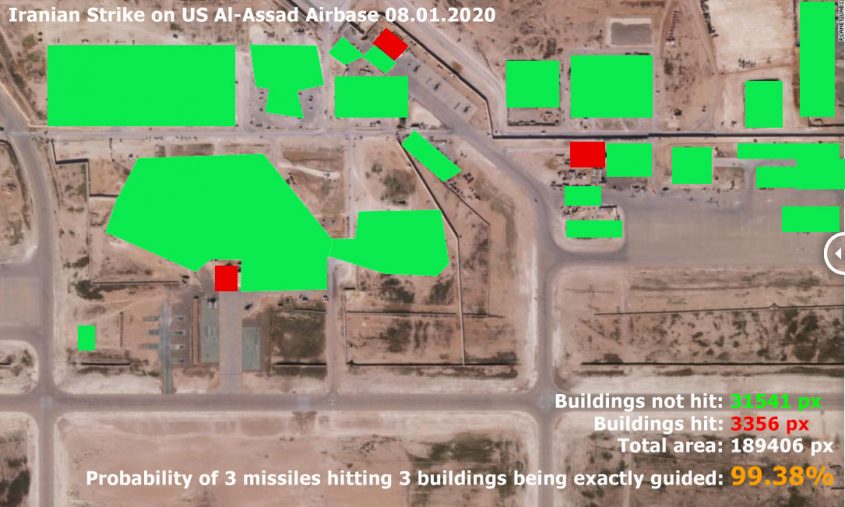
Here is what my friend added:
The key idea is really simple and understandable for anybody who has thought about statistics (even in an everyday context). In number terms, it’s almost like rolling dice and getting a 6 three times in a row, because the probability of rolling a 6 with an ideal dice is 16.67% (and the probability to roll 3 sixes in a row is less than 1%) as opposed to roughly 18% probability for a hit on a building within the map area in the CNN screenshot (if we assume the missiles to be unguided within this area). To be even more precise, the probability for hitting 3 *different* buildings 3 times in a row is actually even slightly lower than 0.62%, as one would have to substract the area being hit from the total area covered by buildings (I ignored that for simplicity). A less than 1% probability for a one-off event like this means that it is really highly UNlikely – to use the British Skripal case expression in its inverted state – to have happened randomly, as we assumed in our hypothesis. Which means that the missiles were, indeed, guided, and guided very accurately, striking targets of less than ~50m size with a high degree of reliability (in this particular area 3/3, in others probably 1/1 as in the runway case, etc). Perhaps, some of them, not covered by the satellite images, missed the target, but it does not substantially change the high degree of accuracy that potential Iranian opponents within reach of these missiles will have to assume from now on. The people most interested in this were probably the Israelis, as they are probably the main potential target for this type of missile in the case of a future escalation.
Please note that neither my friend nor I are professional imagery analysts and that this is just something my friend shared with me in a private email and which I now want to share with you.
If any professional imagery analyst could either confirm/refute my friend’s conclusions, I would be most grateful.
Next, I want to share with you the following image which shows Iranian IRGC General Ali Amir Hajizadeh reviewing results of recent Iranian missile strikes on Ain al-Assad airbase in Iraq during a press conference:
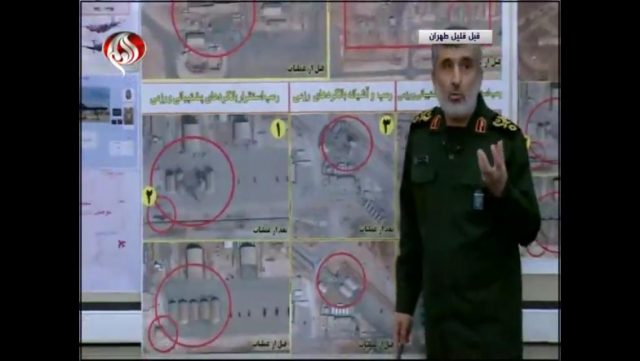
Clearly, the Iranians are very proud of their capability to conduct true precision strikes with an accuracy every bit as good as any Russian and/or US missile.
Finally, check out this image of the Iranian general making a press conference in front of a very interesting row of flags:
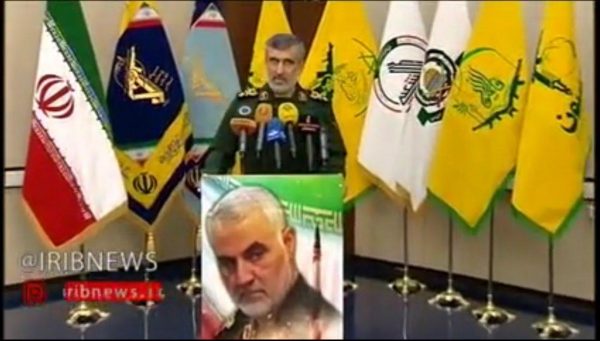
These flags include the following: The Iranian flag, the IRGC flag, the flag of IRGC’s Aerospace Force, the flag of the Lebanese Hezbollah, the Yemeni Houthi Ansarullah flag, the flag of the Iraqi Popular Mobilization Units (PMU), the Palestinian Hamas, the Afghan Liwa Fatemiyoun and the Pakistani Liwa Zainebiyoun
I find this very interesting: when Trump (or any other US politician) makes a solemn pronouncement, he typically has a number of aides, advisors, generals, Congressmen or Senators, etc. This is supposed the show the determination, resolve and unity of Uncle Shmuel, especially when Uncle Shmuel does something illegal or immoral.
The Iranian show of unity does not show more Iranians, they show the unity of all the forces in the Middle-East who have now officially united and whose goal is clear and very official: kick Uncle Shmuel out of the Middle-East.
You tell me which you find more impressive!
Next, the issue of casualties. Frankly, and while this is only my best guess, I do not believe the Iranian official casualty figures. Why? Well, first the Iranians did not try to maximize casualties (more about that option below), and they informed the US by several back-channels. But even if they had not, while the performance of the Patriot missile is pretty awful, the US does have a lot of top of the line technical intelligence means which would allow them to first detect the launch of the missiles from Iran and then to calculate their ballistic trajectory. As far as I know, now I might be wrong here, Iranian missiles do not have terminal maneuvering capability (which is different from terminal guidance). I can’t image why US commanders could not announce a incoming missile alert and then get all the local personnel into shelters. Again, I might be missing something, so if any reader can correct me, I would be grateful.
So what happened, really?
Here are a few of my current working hypotheses:
1) BOTH the USA and Iran don’t want a full-scale war. But for VERY different reasons:
- The US probably understands that it cannot win a war against Iran.
- The Iranians definitely understand that while the US cannot “win”, it most definitely can kill Iranians by the thousands and inflict immense damage upon the Iranian society.
2) What just took place was the single most dangerous moment since 14 April 2018 when Russia and the US came very, very close to a full-scale war. In the current situation, the US and Iran also came very, very close to a full scale war. The only reason I rank this latest crisis lower than the April 14th is that in one case we risked a planetary nuclear war whereas in this case we “only” risked a regional war which, by the way, could have seen nukes used by the US and Israel.
3) There STILL is a risk of full-scale war between the US and Iran, however, and barring a major unforeseen event, I will lower it now down from 80% to a much more tolerable 50%. Why 50%? Because Israel and the Israel Lobby will continue to push for a US attack on Iran and because while I trust the Iranians to keep their anti-US operations right below the threshold of “plausible deniability”, I cannot be sure that all Iranian allies will show similar restraint. Finally, the chances of an Israeli false flag as still sky high.
4) I expect anti-US operations to continue and even expand throughout the Middle-East. I don’t expect that these operations will be executed from Iran and I don’t expect Iranian forces to be involved, at least not officially. The Iranians know that the US has lost every single counter-insurgency war it was involved in and they know that their best chance is now to engage in all forms of asymmetrical operations.
Finally, I want to spell out what we could call the new Iranian threat.
We have to assume that Iran now has terminal guidance capability on many (most?) of its ballistic and cruise missiles and that they can destroy one specific building among many more buildings. Now, remember the Iranian reply that it had 35 US bases within missile range? Now imagine this first one:
- Iran fires 10-12 missile on each and every one of the 35 US bases listed and targets barracks, fuel and ammo dumps, key command posts, etc. How many casualties do you think that such a strike would result in?
Next, let’s try the same thing with Israel:
- Iran fires 2-3 missiles but carefully aims them as Israeli air force bases, personnel barracks, industrial sites (including chemical and nuclear sites, not even necessarily military ones! Dimona anybody?), the Knesset or even Bibi’s personal residence. Can you imagine the panic in Israel?
How about the KSA?
- Iran fires a large amount of missiles aimed at *truly* crippling the Saudi oil installations, National Guard barracks, airfields, etc. We already know what the Houthis could do with their very limited resources. Just imagine what Iran could do to the KSA (or the UAE and Kuwait) if it wanted to!
I think that the bottom line is clear: Iran can inflict unacceptable damage upon any party attacking it. Furthermore, and unlike having “a few” nukes, Iran has hundreds (or even thousands) of cruise missile and ballistic missiles, and you can bet that they are well distributed and well protected, as shown by this short video released by the IRGC and posted by the FARS news agency:
and that means that a disarming first strike against Iran is not possible.
There are two basic ways to respond to an attack: denial and punishment. In the first case, you have the means to deny your enemy his attack, this is what happened when the Syrians intercepted almost all the cruise missiles fired by the US. Punishment is when you cannot prevent an enemy attack, but you do have the means to inflict unacceptable damage in retaliation.
The key notion here is “unacceptable damage”.
What do you think constitutes “unacceptable damage” to the (terminally hedonistic) Israelis?
What do you think would be “unacceptable damage” to the KSA, or the world markets (especially oil)?
What about “unacceptable damage” in terms of losses for CENTCOM?
And, finally, what do you think “unacceptable damage” means to the Iranians?
There is such a huge asymmetry in how the parties to this conflict see “unacceptable damage” that it largely compensates for the asymmetry in force. Yes, sure, the US+Israel are more powerful than Iran (well, not Israel really, but Israel hiding behind the back of the US forces) but Iran is far more capable of absorbing devastating attacks than either the US or Israel.
Finally, in my last post I offered a definition of what constitutes success or failure for Iran: “anything which makes it easier for the US to remain in the Middle-East is a victory for the Empire and anything which makes it harder for the US to remain in the Middle-East is a victory for the rest of the planet.”
At this point my personal opinion is that the way the Iranians conducted their first anti-Empire operation is nothing short of brilliant: they achieved a truly phenomenal result with very little means and, most importantly, without forcing the Empire to counter-attack.
Has the US-Iran war really begun? Yes, I think so. In fact, it began in 1979, but now it has reached a qualitatively new level. The outcome of that war is absolutely evident to me. The cost, however, is not.
This war has relatively cooled down, but that is an illusion and we should most definitely not take our eyes off the situation in the Middle-East: expect the initiation of asymmetrical anti-US operations very soon.
January 10, 2020 Posted by aletho | Illegal Occupation, Timeless or most popular | Iran, Israel, United States | Leave a comment
Timeline of US-Iran conflict: 1953 through Present
If Americans Knew | Last Updated: January 9, 2020
In the interest of understanding recent events, we have quickly put together a partial timeline of US-Iran relations, beginning in 1953 through the present. This is a quick, somewhat cursory timeline, but we feel it’s important that a general outline become available as soon as possible.
Many thousands of American families are heavily invested in the situation – according to U.S. Central Command, between 60,000 and 70,000 U.S. troops are currently in the Middle East and Afghanistan.
* 1800s to 1951: Relations between the US and Iran began in the mid-to-late nineteenth century. Initially, while Iran was very wary of British and Russian colonial interests, it viewed the United States as a more trustworthy great power.
During World War II Iran was invaded by Britain and the Soviet Union, both US allies, but relations with the US continued to be positive. This changed in 1953:
* 1953: UK and US orchestrated a coup to overthrow Iran’s democratically elected prime minister, Mohammad Mossadegh.
Mossadegh had denied the British further involvement in Iran’s oil industry. Britain then appealed to the US for help, which eventually led the CIA to orchestrate the overthrow of Mossadegh and restore power to Mohammad Reza Pahlavi, the last Shah of Iran.
The Shah became known for “his autocratic rule, corruption in his government, the unequal distribution of oil wealth, forced Westernization, and the activities of SAVAK (the secret police) in suppressing dissent and opposition to his rule.”
SAVAK had been formed in 1957 under the guidance of US and Israeli intelligence officers.
Today’s Iranian Supreme Leader was one of those tortured in a Savak prison.
* In 1979 the Shah was overthrown by a popular revolution. He then traveled to the US, which had supported him.
The rebels eventually converted the form of government from a monarchy to an elected government based on a strict interpretation of Islam: The Islamic Republic of Iran. This was a backlash against the authoritarian Shah’s forced westernization and denigration of the traditional religion (more on the revolution & aftermath here and here and here).
* The new Iranian government begins its support of Palestinian rights against Israel’s ethnic cleansing of Muslim and Christian inhabitants of what had originally been called Palestine.
* Iran also supports Hezbollah, armed resistance groups in Lebanon against Israel’s invasions of Lebanon.
(Israel exploited Americans in its fight against Lebanon.)
Ha’aretz : Iran’s mentoring of Hezbollah’s insurgency of the 1980s and 1990s forced Israel’s unilateral withdrawal from Lebanon.
* Israel and the pro-Israel lobby in the US – which plays a major role in US Mideast policies – has opposed Iran ever since the new Iranian government was created.
The Oded Yinon plan (“Greater Israel”: The Zionist Plan for the Middle East) provides some information on the Israeli role through the years in destabilizing many countries in the Middle East.
* Since the Shah’s regime had tortured many dissidents, his victims wanted him to return to Iran to face justice, but the US would not extradite him. Iranian students then seized the U.S. embassy in Tehran and took hostage more than 50 Americans, demanding the extradition of the shah in return for the hostages’ release. Extradition was refused and the hostages were held for 444 days.
* Washington then froze about $12 billion in Iranian assets, including bank deposits, gold, and other properties. Most of those were released in 1981 as part of the Reagan release deal.
* Some assets—Iranian officials say $10 billion, but US officials say much less—remain frozen, pending resolution of legal claims arising from the Revolution. The money that the Obama administration returned to Iran as part of the JCPOA agreement was Iran’s own money.
* The next year, in September 1980, Iraq launched a war against Iran that lasted until 1988. The death toll was an estimated 1 million for Iran and 250,000-500,000 for Iraq.
U.S. officials later acknowledged that American arms, technology and intelligence helped Iraq kill Iranians and avert defeat and eventually grow, with much help from the Soviet Union later, into a major regional power.
* The administrations of Presidents Reagan and George H.W. Bush authorized the sale to Iraq of numerous “dual-use” items, including poisonous chemicals and deadly biological viruses, such as anthrax.
* In 1988 a US Navy ship shot down a commercial Iranian airliner, killing 290 men, women, and children. The Pentagon at first denied it was involved, and then said it was an accident.
* in 1992, Netanyahu told the Israeli Knesset that Iran was “three to five years” away from reaching nuclear weapons capability, and that this threat had to be “uprooted by an international front headed by the U.S.”
* In 1996 Israel’s Netanyahu addressed a joint session of Congress and claimed that Iran was getting “extremely close” to getting nuclear weapons.
Netanyahu makes this claim again and again in the coming years.
* After the World Trade Center attack on September 11, 2001, the US invaded Afghanistan and attacked the Taliban. Iran assisted the US in this fight against the Taliban and Al Qaeda, with Soleimani playing a major role.
Earlier, the U.S. had supported Islamic forces against the Soviet Union, which the Carter administration had drawn into invading Afghanistan.
* In 2002 Israel began a campaign claiming, falsely, that Iran was developing nuclear weapons.
This campaign has continued and escalated through the years, as documented here.
• In 2003 the US invaded Iraq based on what turned out to be a false claim that Iraq had “weapons of mass destruction.”
The invasion was promoted by Israel and its partisans. As a result, 5,000 Americans died and approximately 288,000 Iraqis, most of them civilians. The unprovoked invasion and occupation, including the Abu Ghraib atrocities, destabilized the region and fueled the rise of extremism that led to ISIS.
Iran has been in the forefront of fighting ISIS. General Soleimani led this. At times, the US and Iran cooperated in this fight.
* The US, under the influence of the Israel lobby, supports Israeli actions. Over the years, it labels resistance fighters “terrorists” and condemns Iran’s support of Palestinian rights.
The pro-Israel lobby in the US has long been working against Iran in order to improve Israel’s strategic position. In 2004 AIPAC officials stole US Defense Dept secrets, intending to channel them to the Washington Post to convince Americans that it was time for troops fighting in Iraq to pivot to Iran. (It is not rare for the Post to be used by Israel partisans.)
* In 2007, Iranian President Mahmud Ahmadinejad quoted an old saying of Ayatollah Khomeini calling for ‘this occupation regime over Jerusalem” – meaning Israel – to “vanish from the page of time.” (As Juan Cole explains, many mistranslated his words as “wiped off the face of the map.”)
* Israel and its partisans continue to claim (as they have since 1991) that Iran is developing nuclear weapons. US intelligence find no evidence for the claim.
* Between 2010 and 2012 Israel murdered four young Iranian scientists.
One was the 32 year old deputy head of Iran’s uranium enrichment facility. He was in his car on his way to work when he was blown up by a magnetic bomb attached to his car door. He was married with a young son. He wasn’t armed, or anywhere near a battlefield.
Another was a 35-year-old electronics expert shot dead outside his daughter’s nursery.It appears that another had been murdered in 2007. A US Senator, Rick Santorum, called the murders “a wonderful thing.”
* February 2015 Supreme Leader Khamenei condemns ISIS beheading Christians, tweeting: “We don’t forget how much Iranian #Christians have taken pains to render services & some of them have martyred in Saddam’s war against #Iran.” He advised Muslims to help Christians in need while extolling what he said was the Islamic Republic of Iran’s equal treatment of people of different faiths.
* In January 2015 Khamenei publishes “Letter to Western Youth” on his official website. It is major news in Iran. In November he publishes a second one. They include the statement:
“… The pain of any human being anywhere in the world causes sorrow for a fellow human being. The sight of a child losing his life in the presence of his loved ones, a mother whose joy for her family turns into mourning…… Anyone who has benefited from affection and humanity is affected and disturbed by witnessing these scenes- whether it occurs in France or in Palestine or Iraq or Lebanon or Syria…. The issue, however, is that if today’s pain is not used to build a better and safer future, then it will just turn into bitter and fruitless memories…
U.S. media ignore the letters.
* In July 2015, the “Joint Comprehensive Plan of Action (JCPOA),” a detailed, 159-page agreement is reached by Iran and the P5+1 (China France, Germany, Russia, the United Kingdom, and the United States) aimed at halting Iran’s non-existent nuclear weapons program.
Nevertheless, Iran signs the agreement, giving up many rights in an attempt to diminish US-Israeli sanctions.
* Both Democrats and Republicans repeat the Israel-promoted false claim that Iran is the top sponsor of “terror.”
Recent events
Much of the following is excerpted from an Al Jazeera timeline, with a number of additions from diverse other sources (sources are provided in embedded links):
* Trump makes good on an election campaign promise, announcing on May 8, 2018 that the US is withdrawing from the Iran nuclear deal, formally known as the Joint Comprehensive Plan Of Action (JCPOA).
Trump’s action is influenced by pro-Israel multi-billionaire campaign donors Sheldon Adelson and Bernard Marcus.
Adelson once said he regretted that he had served in the US army instead of in the Israeli military.
* In response, Iran calls this “unacceptable” and says it will bypass Washington and negotiate with the deal’s other remaining signatories: France, Germany, the United Kingdom, Russia and China.
* May 21 Trump administration makes 12 demands, which Iran rejects.
* US on August 7 reimposes the first round of sanctions on Iran, originally lifted as part of the nuclear deal. They prohibit trade with a number of business sectors – from aviation and carpets to pistachios and gold.
* On November 5, the US announces a new round of sanctions, this time specifically targeting the key oil and banking sectors.
2019
* In March the US Treasury Department, under Israel partisan Steven Mnuchin, blacklisted 25 Iranian businesses and individuals.
[The individual under Mnuchin in charge of US actions regarding Iran is an Israeli citizen.]
Pro-Israel organizations had lobbied for the creation of this branch of the Treasury.
* On April 2, Special Representative for Iran Brian Hook said: “I can announce today, based on declassified US military reports, that Iran is responsible for the deaths of 608 American service members. This accounts for 17 percent of all deaths of US personnel in Iraq from 2003 to 2011.”
Navy Commander Sean Robertson followed up with an email to media outlets pushing that same line. When author Gareth Porter asked Robertson for further clarification of the origins of that figure, however, Robertson “acknowledged that the Pentagon doesn’t have any study, documentation, or data to provide journalists that would support such a figure.”
* On April 8, Trump announces he is designating a powerful arm of the Iranian military, the elite Islamic Revolutionary Guard Corps (IRGC) a foreign terrorist organization.
It is the first time Washington has formally labelled another country’s military a “terrorist group.” The designation imposes wide-ranging economic and travel sanctions on the IRGC that will go into effect on April 15.
* Responding to the move, Iran immediately declares the US a “state sponsor of terrorism” and calls Washington’s forces in the region “terrorist groups.”
* On May 5, Trump’s National Security Adviser John Bolton announces the US is sending an aircraft carrier strike group and Air Force bombers to the Middle East “in response to a number of troubling and escalatory indications and warnings”.
* On May 8, Iran says it is preparing to increase enriched uranium and heavy water production as part of its decision to stop certain commitments made under the nuclear deal. (Iran continues to emphasize that it is NOT developing nuclear weapons, which are banned by a religious edict from its Supreme Leader.)
* Trump announces new measures against Iran’s steel and mining sectors.
* On May 12, the United Arab Emirates says four commercial ships off the coast of Fujairah, one of the world’s largest bunkering hubs, “were subjected to sabotage operations”.
The UAE did not name a suspect and there were no claims of responsibility. Unnamed US officials identified Iran as a prime suspect. But the officials offered no proof to back the claim.
Iranian officials expressed concern, saying the alleged attacks could have been carried out by third parties to stir up conflict between Washington and Tehran during the heightened tensions.
The US’s “maximum pressure” campaign had triggered an economic crisis in Iran.
* Yemen’s Houthi rebels, who are locked in a long-running war with a Saudi-UAE-led military coalition, launch drone attacks on Saudi Arabia on May 14, striking a major oil pipeline and taking it out of service.
* Two days later, Riyadh, a key US ally, blames Iran for the attack.
* The US and Saudi Arabia accuse Iran of arming the Houthis.
* Tehran denies the claim.
* On May 19, a rocket lands near the US embassy in Baghdad. No one is harmed.
It is not clear who is behind the attack, but Trump tweets: “If Iran wants to fight, that will be the official end of Iran. Never threaten the United States again!”
Iranian Foreign Minister Mohammed Javad Zarif responds by tweeting that Trump had been “goaded” into “genocidal taunts”.
* After meeting Japanese Prime Minister Shinzo Abe, who offers to broker dialogue between Washington and Tehran, Trump says on May 27 the US is “not looking for regime change” in Iran.
* On June 12, Abe arrives in Tehran in a bid to mediate between the US and Iran.
* Iran’s Supreme Leader Ayatollah Ali Khamenei refuses to meet with him, saying: “I don’t consider Trump as a person worthy of exchanging messages with. I have no response for him and will not answer him.”
* On June 13, with Abe still in Iran, a Japanese and a Norwegian tanker come under “attack” in the Gulf of Oman, according to the Norwegian maritime authority and the Japanese shipowner.
Iran speaks initially of “accidents” and says it rescued 44 crew. Zarif calls tanker “attacks” during Abe’s visit “suspicious”.
* On June 17, the Pentagon authorizes the deployment of 1,000 additional troops to the Middle East.
* On the same date, Iran says it is 10 days away from surpassing the limits set by the nuclear deal on its stockpile of low-enriched uranium.
* Iran says it can reverse the move if the deal’s European signatories step in and make an effort to circumvent US sanctions.
* On June 20, Iranian forces shoot down a US military drone.
Both countries confirm the incident but offer diverging accounts about the location of the aircraft.
The US says it was flying above international waters, while Iran says the drone was flying in Iranian airspace.
* On June 21, Trump says he called off a military strike on Iran the night before, which was intended as retaliation against Tehran for the downing of the unmanned US drone.
Trump says he did so 10 minutes before the planned attack because of potential casualties, saying it was “not proportionate to shooting down an unmanned drone”.
Trump says a US strike could have killed 150 people, and signals he is open to talks with Tehran.
* On June 22, Iran says it is ready to respond firmly to any US threat against it.
“We will not allow any violation against Iran’s borders. Iran will firmly confront any aggression or threat by America,” Abbas Mousavi, foreign ministry spokesman, says.
* On the same day, Iran orders the execution of a “defence ministry contractor” convicted of spying for the US Central Intelligence Agency,
* The US vows to impose fresh sanctions, adding that military action was still “on the table.”
* On June 25, Trump signs an order targeting Khamenei, Iran’s supreme leader, and associates with additional financial sanctions
“Sanctions imposed through the executive order … will deny the supreme leader and the supreme leader’s office, and those closely affiliated with him and the office, access to key financial resources and support,” the US president says.
* Responding to the announcement, Zarif, the Iranian foreign minister, tweets that hawkish politicians close to Trump were thirsty for war rather than diplomacy.
Rouhani dismisses the sanctions as “outrageous and idiotic”, adding that Tehran’s “strategic patience” should not be mistaken for fear.
* On June 29, the US Air Forces Central Command says in a statement that F-22 Raptor stealth fighters are being deployed in the region “to defend American forces and interests”.
* On July 1, Iran exceeds the limit on the amount of enriched uranium in its stockpile set out in the nuclear deal.
Zarif says the accumulation of more enriched uranium than permitted under the deal is not a violation of the pact.
* On July 4, British Royal Marines, police and customs agents in Gibraltar seize a supertanker accused of carrying Iranian crude oil to Syria in breach of European Union sanctions.
The Grace 1 vessel was boarded on Thursday when it slowed down in a designated area used by shipping agencies to ferry goods to ships in the UK territory along Spain’s southern coast.
* On July 8, Iran passes the uranium enrichment cap set in the nuclear deal, the second time in a week that it makes good on a promise to reduce compliance with the accord.
* On July 12, police in Gilbraltar arrest the captain and chief officer of an Iranian tanker that was seized by British forces the previous week.
* On July 19, the IRGC says its forces have seized a British oil tanker in the Strait of Hormuz.
The Stena Impero tanker “was confiscated by the Revolutionary Guards at the request of Hormozgan Ports and Maritime Organisation when passing through the Strait of Hormuz, for failing to respect international maritime rules”, the force says in its official website.
* On July 25, the UK announces the country’s warships will escort all British-flagged vessels through the Strait of Hormuz, a change in policy that takes place amid rising tensions in the Gulf.
* On August 1, the US imposes sanctions on Zarif for acting on behalf of Ali Khamenei.
“Javad Zarif implements the reckless agenda of Iran’s Supreme Leader, and is the regime’s primary spokesperson around the world,” Treasury Secretary Steven Mnuchin says in a statement.
* Zarif brushes off the move on Twitter, saying it indicates Washington saw him as a “threat”.
“It has no effect on me or my family, as I have no property or interest outside of Iran,” he says.
* On August 23, Rouhani inducts a locally built air-defence system into the country’s missile defense network at an unveiling ceremony in Tehran.
Iran began production after the purchase of Russia’s S-300 system was suspended in 2010 due to international sanctions that have barred it from importing many weapons.
Speaking at the ceremony, Rouhani says the mobile surface-to-air system was “better than S-300 and close to [more advanced] S-400”.
* On August 26, Iran’s top diplomat holds talks with France’s President Emmanuel Macron at the sidelines of a G7 summit following a surprise invite to the gathering in Biarritz.
“Iran’s active diplomacy in pursuit of constructive engagement continues,” Zarif says. “Road ahead is difficult. But worth trying.”
On the same day, Iran says it has sold 2.1m barrels of crude oil on board the tanker that was seized in Gibraltar the previous month, adding that the vessel’s new owner will decide on its next destination.
* On August 30, the UN says Iran is still exceeding limitations set by its nuclear deal with world powers, increasing its stock of enriched uranium and refining it to a greater purity than allowed in the agreement.
The quarterly report from the UN’s International Atomic Energy Agency confirms Iran is progressively backing out of the pact in retaliation for the US’s withdrawal from the accord and the subsequent renewal of sanctions that have hit Iranian oil sales.
* On September 3, the US imposes sanctions on Iran’s civilian space agency and two research organizations, saying they were being used to advance Tehran’s ballistic missile program.
The measures imposed by the US Department of the Treasury target the Iran Space Agency, Iran Space Research Center and the Astronautics Research Institute.
* On September 4, the US turns up the economic pressure on Iran, blacklisting an oil shipping network that Washington alleges is directed by the IRGC.
The blacklisted group of firms, ships and individuals stands accused by the US Treasury of breaching sanctions by supplying Syria with oil worth hundreds of millions of dollars.
* The Trump administration, meanwhile, says it will not accommodate a proposal by France to throw a financial lifeline to Tehran.
* The US offers several million dollars to the Indian captain of an Iranian oil tanker suspected of heading to Syria, the State Department confirms.
The Financial Times reports on September 5 that Brian Hook, the State Department point man on Iran, [who spoke at the 2019 AIPAC conference and the American Jewish Committee conference] has sent emails to captain Akhilesh Kumar in which he offered “good news” of millions in US cash to live comfortably if he steered the Adrian Darya 1, formerly known as Grace 1, to a country where it could be seized. (Captain Kumar rejected the offer.)
* On September 7, Iran starts injecting gas into advanced centrifuges to increase its stockpile of enriched uranium and warns time is running out for the nuclear deal’s other signatories to save the landmark pact.
Spokesman Behrouz Kamalvandi says Iran’s Atomic Energy Organisation has started up advanced centrifuges at the enrichment facility in Natanz, the third step by Tehran in scaling back its commitments under the crumbling pact following Washington’s withdrawal.
* Trump on September 10 announces via Twitter that he has fired Bolton, his national security adviser, saying he has “strongly disagreed” with many of his hawkish positions.
Bolton’s sacking is reportedly linked to a fundamental disagreement over the possible easing of US sanctions on Iran.
* On September 14, Yemen’s Houthi rebels claim responsibility for drone attacks on two major Saudi Aramco oil facilities: Abqaiq – the world’s largest oil processing plant – and the Khurais oilfield, in eastern Saudi Arabia. The pre-dawn strikes knock out more than half of crude output from the world’s top exporter.
* Pompeo swiftly blames Iran, saying it “has now launched an unprecedented attack on the world’s energy supply”.
* Iran dismisses the “meaningless” US allegations, saying they were meant to justify actions against the country.
* Addressing the UN General Assembly in New York, Trump on September 24 lashes out at Iran and calls countries around the world to tighten the economic noose around it.
“One of the greatest security threats facing peace-loving nations today is the repressive regime in Iran,” he says.
* Human Rights Watch finds that US sanctions are threatening Iranians’ health.
* In October Trump called the Iraq war “the single worst mistake this country has ever made” and said: “These wars, they never end. And we have to bring our great soldiers back from the never-ending wars.”
* The US on November 4 imposed new sanctions on the inner circle of Supreme Leader Ayatollah Ali Khamenei, including one of his sons.
The US Treasury said that the nine people sanctioned included Khamenei’s chief of staff, the head of the judiciary and senior military figures. It said it also blacklisted Iran’s Armed Forces General Staff.
* Iran’s foreign ministry spokesman Abbas Mousavi described the sanctions as “a sign of the desperation and inability of this regime in benefiting from a diplomatic and logical approach” to important international issues, according to the official IRNA news agency.
* Iran on November 6, began the process of injecting uranium gas into centrifuges at the underground Fordow facility.
* A US-led naval coalition officially launched operations in Bahrain on November 7 to protect shipping in the troubled waters of the Gulf, following a string of attacks that Washington and its allies blamed on Iran.
* Iran, which denied any responsibility for the mystery attacks, put forward its own proposals for boosting Gulf security that pointedly excluded outside powers.
* Iran’s state news agency IRNA says air defence forces shot down an “unknown” drone on November 8.
* The United States Central Command released a statement later that Friday saying that the downed drone was not one of theirs, and that all military drones were accounted for.
* Unrest in Iran erupted on November 15 after the government abruptly raised fuel prices by as much as 300 percent.
Iranian forces reportedly kill several hundred protestors. Iran denies this.
* The US on November 22 imposed sanctions on Iran’s communications minister Mohammad Javad Azari-Jahromi for his role in “widespread censorship”.
* Addressing thousands of demonstrators in the capital, General Hossein Salami on November 25 accused the US, the United Kingdom, Iraq and Saudi Arabia of stoking unrest in the country.
* The official news agency IRNA reported on November 27 that Iranian security agents arrested at least eight people linked to the CIA during deadly unrest over petrol price increases.
* The Pentagon on December 4 denied a report that the US was weighing sending up to 14,000 more troops to the Middle East to confront a perceived threat from Iran.
* A US Navy warship seized advanced missile parts on December 4 believed to be linked to Iran from a boat it had stopped in the Arabian Sea.
* In a rare act of cooperation, Iran and the US on December 7 exchanged prisoners.
Xiyue Wang, a Chinese-born US citizen held in Iran since 2016, was exchanged for Massoud Soleimani, an Iranian scientist detained in the US.
* On December 11, the US Treasury imposed new sanctions on Iran’s biggest airline and its shipping industry, accusing them of transporting lethal aid to Yemen.
* On December 19, the US announced that it would restrict visas for Iranian officials for their alleged roles in suppressing peaceful protests and imposed sanctions on two Iranian judges.
The sanctions imposed by the Treasury froze any assets the two judges have in the US, and barred US citizens from dealing with them.
* On December 27, a rocket attack on an Iraqi military base in Kirkuk killed a US contractor and wounded several US service members and Iraqi personnel.
In its statement confirming the attack, the US-led coalition against ISIL (the ISIS group) did not specify who might be responsible, but US officials later blamed Kataib Hezbollah, an Iran-backed militia, for the attack.
* Two days later – on December 29 – the US military carried out “defensive strikes” on sites in Iraq and Syria belonging to Kataib Hezbollah that Washington said were in retaliation for the killing of the US contractor.
* Iraqi security and militia sources said at least 25 fighters were killed and 55 others wounded following the air attacks in Iraq on Sunday.
* Iran strongly condemned the attacks, with a government spokesman saying: “America has shown its firm support for terrorism and its neglect for the independence and sovereignty of countries and it must accept consequences for its illegal act.”
* On December 31, enraged members and supporters of pro-Iranian paramilitary groups in Iraq broke into the heavily fortified US embassy compound in Baghdad, smashing a main door and setting parts of its perimeter on fire.
* On January 2, US Secretary of Defense Mark Esper said there were “some indications” that Iran or groups it supports “may be planning additional attacks” on US interests in the Middle East.
* On January 3, in a predawn air raid at Iraq’s Baghdad airport, the US struck and killed Qassem Soleimani, the head of Iran’s elite Quds Force, and Abu Mahdi al-Muhandis, the deputy commander of Iran-backed militias known as the Popular Mobilisation Forces, or PMF.
According to Iraq’s prime minister, Soleimani had arrived to ease tensions in the region, after Trump had asked the prime minister to help mediate.
Trump notified Israel ahead of time, but did not notify the US Congress. … Israeli security officials had recommended the assassination of Suleimani last year.
Former top US intelligence officials point out that Israel is the country that most benefits from hostilities between Iran and the US. Others, also, feel Israel was connected to why Trump, who had a few months ago opposed Mideast wars, authorized the assassination.
Pompeo said Soleimani was planning an “imminent” attack on Americans, but did not supply the evidence for this.
* The Iraqi prime minister and parliament condemn the attack and demand the US forces leave Iraq.
Trump threatens major sanctions against Iraq if that occurs. (Previous US sanctions against Iraq had cost the lives of a million Iraqis, half of them children.)
* On January 5th, Hezbollah Secretary General Hassan Nasrallah declared that the assassination of Soleimani was a “turning point in the history of the region,” and that the US would receive a “just punishment” for the crime. He specified that the target would not be American citizens, but the military.
*Iran threatens retaliation.
Soleimani had been widely respected throughout Iran; a million mourners turn out. Analysts around the world are concerned that this escalation will result in major violence.
President Trump tweets that if Iran harms any Americans, he will attack Iranian cultural sites.
While Secretary of State Pompeo had claimed the action would make Americans “safer,” on January 4th the government issued a security alert.
*On January 8 more than a dozen missiles hit two US bases in Iraq.
This reportedly marks the first time that today’s Iranian government has directly struck U.S. military or other state targets and acknowledged doing so.
Iranian Foreign Minister Javad Zarif tweeted: “Iran took & concluded proportionate measures in self-defense under Article 51 of U.N. Charter targeting base from which cowardly armed attack against our citizens & senior officials were launched.”
January 9, 2020 Posted by aletho | Timeless or most popular, Wars for Israel | Iran, Israel, Middle East, United States | Leave a comment
The Kerfuffle War – Trump’s Iran De-escalation Succeeds
By Joaquin Flores | Strategic Culture Foundation | January 9, 2020
Just like that, it was over. General Mark Milley, chairman of the Joint Chiefs of Staff called it ‘a kerfuffle’. A letter was sent to their Iraqi peers that the U.S was repositioning troops out of Iraq in accordance with legislation from Iraq ending the U.S military presence in the war-torn country, and suddenly then it was retracted by higher-ups. Running interference, Mark Esper backed Milley and said it was ‘an honest mistake’. It all went down within a day of the irrational assassination of Iran’s Soleimani.
The immediate termination of Chewning and Sweeney, at the same time as the assassination of Soleimani and Iran’s response raises some big questions. In the near future it will be of critical importance to get to the bottom of any possible relationship that Esper and his subordinates Chewning and Sweeney – who both served as Defense Secretary Esper’s Chiefs of Staff – had to the assassination of Soleimani. The assassination and any number of possible Iranian responses, can push the U.S into a broad and open military conflict with Iran. Such a war would also be Trump’s undoing.
We might otherwise be led to believe that Chewning and Sweeney’s sudden departure has something to do with Ukraine and the recent release of unredacted emails relating to L3Harris Technologies and funding in Ukraine. These of course also relate to the case against Trump and any possible impeachment. But the timing and symbolism of these as concurrent with the provocation against Iran and the blowback, as well as Esper’s backing of the ‘Kerfuffle theory’, lends strong credence to an Iran connection.
The connection to impeachment cannot be denied, but the necessity of uncovering its potential relation to Iran is tremendously important because it directly relates to larger constitutional and practical questions of the president’s ability to have a Department of Defense that works either for or against U.S strategy as formulated and executed by its democratically elected leadership, as opposed to its permanent bureaucratic administration. This is what Trump and his supporters quite rightfully refer to as the ‘Deep State’.
Were elements in the defense department working towards a heightened brinksmanship that the president did not really want? It would be far from the first time in history that such was the case.
Because the proverbial excrement rolls down-hill, was Esper involved in ordering Soleimani’s assassination which Trump was not informed of until it was too late, or until after? Chewning and Sweeney’s fate may be understood here. The ‘kerfuffle’ which was the withdrawal statement would then be a simple ruse to distract from the actual reasons that Chewning and Sweeney were terminated – acting without orders, insubordination, and even treason.
Trump’s Balancing Policy on Iran and America’s leadership crisis
One undeniable point is that a war with Iran works entirely against Trump’s middle-east policy and his prospects for re-election.
What the Trump administration seeks most now is a de-escalation with Iran. Given that Trump has fueled a rumor mill including the possible ending of sanctions if Iran doesn’t respond, or that there will be no further attacks if Iran’s response is ‘reasonable’, all exists in the unspoken framework that Trump inherently recognizes the ‘guilt’ of the U.S in its irrational act, while it is nevertheless politically impossible to frame it overtly as such.
Impeachment against Trump has now been used several times to push him to act aggressively in the middle-east, contrary to his policy and self-interest. On all the ‘impeachment threat – then strike’ occasions, Trump ordered strikes on predictable targets – targets so predictable and oddly executed, that Syrian and Iranian forces barely felt them. There appears to be at the very least an ‘unspoken communication’ at play, where strikes are made to assuage political needs but not to inflict serious damage. If Trump really wanted an excuse to strike Iran, he’s had it before.
There was precisely such an opportunity when subversives in government hatched a plan to push Trump into a war with Iran, when two planes were sent to violate Iranian airspace – one manned, the other unmanned – flying in close proximity. This created the chance that Iran’s downing of either plane could be used as a pretext for a major war-creating strike on Iran.
Despite Trump’s acting reasonably, government actors and media attempted to create a sensation where Trump was ridiculed for ‘calling off’ a planned retaliation in the aftermath of the downed drone. The same liberal media and Democratic Party establishment that attacked Trump’s de-escalation then from a hawkish perspective, today manifest as doves who suddenly oppose Trump’s reckless hawkishness.
Here, in the aftermath of the drone incident, a Trump policy was formulated – and it’s a policy that figures prominently in de-escalation in the aftermath of the assassination of Soleimani and Iran’s measured response.
The policy is this – if Iran kills Americans, then the U.S escalates. If the U.S does something provocative, then Iran is actually allowed to respond militarily, so long as American personnel are not killed.
Iran’s striking of the al-Asad airbase was predictable. That Trump has decided to officially declare that there were no U.S casualties has indicated his real stance. In all reality, the predictability of the target was such that American soldiers would have been repositioned out of that base, so that Iran could assuage its own popular-democratic needs in terms of legitimacy, without forcing the U.S. to respond again further.
Between an AIPAC rock and an Anti-War Hard-spot
A war with Iran would push the anti-war sentiments of independent voters away from Trump, and towards a more revitalized and mobilized Democrat Party anti-war base. Trump needs an anti-war base to be re-elected, and war with Iran pushes that base towards nearly any Democrat candidate.
At the same time, Trump also needs the continued support from America’s Christian Zionist evangelical ‘Israel Firsters’, as well as the infamous AIPAC, not only to be re-elected, but to maintain the support in the senate against impeachment.
That conflict between Trump’s two greatest populist strengths – between Trump’s anti-war base and his Christian Zionist base – largely defines his weakest political spot. That’s why it’s the best place to attack him.
Trump for his part, has a frenemy relationship with AIPAC, and has worked hard to build his profile with Christian Zionist voters even to the extent that this might limit AIPAC’s influence on them. He has purchased a lot of AIPAC support along the way by tearing up the JCPOA and recognizing the Golan Heights and Jerusalem as Israel’s capital. This is capital he will have to spend to maintain support in the Senate.
All together this means that while Trump may or may not have personally sought the assassination of Soleimani, he must take credit for it for any number of reasons. In brief, these relate again to the Zionist base and AIPAC, as well as needing to appear in control of the very country that he is nominally the president of. When Trump refused to go to war over the downing of the un-manned drone, the liberal media monopoly accused him of being soft on Iran and indecisive.
Israel for its part is not tremendously happy with either of the two competing U.S policies. They have been pushing a ‘bomb Iran’ line for years, so that Israel’s conquest of Iraq may come to be. They are also not happy that the U.S presence in the region will come to an end. Trump may or may not have green-lit Soleimani’s assassination, but in either event its result will be the purchase of political capital that he can use towards ending the anti-ISIS campaign in Iraq. The reality is that the U.S is being pushed out either way. Soleimani’s assassination has only strengthened that resolve.
Simultaneously, the anti-war sentiment in the U.S. is one that both led to Trump’s election and can lead to Trump’s undoing. Americans love sabre rattling and posturing. They also hate war.
To wit, in the immediate aftermath of the Soleimani assassination, the well-known American communist group – the PSL – and its anti-war front organization ‘ANSWER’ have already received incredible donations from deep-pocketed Democrat Party sponsors at the local party level, to stage the first significant anti-war demonstration since the Bush presidency. While PSL/ANSWER members and activists have been laudable in their consistent opposition to all American wars for capital and empire, they only seem to magically receive the funds for permits, advertising, organizing, and staging anti-war marches when a Republican is president. The secondary slogan of these mobilizations was ‘Dump Trump’. ‘Dump Obama’ was never a slogan seen at the non-existent mass mobilizations against the Libyan, Ukrainian, and Syrian wars. Trump’s refusal to take the Democrat-laid war bait, means he can pull off an end-run around the Democrat and deep-state plot.
Democrats also don’t want war with Iran, they only want that Trump loses the anti-war vote. They can force him into these compromised positions by coordinating with the ‘permanent administrative military-intelligence bureaucracy’, by coordinating with AIPAC. The Democrat’s plan is therefore pretty simple: use impeachment to force him to strike at Iran (or get Trump to take credit for a strike that the deep-state pulled off), and then use that entanglement to tank his re-election prospects. Then Democrats ride in on an anti-war ticket, restart JCPOA, and move towards integrating Iranian elites into the EU economy. Israel could ultimately guarantee its piece of Iraq and its Greek pipeline deal in due course, with a reformed and EU friendly Iran, ready to make major compromises with Israel. Maybe this is what Biden means by ‘restorationist’ – restoring the traditional left/right political divide which has empowered the Atlanticist status quo.
A Backroom deal? Iran’s Measured Response and Trump’s face-saving
The successful attack on the US’s al-Asad airbase in Iraq was characterized by Iran’s Supreme Leader Khamenei has characterized as a ‘slap’.
Interestingly, Khamenei’s language used is strategic, and uses a sleight of hand to take the steam from possible opponents. It is clear that Khamenei has said today that while the attack on the airbase is just a slap, and that Iran’s full response will come in the future, he has in fact set up that the solution will be political and diplomatic. He did so in a creative way which appeals to hardliners, saying that any solution could not simply be political and diplomatic, but rather more than this. This sort of double-speak does not reflect any moral lapsus, but is necessary for Iran’s greater geopolitical aims and serves the greater good.
De-escalation requires that both parties save face, and can come away with tangible minor victories and agree that the real underlying dispute is resolved in the future.
This reluctance to engage militarily is beyond the mere politics of justifying American casualties, but points to broader considerations of U.S power projection in the region in the aftermath of the failure of the Obama administration policy of overthrowing the government of Syria.
To understand the events at play requires a multi-dimensional and realist understanding of motivations and relationships, and how relationships work at the level of statecraft. And so in a way that would be popularly understood – as in Game of Thrones – just because you’re invited to the banquet or receive a high-honored appointment, doesn’t mean that are you indispensable or even a friend. Trump’s ‘GoT’ relationship with Israel and even his own cabinet, needless to say any number of Pentagon bosses, is precisely this. Bolton and Pompeo are such frenemies, as have been any number of ‘here today, gone tomorrow’ members of the Trump administration, more or less foisted and forced upon the chief executive by Trump’s opponents in the permanent administration and his partisan opposition, and within the Republican Party itself.
Did Trump make a backroom deal with Iran? Probably not – there was a high public dimension to Trump’s offers, and a recent history where an unspoken language was developed. Iran has demonstrated a high level of intelligence, restraint, intuition, and strategic thinking in its several thousand year-old civilization. There is no reason to think that they wouldn’t have understood and inferred everything explained in this article, and much more, without needing a direct conversation with Trump which no doubt would have led to yet another impeachment fandango.
January 9, 2020 Posted by aletho | Ethnic Cleansing, Racism, Zionism, Timeless or most popular, Wars for Israel | Donald Trump, Iran, Iraq, Israel, Middle East, United States, Zionism | Leave a comment
Figures on Left and Right Come Out in Support of Unpopular Anti-Iran Antagonism
By Eric Striker | National Justice | January 6, 2020
A number of figures in the alt-media and extreme-left movement have surprised their audiences by rationalizing the Trump administration’s Israeli-directed push towards war with Iran.
The consensus between high profile voices on the Zionist “far-right” and anarcho-neocon “far-left” in America and Britain reflect the party line in Israel, where even Amir Peretz of the ostensibly left-wing “opposition” Labor party hailed the Pentagon’s decision to assassinate Maj. General Qassem Soleimani by luring him to Iraq under the false pretense of peace negotiations.
Spencer Sunshine, a self-proclaimed anarchist and prominent voice in the American “antifa” scene who has been accused of Zionist entryism in the past, took to twitter to reiterate Sean Hannity’s script on the killing: that the Iranians brought it upon themselves by “antagonizing” America and “meddling” in Iraq. It speaks to the state of the modern co-opted left that somebody like Sunshine can express the Israeli government’s line and still survive the scrutiny of his peers. Sunshine is very suspicious of anti-war sentiment due to the fact that Jews like Sheldon Adelson and Jared Kushner are responsible for our over-the-top Iran policy. He has spent much of his career fighting what he calls “left-wing anti-Semitism” (principled anti-Zionism).
Caroline Orr, another fanatical Jewish supporter of “antifa,” chastised “fellow” leftists for ignoring Soleimani’s supposed “slaughter” of Syrians during the fight to save the country from ISIS. After some pushback, Orr is backpedaling, but her initial approval shows the Jewish nexus between the virulent anti-white forces on the left and the appetite for war against Iran on the so-called right. She also has made a name for herself for promoting fake news about “Russiagate” and attacking anti-war presidential candidate Tulsi Gabbard.
While a branch of the left led by “tankies” (Workers World Party and Revolutionary Communist Party) behind the ANSWER coalition are adamantly against imperialism, many anarchists and “democratic socialists” support the CIA-led protest groups we have seen in recent months in Iran, Iraq and Lebanon, which have largely subsided but were intended to purge pro-Iran political factions. These groups are meant to incite a civil war, so these left-wing voices basically support regime change as well, just not by a full US ground invasion.
The ANSWER coalition’s anti-war protests that erupted across America were small, showing that the left is not passionate about opposing this conflict. Figures like AOC and high ranking advisors in the Bernie Sanders campaign all attended the Zionist Dov Hikind’s march against black “anti-Semitism” yesterday, but not any of the anti-war rallies.
On the other side of the coin, Anne Marie Waters of the “For Britain” group has fully embraced an invasion of Iran. Waters, a remnant of the largely Jewish funded “counter-jihad” movement, does not bother to articulate what the West stands to gain from such a conflict. Her only argument is a neo-liberal desire to impose gay plutocracy on the unwilling Iranians so that Israel can safely continue its expansionist foreign policy.
Mike Cernovich, who made a name for himself in 2016 in part for his non-interventionist views on Syria, has been reduced to an Iraq-war era Toby Keith style jingo. He got so much push back that he too was forced to “clarify” his opposition to war overnight.
Alex Jones of InfoWars has released a new conspiracy theory claiming that the Jews who control Donald Trump’s government had to set off a chain-reaction that will lead to a regional conflagration in order to prevent World War III. According to Jones, the Obama administration is responsible for tensions with Iran by engaging with diplomacy with the country instead of attacking it. His audience isn’t buying it. Over half of the reactions on his Bitchute video on the topic are negative.
Nick Fuentes of the Youtube show “America First” has also come under fire for recent statements on Telegram. While he prefaces his statements by saying he technically opposes a full war with Iran, he followed this by cheerleading threats by Zionists in Washington to bomb ancient Persian cultural sites, calls Iran a “degenerate Muslim shithole,” celebrates “America bullying ppl and throwing around missiles”, and comes to the defense of the “American-led” globalist military order, which Trump himself repeatedly criticized throughout his life and, as Tucker Carlson has said, won the presidency in large part by running against it.
The mealy-mouthed Charlie Kirk of TPUSA, a libertarian-Zionist think-tank Trump has recently adopted to engage in outreach for his 2020 campaign, tepidly approved of Washington’s hit on Soleimani, but has also come out in support of full military withdrawal from Iraq.
Any military entanglement with Iran polls very poorly in America.
The latest opinion research finds that almost 70% of Americans believe heightened tensions with Iran are entirely the fault of the Trump administration. Even after Trump and Mike Pompeo accused Iran of attacking the oil fields of “ally” Saudi Arabia on September 14th, 75% of Americans responded that a war with Iran was completely unwarranted.
While a vocal minority of people are eager to see explosions and dead Arabs at any cost, the majority of Americans understand that a war with Iran will not be like Afghanistan or Iraq. Public support is also not anywhere near where it was for invading Afghanistan and Iraq. Such a conflict will be felt at home, either through Iranian sleeper cells attacking US targets, large numbers of dead American soldiers in the Middle East, or exploding food and gas prices. The argument that killing Soleimani has made Americans safer was widely mocked after the State Department put out a subsequent statement telling US citizens to get out of Iraq immediately.
White workers have no stake in this Israeli-dictated war. The current failure of the left and right to hold a full-throated line against the coming catastrophe is why a third position is needed now more than ever.
January 9, 2020 Posted by aletho | Mainstream Media, Warmongering, Timeless or most popular | Middle East, UK, United States, Zionism | Leave a comment
Featured Video
Nima R. Alkhorshid: US military bombs multiple targets on Iran’s Qeshm Island
or go to
Aletho News Archives – Video-Images
From the Archives
British Intel Tried to Make N Irish Gang ‘Shoot Up’ School, Documentary Claims
Sputnik – 23.02.2019
A new documentary, based on an interview with a self-confessed member of the Glennane Gang, gives some insights into allegations that British military intelligence was behind a shocking murder plot to cause the situation in Northern Ireland to “spiral out of control”.
In a documentary, Unquiet Graves: The Story of the Glennane Gang, John Weir, a former officer from the Royal Ulster Constabulary (RUC), alleges that British intelligence tried to persuade paramilitary group Ulster Volunteer Force (UVF) to attack a Catholic primary school at Belleeks in County Armagh.
Weir claimed that the UVF was urged to kill children and teachers in retaliation for the 1976 Kingsmill massacre, in which gunmen stopped a minibus carrying twelve workmen and shot them; only one person survived despite having been shot 18 times.
“The plan that was decided on was to shoot up a school in Belleeks”, he said, adding that the British intelligence plot was to make the situation in Northern Ireland “spiral out of control”. … continue
Blog Roll
-
Join 2,369 other subscribers
Visits Since December 2009
- 7,809,095 hits
Looking for something?
Archives
Calendar
Categories
Aletho News Civil Liberties Corruption Deception Economics Environmentalism Ethnic Cleansing, Racism, Zionism Fake News False Flag Terrorism Full Spectrum Dominance Illegal Occupation Mainstream Media, Warmongering Malthusian Ideology, Phony Scarcity Militarism Progressive Hypocrite Russophobia Science and Pseudo-Science Solidarity and Activism Subjugation - Torture Supremacism, Social Darwinism Timeless or most popular Video War Crimes Wars for IsraelTags
Afghanistan Africa AIPAC al-Qaeda Australia BBC Benjamin Netanyahu Brazil Canada CDC Central Intelligence Agency China CIA CNN Covid-19 COVID-19 Vaccine Donald Trump Egypt European Union Facebook FBI FDA France Gaza Germany Google Hamas Hebron Hezbollah Hillary Clinton Human rights Hungary India Iran Iraq ISIS Israel Israeli settlement Japan Jerusalem Joe Biden Korea Latin America Lebanon Libya Middle East National Security Agency NATO New York Times North Korea NSA Obama Pakistan Palestine Poland Qatar Russia Sanctions against Iran Saudi Arabia Syria The Guardian Turkiye Twitter UAE UK Ukraine United Nations United States USA Venezuela Washington Post West Bank WHO Yemen Zionism
 Aletho News
- Rhode Island Staffer Could Be Reinstated After Firing Over Ceasefire Post
- Will Republicans Learn Their Lesson from the ‘Disastrous’ Midterms?
- Wrong, Newswise, Irresponsible Climate Messaging, Not Climate Change Itself, Is Fueling Student Anxiety
- Zelensky’s Critics Vanish Into Ukrainian Secret Prisons – Source
- Nima R. Alkhorshid: U.S. Military Bombs Multiple Targets on Iran’s Qeshm Island
- Iran-Linked Ships Spotted Hovering over Subsea Cables: Report
- New attack on Iran could devastate ‘Israel’, IOF general warns
- Nuclear deterrence: The US-Israeli military aggression against Iran made the unthinkable legitimate
- U.S. Midterms – a Referendum on Israel and Zionist Power
- Twice as many Canadian Jews serve in Israeli military as Canada’s armed forces: Report
- If Americans Knew
- An error has occurred; the feed is probably down. Try again later.
- No Tricks Zone
- Zonal Asymmetry of Temperature Change in the Antarctic Circumpolar Current
- New Study: The Net Fossil Fuel Contribution To Rising Atmospheric CO2 Has Been Zero For 500 Years
- Germany’s Green Energy Transition Becoming Increasingly Expensive…Another 6 Trillion Euros!
- Sudden Stratospheric Warming, Powerful El Niño Combination May Lead To Extreme Europe Cold, Energy Crisis!
- Two New Studies Find Thwaites Glacier Melt Cannot Be Driven By Human Activity Or A Warming Ocean
- E-Cars Reduce CO2 Emissions By Only 41% Compared To Internal Combustion Engine Vehicles
- Predictions Made By Renowned Climate Professor Over Past Decades Have Been Proven To Be Poor
- New Study Suggests Large Regions Of The Pacific Ocean Have Been Cooling For The Last 80 Years
- Germany’s Green Energy Debacle: High Energy Costs Force Kahla Porzellan to Close After 182 Years!
- New Study: 50 Years Of The Most Aggressive ‘Net Zero’ Policies Can Only Affect The Global Climate By 0.03°C
Contact:
atheonews (at) gmail.com
Disclaimer
This site is provided as a research and reference tool. Although we make every reasonable effort to ensure that the information and data provided at this site are useful, accurate, and current, we cannot guarantee that the information and data provided here will be error-free. By using this site, you assume all responsibility for and risk arising from your use of and reliance upon the contents of this site.
This site and the information available through it do not, and are not intended to constitute legal advice. Should you require legal advice, you should consult your own attorney.
Nothing within this site or linked to by this site constitutes investment advice or medical advice.
Materials accessible from or added to this site by third parties, such as comments posted, are strictly the responsibility of the third party who added such materials or made them accessible and we neither endorse nor undertake to control, monitor, edit or assume responsibility for any such third-party material.
The posting of stories, commentaries, reports, documents and links (embedded or otherwise) on this site does not in any way, shape or form, implied or otherwise, necessarily express or suggest endorsement or support of any of such posted material or parts therein.
The word “alleged” is deemed to occur before the word “fraud.” Since the rule of law still applies. To peasants, at least.
Fair Use
This site contains copyrighted material the use of which has not always been specifically authorized by the copyright owner. We are making such material available in our efforts to advance understanding of environmental, political, human rights, economic, democracy, scientific, and social justice issues, etc. We believe this constitutes a ‘fair use’ of any such copyrighted material as provided for in section 107 of the US Copyright Law. In accordance with Title 17 U.S.C. Section 107, the material on this site is distributed without profit to those who have expressed a prior interest in receiving the included information for research and educational purposes. For more info go to: http://www.law.cornell.edu/uscode/17/107.shtml. If you wish to use copyrighted material from this site for purposes of your own that go beyond ‘fair use’, you must obtain permission from the copyright owner.
DMCA Contact
This is information for anyone that wishes to challenge our “fair use” of copyrighted material.
If you are a legal copyright holder or a designated agent for such and you believe that content residing on or accessible through our website infringes a copyright and falls outside the boundaries of “Fair Use”, please send a notice of infringement by contacting atheonews@gmail.com.
We will respond and take necessary action immediately.
If notice is given of an alleged copyright violation we will act expeditiously to remove or disable access to the material(s) in question.
All 3rd party material posted on this website is copyright the respective owners / authors. Aletho News makes no claim of copyright on such material.

