British Conservative MP Theresa Villiers blundered into a debate on Israel and Palestine last week. In doing so, the former Northern Ireland Secretary rehashed discredited myths the function of which has historically been to shield Israel from taking responsibility for the plight of Palestinian refugees. During deliberations in the House of Commons on “Jewish Refugees from the Middle East and North Africa”, Villiers spoke of the “untold story” of the “ethnic cleansing” of 856,000 Arab Jews from Arab countries.
According to the member of Conservative Friends of Israel, ignoring the plight of these Jewish refugees and concentrating only on the Palestinians “gives the international community a distorted view of the Middle East dispute.” Villiers added that, “A fair settlement needs to take into account the injustice suffered by Jewish refugees as well as the plight of the Palestinians.”
The MP for Chipping Barnet claimed that, “The historic UN Resolution 242 states that a comprehensive peace agreement should include ‘a just settlement of the refugee problem’; the language is inclusive of both Palestinian and Jewish refugees.”
Villiers-who often speaks in support of Israel and has even used a Commons debate about terrorism on the streets of London to appeal for “sympathy and solidarity” for the Zionist state- mimicked discredited claims made by Israeli officials since the 1950s to absolve the country from its obligations under international law to the 750,000 Palestinians who were ethnically cleansed in 1947-8.
As others have pointed out, “The analogy between Palestinian displacement and the Jewish ‘exodus’ from Arab countries is misleading.” The claims of the two communities are very different; the history and circumstance of their displacement bears no resemblance to each other, which makes any attempt to use the plight of one group to dismiss the other, as though it were a kind of population transfer reminiscent of countries split apart by civil war, totally fanciful.
Contrary to what Villiers suggested, there was no forced mass exodus of Jews from Arab countries, in the way that there was a deliberate, forced expulsion of Palestinians from their own land. If we look at Iraq, for example, Arab Jews left due to a combination of factors, of which a hostile environment following the creation of the State of Israel in Palestine was certainly one. Other push factors, according to Abbas Shiblak, author of The Lure of Zion: Case of the Iraqi Jews, include laws that were enacted to facilitate the Jewish exodus. One such law is 1/1950, known as the denaturalisation law, which empowered the Iraqi government to “divest any Iraqi who wished of his own free will and choice to leave Iraq for good, of his Iraqi nationality.” Shiblak points out that this law was welcomed by Israel, as well as Britain and the US, both of which were applying pressure on Iraq to agree to a population transfer deal involving 100,000 Iraqi Jews. It was indeed a driving factor in the flight of Iraqi Jews.
Other factors, though mired in controversy, also played a part. The 1950s saw a number of Israeli false flag operations. One that grabbed global attention was the failed covert operation, known as the “Lavon Affair”. Egyptian Jews were recruited by Israeli military intelligence to plant bombs inside British and American civilian targets, including churches and libraries. The attacks were to be blamed on the Muslim Brotherhood and Egyptian communists in order to induce the British government to maintain its occupation army in the Suez Canal zone.
While that operation was not intended to create a hostile environment for Jews in Egypt with the hope of persuading them to go to Israel — that result was an arguably unintended consequence — similar plots in Iraq were designed with exactly that in mind. From 1950 through to 1951 Israeli spy agency Mossad orchestrated five bomb attacks on Jewish targets in an operation known as Ali Baba, to drum up fear amongst and hostility towards Iraqi Jews. As the mood darkened, more than 120,000 Jews — 95 per cent of the Jewish population in Iraq — left for Israel via an airlift known as Operation Ezra and Nehemiah.
In addition to the anti-Jewish feelings that took root in Arab cities following the creation of the State of Israel and prompted Jewish flight, there was also a powerful pull factor that had nothing to do with hostility in Arab countries. The very creation of Israel was based on the idea of “the ingathering of the exiles”, which assumed that the self-styled “Jewish State” would attract as a matter of course Jews from around the world to make “aliyah” and migrate there. This was not only intended to fulfil the secular dream of a Jewish “national home” (as the Balfour Declaration put it, not a “state”) but also to bring about what fundamentalist Evangelical Christians believe is a Biblical prerequisite for the long-awaited return of Jesus Christ, Armageddon and the end days; what they refer to as the “rapture”. If the whole purpose of the State of Israel was and remains to attract Jewish migration from across the world — Arab states included, presumably — then to claim that those who make the move are “refugees” is totally inaccurate and a false representation of reality.
In stark contrast, the ethnic cleansing (a term applied by Israeli historians) of three-quarters of the Palestinian population of historic Palestine, and the subsequent further expulsions of the native population that followed the June 1967 war, was premeditated in order to create a Jewish majority in the land. This is not only an indisputable historical fact, but is also reflected in various UN resolutions.
Israel’s membership of the UN was conditional upon the nascent Zionist state taking responsibility for the plight of Palestinian refugees and allowing them to return to their homes. It’s worth noting that Israel first applied to join the UN on 15 May, 1948, the day after it declared its independence; the application was rejected. A second application on 17 December the same year was also turned down on the grounds that the fighting was ongoing in Palestine and that Israel had failed to establish a demilitarised zone in the Negev Desert. It was only at its third attempt a year later that the international community allowed Israel to become a member of the organisation with the aforesaid condition.
UN General Assembly Resolution 273 of 11 May, 1949 admitted the state as a member, but required Israel to comply with Resolution 194 of 11 December, 1948 which “resolves that the [Palestinian] refugees wishing to return to their homes and live at peace with their neighbours should be permitted to do so at the earliest practicable date, and that compensation should be paid for the property of those choosing not to return and for loss of or damage to property which, under principles of international law or in equity, should be made good by the Governments or authorities responsible.” The Israeli government agreed to this condition. In pursuit of this goal, the UN ordered the creation of a commission to facilitate the repatriation, resettlement and economic and social rehabilitation of the refugees and the payment of compensation.
However, Israel has never shown any inclination to fulfil that condition of its UN membership, despite agreeing to do so. Palestinians who were expelled from their land, and their descendants, still live in refugee camps across the occupied Palestinian territories and neighbouring countries, with many others in the wider diaspora around the world.
The international community recognises no such moral and legal claims for Arab Jews who moved to Israel, though it should also be pointed out that many chose to settle elsewhere. Villiers cited UN Resolution 242 when she claimed that such an obligation does indeed exist. However, the strongest interpretation of this resolution given its context in being adopted by the Security Council in 1967 after Israel occupied the West Bank and Gaza during a war that led to the displacement of a further 400,000 Palestinians, is that UN Resolution 242 refers only to Palestinian refugees. The resolution also required Israel to withdraw from the territories that it occupied during the war; it hasn’t done that yet, either.
One could of course make a case for Arab Jews to be compensated for the suffering that they endured and the property they left behind, but that should not in any way be at the expense of Palestinian refugees. Such a move would have no basis in international humanitarian law, and would thus be baseless. Human rights are not interchangeable: you cannot simply exchange the rights of one person with those of another as though it were some kind of commodity to be bartered. The rights and claims of Palestinian refugees on the state of Israel cannot be wiped away by rights that Jews may or may not have over Arab states. The simple truth is that there is not, and never has been, any parity between the ethnic cleansing of the Palestinians since 1947, and the exodus of Jews from Arab states. As a lawyer, Theresa Villiers should know that but, as a strong supporter of the State of Israel, like many others she chooses to ignore it as she tries to deny Palestinians of their legitimate rights.
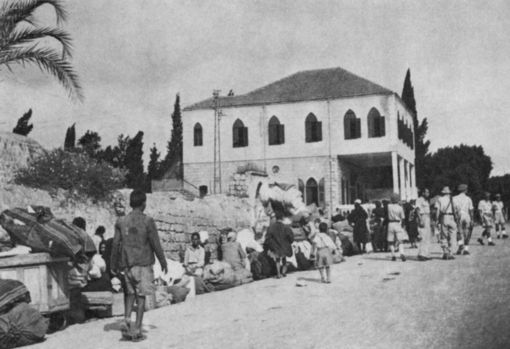
In 1948 my grandfather, along with 3000 other Badrasawis, was expelled by Israeli military forces from our ancestral village of Beit Daras in Palestine.
Like hundreds of thousands of Palestinians from over 500 other villages, my grandfather assumed he would be back home in a few weeks. “Why bother to haul the good blankets on the back of a donkey, exposing them to the dust of the journey, when we know that we will return to Beit Daras in a week or so?” he asked my bewildered grandmother, Zeinab.
Beit Daras was located 32 kilometres north-east of the Gaza Strip, perched between a large hill and a small river that seemed never to run dry. A massacre took place as people fled the village. Houses were blown up, and wells and granaries sabotaged.
A peaceful village, that had existed for millennia, was completely destroyed with the intention of erasing it from existence. In its place now stands the Israeli towns of Giv’ati, Azrikam, and Emunim. The life of those Israeli towns is based on the death of our village.
Seventy years later, we have still not returned. Not just the Badrasawis, but millions of Palestinians, who are scattered in refugee camps all across the Middle East and a growing diaspora globally. Our good blankets have been lost forever, replaced with endless exile and dispossession.
The occupation of Palestine is not a “conflict” – as the Israelis like to present it. Israel is a colonial power that is ethnically cleansing an entire indigenous population in order to legitimise and grow its colony.
And like all people, we Palestinians have the right to resist colonial domination and occupation. This is an inalienable right enshrined in international law. ]
It is this right that justified Africa’s anti-colonial struggles and wars of liberation in the 1950’s and 1960’s, the American Revolution and the Cuban Revolution. This right also legitimates Palestinian resistance – whether that resistance is through the Boycott, Divestment and Sanctions Movement, prosecution of Israeli war criminals at the International Criminal Court, or through armed struggle.
Dedan Kimathi is celebrated as a hero to Kenyans because of his resistance to – not because of his subservience to – colonialism and occupation. The Mau Mau rebellion is a source of inspiration – not just for Kenyans – but for all of humanity.
Israel will claim its occupation of Palestine is self-defense; that its demolition of Palestinian homes, detention without trial policies, construction of illegal settlements, theft of Palestinian land in the West Bank and East Jerusalem, and restrictions on Palestinian freedom of movement, are necessary for ‘security’. Israeli security and peace cannot be built on injustice and occupation – at the expense of Palestinian security, justice, dignity and peace. The life of one group should not be based on the death of the other.
Israeli military strikes on Palestinian targets in the Gaza Strip are always portrayed as a “response” to Palestinian fire. But Palestinian fire is never contextualised. It is never “in return” for the cruel, years-long Israeli siege that has systematically destroyed Gaza’s economy and subjected an entire generation of Palestinian children to malnutrition-related deficiencies.
It is never “in return” for decades of devastating military occupation of Palestinian land and life. Fire from Gaza is never “in return” for the continued dispossession of historic Palestine which made most of the population in Gaza refugees in the first place.
The Palestinian liberation struggle is simply dismissed as “terrorism”. The word “terrorism” is readily applied to Palestinian individuals or groups who use homemade bombs, but never to a nuclear-armed Israeli state that has used white phosphorous, DIME bombs, and other internationally-prohibited weapons against Palestinian civilians.
What is happening in occupied Palestine is incremental genocide – not self-defence. Israel is asking the Palestinian people to let their freedom die, so that the Israeli people can live.
Submit or fight. These were the two choices facing Kenyans during your anti-colonial struggle. Like you, we Palestinians have also chosen to fight for our dignity – for ourselves and our children. We will not let our dream of freedom die.
For me, Beit Daras is not just a piece of earth but a perpetual fight for justice that shall never cease, because the Badrasawis belong to Beit Daras and nowhere else.
Israel can no longer rationalise its oppression of Palestinians by blaming Palestinians who exercise their natural and internationally recognised right to resist occupation and colonialism.
We will continue to resist Israeli colonialism, armed with our rights and international law.
Dr. Ramzy Baroud is a Palestinian journalist, author and editor of the Palestine Chronicle newspaper. He is currently on a tour of Nairobi, discussing his latest book ‘The Last Earth: A Palestinian Story’ (Pluto Press, London).
“Dunk the ball for Palestinian rights?” That is not exactly the world’s catchiest protest chant. No rhyme or alliteration, the meter doesn’t scan, and the image that comes to mind is…what, exactly? Kawhi Leonard stealing Larry Tennenbaum’s head right off his neck and slamming it through the hoop?
Regardless, the well-meaning lefties at Code Pink have their hearts in the right place. Like most well-meaning lefties these days, they feel bad about Israeli atrocities. Unlike most well-meaning lefties, they are trying to do something about them. And unlike just about everybody else in America, they have the guts to get loud and visible, risking arrest or worse. (I will never forget hearing about Medea Benjamin getting her arm broken by al-Sisi’s thugs.)
But Code Pink’s courage does not extend to telling the truth about Jewish power and its most egregious abuses and vulnerabilities. Medea Benjamin must know that 9/11 was a false flag operation—she essentially admitted her suspicions to me, and cheered on my 9/11 activism, during her 2007 interview on my Truth Jihad Radio show. Yet during a 2014 New Horizon Conference in Iran, she and Gareth Porter loudly complained about the Conference’s focus on 9/11 “conspiracy theories” and other forms of “anti-Semitism.” While everyone else at the conference accepted that 9/11 was a Zionist-driven false flag (the show of hands was unanimous except for Benjamin and Porter), the two holdouts raised a stink with the Conference organizers about supposed anti-Jewish sentiment at the event. The two were particularly appalled by a couple of attendees representing the the European New Right, who espoused Holocaust revisionism and ferociously condemned what they saw as grossly disproportionate Jewish power dominating the West.
Which brings us to Gilad Atzmon’s million-dollar question: Why can’t we talk about Jewish power? Some say Jewish power is the elephant in the living room: It is so overwhelmingly huge and obvious that we just don’t notice it. But why don’t we notice it? And why are we met with embarrassed cringes when we mention it? Could it be that the elephant in the living room is standing on its hind legs and displaying a massively oversized sex organ?
In our current cultural living room, Jewish power is a kind of obscenity: It performs unspeakably blasphemous and perverted acts—shooting Palestinian children for sport, putting targets on the bellies of pregnant Palestinian mothers in order to kill the “little snakes” as well as their moms, killing the Kennedies, blowing up the World Trade Center in broad daylight, and so on—and then uses its monopoly on mainstream media to gaslight us and tell us that such things cannot possibly exist. (I analyzed this obscene, “unspeakable” dimension of 9/11 in a 2007 essay.)
When I try to talk about these matters with well-meaning liberal Jews like Medea Benjamin or Rabbi Michael Lerner, I run into a brick wall of denial. Rabbi Lerner seems to think that Jewish power in America is roughly proportional to Jewish demographic status as 1.5% of the population:
Barrett: Is there an American politician who could do that, though, given the ever increasing power of the ever more radical Zionist lobby here in the US? …
Lerner: Well, I think you’re mistaken about the causation. The American Jews represent about 1.5% of the population of the United States. The major force that supports the Republican Party and pushes also forces in the Democratic Party are the Christian fundamentalists. They are at least some place between 30 and 40 million, essentially about 5 or 6 times as many of them as there are Jews…. I think it’s a mistake to exaggerate Jewish power. The United States would be taking the same stance if Israel had no Jews in it, if Israel was simply another country that was willing to play ball with the United States…
Lerner’s seeming obliviousness to the reality of Jewish power in America, and the monstrous crimes it has enabled, is not unlike the reaction of a deep-in-denial child or spouse of an extreme abuser or serial killer. Good-hearted Jews like Rabbi Lerner just can’t face the fact that their community is (a) obscenely disproportionate in its power, and (b) complicit in the obscene crimes of the worst, dominant element of its leadership.
Rabbi Lerner’s assertion that the (organized) Jewish community’s power in America is proportional to its numbers, and has nothing to do with US support for Israel, is absurdly, laughably false. Yet ask average Americans “is Jewish power in America disproportionate, and if so, how disproportionate?” and you’ll probably get a lot of blank, embarrassed stares. We have been trained by the Jewish-dominated mainstream media to imagine that the only people who ask such questions are paranoid Nazi nutcases who fantasize about Jews secretly running the world from Elders of Zion headquarters beneath the South Pole, no doubt in cahoots with a still-living Elvis.
So let’s leave the “how disproportionate is Jewish power” question aside for a moment, and ask a parallel question: “Are African-Americans dominant, i.e. disproportionately represented, in professional basketball?” The answer, as we all know, is “yes.” How disproportionate are they? Rather than bothering to confirm with redundant research what we all know thanks to our own eyes, I confidently opine that the average pro basketball game features ten players, roughly eight of whom appear to be African-Americans. So African-Americans, who make up about 12% of the US population, constitute about 80% of NBA players. In other words, there are between six and seven times as many black NBA players as there would be if their presence was proportional to the black population. That’s a 600% to 700% overrepresentation. One could summarize this all-too-obvious reality by saying that “black people are massively overrepresented on the pro basketball court. They dominate!”
So how about NBA owners? One list claims that 17 out of 39 NBA owners (43.6%) are Jewish. The same list erroneously states that Jews constitute 3% of the population; the reality is less than 1.5%. It seems that Jews are overrepresented in NBA ownership positions by a factor of 2,900%—four times more overrepresentation than black players enjoy on the pro basketball court! So if we say that blacks are massively overrepresented and dominate the NBA courts, what words could possibly describe the overrepresentation of Jews as NBA owners?!
If you’re a Code Pink supporting liberal, it’s OK to protest Larry Tennenbaum dragging his basketball team to Israel to “sportswash” Zionist crimes. But it’s not OK to remark upon the fact that “Tennenbaum” is an obviously Jewish name. It’s even less OK to point out that Jews are absurdly overrepresented in NBA ownership positions. And it is the penultimate in non-OK-ness to point out that this is because Jews are similarly overrepresented among American billionaires, millionaires, people who make at least $100k per year—you name the metric of wealth, Jews pretty much own it. Finally, if you want to really make yourself unpopular by uttering the worst possible obscenity, just point out that this extreme overrepresentation of Jewish wealth, along with even more extreme and disproportionate Jewish dominance of mainstream media, is OBVIOUSLY (sorry Rabbi Lerner) the main reason the US has been bled by the state of Israel to the tune of trillions of dollars while squandering its power, reputation, and freedoms in an endless series of Middle Eastern wars.
Former ADL chief Abe Foxman, upon reading the above words, will no doubt be thrashing around in his plush retirement home bed with rage, screaming: “THE ‘RICH JEW’ IS A PERNICIOUS ANTI-SEMITIC TROPE!” More honest Jewish Americans, like the irrepressible Joel Stein, might reply that like Ilhan Omar’s “anti-Semitic tropes,” this one happens to be true. Joel might even wisecrack that he doesn’t care if Americans think Jews are obscenely rich and powerful, he just wants to keep them that way.
The Jewish community reacted to Stein’s legendary article “Who Runs Hollywood? C’mon!” in much the same way a classroom full of fourth graders might react to an especially loud and stinky fart: Half turned away and held their nose, while the other half giggled. There could be no better illustration of the parallel between the way people naturally react to obscenity, and typical polite middle class liberal reactions to the mention of Jewish power.
Palestinians have rejected the Manama summit taking place today for several legitimate reasons – all pointing to how the US prelude to the so-called “deal of the century” normalises Israel at an unprecedented level. This normalisation will drastically reduce Palestinian prospects for liberation, which are already precariously low, given the focus on diplomacy which marginalised the role that Palestinian resistance movements could have played in the process.
For its own reasons, notably the issue of prolonging its survival, the Palestinian Authority (PA) has also denounced the summit. Israeli Ambassador to the UN, Danny Danon, has taken issue with the PA stance, penning an op-ed in the New York Times in which he discusses the purported benefits of political surrender.
Danon asks: “What’s wrong with Palestinian surrender?”
Palestinian surrender is non-existent, as it should be. Typical of sweeping statements in which Israeli officials eliminate the distinction between the Palestinian leadership and the Palestinian people, Danon deems the conflation necessary in order to support his preposterous argument that “a national suicide of the Palestinians’ current political and cultural ethos is precisely what is needed for peace.”
Pointing fingers at the PA and Palestine Liberation Organisation (PLO) Secretary General Saeb Erekat to make his argument, Danon seeks to pressure the PA into accepting the new framework, detrimental to Palestinians as it is, in order to validate his hypothesis that surrender equals liberation of the Palestinian people. Yet the very mention of liberation by an Israeli official makes clear the existence of a colonial project that has incarcerated Palestinians since before the Nakba of 1948.
Currently the PA has no other option but to speak out against US President Donald Trump’s “deal of the century” and related initiatives. Its authority is eroding, mirroring the divide between the PA hierarchy and the people. The current decision to align itself with the Palestinian people’s demands is a step taken out of necessity – there are no principles involved on behalf of the PA and Danon knows this all too well.
The PA has traded Palestine for symbolic concessions and contributed to making Israel stronger by compromising on the Palestinians’ right to land and return. Unless the current stance is backed up by a radical change within the PA, it will bolster Danon’s surrender requirements at a diplomatic level.
Far from leading to “peace”, which has also been bludgeoned in line with Israeli demands, Palestinian surrender will eliminate both the struggle and the people. Liberation is not tied to economic prosperity – it is a requirement that comes with the decolonisation of historic Palestine. Unless that demand is heeded, all suggestions and plans for negotiations should be rejected. That includes an outright rejection of the two-state compromise, which has proved to be a dangerous scheme and very much in line with what the US hopes to accelerate through its plan.
Is Danon predicting an eventual PA surrender? That hypothesis is much more likely than a Palestinian surrender of their rights to their land. As a coloniser, Danon has no right to dictate what trajectory Palestinians decide upon, much less insist upon a “national suicide” to conceal the fact that Israel – the colonial enterprise he forms part of – perpetuated the ongoing massacre against the Palestinian people.
The implementation of the safe decommissioning of the Fukushima Daiichi nuclear power station is a unique complex case and expected to span several decades: the IAEA Review Team considers that it will therefore require sustained engagement with stakeholders, proper knowledge management, and benefit from broad international cooperation.
The bland language of the official IAEA report is itself a form of lying, offering the false appearance of reassurance that a catastrophic event will be safely managed “for several decades.” There is no way to know that: it is a hope, a prayer, a form of denial. The IAEA, as is its job in a sense, offers this optimism that is unsupported by the realities at Fukushima.
On April 14, 2019, Japan’s prime minister, Shinzo Abe, visited the Fukushima meltdown site. According to The Asahi Shimbun’s headline, “Abe [was] pushing idea that Fukushima nuclear disaster is ‘under control’.” Abe entered the site wearing a business suit and no protective clothing to shield him from radiation. He stood on elevated ground about 100 meters from a building holding one of the melted-down reactors. He had his picture taken. He told reporters, “The decommissioning work has been making progress in earnest.” Abe’s visit lasted six minutes. This was a classic media pseudo-event, designed to be reported despite its lack of actual meaning – for all practical purposes it was another nuclear lie.
The entire Fukushima site remains radioactive at varying levels, from unsafe to lethal, depending on location. The site includes six reactors, three of them in meltdown, and at least as many fuel pools, some of which still contain fuel rods. The site has close to a thousand large storage tanks holding more than a million tons (roughly 264.5 million gallons) of radioactive wastewater.
The prime minister’s stage-managed visit placed him on a platform where the radiation level “exceeds 100 micro-sieverts per hour,” a low level but less than safe. That’s why Abe’s visit lasted only six minutes. Prolonged exposure to that level of radiation is not healthy. A year’s exposure to 100 micro-sieverts per hour would total 87,600 micro-sieverts in a year. How bad that would be is debatable. By way of illustration, even US regulations, not known for their stringency, allow American nuclear workers a maximum annual radiation exposure of 50,000 micro-sieverts.
Translation: the Prime Minister was posing in an area of dangerous radiation level and pretending it was all fine. Call it lying by photo op.
The first thing to know about the Fukushima meltdowns is that they are not even close to being over. The second thing to know about the Fukushima meltdowns is that no one really knows what’s going on, but officials routinely and falsely issue happy-talk reassurances that just aren’t true. The third thing to know about the Fukushima meltdowns is that they won’t be over for years, more likely decades, perhaps even ever.
Now, more than eight years after the triple reactor meltdown at Fukushima, the status of the three melted reactor cores remains somewhat contained but uncontrolled, with no end in sight. No one knows exactly where the melted cores are. No one has any clear idea of how to remove them or how to dispose of them safely. For the foreseeable future, the best anyone can do is keep the cores cooled with water and hope for the best. Water flowing into the reactors and cooling the cores is vital to preventing the meltdowns from re-initiating.
Clean groundwater continues to flow into the reactors. Then radioactive water flows out into the Pacific. Continuously. A frozen ice wall costing $309 million diverts much of the groundwater around the site to the Pacific Ocean. The water flow is not well measured. Some contaminated water is stored on site, but the site’s storage capacity of 1.37 million tons of radioactive water may be reached during 2020.
One proposed wastewater solution is to dilute the stored radioactive water and then dump it in the Pacific. Fukushima fishermen oppose this. Radioactivity in Fukushima fish has slowly declined since 2011, but the local fishing industry is only at 20 percent of pre-meltdown levels.
When it exists, reporting on Fukushima continues to be uneven and often shabby, buying into the official rosy view of the disaster, as The New York Times did on April 15. The day after Abe’s visit to Fukushima, the Times reported that an operation to begin removing fuel rods from a fuel pool was a “Milestone in Fukushima Nuclear Cleanup.” The Times, with remarkable incompetence, couldn’t distinguish clearly between the fuel pool and the melted reactor cores:
The operator of Japan’s ruined Fukushima nuclear power plant began removing radioactive fuel rods on Monday at one of three reactors that melted down after an earthquake and a tsunami in 2011, a major milestone in the long-delayed cleanup effort….
The plant operator, Tokyo Electric Power, said in a statement that workers on Monday morning began removing the first of 566 spent and unspent fuel rods stored in a pool at the plant’s third reactor. A radiation-hardened robot had first located the melted uranium fuel inside the reactor in 2017.
That is such a botch. The fuel pool is a storage pool outside the reactor. It contains fuel rods that have NOT melted down. They could melt down if the pool loses its cooling water, but for now they’re stable. The fuel pool has nothing more to do with the melted reactor cores than proximity. The fuel pool is outside the reactor, the melted cores are somewhere near the bottom of the reactor. The melted cores are beyond any remediation for the foreseeable future. To pretend that the start of fuel rod removal is any kind of meaningful milestone while the three melted cores remain out of reach is really to distort the reality of Fukushima.
The summer Olympics are planned for Tokyo in 2020. In 2013, two years after the Fukushima meltdowns, Prime Minister Abe pitched the Tokyo site by telling the Olympic Committee in reference to Fukushima: “Let me assure you, the situation is under control.”
This was a lie.
Even now, no one knows where the melted reactor cores are precisely. One robot has made one contact so far. Radiation levels at the core are lethal. There is, as yet, no way to remove the cores safely. They think they’re going to remove the cores with robots, but the robots don’t yet exist. The disaster may not be as out of control as it was, but that’s about the best that can be honestly said, unless there’s another tsunami.
Official government statistics show pediatric cancers almost doubling since the Fukushima meltdowns of 2011. Thyroid cancers are reaching epidemic levels. The Japanese government refuses to track leukemia and other cancers. The official Fukushima death toll is more than 18,000, including 2,546 who have never been recovered. Most of Fukushima prefecture remains uninhabitable due to high radiation levels.
On March 21, 2019, Dr. Helen Caldicot offered an assessment much closer to the likely truth:
They will never, and I quote never, decommission those reactors. They will never be able to stop the water coming down from the mountains. And so, the truth be known, it’s an ongoing global radiological catastrophe which no one really is addressing in full.
The Japanese government doesn’t want to address Fukushima in full because it wants to re-start all its other nuclear power plants. TEPCO doesn’t want to address Fukushima in full because it wants to stay in business as long as the Japanese government is willing to make the company profitable with billions of dollars in bailouts. The IAEA and the rest of the nuclear industry don’t want to address Fukushima in full because they don’t want to see the over-priced, over-subsidized, and ultimately dangerous nuclear industry die from its own shortcomings. With billions of dollars at stake, who needs the truth?
William M. Boardman has over 40 years experience in theatre, radio, TV, print journalism, and non-fiction, including 20 years in the Vermont judiciary. He has received honors from Writers Guild of America, Corporation for Public Broadcasting, Vermont Life magazine, and an Emmy Award nomination from the Academy of Television Arts and Sciences.
A few days ago the BBC reported on an extraordinary French identity theft scam. For two years starting in late 2015, an individual or individuals impersonating France’s defence minister, Jean-Yves Le Drian, scammed an estimated €80m from wealthy French patriots.
The victims of this fraud were tricked into believing that they were being contacted by France’s Defence Minister who was requesting money to help pay ransom for journalists held hostage by Islamists in the Middle East. Since France officially does not pay ransom to terrorists, the fake minster assured the victims that payments could not be traced and asked for the funds to be wired to a bank in China.
The BBC deemed the operation “one of the most outlandish and successful rackets of recent times.”
You may not be surprised that the accused evil genius behind this con is a French-Israeli character of Tunisian Jewish background named Gilbert Chikli. Chikli grew up in the working-class Belleville neighbourhood of northeast Paris.
In 2015, Chikli was found guilty of scamming money from French corporations by pretending to be their chief executive. By the time the verdict was reached, Chikli was safely ensconced in the Jewish State, which refuses to extradite its nationals.
Chikli’s luck ran out in August 2017 when he made the mistake of travelling to Ukraine where he was arrested at the request of the French police. Chikli told police he was on a pilgrimage to the tomb of a well-known rabbi. But a search into his phone’s communication revealed that he went to Ukraine to buy a silicone mask
The alleged crime saga didn’t end there. Recently reports began to arrive at French embassies around the world that once again a fake Le Drian, now French foreign minster, was trying to squeeze money out of influential ‘friends of France’. In February, three French-Israeli citizens were arrested near Tel Aviv in connection with this new swindle.
Chikli’s racket is astonishing, creative; criminologists may decide that it borders on genius. Although Chikli didn’t invent the art of the swindle, he ratcheted it up to a higher level.
What I find remarkable about Chikli’s operation is not the stunning amounts of money, the sophistication, or even the chutzpah involved: it is the fact that Chikli ’s scam was dependent upon the humane compassion of others. He banked on the fact that humans feel and care for each other. We are dealing with a disgraceful blow against the most precious aspect of humanity, that which sustains kindness and brotherhood.
It is not surprising that some very wealthy and influential people fell for Chikli’s racket and for the obvious reason: decent humans would find it hard or even impossible to imagine the extent of Chikli and his friends’ deception.
And Chikli is not alone in his practices. In recent years we have seen a number of instances of gross misbehavior and abuse and on a spectacular scale. And as is the case of Chikli we find Jews and Israelis at the centre of these embarrassing sagas.
In 2010 an Israeli court ruled that seven Israelis suspected of scamming tens of millions of dollars from U.S. pensioners in a so-called ‘Nigerian scam’ could be extradited to the United States to face trial there. Israel has bought itself a reputation as the location of some of the most horrendous crimes such as organ trafficking (look here and here), and is notorious as a hub of human trafficking, blood diamond, crypto currency criminals, the binary options scam, and the scope of gross unethical behavior extends well beyond the borders of the Jewish State.
In 2012 Britain was shocked to discover that one of its most popular TV stars was a serial pedophile who had committed sex crimes against children throughout his 50 year career. Jimmy Savile raped children in the BBC’s dressing rooms, in orphan homes and in institutions that cared for the disabled. No one bothered to defend Jimmy Saville. Yet when Lord Janner faced similar allegations, the British establishment was somehow hesitant and confused. Despite the fact that Lord Janner was suspected of sexually abusing more than 30 children from the mid-1950s until the late 1980s the British judicial system found itself struggling.
Janner, a former Leicester MP (Labour) was the chairman of the Board of Jewish Deputies (BOD), a body that claims to represent British Jewry and the founder of the Holocaust Educational Trust (HET). To date, neither the BOD nor the HET has expressed any regret for its past association with Janner who died at age 87 before a trial could take place.
Lord Janner’s family is taking good care to restore their father’s reputation. Soon after the Lord passed away we learned from the British press that Janner’s three grown-up children asked “to take part in the investigation into his alleged crimes.”
Outside the investigation’s London headquarters, Lord Janner’s son, Daniel Janner QC, attacked the “shambolic and discredited inquiry” (into his father alleged crimes).
He claimed there had been a “total failure” to acknowledge “our late father’s good character and legal status as innocent”
In February 2018 we learned that Lord Janner’s son vowed to bring a private prosecution against the man who initiated the Westminster child abuse claims, who has himself been charged with paedophile offences.
I am not in a position to verify whether Lord Janner was guilty of the crimes he was accused of but I can confirm that the enquiry into his suspected sex abuse has collapsed. In all, 33 men and women accused Lord Janner of abusing them. Their plight has been forgotten. One of the most embarrassing chapters in Britain’s past remains untouched.
Lord Janner is hardly alone as a suspect in an abusive sex scandal. For the last two years we have been learning about another Zionist enthusiast who left more than 80 victims traumatized, abused and humiliated.
In October 2017, The New York Times and The New Yorker reported that tens of women came forward and accused Harvey Weinstein, formerly head of Miramax Films and The Weinstein Company (TWC), of rape, sexual assault and sexual abuse over a period of at least three decades. More than 80 women in the film industry have since accused Weinstein of such acts. Weinstein denied “any non-consensual sex”.
Jeffrey Epstein’s story is similarly abusive. The convicted sex offender prostituted dozens of underage girls and should have spent the rest of his life in jail. Again this is no ‘one-off’ abuse of an underage child, he was a serial sex predator.
According to Joseph Recarey, the lead Palm Beach detective on the case, Epstein was essentially operating a “sexual pyramid scheme.”
Vox writes that the girls and women who reported abuse by Epstein, meanwhile, were markedly powerless. Most of them “came from disadvantaged families, single-parent homes or foster care,… Many of the girls were one step away from homelessness.”
In November 2017 the genius comedian Larry David was criticized in the Jewish press for admitting on Saturday Night Live that many of those accused of sexual harassment in Hollywood are Jewish.
Jews often brag about their genius gene pool and about the fact that so many Nobel Prize winners are Jewish (20%). Jews frequently boast about their power in politics, media and finance. “Jews must never be afraid to use their well-earned power” was the title of a recent article by Alan Dershowitz, who was a member of Epstein’s legal team and was later accused by one of the victims’ lawyers of himself participating in the sex trafficking ring.
This raises the obvious question of whether the same ‘gene-pool’ that created so many spectacular Jewish minds is also responsible for the list of gross misconduct as illustrated above. I am not a biologist nor an evolutionary scientist, but I admit I am not a great believer in the notion of a ‘Jewish gene.’
I contend that Chikli, Janner, Weinstein and Epstein have something else in common. Their actions display a dismissal of others that verges on complete contempt for humanity. This is the crux of choseness. To be chosen is to see oneself as an exceptional creation. It entails blindness to otherness. It is a form of impunity. To be chosen often involves a near or total lack of empathy. Such lack is often defined in terms of acute narcissism and psychopathy. Chikli is clearly aware of the human inclination for empathy, it is that impulse that he allegedly exploited to his own benefit, he just lacks that empathic quality himself.
Not every Jew identifies him or herself as chosen. None of the Jews in my social circuit displays any of the horrid symptoms described above. As a reader of early Zionist texts, I know well that Zionism was born to emancipate Diaspora Jews from their exceptionalist cultural traits and to re-make them, I am also aware that some rabbinical Judaic interpretations of choseness are somehow different from the contemporary Zionist secular Jewish political interpretation of Jewish exceptionalism. Nor is choseness limited to Zionists or Israelis. Choseness has become the pillar of Jewish self identification. Choseness is what binds Jews together. This includes anti Zionist Jews boasting about the precious contribution of the so-called ‘Jews in the movement’ and the Israelis and Zionists who celebrate their choseness at the expense of the indigenous people of Palestine.
Like an early Zionist, I would have liked to see Jews liberate themselves from the choseness prison but I accept that such a shift can not occur in the form of a collective or political movement. The escape from choseness to the ordinary must be an individual struggle, a surrender to self-contempt that eventually matures into a genuine search for peace and harmony with the universe, with the soil and with one’s neighbours.
When Michael Rubin at the American Enterprise Institute argued in an article in the National Interest last week that the ‘maximum pressure’ policy of the Trump administration against Iran must be maintained despite the dangerous brinkmanship at the Strait of Hormuz last week, we got an authentic version of Israel’s stance on the current US-Iran standoff. Rubin’s main arguments are three:
A. ’Pressure can work on Iran.’ Rubin cites as examples: release of American hostages by Iran in 1981; Iran’s acceptance of ceasefire with Iraq in 1988; and, US-Iranian negotiations resulting in the 2015 deal.
B. The recent personnel changes at the top of Islamic Revolutionary Guard Corps and armed forces put the newly-appointed commanders under pressure to ‘prove their revolutionary mettle’ and they feel tempted ‘to test long-established red lines.’
C. The Iranian system is about to implode under American pressure. Therefore, Trump should be ‘wise enough to allow his ‘maximum pressure campaign’ to work’.
Rubin sees Iran through the Israeli eyes. And it is a jaundiced view. Nonetheless, it serves to expose that the entire US strategy against Iran, which is driven by Israel, is based on a narrative that is poppycock.
Indeed, what was the hostage crisis of 1979-1980 all about? Quintessentially, the crisis helped the weak fledgling Islamic regime that was formed following the 1979 revolution create space for its political consolidation.
The regime was highly apprehensive about a US-backed counterrevolution (and was rightly so, given the long history of American interference in Iran’s domestic politics.) The hostage crisis put the US on the defensive, throwing Washington’s Iran policies into total disarray by crippling the American intelligence network within Iran and derailing covert operations aimed at subverting the country’s social and political order.
Tehran probably delayed the release of the American hostages on the basis of some ‘feelers’ from Ronald Reagan’s camp that once he was elected in the 1980 election, he’d comprehensively review Iran policies. At any rate, Tehran released the hostages only after the Shah left the United States in December 1979.
To recap, the US had rejected Iran’s demands for the return of the Shah who had taken refuge in America following the Islamic Revolution, in order to stand trial for crimes committed during his reign. Iran had suspicions over the American intentions behind Washington’s granting asylum to the Shah. The hostages were formally handed over to American custody the day after the signing of the Algiers Accords (January, 1981) between Iran and the US.
The main provisions of the Algiers Accords were that: the US would not intervene politically or militarily in Iranian internal affairs; the US would remove the freeze on Iranian assets and trade sanctions on Iran; both countries would end litigation between their respective governments and citizens, referring them instead to international arbitration, namely to the Iran-United States Claims Tribunal (created as a result of the agreement); and, the US would ensure that US court decisions regarding the transfer of any property of the former Shah would be independent from “sovereign immunity principles” and would be enforced. (Of course, it is a different story that the US eventually dumped the Algiers Accords in the dustbin.)
Again, did Iran accept the UN-brokered ceasefire with Iraq in 1988 under American pressure? Nonsense. It was a tactical decision by Iran’s collective leadership which Ayatollah Khomeini reluctantly approved. One million Iranians had died and pressing ahead with the war might have only harmed Iranian interests in the medium and long term.
Khomeini’s decision indeed paid off. By 1990, Iraq and Iran restored diplomatic relations, and Iraq agreed to Iranian terms for the settlement of the war: the withdrawal of Iraqi troops from occupied Iranian territory, division of sovereignty over the Shaṭṭ al-ʿArab waterway, and a prisoner-of-war exchange.
Again, did Iran negotiate with the Obama administration on the nuclear issue under US pressure? Of course not. On the contrary, Iran had repeatedly offered to negotiate with the previous US administrations. According to former secretary of state John Kerry, Iran offered then President George W Bush a nuclear deal in 2003.
Simply put, President Barack Obama estimated that the US sanctions had proved counterproductive, since before July 2015, Iran had a large stockpile of enriched uranium and almost 20,000 centrifuges, enough to create eight to 10 bombs. The US experts estimated that if Iran had decided to rush to make a bomb, it would take two to three months until it had enough 90%-enriched uranium to build a nuclear weapon — the so-called “break-out time”. Suffice to say, Obama understood that there was no alternative but to negotiate a nuclear deal with Iran.
What Rubin glosses over conveniently is that Iran has scrupulously fulfilled its obligations under the 2015 deal and Israel should never have conspired to undermine the deal, having been a nuclear weapon state all this while. The changes agreed under the 2015 deal to limit Iran’s nuclear programme were far-reaching.
Isn’t that funny that Rubin, a Jew himself, is complaining that Iran manipulates US politics? Is Iran’s clout even 1% of that of the Jewish lobby in the US? Read a stunning essay — Trump Has A $259 Million Reason To Bomb Iran — how a clutch of Jewish billionaires acting in Israeli interests wield influence on President Trump and may be singularly responsible for his current policies toward Iran.
As for the shibboleth that Rubin propagates about the Iranian system, the less said the better. It is standard Israeli fare that a collapse of the regime in Tehran is round the corner. Indeed, the US sanctions have put immense pressure on the Iranian economy. But is that translating as mass resentment against the authorities? On the contrary, Iranian nationalism remains a potent force.
One-dimensional minds like Rubin’s refuse to accept that the US sanctions are having just the opposite effect. In an opinion piece last week, the New York Times columnist Roger Cohen quoted Kerry as saying: “The CIA has evidently been unable to penetrate Trump’s mind with a psychological profile of the people he’s dealing with. The Iranians have been around for several thousand years. This policy just tightens their willpower to hang in there…”
It is precisely this “willpower to hang in there” that was on display last Thursday when the Iranians shot down the US drone to demonstrate their deterrent power but let go the manned spy plane flying nearby, which they had in their sights alright, because it had 38 American military personnel on board.
Tehran understands perfectly well what this confrontation is about. As a senior IRGC commander Gen. Gholam Ali Rashid put it, Iran is engaged in a “strategic confrontation to preserve its stability and existence as well as its position as a regional power in the face of an American-Zionist-Saudi coalition.”
That is why Trump’s latest decision to ratchet up sanctions even more is a serious mistake and can only have dangerous consequences. Trump is virtually closing doors on de-escalation and is challenging Tehran to escalate further. This is exactly what Israel desires.
To quote Gen. Rashid, “Either we will all move on the path of stability or the region will be engulfed by instability and war due to America’s interventionist policies, and provocations of certain known states. To avert war, mere words are not enough; they need to be followed by determination and proper behaviour.”
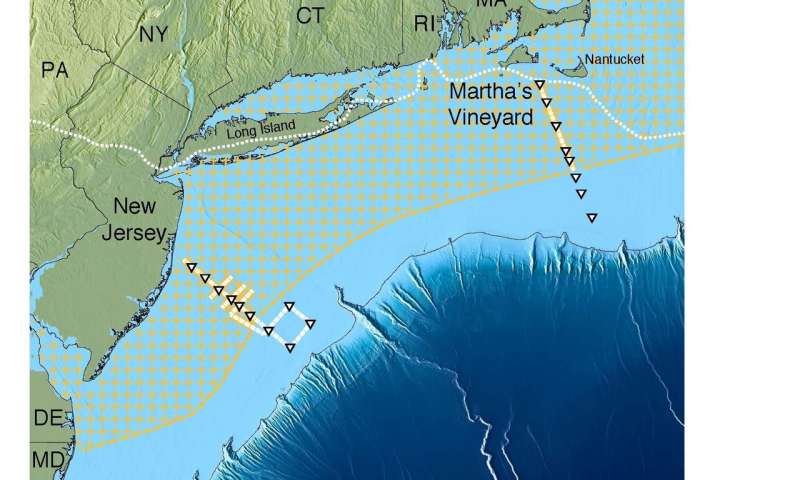
Scientists have mapped a huge aquifer off the US Northeast (hatched area). Solid yellow or white lines with triangles show ship tracks. Dotted white line near shore shows edge of the glacial ice sheet that melted about 15,000 years ago. Further out, dark blue, the continental shelf drops off into the Atlantic abyss. Credit: Gustafson et al., Scientific Reports, 2019
In a new survey of the sub-seafloor off the U.S. Northeast coast, scientists have made a surprising discovery: a gigantic aquifer of relatively fresh water trapped in porous sediments lying below the salty ocean. It appears to be the largest such formation yet found in the world. The aquifer stretches from the shore at least from Massachusetts to New Jersey, extending more or less continuously out about 50 miles to the edge of the continental shelf. If found on the surface, it would create a lake covering some 15,000 square miles. The study suggests that such aquifers probably lie off many other coasts worldwide, and could provide desperately needed water for arid areas that are now in danger of running out.
The researchers employed innovative measurements of electromagnetic waves to map the water, which remained invisible to other technologies. “We knew there was fresh water down there in isolated places, but we did not know the extent or geometry,” said lead author Chloe Gustafson, a Ph.D. candidate at Columbia University’s Lamont-Doherty Earth Observatory. “It could turn out to be an important resource in other parts of the world.” The study appears this week in the journal Scientific Reports.
The first hints of the aquifer came in the 1970s, when companies drilled off the coastline for oil, but sometimes instead hit fresh water. Drill holes are just pinpricks in the seafloor, and scientists debated whether the water deposits were just isolated pockets or something bigger. Starting about 20 years ago, study coauthor Kerry Key, now a Lamont-Doherty geophysicist, helped oil companies develop techniques to use electromagnetic imaging of the sub-seafloor to look for oil. More recently, Key decided to see if some form of the technology could also be used also to find fresh-water deposits. In 2015, he and Rob L. Evans of Woods Hole Oceanographic Institution spent 10 days on the Lamont-Doherty research vessel Marcus G. Langseth making measurements off southern New Jersey and the Massachusetts island of Martha’s Vineyard, where scattered drill holes had hit fresh-water-rich sediments.
They dropped receivers to the seafloor to measure electromagnetic fields below, and the degree to which natural disruptions such as solar winds and lightning strikes resonated through them. An apparatus towed behind the ship also emitted artificial electromagnetic pulses and recorded the same type of reactions from the subseafloor. Both methods work in a simple way: salt water is a better conductor of electromagnetic waves than fresh water, so the freshwater stood out as a band of low conductance. Analyses indicated that the deposits are not scattered; they are more or less continuous, starting at the shoreline and extending far out within the shallow continental shelf—in some cases, as far as 75 miles. For the most part, they begin at around 600 feet below the ocean floor, and bottom out at about 1,200 feet.
An electromagnetic receiver used in the study being deployed off the research vessel Marcus Langseth. Credit: Kerry Key
The consistency of the data from both study areas allowed to the researchers to infer with a high degree of confidence that fresh water sediments continuously span not just New Jersey and much of Massachusetts, but the intervening coasts of Rhode Island, Connecticut and New York. They estimate that the region holds at least 670 cubic miles of fresh water. If future research shows the aquifer extends further north and south, it would rival the great Ogallala Aquifer, which supplies vital groundwater to eight Great Plains states, from South Dakota to Texas.
The water probably got under the seabed in one of two different ways, say the researchers. Some 15,000 to 20,000 years ago, toward the end of the last glacial age, much of the world’s water was locked up in mile-deep ice; in North America, it extended through what is now northern New Jersey, Long Island and the New England coast. Sea levels were much lower, exposing much of what is now the underwater U.S. continental shelf. When the ice melted, sediments formed huge river deltas on top of the shelf, and fresh water got trapped there in scattered pockets. Later, sea levels rose. Up to now, the trapping of such “fossil” water has been the common explanation for any fresh water found under the ocean.
But the researchers say the new findings indicate that the aquifer is also being fed by modern subterranean runoff from the land. As water from rainfall and water bodies percolates through onshore sediments, it is likely pumped seaward by the rising and falling pressure of tides, said Key. He likened this to a person pressing up and down on a sponge to suck in water from the sponge’s sides. Also, the aquifer is generally freshest near the shore, and saltier the farther out you go, suggesting that it mixes gradually with ocean water over time. Terrestrial fresh water usually contains less than 1 part per thousand salt, and this is about the value found undersea near land. By the time the aquifer reaches its outer edges, it rises to 15 parts per thousand. (Typical seawater is 35 parts per thousand.)
If water from the outer parts of the aquifer were to be withdrawn, it would have to be desalinated for most uses, but the cost would be much less than processing seawater, said Key. “We probably don’t need to do that in this region, but if we can show there are large aquifers in other regions, that might potentially represent a resource” in places like southern California, Australia, the Mideast or Saharan Africa, he said. His group hopes to expand its surveys.
The author of this hard-hitting book came from an old English naval family. He served in the Royal Navy for over thirty years, participating in most of the decisive actions of World War I and subsequently helping to direct the Royal Navy Staff College.
Captain Grenfell’s books on naval strategy — Sea Power (1941), The Bismarck Episode (1948), Nelson the Sailor (1949), and Main Fleet to Singapore (1951) — are known throughout the English-speaking world for their brilliance and their clarity. They were given top priority by reviewers here and abroad.
This final book — Captain Grenfell died suddenly of unknown causes in 1954 as he was drafting a sequel to it — is a 21-gun broadside on policy rather than strategy; it touches on so many raw nerves, conflicts with so many prejudices and vested interests, that publication has had to take place in our still largely free and uncensored United States. No English publisher will touch it as of the present — nor has any important American reviewer recognized its existence.
Those who are still fighting World War II will not like this book; but those who are tired of the same old black-and-white cliches with regard to Germany will welcome it as a breath of fresh air. Unconditional Hatred will find its readership, despite an almost complete blackout by the press. … Read the book
While Donald Trump has kicked off his 2020 presidential campaign in Florida reiterating a vow to bring “deep state” figures out into the open, AG William Barr’s “investigation of investigators” is gaining steam. Wall Street analyst Charles Ortel has shared his views on the role of Barack Obama and his team in the so-called “spygate” case.
Attorney General William Barr’s investigation into the origins of the FBI’s 2016 Trump-Russia “collusion” probe has prompted deep concerns among US intelligence officials, especially given the US president’s decision to grant AG Barr sweeping powers.
Some former US spooks argue that the probe may thwart US counterintelligence efforts aimed against Russia, citing Moscow’s alleged interference in the US 2016 elections, something that the Russian leadership resolutely denies.
“If Barr discloses the identities of CIA and CI sources providing information on Russia he is disabling our intelligence capacities to Russia’s advantage”, claimed former FBI special agent Asha Rangappa on 24 May via Twitter.
However, according to Charles Ortel, a Wall Street analyst who has been conducting a private inquiry into the Clinton Foundation’s alleged fraud for the last three years, what is really concerning former and current intelligence officials and their backers in the previous administration are their possibly illegal actions which may soon come to light.
Sputnik: On 17 June, Fox News host Sean Hannity said that AG William Barr’s “spygate” investigation caused panic among “deep state” actors. Hannity highlighted that at least three Trump campaign aides had actively been spied upon abroad by allied countries allegedly “subcontracted” by US top intelligence officials to circumvent US laws. Have there ever been any precedents of engaging US allies in an effort to undermine an American presidential candidate? What countries were supposedly involved in the “spygate”? Why did they agree to participate in those potentially illegal activities?
Charles Ortel: I am not aware of incidents in the past where elements loyal to an existing presidential administration have encouraged foreign powers to train their security forces to spy on a presidential campaign and/or upon the victor in a hotly contested election after the results became known, through the inauguration and then during the newly-elected president’s first term.
So far, one prime culprit seems to be elements within the government of the United Kingdom. Other culprits seemingly include the government of Australia, while there is also speculation that the government of Canada may have been involved. In time, perhaps we may learn that governments of other, supposed allies of the United States may also have been involved, perhaps Italy, France, and Germany, to name three.
What makes this story particularly galling is that nations named are among the staunchest long-term allies of America. Did no one in these nations, in positions of authority, question the wisdom of potentially interfering, especially given the ham-handed ways in which it seems the interference ultimately took place?
Sputnik: Hannity suggested that US State Department officials including Barack Obama knew about the dirty dossier and spying activities against the Trump campaign. Judicial Watch President Tom Fitton echoed Hannity’s assumption citing newly obtained State Department emails at Fox News’ “Deep Dive” on 17 June. If it is proved that Obama and his associates were aware of the “spygate” effort how could this affect the ex-president and his team?
Charles Ortel: As a guess, Obama administration insiders likely did what they could do to insulate the former president from potential culpability in any scheme that might implicate actors in actual crimes. A review of public records suggests that Presidential counselor Valerie Jarrett was one person who may have been the ultimate shield. But, other reports suggest that Barack Obama himself was keenly interested in political campaigns of all types, particularly key races of which the 2016 presidential contest was clearly most important.
Obama loyalists, even now try to argue that the eight years from 20 January 2009 through 20 January 2017 were “scandal free”. I beg to differ – someone high up in the Obama administration had to bless the use by Hillary Clinton and her team of secret servers, unprotected electronic devices, alias emails, and the fact that Team Hillary was allowed to hold onto all of her government records through early December 2014, some 22 months after she departed her role as Secretary of State. One suspects that President Obama himself had to learn, early on, of the Clinton approach and had to know that it fell well afoul of applicable laws and regulations.
Moreover, Barack Obama likely communicated with Hillary Clinton using email and he was sold to the public as someone who was in tune with technology, even “wedded to his Blackberry” – how could Obama have failed to notice he was sending emails to Hillary Clinton on a non-government email address?
All of which raises larger questions. Did Barack Obama use non-government email addresses to send or receive classified information? Did members of his close circle do so? Did any of these people use aliases in their communications? Do we really know whether all of the “presidential records” of the Obama administration were archived securely for posterity? With these latest revelations, and with each passing day, storm clouds darken over what remains of the Obama “legacy”.
Sputnik: Meanwhile, the US State Department has revealed that at least 15 State Department employees were responsible for 23 violations and seven security infractions related to Clinton’s server under the Obama administration. According to Hannity, Clinton’s activities presumably amount to violating the Espionage Act (18 USC 793 (F) and 18 USC 793 (D) and (E)). Conservative pundits presume that the effort against Trump was prompted by Obama administration officials who sought to conceal their crimes. Do you agree with this assumption? Will all the employees involved in the emailgate case be interrogated and probed given the latest revelations? Will it result in criminal proceedings against them and how will this affect Hillary Clinton?
Charles Ortel: As we consider these questions and issues, the timeline from June 2008 to present comes under much closer scrutiny. In early June 2008, when it became evident that Barack Obama would be the Democrat nominee, and that he would likely defeat John McCain, I suspect the Clintons (and the Obamas) hatched a plan to employ Hillary’s considerable resources to cement victory in the November 2008 presidential election.
What candidate Obama likely did not know back then was how dire the position of the Clinton Foundation had become – it was out of compliance with key laws and regulations around the world and millions of dollars in funding had “gone missing”.
Real investigations of mishandling classified information by many persons including Hillary Clinton will likely extend and intertwine with long overdue deep dives into the network of Clinton “charities” that seem, to me, to have been used as conduits to trade cash for contracts and favours, and certainly not for their intended and authorised tax-exempt purposes.
Hannity and others are correct to call this unfolding scandal, the biggest in American history. When it grows to consider all contours of charity frauds and corruption during the period from 1988 forward, as unregulated globalism became the norm, we will be shocked to discover just how badly so many US presidents and other leaders behaved.
We cannot move forward productively until the public is shown what actually happened. Only with real investigations, indictments, prosecutions, convictions, and incarcerations can we prove that no American stands above our laws. With reason, many once powerful persons should be afraid – they are finally being called to account for lives in crime, pretending falsely to serve the people, even as they served themselves.
The Pentagon document laying out the US doctrine of nuclear operations was publicly available for about a week, then made ‘official use only.’ What’s inside is a chilling reminder that Washington sees nuclear war as winnable.
“Nuclear Operations,” or Joint Publication 3-72, was dated on June 11 and made private since, but not before it was downloaded by Steven Aftergood, an activist at the Federation of American Scientists (FAS). It is currently available on the FAS website as a PDF.
The publication “provides fundamental principles and guidance to plan, execute, and assess nuclear operations.” The rest of it is in the same matter-of-fact tone, even when discussing practical consideration of potentially world-ending weapons.
“That kind of thinking itself can be hazardous. It can make that sort of eventuality more likely instead of deterring it,” Aftergood told the Guardian on Wednesday.
Arguably, the US military’s job is to consider all possibilities, and the decision whether to use nuclear weapons is ultimately in civilian hands – in this case, those of President Donald Trump.
The Trump administration has paid a lot of attention to nuclear matters, updating the US Nuclear Posture Review last year and earmarking funds for modernizing the US “nuclear triad”: bombers, land-based missiles and submarines. However, Trump has also announced the US would leave the 1987 Intermediate-range Nuclear Forces (INF) treaty with Russia by next month. The fate of the New START arms control treaty with Russia, set to expire in February 2021, is very much up in the air.
In such circumstances, the Joint Chiefs doctrine stating that “Using nuclear weapons could create conditions for decisive results and the restoration of strategic stability,” might be taken as a cause for alarm, and with good reason.
The document also describes nuclear bombers as offering “the greatest degree of flexibility in the triad because they can be a highly visible sign of resolve and, once ordered to conduct a nuclear strike, are recallable.” It’s a dry, factual statement, but when coupled with the presence of B-52 strategic bombers on Russian borders earlier this week, it begins to sound like a threat.
Asked about the document, the Joint Chiefs of Staff said it was removed from public access “because it was determined that this publication, as is with other joint staff publications, should be for official use only.” There was no explanation as to how or why it was published in the first place, whether it was a mistake or a deliberate message to other governments.
Back in April, Trump made comments about “getting rid” of nuclear weapons altogether, and speculated about a major arms control treaty with Russia and China. Given his current trade war with Beijing and the continued hostility towards Russia driven at least in part by ‘Russiagate’ conspiracy theories at home, it is unclear whether such a treaty will ever go beyond hopes and dreams.
The US is the only country ever to use nuclear weapons in battle, against the Japanese cities of Hiroshima and Nagasaki in August 1945. Neither was a primarily military target.
Newly uncovered documents have revealed that Israeli authorities began looking for ways to encourage Palestinian emigration immediately after occupying the West Bank in 1967.
According to +972 Magazine, the discovery was made by Omri Shafer Raviv, a PhD student in the Department of Jewish History at Hebrew University. The study uses official government documents from the 1967 war and its aftermath that have only recently been declassified.
The documents uncovered by Shafer Raviv show that “mere weeks” after the Six-Day War, “Israel enlisted teams of academics in the country to find ways to encourage Palestinians to emigrate from the newly occupied territories”.
In July 1967, then-Prime Minister Levi Eshkol assembled a committee of academics “and sent them into the territories to study the newly-occupied population”.
The objective of the committee was two-fold: “to create a body responsible for ‘long-term planning’ in the occupied territories”, and, says Shafer Raviv, to find ways to ensure Palestinians did not resist the military regime while looking for ways to encourage them to leave altogether.
“Those early years set the tone for how Israeli policy looks today,” he told +972 Magazine.
According to the academic, a key goal of the Israeli government was to reduce the number of Palestinians living in the newly-occupied territories.
“We saw this most prominently in Gaza, where the authorities believed they could halve the population from 400,000 to 200,000 in order to contend with the new demographic problem.”
NEW YORK — For nearly two decades, one of the most overlooked and little known arrests made in the aftermath of the September 11 attacks was that of the so-called “High Fivers,” or the “Dancing Israelis.” However, new information released by the FBI on May 7 has brought fresh scrutiny to the possibility that the “Dancing Israelis,” at least two of whom were known Mossad operatives, had prior knowledge of the attacks on the World Trade Center. … continue
This site is provided as a research and reference tool. Although we make every reasonable effort to ensure that the information and data provided at this site are useful, accurate, and current, we cannot guarantee that the information and data provided here will be error-free. By using this site, you assume all responsibility for and risk arising from your use of and reliance upon the contents of this site.
This site and the information available through it do not, and are not intended to constitute legal advice. Should you require legal advice, you should consult your own attorney.
Nothing within this site or linked to by this site constitutes investment advice or medical advice.
Materials accessible from or added to this site by third parties, such as comments posted, are strictly the responsibility of the third party who added such materials or made them accessible and we neither endorse nor undertake to control, monitor, edit or assume responsibility for any such third-party material.
The posting of stories, commentaries, reports, documents and links (embedded or otherwise) on this site does not in any way, shape or form, implied or otherwise, necessarily express or suggest endorsement or support of any of such posted material or parts therein.
The word “alleged” is deemed to occur before the word “fraud.” Since the rule of law still applies. To peasants, at least.
Fair Use
This site contains copyrighted material the use of which has not always been specifically authorized by the copyright owner. We are making such material available in our efforts to advance understanding of environmental, political, human rights, economic, democracy, scientific, and social justice issues, etc. We believe this constitutes a ‘fair use’ of any such copyrighted material as provided for in section 107 of the US Copyright Law. In accordance with Title 17 U.S.C. Section 107, the material on this site is distributed without profit to those who have expressed a prior interest in receiving the included information for research and educational purposes. For more info go to: http://www.law.cornell.edu/uscode/17/107.shtml. If you wish to use copyrighted material from this site for purposes of your own that go beyond ‘fair use’, you must obtain permission from the copyright owner.
DMCA Contact
This is information for anyone that wishes to challenge our “fair use” of copyrighted material.
If you are a legal copyright holder or a designated agent for such and you believe that content residing on or accessible through our website infringes a copyright and falls outside the boundaries of “Fair Use”, please send a notice of infringement by contacting atheonews@gmail.com.
We will respond and take necessary action immediately.
If notice is given of an alleged copyright violation we will act expeditiously to remove or disable access to the material(s) in question.
All 3rd party material posted on this website is copyright the respective owners / authors. Aletho News makes no claim of copyright on such material.

 German War Guilt and the Future of Europe
 Real investigations of mishandling classified information by many persons including Hillary Clinton will likely extend and intertwine with long overdue deep dives into the network of Clinton “charities” that seem, to me, to have been used as conduits to trade cash for contracts and favours, and certainly not for their intended and authorised tax-exempt purposes.
![Palestinians cross Qalandiya checkpoint to perform the first Friday Prayer of Islamic holy month of Ramadan at the Al-Aqsa Mosque, in Ramallah, West Bank on 10 May, 2019 [Issam Rimawi/Anadolu Agency]](https://i0.wp.com/www.middleeastmonitor.com/wp-content/uploads/2019/05/201920190510_2_36386259_44341321.jpg?resize=1200%2C778&quality=75&strip=all&ssl=1)

 Aletho News
