Every year, Facebook gets tens of thousands of requests for data from governments worldwide, including search warrants, subpoenas, or calls to restrict certain kinds of content. According to a new report released by the company on Dec. 18, these requests are increasing.
In the US, the requests rose by 26% from the last six months of 2016 to the first six months of 2017, while globally, requests increased by about 21%. Since 2013, when the company first started providing data on government requests, the US number has been steadily rising—it has roughly tripled in a period of four years.
Facebook has also been more forthcoming. In the first six months of 2013, it granted the government—which includes the police—79% of requests (“some data was produced” in these cases, the company says); in the first six months of 2017, that share rose to 85%.
“We continue to carefully scrutinize each request we receive for account data — whether from an authority in the U.S., Europe, or elsewhere — to make sure it is legally sufficient,” Chris Sonderby, the company’s general counsel, wrote in a post. “If a request appears to be deficient or overly broad, we push back, and will fight in court, if necessary.”
Facebook also says that 57% of the requests they got from US law enforcement included a non-disclosure order that bans the company from telling the user that their data was requested. This type of secret request was up by a whopping 50% from the last six months of 2016, but it’s unclear why. Quartz reached out to Facebook for comment.
More than 1,800 requests were so-called “emergency disclosures,” which are granted to law enforcement on a case-by-case basis, and are a subject of some controversy. They include, for instance, requests to suspend someone’s account, as was the case with Korryn Gaines, a 23-year-old mother who was shot and killed by police in 2016, after she reportedly threatened officers with a weapon. She was broadcasting her confrontation on Facebook, and police asked the company to shut down her account, saying that other users were egging her on.
As Quartz reported, law enforcement says it is the best judge of such situations and would like to have greater control over access to digital evidence than they do now. Privacy activists would rather leave some discretion to the companies—but would also like to see more transparency in Facebook’s policies.
Donald Trump tweeted that the US “foolishly spent” $7 trillion in the Middle East, urging for money to be invested in rebuilding his own country.
Trump’s Twitter statement published on Friday initially focused on economic issues, but eventually took aim at the US policy in the Middle East. “At some point, and for the good of the country, I predict we will start working with the Democrats in a Bipartisan fashion.”
“Infrastructure would be a perfect place to start,” the tycoon-turned-president tweeted, adding: “After having foolishly spent $7 trillion in the Middle East, it is time to start rebuilding our country!”
The tweet came a day after 128 UN members supported a General Assembly resolution which condemned the Trump administration’s recognition of Jerusalem as Israeli capital. The vote took place during a rare UN General Assembly emergency session, convened at the request of Arab and Muslim states.
Trump warned before the session that the US could punish nations which vote against Washington’s decision at the General Assembly, saying on Wednesday that there are countries that “take hundreds of millions of dollars and even billions of dollars, and then they vote against us.”
“Well, we’re watching those votes. Let them vote against us, we’ll save a lot. We don’t care.”
US military ventures in the Middle East over just the last decade and a half have indeed cost Washington a pretty sum. Even though the Pentagon said in June that it had spent only $1.5 trillion on war-related costs since September 11, 2001, the real figures could be much higher.
According to a report prepared by the Congressional Research Service back in 2014, the costs of the US war on terror already amounted to at least $1.6 trillion at that time. Later, a 2016 Brown University study put the costs of US wars in Iraq, Afghanistan, Pakistan, and Syria at about $3.6 trillion over the period between 2001 and 2016, adding that they would likely reach $4.79 trillion by the end of 2017.
A 2013 Harvard University working paper said that the cost of just two US wars – in Iraq and Afghanistan – could eventually amount to between $4 and 6 trillion, including long-term medical care and disability compensation for service members, veterans and families, military replenishment, and social and economic expenses.
Bonnie Kristian, a fellow at the Washington-based Defense Priorities think tank put the total costs of the US wars in Iraq and Afghanistan, including the “relevant legacy costs,” at $5 trillion. In her article published by Forbes magazine, she also predicted that this already hefty bill would grow to $12 trillion by 2053 even if the US is “done in Iraq and Afghanistan by the end of 2017,” as it includes healthcare commitments to US veterans and “interest on the debt incurred by these wars.”
And that does not include the costs of other US military endeavors, such as the 2011 intervention in Libya or overseas operations in countries such as Pakistan, Somalia, or Yemen. Apart from that, since 2001, the US has also spent $164.3 billion worth of aid to Iraq and Afghanistan, according to USAID.
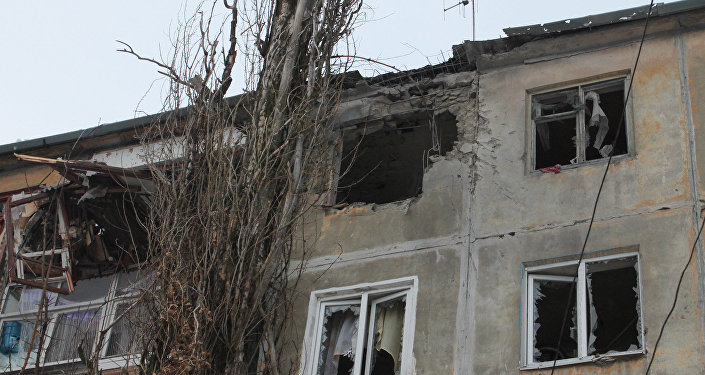
In a move that hardly seems coincidental, Washington made two announcements Friday which seem to outline its foreign policy priorities in Ukraine. Approving the supply of lethal weapons to the country, Washington threatened to partially suspend Kiev’s trade preferences with the US. Sputnik considers what may be behind the seemingly incoherent move.
Following months of internal debate, the State Department announced Friday that the US has “decided to provide Ukraine enhanced defensive capabilities” aimed at building up Kiev’s “defense capacity.” The move follows reports from earlier this week that the State Department had approved export licenses for the commercial sale of small parties of weapons to the instability-wracked country by US arms makers.
Also Friday, the US Trade Representative’s Office announced that President Trump would partially suspend Ukraine’s benefits under a US preferential trade program in 120 days unless the country makes major steps to better protect intellectual property rights. Kiev, according to the US trade office, has “failed” to adequately protect intellectual property, “despite years of encouragement and assistance from the US government.”
Trade officials did not clarify which part of the US Generalized System of Preferences agreement Ukraine would be nixed from, but the tendency seems clear: Washington is cutting out its economic support for Kiev, all the while upping its military assistance to the country, as tensions in the frozen Donbass conflict continue to smolder.
Economic Nationalism vs. Neoconservative Foreign Policy
President Trump’s economic nationalist approach to foreign policy hit Kiev particularly hard. Earlier this year, administration plans on US foreign aid for fiscal year 2018 leaked to US media outlined a whopping 68.8% cut in assistance to Ukraine. Ukraine’s Embassy in Washington quibbled over the scale of the cut, saying the proposal is really “around 30%.” At the same time, the Trump administration enthusiastically approved Kiev’s decision to buy US thermal coal, despite its price being almost double that which Ukraine would pay for the heating source from nearby Donbass or Russia.
At the same time, the US president has had considerably more difficulty challenging the neoconservative agenda on US Ukraine policy. Trump’s campaign promises of curbing US involvement overseas and trying to work together with Moscow on global issues, including the Ukraine conflict, haven’t panned out. Possibly under pressure from Congress and the US bureaucratic apparatus, Trump appointed John McCain ally Kurt Volker as the US’s special envoy to Ukraine. Making several trips to the country, Volker immediately began accusing Russia of engaging in ‘hybrid warfare’ in Ukraine’s breakaway Donbass region, and has pushed aggressively for a more active US policy vis-à-vis Kiev, including through the supply of lethal weapons to the country.
This past week, Volker warned that the situation in eastern Ukraine has significantly deteriorated, and even suggested that 2017 has become the “deadliest year” since the civil war began in 2014. Volker accused ‘Russian-backed forces’ of escalating the conflict.
Volker’s comments were echoed by the State Department on Tuesday, with spokesperson Heather Nauert openly accusing “Russia and its proxies” of being “the source of violence in eastern Ukraine,” and alleging that Moscow “continues to perpetuate an active conflict and humanitarian crisis” in the region. Nauert denied any possibility that the Donbass militia were “organic” entities which sprang up to resist Kiev in the months following the Maidan coup d’état in the Ukrainian capital in February 2014.Earlier this month, Russian Foreign Minister Sergei Lavrov and US Secretary of State Rex Tillerson met to discuss global hot spots, including Ukraine. Lavrov stuck firmly to the position Moscow has held since the signing of the Minsk accords in February 2015, stressing that the accords must be implemented, and arguing that Kiev has played the key role in stalling this process.
Cause for Dangerous Escalation
As far as US arms deliveries to Ukraine are concerned, Russia has vocally objected to the idea, and cautioned that the move would only threaten escalate the conflict. Earlier this year, President Vladimir Putin stressed that although the delivery of lethal weapons was a “sovereign decision of the United States” which Moscow could not stop, “the supply of weapons to the conflict zone is not beneficial to the peacekeeping process, and only exacerbates the situation. If this occurs, this action will not change the [strategic] situation… But the number of victims may certainly increase.”
With these issues in mind, the reaction from Moscow over Washington’s Friday announcement has been highly critical. Deputy Foreign Minister Grigory Karasin toldRIA Novosti that the arms deliveries threaten to disrupt the peace process and hamper the implementation of the Minsk accords. Deputy Foreign Minister Sergei Rybakov echoed his colleague, saying that in the present situation the US in Ukraine looks “less like an intermediary and more like an accomplice in fueling the war.” Finally, Senator Franz Klintsevich, a senior member of the Senate’s security committee, warned that US weapons will encourage Kiev to use force. “The Americans, in essence, are directly pushing Ukraine’s military toward war,” he said.
With Ukraine recently approving a whopping 14.8% increase in its defense spending for the 2018 fiscal year, Washington’s decision to provide the country with lethal weapons is a worrying development. However, facing growing political instability at home, including a slew of street protests in the capital and more and more calls for the country’s government to resign, it’s unclear whether Kiev will dare to try to fulfill its dream of pacifying the Donbass by force.
Argentina’s former foreign minister Hector Timerman says the protracted investigation into the 1994 AMIA bombing incident lacks any convincing evidence against alleged suspects.
In July 1994, a car bomb exploded at the building of the Argentine Israelite Mutual Association, also known as the AMIA, in the Argentinean capital, Buenos Aires, killing 85 people and injuring 300 others.
Israel accused Iran of masterminding the attack, a claim strongly denied by the Islamic Republic.
On December 6, Judge Claudio Bonadio indicted ex-Argentinean president Cristina Fernandez de Kirchner, Timerman, and 10 others for “treason” as part of a probe launched in January 2015, when prosecutor Alberto Nisman accused several officials of allegedly conspiring with Iran to cover up responsibility for the 1994 bombing. Days later, he was found dead in his home. Courts have yet to determine whether Nisman’s death was suicide or murder.
Human Rights Watch (HRW) said the “far-fetched” indictment offered no evidence that would seem to substantiate the charges brought against the Argentinean officials.
In an article for The New York Times, titled “I’m a political prisoner in Argentina” and published earlier this week, Timerman said he had been put under house arrest and stressed that he was “a victim of political persecution.”
“Twenty-three years after the attack, nobody has been convicted and few facts have been established other than that it occurred,” he wrote of the bombing incident.
Timerman also questioned the “treason” charges, saying it had no relevant modern precedent in Argentina.
“For an Argentine citizen to commit treason, the country must be in a state of war. Argentina and Iran are not, and never have been, at war,” he said.
He highlighted the fact that while Iran denied any involvement in the AMIA incident, the Islamic Republic had “agreed to cooperate in the case after a multiyear diplomatic campaign led by the successive Kirchner governments.”
The former Argentinean foreign minister further voiced concern about his health condition aggravated by cancer, saying, “Preventing me from getting timely medical attention is like condemning me to death.”
“For now, the AMIA case languishes, as it has for decades. And we who in good faith sought justice are the targets of the anger of the Jewish community and many families of the victims,” he pointed out.
Israel is believed to be involved in strong lobbying in Argentina. Israeli media reported in October that pro-Israel groups in the United States were activating a campaign regarding the AMIA incident.
From the moment of arrest, Palestinian children encounter ill-treatment and torture at the hands of Israeli forces. Three out of four experience physical violence during arrest or interrogation.
Israel has the dubious distinction of being the only country in the world that systematically prosecutes between 500 and 700 children in military courts each year.
Ill-treatment in the Israeli military detention system remains “widespread, systematic, and institutionalized throughout the process,” according to the UN Children’s Fund (UNICEF) report Children in Israeli Military Detention Observations and Recommendations.
Recent amendments to Israeli military law concerning children have had little to no impact on their treatment during the first 24 to 48 hours after an arrest, when most of the ill-treatment occurs at the hands of Israeli soldiers, police, and the security service.
International juvenile justice standards, which Israel has obliged itself to implement by ratifying the UN Convention on the Rights of the Child in 1991, demand that children should only be deprived of their liberty as a measure of last resort and include universal prohibitions against physical violence and torture among other protections. Despite these obligations Israeli authorities persistently disregard and fail to comply with international law.
The No Way to Treat a Child campaign seeks to challenge Israel’s prolonged military occupation of Palestinians by exposing widespread and systematic ill-treatment of Palestinian children in the Israeli military detention system.
It is a project of Defense for Children International – Palestine and American Friends Service Committee.
Syrian Ambassador to the United Nations and head of the government delegation to intra-Syrian peace talks, Bashar al-Jaafari, says US and Turkish military forces should leave his conflict-plagued Arab country immediately.
He made the demand during the latest round of Syrian peace negotiations in the Kazakh capital city of Astana.
On October 13, Turkish troops travelling in a convoy of 12 armored vehicles entered northern Syria in a new military operation.
Turkish media sources said the convoy included about 80 soldiers.
Local sources said the troops were headed towards the western part of Aleppo province.
The development came after Turkish officials said they were sending troops into Syria to enforce a de-escalation zone in Idlib, which is largely controlled by the Takfiri Hayat Tahrir al-Sham (HTS) terrorist alliance.
The de-escalation zone forms part of an agreement reached between Turkey, Iran and Russia.
Syrian congress of national dialogue to be held in Sochi in late Jan.
Meanwhile, a joint statement released after two days of talks in Kazakhstan said delegations from Russia, Iran and Turkey, Syrian government representatives as well as a 20-member opposition team had agreed to hold a “peace congress” in Russia’s Black Sea resort of Sochi as part of efforts to find a political solution to the six-year-old Syrian conflict.
The statement said the congress will be held between January 29 and 30 next year, and “all segments of the Syrian society” will participate in it.
It added “To this end three guarantors (Russia, Turkey and Iran) will hold a special preparation meeting in Sochi before the congress.”
Last week, the eighth round of UN-backed Syria peace talks in Geneva, Switzerland, ended without progress.
UN special envoy for Syria, Staffan De Mistura, described the talks as a missed opportunity.
Previous rounds of Geneva negotiations have failed to achieve results, mainly due to the opposition’s insistence that Syrian President Bashar al-Assad should cede power.
The collusion circus is coming for Jill Stein. The US Senate Intelligence Committee has asked the 2016 Green Party presidential candidate to hand over documents amid accusations she was part of a Russian plot to elect Trump.
The news was met with delight by some pro-Hillary Clinton Democrats who have long expressed a visceral hatred of Stein simply because she had the audacity to run for president — an act which they say hurt their candidate’s chances of winning by unnecessarily splitting the vote on the left. In the greatest democracy in the world (supposedly) Stein committed the unforgivable sin of running for office and winning some votes. There can only be one explanation for this, the ‘Russiagaters’ say: Stein was a Russian plant, designed to pull votes away from Clinton to tip the election in Trump’s favor. In their increasingly warped minds, nothing else could possibly make sense.
Never mind that Stein also ran for president in 2012, ran for governor in Massachusetts in 2002, as a candidate for the Massachusetts House of Representatives in 2004, for Massachusetts Secretary of the Commonwealth in 2006 and for Massachusetts governor again in 2010 — all of which she lost. Given her track record of not winning, it’s hard to believe Putin would choose Stein to pin his hopes on as the candidate to pull most votes away from Clinton in 2016. But anything is possible, right? Maybe Stein has been a secret Russian asset lying in wait all this time. That, apparently, is what some loony Democrats would have us all believe.
In the real world, however, there is absolutely no reason to believe Stein has anything to do with an alleged Russian plot to elect Trump — evidence for which also remains elusive. Stein’s primary transgressions are as follows: In 2015, she attended a gala event to mark RT’s tenth anniversary in Moscow, where she (god forbid) sat at the same table as Vladimir Putin. Rumors abound that Russia paid for Stein’s trip to Moscow, an accusation which she strongly denies (and claims she has the receipts to prove it). Perhaps even worse than setting foot on Russian soil though, Stein has often dared to express opinions that don’t sit well with establishment Democrats (or Republicans). And well, that’s basically it as far as the evidence for her “collusion” with Russia goes.
But lack of evidence proving Stein has anything to do with the Russian government hasn’t stopped her critics from making wild and defamatory claims. Zac Petkanas (whose Twitter bio describes him as a former “director of rapid response” for Clinton’s 2016 campaign) declared on Twitter this week that “Jill Stein is a Russian agent” — a sentence which he pasted eight times into the same tweet. If that’s the kind of “rapid response” Petkanas was having to Clinton campaign crises (of which there were many) it’s no wonder she lost.
ThinkProgress, which bills itself as a “progressive” platform has devoted an article to Stein’s “pro-Kremlin talking points” and detailed a list of her “odd views” — some of which include not loving NATO, not hating Julian Assange, not hating RT and not hating Russia in general. Those, of course, are all big no-nos if you want to avoid a congressional investigation these days.
But the ThinkProgress piece is typical of the kind of coverage Stein received throughout the election campaign, too. In one particularly bad example, Vice published a mocking piece dripping with disdain for the candidate. It was headlined ‘Everybody Hates Jill’. At one point, the author proudly states she has “ridiculed” and “mocked” Stein on other occasions, too, lest we assume it was only the one occasion.
That’s the kind of farcical and unserious coverage third-party candidates receive in the US — and the journalists who do the mocking, treating candidates like Stein as an amusing sideshow, are very often the same journalists who pretend to care deeply about the lack of fair coverage which tiny opposition movements receive in countries like Russia.
This is a witch hunt. It is neo-McCarthyism, plain and simple. The people who are outright calling Stein a Russian agent are making a complete mockery of themselves and of the American political process — and they genuinely appear to have no idea. One almost feels a sense of second-hand embarrassment for them. With the frenzy around Jill Stein, they have managed to spin a scandal out of nothing, because, for lack of a better word, they’re butthurt that their candidate didn’t win.
Dragging Stein into this mess has been instructive in one sense, however. If nothing else, it shows Clinton Democrats up for what they really are. It proves that the ‘Resist’ crowd’s crusade is not just about Trump and “collusion” — it’s also about discrediting all dissenting American voices and establishing their own definition of what political opposition is supposed to look like — and for the Clinton cult, it’s not supposed to look like Jill Stein.
Of the infamous RT dinner in Moscow, Max Blumenthal (who attended the event) wrote for Alternet : “None of us had any inkling the festivities would come to be seen as a de facto crime scene by packs of Beltway reporters and congressional investigators.”
But that’s just how far we’ve come. Anyone who disagrees with the Democrats is a Putin puppet — and if you’ve ever been to Moscow, forget it — don’t even bother trying to defend yourself. Off with your head.
Speaking of traitors, actress Lindsay Lohan was spotted wearing a baseball cap with the word “RUSSIA” emblazoned across the front this week. Perhaps the celebrity D-lister and possible Russian agent will be the next one dragged into the dock for questioning.
Presenting themselves as shocked bystanders to the growing famine in Yemen, the US and UK are in fact prime movers in a new strategy that will massively escalate it.
The protagonists of the war on Yemen – the US, UK, Saudi Arabia and the United Arab Emirates – have been beset by problems ever since they launched the operation in March 2015. But these problems seem to have reached breaking point in recent months.
First and foremost, is the total lack of military progress in the war. Originally conceived as a kind of blitzkrieg – or “decisive storm” as the initial bombing campaign was named – that would put a rapid end to the Houthi-led Ansarallah movement’s rebellion, almost three years later it has done nothing of the sort. The only significant territory recaptured has been the port city of Aden, and this was only by reliance on a secessionist movement largely hostile to ‘President’ Hadi, whose rule the war is supposedly being fought to restore. All attempts to recapture the capital Sanaa, meanwhile, have been exposed as futile pipe dreams.
Secondly, the belligerents have been increasingly at war with themselves. In February of this year, a fierce battle broke out between the Emiratis and Saudi-backed forces for control of Aden’s airport. According to the Carnegie Endowment for International Peace, the struggle “prevented an Emirati plan to move north to Taiz,” adding that “the risk of such confrontations remains… Lacking ground forces anywhere in Yemen, the Saudis worry that the UAE could be carving out strategic footholds for itself, undermining Saudi influence in the kingdom’s traditional backyard.” Notes intelligence analysts the Jamestown Foundation, “The fight over Aden’s airport is being played out against a much larger and far more complex fight for Aden and southern Yemen. The fighting between rival factions backed by Saudi Arabia and the UAE clearly shows that Yemen’s already complicated civil war is being made more so by what is essentially a war within a war: the fight between Saudi Arabia and the UAE and their proxies.” This tension flared up again in October, with Emirati troops arresting 10 members of the Saudi-aligned Islah movement, the Muslim Brotherhood’s Yemeni faction.
And finally, the war is undergoing a serious crisis of legitimacy. Aid agencies are usually doggedly silent on the political causes of the disasters they are supposed to ameliorate. Yet on the issue of the blockade – and especially since it was made total on November 6th this year – they have been uncharacteristically vocal, placing the blame for the country’s famine – in which more than a quarter of the population are now starving – squarely on the blockade and its supporters. Jamie McGoldrick, the UN’s humanitarian coordinator for Yemen, put it starkly: “150,000 will die before the end of the year because of the impact of this blockade” he told ABC news last month. Save the Children had already stated back in March 2017 that “food and aid are being used as a weapon of war”, and called for an end to UK arms sales to Saudi Arabia, whilst in November 2017, Oxfam’s Shane Stevenson said: “All those with influence over the Saudi-led coalition are complicit in Yemen’s suffering unless they do all they can to push them to lift the blockade.” Paolo Cernuschi, of the International Rescue Committee, added that: “We are far beyond the need to raise an alarm. What is happening now is a complete disgrace.” The governments of Donald Trump and Theresa May were being painted – by the most establishment-aligned of charities – as essentially mass murderers, accomplices to what Alex de Waal has called “the worst famine crime of this decade”. Even the Financial Timescarried a headline that Britain “risks complicity in the use of starvation as a weapon of war”. “Is complicit” would be more accurate than “risks complicity”, but nevertheless: still a pretty damning indictment.
To confront these problems, a new strategy has clearly emerged. It appears to have been inaugurated by Theresa May and Boris Johnson on November 29th. On that date, whilst the British Prime Minister met with King Salman and Crown Prince Mohammed Bin Salman in Riyadh, the Foreign Secretary was hosting a London meeting of the foreign ministers of Saudi Arabia and the UAE and the US under-secretary of state, representing all four of the belligerent powers in Yemen.
The first element of this strategy was for Britain and the US to pacify the NGO fraternity by distancing themselves from the blockade, as if it were somehow separate from the war in which they were so deeply involved. This actually came about in the days preceding those meetings, when Theresa May told the press she would “demand” the “immediate” lifting of the blockade during her forthcoming visit to the king. That was disingenuous; after all, had she really wanted the blockade ended, she could have achieved this immediately simply by threatening to cut military support for the Saudis until they ended it. According to War Child UK, arms sales to Saudi Arabia have now topped £6billion, and Britain runs a major training programme for the Saudi military, with 166 personnel deployed within the Saudi military structure. Former US presidential advisor Bruce Riedel is entirely correct when he states that “the Royal Saudi Air Force cannot operate without American and British support. If the United States and the United Kingdom, tonight, told King Salman [of Saudi Arabia] ‘this war has to end,’ it would end tomorrow.”
In fact, the meeting seems to have been more about reassuring the Saudis that her words were but rhetoric for domestic consumption, and not meant to be taken seriously. In the event, far from an “immediate” end, the UK government website reported that May and Salman merely “agreed that steps needed to be taken” and that “they would take forward more detailed discussions on how this could be achieved”. Just to make it absolutely clear that the UK’s support for the war was not in question in any way, the very next line of the statement was “They agreed the relationship between the UK and Saudi Arabia was strong and would endure”. A deeply complicit press ensured that the actual contents of this meeting was barely reported; the last word on the matter, as far as they were concerned, was May’s pledge to “demand” an end to the blockade. Donald Trump followed suit last week, likewise calling on the Saudis to “completely allow food, fuel, water and medicine to reach the Yemeni people” whilst doing nothing to bring this about. Thus have the UK and US governments attempted to manipulate the media narrative such that the blockade they continue to facilitate no longer reflects badly on them.
The next aspect of the strategy became obvious before the Johnson and May meetings had even finished, as fighting broke out between the Houthis and forces loyal to former President Ali Abdullah Saleh the same day. Saleh had made an alliance with his erstwhile enemies the Houthis in 2015 in a presumed attempt to seize back power from his former deputy Abdrabbuh Mansur Hadi, to whom he was forced to abdicate power in 2012. But he had never been fully trusted by the Houthis, and their suspicions were to be fully confirmed when on Saturday 2nd December he formally turned on them and offered himself up to the Saudis. Saleh had always been close to the Saudis whilst in power, positioning himself largely as a conduit for their influence; now he was returning to his traditional role. The swiftness and intensity of the Saudi airstrikes supporting his forces against the Houthis following his announcement suggests some degree of foreknowledge and collaboration had preceded it, as does the Saudi’s reported house arrest of their previous favourite Hadi the previous month. This restoration of the Saleh-Saudi alliance represents a victory for the UAE, who had been pushing the Saudis to rebuild its bridges with him for some time. Analyst Neil Partrick, for example, had written just weeks before the move that “The Emiratis are advising the Saudis to go back to the former Yemeni president Ali Abdullah Saleh, believing his growing disputes with the Houthis, his tactical allies, can be encouraged to become a permanent breach.” Thus was the problem of the military stalemate supposed to be solved by splitting the Houthi’s alliance with Saleh, paving the way for a dramatic rebalancing of forces in favour of the belligerents. The execution of Saleh two days later has only partially scuppered this plan, with many of his forces either openly siding with the invaders or putting up no resistance to them.
At the same time as the Saudis have finally been brought round to the UAE’s preference for a reconciliation with Saleh’s forces, the UAE have now, it seems, accepted an alliance with the Saudi-backed Islah party. Despite the Saudi’s usual antipathy to the Muslim Brotherhood, it has backed their Yemeni offshoot in this war, a move hitherto firmly opposed by the Emirates. Yet, following earlier meetings between Saudi crown prince Mohammed bin Salman and Islah leader Abdullah al-Yidoumi, the two men met last Wednesday (13th December) with Emirati crown prince Mohammed bin Zayed. Maged Al Da’arri, editor of Yemen’s Hadramout newspaper, explained to The National that “the Gulf leaders are trying to combine the different sides in Yemen to work collaboratively in order to be able to liberate the provinces that are still held by the Houthis.”
It seems likely that Emirati support for Islah was a quid-pro-quo for Saudi support for Saleh, both moves suggesting perhaps that the two powers’ divisions were to some extent being overcome. But this rapprochement was formalised with the formal announcement of a new military alliance between them on December 5th, the day after Saleh’s death.
Thus, within a week of the London and Riyadh meetings, the coalition’s three seemingly intractable problems – the paralysing divisions between UAE and Saudi Arabia, the military stalemate, and the West’s legitimacy crisis over the blockade – had all apparently been turned around. This readjustment was and is intended to pave the way for a decisive new page in the war: an all-out attack on Hodeidah, as a prelude to the recapture of Sanaa itself.
This new strategy is now well under way. On December 6th – four days after Saleh switched sides, and one day after the new UAE-Saudi alliance was announced – the invaders’ Yemeni assets mounted “a major push… to purge Al Houthis from major coastal posts on the Red Sea including the strategic city of Hodeida.” The Emiratis had been advocating an attack on Hodeidah for at least a year, but, according to the Emirati newspaper The National, President Obama had vetoed it in 2016, whilst in March 2017, the Saudis got cold feet due to fears that the plan was “an indication of [the Emirates’] attempt to carve out strategic footholds in Yemen”. Now, it seems, it is finally under way.
The following day, the red sea town of Khokha, in Hodeidah province, was captured by Emirati forces and their Yemeni assets, backed by Saudi airstrikes. Gulf Newsreported that “Colonel Abdu Basit Al Baher, the deputy spokesperson of the Military Council in Taiz, told Gulf News that the liberation of Khokha would enable government forces and the Saudi-led coalition to circle Hodeida from land and sea”. The day after that, Houthi positions in Al Boqaa, between Khokha and Hodeidah, were taken by Emirati-backed forces.
The following Sunday, 10th December, Boris Johnson met with the Emirati crown prince and de facto ruler Mohammed bin Zayed in Abu Dhabi, where he “underlined the depth of strategic relations between the two countries and his country’s keenness on enhancing bilateral cooperation”, before attending another “Quartet committee” meeting with his Emirati and Saudi counterparts and the US acting secretary of state for Near Eastern affairs. The four of them “agreed to hold their meetings periodically, with the next meeting scheduled for the first quarter of 2018.”
This intensive activity in the space of just two weeks, bookended by high-level meetings of the ‘quartet’ on either side, is clearly coordinated. But what it heralds is truly horrifying. Presenting themselves as shocked bystanders to the growing famine in Yemen, the US and UK are in fact prime movers in a new strategy that will massively escalate it.
When an attack on Hodeidah was being contemplated back in March 2017, aid agencies and security analysts alike were crystal clear about its impact. A press release from Oxfam read: “Reacting to concern that Hodeidah port in Yemen is about to be attacked by the Saudi-led coalition, international aid agency Oxfam warns that this is likely to be the final straw that pushes the country into near certain famine…Mark Goldring, Oxfam GB Chief Executive said: “If this attack goes ahead, a country that is already on the brink of famine will be starved further as yet another food route is destroyed… An estimated 70 percent of Yemen’s food comes into Hodeidah port. If it is attacked, this will be a deliberate act that will disrupt vital supplies – the Saudi-led coalition will not only breach International Humanitarian Law, they will be complicit in near certain famine.” The point was reiterated by the UN’s World Food Programme, whilst the UN International Organisation for Migration warned that 400,000 people would be displaced were Hodeidah to be attacked.
“The potential humanitarian impact of a battle at Hodeidah feels unthinkable,” Suze Vanmeegen, protection and advocacy advisor at the Norwegian Refugee Council, toldIRIN recently. “We are already using words like ‘catastrophic’ and ‘horrendous’ to describe the crisis in Yemen, but any attack on Hodeidah has the potential to blast an already alarming crisis into a complete horror show – and I’m not using hyperbole.”
In the Independent, Peter Salisbury noted that “it is by no means certain that taking Hodeidah will be easy” as the (then) “Houthi-Saleh alliance is well aware of the plan” and preparing accordingly. He added that “While the Saudi-led coalition claims that taking the port would help alleviate the humanitarian crisis in the medium term, aid agencies fret that the short-term effect of cutting off access to a major port could be a killing blow to some of Yemen’s starving millions.” The Jamestown foundation were even more wary, writing that the city’s capture would be impossible without major US involvement and that “Even with U.S. assistance, the invasion will be costly and ineffective. The terrain to the east of Hodeidah is comprised of some of the most forbidding mountainous terrain in the world. The mountains, caves, and deep canyons are ideal for guerrilla warfare that would wear down even the finest and best disciplined military.” Yet the US’s current efforts to argue that Houthis are being supplied with Iranian missiles via Hodeidah may well be aimed at legitimising just such direct US involvement in an attack on the port. After all, continues Jamestown, “the Saudi effort in Yemen hinges on the invasion of Hodeidah. The reasoning behind the invasion is that without Hodeidah and its port — where supplies trickle through — the Houthis and their allies, along with millions of civilians, can be starved into submission.”
This, then – the ramping up of the ‘weapon of starvation’ – is the ultimate end of this new phase in the war. Basic humanity demands it be vigorously opposed.
Dan Glazebrook is currently crowdfunding to finance his second book; you can order an advance copy here: http://fundrazr.com/c1CSnd.
Not for the first time, the free world has stood up for truth and justice in Palestine. The General Assembly’s vote against President Trump’s decision on Jerusalem was a victory for the rule of law over the law of the jungle. It now leaves both the US and Israel isolated, disgraced and humiliated.
Washington’s threat to cut aid to countries that voted not to recognise Jerusalem as Israel’s capital was an insult to the UN and a vicious assault on the sovereign rights of its members. In their customary delusional manner, Israelis believed the US threat was enough to force compliance. They were mistaken; people around the world are simply tired of their arrogance and unethical conduct.
As it stands, Trump’s threat is consistent with a long-standing policy of US blackmail and intimidation exerted within the UN to further Israel’s illegal claims. It was no different from the threats issued to impoverished nations to extract the controversial UN Partition Resolution 181 in 1947.
When that vote was taken, it narrowly gained the two-thirds majority to be adopted – 33 countries voted in favour, 13 opposed and ten abstained. Haiti, Liberia and the Philippines all opposed the partition plan initially but were forced to change their position following the intervention of officials “at the highest levels in Washington”, including President Harry Truman. They were threatened with the withdrawal of US financial aid. James Forrestal, the then Secretary of Defence admitted that “the methods that had been used… to bring coercion and duress on other nations in the General Assembly bordered closely onto scandal.”
By allowing itself to be used in such a scandalous manner to facilitate the claims of one people, the UN had done immense damage to its credibility. It had, in fact, violated one of the most fundamental principles of its Charter namely, “respect for the principle of equal rights and self-determination of peoples” (Article 1).
There were, apart from Forrestal, other US officials who were prepared to acknowledge the wrong done to the Palestinian people. Commander E.H. Hutchison, who chaired the Jordan-Israel Armistice Commission after the 1948 Arab-Israeli War, recalled that “every step in the establishment of a Zionist state” was “a challenge to justice”.
While there are parallels between what happened in the General Assembly in 1947 and 2017, there are, nonetheless, striking differences. Both presidents, Trump and Truman, sought to exploit an international crisis to bolster their domestic standings. However, what the incumbent president does not realise is that the free world has moved on from the days of diplomatic blackmail. So, whereas two-thirds were coerced to vote for partition in 1947, 70 years on two-thirds exercised their free will and voted for peace and the rule of law.
Where does this crushing defeat leave Israel and its mercurial Prime Minister, Benyamin Netanyahu? For sure, Israel will become more isolated among the community of nations. Instead of countries moving their embassies to Jerusalem many will now consider severing or curtailing diplomatic contact with the Zionist state. South Africa’s ruling African National Congress (ANC) has taken the lead by adopting a resolution at its national conference to downgrade the South African embassy in Israel to a liaison office
As for Netanyahu, the UN defeat will, almost certainly, increase calls for his resignation. He is, in political terms, damaged goods, even to the point of being toxic. Only the delusional would want to be associated with him.
Instead of disparaging the UN as “the house of lies”, the Israeli prime minister and his fellow travellers should be eternally grateful to the world body for voting to partition Palestine. Gratitude, regrettably, has never been in their lexicon.
In years gone by, Israel was aided and encouraged by a combination of blind American support; indifference on the part of western powers; and the complicity of “leading” Arab countries. If nothing else, yesterday’s vote at the UN on Jerusalem must mark the beginning of the end of that long chapter of subterfuge.
Political disasters can sometimes be turned into opportunities. This scandalous attempt by the Trump administration to trample roughshod over the UN, in defiance of international norms and standards, must be seized as an opportunity to review Israel’s membership of the world body. After all, it was admitted to the world body on condition that it respects the terms of partition and allows the Palestinian refugees to return (Resolution 273). Israel has not only refused to honour the terms of its membership; it has systematically undermined the UN Charter and brought the world body into disrepute. Surely, the UN would be a much better organisation without member states like this.
As for the Arab leaders who were misled into believing that Donald Trump can realise their grand ambitions, they too must think again.
It is reasonable to surmise that the Indian decision to vote in the UN General Assembly on Thursday against the US president Donald Trump’s recognition of Jerusalem as the capital of Israel would only have been taken at the level of Prime Minister Narendra Modi.
India has been largely harmonizing its foreign policies with Washington through the past decade. And, to boot it, the Trump administration has openly threatened to punish any country that voted against it. Generally speaking, bureaucrats in the South Block wouldn’t jeopardize their career – or their post-retirement assignments by annoying the Americans. (Read WikiLeaks and you’ll learn more about it.) Conceivably, therefore, they would have passed the Jerusalem buck to the PMO where it was lying until the PM got back from the Gujarat campaign.
Then, there is the personal bonding between Modi and Israeli PM Benjamin Netanyahu (who is expected to pay a week-long visit to India in January.) Won’t ‘Bibi’ take it amiss? Frankly, that is a non-issue. The arms sales to India constitute a significant source of budgetary support for Israel. Israelis are a very pragmatic lot. The Haaretz newspaper recently featured a lengthy article highlighting the RSS and affiliated Hindu nationalists as an exotic breed who adore Adolf Hitler and subscribe to the Nazi ideology. But has that prevented Israel from doing business with the Modi government? Of course not.
A third aspect is about the ideological affinities devolving upon Islamophobia between the present Indian ruling elite and their Israeli counterparts. Thus, all in all, Modi took a bold decision. Neither academics who claim expertise in West Asian studies nor diplomats who extensively served in the region – or, even ministers in Modi’s cabinet – probably expected him to take such a bold decision.
No doubt, Modi took a wise decision. India has a relationship with West Asia that goes far beyond the regimes in those countries. The West Asian region is in transition, in a historical sense, and India is doing the right thing by taking into account the groundswell of popular opinion over the Jerusalem question. This is one of those rare opportunities available for India to position itself in terms of time past, time present and time future. As a shrewd political mind, Modi senses it.
Diplomacy is far from a cynical process. The importance of principles cannot but be stressed if foreign policy is to be durable and sustainable. Good diplomacy is about maneuvering and negotiating to safeguard interests, but without jettisoning principles. In such a sense, India has had a principled stance on the Palestine issue, which it has maintained even while developing a pragmatic ‘win-win’ relationship with Israel through the past quarter century. India cannot and should not identify with Zionism. Ironically, there is a very significant body of opinion even amongst Jews who find Zionism to be repugnant as an ideology.
Finally, although Trump’s decision on Jerusalem was largely prompted by considerations of US domestic politics, there is undeniably a foreign-policy dimension to it. A former Turkish diplomat and area specialist Faruk Logoglu (who used to be Foreign Secretary when I served as ambassador in Ankara and whom I highly respect at a personal level) told the Tehran Times in an interview this week,
Trump probably calculated that the reactions from the region, especially from Saudi Arabia and Egypt would be meek and he was actually right. The US President aims to isolate Iran by forming a Saudi-led Sunni alliance in the region with the addition of Israel. Trump’s ultimate target is Iran. The issue of Jerusalem is just a way-station in Trump’s strategy against Iran. (Tehran Times)
Evidently, Trump is putting immense pressure on Saudi Arabia. Trump telephoned Saudi King Salman on Wednesday to rev up the anti-Iran campaign, again. But, interestingly, on the very next day, Salman phoned Russian President Vladimir Putin. (Kremlin readout) Saudi Arabia is doing a delicate balancing act. It cannot afford to displease Trump, given the stark realities of the petrodollar. But it increasingly feels he’s a blood sucker and wants to put some space in between. One gets the impression that Saudis want to focus on their own transition and the much-needed internal restructuring. They hope to get a helping hand from Putin to work out an exit strategy in Yemen.
Israel, on the other hand, is spreading exaggerated reports at regular intervals – largely through sly remarks and innuendos –that it is having a quiet affair with Saudi Arabia’s Crown Prince. It is a disinformation game that Israelis are good at playing. And they have nothing to lose anyway.
Suffice to say, Jerusalem is the tip of an iceberg. But looking ahead, Trump’s Iran project is doomed to fail. Unless Israel fundamentally reorients its own strategies (which seems unlikely under Bibi), its own future may become uncertain. Iran and Turkey (plus Egypt, if it can get its act together) are the only two authentic regional powers in the Middle East. This geopolitical reality will manifest – if not already – as time passes. Therefore, keeping the relations with Israel at a transactional level without harboring romantic notions about it is the prudent thing to do.
Kazakhstan may have the world’s best potassium, but as of today it also has a very big problem, or rather 22.6 billion problems.
Overnight, Bank of New York Mellon said it had frozen $22.6 billion in assets held by Kazakhstan’s National Oil Fund in a rare move that escalates a legal battle between the government and a Moldovan investor. According to Reuters, Moldova’s Anatolie Stati and his companies had earlier won damages against the Kazakh government, and his pursuit of payment has resulted in some 40% of the oil revenue-supported fund being frozen. Putting the freeze in context, it is roughly equivalent to 17% of Kazakh GDP.
Details of the asset freeze, which took place in October, were reported by Reuters on Thursday and were subsequently disclosed at a court hearing in Britain. At the heart of the case is a years-long legal row between businessman Stati, his son Gabriel, two family-controlled companies and the Kazakh government of President Nursultan Nazarbayev. The Moldovans invested in Kazakhstan’s oil and gas industry and have charged that they were subjected to significant harassment from the state aimed at forcing them to sell their investments cheaply, according to Reuters.
While Kazakhstan has denied the allegations, Anatolie and Gabriel Stati and two of their companies – Ascom Group S.A. and Terra Raf Trans Traiding Ltd., won an international arbitration award of around $500 million against the government.
Then on Tuesday, Kazakhstan’s government and central bank, the National Bank of Kazakhstan, filed court documents asking a London judge to protect their rights over the fund that is held at BNY Mellon’s London branch under a global custody agreement. The Kazakhstan government and central bank also said they’re “suffering significant, and hard-to-quantify, losses by their inability to complete existing transactions or place new ones.”
However, by this point BNY Mellon said it had frozen the funds because of orders from Belgian and Dutch courts, where creditors are trying to enforce the $500 million arbitration award.
BNY also said it’s “plainly entitled” to freeze the assets, and said it was “caught in the middle” of a dispute between the Kazak government, the central bank, and the creditors.
Meanwhile, following the arbitration verdict, the former Soviet republic refused to pay, and in October Kazakhstan filed a civil racketeering lawsuit in the U.S. District Court in Washington, D.C., against the Statis and their two firms. The central bank also filed a lawsuit against BNY Mellon challenging the asset freeze. However, the claim was dismissed by a judge in London on Thursday.
As Bloomberg adds, while Kazakhstan had asked a London court this week for “urgent declaratory relief” aimed at protecting the government and central bank’s rights in the $22 billion fund, a clerk to judge Andrew Popplewell said by email Thursday: “the judgment today in the BNY Mellon/Kazakhstan case, resulted in the claim being dismissed without recourse to appeal.”
In short, the Kazakh government – which thought it had full access to some $23 billion parked at BoNY – suddenly finds itself $23 billion short.
* * *
“It’s pretty unprecedented,” said Simon Quijano-Evans, an investment strategist at Legal & General Investment Management in London. “If 40 percent of a sovereign fund is frozen and you don’t have access to it, that should be an alarm bell for policymakers.”
Yes but… it’s Kazakhstan: who cares how banks mistreat some third world nation. Surely that will never happen to “developed” world oil funds, right. Just like Saudi Arabia would never shake out its richest royals for billions just because the Crown Prince felt like buying himself a French Chateau and a Leonardo picture, all under the guise of “economic reform.”
Sarcasm aside, not everyone was immune, and Kazakhstan’s dollar bonds promptly fell after the news.
So what are the implications? “Theoretically the fund is a national institution so it should cause a rethink for central banks and sovereign wealth funds as it’s been assumed so far that these assets were relatively immune,” said Quijano-Evans, who clearly is right, especially one day after South Africa’s ruling party decided that it will nationalize the country’s central bank.
And now we wait for the next multi-billion asset freeze from some sovereign which not many will shed tears for… until one day, as the saying goes, they come to freeze your assets.
Ahead of a vote in the United Nations’ General Assembly on a resolution condemning US recognition of Jerusalem as Israel’s capital, president Donald Trump and UN ambassador Nikki Haley threatened states voting for the resolution with the loss of US financial aid. “We’re watching those votes” said Trump. “Let them vote against us, we’ll save a lot. We don’t care. But this isn’t like it used to be where they could vote against you and then you pay them hundreds of millions of dollars and nobody knows what they’re doing.”
A good call on Trump’s part. Now it’s time to follow through. Not because the US lost the UN vote, but because US foreign aid is an inherently disastrous budget item that needs to go. Trump seems to understand that. This is an issue he’s already begun to address with his 2018 budget proposal, which if adopted as written would have cut the US foreign aid budget from $30 billion to $25 billion per year. The more quickly that number moves toward $0, the better for America and the better for recipients of largess from the American government.
Supporters of foreign aid love to point out that it constitutes less than 1% of the federal budget. True, but that 1% comes with lots of strings attached for both parties.
When the US government throws money at another country’s government, it instantly becomes entangled in that country’s problems — internal and external, economic and military, every problem of every sort. For every action there’s an equal and opposite reaction — when America tries to be the good guy for Country A, America also ends up being the bad guy for Country B, and/or for domestic opponents of Country A’s political establishment. The potential negative consequences of such entanglements include, but aren’t limited to, terrorism and war.
On the receiving side, well, there’s no such thing as a free lunch. Washington wants things for its money — things ranging from support for its military adventures to distortions on the recipients’ economies imposed through politics for the benefit of this or that set of corporate cronies. In many cases, the lunch is not just un-free, but insanely over-priced.
Even at current levels, the US foreign aid budget comes to less than $10 per year per American. That’s not an argument for keeping it. It’s an argument for leaving foreign aid to the private charitable “market.” Americans spend one hundred times as much on coffee each year!
If you or I want to “support Israel” or “donate to Kenya” or “fight starvation in India,” we can easily afford to do so in like or greater amounts than the federal government does, individually or as members of voluntary organizations, and without those terrible strings attached.
Reknowned economist M. Shahid Alamoffers this excellent critique of Noam Chomsky’s defective analysis of the relative influence of Oil versus the Israel lobby over US foreign policy: … continue
This site is provided as a research and reference tool. Although we make every reasonable effort to ensure that the information and data provided at this site are useful, accurate, and current, we cannot guarantee that the information and data provided here will be error-free. By using this site, you assume all responsibility for and risk arising from your use of and reliance upon the contents of this site.
This site and the information available through it do not, and are not intended to constitute legal advice. Should you require legal advice, you should consult your own attorney.
Nothing within this site or linked to by this site constitutes investment advice or medical advice.
Materials accessible from or added to this site by third parties, such as comments posted, are strictly the responsibility of the third party who added such materials or made them accessible and we neither endorse nor undertake to control, monitor, edit or assume responsibility for any such third-party material.
The posting of stories, commentaries, reports, documents and links (embedded or otherwise) on this site does not in any way, shape or form, implied or otherwise, necessarily express or suggest endorsement or support of any of such posted material or parts therein.
The word “alleged” is deemed to occur before the word “fraud.” Since the rule of law still applies. To peasants, at least.
Fair Use
This site contains copyrighted material the use of which has not always been specifically authorized by the copyright owner. We are making such material available in our efforts to advance understanding of environmental, political, human rights, economic, democracy, scientific, and social justice issues, etc. We believe this constitutes a ‘fair use’ of any such copyrighted material as provided for in section 107 of the US Copyright Law. In accordance with Title 17 U.S.C. Section 107, the material on this site is distributed without profit to those who have expressed a prior interest in receiving the included information for research and educational purposes. For more info go to: http://www.law.cornell.edu/uscode/17/107.shtml. If you wish to use copyrighted material from this site for purposes of your own that go beyond ‘fair use’, you must obtain permission from the copyright owner.
DMCA Contact
This is information for anyone that wishes to challenge our “fair use” of copyrighted material.
If you are a legal copyright holder or a designated agent for such and you believe that content residing on or accessible through our website infringes a copyright and falls outside the boundaries of “Fair Use”, please send a notice of infringement by contacting atheonews@gmail.com.
We will respond and take necessary action immediately.
If notice is given of an alleged copyright violation we will act expeditiously to remove or disable access to the material(s) in question.
All 3rd party material posted on this website is copyright the respective owners / authors. Aletho News makes no claim of copyright on such material.



 Aletho News
