Israeli Prime Minister Benjamin Netanyahu’s ‘working visit’ to Moscow last week had a key objective relating to the conflict in Syria — a demarche at the highest level with President Vladimir Putin over Iranian presence in that country. Before emplaning for Moscow, Netanyahu told his cabinet in public remarks,
- In the framework of a (future peace agreement) or without one, Iran is attempting to base itself permanently in Syria – either through a military presence on the ground or a naval presence – and also through a gradual attempt to open a front against us on the Golan Heights. I will express to President Putin Israel’s vigorous opposition to this possibility.
In characteristic style, he cornered Putin in his very opening statement as they sat down in the Kremlin,
- One of the things that unites us (Israel and Russia) is our common fight against radical Islamic terrorism. Substantial progress has been made over the last year in fighting radical Sunni Islamic terrorism led by ISIS and Al-Qaeda, and Russia has made a great contribution to this result and this progress. Of course, we do not want to see Shia Islamic terrorism led by Iran step in to replace Sunni Islamic terrorism.
The Russian readout faithfully quoted Netanyahu but left out Putin’s brusque response. The Kremlin later chose to convey via an RT report,
- Putin noted that those events had taken place “in the fifth century BC,” added that “we now live in a different world” and suggested discussing the actual up-to-date problems in the region.
In short, Putin urged Netanyahu to get real instead of digging up the ancient legend of an Iranian forefather’s attempt to eradicate the Jewish people. (RT) The Russians are familiar with Netanyahu’s style of functioning — his swagger and capacity to dissimulate. He was obviously hoping to complicate the Russian-Iranian relationship at a time when Moscow and Tehran are working to put together a Syrian settlement. Evidently, Putin saw through the ploy. (Moscow is preparing for an official visit by the Iranian President Hassan Rouhani.)
Netanyahu keeps playing up the Iran bogey to divert attention away from the Palestine problem. However, importantly in the current context, Israel wants a say in the Syrian settlement. Israel’s motivations here are complex.
Israel’s preference is that the al-Qaeda affiliates fighting in Syria, who are its proxies, should be allowed to retain the swathe of land straddling the occupied Golan Heights so that its annexation of the Syrian territory remains unchallenged.
Russia simply will not acquiesce with the presence of any al-Qaeda affiliate in any residual form on Syrian soil. In fact, Jordan is involved in talks with Russia, which appears to be geared to battle plans under preparation to evict the Islamic State and the al-Qaeda from the Jordan-Israel-Lebanon borderline. Israel is getting frantic that the Russian-Iranian juggernaut proposes to put its al-Qaeda surrogates shortly into the meat grinder.
The alliance with Iran becomes vital for Russia in the coming weeks and months before a complete destruction of terrorist groups on Syrian soil is achieved and the peace process reaches the home stretch. However, this does not mean that Russian-Iranian relationship is smooth as silk. There strong convergence of interests at this point, but, as Iran’s Deputy Foreign Minister Ebrahim Rahimpour said on Saturday in Tehran,
- We will interact with the Russians to the extent that they cooperate with us and we will not be willing to cooperate with them when they are not willing to do so.
The two countries have their respective long-term objectives and agenda in a future Syrian settlement. Clearly, the Syria that emerges in a settlement can very well be a federated country. The US seems to be working toward a federal Syria and Russia may live with it as the realistic outcome of the brutal conflict. Thus, both US and Russia have dealings with Syrian Kurds whose top priority is the establishment of a Kurdish autonomous region in northern Syria bordering Turkey.
Now, it is entirely conceivable that a federal Syria may overlap the ‘spheres of influence’ of foreign powers. Without doubt, the US intends to keep the military bases it has established in the two Kurdish cantons on the eastern part of the Euphrates in the recent years. Russia too has a big presence along western regions of Syria facing the Mediterranean coast and in the Damascus region. The Russian bases in Latakia and Hmeimim in Syria are on permanent footing.
Therefore, how the emergent scenario of federal Syria would grate on the Russian-Iranian relationship remains a ‘known unknown’. After all, Iran made huge sacrifices to defeat Islamic State and al-Qaeda in Syria. A report last week put the casualty figures of Iranians killed in the fighting as exceeding 2000 military personnel.
Read an analysis, here, by Frederick Kagan of the conservative think tank American Enterprise Institute – surprisingly realistic for an American ideologue – on the complex web that makes Russian-Iranian bonding a geostrategic imperative of our times.
March 12, 2017
Posted by aletho |
Ethnic Cleansing, Racism, Zionism, Timeless or most popular, Wars for Israel | al-Qaeda, Iran, Israel, Russia, Syria, United States, Zionism |
Leave a comment
Desperation tactics to shut down discussion of the Israeli regime’s mega-crimes reach new heights of absurdity
A fake anti-semitism campaign masterminded by the usual Zio suspects, their Israel lobby colleagues and their stooges in the corridors of power, continues to sweep across UK universities… and our political parties, especially shambolic and rudderless Labour.
The University of Central Lancashire cancelled an event due to be held last month entitled “Debunking Misconceptions on Palestine and the Importance of Boycott Divestment and Sanctions” organised by the University’s Friends of Palestine Society. The University said it would contravene the International Holocaust Remembrance Alliance’s new definition of what constitutes anti-semitism and would therefore be unlawful. The event went ahead, off campus, at the premises of a local voluntary organisation.
Exeter University banned students from staging a re-enactment called Mock Checkpoint, in which some dressed up as Israeli occupation soldiers while others acted the part of Palestinians trying to go about their daily lives. The event was approved by the students’ guild but banned for “safety and security reasons” less than 48 hours before it was due to take place. An appeal was rejected.
At Leeds former British ambassador Craig Murray was asked by the trustees of the University Union to provide details of what he was going to say in his talk “Palestine/Israel: A Unitary Secular State or a Bantustan Solution” just 24 hours before he was due to speak. Craig reluctantly gave them an outline to allow the lecture to go ahead. He writes in his blog: “I have just been told by Leeds University Union I will not be allowed to speak unless I submit what I am going to say for pre-vetting.
I am truly appalled that such a gross restriction on freedom of speech should be imposed anywhere, let alone in a university where intellectual debate is meant to be an essential part of the learning experience. I really do not recognise today’s United Kingdom as the same society I grew up in. The common understanding that the values of a liberal democracy are the foundation of society appears to have evaporated.
Also at Leeds the student Palestine Solidarity Group was refused permission to mount a visual demonstration outside the Leeds Student Union Building or to have a stall inside.
At Liverpool Professor Michael Lavalette was contacted the day before he was due to speak with a demand that he sign the University’s ‘risk assessment’ for the event. This included reading the controversial IHRA definition of anti-semitism and agreeing with it. He emailed his response in which he carefully avoided mention of the dodgy definition and the meeting went ahead.
The University of Manchester allowed a series of talks marking Israeli Apartheid Week (IAW) to go ahead, but only after several meetings and imposing strict conditions which the organisers called “unheard of…. other societies and groups do not face the same problems.” University authorities, however, vetoed the students’ choice of academic to chair an IAW event on BDS over concerns about her “neutrality”, and other speakers had to acknowledge the British government-endorsed definition of anti-semitism.
Meanwhile some reports say that a conference with the title “International Law and the State of Israel: Legitimacy, Responsibility and Exceptionalism” to be held at University College Cork at the end of this month has been cancelled thanks to pressure from Zionist groups. StandWithUs Israel, in cahoots with Irish4Israel, claim the University has been persuaded to impose added security stipulations and other limitations that “amount to a de-facto cancelling of this hateful event”. But these are desperation tactics. Checking with the organisers I’m told the event is “100% going ahead”. The Irish, it seems, are not as easily pushed around as the English. The conference, if you remember, was chased away from Southampton University two years ago by a similar campaign against free speech. The ‘official’ reason, as usual, was security concerns.
Now comes the scandal of the 26 year-old Exeter student, noted for her work on anti-racism, being smeared by the Zionist Inquisition for her Pro-Palestinian activism.
She is accused of having tweeted two years ago: “If terrorism means protecting and defending my land, I am so proud to be called terrorist”. So what? As everyone and his dog knows, or ought to know, the Palestinians are perfectly entitled, under international law, to take up arms and resist a brutal illegal occupier. As Malaka Mohammed herself says:
It may appear as a radical statement that could raise serious concerns at both the University of Exeter and its Students’ Guild. However, it is my honest belief, and as I will attempt to explain, these kind of statements by Palestinians in general, and me in this instance, are most commonly in response to efforts by Israel advocacy groups and the Israeli government to demonize and dehumanize Palestinians. This is done by using the emotive dog whistle by Israeli descriptors of ‘terrorist’ and ‘terrorism’ whenever referring to the ‘Arab’ population. Palestinians who throw stones in response to Israeli soldiers invading their villages are labelled violent thugs, rioters and terrorists. Palestinians who non-violently protest the illegal occupation are portrayed as violent individuals who terrorize Israeli Jews. Practically any Palestinian who resists the Israeli occupation and its plethora of human rights violations, war crimes and serious violations of international humanitarian and human rights law is stigmatized in this way.
After reading that, I dropped the Vice-Chancellor a line:
Sir Steve Smith, Vice-Chancellor University of Exeter
Dear Sir Steve,
I’m writing as a graduate of Exeter University with fond memories of the place, and because I’m shocked to see its good name besmirched by ludicrous accusations linking Palestinian PhD student Malaka Mohammed (aka Shwaikh) to anti-semitism and supporting terrorism.
As an acknowledged international relations specialist you will know the score regarding Israel’s decades-long illegal occupation of the Palestinians’ homeland and its brutal subjugation and merciless dispossession of the Palestinian people. You will also, I imagine, understand who the true terrorists and anti-semites are.
Lest we forget, the US defines terrorism as an activity that
(i) involves a violent act or an act dangerous to human life, property, or infrastructure; and
(ii) appears to be intended
– to intimidate or coerce a civilian population;
– to influence the policy of a government by intimidation or coercion; or
– to affect the conduct of a government by mass destruction, assassination, kidnapping, or hostage-taking.
And the US has used this definition to terrorise and degrade individuals, groups and countries it doesn’t happen to like.
Ironically it’s a definition that fits the US administration itself – and the thuggish Israeli regime – like a glove.
I sincerely hope that amidst the flurry of investigations going on you will take steps to ensure that plucky Ms Mohammed/Schwaikh ceases to be victimised by tiresome Zionist Inquisitors and is allowed to get on with her studies, and from now on free speech prevails across the beautiful Exeter campus.
Sir Steve is said to earn £400,000 a year according to this report. Perhaps he and many other university bosses need rousing from their plumptious comfort zone.
I’m with Craig Murray on this. I too don’t recognise our society today as the same one I grew up in. Who had the impudence to change our values regarding free speech?
March 12, 2017
Posted by aletho |
Civil Liberties, Ethnic Cleansing, Racism, Zionism, Full Spectrum Dominance, Timeless or most popular | Exeter University, Human rights, Israel, Palestine, UK, University College Cork, University of Central Lancashire |
Leave a comment

Iran’s Parliament Speaker Ali Larijani
Iran says the Israeli prime minister “clearly” showed in his recent remarks opposing Iranian counterterror contribution to Syria that Tel Aviv is behind the ongoing war in the Arab country.
Parliament Speaker Ali Larijani made the remarks on Sunday, concerning a Friday conversation between Israeli premier Benjamin Netanyahu and Russian President Vladimir Putin in Moscow.
Netanyahu reportedly expressed “Israel’s strong opposition to the presence of Iranian forces” north of Israel “in the context of the talks on a settlement of any kind.”
Iran has been lending advisory support to the Syrian military in its battle against foreign-backed militancy, while avoiding any direct military involvement in the conflict.
“Netanyahu laid the conditions for peace in Syria,” Larijani told the parliament session in Tehran. “He clearly stated that the Zionist regime is behind the war in Syria.”
“If some regional leaders were so far in a doubt that the war in Syria is not in line with the interests of Muslims, the least of which Sunni Muslims, they should have been disillusioned with these remarks by the head of the Zionist regime,” he added.
“The main reason behind the adventures in the region is to defeat resistance and its supporters to pave the way for the Zionist regime’s complete dominance here,” Larijani further said.
Netanyahu was also cited as telling Putin “the fact that the Golan Heights is not part of the discussion on any outline” of the peace agreement.
Israel has been occupying Golan since 1967. Since the start of the foreign-backed militancy in Syria, it has been providing medical treatment to injured Takfiri terrorists arriving at the territory, claiming it would do so for all those in the areas “under its control.”
Tel Aviv wants Syrian President Bashar al-Assad ousted. It has been carrying out air raids against Syria-based targets from Lebanese airspace on many occasions.
Late last month, Israel’s Channel 2 said the regime had sent its troops on repeated spying missions into a village located half a kilometer inside Syria’s territory. The Israeli military has also deployed intelligence-gathering equipment in the Golan Heights to record movements by the Syrian military and foreign-backed militants.
Bibi’s ignorance of history
Meeting with Putin, the Israeli premier also claimed ancient Persia had made a failed attempt to “destroy the Jewish people” some 2,500 years ago, a legend commemorated through the Jewish holiday of Purim, which Israel started celebrating Saturday night.
While scholars do not agree on the accuracy of the Purim story, Netanyahu has constantly referred to the legend as a basis of his anti-Iran arguments in his meetings with different world leaders.
Larijani said making the comments, Netanyahu had both misreported Iran’s pre-Islam history and inverted facts.
“Apparently, he is neither acquainted with history, nor has read Torah,” the said Iranian top parliamentarian.
According to Jewish accounts, Persian King Ahasverous discovered his viceroy’s conspiracy to slaughter Jews some 2,500 years ago and had him executed.
Nevertheless, Netanyahu has been selective in his recount of history, ignoring the Hebrew Bible that has repeatedly praised Persian King Cyrus the Great as the patron and deliverer of the Jews, who put an end to their Babylonian captivity.
March 12, 2017
Posted by aletho |
Ethnic Cleansing, Racism, Zionism, Timeless or most popular, Wars for Israel | Benjamin Netanyahu, Israel, Purim, Syria, Zionism |
Leave a comment
China has called on the United States and South Korea to stop joint war games in the Korean Peninsula in exchange for a halt to North Korea’s nuclear and missile tests as a step to defuse a looming crisis in the region.
Chinese Foreign Minister Wang Yi warned at a press conference on Wednesday that the US and South Korea on the one side and the North on the other “are like two accelerating trains coming toward each other with neither side willing to give way.”
“The question is: are the two sides really ready for a head-on collision? Our priority now is to flash the red light and apply the brakes on both trains,” Wang said.
He expressed hope that “suspension-for-suspension can help us break out of the security dilemma and bring the parties back to the negotiating table.”
Washington and Seoul launched large-scale annual drills on the peninsula at the beginning of this month amid already high tensions in the area.
Pyongyang condemned the military exercises as dangerous nuclear war drills at its doorstep. On Monday, the North also fired four ballistic missiles, three of which went down in waters claimed by Japan as its sovereign territory, according to South Korean and Japanese officials.
Japanese Prime Minister Shinzo Abe immediately reacted to the launches by saying, “This clearly shows North Korea has entered a new stage of threat.”
The North Korean ambassador to the United Nations, Ja Song-nam, has also warned that the US-South Korean military exercises are driving the Korean Peninsula and Northeast Asia toward “nuclear disaster.”
In a letter to the United Nations Security Council, he warned that the war games “may go over to an actual war and, consequently, the situation on the Korean Peninsula is again inching to the brink of a nuclear war.”
On Tuesday, the first pieces of a US-made missile system arrived at the Osan Air Base in South Korea.
North Korea has long opposed the controversial deployment of the US system in South Korea. It has been using the threat of American aggression as a reason to develop its own missile and nuclear programs.
In the drills with South Korea, the US is using nuclear-propelled aircraft carriers, nuclear submarines, nuclear strategic bombers, and stealth fighters. The US has military forces in South Korea on a permanent basis.
China is also opposed to the installment of the US missile system in South Korea for its own security reasons.
March 8, 2017
Posted by aletho |
Militarism, Timeless or most popular | China, North Korea, South Korea, United States |
Leave a comment
As a person who is neither a scientist nor well-versed in the minutia of climatology, it is interesting to survey the field of contentions over AGW, but in particular, how, on the one hand, the IPCC (sold to the public as a body of bona fide climate scientists solidly united in a singular consensus) publicly professes 95% certainty on the issue of AGW, while, on the other hand, measured observations and disagreements between highly credentialed climatologists belie both the professed ‘certitude’ of and the ‘consensus’ over ‘anthropogenic global warming.’
The imputations of deviousness leveled by the faithful of either side of the debate against the blasphemies of the other are also interesting: those who either deny or question AGW are accused of being in league with Big Oil or other such business interests. And those who ardently affirm the AGW hypothesis are accused of being extortionists who understand how to use fear to exact funds from terrified publics. Each side is right and each side is wrong, of course: some who deny AGW are indeed doing it at the behest of some political and business interests, but not all; and some who ardently affirm AGW as undeniably and catastrophically upon us are doing it also as cynical professionals intent upon eking out a comfortable living for themselves, but not all. Regardless of the side of the debate on which you stand, money is always a great temptation. And yet not everyone feels starved enough to compromise themselves in their honesty, whether in denying or affirming AGW to any degree of certitude. There are genuine holdouts: some climate specialists are skeptical of the AGW only because their method of approach to the data of climactic phenomena does not yield much support for the ‘attribution;’ other equally competent specialists, working from a different set of assumptions, ‘know’ that the data sets, properly understood, ‘must’ confirm AGW, and they ‘know’ this in all sincerity.
And then to add more muck to the embroilment, there is this propensity that we ‘all’ share, which is simply to talk one another into this or that consensus of opinion, rightly or wrongly. Everyone knows that consensus is not science, and yet it is both reasonable and possible for a group of people, collaborating in a spirit of critical thinking with one another, to come to a consensus of opinion on the basis of scientifically rigorous methods of analysis and investigation, as inherently dangerous and misleading as any kind of group consensus may be, scientific or otherwise.
Therefore, what sometimes appears to be bad faith, whether in an act of agreement or disagreement, is merely a manifestation of the ‘social’ nature of what ‘we’ are as humans in cultural terms, intellectually and cognitively. We cannot ‘think’ alone but under the discursive influence of others, many of whom with which on many things we come to agree, although we must at the same time, for the sake of finding our collective way forward to a more adequate understanding of ourselves and our world, be wary of deriving too much comfort from thinking too much as others do, that is to say, conventionally, however astute and sophisticated that general outlook or mindset might be.
If consensus is not science, the scientist cannot always avoid being under its sway and, moreover, if the ‘truth’ is eventually to win out over our collective cultural benightedness, it must eventually tempt and enthrall the reasoning assent of more than just a few and thereby itself become the basis of a consensus. If consensus is not science, science cannot for all that dispense with it.
The ‘global warming’ debate, then, is fractiously multidimensional in its appeals and interests. The political dimension itself bifurcates into at least two phyla or subspecies: the politics of competing for research funds and the politics of which business interests stand to gain or lose from policies that might be elaborated and instituted on the basis of the prognostications of ‘climate science.’ Most of what appears of the debate for broad public consumption is driven by these two highly politicized ferments.
On the one hand, scientific research must go begging for the resources it needs to further its inquiries, and it secures these resources to the degree that it can persuade prospective patrons or backers of the usefulness or necessity of its initiatives. Depending on who is being wooed as a prospective supporter, his understanding of the ‘usefulness or necessity’ of the initiatives being proposed can be very different from that of another, because different ‘interest groups’ do have different and often conflicting interests. What is ‘useful and necessary’ from a public policy standpoint is not always what is ‘useful and necessary’ from a business standpoint, and even between business interests, what may be an opportunity for one sector of the economy may portend catastrophe for another. One only has to think of the economic implications of serious curtailments of CO2 emissions for, on the one hand, hydrocarbon intensive industries and, on the other, the burgeoning ‘green technology’ business consortia. It is not to be wondered at that Big Oil and related business interests and foundations – assuming that reductions in emissions would negatively impact their bottom lines, which is not necessarily the case, as ‘climate alarmism’ can be turned to account by even these industries, if only by providing a pretext for creating conditions of ‘scarcity’ in hydrocarbon markets – will want to seek out and support ‘climate scientists’ skeptical or incredulous of the claim that CO2 is the main or sole driver of climate change. Likewise, ‘green technology’ interests will find their natural allies to be ‘climate scientists’ who are pushing the AGW line, sincerely or otherwise.
‘Climate scientists’ who manage to sell their theses to the wealthiest or politically most powerful patrons will receive the most by way of research dowries, but perhaps also more importantly, will be the ones whose ‘viewpoints’ will come to dominate public opinion, or at least appear to do so, since the uniformity of public opinion (through the mechanisms of the corporate media and universal education, tightly under the control of the dominant sources of funding in our society) is also a phenomenon under the sway of the wealthiest and most powerful patrons in our midst.
Consequently, the ‘truth’ or ‘untruth’ of the hypothesis of AGW has little to do with its dissemination and acceptance in a broad cultural sense. That dissemination and acceptance is predominantly determined by ‘political’ factors, by who control the main channels of information distribution. In our society, regardless of which position on the issue of ‘global warming’ becomes prominent, that control ultimately rests with the corporate capitalist cartels. One can therefore expect that irrespective of the scientific validity or invalidity of the AGW hypothesis, the version deemed most propitious to advancing both the short- and long-term interests of the ruling elite will also be perceived to be, whether in ‘fact’ or not, the dominant ‘scientific consensus.’
The ‘truth value’ of this politically generated ‘consensus,’ then, whatever it may be, is and will continue to be incidental, largely arbitrary and coincidental, in a word, an accident, like so much else that is characteristic of our age and era.
It remains, however, whether ‘global warming’ is actually happening, and if so, whether it is being driven by an anthropogenically induced accumulation of CO2 in the atmosphere.
Apparently, most climatologists agree that in the last 150 years or so, there has been a measurable increase in the mean global temperature. But to say that the increase in that mean is measurable is to say nothing about its magnitude or its actual relevance for determinate changes in climate.
NOAA estimates that the global mean temperature of the earth has increased by about 0.85ºC, allowing for a probable error of 0.2ºC. [NOAA] [Lindzen] But as Richard Lindzen observes, this measurable increase in the mean global temperature is actually so small as to be invisible in its effects in either local weather or climate events: it is simply impossible, given the extreme inherent variability of climate and weather events, to determine the impact of an increase of 0.85ºC in the mean global temperature in any one location or area on the surface of the planet. [Lindzen] If the effect of a measurable increase in the mean temperature of the earth is in any real sense inappreciable, it is as if it hasn’t happened. With confidence, climatologists can say that coinciding with the rise of industrialization and the exponential increase in CO2 emissions, a warming of the planet has indeed occurred. But it is so far very slight and remains well beneath instrumental notice in its actual local climactic effects.
But is CO2 a greenhouse gas? According to climate scientists on all sides of the debate, it is. Is the increase in CO2 concentration in the atmosphere for which we are responsible in the last 150 years or so the reason why the earth’s mean temperature has risen by roughly 0.85ºC? To my mind, this is highly improbable as well as unprovable. For to make that claim is by implication also to claim that over the last 150 years, in the absence of our CO2 emissions, the mean global temperature would have remained more or less stable. Is there a climatologist anywhere who claims as much and on what grounds? To confidently state as much would entail knowing all of the relevant cumulative factors terminating in the measure we call ‘the mean global temperature.’ Furthermore, it would entail knowing not only that the cumulative effects and interactions of these factors had to have been stable for the last 150 years, but all of the mechanics of that stability in detail. But this is simply impossible, not merely on account of the intractability of the complex interactions that go into generating climate and weather on our planet, but because many phenomena that we suspect implicate important weather generating mechanisms and climate effects have yet to be properly deciphered.
One such suspected phenomenon or correlation (and keeping in mind that it only takes one anomalous observation to falsify a theory) is the one being investigated by the teams of Henrik Svensmark and Jasper Kirkby: the apparent synchronicity between solar magnetic cycles and cycles of global warming and cooling. Svensmark has established that when the solar magnetic field peaks in strength, the surface temperatures of our planet tend to be markedly warmer; and when the solar magnetic field ebbs to its weakest, the surface temperatures of our planet tend to be markedly cooler.
Svensmark’s hypothesis for explaining these correlations is that cosmic rays raining down on our planet from disparate parts of the sky play a crucial role in building up the particulate aerosols necessary to the genesis of clouds. The denser the flux of cosmic rays raining down on us, the denser become the cloud forming aerosols in our atmosphere, and the more clouds we have overhead to counter our sun’s radiative heat emissions. And the density of the incoming cosmic flux, given its ionized and therefore electrically charged state, varies according to the intensity of the sun’s fluctuating magnetic field: the more intense the solar magnetic field, the more attenuated, because deflected, the cosmic flux will be, and conversely.
It remains for the Svensmark hypothesis pertaining to the influence of cosmic rays on aerosol formation to be confirmed or disproved. ‘The Cloud Experiment’ at CERN being conducted under the supervision of Jasper Kirkby intends to do just that.
Now consider that if Svensmark’s speculations find corroborative support from Kirkby’s experiments, climate and weather events on earth will be shown to be influenced by distant cosmic events. Such events lie beyond the scope of any reliable weather or climate forecasting methods we currently possess. If it is demonstrated that distant cosmological events and cycles are themselves a source of significant climactic ‘forcing,’ climate forecasting becomes at least in part dependent on being able to forecast astronomical events such as, for example, super novae, but not only that, but also on being able to predict or map the probable paths of interferences of the cosmic rays generated by those events. Suddenly, if Svensmark turns out to be right, a whole other layer of confounding complexities superimposes itself on an already incredibly complex system of energy redistributions. At this point, though we actually would have arrived at a better understanding of the “what and how” of weather and climate, forecasting climate on a scale measured in years would become what perhaps it currently is and will forever remain, little more than the occult reading of signs and auguries.
If experiments are being conducted to better determine the role of cosmic rays in cloud formation, it is clear that ‘climate science’ is not at an end or complete, and it cannot possibly be stated with any high degree of confidence as yet that, in the absence of anthropogenic CO2, the mean global temperature of our planet would not have increased by 0.85ºC over the last few hundred years. Svensmark’s theory about cloud formation is but one of what must surely be many examples of pivotal questions yet to be resolved by climate science.
I think, then, that it can reasonably be asserted with a certitude of 95% that ‘climate science’ remains a very long way off from being able to assert with 95% certainty that ‘global warming’ is already upon us and that its consequences will be nothing short of catastrophic, and that mankind and mankind alone will have been the cause of that catastrophe.
To my mind, because our world and its weather systems are so complex, and because our knowledge of those systems will always be a lot less than perfect, the most that we can aspire to in terms of understanding our planet’s climates is akin to what we can aspire to in terms of understanding the evolution of earthly life: though we have a pretty good grasp of the underlying mechanics, because the diversity of life on the planet is so sprawling, because the drivers of mutations are so numerous and random, our comprehension of evolution as a process, as profound as it may be, must remain for the most part spectatorial or contemplative. Mutations, inherently random as they are in and of themselves, and even more so in their heritability, cannot be predicted in terms of the actual diversity of species that they will surely generate in the future that remains to life on this planet. Likewise, because of its intractable complexities, though we may eventually understand a great deal more about them than we currently do, the emergence and distribution of climate patterns years into the future will remain largely beyond our measure, as is certain that they currently do.
March 8, 2017
Posted by aletho |
Science and Pseudo-Science, Timeless or most popular | Svensmark’s hypothesis |
Leave a comment

“The Panopticon must not be understood as a dream building: it is the diagram of a mechanism of power reduced to its ideal form.” – Michel Foucault
In the late eighteenth century English Utilitarian philosopher and social-theorist Jeremy Bentham devised what he called the “perfect prison” – The Panopticon. The design is simple, a circular prison with one guard in the central room, and all the cells facing the guard tower. In this way the gaoler can have a line of sight to every cell at once, and no inmate can ever be sure he’s not being observed. Bentham described it as:
“… a new mode of obtaining power of mind over mind, in a quantity hitherto without example… a mill for grinding rogues honest.”
Wikileaks latest release of classified documents, entitled Vault 7, comes as a timely reminder to all of us (as if we needed it) that the panopticon – the theorized perfect prison – is now a fibre-optic, digitized, hard-coded reality.
Here’s a run down from Wikileaks’ own analysis page (with some added emphasis):
The increasing sophistication of surveillance techniques has drawn comparisons with George Orwell’s 1984, but “Weeping Angel”, developed by the CIA’s Embedded Devices Branch (EDB), which infests smart TVs, transforming them into covert microphones, is surely its most emblematic realization.
The attack against Samsung smart TVs was developed in cooperation with the United Kingdom’s MI5/BTSS. After infestation, Weeping Angel places the target TV in a ‘Fake-Off’ mode, so that the owner falsely believes the TV is off when it is on. In ‘Fake-Off’ mode the TV operates as a bug, recording conversations in the room and sending them over the Internet to a covert CIA server.
As of October 2014 the CIA was also looking at infecting the vehicle control systems used by modern cars and trucks. The purpose of such control is not specified, but it would permit the CIA to engage in nearly undetectable assassinations.
The CIA’s Mobile Devices Branch (MDB) developed numerous attacks to remotely hack and control popular smart phones. Infected phones can be instructed to send the CIA the user’s geolocation, audio and text communications as well as covertly activate the phone’s camera and microphone.
The CIA’s Remote Devices Branch’s UMBRAGE group collects and maintains a substantial library of attack techniques ‘stolen’ from malware produced in other states including the Russian Federation. With UMBRAGE and related projects the CIA cannot only increase its total number of attack types but also misdirect attribution by leaving behind the “fingerprints” of the groups that the attack techniques were stolen from.
These early analyses show us the powerful trifecta of these operations – the CIA can hear you, find you and…if they deem it necessary…kill you. In fact, the reveal that the CIA has been working on hacking vehicle control systems adds new dimensions to the (as yet unsolved) case of Michael Hastings, a counter-culture voice in the American press who died in an inexplicable car accident four years ago. (A good rundown of the case can be found here.)
The repetition of a now well-established fact – that the CIA, NSA, DHS… whoever… can hack various electrical devices to listen in to our communications is nicely topical, given the current clash between the in-coming and out-going presidential administrations. An interesting thought is that Wikileaks, if it ever was as completely impartial and alternative as it purports to be, might be being used to score political points. The theorized split between the CIA (pro-Hillary) and the FBI (pro-Trump) works well as an explanation for this, as it did with the DNC and Podesta e-mail dumps prior to the elections. Either way, this information is nicely timed to remind the world that, as we already reported, of course Donald Trump was being surveilled. Everyone is.
The final section we’ve highlighted, the proof that “… the CIA cannot only increase its total number of attack types but also misdirect attribution by leaving behind the “fingerprints” of the groups that the attack techniques were stolen from” is an interesting tidbit of information. Worth remembering, because it will almost definitely have fallen down the memory hole next time some “evidence” is produced claiming Russia or China or Iran have hacked this, that or the other.
Further along in Wikileaks’ explanation of the data, and much discussed on CNN and in Congress (who seem rather unfazed by the illegal bugging and possible assassinations), is that the CIA’s arsenal of “cyber-weapons” were unsecured, and probably stolen by unknown parties.
Did state and/or non-state actors access and steal CIA created data-mining programs and spyware? I don’t think it matters. At all. The reasoning behind this is fairly simple. Firstly, there are no groups LESS trustworthy than the American military intelligence institutions. Secondly, and more importantly, I don’t believe it to be true.
I don’t think the CIA had their weapons “stolen”, I think that establishing – in the public eye – that they don’t have sole control of these tools enables them to preserve plausible deniability, in the event they are used.
If the cyber-tools the CIA developed are also in private hands, they were more likely sold than stolen. The CIA has massive corporate ties in the media, defense, pharmaceuticals and countless other big corporate interests. To the extent it is essentially one large family.
So what has the media reaction been? Four years ago I would have answered “disappointing”, these days I would say “predictable”.
CNN chose to focus on the “stolen” angle, suggesting there be a Senate investigation – not into the CIA’s power to illegally surveil and/or kill American citizens – but into their lax security and whether or not they have endangered national security by letting their toys get taken away.
Already the false premise is set and the subject for debate is decided: The question is not whether or not they should have these powers, but whether enough is being done to ensure they are the only people who have them. In this way a public outcry can be generated, the CIA can be brought before the senate and begged to tighten their security (possibly further slipping what little congressional oversight they still endure in the process). Engineering a situation whereby the citizenry plead with you to what you wanted to do all along is one of the oldest tricks of government.
Ewen McAskill, writing in the Guardian, has this to say:
The leak, dubbed “Vault 7” by WikiLeaks, will once again raise questions about the inability of US spy agencies to protect secret documents in the digital age.
He talks about it being an “embarrassment” for the CIA, and “good timing” for Trump. You’ll also be interested to know he considers the sky to be blue, and water wet. In-depth analysis is thin on the ground, as (more troublingly) is any indication that he understands that this is morally repugnant.
The BBC considers Wikileaks revelations to be a smaller story than the Lords voting on small amendments to the article 50 bill, or the Champions League. The story about how the CIA is spying on all of us and researching covert assassination techniques was filed, not under “politics”, but rather “technology”. You can only imagine that, had this modern BBC existed in 1945, they’d have reported the bombing of Hiroshima under “technology” too, perhaps with the headline “US make breakthrough in use of Nuclear energy”.
No one in the media is ready to concede this vindicates Trumps “wire-tap” tweets from a few days ago, or willing to admit that the “that would be illegal!” defence from Obama’s reps was farcical. (They will instead, in the coming days, point to this being another example of WikiLeaks being on Trump’s side and probably in the pay of Russia. Just watch).
All-in-all the media are taking it in their stride, not one source I could find expressed any kind of shock or moral outrage. They take a deliberately apathetic tone chosen very carefully. They tell us the facts, but refuse to analyse them. They address the current reality as the only option.
That the state claims the power to invade our privacy is a given, that they have the tools to do so, an unfortunate fact of life. Set in stone. The way the world works. No thought is given to holding governmental power to account, and no column inches supplied to those with an angry voice. In short the media provide only one message: They are always watching you, and there’s nothing you can do about it.
In that sense the media, and even Wikileaks, provide a valuable service. There’s no point in creating a panopticon if nobody knows they are being watched.
March 7, 2017
Posted by aletho |
Civil Liberties, Deception, Timeless or most popular | CIA, CNN, NSA, United States, Vault 7 |
Leave a comment
U.S. Ambassador Daniel Fried, who recently retired as the State Department’s coordinator for sanctions policy.
It’s probably safe to wager that few people outside of Washington, and perhaps even quite a few people inside it, have ever heard of Ambassador Daniel Fried — at least not until very recently.
The longtime Ambassador, a 40-year veteran of the U.S. State Department, recently made headlines in Time, Newsweek, Reuters, Politico and NPR for a farewell speech he made to his State Department colleagues during which he took a parting shot at President Trump for the latter’s widely assumed (but yet to be acted upon) desire to come to an accommodation with Russia.
Fried’s address won praise from Establishment figures like former Deputy Secretary of State Antony Blinken (a “powerful defense of liberal international order”), Atlantic Council executive Damon Wilson ( a “clarion call for the U.S. to believe in itself and lead [a] liberal order”) and New York Times columnist Roger Cohen (“a superb summation of everything worth fighting for to keep this planet fit for human habitation”).
Why all the excitement? Well for one, Frieds’s farewell hit the many of Establishment’s erogenous zones:
–NATO expansion as an unalloyed good: NATO and the E.U. – grew to embrace 100 million liberated Europeans… this great achievement is now under assault by Russia
–Realists just don’t “get it”: George Kennan didn’t think much of what he termed America’s moralistic-legalistic tradition. But this foreign policy exceptionalism was the heart of our Grand Strategy through two World Wars, the Cold War and the post-1989 era, and it was crowned with success.
–And then there is Fried’s tendentious (and among neoconservatives and liberal interventionists widely shared) rendering of history and his puzzling conflation of the world situations as they obtained in 1940 and as it obtains currently, in 2017: In 1940, Germany offered Britain a sphere of influence deal: German recognition of the British Empire in exchange for London’s recognition of Germany dominance of continental Europe. Churchill didn’t take the deal then; we should not take similar deals now.
While there can be little doubt that Fried served loyally, with distinction and was in all likelihood an exemplary functionary of the U.S. foreign policy apparatus, what else explains the outpouring of praise for Fried?
Part of it of course is that in Washington, you get points for longevity regardless of your record. Recall the encomiums heaped upon Andrew Marshall a couple years ago when Marshall, who spent his career as the Pentagon’s chief policy hand, retired after four decades in 2015.
The Washington Post reverentially called Marshall “the Pentagon’s Yoda”; The Economist praised him as “the quiet American”; and that year a flattering book was released about Marshall entitled The Last Warrior: Andrew Marshall and the Shaping of Modern American Defense Strategy. In a review of the book, Notre Dame political scientist Michael Desch tartly noted that “at the end of the day, Marshall was not a saint but rather a public official who served too long and whose record was more mixed than his incense burners are prepared to admit.”
#Resistance to Trump
Another reason for the current praise for Fried’s address is that it combined two of the essential ingredients of the #Resistance that is currently so in vogue in today’s Washington: opposition to Trump and hostility to Russia – never mind whether the policy implications of such a stance are necessary or wise.
Days after he retired, Fried sat down with another tried-and-true Russia critic, former Moscow correspondent for The Washington Post Susan Glasser, and said that in his opinion, “Russia despises the West. And it is doing what it can to weaken the West.” Trump should not, said Fried, “be so desperate to rub up against a Russia which is busy trying to do us in all over the world.”
That Fried’s carries these opinions on Russia is unsurprising; a look at his career in the Foreign Service shows a diplomat who took the most hawkish positions possible regarding Russia in the post-Cold War period. Fried was a vocal champion of NATO enlargement, arguing, as U.S. Ambassador to Poland in January 1998 that “NATO membership had a stabilizing effect on Western Europe’s ‘ethnic rivalries’ and the prospect of membership in ‘the West’ has strengthened political moderates and weakened nationalists throughout Central Europe, to U.S. benefit.”
This assessment looks rather less than prescient in light of the recent rise in ethno-nationalist regimes in Poland, Hungary and, of course, Ukraine.
As U.S. Assistant Secretary for Europe under George W Bush, Fried declared that Russia’s defense of the ethnic Russian enclave of South Ossetia against the neoconservative puppet government of Mikheil Saakashvili was “not the sign of a strong nation. It is the sign of a weak one.”
Russia, said Fried, anticipating many of the same talking points we hear today, told the Washington Post in August 2008, “Russia is going to have to come to terms with the reality; it can either integrate with the world or it can be a self-isolated bully. But it can’t be both.”
Fried was one of the lead architects of U.S. sanctions against Russia in the aftermath of the Ukraine crisis and Crimean annexation. Having served as the State Department’s coordinator of sanctions policy, he recently argued that “without the sanctions the situation might well be much worse. And if you don’t think it can be worse then I think you just lack imagination. The Russians could have driven deeper into Ukraine and they could have tried to seize Mariupol or driven on land all the way to Crimea or attack Harkhiv. The sanctions may have stopped the Russians from going further.”
This summation is, to put it mildly, open to question, given that there is little evidence that the Russians even want the small part of Donetsk and Luhansk that they currently help to subsidize and support.
In the end, in judging the supposed wisdom of Fried’s recent fusillades against Trump and Russia we might look to the record of the man rather than his rhetoric.
James W Carden is a contributing writer for The Nation and editor of The American Committee for East-West Accord’s eastwestaccord.com. He previously served as an advisor on Russia to the Special Representative for Global Inter-governmental Affairs at the US State Department.
(Photo from YouTube)
March 7, 2017
Posted by aletho |
Mainstream Media, Warmongering, Militarism, Russophobia, Timeless or most popular | Daniel Fried, NATO, Russia, United States, Washington Post |
Leave a comment
A senior official with the Central Bank of Iran (CBI) says US efforts to seize $1.6 billion of Iran’s assets in Luxembourg run counter to the international laws and will bear no fruit.
CBI Legal Chief Executive Ardeshir Fereydouni made the remarks on Tuesday in reaction to a Monday report by the New York Times about a confidential court ruling by a Luxembourg court to freeze $1.6 of CBI assets in a financial institution in the European country.
According to informed sources, the Luxembourg court ordered the freezing of the CBI assets after a group of terror attack victims, who had won a default judgment against Iran in the US, filed a lawsuit at the European court to try to enforce it, the report said.
In 2011, the group had persuaded a federal judge in New York, George B. Daniels, to find that Iran had provided assistance to al-Qaeda in the 9/11 attacks, an allegation vehemently dismissed by the Islamic Republic. In 2012, the judge ordered Iran to pay the victims two billion dollars in compensatory damages and five billion dollars in punitive damages.
That judgment stagnated for years, as there was no obvious financial source to collect it. However, after the nuclear sanctions against Iran were lifted, the group referred the case to the Luxembourg court as it came to light that the Clearstream system in Luxembourg, which facilitates international exchanges of securities, was holding $1.6 billion in CBI assets.
“The issue of freezing [CBI assets] does not mean the withdrawal [of money] from the mentioned account and assets. The Luxembourg court is now studying the case and trying to find out whether the ruling issued by the US court can be recognized and enforced in Luxembourg,” Fereydouni said.
The CBI attorneys have submitted Iran’s defense with regard to the case. The country has also lodged a complaint against the US at the International Court of Justice, urging the international body to declare the issued verdicts as illegal and compel the US to end its anti-Iran measures, he added.
Iran has also claimed damages with regard to the previous cases in which the US had issued unjust rulings against the country, the CBI official pointed out.
Earlier on Tuesday, Iranian deputy foreign minister Majid Takht Ravanchi described the freezing of CBI assets in Luxembourg as part of an anti-Iran campaign and noted, “Some people acting against Iran have tried to broaden [the scope of] a ruling that was delivered in the US, which we consider totally unjust and baseless, to outside the country [the US].”
In a similar case in April, the US Supreme Court issued an order authorizing the transfer of around two billion dollars of frozen Iranian assets to the families of the victims of a 1983 bombing in Beirut, which targeted a US Marine Corps barracks in the Lebanese capital, and other attacks blamed on Iran.
The assets belong to the Central Bank of Iran (CBI), which have been blocked under US sanctions.
Iran has denied any role in the attack and strongly criticized the US move.
March 7, 2017
Posted by aletho |
Deception, Economics, Timeless or most popular, Wars for Israel | 9/11, George B. Daniels, Luxembourg, United States |
Leave a comment
At Mar-a-Lago this weekend President Donald Trump was filled “with fury” says The Washington Post, “mad — steaming, raging, mad.”
Early Saturday the fuming president exploded with this tweet: “Terrible! Just found out that Obama had my ‘wires tapped’ in Trump Tower just before the victory. Nothing found. This is McCarthyism!”
The president has reason to be enraged. For what is afoot is a loose but broad conspiracy to break and bring him down, abort his populist agenda, and overturn the results of the 2016 election.
At its heart is the “deep state” — agents of the intel community, their media collaborators, and their amen corner in a Democratic party whose control of our permanent government is all but total.
At the heart of the case against Trump is what appears to be a Big Lie.
It is that Vladimir Putin and Russian intelligence hacked the DNC and John Podesta’s email account, then colluded with Trump’s friends or associates to systematically sabotage Hillary Clinton’s campaign. Therefore, Trump stole the election and is an illegitimate president. In this city, Trump is looked upon as a border-jumper, an illegal alien.
Yet let us consider the constituent components of the charge.
For months, we have heard that U.S. intel agencies agree that the Russians hacked the DNC and Clinton campaign, and gave the fruits of their cybertheft to WikiLeaks, because Putin wanted Trump to win.
For months, this storyline has been investigated by the FBI and the intelligence committees of both houses of Congress.
Yet where is the body of evidence that the Russians did this?
More critically, where is the evidence Trump’s people played an active role in the operation? Why is it taking the FBI the better part of a year to come up with a single indictment in this Trump-Putin plot?
Is this all smoke and mirrors?
In late February, The New York Times reported that Trump officials had been in regular touch with Russian intelligence officers.
The smoking gun had been found!
Yet, almost immediately after that report, White House Chief of Staff Reince Priebus told Fox News “the top levels of the intelligence community” had assured him that the allegations of campaign contacts with Russia were “not only grossly overstated, but also wrong.”
If what Reince says is true, the real crime here is U.S. security officials enlisting their Fourth Estate collaborators, who enjoy First Amendment privileges against having to testify under oath or being prosecuted, to undermine the elected commander in chief.
Now we expect Russia to seek to steal our secrets as we steal theirs. After all, our NSA wiretapped Angela Merkel and Brazilian President Dilma Rousseff. Our National Endowment for Democracy pushes “color revolutions” to bring about regime change in the near abroad of Putin’s Russian Federation.
Our NGOs are being restricted, shut down, expelled from Russia, China, Israel and Egypt, because they have been caught interfering in the internal affairs of those countries.
There is talk that Putin used the pilfered emails as payback for Clinton’s urging demonstrators to take to the streets of Moscow to protest a narrow victory by his United Russia party in 2011.
As for the alleged wiretapping of Trump Tower, President Obama has denied ordering any such thing and former Director of National Intelligence James Clapper assures us nothing of the sort was ever done.
Yet, there are other reports that intelligence officials got a warrant to surveil Trump campaign officials or the Trump Tower, and, though failing to succeed in the FISA court that authorizes such surveillance in June, they did succeed in October.
If true, this is a far more explosive matter than whether a Trump aide may have told the Russians, “You’re doing a great job!” when WikiLeaks blew DNC chairwoman Debbie Wasserman Schultz out of her job for tilting the playing field against Bernie Sanders in the primaries.
What needs to be done now?
The White House should tell the Justice Department to tell the FBI to expedite its investigation and file a report on what was done by the Russians. And if any Trump campaign official criminally colluded with the Russians, send the recommendation to indict to Justice.
The acting attorney general should instruct Director James Comey to run down, remove and recommend for prosecution any FBI or intel agent who has leaked the fruits of their investigation, or fake news, to the media. If Comey cannot find the source of the leaks, or lies, coming out of this investigation, a housecleaning may be needed at the bureau.
While President Obama may not have ordered any surveillance of Trump or his advisors, the real question is whether he or Attorney General Loretta Lynch were aware of or approved of any surveillance of Trump and his staff during the campaign.
Russian hacking of the DNC is a problem, not a scandal. The scandal is this: Who inside the government of the United States is trying to discredit, damage or destroy the President of the United States?
For these are the real subversives.
Copyright 2017 Creators.com.
March 7, 2017
Posted by aletho |
Deception, Timeless or most popular | FBI, NSA, Russia, United States |
Leave a comment
In the explosive “Vault 7” CIA secrets published by WikiLeaks on Tuesday, the organization has warned that the CIA, among a myriad of other intrusive exploits, has been investigating ways to hack and manipulate the control systems of cars and trucks for use in covert operations.
According to WikiLeaks, the CIA’s interest in hacking vehicles is not specified, but could be used in sinister ways, including assassinations.
“As of October 2014 the CIA was also looking at infecting the vehicle control systems used by modern cars and trucks,” WikiLeaks said in a statement. “The purpose of such control is not specified, but it would permit the CIA to engage in nearly undetectable assassinations.”
Many current vehicles are now mainly controlled by computer systems — including brake control, air bags, acceleration, steering, door locks, and other vital systems.
In 2014, hackers Charlie Miller and Chris Valasek using their laptops while in the car, took over a Jeep Grand Cherokee driven by a reporter for Wired, as they were traveling on the highway. The demonstration was shocking, and lead to the recall of 1.4 million vehicles. The previous year, hackers compromised a Ford Escape and a Toyota Prius, while sitting in the backseat.
The vehicle hacking reports were contained in the first batch of CIA leaks, titled “Year Zero.” Wikileaks published 8,761 documents and files which they claim are from the CIA’s Center for Cyber Intelligence in Langley, Virginia.
WikiLeaks has a 100-percent track record for publishing authentic documents.
NSA whistleblower Edward Snowden has also chimed in on the issue, tweeting, “Still working through the publication, but what @Wikileaks has here is genuinely a big deal. Looks authentic.”
March 7, 2017
Posted by aletho |
Civil Liberties, Deception, Timeless or most popular | CIA, Human rights, United States |
Leave a comment
Our press seems to be in a feeding frenzy regarding contacts that President Trump’s supporters had with Russian Ambassador Sergei Kislyak and with other Russian diplomats. The assumption seems to be that there was something sinister about these contacts, just because they were with Russian diplomats.

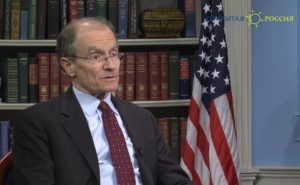
Former US Ambassador to the USSR Jack Matlock
As one who spent a 35-year diplomatic career working to open up the Soviet Union and to make communication between our diplomats and ordinary citizens a normal practice, I find the attitude of much of our political establishment and of some of our once respected media outlets quite incomprehensible. What in the world is wrong with consulting a foreign embassy about ways to improve relations? Anyone who aspires to advise an American president should do just that.
Yesterday I received four rather curious questions from Mariana Rambaldi of Univision Digital. I reproduce below the questions and the answers I have given.
Question 1: Seeing the case of Michael Flynn, that has to resign after it emerged that he spoke with the Russian ambassador about sanctions against Russia before Trump took office, and now Jeff Sessions is in a similar situation. Why is so toxic to talk with Sergey Kislyak?
Answer: Ambassador Kislyak is a distinguished and very able diplomat. Anyone interested in improving relations with Russia and avoiding another nuclear arms race — which is a vital interest of the United States — should discuss current issues with him and members of his staff. To consider him “toxic” is ridiculous. I understand that Michael Flynn resigned because he failed to inform the vice president of the full content of his conversation. I have no idea why that happened, but see nothing wrong with his contact with Ambassador Kislyak so long as it was authorized by the president-elect. Certainly, Ambassador Kislyak did nothing wrong.
Question 2: According to your experience, are Russian ambassadors under the sight of the Russian intelligence or they work together?
Answer: This is a strange question. Intelligence operations are normal at most embassies in the world. In the case of the United States, ambassadors must be informed of intelligence operations within the countries to which they are accredited and can veto operations that they consider unwise or too risky, or contrary to policy.
In the Soviet Union, during the Cold War, Soviet ambassadors did not have direct control over intelligence operations. Those operations were controlled directly from Moscow. I do not know what Russian Federation procedures are today. Nevertheless, whether controlled by the ambassador or not, all members of an embassy or consulate work for their host government. During the Cold War, at least, we sometimes used Soviet intelligence officers to get messages direct to the Soviet leadership. For example, during the Cuban missile crisis, President Kennedy used a “channel” through the KGB resident in Washington to work out the understanding under which Soviet nuclear missiles were withdrawn from Cuba.
Question 3. How common (and ethic[al]) is that a person related with a presidential campaign in the US has contact with the Russian embassy?
Answer: Why are you singling out the Russian embassy? If you want to understand the policy of another country, you need to consult that country’s representatives. It is quite common for foreign diplomats to cultivate candidates and their staffs. That is part of their job.
If Americans plan to advise the president on policy issues, they would be wise to maintain contact with the foreign embassy in question to understand that country’s attitude toward the issues involved. Certainly, both Democrats and Republicans would contact Soviet Ambassador Dobrynin during the Cold War and discuss the issues with him.
As the person in charge of our embassy in Moscow during several political campaigns, I would often set up meetings of candidates and their staffs with Soviet officials. Such contacts are certainly ethical so long as they do not involve disclosure of classified information or attempts to negotiate specific issues. In fact, I would say that any person who presumes to advise an incoming president on vital policy issues needs to understand the approach of the country in question and therefore is remiss if he or she does not consult with the embassy in question.
Question 4: In a few words, What’s your point of view about Sessions-Kislyak case? Is possible that Sessions finally resigns?
Answer: I don’t know whether Attorney General Sessions will resign or not. It would seem that his recusal from any investigation on the subject would be adequate. He would not have been my candidate for attorney general and if I had been in the Senate I most likely would not have voted in favor of his confirmation. Nevertheless, I have no problem with the fact that he occasionally exchanged words with Ambassador Kislyak.
In fact, I believe it is wrong to assume that such conversations are somehow suspect. When I was ambassador to the USSR and Gorbachev finally allowed competitive elections, we in the U.S. embassy talked to everyone. I made a special point to keep personal relations with Boris Yeltsin when he in effect led the opposition. That was not to help get him elected (we favored Gorbachev), but to understand his tactics and policies and to make sure he understood ours.
The whole brou-ha-ha over contacts with Russian diplomats has taken on all the earmarks of a witch hunt. President Trump is right to make that charge. If there was any violation of U.S. law by any of his supporters — for example disclosure of classified information to unauthorized persons — then the Department of Justice should seek an indictment and if they obtain one, prosecute the case. Until then, there should be no public accusations.
Also, I have been taught that in a democracy with the rule of law, the accused are entitled to a presumption of innocence until convicted. But we have leaks that imply that any conversation with a Russian embassy official is suspect. That is the attitude of a police state, and leaking such allegations violates every normal rule regarding FBI investigations. President Trump is right to be upset, though it is not helpful for him to lash out at the media in general.
Finding a way to improve relations with Russia is in the vital interest of the United States. Nuclear weapons constitute an existential threat to our nation, and indeed to humanity. We are on the brink of another nuclear arms race, which would be not only dangerous in itself, but would make cooperation with Russia on many other important issues virtually impossible. Those who are trying to find a way to improve relations with Russia should be praised, not scapegoated.
Jack Matlock served as U.S. Ambassador to the Soviet Union from 1987 to 1991.
March 7, 2017
Posted by aletho |
Economics, Militarism, Russophobia, Timeless or most popular | Russia, United States |
Leave a comment
A week after the Pentagon submitted its report to the White House on February 28 outlining a new strategy against terrorism, there are signs of a refreshing change of course in the US’ activities on the ground in Syria. It is extraordinary that President Donald Trump is proceeding on a novel track on Syria, according to his script, undeterred by the relentless assault on his citadel by recalcitrant groups of various persuasions in the Washington Beltway, especially the Russophobes and the Barack Obama era holdovers within the US establishment.
Trump, for sure, is proving to be a man of his words on Syria. Three things emerged in the past week. One, the US rejects its NATO ally Turkey’s pre-condition that it should cease the support for Syrian Kurds who are its allies in northern Syria. In fact, the US intends to wade deeper into the military operations in that region by beefing up the deployment of the Special Forces and stepping up arms deliveries to the Syrian Kurds, including deploying attack helicopters and artillery.
Two, Pentagon is concurring with the back-to-back deal reached by the Syrian Kurds with the government forces and Russia to jointly put a road block on the Turkish army’s plans to advance toward the strategic town of Manbij en route to the ISIS’ de facto capital, Raqqa.
This is turning out to be a curious joint enterprise with the US Special Forces having moved into Manbij town as a “visible sign of deterrence” (to quote Pentagon spokesman) against Turkey, while Russia is sending food and medical supply convoys to the town with the prior knowledge and coordination with Pentagon.
The US is indeed aware that the Russian convoy also brought “some armoured equipment” to Manbij. The Pentagon spokesman said on Friday, “We were aware of this. The Russian government has informed us of it as well. It has not changed anything we are doing.”
Three, stemming from the above stunning turn of events on the ground, clearly, the Trump administration seems to be edging away from the Obama administration’s overt and covert prioritization of the “regime change” agenda in Syria. Trump all along said he wanted the US military to train its sights exclusively on vanquishing the ISIS, al-Qaeda and other terrorist groups. Now, we are, literally, witnessing this being implemented on the ground.
The “known unknown” here is as to when the US could turn to explicit cooperation with Russia on Syria, which is also something Trump has spoken about. Much depends on the space that Trump manages to create to push forward his independent foreign policies. To my mind, once the preparations begin for the daunting military operations to capture Raqqa, where the ISIS is well-ensconced, and when it transpires that a bloody drawn-out battle lies ahead, the US forces on the ground will need all the help they can get from like-minded quarters – Russia, in particular. Trump will count on Defence Secretary Gen. James Mattis to calibrate the shift.
The implications are going to be simply profound. For, if such cooperation is possible between the US and Russian militaries in Syria, what prevents a similar pooling of resources in Afghanistan as well? A curious US-China dalliance in Afghanistan recently sailed into view.
It is only through concerted US-Russia-China efforts on the ground alongside cooperation on the diplomatic and political turf that Afghanistan can be stabilized. Of course, this must be a spectre that is already haunting the Pakistani GHQ in Rawalpindi.
Read an insightful interview here by US Army Maj. Gen. Paul Vallely with Fox News (close to Trump’s circle) on what to expect in US-Russia relations. Interestingly, the general travelled to Moscow recently on Track 2 and had a “private meeting” with Russian Deputy Foreign Minister Mikhail Bogdanov (who also happens to be the Kremlin’s Special Presidential Representative for the Middle East and Africa.)
March 7, 2017
Posted by aletho |
Russophobia, Timeless or most popular | Afghanistan, China, Donald Trump, Russia, Syria, Turkiye, United States |
Leave a comment

 Aletho News

