Britain acted illegally when it imposed territorial controls on the Chagos Islands without the consent of Mauritius, a UN judgment claims. The ruling may hinder US operations in Diego Garcia, where it holds an airbase on lease from the British.
The UN ruling also accuses Britain of ignoring the rights of Mauritius – which claims the islands as its own. Declaring the remote Indian Ocean archipelago a marine protected area (MPA) has damaged the fishing industry in surrounding waters, Mauritius claims.
The British Labour government of the time is accused of forcing through the MPA measure to strengthen its hand in the impending election.
“The UK has not been able to provide any convincing explanation for the urgency with which it proclaimed the MPA on 1 April 2010,” the ruling states.
The speed of the decision was “dictated by the electoral timetable in the United Kingdom or an anticipated change of government,” it was found.
“Not only did the United Kingdom proceed on the flawed basis that Mauritius had no fishing rights in the territorial sea of the Chagos archipelago, it presumed to conclude – without ever confirming with Mauritius – that the MPA was in Mauritius’ interest.”
The issue was addressed by a panel of five judges serving on the permanent court of arbitration, based in The Hague.
While three judges ruled the tribunal lacked the authority to adjudicate the issue, two ruled that, prior to the UK general election in 2010 and at the point of the territory’s creation in 1965, “British and American defense interests were put above Mauritius’s rights.”
The Mauritian government maintains its own sovereign claim, arguing the islands were effectively stolen by Britain in contravention of a UN resolution that segments of decolonizing nations could not simply be detached by the departing colonial power.
The Mauritian claim was succored by the ruling, which found that “The United Kingdom’s undertaking to return the Chagos archipelago to Mauritius gives Mauritius an interest in significant decisions that bear upon the possible future uses of the archipelago.
“Mauritius’ interest is not simply in the eventual return of Chagos archipelago, but also in the condition in which the archipelago will be returned.”
The move will be welcomed by displaced former residents of the Chagos Islands, who were forced from of their homes by the British in the 1960s to make way for the current US base.
Diego Garcia has repeatedly made headlines over allegations that US extraordinary rendition flights were routed through the airbase.
March 20, 2015
Posted by aletho |
Illegal Occupation, Militarism, Timeless or most popular | Military, UK, USA |
Leave a comment
France Now an Obedient, Cowardly Nation
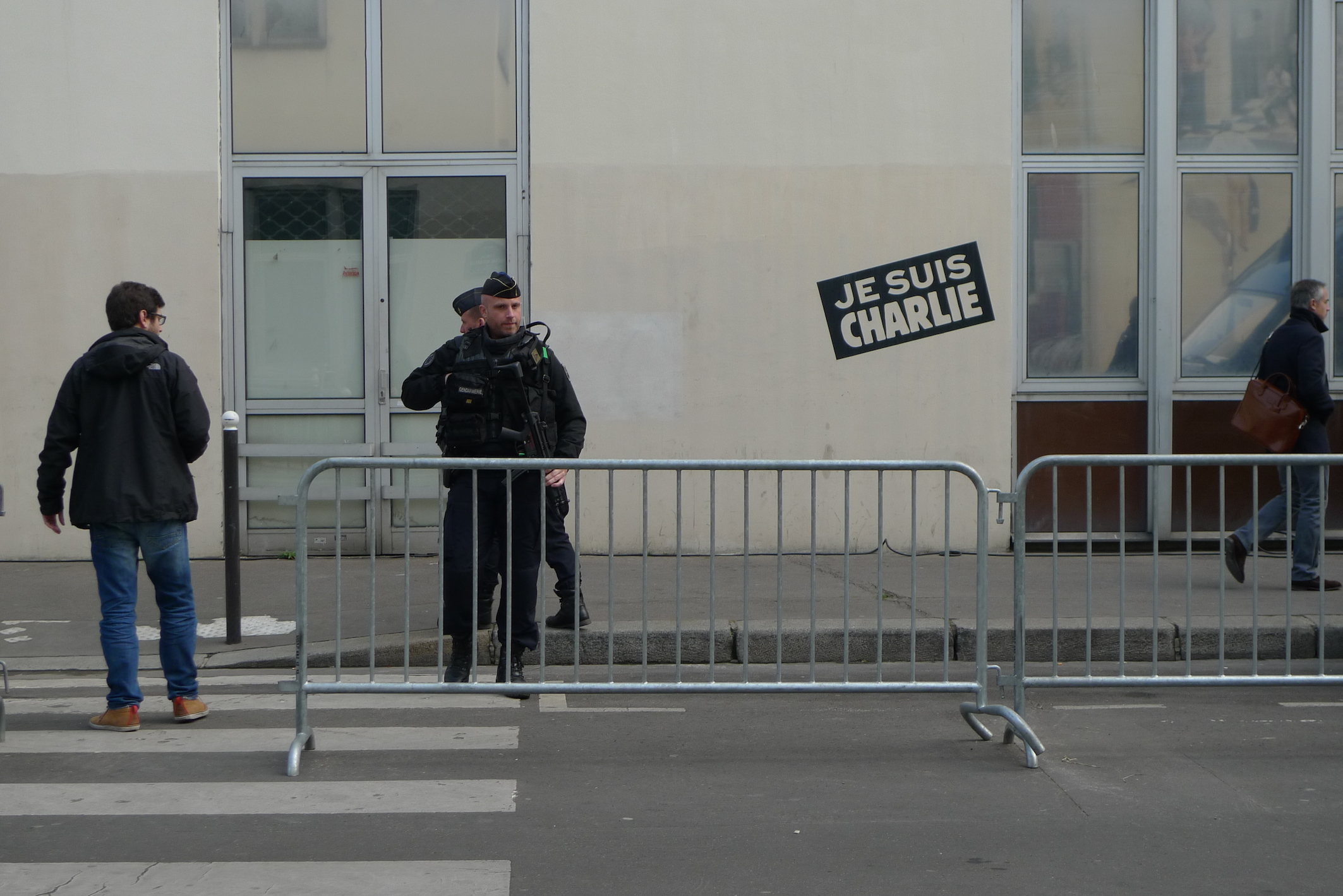
There are several machine gunners in front of the Charlie Hebdo building in Paris. These are cops, wearing bulletproof vests, carrying powerful weapons. They stare at occasional pedestrians in their special, revolting and highly intimidating way. Charlie Hedbo editors are well protected, some of them postmortem.
If you think that France is not as much a police state, as the UK or the US, think twice. Heavily armed military and police are visible at all train stations and many intersections, even at some narrow alleys. Internet providers are openly spying on their costumers. Mass media is self-censoring its reports. The regime’s propaganda is in “top gear”
But the people of France, at least the great majority of them, believe that they live in an ‘open and democratic society.’ If asked, they cannot prove it; they have no arguments. They are simply told that they are free, and so they believe it.
***
Employees of Charlie Hebdo go periodically out of the building for a smoke. I try to engage them in a conversation, but they reply in very short sentences only. They do their best to ignore me. Somehow, intuitively, they sense that I am not here to tell the official story.
I ask them why don’t they ever poke fun at the Western neo-colonialism, at the grotesque Western election system, or at the Western allies that are committing genocides all over the world: India, Israel, Indonesia, Rwanda, or Uganda? They impatiently dismiss me with their body language. Such thoughts are not encouraged, and most likely, they are not allowed. Even humorists and clowns in modern France know their place.
They soon let me know that I am asking too many questions. One of the employees simply looks, meaningfully, in the direction of armed cops. I get the message. I am not in the mood for a lengthy interrogation. I move on.
In the neighborhood, there are several sites carrying outpours of sympathy for the victims; 12 people who died during the January 2015 attack on the magazine. There are French flags and there are plastic white mice with Je Suis Charlie written on their bodies. One big poster proclaims: Je suis humain. Other banners read: “Islamic whores”, with red color correction, replacing Islamic with “terrorist” – Putain de terroristes.
There is plenty of graffiti written about freedom, all over the area. “Libre comme Charlie”, “Free like Charlie”!
A woman appears from the blue. She is very well dressed; she is elegant. She stands next to me for a few seconds. I realize that her body is shaking. She is crying.
“You’re a relative…?” I ask her, gently.
“No, no”, she replies. “We are all their relatives. We are all Charlie!”
She suddenly embraces me. I feel her wet face against my chest. I try to be sensitive. I hold her tight, this stranger – this unknown woman. Not because I want to, but because I feel that I have no other choice. Once I fulfill my civic obligation, I run away from the site.
***
Fifteen minutes walk from the Charlie Hebdo building, and there is the monumental National Picasso Museum, and dozens of art galleries. I make sure to visit at least 50 of them.
I want to know all about that freedom of expression that the French public is so righteously longing for and ‘defending’!
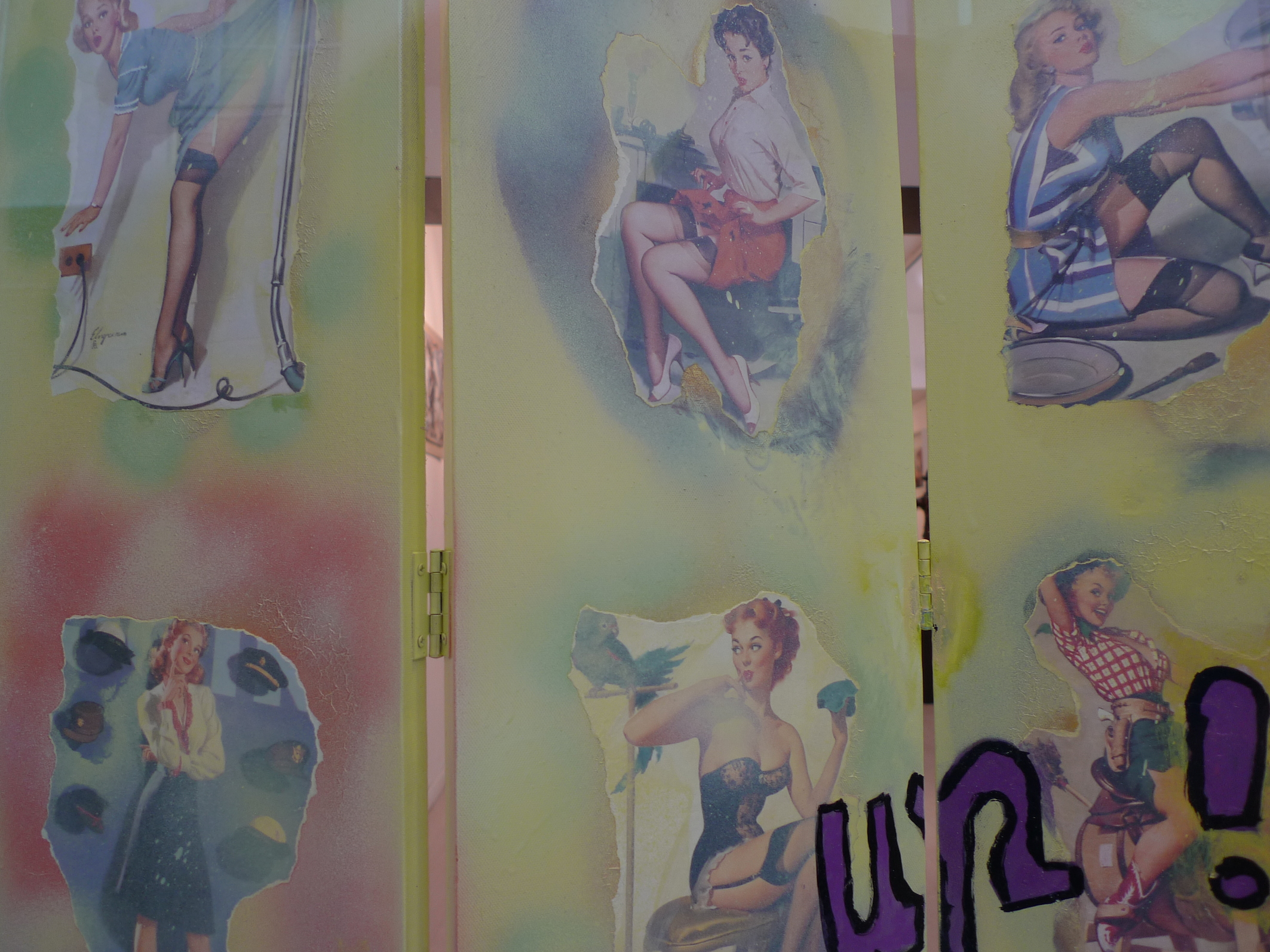
But what I see is endless pop. I see some broken window of a gallery and a sign: “You broke my art”. It is supposed to be an artwork itself.
Galleries exhibit endless lines and squares, all imaginable shapes and colors.
In several galleries, I observe abstract, Pollock-style ‘art’.
I ask owners of the galleries, whether they know about some exhibitions that are concentrating on the plight of tens of thousands of homeless people who are barely surviving the harsh Parisian winter. Are there painters and photographers exposing monstrous slums under the highway and railroad bridges? And what about French military and intelligence adventures in Africa, those that are ruining millions of human lives? Are there artists who are fighting against France becoming one of the leading centers of the Empire?
I am given outraged looks, or disgusted looks. Some looks are clearly alarmed. Gallery owners have no clue what am I talking about.
At the Picasso Museum, the mood is clearly that of ‘institutionalism’. Here, one would never guess that Pablo Picasso was a Communist, and deeply engaged painter and sculptor. One after another, groups of German tourists consisting mainly of senior citizens are passing through well-marked halls, accompanied by tour guides.
I don’t feel anything here. This museum is not inspiring me, it is castrating! The longer I stay here, the more I feel that my revolutionary zeal is evaporating.
I dash to the office and summon a junior curator.
I tell her all that I think about this museum and about those commercial galleries that are surrounding it.
“Those millions who were marching and writing messages around Charlie Hedbo… What do they mean by ‘freedom’? There seems to be nothing ‘free’ in France, anymore. Media is controlled, and art has just became some sort of brainless pop.”
She has nothing to say. “I don’t know”, she finally replied. “Painters are painting what people want to buy.”
“Is that so?” I asked.
I mention “798” in Beijing, where hundreds of galleries are deeply political.
“In oppressed societies, art tends to be more engaged”, she says.
I tell her what I think. I tell her that to me, and to many creative people I met in China, Beijing feels much more free, much less brainwashed or oppressed, than Paris. She looks at me in horror, then with that typical European sarcasm. She thinks I am provoking, trying to be funny. I cannot mean what I say. It is clear, isn’t it, that French artists are superior, that Western culture is the greatest. Who could doubt it?
I give her my card. She refuses to give me her name.
I leave in disgust, as I recently left in disgust the Peggy Guggenheim Collection in Venice.
At one point I walk into a cafe, to drink a cup of coffee and a glass of mineral water.
A man and his enormous dog walk in. Both park at the bar, standing. A dog puts its front paws on the bar table. They both have a beer: the man from a glass, his dog from a saucer. A few minutes later, they pay and leave.
I scribble into my notepad: “In France, dogs are free to take their beer in cafes.”
***
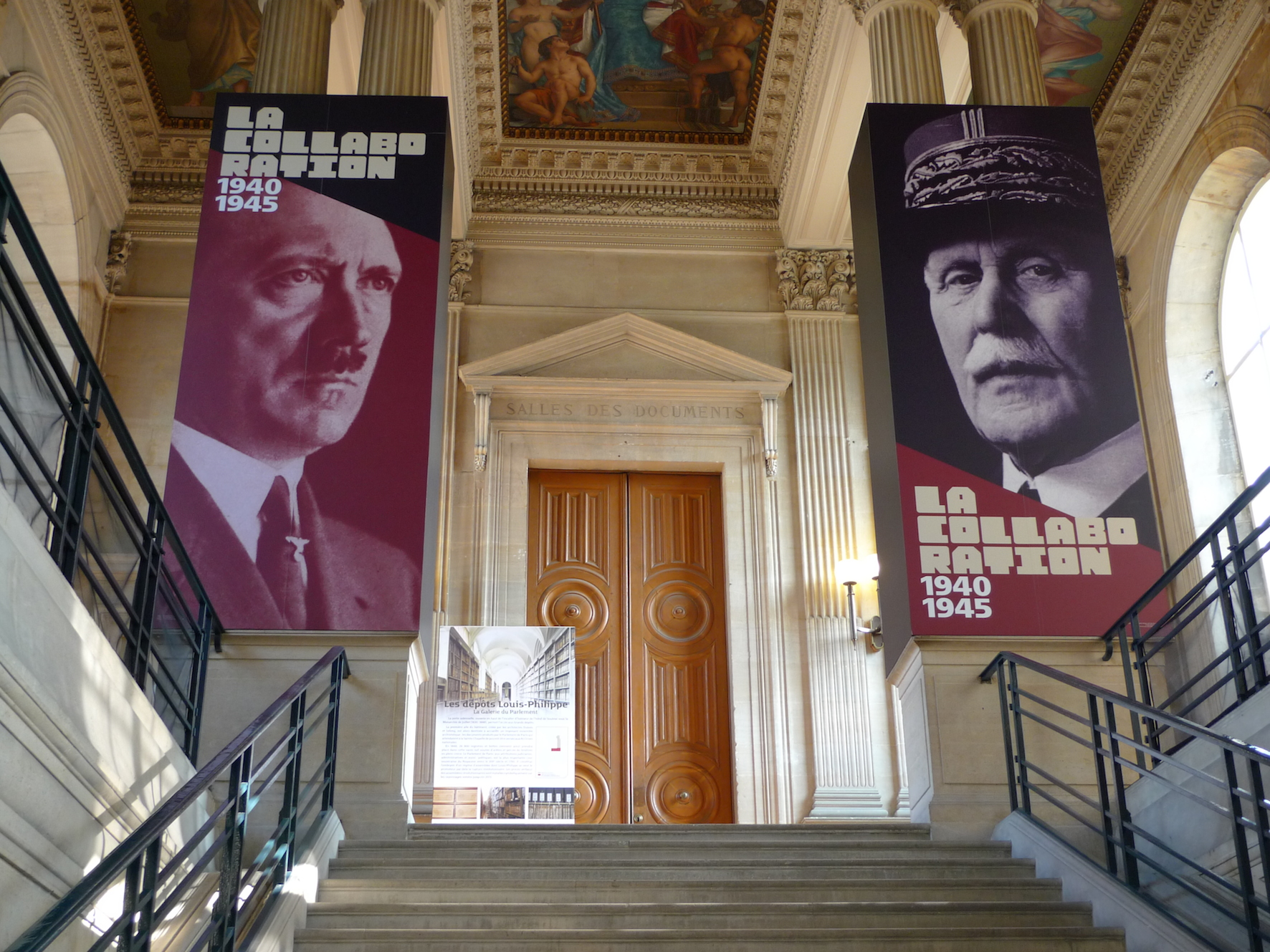
In the same neighborhood, I rediscover an enormous National Archive, a beautiful group of buildings with gardens and parks all around.
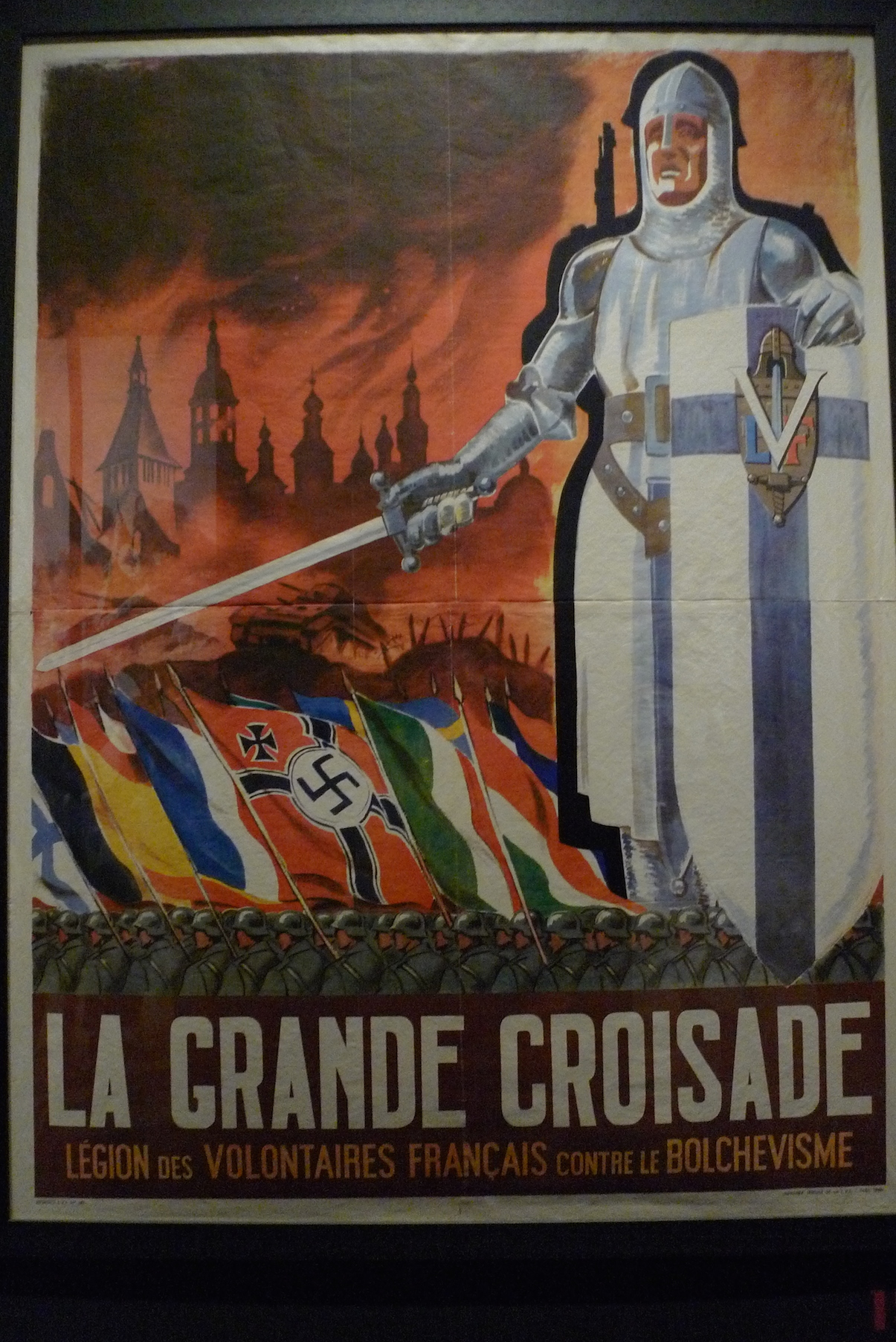
The place is holding a huge exhibition: on how France collaborated with the Nazi Germany during the WWII. The retrospect is grand and complete: with images and texts, with film showings.
For the first time in days, I am impressed. It all feels very familiar, intimately familiar!
***
At night I found myself in that enormous new Philharmonic, at the outskirts of Paris, near Porte de Pantin. I managed to smuggle myself to the invitation-only-opening of an enormous exhibition dedicated to French composer, conductor and writer – Pierre Boulez. That same Pierre Boulez who has been promoting, for ages, the idea of a public sector taking over French classic music scene!
Nobody protested at the exhibition, and I did not hear any jokes directed at Pierre Boulez. It was all brilliantly orchestrated. Great respect for the establishment cultural figure, for the cultural apparatchik!
I heard a technically brilliant concert of contemporary classical music, with new instruments being used.
But nowhere, in any of those tremendous spaces of the Philharmonic, did I hear any lament, any requiem, for the millions of people literally slaughtered by the Empire, of which France is now an inseparable part. No new symphonies or operas dedicated to the victims of Papua, Kashmir, Palestine, Libya, Mali, Somalia, the Democratic Republic of Congo, or Iraq.
My new friend, Francois Minaux, is writing an opera about the US carpet-bombing of the Plane of Jars, during the ‘Secret War’ conducted by the West against Laos. I am helping him with this enormous and noble project. But paradoxically (or logically?), Francoise is not living in France, but in the United States.
When I shared my thoughts with him, on Charlie Hebdo, and on freedom of expression in France, he summarized:
“It’s terrible. The art scene sucks. People are zombies. The mass reaction to the Charlie H attack is disgusting and depressing. ‘1984’ is happening but people are too blind to see it.”
A few hours later, I received an email in which Francoise reflected on his complex relationship with his native land, and its culture:
“Being French nowadays and being free to express yourself is impossible. Back in the early 2000’s, I could not accept the frame that culture would impose on its artists, and they could not accept my questioning and different approach to art making. They either spat on me or even worse, went mute. So, I left. You must travel outside of Europe and live and work outside, to feel the world.
I felt also that politically engaged works of art were not considered real art in Paris. There is this thing in France: any political engagement is seen either as propaganda or as advertisement. Back in the early 2000’s, we were supposed to make art for art’s sake. We were living under the glass dome of the conservatory. We were ‘protected by the government’.
They let us know that we should not talk about politics or religion in public. Maybe French secularism was a good idea but not to the present extent, when politics and religion became taboo. There is this climate of fear: our elders and teachers hardly discuss politics and religion. And so we didn’t know! Certain things are forbidden to be known in France.
Life in Paris became suffocating. Opinions were not expressed. We were not allowed to understand others. Live became boring: we had nothing substantial to talk about. And so we discussed greasy food and French wine. Economists describe the French economy as “austere”, but I would go further by saying that French behavior as well as French identity is austere. But the French people can’t see it because they now all think the same. They are trying so hard to stay French but they are forgetting, how the world has bled, so their French-ness could be preserved. Their culture was built from the blood flowing from the French colonies, and on the foundations of the modern-day French Empire.”
***
So where are those brave French minds now; people so many of us were admiring for their courage and integrity?
They were never ‘perfect’, and they erred, like all humans do, but they were often standing on the side of oppressed, they were calling for revolutions and some even for the end of colonialism. They were holding Western culture responsible for the horrors our planet has been facing for centuries.
Emile Zola and Victor Hugo, then later Sartre, Camus, Malraux, Beauvoir, Aragon…
What do we have now? Michel Houellebecq and his novels, full of insults against Islam, as well as of ‘tears of gratitude’ felt after each blowjob his characters get from their girlfriends.
The legacies of Houellebecq and Charlie are somehow similar. Is this the best France can do, these days? Is kicking what is on the ground, what was already destroyed by the West, what is humiliated and wrecked – called courage?
Are pink poodles on silver leashes, exhibited in local galleries, the essence of what is called the freedom of speech? Such stuff would pass any censorship board even in Indonesia, or Afghanistan! No need for the freedom of expression. It is cowardly and it is selfish – exactly what the Empire is promoting.
***
Christophe Joubert, a French documentary filmmaker, told me over a cup of coffee:
“First I was sad, when I heard about what happened to people at Charlie Hedbo. Then I got scared. Not of terrorism, but of the actions of the crowd. Everybody was indoctrinated: thinking the same way, acting the same way. Like Orwell and his 1984! More precisely, ‘the 8th day.”
“People in France know nothing about the world”, continues Christophe. “They believe what they are told by propagandist mass media”.
“I am not allowed to speak”, the Eritrean Ambassador to France, Hanna Simon, explained to me. “They invite me to some television show where they present a film criticizing my country. They speak openly, but when I try to respond, they shut me up.”
“I know nothing about what you are saying”, my good Asian friend replies, with sadness, after I tell him about the tremendous global rebellion taking place against the West, in Latin America, China, Russia, Africa… He is a highly educated man, working for the UNESCO. “You know, here we hear only one side; the official one.”
I am wondering whether, perhaps in 70 years from now, the National Archive will have another huge exhibition: one on France’s collaboration with neoliberalism, and on its direct involvement in building the global fascist regime controlled by the West.
But for now, as long as dogs can have a beer at the bar, fascism, imperialism and neoliberalism do not seem to matter.


Andre Vltchek is a philosopher, novelist, filmmaker and investigative journalist. He covered wars and conflicts in dozens of countries. His latest books are: “Exposing Lies Of The Empire” and “Fighting Against Western Imperialism”. Discussion with Noam Chomsky: On Western Terrorism. Point of No Return is his critically acclaimed political novel. Oceania – a book on Western imperialism in the South Pacific. His provocative book about Indonesia: “Indonesia – The Archipelago of Fear”. Andre is making films for teleSUR and Press TV. After living for many years in Latin America and Oceania, Vltchek presently resides and works in East Asia and the Middle East. He can be reached through his website or his Twitter.
March 20, 2015
Posted by aletho |
Full Spectrum Dominance, Timeless or most popular | France |
Leave a comment
In reopening the investigation into the mysterious plane crash that killed UN Secretary General Dag Hammarskjold in 1961, the United Nations is appealing to member states to release long-secret files related to this cold case from a tense moment in the Cold War in Africa, which Lisa Pease examined in 2013.
More than a half century ago, just after midnight on Sept. 18, 1961, the plane carrying UN Secretary-General Dag Hammarskjöld and 15 others went down in a plane crash over Northern Rhodesia (now Zambia). All 16 died, but the facts of the crash were provocatively mysterious.
There have been three investigations into the crash: an initial civil aviation Board of Inquiry, a Rhodesian Commission of Inquiry, and a UN Commission in 1962. Not one of them could definitively answer why the plane crashed or whether a deliberate act had been responsible.
While a few authors have looked into and written about the strange facts of the crash in the years since the last official inquiry in 1962, none did a more thorough reinvestigation than Dr. Susan Williams, a Senior Fellow at the Institute of Commonwealth Studies at the University of London, whose book Who Killed Hammarskjöld? was released in 2011, 50 years after the crash.
Her presentation of the evidence was so powerful it launched a new UN commission to determine whether the UN should reopen its initial investigation. “It is a fact,” the current Commission wrote in its report, “that none of these inquiries was conducted to the standard to which a modern inquiry into a fatal event would be conducted….”
The Commission was formed by Lord Lea of Crondall, who assembled a group of volunteer jurists, solicitors and others from the Netherlands, South Africa, Sweden and elsewhere to tabulate and review the evidence the Commission collected from past investigations, Williams’s book, and independent witnesses, such as myself.
I was one of the 28 witnesses (and one of only three Americans) who provided testimony to the Commission, based on information gathered in the course of my research into the assassinations of the Sixties.
“It is legitimate to ask whether an inquiry such as this, a full half-century after the events with which it is concerned, can achieve anything except possibly to feed speculation and conspiracy theories surrounding the crash,” the most recent Commission wrote in its report.
“Our answer, and the reason why we have been willing to give our time and effort to the task, is first that knowledge is always better than ignorance, and secondly that the passage of time, far from obscuring facts, can sometimes bring them to light.”
The Congo Crisis
The report summarized the historical situation Hammarskjöld was faced with in 1961. In June of 1960, under pressure from forces in the Congo as well as from the United Nations, Belgium had relinquished its claim to the Congo, a move which brought Patrice Lumumba to power.
Lumumba faced a near civil war in his country immediately. The military mutinied, the Belgians stepped back in to protect Belgian settlers, and local leader Moise Tshombe declared Katanga, a mineral-rich province, an independent state.
As the Commission’s report noted, “Katanga contained the majority of the Congo’s known mineral resources. These included the world’s richest uranium and four fifths of the West’s cobalt supply. Katanga’s minerals were mined principally by a Belgian company, the Union Minière du Haut Katanga, which immediately recognised and began paying royalties to the secessionist government in Elisabethville. One result of this was that Moise Tshombe’s regime was well funded. Another was that, so long as Katanga remained independent of the Congo, there was no risk that the assets of Union Minière would be expropriated.”
The U.S. government feared that Katanga’s rich uranium reserves would fall under Soviet control if the nationalist movement that brought Lumumba to power succeeded in unifying the country. Indeed, rebuffed by Western interests, Lumumba did reach out to the Soviets for help, a move that caused CIA Director Allen Dulles to initiate CIA plans for Lumumba’s assassination. Lumumba was ultimately captured and killed by forces of Joseph Mobutu, whom Andrew Tully called “the CIA’s man” in the Congo just days before President Kennedy’s inauguration.
On the southern border of Katanga lay Northern Rhodesia, where Hammarskjöld’s plane would eventually go down, Sir Roy Welensky, a British politician, ruled as prime minister. Welensky, too, pushed for an independent Katanga. Along with the resources, there was also the fear that an integrated Congo and Katanga could lead to the end of apartheid in Rhodesia which might spread to its larger and more prosperous neighbor South Africa.
The British situation was divided, with the Under-Secretary of State for Foreign Affairs, Lord Landsdowne, backing the UN’s efforts at preserving a unified Congo, while the British High Commissioner to the Rhodesian Foundation, Lord Alport, was upset with the UN’s meddling, saying African issues were “better left to Europeans with experience in that part of the world.”
Similarly, U.S. policy appeared split in 1961. Allen Dulles and possibly President Dwight D. Eisenhower had worked to kill Lumumba just before President John F. Kennedy took office. But President Kennedy had been a supporter of Lumumba and fully backed the UN’s efforts in the Congo.
As the report notes, “There is evidence … of a cleft in policy between the US Administration and the US Central Intelligence Agency. While the policy of the Administration was to support the UN, the CIA may have been providing materiel to Katanga.”
So British, Belgian and American interests that weren’t always representative of their official heads of state had designs on Katanga, its politics and its resources. What stood in their way? The UN, under the firm leadership of Dag Hammarskjöld.
The UN forces had been unsuccessful in unifying the Congo, so Hammarskjöld and his team flew to Leopoldville on Sept. 13, 1961. Hammarskjöld planned to meet Tshombe to discuss aid, contingent on a ceasefire, and the two decided to meet on Sept. 18 in Ndola in Northern Rhodesia (now Zambia).
On Sept. 17, the last day of Hammarskjöld’s life, Neil Ritchie, an MI6 officer, went to pick up Tshombe and the British consul in Katanga, Denzil Dunnett. He found them in the company of a high-level Union Minière employee.
That night, Hammarskjöld embarked on the Albertina, a DC6 plane, and flew from Leopoldville to Ndola, where he was to arrive shortly after midnight. Lord Landsdowne, the British leader opposing a unified Congo, flew separately, although the report goes out of its way to say there was nothing sinister in them flying in separate planes and that this was “diplomatically and politically appropriate.”
A large group of diplomats, Africans, journalists and at least three mercenaries waited for Hammarskjöld’s plane at the Ndola airport. The Commission found the presence of mercenaries there strange as a police inspector was on duty specifically “to ensure nobody was at the airport who had no good reason to be there.”
The Crash
Hammarskjöld’s plane deliberately circumvented Katanga, fearing interception. The pilot radioed Ndola 25 minutes before midnight with an estimate that they plane was about 45 minutes from landing. At 12:10 a.m., the pilot notified the Ndola airport “Your lights in sight” and requested confirmation of the air pressure reading (QNH). “Roger QNH 1021mb, report reaching 6000 feet,” the airport replied. “Roger 1021,” the Albertina responded. That was the last communication received from Hammarskjöld’s plane. It crashed within minutes.
The Commission found the airport gave the plane correct information, that there was no indication the plane’s altimeter had been tampered with, that the landing gear had been lowered into the proper position and locked, and that the wing flaps had been correctly set. In other words, pilot error — the verdict of the initial Rhodesian inquiry into Dag Hammarskjöld’s death in 1962 — did not seem to be the likely cause.
At the crash site, several of the crash victims had bullets in their bodies. In addition, the Commission found “evidence from more than one source…that holes resembling bullet-holes were observed in the burnt-out fuselage.”
The Commission’s two aviation experts concluded the most likely cause of the crash seemed to be a “controlled flight into terrain,” meaning, no in-air explosion. This suggests someone deliberately or mistakenly drove the plane right into the ground. However, the report notes, this does not rule out some form of sabotage that could have distracted or injured the pilots, preventing a successful landing.
And the Commission noted contradictory evidence from a few eyewitnesses who claimed they saw the plane explode in mid-air. Another eyewitness, a member of the flight crew, found alive but badly burned, told a police inspector that the plane “blew up” and that “There was a lot of small explosions all around.”
The Commission interviewed African eyewitnesses who had feared coming forward years ago. One of them described seeing the plane on fire before it hit the ground. Another described seeing a “ball of fire coming on top of the plane.” Still another described a “flame … on top of the plane … like a ball of fire.”
Several witnesses saw a second plane near the one that crashed. One witness saw a second, smaller plane following a larger one, and told the Commission, “I saw that the fire came from the small plane…” And another witness also recalled seeing two planes in the sky with the larger one on fire. A third witness noted that he saw a flash of flame from one plane strike another. Several witnesses reported two smaller planes following a larger one just before the larger one caught fire.
A Swedish flight instructor described in 1994 how he had heard dialog via a short-wave radio the night of the crash. He recalled hearing the following from an airport control tower at the time of the crash: “He’s approaching the airport. He’s turning. He’s leveling. Another plane is approaching from behind — what is that?”
In one of the more bizarre elements of the case, Hammarskjöld’s body was not burnt, yet the other victims of the crash were severely burnt. The Commission concluded the most likely explanation, though not the sole one, was that Hammarskjöld’s body had been thrown from the plane before it caught fire.
And even more strangely, the commission found the evidence “strongly suggests” that someone moved Hammarskjöld’s body after the crash and stuck a playing card in his collar before the photographs of his body were taken. (The card “or something like it” was plainly visible “in the photographs taken of the body on a stretcher at the site.”)
Given the proximity of the plane to the airport, the Commission had a hard time explaining the nine-hour delay between the time of the crash and the Rhodesian authorities’ acknowledgement of its discovery of the wreckage.
While the Commission found a “substantial amount of evidence” that Hammarskjöld’s body had been “found and tampered with well before the afternoon of 18 September and possibly very shortly after the crash,” they also stated the evidence was “no more consistent with hostile persons assuring themselves that he was dead than with bystanders, or possibly looters, examining his body.” But the Commission also noted that “The failure to summon or send help, however, remains an issue.”
The Commission tried very hard to find the autopsy X-rays, as there were reports that a bullet hole had been found in Hammarskjöld’s head. But the X-rays appear lost forever.
Was Hammarskjöld deliberately assassinated?
Former President Harry S. Truman was convinced Hammarskjöld had been murdered. A Sept. 20, 1961 New York Times article quoted Truman as having told reporters, “Dag Hammarskjöld was on the point of getting something done when they killed him. Notice that I said ‘When they killed him.’”
Years later, when the CIA was revealed to have been engaged in assassination plots, reporter Daniel Schorr speculated that the CIA may have been involved in Hammarskjöld’s death.
The report references the report of David Doyle, the chief of the CIA’s Elizabethville base in Katanga who wrote in a memoir how three armed Fouga planes were being delivered to Katanga “in direct violation” of U.S. policy. Doyle doubted this was an official CIA operation, since he had not been notified of the delivery.
Bronson Tweedy, the head of the CIA’s Africa division, questioned Doyle about the possibility of a CIA operation to interfere with Hammarskjöld’s plane. The report notes that this could indicate a lack of CIA involvement in Hammarskjöld’s death, “unless, conceivably, Tweedy was simply trying to find out how much Doyle knew.”
It is the essence of CIA operations that they are highly compartmentalized and often kept secret between people even within the Agency itself. Meaning, Allen Dulles or someone high up the chain could easily have ordered a single operator to take out Hammarskjöld’s plane without using any official CIA channels. Indeed, that is what one would expect were so sensitive an operation as the assassination of a UN head contemplated.
After Lumumba’s death, in early 1961, the UN passed resolution 161, which urged the immediate removal of Belgian forces and “other foreign military and paramilitary personnel and political advisors not under the United Nations Command, and mercenaries” from the Congo.
Confession from a CIA operative
When I heard such a commission was forming, I reached out to Lord Lea of Crondall to offer some evidence of my own. John Armstrong, a fellow researcher into the JFK assassination, had forwarded me a series of Church Committee files and correspondence to and from a CIA operative named Roland “Bud” Culligan.
Culligan claimed the CIA had set him up on a phony bank fraud charge, and his way out of jail appears to have been to offer the Church Committee information on CIA assassinations (which he called “executive actions” or “E.A.’s”). Culligan was asked to list some “E.A.’s” that he had been involved in. Culligan mentioned, among high-profile others, Dag Hammarskjöld.
“Damn it, I did not want the job,” Culligan wrote to his legal adviser at Yale Law School. Culligan described the plane and the route, he named his CIA handler and his contact on the ground in Libya, and he described how he shot Hammarskjöld’s plane, which subsequently crashed.
As I testified, and as the Commission quoted in its report: “You will see from the correspondence that Culligan’s material was referred to an Attorney General, a Senator, and ultimately, the Senate investigation of the CIA’s activities at home and abroad that became known as the Church Committee after its leader, Senator Frank Church. Clearly, others in high places had reasons to believe Culligan’s assertions were worthy of further investigation.”
Culligan’s claims fit neatly with a broadcast allegedly heard by Navy Cmdr. Charles Southall, another Commission witness. The morning before the crash, Charles Southall, a naval pilot and intelligence officer, was stationed at the NSA’s facility in Cyprus.
At about 9 p.m. that night, Southall reported he was called at home by the communications watch officer and told to get down to the listening post because “something interesting” was going to happen that night. Southall described hearing a recording shortly after midnight in which a cool pilot’s voice said, “I see a transport plane coming low. All the lights are on. I’m going to make a run on it. Yes, it’s the Transair DC6. It’s the plane.”
Southall heard what sounded like cannon fire, then: “I’ve hit it. There are flames. It’s going down. It’s crashing.” Given that Cyprus was in the same time zone as Ndola, the Commission concluded it was possible that Southall had indeed heard a recording from Ndola. Southall was certain that what he heard indicated a deliberate act.
Bullets
Several witnesses described seeing bullet holes in the plane before it burnt. The report described one witness’s account that the fuselage was “’riddled with bullet-holes’ which appeared to have been made by a machine-gun.”
This account was disputed by AP journalist Errol Friedmann, however, who claimed no bullet holes were present. However, bullets were definitely found embedded in the bodies of several of the plane crash victims, which tends to give the former claim more credence.
The same journalist Friedmann also noted to a fellow journalist that the day after the crash, in a hotel, he had heard a couple of Belgian pilots who had perhaps had too much to drink discussing the crash. One of the pilots claimed he had been in contact with Hammarskjöld’s plane and had “buzzed” it, forcing the pilot of the Albertina to take evasive action. When the pilot buzzed the plane a second time, he forced it towards the ground.
A third-party account allegedly from a Belgian pilot named Beukels was investigated with some skepticism by the Commission. Beukels allegedly gave an account to a French Diplomat named Claude de Kemoularia, who evidently first relayed Beukels’s account to UN diplomat George Ivan Smith in 1980 (not long after Culligan’s 1975 account, I would note).
Smith’s source, however, appeared to be a transcript, about which the Commission noted “the literary quality of the narrative suggests an editorial hand, probably that of one or both of the two intermediaries.” Allegedly, Beukels fired what he meant to be warning shots which then hit the tail of the plane.
While Beukels’s alleged narrative matched several known facts, the Commission wisely noted, “there was little in Beukels’s narrative, as reported, that could not have been ascertained from press coverage and the three inquiries, elaborated by his experience as a pilot.” The Commission wrote of other elements which invited skepticism of this account, but did concede it’s possible this account was self-serving, designed to excuse a deliberate shooting down by Beukels.
The Commission’s recommendation
While the Commission had no desire to place blame for the crash, the report states: “There is persuasive evidence that the aircraft was subjected to some form of attack or threat as it circled to land at Ndola, which was by then widely known to be its destination,” adding “we … consider that the possibility that the plane was in fact forced into its descent by some form of hostile action is supported by sufficient evidence to merit further inquiry.”
The key evidence that the Commission thinks could prove or disprove a deliberate act would be the Ndola airport’s radio traffic that night. The Commission reported “it is highly likely that the entirety of the local and regional Ndola radio traffic on the night of 17-18 September 1961 was tracked and recorded by the NSA, and possibly also by the CIA.”
The Commission filed a Freedom of Information request for any such evidence with the National Archives but did not appear hopeful that such records would be released unless pressure was brought to bear.
In its discussion of Culligan, the Commission felt there were no leads there that could be pursued. But if any of Culligan’s many conversations with his legal adviser was captured on tape, and if tapes of the radio traffic cited above could be obtained, a voice match could be sought.
Based on its year-long investigation, the Commission stated that the UN “would be justified” in reopening its initial 1962 inquiry in light of the new evidence “about an event of global significance with deserves the attention both of history and of justice.”
[Regarding President Eisenhower’s possible role in ordering the assassination of Lumumba, Robert Johnson, a National Security Council staff member, told the Church Committee he heard Eisenhower give an order that Lumumba be killed. He remembered being shocked to hear this. Under questioning, however, Johnson allowed that may have been a mistaken impression, that perhaps Eisenhower was referring to Lumumba’s political, not physical, removal.]
March 19, 2015
Posted by aletho |
Deception, Timeless or most popular, War Crimes | Belgium, Congo, Dag Hammarskjöld, Patrice Lumumba, UK, United States |
Leave a comment
Freshman US Senator Tom Cotton already has two claims to fame. First he wrote a letter to Iran in an effort to sabotage his own President’s diplomatic efforts and start a war. And then he set an all-time record by invoking Hitler in less than one minute during his first Senate speech.
Sen. Cotton thus stands condemned under Godwin’s Law, which states that whoever mentions Hitler first automatically loses the debate. “Playing the Hitler card” is widely reviled. Yet people like Cotton cannot resist the temptation.
Why has the demonization of Hitler—and of anybody one wants to demonize through comparisons to Hitler—become such a massively overused, utterly shopworn cliché?
In Western culture, Hitler is everybody’s favorite villain. And while the German dictator’s transformation from historical figure to avatar of ultimate evil is partially based on fact, it is primarily the product of a mythological process. Scholars who study the creation of myths, legends and folktales can easily see the distortions in mainstream Western accounts of World War II, “the Good War,” enshrined in the collective imagination as a struggle of pure goodness against diabolical evil.
Today, as Senator Cotton and his neoconservative colleagues push for World War III, it seems increasingly likely that the West’s self-serving World War II mythology will lead us into a war far more destructive than anything humanity has yet experienced. For that reason, everyone who supports peace should be working to demythologize World War II.
The so-called “Good War” was not a metaphysical good-versus-evil battle. It was a power struggle between empires. The British ruled the most powerful empire of the first half of the twentieth century, and they orchestrated World War I in an effort to pre-empt the rise of the number two power, Germany. World War II was really just unfinished business from World War I. So in effect, there was only one World War with two distinct phases (1914-1919 and 1939-1945) and the British, not the Germans, were the primary instigators.
Other imperial potentates, including leaders in the US, Russia, Austria-Hungary, Italy, Japan and China, also played self-serving, power-seeking roles. There were no good guys, except maybe the pacifists like Eugene Debs, who was sentenced to ten years imprisonment (and ran for President from prison) for opposing US involvement in World War I; or those like Robert Maynard Hutchins and Charles Lindberg, who bravely stood against the treasonous deceptions that pushed the US into World War II.
Western schoolchildren are taught that World War II was the supreme example of a just and necessary war. Yet in his book Churchill, Hitler, and the Unnecessary War, Patrick Buchanan offers strong evidence debunking this notion.
Leaders lionized as heroes by the Western mythographers—people like Winston Churchill and Franklin D. Roosevelt—were, in reality, less than heroic. A case could be made that Churchill, Roosevelt and Stalin, alongside Hitler and Mussolini, stand as the worst mass murderers in human history. (Stalin’s crimes against his own people dwarfed Hitler’s.)
Churchill and Roosevelt were responsible for firebombing German and Japanese cities and roasting alive their civilian populations. The ISIL video of a Jordanian pilot being burned to death, presented to the world as proof of terrorist villainy, gives a hint of what was done to more than one million innocent civilians in such cities as Hamburg, Dresden and Tokyo. Imagine more than a million people suffering the fate of the pilot in the ISIL video! The British-American campaign to mass murder civilians by firebombing had no military purpose. It was sheer sadism.
Even worse were the American, British and Russian rapes and massacres of Germans after the war. Tom Goodrich’s book Hellstorm offers bone-chilling, nausea-inducing descriptions of the shameful holocaust the occupiers perpetrated against a defeated and helpless German population. Millions of German women were raped—not just by Russians on the Eastern front, but also by Americans on the Western front. (The de facto US official policy of mass-raping the women of defeated and helpless populations is probably the single biggest reason why most American World War II veterans would maintain shame-faced silence when asked by family members about their experiences in the war—a phenomenon well known to all Americans who have had fathers, uncles or grandfathers who fought.)
When we hear the phrase “World War II death camps” most of us think of Hitler. But what about those of US General Dwight David Eisenhower? The American General, who later served as President, massacred more than a million German prisoners of war by herding them into huge barbed-wire enclosures, providing no food, water, or shelter, and allowing them to die of exposure and starvation. By contrast, Hitler’s treatment of American and British prisoners-of-war was scrupulous and humane.
The Allies’ ethnic cleansing of the German Reich was conducted with similar brutality. Millions of German civilians were murdered, forced from their homes and driven to their inevitable deaths through deprivation of food, fuel and shelter.
All in all, more than 70 million human beings were murdered during World War II, the vast majority of them civilians. Virtually all of the 50 million civilians slaughtered during the “Good War” were killed purely because they belonged to a particular ethnicity. Germans were roasted alive in Dresden because they were Germans; Japanese were firebombed in Tokyo, and incinerated with nuclear weapons in Hiroshima and Nagasaki, because they were Japanese. The whole war, not just the Nazi crimes against Jews and Gypsies, was a holocaust—an episode of mass ethnocide.
The above descriptions cannot even come close to doing justice to the evil and brutality of World War II. Yet Americans, Westerners, and even Russians (who have somewhat better reasons, given Hitler’s plans for the “Slavic races”) all remember World War II as a heroic episode in their history. Western leaders use World War II myths, inflated on the Hollywood big screen, as justification for pursuing policies of murderous aggression. In their eyes, anyone who gets in their way is “another Hitler.”
Since World War II the US has murdered roughly 60 million innocent people all over the world, and ruined the lives of hundreds of millions more, in CIA and military “interventions.” (The 60 million figure comes from Chomsky and Vltchek’s book On Western Terrorism; for some of the details, read William Blum’s book entitled Killing Hope.) This so-called American Holocaust of post-World War II crimes, like the holocaust of African slaves and the holocaust of Native Americans, dwarfs the Nazi holocaust against Jews, gypsies and communists.
We Westerners are free to grossly underestimate the number of victims of our own holocausts. But anyone who argues that significantly fewer than six million Jews were killed by the Nazis risks imprisonment. Is “holocaust denial” illegal because the revisionist arguments cannot be successfully countered using logic and evidence? Or are these laws and prosecutions simply the neurotic symptom of a West that demonized the Nazis in order to cover up its own crimes, and conceal its own guilt?
Whatever the merits or demerits of holocaust revisionism, it is clear that we need something much larger in scale: We need an epic wave of World War II revisionism to sweep away the whole self-congratulatory feel-good myth written by the victors, and reveal the horrific truth.
If we are bamboozled by myth, we cannot know history. And as Santayana suggested, those who don’t know history are condemned to repeat it.
March 18, 2015
Posted by aletho |
Ethnic Cleansing, Racism, Zionism, Mainstream Media, Warmongering, Militarism, Timeless or most popular | Hitler, UK, United States, World War II |
Leave a comment
Agrochemical giant Monsanto has been sued by the City of San Diego and the San Diego Unified Port District for selling chemicals the multinational knew were harmful to the ecology, including that of the now heavily polluted San Diego Bay.
According to the San Diego Reader, city agencies filed suit on Monday, alleging Monsanto hid its knowledge of the toxicity of polychlorinated biphenyls (PCBs). Despite being aware of these facts, the company peddled its chemical compounds for industrial use, including shipbuilding, electrical component manufacture, food packaging and paint plasticizers.
The city and port were previously held responsible by the San Diego Regional Water Control Board for the bay’s pollution, resulting in fines of $949,634. The city set aside $6.45 million to improve the Shipyards Sediment Site, the most notoriously polluted section of the bay. City and port authorities have already sued shipbuilding companies BAE and NASSCO, and are now going for Monsanto.
“PCBs manufactured by Monsanto have been found in Bay sediments and water and have been identified in tissues of fish, lobsters, and other marine life in the Bay,” the city said in the lawsuit. “PCB contamination in and around the Bay affects all San Diegans and visitors who enjoy the Bay, who reasonably would be disturbed by the presence of a hazardous, banned substance in the sediment, water, and wildlife.
“PCBs were not only a substantial factor in causing the City and Port District to incur damages, but a primary driving force behind the need to clean up and abate Bay sediments. In addition, fish consumption warnings are posted at locations in and around Bay tidelands warning the public that fish within the Bay may contain contaminants and directing consumption limitations.”
Monsanto was the practically the only PCB producer in North America, marketing the products under the name Aroclor from 1930 to 1977, according to US Centers for Disease Control and Prevention.
The lawsuit claimed Monsanto had known about the risks of inhaling or ingesting PCBs since the 1930s.
A report from 1969, the suit noted, showed that a Monsanto committee discussed ways to continue propagating the organic pollutants, which have been linked to non-Hodgkin lymphoma by the International Agency for Research on Cancer, among others.
“There is little probability that any action that can be taken will prevent the growing incrimination of specific polychlorinated biphenyls as nearly global environmental contaminants leading to contamination of human food (particularly fish), the killing of some marine species (shrimp), and the possible extinction of several species of fish eating birds,” the internal Monsanto report said.
“Secondly, the committee believes that there is no practical course of action that can so effectively police the uses of these products as to prevent environmental contamination. There are, however a number of actions which must be undertaken to prolong the manufacture, sale and use of these particular Aroclors as well as to protect the continued use of other members of the Aroclor series.”
Through the suit, the city and port want to recoup costs of removing PCBs from the bay and for loss of natural resources.
PCBs have been banned in the United States since 1979.
Much of Monsanto’s PCB production occurred in plants based in Anniston, Alabama and Sauget, Illinois, just across the Mississippi River from St. Louis.
In 2013, a Missouri appeals court ruled that a lawsuit — alleging PCBs produced by Monsanto caused cancer — could move forward in a reversal of a lower court’s decision.
The case, according to attorneys for the plaintiffs, is monumental given the plaintiffs alleged “general population” — and not occupational — exposure.
“The case represents the first time that injured victims have sought to hold a company accountable for producing a chemical that has contaminated the entire planet, including every person in the United States,” wrote Allen Stewart, P.C., a Dallas law firm that handles lymphoma claims.
“The plaintiffs are three lymphoma patients who each have elevated levels of PCBs in their blood. The original Monsanto Co. (now known as “Pharmacia Corp.”) produced more than 99% of all of the PCBs ever used in the United States. Because PCBs are far more persistent in the environment than most other chemicals, PCBs are now a ubiquitous environmental contaminant. Today, PCBs can be found in measurable levels in virtually any sample of soil or air, and also in the food chain. PCBs contaminate fish, dairy products, beef, pork, poultry, and eggs.”
DuPont pushing for lenient plan in cleaning up toxic former munitions plant
March 17, 2015
Posted by aletho |
Corruption, Deception, Economics, Environmentalism, Timeless or most popular | Ecology, Health, Human rights, Monsanto, PCBs, Pharmacia Corp, USA |
Leave a comment
Four years after the multiple explosions and melt-downs at Fukushima, it seems the scary stories have only just begun to surface.
Given that Japan’s authoritarian regime of Shinzo Abe has cracked down on the information flow from Fukushima with a repressive state secrets act, we cannot know for certain what’s happening at the site.
We do know that 300 tons of radioactive water have been pouring into the Pacific every day. And that spent fuel rods are littered around the site. Tokyo Electric power may or may not have brought down all the fuel rods from Unit Four, but many hundreds almost certainly remain suspended in the air over Units One, Two and Three.
We also know that Abe is pushing refugees to move back into the Fukushima region. Thyroid damage rates—including cancer—have skyrocketed among children in the region. Radiation “hot spots” have been found as far away as Tokyo. According to scientific sources, more than 30 times as much radioactive Cesium was released at Fukushima as was created at the bombing of Hiroshima.
Some of those isotopes turned up in at least 15 tuna caught off the coast of California. But soon after Fukushima, the U.S. Food & Drug Administration stopped testing Pacific fish for radiation. The FDA has never fully explained why.
But now a small amount of Fukushima’s radiation has turned up in green tea shipped from Japan to Hong Kong. This is a terrifying development, casting doubt on all food being exported from the region.
According to the New York Times:
“A sample of powdered tea imported from the Japanese prefecture of Chiba, just southeast of Tokyo, contained traces of radioactive cesium 137, the Hong Kong government announced late Thursday evening, but they were far below the legal maximum level.
The discovery was not the first of its kind. The government’s Center for Food Safety found three samples of vegetables from Japan with “unsatisfactory” levels of radioactive contaminants in March 2011, the month that nuclear reactors in Fukushima, northeast of Tokyo, suffered partial meltdowns following a powerful earthquake and tsunami.”
Should every meal you are served now be accompanied with a radiation monitor?
March 17, 2015
Posted by aletho |
Full Spectrum Dominance, Nuclear Power, Timeless or most popular | Fukushima |
Leave a comment
Where I live (the Netherlands), if you were to call NATO the world’s most dangerous institution, a consensus would quickly form to conclude that you must have lost your marbles. Yet, without NATO we would not have a Ukraine crisis, and no speculations about the possibility of war with Russia. Taking nuclear war seriously as a policy option should be listed in psychology handbooks as indicative of complete insanity or lethal ignorance. This has not stopped newspaper editors from speculating about it in their headlines, as they fill in the blanks of what a number top officials on both sides of the Atlantic have recently been half-saying or implying. With no NATO they would not have had occasion or reason to do so. Ukraine’s Deputy Foreign Minister Vadym Prystaiko recently said: “Everybody is afraid of fighting with a nuclear state. We are not anymore”. Political insanity can exist independently of NATO, but the least one can say is that it has become a facilitator of that insanity.
It would therefore be a momentous development for what is still called ‘the West’ if last week’s Der Spiegel signals a relevant German awakening. The weekly magazine published a hard hitting article in which the Supreme Allied Commander Europe, General Breedlove, is accused of undermining Chancellor Merkel’s attempts to find a solution to the Ukraine crisis through diplomacy. The military head of NATO, with his exaggerations and untruths about Russian troop movements, spouts “dangerous propaganda” according to officials in Merkel’s Chancellery, as quoted by the magazine. In other words, he can no longer be trusted.
Lies coming out of Washington that portray Putin as the grand aggressor are nothing new; for about a year they have formed a constant stream, from the lips of the Vice President, the Secretary of State, and in a milder form from the President himself. As a result the idea of Russian aggression has become close to an article of faith in Northern Europe’s mainstream media. But by singling out Breedlove, the German finger-pointing is directed at NATO, and Obama and Co may draw their own conclusions from it.
An assortment of conflicts have gone into the Ukraine crisis, but the two that now appear to have become fundamental to it play themselves out far away from that tragic country. One is centered in Washington where an out-of-his-depth president must decide whether to become realistic or give in further to right-wing forces that want to give the Kiev regime the weapons needed to continue its war in Eastern Ukraine. The second conflict is an incipient one about NATO – meaning European subservience to the United States – begun by Angela Merkel’s and Francois Hollande’s recently formed Peace Party, of which their mission to the Kremlin, Merkel’s joint press conference with Obama and the above mentioned German reporting are early signs.
Until now Obama has given as good as free rein to the liberal hawks and neocons in his own government. The War Party. A prominent member of that group, Victoria Nuland, who played a central role in helping to organize the coup d’état in Kiev last year, is eager to give Ukrainian President Petro Poroshenko the means to survive the onslaughts of supernationalists in his own environment and to subdue, finally, the anti-regime troops in South East Ukraine. Nuland works closely with Breedlove, and both have expressed themselves in denigrating terms about European recalcitrance in the face of what they want to accomplish.
Should Obama choose to become realistic, it would require measures to show the world his re-established political control over the State Department, and other institutions where neocons and “responsibility to protect” liberals have nestled. These have been writing America’s foreign policy basics since George W. Bush. It would also have to be accompanied by a genuine change of position vis-à-vis Putin. Obama must be aware that if, instead, he chooses to continue siding with the War Party, he runs the risk of demonstrating to all and sundry NATO’s impotence as military instrument of ‘The West’. The fighting forces of Donetsk and Lubansk wage an existential battle, and have all along been superior to the demoralized and apparently disorganized Kiev military. American intervention could only be effective if the proposed ‘lethal weapons’ have the capacity to turn the Ukraine war into a theatre of full military escalation, with tactical nuclear weapons an ultimate option.
The newly revealed split in transatlantic purposes may finally decide NATO’s future. As an institution that began living a life of its own with purposes and actions entirely different from, and at odds with, the original purposes for which it was created, NATO has had a much more fateful influence on political Europe than is routinely understood. Set up in 1949 to reassure a demoralized and war devastated Europe that it would help prevent a new war, the European member countries normally do not question the official reason that it exists to protect them. But there has not been a single instance since the demise of the Soviet Union to confirm such a function. It has, instead, forced governments to lie to their populations (we are threatened from behind the Hindu Kush and Saddam Hussein can make mushroom clouds), poisoning the air in which reasoned geopolitical discussion ought to have taken place. It has, moreover, created risks from blowback activity as member countries participated in wars that were none of NATO’s business.
But NATO’s worst consequence is what it has done to Europe’s prospects to pull itself out of its current muddle and become a political entity recognizable as such by the rest of the world. It has prevented the European Union from developing a defense policy, and consequently a foreign policy worthy of the term. Since the demise of its original reason for existence, it has caused Europe to slip ever further into a relationship vis-à-vis the United States best compared to medieval vassalage. That sad fact could hardly have been more blatantly obvious when in 2014 it succumbed to Washington’s pressure to join punitive economic sanctions against Putin’s Russia, to its own significant economic detriment, and for reasons justified solely by American propaganda.
The ease with which European Union heads of government fell in line behind misguided American efforts in the demonization of Putin reveals an even deeper problem. Since the end of the Cold War NATO has kept European politicians in a kind of geopolitical kindergarten, encouraging a comic book style vision of world affairs scripted in Washington with bad guys threatening the West and its ‘values’.
Some of this is of course well-understood in parts of the highest ruling circles of the European Union. Hence the recent suggestion made by EU Commission President Jean Claude Juncker in an interview with Germany’s Die Welt newspaper, that Europe requires its own army to amount to anything on the world stage, and also to impress Russia with what Europe stands for. Juncker is well-known as an enthusiast for a federal Europe.
One of the reasons to wake the European Union up to the fact that is a political entity, and to encourage its development in the direction of a federal superstructure, is that by projecting its own power it could create a much needed counterbalance to the tragic American extremism in world affairs. It would force a militarist United States to stop legitimizing its aggression with references and appeals to putative ‘Western values’.
The European Union missed a chance to establish itself squarely on the world stage when Jacques Chirac and Gerhard Schroeder did not clarify why they denied George W. Bush a UN Security Council resolution for his invasion of Iraq. They failed to explain to their own public and to the wider world that Europe continues to uphold the UN Charter as the basis of what we have in the way of fledgling international law. Instead, from that moment onward the world saw an open European display of utter subservience to a tragically out-of-control Washington in Afghanistan and Iraq.
The much bandied about ‘Western values’ do not now include earlier principles connected with international law, desirable world order, sovereignty or diplomacy. Those have been eclipsed by Atlanticism, which is a peculiar European secular faith. It holds that the United States, while perhaps flawed, is still an indispensable savior, and without its leadership there cannot be good world order. Hence we must all do what Washington demands.
Since Atlanticism is worshipped most intensely by NATO, we may think of this institution as the Church of this faith. Its texts are slogans about liberty, ‘shared values’, human rights and the need to spread democracy. It has of course derived strength from historical experience and also from deserved gratitude. A weak lingering fear that without American supervision European quarrels could turn nasty – an original additional reason for wanting to have it around – may still enter into it as well. But its resilience is probably most of all due to an utter dearth of imagination among the technocrats and ideologically crippled men and women that form majorities among Europe’s ruling elites.
“Like no other institution, NATO embodies Atlantic cohesion, something that remains essential for any Western effort to promote a degree of international order. NATO links Europe to the world’s most powerful country and uniquely ties the United States to a common procedure of consultation and cooperation. … European governments, therefore, are crazy not to support NATO. To watch it wither is at best frivolous, at worst dangerous”, so said the well-known NATO advocate Christoph Bertram when in 2004 misgivings about George W. Bush were creating European doubts about its value. The crucial point he and other true believers have missed is that already for some time now genuine consultation is no longer part of the deal and, more importantly, that at the center of their faith is a country addicted to enemies.
An enemy that others can agree on offers a simple, rudimentary, way of measuring the goodness, badness and seriousness of fellow citizens. Especially for American politicians being ‘tough’ on baddies has become an almost indispensable means to demonstrate their political bona fides. When obvious solutions for substantial political problems affecting everyday life are too controversial, politicians tend to take firm stands on matters that brook no disagreement, like crime or familiar enemies. For a long time one of the worst things that could befall an American candidate for high office was to be called “soft on communism”. President Lyndon Johnson against his own better judgment did not end the Vietnam War because he anticipated massive political attacks from Republican ranks for having caved in to it. Today Obama’s detractors in the Republican Party have the Ukraine crisis as a welcome opportunity to ‘prove’ their repeated claim that he is a weak president, who cannot stand up to the challenges supposedly thrown down by Vladimir Putin. As a result the ‘liberal hawks’ in Obama’s own administration have a field day in pushing anti-Russian hysteria.
The mandatory enemy has determined much geopolitical reality since the end of the Cold War. Living with one prompts standard behaviour that, in the way of all regular behaviour, itself becomes an institution, which does not simply go away when the enemy vanishes. So after the demise of the Soviet Union there was a sudden desperate need to promote countries to enemy position. Since 2001 the “soft on terrorism” accusation has partially substituted for the political use of the putative communist threat; and before the attacks that destroyed the World Trade Center Towers in Manhattan a fabrication of ‘rogue states’ or ‘failed states’ was introduced to keep all manner of Cold War institutions going.
When leading Vietnam War official Robert McNamara testified before Congress that with the Soviet Union gone America’s defense budget could be cut in half, the Pentagon and assorted military-related institutions suffered from a collective panic attack. Their answer was a report compiled by Colin Powell, then head of the Joint Chiefs of Staff, who obligingly created new threats, dictating that in future the United States must be able to fight two wars simultaneously against new enemies. China is held in reserve, radical Islamists are currently serving, and Putin’s Russia has now been added as a huge new but still familiar fake monster to join the list. With NATO membership the Europeans get America’s enemies as a bonus.
The one genuine threat to NATO, the fact that it is obsolete, has remained mostly hidden. It has been searching for causes that would keep it relevant, hence the involvement of member states in Afghanistan and Iraq and Mali and Libya. Hence its expansion, through absorbing the former Warsaw pact countries; a bureaucracy that increases in size gains new relevance. Ten years after the Berlin Wall came down it sought relevance by changing from a defensive into an offensive alliance, promptly violating the UN Charter, through its war in Kosovo.
To do away with NATO in one fell swoop, desirable as it may be, is obviously not going to work in the immediate future. But it could be allowed gradually to wither away, as it was doing before the Pentagon dragged it into Afghanistan.
A bureaucracy is not easily killed once it becomes redundant. Complicating matters in this case is that behind its appeals to ‘common values’, the alliance is an outgrowth of the U.S. military-industrial complex, adding to its military procurements, jobs, astronomical profits, and highly remunerated official positions.
But there is something more to NATO than this and all the already mentioned other reasons, something less tangible and hence easily overlooked. Its withering will not make the Atlanticist faith go away. That faith, together with NATO are links to political certainty of a kind. They are an extension of a spiritual handrail that existed throughout the Cold War, one helping to counter radical doubt. The post-World-War-II international order that developed in the shadow of United States-Soviet rivalry came, for all its defects, closer to a relatively stable society of states than anything seen in global relations since the Peace of Westphalia of 1648, and with it we could be certain that we knew what was politically good and bad.
Suddenly that was gone, and we had a post-Cold-War world throwing up massive uncertainties that, as imagined by a generation of concerned Europeans, have eaten into the fabric of moral and political life of the West. One could hardly expect the Cold War generation right away to throw overboard an Atlanticism that had been a political life sustaining faith. Decades later, clinging to that faith and as members of NATO, you get a modicum of certainty along with the American enemies that accompany it.
Listen to why retired French, German, Dutch, British and American top defense officials, in a book prepared for a 2008 NATO conference, advocated a military response not to physical threats but to foreign ideas that question Western supremacy and power. These NATO thinkers spoke explicitly in terms of a “restoration of its certainties” as a condition for the security of the West. China has the temerity to compete with Western interests in Africa, and Iran wants to wipe out Israel. The foreign ideas to be fought are irrational and aimed at defeating Western values. Implicitly claiming a moral monopoly of the use of violence for the United States and NATO, those former NATO generals came out in favor of using nuclear weapons, if need be, to stop other countries from developing weapons of mass destruction. In the words of Germany’s former chief of Defense, “we cannot survive … confronted with people who do not share our values, who unfortunately are in the majority in terms of numbers, and who are extremely hungry for success”. The massive Western propaganda of last year, demonizing Putin, from the putsch in Kiev onward, breathes the same spirit.
Neocons and liberal hawks deal in certainties. They have uncovered existential threats to Western values coming from terrorists and Islamists. The anomalous fantasy of the ‘war on terrorism’, which cannot exist and is the biggest lie of the twenty-first century, nevertheless brings the certainty of valiant defenders of Western values.
But Chancellor Merkel received her political education on the other side of the Iron Curtain. It would appear that her view of the situation has come rather close to that of Putin as expressed in his 2007 Munich Security Conference speech:
“I am convinced that we have reached that decisive moment when we must seriously think about the architecture of global security. And we must proceed by searching for a reasonable balance between the interests of all participants in the international dialogue … The United States, has overstepped its national borders in every way … And of course this is extremely dangerous. It results in the fact that no one feels safe. I want to emphasize this — no one feels safe.”
Germany’s foreign minister, the formidable Frank-Walter Steinmeier visits the United States this week to talk with high officials. Writing in the New York Times of 11 March, he came with what can be read as an appeal to realism and formerly held principles – albeit with a sop to prevailing opinion about Russian aggression.
The potential of a heightened conflict between Washington and a Chancellor Merkel, if she has the courage, the intelligence, and the inclination fully to open her eyes to Europe’s interests, lays bare the all-important question whether the United States is still capable of re-engaging in diplomacy. This is something it abandoned after the end of the Cold War, along with the very principle of respecting the sovereignty of countries that do not do its bidding. As of now, the United States simply will not accept sharing the globe with any other power that has significant political influence in its own part of the world.
This particular superpower psychosis is a first in history.
Merkel, and some other top European officials must by now have concluded that there is urgency in the matter, quite aside from avoiding the further provocation of Moscow by arming Poroshenko. Waiting in the wings is Hillary Clinton who, by all relevant commentary and impressions of her past actions and opinions will be an even worse war president than Obama has been, if she makes it to the White House.
March 15, 2015
Posted by aletho |
Militarism, Timeless or most popular | Atlanticism, European Union, NATO, Obama, Russia, Ukraine, United States |
Leave a comment
 President François Hollande of France has explained to the world why nuclear weapons must be banned and eliminated. Not intentionally, of course. Not because he made the fallacious argument that nuclear weapons make France more secure in a dangerous world (although he did); not because he lumped every conceivable and inconceivable threat to France into a confusing hash and came up with nuclear weapons as the final answer to every one (although he did that, too); and not because be shamelessly contradicted himself on the fundamental point that France is a champion of nuclear disarmament but finds its own “nuclear deterrent” indispensible (all the nuclear-armed States suffer from that particular mental health problem, as Sue Wareham has diagnosed it elsewhere on this blog).
In fact, his speech on February 19 to the French military and political elite at Istres Air Force Base was more frightening than that. I don’t want to twist his words, so here’s exactly what President Hollande said, taken from the English translation of the speech released by the French Ministry of Foreign Affairs:
“Our nuclear forces must be capable of inflicting absolutely unacceptable damages for the adversary, upon its centres of power, its political, economic and military nerve centres.” And since “the Head of State is the first citizen in France to speak and decide,” it’s up to President Hollande (or one of his successors) to decide if and when nuclear weapons will be used to “preserve the life of our nation.”
Never mind that this is delusional Cold-War thinking at its worst, since any use of nuclear weapons by France would almost certainly result in the use of nuclear weapons against France, rendering the “integrity of [it’s] territory” somewhat tentative. Never mind that the entire concept of nuclear deterrence—“to prevent any threat of blackmail by another state”—is itself the most extreme threat of blackmail. Never mind that every word of this speech ignores the evidence about the humanitarian impact of nuclear weapons presented at three international conferences over the past two years and is an arrogant attempt to rescue nuclear weapons from stigmatization.
No, what makes the French president’s tribute to “the credibility of our deterrence force” truly terrifying is that he has claimed the right to use nuclear weapons, more or less on his own say so, in order to make sure no one messes with France’s (or, I kid you not, Sony’s) “vital interests.” Apparently no price, not even the end the world (which would be a bit inconvenient for French citizens in a permanent season of nuclear winter), is too high to pay for “independence, freedom, and the ability to ensure our values prevail.” Which begs the question, what values are those, exactly, that prepare one to inflict “absolutely unacceptable damages” on millions upon millions of people?
Perhaps the rest of us lack President Hollande’s poetic vision. “France has, with its partners,” he said, “built a community of destiny,” with nuclear weapons as the ultimate expression of “heartfelt solidarity.” In a way, he’s right. But how many of you care to join him in that destiny?
March 14, 2015
Posted by aletho |
Militarism, Timeless or most popular, War Crimes | deterrence, François Hollande, France, International Physicians for the Prevention of Nuclear War, IPPNW, Nuclear disarmament, nuclear war, Nuclear weapons |
Leave a comment
… that some of the warming nearer to the surface came from the deep ocean
The paper is Liang et al. (2015) Vertical Redistribution of Oceanic Heat Content. The abstract reads (my emphasis):
Estimated values of recent oceanic heat uptake are of order of a few tenths of a W/m2, and are a very small residual of air-sea exchanges with annual average regional magnitudes of hundreds of W/m2. Using a dynamically consistent state estimate, the redistribution of heat within the ocean is calculated over a 20-year period. The 20-year mean vertical heat flux shows strong variations in both the lateral and vertical directions, consistent with the ocean being a dynamically active and spatially complex heat exchanger. Between mixing and advection, the two processes determining the vertical heat transport in the deep ocean, advection plays a more important role in setting the spatial patterns of vertical heat exchange and its temporal variations. The global integral of vertical heat flux shows an upward heat transport in the deep ocean, suggesting a cooling trend in the deep ocean. These results support an inference that the near-surface thermal properties of the ocean are a consequence, at least in part, of internal redistributions of heat, some of which must reflect water that has undergone long trajectories since last exposure to the atmosphere. The small residual heat exchange with the atmosphere today is unlikely to represent the interaction with an ocean that was in thermal equilibrium at the start of global warming. An analogy is drawn with carbon-14 “reservoir ages” which range over hundreds to a thousand years.
A preprint edition of the paper is here. The paper is full of memorable quotes, including (my emphasis):
An upward heat transport in the deep ocean may appear to be in conflict with the widespread idea that a large portion of the extra heat added to the Earth system in the past decades should be transported into the deep ocean (e.g. Fig. 1 in Stocker et al. 2013). That inference is based on the assumption that the ocean was in equilibrium with the atmosphere before any extra heat entered. When interpreting measurements of the ocean heat content, it is often assumed that the disturbances arise only from the recent past. However, as emphasized by Wunsch and Heimbach (2014) and the present analysis, the long integration times in the ocean circulation imply an observed response involving the time history of the circulation over hundreds of years, at least.
And contrary to climate models:
Furthermore the ocean, far from being a passive reservoir filled and emptied by the atmosphere, is a dynamically active, turbulent element of a coupled system.
And keeping in mind that Balmaseda et al. (2013) was one of the papers that claimed to have found part, but not all, of Trenberth’s “missing heat”:
Global average cooling in the deep ocean conflicts with some previous ocean heat content estimates (e.g. Balmaseda et al. 2013), but is consistent with the long thermal memory of the ocean, and with other recent studies (e.g. Durack et al. 2014; Llovel et al. 2014).
For more on Balmaseda et al. (2013) and Trenberth’s “missing heat”, see:
[My thanks to Judith Curry, who included a link to Liang et al. (2015) in her recent Week In Review dated March 13, 2015.]
March 14, 2015
Posted by aletho |
Science and Pseudo-Science, Timeless or most popular | Missing Heat |
Leave a comment

With ISIS carrying out rampages through archaeologically sensitive areas of Iraq, a pertinent question to ask now is what group’s cultural heritage in the Middle East is being preserved, and whose is being destroyed.
Over the past couple of weeks shocking reports have surfaced concerning mass destruction of Iraq’s cultural heritage at two locations–the museum in Mosul and the ancient Assyrian city of Nimrud, located in northern Iraq. Both incidents were perpetrated by the so-called Islamic State. The one at the Mosul museum was recorded on video.
But destruction with sledge hammers, bonfires, and heavy equipment isn’t the only threat to priceless objects thousands of years old. Artifacts are also being illegally excavated and pilfered on a massive scale. An enormous black market in stolen antiquities in fact has arisen in the last four years since the outbreak of the conflict in Syria, and the general rule of thumb seems to be if it’s small enough to be carted off, take it and sell it on the black market; if it’s too large to move, then smash it to pieces. This is what we’ve seen repeatedly in Syria and Iraq since ISIS took over large swaths of both countries.
By the way, the trade in looted antiquities seems to be quite lucrative, with some of these items fetching in the hundreds of thousands of dollars, while the total black market trade has been estimated at roughly $7 billion per year.
This is not just Iraq’s cultural heritage that is at stake, of course; it’s all of humanity’s. If we think of human history collectively as a lepidopteron, drifting lazily from the flower of the Neolithic past, into the age of proto-writing, and finally early recorded history, then Syria, Iraq and the Fertile Crescent stand out perhaps unique among regions of the earth. This is where human civilization got started, and the looting and destruction of these antiquities is a loss to all of us.
Interestingly, an exhibition entitled “By the Rivers of Babylon” has now opened at a museum in Israel, and among its exhibits are a large number of ancient Babylonian cuneiform tablets–110 of them altogether. These tablets belong to a London-based Israeli collector by the name of David Sofer, but a controversy has sprung up, since there seems to be some question about the provenance, or origin, of the artifacts.
The tablets are said to be some 2,500 years old and reportedly shed light on the biblical Israelites during their exile in Babylon (in what is, of course, today Iraq). Sofer claims he purchased the tablets in the 1990s from a person who supposedly obtained them through public auction some 20 years previous. However, he reportedly has refused to name the person he bought them from.
The rise of ISIS has made it extremely perilous for archaeologists to continue to work in Iraq and Syria, and most expeditions have in fact come to a halt. But in Israel these days things are a bit different.
Unhindered by ISIS marauders, the Israeli Antiquities Authority has undertaken archaeological excavations in numerous areas of the country, including one begun last year in the occupied West Bank, where the objective is to recover artifacts dating back to the King David era. Finds of this nature would, by some views at any rate, help validate Israel’s “3000-year-old land claim,” as it’s been called, and thus you won’t be surprised to learn that this isn’t the only such archaeological dig going on–not by a long shot.
In fact, you can go to the website of the Israeli Antiquities Authority, where no less than 19 separate excavations are listed as currently active for the year 2015.
So what to make of it all? That’s a good question. All I can really say is that it seems enormous efforts are being expended to recover and safeguard Jewish cultural heritage–this, ironically, as everyone else’s cultural heritage in the Middle East is being looted and destroyed.
At any rate, here is an article recently published about the museum exhibition in Israel featuring the artifacts in Sofer’s possession.
Museum Embroiled in Looting Row
A new exhibition in Jerusalem is causing heated debate.
The exhibition, ‘By The Rivers of Babylon’, at the Bible Lands Museum, displays some spectacular examples of ancient Babylonian tablets. On show for the first time, the 2,500-year-old clay tablets written in cuneiform present artefacts from an important time in the Middle East.
Experts note that the collection of 110 clay tablets provides the earliest written evidence of the Biblical exile of the Judeans in the area of modern-day Iraq. As such, the Babylonian tablets provide fresh insight into a formative period of early Judaism.
Filip Vukosavovic, a curator for the exhibition, says the tablets complete a 2,500-year puzzle. Many Judeans returned to Jerusalem after the Babylonians allowed them to in 539 BCE, but some remained in the area to build a Jewish community that lasted for two millennia.
“The descendants of those Jews only returned to Israel in the 1950s,” Vukosavovic said. As a result, the tablets provide a unique insight into a little known period of Jewish history.
Controversy has surrounded the exhibition however, as the tablets are the product of a modern, shadowy process. The recently chaotic climate in Iraq and Syria has led to the rampant theft of the area’s archaeological heritage. Widespread looting has led to the international antiquities markets being stocked with cuneiform tablets.
Many museums have promised not to exhibit artefacts that may have been looted, as part of an effort to discourage the illicit trade in antiquities. Cuneiform inscriptions, however, are a notable exception to this. Since 2004, cuneiform artefacts with no record of where or how they were unearthed have been allowed to be transported, in order to be examined by scholars. This is done on the condition that Iraqi authorities give their consent, and that the tablets are eventually returned to Iraq.
Some argue that these precious objects, some of which are the earliest examples of writing in the world, could be forever lost if they are not looked after by conservators.
“We are not interested in anything that is illegally acquired or sneaked out,” said Amanda Weiss, director of the Bible Lands Museum Jerusalem. “But it is the role of a museum to protect these pieces,” she added. “It’s what we are here for.”
It has been claimed that the Islamic State extremist group and other militants are part-funding their campaigns through the illegal trafficking of historic artefacts. Trafficking and looting have, however, been going on for a long time. Archaeologists were first alerted to the problem during the first Gulf War, when Western antiquities markets were flooded with cuneiform artefacts.
London-based collector David Sofer, who owns the cuneiform collection currently exhibited in the Bible Lands Museum, has denied his artefacts were trafficked. He said he had bought the tablets legally in the United States in the 1990s; and the tablets had previously been obtained from public auctions in the 1970s.
The exhibition at the Bible Lands Museum allows the public to see some remarkable artefacts and to learn more about an important part of Jewish history. What must not be overlooked, however, is the damage which can be caused by illicitly-obtained artefacts.
***
A little bit more on the Bible Lands Museum and Sofer’s collection of cuneiform tablets can be found here. The article focuses especially on a symposium entitled “Jerusalem in Babylonia” held at the museum in early February, asserting that the tablets provide “new insights into the social and economic life of the Judeans… in their own community of Al Yahudu (Jewtown) and their interrelationships with and assimilation to their West Semitic and Babylonian neighbors.”
Another article on the museum display is here and includes the following (emphasis added):
Sofer said a few tablets from the collection were displayed in a New York museum and a Los Angeles museum in 2013, and their import and export in the U.S. was properly reported to U.S. authorities. He would not name the two museums, or the person who sold them to him.
“These things would be lost, and wouldn’t be recognized for what they are” if he hadn’t bought them, Sofer said.
As common as cuneiform tablets are, few have been as celebrated as those on display in Jerusalem.
More on David Sofer (or someone from Israel going by the same name, at any rate) can be found here in an L.A. Times article from 1991. It seems he and a fellow Israeli, Nahum Vaskevitch, were implicated in insider trading in 1987. While the Sofer named in the article appears to have reached a settlement in his own case, Vaskevitch went on to be named in a 45-count indictment accusing him of conspiracy and violation of US insider trading laws from 1984-87.
A New York Times article on Sofer from 1987 includes a quote describing him as “a financial wizard, a genius manipulator with brilliant ideas in everything financial,” and reports that he made his fortune through the Jordan Exploration and Investment Company. The company engaged in oil development in the Sinai in the 1970s, yet the same article goes on to also mention investments in real estate in Israel, “including interests in such choice property as the Dizengoff Center shopping mall in Tel Aviv and the Ben Yehuda arcade in Jerusalem, as well as in hotels and other interests.”
Two additional articles, both from 2008–one here in YNet and the another here in Haaretz–describe a controversy which arose over a Sofer-owned property, a highly prized piece of Jerusalem real estate known as the Villa Salameh. The rightful owners of this property were a Palestinian Christian, Constantine Salameh, and his family, who completed construction on the villa in 1935.
But in 1948 the family left Israel and the property was seized by the new Israeli state under the so-called Absentee Property Law. The government of Belgium also entered the picture, leasing the property for its consulate in Jerusalem. But instead of paying rent to the Israelis, the Belgians made a decision apparently based upon conscience and sent their rent payments directly to the Salameh family, who by this time were living in Egypt.
However, in 1983 Sofer (or, again, someone by that name) acquired the property for a faction of its worth and sued the Belgian government for full payment of rent. The case was decided in an Israeli court. Fortunately the Salameh family had some political clout and was able to negotiate a settlement awarding them $700,000 as compensation for their lost property–a small fraction of its total value.
“The man (Salameh) sought to appeal his status as an absentee and a discussion began about his case,” said former Israeli Justice Minister Moshe Nissim. “We reached the conclusion that instead of being in a situation in which all the property would be registered in his name, it would be worth the state’s while to purchase Salameh’s vast property – which already then was worth millions of dollars – for a pittance.”
Quite an interesting story, to be sure, but what does it have to do with the theft of archaeological artifacts going on today? Maybe nothing. Maybe a lot.
There has of course been abundant evidence of Israeli support for terrorist rebels in Syria (see here, here, here, here, here, here, and here, for instance) and it has been noted that neither ISIS nor Al-Nusra have launched attacks against Israel, even though the latter, in particular, seems to be active in the Golan Heights very close to Israel’s border.
And not only do Israel and Al-Nusra not attack each other, but Israel has even transported wounded terrorists across the border for medical treatment in Israel.

Most people seem to be of the opinion that the Jewish state’s motivation in all this is its desire for regime change in Syria, but are there perhaps a few lesser-discussed fringe benefits as well?
Back in May of 2003, after the fall of Baghdad and the looting of Iraq’s national museum, a large trove of Jewish communal documents, Torah fragments as well as public records dating back several centuries, were discovered in a flooded basement and taken to the United States for restoration and safeguarding. Iraqis were given assurances that the collection would be returned to them at a later date.
Eventually the summer of 2014 was set as the target date for when the restored documents would be handed back over, but this got sidetracked in late 2013 when a campaign was launched to have the entire collection remain in the US… or possibly transferred to Israel.
It is, after all, Jewish heritage, so the argument went, and since there aren’t many Jews left in Iraq today, why on earth should the collection go back there?
Initially the position of US officials was that America would honor its commitment and return the collection to Iraq. But then in the summer of 2014, ISIS took over large parts of the country, including the city of Mosul, and in September it was announced that highlights of the archive, rather than going back to Iraq, would be taken on a tour of US cities.
The plot thickened further in January of 2015 when it was reported that one of the artifacts, a 200-year-old Torah scroll, had not actually been taken to the US at all, but rather instead had been deposited at the Israeli Embassy in Jordan–and from there it made its way into Israel.

Reportedly the scroll is now housed in a synagogue attached to the Israeli Foreign Ministry, and a ceremonial “Torah inauguration” is said to have been held on January 22.
By all accounts the text of the scroll had been copied onto a deer skin parchment using concentrated pomegranate juice as ink. Supposedly the use of deer skin was unusual, as most of the Torah scrolls at the time in question were comprised of cow parchment.
In any event, the disposition of the scroll, and its ending up in Israel, have prompted accusations of collaboration on the theft of Iraqi heritage by the US and Israel.
Meanwhile, the rest of the Iraqi Jewish archive purportedly remains in “safe hands” in the US.
Alas, the same cannot be said of Iraq’s, or humanity’s, “non-Jewish” heritage, as it were, the destruction of which continues at an alarming pace. The attacks upon the Mosul Museum and the ancient city of Nimrud, as well as the earlier ransacking and burning of documents at the Mosul library–these and other incidents like them exact a dreadful toll. They are, in essence, “taking us back to the dark ages,” as an Iraqi official recently described it.
And it doesn’t seem to be letting up.
Just within the past several days news has surfaced of destruction at two more sites, Khorsabad, located 12 miles northeast of Mosul, and Hatra, also in the general vicinity of Mosul though 68 miles to the southwest. Iraq’s Ministry of Tourism and Antiquities has confirmed reports of ISIS attacks at both sites, though the extent of the damage is unclear at this time.
Deliberate destruction of cultural heritage by belligerent parties in war is of course not unprecedented. But clearly it is now being carried by ISIS to levels heretofore unseen.
“They are killing the diversity of this region,” says Hélène Sader, an archaeologist at the American University of Beirut. “This is ethnic cleansing. You throw the people out, erase their history, and you can claim they were never there.”
Protection of cultural property is covered under several international treaties, including the 1954 Hague Convention, though many critics are now saying that the laws are not tough enough and need to be strengthened considerably.
With growing public outrage at the destruction now occurring in Iraq, chances are probably good we will see some toughening of international law on the matter. But the question is whether or not individual nations can muster the political will to adopt rigid enforcement of any new measures should they pass–and part of the problem in that regard seems to be complicity on the part of certain museums and auction houses, if not in the black market trade itself, at least insofar as knowingly accepting unprovenanced artifacts.
As long as someone is making a profit or benefiting in some way, and as long as the geopolitical interests of certain powerful nations are served by continuing the conflict in the Middle East, the looting and destruction are not likely to let up anytime soon.
March 14, 2015
Posted by aletho |
Ethnic Cleansing, Racism, Zionism, Timeless or most popular | Iraq, Israel, Palestine, Syria, United States, Zionism |
Leave a comment
Monsanto is now instantly recognized as the company dominating the global food supply with its more than 7000 current worldwide patents. But today’s Monsanto is not a corporate newcomer. Although its literature heralds the company as having a clear and principled code of conduct and a pledge to demonstrate integrity, respect, ethical behavior, and honesty in everything they do, the truth is that this company has a legacy of contamination and cover-up that dates back more than a century.
The Rise of one of ‘The Worst Corporations in the World’
At the turn of the 19th century, John Queeny founded Monsanto Chemical Works to produce such nefarious products as saccharin, synthetic vanillin, and laxative and sedative drugs. The company was well positioned as a leading force in the dawning American chemical industry.
From the 1920’s until the late 1960’s, Queeny’s son, Edgar Monsanto Queeny, expanded the company into a global franchise, and changed its name to Monsanto Chemical Company in 1933. He added sulfuric acid, PCBs, DDT, synthetic fibers, and an array of plastics that included polystyrene to the product line.
During this time, Monsanto also created Agent Orange, one of the herbicides and defoliants used by the U.S. military as part of its herbicidal warfare program, Operation Ranch Hand, during the Vietnam War from 1961 to 1971.
Agent Orange was a combination of equal parts of two herbicides, 2,4,5-T and 2,4-D. The 2,4,5-T used to produce Agent Orange threw off dioxin as a byproduct, a compound the World Health Organization classes as highly toxic. Dioxin can cause reproductive and developmental problems, damage to the immune system, hormone disruption, and the initiation of cancer. Dioxin persists in the environment and accumulates in the body, even at minimal exposure.
In areas where Agent Orange was used, the concentration of dioxin was hundreds of times greater than the levels considered safe by the Environmental Protective Agency (EPA). This resulted in a host of terrible health consequences for anyone exposed. and led to decades of litigation during which Monsanto fought tooth and nail to avoid paying for the horrific damage military personnel suffered from. The class action case that followed was settled out of court in 1984 for $180 million, reportedly the latest settlement of its kind at the time.
More than 60 years of Contamination and Cover Up
Dioxin Leak at Nitro – $93 Million Settlement
 From 1929 until 1995, Monsanto operated a chemical plant in the small town of Nitro, West Virginia, where it manufactured Agent Orange. In 1949, a pressure valve blew on a tank of the herbicide, sending plumes of smoke and vapors containing dioxin throughout the town, coating residents and the homes they lived in with powdery residue.
In a short time, some people developed skin eruptions and were diagnosed with an enduring and disfiguring condition known as chloracne. Others had prolonged pain extending from their chest to their feet. According to a medical report following the explosion, “It caused a systemic intoxication in the workers involving most major organ systems.”
Monsanto’s reaction? The company down-played it, claiming the chemical was slow-acting and just a minor irritant.
To get rid of the dioxin, the company dumped it into storm drains, streams and sewers, and stored it in landfills. Dioxin persisted in waterways and in the fish that lived in them. When residents sued for damages, they were told by Monsanto that their allegations had no merit and that the company would defend itself vigorously.
The residents of Nitro or their descendants finally received $93 million from Monsanto in 2012.
PCBs Contaminate the Town of Anniston, Alabama
PCBs (polychlorinated biphenyls) are used in many industries as hydraulic fluids, sealants, and lubricants. These chemicals have been demonstrated to cause cancer, as well as a variety of other adverse health effects on the immune, reproductive, nervous, and endocrine systems.
Monsanto’s plant in Anniston, Alabama produced PCBs from 1929 to 1971. Since then, tons of contaminated soil have been hauled away from the plant, but the site continues to be one of the most highly polluted areas in the country.
Why was it such a mess? During its production years, waste PCBs were dumped into a nearby open landfill, poured into a creek that ran alongside the plant, or just allowed to run off the property during storms. During those years, the townspeople drank from their wells, ate fish they caught, and swam in the creeks, oblivious of the PCBs. When public awareness began to mount, authorities found high levels of PCBs all over the place, and in the bodies of those people, where it will remain forever.
In 1966, a Monsanto biologist testing waterways near the Anniston plant found that when live fish were added to the water, “All 25 fish lost equilibrium and turned on their sides in 10 seconds and all were dead in 3 1/2 minutes.”
In 1970, the FDA found high levels of PCBs in fish near the Anniston plant, and Monsanto jumped into cover-up mode. A leaked internal memo from a company official outlined steps for the company to take to limit disclosure. The strategy called for engaging public officials to fight the battle for them. “Joe Crockett, Secretary of the Alabama Water Improvement Commission will try to handle the problem quietly without release of the information to the public at this time,” the memo promised.
A statement eventually released from Monsanto’s world headquarters in St. Louis stated, “Quoting both plant management and the Alabama Water Improvement Commission, the PCB problem was relatively new, was being solved by Monsanto and, at this point, was no cause for public alarm.”
The class action suit for Anniston was finally settled in 2003, when Monsanto was forced to pay $700 million.
More PCBs Dumped into the Environment
In 1977, Monsanto closed its PCB plant in Whales, but not before dumping thousands of tons of waste into the quarry of the town of Groesfaen. Authorities there say the site is still one of the most contaminated in Britain.
Internal papers indicate that Monsanto knew about the PCB dangers as early as 1953, when toxicity tests on the effects of PCBs killed more than 50% of the lab rats subjected to them. In 2011, Monsanto reluctantly agreed to help in the clean up after an environmental agency found 67 chemicals at the quarry site that were exclusively manufactured by Monsanto. Yet that effort remained underfunded and the quarry remains contaminated.
The Guardian reported that Monsanto wrote an abatement plan in 1969 which admitted “the problem involves the entire United States, Canada, and sections of Europe, especially the UK and Sweden.”
Navy Rejects Monsanto Product Because it was ‘Too Toxic’
Monsanto tried to sell its hydraulic fluid, known as Pydraul 150, to the navy in 1956, and supplied test results in their sales pitch. But the navy decided to do its own testing, and the company was informed that there would be no sale because the product proved to be too toxic. In an internal memo divulged during a court proceeding, Monsanto’s medical director stated that “no matter how we discussed the situation, it was impossible to change their thinking that Pydraul 150 is just too toxic for use in submarines.”
Monsanto Moves into Food, Biotechnology
Monsanto’s move into biotech began in the 1970’s, and in 1983 the first genetic modification of a plant cell had been achieved. Synthetic bovine growth hormone (rBST) was on the horizon. Monsanto’s public relations department portrayed GM seeds as a panacea for alleviating poverty and feeding the hungry. In 1985, the company bought NutraSweet artificial sweetener, a branded version of aspartame – the compound responsible for 75% of the complaints reported to the FDA’s adverse reaction monitoring system.
Monsanto Seeks Clean Image, Creates Solutia
In the late 1990’s, Monsanto created a new company known as Solutia, and off-loaded its chemical and fiber businesses. L. Bartlett and James B. Steele, chronicling the rise of Monsanto for Vanity Fair magazine, noted the reason for the spinoff was to channel the bulk of Monsanto’s mounting chemical lawsuits and liabilities into the spun-off company, thereby creating a clean image for Monsanto. Solutia became Monsanto’s solution!
As the company, now known simply as Monsanto, moves through the 21st century, it has a ‘new cleaned-up image,’ and a fine sounding mission statement. It refers to itself as a relatively new company that promotes sustainable agriculture and delivering products that support farmers around the world.
Except Monsanto is the 3rd most hated company in the world.
Monsanto’s legacy of contamination and cover-up should be a wake up call for you to run from the GMOs they have spawned. Remember the old adage that says leopards can’t change their spots?
March 12, 2015
Posted by aletho |
Deception, Environmentalism, Timeless or most popular, War Crimes | Agent Orange, BGH, DDT, GMOs, Monsanto, PCBs, United States |
Leave a comment