NYPD Spent Years Spying On Muslims, Generated Exactly Zero Leads
By Mike Masnick | Techdirt | August 21, 2012
We just wrote about yet another (in a long line) of manufactured terrorist plots, in which the FBI creates its own terrorist plot to arrest anyone who can be coaxed into going along for the ride, even if they had no interest or ability to push the plot forward on their own. In that case, it was even more ridiculous, because they couldn’t even find anyone willing to go along with the plot — and the main “suspect” actually alerted the FBI to the informant who was trying to coax him into taking part in a plot (which didn’t stop him from being arrested, even if the case was eventually dropped).
Of course, the FBI is not alone in its incredibly ham-fisted anti-terrorism efforts in which the focus seems to be much more about someone’s religious leanings, rather than any actual interest in creating terror. The NY Police Department got plenty of attention for deciding to build their own local versions of the FBI and CIA to try to catch terrorists. That link describes the NYPD as a sort of new “elite” intelligence agency, hiring people out of other intelligence agencies and then placing agents around the globe to try to beat the FBI and CIA at their own game.
Back at home, apparently this included following on the FBI’s tactic of assuming that “brown skin = terrorist.” As such, they’ve spent the past few years spying on “Muslim neighborhoods” throughout New York (with help from the CIA), sending undercover agents and informants into Muslim groups and organizations:
The Demographics Unit is at the heart of a police spying program, built with help from the CIA, which assembled databases on where Muslims lived, shopped, worked and prayed. Police infiltrated Muslim student groups, put informants in mosques, monitored sermons and catalogued every Muslim in New York who adopted new, Americanized surnames.
Police hoped the Demographics Unit would serve as an early warning system for terrorism. And if police ever got a tip about, say, an Afghan terrorist in the city, they’d know where he was likely to rent a room, buy groceries and watch sports.
How useful has it been? Apparently not at all. Not a single lead has come out of the program. Not one.
I know this is a crazy thought, but perhaps violating the privacy of tons of people just because of the color of their skin or their religion, isn’t the best (or even “a”) way to stop terrorists.
May 2, 2014 Posted by aletho | Civil Liberties, Islamophobia, Timeless or most popular | New York, NYPD, United States | Leave a comment
Ukraine and Georgia: Different Approaches
By Renee Parsons | CounterPunch | April 30, 2014
In October, 2009, less than one year after becoming President, the affable Barack Obama was awarded the Nobel Peace Prize for his “extraordinary efforts to strengthen international diplomacy and cooperation between people” and for citing a “new climate in international politics.”
At the time, it was problematic exactly what the new President had achieved to deserve the esteemed Prize and most commentators overlooked the premature nature of the award suggesting, that the President offered hope for the future as the Nobel declaration stated “Dialogue and negotiations are preferred as instruments for resolving even the most difficult international conflicts.”
Since it is now embarrassingly obvious that the Nobel Committee misjudged the new President, the Committee, in the future, might consider basing the Peace Prize on actual accomplishments regarding the pursuit of peace rather than specious possibilities.
Two months later, the President offered a hint of what was to come when he accepted the award in Oslo delivering one of his customary rhetorical speeches entitled “A Just and Lasting Peace.” In retrospect, that speech is even more alarming today than it was five years ago as we now know what the President meant when he referred to ‘future interventions’ and went on to defend the notion of a ‘just war’ characterized when “certain conditions were met”: if it is “waged as a last resort or in self-defense”; if the “force used is proportional”; and if, whenever possible, “civilians are spared from violence.”
One inescapable irony is that Peace Prize winner Obama has instigated, continued and encouraged more war and militarism around the planet (including a Tuesday morning ‘kill list’ review, combat troops in Africa, a “pivot to Asia,’ “absolute’ support for Japan in its conflict with China over an insignificant, uninhabited pile of rocks, Marines in northern Australia, combat troops in Poland, Estonia and Lithuania, drone attacks on civilians, extra-judicial assassinations, proxy wars in Libya and Syria, increased constitutional violations and surveillance while continuing Bush’s war on terrorism in the Middle East and in Guantanamo) than the notoriously pro-war George W. Bush accomplished even in his most hawkish moments.
During his recent trip to Asia, the President warned North Korea, China and Russia, all in one 48 hour period to follow US dictates or else – not bad for a day’s work, if you want to be to known as the world’s greatest purveyor-of-war and violence.
Despite striking similarities, the 2008 five day war between Russia, South Ossetia and Georgia offers an insight into how the belligerent Bush Administration pursued a different approach in Georgia as compared to Obama’s US-generated conflict in Ukraine causing the ultimate secession of Crimea. One obvious parallel is that Bush, already weakened by the Iraq and Afghanistan wars, was an unpopular lame duck at home during the Georgia conflict while Obama, with a steady disapproval rating, is no longer viewed as a skilled leader to be trusted with keeping the peace.
One distinct dissimilarity is that Russia did not attempt a coup to oust Georgia’s democratically elected Mikheil Saakashvili in 2008 as the US did in Ukraine – nor did the Bush Administration overreact with a military response or economic sanctions against Moscow.
While Crimea, South Ossetia and Abkhazia, all considered ‘autonomous’ regions with historic and cultural connections to Russia, yet located within the borders of Ukraine and Georgia, respectively; the Bush and Obama Administrations, both dominated by a neo-con foreign policy, chose substantially different responses for the urge to secede. Despite their rationale, one might almost be tempted to applaud the Bushies, no heroes in my book, for having better recognized the political realities of another grand war.
From the time of the 1917 Russian revolution, the Ossetians were on the side of the Bolsheviks and later South Ossetia, a thumb-print of a country surrounded mostly by Georgia with North Ossetia on its western border, became an autonomous region within the Soviet Republic of Georgia. By the early 1990’s, as the USSR was unraveling, South Ossetia’s demand to formally secede as an autonomous, independent state was declared illegal by Georgia. By 1992, tensions with Abkhazia, Georgia’s neighbor along the Black Sea and already an autonomous region with Russian roots, escalated as both regions went to war with Georgia. Both regions, like Crimea, so small, so insignificant yet so strategically vital to Russia as NATO buffers.
By 1992, a Russian-brokered ceasefire was in effect in South Ossetia with a peacekeeping force in place as a Constitution was adopted forming the Republic of South Ossetia. Abkhazia declared its formal independence from Georgia and adopted its Constitution in 1994.
At the April, 2008 NATO Summit in Bucharest, NATO enlargement was a significant agenda item including US-proposed admission of Georgia and Ukraine with Russian Deputy Foreign Minister warning that membership would be a ‘huge strategic mistake which would have most serious consequences for pan-European security.”
Russian President Vladimir Putin arrived to oppose the US deployment of missile defense shields in Poland and Czechoslovakia and the entry of Georgia and Ukraine and while Russia observed the process, the depth of its long-term apprehensions and also its legitimate right to equal security fell on deaf ears. While the US had sponsored Georgia and Ukraine for membership, France and Germany, with continued energy supply issues from Gazprom, resisted US pressure and opposed affiliation for the time being. Both Georgia and Ukraine were short-listed to receive a NATO Membership Action Plan in preparation for eventual membership.
The appeal of a better life under the IMF and NATO did little to convince South Ossetia and Abkhazia which still objected to Georgia’s push for reunification. By August 7, 2008, after a July visit by US State Department Secretary Condoleeza Rice and a series of clashes with south Ossetia forces, there is little dispute in the historical record that Georgian President Saakashvili, well-known as a combustible personality and hot-head, initiated an invasion into South Ossetia. Russian troops responded by advancing into South Ossetia to defend its peacekeepers.
In “A Little War that Shook the World,” (not to be confused with “Ten Days that Shook the World” by John Reed) former State Department NATO Enlargement official Ron Asmus confirmed that on multiple occasions, Saaskashvili was warned by US officials to not precipitate a crisis or initiate any confrontation with Russia. Asmus relates that on a 2005 visit to Georgia, President Bush personally told Saaskashvili ‘don’t do it.”
Whether Saaskashvili misread the signals or there was a green light from the US in support of military action, the fact is that the Bush Administration did not respond militarily; presumably with an awareness that the region was not significant enough to be worth a potential war with Russia and that the NATO pledge of ‘all for one, and one for all’ did not apply to non-NATO nations.
On September 4, Vice President Dick Cheney visited Georgia announcing a one billion dollar aid package to assist in “work to overcome an invasion of your sovereign territory” as Russia signed a pact with both countries to maintain a 3,800 military force in each country. On August 26, 2008, Russian President Medvedev signed a decree recognizing South Ossetia and Abkhazia as independent states after which Georgia severed diplomatic relations with Russia.
The author of the EU’s Tagliavini Report (Swiss diplomat Heidi Tagliavini) on the origins of the war determined that Georgia did not to have the right of self-defence in regard to attacks by Ossetian secessionist forces and that Georgia’s ‘excessive use of force” violated the UN Charter. And further, although Russian forces did not penetrate into what it considers to be sovereign Georgian territory and since South Ossetia and Abkhazia are considered regions within Georgia, Tagliavini concluded that Russia did not have the right to invade Georgia to protect its members of the international peacekeeping force.
Today, Abkhazia remains a ‘disputed’ territory and neither Abkhazia or South Ossetia are recognized as independent states but as sovereign territory belonging to Georgia. Currently, NATO and Georgian officials have met to discuss membership as early as September, 2014 – sure to trigger additional international turmoil. Delegations of South Ossetia and Georgia are meeting currently for another round of Russia-EU-OSCE mediated talks with the South Ossetians due to raise ‘demonstrative and provocative border violations on the part of Georgia.”
Renee Parsons was a staffer in the U.S. House of Representatives and a lobbyist on nuclear energy issues with Friends of the Earth. in 2005, she was elected to the Durango City Council and served as Councilor and Mayor. Currently, she is a member of the Treasure Coast ACLU Board.
May 1, 2014 Posted by aletho | Militarism, Progressive Hypocrite, Timeless or most popular | Obama, Russia, Ukraine, United States | Leave a comment
May Day ~ Palestine
By Reham Alhelsi | May 1, 2009
Every morning, thousands of Palestinians say goodbye to their families and go to work. Teachers, doctors, farmers, labourers, fishermen, etc… They go to school to teach children, defying the Israeli tank standing outside the school. They go to their fields to work them, defying fanatic Jewish settlers armed with weapons and hate. They repair their nets and go fishing, defying Israeli pirate ships shelling and hijacking the area. They drive their ambulances and rush to save lives, defying Israeli snipers aiming to kill. They take their pens and recording equipment to register Israeli crimes, defying Israeli tanks with their cameras. They go to their jobs every morning defying daily Israeli crimes committed under the eyes, ears and noses of the whole world that prefers to remain silent. They go to their jobs because they want their children to have food on the table, a roof over their heads, an education as a weapon in their hands, and a future that is free of Zionists and military occupation. The 1st of May is a day to remember every Palestinian who wakes up to a new day, full of new hopes and new strength to face and defy the siege, the closure, the military occupation, the fanatic settlers, the terror aiming to starve us as a nation and make us fall to our knees.
On the 1st of May we remember Zionist massacres committed against Palestinian labourers. We remember the massacre of Oyoun Qara (Rishon Lezion), when on 20.5.1990 an Israeli soldier lined up some 100 Palestinian labourers who were on their way to work, and in cold blood killed 7 of them with a sub-machine gun. As with all massacres committed by individual Israelis, the Israeli government rushed to declare the soldier deranged. Ami Popper, the IOF soldier, had come upon the group of Palestinians, asked them to in kneel down in 3 lines, and after checking their IDs and making sure they were Arabs he started shooting randomly at them. Their only fault was that they were Palestinians. They had lost their homes and everything else they owned in 1948, and were made refugees by the Zionist state. And as the tragedy of the Nakba continued, the suffering of these people knew no end. For, in order to feed their children, they were forced to work like slaves for those who made refugees out of them. The photos of the massacre show the extent of hate and brutality of the IOF soldier: young and elderly, drowning in pools of blood, their lunch packages scattered around them. And when the Israeli police finally arrived to the scene of the massacre, they started beating those Palestinian workers who had survived the death machine that day. On the 1st of May we remember:
Abdil Rahim Baraka – 23 years old from Khan Younis.
Ziyad Swed, 22 years old from Rafah.
Zayid Alamour, 23 years old from Khan Younis.
Suleiman abu Anza, 22 years old from Khan Younis.
Omar Dahles, 27 years old from Khan Younis.
Zakariya Qdeh, 35 years old from Khan Younis.
Younis Abu Daqa from Khan Younis.
On the 1st of May we remember the 3 Palestinian labourers who were burned to death in a shed in Or Yehuda near Tel Aviv on 9.8.1988. As the 3 men cried out for help, spectators stood watching while the fire ate the men alive. When interviewed by the press on the incident, the residents of Or Yehuda showed unanimous support of the hideous murder. One Israeli witness to the burning said: “It was all organized beautifully.” Adding, “look, I could put 10 in a line and shoot them. That’s okay. But burning, I can’t do. When it happened I sat on the veranda and, if I didn’t have family reason not to, I would dance. I wouldn’t help them. Let them be burned, the Arabs.” His 17 year old brother added: “I will go to the border guards to kill Arabs by beating them with clubs”. Another resident serving in the IOF said: “They did well to burn them. Why should they be ashamed” … “It’s a Mitzvah, what they did …”. Only one person, an IOF soldier, tried to help and that only because the 3 men were screaming out for help in Hebrew and he thought them Jews. One of the 3 men ran out of the shed while burning, but the residents of Or Yehuda stood watching as he was burned alive. Another Israeli told a reporter that they should do to the Arabs what Hitler did to the Jews, and that he didn’t care if they put Arabs in concentration camps. One 16 year old said, “what does it matter if an Arab burns? What does an Arab matter at all? It’s not a human being. I wouldn’t care if more than 2000 burned.” His friend added: “I would burn 5,000 more.” This is the same Or Yehuda whose residents publicly burned hundreds of copies of the New Testament on 15.5.2008. On the 1st of May we remember:
Abdallah Khalil, 30 years old from Khan Younis.
Said Ismael from Rafah.
Naseem Ayid from Magazi Refugee Camp.
On the 1st of May we remember many more massacres committed by the Zionist state and its IOF against innocent civilians working for their daily living. We remember the Eretz Checkpoint massacre, when on 17.7.1994 Israeli soldiers killed 11 Palestinian labourers and injured 200 who were waiting at the checkpoint to go to their work. We remember the Tarqumia massacre, when on 10.3.1998 IOF soldiers stopped a van full with unarmed Palestinian labourers on their way home after a long day. The soldiers opened fire without warning, killing 3 men. Others survived death because the bodies of their murdered comrades fell over them and protected them from the bullets. We remember those who were shot dead at checkpoints on their way to work or on their way back home. We remember those forced to sleep in sheds like animals. We remember those forced to wear badges like the yellow Star of David the Nazis forced the Jews to wear. We remember those beaten almost to death by Israelis for being Arabs and for wanting to clean the cities of them.
On the 1st of May we remember Palestinian teachers who despite restrictions and arrests continue to teach Palestinians, generation after generation, about Palestine, about freedom and about our non-negotiable rights. We remember the teachers who went on strike after Israel occupied East Jerusalem and forced its Zionist curriculum in Arab schools. We remember those who refused to teach this curriculum despite Israeli threats or the promised rewards in case they concede to teaching the curriculum. We remember those who were punished and sent to teach in isolated schools far away from their homes, that they had to wake up at 4 every morning to be able to reach their schools and continue teach Palestinian children. We remember school and university teachers who after Israel closed all educational institutions during the first Intifada, organized secret learning groups, risked their lives to meet with their pupils and give them lessons and worked day and night preparing work material for their students so the educational process could go on. We remember our teachers, who stood with such dignity despite being humiliated and beaten by teenage IOF soldiers who had no respect for anything. We remember those teachers who try to protect us from the shelling of our schools, from the armed soldiers at checkpoints, from the fanatic settlers waiting at every corner to attack us. We remember those teachers who risked their freedom to teach us about Palestinian history, folklore and culture. We remember all those teachers who spend years in Israeli prisons, those who were tortured and those who were killed by the IOF or illegal Jewish settlers. We remember Hani Na’eem, a 38 year old school teacher who was killed by an Israeli missile attack on a school in Beit Hanoun on 7.2.2008. Three 16 year old pupils were wounded in the attack. We remember Wafa’ Al Daghma, a 34 year old teacher killed in her home and in front of her three children during an Israeli raid on 11.5.2008. Wafa’s head was blown away as the IOF blasted open the front door of her house with explosives. They then locked the children aged 2 to 13 in a room for five hours, and continued their military incursion while the body of Wafa lay on the ground.
On the 1st of May we remember doctors, nurses and all medical personnel who were killed while performing their duty. We remember the medical personnel who were beaten, tortured or killed by illegal settlers. We remember those brave men who continue their work despite Israeli attacks, shelling, curfews and incursions. We remember those doctors who were killed while performing first aid to wounded Palestinians and those who were blown to pieces together with their ambulances by Israeli bombs. Ample evidence shows that such attacks are not isolated incidents or mistakes, but represent an adopted policy of deliberate targeting to kill even those whose duty is to save lives. We remember the 23 Palestinians killed and the 850 injured in the Al Aqsa mosque massacre on 8.10.1990. According to media reports, nurse Fatima Abu Khadir who witnessed the massacre said: “we went into the mosque precincts in an ambulance. I saw a large number of injured who had fallen on the ground. Then I saw lots of soldiers, hundreds of soldiers. They were about 30 meters from the ambulance and kneeling on one knee the way snipers do, and their weapons were aimed inside the ambulance.” Physician Muhammad Abu ‘Alya said: “I got out of the ambulance carrying a first-aid kit. I was wearing a white uniform. The soldiers saw me and knew I was a doctor. But when I got to the wounded person nearest me and bent down to treat him, I got three bullets in my back in the region of the kidney. At that very moment, the wounded man near me died. But he could have been saved if I hadn’t been hit.” We remember the 16 medical personnel killed while on duty by the IOF during the latest war on Gaza:
Rami Al Salut, 27 years old, medical lab. specialist, Sheikh Radwan.
Azmi Abu Dalal, 26 years old, medic, Nuseirat.
Ahmed Abdallah, 26 years old, nurse, Rafah.
Ihab Al-Shaer, 32 years old, physician, Rafah.
Zeyad Abu Teir, 32 years old, nurse, Khan Younis.
Mohammad Abu Hassira, 21 years old, medic, al daraj.
Ihab Al-Madhoun, 35 years old, physician, al daraj.
Yaser Shbeir, 25 years old, medic, Shati Refugee Camp.
Anas Na’im, 23 years old, medic, Al Zaytoon.
Ra’fat Ibrahim, 20 years old, medic, Al Sabra.
Arafah Abdul Dayem, 35 years old, medic, Beit Hanoun.
Salem Al-Bensh, 57 years old, nurse, Rafah.
Albina Al-Jaru, 25 years old, physician, Gaza.
Issa Saleh, 32 years old, physician, Jabalia.
Abdullah Al-Imawi, 22 years old, nurse, Gaza.
Zayed Jneid, 30 years old, medic, Gaza.
On the 1st of May we remember journalists, camera persons and other media personnel who died while reporting on Israeli crimes and exposing Israeli terror to the world. We remember those wounded and those imprisoned for fighting Israel with their pens. We remember Nazeh Darwazeh and Fadel Shanna, two cameramen whose last minutes were caught on camera. We remember Imad Abu Zahra, Ihab Al-Wahidi, Hamza Shaheen, Omar Silawi, Muhammad Al-Bishawi, Raffaele Ciriello, James Miller, Mohamad Abu Halima, Basil Faraj, and many other journalists killed and injured by the IOF. We remember Issam Tillawi, whose story is similar to that of thousands of Palestinian families: a story of losing a home, wandering and suffering in the Diaspora, waiting for the day to come back home. In 1948 Issam’s family was forced out of their hometown of Tell and found temporary refuge in Iraq, after which the family moved to Kuwait. During the 2nd Gulf War, the Tillawi family was deported from Iraq and moved yet again to Jordan. Issam decided to go back to his home country; to Palestine. He worked at the voice of Palestine as a journalist and hosted 2 weekly programs: “International Affairs” and “Nahar Jadid”. While covering a demonstration in protest of the Israeli military occupation in the Manara Square in Ramallah on the night of 22.9.2002, Issam was shot in the back of the head by an IOF sniper. He was wearing a jacket stating clearly that he’s a journalist and had his recording equipment with him, so any sniper would have seen clearly what he was shooting at. Issam lay 10 minutes bleeding on the street before the ambulance was allowed to reach him, but the medics couldn’t save his life. As usual, the IOF claimed it was not responsible for his death, adding that he was among a group of demonstrators. Issam was 32 when he was murdered, and today he finds his final resting place in Tell, that small village from which his parents were uprooted in 1948. He is back in Palestine for good.
On the 1st of May we remember Palestinian farmers working their lands, protecting them and standing steadfast on these lands in the face of the Israeli war being waged against them to kick them out. We remember those attacked by the illegal Jewish settlers during harvest time. Palestinian farmers have been working their fields under threatening conditions. They have been shot at, attacked and harassed by the IOF and by illegal settlers. Many have been killed and hundreds wounded. Fields have been burned, harvest stolen and Olive trees uprooted and replanted in illegal Jewish settlements as decoration. Greenhouses and water wells have been destroyed, complete olive and fruit fields have been bulldozed and cattle have been butchered or stolen. Farmers living close to the Apartheid Wall are often blocked from reaching their lands, and need permits from the IOF to enter the field of their ancestors. Their land is being confiscated, their hard work stolen. Not satisfied with stealing the land and the harvest, settlers often set fire to whole fields, diminishing the hard work of years into ashes. The water Palestinian farmers need for their fields is being stolen by Israel and used to fill swimming pools in illegal Jewish settlements. One Palestinian farmer was reported saying: “it seems that we are going to pay with blood for each olive oil drop. The Palestinian olive oil this year is going to be mixed with the blood of its owner.” For another farmer “being with the tree is like being in heaven. I am not crazy but I open my heart to the trees. I think of the trees as I do of my family. I speak to them when I have troubles.” We remember Yahia Atta Bani Monia. The 18 year old shepherd from the Nablus area was executed in cold blood by a group of Jewish settlers from the illegal settlement of Etamar on 27.9.2008. After they were done with him, Yahia was left with some 20 bullets riddling his body. One bullet was not enough for these killers. We remember the group of shepherds attacked by masked settlers from the illegal settlement of Susia near Hebron. The shepherds, including an elderly couple of 58 and 60 were attending their sheep on their lands, when ordered by the settlers to leave the land. Upon refusal, they were attacked. We remember Yasser Tmeizi from Ithna near Hebron who was arrested by the IOF while working in his land with his son. The soldiers beat him with batons until he lost consciousness, and later died. The IOF claimed Yasser tried to snatch the weapon of one of the soldiers at a checkpoint, although many witnesses saw him being arrested and beaten on his land away from any checkpoint.
On the 1st of May we remember every Palestinian whose story rarely made the news and whose name we don’t know. We remember the teacher who died of a heart attack after being beaten by the IOF. We remember the doctor who was tortured and hanged on a tree by fanatic Jewish settlers. We remember labourers, students, taxi drivers facing death squads at Israeli checkpoints. We remember farmers who risk their lives to reach their fields and work them for the next generations. We remember the fishermen of Gaza, practicing their right of fishing in their national waters and defying Israeli warships. We remember all those who fight every single day to provide some normality to their families under a most brutal situation. We remember those who despite Israeli terror, continue to live and protect their land and homes and families. We remember those who wake up every morning, think of the loved one that was killed yesterday, or the house that was demolished, or the field that was uprooted, and then go and hug their children and tell them about Palestine, build a new house on the ruins of the demolished one, plant more olive trees. And because we are Palestinians, because we cherish and love life and freedom and because the land is ours, we will continue hoping, and waking up every morning despite the daily terror, work to defend our land and protect it to hand it over to the next generations of Palestinians. We will continue to fight for our legitimate rights, for independence, for freedom. And one day we will tear down the Apartheid Wall and all the illegal settlements, break the siege, rebuild the destroyed towns and villages, free the prisoners, replant the fields desertified by Israel, because they will never kill our soul nor our will and we will keep waking up every morning for a new day in Palestine.
According to the PCHR: from the beginning of the 2nd Intifada on 29.9.2000 till 20.12.2008 3,741 Palestinian civilians have been killed by the IOF and 1,130 have been killed in armed clashes with the IOF. 26,063 have been injured.
During the 2nd Intifada at least 37 Palestinian teachers were killed by Israel, 55 were wounded and 190 detained. No less than 12 Palestinian journalists and camerapersons were killed.
During the latest Israeli war on Gaza 1417 Palestinians have been killed by the IOF, 926 of them were civilians. 5303 were injured.
16 Palestinian medical personnel were killed, 25 wounded.
12 teachers were killed, 5 wounded.
No less than 21 farmers killed, 2 fishermen and 92 labourers were killed.
Sources:
www.wrmea.com/backissues/1088/8810020a.htm
http://www.imemc.org/
http://www.pchrgaza.org/
http://www.poica.org/
http://www.palissue.com/
http://www.palestinemonitor.org/
www.american.edu/TED/ice/olive-tree.htm
http://www.cpj.org/
http://www.phrmg.org/monitor1999/jun99-specific.htm (on the Tarqumia massacre of Palestinian labourers and the massacre at Rishon Lezion)
April 30, 2014 Posted by aletho | Ethnic Cleansing, Racism, Zionism, Subjugation - Torture, Timeless or most popular | Gaza, Palestine, Zionism | Leave a comment
IPCC Third Assessment Report and the hockey stick
By Judith Curry | Climate Etc. | April 29, 2014
Back in April 2011, I had a post on The U.S. House of Representatives Hearing on Climate Change: Examining the Processes Used to Create Science and Policy. John Christy’s testimony is worth revisiting, in two contexts:
- problems with the IPCC process, most recently highlighted in context of WG3 [link]
- the Steyn versus Mann and Mann versus Steyn lawsuits [link]
John Christy has a unique perspective on how the hockey stick became the icon of the Third Assessment Report (TAR) – he served as a Lead Author (along with Michael Mann) on Chapter 2 Observed Climate Variability and Change. Relevant excerpts from Christy’s testimony:
In simplified terms, IPCC Lead Authors are nominated by their countries, and downselected by the IPCC bureaucracy with help from others (the process is still not transparent to me – who really performs this down-select?) The basic assumption is that the scientists so chosen as Lead Authors (L.A.s) represent the highest level of expertise in particular fields of climate science (or some derivative aspect such as agricultural impacts) and so may be relied on to produce the most up-to-date and accurate assessment of the science. In one sense, the authors of these reports are volunteers since they are not paid. However, they do not go without salaries. Government scientists make up a large portion of the author teams and can be assigned to do such work, and in effect are paid to work on the IPCC by their governments. University scientists aren’t so lucky but can consider their IPCC effort as being so close to their normal research activities that salary charges to the university or grants occur. Travel expenses were paid by the IPCC for trips, in my case, to Australia, Paris, Tanzania, New Zealand, Hawaii, and Victoria, Canada. Perhaps it goes without saying that such treatment might give one the impression he or she is an important authority on climate.
As these small groups of L.A.s travel the world, they tend to form close communities which often re-enforce a view of the climate system that can be very difficult to penetrate with alternative ideas (sometimes called “confirmation bias” or “myside bias”.) They become an “establishment” as I call them. With such prominent positions as IPCC L.A.s on this high profile topic, especially if they support the view that climate change is an unfolding serious disaster, they would be honored with wide exposure in the media (and other sympathetic venues) as well as rewarded with repeated appointments to the IPCC process. In my case, evidently, one stint as an L.A. was enough.
The second basic problem (the first was the murkiness of our science) with these assessments is the significant authority granted the L.A.s. This is key to understanding the IPCC process. In essence, the L.A.s have virtually total control over the material and, as demonstrated below, behave in ways that can prevent full disclosure of the information that contradicts their own pet findings and which has serious implications for policy in the sections they author. While the L.A.s must solicit input for several contributors and respond to reviewer comments, they truly have the final say.
In preparing the IPCC text, L.A.s sit in judgment of material of which they themselves are likely to be a major player. Thus they are in the position to write the text that judges their own work as well as the work of their critics. In typical situations, this would be called a conflict of interest. Thus L.A.s, being human, are tempted to cite their own work heavily and neglect or belittle contradictory evidence (see examples below.) In the beginning, the scientists who wrote the IPCC assessment were generally aware of the new responsibility, the considerable uncertainties of climate science, and that consequences of their conclusions could generate burdensome policies. The first couple of reports were relatively cautious and rather equivocal.
In my opinion, as further assessments were created, a climate “establishment” came into being, dominating not only the IPCC but many other aspects of climate science, including peer-review of journals. Many L.A.s became essentially permanent fixtures in the IPCC process and rose to positions of prominence in their institutions as a side benefit. As a result, in my view, they had a vested interest in preserving past IPCC claims and affirming evermore confident new claims to demonstrate that the science was progressing under their watch and that financial support was well spent. Speaking out as I do about this process assured my absence of significant contribution on recent and future reports. Political influence cannot be ignored. As time went on, nations would tend to nominate only those authors whose climate change opinions were in line with a national political agenda which sought perceived advantages (i.e. political capital, economic gain, etc.) by promoting the notion of catastrophic human-induced climate change. Scientists with well-known alternative views would not be nominated or selected. Indeed, it became more and more difficult for dissension and skepticism to penetrate the process now run by this establishment. As noted in my InterAcademy Council (IAC) testimony, I saw a process in which L.A.s were transformed from serving as Brokers of science (and policy-relevant information) to Gatekeepers of a preferred point of view.
A focus evolved in the IPCC that tended to see enhanced greenhouse gas concentrations as the cause for whatever climate changes were being observed, particularly in the 2001(Third Assessment Report or TAR) which was further solidified in 2007, (the Fourth Assessment Report or AR4.) The IAC 2010 report on the IPCC noted this overconfidence when it stated that portions of the AR4 contained “many vague statements of ‘high confidence’ that are not supported sufficiently in the literature, not put into perspective, or are difficult to refute.’” (This last claim relates to the problem of generating “unfalsifiable hypotheses” discussed in my recent House testimony.)
My experience as Lead Author in the IPCC TAR, Chapter 2 “Observed Climate Variability and Change”, allowed me to observe how a key section of this chapter, which produced the famous Hockey Stick icon, was developed. My own topic was upper air temperature changes that eventually drew little attention, even though the data clearly indicated potentially serious inconsistencies for those who would advocate considerable confidence in climate model projections.
First, note these key points about the IPCC process: the L.A. is allowed (a) to have essentially complete control over the text, (b) sit in judgment of his/her own work as well as that of his/her critics and (c) to have the option of arbitrarily dismissing reviewer comments since he/she is granted the position of “authority” (unlike peer-review.) Add to this situation the rather unusual fact that the L.A. of this particular section had been awarded a PhD only a few months before his selection by the IPCC. Such a process can lead to a biased assessment of any science. But, problems are made more likely in climate science, because, as noted, ours is a murky field of research – we still can’t explain much of what happens in weather and climate.
The Hockey Stick curve depicts a slightly meandering Northern Hemisphere cooling trend from 1000 A.D. through 1900, which then suddenly swings upward in the last 80 years to temperatures warmer than any of the millennium when smoothed. To many, this appeared to be a “smoking gun” of temperature change proving that the 20th century warming was unprecedented and therefore likely to be the result of human emissions of greenhouse gases.
I will not debate the quality of the Hockey Stick – that has been effectively done elsewhere (and indeed there is voluminous discussion on this issue), so, whatever one might think of the Hockey Stick, one can readily understand that its promotion by the IPCC was problematic given the process outlined above. Indeed, with the evidence contained in the Climategate emails, we have a fairly clear picture of how this part of the IPCC TAR went awry. For a more detailed account of this incident with documentation, see http://climateaudit.org/2009/12/10/ipcc-and-the-trick/.
We were appointed L.A.s in 1998. The Hockey Stick was prominently featured during IPCC meetings from 1999 onward. I can assure the committee that those not familiar with issues regarding reconstructions of this type (and even many who should have been) were truly enamored by its depiction of temperature and sincerely wanted to believe it was truth. Skepticism was virtually non-existent. Indeed it was described as a “clear favourite” for the overall Policy Makers Summary (Folland, 0938031546.txt). In our Sept. 1999 meeting (Arusha, Tanzania) we were shown a plot containing more temperature curves than just the Hockey Stick including one from K. Briffa that diverged significantly from the others, showing a sharp cooling trend after 1960. It raised the obvious problem that if tree rings were not detecting the modern warming trend, they might also have missed comparable warming episodes in the past. In other words, absence of the Medieval warming in the Hockey Stick graph might simply mean tree ring proxies are unreliable, not that the climate really was relatively cooler.
The Briffa curve created disappointment for those who wanted “a nice tidy story” (Briffa 0938031546.txt). The L.A. remarked in emails that he did not want to cast “doubt on our ability to understand factors that influence these estimates” and thus, “undermine faith in paleoestimates” which would provide “fodder” to “skeptics” (Mann 0938018124.txt). One may interpret this to imply that being open and honest about uncertainties was not the purpose of this IPCC section. Between this email (22 Sep 1999) and the next draft sent out (Nov 1999, Fig. 2.25 Expert Review) two things happened: (a) the email referring to a “trick” to “hide the decline” for the preparation of report by the World Meteorological Organization was sent (Jones 0942777075.txt, “trick” is apparently referring to a splicing technique used by the L.A. in which non-paleo data were merged to massage away a cooling dip at the last decades of the original Hockey Stick) and (b) the cooling portion of Briffa’s curve had been truncated for the IPCC report (it is unclear as to who performed the truncation.)
In retrospect, this disagreement in temperature curves was simply an indication that such reconstructions using tree ring records contain significant uncertainties and may be unreliable in ways we do not currently understand or acknowledge. This should have been explained to the readers of the IPCC TAR and specifically our chapter. Highlighting that uncertainty would have been the proper scientific response to the evidence before us, but the emails show that some L.A.’s worried it would have diminished a sense of urgency about climate change (i.e. “dilutes the message rather significantly”, Folland, 0938031546.txt.)
When we met in February 2000 in Auckland NZ, the one disagreeable curve, as noted, was not the same anymore because it had been modified and truncated around 1960. Not being aware of the goings-on behind the scenes, I had apparently assumed a new published time series had appeared and the offensive one had been superceded (I can’t be certain of my actual thoughts in Feb. 2000). Now we know, however, that the offensive part of Briffa’s curve had simply been amputated after a new realization was created three months before. (It appears also that this same curve was apparently a double amputee, having its first 145 years chopped off too, see http://climateaudit.org/2011/03/23/13321/.) So, at this point, data which contradicted the Hockey Stick, whose creator was the L.A., had been eliminated. No one seemed to be alarmed (or in my case aware) that this had been done.
Procedures to guard against such manipulation of evidence are supposed to be in place whenever biases and conflicts of interest interfere with duties to report the whole truth, especially in assessments that have such potentially drastic policy implications. That the IPCC allowed this episode to happen shows, in my view, that the procedures were structurally deficient.
Even though the new temperature chart appeared to agree with the Hockey Stick, I still expressed my skepticism in this reconstruction as being evidence of actual temperature variations. Basically, this result relied considerably on a type of western U.S. tree-ring not known for its fidelity in reproducing large-scale temperatures (NRC 2006, pg. 52).
At the L.A. meetings, I indicated that there was virtually no inter-century precision in these measurements, i.e. they were not good enough to tell us which century might be warmer than another in the pre-calibration period (1000 to 1850.)
In one Climategate email, a Convening L.A., who wanted to feature the Hockey Stick at the time (though later was less enthusiastic), mentions “The tree ring results may still suffer from lack of multicentury time scale variance” and was “probably the most important issue to resolve in Chapter 2” (Folland, 0938031546.txt). This, in all likelihood, was a reference to (a) my expressed concern (see my 2001 comments to NRC below) as well as to (b) the prominence to which the Hockey Stick was predestined.
To compound this sad and deceptive situation, I had been quite impressed with some recent results by Dahl-Jensen et al., (Science 1998), in which Greenland ice-borehole temperatures had been deconvolved into a time series covering the past 20,000 years. This measurement indeed presented inter-century variations. Their result indicated a clear 500-year period of temperatures, warmer than the present, centered about 900 A.D. – commonly referred to as the Medieval Warm Period, a feature noticeably absent in the Hockey Stick. What is important about this is that whenever any mid to high-latitude location shows centuries of a particularly large temperature anomaly, the spatial scale that such a departure represents is also large. In other words, long time periods of warmth or coolness are equivalent to large spatial domains of warmth or coolness, such as Greenland can represent for the Northern Hemisphere (the domain of the Hockey Stick.)
I discussed this with the paleo-L.A. at each meeting, asking that he include this exceptional result in the document as evidence for temperature fluctuations different from his own. To me Dahl-Jensen et al.’s reconstruction was a more robust estimate of past temperatures than one produced from a certain set of western U.S. tree-ring proxies. But as the process stood, the L.A. was not required to acknowledge my suggestions, and I was not able to convince him otherwise. It is perhaps a failure of mine that I did not press the issue even harder or sought agreement from others who might have been likewise aware of the evidence against the Hockey Stick realization.
As it turned out, this exceptional paper by Dahl-Jensen et al. was not even mentioned in the appropriate section (TAR 2.3.2). There was a brief mention of similar evidence indicating warmer temperatures 1000 years ago from the Sargasso Sea sediments (TAR 2.3.3), but the text then quickly asserts, without citation, that this type of anomaly is not important to the hemisphere as a whole.
Thus, we see a situation where a contradictory data set from Greenland, which in terms of paleoclimate in my view was quite important, was not offered to the readers (the policymakers) for their consideration. In the end, the Hockey Stick appeared in Figure 1 of the IPCC Summary for Policymakers, without any other comparisons, a position of prominence that speaks for itself.
So, to summarize, an L.A. was given final say over a section which included as its (and the IPCC’s) featured product, his very own chart, and which allowed him to leave out not only entire studies that presented contrary evidence, but even to use another strategically edited data set that had originally displayed contrary evidence. This led to problems that have only recently been exposed. This process, in my opinion, illustrates that the IPCC did not provide policymakers with an unbiased evaluation of the science, whatever one thinks about the Hockey Stick as a temperature reconstruction.
Judith Curry comments: Christy’s assessment, when combined with the University of East Anglia emails, provides substantial insight into how this hockey stick travesty occurred. My main unanswered question is: How did Michael Mann become a Lead Author on the TAR? He received his Ph.D. in 1998, and presumably he was nominated or selected before the ink was dry on his Ph.D. It is my suspicion that the U.S. did not nominate Mann (why would they nominate someone for this chapter without a Ph.D.?) Here is the only thing I can find on the U.S. nomination process [link]. Instead, I suspect that the IPCC Bureau selected Mann; it seems that someone (John Houghton?) was enamored of the hockey stick and wanted to see it featured prominently in the TAR. The actual selection of Lead Authors by the IPCC Bureau is indeed a mysterious process.
The IPCC process is clearly broken, and I don’t see anything in their recent policies that addresses the problems that Christy raises. The policy makers clearly wrought havoc in context of the AR5 WG3 report; however there is a more insidious problem particularly with the WG1 scientists in terms of conflict of interest and the IPCC Bureau in terms of stacking the deck to produce the results that they want.
April 29, 2014 Posted by aletho | Corruption, Deception, Science and Pseudo-Science, Timeless or most popular | United Nations | Leave a comment
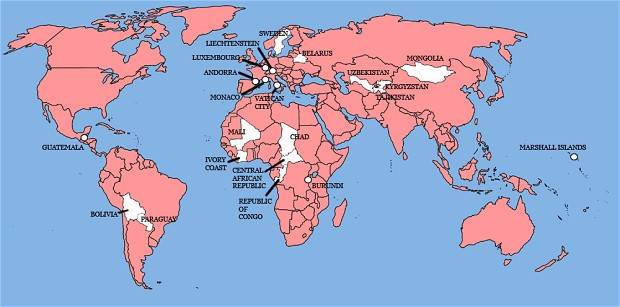
Britain has invaded all but 22 countries in the world
By Jasper Copping | World Observer | November 9, 2012
Every schoolboy used to know that at the height of the empire, almost a quarter of the atlas was coloured pink, showing the extent of British rule.
But that oft recited fact dramatically understates the remarkable global reach achieved by this country.
A new study has found that at various times the British have invaded almost 90 per cent of the countries around the globe.
The analysis of the histories of the almost 200 countries in the world found only 22 which have never experienced an invasion by the British.
Among this select group of nations are far-off destinations such as Guatemala, Tajikistan and the Marshall Islands, as well some slightly closer to home, such as Luxembourg.
The analysis is contained in a new book, All the Countries We’ve Ever Invaded: And the Few We Never Got Round To.
Stuart Laycock, the author, has worked his way around the globe, through each country alphabetically, researching its history to establish whether, at any point, they have experienced an incursion by Britain.
Only a comparatively small proportion of the total in Mr Laycock’s list of invaded states actually formed an official part of the empire.
The remainder have been included because the British were found to have achieved some sort of military presence in the territory – however transitory – either through force, the threat of force, negotiation or payment.
Incursions by British pirates, privateers or armed explorers have also been included, provided they were operating with the approval of their government.
So, many countries which once formed part of the Spanish empire and seem to have little historical connection with the UK, such as Costa Rica, Ecuador and El Salvador, make the list because of the repeated raids they suffered from state-sanctioned British sailors.
Among some of the perhaps surprising entries on the list are:
* Cuba, where in 1741, a force under Admiral Edward Vernon stormed ashore at Guantánamo Bay. He renamed it Cumberland Bay, before being forced to withdraw in the face of hostile locals and an outbreak of disease among his men. Twenty one years later, Havana and a large part of the island fell to the British after a bloody siege, only to be handed back to the Spanish in 1763, along with another unlikely British possession, the Philippines, in exchange for Florida and Minorca.
*Iceland, invaded in 1940 by the British after the neutral nation refused to enter the war on the Allies side. The invasion force, of 745 marines, met with strong protest from the Iceland government, but no resistance.
* Vietnam, which has experienced repeated incursions by the British since the seventeenth century. The most recent – from 1945 to 1946 – saw the British fight a campaign for control of the country against communists, in a war that has been overshadowed by later conflicts involving first the French and then Americans.
It is thought to be the first time such a list has been compiled.
Mr Laycock, who has previously published books on Roman history, began the unusual quest after being asked by his 11-year-old son, Frederick, how many countries the British had invaded.
After almost two years of research he said he was shocked by the answer. “I was absolutely staggered when I reached the total. I like to think I have a relatively good general knowledge. But there are places where it hadn’t occurred to me that these things had ever happened. It shocked me.
“Other countries could write similar books – but they would be much shorter. I don’t think anyone could match this, although the Americans had a later start and have been working hard on it in the twentieth century.”
The only other nation which has achieved anything approaching the British total, Mr Laycock said, is France – which also holds the unfortunate record for having endured the most British invasions. “I realise people may argue with some of my reasons, but it is intended to prompt debate,” he added.
He believes the actual figure may well be higher and is inviting the public to get in touch to provide evidence of other invasions.
In the case of Mongolia, for instance – one of the 22 nations “not invaded”, according to the book – he believes it possible that there could have been a British invasion, but could find no direct proof.
The country was caught up in the turmoil following the Russian Revolution, in which the British and other powers intervened. Mr Laycock found evidence of a British military mission in Russia approximately 50 miles from the Mongolian border, but could not establish whether it got any closer.
The research lists countries based on their current national boundaries and names. Many of the invasions took place when these did not apply.
The research covered the 192 other UN member states as well as the Vatican City and Kosovo, which are not member states, but are recognised by the UK government as independent states.
The earliest invasion launched from these islands was an incursion into Gaul – now France – at the end of the second century. Clodius Albinus led an army, thought to include many Britons, across the Channel in an attempt to seize the imperial throne. The force was defeated in 197 at Lyon.
Mr Laycock added: “On one level, for the British, it is quite amazing and quite humbling, that this is all part of our history, but clearly there are parts of our history that we are less proud of. The book is not intended as any kind of moral judgment on our history or our empire. It is meant as a light-hearted bit of fun.”
The countries never invaded by the British:
Andorra
Belarus
Bolivia
Burundi
Central African Republic
Chad
Congo, Republic of
Guatemala
Ivory Coast
Kyrgyzstan
Liechtenstein
Luxembourg
Mali
Marshall Islands
Monaco
Mongolia
Paraguay
Sao Tome and Principe
Sweden
Tajikistan
Uzbekistan
Vatican City
April 27, 2014 Posted by aletho | Militarism, Timeless or most popular | Britain, France, UK, United States | Leave a comment
Karen Kwiatkowski: Inside the Pentagon’s “Office of Special Plans”
National Summit to Reassess the U.S.-Israel “Special Relationship”
Presentation at the National Summit to Reassess the U.S.-Israel “Special Relationship” on March 7, 2014 at the National Press Club.
Karen U. Kwiatkowski retired from the U.S. Air Force with the rank of Lieutenant Colonel following service at the top echelons of the Pentagon, including the Office of Special Plans during the run-up to the war in Iraq. She served as Political-military affairs officer in the Office of the Secretary of Defense, Under Secretary for Policy, in the Sub-Saharan Africa and Near East South Asia (NESA) Policy directorates; worked on the North Africa desk; served on the Air Force Staff, Operations Directorate at the Pentagon; served on the staff of the Director of the National Security Agency (NSA) at Fort Meade, as well as tours of duty in Alaska, Massachusetts, Spain and Italy. Kwiatkowski is the author of two books about U.S. foreign policy towards Africa: African Crisis Response Initiative: Past Present and Future (US Army Peacekeeping Institute, 2000) and Expeditionary Air Operations in Africa: Challenges and Solutions (Air University Press, 2001). Kwiatkowski has an MA in Government from Harvard University, MS in Science Management from the University of Alaska, and completed both Air Command and Staff College and the Naval War College seminar programs. She earned her Ph.D. in World Politics from Catholic University of America in 2005. Kwiatkowski’s analysis of the U.S. invasion of Iraq has been featured in a number of documentaries, including Why We Fight in 2005. She has written for The American Conservative and for LewRockwell.com since 2003.
April 26, 2014 Posted by aletho | Timeless or most popular, Video, Wars for Israel | Iraq War, Israel, Middle East, United States, Zionism | Leave a comment
Brazilian torturer found murdered
Memory in Latin America | April 26, 2014
Brazilian former army colonel Paulo Malhães has been murdered in his home near Rio de Janeiro.
He was reportedly killed by three men who broke in and suffocated him, as well as stealing computers and guns.
Malhães recently testified to the truth commission about his involvement in torture, about which he expressed no regrets. Commission president Wadih Damous called for the murder to be fully investigated, saying that it could have been an attempt to prevent Malhães revealing further information about the military regime.
Morte de Malhães pode ser queima de arquivo, diz Comissão da Verdade (uol.com.br)
Brazilian military rule torturer Paulo Malhaes found dead (BBC)
Former security agent who testified to CNV is murdered (Transitional Justice in Brazil)
April 26, 2014 Posted by aletho | Subjugation - Torture, Timeless or most popular | Brazil, Latin America | Leave a comment
Lavrov: Kiev issued ‘criminal order’ allowing use of weapons against civilians
Americans ‘not ready to admit they cannot run the show’
SophieCo | April 23, 2014
The coup-appointed Kiev government’s order to use force against Ukrainian citizens is “criminal,” the Russian Foreign Minister told RT. He also denied claims that there is Russian military presence on Ukrainian territory.
In an interview with RT’s Sophie Shevardnadze, Sergey Lavrov called acting Ukrainian President Alexander Turchinov’s order to reinitiate an anti-terror operation in East Ukraine, a criminal act.
Referencing the four-sided talks between the EU, the US, Russia and Ukraine that took place in Geneva on April 17, Lavrov accused Kiev’s coup-appointed government of going back on its pledge to put a stop to all violence.
“In Geneva we agreed there must be an end of all violence. Next afternoon [interim Ukrainian President Aleksandr] Turchinov declared almost a state of emergency and ordered the army to shoot at the people.”
Turchinov announced the resumption of the anti-terrorist operation in eastern Ukraine on Tuesday. Moscow has decried the operation and urged the Ukrainian government to refrain from using force on civilians living in the region.
The Russian Foreign Minister said the buildup of troops on the border with Ukraine was within the bounds of international law and denied the presence of Russian troops in East Ukraine. Lavrov said the troops were participating in routine military drills, something that has been verified by international inspectors.
Describing a worst case scenario in the Ukrainian crisis, Lavrov said Russia would be forced to respond if it were attacked.
“If we are attacked, we would certainly respond. If our interests, our legitimate interests, the interests of Russians have been attacked directly, like they were in South Ossetia for example, I do not see any other way but to respond in accordance with international law,” he said.
“Russian citizens being attacked is an attack against the Russian Federation,” he told RT.
Referencing Prime Minister Arseniy Yatsenyuk’s trip to the Vatican on Wednesday, Lavrov said the acting Prime Minister would do better to visit the South of Ukraine and actually meet with the anti-Maidan protesters.
The foreign minister also spoke about American involvement in the ongoing crisis in Ukraine, accusing Washington of trying to manipulate the situation.
“There is no reason not to believe that the Americans are running the show,” said Lavrov, referencing US Vice-President Joe Biden’s visit to Kiev and its coincidence with the renewed counter-terror operation on activists in eastern Ukraine.
“It’s quite telling they chose the moment of the Vice President of the US’ visit to announce the resumption of this operation because the launching of this operation happened immediately after [head of the CIA] John Brennan’s visit to Kiev,” said Lavrov.
The situation in Ukraine is just another example of Washington trying to gain ground in the geopolitical fight, the minister said.
“Ukraine is just one manifestation of the American unwillingness to yield in the geopolitical fight. Americans are not ready to admit that they cannot run the show in each and every part of the globe from Washington alone,” said Lavrov, adding Washington’s “ready-made solutions” cannot remedy a crisis that it does not understand.
The Russian government does not recognize Kiev’s interim government, which took power on February 22 following weeks of deadly protests ending with the ouster of President Victor Yanukovich.
Follow SophieCo: https://twitter.com/SophieCo_RT
RT LIVE http://rt.com/on-air
Subscribe to RT! http://www.youtube.com/subscription_c…
April 23, 2014 Posted by aletho | Timeless or most popular, Video | Russia, Ukraine, United States | Leave a comment
Israel detains thousands of army deserters every year
MEMO | April 21, 2014
The Israel Defence Forces detain nearly 22,000 deserters and “undisciplined soldiers” every year, Haaretz newspaper revealed on Sunday. The paper said that nearly 13,000 of the soldiers are detained in army prisons while the rest are held inside military bases.
The paper quoted data from the Military Police, which revealed that around 400 escape attempts, rebellions and acts of violence occur inside army prisons annually. At least 13,452 soldiers were detained in 2013; 76 per cent of them were charged with evading military service, while 18 per cent were soldiers classified as “undisciplined” and 6 per cent had committed criminal offences.
According to the data, 13 per cent of detained soldiers are of Ethiopian origin although they represent only 3 per cent of the total personnel in the IDF.
April 21, 2014 Posted by aletho | Ethnic Cleansing, Racism, Zionism, Illegal Occupation, Subjugation - Torture, Timeless or most popular, War Crimes | Israel, Palestine, Zionism | Leave a comment
An Eyewitness to the Syrian Rebellion: Father Frans in His Own Words
By John Rosenthal | The BRICS Post | April 19, 2014
![The Syrian Civil War has devastated entire cities and towns as fighting between the rebels and Syrian Army spreads from neighborhood to neighborhood [Xinhua]](https://i0.wp.com/thebricspost.com/wp-content/uploads/2014/04/219858479_8-e1397921219172.jpg)
An examination of texts published by Father Frans van der Lugt in 2011 and 2012 shows that the late Dutch Jesuit priest had a dim view of the Syrian rebellion, which he held to be the work of a violent minority, and favored a process of political reform in Syria to be implemented by the current government under President Bashar Al-Assad.
Father Frans was murdered under still unclarified circumstances in the embattled Syrian city of Homs earlier this month.
Opposition sources have blamed the Syrian government for his death. But it is widely believed that Father Frans was killed by hard-line Islamist members of one of the rebel factions that have taken control of his Bustan al-Diwan neighborhood in Homs.
The texts of Father Frans, who had lived in Syria since 1966, provide an eyewitness account of the origins of the anti-Assad rebellion and the gradual hardening of the front between opposing rebel and government forces in Homs.
In many respects, the Father’s observations contrast sharply with what has become the standard view of the rebellion in Western media.
Perhaps most notably, whereas the rebellion is typically held to have been sparked by the violent repression of peaceful protests, according to Father Frans, the “protest movement” contained an armed and violent element “from the start” and the violent opposition quickly gained the ascendancy over the peaceful opposition.
Thus, in a letter published in January 2012 on the Dutch-Flemish Mediawerkgroep Syrië website, Father Frans wrote:
From the start, the protest movements were not purely peaceful. From the start I saw armed demonstrators marching along in the protests, who began to shoot at the police first. Very often the violence of the security forces has been a reaction to the brutal violence of the armed rebels.
In the same letter, Father Frans insisted that what was occurring in Syria could not be described as a “popular uprising,” since the majority of Syrians do not support the opposition and “certainly not” its armed component.
Already in September 2011, Father Frans had made similar observations in a guest post on a Belgian blog, going so far as to accuse armed opposition groups of blaming the regime for their own acts of violence.
Having noted the splintering of the opposition among Islamists, “liberals and democrats”, communists and so on, Father Frans continued:
Moreover, from the start there has been the problem of the armed groups, which are also part of the opposition….The opposition of the street is much stronger than any other opposition. And this opposition is armed and frequently employs brutality and violence, only in order then to blame the government. Many representatives of the government [regeringsmensen – Father Frans might also be referring to supporters of the government] have been tortured and shot dead by them.
“Personally,” Father Frans concluded, “I expect little good to come from the opposition, which, moreover, has been instigated and paid by foreign interests.”
Favoring political reform
Faced with a choice between an opposition as so described and the current Syrian government, Father Frans clearly favored a process of political reform undertaken by the latter and not the “regime change” that has been favored by the West.
“Personally,” he wrote in September 2011, “I think this government has to stay, despite all difficulties, and proceed along the path of reforms.”
In his January 2012 letter, he outlined a similar course of action, noting that the current government is “perhaps more democratic than possible replacements.”
In particular, he regarded the current regime as the best guarantee against the spread of sectarian violence in Syria.
Whereas Western press reports have emphasized his efforts to promote understanding among Christians and Muslims, Father Frans identified the main sectarian fault-line in Syria as that running between two Muslim communities: Sunnis, who make up the majority of the population, and the Alawite minority, which is not only associated with the current regime but whose members are regarded as apostates by radical Sunni currents.
In January 2012, Father Frans warned that the Syrian army was the only thing standing in the way of a full-fledged civil war between Sunnis and Alawites in Homs.
In the same letter, he noted that most Christian leaders in Syria support Assad, “because they are convinced that they would be worse off with another solution.”
In his critical observations on the Syrian crisis, Father Frans did not spare the Western media, which he accused of distortion and bias.
In September 2011 he wrote that he was disturbed by Western coverage of the Syrian crisis because there was “never a good word” published about the current government.
He said that Western media blamed the Syrian government “for things that it had not done”. He went on:
Our experience with the government has not been so negative. In my case, they always helped my projects and supported my idea of being of service to Sunnis and Alawites. They wanted an ever greater separation of church and state and were enthusiastic about projects that were non-denominational.
According to the Dutch daily de Volkskrant, the help provided by the Syrian government to Father Frans included a grant of over 100 acres of land for the Father’s agricultural projects.
Lords and masters
Ironically, by March 2012, Father Frans found himself living under siege by the forces of the very Syrian government he supported. In the meanwhile, rebel forces, which had briefly taken control of Bustan al-Diwan in September 2011, were back again and this time they were there for the long-term.
Now, as Father Frans noted in an eyewitness report for the Flemish monthly Streven, the rebel forces were “much better organized” and “called themselves ‘the Free Syrian Army.’”
“They had an abundance of food,” he continued, “and they also distributed it to poor people. They are financially and militarily supported by foreign interests.”
“For now,” Father Frans concluded, referring to both the Bustan al-Diwan and Hamidiyeh neighborhoods of Homs, “the Free [Syrian] Army is lord and master of our Christian neighborhoods….”
In late March, Father Frans’s own car was destroyed by a missile or mortar fired into Bustan al-Diwan by the Syrian army. “The army was aiming for a restaurant not far from us where the FSA has its headquarters,” he explained to the Swiss Catholic new agency APIC.
“There is a Greek Orthodox church right next door, which was also damaged.”
Father Frans told APIC that ninety percent of the Christian population of Homs had already fled the city, because of the fighting.
“They were not chased out by the Sunni militias,” Father Frans took care to add, “This needs to be emphasized! The Syrian army was first driven from the neighborhood by the FSA and now it’s the FSA that is being bombed.”
In his contribution to Streven, Father Frans wrote about the futility of the army’s bombing campaign and its disastrous effects upon the remaining Christian population:
… [T]he only result is that many Christian homes and also churches… have been bombed and partially or wholly destroyed, while the soldiers of the Free [Syrian] Army remain unharmed. The latter hide in the cellars of the Christian homes to protect themselves from the bombing.
Nonetheless, Father Frans remained clear about where he believed the ultimate responsibility for the disaster lay. “There is no excusing the fact,” he wrote, “that the Free Syrian Army has taken the Christian neighborhoods in order to use them as a battlefield for combating the government army.”
But not even the experience of siege and bombardment by government forces could shake Father Frans’s conviction that distorted, one-sided coverage of the Syrian crisis in the media was itself a major obstacle to peace.
Reflecting on the way forward in the conclusion to his contribution to Streven, Father Frans warned:
In the first place, it has to be said that it is very difficult to provide a nuanced and objective account of what is happening. Many journalists fall into describing matters in black and white. For them, good and evil are not interwoven, but are clearly separated. They demonize the one side and glorify the other. Thus, for example, it is not true that our [the Syrian] government has only bad sides and the opposition only good ones. But because the US, Europe and certain Arab countries support the opposition, they endeavor, whether consciously or unconsciously, to idealize it as much as possible, without engaging in any careful analysis of the real situation. Certain interests are obscuring our view of the real situation and contaminating the description of it.
The author of this article John Rosenthal is a European-based journalist and political analyst who writes on European politics and transatlantic issues. His articles have appeared in such publications as Al-Monitor, World Affairs, The Wall Street Journal Europe, Les Temps Modernes, and Die Weltwoche. He is the author of the recent book The Jihadist Plot: The Untold Story of Al-Qaeda and the Libyan Rebellion. You can follow his work at www.trans-int.com or on Facebook
April 20, 2014 Posted by aletho | Mainstream Media, Warmongering, Timeless or most popular | Leave a comment
9/11: How it Was Done, the Science of Demolition
#howtheydid911
As public awareness grows about the truth about 9/11, it serves to point out that many features of the towers’ destruction fit perfectly with standard patterns of demolition. Evidence which at first seems puzzling is in fact consistent with known demolition techniques.
WTC 7 differed from Towers One and Two in that WTC7 was a traditional “bottom-up” implosion. The Twin Towers, on the other hand, exhibited the more unfamiliar pattern of a “banana peel” demolition, which starts at the middle or the top of a building and progresses downward. The below demolition in China shows the pattern of streamers of arcing debris that we see coming from the Twin Towers, as the cutting of supports begins high above ground level and works its way down.
Banana Peel Demolition in China next to Twin Towers
Banana peel demolitions are used for taller, narrower buildings, where there is danger of the building tipping over should the bottom be cut and the rest of the sequence not execute perfectly. … continue at 9/11explained
April 17, 2014 Posted by aletho | Deception, False Flag Terrorism, Timeless or most popular, Video | 9/11, United States | Leave a comment
Oligarchy, not democracy: Americans have ‘near-zero’ input on policy – report
RT | April 15, 2014
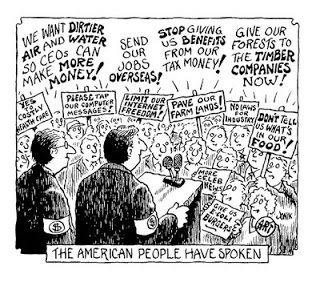
The first-ever scientific study that analyzes whether the US is a democracy, rather than an oligarchy, found the majority of the American public has a “minuscule, near-zero, statistically non-significant impact upon public policy” compared to the wealthy.
The study, due out in the Fall 2014 issue of the academic journal Perspectives on Politics, sets out to answer elusive questions about who really rules in the United States. The researchers measured key variables for 1,779 policy issues within a single statistical model in an unprecedented attempt “to test these contrasting theoretical predictions” – i.e. whether the US sets policy democratically or the process is dominated by economic elites, or some combination of both.
“Despite the seemingly strong empirical support in previous studies for theories of majoritarian democracy, our analyses suggest that majorities of the American public actually have little influence over the policies our government adopts,” the researchers from Princeton University and Northwestern University wrote.
While “Americans do enjoy many features central to democratic governance, such as regular elections, freedom of speech and association,” the authors say the data implicate “the nearly total failure of ‘median voter’ and other Majoritarian Electoral Democracy theories [of America]. When the preferences of economic elites and the stands of organized interest groups are controlled for, the preferences of the average American appear to have only a minuscule, near-zero, statistically non-significant impact upon public policy.”
The authors of “Testing Theories of American Politics: Elites, Interest Groups, and Average Citizens” say that even as their model tilts heavily toward indications that the US is, in fact, run by the most wealthy and powerful, it actually doesn’t go far enough in describing the stranglehold connected elites have on the policymaking process.
“Our measure of the preferences of wealthy or elite Americans – though useful, and the best we could generate for a large set of policy cases – is probably less consistent with the relevant preferences than are our measures of the views of ordinary citizens or the alignments of engaged interest groups,” the researcher said.
“Yet we found substantial estimated effects even when using this imperfect measure. The real-world impact of elites upon public policy may be still greater.”
They add that the “failure of theories of Majoritarian Electoral Democracy is all the more striking because it goes against the likely effects of the limitations of our data. The preferences of ordinary citizens were measured more directly than our other independent variables, yet they are estimated to have the least effect.”
Despite the inexact nature of the data, the authors say with confidence that “the majority does not rule — at least not in the causal sense of actually determining policy outcomes.”
“We believe that if policymaking is dominated by powerful business organizations and a small number of affluent Americans, then America’s claims to being a democratic society are seriously threatened,” they concluded.
April 17, 2014 Posted by aletho | Civil Liberties, Corruption, Timeless or most popular | Corruption, USA | Leave a comment
Featured Video
Elijah Magnier: Yemen’s strikes are shattering Saudi Arabia’s long-term strategy
or go to
Aletho News Archives – Video-Images
From the Archives
British weapons and personnel doing much of the killing in Yemen
Press TV – June 18, 2019
A detailed report published by the Guardian newspaper has shown how Britain is massively contributing to Saudi Arabia’s devastating war on Yemen as it suggests that London is not only supplying the bombs that fall on Yemenis, but it provides the personnel and expertise that keep the war going.
The comprehensive report by Arron Merat published on Tuesday showed that Britain was doing much of the killing in Yemen as the country continues to provide Saudi Arabia with everything it needs to turn its southern impoverished neighbor into a graveyard.
“Every day Yemen is hit by British bombs – dropped by British planes that are flown by British-trained pilots and maintained and prepared inside Saudi Arabia by thousands of British contractors,” said Merat in the report. … continue
Blog Roll
-
Join 2,366 other subscribers
Visits Since December 2009
- 7,783,029 hits
Looking for something?
Archives
Calendar
Categories
Aletho News Civil Liberties Corruption Deception Economics Environmentalism Ethnic Cleansing, Racism, Zionism Fake News False Flag Terrorism Full Spectrum Dominance Illegal Occupation Mainstream Media, Warmongering Malthusian Ideology, Phony Scarcity Militarism Progressive Hypocrite Russophobia Science and Pseudo-Science Solidarity and Activism Subjugation - Torture Supremacism, Social Darwinism Timeless or most popular Video War Crimes Wars for IsraelTags
Afghanistan Africa AIPAC al-Qaeda Australia BBC Benjamin Netanyahu Brazil Canada CDC Central Intelligence Agency China CIA CNN Covid-19 COVID-19 Vaccine Donald Trump Egypt European Union Facebook FBI FDA France Gaza Germany Google Hamas Hebron Hezbollah Hillary Clinton Human rights Hungary India Iran Iraq ISIS Israel Israeli settlement Japan Jerusalem Joe Biden Korea Latin America Lebanon Libya Middle East National Security Agency NATO New York Times North Korea NSA Obama Pakistan Palestine Poland Qatar Russia Sanctions against Iran Saudi Arabia Syria The Guardian Turkiye Twitter UAE UK Ukraine United Nations United States USA Venezuela Washington Post West Bank WHO Yemen Zionism
Aletho News- Racist Seinfeld Dances for Joy as Bibi Unveils His New Map
- A West Bank War for Netanyahu’s Election Campaign, Could It Backfire?
- Yemen denounces European Parliament’s ‘hypocritical’ push to blacklist Ansarullah
- Qalibaf: UAE’s UN bid aims to ‘clear the runway’ for ‘Greater Israel’, whitewash genocide
- Pakistan reopens Iran border after boosting security: Report
- Why are so many Brazilians voting for Flávio Bolsonaro?
- Democrats Put Anti-Russia Agenda Ahead of American Workers
- Elijah Magnier: Yemen’s Strikes Are Shattering Saudi Arabia’s Long-Term Strategy
- Pentagon designates Chinese cultural centers national security threat
- Israel Demolishes Home Of Lebanese Journalist Whose Viral Film Exposed Pager Attack
If Americans Knew- An error has occurred; the feed is probably down. Try again later.
No Tricks Zone- Sudden Stratospheric Warming, Powerful El Niño Combination May Lead To Extreme Europe Cold, Energy Crisis!
- Two New Studies Find Thwaites Glacier Melt Cannot Be Driven By Human Activity Or A Warming Ocean
- E-Cars Reduce CO2 Emissions By Only 41% Compared To Internal Combustion Engine Vehicles
- Predictions Made By Renowned Climate Professor Over Past Decades Have Been Proven To Be Poor
- New Study Suggests Large Regions Of The Pacific Ocean Have Been Cooling For The Last 80 Years
- Germany’s Green Energy Debacle: High Energy Costs Force Kahla Porzellan to Close After 182 Years!
- New Study: 50 Years Of The Most Aggressive ‘Net Zero’ Policies Can Only Affect The Global Climate By 0.03°C
- US September “Heat” Was No Record…Many Records Set Decades Ago
- Latest European Green Energy Debacle; Portugal’s Largest Flagship Solar Park Insolvent!
- Green Energy Debacle: German Expert Professor Fritz Vahrenholt Warns Of Severe Economic And Social Consequences
Contact:
atheonews (at) gmail.com
Disclaimer
This site is provided as a research and reference tool. Although we make every reasonable effort to ensure that the information and data provided at this site are useful, accurate, and current, we cannot guarantee that the information and data provided here will be error-free. By using this site, you assume all responsibility for and risk arising from your use of and reliance upon the contents of this site.
This site and the information available through it do not, and are not intended to constitute legal advice. Should you require legal advice, you should consult your own attorney.
Nothing within this site or linked to by this site constitutes investment advice or medical advice.
Materials accessible from or added to this site by third parties, such as comments posted, are strictly the responsibility of the third party who added such materials or made them accessible and we neither endorse nor undertake to control, monitor, edit or assume responsibility for any such third-party material.
The posting of stories, commentaries, reports, documents and links (embedded or otherwise) on this site does not in any way, shape or form, implied or otherwise, necessarily express or suggest endorsement or support of any of such posted material or parts therein.
The word “alleged” is deemed to occur before the word “fraud.” Since the rule of law still applies. To peasants, at least.
Fair Use
This site contains copyrighted material the use of which has not always been specifically authorized by the copyright owner. We are making such material available in our efforts to advance understanding of environmental, political, human rights, economic, democracy, scientific, and social justice issues, etc. We believe this constitutes a ‘fair use’ of any such copyrighted material as provided for in section 107 of the US Copyright Law. In accordance with Title 17 U.S.C. Section 107, the material on this site is distributed without profit to those who have expressed a prior interest in receiving the included information for research and educational purposes. For more info go to: http://www.law.cornell.edu/uscode/17/107.shtml. If you wish to use copyrighted material from this site for purposes of your own that go beyond ‘fair use’, you must obtain permission from the copyright owner.
DMCA Contact
This is information for anyone that wishes to challenge our “fair use” of copyrighted material.
If you are a legal copyright holder or a designated agent for such and you believe that content residing on or accessible through our website infringes a copyright and falls outside the boundaries of “Fair Use”, please send a notice of infringement by contacting atheonews@gmail.com.
We will respond and take necessary action immediately.
If notice is given of an alleged copyright violation we will act expeditiously to remove or disable access to the material(s) in question.
All 3rd party material posted on this website is copyright the respective owners / authors. Aletho News makes no claim of copyright on such material.