NEW FAUCI EMAILS EXPOSE ATTACK ON NATURAL IMMUNITY
The HighWire with Del Bigtree | January 22, 2026
Newly revealed emails show Dr. Anthony Fauci privately acknowledged that natural immunity may provide stronger protection than COVID vaccination, even as he publicly dismissed it during the mandate period. As Senator Rand Paul calls for criminal referrals, the larger issue is whether the DOJ will pursue Fauci—or protect the COVID-era establishment instead.
Israelis SUDDENLY Mass Deported From Many Countries
The CJ Werleman Show | January 22, 2026
In this urgent report, I expose why Israelis are now being mass deported or denied entry by countries around the world – from Eastern Europe to South America, from the Maldives to even North Korea. These are not isolated incidents. They are a direct consequence of Israel’s policies, its ongoing atrocities against Palestinians, and a historic collapse in Israel’s global image. Watch to the end to understand how all of this connects to war crimes, apartheid, racism, and Western hypocrisy – and why platforms like YouTube are punishing channels that dare to tell the truth.
❌ YouTube Demonetized Our Channel Because We Expose Israel ❌ 💪
Please HELP me expose Israel and injustices in Muslim world via Patreon HERE: ▶  / cjwerleman
One-time donations can be made here: ▶ https://www.paypal.me/cjwerleman
We can’t sustain, improve and grow this program without your help via Patreon membership, and you will be helping us push back against Zionist censorship, produce more in-depth investigations, platform Palestinian voices and other victims of occupation and war. Thank you for your support and understanding.
Peace Plan Phase 2 Without Phase 1: Can the US Really Bring Peace to Gaza?
By Abbas Hashemite – New Eastern Outlook – January 22, 2026
US President Donald Trump announced Phase 2 of the Gaza Peace Plan despite the failure of Phase 1 to bring any relief to the Palestinians, reasserting the fact that it only intends to legitimize the Israeli occupation.
On January 16, the United States announced the launch of the 2nd phase of the infamous 20-point Gaza Peace Plan, which is supposed to end Israel’s genocidal operations against native Palestinians in Gaza. The Trump administration portrays Phase 1 of the Gaza Peace Plan as a success. However, the reality on the ground is in sheer contrast to the US government’s claims. Most of the expectations of Phase 1 were never materialized on the ground in Gaza. Phase 1 of the 20-point Gaza Peace Plan was supposed to immediately stop the fighting between Israel and Hamas, allow full admittance of humanitarian aid in the Gaza enclave, open the Rafah crossing between Egypt and Gaza, enable the exchange of captives between the two sides, and set a limit for the Israeli withdrawal from the boundary of Gaza.
Phase 1: Broken Promises
Although the Israeli attacks in Gaza have decreased since the start of the ceasefire, the genocide still continues. The Zionist government continues to violate the ceasefire by launching unprovoked attacks in the Gaza enclave, violating the ceasefire at least 1193 times, resulting in the deaths of at least 451 Palestinians since October 10. According to a UNICEF report, “More than 100 children have been killed in Gaza since the ceasefire of early October. That is roughly one girl or boy killed every day during a ceasefire.” It further states, “Since the ceasefire, UNICEF has recorded reports of at least 60 boys and 40 girls killed in the Gaza Strip. The 100 figure only reflects incidents where sufficient details have been available to record, so the actual number of Palestinian children killed is expected to be higher. Hundreds of children have been wounded.”
Hamas has released all the living and dead captives except one. However, reports suggest that Israel has not released all the prisoners as stipulated in the ceasefire agreement. It still holds numerous children, women, and doctors. Moreover, reports suggest that the Israeli government continues to block much of the essential humanitarian aid in Gaza, only allowing around 43 percent of the total aid trucks. The Zionist government does not allow the passage of the trucks containing meat, dairy products, and vegetables, which are necessary for maintaining a balanced diet. It only allows trucks containing soft drinks, chocolates, snacks, and crisps into the Gaza enclave. In addition, the Israeli government has banned more than three dozen charity organizations from working in Gaza, further worsening the dire conditions of the Gazans. Furthermore, the key lifeline for the entry of aid, medical evacuation, and travel, the Rafah crossing, also remains closed by the Israeli Defense Forces (IDF).
Phase 2: Political Theatre or Real Solution
Phase 2 of the Gaza Peace Plan aims to shift the focus to establishing a Palestinian technocrats’ panel to supervise and lead post-war Gaza, as well as long-term governance in the enclave. Steve Witkoff, Special Envoy of the US President Donald Trump, stated the Phase 2 “establishes a transitional technocratic Palestinian administration in Gaza” and would initiate “the full demilitarization and reconstruction of Gaza, primarily the disarmament of all unauthorized personnel.” However, without the success of Phase 1 of the 20-point Peace Plan, the announcement of Phase 2 seems nothing more than a political theatrics to enhance President Trump’s international stature.
Controversial Appointments Undermine Trust and Peace
The Trump administration’s announcement of the former British Prime Minister, Tony Blair, responsible for the death of thousands of Muslims in the Middle East, along with US Secretary of State Marco Rubio, the US special envoy to the Middle East Steve Witkoff, and Trump’s son-in-law Jared Kushner – a staunch Zionist, as one of the founding executive members of the so-called Board of Peace, which is supposed to overview the implementation of the so-called Gaza Peace Plan, also reflects the nonchalance of the US government to end the Israeli genocide in Gaza. The United States has appointed US Major General Jasper Jeffers as Commander of the International Stabilization Force (ISF) for the Gaza Enclave. According to the White House, Jeffers would lead the ISF in a wide range of areas, including “comprehensive demilitarization.”
However, this “comprehensive demilitarization” is limited to de-weaponizing Hamas. The United States has been a key supporter of Israeli war crimes in Gaza. It has also been the prime supporter of Israel’s demand to demilitarize Hamas, a demand unacceptable to the Palestinian group. The appointment of Major General Jasper Jeffers would make the ISF more controversial. The US government needs to address the concerns of all the stakeholders effectively to successfully implement the 20-point Gaza Peace Plan. Moreover, appointing people with controversial backgrounds like Tony Blair and Jared Kushner would only lead to a trust deficit, further complicating the peace process in Gaza.
Аbbas Hashemite is a political observer and research analyst for regional and global geopolitical issues. He is currently working as an independent researcher and journalist
Hamas: Netanyahu’s inclusion in ‘peace council’ threatens justice
Al Mayadeen | January 22, 2026
The Hamas Resistance movement has condemned the inclusion of Israeli Prime Minister Benjamin Netanyahu in the so-called “Peace Council” for Gaza, calling it a dangerous sign that undermines justice and accountability.
In an official statement issued Thursday, Hamas said, “We strongly condemn the inclusion of war criminal Netanyahu, who is wanted by the International Criminal Court, in the Peace Council for Gaza.”
The movement stated that Netanyahu’s participation contradicts the very principles such a council should represent. It warned that “the war criminal Netanyahu continues to obstruct a ceasefire agreement in Gaza and carries out the most heinous violations by targeting unarmed civilians.”
Hamas stressed that “the first step toward stability lies in ending the occupation’s violations and holding all those responsible for genocide and starvation accountable.”
The statement came after US President Donald Trump and several international leaders signed a decree on Thursday establishing the “Peace Council” concerning the Gaza Strip. The signing took place during the World Economic Forum in Davos, Switzerland.
Netanyahu confirmed his participation on Wednesday, saying: “I will join the Peace Council in response to President Trump’s invitation.”
Others who joined the so-called “Peace Council” include Turkey, Saudi Arabia, Egypt, Jordan, and others, bringing the total number of those who accepted Trump’s invitation up to 25.
France seizes tanker ‘coming from Russia’
RT | January 22, 2026
French commandos have boarded and seized a sanctioned tanker “coming from Russia,” President Emmanuel Macron announced on Thursday. The ship, Macron claimed, is part of Russia’s supposed ‘shadow fleet’.
The ship was intercepted by the French Navy in the Mediterranean, Macron said, adding that the vessel was “subject to international sanctions and suspected of flying a false flag.” The tanker has since been diverted to port, he added, where a judicial investigation will take place.
The ship, named ‘Grinch’, was sailing from the Russian port of Murmansk. According to publicly available maritime tracking data, ‘Grinch’ is a 250-meter crude oil tanker flying under the flag of Comoros.
The seizure was carried out by French naval forces with assistance from the UK, the French military said in a statement. According to an AP report, Britain provided intelligence support for the operation.
“We will not tolerate any violation,” Macron wrote in a post on X. “The activities of the ‘shadow fleet’ contribute to financing the war of aggression against Ukraine.”
There is no Russian-operated ‘shadow fleet’. Instead, the term refers to any vessel that transports Russian oil outside the coverage of London-based insurance brokers. While their cargo may be sanctioned, Western powers have no legal basis to enforce these sanctions on the high seas, under the United Nations Convention on the Law of the Sea.
According to Macron, the operation took place on the “high seas” in the Mediterranean, but was carried out in “strict compliance” with the convention.
The seizure took place a week after British Foreign Secretary Yvette Cooper promised to take “a much more assertive and robust approach” against “the Russian shadow fleet.” In October last year, Macron said that France and other EU countries would adopt a “policy of obstruction” against these vessels.
”Russian oil must be stopped, confiscated, and sold for Europe’s benefit,” Ukrainian leader Vladimir Zelensky said at the World Economic Forum’s annual meeting in Davos on Thursday. “Why not? If Putin has no money, there is no war,” he added.
Introducing Mossad Farsi, the Motto and the Methods
By Ilana Mercer • Unz Review • January 21, 2026
I’ll stifle the impulse not to say the obvious, and say it: An Israeli-American regime-change operation is underway in Iran.
It’s “right out of the US-Israel playbook” for such operations, notes Professor John Merisheimer, a scrupulous scholar of “great-power politics,” or, more precisely, of naked imperial power.
First, the US “wrecked the country’s economy through crippling sanctions, making the populace profoundly unhappy, poor, desperate, hungry.” Next, cheek-by-jowl with Israel, massive protests were fomented, confirmation for which came in a December 29, Jerusalem Post article, the headline to which read as follows:
“Mossad spurs Iran protests, say agents with [the] demonstrators, in [a] Farsi message: As protests grow across Iran, the Mossad posted an unusual Farsi message urging demonstrators to act, saying it is with them in the streets, amid rising economic pressure and public unrest.”
To Israel, the United States of America offers service and subservience.
Thus, comments from Trump on Truth Social and Mike Pompeo, more openly, backed the fact of an orchestrated, malevolent intervention, in what were initially organic, peaceful protests that stemmed from ruthless economic warfare (American) against the Islamic Republic.
Duly, on January 2, 2026, Pompeo, former U.S. Secretary of state and CIA director, wrote: “Happy New Year to every Iranian in the streets. Also, to every Mossad agent walking beside them…”
As reported by the Times of Israel, on January 16, “Channel 14, seen as close to Prime Minister Benjamin Netanyahu,” initially said that “‘foreign actors’ are arming the protesters in Iran with live firearms, which is the reason for the hundreds of regime personnel killed.” A little later, a typically oleaginous Israeli source quipped: “Everyone is free to guess who is behind it.”
We’ve sensed as much. The Iranian January 2026 protesters are acting out-of-character. More like Israelis than ordinary Iranians. These protesters appear thoroughly Israelized—it is certainly unusual historically for the generally demure, respectful Iranians to burn down and desecrate their own holy sites; acts that conform, however, to the rules and customs of Israeli “transnational terrorism.”
Historically, Iranians in protest have targeted government symbols, but not national and religious symbols.
And, Lo: These Iranian protesters had enjoyed access to 40,000 StarLink terminals, a news tidbit confirmed by the Times of Israel and Fox News, in bursts of good cheer and cheerleading. The “live” firearms provided were in keeping with Israel’s terror-state tactics. Recall that, in June of 2025, in connivance with the CIA, Mossad, MI5 and Trump—Israelis had smuggled needed materiel into Iran for their war of aggression. Trump had done his part in the subterfuge by pursuing “diplomacy-as-deception” with his trusting Iranian interlocutors, thus distracting and deceiving them.
The third stage in the “US-Israel Axis’” “four-part regime change playbook,” avers Mearsheimer, is the disinformation campaign.
Before their respective, well-coordinated air forces and armies alight on their Iranian victims in targeted attacks and assassinations—the “transnational terrorists” of the “US-Israel Axis” have a trifling task: Convince the most-propagandized minds in the world, Westerners, that this grotesque burlesque of a regime-change farce is a naturally occurring thing.
In other words, that America’s color-coded, plant-based “democratic” revolutions, you know the kind—“Purple” in Iraq, “Blue” in Kuwait, “Cotton” in Uzbekistan, “Grape” in Moldova, “Orange” in the Ukraine, “Rose” in Georgia, “Tulip” in Kyrgyzstan, “Cedar” in Lebanon, “Jasmine” in Tunisia, “Green” in Iran, still un-christened in Russia and Syria—these are but natural uprisings, led by noble patriots, who just happen, all-too frequently, to be aligned with and sponsored by Foreign Policy Inc., the clubby DC foreign-policy establishment and its Israeli offshoots and operatives.
Mearsheimer appears to imply that the stages of regime change are consecutive, or sequential. I would argue that, as in all formulaic stage theories—the stages of regime change overlap, run into each other, reoccur and repeat. To wit, Iran has and will continue to endure this devilry for decades.
Over and above regime change, Israel, by Mearsheimer’s careful estimation, has a “deep-seated interest” in “wrecking Iran,” in breaking the Islamic Republic apart, and fracturing the surrounding nations.
“At bottom,” I posited during the 12-day war on Iran, “If Israel wanted to enjoy its neighborhood; it would not perennially reduce it to a primordial, pre-civilization stage, as in Gaza, by wiping out knowledge, experience, strength; smarts, beauty and goodness. … These Israeli atavists—who during the 2025 offensive in Iran murdered nearly 900 Palestinians in Gaza—don’t want educated, erudite neighbors; equals with whom to make magic in the region; they want subjects they can sanction and slaughter into submission.”(“IRAN: Everything You Need To Know But Were Too Afraid Of The Israel Lobby To Ask,” July 1, 2025.”)
I should revise that: According to the twinned belief-systems of Jewish supremacy and American exceptionalism; all ‘good,’ ‘happy’ human beings are either those who are like Americans or like Israelis, or en route to becoming clones of the one or the other.
Those involved in these foreign-policy drives honestly believe that to be American or Israeli is the existential Gold Standard. Lowly humanity is a pilgrim en route to the Promised Land, whether they know it or not —sometimes by hook or crook. Ultimately, the lives of all the Others being roused to revolt are just not worth much until they “arrive.”
As to their deep involvement in inciting regime-change riots in Iran: News tidbits to that effect have come to us directly via the Israelis themselves.
By now you know that Israel is “amoral,” it acts outside the laws of both man and God. By now you know that bursts of pride accompany Israeli barbarity. As is often the case, Israelis and their media openly report their crimes. And they are especially proud to be inciting regime-change in Iran. On the ground.
Take the X account titled “Mossad Farsi.” So nauseatingly audacious in content is it, that I doubted its authenticity.
In sickeningly sugared tweets, “Official Mossad in Farsi” and its bots (the programmed, online Artificial Intelligence responders or Israel’s paid lickspittles) profess the love Israelis have for the largely pro-Palestinian Iranians.
These are the same Israelis, still mid-murder in Gaza and the West bank, who were posting and celebrating imagery of murdered Palestinians with the flesh hanging on their bones in ribbons. That amoral Israel is now “loving on” the Iranians, a people who have generally resisted for Palestine.
Filled with love, “Mossad Farsi” has been loud and proud about its role in attempting to break the Islamic Republic. Here is the Mossad Farsi tweet that got world attention. Dated December 29, it reads as follows: “Let’s come out to the streets together. The time has come. We are with you. Not just from afar and verbally, we are with you in the field as well.”

Speaking in unison, Israeli media—Channel 14, i24, Israel Hayom, and others, no doubt—confirmed the authenticity and impetus of this account. In identically scripted messages, all outlets announced that a “Mossad X account in Farsi urges Iranians to protest as unrest sweeps the country.”
The criminal Svengali Bibi tips the nose toward Iran (allegedly), in a December 29 meeting at Mar-a-Lago, and Trump runs. “Fetch,” says Netanyahu to a pack of dreadful American curs, and they fetch. (Apologies, again, to animals for using them as the source of metaphor for things stupid and evil. It’s a regrettable feature of the English language.)
What might I add to the information provided by Mearsheimer (and reported by Max Blumenthal) in hashing out the finer points of the Israeli scheme? I can provide a translation from the Hebrew of the motto embedded by Mossad Farsi in its X account’s graphic. It reads as follows:
“Without connivance [as in scheming], a nation will fall”:
באין תחבולות יפול עם
Mossad Farsi’s motto is The Message. Israel’s message.
Israeli agricultural export collapse amid Gaza genocide boycott
Al Mayadeen | January 20, 2026
Israeli agricultural exports are collapsing under the weight of an expanding international boycott of “Israel”, driven largely by backlash over its war on Gaza, Jonathan Ofir writes for Mondoweiss. Reports aired by Kan 11 reveal a sharp decline in demand for Israeli mangos and citrus fruits, with settlers warning of imminent financial “collapse.”
In interviews, exporters say that Israeli fruit exports are being rejected by European buyers who now only consider purchasing Israeli produce when no alternatives are available. One farmer stated plainly, “They don’t want our mangos.”
Compounding the crisis was Ansar Allah’s Red Sea blockade, which disrupted shipping routes to Asian markets, pushing logistics costs up and delaying deliveries by months. Settlers say the new routes compromise fruit quality and profitability.
European markets withdraw as genocide condemnation grows
While no single factor has caused the breakdown of “Israel’s” fruit export market, the most consistent thread cited in Kan 11’s reporting is global outrage over the Gaza genocide. A widespread perception of Israeli impunity, underscored by public polling showing most Israelis believe there are “no innocents in Gaza,” has intensified calls to avoid Israeli products.
The economic consequences are already being felt in key agricultural hubs like Kibbutz Givat Haim Ichud and Kibbutz Ein Hahoresh, where settlers describe export losses as unsustainable. “Israeli fruit, despite its high quality, is currently less desired in Europe,” one settler admits.
Even Russia, a state under sanctions itself, is for now one of “Israel’s” few remaining markets. “We are now in the alliance of the boycotted,” says one settler.
Citrus and mango growers warn of industry collapse
The mango and citrus crisis has taken a visible toll. Settlers report rotting fruit, empty warehouses, and significant financial losses. Mango grower and retired general Moti Almoz says he’s left 25% of his crop unharvested, “I couldn’t do anything with them… people can’t just eat mango.”
In the north, out of 1,200 tons of mangoes, 700 are expected to rot on the ground. Smaller farms are attempting direct-to-customer sales, but say it won’t be enough to remain viable. “It’s a crisis the likes of which we haven’t ever experienced,” says another farmer.
The situation has escalated to the point that settlers are calling for state intervention. Without it, many warn that “Israel” may soon lose its entire export agriculture sector.
Hatred, denial, and the price of genocide
Despite the mounting crisis, some farmers refuse to sell to Palestinians, even if it would ease their losses. Almoz, whose produce once reached Gaza, says bluntly, “I’m done with them… If there’s a chance that I lose money because this [mango] turns into a Hamas interest, then I need to lose money.”
Such positions reflect how Israeli nationalism and denial of wrongdoing intersect with the economic consequences of genocide. Even as tears are shed over rotting fruit, there is little acknowledgment of the reason behind the boycott, the destruction of Gaza and its people.
The Changing Face of Regime Change
By Daniel McAdams | Ron Paul Institute | January 19, 2026
The most disturbing lesson from the 2014 Maidan Revolution in Ukraine that has been well-learned by the various intelligence agencies in this business is that the application of extreme violence – especially aimed at law enforcement, other state authorities, and civilians – provides an effective template upon which to further the regime change narrative. Everything can be blamed on “the regime” and thus serve the purpose of the operation.
We have seen this recently in Iran.
When I was on the ground observing the early “color revolutions” in the 1990s in Eastern Europe it was simply about getting warm bodies in the street to wave the correct flags and mouth the NED-approved slogans and to demand a new election, the most recent one having been “stolen.”
Questioning legitimacy of elections was enough at that early stage. Even Western polls suggesting the election result matched the will of the people (as in the 2006 Belarus presidential election and subsequent “Denim Revolution” I monitored on the ground) did not dissuade the protesters. But that was all fun and games compared to what came next.
Now it is about bodies and blood and particularly the most gruesome injuries. This is difficult for any legitimate state authority to defend against, as any application of counter-force only feeds the narrative of a violent regime determined to quell “legitimate” desire for political pluralism.
For a successful regime change in the current conditions there must be maximum bloodshed. And it does not matter whose blood is shed, it can all be blamed on “the regime.” The bots and fake social media accounts under control of intelligence agencies can take care of that part. Amplify atrocities, regardless whence they came.
Heavier bloodshed also feeds the ignorance and voyeurism of the intended Western and (especially) US audiences. “Thar be dragons,” is the rallying cry. Everything beyond our borders is unsophisticated and bestial, while at the same time longing to be exactly as we are.
We saw this clearly in the well-orchestrated attacks against state law enforcement authorities in Ukraine/Maidan in 2014. What would normally have sufficed to return society to order was shown to be woefully inadequate in the face of extremely violent agents on the ground including snipers on the rooftops and “wet works” specialists willing to murder law enforcement with their bare hands. The more violence the better. The more gruesome the better.
Lenin understood it well: “The worse the better.” You must recruit the absolute lowest and most violent dregs of society to carry out the operation. But then that has been the CIA Operations Directorate modus operandi since its founding. Which is why President Truman was desperate to strangle his own baby in the cradle.
Through some serendipity, the extreme violence of the CIA/MI6/Mossad attempted regime change operation we just witnessed in Iran was defeated by technology (likely imported from Iran’s allies) targeting the plan at its weakest point: communications and coordination. Extreme acts of violence against state authorities and average citizens have no value unless coordinated for propaganda purposes.
No less than President Trump himself reduced the entire operation to body counts. So the regime-changers had the incentive to produce more bodies and their recruits on the ground were only too happy to comply.
But something happened: the shutdown of Elon Musk’s ill-advised gift of Starlink to the violent Israel-sponsored extremists was defeated somehow and you had a gang of violent killers with no directions from Langley or Tel Aviv on who to kill next.
And it turns out that no matter what you think about that country six thousand miles away, it is not as easy as the neocons claim to overthrow the government and usher in at the point of a gun “democracy” DC style. With rainbow parades and promises of an atheistic, multi-culti paradise a la – ironically – the ICE resisters in Minnesota or Seattle.
Overseas, the neocon Right becomes the most ideologically insane version of the Minnesota Left: “Iran needs to celebrate multi-culturalism, atheism, and pan-sexuality!”
OK.
In the world of US Middle East regime change hegemony there is no Right or Left. It’s all been contracted out to Tel Aviv, as our tech world has been contracted out to H1B visas. Connect the dots and realize, as the Communists so well realized, what are the correlation of forces for and against you.
Husbanding the entirety of the US global military empire to overthrow the main impediment of Israel’s “Greater Israel” goal to conquer the Middle East is in no way in accord to our own interests or future well-being. On the contrary.
The US embrace of extreme violence – the “Israel model” – overseas can only harm our actual national interest. Embracing the latest iteration of the “regime change” template not only betrays our supposed moral high-ground, it hastens the correlation of forces against dollar hegemony and against the survival of America’s own oligarch class.
Oppose this or get used to being poor, immoral, and dead.
Executive Director of the Ron Paul Institute for Peace and Prosperity and co-Producer/co-Host, Ron Paul Liberty Report. Daniel served as the foreign affairs, civil liberties, and defense/intel policy advisor to U.S. Congressman Ron Paul, MD (R-Texas) from 2001 until Dr. Paul’s retirement at the end of 2012. From 1993-1999 he worked as a journalist based in Budapest, Hungary, and traveled through the former communist bloc as a human rights monitor and election observer.
Vitol tests Chinese demand with narrower discounts on Venezuelan crude
Al Mayadeen | January 19, 2026
Vitol Group has offered Venezuelan crude oil cargoes to Chinese buyers at discounts of around $5 per barrel to ICE Brent, signaling a bid to test Chinese firms’ demand for the Latin American country’s heavy, sour grades, Bloomberg reported, citing traders familiar with the matter.
If deals go through, the cargoes are expected to be delivered in the second half of April, traders said. The move underscores renewed efforts by major US-based trading houses to place Venezuelan barrels in Asia, with China remaining a key destination.
Venezuela’s Merey crude has historically been among the cheapest globally, with Asia, particularly China, absorbing large volumes. Before US President Donald Trump ordered the abduction of Venezuelan President Nicolas Maduro, discounts on delivered barrels to Brent were as wide as $15 per barrel. The narrower spread now being tested suggests a recalibration of pricing after the US allowed for larger sales of Venezuelan crude, revenues it seeks to exploit. In recent years, Vitol has operated under licenses issued by the US Treasury that allow the loading and sale of Venezuelan crude. Under this imposed framework, proceeds from oil sales are directed into US-controlled bank accounts, a mechanism Washington claims is intended to manage revenues of Venezuela’s oil industry.
Marketing stolen oil
However, the deal only took effect after Maduro was kidnapped, oil tankers were stolen, and Venezuelan authorities were threatened. Vitol also gained preferential treatment, securing a deal it could only dream of to sell Venezuelan crude. The granting of an 18-month license to Vitol to market stolen crude triggered sharp controversy in Congress and across the energy sector.
Concerns center on the speed of the approval and Vitol’s political connections, which include reports that senior Vitol trader John Addison had donated more than $5 million to Donald Trump’s 2024 re-election campaign and attended a high-profile White House meeting with oil executives days before the roughly $250 million deal was awarded. US Senator Tim Kaine said the arrangement was “smacking of corruption,” questioning why proceeds were routed to specific bank accounts and who ultimately stood to benefit from the administration’s plan to effectively “run” Venezuela’s oil sales. The fact that Vitol and Trafigura were the first firms to receive such licenses, while other traders remained barred under sanctions, fueled accusations of “transactional diplomacy”.
The Trump administration and industry analysts rejected the allegations, arguing that Vitol and Trafigura were selected for practical reasons. US officials cited the traders’ vast shipping fleets and global logistics networks as essential for rapidly moving large volumes of stranded crude.
Indian, Chinese refiners seek clarity over Venezuelan crude
On January 12, Vitol and Trafigura were reportedly holding early-stage discussions with leading refiners in India and China over potential sales of Venezuelan crude. Bloomberg, citing people familiar with the matter, reported that the two trading giants contacted large Asian buyers over the weekend, though talks remained exploratory and no formal offers were made. Both firms are also gauging interest among US refiners.
India’s Reliance Industries previously imported Venezuelan oil under a waiver before halting purchases last year following a decision by Trump to impose a 25% tariff on countries buying oil from Venezuela.
India’s state-owned Indian Oil Corp. (IOC) is among the companies awaiting confirmation from Washington that it has been cleared to resume purchases of Venezuelan oil, according to Bloomberg‘s sources. IOC declined to comment. Reliance Industries said last week it was seeking clarity on whether non-US buyers could access Venezuelan crude and stated it would consider purchases “in a compliant manner.”
It remains unclear how much oil Vitol and Trafigura would be able to sell, or whether transactions would be limited to the initial tranche referenced by Trump. Nevertheless, any sales would mark a significant development for trading houses with longstanding involvement in Venezuela’s oil sector.
Palestinian prisoners in 2025: Shocking figures and escalating violations
Palestinian Information Center – January 17, 2026
RAMALLAH – The Asra Media Office has revealed alarming data regarding the situation of Palestinian prisoners up to the end of 2025, noting that their number has reached approximately 9,300 prisoners, nearly half of whom are held in detention without charge or trial amid an unprecedented expansion in the use of administrative detention and arbitrary classifications, including the so-called “unlawful combatant.”
In a report issued today, Saturday, the office explained that the Israeli occupation authorities have escalated their repressive policies by targeting women, children, journalists, and medical personnel, alongside systematic violations inside prisons. These violations include physical and psychological torture, deliberate medical neglect, starvation, detention under inhumane conditions, sexual assaults, the denial of visits, restrictions on lawyers’ work, and obstruction of the tasks of the International Committee of the Red Cross.
According to official data, since 1967 and up to the end of 2025, around 323 prisoners have died inside Israeli prisons, including 86 prisoners since 2023 and 32 during 2025 alone. The occupation authorities continue to withhold the bodies of 94 prisoners, constituting a grave violation of international humanitarian law, amid documented cases of direct killing, torture, and medical neglect leading to death.
The Asra Media Office noted that by mid-January 2026, the number of martyrs of the prisoners’ movement had risen to 324, including 87 since the war of genocide, with the continued withholding of 95 bodies under a policy of collective punishment prohibited under international law.
Despite the release of 3,745 prisoners during exchange deals in 2025, the Office confirmed that the occupation continued its policies of deportation and re-arrest, alongside the enactment of dangerous repressive legislation, including calls for the execution of prisoners, the extension of administrative detention periods, the revocation of citizenship, and the targeting of human rights institutions working on prisoners’ issues.
The Office called on the international community to assume its legal and moral responsibilities and to take immediate action to hold the occupation authorities accountable for these crimes, ensure the urgent release of sick prisoners, children, and women, and impose independent international monitoring over Israeli prisons.
US announces Gaza ‘Board of Peace’ amid ongoing Israeli ceasefire breaches
Press TV – January 17, 2026
The administration of US President Donald Trump has announced the executive members of Gaza’s so-called Board of Peace, a body purportedly tasked with managing transitional governance in the territory, as Israel continues to violate its ceasefire agreement with Hamas.
On Friday, the White House published the names of the Gaza Strip’s so-called “Board of Peace” members and the head of the National Committee for the Administration of Gaza (NCAG), marking the launch of the second phase of Trump’s 20-point plan for Gaza.
Ali Sha’ath, a former Palestinian deputy minister in the Palestinian Authority (PA), will lead the NCAG, according to the White House.
The so-called Board of Peace will be chaired by Trump himself, with key members including Secretary of State Marco Rubio, Trump’s special envoy Steve Witkoff, Trump’s son-in-law Jared Kushner, and former UK Prime Minister Tony Blair.
The statement also listed members of a “Gaza Executive Board”: Turkish Foreign Minister Hakan Fidan; United Arab Emirates’ Minister of State for International Cooperation Reem Al-Hashimy; veteran Qatari diplomat Ali Al-Thawadi; Egypt’s intelligence chief Hassan Rashad; UAE-based Bulgarian diplomat and former UN envoy Nickolay Mladenov; Cypriot-Israeli businessman Yakir Gabay; Dutch politician Sigrid Kaag; as well as Witkoff, Kushner, and Blair.
Mladenov will act as High Representative for Gaza, linking the Board of Peace with the NCAG, while Major General Jasper Jeffers will lead the International Stabilization Force (ISF).
The US also appointed Aryeh Lightstone and Josh Gruenbaum as senior advisers to the Board of Peace to supervise “day-to-day strategy and operations.”
More appointments to the Executive Board and the Gaza Executive Board are expected in the coming weeks.
The announcement follows Witkoff’s Wednesday statement launching the second phase of the Gaza ceasefire plan.
The second phase is said to focus on “demilitarisation, technocratic governance, and reconstruction.”
However, most of the goals in Trump’s 20-point plan that became the basis for a ceasefire in Gaza three months ago never became a reality on the ground.
Phase one was designed to immediately halt the fighting, facilitate the exchange of Israeli and Palestinian captives, set a boundary for Israeli withdrawal from parts of Gaza, allow the full entry of humanitarian aid, and open the Rafah crossing between Gaza and Egypt.
While the daily number of Israeli attacks has decreased since the start of the ceasefire, Israel has killed at least 451 Palestinians and injured 1,251 – an average of nearly five killed every day – since October 10.
Under the ceasefire deal, Hamas released all 20 living Israeli captives in exchange for nearly 2,000 Palestinian prisoners.
Hamas has also returned 27 of the 28 bodies of deceased captives, while the search is still on for the remaining body, believed to be buried under the rubble of buildings bombed by Israel.
However, according to Hamas, Israel has failed to release all women and child prisoners as stipulated in the agreement.
Moreover, the Israeli military did not fully withdraw its troops to an area dubbed the “yellow line” and continues to restrict aid.
The opening of the Rafah crossing did not happen, either.
Since Israel launched its genocidal campaign on October 7, 2023, more than 71,000 Palestinians have been killed and over 172,000 wounded, the majority of them women and children.
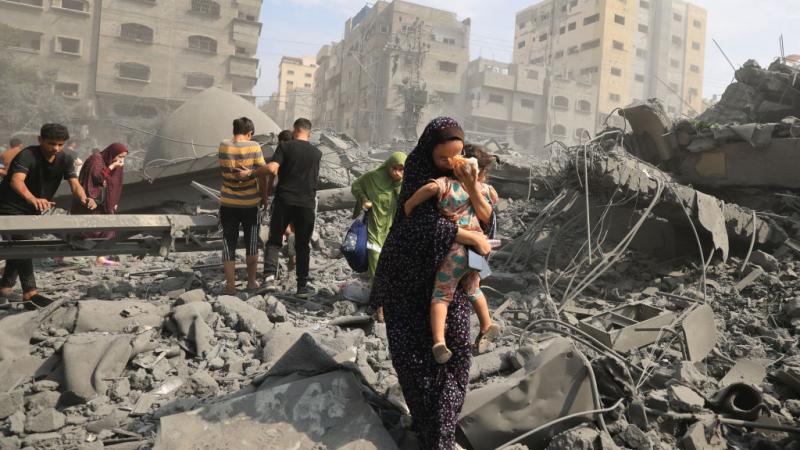
Hamas: Israeli minister’s boasting over Gaza’s destruction an open admission of genocide
Palestinian Information Center – January 17, 2026
GAZA – Hamas spokesperson Hazem Qassem said on Saturday that the Israeli war minister’s public boasting about the destruction of the Gaza Strip, and his congratulation to the soldiers for criminal acts, amounts to an explicit and unprecedented admission of genocide.
Qassem said the remarks, made in light of revelations by Western media about the scale of devastation in Gaza, constitute further proof of a level of contempt for international law and humanitarian norms unseen in modern history.
He added that what has unfolded in the Gaza Strip, genocide and ethnic cleansing, constitutes a full-fledged crime under international law, now accompanied by a clear and public confession from those responsible. This, he said, necessitates genuine accountability for the entire Israeli occupation system behind these crimes.
Israel launched a genocide in the Gaza Strip in October 2023 that continued for more than two years, resulting in the killing of more than 71,000 Palestinians and the wounding of over 171,000 others. The assault caused massive destruction to approximately 90 percent of Gaza’s civilian infrastructure, with the United Nations estimating reconstruction costs at around $70bn.
Featured Video

“Historic Russia”: The Land Putin Will Not Give Back
or go to
Aletho News Archives – Video-Images
From the Archive
How Ukraine Tortured and Slaughtered Donbass
By Kit Klarenberg | Al Mayadeen | July 11, 2024
Almost immediately after the proxy war erupted, ISIS-tier footage of the torture and murder of Russians in Ukrainian custody emerged.
On July 6th, the New York Times published an astonishing investigation: In Ukraine, Killings of Surrendering Russians Divide an American-Led Unit. The article documents in grim detail how Chosen Company, an international volunteer battalion for Kiev, routinely executes Russian prisoners of war. It is the very first mainstream admission that this practice – a brazen breach of the Geneva Conventions, and a grave war crime – is widespread among Ukraine’s fighters, both foreign and homegrown. … continue
Blog Roll
 Aletho News
- BRITAIN’S WARNING: PREPARE FOR WAR
- “Historic Russia”: The Land Putin Will Not Give Back
- How the Cambridge Analytica scandal still haunts Mark Zuckerberg
- The Ongoing Cancellation Campaign Against a Dissenting Academic in Norway
- Yemen and ‘the Houthis’: Challenging Sami Hamdi’s Narrative
- No, Christians did not invent Zionism
- AIPAC-led lobbying network opens branches in Cypriot, Greek parliaments
- Araghchi blasts ‘parasitic’ alliance as US taxpayers pay for Israel’s war on Iran
- Easy fix for Europe’s chaos? Stop fueling war against Russia
- Putin’s key remarks on peace talks and Europe’s ‘schizophrenia’
- If Americans Knew
- An error has occurred; the feed is probably down. Try again later.
- No Tricks Zone
- Two New Studies Find Thwaites Glacier Melt Cannot Be Driven By Human Activity Or A Warming Ocean
- E-Cars Reduce CO2 Emissions By Only 41% Compared To Internal Combustion Engine Vehicles
- Predictions Made By Renowned Climate Professor Over Past Decades Have Been Proven To Be Poor
- New Study Suggests Large Regions Of The Pacific Ocean Have Been Cooling For The Last 80 Years
- Germany’s Green Energy Debacle: High Energy Costs Force Kahla Porzellan to Close After 182 Years!
- New Study: 50 Years Of The Most Aggressive ‘Net Zero’ Policies Can Only Affect The Global Climate By 0.03°C
- US September “Heat” Was No Record…Many Records Set Decades Ago
- Latest European Green Energy Debacle; Portugal’s Largest Flagship Solar Park Insolvent!
- Green Energy Debacle: German Expert Professor Fritz Vahrenholt Warns Of Severe Economic And Social Consequences
- Two More Paleo Reconstructions Affirm Meters-Higher Sea Levels Across Ireland, Brazil 7000-6000 Years Ago

