MOSCOW – Ekaterina Blinova – 38 years ago, on October 6, 1976, Cubana Airlines Flight 455 was downed by terrorists, only now known to be CIA operatives; experts further claim it was not the only case when CIA was sponsoring terrorists.
“The US Government, being consistent with its stated commitment to fight terrorism, should act without double standards against those who, from US soil, have carried out terrorist acts against Cuba,” said Ambassador of the Republic of Cuba to Barbados Lisette Perez, as cited by the Barbados Advocate, during the ceremony of commemorating the victims at the Cubana Monument at Paynes Bay, Barbados.
The sudden explosion of two bombs onboard Cubana Flight 455, traveling between Havana and Panama, led to the plane’s crash, killing all 73 passengers and five crew members.
“For the past three months, Dr. Castro’s opponents in the US have waged a terrorist campaign in the Caribbean against those who break bread with the Cuban leader,” the Guardian wrote on October 8, 1976, reporting on the tragic accident. The media source noted that a previous attempt to place explosives on the plane was carried out in July, 1976, when a suitcase bomb exploded just before it was loaded onto the plane. In the same month the “office of a Trinidad airline was bombed in Barbados and a mysterious fire in Guyana destroyed a large quantity of Cuban-supplied fishing equipment,” the Guardian wrote.
According to the media outlet, the terror acts were presumably conducted by right-wing Cuban exiles and were aimed at states with political and economic ties with Cuba. Four suspects, Luis Posada Carriles, Orlando Bosch, Freddy Lugo and Hernan Ricardo Lozano were arrested. In August 1985, Bosch was acquitted because of the lack of evidence, while Posada fled from prison under mysterious circumstances on the eve of the announcement of his verdict. Both Luis Posada and Orlando Bosch later ended up in the US.
Remarkably, in May 2005 the National Security Archive, an independent non-profit organization at George Washington University, released declassified CIA and FBI documents, indicating Cuban exile Luis Posada was a former CIA agent and a mastermind of the terror attack on Cubana Airlines flight 455. It was also revealed Posada was linked to a series of bombing in Barbados in 1976. Additional CIA records confirmed Posada indeed served as an agent in the 1960s and early 1970s and worked as an informant until June 1976. Posada was on a payroll, “receiving approximately $300.00 per month from CIA,” according to the FBI’s Memorandum, written on July 14, 1966. In that period, Posada was involved in military activities directed against Fidel Castro. Particularly, under the guidance of the US intelligence services he organized a military base in the Dominican Republic, drawing in fighters from different anti-Castro organizations.
According to the declassified CIA report, dated June 21, 1976, the US intelligence service was informed by Posada, allegedly, that Orlando Bosch, the leader of extremist Cuban exile group was planning to place two bombs on a board of a Cubana Airlines Flight, traveling between Havana and Panama. The US security agency did not inform the authorities of Barbados, which in 1970s granted Cuba stopover rights for its passenger planes flying to Africa, nor did they warned Havana about the preplanned terrorist act.
Furthermore, in July of 1990, US President George H.W. Bush pardoned Orlando Bosch of all American charges and rejected an extradition request to those seeking to arrest Bosch for his terrorist activities. Interestingly enough, the Cuban terrorist was exempted from charges at the request of Jeb Bush, a Potential 2016 Republican Presidential Candidate. Washington had also refused to extradite Luis Posada to Venezuela, under the pretext that he could face torture and mistreatment there.
The National Security Archive cited Peter Kornbluh, the Director of the Archive’s Cuba Documentation Project, who warned in 2005 that Posada’s presence in the US “poses a direct challenge to the Bush administration’s terrorism policy.” Although Bush claimed that no nation should shelter terrorists, surprisingly, the White House provided asylum to the murderers responsible for terrorist crimes against peaceful civilians.
Experts assert that the policy is mutable when Washington and its intelligence services use their own terrorists in order to threaten and undermine “disagreeable regimes.” For instance, political analysts point to the fact that ISIL fighters were trained in NATO camps located in Jordan and Turkey. The assistance, provided by the US to the so-called “Syrian opposition,” was aimed to oust Syria’s President al-Assad. In fact the Islamic State “was actually an integrated part of the ‘opposition movement’ supported, trained and financed by the West and its regional allies,” notes Andre Vltchek, an investigative journalist. Former CIA analyst Kenneth M. Pollack confirms that the US was carrying out military training of anti-Assad rebels in Jordan and Turkey in his article “An Army to Defeat Assad,” published in August 2014 in Foreign Affairs magazine. Some experts insist that the IS plot is a pretext for a large-scale military operation against Syria and Bashar al-Assad.
In his speech before the meeting of the 69th session of the United Nations General Assembly on September 24, U.S. President Barack Obama resurrected yet another turn of phrase used most often by those wishing to make the case for dropping bombs on people and things.In an effort to justify U.S.-led airstrikes in Syria, Obama declared that the militant organization known as ISIS (or ISIL or IS, the ‘Islamic State’) not only commits the “most horrific crimes imaginable,” but is so vicious, violent, and uniquely brutal that it “forces [the international community] to look into the heart of darkness,” adding later:
No god condones this terror. No grievance justifies these actions. There can be no reasoning, no negotiation, with this brand of evil. The only language understood by killers like this is the language of force. So the United States of America will work with a broad coalition to dismantle this network of death.
The rhetoric used by Obama to defend yet anotherillegal and ill-conceived American air campaign in the Middle East – an undefined, unconstitutional operation designed to inevitably expand and escalate – is well-worn. The very same word salad, notably the “language of force” line, has been routinely served up to justify lethal action against a seemingly intractable foe and it puts the onus on the target of that aggression for bringing such violence upon itself: if they weren’t such barbarians, we too wouldn’t have to resort to barbarism.
So, bombs away. After all, military action was our only choice, we are told, despite the fact that the declared targets of our artillery pose no direct or imminent threat to the United States. The irrational and bloodthirsty comprehend only the heat-seeking and bunker-busting. Diplomacy is impossible, thus destruction is imperative.
One of the most noticeable and ubiquitous features of the language of counter-terrorism is its invariable appeal to identity: terrorists are endlessly demonised and vilified as being evil, barbaric and inhuman, while America and its coalition partners are described as heroic, decent and peaceful – the defenders of freedom.
“At its most basic level, the language used by officials is attempt to convince the public that a ‘war’ against all forms of terrorism is necessary, reasonable, inherently good and winnable,” he added.
Over the past few decades, whenever bombing Iraq is on the horizon, we’ve heard much of the same from government officials and their pro-war mouthpieces in the media and think tank establishment.
In late 1990, Martin Indyk, founder and executive director of the AIPAC-launched Washington Institute for Near East Policy (WINEP) and later senior advisor to presidents Bill Clinton and Barack Obama, wrote, “Saddam Hussein has demonstrated that he only speaks and understands the language of force.”
In 1991, Maine Representative Olympia Snowe supported the authorization of Operation Desert Storm due to her determination that successfully confronting Saddam Hussein required “a credible military threat be maintained against a brutal aggressor who only understands the language of force.”
Just days before Bill Clinton’s first inauguration as president in January 1993, the George H.W. Bush administration was again bombing Iraq. Utah Senator Orrin Hatch insisted, “Unfortunately, Saddam Hussein knows only the language of force. President Bush has delivered a message that Saddam is certain to understand,” adding, “The air strikes are not enough.”
In September 1996, when the Clinton administration itself was routinely bombing Iraq, Secretary of State Warren Christopher expressed his frustration with Russian condemnation of such attacks. He told the press he was “disappointed” the Russians “don’t understand as we do that the only language that Saddam understands is the language of force.” This became a go-to phrase in the administration’s talking points.
Speaking to members of the group “Seeds of Peace” on September 3, 1996, Christopher made arguments eerily reminiscent of what we’ve heard recently with regard to Obama’s current operation:
The record is, unfortunately, all too clear. Saddam has threatened and invaded his neighbors, developed and used weapons of mass destruction, sponsored countless acts of terrorism, and for the last two decades he has relentlessly persecuted the Kurds and the Shiites. When Saddam tests the will and resolve of the international community, our response must be and will be forceful and immediate.
Time and again we’ve seen that the United States leadership is essential to provide that response. Military action that the United States launched today has made it clear that Saddam will pay a price whenever he engages in aggression. We are answering in the only language he understands, the language of force.
Later that month, on September 12, 1996, former Secretary of State James Baker testified before the Senate Armed Services Committee and encouraged more military attacks, saying, “Iraq under Saddam Hussein only understands force. And more to the point, it seems only to understand overwhelming force. When we respond in a situation like this, I do not believe that it needs to be limited so as to be proportionate to the provocation.”
In their book about the 2003 invasion of Iraq and subsequent occupation, New York Times correspondent Michael R. Gordon and former Marine lieutenant general Bernard Trainor recount the words of a high-ranking officer of the U.S. Army’s Fourth Infantry Division sent to attack the city of Tikrit. “The only thing these sand niggers understand is force,” the officer remarked, “and I’m about to introduce them to it.” General Ray Odierno, who led the 4th ID’s attack, is currently the U.S. Army’s Chief of Staff.
The messaging is clear. As Richard Jackson notes, “In this most rudimentary sense, the language accompanying the ‘war on terrorism’ is a public relations or propaganda exercise; it is designed to ‘sell’ the policies of counter-terrorism.” In order to build support for military action, the public is repeatedly told that “the terrorists are inhuman barbarians who deserve to be eradicated from civilised society; the threat posed by terrorism is catastrophic and it is only rational to respond with all due force; and the American-led war against terrorism is by definition a good and just war.”
In a video message allegedly made and distributed on October 20, 2001, al-Qaeda leader Osama bin Laden declared, “Bush and Blair… don’t understand any language but the language of force. Every time they kill us, we kill them, so the balance of terror is achieved,” according to a declassified report released by British intelligence in November 2001.
Al-Qaeda leader Ayman Al-Zawahiri, in a 2003 sermon, reportedly announced, “The Crusaders [Americans] and the Jews only understand the language of force, and they only understand the return of coffins and destroyed interests and burned towers and destroyed economy.”
In a statement claiming responsibility for simultaneous suicide bombings that killed 155 people in Baghdad on October 25, 2009, an anti-occupation, al-Qaeda linked group known then as the Islamic State in Iraq explained, “Among the chosen targets were the ministry of oppression known as the Ministry of Justice and the Baghdad provincial assembly… The enemies only understand the language of force.”
Prior to the beheading of American journalist James Foley, on August 12, 2014, ISIS reportedly sent an email to Foley’s family announcing their intention to murder him in retaliation for U.S. airstrikes and delivering a wider message to the American government and people. Claiming to have provided “many chances to negotiate the release of your people via cash transactions” and “prisoner exchanges,” ISIS wrote that it was clear “this is NOT what you are interested in.”
The email went on: “You have no motivation to deal with the Muslims except with the language of force, a language you were given in ‘Arabic translation’ when you attempted to occupy the land of Iraq! Now you return to bomb the Muslims of Iraq once again, this time resorting to Arial [sic] attacks and ‘proxy armies’, all the while cowardly shying away from a face-to-face confrontation!”
“You do not spare our weak, elderly, women or children so we will NOT spare yours!” the email warned. “You and your citizens will pay the price of your bombings!”
In his speech before the United Nations last week justifying expanded airstrikes against ISIS, Obama thus recycled the very phrase used by ISIS to justify its own violence.
Still, the phrase has even older roots.
Zionism and Its Malcontents
In 1891, after one of his frequent travels through Palestine, Ahad Ha’am, the Ukrainian-born Jewish essayist known widely as the founder of cultural Zionism, lamented that Zionist settlers acted like “the only language the Arabs understand is that of force” and “behave towards the Arabs with hostility and cruelty, trespass unjustly upon their boundaries, beat them shamefully without reason and even brag about it, and nobody stands to check this contemptible and dangerous tendency.”
This linguistic articulation of Zionist sentiment was already so prevalent prior to the establishment of the State of Israel that renowned political theorist Hannah Arendt turned the phrase on its head in her 1948 essay, “Peace or Armistice in the Near East?,” published two years later in the Review of Politics. “All hopes to the contrary notwithstanding,” she wrote, as the Nakba raged on, “it seems as though the one argument the Arabs are incapable of understanding is force.”
In February 1992, following the assassination of Hezbollah leader Sheikh Abbas Moussawi, killed in southern Lebanon in an Israeli airstrike along with his wife and five-year-old son, Israeli Defense Minister Moshe Arens boasted, “We’ve learned that terror organizations like Hezbollah only understand one language – the language of force.”
Prior to Israeli parliamentary elections in 2009, supporters of the fascistic Avigdor Lieberman enthusiastically endorsed this narrative. “He’s the kind of leader we’ve been waiting for, he knows how to talk to Arabs in their own language, the language of force,” an Israeli woman who resides in a town close to the border with Gaza told the press.
Predictably, those opposed to Israel policies of colonialism, annexation, occupation, and military aggression have also resorted to such rhetoric. “Our enemy knows only the language of force and negotiations are useless,” Palestinian officials have longeddeclared. In 1998, a resident of the Jabaliya refugee camp in Gaza said this of Israeli leadership: “They only understand the language of force, not of peace.” A decade later, a Palestinian professor in Gaza said that same of Hamas.
From Stalin to Putin
While the “language of force” has long been used in the West to describe the supposed base nature and unsophisticated lack of humanity of the savage “Oriental” – a colonial, supremacist discourse popularized all the more after the attacks of September 11, 2001 – this discursive process has not been reserved for Arab or Muslim targets alone.
In his famous March 1946 “Iron Curtain Speech,” Winston Churchill expressed his conviction that, for Soviet Russia and its Communist satellites, “there is nothing for which they have less respect than for weakness, especially military weakness.” Thus, he reasoned, “Western Democracies” must “stand together” lest “they become divided or falter in their duty and if these all-important years are allowed to slip away then indeed catastrophe may overwhelm us all.”
68 years later, speaking at a Center for Strategic and International Studies forum in March 2014, New York Times columnist Roger Cohen paraphrased Churchill’s admonition, saying of Russian president Vladimir Putin that “the language he understands is force” and warning that, “unless there is a strong response, and a united response above all,” to Russian actions in Crimea and eastern Ukraine, “from the United States and Europe together to this, and a reassertion of the transatlantic alliance and NATO, then we could be heading in a very worrying direction.”
In May 2014, prior to his election as new Ukrainian president, billionaire confectionery magnate Petro Poroshenko stated that, in order to deal with pro-Russian separatists — whom he called “terrorists” — “we should find out the right language they understand, and that would be the language of force.”
Vietnam
On April 19, 1965, as American bombs fell in Vietnam, conservative columnist Russell Kirk wrote, “Like the Nazis, the Asiatic Communists prefer guns to butter,” and accused North Vietnamese leader Ho Chi Minh of aggressive “conquest”:
At this stage of affairs, only effective military resistance and retaliation can dissuade Ho Chi Minh from pursuing the war with increased vigor. The language of force, indeed, Communists understand.
General William C. Westmoreland, commander of U.S. forces in Vietnam at the time of the My Lai Massacre, and soon-to-be Army Chief of Staff, often and openly maintained that “meaningful force” was “the only language they [the North Vietnamese] understood.”
As late as March 1975, after nearly all American troops had been withdrawn from the conflict, and following a meeting with President Gerald Ford, the then-retired Westmoreland told journalists that “the culprit in this whole thing is Hanoi,” adding, “The only language Hanoi understands is the language of force and I think it’s too bad that we couldn’t again mine Haiphong harbor and that the President doesn’t have authority to use tactical air and B52 strikes to hit the Communist supply lines.”
Six weeks later, Saigon fell to the North Vietnamese Army.
Nicaragua
On the floor of the United States Congress on February 4, 1988, long-serving South Carolina Senator Ernest Hollings advocated for increased military aid sent to the Contras in Nicaragua. Denouncing Congressional Democrats as “not committed to fight for anything” and “only willing to posture and talk,” Hollings declared that “there is no hope in Nicaragua without aid to the Contras.” Dismissing diplomacy, he bellowed, “Peace plans? The Marxists only understand the language of force.”
Later that year, in August 1988, Nicaraguan Contra founder and commander Enrique Bermúdez also made the case for continued military support from the U.S. government. “The only language the Sandinistas understand or respect is the language of force,” he insisted. “If the Sandinistas weren’t receiving massive assistance from the Soviet Union, Cuba and other communist countries, the Nicaraguan people wouldn’t have any need of foreign sources of support.”
Repeated Rhetoric
The ubiquity of the “language of force” line has rendered the phrase effectively meaningless, levied at one’s enemies in order to silence debate and promote military action.
The same rhetoric is used by tyrants as well to describe dissident, resistance, and revolutionary movements. For instance, in early February 2011, as Cairo’s Tahrir Square swelled with increasing demands for Egyptian dictator Hosni Mubarak’s resignation, a CNN report noted that the U.S.-backed leader had long “argued that Egypt had to adopt a tight security policy to combat terrorism; that the forces of political Islam do not understand anything but the language of force and a strong government grip.”
A year ago, in a September 20, 2013 article, David Sanger of the New York Times credited Obama’s economic warfare on Iran and threats of military action in Syria with restarting nuclear negotiations and, with the help of Russia, dismantling Assad’s chemical weapons. With regard to “President Bashar al-Assad of Syria, President Vladimir V. Putin of Russia, and Iran’s erratic mullahs,” Sanger wrote, Obama was experiencing “the long-delayed fruits of the administration’s selective use of coercion in a part of the world where that is understood.”
Speaking before the United Nations General Assembly two weeks later, Israeli Prime Minister Benjamin Netanyahu said that, “when it comes to Iran, the greater the pressure, the greater the chance” of successfully denying the nation their inalienable right to a domestic nuclear energy program.
For years, however, Iranian officials from three successive presidential administrations have consistently pushed back against this offensive presumption.
Back in June 2003, as U.S.-led pressure over Iran’s nuclear program increased, Iranian Foreign Ministry spokesman Hamid Reza Asefi warned that unjust accusations and illegal threats would strengthen the resolve of conservative elements in the government opposed to diplomacy with the West. “Excessive pressure on Iran would untie the hands of those who do not believe in dialogue,” he said, “Even those who favour constructive talks would not accept the language of force and threat.”
Two years later, as dubious allegations, wild predictions, and threats of unprovoked attack mounted, Iranian President Mahmoud Ahmadinejad addressed the nuclear issue in his first speech before the UN General Assembly on September 17, 2005. Western powers and Israel, he said,
have misrepresented Iran’s healthy and fully safeguarded technological endeavors in the nuclear field as pursuit of nuclear weapons. This is nothing but a propaganda ploy. The Islamic Republic of Iran is presenting in good faith its proposal for constructive interaction and a just dialogue. However, if some try to impose their will on the Iranian people through resort to a language of force and threat with Iran, we will reconsider our entire approach to the nuclear issue.
The next year, leading Iranian cleric Ahmad Khatami, a senior member of the Assembly of Experts, noted in a nationally broadcast weekly sermon, “Iran is favourable toward negotiations that are just, logical and without preconditions, but refuses the language of force,” adding, “Using the language of force with Iran is a foolish and clumsy attitude.”
“Resolutions, sanctions and threats have always made the issue more complicated,” Iran’s IAEA envoy Ali-Asghar Soltanieh said in late 2009 before a Board of Governor’s vote on a resolution focusing on the recently-announced uranium enrichment facility at Fordow. “We recommend the IAEA not to refer to such methods and use the language of logic rather than force.”
Throughout 2012, Ahmadinejad reaffirmed his assertion that Iran would never buckle to the West’s “language of force and insult.”
Earlier this year, following a round of nuclear negotiations in Vienna, Iranian Foreign Minister Mohammad Javad Zarif remarked that “the language of force has no place in foreign policy agendas” and that “any state using the ‘all-options-on-the-table’ rhetoric is actually taking outdated measures.”
In late 2009, then IAEA chief and Nobel Peace Prize laureate Mohamed ElBaradei concurred with this message. “[U]sing the language of force is not helpful. It leads to confrontation, to the other country taking counteraction,” he said in an interview with The Hindu. “It is better to forget the language of coercion and focus on trying to engage in dialogue.”
The Force of Language
Barack Obama, the drone president who defended perpetual war while receiving his own Nobel prize, disagrees. In his UN speech, Obama has again joined the ranks of those who justify the use of force through the abuse of weaponized language. The appeal to an adversary’s unprecedented “brand of evil” serves not to illuminate the challenges faced, but rather to obfuscate an informed comprehension of current affairs. It is the ultimate conversation-stopper.
… the language of good and evil suppresses questions: we don’t need to ask what the motivations or aims of the terrorists were if they are ‘evil,’ as ‘evil’ is its own motivation and its own self-contained explanation. Evil people do not have any politics and there is no need to examine their causes or grievances. Evil people do what they do simply because they are evil. Clearly, the use of this language is a way of encouraging quiescence and displacing more complex understandings of political and social events. As such, it qualifies as demagoguery by appealing to ignorance and arrogance through a distorted representation of the nature of evil.
As the United States and its coalition partners embark once again on an ill-fated, military misadventure in the Middle East, the recycled language used to promote such policies is predictable. And this time around, as in the past, it’s effectiveness is proven.
A FoxNewspoll released this week shows that upwards of 78% of Americans approve of U.S. airstrikes against ISIS in Iraq and Syria, while 55% believe such action is “not aggressive enough.” Additionally, 57% of respondents are supportive of a ground operation if the bombing campaign proves ineffective or indecisive. A Washington Post/ABC News poll this week produced similar results.
Yet, beyond all the political rhetoric and domestic jingoism, for those on the ground in Iraq and Syria, including the dozens of civilians already killed in U.S. airstrikes against ISIS, bombs drop louder than words.
As Jewish congregations around the world gathered this past week to celebrate Rosh Hashanah, the Jewish New Year, the members of one synagogue, located near Atlanta, Georgia were subjected to a diatribe against Muslims and a call for a ‘Holy War’ to ‘exterminate the savages’.
This is not the first time that Rabbi Shalom Lewis of Congregation Etz Chaim in Marietta, Georgia has given a sermon demonizing Islam. Three years ago, also on Rosh Hashanah, he gave a similar talk comparing Muslims to Nazis and warning of the coming wave of Islam that would end up wiping out Jews and Christians, and calling for a war against Islam.
This year’s speech is filled with racist platitudes, demonizing the religion of Islam, and calling for a new World War against Islam.
At one point, Rabbi Lewis says of Muslims, “We are dealing with a moral species that eats its own, kills it’s young and celebrates innocent death as homage to God.”
He says of Muslim residents of Europe, “There is a cold darkness settling on Europe. A nihilism. A corruption. A perversion in the name of Allah. A Kristallnacht of European and Western culture is coming that will destroy a millennia of creative genius.”
He ends his speech with a call to action: “These Islamist criminals are unlike us in the most basic of ways and we have yet to accept and understand their total immersion in moral debauchery.
“The enemy has eyes and ears. Fingers and toes. Speaks with lips. Runs with legs. Eats. Drinks. Has the face of a human being – but, has a much different heart and a much different soul. Three years ago on this bima, on this very same day, standing at this podium, I cried out, ‘Ehr Kumpt – they are coming.’ 3 years later on this bima, on this very same day, standing at this podium, I cry out not ‘Ehr Kumpt – they are coming,’ I cry out, ‘Ehr daw – they are here.’ The fury of ultimate evil is upon us and we must act – not to contain it. Not to degrade it. Not to manage it. Not to tolerate it, but to exterminate it utterly and absolutely.”
According to Adam Horowitz, “It’s as hateful as any you would expect from any fringe religious demagogue. Except Lewis isn’t a fringe figure. As the website Loonwatch points out, Lewis was given commendations by the Georgia legislature and the US House of Representatives. He has been at Etz Chaim for nearly 40 years. In fact when he recently announced his retirement in 2017, congregation President Cheryl Miller said, ‘Rabbi Lewis will continue to be an active participant in the leadership of our congregation, a wealth of information and resources, a trusted friend, and a role model to our future clergy.’ This man who has called for the annihilation of millions of people is apparently a beloved figure.”
A Swiss national working for the International Committee of the Red Cross (ICRC) was killed in Donetsk on Thursday as fighting continues between the Ukrainian military and pro-Russian separatist rebels.
Laurent DuPasqiue, 38, had been working with the Red Cross in Ukraine for six weeks before being killed by mortar fire. The aid organization said it has about 20 staff members working in Donetsk.
“We are deeply shocked by this tragic loss,” said ICRC Director of Operations Dominik Stillhart. “We understand that there were other civilian casualties in Donetsk today. Indiscriminate shelling of residential areas is unacceptable and violates international humanitarian law.”
Moscow accused Kiev of responsibility for the bombing of the local Red Cross office which killed the aid worker, located about 2 miles from the Donetsk airport where fighting rages on despite a cease-fire signed September 5.
“Kiev is unwilling to admit an evident thing: that district of Donetsk was controlled by the self-defense forces and was shelled from positions held by Ukrainian troops,” the Russian Foreign Ministry said in a statement. “We categorically condemn such actions that are a blatant violation of the international humanitarian law. We insist on an unbiased and thorough investigation into the killing of the ICRC worker and on bringing those guilty to justice.”
Ukrainian Foreign Minister Pavel Klimkin denied responsibility for the shelling, blaming instead local separatist rebels.
In an interview published Friday, IDF Chief of Staff Benny Gantz addressed the prospect of a future war with Hezbollah by threatening to “take Lebanon and knock it back 70 or 80 years, in all areas.”
Discussing how the next war would play out, Gantz also stated that it was possible the Israeli army would “need to capture Lebanese territory.”
In a separate interview also published today, Gantz claimed Hezbollah leader Hasan Nasrallah understands that Israel “know[s] to do in Lebanon what we did in Gaza”.
The Bedouin Jahalin Tribe had a historic existence roaming the expansive lands in the Naqab Desert which ended abruptly when the State of Israel was declared. Most joined the thousands of Palestinians fleeing, and the group was splintered and scattered.
Many of the Jahalin continued to herd their livestock between Ramallah, Wadi Qelt and Jerusalem until large swathes of land were confiscated to make way for mushrooming Israeli settlements following the beginning of the occupation of the West Bank. Some squeezed into the area off the Jerusalem-Jericho highway, which, after the Oslo Accords fell under complete Israeli military and administrative control. In order to expand the vast Ma’ale Adumim settlement, Israel razed some of the homes and packed their inhabitants away on trucks to live in containers beside a rubbish dump. The separation wall was then built severing the remaining community from East Jerusalem, the main market where they sold the milk and cheese made from their remaining livestock.
The semi-nomadic lifestyle of the Bedouin, hinged on land and livestock, has been continuously chipped away by Israel’s policy of demolitions and displacements. Now, sixty years after the Jahalin were first made refugees, they face being uprooted again as Israel advances plans to “relocate” 12,500 Bedouins from where they reside in the Jerusalem periphery. The plan is reminiscent of the Prawer Plan, the bill approved by the Israeli Knesset in 2011 to relocate some 40,000 Bedouin-Palestinian citizens of Israel from ‘unrecognised villages‘ into townships which was eventually frozen following mass protests within Israel.
This time the Israeli administration has said they won’t put the Jahalin on trucks as they did during the mass eviction in 1997, but they will take immediate action to demolish their residences and agricultural buildings, “because there is an alternative here”. The alternative referred to is a purpose built township north of the West Bank city of Jericho, where they will be lumped with two other tribes- against Bedouin customs- each family allotted a housing plot and a small area unsuitable for the rearing of livestock. A total of 23 communities will be herded into the area.
Jameel Hamadin, a Bedouin facing eviction said: “These areas do not suit our lifestyle or our traditions or our culture.” He added in his address to the European Union: “If they deport us to the city, our lifestyle will end.” The communities previously evicted were housed in Al- Jabal village on expropriated Palestinian land. The United National Committee of Economic Social and Cultural Rights “deplored the manner” those relocated were “housed in steel container vans in a garbage dump in Abu Dis in Subhuman conditions”. Their traditional lifestyle was destroyed by the move.
Israel has justified its expulsion plan through the rhetoric of improving Bedouin living conditions by allowing them to live in places with “suitable infrastructure” and as an appropriate response to the “dynamic changes” that Bedouin society is undergoing as it moves from an agricultural society “to a modern society that earns its living by commerce, services, technical trade and more”.
For the Bedouin, who claim they were not consulted about the plans, this is just another attempt to remove them from strategic land, one that they fear will destroy their traditional way of life for good. Abu Suleiman, head of the Jerusalem Bedouins’ Community Cooperative, asks “why do they not let us build here if they want to improve our living conditions”.
Residing in tin shack like structures perched on the unforgiving hillside terrain; many overlook the continuous construction in Ma’ale Adumim settlement. The homes in the settlement have running water, power, their occupants have access to medical services and top notch schools for their children. In contrast Israel does not allow the Bedouin community to gain access to running water and electricity, and prevents the building of permanent structures and even the tin shacks, which are no match for Israeli bulldozers, stand with the daily threat of demolition.
Under the contentious E1 plan the area of land that the Bedouin currently call home is to be turned into an urban block connecting Ma’ale Adumin and Jerusalem. The plan will divide the West Bank into two and in the process render the chances of a viable Palestinian state dead, and with it the future of a two state solution.
United Nations Relief and Works Agency has urged the plan to be halted, with Pierre Krähenbühl, Commissioner General of UNRWA stating it: “gives rise to concerns that it amounts to a ‘forcible transfer’ in contravention of the Fourth Geneva Convention.” He added: “The humanitarian impact of the planned transfer could be immense”.
This process is already in motion. According to analysis by the Association of International Development Agencies of data compiled by the United Nations Office for the Coordination of Humanitarian Affairs, the number of demolitions in the first eight months of 2014 was higher than in any comparable period in the last five years, as was the number of people who lost their homes as a result.
The Bedouin have a hard fight to remain on their land, a fight that has lasted decades long. For the traditional rural communities this is the next step in Israel’s long history of policies targeting their existence.
The Ir David Foundation, known as Elad, has published an announcement on social media networks in search of Jewish settlers to live in Palestinian homes that it has captured in the town of Silwan, occupied East Jerusalem, in return for a financial reward estimated at 500 shekels ($136) per day, Israel’s Haaretz newspaper reported on Wednesday.
Elad is known for its Judaisation projects of the city of Jerusalem. According to the association’s advertisement, an amount of 500 shekels will be given to each settler who agrees to live in one of the homes that have been seized, with the settler only required to “keep his gun loaded and ready to fire at any time”, according to the declaration.
Haaretz quoted one of the advertisements as follows: “We are looking for people who can stay in the apartments and watch them until families move into them. The work will probably take ten to 30 days (perhaps even more). The daily wage is 500 shekels gross. The workers will stay in the apartments and guard them until they are inhabited by families. Only suitable applicants will be accepted. Please pass this on to friends.”
The following day, the newspaper reported that when asked about the details on what the job entails, an Elad official said: “You’re not the security guard … There are security guards and police when needed, and there’s someone to supervise you and call to make sure everything is all right all the time. We don’t need you as a security guard. As far as we’re concerned, you live in the house, but it’s better if you have a weapon.”
The official also stressed that Elad would be the employer. “I think the payment would be by bank transfer,” she said. “You come and fill out forms.”
With the assistance of armed guards, the Foundation seized, overnight on Monday, ten individual buildings that include 23 apartments in the Wadi Hilweh neighbourhood of Silwan, located just south of Al-Aqsa Mosque, claiming that the settlers now own them.
Silwan has been witnessing continuous and tense confrontations with Israeli occupation forces ever since the seizure of the Palestinian homes, with Israeli police and armed forces present in the streets around the clock to protect the settlers.
At least 11 people have been killed and 40 others have been injured in Donetsk, where a school and a bus stop came under fire – reportedly from Ukrainian Army positions.
Two people are reported to have died at the school, and nine at the bus stop, according to Donetsk People Republic’s Deputy Prime Minister Andrey Purgin.
No children were killed in the shelling of school №57, the Donetsk People’s Republic ‘s Interior Ministry said, as cited by TASS. The ministry’s press service added that parents and teachers became victims of the shelling.
The city council stated that all 70 children studying at the school were in the building at the moment of the strike. They were hastily evacuated. The school building was damaged in the attack.
The Russian Foreign Ministry describes the attack as a cynical and blatant breach of international law.
“The particular cynicism of this shelling is the very fact that today was the children’s first day at school. And on this day, artillery directly targets them. These are blatant, intolerable things,” the ministry’s human rights ombudsman Konstantin Dolgov said.
No Ukrainian sources have confirmed the information yet.
“Heavy artillery fire is being heard in Donetsk. The Kievsky district has been under fire – many residential areas and other buildings have been damaged, civilians have been killed and wounded,” the city council said in a statement.
Public transport has been changing routes due to the shelling.
One hundred and forty-six schools in the self-proclaimed Donetsk People’s Republic had commenced classes out of 150, Minister of Education of Donetsk People’s Republic Igor Kostenok said.
A ceasefire between the Ukrainian government and the Donetsk and Lugansk People’s Republics’ authorities was signed in Minsk, Belarus, on September 5.
A top UN rights expert has expressed alarm at the impact of Israel’s attack on Gaza for civilians, concluding that “Israel’s claim of self-defense against an occupied population living under a blockade considered to be illegal under international law is untenable.”
Makarim Wibisono, Special Rapporteur on the situation of human rights in the Palestinian territories occupied since 1967, spoke Monday at the end of his first mission to the region.
In a press release, Wibisono stated that the Israeli military killed almost 1,500 civilians, including more than 500 children, with “a staggering 11,231 Palestinian civilians, including 3,436 children” injured and many “now struggling with life-long disabilities”.
Tens of thousands of children live with the trauma of having witnessed the horrific killings of family members, friends, and neighbours before their own eyes.
Wibisono, echoing similar and even stronger conclusions by the likes of Amnesty International and the International Committee of the Red Cross, said that “this raises serious questions about possible violations of international humanitarian law and human rights law.”
Wibisono related three demands from Palestinians: “the need for accountability, an end to the blockade, and an end to the occupation”. Affirming this call, the UN official said that “those responsible for violations of international law must be brought to justice in order to avoid yet another round of deadly violence in the near future”.
The Special Rapporteur had a special focus on children in Gaza, noting that “there wasn’t a single child…who has not been adversely affected”. Wibisono pointed to an estimated 7,000 unexploded ordinances “littered across” the territory, and described how over “50 days of relentless bombing and shelling”, some 228 schools were damaged, including 26 destroyed or damaged beyond repair.
According to Wibisono, around 60,000 Palestinians remain in 19 shelters in the Gaza Strip, while medical professionals report a “critical shortage” of medicines and equipment. “Israel must immediately lift the seven year land, sea and air blockade of Gaza”, Wibisono urged, “and urgently allow needed materials for reconstruction and recovery.”
The Special Rapporteur also spoke to the “excessive use of force” used by Israeli forces in the Occupied West Bank over the summer, “noting that during the period from 12 June to 31 August 2014, a total of 27 Palestinians were killed, of whom five were children, with the youngest victim only 11 years-old.” Wibisono stressed that “the use of live ammunition against Palestinians even if they were throwing stones, is unjustifiable.”
The Special Rapporteur will report fully on his findings and recommendations to the 28th session of the Human Rights Council in March 2015.
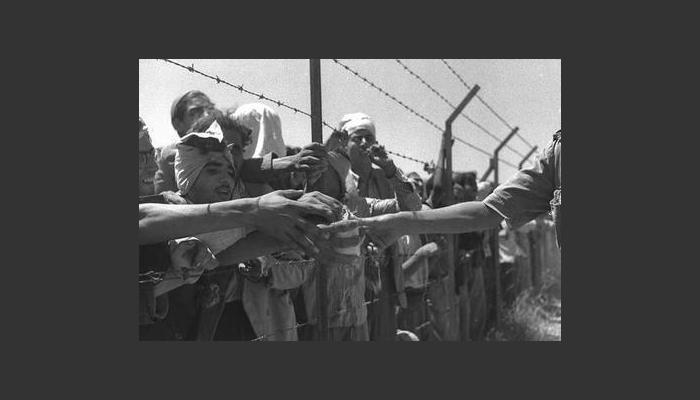
Much of the grim and murky circumstances of the Zionist ethnic cleansing of Palestinians in the late 1940s have gradually been exposed over time. One aspect – rarely researched or deeply discussed – is the internment of thousands of Palestinian civilians within at least 22 Zionist-run concentration and labor camps that existed from 1948 to 1955. Now more is known about the contours of this historical crime, due to the comprehensive research by renowned Palestinian historian Salman Abu Sitta and founding member of the Palestinian resource center BADIL Terry Rempel.
The facts are these.
The study – to be published in the upcoming issue of the Journal of Palestine Studies – relies on almost 500 pages of International Committee of the Red Cross’s (ICRC) reports written during the 1948 war, that were declassified and made available to the public in 1996, and accidentally discovered by one of the authors in 1999.
Furthermore, testimonies of 22 former Palestinian civilian detainees of these camps were collected by the authors, through interviews they conducted themselves in 2002, or documented by others during different moments of time.
With these sources of information, the authors, as they put it, pieced together a clearer story of how Israel captured and imprisoned “thousands of Palestinian civilians as forced laborers,” and exploited them “to support its war-time economy.”
Digging up the crimes
“I came across this piece of history in the 1990s when I was collecting material and documents about Palestinians,” Abu Sitta told Al-Akhbar English. “The more and more you dig, the more you find there are crimes that have taken place that are not reported and not known.”
At that time, Abu Sitta went to Geneva for a week to check out the newly-opened archives of the ICRC. According to him, the archives were opened to the public after accusations that the ICRC had sided with the Nazis during World War II. It was an opportunity that he could not miss in terms of seeing what the ICRC had recorded of the events that occurred in Palestine in 1948. It was there he stumbled onto records discussing the existence of five concentration camps run by the Israelis.
He then decided to look for witnesses or former detainees, interviewing Palestinians in occupied Palestine, Syria, and Jordan.
“They all described the same story, and their real experience in these camps,” he said.
One question that immediately struck him was why there were barely any references in history about these camps, especially when it became clearer the more he researched that they existed, and were more than just five camps.
“Many former Palestinian detainees saw the concept of Israel as a vicious enemy, so they thought their experience labouring in these concentration camps was nothing in comparison to the other larger tragedy of the Nakba. The Nakba overshadowed everything,” Abu Sitta explained.“However, when I dug into the period of 1948-1955, I found more references like Mohammed Nimr al-Khatib, who was an imam in Haifa, who had written down interviews with someone from al-Yahya family that was in one of the camps. I was able to trace this man all the way to California and spoke with him in 2002,” he added.
More references were eventually and slowly discovered by Abu Sitta that included information from a Jewish woman called Janoud, a single masters thesis in Hebrew University about the topic, and the personal accounts of economist Yusif Sayigh, helped to further flesh out the scale and nature of these camps.
After more than a decade, Abu Sitta, with his co-author Rempel, are finally presenting their findings to the public.
From burden to opportunity: concentration and labor camps
The establishment of concentration and labor camps occurred after the unilateral declaration of Israel’s statehood on May 1948.
Prior to that event, the number of Palestinian captives in Zionist hands were quite low, because, as the study states, “the Zionist leadership concluded early on that forcible expulsion of the civilian population was the only way to establish a Jewish state in Palestine with a large enough Jewish majority to be ‘viable’.” In other words, for the Zionist strategists, prisoners were a burden in the beginning phases of the ethnic cleansing.
Those calculations changed with the declaration of the Israeli state and the involvement of the armies of Egypt, Syria, Iraq, and Transjordan, after much of the ethnic cleansing had occurred. From that moment, “the Israeli forces began taking prisoners, both regular Arab soldiers (for eventual exchange), and – selectively – able-bodied Palestinian non-combatant civilians.”
The first camp at Ijlil, which was about 13 km northeast of Jaffa, on the site of the destroyed Palestinian village Ijlil al-Qibiliyya, emptied of its inhabitants in early April. Ijlil was predominately made up of tents, housing hundreds and hundreds of prisoners, categorized as POWs by the Israelis, surrounded by barbed wire fences, watchtowers, and a gate with guards.
As the Israeli conquests grew, in turn exceedingly increasing the number of prisoners, three more camps were established. These are the four “official” camps that the Israelis acknowledged and were actively visited by the ICRC.
The study notes:
All four camps were either on or adjacent to military installations set up by the British during the Mandate. These had been used during World War II for the interment of German, Italian, and other POWs. Two of the camps – Atlit, established in July about 20 kms south of Haifa, and Sarafand, established in September near the depopulated village of Sarafand al-Amar in central Palestine—had earlier been used in the 1930s and 1940s to detain illegal Jewish immigrants.
Atlit was the second largest camp after Ijlil, it had the capacity of holding up to 2,900 prisoners, while Sarafand had the maximum capacity of 1,800, and Tel Letwinksy, near Tel Aviv, held more than 1,000.
All four camps were administered by “former British officers who had defected their ranks when British forces withdrew from Palestine in mid-May 1948,” and the camp’s guards and administrative staff were former members of the Irgun and the Stern Gang – both groups designated as terrorist organizations by the British before their departure. In total, the four “official” camps were staffed by 973 soldiers.
A fifth camp, called Umm Khalid, was established at a site of another depopulated village near the Zionist settlement of Netanya, and was even assigned an official number in the records, but never attained “official” status. It had the capacity to hold 1,500 prisoners. Unlike the other four camps, Umm Khalid would be “the fist camp established exclusively as a labor camp” and was “the first of the “recognized” camps to be shut down… by the end of 1948.”
Complementing these five “recognized” camps, were at least 17 other “unrecognized camps” that were not mentioned in official sources, but the authors discovered through multiple prisoner testimonies.
“Many of [these camps],” the authors noted, “[were] apparently improvised or ad hoc, often consisting of no more than a police station, a school, or the house of a village notable,” with holding capacities that ranged from almost 200 prisoners to tens.
Most of the camps, official and unofficial, were situated within the borders of the UN-proposed Jewish state, “although at least four [unofficial camps] – Beersheba, Julis, Bayt Daras, and Bayt Nabala – were in the UN-assigned Arab state and one was inside the Jerusalem “corpus separatum.”
The number of Palestinian non-combatant detainees “far exceeded” those of Arab soldiers in regular armies or bona fide POWs. Citing a July 1948 monthly report made by ICRC mission head Jacques de Reynier, the study states that de Reynier noted, “that the situation of civilian internees was ‘absolutely confused’ with that of POWs, and that the Jewish authorities ‘treated all Arabs between the ages of 16 and 55 as combatants and locked them up as prisoners of war.’” In addition, the ICRC found among the detainees in official camps, that 90 of the prisoners were elderly men, and 77 were boys, aged 15 years or younger. The study highlights the statements by an ICRC delegate Emile Moeri in January 1949 of the camp inmates:
It is painful to see these poor people, especially old, who were snatched from their villages and put without reason in a camp, obliged to pass the winter under wet tents, away from their families; those who could not survive these conditions died. Little children (10-12 years) are equally found under these conditions. Similarly sick people, some with tuberculosis, languish in these camps under conditions which, while fine for healthy individuals, will certainly lead to their death if we do not find a solution to this problem. For a long time we have demanded that the Jewish authorities release those civilians who are sick and need treatment to the care of their families or to an Arab hospital, but we have not received a response.
As the report noted, “there are no precise figures on the total number of Palestinian civilians held by Israel during the 1948-49 war” and estimates tend to not account for “unofficial” camps, in addition to the frequent movement of prisoners between the camps in use. In the four “official” camps, the number of Palestinian prisoners never exceeded 5,000 according to figures in Israeli records.
Taking account of the capacity of Umm Khalid, and estimates of the “unofficial camps,” the final number of Palestinian prisoners could be around the 7,000 range, and perhaps much more when, as the study states, taking into account a November 17, 1948 diary entry by David Ben-Gurion, one of the main Zionist leaders and Israel’s first prime minister, who mentioned “the existence of 9,000 POWs in Israeli-run camps.”
In general, the living conditions in the “official” camps were far below what would be considered appropriate by international law at that time. Moeri, who visited the camps constantly, reported that in Ijlil in November 1948:
“[m]any [of the] tents are torn, that the camp was “not ready for winter,” the latrines not covered, and the canteen not working for two weeks. Referring to an apparently ongoing situation, he stated that “the fruits are still defective, the meat is of poor quality, [and] the vegetables are in short supply.”
Furthermore, Moeri reported that he saw for himself, “the wounds left by the abuse” of the previous week, when the guards had fired on the prisoners, wounding one, and had beaten another.”
As the study shows, the civilian status of the majority of the detainees were clear for the ICRC delegates in the country, who reported that the men captured “had undoubtedly never been in a regular army.” Detainees who were combatants, the study explains, were “routinely shot on the pretense that they had been attempting to escape.”
The Israeli forces seemed to always target able-bodied men, leaving behind women, children, and the elderly – when not massacring them – the policy continued even after there were low levels of military confrontation. All in all, as the Israeli records show and the study cites, “Palestinian civilians comprised the vast majority (82 percent) of the 5,950 listed as internees in the POW camps, while the Palestinians alone (civilian plus military) comprised 85 percent.”
The wide-scale kidnapping and imprisonment of Palestinian civilians tend to correspond with the Israeli military campaigns. For example, one of the first major roundups occurred during Operation Danj, when 60-70,000 Palestinians were expelled from the central towns of Lydda and Ramleh. At the same time, between a fifth and a quarter of the male population from these two towns who were over the age of 15 were sent to the camps.
The largest round-up of civilians came from villages of central Galilee who were captured during Operation Hiram in the fall of 1948.
One Palestinian survivor, Moussa, described to the authors what he witnessed at the time.
“They took us from all villages around us: al-Bi’na, Deir al-Asad, Nahaf, al-Rama, and Eilabun. They took 4 young men and shot them dead… They drove us on foot. It was hot. We were not allowed to drink. They took us to [the Palestinian Druze village] al-Maghar, then [to the Jewish settlement] Nahalal, then to Atlit.”
A November 16, 1948 UN report collaborated Moussa’s account, stating that some 500 Palestinian men “were taken by force march and vehicle to a Jewish concentration camp at Nahlal.”
Maintaining Israel’s economy with “slave labor”
The policy of targeting civilians, particular “able-bodied” men, was not accidental according to the study. It states, “with tens of thousands of Jewish men and women called up for military service, Palestinian civilian internees constituted an important supplement to the Jewish civilian labor employed under emergency legislation in maintaining the Israeli economy,” which even the ICRC delegation had noted in their reports.
The prisoners were forced to do public and military work, such as draining wetlands, working as servants, collecting and transporting looted refugee property, moving stones from demolished Palestinian homes, paving roads, digging military trenches, burying the dead, and much more. As one former Palestinian detainee named Habib Mohammed Ali Jarada described in the study, “At gunpoint, I was made to work all day. At night, we slept in tents. In winter, water was seeping below our bedding, which was dry leaves, cartons and wooden pieces.”
Another prisoner in Umm Khalied, Marwan Iqab al-Yehiya said in an interview with the authors, “We had to cut and carry stones all day [in a quarry]. Our daily food was only one potato in the morning and half dried fish at night. They beat anyone who disobeyed orders.” This labor was interspersed with acts of humiliation by the Israeli guards, with Yehiya speaking of prisoners being “lined up and ordered to strip naked as a punishment for the escape of two prisoners at night.”
“[Jewish] Adults and children came from nearby kibbutz to watch us line up naked and laugh. To us this was most degrading,” he added.
Abuses by the Israeli guards were systematic and rife in the camps, the brunt of which was directed toward villagers, farmers, and lower class Palestinians. This was so, the study said, because educated prisoners “knew their rights and had the confidence to argue with and stand up to their captors.”
What is also interestingly noted by the study is how ideological affiliations between prisoners and their guards, had another effect in terms of the relationship between them. The study, cites the testimony of Kamal Ghattas, who was captured during the Israeli attack in the Galilee, who said:
We had a fight with our jailers. Four hundred of us confronted 100 soldiers. They brought reinforcements. Three of my friends and I were taken to a cell. They threatened to shoot us. All night we sang the Communist Anthem. They took the four of us to Umm Khaled camp. The Israelis were afraid of their image in Europe. Our contact with our Central Committee and Mapam [Socialist Israeli party] saved us .… I met a Russian officer and told him they took us from our homes although we were non-combatants which was against the Geneva Conventions. When he knew I was a Communist he embraced me and said, “Comrade, I have two brothers in the Red Army. Long live Stalin. Long Live Mother Russia”.
Yet, the less fortunate Palestinians faced acts of violence which included arbitrary executions and torture, with no recourse. The executions were always defended as stopping “escape attempts” – real or claimed by the guards.
It became so common that one former Palestinian detainee of Tel Litwinsky, Tewfic Ahmed Jum’a Ghanim recounted, “Anyone who refused to work was shot. They said [the person] tried to escape. Those of us who thought [we] were going to be killed walked backward facing the guards.”
Ultimately, by the end of 1949, Palestinian prisoners were gradually released after heavy lobbying by the ICRC, and other organizations, but was limited in scale and very focused to specific cases. Prisoners of Arab armies were released in prisoner exchanges, but Palestinian prisoners were unilaterally expelled across the armistice line without any food, supplies, or shelter, and told to walk into the distance, never to return.
It would not be until 1955 that most of the Palestinian civilian prisoners would finally be released.
An enduring crime
The importance of this study is multi-faceted. Not only does it reveal the numerous violations of international law and conventions of the age, such as 1907 Hague Regulations and the 1929 Geneva Conventions, but also shows how the event shaped the ICRC in the long run.
Because the ICRC was faced with an Israeli belligerent actor who was unwilling to listen and conform to international law and conventions, the ICRC itself had to adapt in what it considered were practical ways to help ensure the Palestinian civilian prisoners were protected under the barest of rights.
Citing his final report, the study quotes de Reynier:
[The ICRC] protested on numerous occasions affirming the right of these civilians to enjoy their freedom unless found guilty and judged by a court. But we have tacitly accepted their POW status because in this way they would enjoy the rights conferred upon them by the Convention. Otherwise, if they were not in the camps they would be expelled [to an Arab country] and in one way or another, they would lead, without resources, the miserable life of refugees.
In the end, the ICRC, and other organizations, were simply ineffective as Israel ignored its condemnations with impunity, in addition to the diplomatic cover of major Western powers.
More importantly, the study sheds more light on the extent of the Israeli crimes during its brutal and bloody birth. And “much more remains to be told,” as the final line of the study states.
“It is amazing to me, and many Europeans, who have seen my evidence,” Abu Sitta said, “that a forced labor camp was opened in Palestine three years after they were closed in Germany, and were run by former prisoners – there were German Jewish guards.”
“This is a bad reflection of the human spirit, where the oppressed copies an oppressor against innocent lives,” he added. The study essentially shows the foundations and beginnings of Israeli policy towards Palestinian civilians that comes in the form of kidnapping, arrest, and detainment. This criminality continues till this day. One merely has to read the reports on the hundreds of Palestinians arrested prior, during, and after Israel’s latest war on Gaza mid-summer of this year.
“Gaza today is a concentration camp, no different than the past,” Abu Sitta concluded to Al-Akhbar English.
Yazan is a staff writer for Al-Akhbar English. Follow him on Twitter: @WhySadeye
Prisoner swaps in Ukraine are in danger of stalling as rebels say they will no longer tolerate Kiev’s practice of producing random people for exchange instead of actual members of militia and political prisoners.
Prisoner exchanges are a crucial part for consolidating the shaky truce in eastern Ukraine. The peace deal signed in Minsk, Belarus, on September 5 states that all captives must be eventually set free. So far the OSCE-monitored swaps had been done on a one-for-one basis, and Kiev is apparently lacking genuine rebel captives to offer and is substituting them with whoever it can procure.
But the rebels say they won’t have it anymore.
“We don’t reject further trade, but the rules of the game have changed now. The Ukrainian side will have to deliver lists and IDs of our supporters they offer in advance,” prime minister of the self-proclaimed Donetsk People’s Republic, Aleksandr Zakharchenko, told Interfax. “We will be checking the people brought for exchange against those lists. If they try to send us wrong people, we would reject them and would hold a corresponding number of their military.”
On Friday last week the rebels said they would suspend all exchanges unless Kiev stops sending them people who have nothing to do with the militias. Despite the threat, a new trade did happen on Sunday, as Kiev offered 60 prisoners in exchange for 30 army soldiers captured by the rebels. The willingness to double the number of released captives may indicate that Kiev is trying to make concessions.
But the Sunday trade may have been the reason for the latest demand, as some of those released by the Ukrainian government insisted that they had never been combatants, RIA Novosti reported.
One of the prisoners, who introduced himself as Aleksandr from the city of Kharkov, said he was just snatched from the street near his home.
“I came out for a smoke. Gunmen in a police car drove by, dragged me in took to a police station,” he told the Russian news agency. “They beat me and made me confess of murdering several people. Told me that I was a terrorist. I could barely comprehend what was happening.”
He added he wouldn’t go home because he fears he would be arrested again.
Another ex-prisoner said he was a music teacher and that he was arrested for telling a family member on the phone that he could see Ukrainian military vehicles from his window. Apparently he was suspected of giving intelligence to the rebels, but he denies any ties with the militias.
Yet another said he was arrested in Nikolayev, a city far from the conflict zone, for taking part in a peaceful anti-government protest.
“Ukraine is passing off the wrong people all the time. Of the 60 people they offered for the latest trade, 45 were just random folk,” Andrey Purgin, a senior DPR official told the news agency.
The allegations of foul play were corroborated last week by the New York Times, which covered a prisoner swap on September 21. The newspaper cited the prisoners released by Kiev as saying that only seven of the 28 were rebel fighters. Those released by the rebels all looked like military.
The problem is aggravated by a concern among the rebels that their fighters may have been killed in captivity. In preparation for the latest exchange the rebels made a list of 100 captive militiamen, but Kiev could find only 29 of them, said Darya Morozova, who heads the exchange committee for the DPR.
There has long been reluctance among Ukrainian officials over prisoner exchanges. For months the bulk of the work to release captives was shouldered by civilian activists rather than officials, and ensuring that the agreed terms of prisoners swaps were upheld by Kiev was always a major issue, according to Vladimir Ruban, a retired Ukrainian general who found himself in the position of a key negotiator once the conflict in the east escalated.
“Everything can be settled, a compromise can be found in any situation. But relying on the Ukrainian side to hold to the terms – that’s an issue,” he said in an interview to Vesti newspaper in early September. “The Donetsk side understands that the Ukrainian side may not deliver, and still they agree to big concessions because they realize the peculiarity of the state and its officials. We still make deals. This is both great and awful.”
NABLUS – Israeli military forces on Monday destroyed an electricity network in the Nablus village of Aqraba, a Palestinian official said.
Ghassan Daghlas, an official who monitors settlement activity, told Ma’an that Israeli military bulldozers raided the Khirbet al-Tawil area of the village and demolished the main power line established in 2004.
Israeli soldiers destroyed over 80 electricity pylons and wires, he added.
Israel is using demolitions to “pressure residents to leave their houses for the sake of nearby settlements.”
In August, Israeli forces demolished four houses in the al-Tawil neighborhood, some of which were over 100 years old.
The al-Tawil neighborhood is on the outskirts of Aqraba and locals say Israeli forces have targeted several properties in the area under the pretext that they were built without a permit.
This site is provided as a research and reference tool. Although we make every reasonable effort to ensure that the information and data provided at this site are useful, accurate, and current, we cannot guarantee that the information and data provided here will be error-free. By using this site, you assume all responsibility for and risk arising from your use of and reliance upon the contents of this site.
This site and the information available through it do not, and are not intended to constitute legal advice. Should you require legal advice, you should consult your own attorney.
Nothing within this site or linked to by this site constitutes investment advice or medical advice.
Materials accessible from or added to this site by third parties, such as comments posted, are strictly the responsibility of the third party who added such materials or made them accessible and we neither endorse nor undertake to control, monitor, edit or assume responsibility for any such third-party material.
The posting of stories, commentaries, reports, documents and links (embedded or otherwise) on this site does not in any way, shape or form, implied or otherwise, necessarily express or suggest endorsement or support of any of such posted material or parts therein.
The word “alleged” is deemed to occur before the word “fraud.” Since the rule of law still applies. To peasants, at least.
Fair Use
This site contains copyrighted material the use of which has not always been specifically authorized by the copyright owner. We are making such material available in our efforts to advance understanding of environmental, political, human rights, economic, democracy, scientific, and social justice issues, etc. We believe this constitutes a ‘fair use’ of any such copyrighted material as provided for in section 107 of the US Copyright Law. In accordance with Title 17 U.S.C. Section 107, the material on this site is distributed without profit to those who have expressed a prior interest in receiving the included information for research and educational purposes. For more info go to: http://www.law.cornell.edu/uscode/17/107.shtml. If you wish to use copyrighted material from this site for purposes of your own that go beyond ‘fair use’, you must obtain permission from the copyright owner.
DMCA Contact
This is information for anyone that wishes to challenge our “fair use” of copyrighted material.
If you are a legal copyright holder or a designated agent for such and you believe that content residing on or accessible through our website infringes a copyright and falls outside the boundaries of “Fair Use”, please send a notice of infringement by contacting atheonews@gmail.com.
We will respond and take necessary action immediately.
If notice is given of an alleged copyright violation we will act expeditiously to remove or disable access to the material(s) in question.
All 3rd party material posted on this website is copyright the respective owners / authors. Aletho News makes no claim of copyright on such material.