Britain’s MoD uses torture systematically
Press TV – September 9, 2011
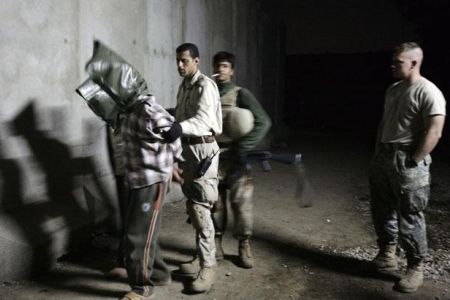
Britain’s Ministry of Defence (MoD) has decided to shake off allegations of systematic abuse at any cost, as hard evidence corroborates the British Army’s use of torture techniques.
The findings of an inquiry into the death of an Iraqi civilian at the hands of British soldiers has sparked widespread criticism, even condemnation, of the treatment of Iraqi detainees by British soldiers.
Baha Mousa, a 26-year-old hotel receptionist, was detained when soldiers from the First Battalion of the Queen’s Lancashire Regiment in the Iraqi city of Basra raided the hotel at which he worked. Two days later, Mousa died while in British Army custody.
The MoD was optimistic about the findings of the inquiry into Mousa’s death trying to bypass any allegations of systematic torture. Nevertheless, as the MoD tries in vain to persuade the public that its detention policies have undergone systematic reforms, analysts have come up with evidence that contradicts any such claims.
A high profile British human rights lawyer, Phil Shiner, has provided several reasons supporting the systematic use of torture and abuse in the British military during the Iraq war.
First, Shiner asserts that the detention policies, which involved torture and abuse, were not restricted to just one battle group, namely 1QLR, as he states that such practices were common, at least, at 14 UK facilities over the period between March 2003 and December 2008.
Shiner asserts that the set of techniques and practices included “unbelievably debased sexual behaviour, mock executions, vicious threats of rape of detainees’ female relatives, and systematic use of hooding, sleep deprivation, sensory deprivation, temperature manipulation and solitary confinement for weeks.”
Second, Shiner says that the shameful techniques and practices were systematically taught, as the Joint Forward Intelligence Team was the mastermind behind the techniques used by British troops.
Furthermore, as the British Defence Secretary, Liam Fox, refused to accept a key finding of the inquiry, Shiner is of the opinion that the MoD has no intention of implementing the “73 carefully measured recommendations” made by the chairman of Mousa’s inquiry, Sir William Gage.
Shiner predicts that the MoD “will continue to hide damaging documents, mislead our courts, run unworthy legal arguments and use its mighty coercive power to keep the public in the dark, not just about Iraq but also Afghanistan.”
More importantly, Shiner argues that the MoD still approves the very same shameful techniques employed by interrogators in Iraq, though Sir William has severely criticised such practices. Forcing a person or two into a sandbag, harshing, and hooding are techniques that are still used by the MoD.
Video Report
Press TV News/Analysis on September 8, 2011
What do Baha Mousa, Ian Tomlinson, Smiley Culture and Mark Dugan have in common? They are people who have died because of tactics used by UK police and in Baha Mousa’s case, British soldiers, why are “unlawful killings” as they are called taking place in the first place? Whether inside Britain or in war zones, it has put the spotlight on UK’s disproportionate and excessive use of force, as was evident in the recent unrest in the UK.
Related articles


Recap of first day of Irvine 11 trial: “no unlawful act was committed”
Nora Barrows-Friedman – The Electronic Intifada – 09/08/2011
Today’s opening statements in the Irvine 11 trial included explicit deconstruction by the defense team of the Orange County District Attorney’s argument that the Muslim students who protested an Israeli official’s speech last year did so in violation of a California penal code for conspiracy.
“You cannot have a conspiracy to commit an unlawful act if there is not an unlawful act that has been committed,” stated a defense attorney in the courtroom today.
The trial, now underway in the Orange County courthouse in Santa Ana, California, focuses on the prosecution’s claim that the students violated the penal code that could send the students to jail for up to two years on two misdemeanor counts: conspiracy to disrupt a meeting, and disruption of a meeting.
Kifah Shah, media coordinator and spokesperson for the Irvine 11 solidarity group, Stand With the Eleven, told The Electronic Intifada that approximately 100 supporters packed the courtroom after attending a press conference outside of the courthouse. Several major media organizations also attended the pre-trial debriefing, which was organized by local community leaders from such groups as the Muslim Public Affairs Council (MPAC), Jewish Voice for Peace (JVP), the Council on American-Islamic Relations (CAIR), and several interfaith leaders and professors at UC Irvine.
The LA Times’ Orange County-based Daily Pilot reported that Father Wilfredo Benitez of the Saint Anselm of Canterbury Episcopal Church stated at the press conference that “[t]his smells of persecution. In a free country … this should simply not be happening.” The report continued:
Moutaz Herzallah, whose son Taher is among the defendants, said Rackauckas “threw the [U.S.] Constitution in the trash” when he decided to press charges.
Moutaz Herzallah, who is from Gaza, said he immigrated to the United States “to have peace, dignity and honor” and that the D.A. should be prosecuted for his disregard of the Constitution.
Shah said that the opening day of the trial “went really well.”
“There were a lot of people there, and a lot of community members came out to support. There was a sentiment of eagerness in the room awaiting and anticipating justice. There was a hopeful feeling,” she added.
I asked her if she had a sense of whether the selected jurors were given a clear picture of what went on during Ambassador Oren’s speech that has led to the prosecution of the students, following the opening statements by the defense and prosecution teams.
Shah replied:
Yes. They went over what happened and explained it thoroughly to the jury. They went through exactly what happened, and obviously in their own terms. In terms of the opening statements, the prosecution is arguing that this was a “heckler veto” — meaning that individuals don’t like what’s being said, and decide to “veto” a speech. The prosecution lawyer reiterated that the students tried to “shut down” the event, to provide the evidence during his statements that [the protest] was a conspiracy. He also went over the fact that they belong to a group, the Muslim Student Union (MSU), and that these defendants “conspired together as a group to enact a heckler’s veto.”
He said that the MSU “was not happy” that the ambassador, Michael Oren, was coming to campus, and “they didn’t want to debate the ambassador — they decided they wanted to shut down the event within the guise of acting as individuals. They wanted to shut him down.” Like I said, he repeatedly asserted that the Irvine 11 wanted to shut down the event.
The other part is that he also talked about that it’s the act itself that the jury will deliberate upon, and not the content of the speech. He added that in the beginning of [Oren’s event] itself, the chair of the Political Science department had stated that we “expect and relish debate on campus, but will expect nothing but civility and courtesy” [from the audience]. And then he said that even the Chancellor, when the protest began, that “this is outrageous, and this violates the rules.” So the prosecuting attorney chose these statements in particular to tell a story to the jury — that this was a violation of rules, that this was a conspiracy to shut down the event.
The defense attorneys also laid out what the defendants did during the protest, and what that looked like for them. What … really hit it on the head was that [defense attorney] Reem Salahi stated exactly what was written on the index cards [from which the students read during their protest]. This was a concerted, calculated effort — it was not their intention to resist removal, they were not trying to stall or prolong anything — they simply wrote down what they wanted to say on their index cards, said what they had to say, which amounted in total for each of them just a few seconds, which took up a cumulative five minutes including the jeers from the crowd.
In their emails [that were subpoenaed during the investigation], the students were talking about not resisting, being nonviolent, acting with a certain demeanor — the defense was illustrating how it wasn’t their intention in any way to “shut down” the event. At the end of the event, even Michael Oren had said that he wished the students who protested and were removed from the ballroom “had stayed … it was that group that I wanted to address.”
The defense said really well that “you cannot have a conspiracy to commit an unlawful act if there is not an unlawful act that has been committed.” So what the prosecution has is a conspiracy to commit a crime, and then the actual committing of that crime. But in terms of whether or not a crime was committed, we’re looking at CA Penal Code section 403 which states that there is a violation if a meeting has been disturbed or broken up. However, there was not a crime that was committed here — Oren did finish his speech, at the end of which he stated that he wished the students had stayed.
Another argument is that Oren wasn’t able to do a question and answer — but if you look at how the event was advertised, they didn’t even say that there was an intention that there was going to be a question and answer section to Oren’s speech. The penal code was not violated. That means that the prosecution’s argument of a “shut down” didn’t happen.
In closing, I asked Shah to talk about the solidarity efforts of her campaign, Stand With the Eleven.
Well, even from the opening statements, this is a political opportunity for the district attorney’s office — everyone knows he’s running for re-election, and I really think that if this is selective prosecution, it’s really important to remember that now it’s not just about these ten students, but it’s significant for all Americans at this point. The precedent that is set concerns everyone’s rights to free speech.
The district attorney is the one who’s committing egregious acts of intolerance and persecution. It’s not about these ten students in a courtroom anymore, now it’s about every American and everyone’s rights to free speech.
The Electronic Intifada will continue to update our readers on the Irvine 11 trial. The verdict is set for 23 September.
UN slams airstrike on Yemen hospital
Press TV – September 8, 2011
The United Nations has condemned a deadly airstrike by the Yemeni regime on a hospital in southern Yemen where government forces have stepped up attacks backed by US airstrikes against alleged armed groups.
The UN deplored the latest attack on Al-Razi hospital in Abyan in south Yemen, where at least seven civilians were killed.
“The targeting of civilians and the obstruction of humanitarian aid constitute a serious violation of International Humanitarian Law,” the Associated Press quoted a UN statement as saying on Wednesday.
The ground and air offensive unfolded on Wednesday in the southern Yemeni province of Abyan, where the armed groups seized control of its capital city and surrounding towns earlier this year.
A medical official in Abyan, which has become a flashpoint for fierce fighting between the US-backed government forces and alleged al-Qaeda-linked militants, said Asmaa Hamza, a 14-year-old girl, was killed in Wednesday’s military airstrike on al-Razi hospital.
It was the second attack on the same hospital in the town of Jaar in less than 48 hours, witnesses said, adding that the Wednesday airstrikes on Jaar also targeted a high school, a hotel, residential buildings and a police station, near areas where the military believes “militants” are seeking refuge.
Airstrikes in the area wounded at least 20 civilians, several of whom being seriously injured, according to a hospital official.
The Yemeni regime claims it launched the attacks against al-Qaeda militants in the south.
This comes as anti-government uprisings against the rule of Yemen’s Ali Abdullah Saleh have been raging across Yemen since January.
Hundreds of thousands of people have turned out for regular demonstrations in Yemen’s major cities, calling for an end to corruption and unemployment and demanding Saleh’s ouster.
Hundreds of people have been killed and many more injured during the unrest as a result of the brutal crackdown on anti-government protests by military forces and loosely-organized individuals loyal to Saleh.
Protesters insist that the US and Saudi Arabia are making efforts to save the ailing regime of Saleh.
Saleh and five other high-ranking officials have fled to Saudi Arabia for medical treatment, following a rocket attack on the Yemeni presidential palace in Sana’a on June 3.
“Free Tripoli” – just don’t mention the corpses
By Lizzie Phelan | Pravda | September 6, 2011
The war on Libya has not only been a war that has vindicated NATO’s claim to the most powerful military force on earth, capable of imposing its will through sheer aggression wherever it sees fit, but it has also been a war that has reasserted the western mainstream media’s power to not just fabricate events but to create.
The first media victory was when it got away with claiming that Gaddafi’s government was attacking it’s own citizens in Tripoli from the air, a claim which formed part of the pretext for NATO’s intervention and also served to create panic and anger amongst the city’s residents. No one was held to account when later Russian intelligence satellites and visits from independent observers to the areas alleged to have been targeted, revealed no evidence that such attacks had taken place.
One of the most powerful lies was churned out by none other than British Foreign Secretary William Hague who claimed in the first days of the crisis that Gaddafi had fled to Venezuela. The Libyan government admitted repeatedly that their media was wholly incompetent and unable to provide alternative information at the time, with the result that the people of Libya like the rest of the world believed the claims that were being made. In this instance the result was to create a sense even amongst his traditional support base that they had been abandoned and betrayed. Of course Mr Hague made no apology for such irresponsible remarks when soon after Gaddafi showed his face in the streets of Tripoli.
More recently, the BBC has yet to apologise for using blatantly fake footage from a demonstration in India claiming it was in Tripoli’s Green Square, as part of their evidence that the city had fallen.
Such fabrications continued throughout the six months, as the media reported that areas had been “captured” by the rebels, when in reality, these areas had been blitzed from the air and the sea by NATO rockets with the sole aim of destroying any threat of resistance to its allies the rebels.
As the alliance bombed the rebels’ path to Tripoli, on its way massacring at least 85 civilians in the Zlitan town of Majer, the leaders of hundreds of the country’s tribes, including the largest, Wafalla, Tarhouna, Washafana and Zlitan, reasserted their determination to defend their areas, and to descend on Tripoli should it come under threat.
Meanwhile, the masses of men and women of Tripoli who turned out in rallies against the rebels, felt confident that should the rebels show up in their city they would be able to defeat them with the arms that Gaddafi’s government had been issuing to them since the beginning of the crisis.
Now many of those people have been massacred, have fled or are in hiding. They may or may not have underestimated the ruthless might of NATO, but the media’s narrative that Tripoli fell without resistance is contested by the fact that it took the massacre of thousands and at least five days to establish tentative TNC control of the capital as well as by eyewitnesses accounts of what happened during those five days and beyond.
From the beginning of the fighting in Tripoli on August 20th when I and 35 other journalists became trapped inside the Rixos hotel, it was virtually impossible to get a clear idea of what was happening on the streets outside. Throughout that period the sounds of bombs, gunfire and other heavy weaponry was almost non-stop, with shrapnel and bullets occasionally making their way inside the hotel. But like the rest of the world, the only information we had, apart from the odd moments of communication with contacts inside the city, was from the mainstream international media.
Since my release, I have begun to collate information from residents in the capital in the absence of information from sources which are recognized internationally as “independent”. The following report is based on these accounts and the sources identity must be kept confidential due to the systematic targeting of anyone who betrays disloyalty to the rebels, which as I experienced myself, includes challenging their version of events in the media.
 On the first day, rebels from sleeper cells inside Tripoli emerged and began attacking checkpoints manned by Libyan special forces. As is the pattern with their advance into areas on the way to the capital they faced a swift initial defeat. But the first images emerging around the world of the rebels inside Tripoli NATO ensured it would not be short lived. The organisation sanctioned to “protect civilians”, rapidly moved to bomb all checkpoints in the densely packed city. The vast majority of these were manned by volunteers – ie ordinary citizens that had been armed with Kalashnikovs since the beginning of the crisis – so that the rebels could easily move into the city by sea and by road. (see attached image of mother and 17 year old daughter, both volunteers manning checkpoint in Tripoli.)
This was followed by masses of youth and other residents in the capital pouring into the streets to defend their city as they had pledged to do during mass rallies.
The following day, NATO responded with intensified aggression. Eyewitnesses report that during this day, the broadcasting station in Tripoli was bombed, killing dozens. Shortly after the rebels claimed control of Libyan TV and the international media dutifully repeated the claim, blocking any mention of how the takeover had occurred.
Adding to the media’s campaign of confusion, reports of Gaddafi’s sons being caught and that Gaddafi along with other family members had fled the country continued to beam out of televisions across the world.
Having become accustomed to such psychological operations designed to weaken the people’s support for the government by making them believe it had betrayed them, masses defied the reports and marched to Green Square. From inside the Rixos, during the short periods when phone access was revived, my contacts in the city who were in Green Square at the time, informed me that Muammar Gaddafi had been seen driving through the city in his army fatigues urging people to remain strong and not be deceived by the west’s relentless propaganda. This has since been reported by further contact with other residents who were in the streets at the time.
Following relentless bombardment, the masses were pushed back to Gaddafi’s compound Bab al-Azizia where they resisted the rebels’ advance for a further 24 hours. It was during this time that Saif al-Islam, who until then the media and International Criminal Court had been insisting was captured and arrested, showed up at the Rixos hotel where we were trapped. Calm and confident, he took out a group of journalists to Bab al-Azizia where upon their return, they confirmed seeing thousands in and around the compound waving the green flag, including as the tribes had pledged, from their people across the country.
But like the peaceful march in the western mountains on July 24th which was attacked by NATO and the rebels, the masses in Bab al-Azizia were broken up by NATO bombing an entrance for the rebels and attacks by Apache gunships.
The same fate was visited upon gatherings in Green Square. Bab al-Azizia alone was reported to have been bombed 63 times during that time.
With both Green Square and Bab-Alzizia now in control of the rebels, the resistance continued in areas like Tripoli’s poorest neighbourhood Abu Saleem, which a few weeks previously had held a mass demonstration against the NATO aggression and in support of the Jamahiriya. Fighting against the rebels also raged on in Salah Eldeen and El Hadba.
Armed with Kalashnikovs and Rocket Propelled Grenades, the citizens of these areas fighting 8,000 kg bombs, Apache gunships, US, European and UAE special forces and the rebels laden with NATO’s sophisticated weaponry, became part of the carnage and piles of bodies were reported to line the streets.
Since then, any area known to have supported Gaddafi has reportedly been bombed or been subjected to homes and apartments being burnt and looted. And even the mainstream media has been unable to ignore the systematic targeting and lynching of anyone with black skin. It is widely known that Gaddafi’s opponents deeply loathed his rhetoric and policies in support of Black Africa.
With Sirt, Sabha and Beni Walid being amongst the last areas still flying the green flag high, the rebels claim to be giving these a deadline before they resort to a “military response”, implying that in the meantime, a non-military avenue will be pursued. Yet again, the media fail to highlight that the rebels’ ally, NATO, has been openly bombing these areas.
The same media has unquestioningly swallowed NATO’s line that the targets have been exclusively “Gaddafi’s forces”, in the face of evidence before their very eyes to the contrary and in the absence of any independent investigation into the death toll of the 30,000 bombs estimated to have been dropped over the past six months.
The last concrete figures on the second day of fighting put the death toll in 12 hours of fighting in Tripoli alone at 1,300 with 900 injured. Far from Tripoli falling without resistance these figures suggest that Tripoli fell with the masses resisting being massacred.
As in Zlitan, Zawiya and elsewhere, the same atrocities as those committed in Tripoli, are being carried out in Beni Walid and Sirt with the complete silent complicity of journalists and “independent” observers on the ground. This is “free Libya”, so long as the thousands of dead and in hiding upon which it is based goes unmentioned.
Why the Palmer-Uribe report on Israel’s flotilla attack is worthless
By Ali Abunimah – The Electronic Intifada – 09/02/2011
Turkey has imposed sanctions on Israel following Turkey’s rejection of a UN report on Israel’s attack on the Gaza flotilla last year.
In the latest developments on Friday morning, Turkish Foreign Minister Ahmet Davutoğlu rejected the findings of the report and announced unprecedented sanctions on Israel saying “it’s time for Israel to pay a price.”
From 7 September, diplomatic ties will be reduced to the lowest level, all Turkish-Israeli military agreements will be canceled, and Turkey will support victims of the Israeli attack on the flotilla to pursue justice through legal cases.
Crucially, Davutoğlu affirmed that Turkey does not recognize the blockade of Gaza which the Palmer report attempted to justify, and which a UN Human Rights Council official fact-finding mission had already ruled to be illegal. Turkey will also challenge the Israeli siege of Gaza through international legal channels.
Palmer report attempts to whitewash attack on flotilla, justify Israeli siege
A leaked copy of the Palmer report into Israel’s attack on the Gaza Freedom Flotilla in May 2010 was published by the New York Times on Thursday, a day before its expected official release by the UN Secretary General.
On 31 May 2010, Israel attacked the largest ship in the Gaza Freedom Flotilla, the Mavi Marmara, killing 9 people on board.
Publication of the report had been delayed several times as Turkey and Israel attempted to negotiate a settlement. Turkey demanded an apology for the attack, compensation for victims and an end to the siege of Gaza. In his statement today Davutoğlu said Israel had passed up many opportunities to resolve the issue.
The four-member committee that wrote the Palmer report was appointed by UN Secretary General Ban Ki-moon and was chaired by former New Zealand prime minister Geoffrey Palmer and vice-chaired by former president of Colombia Alvaro Uribe.
This panel is in addition to an official UN Human Rights Council fact-finding mission which reported last September that Israel’s attack on the ships was illegal.
According to the The New York Times article on the Palmer report, the Palmer panel:
has found that Israel’s naval blockade of Gaza is both legal and appropriate. But it said that the way Israeli forces boarded the vessels trying to break that blockade 15 months ago was excessive and unreasonable.
The report, expected to be released Friday, also found that when Israeli commandos boarded the main ship, they faced “organized and violent resistance from a group of passengers” and were therefore required to use force for their own protection. But the report called the force “excessive and unreasonable,” saying that the loss of life was unacceptable and that the Israeli military’s later treatment of passengers was abusive.
An initial examination of the report indicates that these many of findings are not credible on their face for a number of reasons including the composition of the panel, its reliance on Israel which has controlled and withheld most of the evidence, and a skewed and politicized perspective which ignores the realities of Israel’s decades-long violent occupation of Gaza.
Palmer panel was stacked for Israel and includes notorious human rights abuser
As Jose Antonio Gutierrez and David Landy explained on The Electronic Intifada in August 2010, the panel was selected almost entirely according to Israel’s dictates:
The commission is composed of four persons, one chosen by Turkey, one chosen by Israel and two chosen from a list provided by Israel. The latter two are former Prime Minister of New Zealand Geoffrey Palmer, who will be the chair, and Uribe, who will serve as vice-chair. While Palmer, an expert in international law, is an uncontroversial choice, the appointment of Uribe is as perplexing as it is shocking. It appears that “balance” in this commission involves balance between someone versed in international and human rights law and someone who is adamantly opposed to it. This notion of balance fatally weakens this commission even before it has started, and tarnishes the process of international law.
Uribe himself has a long and notorious history of violating human rights on a massive scale, attacking human rights defenders and organizations, and expressing contempt for any notion of law that restrains states from engaging in almost any kind of violence they desire.
Gutierrez and Landy on Uribe’s record in Colombia:
In June 2010 an international human rights mission investigated the biggest mass grave in the western hemisphere — containing some 2,000 execution victims who had been dumped there since 2004 — which had just been discovered in the Colombian town of La Macarena. At the same time Uribe travelled to that very locality but not to pay his condolences to the victims’ families, or guarantee that an investigation would determine what happened there. Instead, he went to visit the local military base — exactly the same people that, according to victims’ reports, filled that mass grave with its grisly contents — to praise them for their work.
On Uribe’s attacks on human rights defenders, Gutierrez and Landy write:
Uribe’s scorn for human right defenders is notorious. According to Human Rights First, “President Uribe and other administration officials have branded [human rights defenders] as terrorist sympathizers and have insinuated that illicit connections exist between human rights NGOs [nongovernmental organizations] and illegal armed groups. Irresponsible comments by government officials in Colombia put the lives of human rights defenders at even greater risk and threaten to undermine the value and credibility of their work” (“Human Rights Defencers in Colombia”).
In September 2009 Colombia was visited by Margaret Sekaggya, special rapporteur on the situation of human rights defenders from the UN Human Rights Commission. Sekaggya found that constant problems faced by human rights defenders in Colombia include “Stigmatization [of human rights defenders] by public officials and non-State actors; their illegal surveillance by State intelligence services; their arbitrary arrest and detention, and their judicial harassment; and raids of nongovernmental organizations’ (NGOs) premises and theft of information” (“Report of the Special Rapporteur …,” 4 March 2010, pp. 13-18 [PDF]). Public officials in Colombia constantly attack human rights defenders and members of the political and social opposition as aides of “terrorists,” that is, left-wing guerrillas.
Uribe has led these attacks, calling human rights defenders “rent-a-mobs at terrorism’s service who cowardly wave the human rights flag,” “human rights traffickers,” “charlatans of human rights,” “bandits’ [ie. guerrillas] colleagues,” “intellectual front of the FARC [the Revolutionary Armed Forces of Colombia]” and he has stated that “Every time terrorists and their supporters feel they will be defeated, they resort to denouncing human rights violations.”
This is just a small selection of Uribe’s verbal attacks on human rights organizations in his own country, but he has also referred to Amnesty International and Human Rights Watch as “rats.”
Uribe’s alliance with Israel
During Uribe’s term, Colombia, which is one of the top three recipients of US military aid along with Israel and Egypt, developed a close military alliance with Israel, as Gutierrez and Landy explain:
In recent years, according to news reports, Israel has become Colombia’s number one weapon supplier, with arms worth tens of millions of dollars, “including Kfir aircraft, drones, weapons and intelligence systems” being used against opponents of the Colombian regime (“Report: Israelis fighting guerillas in Colombia,” Ynet, 10 August 2007). According to a senior Israeli defense official, “Israel’s methods of fighting terror have been duplicated in Colombia” (“Colombia’s FM: We share your resilience,” 30 April 2010).
There is a reason that Latin Americans often refer to Colombia as the “Israel of Latin America,” and indeed why Colombian President-elect Juan Manuel Santos, ex-Minister of Defence and right hand of Uribe, expressed his pride at such a comparison (“Santos, orgulloso de que a Colombia lo comparen con Israel,” El Espectador, 6 June 2010).
As Gutierrez and Landy also point out, top officials in Uribe’s administration, including the president himself, frequently expressed full support for Israel’s fight against what it terms “terrorism.”
Israel withheld and manipulated evidence
The Palmer panel cannot be described in any sense as an independent investigation. As the report states:
The Panel received and reviewed reports of the detailed national investigations conducted by both Turkey and Israel. Turkey established a National Commission of Inquiry to examine the facts of the incident and its legal consequences, which provided an interim and final report to the Panel along with annexes and related material. Israel provided the report of the independent Public Commission that it had established to review whether the actions taken by the State of Israel had been compatible with international law.
The Panel reviewed these reports and further information and clarifications it received in written form and through direct meetings with Points of Contact appointed by each government.
The report adds:
In particular, the Panel’s means of obtaining information were through diplomatic channels. The Panel enjoyed no coercive powers to compel witnesses to provide evidence. It could not conduct criminal investigations. The Panel was required to obtain its information from the two nations primarily involved in its inquiry, Turkey and Israel, and other affected States.
The panel therefore interviewed no survivors or witnesses. Only Israel controlled most key physical evidence – the ship itself and the belongings and recordings of all the passengers and the weapons Israel used in carrying out the attack. The panel did not have uncensored access to the massive amounts of evidence in the form of photo and video from passengers on board that Israel has stolen, hidden and refused to release or return. As a consequence, of these crippling limitations, the report states:
It means that the Panel cannot make definitive findings either of fact or law. But it can give its view.
The panel also implies that its own independence is further in question because:
It will be clear from the above that the essential logic of the Panel’s inquiry is that it is dependent upon the investigations conducted by Israel and Turkey.
In contrast, the UN Human Rights Council fact-finding mission report published last September went much beyond merely commenting on information provided by governments. That fact-finding mission:
conducted interviews with more than 100 witnesses in Geneva, London, Istanbul and Amman.
And in addition to information provided by governments, the Human Rights Council also relied on information
including the evidence of eyewitnesses, forensic reports and interviews with medical and forensic personnel in Turkey, as well as written statements, video film footage and other photographic material relating to the incident.
Perhaps because of its thoroughness, Israel refused to cooperate with the Human Rights Council fact-finding mission, just as it refused to cooperate with the Goldstone report.
Accusations of “violent resistance”
The Palmer panel report claims:
Israeli Defense Forces personnel faced significant, organized and violent resistance from a group of passengers when they boarded the Mavi Marmara requiring them to use force for their own protection. Three soldiers were captured, mistreated, and placed at risk by those passengers. Several others were wounded.
Given the fact that Palmer panel did not gather any evidence of its own, its conclusion that the Israeli military attackers who boarded the Mavi Marmara under cover of dark in international waters, faced “organized and violent resistance” can be given no more credibility than any common or garden Israeli military press release.
While Israel has repeatedly made such claims, it never produced independent evidence of it and – as noted – is still concealing evidence.
Nevertheless, the video footage that did escape Israeli confiscation showed:
- Indiscriminate live fire by the Israeli attackers
- A working journalist who appears to have been executed
- Evidence of targeted assassination of at least one passenger
Even the deeply flawed Palmer report is forced to admit:
The loss of life and injuries resulting from the use of force by Israeli forces during the take-over of the Mavi Marmara was unacceptable. Nine passengers were killed and many others seriously wounded by Israeli forces. No satisfactory explanation has been provided to the Panel by Israel for any of the nine deaths. Forensic evidence showing that most of the deceased were shot multiple times, including in the back, or at close range has not been adequately accounted for in the material presented by Israel.
Moreover, the propagandistic Israeli claims that their soldiers were mistreated were belied by photographs that showed passengers giving aid and protection to Israeli attackers who had been disarmed.
It is possible of course that passengers defended themselves against a terrifying Israeli assault in dead of night with a full military arsenal that included assault helicopters and elite commandos against a civilian ship.
Indeed, footage shows terrified passengers hiding and attempting to fend off indiscriminate fire with sticks in a blood-stained stairwell. But to equate any of this to “organized and violent resistance” that could in any way justify Israel’s execution-style killings is completely absurd.
The blockade is “legal”
The Palmer report’s assertion that the Israeli naval blockade of Gaza is legal and necessary for “security” echoes the other aspects of the report that accept Israeli military propaganda as given.
By privileging the security of Israel, the occupying power, the report also ignores the rights and needs for security of the Palestinian people in Gaza who are being collectively punished and who have been subjected to decades of indiscriminate Israeli military attacks in which thousands of civilians have been killed and injured.
Yet this opinion of the Panel is, as the report states, not binding in any legal sense. But more importantly, it has no bearing at all on the assault on the Mavi Marmara, which Israel attacked in international waters as it was moving away from the Gaza Strip and the Israeli-controlled coast of Palestine.
Israel’s claim that it needs to blockade people it is violently victimizing in order to prevent them obtaining any means means whatsoever to defend themselves can only be made by wholly ignoring the context of Israel’s violent occupation of Gaza and decades of well-documented war crimes.
Israel is not in a defensive position in which it can claim a “security” need to impose a blockade. Israel is the military aggressor which for decades from 1967 until 2005 violently colonized the Gaza Strip, placing settlers there in blatant violation of international law. Since 2005, Israel has continued to occupy besiege, harass, attack and kill civilians in Gaza with almost no respite culminating in the indiscriminate killing of hundreds of civilians during the 2008-2009 “Operation Cast Lead.”
A perfect example of Israel’s wanton violence was its unprovoked series of attacks on the Gaza Strip last month which killed more than two dozen people, including children.
Human Rights Council fact-finding mission and legality of Israeli blockade
The UN Human Rights Council had already concluded that Israel’s interception of the flotilla was illegal because the blockade was unjustified:
In evaluating the evidence submitted to the Mission, including by OCHA oPt [Office for the Coordination of Human Affairs in the occupied Palestinian territories), confirming the severe humanitarian situation in Gaza, the destruction of the economy and the prevention of reconstruction (as detailed above), the Mission is satisfied that the blockade was inflicting disproportionate damage upon the civilian population in the Gaza strip and that as such the interception could not be justified and therefore has to be considered illegal.
It also concludes:
The Mission considers that one of the principal motives behind the imposition of the blockade was a desire to punish the people of the Gaza Strip for having elected Hamas. The combination of this motive and the effect of the restrictions on the Gaza Strip leave no doubt that Israel’s actions and policies amount to collective punishment as defined by international law.
and that:
the blockade amounts to collective punishment in violation of Israel’s obligations under international humanitarian law.
Palmer panel went against international consensus on blockade
Moreover, the Turkish appointee on the Palmer panel, Süleyman Özdem Sanberk, noted in a dissenting statement rejecting large parts of the report:
On the legal aspect of the blockade, Turkey and Israel have submitted two opposing arguments. International legal authorities are divided on the matter since it is unprecedented, highly complex and the legal framework lacks codification. However, the Chairmanship and its report fully associated itself with Israel and categorically dismissed the views of the other, despite the fact that the legal arguments presented by Turkey have been supported by the vast majority of the international community. Common sense and conscience dictate that the blockade is unlawful.
- Also the UN Human Rights Council concluded that the blockade was unlawful. The Report of the Human Rights Council Fact Finding Mission received widespread approval from the member states.
- Freedom and safety of navigation on the high seas is a universally accepted rule of international law. There can be no exception from this long-standing principle unless there is a universal convergence of views.
- The intentions of the participants in the international humanitarian convoy were humanitarian, reflecting the concerns of the vast majority of the international community. They came under attack in international waters. They resisted for their own protection. Nine civilians were killed and many others were injured by the Israeli soldiers. One of the victims is still in a coma. The evidence confirms that at least some of the victims had been killed deliberately.
- The wording in the report is not satisfactory in describing the actual extent of the atrocities that the victims have been subjected to. This includes the scope of the maltreatment suffered by the passengers in the hands of Israeli soldiers and officials.
After Goldstone, protecting Israel
Based on what was known before its report became public, and now that we have read the report, it is clear that the Palmer panel was no more than political exercise by the UN Secretary General Ban Ki-moon to whitewash Israel’s attack on the flotilla and protect it from any real accountability.
After Israel and the United States’s all out war on the Goldstone report detailing Israeli war crimes in Gaza, it appears that international officials are unwilling to repeat the experience.
Indeed, an exclusive report on The Electronic Intifada in June 2010 revealed intense diplomatic efforts to undermine Turkey’s push for an independent UN investigation into Israel’s flotilla attack.
The Palmer panel was stacked from the start to ensure Israeli impunity, not to provide truth for the victims and survivors of the Mavi Marmara.
Featured Video

10 Climate Myths Busted (in 60 seconds!)
or go to
Aletho News Archives – Video-Images
Book Review
How the U.S. Navy Sold the Vietnam War
By Gareth Porter | TruthDig | March 27, 2019
Dr. Tom Dooley, whose best-selling book “Deliver Us From Evil” helped create a favorable climate of opinion for U.S. intervention in South Vietnam, has long been linked to legendary CIA officer Edward G. Lansdale and his black operations in Vietnam between 1954 and 1955. But the real story about Dooley’s influential book, which has finally emerged from more recent scholarly research, is that it was engineered by an official of the U.S. Navy’s Pacific Command, Capt. William Lederer.
Lederer is best known as the co-author, with Eugene Burdick, of the 1958 novel “The Ugly American,” which was turned into a 1963 movie starring Marlon Brando. Far more important, however, is the fact that from 1951 through 1957 Capt. Lederer was on the staff of the commander in chief of the U.S. Pacific Fleet (CINCPAC), Adm. Felix Stump. … continue
Blog Roll
 Aletho News
- The 10 Disease Renamings That Rescued the Vaccine
- NATO cancels 2027 leaders’ summit
- IAEA’s politicized use of safeguards undermines its impartiality: Russian envoy
- UK must be ready to strike Russian Arctic – ex-PM
- Fico’s Two Red Lines: Russian Energy and the Next Ukraine Loan
- Thousands rally for banned NATO-skeptic presidential candidate
- Ukraine Settlement and New European Security Architecture Must Go Hand in Hand – Kremlin
- Book review: Boiling Point, How America Brought War to Ukraine
- Israel Revives The ‘Iranian Assassination Threat Against Trump’ Deception In A Desperate Bid To Restart The War
- US rewrites history to dodge blame for illegal war on Iran: Foreign Ministry spokesperson
- If Americans Knew
- No, Christians did not invent Zionism
- Hakeem Jeffries & Chuck Schumer: Conduits for Israel Lobby Dark Money
- DAILY UPDATE: Latest essential news on Palestine, Israel, & region
- Aid organizations in Gaza are pulling back, leaving hundreds of thousands of Palestinians without food
- 1.4 Million People in Gaza Live in Tents. Winter Storms Can Be a Death Sentence.
- Israel Used a U.S.-Made Missile to Kill Six at Gaza’s Nasser Hospital
- Congress Might Sneakily Use Lame Duck to Deeply Intertwine the U.S. and Israeli Militaries
- DAILY UPDATE: Latest essential news on Palestine, Israel, & region
- 9-month-old baby dies from severe cold in Gaza, 1st cold-related death this winter: Health Ministry
- Israel Kills over 12, Injures Many Across Gaza
- No Tricks Zone
- New Study: Barents Sea Temperatures Were Warmer And Sea Ice Less Extensive In The 1700s Than Today
- German Authorities Start Initiative To Evaluate Public Register For Climate “Disinformation” Spreaders!
- Zonal Asymmetry of Temperature Change in the Antarctic Circumpolar Current
- New Study: The Net Fossil Fuel Contribution To Rising Atmospheric CO2 Has Been Zero For 500 Years
- Germany’s Green Energy Transition Becoming Increasingly Expensive…Another 6 Trillion Euros!
- Sudden Stratospheric Warming, Powerful El Niño Combination May Lead To Extreme Europe Cold, Energy Crisis!
- Two New Studies Find Thwaites Glacier Melt Cannot Be Driven By Human Activity Or A Warming Ocean
- E-Cars Reduce CO2 Emissions By Only 41% Compared To Internal Combustion Engine Vehicles
- Predictions Made By Renowned Climate Professor Over Past Decades Have Been Proven To Be Poor
- New Study Suggests Large Regions Of The Pacific Ocean Have Been Cooling For The Last 80 Years

