Israeli war crime confessions to debut in bookstores this month
Palestine Information Center – 22/01/2011

OCCUPIED JERUSALEM — An Israeli organization has compiled many statements by Israeli soldiers confessing to war crimes against unarmed Palestinians in a book that will be released soon and sold in Europe.
The NGO Breaking the Silence will release this month details of torture and murder incidents committed by 180 soldiers from 2000 to 2009.
Testimonies, tapes and images have already been in circulation, but the soldiers who testified will for the first time ever reveal their identities and faces.
Breaking the Silence founder Yehuda Shaul, who is an ex-soldier, said he aimed to launch debate in Israel about the country’s army.
“[The Israeli army] is corrupting the youth,” Shaul said.
The book, containing first time ever released details, is expected to spark controversy in Israel and the world over.
Breaking the Silence has a membership of 700 former soldiers and activists.
Update: a nearly final electronic version can be found online.
A State of Permanent Human Bondage
By Malcom Lagauche | January 19, 2011
The goal of Desert Storm was to destroy the country of Iraq under the guise of liberating Kuwait. In February 1991, during the height of U.S. bombing, former U.S. Attorney General Ramsey Clark visited Iraq and reported his findings. At that time, few photos had come from Iraq showing the devastation. Most reporters left Iraq on the eve of the bombing campaign and spent their time in Saudi Arabia listening to the daily propaganda given by the U.S. military. They became so bored that they began to interview each other.
What Clark saw was not pretty. He stated:
The effect of the bombing, if continued, will be the destruction of much of the physical and economic base for life in Iraq. The purpose of the bombing can only be explained rationally as the destruction of Iraq as a viable state for a generation or more.
Clark’s message was not widely reported. After all, the U.S. version of events stated that the only reason for the aggression was to remove Iraqi soldiers from Kuwait. The lack of coverage of what was occurring in Iraq was convenient for the U.S. because it allowed the destruction of Iraq to continue with no world outcry.
After the bombing ceased, pictures began making their way to the outside world. When this information reached the U.S., the administration called it lies and propaganda. At other times, it accused Iraq of destroying its own institutions and blaming it on U.S. bombs. Once people from outside Iraq began to visit the country, the blatant U.S. lies were exposed. The following is a list of the numbers of facilities destroyed during the 42-day bombing campaign. It was compiled and published by the Iraqi Reconstruction Bureau:
· Schools and scholastic facilities — 3960
· Universities, labs, dormitories — 40
· Health facilities (including hospitals, clinics, medical warehouses) — 421
· Telephone operations, communication towers, etc. — 475
· Bridges, buildings, housing complexes — 260
· Warehouses, shopping centers, grain silos — 251
· Churches and mosques — 159
· Dams, pumping stations, agricultural facilities — 200
· Petroleum facilities (including refineries) — 145
· General services (shelters, sewage treatment plants, municipalities) — 830
· Houses — 10,000 to 20,000
In April 1991, a fact-finding team from Greenpeace visited Iraq and nobody was prepared for the display of massive devastation. When Greenpeace issued its report, it said Iraq had been bombed back to a pre-industrial era. The report added, “New technology did not make the U.S. military better at preventing destruction, it just made it more efficient at destruction itself.”
The U.S. press ignored most of the reports by various groups that visited Iraq after Desert Storm. The few words reported, along with the absence of photos, assured a lack of public outcry condemning the slaughter.
The massacre should not have surprised those who followed incidents leading to Desert Storm. As early as September 1990, a high-up military person mapped the plans for the invasion. On September 16, 1990, General Dugan stated that the proposed plans for combat included the destruction of the Iraqi civilian economy and infrastructure. At that time, no one could envisage the U.S. attacking Iraq because the Iraqi soldiers were in Kuwait and the U.S. demanded their exit. Most people thought, if there was to be a war, it would be conducted in Kuwait, not Baghdad. General Dugan was immediately removed from office. The Bush administration negated Dugan’s claims and discredited him. In hindsight, we see that Dugan’s testimony was about the only truth we heard from the U.S. government or military at that time. He let the cat out of the bag, but government damage control quickly led the people to believe he made up the scenarios he predicted.
For the first week of Desert Storm, everyone seemed to be mesmerized by the “smart bombs” that were going down chimneys and smashing through the windows of weapons warehouses. When the odd person asked about civilians being hit, the standard response was, “We’re not targeting civilians.” What we were not told was that 93% of the bombs dropped were “dumb bombs” and the civilian infrastructure of Iraq was being destroyed. Only about 30 to 40% of the dumb bombs hit their targets. The others randomly created havoc by killing civilians and destroying Iraq’s cities and towns.
After Desert Storm, some military people admitted the real nature of the attacks. Air Force General Tony McPeak stated on March 20, 1991, “I’ve got photographic evidence of several where the pilot just acquired the wrong target.” When asked why that information had not come forth earlier, he added, “It ain’t my call. I made some recommendations about this; it got turned around, quite frankly.”
Those who questioned the U.S. government’s reports of only hitting military targets had their fears verified on January 22, 1991. Pictures of a destroyed baby milk factory in the region of Abu Ghraib were broadcast worldwide. Many people were aghast at the bombing of a civilian industry crucial for the existence of youngsters.
The Pentagon immediately went into high gear to try to dispel the protests of those who questioned such barbaric actions. The administration stated that it was a biological weapons plant. Colin Powell said”
It is not an infant formula factory, no more than the Rabta chemical plant in Libya made aspirin. It was a biological weapons facility, of that we are sure — and we have taken it out.
The administration came up with the excuse that “Baby Milk Factory” signs around the plant were written in English and Arabic and they had just been mounted after the bombing to try to make people think it was a baby formula factory. The American public bought the excuse.
The public never researched to discover that many signs in Iraq included both English and Arabic versions because of the substantial English-speaking population who worked in Iraq prior to Desert Storm. The sign at the baby milk factory had been in place for several years prior to its bombing. Peter Arnett of CNN stated after Desert Storm that the same factory and sign were evident in a documentary that CNN produced in the late 1980s.
Nestlé of Switzerland is a leading producer of infant foods. A spokesman for the company said, “We know this was a state-built infant formula plant.” Company officials said they had regularly observed its construction in the past, “because we like to be aware of the competition.”
U.S. audiences rarely heard or saw what other countries reported concerning Desert Storm. A British TV show, “Panorama,” was broadcast on March 25, 1991 which included an interview with General Leonard Perroots, a consultant to U.S. intelligence in Desert Storm. He addressed the bombing of the baby milk factory and he quickly put the matter to rest as he said, “We made a mistake.”
The bombing of the baby milk factory put the world on alert that the information broadcast at the daily military briefings was untruthful. At that time, those who opposed Desert Storm were shocked at the widespread destruction in Iraq. They wondered how the U.S. public, which usually would have treated such barbaric designs with disdain, had acquiesced to cheering such actions. The answer lies in the demonizing of Iraq and its president, Saddam Hussein.
In George Bush’s Thanksgiving speech to U.S. troops in Saudi Arabia in 1990, he stated:
Every day that passes brings Saddam one step closer to realizing his goal of a nuclear weapons arsenal, and that’s why more and more your mission is marked by a real sense of urgency. You know, no one knows exactly who they may be aimed at down the road, but we know this for sure, he’s never possessed a weapon he didn’t use.
At the time of his speech, Bush knew that Iraq was at least five years away from developing its first crude atomic weapon, yet he made it sound as though Iraq was on the verge of obtaining a comprehensive nuclear arsenal. In further speeches, he suggested that in six months, Iraq would be a nuclear threat to the world. The myth of an Iraqi nuclear warehouse was a prime excuse for Bush II invading Iraq in 2003. And, to this day, many U.S. citizens believe Iraq possessed nuclear weapons.
Even after the bombing of the baby milk factory, the U.S. denied bombing civilians or buildings used in civilian industries. When the Iraqi government stated that a village or suburb was hit, the U.S. government would say the Iraqis weren’t telling the truth. Because of the demonizing of Iraq, most Americans thought all Iraqi information consisted of lies.
On January 31, an independent source announced that the U.S. was bombing civilians. The Jordanian Foreign Ministry stated that coalition planes had bombed oil trucks and civilians moving along the highway from Iraq to Jordan. Again, the U.S. denied the allegations, but some eyes were being opened.
In Iran, reports were made stating that the bombing was so intense that the ground in Iran was shaking. On February 5, 1991, an official in Basra described “a hellish nightmare” of fires and smoke so dense that eyewitnesses say the sun had not been clearly visible for days at a time; that the bombing was leveling entire city blocks; and that there were bomb craters the size of football fields and an untold number of casualties.
On February 7, the military still denied that civilians were being targeted. When asked about the allegations, General Richard Neal told the press, “It’s a target-rich environment and there’s plenty of other targets we can attack.”
While Neal was making his statement, Ramsey Clark was traveling throughout Iraq but his assessment differed greatly from that of the general. In describing the reality in Iraq, Clark stated:
Over the 2,000 miles of highway, roads and streets we traveled, we saw scores, probably several hundred, destroyed vehicles. There were oil tank trucks, tractor trailers, lorries, pickup trucks, a public bus, a mini bus, a taxi cab and many private cars destroyed by aerial bombardments and strafing. We found no evidence of military equipment or supplies in the vehicles.
Along the roads, we saw several oil refinery fires and numerous gasoline stations destroyed. One road-repair camp had been bombed on the road to Amman (Jordan). As with the city streets in residential and commercial areas where we witnessed damage, we did not see a single damaged or destroyed military vehicle, tank, armored car, personnel carrier or other military equipment, or evidence of any having been removed.
Basra was probably the hardest-hit city during Desert Storm. There was evidence of weapons that are normally used against military personnel having been deployed in civilian areas of Basra: cluster bombs. Clark saw this evidence and reported:
Small, anti-personnel bombs were alleged to have fallen here (Basra) and we saw what appeared to be one that did not explode imbedded in the rubble. We were shown the shell of a “mother” bomb which carries the small fragmentation bombs.
When he left Iraq in February 1991, Clark gave an overview of the situation:
United States annual military expenditures alone are four times the gross national product of Iraq. The use of highly-sophisticated military technology with mass destructive power against an essentially defenseless civilian population of a poor nation is one of the greatest tragedies of our times.
A few days after Clark left Iraq, an incident occurred that astonished the world. On February 13, a pair of Stealth F-117 bombers dropped two 2,000-pound laser-guided bombs on a concrete building in the Amiryah section of suburban Baghdad. The case-hardened bombs were directed to penetrate the steel reinforced roof and detonate inside. It was a civilian bomb shelter.
The reports of the number of civilians killed in the building — more than half were children — ranged from 400 to more than 1,000. Because the bodies were so badly burned and melted, no one will ever know the exact total.
The U.S. administration first proclaimed that the target was an Iraqi command-and-control post and the dead were Iraqi military personnel. The cameras eventually showed charred bodies of women and children, so the U.S. story had to be revised. The administration then said that the building was a military target in which Saddam Hussein placed civilians to protect the military personnel. Dick Cheney, then the U.S. Secretary of Defense, stated, “Saddam might be resorting to a practice of deliberately placing civilians in harm’s way.”
The U.S. government scrambled to try to explain the massacre of so many people inside a civilian bomb shelter. General Neal stated the government’s case as he said, “From a personal point of view, I’m outraged that civilians might have been placed in harm’s way, and I blame the Iraqi leadership for that.” Unfortunately, many Americans believed Neal’s twisted excuse of blaming the Iraqi leadership for the incineration of hundreds of people by deadly superbombs.
Within a few hours, the truth emerged. The Amiryah bomb shelter was built for civilian defense during the Iran-Iraq War. The engineer who designed it appeared on television and told the world there was no way it could be a military asset.
After the lies were put to rest, it became evident that the U.S. had either mistaken the target as a military venue, or it had deliberately destroyed it knowing it was a bomb shelter. Since February 14, 1991, the subject of the bombing of the Amiryah bomb shelter has been left unspoken in the U.S.
Those inside the bomb shelter died horrific deaths. First, a 2,000-pound bomb crashed through the shelter, creating a massive tunnel in which the second 2,000-pound projectile entered. Then, both exploded, leaving a huge hole. Those who died saw the first bomb and had a few seconds of life left before the second burrowed its way into the shelter and discharged.
Despite the ensuing international outcry about the destruction of the Amiryah shelter, the U.S. did not cut back on the bombing. Actually, the bombing of the Iraqi infrastructure increased. According to Greenpeace in a report called On Impact::
Despite numerous statements of U.S. military leaders that the Iraqi army had been defeated, as well as some confidence that contact between Baghdad and the front in the south had been severed, communications targets, mostly serving civilian functions, continued to be struck and re-struck to the end. If fact, according to Air Force Times, during the final ground phase, “Baghdad was targeted for some of the heaviest bombardments since January 17.”
The cease-fire did not solve all the problems for the civilians of Iraq. Shortly after, George Bush called for the Iraqi people to “take matters into their own hands” in ridding Iraq of its government. For the next few weeks, some Shi’ites in the south, heavily aided and infiltrated by Iranians, wreaked havoc, while certain Kurdish factions started an insurrection in the north of Iraq. There was bloody fighting and at one time, the Shi’ite and Kurdish elements controlled 16 of Iraq’s 18 provinces. Both movements eventually were brought under control by the Iraqi government. Not content with destroying Iraq by bombing it back to a “pre-industrial era,” Bush prompted even more destruction by urging factions within Iraq to overthrow the government. He promised both groups military assistance from the U.S., but none came.
In April 1991, the outside world saw Iraq for the first time since it had been destroyed by U.S. bombs and missiles. The nightmarish pictures started to appear. They showed a country that was bombed so heavily that the most common sites were craters and twisted, melted and devastated structures.
Ramsey Clark made another trip to Iraq to document the devastation. Once there, he noticed an ongoing operation that was meant to terrorize the population:
On our second night there, and several other times, at about 2:30 a.m., U.S. jets flew over the city (Baghdad), deliberately creating an enormous sonic boom that sounded as if the bombing had started again. The next morning, people would describe how their children had awakened in terror.
Clark chronicled the civilian industries that were demolished during the bombing of Iraq:
Twenty minutes outside the city (Baghdad), in Al Taji, we saw the country’s largest frozen meat storage and distribution center; one of two main centers for the entire country, which also included a laboratory for testing meat quality. It had been completely obliterated by the bombing. The center held 14,000 tons of frozen meat. The plant had been bombed three times, at 8:00 a.m., 3:00 p.m., and 8:00 p.m., and workers inside the plant had been killed.
All over Iraq, Clark saw the same mindless destruction. In Babylon, he visited a textile weaving plant that was totally destroyed. The plant was bombed at 3:00 in the afternoon and two women were killed working at their stations. According to the plant manager, Mr. Hassan, the factory was built by an Italian company and the new structure next door, containing no equipment, was untouched.
Dr. Al Qaysi, an Iraqi medical official, put everything in perspective when he stated:
No home remained untouched, no family unharmed, if not through death in the war, through malnutrition, disease, or new-found poverty. This is a return to colonialism. The U.S. is asking for terms like another Treaty of Versailles. Iraq is dependent on the outside world to repair its infrastructure and I fear Iraq will be in a state of permanent human bondage.
The Iraqi Minister of Trade, Mohammed Mahdi Saleh, realized the enormity of the task of trying to rebuild Iraq, particularly with the encompassing trade embargo in place. Despite the U.S. administration maintaining that Iraq was able to import humanitarian goods, there was virtually no way to obtain food, medicine, and parts to repair destroyed machinery. Saleh stated, “If it was possible, the Bush administration would have prevented the air from coming in.”

Can a criminal state deal with war criminals?
By Gilad Atzmon | January 19, 2011
Haaretz reported yesterday that Israeli citizen Aleksander Cvetkovic, 42, is suspected of participating in the murder of at least 1,000 Bosnian Muslims at the Branjevo farm near the city of Zvornik.
Cvetkovic, 42, was arrested at the request of the Bosnia-Herzegovina government. He is suspected of participating in the murder of between 1,000 and 1,200 Bosnian Muslims at the Branjevo farm near the city of Zvornik. This was one of a series of mass murders over a 10-day period of the Bosnian War that are collectively known as the Srebrenica Massacre. In 2006, Cvetkovic immigrated to Israel with his Jewish wife and received citizenship.
Cvetkovic’s defense lawyer Vadim Shub said yesterday that Israel has never extradited citizens on charges of genocide, “and we do not think this is a proper place to begin.”
Shub obviously plucked the right string. He knows that the Israeli society is riddled with war criminals and mass murderers. Shimon Peres, Tzipi Livini, Ehud Olmert and Ehud Barak amongst many others, have far more blood on their hands than suspect Cvetkovic.
In remarks to Israel’s Army Radio, Shub insightfully suggested that extraditing Cvetkovic could set a precedent for the prosecution abroad, of numerous Israeli officials and military personnel.
The extradition request exposes a shockingly detailed description of some devastating murderous enthusiasm:
On July 16, 1995, the unit’s commander summoned eight soldiers, including Cvetkovic, and ordered them to the city of Pilica, where they were to take part in the execution of Bosnian Muslim prisoners held in a local school. Cvetkovic and the other soldiers were then taken to the Branjevo farm, where they waited for the prisoners to arrive.
The prisoners were brought to the farm on buses, some of them handcuffed and blindfolded. They were then taken off the buses in groups of ten and led a short distance away, where the soldiers lined them up and shot them with automatic weapons, including both machine guns and pistols.
After each initial barrage, the soldiers would walk among the victims, locate wounded survivors and finish them off. The Bosnian request asserts that at one point, Cvetkovic offered to use an M-84 machine gun to accelerate the killing. According to estimates by soldiers who took part in the killing, and by a few people who survived by pretending to be dead, the massacre went on for 10 hours.
It would be very interesting to examine the integrity of the so-called Israeli and Jewish Nazi-hunters behind the notorious ‘Operation Last Chance.’ Cvetkovic’s case may verify whether Israelis oppose genocide in general, or just crimes against Jews.
UN Security Council: An organization for injustice
By Kourosh Ziabari | The People’s Voice | January 19, 2011

Since its very inception in 1946, the United Nations Security Council demonstrated that it cannot be trusted as a podium of justice for the world countries, specially the oppressed and defenseless nations which eye the assistance and patronage of the powerful and economically influential nations for tackling their political predicaments and crises, and showed that it merely pursues the interests of its small bloc of five permanent members and undemocratically discriminates against a multitude of countries who don’t have a say in the policies which directly affects them.
United Nations Security Council is said to be one of the principal organs within the operative system of the United Nations and is “allegedly” charged with the maintenance of international peace and security. The authorities possessed by UNSC are the establishment of peacekeeping missions, imposition of international sanctions and authorization of military actions whenever necessary.
UNSC has five permanent members: China, Russia, Britain, France and the United States. What’s the reason? Why should the UNSC have permanent members which cannot be removed from power and must wield an unyielding and resolute authority to make decision over the international affairs? The answer is simple: these five countries are the victorious powers of the Second World War. Their victory in a war which took place and was concluded more than half a century ago minimally accounts for the eternality and endlessness of the power which they possess.
UNSC has also 10 non-permanent members which are elected on a rotating basis and through the vote of the members of United Nations General Assembly.
According to the Article 27 of the UN Charter, a draft resolution on non-procedural matters is adopted if nine or more of the fifteen members of the UNSC vote for the resolution, provided that none of the permanent members veto it.
What is the veto power? The answer is simple. It’s a discriminatory and biased privilege given to five countries to dictate their own will to some 200 countries as they wish. If a draft resolution, put forward by one of the fifteen members of the UNSC, is vetoed by any of the five permanent members, its adoption will be precluded. Veto power, seen by many as the most unfair and inequitable law of the world which enables a powerful and authoritative minority to determine the fate of an indispensable and subjugated majority, is unquestionably an insult to the insight and perception of the international community.
The permanent members of the UNSC are free to exercise their right of veto whenever they wish to, and nobody can question the legitimacy or justifiability of this approach. Several international organizations, lawyers and lawmakers, journalists, politicians and even statesmen have put forward alternatives to the right of veto wielded by the Big 5, but all of their efforts have been in vain, as the United Nations Security Council has showed the least flexibility with regards to the reformation of its autocratic and undemocratic structure.
Interestingly, all of the permanent members of the UNSC are the countries which we’ve long got used to hearing their claims of being the pioneers of democracy and freedom; nevertheless, in the very approach which they’ve implemented over the past fifty years and the manner of their interaction with the other countries of the world, one can hardly trace the footsteps of democratic and civilized behavior.
Unfortunately, the United Nations Security Council has become an instrument for the five superpowers to further their political will in the arena of international politics and alter the political equations according to their interests. They put forward a draft resolution whenever their interests are jeopardized and pressure the rest of members to vote for it, and veto the resolutions in which the interests of their allies are endangered.
Since its establishment up to now, the UNSC has adopted 1966 resolutions. Now the question lies: how many of these resolutions have become operative and come into effect? How many of these resolutions have been fair, lawful and defendable? Whose interests are met through these resolutions? Is the will of five nations more valuable or worthy than the will of 200 countries who don’t have access to UNSC?
Let’s bring up some examples. UNSC’s treatment with Iran is a notable and clear example of discrimination and prejudice exercised by the Security Council against an independent nation which wants to stride on its own path towards self-sufficiency and progress, free from the pressure of bullying powers. Since 2006 UNSC has adopted seven resolutions against Iran’s civilian nuclear activity and imposed four rounds of sanctions against the country for what it claims to be “Iran’s failure to halt its uranium enrichment program”. The imposition of four rounds of sanctions against an independent country which tries to achieve a scientific breakthrough is an ironic drama. All of the reports published by the International Atomic Energy Agency attest to the legality and rightfulness of Iran’s nuclear program. There has been not a single paper of evidence signifying that Iran wants to develop nuclear weapons. All the international community knows about Iran’s nuclear program is that Iran enriches uranium, and enriched uranium, to some certain extents, might be used to fuel a nuclear bomb! At the same time, the international community is well aware of the fact that the regime of Israel possesses 170 to 200 nuclear warheads, and this is a figure which is confirmed by the Federation of American Scientists, an organization within the country which is the staunchest ally of Israel. So why did the UNSC, being headed by the Big 5, impose four rounds of crippling sanctions and pass seven resolutions against Iran instead of condemning Israel and imposing sanctions on it?
Ironically, 118 members of the Non-Aligned Movement and 57 members of the Organization of Islamic Conference unconditionally backed Iran’s peaceful nuclear program; however, the country should face financial sanctions because 5 countries like this way. Is it fair, not? Five is bigger than 118!
World superpowers don’t tolerate the emergence of a new political and scientific power. Iran is an inspiring example for the developing world and should be obstructed at any rate, so the UNSC can effectively function as an impediment on the way of Iran and any country such as Iran which looks for improvement and progress.
However, UNSC’s treatment with Iran was a simple example of the discriminatory approach of this unfair and unjust organization with the world nations. Hundreds of unfair and unjust resolutions have been passed against the oppressed nations of the world, from the Latin America to Africa, adding to the pains and problems of these impoverished nations.
UNSC needs a drastic reformation. The veto power should be dissolved as soon as possible. There should be a permanent seat for the representative of the Islamic world with more than 1.5 billion population. The power to authorize sanctions or military expeditions should be handed over to the UN General Assembly rather than the Security Council. The members of UNSC should be held accountable for the decisions which they make. Their responsiveness to the international community should be built up. The impunity of UNSC members should be abolished. They should not be able to make any decision which they want and get away with it. It’s only with the implementation of such reforms that we can be hopeful for a successful future for the UNSC; otherwise, this organization will forever remain an organization of injustice and bias.
-###-
– Kourosh Ziabari is an Iranian freelance journalist
Arrest Warrant Issued Against Israeli National Believed To Be Involved In Dubai Assassination
By Saed Bannoura – IMEMC & Agencies – January 17, 2011
Nearly a year after a number of Israeli Mossad Agents assassinated a senior Hamas member, at a hotel in Dubai, the German Authorities issued an arrest warrant against an Israeli national believed to have used a forged German passport to enter Dubai.
The German Weekly Der Spiegel reported that the man, identified as Uri Brodsky, is part of the group of assassins that carried forged passports of several European countries and Australia.
The German authorities believe that Brodsky helped a man identified as Michael Bodenheimer, to obtain a forged German Passport. Bodenheimer entered Dubai using this passport.
Der Spiegel did not specify what new charges were brought against Brodsky but the man is believed to be working for the Israeli Mossad, and also believed to have participated in carrying out the [assassination] at the room of Mahmoud Al Madbouh at a Dubai hotel on January 19. 2010.
Brodsky was taken into custody at Warsaw International Airport; the Authorities arrested him due to a German arrest warrant that was issued by Germany in June. 2010. The District Court in Warsaw ordered the extradition of Brodsky to Germany. But after spending no more than 24 hours imprisoned in Germany, he was released last August after paying a 100.000 Euros bail.
The German Authorities removed the charges regarding passport forgery and instead ordered him to pay a 60.000 Euros fine.
Following the assassination, the authorities in Dubai held extensive investigations and also collaborated with other international agencies and came up with a list of at least 27 agents working for the Mossad to assassinate Al Madbouh.
The authorities in Dubai even presented evidence showing that Mossad agents involved in the assassination used forged foreign passports.
Israel Tested Stuxnet on Iran, with US help: Report
Al-Manar – 16/01/2011
US and Israeli intelligence services collaborated to develop a destructive computer worm to sabotage Iran’s nuclear efforts, The New York Times reported Sunday.
The newspaper quoted intelligence and military experts as saying Israel has tested the effectiveness of the Stuxnet computer worm, which allegedly shut down a fifth of Iran’s nuclear centrifuges in November and helped “delay its ability to make its first nuclear weapons.”
The testing took place at the heavily guarded Dimona complex in the Negev desert housing the Middle East’s sole, albeit undeclared nuclear weapons program. Experts and officials told the Times the effort to create Stuxnet was a US-Israeli project with the help, knowingly or not, of Britain and Germany.
“To check out the worm, you have to know the machines,” a US expert told the newspaper. “The reason the worm has been effective is that the Israelis tried it out.”
There has been widespread speculation Israel was behind the Stuxnet worm that has attacked computers in Iran, and Tehran has blamed the Jewish state and the United States for the killing of two nuclear scientists in November and January.
Moshe Yaalon, Israel’s strategic affairs minister and former military chief, said last month that a series of “technological challenges and difficulties” meant Tehran was still about three years away from being able to build nuclear weapons.
On Tuesday, Israeli Prime Minister Benjamin Netanyahu said international sanctions against Iran would only be effective if they were backed by a “credible” military threat.
The Stuxnet worm apparently included two major parts, one intended to make Iran’s nuclear centrifuges spin out of control.
Another secretly recorded normal operation at the nuclear plant, then played those recordings back to the site’s operators so all would appear usual during the sabotage operation, according to the Times.
Stuxnet targets computer control systems made by German industrial giant Siemens and commonly used to manage water supplies, oil rigs, power plants and other critical infrastructure.
Most Stuxnet infections have been discovered in Iran, giving rise to speculation it was intended to sabotage nuclear facilities there.
The report came after Clinton, who was on a five-day trip to the United Arab Emirates, Oman and Qatar last week, urged Arab states to stay focused on sanctions against Iran.
The UN Security Council last June imposed a fourth round of sanctions against Iran in a bid to halt its uranium enrichment program.
Iran says its aims are peaceful, denying charges by Israel and the West that its uranium enrichment work masks a drive for nuclear weapons.
The Islamic republic is set to hold a new round of nuclear talks with Britain, China, France, Germany, Russia, and the United States in Istanbul on January 21 and 22.
Israel’s killing zone in Gaza
Max Ajl, The Electronic Intifada, 6 January 2011
 |
Palestinian farmers in Gaza working in the area of Israel’s deadly “buffer zone.” |
Ahmed Qudaih was skinny, in blue Converse sneakers and a black leather jacket, his mustache oddly making him look younger, not older, than his 27 years. His voice was even, his face rigidly composed, like human stone, as we sat down with him in the martyr’s tent in Khozaa, a rural village slightly to the east of Khan Younis in the southern Gaza Strip. Young men moved up and down the rows of plastic seats with brass coffee pots and tiny ceramic cups and platters of dates. Ahmed agreed to speak briefly about how the Israeli military had just murdered his 19-year-old brother Hassan Qudaih in the village’s borderlands.
Ahmed said that a few hours before sunset on 28 December, Hassan had entered the area where two nights before, there had been a firefight between the Palestinian resistance and Israeli soldiers, who were accompanied by several Apache helicopters and tanks. During the melee, the soldiers killed Issa Abu Rok and Muhammad al-Najjar, fighters from the al-Quds Brigades, the armed wing of the Palestinian Islamic Jihad. They were also members of Hassan and Ahmed’s extended family. Hassan entered the area to look around, to search through it for anything that had been left behind after the bodies had been removed.
Ahmed said that a sniper sitting in a jeep abutting the border shot Hassan in the leg. Hassan treated himself, partially stanching the blood flowing from the wound. And then, according to Ahmed, “the [Israeli army] let him bleed slowly for the subsequent two hours, preventing any emergency vehicles, or his friends, from reaching him.”
His friends made repeated attempts to get close to Hassan, but were repelled by shots from the Israeli border patrol, and eventually incapacitated by a sort of “gas, which made them unconscious,” Ahmed said. Emergency vehicles from the Palestinian emergency services also repeatedly attempted to coordinate with the Israeli army to evacuate Hassan, but they were denied permission to do so, while Hassan continued to bleed, Ahmed explained.
After some time, Ahmed said, a beleaguered Hassan “took out his phone and tried to call for help.” Ahmed said it was at that point that the Israeli military “shelled him from a border-area tank, decapitating him.” Ahmed speculated that perhaps they tracked Hassan’s phone signal to the body. Hassan died instantly, his head apparently severed from his body.
Ahmed explained that “The area where they killed my brother is flat, free of any obstacles that could have blocked their view. The soldiers must have clearly seen that Hassan was a civilian, without any weapons, and shot anyway.”
 |
A family photograph of Qudaih Hassan. |
Ahmed showed us a picture of Hassan, as well as his shrapnel-damaged money case. He looked in the picture precisely like the young man he was, barely out of boyhood — frighteningly young — a stand-in for the stunningly young population of Gaza, more than 50 percent of which is under 18, and a wrenching reminder that war and siege on Gaza has meant war and siege on children.
Initial press reports, repeating information issued by the Israeli military spokespersons’ office, put Hassan amongst four other youth “planting explosives at the security fence.” However, subsequent investigations showed otherwise.
The Palestinian Centre for Human Rights reports that the five youth were roughly 300 meters from the fence, just on the edge of the “buffer zone” — the no-go area imposed by Israel covering a wide swath of land on the Gaza side of the boundary with Israel, in the east and north — when Israeli firing began. Relatives and neighbors agree: Hassan was unarmed and shot without provocation other than his presence in Israel’s unilaterally-declared “buffer zone.”
That buffer zone ruinously affects Gaza residents living in areas like Khozaa. Khozaa, and the whole rural area east of Khan Younis — which includes the towns and villages of Abasan al-Kabir, Abasan al-Saghira and al-Farrahin — have been the subject of numerous incursions, demolitions, shelling and shootings over the past several years, occurring with an increasing frequency in recent months. Homes with any exposure to the boundary with Israel are pocked with hundreds of bullet holes, and children are barred by their parents from playing in areas which are within the line-of-sight to the boundary after dusk.
Officially, the buffer zone is 300 meters wide, at least according to the leaflets the Israeli military dropped on all of Gaza’s hinterlands on 19 May 2009, showing a map of the Gaza Strip with clearly demarcated no-go areas. Unofficially, however, it extends as far as the bullets from Israeli snipers fly before they hit something.
According to a report put out by the UN’s Office for the Coordination of Humanitarian Affairs (OCHA), 29 percent of Gaza’s arable farmland is inaccessible due to the belt of forbidden or dangerous land, which extends from 0.5-1 kilometer on the eastern frontier and 1.8 to 2 kilometers on the northern frontier.
In the southern governorates, the imposition of the buffer zone has hit agricultural production hard. For example, in the Khan Younis area, the administrative area of which includes the smaller zones to its east, agriculture and fishing-related activities plummeted from 24 percent of all jobs in the second quarter of 2007 to 7.2 percent in the third quarter of 2009.
If not enforced by physically present soldiers armed with sniper rifles, it is enforced by women soldiers manning remote-controlled motion-sensing machine gun turrets. The landscape there is marked by ditches, peppered by broken clumps of barbed wire. It’s a tableau of exposed dirt and sliced-off irrigation tubes. It looks like the war zone that it frequently is.
And soldiers often fire at anything that enters the buffer zone. Indeed, repeated calls to the Israeli military spokespersons’ office to ask how they made the determination that Hassan was a “militant” either were met with unfulfilled promises to call back shortly, or the response that “we can’t reveal that information for security reasons.” Nor has the Israeli military issued a correction in response to the repeated queries.
And the assault continues apace. Abd Alazeer Yousef Abu Rijla, Hassan’s uncle and the owner of the land where the young man was killed, described how on 29 December Israeli armor-plated bulldozers entered their farmland in Khozaa and ripped up the remainder of the crops growing there. The total area destroyed comes to about four dunums, or roughly 4,000 square meters. “We cannot go there anymore, even though we are three families that depend on that area,” Abu Rijla said. Although he said that he needed to return to his land, the area was far too dangerous for the time being.
Fifty-nine Palestinians were killed in Gaza by the Israeli military last year, 24 of them civilians, most in the buffer zone. The number of wounded — 220 — has been ten times that, with approximately forty of them occurring since the beginning of November. The tempo of rockets fired from Gaza has increased in response to ongoing Israeli provocations and pummeling, as well as the need to resist the 42-month-long siege.
Meanwhile, the next war slides in and out of view, as Israeli politicians and generals openly discuss timing and strategy. General Gabi Ashkenazi said that the Israeli military “holds the Hamas terrorist organization solely responsible for any terrorist activity emanating from the Gaza Strip. We hope that the security situation in the south does not deteriorate, however the IDF [Israeli army] is preparing for any scenario” (“Ashkenazi: We’ll be ready if Gaza tensions escalate,” The Jerusalem Post, 27 December 2010).
Indeed, a cable released by WikiLeaks, dated 15 November 2009, confirms that planning for the next incursion began even while the Palestinians of Gaza were still sifting through the rubble of the winter 2008-09 invasion. Ashkenazi told a visiting American Congressional delegation that “I am preparing the Israeli army for a large-scale war,” likely against Hamas and Hizballah (“Israeli army chief was preparing for ‘a large scale war’,” Agence France Presse, 2 January 2011).
A few think this is just posturing, meant to tamp down rocket fire to a more tolerable level and more importantly, to incite massive and paralyzing fear amongst Gaza’s population. If so, perhaps it has worked: the resistance groups recently agreed to cease rocket fire for the time being, while most everyone I talk to in the streets worries that Israel will commemorate the biennial of the 2008-09 Gaza invasion by repeating it, while they grow tortuously frustrated by the stalled peace process.
“We are trapped here, and upset … there is nothing,” a meat seller in the middle class Gaza City neighborhood of Tel al-Hawa told me, before giving me a ride home. Meanwhile, the subdued roar of F-16s is audible nearly daily here and there in the Gaza Strip, while on the horizon grey Israeli warships hulk in the steel blue sea and Israeli drones buzz overhead in the washed-out sky — watching, waiting, preparing and gathering information for the next massacre from the north.
All images by Max Ajl.
Max Ajl is a doctoral student in development sociology at Cornell, and was an International Solidarity Movement volunteer in the Gaza Strip. He has written for many outlets, including the Guardian and the New Statesman, and blogs on Israel-Palestine at www.maxajl.com.
US-led forces kill 5 Afghan civilians
Press TV – January 6, 2011
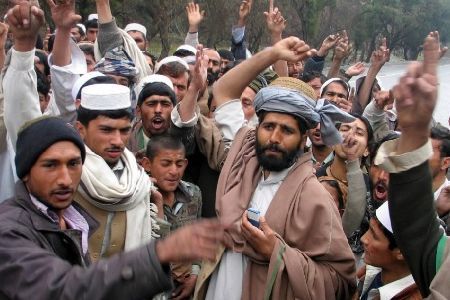
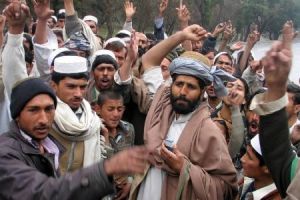 File photo of protesting Afghans
US-led foreign troops in Afghanistan have killed five Afghan civilians in the war-ravaged country, further intensifying security risks to the civilian population in the country.
Hundreds of people in central Afghanistan took to the streets on Thursday to protest the latest killing of the three Afghan civilians by the US-led forces in Ghazni, a Press TV correspondent reported.
The protesters said three Afghan civilians, including a student, were killed in an overnight raid in a remote village in Ghazni on Wednesday.
Carrying a copy of the Holy Quran with five bullet holes in it, the angry Afghans said the US-led troops desecrated the Holy Quran during the raid.
Earlier on Wednesday, two Afghan farmers were also reported killed in the town of Band-e-Chak in Wardak province.
Civilian deaths in US-led night raids have sparked several street protests in Afghanistan.
Earlier on Tuesday, Ghazni residents held a demonstration to protest what they called uncoordinated operations by US-led foreign forces stationed in Afghanistan.
NATO has claimed that the attack was aimed at a suspicious militant base, but Afghan police say no militants were in the area.
Thousands of civilians have lost their lives in attacks by US-led NATO forces occupying Afghanistan since 2001 in supposed effort to bring security to the nation.
Afghan civilian casualties were at record levels in 2010. The number of civilians killed or wounded in the Afghan war increased by 20 percent during the first 10 months of 2010, compared with the same period last year.
Featured Video

10 Climate Myths Busted (in 60 seconds!)
or go to
Aletho News Archives – Video-Images
Book Review
How the U.S. Navy Sold the Vietnam War
By Gareth Porter | TruthDig | March 27, 2019
Dr. Tom Dooley, whose best-selling book “Deliver Us From Evil” helped create a favorable climate of opinion for U.S. intervention in South Vietnam, has long been linked to legendary CIA officer Edward G. Lansdale and his black operations in Vietnam between 1954 and 1955. But the real story about Dooley’s influential book, which has finally emerged from more recent scholarly research, is that it was engineered by an official of the U.S. Navy’s Pacific Command, Capt. William Lederer.
Lederer is best known as the co-author, with Eugene Burdick, of the 1958 novel “The Ugly American,” which was turned into a 1963 movie starring Marlon Brando. Far more important, however, is the fact that from 1951 through 1957 Capt. Lederer was on the staff of the commander in chief of the U.S. Pacific Fleet (CINCPAC), Adm. Felix Stump. … continue
Blog Roll
 Aletho News
- In Mexico, the CIA Is Playing a Dangerous Game
- Spain’s Left Protested the Crisis It Legitimized: the General Strike as election stunt
- The power of inflicting oblivion
- The 10 Disease Renamings That Rescued the Vaccine
- NATO cancels 2027 leaders’ summit
- IAEA’s politicized use of safeguards undermines its impartiality: Russian envoy
- UK must be ready to strike Russian Arctic – ex-PM
- Fico’s Two Red Lines: Russian Energy and the Next Ukraine Loan
- Thousands rally for banned NATO-skeptic presidential candidate
- Ukraine Settlement and New European Security Architecture Must Go Hand in Hand – Kremlin
- If Americans Knew
- An error has occurred; the feed is probably down. Try again later.
- No Tricks Zone
- New Study: Barents Sea Temperatures Were Warmer And Sea Ice Less Extensive In The 1700s Than Today
- German Authorities Start Initiative To Evaluate Public Register For Climate “Disinformation” Spreaders!
- Zonal Asymmetry of Temperature Change in the Antarctic Circumpolar Current
- New Study: The Net Fossil Fuel Contribution To Rising Atmospheric CO2 Has Been Zero For 500 Years
- Germany’s Green Energy Transition Becoming Increasingly Expensive…Another 6 Trillion Euros!
- Sudden Stratospheric Warming, Powerful El Niño Combination May Lead To Extreme Europe Cold, Energy Crisis!
- Two New Studies Find Thwaites Glacier Melt Cannot Be Driven By Human Activity Or A Warming Ocean
- E-Cars Reduce CO2 Emissions By Only 41% Compared To Internal Combustion Engine Vehicles
- Predictions Made By Renowned Climate Professor Over Past Decades Have Been Proven To Be Poor
- New Study Suggests Large Regions Of The Pacific Ocean Have Been Cooling For The Last 80 Years

