‘Scores die’ in Afghan village raid
Al-Jazeera | July 26, 2010
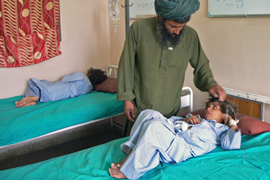 A Nato rocket attack on a village in Afghanistan last week killed 52 civilians, including women and children, the office of Hamid Karzai, the Afghan president, has said in a statement.
Based on reports from the Afghan National Directorate of Security, a house in Regey village in Sangin district of the southern Helmand province was hit with a rocket launched by Nato troops on Friday. […]
Helicopter attack
Reports surfaced on Saturday that a helicopter gunship fired on villagers who had been told by fighters to leave their homes as a firefight with troops from Nato’s International Security Assistance Force (Isaf) was imminent.
According to witness accounts, men, women and children fled to Regey village and were fired on from helicopter gunships as they took cover.
Abdul Ghafar, 45, told AFP, a French press agency, that he lost “two daughters and one son and two sisters” in the attack.
He and six other families fled to Regey, about 500 metres from their village of Ishaqzai, after being warned about the imminent battle, he said.
Men and women took shelter in separate compounds, he said, ahead of an expected firefight between Taliban fighers and Nato troops.
“Helicopters started firing on the compound killing almost everyone inside,” he said, speaking at the Mirwais hospital in Kandahar city.
“We rushed to the house and there were eight children wounded and around 40 to 50 others killed.” Ghafar said he took three girls and four boys to the Kandahar hospital.
He said: “Three of the wounded are my nephews and one is my son.
“One of the wounded children is four years old and has lost both parents.”
The BBC said it sent an Afghan reporter to Regey to interview residents, who described the attack and said they had buried 39 people.
Civilian casualties are an incendiary topic in Afghanistan, though surveys have shown that most are caused by Taliban attacks.
Colonel Wayne Shanks, an Isaf spokesman, said the location of the reported deaths was “several kilometres away from where we had engaged enemy fighters”.
Isaf forces had fought a battle with the Taliban, Shanks said, but an investigation team dispatched after the casualty reports emerged “had accounted for all the rounds that were shot at the enemy”.
“We found no evidence of civilian casualties,” he said.
Israel Admits: “Our Troops Are Psychopaths!”
Kevin Barrett | July 25, 2010
Yesterday’s radio guest Gordon Duff just broke a big story:
Gordon is skeptical of the Zionist claim that their troops, unlike American soldiers, don’t suffer from PTSD. If this is true, Gordon says, maybe it’s because American soldiers are fighting and dying for a Zionist-orchestrated series of lies, and are treated like “broken toys” when they come home; while Israeli soldiers are committing genocide for their own national benefit, and are relatively well-treated by their US-taxpayer-funded regime.
But there is a simpler explanation: In claiming that its soldiers are immune to PTSD, Israel is implicitly confessing that its troops are psychopaths.
In On Killing: The Psychological Cost of Learning to Kill in War and Society, Lt. Col. Dave Grossman shows that throughout history, 5% of the soldiers — the psychopaths and borderline psychopaths — have done 95% of the killing. As Grossman explains, studies by S.L.A. Marshall and associates showed that the vast majority of World War II infantry soldiers found ways to avoid firing at the enemy; and archeological evidence suggests that the same was true of previous wars.
Normal human beings can only kill at tremendous psychological cost, and thus find ways to avoid killing on the battlefield, even if it means losing their own lives. A non-psychopath who kills in wartime will almost certainly suffer some form of PTSD upon returning to civilian life.
Marshall’s studies spurred the development of intensive Pavlovian conditioning methods that raised the shoot-to-kill ratio to 50% in the Korean war, and 90% in Vietnam. That, Grossman suggests, is why PTSD rates skyrocketed. Normal, non-psychopathic men were being effectively turned into killers for the first time in history. When they came home, they couldn’t live with themselves.
It is a tribute to the American character — to the fact that only about 5% of American men are psychopaths — that our troops suffer from so much PTSD.
The Israelis, on the other hand…how to put this politely?
Andrzej Lobaczewski, in his seminal study of political psychopathy Political Ponerology, writes:
“The pathocratic phenomenon [a society ruled by psychopaths and those who catch the psychopathic contagion] has appeared many times in history…[it sometimes] occurs when the religious association itself succumbs to infection…succumbs to destruction from within, its organism becomes subordinated to goals completely different from the original idea, and its theosophic and moral values fall prey to characteristic deformation, thereby serving as a disguise for domination by pathological individuals. The religious idea then becomes both a justification for using force and sadism against nonbelievers, heretics, and sorcerers, and a conscience drug for people who put such inspirations into effect.“
Clearly the “religious idea” of Zionism has undergone this kind of pathological shift. Israel is a psychopathic state par excellence. Its soldiers slaughter innocent Palestinian children by the hundreds as they play on sidewalks and schoolyards as a de facto national policy:
“Two thirds of the 621 children (two thirds under 15 years) killed at checkpoints, in the street, on the way to school, in their homes, died from small arms fire, directed in over half of cases to the head, neck and chest – the sniper’s wound…Clearly, soldiers are routinely authorised to shoot to kill children in situations of minimal or no threat.” (British Medical Journal 10/16/04)
There are countless eyewitness accounts of these child-killings. For example, Chris Hedges, wrote in Harper’s magazine (October 2001) that he had been in several war zones, but he had never seen soldiers luring children within range of their guns, then gut-shooting them for sport, until he saw Israeli soldiers doing it in the Occupied Territories.
The Israeli soldiers who gut-shoot Palestinian children for sport apparently feel no remorse, and therefore suffer from no PTSD. Israeli society and its judicial system feel no remorse either, which is why they have never prosecuted the child-killers, and why polls show that more than 90% of Israeli Jews approve of the criminal destruction of Gaza by Operation Cast Lead.

A society that slaughters innocent children without remorse is a society of psychopaths.
Suspect in murder of four Palestinians was Shin Bet agent
By Jonathan Cook | The National | July 24. 2010
NAZARETH // The arrest by the Israeli internal security service, the Shin Bet, of an Israeli Jew accused of killing at least four Palestinians has thrown a rare light on the secret police, including claims that it tried to enlist the accused to assassinate a Palestinian spiritual leader.
Chaim Pearlman, who was arrested on July 13, has been charged with murdering four Palestinians in Jerusalem and injuring at least seven others in a series of knife attacks that began more than a decade ago. Police are still investigating whether he was involved in additional attacks.
Although Mr Pearlman had been denied access to a lawyer until Friday, since his arrest far-right groups have rapidly come to his aid, waging what the Shin Bet officials have described as “psychological warfare” by releasing damaging details about the case.
Ties between the Shin Bet and illegal settler organisations have come to light after Mr Pearlman’s arrest. The Shin Bet have been cornered into admitting that they recruited Mr Pearlman as an agent in 2000, in the midst of his alleged stabbing spree, despite the fact that he was a known member of Kach, an outlawed group calling for the expulsion of Palestinians from “Greater Israel”.
In addition, Mr Pearlman has also released tape recordings he secretly made of recent conversations with an undercover Shin Bet agent who tried to get Mr Pearlman to incriminate himself.
The agent, who befriended Mr Pearlman and was known as “Dada”, can be heard exhorting him both to go to an “Arab village” to “turn it into a fireworks display” and to execute Sheikh Raed Salah, a leader of the Islamic Movement and a recent participant in the aid flotilla to Gaza that was attacked by Israel.
In the 20 hours of recordings with Dada, some of which have been broadcast on Israeli television, the undercover agent can be heard repeatedly inciting Mr Pearlman to kill Sheikh Salah,
Dada says: “Why haven’t soldiers killed Raed Salah, may he die? Someone should take care of him, send him to the next world.”
He then suggests Mr Pearlman shoot at the sheikh’s car or put a bomb under it. “That’s the classic one. Nothing’s left, everything goes everywhere,” he says on the recording.
Dada’s advice came after Sheikh Salah had stated that Israeli commandos aboard Mavi Marmara ship had tried to kill him. Mr Pearlman, who apparently suspected he was being investigated, sent the recorded conversations with Dada to local media to be broadcast in the event of his detention.
In another blow to the Shin Bet, Mr Pearlman’s supporters have released a secretly filmed video of the head of the agency’s Jewish division, which arrested Mr Pearlman, naming him and identifying where he lives.
Although the agent is in charge of handling “Jewish terror” cases, the video states that he lives in Kfar Adumim, a West Bank settlement.
It is a criminal offence to identify any employee of the Shin Bet, but the release of details about such a senior figure is certain to provoke fears among officials that he may be in danger, including revenge attacks or future prosecution in an international tribunal.
Mr Pearlman’s supporters have posted the video on YouTube and other overseas websites, making it difficult for the Shin Bet to remove.
Nadia Matar, the leader of the pro-settler group Women in Green, told the Jerusalem Post last week that the Shin Bet divisional head “has to know that there is a price to stabbing Jewish brothers in the back. People have to be loyal or bear the consequences.”
The Shin Bet’s modus operandi was exposed in part by a rare decision from the judge supervising the investigation to partially revoke a gag order immediately after Mr Pearlman’s arrest.
Abir Baker, a lawyer with Adalah, a legal centre that handles Palestinian security cases, said: “The Shin Bet is facing an internal crisis over this arrest and the settlers are trying to exploit that with their campaign.
“Many members of the Shin Bet are settlers themselves and think of these extremists as their colleagues, not as the enemy. The line between the Shin Bet and these extremist organisations is very blurred.”
Unlike in the case of Palestinian attacks on Israelis, attacks by Jews on Palestinians are rarely solved, leading to criticism that the Shin Bet is not serious about tackling the problem of Jewish terror.
Amir Oren, a columnist for the liberal Haaretz newspaper, accused the Shin Bet of having “chains on its feet and weights around its neck” when it investigated such cases.
Yaakov Teitel, a settler who was arrested by the Shin Bet last year, was accused of his first murder of a Palestinian 14 years ago. Some observers have suggested he was only arrested after he started attacking left-wing Jews, including placing a bomb at the home of a prominent academic in 2008.
Ms Baker said Jewish terrorists often found it easy to evade the Shin Bet because they had learnt about the organisation’s investigation techniques while working as agents.
Although Mr Pearlman, 30, was living in the Israeli town Yavne, north of Ashdod, at the time of his arrest, he was raised on a settlement and spent time living in Kfar Tapuach, which is closely identified with the Kach movement. Despite being illegal, Kach operates relatively openly in settlements and Mr Pearlman’s connections to the group may explain the well-organised campaign quickly mounted in his defence.
Itamar Ben Gvir, a parliamentary aide to Michael Ben Ari, an MP who has maintained ties to Kach, was reported by the Israeli press to be behind the media campaign against Shin Bet. Mr Pearlman is also being helped by Honenu, a legal organisation that defends Jews accused of attacking Palestinians.
Anonymous Shin Bet officials told Channel 2 television that the campaign being waged against them by the far-right was “a completely different game” from previous confrontations.
foreign.desk@thenational.ae
Toxic legacy of US assault on Fallujah ‘worse than Hiroshima’
Shocking rates of infant mortality and cancer
By Patrick Cockburn | The Independent | 24 July 2010
Dramatic increases in infant mortality, cancer and leukaemia in the Iraqi city of Fallujah, which was bombarded by US Marines in 2004, exceed those reported by survivors of the atomic bombs that were dropped on Hiroshima and Nagasaki in 1945, according to a new study.
Iraqi doctors in Fallujah have complained since 2005 of being overwhelmed by the number of babies with serious birth defects, ranging from a girl born with two heads to paralysis of the lower limbs. They said they were also seeing far more cancers than they did before the battle for Fallujah between US troops and insurgents.
Their claims have been supported by a survey showing a four-fold increase in all cancers and a 12-fold increase in childhood cancer in under-14s. Infant mortality in the city is more than four times higher than in neighbouring Jordan and eight times higher than in Kuwait.
Dr Chris Busby, a visiting professor at the University of Ulster and one of the authors of the survey of 4,800 individuals in Fallujah, said it is difficult to pin down the exact cause of the cancers and birth defects. He added that “to produce an effect like this, some very major mutagenic exposure must have occurred in 2004 when the attacks happened”.
US Marines first besieged and bombarded Fallujah, 30 miles west of Baghdad, in April 2004 after four employees of the American security company Blackwater were killed and their bodies burned. After an eight-month stand-off, the Marines stormed the city in November using artillery and aerial bombing against rebel positions. US forces later admitted that they had employed white phosphorus as well as other munitions.
In the assault US commanders largely treated Fallujah as a free-fire zone to try to reduce casualties among their own troops. British officers were appalled by the lack of concern for civilian casualties. “During preparatory operations in the November 2004 Fallujah clearance operation, on one night over 40 155mm artillery rounds were fired into a small sector of the city,” recalled Brigadier Nigel Aylwin-Foster, a British commander serving with the American forces in Baghdad.
He added that the US commander who ordered this devastating use of firepower did not consider it significant enough to mention it in his daily report to the US general in command. Dr Busby says that while he cannot identify the type of armaments used by the Marines, the extent of genetic damage suffered by inhabitants suggests the use of uranium in some form. He said: “My guess is that they used a new weapon against buildings to break through walls and kill those inside.”
The survey was carried out by a team of 11 researchers in January and February this year who visited 711 houses in Fallujah. A questionnaire was filled in by householders giving details of cancers, birth outcomes and infant mortality. Hitherto the Iraqi government has been loath to respond to complaints from civilians about damage to their health during military operations.
Researchers were initially regarded with some suspicion by locals, particularly after a Baghdad television station broadcast a report saying a survey was being carried out by terrorists and anybody conducting it or answering questions would be arrested. Those organising the survey subsequently arranged to be accompanied by a person of standing in the community to allay suspicions.
The study, entitled “Cancer, Infant Mortality and Birth Sex-Ratio in Fallujah, Iraq 2005-2009”, is by Dr Busby, Malak Hamdan and Entesar Ariabi, and concludes that anecdotal evidence of a sharp rise in cancer and congenital birth defects is correct. Infant mortality was found to be 80 per 1,000 births compared to 19 in Egypt, 17 in Jordan and 9.7 in Kuwait. The report says that the types of cancer are “similar to that in the Hiroshima survivors who were exposed to ionising radiation from the bomb and uranium in the fallout”.
Researchers found a 38-fold increase in leukaemia, a ten-fold increase in female breast cancer and significant increases in lymphoma and brain tumours in adults. At Hiroshima survivors showed a 17-fold increase in leukaemia, but in Fallujah Dr Busby says what is striking is not only the greater prevalence of cancer but the speed with which it was affecting people.
Of particular significance was the finding that the sex ratio between newborn boys and girls had changed. In a normal population this is 1,050 boys born to 1,000 girls, but for those born from 2005 there was an 18 per cent drop in male births, so the ratio was 850 males to 1,000 females. The sex-ratio is an indicator of genetic damage that affects boys more than girls. A similar change in the sex-ratio was discovered after Hiroshima.
The US cut back on its use of firepower in Iraq from 2007 because of the anger it provoked among civilians. But at the same time there has been a decline in healthcare and sanitary conditions in Iraq since 2003. The impact of war on civilians was more severe in Fallujah than anywhere else in Iraq because the city continued to be blockaded and cut off from the rest of the country long after 2004. War damage was only slowly repaired and people from the city were frightened to go to hospitals in Baghdad because of military checkpoints on the road into the capital.
Israel’s friends at Westminster legislate to protect vilest criminals
By Stuart Littlewood | 24 July 2010
Israelis wanted for war crimes can sleep easier thanks to their friends and admirers in the British Establishment.
Yes, our brand-new coalition government intends providing a safe haven for the vilest of criminals.
When Israel’s ex-foreign minister, Tzipi Livni, and other architects of the terror campaign against Palestinian civilians, recently cancelled trips to the UK for fear of being arrested under universal jurisdiction laws on charges of war crimes, it sparked a diplomatic row. Britain’s then foreign secretary-in-waiting, William Hague, an avid Friend of Israel since boyhood, said: “We cannot have a position where Israeli politicians feel they cannot visit this country. The situation is unsatisfactory [and] indefensible. It is absolutely my intention to act speedily.”
He found it “completely unacceptable” that someone like Livni felt she could not visit the UK. He didn’t explain how welcoming Livni with open arms was possible “without weakening our commitment to hold accountable those guilty of war crimes”.
Gordon Brown, the then prime minister, expressed his regret over the incident, saying that Livni was “most welcome in Britain any time” – even though she was no longer a government minister in Israel.
Under universal jurisdiction all states that are party to the Geneva Conventions are obliged to seek out and either prosecute or extradite those suspected of having committed grave breaches of the conventions and bring them, regardless of nationality, to court.
“Grave breaches” means willful killing, torture or inhuman treatment, causing great suffering or serious injury to body or health, and other serious violations of the laws of war … the sort of atrocities that have been (and still are) committed wholesale by Israel in the Gaza Strip and West Bank.
Lo and behold, new Justice Secretary Kenneth Clarke has announced, just as MPs are about to disappear on their long summer recess, that “it would be appropriate to require the consent of the director of public prosecutions before an arrest warrant can be issued to a private prosecutor in respect of an offence of universal jurisdiction.”
Alerts have gone out from activist groups. The Palestine Solidarity Campaign urges its members to write to their MPs immediately:
This would seriously hamper the work of human rights lawyers in this country who are attempting to bring these war criminals to justice, and would deny the Palestinians yet another chance at justice.
Between September and December 2009, lawyers issued arrest warrants against three Israeli ministers who were planning to visit Britain. Two of them – Livni and Moshe Ya’alon – cancelled their visits as a result. The third – Ehud Barak – had his status upgraded by the then Labour government, so that he could attend the Labour Party conference in Brighton.
If the Government’s plans become law, warrants such as these will become much harder to serve.
Meanwhile, in his report to the UN, Judge Richard Goldstone found masses of evidence of war crimes by Israel in Gaza and has called for individual states in the international community to “start criminal investigations in national courts, using universal jurisdiction, where there is sufficient evidence of the commission of grave breaches of the Geneva Conventions of 1949″.
Hague and Clarke, however, seem determined to make the likes of Livni and Barak and their murderous military henchmen a protected species.
The director of public prosecutions, a supposedly independent figure, is answerable through the attorney-general. The new attorney-general is Dominic Grieve. In 2007 he was in Israel with a Conservative Friends of Israel delegation. He spoke up for the release of captured Israeli soldier Gilad Shalit but his sense of justice apparently didn’t prompt him to mention the thousands of Palestinian civilians tortured and rotting in Israeli jails.
Grieve’s deputy is Solicitor-General Edward Garnier. In February, while still in opposition but warming up for the general election, he and Kenneth Clarke visited Israel as delegates of Conservative Friends of Israel when they could (and should) have gone under a neutral parliamentary flag. They met with deputy foreign minister Danny Ayalon and leader of the Opposition Livni. Ayalon is also on the wanted list but was able to visit London after receiving a letter from the Foreign Office promising he would be safe from arrest while in England.
At the height of the Gaza blitz (which killed 1,400 including 350 children, destroyed or damaged 58,000 homes, 280 schools, 1,500 factories, water and sewage installations and 80 per cent of agricultural crops), Hague said in Parliament: “The immediate trigger for this crisis … was the barrage of hundreds of rocket attacks against Israel on the expiry of the ceasefire or truce.”
Wrong. A person in his position should know better than mouth off the Israeli propaganda line. The truce with Hamas didn’t just “expire”. It was violated after six months by Israeli forces, killing six Palestinians in air strikes and other attacks, in order to provoke Hamas. Israel had also failed to deliver its side of the ceasefire bargain, which was to lift the blockade.
While the evidence piles up against Livni and others, the justice secretary assures us that “our commitment to our international obligations and to ensuring that there is no impunity for those accused of crimes of universal jurisdiction is unwavering”. How can that be if universal jurisdiction cases in future are filtered and processed solely by the director of public prosecutions?
The fear is that the director of public prosecutions’ wheels turn so slowly that the birds will have flown before arrests can be made, and the change in the law will simply enable the director of public prosecutions to thwart private efforts to bring to book those criminals the British government regards as friends.
Let’s remember that after the 22-day devastation of Gaza and the mega-deaths and maimings, their friend Livni bragged how she would happily do it again.
Hague, after just two months in the top job at the Foreign Office, is already an embarrassment to English people who yearn for moral leadership in foreign affairs. It was Hague who uttered these words in 2008: “The unbroken thread of Conservative Party support for Israel that has run for nearly a century from the Balfour Declaration to the present day will continue. Although it will no doubt often be tested in the years ahead, it will remain constant, unbroken, and undiminished by the passage of time.”
Undimished by the passage of crime, too.
New Israeli report on Operation Cast Lead confirms Goldstone report’s main findings
By Yaniv Reich on July 22, 2010
Defense Minister Ehud Barak described it as “false, distorted, and irresponsible“. Information Minister Yuli Edelstein called it “anti-Semitic“. Israeli Ambassador to the US Michael Oren said it “insidiously… portrayed the Jews as the deliberate murderers of innocents“. Foreign Minister Lieberman argued that its true purpose “was to destroy Israel’s image, in service of countries where the terms ‘human rights’ and ‘combat ethics’ do not even appear in their dictionaries“. And the US House of Representatives banded together in bipartisan harmony to pass a resolution (344–36) that called “on the President and the Secretary of State to oppose unequivocally any endorsement or further consideration” of it.
For nearly a year now, vicious attacks on the Goldstone report and on Judge Goldstone himself have been the thing for Israel’s numerous apologists to do.
There is just one not-so-minor problem with this knee-jerk criticism of the report and infinite stream of ad hominem libel against its main author. A majority of the most damning—and damaging—war crimes that are alleged to have taken place have now been confirmed by the IDF’s own investigations into the matter, themselves only conducted in an effort to derail the Goldstone report’s referral to the International Criminal Court.
IDF confirms over 20 gravest findings of the Goldstone Report
Several of the most dramatic instances of war crimes, which previously stirred Israel’s defenders into fits, are now publicly admitted by the IDF in the recent update to its official response (which can be found here).
Some examples of war crimes include:
- White phosphorous in urban areas: This one is probably the most famous admission that emerged after a series of easily disproved lies. Israel’s initial response was one of absolute denial, indeed indignation, that people would suggest it had used banned chemical weapons in densely populated areas. But the steady stream of photos and videos depicting phosphorous burns on children and buildings eventually forced Israel to admit it had used these prohibited weapons.
- The murder of two unarmed Palestinians carrying white flags of surrender.
- The Al-Fakhura Street incident: Israeli mortar fire at a site adjacent to a UN Relief Works Agency compound resulted in multiple civilian deaths.
- The use of innocent Palestinians as human shields: The Goldstone report explains that in order “to carry out house searches as human shields the Israeli soldiers took off AD/03’s blindfold but he remained handcuffed. He was forced to walk in front of the soldiers and told that, if he saw someone in the house but failed to tell them, he would be killed. He was instructed to search each room in each house cupboard by cupboard. After one house was completed he was taken to another house with a gun pressed against his head and told to carry out the same procedure there. He was punched, slapped and insulted throughout the process.” The new Israeli report identifies this anonymous human shield AD/03 and confirms this episode. Other cases of human shield use, e.g. Abbas Ahmad Ibrahim Halawa and Mahmoud Abd Rabbo al-Ajrami, were also confirmed.
- Al-Samouni family massacre: The Israelis attacked two houses of the Samouni family, killing 23 people in total. Subsequently, they prevented the Red Cross and PRCS from providing care to the wounded and dying for three days. Confirmed by Israel and the subject of a military investigation.
- Firing on Al Maqadmah and other mosques during prayer time.
In total, a quick scan through the IDF’s new report provides direct confirmation of more than 20 of Goldstone’s findings.
Israeli report on shootings of ‘4 civilians’ fails to state that they were three sisters, 3, 5, and 9, and their grandmother
By Philip Weiss on July 21, 2010
On Monday the Israeli government posted its latest word on the Gaza conflict of ’08-’09. It’s called the “second update” on its investigation of incidents during the conflict.
Below I have excerpted three accounts of one incident in the war: the shootings of three sisters and their grandmother on January 7, 2009, in which two of the girls died. The accounts: 1, the Israeli government’s account, 2, a report on the incident in the Goldstone Fact-Finding Mission of the U.N., and 3, the account of the shootings from the girls’ father, as told to the Goldstone Mission.
Notice that the Israeli account, which absolves the Israeli unit engaged of any criminal responsibility, and describes the shootings as allegations purely, refers to the case as the shooting of 4 civilians, and while it gives their names, it does not say that the civilians were three sisters, aged 3, 5, and 9, and their 60-year-old grandmother.
1, The Israeli investigation:
(3) Amal, Souad, Samar, and Hajja Souad Abd Rabbo & Adham Kamiz Nasir
108. This incident involved the alleged shooting of four Palestinian civilians on 7 January 2009 in the neighborhood of Izbat Abd Rabbo, and was reported to Israeli authorities by several human rights organizations. The MAG referred the complaint to a direct criminal investigation which was recently concluded. In the course of this comprehensive investigation, the MPCID collected testimony from eleven Palestinians who witnessed the events. Some of them were unable or unwilling to testify before MPCID investigators, but provided detailed affidavits. In addition, the investigators reviewed medical reports and death certificates, as well as aerial photographs provided by an Israeli NGO, which helped identify the different units involved in the incident. More than fifty commanders and soldiers from these units were also questioned by the MPCID. Some were questioned multiple times in order to clarify the circumstances of the case.
109. The evidence collected in the course of the investigation could not confirm the description of the incident by the complainants, who claimed that a soldier standing on a tank had opened fire at a group of civilians. The substantial discrepancies between the complaint and the findings of the investigation—in particular, the identity of the force and the sequence of events—led the MAG to conclude that the evidence was insufficient to initiate criminal proceedings.
2, Now: The Goldstone Report, (hear it narrated here)
770. The Mission visited the site of the shooting of Amal, Souad, Samar and Hajja Souad Abd Rabbo and interviewed an eyewitness, Mr. Khalid Abd Rabbo, on site. Khalid and Kawthar Abd Rabbo gave their testimony at the public hearing in Gaza on 28 June 2009. The Mission also reviewed sworn statements from two additional witnesses it was not able to interview in person.
771. The family of Khalid Abd Rabbo and his wife Kawthar lived on the ground floor of a four-storey building in the eastern part of Izbat Abd Rabbo, a neighbourhood east of Jabaliyah inhabited primarily by members of their extended family. Khalid Abd Rabbo’s parents and brothers with their families lived on the upper floors of the house. The residents of Izbat Abd Rabbo started hearing the sound of shooting and of the Israeli ground incursion in the evening of 3 January 2009. Khalid Abd Rabbo’s family decided to stay inside the house, all gathered on the ground floor, as they had done safely during previous Israeli incursions into the neighbourhood.
772. In the late morning of 7 January 2009, Israeli tanks moved onto the small piece of agricultural land in front of the house. Shortly after 12.30 p.m., the inhabitants of that part of Izbat Abd Rabbo heard megaphone messages telling all residents to leave. According to one witness’s recollection, there had also been a radio message broadcast by the Israeli armed forces around 12.30 announcing that there would be a temporary cessation of shooting between 1 and 4 p.m. that day, during which time residents of the area were asked to walk to central Jabaliyah.
773. At about 12.50 p.m., Khalid Abd Rabbo, his wife Kawthar, their three daughters, Souad (aged 9), Samar (aged 5) and Amal (aged 3), and his mother, Hajja Souad Abd Rabbo, stepped out of the house, all of them carrying white flags. Less than 10 metres from the door was a tank, turned towards their house. Two soldiers were sitting on top of it having a snack (one was eating chips, the other chocolate, according to one of the witnesses). The family stood still, waiting for orders from the soldiers as to what they should do, but none was given. Without warning, a third soldier emerged from inside the tank and started shooting at the three girls and then also at their grandmother. Several bullets hit Souad in the chest, Amal in the stomach and Samar in the back. Hajja Souad was hit in the lower back and in the left arm.
774. Khalid and Kawthar Abd Rabbo carried their three daughters and mother back inside the house. There, they and the family members who had stayed inside tried to call for help by mobile phone. They also shouted for help and a neighbour, Sameeh Atwa Rasheed al-Sheikh, who was an ambulance driver and had his ambulance parked next to his house, decided to come to their help. He put on his ambulance crew clothes and asked his son to put on a fluorescent jacket. They had driven a few metres from their house to the immediate vicinity of the Abd Rabbo house when Israeli soldiers near the Abed Rabbo house ordered them to halt and get out of the vehicle. Sameeh al-Sheikh protested that he had heard cries for help from the Abd Rabbo family and intended to bring the wounded to hospital. The soldiers ordered him and his son to undress and then re-dress. They then ordered them to abandon the ambulance and to walk towards Jabaliyah, which they complied with. When the families returned to Izbat Abd Rabbo on 18 January, they found the ambulance was in the same place but had been crushed, probably by a tank.
775. Inside the Abed Rabbo house, Amal and Souad died of their wounds. The family decided that they had to make an attempt to walk to Jabalya and take Samar, the dead bodies of Amal and Souad, and their grandmother to hospital. Khaled and Kawthar Abd Rabbo, and other family members and neighbours carried the girls on their shoulders. Hajja Souad was carried by family and neighbours on a bed. Samar was transferred to al-Shifa hospital and then, through Egypt, to Belgium, where she still is in hospital. According to her parents, Samar suffered a spinal injury and will remain paraplegic for the rest of her life.
776. When Khalid Abd Rabbo returned to his home on 18 January 2009, his house, as most houses in that part of Izbat Abd Rabbo, had been demolished. He drew the Mission’s attention to an anti-tank mine under the rubble of a neighbour’s house.
From the Goldstone Mission’s interview of Khaled Abed Rabbo, the father of the three girls:
Khaled Abed Rabbo
On January 7 at 12:50 p.m. the Israeli army bulldozed our garden and the Israeli tanks were positioned in front of our house. They started yelling at us through the speakers and asked us to leave the house. So I came out along with my wife and my three children: Suad, 8 years old, Samar, 4 years old, and Amal, 3 years old, and my mother, 60 years old. We were all holding white flags. The Israeli army was stationed right across from our house. So we stood by our entrance and holding… white flags. The tanks were seven meters away from our house…. They did not say anything to us. There were two soldiers sitting on top of the tank. One of them was eating chips. The other one was eating chocolate. We were looking at them like what are we supposed to do, where should we go… We were surprised because there was all of a sudden a third soldier coming out of the tank and they starting shooting at the children with no reason… with no explanation, no pretext. My daughter, 3 years old, her stomach was hit and her intestines were coming out. So really I was amazed at how could a soldier be firing at my daughter? So I carried my daughter, 3 years old. She could hardly breathe…. My other daughter was also wounded in her chest. So I took both of them, Samar and Amal, inside the house. My wife and my mother and my other daughter Suad were still outside. All of a sudden my wife joined me carrying Suad… Her chest was wounded by many bullets. My mother, 60 years old, she was carrying the white flag and she was wounded on her forearm and also in her stomach. So we were all inside the house and we started calling the ICRC, the ambulances, anybody to come and rescue us but nobody came and all of a sudden we heard an ambulance but all of a sudden nothing, silence. But later, we saw that the Israeli soldiers asked the ambulance drivers to come out of the car, to undress, and they bulldozed the ambulance with the tank… My daughter, Amal, 3 years old, she was dying and at the end of the day she did die. My other daughter, 8 years old, like I said, her chest was riddled with bullets. She passed away. My other daughter, Samar, her back was riddled with bullets. Her back was open. She was not breathing through her nose but through her lungs and she was telling me, “Dad, help, help,” and I couldn’t do anything. She was thirsty. I was afraid if I gave her any water something would happen. I didn’t know what to do. My mother, 60 years old, was also dying. I was helpless. I didn’t know what to do for my children. There was my daughter dying in front of me. So I carried her and left the house even if I had to die myself because I couldn’t take it anymore. So I carried my daughter and left the house again so that the soldier, he might as just well kill my daughter and kill myself because I couldn’t take it anymore. I couldn’t let my children die in front of me.
Egypt Decides To Deny Entry To Jordanian Aid Convoy
By Saed Bannoura – IMEMC & Agencies – July 19, 2010
The Egyptian Authorities prevented the “Ansar 1” Jordanian aid convoy from entering Egypt while on their way to deliver humanitarian supplies to the Gaza Strip.
The Egyptian Foreign Ministry issued an official decree preventing the convoy from entering the country by all means, the Qatar-based Al Jazeera reported.
Hussein Al Saoub, head of the “Al Jisr Al Araby”, the Arabic Bridge Company, phoned late on Sunday at night the head of the Jordanian convoy informing him that Egypt decided to prevent the convoy from entering Egypt.
There are 138 persons participating in the aid convoy. Al Sa’oub said that the Egyptian Authorities decided that each person on the convoy is a “Persona non grata”.
The aid was sent by a company owned by the governments in Iraq, Jordan and Egypt; the plan was to leave on Monday morning from Aqaba in Jordan to the Egyptian city Nweibi’.
Despite the Egyptian decision, convoy organizers decided to head to Aqaba in order to try to sail to Egypt before heading to Gaza.
Head of the Jordanian “Artery Of Life” committee, Wa’el Al Saqqa, said that the “Al Jisr Al Araby” company is the only company in charge of shipments between Aqaba and Nweibi’ on the Red Sea.
The company granted the participants all needed travel tickets and documents but Egypt officially decided to prevent them from entering.
Gaza imports held at port for 4 years
Israeli occupation authority still holding hundreds of cargo containers belonging to Palestinian traders
Ma’an – 18/07/2010
Gaza – Israeli authorities have yet to release Gaza-bound goods sequestered at Israeli seaports for over four years despite reportedly easing the terms of its blockade, independent lawmaker Jamal Al-Khoudary said Sunday.
Al-Khoudary, who also heads the Popular Committee Against the Siege, issued a statement saying containers imported by Palestinian merchants since Israel imposed its blockade have yet to receive their goods.
Detained at Israeli ports, merchants are forced to pay considerable fines despite legally importing the goods, the lawmaker said.
Israel continues to ban the entry of raw materials, Al-Khoudary added, leading to the continued closure of Gaza’s factories and forcing thousands into unemployment.
The legislator described Israel’s change in its siege policy as “nothing more than propaganda” and “marginal steps which do not have any positive influence on Gaza’s population.”
Al-Khoudary called for the opening of all crossings into Gaza, the free flow of goods, raw and for construction, the opening of a sea passage, and safe passage for Palestinians traveling between Gaza and the West Bank.
Following international pressure to lift its blockade of after six aid vessels were raided by navy forces on May 31, the Israeli cabinet published a list of banned goods for import and said it would be allowing previously barred items in.
EU foreign policy chief Catherine Ashton, who arrived in Gaza on Sunday, called on Israel for a “full and effective implementation of the new Israeli policy to improve the lives of the people of Gaza and meet their needs for humanitarian and commercial goods.”
The EU official further said improving the economic situation in Gaza “is not simply a matter of letting in aid – it is a matter of revitalizing the local economy.”
“For a fundamental change, private sector development and commercial activity, including exports, will be crucial,” Ashton said, expressing hope that the crossings’ capacity would be expanded.
Blockade: Dockers respond to Israel’s Flotilla Massacre and Gaza Siege
Report by Greg Dropkin on 09/07/10
Three weeks after the massacre on the Freedom Flotilla, ILWU dockworkers in the San Francisco Bay area delayed an Israeli Zim Lines ship for 24 hours, the Swedish Dockworkers Union began a week-long blockade of Israeli ships and containers, dockers in the Port of Cochin, India, refused to handle Israeli cargo, and the Turkish dockworkers union Liman-Is announced their members would refuse to service any Israeli shipping. In South Africa, Durban dockers had already boycotted a Zim Lines ship in response to the invasion of Gaza last year.
On the 5th Anniversary of the United Palestinian Call for Boycott Divestment and Sanctions, Israel faces the prospect of targetted industrial action to implement boycotts. How did it happen, what does it mean, and how can the solidarity movement respond to the new opening?
Oakland
| photo: PSLweb.org |
 |
| Port of Oakland 5:30 am 20 June 2010 |
At 5am on Sunday 20th June, 800 trade unionists and Palestine solidarity activists from the San Francisco Bay Area marched to the SSA (Stevedoring Services of America) terminal at Berths 57-58 in the Port of Oakland, where the “Zim Shenzhen” was due. Zim Lines is the main Israeli shipping company, with services connecting Israel to the world. The ship sailed from Haifa, calling at Piraeus, Livorno, Genoa, Tarragona, Halifax, New York, Savannah, Kingston, Panama Canal, Los Angeles before reaching Oakland.
When longshore workers turned up for the day shift a mass demo was in place at four gates chanting “Free, Free Palestine, Don’t You Cross Our Picket Line”. . .“An Injury to One is An Injury to All, Bring Down the Apartheid Wall”. . .“Open the Siege, Close the Gate, Israel is a Terrorist State”. . . As union members spoke to drivers, pickets sat down in front of cars. The San Francisco Labor Council and the Alameda County Labor Council had passed their own resolutions and mobilised hundreds of trade unionists to back the demo called by the Labor Community Committee in Solidarity with the Palestinian People. It was an unprecedented show of strength from the local and regional AFL-CIO, affiliated unions and their members side by side with Palestinian and Arab-American activists. The Gaza ships were originally organised by Paul Larudee from San Francisco, and Bay Area residents had sailed with him. Now everyone came together for a united action organised in just two weeks.
Local 10 and Local 34 (clerical) are militant sections of the International Longshore Workers Union. The ILWU organises longshore (dockers) and many other industrial sectors on the US West Coast and Hawaii. With a history stretching back to 1934, the ILWU has faced the employers in countless disputes on the docks, carried out industrial solidarity action with other workers, fought against racism, adopted resolutions which characterize the Israeli oppression of Palestinians as “state-sponsored terrorism”, and on May 1st 2008 shut down every port on the US West Coast against the war in Iraq. Labor laws in the U. S. like the Taft-Hartley Act make it illegal for unions to organize solidarity actions.
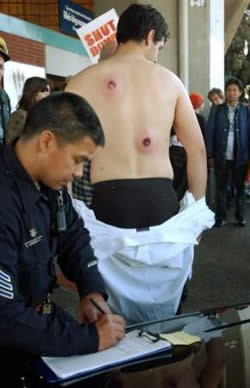
The Oakland longshore workers arrived for the day shift and refused to cross the picket line on grounds of “health and safety”. The Pacific Maritime Association, on behalf of the employer SSA, immediately called in the Arbitrator (a joint union-management procedure for first-line response to disputes on the docks) hoping he would order everyone to work. The Arbitrator considered the PMA demand that the police use force to open access through the picket line, to make it “safe” for workers to enter the terminal. The union argued that the Oakland police are a threat to the security of workers and demonstrators. In 2003, as the U. S. attacked Iraq, Oakland police fired so-called “non lethal” weapons at longshore workers and anti-war demonstrators alike, injuring scores and sending many to hospital.
REUTERS/Tim Wimborne
The Arbitrator agreed with the union. As per their contract, the dockers were sent home with pay for standing by, however the employers have refused to abide by the Arbitrator’s decision and have paid out nothing, leaving the issue in dispute.
The “Zim Shenzen” had left Los Angeles around 2:30pm Saturday, and could have arrived at the San Francisco pilot station in as little as 18 hours, plus 2 hours to the dock. The ship’s tracking system was removed from the nautical GPS system, leaving the demo guessing when it would arrive. But with several hundred marching at 5:30am swelling to 800 as the morning progressed, the company decided to hold up the docking until 6pm. By then, SSA Terminal realised that the mass picket line would return for the evening shift and the Arbitrator would make the same decision, so they gave up and prudently chose not to call longshoremen to report for work. The ship sat at the quay, untouched. Establishing the mass picket line early and preventing longshoremen and clerks from working the terminal was critical in this victory.
This was the first ever boycott of an Israeli ship by workers in the US, where Zionism has counted on influencing the traditional stance of the mainstream labor movement, as well as elected politicians.
“An Injury to One is An Injury to All” is the slogan of the ILWU. It is also an emblem for South African workers.
The “Zim” action was recognised as a direct echo of Local 10’s fight against apartheid in 1984, when members refused to work South African steel and coal for 11 days until the employer obtained a Federal injunction to break the boycott. Interviewed on video during the “Zim” picket, Local 10 Executive Board member Clarence Thomas stated [1]
“This is a historic occasion. Everyone remembers the action taken by the community and labor in 1984 at Pier 80 in San Francisco, where the “Nedlloyd Kimberley” was picketed.”
Retired Local 10 longshore worker Howard Keylor, a co-organiser of that action, recalled:
“This was the result of over a decade of education within the Local on the horrors of the South African apartheid regime. South Africa arrested the entire leadership of the black miners union (the National Union of Mineworkers) and charged them with treason, and was threatening to execute them. I made the motion in Local 10, which passed unanimously, not to work the cargo in the next ship that came in. It was the longshore courage in deliberately violating the Taft-Hartley law and the union contract that made that successful.”
Clarence Thomas set out the current strategy:
“People are lacking food, people cannot rebuild in Gaza, construction supplies are not allowed. They haven’t even been allowing chewing gum! The thing that is going to make Israel and the United States both understand that this cannot continue, is the whole question of commerce and trade. Israel is very vulnerable on that question. This was critical in building the mobilisation in 1984 against apartheid, with three prongs: Boycotts, Sanctions, and Divestment.”
Jack Heyman, also from the Local 10 Executive Board:
“If longshoremen decide they’re not going to cross the picket line, then the Zim ship that’s coming in is not going to be worked, and that’s going to be repeated around the world, in Norway, Sweden, South Africa. I think people are beginning to understand that the Israeli government is going to have to be sent a message loud and clear, that their policies towards the Palestinian people are unjust and they’re going to suffer the consequences. It’s not business as usual when they commit acts of murder like this.”
Monadel Herzallah, of the Arab American Union Members Council summed up the impact on the labour movement:
“It’s indeed a significant turning point in the work with labour, and it’s significant because ILWU has honoured our picket line, it is something that we cherish, that we think will make an impact not only in the United States of America but also worldwide. The Labor Councils in Alameda and in San Francisco, responded to the call by encouraging labor unions, members, activists, to support this, with dozens of other community organisations who have worked to make this picket successful. People have wanted to tell this government and the government of Israel that they cannot be above the law, they have to be held accountable for what they did against these unarmed civilians on the flotilla ship in the Mediterranean.”
Palestinian unions appeal
On 7 June, the Palestinian trade union movement had produced a united appeal [2] to dockworkers unions worldwide. It was signed by the Palestinian General Federation of Trade Unions (PGFTU), the General Union of Palestinian Workers (GUPW), the Federation of Independent Trade Unions (IFU), and 11 other Palestinian union and labour movement organisations. It concluded
“Gaza today has become the test of our universal morality and our common humanity. During the South African anti-apartheid struggle, the world was inspired by the brave and principled actions of dockworkers unions who refused to handle South African cargo, contributing significantly to the ultimate fall of apartheid. Today, we call on you, dockworkers unions of the world, to do the same against Israel’s occupation and apartheid. This is the most effective form of solidarity to end injustice and uphold universal human rights.”
This appeal was doubly significant. It gave the basis for dockers to respond, knowing that the call came from fellow workers. And, it showed exceptional unity on the Palestinian side, a big step in its own right.
The joint union appeal developed the call from the Palestinian Boycott National Committee (BNC) issued on 1 June, which included: [3]
We call specifically on transport and dock workers and unions around the globe to: Refuse to load/offload Israeli ships and airplanes, following the historic example set by the South African Transport and Allied Workers Union (SATAWU) in Durban in February 2009 and endorsed by the Maritime Union of Australia (Western Australia).
The ILWU Local 10 Executive Board met on 8 June, and heard from members of the San Francisco Labour Council, a Palestinian speaker and solidarity activists. The Board unanimously adopted an Executive motion [4] citing the Palestinian union appeal which they had received, and noting that the flotilla massacre had been condemned by the International Dockworkers Council (IDC), the International Transportworkers Federation (ITF), the International Trade Union Confederation (ITUC), the Confederation of South African Trade Unions (COSATU) and British union UNITE. The Executive motion joined in condemning the massacre and concluded with a “call for unions to protest by any action they choose to take”.
The ILWU also noted that Swedish Dockworkers were planning an action, scheduled to begin on 15 June.
Sweden
 Even before the Palestinian unions issued their appeal, the Swedish Dockworkers Union had announced plans for a week-long blockade of all trade with Israel. The union is a key member of the International Dockworkers Council formed during the Liverpool dockers battle from 1995 – 1998 to regain their jobs after being sacked for refusing to cross a picket line. Former Liverpool dockers and Swedish dockers discussed the possibilities for action and alerted the IDC and its affiliated unions when the Palestinian BNC made contact through BDS activists in both countries on 31 May.
The Swedish Dockworkers Union set out the aims of the blockade and discussed strategy in detailed briefings to the membership and press articles. [5]
Their blockade was designed to last one week, a temporary measure to be evaluated with the possibility of further action. It aimed to influence the Israeli government to:
“1. Lift the illegal and inhuman blockade of Gaza, which has been going on for over three years.
“2. Allow an independent, international inquiry into Israel’s boarding of the Freedom Flotilla (of which the Swedish Ship to Gaza was a member) in international waters, when nine people were killed and at least 48 people were injured. The requirements are clearly defined and conform fully with the demands that the UN and the EU have made to Israel.”
After the initial announcement, the employers’ association “Ports of Sweden” threatened to sue individual union members, deduct from their wages, and demand compensation for participation in the blockade. The dockworkers postponed their action for a week, to dovetail with plans by the Norwegian Transportworkers Union. The Palestinian unions issued their appeal and Sweden would now be acting in response. In the event, the Norwegian blockade did not take place – yet – but Sweden went ahead.
“From the 23rd of June we will no longer handle containers with Israeli wines, vegetables or fruits branded Jaffa, Carmel or Top, vegetarian pre-fabricated foods from Tivall or the carbonation-machine Soda Stream. Neither will we contribute to the Swedish export of Volvo buses, which were used by Israel to transport hundreds of human right activists from the Freedom Flotilla to Israeli prisons.”
The union was directly involved in the original plans for the Swedish Ship to Gaza, which the dockworkers intended to load for free. When the “Sofia” was eventually purchased jointly with a Greek solidarity organisation, the Swedish Dockworkers were in touch with the Greek Port Workers Union who loaded “Sofia” with electric wheelchairs and cement at the port of Pireus, free of charge. The Swedish also approached the IDC to ask affiliates to protect and handle voluntarily all ships carrying supplies to Gaza.
Björn Borg, Chairperson of the Swedish Dockworkers Union, and Erik Helgeson, Ombudsman, local 4 Gothenburg, stressed the significance of the Flotilla.
“We could see how the eyes of the world were finally turned towards the isolated population of Gaza. Even the night before the Israeli military violently stormed the Freedom Flotilla, this international initiative had done more to bring attention to the catastrophic situation of the people of Gaza, than all the diplomatic moves, declarations and resolutions put forward in recent years. That also inspires us and our colleagues in ports around the world to take action.”
When the blockade began, the dockers identified and isolated 10 containers full of goods to or from Israel. Erik Helgeson commented:
“We thought the flow of goods would be much lower considering the blockade has been announced for twenty days. Our ambition is of course that our action can be one of many grassroots initiatives that will keep the eyes of the world focused on the 800, 000 children living isolated in Gaza. The Palestinian civilian population must be allowed to rebuild their economy, their infrastructure and freely integrate with the rest of the world. The war on Gaza and Israel’s brutal blockade have made all this impossible for over three years.”
Turkey
| photo: www.freegaza.org |
 |
| The Mavi Marmara |
As the Swedish began their blockade, news emerged that the dockworkers union Liman-Is intended to join the fast growing movement for boycott sweeping through all levels of society after the murder of Turkish aid volunteers aboard the “Mavi Marmara”. Alongside the Physicians’ Association of Turkey and the Chamber of Agricultural Engineers, the Liman-Is Central Committee stated: [6]
“. . . The attack that was protested throughout the world and condemned harshly by the UN also brought people out to the streets in Turkey. The government’s announcements indicate that further sanctions against Israel are to be expected.“However, Israel needs to be answered not only through the channels of government, but through all institutions and social organizations, most of all, through NGO’s and unions.
“Our union Liman-Is, has decided to boycott the ships from Israel, which has become a machine of death and torture. In the framework, no member of our union will give service to Israel in any docks where we are organized.
“Liman-Is union invites all unions and NGO’s organized in our country and throughout the world to join this boycott and protest campaign.”
Turning this declaration into an actual boycott will require the active involvement of other unions in Turkish ports.
India
A few days before the Oakland action, unions in the Port of Cochin, in the state of Kerala, India, had agreed to boycott Israeli ships and cargo. [7] The boycott began on June 17 on receipt of information that cargo unloaded at Colombo Port from Israeli ship m/v Zim Livorno was bound to arrive at Cochin Port in a feeder vessel. Similar consignments unloaded at Colombo from Israeli ships were set to arrive in feeder vessels.
On June 23, trade unions held a joint protest rally in Cochin Port near the office of Zim Integrated Shipping Services (India) Pvt Ltd – the Israeli shipping line. Addressing the rally B Hamza, general secretary of Cochin Port Labour Union (CITU) condemned the flotilla massacre and expressed the Port workers solidarity with Palestine. Leaders of at least five port unions and the Water Transport Workers Federation of India expressed the unity of Cochin Port workers with the growing world-wide boycott.
South Africa
 The Congress of South African Trade Unions (COSATU) had already responded straight after the attack on Gaza in Dec 2008 – Jan 2009. In three weeks, Israeli forces killed 1400 Palestinians including over 300 children. In the midst of the carnage, the International Committee of the Red Cross had to wait 4 days before the Israeli military allowed ambulances to reach children huddled next to their dead mothers in a house shelled by Israeli forces. A UN compound was attacked with white phosphorus munitions. Schools, hospitals, ambulances, sewage treatment plants, all came under fire. Long before the UN launched their own investigation of possible war crimes (the “Goldstone Report”), South African workers knew enough to act. Members of the South African Transport and Allied Workers Union SATAWU, affiliated to COSATU, refused to work the Zim Lines “Johanna Russ” – which sailed from Haifa at the height of the invasion – when it arrived in Durban in early February 2009. On the eve of that action, COSATU wrote: [8]
“SATAWU’s action on Sunday will be part of a proud history of worker resistance against apartheid. In 1963, just four years after the Anti-Apartheid Movement was formed, Danish dock workers refused to offload a ship with South African goods. When the ship docked in Sweden, Swedish workers followed suit. Dock workers in the San Francisco Bay Area and, later, in Liverpool also refused to offload South African goods. South Africans, and the South African working class in particular, will remain forever grateful to those workers who determinedly opposed apartheid and decided that they would support the anti-apartheid struggle with their actions.“Last week, Western Australian members of the Maritime Union of Australia resolved to support the campaign for boycotts, divestment and sanctions against Israel, and have called for a boycott of all Israeli vessels and all vessels bearing goods arriving from or going to Israel.
“This is the legacy and the tradition that South African dock workers have inherited, and it is a legacy they are determined to honour, by ensuring that South African ports of entry will not be used as transit points for goods bound for or emanating from certain dictatorial and oppressive states such as Zimbabwe, Swaziland and Israel.”
| photo: Greg Dropkin |
 |
| COSATU Campaigns Co-ordinator George Mahlangu at UN building, Cairo 28 Dec 2009 |
Five COSATU officers were amongst the 1400 internationals who converged on Cairo last December, hoping to enter Gaza for the Gaza Freedom March. Zico Tamela, the International Secretary of SATAWU, was on the delegation. Interviewed outside the UN buildings by the Nile, he called on transportworkers throughout the world [9]
“. . . to assist in the struggle for the liberation of our brothers and sisters in Palestine. We must support and actively participate in the Boycott, Divestment and Sanctions campaign. This means the total isolation of Israel in terms of arms embargo, economically, culturally, socially, and otherwise. Just like you fellow workers did with apartheid South Africa. This also means that the Israeli labour movement, which is Zionist to the core, must be kicked out of the progressive international trade union movement. It’s not a question of fighting Jewish workers, no, no, it’s a question of isolating Zionism within the labour movement. Just like it was not a question of fighting white workers, but of fighting racism and isolating it within the international progressive trade union movement.“The action we South Africans took in relation to an Israeli ship and a Chinese ship that docked in Durban, when we refused to offload the consignments those ships carried, the Israeli ship carried civilian goods, the Chinese ship carried arms for Zimbabwe, we didn’t offload those goods. As transport workers throughout the world, we need to be at the forefront of the struggle to implement Boycott Divestment and Sanctions campaign, because we are the ones who transport goods to and from Israel throughout the world.”
Israeli Consulate rebuffed by ILWU Local 10 Executive
Israel is taking this seriously. Their San Francisco based Consul for the Pacific Northwest Akiva Tor sought to meet with the ILWU Local 10 Executive Board on 6 July, hoping to persuade the union to change course. When the PGFTU found out, they wrote to the Executive Board on 2 July, saluting the union’s boycott, their history of international solidarity, and the risks taken by African-Americans in the civil rights movement. They appealed to the union to stand firm: [10]
…Although we do not live in the United States, we find it highly unusual and somewhat uncustomary that a paid foreign representative of a racist and apartheid regime can demand and get a meeting with the executive board of a local union no less than the ILWU. . .Our civil society has risen and said that justice is universal. We supported the struggle to end apartheid in South Africa, the struggle for Civil Rights in the United States, and the struggle for international solidarity. We remember that May 1st commemorates a labor struggle that took place in Chicago, IL, in the US and on May Day 2008, your union the ILWU, shut down all west coast ports to oppose the wars in Afghanistan and Iraq, setting a precedent in the U. S. Labor movement.
We humbly ask of you to hold steadfast in the face of backlash and revenge against your union. The call for a meeting with your union by a foreign paid emissary is intervening in the domestic affairs of local community grassroots action in the United States. Israel, an apartheid state, maintaining an illegal war against our people, should not be given the platform at your union house. That platform should be reserved for heroes who champion justice and equality for all.
The Consul may have scented danger, and 6 July his Deputy Gideon Lustig turned up to head the delegation. Lustig spent 10 years in the Israeli Defence Force and attained the rank of Major before turning to a diplomatic career.
| photo: Labor Video Project |
 |
| Deputy Israeli Consul for the Pacific Northwest Gideon Lustig (left) and Dr. Roberta Seid (3rd from left) |
The Consular delegation was joined by Dr Roberta Seid, an academic at University of California Irvine who believes the IDF was not responsible for the death of ISM volunteer Rachel Corrie, run over by an IDF Caterpillar bulldozer in Gaza on 16 March 2003 while trying to prevent the demolition of a Palestinian doctor’s house. Why? Because an official Israeli investigation concluded her death was an accident.
In a major diplomatic rebuff for Consular staff, the Executive Board refused to allow the delegation to enter the meeting, in line with the appeal from the PGFTU. [11] Dr Seid was given permission to speak. To general amazement, she defended the murderous attack on the Freedom Flotilla. Perhaps she anticipates the official Israeli investigation will clear the Navy of responsibility. What differences would the Israeli government have with her presentation, she was asked. None, apparently. Had the journal “Foreign Affairs” recently exposed Israel’s offer to supply South Africa with nuclear weapons during the apartheid era? Seid admitted they had, but claimed the story was untrue. A former ILWU official recalled his own experience of visiting Palestine in 1989 and described the expansionist aims of the Israeli state in detail.
When it was over, the Executive reaffirmed the union’s position opposing the Israeli blockade of Gaza, the apartheid wall in the West Bank, the continuing bloody Zionist oppression of Palestinians and the murderous Israeli attack on the aid flotilla.
What does it mean?
In the past, with a few very important exceptions, unions have focused on adopting national policies in solidarity with Palestine, donated funds, sent delegations to the West Bank and occasionally to Gaza, invited their Palestinian counterparts to address conferences, but without engaging in any dispute with their own employers over this issue. Although unions have adopted policies in support of BDS, and even overcome strong internal opposition before doing so, these policies have mainly remained paper committments. Yet these small steps are essential preparation. As Howard Keylor remarked, it took years of education within Local 10 before the boycott of the “Nedlloyd Kimberley” became possible.
The first sign of another strategy came in 2006, during the Israeli invasion of Lebanon and the largely secret war in Gaza that same year. [12] Tram drivers in Dublin were instructed to train their Israeli counterparts on how to operate the planned Light Rail system connecting Jerusalem to the illegal Settlements. In line with the policies of their union SIPTU and the Irish Congress of Trade Unions, they refused, risking their jobs. [13] At the same time, an appeal from sacked Liverpool dockers entitled “Sanctions on Israel: If not now, when?” concluded “If you can, intervene directly to stop trade with Israel while the carnage in Lebanon and Gaza continues”. Possible action against Zim Lines was discussed in San Francisco a few months later.
During the bombardment and invasion of Gaza from Dec 2008 – Jan 2009, Greek dockers threatened to boycott a shipment of US arms to Israel, which was then re-routed, eventually reaching Ashdod in March. [14]
Now, for the first time, Israel faces the prospect that their trade links are no longer secure as unions across the world are willing to go into dispute to implement the boycott. This is not a dockers issue, it is an issue for any union which wants to make BDS a reality. And the dockers are only able to act because they know there is a strong basis of support in the wider labour movement.
This is exactly what happened to South Africa from about 1978 onwards. Workers at the computer manufacturing firm ICL (now Fujitsu) in Manchester refused to dispatch the machine they had built for administration of the hated Pass Laws. Air France pilots were poised to refuse to fly uranium illegally mined by Rio Tinto Zinc in South African-occupied Namibia. The trade was suddenly switched to sea. But a decade later Liverpool dockers blockaded containers to interrupt the export of processed South African and Namibian uranium, touching off an outcry in Japan where electricity contracts with RTZ were cancelled. Dublin shopworkers refused to sell Outspan oranges, and were sacked. Oakland dockers refused to offload South African steel and coal, and survived.
It all coincided with the emergence inside South Africa of militant independent trade unions ready to strike against the employer and the apartheid system, eventually forming the Congress of South African Trade Unions in 1985. That was the moment when the South African ruling class knew it would have to find a way out of apartheid. Even so, it took another 9 years.
These were not the only factors which brought down the apartheid regime. Nobody should imagine that a week of blockades spells the end of Israeli apartheid, or even the end of the siege of Gaza. But the dockers have broken through the consensus that trade union solidarity begins and ends with resolutions at trade union congresses, education, fundraising and delegation work, important as these are in laying the basis for action.
The blockades connect Palestine to the class struggle which workers live through every day of their lives. In Oakland, Sweden, Turkey, India, and South Africa, a new generation of dockers has joined a fight with echoes of the 1980s. Clarence Thomas:
“Today what you witnessed was the current young membership of ILWU Local 10 answering the call of the brothers and sisters who came before them. We understand what international solidarity means. It is not an empty slogan. You have to give something up. Our members were willing to give up a day’s pay today. That’s what solidarity means. This is indeed a people’s victory, and remember, just because it’s not on the front page of the New York Times, just because it’s not on CNN, we have to get the word out. We claim no easy victories and tell no lies. Solidarity to the Palestinians. Solidarity to the working class around the world.”
Whatever the immediate consequences, Israel’s murderous attack on the flotilla has landed the Zionist regime in very dangerous waters.
Notes
[1] interviews from the Oakland picket line transcribed from the video “Workers stand against Israeli Apartheid”, Labor Video Project. www.blip.tv/file/3806741
[2] bdsmovement.net/?q=node/712 (from the website of the Palestinian Boycott National Committee)
[3] bdsmovement.net/?q=node/710
[4] www.transportworkers.org/node/1487 (from the website of the Transportworkers Solidarity Committee, which helped to organise the action)
[5] for English versions see www.labournet.net/docks2/1006/sweden1.html
www.labournet.net/docks2/1006/sweden2.html
www.labournet.net/docks2/1006/sweden3.html
www.labournet.net/docks2/1006/sweden4.html
www.labournet.net/docks2/1006/sweden5.html
[6] for English version see www.labournet.net/world/1006/turkey1.html
[7] pd.cpim.org/2010/0704_pd/07042010_7.html
[8] www.palestinecampaign.org/files/COSATU.pdf
[9] www.labournet.net/world/1001/CosatuGaza.html
[10] www.laborforpalestine.net/wp/2010/07/08/pgftu-letter-to-oakland-dockworkers-no-meeting-with-tor/
[11] www.transportworkers.org/node/1518
[12] www.labournet.net/other/0611/sanctions1.html
[13] www.labournet.net/world/0608/tram1.html
[14] www.amnesty.org.uk/news_details.asp?NewsID=18136
Related Aletho News Posts:
April 2003
Police Violence Shocks Activists, Others at Port of Oakland Protest
April 2006
Oakland Police Settle Lawsuits for Bloody Monday
The spot-and-shoot game, remote-controlled killing
By JONATHAN COOK – July 13, 2010
It is called Spot and Shoot. Operators sit in front of a TV monitor from which they can control the action with a PlayStation-style joystick.
The aim: to kill terrorists.
Played by: young women serving in the Israeli army.
Spot and Shoot, as it is called by the Israeli military, may look like a video game but the figures on the screen are real people — Palestinians in Gaza — who can be killed with the press of a button on the joystick.
The female soldiers, located far away in an operations room, are responsible for aiming and firing remote-controlled machine-guns mounted on watch-towers every few hundred metres along an electronic fence that surrounds Gaza.
The system is one of the latest “remote killing” devices developed by Israel’s Rafael armaments company, the former weapons research division of the Israeli army and now a separate governmental firm.
According to Giora Katz, Rafael’s vice-president, remote-controlled military hardware such as Spot and Shoot is the face of the future. He expects that within a decade at least a third of the machines used by the Israeli army to control land, air and sea will be unmanned.
The demand for such devices, the Israeli army admits, has been partly fuelled by a combination of declining recruitment levels and a population less ready to risk death in combat.
Oren Berebbi, head of its technology branch, recently told an American newspaper: “We’re trying to get to unmanned vehicles everywhere on the battlefield … We can do more and more missions without putting a soldier at risk.”
Rapid progress with the technology has raised alarm at the United Nations. Philip Alston, its special rapporteur on extrajudicial executions, warned last month of the danger that a “PlayStation mentality to killing” could quickly emerge.
According to analysts, however, Israel is unlikely to turn its back on hardware that it has been at the forefront of developing – using the occupied Palestinian territories, and especially Gaza, as testing laboratories.
Remotely controlled weapons systems are in high demand from repressive regimes and the burgeoning homeland security industries around the globe.
“These systems are still in the early stages of development but there is a large and growing market for them,” said Shlomo Brom, a retired general and defence analyst at the Institute of National Security Studies at Tel Aviv University.
The Spot and Shoot system — officially known as Sentry Tech — has mostly attracted attention in Israel because it is operated by 19- and 20-year-old female soldiers, making it the Israeli army’s only weapons system operated exclusively by women.
Female soldiers are preferred to operate remote killing devices because of a shortage of male recruits to Israel’s combat units. Young women can carry out missions without breaking the social taboo of risking their lives, said Mr Brom.
The women are supposed to identify anyone suspicious approaching the fence around Gaza and, if authorised by an officer, execute them using their joysticks.
The Israeli army, which plans to introduce the technology along Israel’s other confrontation lines, refuses to say how many Palestinians have been killed by the remotely controlled machine-guns in Gaza. According to the Israeli media, however, it is believed to be several dozen.
The system was phased-in two years ago for surveillance, but operators were only able to open fire with it more recently. The army admitted using Sentry Tech in December to kill at least two Palestinians several hundred metres inside the fence.
The Haaretz newspaper, which was given rare access to a Sentry Tech control room, quoted one soldier, Bar Keren, 20, saying: “It’s very alluring to be the one to do this. But not everyone wants this job. It’s no simple matter to take up a joystick like that of a Sony PlayStation and kill, but ultimately it’s for defence.”
Audio sensors on the towers mean that the women hear the shot as it kills the target. No woman, Haaretz reported, had failed the task of shooting what the army calls an “incriminated” Palestinian.
The Israeli military, which enforces a so-called “buffer zone” — an unmarked no-man’s land — inside the fence that reaches as deep as 300 metres into the tiny enclave, has been widely criticised for opening fire on civilians entering the closed zone.
In separate incidents in April, a 21-year-old Palestinian demonstrator was shot dead and a Maltese solidarity activist wounded when they took part in protests to plant a Palestinian flag in the buffer zone. The Maltese woman, Bianca Zammit, was videoing as she was hit.
It is unclear whether Spot and Shoot has been used against such demonstrations.
The Israeli army claims Sentry Tech is “revolutionary”. And that will make its marketing potential all the greater as other armies seek out innovations in “remote killing” technology.
Rafael is reported to be developing a version of Sentry Tech that will fire long-range guided missiles.
Another piece of hardware recently developed for the Israeli army is the Guardium, an armoured robot-car that can patrol territory at up to 80km per hour, navigate through cities, launch “ambushes” and shoot at targets. It now patrols the Israeli borders with Gaza and Lebanon.
Its Israeli developers, G-Nius, have called it the world’s first “robot soldier”. It looks like a first-generation version of the imaginary “robot-armour” worn by soldiers in the popular recent sci-fi movie Avatar.
Rafael has produced the first unmanned naval patrol boat, the “Protector”, which has been sold to Singapore’s navy and is being heavily marked in the US. A Rafael official, Patrick Bar-Avi, told the Israeli business daily Globes: “Navies worldwide are only now beginning to examine the possible uses of such vehicles, and the possibilities are endless.”
But Israel is most known for its role in developing “unmanned aerial vehicles” – or drones, as they have come to be known. Originally intended for spying, and first used by Israel over south Lebanon in the early 1980s, today they are increasingly being used for extrajudicial executions from thousands of feet in the sky.
In February Israel officially unveiled the 14 metre-long Heron TP drone, the largest ever. Capable of flying from Israel to Iran and carrying more than a ton of weapons, the Heron was tested by Israel in Gaza during Operation Cast Lead in winter 2008, when some 1,400 Palestinians were killed.
More than 40 countries now operate drones, many of them made in Israel, although so far only the Israeli and US armies have deployed them as remote-controlled killing machines. Israeli drones are being widely used in Afghanistan.
Smaller drones have been sold to the German, Australian, Spanish, French, Russian, Indian and Canadian armies. Brazil is expected to use the drone to provide security for the 2014 World Cup championship, and the Panamanian and Salvadoran governments want them too, ostensibly to run counter-drug operations.
Despite its diplomatic crisis with Ankara, Israel was reported last month to have completed a deal selling a fleet of 10 Herons to the Turkish army for $185 million.
Jonathan Cook is a writer and journalist based in Nazareth, Israel. His latest books are “Israel and the Clash of Civilisations: Iraq, Iran and the Plan to Remake the Middle East” (Pluto Press) and “Disappearing Palestine: Israel’s Experiments in Human Despair” (Zed Books). His website is www.jkcook.net.
The bombs that remain
By Eva Bartlett | IPS | July 7, 2010
|

GAZA CITY – At precisely 12 noon on a Thursday afternoon, among the rolling sandy hills in southern Gaza, a controlled explosion destroys another round of white phosphorous shells left in Gaza following the 2008-2009 Israeli war on Gaza.
Explosives experts from the Mines Advisory Group (MAG) and the United Nations Mine Action Team (UNMAT) are working together to eliminate the remainders of a deadly Israeli attack. The Israeli bombings from land, sea and air left behind large amounts of unexploded ordnance (UXO) in civilian areas.
In a precise, technical routine which takes into account all possible dangers to the MAG and UNMAT workers as well as Palestinian residents living in Gaza, the explosives experts are, detonation by detonation ridding Gaza of the remaining white phosphorous shells.
In order to deprive them of oxygen, shells are first sealed in plaster casts, then moved into large sand-filled containers, until their day of detonation.
Controlled detonations occur twice weekly, coordinated with the Hamas government and the Israeli army, whose war planes fly over the detonation site during the afternoon.
On the day of the seventh round of UXOs to be detonated, there are eight shells to destroy. Two are completely full and six are broken open but unexploded.
Inside each shell are 122 sponges soaked with the lethal chemical, designed to scatter far upon explosion.
“Some white phosphorous shells can be only liquid,” explains Mark Buswell, MAG’s technical director. “But the kind used in Gaza were sponges, more difficult to get rid of.”
The use of sponge-filled white phosphorous shells by Israel’s in its attack on Gaza 18 months back also meant that the probability of injuring civilians was greater.
The controlled detonations stop these shells harming civilians in the future and allow the lethal chemical weapon to burn off in containment pits in the ground, far enough away from the nearest houses to cause harm.
Twenty minutes after the first detonation, when the majority of the thick, white smoke has burned off and dissipated, MAG technicians prowl for stray sponges, move them to the pit, and re-ignite them together.
A solitary clump burns in five to ten minutes, although if covered by sand it can lie dormant for days, re-igniting with the poke of a child’s stick or kick of a shoe.
Jim Hill, a Canadian medic working with MAG in Gaza, explains their work. “We are here in case there are injuries from white phosphorous burns, smoke inhalation or unexpected detonations resulting in injuries.”
Hill and other medics accompany the team as it slowly safeguards sites where the rubble clearance has finally begun, well over a year after the destruction.
With over 4,000 houses completely destroyed and 16,000 houses partially or badly damaged, the risk of UXOs is huge.
Buswell says their work is only just beginning.
Israel’s 23-day-war on Gaza December-January 2008-2009 killed more than 1,500 Palestinians, and left more than 5,320 wounded. Among the casualties were those hit or affected by white phosphorous bombings.
“When white phosphorus lands on skin it burns deeply through muscle and into the bone, continuing to burn until deprived of oxygen,” says Amnesty International.
Dr. Nafez Abu Shaban, head of the Burns Unit in Al-Shifa Hospital of Gaza City, told the Palestinian Centre for Human Rights (PCHR) that he was seeing patients “who sustained severe burns due to which the muscles and body cells are completely destroyed.”
Among Israeli soldiers’ targets were homes, schools where thousands of Palestinians were taking refuge, UN buildings storing humanitarian aid, and hospitals. Over half of Gaza’s 27 hospitals and 44 medical centres were destroyed or damaged.
The Al-Quds hospital in Gaza City and the Al-Wafa Rehabilitation Centre east of Sheyjayee — housing over 50 patients, the majority invalid and dependent on life-support machinery — suffered multiple bombings, including direct white phosphorous hits.
Israeli officials first denied using white phosphorous but later admitted and justified its use as a smokescreen for soldiers.
The International Committee of the Red Cross (ICRC) says its use among a concentration of civilians is “simply prohibited”, and notes that white phosphorous can spread up to several hundred square metres, with the “potential to cause particularly horrific and painful injuries or slow painful death.”
Over a year after the Israeli war on Gaza, the risk of UXO poses as real a threat as the fresh bombings.
These UXOs may detonate even decades later, MAG notes. In rural areas farmers ploughing or workers scavenging stones and steel can inadvertently set the bombs off. The anti-tank mines used by Israeli soldiers to demolish houses, and several of which remain, pose a risk to workers removing rubble or to families returning to their homes to sift for belongings.
As of August 2009, the UN reported 12 people killed from UXO explosions, six of who were children. Twenty-three were reported injured, including four children.
In March 2010, UNMAT and MAG began to destroy the 343 UXOs collected so far, including white phosphorous shells.
Mark Buswell compared the threat of an explosion in Gaza to “an explosion which could damage a city centre area the size of the City of London (2.6 square kilometres)”.
Featured Video

Piers Corbyn on religion of climate change
or go to
Aletho News Archives – Video-Images
Book Review
How the U.S. Navy Sold the Vietnam War
By Gareth Porter | TruthDig | March 27, 2019
Dr. Tom Dooley, whose best-selling book “Deliver Us From Evil” helped create a favorable climate of opinion for U.S. intervention in South Vietnam, has long been linked to legendary CIA officer Edward G. Lansdale and his black operations in Vietnam between 1954 and 1955. But the real story about Dooley’s influential book, which has finally emerged from more recent scholarly research, is that it was engineered by an official of the U.S. Navy’s Pacific Command, Capt. William Lederer.
Lederer is best known as the co-author, with Eugene Burdick, of the 1958 novel “The Ugly American,” which was turned into a 1963 movie starring Marlon Brando. Far more important, however, is the fact that from 1951 through 1957 Capt. Lederer was on the staff of the commander in chief of the U.S. Pacific Fleet (CINCPAC), Adm. Felix Stump. … continue
Blog Roll
 Aletho News
- Putin aide reveals Moscow’s stance on Europe at peace talks
- Imran Khan warns Pakistani judges he may die in prison
- IOF used Amazon facial recognition to track millions of Palestinians
- More EU Citizens Face Sanctions For Criticizing The Ukraine Proxy War
- In Mexico, the CIA Is Playing a Dangerous Game
- Spain’s Left Protested the Crisis It Legitimized: the General Strike as election stunt
- The power of inflicting oblivion
- The 10 Disease Renamings That Rescued the Vaccine
- NATO cancels 2027 leaders’ summit
- IAEA’s politicized use of safeguards undermines its impartiality: Russian envoy
- If Americans Knew
- Inside the Israel-backed ‘NAZA’ disinformation campaign
- US Restrictions Prevent Palestinian Clergy From Speaking in Washington
- Gazan medics detained on shift, tortured – and return to work
- AIPAC and more: Network of pro-Israel influence in US Congress
- Israel Pays “Conservative” Media to Propagandize Americans
- Could it be satan? No, Huckabee, just the Americans you work for
- Israel Blocking Treatment for Six-Year-Old Gaza Burn Victim
- The Nasser Hospital Attack and Israel’s Relentless Lies
- Revealed: Israel uploaded millions of photos to Amazon’s facial recognition platform to track Palestinians
- ‘Looking away was never a choice for me’: How Hollywood’s love affair with Israel turned sour for some
- No Tricks Zone
- New Study: Barents Sea Temperatures Were Warmer And Sea Ice Less Extensive In The 1700s Than Today
- German Authorities Start Initiative To Evaluate Public Register For Climate “Disinformation” Spreaders!
- Zonal Asymmetry of Temperature Change in the Antarctic Circumpolar Current
- New Study: The Net Fossil Fuel Contribution To Rising Atmospheric CO2 Has Been Zero For 500 Years
- Germany’s Green Energy Transition Becoming Increasingly Expensive…Another 6 Trillion Euros!
- Sudden Stratospheric Warming, Powerful El Niño Combination May Lead To Extreme Europe Cold, Energy Crisis!
- Two New Studies Find Thwaites Glacier Melt Cannot Be Driven By Human Activity Or A Warming Ocean
- E-Cars Reduce CO2 Emissions By Only 41% Compared To Internal Combustion Engine Vehicles
- Predictions Made By Renowned Climate Professor Over Past Decades Have Been Proven To Be Poor
- New Study Suggests Large Regions Of The Pacific Ocean Have Been Cooling For The Last 80 Years