Meg Ryan and Dustin Hoffman miss Jerusalem film festival after Gaza raid
By Ben Child | guardian.co.uk | 7 July 2010
Hollywood actors Meg Ryan and Dustin Hoffman cancelled plans to attend the Jerusalem film festival following Israel‘s raid on the Gaza-bound aid flotilla that left nine dead earlier this year, an official has told the Jerusalem Post newspaper.
Yigal Molad Hayo – associate director of the Jerusalem Cinemateque, the main venue for the event – said neither actor had cited the international outcry over the country’s actions as a reason for pulling out of the annual festival, but added: “It became quite clear that this was the reason.”
“Meg Ryan was supposed to come here – it had all been closed with her people,” he told the Post. “A day after the flotilla incident we got an email saying she was not going to attend, and although they claimed it was because she was too busy it was clear to me that it probably had something to do with what had happened.”
Hayo added: “We were very close to reaching an agreement with [Hoffman], then the flotilla happened and correspondence was ended.”
The two-week festival, which opens tomorrow, will nevertheless play host to some 150 international guests including heads of other international festivals, actors, producers and directors. It will debut around 50 Israeli movies, documentaries and short films.
Welcome to smart bombs
Ramzy Baroud | 6 July 2010
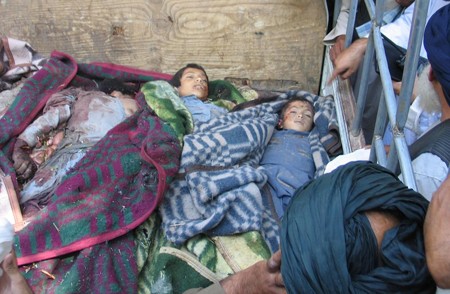
Cluster bombs are in the news again, thanks to a recent report from Amnesty International. The human rights agency has confirmed that 35 women and children were killed following the latest US attacks on an alleged al-Qaeda hideout in Yemen.
Initially, there were attempts to bury the story, and Yemen officially denied that civilians were killed as a result of the December 17 attack in southern Yemen. However, it has been impossible to conceal what is now considered the largest loss of life in one single US attack in the country. If the civilian casualties were indeed a miscalculation on the part of the US military, there should no longer be any doubt about the fact that cluster munitions are far too dangerous a weapon to be utilised in war. And they certainly have no place whatsoever in civilian areas. The human casualties are too large to justify. Yemen is not alone. Gaza, Lebanon and Afghanistan are also stark examples of the untold loss and suffering caused by cluster bombs.
Meanwhile, the unrepentant Israeli army will not consider dropping the use of cluster bombs in civilian areas altogether. Instead it is pondering ways to make them ‘safer’. The Jerusalem Post reported on July 2 that the army “has carried out a series of tests with a bomblet that has a specially designed self-destruct mechanism which dramatically reduces the amount of unexploded ordnance.” During the Israeli onslaught in Lebanon in 2006, Israel fired millions of bomblets. Aside from the immediate devastation and causalities, unexploded ordnance continues to victimise Lebanon’s civilians, most of whom are children. Dozens of lives have been lost since the end of this war.
In Gaza, the same terrible scenario was repeated between 2008 and 2009. Unlike Lebanon, however, trapped Palestinians in Gaza had nowhere to go. Now Israel is anticipating another war with the Lebanese resistance. In preparation for this, an Israeli PR campaign is already underway. It seeks to convince public opinion that Israel is doing its utmost to avoid civilian casualties. “Ahead of a potential new conflict with Hezbollah, the IDF has decided to evaluate the M85 bomblet manufactured by the Israeli Military Industries,” reports the Jerusalem Post. Of course, Israel’s friends will be pleased by the initial successes of the Israeli army testing.
Under pressure to ratify the agreement, these countries are only too eager to offer a ‘safer’ version of current cluster bomb models. This would help not only to maintain the huge profits generated from this morally abhorrent business, it would also hopefully quell growing criticism by civil society and other world governments.
In December 2008, the United States, Russia and China, among others, sent a terrible message to the rest of the world. They refused to take part in the historic signing of the treaty that banned the production and use of cluster bombs.
In a world that is plagued by war, military occupation and terrorism, the involvement of the great military powers in signing and ratifying the agreement would have signaled – if only symbolically — the willingness of these countries to spare civilians’ unjustifiable deaths and the lasting scars of war. Fortunately, the refusal didn’t completely impede an international agreement. The incessant activism of many conscientious individuals and organisations came to fruition on December 3 and 4 in Oslo, Norway, when ninety-three countries signed a treaty banning the weapon.
Not surprisingly, the US, Russia, China, Israel, India and Pakistan – a group that includes the biggest makers and users of the weapon — neither attended the Ireland negotiations of May 2008, and nor did they show any interest in signing the agreement in Oslo.
Most countries that have signed the accords are not involved in any active military conflict. They are also not in any way benefiting from the lucrative cluster munition industry.
But without the involvement of the major producers and active users of the weapon, the Oslo ceremony remained largely symbolic. However, there is nothing symbolic about the pain and bitter losses experienced by the many victims of cluster bombs.
According to the group Handicap International, a third of cluster-bomb victims are children.
Equally alarming, 98 per cent of the weapon’s overall victims are civilians. The group estimates that about 100,000 people have been maimed or killed by cluster bombs around the world since 1965.
Unlike conventional weapons, cluster bomblets survive for many years, luring little children with their attractive appearance. Children often mistake the bomblets for candy or toys.
Recently, some encouraging news emerged from the Netherlands. Maxime Verhagen, Minister of Foreign Affairs, urged his country’s House of Representative to ratify the Convention, which bans the production, possessions and use of such munitions. The ban leaves no room for any misguided interpretations and does not care for the Israeli army’s experimentations. In his speech, Verhagen claimed, “Cluster munitions are unreliable and imprecise, and their use poses a grave danger to the civilian population…Years after a conflict has ended, people – especially children – can fall victim to unexploded submunition from cluster bombs.”
To date, the agreement has been signed by 106 countries and ratified by 36 – and will enter into force on August 1, despite the fact that the big players refuse to take part. The Netherlands’ push is certainly a step in the right direction. But much more remains to be done.
The onus is also on civil societies in countries that are yet to ratify the agreement or sign it in the first place. “All that is necessary for evil to triumph is for good men (and women) to do nothing.” This holds as true in the issue of cluster bombs, as in any other where human rights are violated and ignored.
Ramzy Baroud is a distinguished Arab American commentator and author, most recently, of ‘My father was a freedom fighter’ published by Pluto Press
Recalling the ‘successful’ counterinsurgency
July 6, 2010 – Kuala Lumpur
Do we not care about the massacres of our lifetime?
December 1948 was just six months into a 12-year campaign to crush communists, who were trying to drive British occupiers out of the Malay Peninsula.
From 1874 to mid 1950s, the British struggled to suppress resistance to occupation. The brutality of some British forces in the Malay Peninsula drove many ethnic Chinese to communism. People who supported communists were literally fenced in. People who opposed communism were co-opted and their communities offered food, medicine and protection. The guerrillas were starved out in the jungle with the gorillas.
Survivors recall
“Did the soldiers bring you outside all at once or in groups?”
“I cannot remember, I fainted. The spirits pushed me. They shot us.”
He was not well in his 70s. He went to the spot where he fainted and fell from British bullets that killed 24 of his fellow workers 55 years before. The rubber trees these deceased tapped were felled long ago. Only stumps remain of the “rumah kongsi” that was once their communal home. His wife had throat cancer. She could eat only un-spiced fish and vegetables. She remembered the brutalities. She was 16 then, a fiance to the man. Another survivor, in her 80s, could recall seeing her husband, the estate supervisor, led out and shot in cold blood with the others.
“The British said that the man who had a receipt for fruit was supplying communists with food. ” “They shot him.” “I wanted to stay and die with them.”
“So cruel those British, so cruel.”
The British soldiers came in trucks and accused the villagers of helping communists. The men and women of the village were separated. The women were loaded onto trucks to be taken away. The younger woman asked where the men were. The soldiers said the men would have to be shot. She remembered watching as the men were led out in groups of four and five, told to turn around by the waiting troops and shot in the back. After two days, she returned to look for her fiance. The bodies had been mutilated, heads hacked off and genitals smashed.
This was 8 months after the massacre of 250 Palestinians on 9th April, 1948 in the village of Deir Yassin in the district of Jerusalem in British-occupied Palestine. The soldiers who made Batang Kali into a killing field in December 1948 were not illegal illegitimate immigrant thugs of the Haganah, Vladimir Jabutinsky’s Irgon, Abraham Stern’s the Stern gang, Palmach and Golani supported and funded by Anglo-American Zionists in the premeditated and systematic ethnic cleansing of Palestinians. They were British Scots Guards struggling to hold on to imperialism, colonialism and may be even Zionism in the face of widespread resentment and resistance. This killing field in the Malay Peninsular as brutal as the Sharpeville massacre of 69 young demonstrators in apartheid South Africa in March 1960 was not unlike so many killing fields made by Americans up north in late 1960s. It was worse with the massacre of 150 unarmed Vietnamese at My Lai on 16th March 1968. It was so much worse with the massacre of at least 1000 unarmed Palestinian refugees in September 1982 at Sabra and Shatila camps in Lebanon ordered by Ariel Sharon as Israeli defense minister conspiring with Elie Hobeike’s Lebanese Forces militia, and another Israeli proxy, Major Saad Haddad’s South Lebanon Army after the American-backed invasion of West Beirut.
Justice was never seen to have been done about these massacres and many more. The killers are still at it in Palestine, Afghanistan, Iraq and Sudan.
Are we not weaklings held to account for indifference or inaction?
These, our deceased, had the right of resistance; they might be labeled communists or terrorists, but they were our people, dead or alive; anytime anywhere they were braver than those people who shot them in the back.
Britain’s Abu Ghraib
The allegations of torture by British soldiers in Iraq bear chilling comparison with America’s worst excesses
Phil Shiner and Tessa Gregory | The Guardian | 3 July 2010
The inquiry into the death of Baha Mousa is due to report by the end of the year. It will detail how Mousa died in Iraq in September 2003, allegedly brutalised by British soldiers in a “free for all”; and how it was that he and nine other men in the same incident were allegedly hooded, forced into painful stress positions, and deprived of sleep, food and water.
The Guardian article this week, which reported that many more civilians died in army custody than previously thought, should shock the conscience of the nation. The evidence of Lieutenant Colonel Mercer to the inquiry reveals that as early as May 2003 – four months before Mousa’s death – there were “a number of deaths in custody” with “various units”. It appears there were, by then, at least nine deaths. The Ministry of Defence refuses to answer questions from us or the Guardian as to where, how or why these Iraqis died, and refuses to confirm or deny whether any of these deaths were ever investigated and if so with what outcome.
Although we are acting for one family referred to in the article, we have no idea about the other cases. And the story could be a lot worse: an ex-Royal Military Police (RMP) major told BBC radio last October that there were “hundreds” of similar cases.
Further, there are thousands of torture allegations being made by more than 100 Iraqi clients in new cases. We applaud the efforts of those who have succeeded in obtaining an inquiry into alleged British complicity in torture by various overseas regimes. But the public and the government also need to face up to our history of actual torture. The evidence from the Mousa inquiry and the allegations in these other cases may allow a chilling comparison to be made with the worst excesses of the US at Guantánamo Bay or Abu Ghraib, with the Stasi in the cold war, or the British in post-colonial wars.
Apart from the techniques banned by the Heath government in 1972 (hooding, stressing, food and water deprivation, sleep deprivation, the use of noise), which returned as standard operating procedure in Iraq, the array of allegations is staggering: mock executions; the use of tiny refrigerated spaces; electric shocks; forced nudity; threats of rape to female relatives; prolonged solitary confinement; loud, hardcore pornography played incessantly; disorientation by various means; simulated drowning; dog attacks; masturbation and other sexual acts; urinating on detainees; giving urine not water to drink; as well as systematic abuse through rifle-butting, kicks, punches, forced exertion and prolonged shouting at detainees.
The MoD insists our brave soldiers behaved impeccably save for a few rotten apples and that there is no evidence of coercive interrogation techniques. Now the Iraq historic allegation team, comprising of RMP investigators and others, will investigate whether anyone should be prosecuted by a military court martial.
However, these other deaths in custody are not being investigated; the thousands of allegations of the use of coercive interrogation make it difficult to see how much more evidence of systemic issues is needed; and the RMP is a discredited and failed organisation that is incapable of dealing with these cases, and in any event its soldiers are the subject of some of the allegations.
The damage caused to the French in Algeria by its use of torture is well known. The same damage may have been caused to the British battle for Iraqi hearts and minds. To perpetuate that damage by this alleged cover-up would be immeasurably stupid: as we now know from Bloody Sunday, when the state is involved in wrongdoing the nation requires not a Widgery but a Saville.
Iranians remember Flight 655 victims
Press TV – July 3, 2010
Iran will mark the 22nd anniversary of a US missile attack on an Iranian passenger airliner over the Persian Gulf, commemorating those killed by laying flowers at the site of the tragic incident.
On July 3, 1988, the guided missile cruiser USS Vincennes launched two SM-2MR surface-to-air missiles, downing Iran Air Flight 655 destined for Dubai. All 290 passengers onboard were killed, 66 of whom were children.
Iranians including families of those killed in the tragic incident will gather at the site of the incident on Saturday to remember the victims by throwing flowers into the Persian Gulf waters.
A message from Iranian President Mahmoud Ahmadinejad will also be read out during the ceremony.
The US has so far refused to issue an apology, arguing that their naval officers had mistaken the Iranian Airbus A300 for an F-14 Tomcat fighter. Iran, however, has dismissed the justification, saying mistaking an Airbus A300 for an F-14 Tomcat fighter is beyond the bounds of possibility.
The UN Security Council passed a resolution, in which it only expressed “deep distress” over the downing and “profound regret” for the loss of life.
Israel Releases Abducted Lebanese Shepherd, Leaves Scars All Over His Body
Islamic Resistance of Lebanon | June 28, 2010

It seems that the Lebanese citizens remain to be subject to the “Israeli” enemy’s atrocities while the UN Interim Forces set a blind eye to all violations, and it seems that its only mission is to keep record of these “Israeli” violations.
In this context, a Lebanese shepherd was abducted on Sunday the 27th of June 2010 by “Israeli” forces, and then released 24 hours later, with scars of torture and violence covering his body.
Intiqad correspondent to South Lebanon Fatima Shoeib visited the Lebanese abducted citizen and shepherd Imad Hassan Atwi- 37 years old- in Tyr Governmental Hospital, where he received treatment for his injuries.

Released Shepherd Imad Hassan Atwi told Al Intiqad that he was grazing his sheep a hundred meters away from the Blue Line when suddenly soldiers captured him and started hitting him brutally, “I am nothing but a shepherd who has been present in this area for the past 20 years. This time I fell in the hands of “Israeli” forces and was unable to run away as “Israeli” soldiers surrounded me and hit me brutally on my head, chest and back until I passed away,” he said.
Atwi added “They threw me to the ground, sat on my chest, and hit me on my head until I passed away. They transferred me then on a stretcher off which I fell multiple times until I was put in the vehicle. I was then transported to Roweisat Al Alam point, from there again transported to the intelligence center where 9 detectives conducted investigations with me. Their accusation was that I aimed at abducting Zionist soldiers… At that point, I mocked them questioning if I was able to abduct any soldiers with a stick I use to graze the cattle…”

“When I denied the charges, they started questioning me about fellow brothers from my village Sheba’a. They even showed my photos taken by reconnaissance planes and asked me to determine the owners of the houses in the village, but again I said I knew nothing. That was when they threatened me that I will stay imprisoned for 20 years, but my answer was that I will be with my children tomorrow.” Atwi added.
Atwi, who was hospitalized for serious injuries, was handed over at the Naqura border crossing.
He was received by the United Nations Interim Force in Lebanon (UNIFIL) at the Naqoura border crossing and later handed over to the specialized Lebanese forces. He was transferred to the Tyre governmental hospital for having had incurred some bruises. Enquiry into incident is still underway.
Shabtai Rosenne and the Qibya Coverup
Richard Silverstein | June 17, 2010

Shabtai Rosenne, from the days he served in the Israeli foreign service (AP)
Shabtai Rosenne is the 93 year-old Israeli appointee to the panel investigating the IDF’s attack on the Gaza flotilla last month. He has had a distinguished career as an scholar specializing in international law and in the diplomatic corps. I’ve written here about the ludicrousness of placing a nonagenarian in such a key position on such a sensitive political body. But Nahum Barnea published a new charge against Rozen that strengthens my argument.
In 1953, there were repeated cross-border attacks from Israel and Jordan on each other’s territory in which citizens of both countries were killed. Some attacks were carried out by military forces and some by irregular forces attempting to take vengeance on the other side for the losses of the 1948 War. Finally fed up with this violence, David Ben Gurion, Israel’s prime minister resolved to strike a savage blow against a Jordanian target that would end the guerilla attacks once and for all.
Ben Gurion and his defense minister, the notorious Pinhas Lavon, planned the attack on the West Bank village of Qibya without notifying the rest of the cabinet. Foreign minister Moshe Sharett was informed in general terms though given no specifics about the exact nature of the attack.
During an all-day assault, Israeli forces under the command of Ariel Sharon, destroyed 41 buildings in the village including the school. Many homes were dynamited with the residents still within them. 60 residents were killed. The response by the international community was, much like the Gaza flotilla incident, pure outrage. In the aftermath of the bloodbath and the ensuing furor, the IDF turned to the foreign ministry to devise a way to mitigate the damage to Israel’s reputation.
In his memoir, Sharett explains that a plan was devised to deny the army had anything to do with the attack and to claim it was the result of attacks from Israeli border settlements who were angry with the continuing incursions against them from the Jordanian side. As a result, Ben Gurion released this entirely mendacious statement:
None deplores it more than the Government of Israel, if … innocent blood was spilled … The Government of Israel rejects with all vigor the absurd and fantastic allegation that 600 men of the IDF took part in the action … We have carried out a searching investigation and it is clear beyond doubt that not a single army unit was absent from its base on the night of the attack on Qibya.
We can see that the lies of current Israeli governments find their paternity in one of the august founders of the modern state.
Sharett further notes that at a strategy meeting, Shabtai Rosenne, one of his senior advisors, suggested that in order to make Ben Gurion’s claim credible that Israel should pass a law enabling it to collectively punish the border settlements for their alleged misdeeds. Sharett was aghast. He didn’t believe the world would buy the original claim that the army wasn’t involved. He thought Rozen’s further subterfuge was an insult to the world’s intelligence.
Barnea writes:
Sharett was angered. He hadn’t expected those advisers closest to him would lend themselves to such a fabrication which no one in the world would believe.
So 57 years ago Shabtai Rosenne prepared lies on behalf of a state which had committed war crimes against Palestinian civilians. Today, he is called upon again to defend Israeli soldiers who killed in cold blood. Plus ca change, plus la meme chose. But this time, we know Rosenne’s past and raise it to discredit the proceedings of this farce of an inquiry endorsed so heartily by Barack Obama and Bibi Netanyahu.
Killing Civilians, Ducking Blame
By KATHY KELLY and DAN PEARSON | June 26, 2010
In accepting General McChrystal’s resignation, President Obama said that McChrystal’s departure represented a change in personnel, not a change in policy. “Americans don’t flinch in the face of difficult truths or difficult tasks.” he stated, “We persist and we persevere.” Yet, President Obama and the U.S. people don’t face up to the ugly truth that, in Afghanistan, the U.S. has routinely committed atrocities against innocent civilians. By ducking that truth, the U.S. reinforces a sense of exceptionalism, which, in other parts of the world, causes resentment and antagonism.
While on the campaign trail and since taking office, President Obama has persistently emphasized his view that attacks against civilians are always criminal, unless the U.S. is the attacker, in which case they are justified. We heard this again, on June 23rd, as the President assured the U.S. people that we will persevere in Afghanistan. “We will not tolerate a safe haven for terrorists who want to destroy Afghan security from within, and launch attacks against innocent men, women, and children in our country and around the world.”
When considering the security of Afghan civilians, it’s crucial to ask why, on May 12, 2009, General McChrystal was selected to replace General McKiernan as the top general in Afghanistan. News reports said it was because he had experience in coordinating special operations in Iraq. That experience involved developing death squads, planning night raids, and coordinating undercover assassinations. McChrystal proved, since his appointment, that he could organize atrocities against Afghan civilians and simultaneously present himself as a protector of Afghan civilians. In doing so, he relied on collaboration and cooperation from Defense Secretary Gates, General Petraeus and President Obama. They are united in their culpability. We, ourselves, bear responsibility to examine disturbing patterns of misinformation regarding U.S./NATO attacks against Afghan civilians.
In each of eleven incidents since April 9th, 2009, U.S. forces killed innocent civilians, then engaged in a cover-up, insisting that they had killed insurgents, and eventually acknowledged having killed civilians. Generally, U.S./NATO officials issued an apology. Wikileaks is expected to release a video that establishes U.S. responsibility for a May 4th, 2009 air attack which killed an estimated 86 – 140 civilians, mostly women and children. In the days and weeks after the attack, U.S. and NATO military officials made a concerted effort to avoid blame for this attack. Voices for Creative Nonviolence has maintained a list, assuredly only a partial list, of U.S./NATO attacks, since April 2009, which caused civilian deaths. Below is the entry describing the May 4, 2009 attack.
Date: May 4, 2009
Place: Farah Province near the town of Granai
Circumstances: Mainstream media reports estimate that between 86 and 140 people, mostly children, died in a US air attack. According to Reuters, only 22 of the victims were adult males.
Initial U.S./NATO response: The following chronology indicates multiple attempts on the part of US officials to avoid blame.
May 6, 2009—U.S. officials plea ignorance and state that an investigation is under way.
May 6, 2009—According to The Guardian, a spokesperson for US forces in Afghanistan, Captain Elizabeth Mathias says, “This was not coalition forces. This was Afghan national security forces who called in close air support, a decision that was vetted by the Afghan leadership.”
May 7, 2009—An Armed Service Press Service report announces that a team is “investigating differing accounts of the events leading up to the casualties. Those accounts include allegations that the Taliban tossed grenades into homes to ‘frame’ Afghan and coalition forces.” U.S. Defense Secretary Robert Gates states that “the United States and coalition partners do everything we can to avoid civilian casualties.” He goes on to say that “While there have been civilian casualties caused by American and NATO troops, they have been accidental. When the Taliban cause casualties, they are on purpose.”
May 8, 2009—Pentagon spokesperson Col. Greg Julian insists that earlier estimates of the death toll were “grossly exaggerated.” May 10, 2009—In an interview with Mike Wallace, General David Petraeus suggests that the Taliban forced people “to remain in houses from which the Taliban was engaging U.S. forces.”
May 15, 2009—Marine Corps Commandant Gen. James Conway again blames the Taliban for civilian casualties. “We believe that there were families who were killed by the Taliban with grenades and rifle fire,” he said, “that were then paraded about and shown as casualties from the airstrike.”
U.S. /NATO acknowledgment that the people killed were unarmed civilians:
May 13, 2009—Referring to the May 4th raids in an Afghan press interview, Ambassador Karl W. Eikenberry admits that “there were a number of civilians killed, a number of civilians wounded. We don’t know the exact amount. You are aware that our President of the United States and our Secretary of State and our Secretary of Defense have all very explicitly expressed their condolences for what happened.”
June 2, 2009— According to The New York Times “A military investigation has concluded that American personnel made significant errors in carrying out some of the airstrikes in western Afghanistan on May 4 that killed dozens of Afghan civilians, according to a senior American military official.”
With all due respect for Ambassador Eikenberry’s sincerity, and recognizing that condolences may have been relayed to Afghanistan, we nevertheless want to say that we couldn’t find any record of U.S. officials publicly expressing sorrow, explicitly, for the U.S. attack against Afghan civilians on May 4, 2009.
However, we do note that U.S. officials, one week later, nominated General McChrystal to replace General McKiernan. It seems that this appointment signaled U.S. intent to shift assaults against Afghan civilians into the realm of undercover operations, making it much easier to duck the blame.
Kathy Kelly, (kathy@vcnv.org), and Dan Pearson, (dan@vcnv.org), are co-coordinators of Voices for Creative Nonviolence (www.vcnv.org)
Guantanamo and presidential priorities
By Glenn Greenwald | June 26, 2010
The headline from this morning’s New York Times article by Charlie Savage says it all — not just about this issue but about the administration generally:
Closing Guantanamo Fades as a priority
Savage writes that it is “unlikely that President Obama will fulfill his promise to close it before his term ends in 2013”; quotes Sen. Carl Levin as saying that “the odds are that it will still be open” by the next presidential inauguration; and describes how Sen. Lindsey Graham — who is actually trying to close the camp — is deeply frustrated with the White House’s refusal to spend time or energy to do so, quoting him as saying that the effort is “on life support and it’s unlikely to close any time soon.” So that appears to be a consensus: Guantanamo — the closing of which was one of Obama’s central campaign promises — will still be open as of 2013, by which point many of the detainees will have been imprisoned for more than a decade without charges of any kind and without any real prospect for either due process or release, at least four of those years under a President who was elected on a commitment to close that camp and restore the rule of law.
None of this is news to anyone even casually watching what’s been going on, but there are several aspects of this article which are so noteworthy for illustrating how this administration works. Let’s begin with this: Obama officials — cowardly hiding behind anonymity as usual — raise the typical excuse which they and their defenders perpetually invoke for their “failures” to fulfill their campaign positions: it’s all Congress’ fault (“They blame Congress for failing to execute that endgame,” Savage writes). It’s true that Congress has enacted measures to impede the closing of Guantanamo, and threatened to enact others, but the Obama administration’s plan was never so much to close Guantanamo as to simply re-locate it to Thompson, Illinois (GTMO North), in the process retaining one of its key, defining features — indefinite, due-process-free detention — that made it such a menace in the first place (that’s the attribute that led Candidate Obama to scorn it as a “legal black hole”).
The only meaningful way to “close Guantanamo” is to release the scores of detainees whom the administration knows are innocent and then try the rest in a real court (as Pakistan just did with Americans they accused of Terrorism). Imprisoning only those people whom you convict of crimes is a terribly radical, purist, Far Leftist concept, I know — the Fifth Amendment is so very un-Pragmatic and pre-9/11 — and that is something the administration therefore refused from the start even to consider.
But more important — and this goes to the heart of the debate I had all week with Obama defenders over his alleged inability to influence Congress — the primary reason why Congress has acted to impede the closing of Guantanamo is because the Obama White House has allowed it to, and even encouraged it to do so with its complete silence and inaction. I was accused by various Obama defenders all last week of being politically ignorant for arguing that Obama possesses substantial means of leverage to influence Congress to do what he wants, and that often, when the excuse is made that it’s not Obama’s fault because he can’t control Congress, the reality is that Congress is doing what it does because the White House is content with or even supportive of that, while pretending in public to lament it. I provided numerous examples proving that was true, none of which was answered, but one need not believe me and my starry-eyed political ignorance. Just listen to Carl Levin, who sort of knows how the process works given that he’s been in the Senate for about 400 years, explaining the real reason Guantanamo will not close:
“There is a lot of inertia” against closing the prison, “and the administration is not putting a lot of energy behind their position that I can see,” said Senator Carl Levin, the Michigan Democrat who is chairman of the Senate Armed Services Committee . . . . .
Mr. Levin portrayed the administration as unwilling to make a serious effort to exert its influence, contrasting its muted response to legislative hurdles to closing Guantánamo with “very vocal” threats to veto financing for a fighter jet engine it opposes.
Last year, for example, the administration stood aside as lawmakers restricted the transfer of detainees into the United States except for prosecution. And its response was silence several weeks ago, Mr. Levin said, as the House and Senate Armed Services Committees voted to block money for renovating the Illinois prison to accommodate detainees, and to restrict transfers from Guantánamo to other countries — including, in the Senate version, a bar on Yemen, Saudi Arabia, Afghanistan, Pakistan and Somalia. About 130 of the 181 detainees are from those countries.
“They are not really putting their shoulder to the wheel on this issue,” Mr. Levin said of White House officials. “It’s pretty dormant in terms of their public positions.”
That — what Levin just said there — is the heart of the critique of the Obama administration which its defenders steadfastly refuse to address, opting instead to beat the same strawman over and over no matter how many times it’s pointed out what they’re doing… Full article
Flotilla organizers: We’ll take Israel to The Hague
Ma’an – 24/06/2010
Bethlehem – The Free Gaza Movement says it will take the State of Israel to the International Criminal Court over last month’s raid on an aid ship that left nine civilians dead.
Twelve lawyers from countries whose citizens took part in the voyage are collecting evidence and testimonies from passengers, human rights lawyer Audrey Bomse told Ma’an.
The lawyers have asked governments of citizens on board, including the US and UK, to pressure Israel to return passengers’ property taken by Israeli soldiers during the raid on 31 May.
In a statement, the organizers said the seized cameras, camcorders, and mobile phones contain vital evidence of “willful killing, inhuman treatment, wilfully causing great suffering or serious injury to body or health and unlawful deportation or transfer.”
As Israel is the occupying power in Gaza, these alleged crimes would constitute a contravention of the Fourth Geneva Convention.
Bomse told Ma’an, “We intend to hold Israel responsible for its criminal behavior. As this was done by a state, it amounts to piracy and state terrorism.”
The organizers also claimed that Israeli military personnel used credit cards stolen from passengers.
Two soldiers were indicted last year for using a credit card in Israel which they had stolen from a Palestinian during Israel’s assault on Gaza that began in December 2008.
Council of Europe calls for lifting of Gaza blockade
DPA | June 24, 2010
Strasbourg – Council of Europe parliamentarians Thursday called on Israel to completely lift its blockade of the Gaza Strip.
‘Without prejudice to its own security,’ Israel should allow goods to be delivered to the coastal enclave by land and sea, so Palestinians can enjoy ‘normal living conditions,’ a resolution adopted by a large majority of the Parliamentary Assembly of the Council of Europe (PACE) said.
PACE, consisting of parliamentarians from the 47 members of the Council of Europe, meets four times a year to debate topical issues and give policy advice to the European Parliament in Strasbourg.
The parliamentarians also criticised the Israeli raid of a Gaza- bound aid flotilla last month as a breach of international law, calling it ‘manifestly disproportionate.’
The group additionally called on Israel to halt the construction of new settlements in occupied territories and East Jerusalem.
Israel’s recent easing of the Gaza blockade was described as a ‘first step’ by the assembly. But completely lifting the blockade is ‘essential’ to lower tensions and revive the dialogue between Israelis and Palestinians, the Italian social democrat and assembly rapporteur Piero Fassino said.
As part of its efforts to bring peace to the Middle East, PACE regularly brings together members of the Israeli Knesset and the Palestinian Legislative Council for talks.
Featured Video

Piers Corbyn on religion of climate change
or go to
Aletho News Archives – Video-Images
Book Review
How the U.S. Navy Sold the Vietnam War
By Gareth Porter | TruthDig | March 27, 2019
Dr. Tom Dooley, whose best-selling book “Deliver Us From Evil” helped create a favorable climate of opinion for U.S. intervention in South Vietnam, has long been linked to legendary CIA officer Edward G. Lansdale and his black operations in Vietnam between 1954 and 1955. But the real story about Dooley’s influential book, which has finally emerged from more recent scholarly research, is that it was engineered by an official of the U.S. Navy’s Pacific Command, Capt. William Lederer.
Lederer is best known as the co-author, with Eugene Burdick, of the 1958 novel “The Ugly American,” which was turned into a 1963 movie starring Marlon Brando. Far more important, however, is the fact that from 1951 through 1957 Capt. Lederer was on the staff of the commander in chief of the U.S. Pacific Fleet (CINCPAC), Adm. Felix Stump. … continue
Blog Roll
 Aletho News
- Putin aide reveals Moscow’s stance on Europe at peace talks
- Imran Khan warns Pakistani judges he may die in prison
- IOF used Amazon facial recognition to track millions of Palestinians
- More EU Citizens Face Sanctions For Criticizing The Ukraine Proxy War
- In Mexico, the CIA Is Playing a Dangerous Game
- Spain’s Left Protested the Crisis It Legitimized: the General Strike as election stunt
- The power of inflicting oblivion
- The 10 Disease Renamings That Rescued the Vaccine
- NATO cancels 2027 leaders’ summit
- IAEA’s politicized use of safeguards undermines its impartiality: Russian envoy
- If Americans Knew
- An error has occurred; the feed is probably down. Try again later.
- No Tricks Zone
- New Study: Barents Sea Temperatures Were Warmer And Sea Ice Less Extensive In The 1700s Than Today
- German Authorities Start Initiative To Evaluate Public Register For Climate “Disinformation” Spreaders!
- Zonal Asymmetry of Temperature Change in the Antarctic Circumpolar Current
- New Study: The Net Fossil Fuel Contribution To Rising Atmospheric CO2 Has Been Zero For 500 Years
- Germany’s Green Energy Transition Becoming Increasingly Expensive…Another 6 Trillion Euros!
- Sudden Stratospheric Warming, Powerful El Niño Combination May Lead To Extreme Europe Cold, Energy Crisis!
- Two New Studies Find Thwaites Glacier Melt Cannot Be Driven By Human Activity Or A Warming Ocean
- E-Cars Reduce CO2 Emissions By Only 41% Compared To Internal Combustion Engine Vehicles
- Predictions Made By Renowned Climate Professor Over Past Decades Have Been Proven To Be Poor
- New Study Suggests Large Regions Of The Pacific Ocean Have Been Cooling For The Last 80 Years

