Is Seeking to Stop a War a Crime?
Whistleblowers and other government activists need to be heard

By Philip Giraldi • Unz Review • December 18, 2024
The early November detention of Asif Rahman, a Central Intelligence Agency (CIA) officer, indicted in a federal national security court in the Eastern District of Virginia on two counts of “willful retention and transmission of national defense information under the Espionage Act,” was largely downplayed in the national media. He was arrested by the Federal Bureau of Investigation (FBI) on Tuesday November 5th at the US Embassy in Phnom Penh in Cambodia where he was stationed and was sent to appear in the nearest federal court in Guam on Thursday the 7th to be charged. After his initial court appearance and indictment, Rahman, was transferred to a federal prison in Virginia.
Rahman was a CIA analyst with a top-secret clearance that gave him access to the classified material that passed through the Agency’s Cambodia Station, which would have included much of the routine collection and dissemination of information on developments in Asia. Rahman allegedly selected one report containing two files relating to plans by Israel to attack Iran, which he then placed on an Iranian frequented site on the Telegram messaging app called the “Middle East Spectator,” which in turn claimed that the information came from a Pentagon source. After being posted it attracted a considerable audience, including US security monitors, numerous Iranians and, inevitably, the Israelis. The two top secret documents were marked as having been produced by the US government’s National Geospatial-Intelligence Agency and the National Security Agency. They included satellite imagery from October 15th and 16th that showed that Israel was moving Air Force military assets preparatory to conducting a military strike on Iran. Bear in mind that Israel has long sought to eliminate Iran as an adversary in the Middle East region they share, up to and including assassination of Iranian scientists and government officials and air attacks on targets in places like Syria that have been regarded as Iranian allies. Iran, for its part, has never attacked Israel prior to recent developments relating to the Gaza conflict.
The US government declared the leak of the classified files to be “deeply disturbing” and investigators who finally focused on Rahman declared that he might have been “ideologically” motivated to expose the information. Rahman has declared himself to be not guilty and as the case relates to intelligence on a non-allied foreign country’s military making preparations for war it raises some ethical problems as well as political issues connected to Israel’s unofficial special relationship with the United States government. It is, for example, not normal for someone detained for leaking classified information to be imprisoned as the preparations for trial are underway unless they are likely to flee jurisdiction. Rahman is from a prominent and wealthy family based in Vienna Virginia and his father Muhit Rahman and lawyer Amy Jeffress sought to have him stay at home with family in custodial pretrial, which is normal, but a ruling by US District Judge Patricia Tolliver Giles overruled a magistrate who said a week before that Rahman could be free of additional restrictions including detention while he is awaited his trial. Jeffress has indicated that she will be appealing the detention order which was restored by Giles.
In the event, Israel decided to proceed with its plans and carried out the attack targeting Iran’s air defense systems and missile manufacturing facilities in late October. Citing no actual evidence, court papers related to the case reveal that the US government claims the leak of the files caused Israel to delay its attack plans. Prosecutor Troy Edwards said the volatile nature of the developing situation in the Middle East made the leak especially dangerous. He explained that “It is hard to overstate what other circumstances present graver risks of danger to human life than unilaterally deciding to transmitting information related to plans for kinetic military action between two countries.”
Actually, stopping the planned “kinetic action” is the solution if one wants to save lives. Edwards’ line of reasoning, encouraging one side to proceed, could be considered to be the reverse of what might be true if one is truly seeking to mitigate the “danger to human life.” While it is unquestionably true that a government employee who takes classified information and shares it is committing a serious crime under the Espionage Act as well as other legislation, one might argue that Rahman, if actually guilty as charged and convicted, may have been responding to what he might have considered to be mitigating circumstances. By exposing information on Israeli plans to attack Iran he might have believed that he was actually saving many lives as well as avoiding an escalation of a developing major war in the Middle East. He may have revealed information that the US government considered to be classified due to the way it was obtained by satellite but which, apart from that fact, did not in any way impact on the national security of the United States. Quite the contrary, as it would be quite plausible to argue that the United States would have been dragged into any conflict escalated by Israel against Iran, which does not in any way threaten the US, and which would serve no American national interest. Examining the leak from that perspective it would be quite reasonable to argue that Rahman, if he is guilty of mishandling the classified information, was trying to avert escalating a war that would quite plausibly do damage to all countries involved, including the United States and Israel.
The Rahman case is just one more indication of how anything having to do with Israel is not quite treated by government and media in the same fashion as for any other country. It is clearly a response to the immense power of the Israel Lobby in the United States. There is a strong tendency by the US to always defer to actions and behavior that Israel exhibits while also giving the Jewish state a pass when the results are awful or even genocidal as they are in Gaza. And there is a certain irony in how it all plays out going in the other direction. Israel, in fact, has a history of actively spying against the United States without any real consequences to make it pay a price for such behavior. The most devastating spy ever to steal American defense secrets was Jonathan Pollard, a Jewish civilian employee of the US Navy, who stole whole rooms full of classified information in the 1980s, including the beyond top secret National Security Agency‘s ten-volume manual on how the US gathers its signal intelligence, to include the technical details of how the US collected information on its actual enemies during the Cold War, revealing aspects of US intelligence gathering’s “sources and methods.” The defense information went to Israel where it was used in part to trade for visas from Moscow so Russian Jews could emigrate, certainly arguably a good cause, but paid for by damaging US security. Other US classified information went from Tel Aviv to China. Condemned to a life prison sentence, Pollard actually spent years in jail, where, in 1995, he became an Israeli citizen, but he was eventually released under parole in 2015 requiring him to stay in the United States. The parole requirement was canceled by President Donald Trump and Pollard immediately returned to Israel where he was celebrated as a hero. So much for Israel as America’s good friend and ally.
By another definition, Rahman, even if found guilty as charged over the sharing of classified documents, might easily be viewed as a whistleblower, revealing information that the United States government had collected on a foreign government that might lead to a war and many deaths. Rahman may have believed that the exposure of the war plans would make Israel pause and reconsider. And maybe it would also lead the United States to also reexamine its often touted “ironclad” support of everything that Israel does as excessively risky in a volatile part of the world where Washington has considerable real interests in terms of energy issues and national security.
If Rahman were to consider himself a whistleblower acting as he did as a matter of conscience, he would not be the first CIA officer to do so. John Kiriakou was an analyst and later a case officer and counterterrorism specialist for the Central Intelligence Agency (CIA) who worked in the Middle East, Pakistan and Greece. After leaving the Agency he became a senior investigator for the Senate Foreign Relations Committee, and later a consultant for ABC News, after which he became the operating manager of a political risk analysis consulting firm in Arlington Virginia. To John’s credit, he became the first US government official to confirm, during an interview with a reporter in December 2007, that waterboarding, which was simulated drowning, was routinely used to interrogate terrorist suspects, which he described as torture. One victim was reportedly waterboarded 183 times in a secret prison.
In Kiriakou’s case, as it was and still is illegal for the US government to torture people to extort a confession, the same Virginia court that is trying Rahman had to avoid allowing the potential war crimes issue to surface. So on April 5, 2012, Kiriakou was indicted, not for exposing torture, but rather for one count of violating the Intelligence Identities Protection Act, three counts of violating the Espionage Act, and one count of “making false statements” for lying to the Agency’s Publications Review Board regarding a book that John was writing. Kiriakou pleaded not guilty and was released on bail. His time in court began on September 12th, 2012, at the District Court for the Eastern District of Virginia. It was conducted as a closed hearing in line with the Classified Information Procedures Act. On October 22, 2012, Kiriakou agreed to a plea bargain of guilty to one count of passing classified information to the media, violating the Intelligence Identities Protection Act and thereby avoiding a formal trial. All other charges were dropped. On January 25th, 2013, John Kiriakou was sentenced to 30 months in a federal prison. On February 3rd, 2015, Kiriakou was released to serve a final three months under house arrest at his home in Virginia. Following his release, Kiriakou said his case was not about leaking information but about exposing torture, continuing, “and I would do it all over again.”
Kiriakou, to his immense credit, never walked away from what he did, declaring firmly that the torture regime and the lies that supported it was wrong, both illegal and immoral. Was Asif Rahman a whistleblower like Kiriakou? The answer to that depends on one’s point of view as he might have been seeking to stop a war rather than start one. He may have thought that it was something that his conscience and sense of shared humanity obligated him to do without regard for the possible consequences to himself. We will see how he defends himself when he finally appears before the judges. It will possibly be a very interesting discussion about America’s values as a nation vis-à-vis the questionable behavior of the state of Israel, but instead of listening to what Rahman has to say, the public will likely be hearing something like this from those in government as echoed by the captive media: Michael Waltz, Trump’s foreign policy advisor nominee recently said “When [Secretary of State] Blinken touched down in Israel yesterday, I hope he apologized to Bibi for leaking their battle plans, and told the Israelis that they were right all along. Because the Ayatollah is in hiding right now, not because of Biden, but because of Bibi.” The sad reality is that Israel’s Prime Minister Benjamin Netanyahu, who has overwhelmed Joe Biden and will likely do the same to Donald Trump, has been allowed to become the prime architect of the shambles that the Middle East has become with no one but a handful of whistleblowers seeking to restore sanity.
Philip M. Giraldi, Ph.D., is Executive Director of the Council for the National Interest, a 501(c)3 tax deductible educational foundation (Federal ID Number #52-1739023) that seeks a more interests-based U.S. foreign policy in the Middle East. Website is councilforthenationalinterest.org, address is P.O. Box 2157, Purcellville VA 20134 and its email is inform@cnionline.org.
USS Harry S. Truman Leads American Naval Deployment to Middle East
Sputnik – 15.12.2024
The USS Harry S. Truman Carrier Strike Group arrived in the Middle East on December 14, entering the US Central Command’s (CENTCOM) area of responsibility. The deployment was announced by CENTCOM on the social media platform X.
The group includes the aircraft carrier USS Harry S. Truman, Carrier Air Wing 1 with nine aviation squadrons, the guided-missile cruiser USS Gettysburg (Ticonderoga class), and two guided-missile destroyers, USS Stout and USS Jason Dunham (Arleigh Burke class).
Earlier in November, US F-15E Strike Eagle fighter jets were deployed to the region from the United Kingdom, reinforcing the American military presence in the Middle East.
The deployment comes amid heightened regional tensions and US President-elect Donald Trump’s earlier remarks promising to avoid “starting wars” once he officially takes office.
How ex-Daesh and al-Qaeda leader al-Jolani became West’s blue-eyed boy in Syria

By Alireza Akbari | Press TV | December 15, 2024
Only a day after West-backed militant groups led by Hay’at Tahrir al-Sham (HTS) took control of Damascus, ending Bashar al-Assad’s long reign, HTS leader Abu Muhammad al-Jolani stood triumphantly on a hill overlooking the Syrian capital.
Wearing army fatigues, Ahmed al-Sharaa, popularly known as Jolani, looked on as plumes of smoke billowed into the sky—a grim spectacle of destruction wrought by Israeli bombings following the ouster of Assad’s democratically-elected government in Damascus.
The haunting scene evoked an eerie parallel to Emperor Nero, who infamously watched Rome burn while playing his lyre—portraying an image of power and apathy.
As the Israeli regime grabbed more Syrian land beyond the occupied Golan Heights and launched unprecedented airstrikes on Damascus, HTS militants gleefully roamed the streets, celebrating the “conquest,” and unleashed a brutal campaign of throat-slitting and terrorizing minorities.
The tumultuous events that eventually led to the overthrow of the Assad government began on November 27, when videos surfaced of militant groups in Aleppo making rapid advances.
These groups swiftly and dramatically escalated their advances, capturing strategic military bases in Idlib and Hama before marching toward the capital Damascus.
On December 8, they delivered a televised address from Damascus, declaring the end of Assad’s 24-year reign—a seismic shift in the region’s power dynamics with all eyes on Jolani as the leader.
Who is al-Jolani?
Abu Muhammad al-Jolani was born in Riyadh, Saudi Arabia, in 1982 to a Syrian family originally from the occupied Golan Heights of Syria, which has been under Israeli occupation for years.
His family returned to Syria in 1989, settling in Damascus’s affluent Mezzeh district. Jolani pursued media studies in Damascus before relocating to Iraq in 2003, just prior to the US invasion.
In Iraq, he joined the al-Qaeda terrorist group and became a key figure in the group.
He was captured by American forces in 2006 and spent five years imprisoned at Camp Bucca before being released in 2011. After that, he moved back to Syria and gained prominence as a militant leader.
Jolani’s journey through the ranks of Takfiri terrorist groups was spectacular as he became a close aide to top al-Qaeda leaders including Osama bin Laden and Ayman al-Zawahiri.
After his release from Camp Bucca in 2011, where he forged connections with future Daesh leaders, Jolani emerged as a key figure in the global Takfiri terrorist movement.
He initially served as a Daesh commander in Iraq’s Nineveh and Mosul provinces before being handpicked by Daesh chief Abu Bakr al-Baghdadi in 2012 to establish a Syrian affiliate at the outset of the West-backed militancy against the Assad government in the Arab country.
Jolani founded the Nusra Front as Daesh’s Syrian offshoot, leveraging the chaos to advance his agenda. However, a power struggle with al-Baghdadi over control of the group led to a split in 2013.
Jolani severed ties with Daesh and fortified his influence in Syria’s Idlib governorate, aligning the Nusra Front with al-Qaeda to retain the loyalty of hardline elements within his ranks.
While the split signaled a shift in allegiance, according to experts, it was less about ideology and more a personal rift. Jolani continued to espouse the Salafi ideology but sought to differentiate himself through a political veneer, setting him apart from figures like al-Zarqawi and al-Baghdadi.
Terror designation
The US State Department designated Jolani as a Specially Designated Global Terrorist in May 2013. By 2017, he was among the most wanted terrorists globally, with a $10 million bounty by the US government for information leading to his capture.
In an audio statement on September 28, 2014, Jolani declared his intent to fight the United States and its allies, urging his forces to reject Western assistance in their battle against Daesh.
Yet, just two years later, in July 2016, Jolani broke his pledge of allegiance to al-Qaeda leader al-Zawahiri, aiming to rebrand his militant organization and broaden its alliances.
This strategic pivot marked a shift in Jolani’s focus—from global ambitions to governance in Syria.
Following the establishment of the HTS militant group in 2017, the group took control of large swathes of Idlib, where they established a rudimentary governing structure.
HTS began collecting taxes and issuing identity cards to locals. However, these efforts were marred by authoritarian practices, including the suppression of dissent and the arrest of political opponents.
Despite Jolani’s public commitment to protecting minorities, his group adopted high-handed measures against religious and ethnic minorities, especially those who spoke about discrimination.
While HTS made rapid strides in consolidating power in the region bordering Turkey, its track record of human rights abuses in Idlib continued to be an area of concern.
The group has been known for systematically silencing dissent, targeting rivals, and using disproportionate force against those who opposed his authoritarian practices.
Concerns have also grown over the presence of foreign mercenaries in HTS, particularly those in its elite Red Brigades, which include members from Central Asia, Chechnya, and France.
Bigger political aspirations
Despite his Takfiri-militant roots, Jolani’s bigger political aspirations kept him in the news for years, as he continued to harbor ambitions of capturing Damascus from his hideouts in Idlib, financially and militarily backed by the United States, the Israeli regime and some regional countries.
Now, with HTS and its allies controlling significant territory in Syria, questions loom over how they will govern the country. Around 100,000 Syrians have already gathered on the border to enter Lebanon, according to reports, desperate to leave their home country.
Fears persist about the treatment of minorities, dissidents, and women under their rule, as many Syrians and the international community remain wary of Jolani’s true intentions.
Despite growing concerns over HTS rule, fueled by viral videos showing the group’s violent tactics, both the UK and the US are reportedly reconsidering its designation as a terrorist organization.
The British government is actively weighing the removal of HTS from its list of designated terrorist groups, particularly in light of the group’s pivotal role in the fall of the Assad government.
UK government minister Pat McFadden has suggested that such a move could be “relatively swift,” given the rapidly changing dynamics in Syria.
Similarly, US officials are debating the merits of removing the $10 million bounty on Jolani.
After years of lobbying for delisting, HTS appears to have gained traction with Western powers, particularly following its instrumental role in Assad’s ousting, a goal it shared with Western powers.
For years, the US and its Western allies had tried to dislodge the Assad government, using transnational mercenary forces as well as terrorist groups without much luck.
al-Jolani finally accomplished what his Western backers couldn’t for years despite massive efforts.
In his first detailed interview on Saturday, he emphasized engagement with Western nations and confirmed that the channels of communication with Western embassies, including talks with the British government to restore its diplomatic representation in Damascus, are underway.
He once again asserted that his regime has no intention of engaging in a conflict with the Israeli regime, despite Benjamin Netanyahu decimating the Arab country’s military muscle in a few days.
Has Bibi Achieved His Dream of Obliterating the Arab World?

By Mike Whitney • Unz Review • December 14, 2024
Take a look at the map above. It explains everything.
This is roughly the situation on the ground today. The majority of Syria’s landmass is controlled by 5 groups: Al Qaida (HTS), the Kurds (SDF), the IDF (Israel), the Turks, and remnants of the Syrian Army (SAA). Of course, the situation is extremely fluid so some of the territory is likely to change hands in the near future as rival groups fight among themselves. But here’s what won’t change: A government will not emerge that is capable of stitching together a unified, contiguous, viable centrally-governed Syrian state. That’s not going to happen. The various armies are too powerful for any one group to crush the others and reestablish a government that rules all of Syria’s previously controlled territory.
Why does that matter?
Because we need to acknowledge that Israel has accomplished what it sought from the very beginning; they not only enlisted allies to help them topple Assad, but they also obliterated the Syrian state. Syria is gone; it no longer exists. And that has been Israel’s goal for more than 40 years.
So, we shouldn’t view the events of the last week as random or spontaneous, because they are neither. Everything that has taken place aligns closely with a strategic blueprint produced by a Zionist intellectual (Oded Yinon) more than four decades ago and which—according to biographer Israel Shahak—concocted “an accurate and detailed plan…. for the Middle East which is based on the division of the whole area into small states, and the dissolution of all the existing Arab states.” Full Stop.
This is where readers need to pause for a moment and honestly consider whether this accurately explains the endless fighting and turmoil we’ve seen in the Middle East for the last two decades?
The answer is: It does. Iraq, Libya, Lebanon, Syria etc. These are not just countries; they are agenda items on a Zionist checklist for regional domination. So, stop thinking that the wars have something to do with Assad or oil or pipelines or Hamas or even Israeli security. Because they don’t. These are wars aimed at establishing Israeli hegemony across the Middle East. Let’s look at the document itself which is titled A Strategy for Israel in the Nineteen Eighties by Oded Yinon:
The Moslem Arab World is built like a temporary house of cards put together by foreigners without the wishes and desires of the inhabitants having been taken into account. … every Arab Moslem state nowadays faces ethnic social destruction from within, and in some a civil war is already raging. All of the Arab states east of Israel are torn apart, broken up and riddled with conflict… This national ethnic minority picture extending from Morocco to India and from Somalia to Turkey points to the absence of stability and a rapid degeneration in the entire region. When this picture is added to the economic one, we see how the entire region is built like a house of cards, unable to withstand its severe problems… A Strategy for Israel in the Nineteen Eighties, Oded Yinon, voltairenet

So, in the opening paragraphs, the author identifies the vulnerabilities within the current societies that can be exploited for Israel’s strategic advantage. The focus, of course, is on “ethnic minorities” that can be incited to exacerbate existing divisions within the society in order to weaken the larger body politic leading to regime change. Here’s the kicker:
The Western front… is in fact less complicated than the Eastern front. Lebanon’s total dissolution into five provinces serves as a precendent for the entire Arab World… The dissolution of Syria and Iraq later on into ethnically or religiously unique areas such as Lebanon, is Israel’s primary target on the Eastern front in the long run, while the dissolution of the military power of those states serves as the primary short term target. Syria will fall apart in accordance with its ethnic and reliegious strtucture, into several states such as in present day Lebanon, so that there will be a Shi’ite Alawi state along its coast, a Sunni state in Damascus hostile to its northern neighbor, and the Druzes who will set up a state, maybe even in our Golan, and certainly in the Hauran and in northenr Jordan. This state of affairs will be the guarantee for peace and security in the area in the long run, and that aim is already within our reach today… A Strategy for Israel in the Nineteen Eighties, Oded Yinon, voltairenet
Repeat: “This state of affairs will be the guarantee for peace and security in the area in the long run.” In other words, inciting ethnic and religious violence against other groups within the society, is the operational strategy for achieving regional dominance. In order to establish Israeli security, Arabs must be encouraged to kill each other.
Are we clear about that?
Regarding the Palestinians, there’s this little nugget:
Genuine coexistence and peace will reign over the land only when the Arabs understand that without Jewish rule between the Jordan and the sea, they will have neither existence nor security. A nation of their own and security will be theirs only in Jordan. A Strategy for Israel in the Nineteen Eighties,
Keep in mind, this was written in 1982 which means—that among the politicos in Netanyahu’s party—there was never any intention of exchanging land for peace or fulfilling their obligations under US Resolution 242 to evacuate the occupied territories. It was always a ruse aimed at confusing credulous nitwits in the US.
Economist Jeffrey Sachs has confirmed much of what we’ve stated here. He has recently been quite outspoken in a number of interviews on YouTube where he has laid blame for all the recent wars in the Middle East on Benjamin Netanyahu. Here’s Sach’s in a recent piece at Consortium News:
The fall of Syria this week is the culmination of the Israel-U.S. campaign against Syria that goes back to 1996 with Netanyahu’s arrival in office as prime minister. The Israel-U.S. war on Syria escalated in 2011 and 2012, when former U.S. President Barack Obama covertly tasked the C.I.A. with the overthrow of the Syrian Government in Operation Timber Sycamore. ….
Syria’s fall came swiftly because of more than a decade of crushing economic sanctions, the burdens of war, the U.S. seizure of Syria’s oil….. and most immediately, Israel’s attacks on Hezbollah… Netanyahu’s ambition to transform the region through war, which dates back almost three decades, is playing out in front of our eyes…
The long history of Israel’s campaign to overthrow the Syrian government is not widely understood, yet the documentary record is clear…
Israel’s war on Syria began with U.S. and Israeli neoconservatives in 1996, who fashioned a “Clean Break” strategy for the Middle East for Netanyahu as he came to office… The core of the “clean break” strategy called for the Israel (and the U.S.) to reject “land for peace,” the idea that Israel would withdraw from the occupied Palestinian lands in return for peace…
... Netanyahu’s strategy was integrated into U.S. foreign policy. Taking out Syria was always a key part of the plan. This was confirmed by General Wesley Clark after 9/11. (The role of the Israel Lobby is spelled out in Ilan Pappé’s new book, Lobbying for Zionism on Both Sides of the Atlantic)…
The U.S. has by now led or sponsored wars against Iraq (invasion in 2003), Lebanon (U.S. funding and arming Israel), Libya (NATO bombing in 2011), Syria (C.I.A. operation during 2010s), Sudan (supporting rebels to break Sudan apart in 2011), and Somalia (backing Ethiopia’s invasion in 2006).
A prospective U.S. war with Iran, ardently sought by Israel, is still pending….. The U.S. and Israel are high-fiving that they have successfully wrecked yet another adversary of Israel and defender of the Palestinian cause, with Netanyahu claiming “credit for starting the historic process.”...
American interference, at the behest of Netanyahu’s Israel, has left the Middle East in ruins, with over a million dead and open wars raging in Libya, Sudan, Somalia, Lebanon, Syria, and Palestine, and with Iran on the brink of a nuclear arsenal, being pushed against its own inclinations to this eventuality. US & Israel Destroyed Syria & Called it Peace, Jeffrey Sachs, Consortium News

These are Israel’s wars, and they are prosecuted to pursue Israeli interests not American interests. The US military (and political class) has been hijacked by the maneuverings of strongarm lobbyists who know how to work the levers of power to achieve their own ends. Their rate of success speaks for itself. Much of the Middle East lies in ruins which was the plan from the get-go.
But now comes the hard part, because nothing has really been resolved in Syria. Yes, Assad is gone and, yes, the Syrian state has disintegrated. But how long will it take before Turkey is fighting the US-backed Kurds in the East, or before Israeli and Turkish interests clash in central or southern Syria or before HTS proves to be the unreliable terrorist organization it is known to be and refuses to follow its marching orders from Washington and Tel Aviv? So, yes, the invaders may be congratulating themselves this week “for a job well done”, but the Syrian conflagration is not over yet, not by a long-shot.
There was an important development that took place last week that provides a window into future goings-on in the battered country, although the statement was downplayed by most of the media. On Wednesday, officials of Hayat Tahrir-al Sham (HTS) announced that Mohammed al-Bashir had been appointed as Syria’s interim prime minister. Al-Bashir, who has been running the Idlib province, has been chosen to lead a small cabinet whose job will be to make sure the government agencies, banks and public services continue operate without interruption. More importantly, al-Bashir, who speaks English, is likely the designated technocrat chosen by Washington to jumpstart the sale of the country’s state-owned assets and businesses, its natural resources, and anything else of value. Judging from past experience, he will probably oversee a sharp reduction in government spending, as well as dramatic cutbacks in education, public safety and health care. He will also seek hefty loans from the IMF for reconstruction that will be diverted to foreign accounts for his family and cronies leaving ordinary Syrians with an ocean of red ink they can never hope to repay. Sound familiar?
Unfortunately, Bashir’s debut did not go as well as expected. Here’s the story from NBC News:
When Syria’s new interim prime minister, Mohammad al-Bashir, chaired a Cabinet meeting in Damascus on Tuesday, hanging behind him was the flag of the country’s suddenly victorious opposition. Next to it, however, was a second banner popular with the region’s Sunni Islamist fighters, featuring the large Arabic letters of the Shahada, an Islamic declaration of faith.
As a new Syria fast emerges from the ruins of the Assad regime, the world is watching for hints of what that might look like — and that second flag has concerned those hoping for a future of moderation and tolerance…
HTS is banned as a terrorist organization in the United States and elsewhere and grew out of a branch of Al Qaeda. Its leader, Abu Mohammad al-Jolani, said a decade ago that there would be no room for religious minorities in the Islamist Syria of which he dreamed about. He also suggested that he could bring terrorism to the West unless it withdrew from the Middle East’s wars.
More recently, however, Jolani, who now uses his real name, Ahmad al-Sharaa, has undergone something of a rebrand, trimming his beard, donning Westernized green fatigues and espousing tolerance for all of Syria’s myriad faiths. Nevertheless plenty of observers are reserving judgment until these words become actions…
Seeing Syria’s corridors of power welcome a flag “indicating Islamist-Salafist leanings” has “put people on alert,” Sukkar said. Although he does not think deploying the emblem was a “wise” move, he sees it as more reflective of the rebels’ origins in Idlib rather than anything else…
The classic worry among Western foreign policy watchers was that Assad might be toppled but replaced by something that is not much better: an extremist terror group…
Displaying the flag in an image meant to represent Syria’s new transition government shows how HTS and Jolani are still “deeply entrenched in their Salafist-Sunni ideology and worldview”…
With the group now making more moderate noises, and also in a position of considerable influence, the United States is exploring removing HTS’ terrorist designation, two current administration officials and a former senior U.S. official told NBC News. Although Washington will watch closely the militant group’s moves from its new political vantage point. Why a photo of Syria’s interim leader could hint at trouble ahead, NBC News
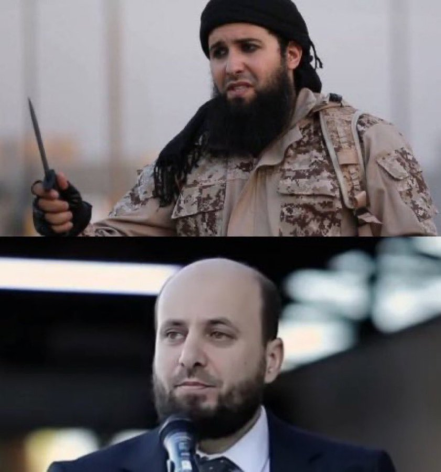
Mohammed al-Bashir before and after his Western Facelift
Let’s see if I got this right: The Biden administration replaces Assad with a terrorist organization but is suddenly surprised when it discovers the group is led by terrorists. Is that it?
Indeed, it is. As you can see, none of this resolves the basic crisis created by the removal of Assad. Instead, the main proponents of regime change—Turkey, the US and Israel—have merely transformed Syria into an even bigger battleground where their own competing interests will soon play out by way of mortal combat.
How long will it be before Turkey locks horns with Israel or the United States? How long before sectarian war engulfs the country?
Not long, I’d wager. And for the people who thought that toppling the “evil dictator” would bring peace and security. They’d better think again.
Israel Gives Biden His Marching Orders
Syrian land will be annexed into “Greater” Israel
By Philip Giraldi • Unz Review • December 13, 2024
My former CIA colleague Larry Johnson has a real ability to clarify the significance of the constantly growing deep dark hole that Joe “Mumbles” Biden, he of failing mental capacity, has hurled the American people into. Larry wrote on December 12th that “There is still plenty of time before Donald Trump is inaugurated for Joe Biden’s team of cretins to start World War III. I think the biggest risk is that Israel may be emboldened to attack Iran and try to destroy sites, and may be encouraged to do so by the Biden lackeys. In short, American interference, at the behest of Netanyahu’s Israel, has left the Middle East in ruins, with over a million dead and open wars raging in Libya, Sudan, Somalia, Lebanon, Syria, and Palestine, and with Iran on the brink of a nuclear arsenal, being pushed against its own inclinations to this eventuality. The collapse of the Assad regime has prompted a punishing military response from Israel, which has launched airstrikes at military targets across Syria and deployed ground troops both into and beyond a demilitarized buffer zone for the first time in 50 years.”
Given the destruction and partitioning of Syria, it has become impossible to consider United States foreign policy without some acceptance that it is driven and, in a sense, directed by Israel and Israel’s formidable domestic lobby in the US. “The Lobby,” as it is commonly referred to, controls both Congress and the White House on key issues and manages the media narrative in such a fashion as to make Israel the permanent victim, never the aggressor. Even though Israel is now marching in triumph across what remains of Syria and has indicated that it will be sticking around as an occupier, the move is being described as “temporary” and “defensive” by White House spokesmen. The Lobby’s success rests on the corruption that lots of money can buy, obvious to nearly everyone in politics, but a forbidden topic, sometimes referred to as an antisemitic “trope,” i.e. “Jews and money.” Israel’s role in managing the Joe Bidens and Donald Trumps is largely exercised in the broader Middle East but it also includes passionately supporting Volodymyr Zelensky’s Ukraine, a process derived in part from Jewish mythologizing and obtaining revenge for the alleged “pogroms” carried out in imperial Russia. Subsequent Jewish dominance of the Soviet intelligence and security services, which saw the killing of millions of Christians in Russia, Ukraine and Eastern Europe, are carefully excluded from the narrative.
In the latest bit of “mowing the grass” by the Israeli military, the country’s new Defense Minister Israel Katz told the press that the Israel Air Force (IAF) had carried out more than 480 strikes across Syria during the two days after the initial invasion, deliberately destroying most of Syria’s strategic weapon stockpiles. Meanwhile, the Israeli navy totally destroyed the Syrian fleet based at Latakia overnight. Katz hailed the operation as “a great success.” Israeli Prime Minister Benjamin Netanyahu, on the day before, had called the rapid defeat of Bashar al-Assad’s regime as “a new and dramatic chapter… The collapse of the Syrian regime is a direct result of the severe blows with which we have struck Hamas, Hezbollah and Iran… we are changing the face of the Middle East.”
When informed of the initial invasion of al-Assad’s Syria by Israeli, Turkish, insurgent and US forces, Donald Trump said that the conflict was none of our business and it would be best to keep out of it. Hopefully that will be the policy after January 20th’s inauguration, but one recalls that Trump’s record of pandering to Israel is almost as bad as Biden’s, and he was the one who decided (admittedly under pressure from the Pentagon) to continue in 2017 the military occupation of a third of Syria that included its oil resources and its best agricultural land. Add in the crippling US and European sanctions on Damascus and one might argue that since that time Syrians have been poor and starving, causing refugee flows and hostility towards the al-Assad government that contributed to the success of the recent uprising.
To be sure, many Syrians are celebrating the fall of an admittedly repressive, authoritarian, and corrupt Bashar al-Assad government. But other Syrians, particularly from hitherto protected minority groups like Christians, Alawites and Shiites, are now living in fear of or fleeing from the violent sectarian insurgents that have taken the place of President al-Assad. Christian Churches have already been looted and desecrated and warned not to hold Christmas services, not to sponsor Christmas parades, and not to display the image of St. Nicholas.
To be sure, fearing what is to come is legitimate as the “rebel” leader of the al-Qaeda derived Hayat Tahrir al-Sham (HTS) Terror group, Abu Mohammad al-Jolani, who now goes by his given name Ahmed al-Shara, is a founder of al-Qaeda in Syria, al-Nusra, and a former deputy to ISIS leader Abu Bakr al-Baghdadi. The US State Department has listed him as a terrorist as well as HTS as a terrorist group, and has placed a $10 million bounty on al-Jolani’s head, which presumably will soon be removed by Joe Biden. There is plenty of blood on al-Jolani’s hands and little in the way of evidence that he will not opt to slaughter those who he sees as his enemies, much of the killing being guided by the extreme religious groups that make up his followers. Indeed, there are already reports of group killings, including numerous soldiers in the Syrian Arab Army who surrendered rather that fight the insurgents.
Al-Jolani now claims that his extremism was just a “phase” and he has several times confirmed that he wants good relations with Israel, clearly a condition imposed by the US to allow him to remain in power. He has even suggested that Israeli air support enabled his warriors to move quickly from their bases in the north to Damascus. But al-Jolani has never actually apologized for or disowned the atrocities committed on his watch in 2011-3 when he was actively killing fellow Syrians. This includes August 2013 massacres in some of the Alawite areas of Latakia, which included “the systematic killing of entire families,” an international investigation later determined. One observer also reported that the insurgents were devoted to “sectarian mass murder” This is the legacy of the new “inclusive” government in Syria. According to one other ominous report, it appears that Sharia law has already been announced by the newly installed justice minister, Shadi Alwaisi.
So, what is in it for the United States? Nothing but a curt thank you from Prime Minister Benjamin Netanyahu, who clearly connived with Joe Biden’s Special Envoy Amos Hochstein, an Israeli by birth, to set the ball rolling towards Syria through adroit use of an attack on southern Lebanon to disarm Hezbollah followed by a phony ceasefire in Lebanon that gave Netanyahu a free hand and empowered Israel to invade and overthrow its neighbor Syria, parts of which will undoubtedly be annexed to help create Eretz or “Greater” Israel. It was and is all part of a plan by the US and Israel to reshape the Middle East to benefit the Jewish state and you can bet that Iran is the next target. And a delusional Joe Biden took credit for it all in his usual haphazard way, claiming after the regime change that Assad’s “main allies” — Iran, Hezbollah, and Russia — “are far weaker today than they were when I took office.” Their inability to save Assad was “a direct result of the blows that Ukraine, Israel have delivered upon their own self-defense, with unflagging support of the United States.”
Sure Joe, what bullshit. At the end of the day, to bring down Syria the US spent billions of dollars arming an insurgency that they knew was dominated by al-Qaeda in a government replacement scheme that benefited only Israel and Turkey and which targeted a country that in no way threatened the United States. It sure makes sense to me and I hope you will be comforted by it when you are hauled off to prison after you leave office and are prosecuted for exceeding your constitutional authority by involving the United States in two unnecessary wars. Some might call it treason!
Philip M. Giraldi, Ph.D., is Executive Director of the Council for the National Interest, a 501(c)3 tax deductible educational foundation (Federal ID Number #52-1739023) that seeks a more interests-based U.S. foreign policy in the Middle East. Website is councilforthenationalinterest.org, address is P.O. Box 2157, Purcellville VA 20134 and its email is inform@cnionline.org.
OCCUPIED: Former IDF Volunteer to Chair House Foreign Affairs Committee, Trump Approves
By Frankie Stockes | SPN | December 12, 2024
At the behest of President-elect Donald Trump, GOP House Leadership has named Israeli-funded-and-tied Congressman Brian Mast as the new House Foreign Affairs Committee Chairman, marking the first known time in American history that a veteran of a foreign military has led a congressional committee. Last year, Mast also became the first known member of Congress to wear the uniform of a foreign military to work at the U.S. Capitol, when he donned his IDF uniform in support of Israel’s campaign in Gaza, following the outbreak of war.
Assuming he’s confirmed by the GOP House Conference, Rep. Mast (R-FL) will succeed Rep. Michael McCaul (R-TX) as the Foreign Affairs Committee Chairman, giving the staunchly pro-Israel Mast jurisdiction over ALL of America’s foreign relations that come through Congress, including war powers, treaties, and the deployment of American troops overseas.
These duties are especially relevant to Mast’s background and loyalties, as he is a staunch opponent of a two-state solution in the Middle East, supporting Israel’s continued seizure of Palestinian land and the expansion of Israel’s borders.
Mast has even cheerled the wholesale slaughter of Palestinian civilians, telling the media in 2023 that he “would encourage the other side to not so lightly throw around the idea of innocent Palestinian civilians… I don’t think we would so lightly throw around the term innocent Nazi civilians during World War II.”
The Israeli press has rejoiced in Mast’s installation as chairman, with The Times of Israel calling him a “pugnacious defender of Israel in [America’s] Congress” in an article published this week.
“The US House of Representatives elected Florida Representative Brian Mast, a zealous pro-Israel Republican who has volunteered with a group that assists the Israeli army, to chair the powerful House Foreign Affairs Committee,” The Times of Israel report went on, before revealing that President-elect Trump is behind the pending installation of Brian Mast.
“Insiders say that President-elect Donald Trump lobbied the Republican Steering Committee, which names committee chairs, to choose Mast.”
Mast, a self-proclaimed Christian and a U.S. Army veteran who lost both of his legs in the Middle East, later volunteered to serve the IDF and says on his campaign website that his worldview was shaped at Israeli “Shabbat tables.”
“I worked to strengthen the relationship between our two countries, as both a private citizen and as a soldier, because the national security of the United States is directly tied to the strength of Israel,” says Mast, who also says he will “advance policies” that are favorable to Israel and even use the force of the United States government to ensure that the American People are FORCED to support Israel.
“I will do all I can to put an end to the dangerous Boycott, Divestment, and Sanctions movement,” he says.
Mast’s ties to Israel go well beyond serving the IDF and since his political career began, he’s received more than half a million dollars from the Israel lobby, with AIPAC holding the distinction of being his top donor.
HTS officials order Palestinian resistance factions to disarm, close bases in Syria: Report
The Cradle | December 13, 2024
Representatives from Hayat Tahrir al-Sham (HTS), the new ruling extremist organization in Damascus, informed the representatives of the Palestinian factions in Syria they would no longer be allowed to possess any weapons, training camps, or military headquarters, Ibrahim Amin of Al-Akhbar reported on 13 December.
Amin further reports that the factions must dissolve their military formations as soon as possible in exchange for political and charitable work under the roof of the new Syrian state.
Palestinian factions, including Fatah, the Popular Front for the Liberation of Palestine (PFLP), and the Popular Front for the Liberation of Palestine-General Command (PFLP-GC), the Saiqa, and Palestinian Islamic Jihad (PIJ) Martyr Ali Aswad Brigad, have had a presence in Syria as guests of the government for decades.
A source in the PFLP-GC revealed to Erem News that the factions were informed of the decision in meeting headed by Ahmed al-Sharaa, also known as Abu Muhammad al-Julani, in the Yarmouk Palestinian refugee camp in the capital, Damascus.
Palestinians came to Syria as refugees during the 1948 Nakba. That year, pre-state Zionist militias ethnically cleansed some 750,000 Palestinians from the land that became the state of Israel, making them refugees in neighboring countries.
Many Palestinian refugees settled in Syria in the Yarmouk Camp on the southern outskirts of Damascus. The camp became the capital of the Palestinian diaspora.
The Palestinian factions formed armed resistance groups and provided manpower for the Palestinian Liberation Army (PLA), which served as an auxiliary to the Syrian Army.
Amin notes that the practical result of these steps taken by HTS, led by former Al-Qaeda leader Abu Mohammad al-Julani, who now goes by his real name Ahmad al-Sharaa, is that the Palestinians are prohibited from using Syria as a headquarters or passage for any activity against Israel.
In 2012, the predecessor to HTS, the Nusra Front, invaded and occupied Yarmouk, seeking to use it as the gateway to conquer Damascus. The camp was largely destroyed over the following years in the course of the fighting. ISIS also occupied the camp and fought against the Syrian army and Palestinian factions there.
Amin says that although the new Syrian government does not talk about establishing relations with Israel, its representatives talk about taking practical steps to prevent any existing or potential resistance against Israel from Syrian territory.
He writes that Israel may seek to force the Lebanese government to take similar actions against Palestinian factions in the refugee camps in Lebanon.
How the US and Israel Destroyed Syria and Called it Peace
By Jeffrey D. Sachs | Common Dreams | December 12, 2024
In the famous lines of Tacitus, Roman historian, “To ravage, to slaughter, to usurp under false titles, they call empire; and where they make a desert, they call it peace.”
In our age, it is Israel and the U.S. that make a desert and call it peace.
The story is simple. In stark violation of international law, Israeli Prime Minister Benjamin Netanyahu and his ministers claim the right to rule over seven million Palestinian Arabs. When Israel’s occupation of Palestinian lands leads to militant resistance, Israel labels the resistance “terrorism” and calls on the U.S. to overthrow the Middle East governments that back the “terrorists.” The U.S., under the sway of the Israel Lobby, goes to war on Israel’s behalf.
The fall of Syria this week is the culmination of the Israel-U.S. campaign against Syria that goes back to 1996 with Netanyahu’s arrival to office as Prime Minister. The Israel-U.S. war on Syria escalated in 2011 and 2012, when Barack Obama covertly tasked the CIA with the overthrow of the Syrian Government in Operation Timber Sycamore. That effort finally came to “fruition” this week, after more than 300,000 deaths in the Syrian war since 2011.
Syria’s fall came swiftly because of more than a decade of crushing economic sanctions, the burdens of war, the U.S. seizure of Syria’s oil, Russia’s priorities regarding the conflict in Ukraine, and most immediately, Israel’s attacks on Hezbollah, which was the key military backstop to the Syrian Government. No doubt Assad often misplayed his own hand and faced severe internal discontent, but his regime was targeted for collapse for decades by the U.S. and Israel.
Before the U.S.-Israel campaign to overthrow Assad began in earnest in 2011, Syria was a functioning, growing middle-income country. In January 2009, the IMF Executive Board had this to say:
Executive Directors welcomed Syria’s strong macroeconomic performance in recent years, as manifested in the rapid non-oil GDP growth, comfortable level of foreign reserves, and low and declining government debt. This performance reflected both robust regional demand and the authorities’ reform efforts to shift toward a more market- based economy.
Since 2011, the Israel-U.S. perpetual war on Syria, including bombing, jihadists, economic sanctions, U.S. seizure of Syria’s oil fields, and more, has sunk the Syrian people into misery.
In the immediate two days following the collapse of the government, Israel conducted about 480 strikes across Syria, and completely destroyed the Syrian fleet in Latakia. Pursuing his expansionist agenda, Prime Minister Netanyahu illegally claimed control over the demilitarized buffer zone in the Golan Heights and declared that the Golan Heights will be a part of the State of Israel “for eternity.”
Netanyahu’s ambition to transform the region through war, which dates back almost three decades, is playing out in front of our eyes. In a press conference on December 9th, the Israeli prime minister boasted of an “absolute victory,” justifying the on-going genocide in Gaza and escalating violence throughout the region:
I ask you, just think, if we had acceded to those who told us time and again: “The war must be stopped”– we would not have entered Rafah, we would not have seized the Philadelphia Corridor, we would not have eliminated Sinwar, we would not have surprised our enemies in Lebanon and the entire world in a daring operation-stratagem, we would not have eliminated Nasrallah, we would not have destroyed Hezbollah’s underground network, and we would not have exposed Iran’s weakness. The operations that we have carried out since the beginning of the war are dismantling the axis brick by brick.
The long history of Israel’s campaign to overthrow the Syrian Government is not widely understood, yet the documentary record is clear. Israel’s war on Syria began with U.S. and Israeli neoconservatives in 1996, who fashioned a “Clean Break” strategy for the Middle East for Netanyahu as he came to office. The core of the “clean break” strategy called for Israel (and the US) to reject “land for peace,” the idea that Israel would withdraw from the occupied Palestinian lands in return for peace. Instead, Israel would retain the occupied Palestinian lands, rule over the Palestinian people in an Apartheid state, step-by-step ethnically cleanse the state, and enforce so-called “peace for peace” by overthrowing neighboring governments that resisted Israel’s land claims.
The Clean Break strategy asserts, “Our claim to the land—to which we have clung for hope for 2000 years—is legitimate and noble,” and goes on to state, “Syria challenges Israel on Lebanese soil. An effective approach, and one with which American can sympathize, would be if Israel seized the strategic initiative along its northern borders by engaging Hizballah, Syria, and Iran, as the principal agents of aggression in Lebanon…”
In his 1996 book Fighting Terrorism, Netanyahu set out the new strategy. Israel would not fight the terrorists; it would fight the states that support the terrorists. More accurately, it would get the US to do Israel’s fighting for it. As he elaborated in 2001:
The first and most crucial thing to understand is this: There is no international terrorism without the support of sovereign states… Take away all this state support, and the entire scaffolding of international terrorism will collapse into dust.
Netanyahu’s strategy was integrated into U.S. foreign policy. Taking out Syria was always a key part of the plan. This was confirmed to General Wesley Clark after 9/11. He was told, during a visit at the Pentagon, that “we’re going to attack and destroy the governments in seven countries in five years—we’re going to start with Iraq, and then we’re going to move to Syria, Lebanon, Libya, Somalia, Sudan and Iran.” Iraq would be first, then Syria, and the rest. (Netanyahu’s campaign for the Iraq War is spelled out in detail in Dennis Fritz’s new book, Deadly Betrayal. The role of the Israel Lobby is spelled out in Ilan Pappé’s new book, Lobbying for Zionism on Both Sides of the Atlantic). The insurgency that hit U.S. troops in Iraq set back the five-year timeline, but did not change the basic strategy.
The U.S. has by now led or sponsored wars against Iraq (invasion in 2003), Lebanon (U.S. funding and arming Israel), Libya (NATO bombing in 2011), Syria (CIA operation during 2010’s), Sudan (supporting rebels to break Sudan apart in 2011), and Somalia (backing Ethiopia’s invasion in 2006). A prospective U.S. war with Iran, ardently sought by Israel, is still pending.
Strange as it might seem, the CIA has repeatedly backed Islamist Jihadists to fight these wars, and jihadists have just toppled the Syrian regime. The CIA, after all, helped to create al-Qaeda in the first place by training, arming, and financing the Mujahideen in Afghanistan from the late 1970s onward. Yes, Osama bin Laden later turned on the U.S., but his movement was a U.S. creation all the same. Ironically, as Seymour Hersh confirms, it was Assad’s intelligence that “tipped off the U.S. to an impending Al Qaeda bombing attack on the headquarters of the U.S. Navy’s Fifth Fleet.”
Operation Timber Sycamore was a billion-dollar CIA covert program launched by Obama to overthrow Bashar al-Assad. The CIA funded, trained, and provided intelligence to radical and extreme Islamist groups. The CIA effort also involved a “rat line” to run weapons from Libya (attacked by NATO in 2011) to the jihadists in Syria. In 2014, Seymour Hersh described the operation in his piece “The Red Line and the Rat Line”:
“A highly classified annex to the report, not made public, described a secret agreement reached in early 2012 between the Obama and Erdoğan administrations. It pertained to the rat line. By the terms of the agreement, funding came from Turkey, as well as Saudi Arabia and Qatar; the CIA, with the support of MI6, was responsible for getting arms from Gaddafi’s arsenals into Syria.”
Soon after the launch of Timber Sycamore, in March 2013, at a joint conference by President Obama and Prime Minister Netanyahu at the White House, Obama said: “With respect to Syria, the United States continues to work with allies and friends and the Syrian opposition to hasten the end of Assad’s rule.”
To the U.S.-Israeli Zionist mentality, a call for negotiation by an adversary is taken as a sign of weakness of the adversary. Those who call for negotiations on the other side typically end up dead—murdered by Israel or U.S. assets. We’ve seen this play out recently in Lebanon. The Lebanese Foreign Minister confirmed that Hassan Nasrallah, Former Secretary-General of Hezbollah had agreed to a ceasefire with Israel days before his assassination. Hezbollah’s willingness to accept a peace agreement according to the Arab-Islamic world’s wishes of a two-state solution is long-standing. Similarly, instead of negotiating to end the war in Gaza, Israel assassinated Hamas’ political chief, Ismail Haniyeh, in Tehran.
Similarly in Syria, instead of allowing for a political solution to emerge, the U.S. opposed the peace process multiple times. In 2012, the UN had negotiated a peace agreement in Syria that was blocked by the Americans, who demanded that Assad must go on the first day of the peace agreement. The U.S. wanted regime change, not peace. In September 2024, Netanyahu addressed the General Assembly with a map of the Middle East divided between “Blessing” and “Curse,” with Lebanon, Syria, Iraq, and Iran as part of Netanyahu’s curse. The real curse is Israel’s path of mayhem and war, which has now engulfed Lebanon and Syria, with Netayahu’s fervent hope to draw the U.S. into war with Iran as well.
The U.S. and Israel are high-fiving that they have successfully wrecked yet another adversary of Israel and defender of the Palestinian cause, with Netanyahu claiming “credit for starting the historic process.” Most likely Syria will now succumb to continued war among the many armed protagonists, as has happened in the previous U.S.-Israeli regime-change operations.
In short, American interference, at the behest of Netanyahu’s Israel, has left the Middle East in ruins, with over a million dead and open wars raging in Libya, Sudan, Somalia, Lebanon, Syria, and Palestine, and with Iran on the brink of a nuclear arsenal, being pushed against its own inclinations to this eventuality.
All this is in the service of a profoundly unjust cause: to deny Palestinians their political rights in the service of Zionist extremism based on the 7th century BCE Book of Joshua. Remarkably, according to that text—one relied on by Israel’s own religious zealots—the Israelites were not even the original inhabitants of the land. Rather, according the text, God instructs Joshua and his warriors to commit multiple genocides to conquer the land.
Against this backdrop, the Arab-Islamic nations and indeed almost all of the world have repeatedly united in the call for a two-state solution and peace between Israel and Palestine.
Instead of the two-state solution, Israel and the U.S. have made a desert and called it peace.
Exposing CIA/MI6 ‘Justice’ Operations in Syria
By Kit Klarenberg | Global Delinquents | December 12, 2024
In the immediate wake of the Syrian government’s abrupt collapse, much remains uncertain about the country’s future. While longtime leader Bashar Assad has sought refuge in Moscow, most of his government and its military, security, and intelligence apparatus remains in Damascus. Calls for reconciliation between officials and the predominantly foreign “opposition” abound, but the prospect of show trials for state apparatchiks is high. After all, elements of Anglo-American intelligence have been planning for such an eventuality since before the Syrian civil war even started.
In May 2011, the Commission for International Justice and Accountability (CIJA) was birthed by shadowy NATO state contractors, ARK and Tsamota. Its first act was to train handpicked Syrian “investigators, lawyers, and activists in basic international criminal and humanitarian law… enabling [them] to link state and non-state actors to underlying criminal acts.” Dedicated “teams of investigators according to their regions” – including Aleppo, Hama, Homs, and Idlib – were created, “and equipped with field investigative kits.”
Their objective was to gather evidence of war crimes committed by Syrian government forces, in support of a “domestic justice process in a future transitional Syria.” We must ask ourselves how such a project came to be before the Syrian army was formally deployed by Damascus, in response to the foreign-fomented crisis that commenced in mid-March that year. Particularly given bringing officials to trial in a “future transitional Syria” was wholly contingent on all-out regime change.
The timing of CIJA’s launch is a palpable indication foreign actors were laying foundations for that eventuality from the very first days of Syria’s “peaceful revolution”, before full-blown civil war had erupted. Given the affiliations of ARK and Tsamota, the pair were well-placed to know in advance of plans by Western governments to topple the Assad government via brute force. Now that has come to pass, it may be time for their long-standing plan to at last be put into action.
‘Regime Change’
Founded by MI6 journeyman Alistair Harris, ARK was one of a constellation of contractors, staffed by military and intelligence veterans, employed by British intelligence at a cost of many millions to conduct covert psychological warfare campaigns in Syria, from the initial days of the crisis. The aim was to destabilise Assad’s government, convince the domestic population, international bodies and Western citizens that genocidal CIA and MI6-backed militant groups pillaging the country were a “moderate” alternative, and deluge media the world over with pro-opposition propaganda.
Under this operation’s auspices, ARK founded and ran numerous ostensibly independent opposition media outlets targeting Syrians of all ages, while tutoring and equipping countless local “citizen journalists”, teaching them “camera handling, lighting, sound, interviewing, filming a story… video and sound editing… voice-over, scriptwriting,” and “graphics and 2D and 3D animation design.” The firm’s students were also instructed in practical propaganda theory, such as “target audience identification, media narrative analysis and monitoring, behavioral identification/understanding, campaign planning, behavioral change, and how communications can influence it.”
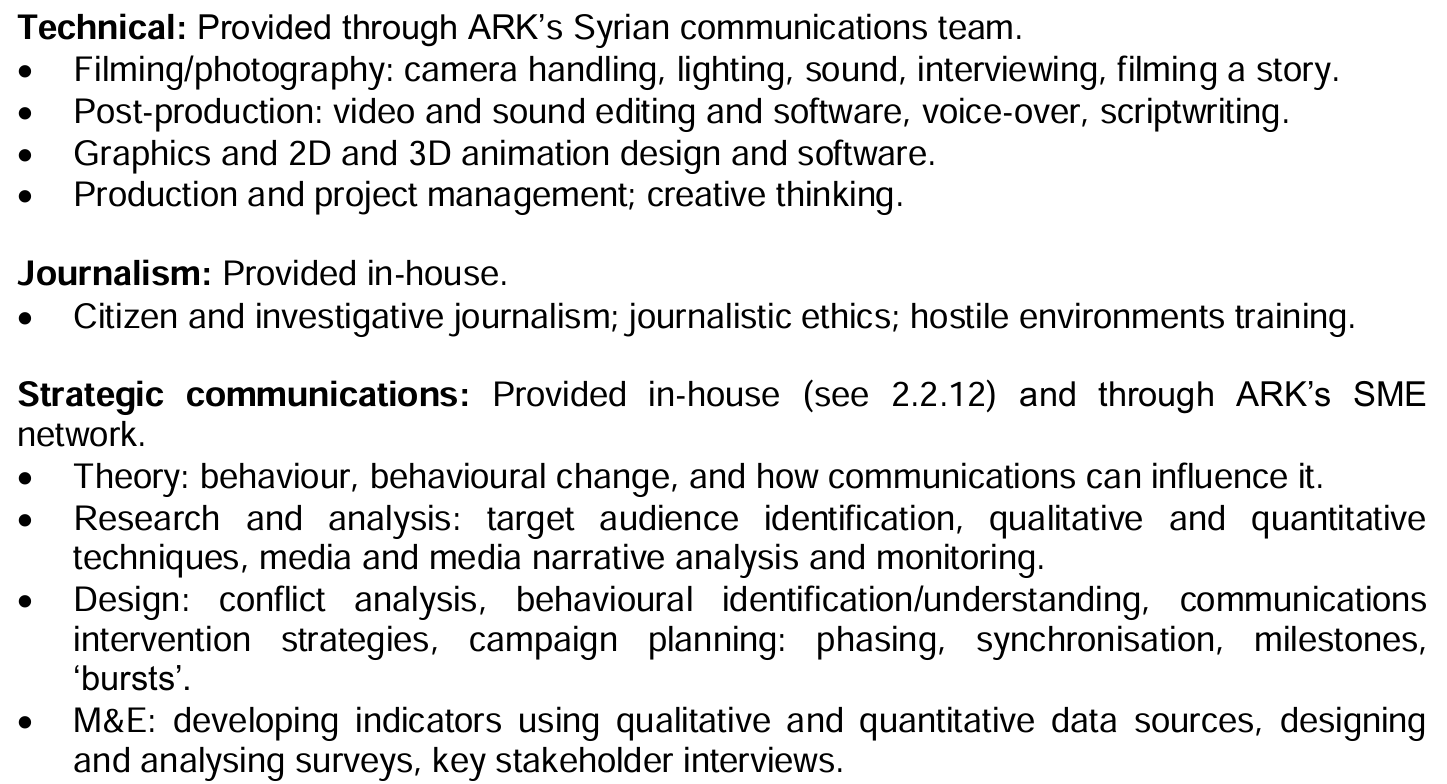
Such was ARK’s intimate proximity with anti-Assad elements, it boasted in leaked submissions to the Foreign Office of being entrusted by Western governments to develop a dedicated Office for Syrian Opposition Support. This entity identified the most promising groups for the proxy war’s sponsors to finance, in turn “[helping] present them to international donors, and provide access to networks that could deliver assistance.” These efforts intensified “as the conflict deepened and it became apparent that regime change would not occur in the short term.”
Tsamota’s primitive official website describes the company as “a security and justice sector consultancy which provides rule of law, forensics and natural resources advisory services,” working in “in politically, legally, socially and logistically challenging environments” for Western governments. The firm is not a compelling candidate for holding government officials anywhere accountable for war crimes. Tsamota has since inception offered guidance to major corporations on how to maximise profits in the Global South, while limiting their local and international legal liabilities.
In 2013, Tsamota director William Wiley gave a scandalous presentation to Canadian consortium MineAfrica Inc. In it, he set out a series of hypothetical scenarios in which mining companies operating in countries such as the Congo and Mali employed private security firms to crack down on striking workers, or deal with “local militias” interfering with their operations. Wiley outlined a number of means by which companies could be insulated from repercussions of heavy-handed responses to such incidents, up to and including murder.
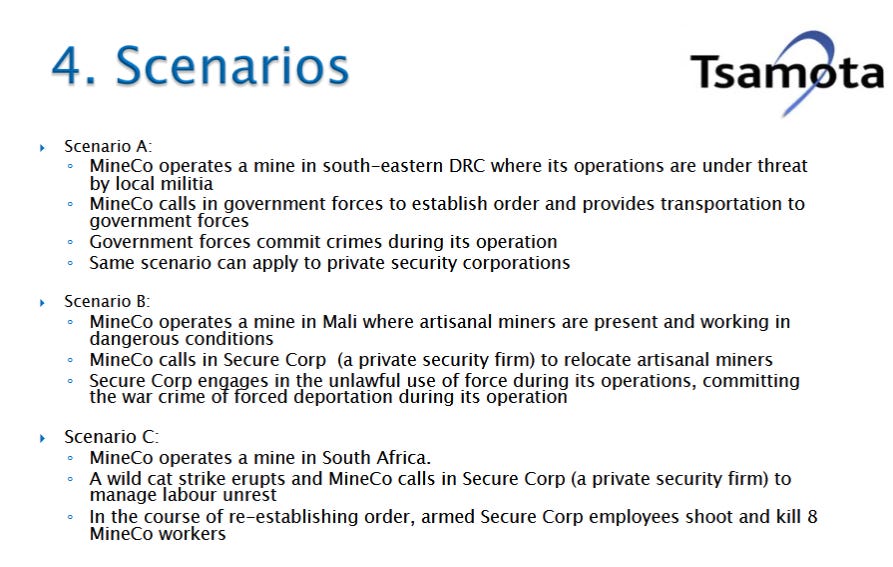
That presentation described Tsamota as composed of “experts” drawn from “national police, military and intelligence forces.” Wiley is no exception, having served in the Canadian military for almost two decades. Subsequently, he turned to international law, among other things overseeing the trial of Saddam Hussein October 2005 – December 2006, for crimes against humanity. Mainstream accounts acknowledge Wiley was imposed on the former Iraqi leader’s defence team without consent – a major breach of basic legal norms – by the US embassy in Baghdad’s Regime Crimes Liaison Office.
After capture, Hussein was initially interrogated by the CIA. Contemporary media reports note there was significant concern within the Agency that “their questioning could become public during his eventual trial,” raising issues around “how to conduct the questioning and record the conversations.” The reasons why were unstated, although a likely explanation was Washington wished to avoid awkward disclosures in court about Hussein’s long-running relationship with the CIA, and active US complicity in many of the most heinous crimes of which he was accused.
To say the least, this was a sensitive role indeed. Even prominent Iraqi supporters of US invasion and occupation charged Baghdad’s “interim” puppet government was seeking “show trials followed by speedy executions” of Hussein et al to boost its credibility. That Wiley was entrusted with this mission speaks volumes about his reliability from the US government’s perspective. It also raises obvious questions about the nature of his relationship with the CIA, and whether that bond influenced CIJA’s creation half a decade later.
‘Moving Documents’
A series of leaked ARK files on CIJA’s activities authored in the years immediately following its creation make grand claims about its achievements. One declares the Commission “innovated in the field of transitional justice… aiding the collection of evidence to document war crimes, crimes against humanity, and other violations of International Humanitarian Law” in Syria. Another states its work represented “a landmark development in international justice: the contemporaneous gathering of evidence of violations of international humanitarian law conducted by regime forces”:
“[CIJA], through expert training, effective equipment provision and a commitment to the truth were able to ensure that when the conflict ends, the raw material of a post-conflict war crimes process is ready for trial, in turn providing a key contribution to truth telling, reconciliation and the future of Syria.”
Elsewhere, ARK boasted how CIJA had seized thousands of kilograms of “contemporaneous documentation”, hundreds of thousands of pages of “evidential material” and thousands of videos from Syria, “all of which had to be hand carried” out of the country. Cut to February 2021, and Commission chair Stephen Rapp, a US diplomatic warhorse, bragged to CBS about the sheer volume of evidence CIJA collected. He claimed the papertrail exposed a systematic strategy of Assad government-directed executions of opposition activists, along with ensuing coverups:
“Now we have 800,000 pages of original documents, signed and sealed with original signatures going all the way up to Assad that document this whole strategy…We see reports back about ‘well, we’ve got a real problem here, there are too many corpses stacking up, somebody’s gonna have to help us with that’… Everything is handled in this sort of totalitarian system where they frankly think they can get away with things… they were almost stupid… they created evidence.”
If such damning, incontrovertible proof was bagged at any stage by CIJA, it has never emerged publicly. Still, throughout the Syrian dirty war, the Commission enjoyed glowing profiles in Western media, while providing journalists and rights groups with multiple scoops supposedly exposing Syrian government atrocities. At no point did any mainstream reporter or NGO question, let alone raise concerns about, the manner in which the Commission garnered the material upon which its cases against government officials in Damascus was “hand carried” out of the country.
CIJA chief Wiley acknowledged in 2014 that his organisation smuggled evidence from Syria by working with every opposition group “up to but excluding Jabhat al-Nusra and Islamic State.” However, a 2019 investigation by The Grayzone amply indicates that CIJA was frequently in extremely close quarters with both groups. Moreover, they were paid handsomely for their assistance in securing documentation. This included material seized in Raqqa after its January 2014 capture by ISIS, right when the ultra-extremist group was massacring Alawites and Christians.
In a 2016 New Yorker profile of CIJA, Wiley detailed the practical hassles and financial drain inherent in “moving documents [over] international borders” and opposition-controlled “checkpoints”, while relying on “rebel groups and couriers for logistical support.” He described how bundles of government files “typically” arrived at the Commission’s offices “in a dizzying array of crappy suitcases.” Wiley lamented, “we burn enormous sums of money moving this stuff.”
Accordingly, CIJA received tens of millions of dollars for its efforts from a variety of Western governments, including those at the forefront of the Syrian dirty war. Despite the vast windfall, the Commission’s work produced zero prosecutions for many years. This changed in late 2019, when Anwar Raslan and Eyad Gharib, two former members of Damascus’ General Intelligence Directorate, were indicted in Germany for crimes against humanity.
‘Many Contradictions’
Raslan headed the Directorate’s domestic security unit, while Gharib was one of his departmental subordinates. The pair defected to the opposition in December 2012. Raslan and his family fled to Jordan, where he played “an active and visible role in the Syrian opposition.” He was part of the anti-Assad delegation at the Geneva II conference on Syria in January 2014, and in July that year, was granted asylum in Germany.
After his escape from Syria, Raslan told numerous lurid tales of abuse and atrocities perpetrated by his unit, and the Assad government more widely, during his 20 years of state service. He claimed his defection was spurred after learning an apparent opposition attack in Damascus that he was charged with investigating was, in fact, staged by security forces. Significant doubts about his accounts, and whether his defection was principled or just cynical opportunism, have been raised in many quarters.
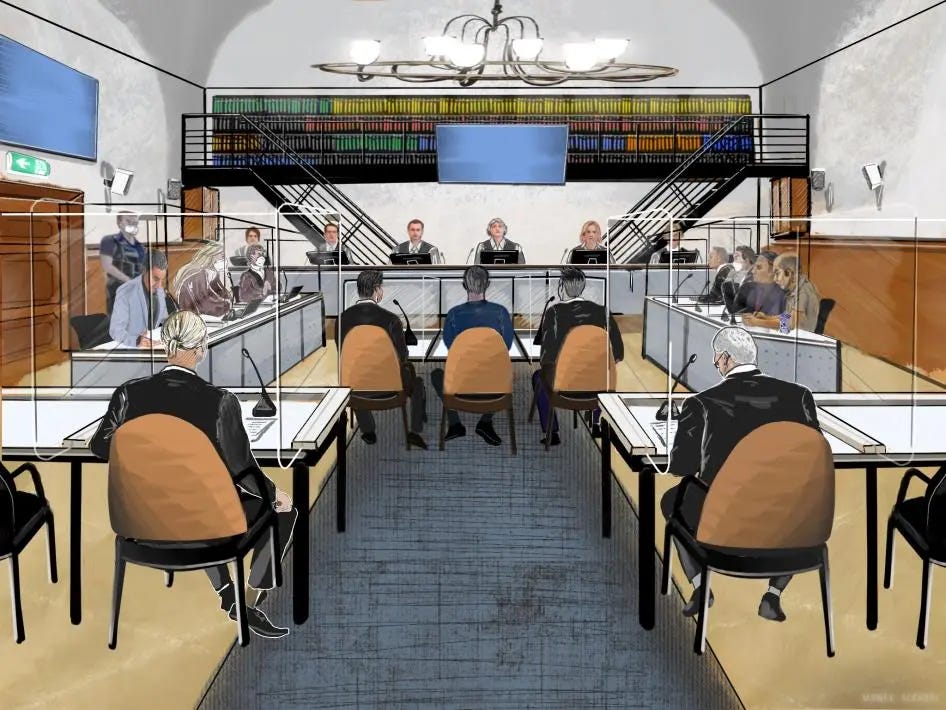
Artist’s rendition of Raslan’s trial
In a perverse irony, Raslan’s loudmouth propensity was his undoing. His assorted claims post-defection provided grounds for arrest by German authorities, and were used against him and Gharib in their prosecutions. These legal actions heavily relied on documents seized by CIJA, including Central Crisis Management Cell records. This unit was created in March 2011 by Damascus, to manage responses to mass rioting that erupted this month. These documents have been widely described as the “linchpin” of the Commission’s case against “the Syrian regime.”
Yet, as this journalist has previously exposed, the Central Crisis Management Cell files in fact show the Assad government explicitly and repeatedly instructed security forces to protect protesters, prevent violence, and keep the situation under control. The documents also detail how from inception, many “peaceful” demonstrators were extremely violent, while opposition fighters systematically murdered security service operatives, pro-government figures, and demonstrators to foment catastrophe, in a manner eerily similar to many CIA/MI6 regime change operations old and new.
In February 2021, Gharib was found guilty of aiding and abetting crimes against humanity. He received four-and-a-half years in prison. A year later, Raslan was given life for crimes including mass torture, rape, and murder. The pair were not convicted for personally perpetrating these horrors, but serving in the General Intelligence Directorate at the time they were allegedly committed. “Expert” witness evidence provided at their trials left much to be desired.
For example, judges and prosecutors alike expressed disquiet at “many contradictions” in the testimony of “P3”, a Syrian government operative who purportedly worked in a security service “mail department”, and was central to Gharib’s conviction. P3 professed to seeing sensitive documents “related to the transfer of corpses” of opposition activists “to burial sites.” They “provided contradictory information” in statements to German police and the court, and were “visibly nervous” while testifying. Throughout, their seemingly aghast attorney sat nearby “putting his hands behind his head.”
Meanwhile, during Raslan’s prosecution, “P4” – a nameless individual who claimed to have been detained in a Syrian prison, and bribed his way out – testified he saw 500,000 corpses buried via a “bulldozer and a truck” next to his house, in an area which was previously “a desert”. Reports of the trial indicate there “was a feeling” among those present in court, including “the public”, that these numbers were greatly “exaggerated.”
The sense that Gharib and Raslan were prosecuted because they were within easy reach, and CIJA needed something to show for all its well-remunerated efforts, is ineluctable. The Commission had strong grounds to be anxious about failing to fulfill its founding objective. In March 2020, the European Anti-Fraud Office (OLAF) formally accused the organization of “submission of false documents, irregular invoicing, and profiteering” relating to an EU “Rule of Law” project it ran in Syria.
Fast forward to today, and The Guardian reports that “the abrupt implosion of the infrastructure of state terror” in Syria “has made available a huge volume of evidence.” The outlet quoted CIJA chief William Wiley at some length. He compared Assad’s fall to “a situation much like Germany in 1945 or Iraq in 2003,” with “a sudden availability of all state records” making prosecution of state officials a fait accompli:
“It’s a very unusual situation, and its suddenness creates challenges and opportunities in simply dealing with the material… If there’s any security intelligence guy that rocks up in Europe, there’s typically going to be enough material already to hand.”
Lessons from Syria, Lebanon: Resistance is the only guarantor of sovereignty
By Mohamad Hasan Sweidan | The Cradle | December 12, 2024
On the heels of thinly veiled threats from Israeli Prime Minister Benjamin Netanyahu that deposed Syrian president Bashar al-Assad was “playing with fire,” and seizing the opportunity presented by the sudden collapse of the Syrian state, the occupation army invaded Syrian territory for the first time in 50 years.
The pretext of establishing a “buffer zone” was a transparent attempt to conceal Israel’s historic regional agenda: the weakening and fragmentation of Arab states to facilitate Tel Aviv’s regional domination.
Exploiting the power vacuum that ensued from the fall of Damascus, Israel launched hundreds of air strikes to cripple Syria’s already weakened military capabilities, and patted itself on the back for what it called the largest air blitz in its history. Its land forces and armored vehicles now lay a few kilometers from the Syrian capital, having literally driven through border terrain without a single challenge by opposing troops.
For many observers in neighboring Lebanon – and perhaps Iraq and other regional states – the Israeli rout answered a critical question: if they relinquished the will or capacity to defend themselves, would this too be Lebanon’s fate?
A legacy of expansionism
The concept of ‘Greater Israel’ is deeply rooted in Zionist ideology. From Theodor Herzl, the father of modern Zionism, to revisionist figures like Ze’ev Jabotinsky, and even Israel’s first prime minister, David Ben-Gurion, expansionist ambitions have been a consistent theme.
Oded Yinon’s plan, A Strategy for Israel in the Eighties, further solidified this vision. First made public in the magazine Kivunim (Directions) of the World Zionist Organization in February 1982, the plan was based on the vision of Herzl, and the founders of the Israeli state in the late 1940s, among them Polish-born, US Zionist leader Jacob Fishman.
From North Africa to the Levant to the Arabian Peninsula, Yinon advocated a strategy of breaking up and chronically weakening Arab states in order to ensure Israel’s long-term security.
“Israel’s policy, both in war and in peace, ought to be directed at the liquidation of Jordan under the present regime and the transfer of power to the Palestinian majority … The dissolution of Syria and Iraq later on into ethnically or religiously unique areas such as in Lebanon, is Israel’s primary target on the Eastern front … Iraq, rich in oil on the one hand and internally torn on the other, is guaranteed as a candidate for Israel’s targets. Its dissolution is even more important for us than that of Syria … The entire Arabian peninsula is a natural candidate for dissolution due to internal and external pressures, and the matter is inevitable especially in Saudi Arabia … Egypt is divided and torn apart into many foci of authority. If Egypt falls apart, countries like Libya, Sudan or even the more distant states will not continue to exist in their present form and will join the downfall and dissolution of Egypt.”
This destructive and expansionist drive is not confined to historical Israeli figures. Current Israeli Finance Minister Bezalel Smotrich has openly stated his desire for Israel to control territory extending to Damascus and including Jordan. In a 2016 interview, he is quoted as saying: “Our great religious elders used to say that the future of Jerusalem was to extend as far as Damascus.”
More recently, following the fall of Damascus, Smotrich pressed: “It is time to seize control of Gaza and strip Hamas of its civilian authority, cutting off its lifeline,” and to launch an all-out offensive in the occupied West Bank.
Such pronouncements, far from being isolated incidents, reflect a core Zionist principle that resurfaces with increased intensity during times of conflict.
The ongoing war in Gaza exemplifies this. Nearly 10 months after the start of the war, Netanyahu said of the Occupied Palestinian Territory: “It is part of our homeland. We intend to stay there.” Smotrich’s display of a ‘Greater Israel’ map encompassing all of historic Palestine and Jordan during a 2023 visit to Paris further illustrates these ambitions.
Historically, these far-right expansionist fantasies are rooted in religious beliefs that the ‘Promised Land’ stretches from the Nile River in Egypt to the Euphrates River in Iraq. These beliefs have been seeded and advanced by the leaders of the Zionist movement since its inception more than 120 years ago.
Breaking up West Asia
Their expansionist fantasies are not merely ideological. The Yinon Plan outlined a strategy for breaking Arab states into weak, sectarian ones, each dependent on Israel for survival. Iraq is to be divided into Kurdish, Sunni, and Shia states, Lebanon reduced to fragments, and Syria obliterated. This is not a theory – it’s a Zionist roadmap for domination, and the occupation state’s aggression in Syria is a direct implementation of these sinister goals.
Israel’s actions in Syria lay bare the insatiable greed of the occupation state. Without resistance movements in neighboring Lebanon, Israeli tanks would undoubtedly have rolled deep into Lebanese territory, seizing lands far beyond the south of the Litani.
The evidence is clear. Since the ceasefire between Israel and Lebanon took effect on 27 November, the Israeli occupation army has violated Lebanese sovereignty at least 195 times. These violations include airstrikes, drone incursions, artillery bombardments, and the destruction of homes – acts of terror meant to keep Lebanon on its knees.
The Lebanese government and armed forces, shackled by limited capacity and international neglect, have been unable to halt this aggression. International mechanisms like the five-member committee – comprising the US, France, Lebanon, Israel, and UNIFIL – are nothing more than diplomatic theatrics.
Resistance: The barrier against occupation
A day after the committee meeting on 9 December, the Israeli army committed 12 violations of the ceasefire agreement.
They meet, they talk, but they fail to act. While these parties dither, Tel Aviv tightens its grip, proving time and time again that the only language it understands is the language of force. This is why Lebanon’s resistance remains the only genuine national safeguard against Israeli aggression.
Southerners in Lebanon know this truth intimately: without the resistance, Israel’s greed knows no bounds. Every incursion, every violation, is a reminder that resistance is not just a choice – it’s a necessity.
The unrelenting aggression of the occupation state reveals a harsh reality; in a world dominated by power, weakness invites exploitation. Realists in international relations argue that power is the only currency that matters, and Lebanon’s experience validates this view.
Resistance movements have demonstrated that the balance of power is the sole way to curb Tel Aviv’s appetite and ambitions. Israel’s expansionism will not end with Syria or Palestine. It eyes every vulnerable nation in the region, seeking to carve it up and dominate.
The lesson is clear. Only through resilience and force can sovereignty be defended. Resistance is not just a shield – it is the only path to survival against an entity that thrives on destruction and occupation.
Al-Qaeda Rides Again… in Syria
By Daniel McAdams | Ron Paul Institute | December 11, 2024
As Christians around the world prepare to celebrate Christmas, a hell has been unleashed inside Syria with the seizure of the country by the re-named “al-Qaeda in Syria” now called Hay’at Tahrir al-Sham (HTS). Its leader is a former deputy commander of ISIS, Abu Mohammed al-Julani.
While neocons and the mainstream media in the US and Europe celebrate the overthrow of the Assad government – a priority since the Obama Administration – as with previous US “liberations” in Libya and Iraq the outcome is proving to be anything but liberating. Christian churches are being ransacked and believers abused.
Sharia law has been announced by the new justice minister, Shadi Alwaisi.
Public executions of those who oppose the rule of al-Julani – who still has a $10 million bounty on his head from the US State Department even as he is funded by the CIA – have begun across the country. (Extremely graphic link here).
Just today, Christian Churches in Syria were warned not to hold Christmas services, not to hold Christmas parades, and not to even display the image of St. Nicholas! This is what the mainstream media told us was the new “inclusive” government in Syria.
Featured Video

Iran FM Araghchi: “Hormuz Will No Longer Be the Same”
or go to
Aletho News Archives – Video-Images
From the Archives
Sam Husseini: The entire US establishment helped lie their way into the Iraq war
By Slava Zilber | American Herald Tribune | October 14, 2019
Sam Husseini is a senior analyst with the Institute for Public Accuracy, independent journalist and contributor to The Nation and FAIR.
Slava Zilber: Sam, three years ago, you appeared on Talk Nation Radio with David Swanson and spoke about the case of the GCHQ whistleblower Katharine Gun. You pointed out that the people involved in the spying on the UN and the people authorizing the Iraq War were not held accountable:
“Virtually everybody who went along with the war, whether it is Kerry or Clinton, of course, the Bush administration themselves has falsified their own records in terms of why, what they did, when they did, why they did it, to the extent that they’ve been scrutinised at all.”
You also address it in a recent article. And recently, Joe Biden has been lying about his position on the Iraq War. How can such an important issue escape meaningful scrutiny? … continue
Blog Roll
 Aletho News
- Iran FM Araghchi: “Hormuz Will No Longer Be the Same”
- EU facing trillion-euro debt hole while seeking more cash for Kiev
- How US, Europe, Persian Gulf states exhausted missile stockpiles, splurged billions to defend Israel
- Up in arms… Koreans reject U.S. empire’s plan to make South Korea the next Ukraine
- Iran, Turkey, Pakistan, Saudi Arabia could advance region-led security framework in Tehran: FM spox
- Netizens condemn Japanese drama for projecting Japan’s wartime atrocities onto Chinese characters
- Racist Seinfeld Dances for Joy as Bibi Unveils His New Map
- A West Bank War for Netanyahu’s Election Campaign, Could It Backfire?
- Yemen denounces European Parliament’s ‘hypocritical’ push to blacklist Ansarullah
- Qalibaf: UAE’s UN bid aims to ‘clear the runway’ for ‘Greater Israel’, whitewash genocide
- If Americans Knew
- An error has occurred; the feed is probably down. Try again later.
- No Tricks Zone
- Sudden Stratospheric Warming, Powerful El Niño Combination May Lead To Extreme Europe Cold, Energy Crisis!
- Two New Studies Find Thwaites Glacier Melt Cannot Be Driven By Human Activity Or A Warming Ocean
- E-Cars Reduce CO2 Emissions By Only 41% Compared To Internal Combustion Engine Vehicles
- Predictions Made By Renowned Climate Professor Over Past Decades Have Been Proven To Be Poor
- New Study Suggests Large Regions Of The Pacific Ocean Have Been Cooling For The Last 80 Years
- Germany’s Green Energy Debacle: High Energy Costs Force Kahla Porzellan to Close After 182 Years!
- New Study: 50 Years Of The Most Aggressive ‘Net Zero’ Policies Can Only Affect The Global Climate By 0.03°C
- US September “Heat” Was No Record…Many Records Set Decades Ago
- Latest European Green Energy Debacle; Portugal’s Largest Flagship Solar Park Insolvent!
- Green Energy Debacle: German Expert Professor Fritz Vahrenholt Warns Of Severe Economic And Social Consequences

