ISIS kills Palestinian fighters in Syrian desert
The Cradle | April 19, 2024
At least 20 fighters from Liwa al-Quds, a Palestinian armed group supporting the Syrian army, were killed when their bus was ambushed by unknown militants in the eastern countryside of Homs Governorate in Syria, Sputnik reported on 19 April.
Sputnik’s correspondent added that the ambush was carried out by militants likely affiliated with ISIS. The militants attacked the bus with heavy machine guns and B7 artillery shells while it was traveling between the village of Al-Koum and the city of Al-Sukhnah in the eastern Badia desert near Palmyra.
Several Liwa al-Quds members were also seriously injured, suggesting the death toll may rise.
The Syrian army sent reinforcements to the area and began extensive combing operations in search of ISIS cells.
The Badia desert near Al-Suknah lies north of the 55-kilometer “protected” area surrounding the illegal US military base at Al-Tanf on the Syria–Iraq–Jordan border.
Pro-Syrian forces are not allowed to enter the protected zone and are bombed by US warplanes if attempting to do so.
The Syrian and Russian governments have accused the US of training militants from ISIS and other mercenary armed groups in the protected zone and allowing them to use it as a base for attacks on Syrian forces elsewhere in the Badia desert region.
The Russian military has supported the Syrian army’s effort to defeat ISIS since 2015. On Thursday, Russian Major General Yuri Popov confirmed that the Russian Air Force destroyed three militant bases in remote areas in Homs Governorate.
During a press conference, Popov said, “The Russian Air Force destroyed three bases for militants who left the Al-Tanf area and were hiding in inaccessible areas in the Al-Amur mountain range in Homs Governorate.”
In recent months, ISIS has escalated its operations, targeting civilians, soldiers, and forces supporting the Syrian army.
ISIS attacks on Syrian forces have coincided with Israel’s ongoing shadow war with Iran, including in Syria. On 1 April, Israel bombed the Iranian consulate in Damascus, killing a prominent Islamic Revolutionary Guard Corps (IRGC) general.
Iran responded last week by launching hundreds of drones and missiles at Israel, damaging the Nevatim airbase and an intelligence collection center on Jabal al-Sheikh mountain on the Lebanon border.
Syria is part of the Axis of Resistance forces, along with Iran, Hezbollah, Ansarallah, and the Islamic Resistance in Iraq, that have sought to resist Israel’s genocide in Gaza.
Wheels Within Wheels: Complexity is Real in War
By Bill Buppert | The Libertarian Institute | April 18, 2024
Sober observers may find another reason for the Iranian attack against Israel this month in retaliation for the Israeli bombing of the Iranian consulate annex building adjacent to the Iranian embassy in Damascus, Syria on April Fools Day.
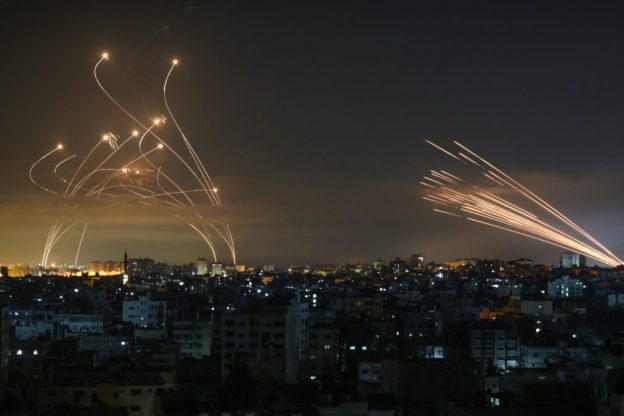
May I suggest it is more important in this case to exhaust the kinetic Israeli/US air defense assets and accuracy doesn’t matter as long as exquisite munitions are exhausted; whether shoot/shoot/look or shoot/look/shoot which is a slight permutation on dynamic retasking, controlled pairs or more of air defense munitions are launched as a matter of course to service incoming ordnance. If the object here is to empty the western magazine cupboards by sending your older and less effective munitions aloft (Iran), mission accomplished and you have a very sufficient intelligence mapping of Israeli Anti-Access Air Defense (A2AD) dispositions and tactics, techniques and procedures (TTP) for follow-on responses.
Nations and regions do stumble into war precipitously but there are conflicts in history where the weaker opponents plan and shape the conditions to prevail before the conflict is started; Vietnam is the best example in recent history of reading the tea leaves and setting the stage for success against superior forces.
The west has a manufacturing crisis right now that is existential in restocking and reconstituting the emptying stocks of war materiel. One can either favor or oppose doing that but the fact remains the manufacturing base and capability is an open question for America and its allies.The chaos avalanche of the competency crisis, the reproducibility problems in STEM research & application and the very real infrastructure failures increasing in frequency year by year doesn’t bode well for those wishing to replenish the diminished war stocks potentially reconstituting with stuff that simply doesn’t work.
The second 155mm artillery shell manufacturing plant in the west just went up in flames in the UK in less than a week. One in Scranton Army Ammunition Plant in PA and the BAE Systems Glascoed Plant in Monmouthshire, UK.
In war, there is a lot to be said for how to leverage shaping the conflict left of bang.
I’m fond of saying that many people are in charge but no one is in control.
The collapse of the concept of a rules-based international order
By Veniamin Popov – New Eastern Outlook – 18.04.2024
After the collapse of the Soviet Union, the United States believed that a unipolar world would last forever: year after year, day after day, it became increasingly blatant in its disregard for the interests of others and the opinions of the rest of the world.
Then the concept of an international “rules-based order” was born: a group of American scholars, former and future officials, presented a paper at Princeton in 2006 entitled “A World of Freedom Under Law”. They framed this as a response to the weaknesses of international law, suggesting that when international institutions fail to produce the outcomes preferred by the “world of freedom”, there is “an alternative forum for liberal democracies to authorise collective action”. In practice, this forum has most often been the White House.
During the Libyan crisis of 2011, the United States and its allies used Security Council authorisation for a no-fly zone to overthrow Muammar Gaddafi.
American troops have now been operating in eastern Syria for more than eight years – yet there is no justification in international law for their presence.
Even American political scientists describe this concept as a kind of asterisk placed over international law. The “rules-based order” absolves the US and its allies of responsibility and fundamentally undermines the concept of international law. US policymakers use this theory to entrench US advantages as a global power. When the prerogatives and rules of international law coincide with the canons they establish, Washington calls them synonymous. Thus, on the eve of February 2022, i.e. the start of a special military operation in Ukraine, Secretary Blinken warned of a moment of danger for “the foundations of the United Nations Charter and the rules-based international order that preserves stability around the world”, but when US prerogatives diverge from international law, the concept of a “rules-based order” comes into play, which “should ultimately benefit global stability”.
A prime example is the 2003 US invasion of Iraq, which the George W. Bush administration cynically justified as a means of enforcing UN disarmament mandates. Iraq was declared an invader, it survived the military occupation, the death toll of Iraqis is approaching 1 million, and the country is still reeling from America’s brazen attack.
Washington’s military and economic might at the time ensured that America would face few consequences for invading without UN authorisation.
The very concept of a “rules-based order” set America at odds with the rest of the world, which recognised that international relations were becoming multipolar. Many leaders of developing countries, especially Russia, China, India and Brazil, talked about the same thing. Even American allies tried to show the flaws in the concept. Former German Chancellor Gerhard Schröder warned of the “undeniable danger of US unilateralism”, and former French Minister Hubert Védrine once said that “France’s entire foreign policy … is aimed at making tomorrow’s world consist of several poles, not just one”.
According to Harvard University professor Stephen Walt, the US was carried away by a show of force, disregarding the opinions of even its allies and international organisations, and then went off on its own to gain the advantage.
The Gaza war drew a final line under the concept of the “rules-based order”: on 25 March, 14 members of the UN Security Council adopted a resolution demanding an immediate end to the war in Gaza, with the US abstaining. The resolution became a legally enforceable document, but Israel, unwilling to accept UN mandates, continued to bomb the southern town of Rafah and besiege Al-Shifa Hospital in Gaza City. Shortly after the vote, a spokesman for the Biden administration called Resolution No. 2728 “non-binding”, in a clear attempt to deny its status as international law. At a State Department press briefing, the spokesman said the measure would not lead to an immediate ceasefire or affect the complex hostage negotiations.
International law is clearly against what Israel is doing in Gaza. 2 months before Resolution No. 2728 was adopted, the International Court of Justice ruled that Israel’s ongoing campaign could plausibly be considered genocide and called on Israel to take measures to prevent genocide.
On the eve of the passage of Bill 2728, the Canadian Parliament passed a motion to halt new arms transfers to Israel. On the day the Security Council adopted the resolution, the UN Special Rapporteur on the Occupied Palestinian Territories, Francesca Albanese, recommended that member states “immediately” impose an arms embargo on Israel for failing to comply with mandatory measures ordered by the International Court of Justice.
After the above resolution was passed, White House national security spokesman John Kirby clarified that American arms shipments and sales to Israel would not be affected, while the State Department stated, and the White House later confirmed, that “there are no incidents where the Israelis have violated international humanitarian law.
All of this comes after Israel has killed tens of thousands of Palestinians, most of them women and children, and displaced and permanently starved two million people in Gaza. In addition, the Israeli military bombed a convoy of aid workers from the World Central Kitchen.
The crux of the matter is that Washington is arming a country that has been ordered by the Security Council to cease hostilities. Washington’s actions are at odds with reality: the massacre in Gaza has made many foreign figures and organisations reluctant to listen to American officials on other issues. According to US press reports, Annelle Sheline, a State Department human rights official who recently resigned, said that some activist groups in North Africa have simply stopped meeting with her and her colleagues: “Trying to defend human rights has simply become impossible as long as the US is helping Israel,” she said.
Two years ago, US diplomats seeking support for Ukraine faced “a very clear negative reaction to America’s penchant for defining the global order and forcing countries to take sides”. In this regard, the New York Times concluded on 10 April this year that “Resolution No. 2728, which passed without result, may well be remembered as a watershed moment in the decline of the ‘rules-based international order’ – that is, the world the United States seeks to build and preserve… Gaza is a chilling reminder that in a world of exceptions to international law, it is the least powerful who suffer the most.
All these developments were accurately characterised by China’s Permanent Representative to the UN, who described the US statements and actions as incompatible with the status of a permanent member of the UN Security Council, and said that Washington was undermining the authority of the Security Council.
US-UK launch new strikes on Yemen’s Hudaydah
MEMO | April 17, 2024
The US and Britain yesterday carried out two air raids on Yemen’s Bajil district, in the Hudaydah province in the west of the country.
No details regarding casualties or damage following the air strikes have been released so far.
Separately, it was also reported yesterday that a Yemeni civilian was killed following renewed Saudi targeting of Yemen’s border areas in Saada governorate.
A security source said that the Saudi army attacked the Al-Sheikh area in Munabeh district with artillery shells, which led to the death of a civilian and property damage.
Reacting to the latest US and British strikes, Russia has condemned the acts of aggression against Yemen. Russia’s deputy delegate to the Security Council, Dmitry Polyansky, said at a council meeting that the strikes on Yemeni territory were unacceptable, stressing that they harm the internal Yemeni settlement.
“We note the destructive role of the coalition that has established itself as its ruler, led by the United States and Britain, and which continues to launch weekly attacks on Yemeni territory,” Polyansky said.
He added: “We reiterate that the missile and bomb attacks launched by the Western coalition led by the United States on the territory of sovereign Yemen are categorically unacceptable, as are attempts to justify aggression by Security Council Resolution 2722 or by referring to the right to self-defence under Article 51 of the United Nations Charter.”
Since 12 January, a coalition led by the US has been conducting intermittent air strikes in Yemen as part of measures against the de facto government based in Sanaa. These air strikes are aimed at diminishing the capabilities of the Houthi-aligned armed forces who have been targeting Israeli-linked vessels in and around the Red Sea in support of the Palestinians amid the war on Gaza.
US Will Try to Rally Other Nations to Sanction Iran Over Israel Attack
By Kyle Anzalone | The Libertarian Institute | April 16, 2024
US Treasury Secretary Janet Yellen will attempt to convince the international community to increase economic penalties on Iran as punishment for the drone and missile barrage Tehran launched at Israel. Iran’s attack followed Israel’s assassination of several high-ranking officials when Tel Aviv bombed Tehran’s consulate in Damascus.
On Tuesday, Axios reported that the Treasury is preparing new sanctions to levy on Iran and will use an International Monetary Fund (IMF) meeting later this week to try to convince other countries to join. “All options to disrupt terrorist financing of Iran continue to be on the table,” she said.
The sanctions would be a response to Iran’s drone and missile attack on Israel. The Iranian attack was a response to Israel’s bombing of the Iranian consulate in Syria, which killed 16 people, including seven IRGC officials.
“Treasury will not hesitate to work with our allies to use our sanctions authority to continue disrupting the Iranian regime’s malign and destabilizing activity,” Yellen is set to say during her opening remarks at the IMF conference. “The attack by Iran and its proxies underscores the importance of Treasury’s work to use our economic tools to counter Iran’s malign activity.”
According to Axios, Washington hopes the sanctions will show Tel Aviv that there is a way to punish Tehran without a direct attack on Iran. The war government in Tel Aviv says it will respond to the Iranian attack “clearly and forcefully.”
However, the Washington Post notes that the White House has few options for sanctioning Tehran as the Iranian economy is already one of the most heavily sanctioned. The Post explains that one of Washington’s few options for expanding sanctions on Iran is to blacklist Chinese firms purchasing Iranian crude oil.
Pursuing that path may create more problems for the White House as it will likely upset Beijing and drive up oil prices. The Biden administration is seeking to prevent an increase in gas prices in an election year and has previously asked Ukraine not to attack Russian energy infrastructure.
NATO member blames Israel for Iranian attack
RT | April 16, 2024
Iran’s first direct attack on Israel is the fault of Israeli Prime Minister Benjamin Netanyahu first and foremost, Turkish President Recep Tayyip Erdogan has said.
In a televised address after a cabinet meeting in Ankara, Erdogan said it was unfair to look at last Saturday’s events in a vacuum.
“The one chiefly responsible for the tension that gripped our hearts on the evening of April 13 is Netanyahu and his bloody administration,” he said.
“Since October 7, the Israeli government has opted for provocative moves in order to spread the fire to the entire region. The Israeli government targeted the Iranian consulate in Damascus, violating international law and the Vienna Convention, and that was the last straw,” added Erdogan.
Tehran’s diplomatic mission was struck on April 1, killing seven high-ranking officers of the Islamic Revolutionary Guard Corps (IRGC) Quds Force, including two generals. Israel never officially claimed responsibility for the strike, but has repeatedly bombed Syria, claiming preemptive self-defense from the Iranian presence there.
“We have seen the double-standard approach of Western countries,” Erdogan said, pointing out that only a handful of countries condemned Israel’s move, but rushed to denounce Iran’s response.
Tehran eventually launched scores of drones and missiles against targets inside Israel. The US, UK, France and Jordan helped the Israelis with air defense but some of the projectiles got through, causing unspecified damage.
Erdogan also blamed Israel for the current conflict in general, saying its forces have “indiscriminately” killed tens of thousands of Palestinian civilians in Gaza, including people standing in line for humanitarian aid.
“For more than 132 days, Israel has been implementing genocidal policies,” the Turkish leader claimed.
Netanyahu declared war on Gaza-based Hamas after the Palestinian militant group raided nearby Israeli villages and military bases last October. Much of Gaza has since been reduced to rubble and its civilian population pushed to the edge of starvation. A recent report by UN Human Rights Council special rapporteur Francesca Albanese has accused Israel of intending to commit genocide in the enclave.
US Navy Depletes $1Bln Worth of Weapons in Middle East in 6 Months – Secretary Del Toro
Sputnik – 16.04.2024
WASHINGTON – The US Navy needs to replace about $1 billion worth of munitions that it used to combat attacks on Red Sea shipping and defend Israel over the last six months, Navy Secretary Carlos Del Toro said in testimony to the Senate Appropriations Committee on Tuesday.
“Over the course of the last six months we have actually countered over 130 direct attacks on US Navy ships and merchant ships,” Del Toro said. “We currently are approaching $1 billion in munitions that we need to replenish at some point in time.”
Del Toro emphasized that it would be “critical” for Congress to pass a national security supplemental in order to replace the weapons, which include SM-2, SM-3 and SM-6 missiles.
The national security supplemental passed by the US Senate includes $2 billion in funds for the US Navy that would be used to replenish the weapons, he added.
US makes failed bid for Iran to allow ‘symbolic strike’ by Israel
The Cradle | April 16, 2024
An Iranian military security official has revealed exclusively to The Cradle that the US contacted the Islamic Republic, asking the nation to allow Israel “a symbolic strike to save face” following Iran’s retaliatory drone and missile barrage this weekend.
“Iran has received messages from mediators to let the regime do a symbolic strike to save face and asked Iran not to retaliate,” the source, who spoke on condition of anonymity, revealed to The Cradle.
He added that Tehran “outright rejected” the proposal, delivered by mediators, and reiterated warnings that any Israeli attack on Iranian soil would be met with a decisive and immediate response.
The reply was delivered directly to the Swiss envoy in Tehran by officials from the Islamic Revolutionary Guard Corps (IRGC) and not the foreign ministry. According to The Cradle’s source, the decision for the IRGC to reply directly was meant “to send a strong warning to the US.”
“Iran successfully embarrassed all of the integrated radar network and anti-missile systems of the US and the [Israeli] regime. The US even activated its parked satellites over the region to do maximum protection and failed miserably,” the Iranian military official added.
The revelations come as US defense officials have told western media that they expect a “limited response” from Israel against Iran, which will reportedly focus on targets outside of Iranian territory.
Nevertheless, US officials stressed that Tel Aviv had not briefed the Pentagon on a “final decision” as discussions within Israel’s fractured war cabinet continued.
“The US does not intend to take part in the military response,” they confirmed. However, they expect Israel to inform Washington about response plans in advance.
Israel has publicly vowed to respond to the Iranian operation this weekend, which saw the launch of hundreds of drones, ballistic and cruise missiles by the Islamic Republic in retaliation to the Israeli bombing of Iran’s consulate in Damascus.
“This launch of so many missiles, cruise missiles and drones into Israeli territory will be met with a response,” Israeli army chief of staff, Lt Gen Herzi Halevi, said on Sunday, speaking from the Nevatim air force base in southern Israel, which was one of three military targets successfully hit by the Iranian barrage.
Iranian Deputy Foreign Minister Ali Bagheri Kani told state TV on Monday night that Tehran’s response to any Israeli retaliation would come in “a matter of seconds, as Iran will not wait for another 12 days to respond.”
Scott Ritter: Ukraine ‘Owned’ by US, While With Israel It’s the Other Way Around
By Ilya Tsukanov – Sputnik – April 15, 2024
Senior Ukrainian officials couldn’t help but feel sidelined by the outpouring of US attention and support for Israel as Tel Aviv sought to fend off an unprecedented Iranian missile and drone attack over the weekend. There’s a good reason for that, says former US Marine Corps intelligence officer and UN weapons inspector Scott Ritter.
President Zelensky took to X on Sunday to plead with US lawmakers not to forget about Ukraine, saying “it is critical that the United States Congress make the necessary decisions to strengthen America’s allies in this critical time” by delivering on the aid package promised by President Biden six months ago.
Zelensky’s comments were echoed by Foreign Minister Dmytro Kuleba, who told reporters on Monday that Ukraine also needs help from its Western partners, even if it’s not in the form of direct military help – like Israel got. “All we ask our partners is, even if you cannot act the way you act in Israel, give us what is needed, and we will do the rest ourselves,” Kuleba urged.
“Let me make this very clear to the Ukrainian crowd. You see, the difference between Israel and Ukraine is that, whether you like it or not, Israel has bought and paid for the United States’ support,” while Ukraine hasn’t, Scott Ritter told Sputnik.
“Israel, through its political action committee, AIPAC, in the United States, has pretty much bought the United States Congress. They’ve bought the United States presidency. They control American media. And as a result, America comes to the defense of Israel because we’ve been paid to do so,” Ritter said.
With Ukraine, it’s the other way around, the observer said.
“America, on the other hand, has bought and paid for Ukraine. You’re not a friend. You’re not an ally. You’re a tool being used by the United States for its larger foreign policy and national security objectives vis-à-vis Russia. We provide you weapons only so far as it facilitates our objective of creating a problem for Russia. We don’t want you to win. We don’t care about you. We give you just enough to keep you going. And then we stand by and watch you bury your dead. Because we don’t care,” Ritter said, channeling the sentiments of the American establishment.
“You’ve done your ‘duty’. You created a problem for the Russians. But now you’ve become inconvenient. And we’re going to stand by and let the Russians finish the job without spending any more money or providing you with much more assistance. You don’t matter to us. You’re not Israel. You don’t own us. We’re not going to fight and die for you. I hope I made that clear,” Ritter summed up.
Israel received unprecedented military support from the US, the UK, France and Jordan on Saturday night, with the countries scrambling fighter jets and deploying ground and sea-based air and missile defense systems to shoot down a barrage of Iranian drones and missiles fired in response to Israel’s April 1 attack on the Iranian Embassy compound in Damascus, Syria. Despite foreign assistance and its own sophisticated air and missile defense network, some of the Iranian projectiles nevertheless managed to make it through, striking two vital Israeli airbases.
“You got a win. Take the win,” President Biden reportedly told Israeli Prime Minister Benjamin Netanyahu, warning that the US wouldn’t support any Israeli aggression against Iran.
Iran’s drone strike busts a number of myths and strains Israel-U.S. relations
By Martin Jay | Strategic Culture Foundation | April 14, 2024
It is ironic to western analysts how invariably it is the East which keeps a cool head and doesn’t rise to the bait of escalation while it is the West which is reckless, foolhardy and careless with its provocations. In Ukraine we have seen nothing but this accompanied by miscalculation and poor decisions on the part of NATO. And now we are seeing this in Israel as remarkably, Joe Biden, has managed to be ensnared now in a regional war between Israel and Iran – a dream for the latter for well over 30 years.
Iran’s reaction to the bombing of its consulate in Damascus was very measured, well thought-out and pulled off with a certain sobriety which will not be matched by Israel and the U.S. Tehran did not want to kill civilians but simply send a message that Israel crossed a line and if it does this again, then there will be more attacks from Iran, perhaps intercontinental missiles with deeper impact than cheap drones. That is not to say that the drones were not effective. They were at the specific task which the Iranians wanted of them, knowing full well that most of them would be intercepted.
But the move by Tehran was still a shock to many western experts and no doubt the Netanyahu cabal as well, as it busted a number of myths in one evening. Firstly, that Iran would have the courage to bomb directly Israel, as many pundits dismissed this without a thought. The fact that Iran is prepared to use its missiles to potentially kill civilians on Israeli soil changes the dynamic now as Israel can no longer double guess what the payback will be if it continues its feral bombing of Iranian soldiers, even on Syrian soil.
Secondly, it also busts the myth that Israel has the capability to tackle war on more than one front. All during the night while its military was busy, Gazans were enjoying a peaceful night of no shelling at all and took to social media to celebrate the detente. Israel’s military does not have the capacity or strength to fight a war in Gaza as well as one from a second front, such as a massive drone attack, let alone a third one from Hezbollah in Lebanon, if need be.
And thirdly, the role of partners. Israel couldn’t have got through the night and got what it claims to be a 99 percent hit rate without the help of partners like British RAF fighter jets who helped, not to mention King Abdullah of Jordan whose air force also shot down the drones. If these relations, along with the U.S., are tested and pushed beyond their limits, Israel’s vulnerability becomes contentious to say the least.
And so how Netanyahu plays his cards in the coming days is crucial for Israel to stay on good terms with its western allies but also to realistically stay in the game. Iran’s drone attack has opened up a can of worms now which Biden would have preferred wouldn’t have been opened. According to some reports, it is believed that Biden told Netanyahu now to back down and leave the Iranians, fearing the situation spiralling out of control. Could Biden seriously go to the polls in December of this year with a foreign policy cheat sheet which listed pulling out of Afghanistan, starting a war in the Ukraine which will humiliate him and NATO when Russia inevitably wins and now start a world war with Iran? Seasoned analysts have ventured that he will not be able to hold himself back from upping the stakes and going for a revenge attack on Iran or its proxies. This of course would test the relationship with the U.S. and push it to its very limit – a stunt which Biden is hoping very much will not be carried out by Netanyahu. Given that this will almost certainly bring the relationship between Biden and Netanyahu to breaking point and will give Iran the victory either way, it’s hard to see how most western pundits failed to see the drone strike as a great victory for Tehran. Netanyahu’s gambit will be that Biden is weak and now lost in the maze of Middle Eastern warmongering. He will also think that Biden will need to present himself to the hawks in Washington as a victor and so is now in deeper more than ever before, as options run out and the window for rational thinking seems to now no longer be. Biden’s nightmare with Netanyahu is just starting.
What you need to know about the Iranian attack on Israel but will not find in mainstream news
By Gilbert Doctorow | April 15, 2024
Iran’s weekend massive drone, cruise missile and ballistic missile attack on Israel has now been covered in the global media, with the headlines announcing that 99% of the barrage was shot down by Israeli, U.S. and other friendly air defense systems. The question these media pose is what will be the Israeli response, as if that were a matter strictly to be decided by Prime Minister Netanyahu’s cabinet.
In fairness, I note that The Financial Times has also published a front page article setting out what it considers to be the Iranian perspective on the attack, namely that it was successful insofar as it demonstrated their country is not shying away from direct military confrontation with Israel and is confidently prepared to prosecute a full scale war if it comes to that. See “We’re crazier than you realize”: Iran delivers its message with attack on Israel. Tehran believes calibrated missile and drone barrage is enough to restore deterrent and bolster image.”
However, the Iranian position is much more nuanced and contains far greater threat not only to Israel but also to the entire United States presence in the region than the FT suggests. I say this on the basis of an analysis provided on last night’s edition of the Vladimir Solovyov talk show on Russian state television by a regular panelist, Semyon Arkadievich Bagdasarov, who is a leading Russian specialist on the region.
For those who wish to see and hear Bagdasarov’s 14 minutes on air in the original Russian, the link is https://all-make.su/22174-vecher-s-solovyovym-14-04-2024/ minutes: 27 – 41.
In what follows I offer a brief biographical sketch of Bagdasarov so that the seriousness of his remarks can be better appreciated. Then I will summarize what he said on air.
Aged 69, Bagdasarov was born in Central Asia in the Ferghana Valley, which passes through Uzbekistan, Tadjikistan and Kyrgyzstan. Accordingly, he has the proper birthright to his position since 2014 as director of the think tank called the Center for the Study of the Countries of the Near East and Central Asia. However, Bagdasarov reached this academic plateau after passing through a succession of military and civilian government posts, including the 5 years starting in 2007 as a Duma member from the ‘For a Just Russia opposition party of Sergei Mironov, which might be described as slightly to the Left of the ruling United Russia party.
Bagdasarov’s professional education was in a military academy and he ultimately retired with the rank of colonel. He then moved into government service first at the regional level and then as an expert to the Duma, to which, as I said above, he was later elected.
In line with what the FT article has said, Bagdasarov calls the Iranian attack on Israel a limited strike intended as a warning, but also yielding both specific tactical and strategic results.
On the tactical side, the swarming of drones was intended to activate the Iron Dome and other levels of Israeli air defense and to reveal the location of their component parts as well as to deplete the Israeli stock of relevant missiles.
Per Bagdasarov, Israeli claims to have shot down 99% of the incoming barrage should be taken with a grain of salt. The Iranians’ key targets in the attack were the Israeli air force base in the south of the country from which the Israeli strike on Iran’s consulate in Damascus was launched two weeks ago and a military intelligence compound which had prepared that deadly strike. The actual extent of damage from Iranian missiles remains to be evaluated.
Bagdasarov explains that the Iranian attack was ‘limited’ because it consisted of rather slow moving drones and of missiles with small warheads. These were not Iran’s most advanced and lethal attack materiel, which has been held in reserve for any possible Round Two.
How many drones, ballistic missiles and cruise missiles does Iran have? Bagdasarov says no one knows exactly but it may well be 10,000 or more and includes several hundred highly advanced missiles which also have multiple warheads and so are very difficult to defend against. Over the past 20 years, Iran has bet its defense budget on missiles and drones, and it has a large-scale serial production of both. Meanwhile, Iran’s regional allies also have large stocks of these weapons, some of which are also fairly sophisticated. In particular, Hizbollah in Lebanon may have 1500 high quality missiles in its arsenal.
At the strategic level, Iran demonstrated its ability to coordinate a missile and drone attack on Israel with its regional proxies so as to maximize the threat coming from all directions.
Iran used the attack to achieve a political and military objective that has long eluded it. Teheran has now issued threats against Persian Gulf states to bomb any and all that allow the Americans to use their air space or otherwise facilitate Israel’s possible revenge attack on Iran from their territories. These states all fear a war and have now agreed to Iran’s demand. In effect, this negates decades of U.S. unchallenged domination in the Gulf.
Iran has specifically threatened the U.S. regional command in Qatar and the base of the 5th fleet in Bahrain.
The latter point is reflected in Biden’s latest urging restraint on Israel. Washington has understood that its forces in the region are now hostage to whatever Netanyahu may do against Iran as follow-up to this weekend’s barrage.
Furthermore, at the threat level, Iran has a still unused but clearly visible ace in the hole: its ability at will to blockade the Straits of Hormuz and thereby cut off nearly all export shipments of gas and oil from the region. The Straits are just 50 km wide and are easily controlled by Iran’s anti-ship missiles ashore. Such a closure would create havoc on global energy markets. We were reminded of Iran’s dominant position there several days ago when they captured a container ship owned by an Israeli millionaire which was traveling through and directed it to their own coast.
And what about Israel’s alleged plans to attack Iran’s nuclear installations? Bagdasarov insists that this is an impossible objective. Firstly, because the Iranian nuclear program is distributed among 200 centers spread across the vast country and many of these locations are in desert areas buried under 40 meters of sand. The Israelis might only destroy a couple of the best known nuclear centers. Secondly, because to reach their targets in Iran, the Israeli jets would require in-air refueling by American tankers, and it is scarcely credible that Biden will give his consent considering how the U.S. regional bases are under threat.
Iran fired this time only on military objects, but if they use not 300 but 10,000 missiles and drones then Israel will be obliterated. Hizbollah alone have 1,500 advanced missiles. Iran surely has real missiles and drones that are still more powerful. No one knows exactly how many. Over the past 20 years Iran placed its bets on drones and missiles. In the assortment, they have some very sophisticated multi warhead missiles that are unstoppable.
Later in the program (at 1 hour 36 minutes) a military commentator who is a frequent panelist on the Solovyov show, Lt General (retired), Yevgeny Buzhinsky, head of the Center of Applied Military Research of Moscow State University, seconded the estimation of Bagdasarov that this was just a warning, a PR exercise by Iran. As for the shoot-down, he noted that with its S400 and other systems Russia has probably the best air defense in the world, and yet they strain to reach the 99% interception that Israel has blithely claimed.
As host Vladimir Solovyov commented at the opening of the program, the principal fact is that the Iranians did it. They spat on the U.S. and its allies, and they just did what they believed was necessary. In consequence the world ‘built on rules’ counts for nothing.
©Gilbert Doctorow, 2024
Israeli general pegs cost of defending against attack – media
RT | April 14, 2024
Israel has claimed success in defending itself against Saturday’s drone and missile barrages by Iran, but that effort reportedly came at a high price.
The interceptors, jet fuel and other materials expended in shooting down Iran’s unmanned aerial vehicles (UAVs) and missiles cost about 4 billion to 5 billion shekels ($1.06 billion to $1.33 billion), Israeli Brigadier General Reem Aminoach told local media outlet Ynet News on Sunday. The estimate included only Israel’s direct costs, not counting the considerable weaponry used by the US and other allies in helping to defend against the attack.
Aminoach, formerly the financial adviser to the Israel Defense Forces (IDF) chief of staff, said West Jerusalem used such munitions as Arrow and David’s Sling interceptor missiles, which have per-unit costs of about $3.5 million and $1 million, respectively. He also included sortie expenses for the fighter jets that did the bulk of the work in shooting down Iranian drones.
The general lamented that it was far cheaper for Iran to launch the attack than for Israel to defend itself. “The attack cost Iran less than 10% of what it cost us to defend against it,” he told Ynet. “In the future – in a year, two years, or five years – they can carry out 50 such attacks. And let’s say that if the IDF’s net budget in 2023 was 60 billion shekels, with less than double that you have no chance of reaching a situation where we can maintain the required amounts.”
The IDF claimed that 99% of the more than 300 kamikaze drones and missiles launched from Iranian territory were successfully intercepted. All of the UAVs and cruise missiles were shot down, military spokesman Daniel Hagari said, while a few ballistic missiles got through Israel’s defenses.
Those projectiles fell at the Nevatim Airbase and caused “only minor damage to infrastructure,” the spokesman said. He added that the drones launched by Iranian-backed militants in Iraq and Yemen all failed to reach Israeli territory. The only casualty was a shrapnel wound to a 10-year-old Bedouin Israeli girl who was hit while sleeping at her home in southern Israel.
Saturday’s attack came in response to an April 1 airstrike that killed seven Iranian military officers, including two senior commanders, at Tehran’s consulate in Damascus. Israel has vowed to “exact a price” from Iran for striking back.
Featured Video

Iran FM Araghchi: “Hormuz Will No Longer Be the Same”
or go to
Aletho News Archives – Video-Images
From the Archives
Sam Husseini: The entire US establishment helped lie their way into the Iraq war
By Slava Zilber | American Herald Tribune | October 14, 2019
Sam Husseini is a senior analyst with the Institute for Public Accuracy, independent journalist and contributor to The Nation and FAIR.
Slava Zilber: Sam, three years ago, you appeared on Talk Nation Radio with David Swanson and spoke about the case of the GCHQ whistleblower Katharine Gun. You pointed out that the people involved in the spying on the UN and the people authorizing the Iraq War were not held accountable:
“Virtually everybody who went along with the war, whether it is Kerry or Clinton, of course, the Bush administration themselves has falsified their own records in terms of why, what they did, when they did, why they did it, to the extent that they’ve been scrutinised at all.”
You also address it in a recent article. And recently, Joe Biden has been lying about his position on the Iraq War. How can such an important issue escape meaningful scrutiny? … continue
Blog Roll
 Aletho News
- Barghouti: ‘Netanyahu has fallen,’ era of Smotrich, Ben-Gvir over
- China slams US policy on Iran as Russia rejects legality of nuclear meeting at UN
- The Mecca Pact Courts Iran: Containment Comes Full Circle
- Oman FM: Persian Gulf states, Iran, Iraq should form security pact excluding US
- Trump peddles fresh falsehoods, claims Iran ‘started the war’ as US aggression drags on
- Ukraine quagmire? Yes, but it’s for NATO, not Russia
- US intelligence hypes Chinese, Russian space threats while accelerating its own military buildup in orbit
- Iran FM Araghchi: “Hormuz Will No Longer Be the Same”
- EU facing trillion-euro debt hole while seeking more cash for Kiev
- How US, Europe, Persian Gulf states exhausted missile stockpiles, splurged billions to defend Israel
- If Americans Knew
- An error has occurred; the feed is probably down. Try again later.
- No Tricks Zone
- Sudden Stratospheric Warming, Powerful El Niño Combination May Lead To Extreme Europe Cold, Energy Crisis!
- Two New Studies Find Thwaites Glacier Melt Cannot Be Driven By Human Activity Or A Warming Ocean
- E-Cars Reduce CO2 Emissions By Only 41% Compared To Internal Combustion Engine Vehicles
- Predictions Made By Renowned Climate Professor Over Past Decades Have Been Proven To Be Poor
- New Study Suggests Large Regions Of The Pacific Ocean Have Been Cooling For The Last 80 Years
- Germany’s Green Energy Debacle: High Energy Costs Force Kahla Porzellan to Close After 182 Years!
- New Study: 50 Years Of The Most Aggressive ‘Net Zero’ Policies Can Only Affect The Global Climate By 0.03°C
- US September “Heat” Was No Record…Many Records Set Decades Ago
- Latest European Green Energy Debacle; Portugal’s Largest Flagship Solar Park Insolvent!
- Green Energy Debacle: German Expert Professor Fritz Vahrenholt Warns Of Severe Economic And Social Consequences

