The Damage Israel Does
Constitutional rights and genuine national interests are ignored as governments surrender to Jewish power
BY PHILIP GIRALDI • UNZ REVIEW • OCTOBER 23, 2023
There are numerous one-liners like “wag-the-dog” that constitute a long running joke about how Israel exploits Jewish power in the United States to limit and control Washington’s options in foreign policy as well as in many other aspects of international interaction. This has been accomplished by a cleverly executed neoconservative takeover of the foreign policy instruments of both major parties based on a series of nonexistent “threats” coupled with media control and billions of dollars in political donations that have bought the numerous politicians willing to be bought, which clearly constitutes a majority of Congress.
President Joe Biden and those who surround him are all about Israel and many of them are Jewish. His Secretary of the Treasury Janice Yellen claims that the US “can afford” two wars simultaneously and the Chuck Schumer led Senate has voted unanimously 97-0 pledging full and unconditional support for the Jewish state. Biden’s somewhat pathetic fifteen-minute speech last week justifying throwing another $105 billion of deficit spending at Ukraine and Israel could have been written by a neocon scribe in its attempt to demonstrate that the US is threatened by developments in those two countries. It is not, even Biden knows that, and his assertions were as hollow as the rhetoric used to support the false premise. My favorite argument being made by the president was that “American leadership holds the world together….and is necessary to keep freedom alive in both the Middle East and Eastern Europe… Hamas and Putin represent different threats, but they share this in common: They both want to completely annihilate a neighboring democracy.” As it turns out, Biden was wrong on every point. Opinion polls suggest that the world overwhelmingly sees the United States as the most disruptive and dangerous nation on the planet, so Biden’s unwillingness or inability to discern that he is presiding over the death throes of America’s global leadership is particularly troubling. And Joe even fails to realize that Russia is more democratic by most measures than is Ukraine, which is consistently rated as the most corrupt country in the world, while Israel is not a democracy at all unless one is a Jew.
Biden was certainly motivated to speak to the American public in prime time, only the second time he has done so, by his overriding concern to express and obtain absolutely total support for Israel no matter what it does. He is willing to lie, cheat and steal for Israel. In the wake of the devastating October 17th blast at al-Ahli Baptist Hospital, a Christian-run medical complex in central Gaza City, which killed at least 500 people and injured hundreds more, he immediately jumped on the protect-Israel bandwagon and declared that Israel had not done it, which is far from being demonstrated and is being hotly disputed by eyewitnesses and forensic specialists. Ukraine is a secondary issue but it too is a war supported overwhelmingly by international Jewry for various reasons, most notably visceral hatred of Russia.
Nevertheless, the control by the Israel Lobby aside, one is at a loss to understand the actual rationale behind the recent trips to Israel in the wake of the Gaza uprising made by Secretary of State Antony Blinken and “they beheaded the babies” Joe Biden since the United States has no genuine national interest that compels it to get involved in either war, even less so in Gaza where Israel has been indisputably the source of nearly all the trouble. Lest anyone be confused over what signal was being sent, two US aircraft carrier strike groups were also dispatched to the Eastern Mediterranean together with orders to prepare to deploy 2,000 Marines, suggesting that Washington was itself preparing for war. And the Muslim world, convulsed by what it is seeing happen to Gaza, is also heeding a call to arms. As of last Friday there have been seven separate drone and rocket attacks on US military bases in Iraq and Syria. Journalist Caitlin Johnstone has neatly summarized the legitimate rage on the ground in Palestine that the White House and Congress make no attempt to appreciate: “The status quo in Israel has been one of continually escalating violence, tyranny and abuse for generations… Stand on someone’s face for long enough and one day it will surprise you if he eventually bites your foot. You might even feel like you were the victim, because that’s just what you’d gotten used to.”
Blinken, citing his ancestors and the holocaust, presented himself as a Jew to his Israeli audience, which meant that no further justification was required as he totally rolled over to comply with the Prime Minister Benjamin Netanyahu’s interpretation of what had taken place on October 7th. Reports suggest that Blinken had initially sensibly supported a cease-fire on social media just after the Hamas attack, writing that he would be “encourage[ing] Turkey’s advocacy for a cease-fire and the release of all hostages by Hamas immediately.” Presumably under pressure from Biden and the Israel Lobby, he then deleted that and wrote, “Israel has the right to defend itself, rescue any hostages, and protect its citizens.” The State Department got the message and circulated instructions to staffers to not use the terms “de-escalation/ceasefire,” “end to violence/bloodshed” and “restoring calm” in regard to the Gaza/Israel situation, giving Netanyahu a free hand to do whatever he would choose to do.
Blinken was thus converted to fully support massive and indiscriminate Israeli retaliation against the civilian population, a war crime, and his reward was being stiffed by the Saudi Crown Prince, forced to wait in attendance all night before being allowed a short and non-productive audience. Biden outdid his colleague in being completely stonewalled by Saudi, Jordanian, Egyptian, Iraqi and Palestinian heads of state and government, which leads to the question “What did Biden seek to achieve apart from demonstrating that the United States was owned by Israel which is committing a war crime by its collective punishment of Gaza? Did he think the Arab and Muslim states would react positively to a developing massacre of the Gazans, which he specifically supported?”
So why were Biden and Blinken so willfully ignorant as to be unable to appreciate that they were bearing a message that could only succeed in infuriating their hosts? Israel, after all, is by law a Jewish state which not only does not provide equal rights to the non-Jewish citizens and residents, it also has a government that has senior officials and some leading religious figures describing Palestinian Arabs as something less than human or even “animals” and who, in some cases, openly consider it perfectly acceptable to exterminate them. It is the same government with a different cast of characters that has been stealing, killing and inflicting a host of war crimes and crimes against humanity on its captive and largely helpless Palestinian Christian and Muslim minority for the past 76 years.
Biden’s nice package of $105 billion, which will likely sail through Congress because it is “for Israel,” will include $14 billion for Netanyahu to buy some new heavy ordnance to exterminate the Palestinians, which guarantees that the Muslim world will hate the United States for the foreseeable future. The money is also funding the war in Ukraine for the next year and arming Taiwan with some shiny new weapons to ward off China. Ironically, a new CBS/YouGov poll finds that most Americans don’t want the US providing Israel with weapons and supplies in this war, but, of course ordinary voters are never asked their opinion when the White House chooses to demonstrate “American exceptionalism” towards the country that it loves beyond all others. Oh, and the bill will also include some cash to “fortify” America’s Mexican border, a sweetener that runs completely contrary to what Biden has been doing for the past three years. All this will be piled on to the United States government debt which, at just short of $33 trillion, is considered to be unsustainable and weighs in at $350,230 for every American family. And it is all being done for no good reason whatsoever in terms of genuine American interests, and probably illegally too as proxy wars run by the Executive Branch would seem to go against the Constitution’s separation of powers as well as the time constraints in the War Powers Act of 1973. Congressman Michael McCaul from Texas, the Israel firster fanatic who heads the House Foreign Affairs Committee, is currently pushing legislation that would provide an in-advance authorization to go to war on Iran and on Lebanon if Hezbollah were to come in to support the Gazans when Netanyahu starts his potentially genocidal ground attack. Another Congressional clown, Senator Lindsey Graham of South Carolina is already calling for an attack on Iran under the presumption that it assisted the Gazans.
Fortunately for all of us who care for such issues as life and death, some cracks are appearing in the wall surrounding total subservience to Israel and its interest. Some even suspect that the “US-based Middle East system,” which mandates blind support for Israel, has become so abusive that the public is becoming reluctant to support it. Indeed, public opinion polls suggest that support for the Palestinians is increasing while that for Israel is growing weaker as atrocities against the Arabs multiply with Israel new ultra-conservative government. The resignation letter of senior State Department official Josh Paul, who recently quit over the Biden administration’s position on the Gaza War, makes for interesting reading. Paul described the Hamas attack as a “monstrosity of monstrosities” but continued: “This Administration’s response – and much of Congress’ as well – is an impulsive reaction built on confirmation bias, political convenience, intellectual bankruptcy and bureaucratic inertia. Decades of the same approach have shown that security for peace leads to neither security nor peace, The fact is that blind support for one side is destructive in the long term to the interests of the people on both sides.”
Paul was responding to the latest arms package being rushed through congress for Israel, which he described as “shortsighted, destructive and unjust,” and the US veto early last week of a Russian proposal in the UN Security Council to call for a ceasefire. The US permanent representative to the UN Linda Thomas Greenfield submitted the veto and then erupted with “By failing to condemn Hamas, Russia is giving cover to a terrorist group that brutalizes innocent civilians. It is outrageous, it is hypocritical, and it is indefensible.” She is the hypocrite in that she obviously does not recognize or does not care that Israel’s record is far worse than Russia’s in “brutalizing innocent civilians” for the past 76 years.
There are also other reports of general “discomfort” and dismay among civil servants over what is happening vis-à-vis the US role in Gaza out of concern for Israel not being urged to show restraint and the White House lack of any genuine concern over the developing humanitarian crisis. It also appears that several of the few Muslim federal government officials have been removed from positions having anything to do with Middle East policy. The US media likewise has been transferring many of its Muslim journalists who were on the ground in Gaza and elsewhere in the Middle East for fear that they will actually try to tell the truth about what is going on and who is doing what to whom.
On a next to last final note, it has often been noted that the first victim of war is truth. The US government in its various guises has been lashing out at social media and other sites that have been making available material that can be construed as favorable to Gaza. So far, they have been less than successful, but the efforts persist and could lead to legislation. Also, there have been the usual claims regarding “antisemitism” which can be exploited in “hate crimes” prosecutions as well as the existing legislation in 35 states that protect Israel with potential criminal and civil penalties as well denial of jobs and services to applicants who are critics of the Jewish state’s behavior. In Israel itself, al-Jazeera journalists have now been detained and expelled as a consequence of legislation criminalizing the activity of journalists who report “facts” that are not approved by the Israeli government.
But some of the most bizarre lashing out by the Israel lobby and its friends is taking place in the United States. In Florida the state Attorney General has told prosecutors to “exercise zero tolerance” when dealing with the “anti-Jewish hate crimes” engaged in by college students who have been demonstrating in support of the Gazans. At Harvard, major donors who are mostly Jewish have cut off donations to the university due to its tolerance of pro-Gazan student demonstrators. A so called “conservative group” Accuracy in Media headed by one Adam Guillette, who is Jewish, has led the response to a coalition of more than 30 Harvard student groups that posted an open letter on the night of the Hamas attack, citing Israel as “entirely responsible” for the violence that killed more than 1,400 people, mostly civilians. The letter was posted on social media and did not include the names of the individual students in the groups. But within days, students connected to those groups were being identified together with their personal information, all of which was posted online. Families back home were threatened while presumed Harvard alumni businessmen and executives demanded a list of the student names to ban their hiring. And a truck with a digital billboard paid for by Accuracy in Media circled Harvard Square, flashing student photos and names, under the headline, “Harvard’s Leading Antisemites.” The students now have to deal with “people’s lives being ruined, people’s careers being ruined, people’s fellowships being ruined” because they opposed a certainly controversial war being fought. Guillette said his organization’s next move, which has already started, is to create online domains using the students’ first and last names to create sites identifying them as antisemites. Guillette boasted that “I think it’s incredibly important for people to know who the antisemites are on their campus and in their community.”
And on a final note, if you have wondered where the money is coming from to fund Israel’s wars and crimes beyond what Joe Biden and his buddies are willing to hand them, there is an interesting story out of Georgia. Republican Governor Brian Kemp has ordered his state treasurer to use tax revenues to purchase $10 million in Israel Bonds. The bonehead then issued a statement: “Israel is one of Georgia’s strongest allies and greatest friends, and our support for its people as they endure horrific attacks from terrorists is unwavering. Purchasing these bonds is just the latest expression of that support.” It is not clear if the purchase is completely legal and someone should have advised the governor that buying Israel bonds is in the nature of a gift as they lack liquidity and are generally regarded as a terrible investment. So it is a rip-off of the Georgia taxpayer. I wonder if anyone will notice!
Philip M. Giraldi, Ph.D., is Executive Director of the Council for the National Interest, a 501(c)3 tax deductible educational foundation (Federal ID Number #52-1739023) that seeks a more interests-based U.S. foreign policy in the Middle East. Website is councilforthenationalinterest.org, address is P.O. Box 2157, Purcellville VA 20134 and its email is inform@cnionline.org.
US needs ‘Department of Offense, not Defense’ – presidential candidate
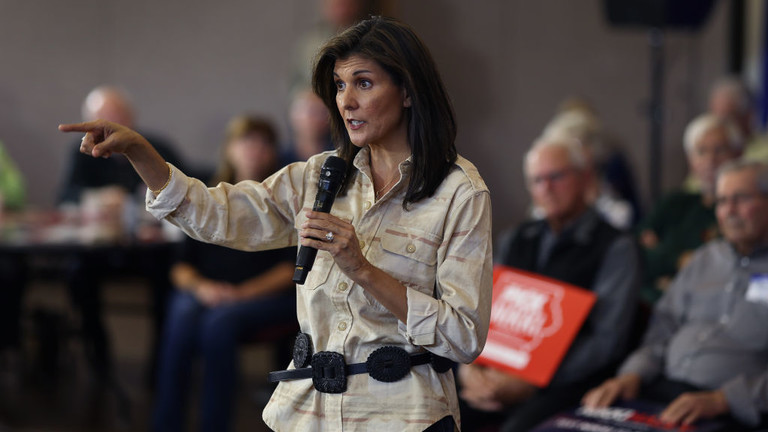
US presidential candidate Nikki Haley speaks at a campaign event on Saturday in Pella, Iowa. © Getty Images / Scott Olson
RT | October 22, 2023
Republican presidential candidate Nikki Haley has called for instilling fear in Washington’s foreign enemies by transforming the US Department of Defense into the “Department of Offense.”
Speaking at a campaign event on Friday in Cedar Rapids, Iowa, Haley demanded that the US respond to the Israel-Hamas war by providing the Israeli government and military with “whatever they need whenever they need it.” She added that Washington’s goal must be to “eliminate Hamas, not weaken them,” and she called for cutting off government funding to colleges whose students or employees hold protests in support of the Palestinians.
Haley, a former South Carolina governor who served as US ambassador to the UN under then-President Donald Trump, suggested that the administration of US President Joe Biden must not be fooled by Friday’s release of two American hostages by Hamas. “They are doing this to earn favor with America because they want to try and look good in the eyes of America,” she said. “Don’t fall for it.”
Having a stronger military and strong leadership in the White House could have prevented the war in Israel, as well as the Russia-Ukraine conflict, Haley argued. Biden’s botched withdrawal of US forces from Afghanistan in 2021 and his administration’s recent prisoner-swap agreement with Iran emboldened America’s enemies, she claimed, adding that only a stronger military can restore US credibility.
“We’ve got to be smart, and we’ve got to be ready,” Haley said. “I’m tired of talking about a ‘department of defense’. I want a ‘department of offense’. Every enemy needs to fear us.”
Haley is calling for a bigger and apparently more aggressive military despite the fact that the Pentagon already boasts annual spending of nearly $832 billion – exceeding the world’s nine next largest defense budgets combined. The US has about 750 bases in 80 countries, and it has a long history of regime-change programs and military interventions around the world.
“This woman is a crazed warmonger,” US podcast host Joey Mannarino said in an X (formerly Twitter) post. “Don’t let the sweet Southern accent fool you. She’d have us in every war she could find.”
Haley has reportedly been enriched by the US military industrial complex since resigning as Trump’s UN ambassador in October 2018. She was hired as a board member with US defense contractor Boeing in 2019. Although she left the company the following year, she still owned as much as $250,000 in Boeing stock as of a financial disclosure filing in May.
Haley has earned six-figure fees for speaking engagements, including over $230,000 from the Center for Israel and Jewish Affairs, and she was paid $127,500 for her work as a consultant to an advocacy group called United Against a Nuclear Iran, which has lobbied for military strikes against Tehran. She also netted more than $708,000 in consulting fees from Prism Global Management LLC, an investment fund, and her husband holds stakes in two firms with ties to the defense industry.
Large blasts heard inside US military bases in Syria, Iraq: Report
Press TV – October 20, 2023
Two military bases, used by American troops and their military advisors, in Syria’s eastern province of Dayr al-Zawr and near the Baghdad International Airport in the Iraqi capital have been hit by a series of large explosions amid rising anti-US sentiment in the two neighboring Arab countries.
Syria’s official news agency SANA, citing local sources speaking on condition of anonymity, reported that two separate missile attacks targeted the al-Omar oil field and the gas line connecting to the Conoco gas field in Dayr al-Zawr province early on Friday.
The sources added that a strike hit the transmission pipeline, used by US occupation forces and allied Kurdish-led militants affiliated with the so-called Syrian Democratic Forces (SDF) to steal natural gas from the Conoco field, in the Abu Khashab desert area.
American occupation forces and allied SDF militants were subsequently put on high alert, and many military aircraft were seen hovering in the skies over the area, according to the report.
The sources added that another missile attack targeted the al-Omar oil field. There were no immediate reports about possible casualties and the extent of damage caused.
Moreover, explosions were heard near the US-run Victoria military base, which is adjacent to Baghdad airport.
Lebanon’s al-Mayadeen television news network reported that three rockets were launched at the base early on Friday.
Earlier on Thursday, a US military base in southern Syria was targeted in a drone attack. The al-Tanf base, located in Homs province, was targeted by three drones, according to al-Mayadeen.
Sabereen News, a Telegram news channel associated with Iraqi anti-terror Popular Mobilization Units, also reported the incident.
US military contractor dies of heart attack during al-Asad airbase attack
Meanwhile, a US military contractor, whose identity has not been disclosed, lost his life during the recent attack on the al-Asad Airbase in western Iraq.
Brigadier General Patrick S. Ryder, the US Department of Defense Press Secretary, stated that the contractor, whose identity has not been disclosed, suffered a heart attack while attempting to seek shelter.
He added that Americans are “investigating the recent attacks and the party behind them.”
On Thursday, Iraq’s Harakat Hezbollah al-Nujaba movement claimed responsibility for the missile strike against the Ain al-Asad base.
Firas al-Yasser, a member of the political council of the movement, told al-Mayadeen that the attack was in line with the “fight on one front” doctrine.
Yasser highlighted that Islamic resistance groups in Iraq are gearing up to prepare surprises against American interests as Israeli aggression against the besieged Gaza Strip is poised to escalate.
Iran: UN Security Council sanctions on missile-related activities end
Press TV – October 18, 2023
The Iranian Foreign Ministry has announced that the Islamic Republic, as of October 18, will no longer be subject to any restriction with regard to its ballistic missile-related activities and transfers by the United Nations Security Council.
The Ministry said in a statement on Wednesday that the entire restrictions imposed on the Islamic Republic’s ballistic missile-related activities and its associated services and technology have “unconditionally” ended.
The termination came into force on October 18, eight years after the 2015 Iran nuclear deal with major world powers, officially known as the Joint Comprehensive Plan of Action (JCPOA).
“As of today, 18 October 2023, the last part of unjustly imposed restrictions by the United Nations Security Council on missile-related activities and its associated services and technology to/from Islamic Republic of Iran, including asset freeze and financial restrictions on certain Iranian individuals and entities, terminated unconditionally,” the statement said.
“According to the provisions of 2231 UNSC Resolution, termination of these restrictions, does not require any resolution, statement or any other action in the context of the UNSC and occurred automatically,” it added.
The Iranian Foreign Ministry also said cooperation in all military and defense areas would be carried out, without any restriction, based on the needs and discretion of the Islamic Republic of Iran, within the framework of bilateral contracts with other countries.
Pointing to the provisions of UNSCR 2231, the statement noted, “In accordance with paragraph 3 of Annex B, Iran is no longer ‘called upon’ by the Security Council ‘not to undertake any activity related to ballistic missiles.”
The Foreign Ministry said the Islamic Republic, by recalling the provisions of the UN charter, in particular article 25 as well as provisions of UNSCR 2231, emphasizes the commitments of all member states to effectuate the termination of the above-mentioned restrictions at the national level.
“Iran expects all States to modify and revise, in the case of existence, any relevant restriction or sanction, according to their domestic legal system,” it added.
The statement underlined that any measure, at the national or regional level, aiming at imposing sanctions or restrictions on defensive engagements and cooperation of the Islamic Republic of Iran, is in contradiction with the termination of restrictions of UNSCR 2231, and that Tehran reserves its right to take appropriate measures to secure its national interests.
“The defense doctrine of the Islamic Republic of Iran has always been on the basis of domestic capabilities and capacities, and deeply rooted in resistance and power of Iranian Nation. Unconventional arms and weapons of mass destruction has no place in the defense doctrine of the Islamic Republic of Iran,” the statement said.
“Moreover, the Islamic Republic of Iran will continue to take necessary measures to strengthen its defense capabilities in order to protect its sovereignty, independence, and territorial integrity against any aggression and to counter the menace of terrorism in the region,” it added.
Stressing that the Iranian military capabilities, including ballistic missiles, are exclusively for self-defense, the statement said, “The Islamic Republic of Iran continues to insist that all sanctions and restrictive measures introduced and applied against Iran, including those imposed under the pretext of its nuclear program, have been baseless, unjust and unlawful.”
Last month, the three European signatories to the JCPOA — the UK, Germany, and France — said they plan not to terminate their anti-Iran sanctions, including ballistic missile bans, arguing that Iran has been in non-compliance with the deal since 2019.
Iran halted some of its JCPOA commitments in 2019, a year after the US unilaterally walked out of the deal and after the EU failed to offer any compensation for the US withdrawal.
Iran said at the time the reduction of its commitments was in accordance with the deal, which allows parties to dishonor commitments should other parties do the same.
US warmonger Senator threatens Iran
By Lucas Leiroz | October 17, 2023
Once again, the pro-war sectors of American politics seem to want to foment a conflict situation with US involvement. A prominent public figure in the US Senate has made very serious threats to Iran, promising that Washington “will not hesitate” to take actions against Tehran if the conflict in the region continues to escalate.
The threats were made by the highly known Senator Lindsey Graham, who is notorious for his bellicose and irresponsible positions regarding American foreign policy. Graham issued a warning to Iranian authorities, stating that if there is any military action by Hezbollah against Israel, Washington will act to protect its ally, which could have serious consequences for Iran, both in military and economic terms.
“Here’s my message. If Hezbollah, which is a proxy of Iran, launches a massive attack on Israel, I would consider that a threat to the — to the State of Israel, existential in nature. I will introduce a resolution in the United States Senate to allow military action by the United States in conjunction with Israel to knock Iran out of the oil business,” Graham said.
Hezbollah was not the only topic in the Senator’s speech. Graham also stated that he does not believe in the Iranian government’s official narrative that the Hamas operation was carried out autonomously. For him, believing this is “laughable”, with total confidence on his part that Hamas’ actions were previously discussed with Iran.
“The idea that Iran read about this operation in the paper, or on television is laughable. 93% of Hezbollah and Hamas’ money comes from Iran (…) They’re the source of the problem. They’re the great evil. So, if Hezbollah escalates against Israel, it will be because Iran told them to. Then Iran, you’re in the crosshairs of the United States and Israel,” Graham added.
Graham’s stance is extremely complicated, as the current tense situation in the Middle East favors risks of escalation and internationalization, and there is therefore a considerable possibility of Iran becoming involved in hostilities. This involvement can be direct or indirect, with Tehran sending regular troops or mobilizing its allied groups – which are not limited to Hezbollah. In either scenario, the risks would be enormous for Israel, which, despite its large military strength, is a small and vulnerable country in situations of war of attrition.
Furthermore, it must be emphasized that Iran is doing everything possible not to enter the war. By warning Israel not to continue collectively punishing Gaza, Tehran is offering alternatives to armed confrontation. But Tel Aviv, despite being afraid of invading on the ground, continues to bomb Gaza and kill thousands of civilians, causing Iran’s patience to progressively run out.
It has also been informed by the Persian country’s authorities that the so-called “Axis of Resistance” – a Theran-led coalition of anti-Zionist armed movements – could act at any time in defense of the Palestinians. Iranian politicians clarified that, despite Tehran leading the coalition, the member groups have high decision-making autonomy, and there is no full Iranian control over how these movements will react to Israel. In other words, the risks of escalation are great, and Iran is not capable of preventing it alone.
The only way to truly de-escalate is through a commitment on the part of Israel to stop the attacks. Without this, the situation will go out of control and there will inevitably be intervention – if not direct from Iran, at least from some Iranian-allied group. Furthermore, it is necessary to remember that Hezbollah is already de facto involved in hostilities, with bombings being exchanged between the IDF and the Shiite militia every day. Obviously, if nothing is done to stop these hostilities, at some point Hezbollah will choose to launch a more effective incursion.
With all these factors, Graham’s words sound like a “self-fulfilling prophecy”. He points to an imminent scenario as a “red line” and issues direct threats, making real de-escalation actions virtually impossible. However, this type of behavior is in fact expected from Graham, who is a known “hawk” of American foreign policy. Months ago, the Senator became embroiled in a controversy after saying that the US was investing money in “killing Russians” in Ukraine – praising such an “investment”. In the same vein, on another occasion, he also suggested that Kiev should kill Russian President Vladimir Putin.
It remains to be seen whether these pro-war tendencies will prevail in the American public debate. For now, the US stance has been extremely bellicose, with the country sending aircraft carriers to “help” Israel. However, it is necessary to remember that the American military-industrial complex is not able to work on two different fronts at the same time – in addition to the possibility of escalation in the Pacific in the near future. Washington needs to act rationally and discourage war in the Middle East.
Lucas Leiroz, journalist, researcher at the Center for Geostrategic Studies, geopolitical consultant.
Netanyahu wants US involved in war – ex-Pentagon official
RT | October 11, 2023
Israeli Prime Minister Benjamin Netanyahu would like Washington directly involved in the conflict with Hamas because he hopes to expand the war to Lebanon and Iran, former senior security policy analyst at the US Department of Defense, Michael Maloof, told RT on Wednesday.
On Monday, the US ordered the aircraft carrier USS Gerald R. Ford and five guided missile destroyers to the Eastern Mediterranean. According to Maloof, this “meets Netanyahu’s wildest dreams.”
“He wanted the US involved in this conflict,” the former Pentagon official told RT.
Netanyahu “wants to open up the war with Lebanon, by attacking Hezbollah” in pursuit of his ultimate objective, “to bomb Iran’s nuclear facilities,” Maloof added. For that to happen, “he has to have a Gulf of Tonkin moment, if you will.”
Maloof recalled how US President Lyndon Johnson essentially started the Vietnam War by sending ships to the Gulf of Tonkin in 1964. An alleged North Vietnamese attack on two US destroyers was then used as a pretext for direct involvement.
The US has also pledged to help Israel with deliveries of weapons and ammunition, with the Pentagon insisting it has enough to do so and continue supplying Ukraine. Maloof is skeptical of that assertion, however.
He also told RT it was “not surprising” that some of the weapons Washington had sent Kiev ended up in the hands of Hamas.
That accusation was first made by former Russian President Dmitry Medvedev. Ukraine’s military intelligence, the GUR, responded on Monday by accusing Russia of sending captured Western weapons to Hamas militants in a “false flag” operation designed to make Kiev look bad to its backers.
Israel has neither confirmed nor denied the weapons claim, but rejected the Ukrainian insinuations of Russian involvement in the Hamas attack as “complete nonsense.”
US Support for Israel May Set Off Total Middle East Upheaval – Former US Envoy
Sputnik – 10.10.2023
WASHINGTON – The United States will support Israel in all actions it takes against Hamas in Gaza after the killing of over 1,000 Israelis in Saturday’s incursion, but this will set off an anti-US wave across the Middle East and the wider Muslim world, former US Ambassador to Saudi Arabia Chas Freeman told Sputnik.
Israel formally declared a state of war on Sunday, a day after Hamas invaded Israeli territory and committed the greatest slaughter of civilians in the 75 year history of the Jewish state. On Monday, Israel put the Gaza Strip under full blockade, with no food, gas or electricity supplies. Both Israel and Palestine have so far reported hundreds of dead and thousands of injured as a result of the escalation.
“The United States will support Israel reflexively but this will set off a much wider anti-US reaction across the Middle East and the wider Muslim world,” Freeman, who also served as assistant secretary of defense for international security affairs in the Clinton administration, said in an interview.
The crisis is unlikely to be confined to Israel and Gaza and will metastasize to other neighboring countries, Freeman warned.
“The geopolitical dangers could very well rapidly spread to Lebanon and Syria,” he said.
The Israeli-US “pipedream” fostered by Prime Minister Benjamin Netanyahu that relations with Saudi Arabia are going to normalize is now also “gone” for the foreseeable future, Freeman believes.
The Biden administration itself appears to have been caught off guard by the ferocious suddenness and success of Hamas’ invasion, Freeman suggested.
“National Security Adviser Jake Sullivan last week made the truly idiotic claim that the Middle East region had reached a reassuring level of stability,” he said.
US Deploying Carrier Strike Group to Eastern Mediterranean Amid Hamas Attacks – Pentagon
Sputnik – 08.10.2023
WASHINGTON – The United States is deploying the USS Gerald R. Ford Carrier Strike Group to the Eastern Mediterranean to bolster US regional deterrence efforts in response to the Hamas attack on Israel, US Defense Secretary Lloyd Austin said on Sunday.
“I have directed the movement of the USS Gerald R. Ford Carrier Strike Group to the Eastern Mediterranean. This includes the U.S. Navy aircraft carrier USS Gerald R. Ford (CVN-78), the Ticonderoga-class guided missile cruiser USS Normandy (CG 60), as well as the Arleigh-Burke-class guided missile destroyers USS Thomas Hudner (DDG 116), USS Ramage (DDG 61), USS Carney (DDG 64), and USS Roosevelt (DDG 80),” Austin said in a statement.
The United States maintains ready forces globally to further reinforce this deterrence posture if required, the US defense chief also said.
The US will be rapidly providing the Israel Defense Forces with additional equipment and resources, including munitions, which will begin arriving in the coming days, Austin added.
As conflict rises in Israel, Trump offers a relatively noninterventionist reaction among Republican presidential candidates
By Adam Dick | Ron Paul Institute | October 7, 2023
In response to a Saturday attack by Hamas in Israel, Republican Party presidential candidates rushed out statements setting forth their related views. Among these statements, the statement of Donald Trump stood out as relatively noninterventionist.
While placing blame on Hamas, Trump refrained from promising support for the government of Israel in the conflict. This set him apart from the other prominent Republican candidates who made comments pledging support for Israel.
Here is Trump’s Saturday statement on the matter:
These Hamas attacks are a disgrace and Israel has every right to defend itself with overwhelming force. Sadly, American taxpayer dollars helped fund these attacks, which many reports are saying came from the Biden Administration. We brought so much peace to the Middle East through the Abraham Accords, only to see Biden whittle it away at a far more rapid pace than anyone thought possible. Here we go again.
So far so good. Trump is not endorsing in his statement the United States government supporting the Israel government in this conflict. But, there certainly is much pressure on him to make such an endorsement soon.
Other Republican presidential candidates, in contrast, jumped immediately at the opportunity to declare their support for aiding Israel in this new rising conflict. Tara Suter reported Saturday at The Hill on other prominent Republican candidates’ early statements on the matter. Every one of them took a step beyond Trump, pledging their support to the Israel government in the rising conflict.
Below are excerpts from those candidates’ statements presented in Suter’s article.
Doug Burgum: “Iran and its terror sponsors in Gaza are showing the world their true face: pure evil. Israel is at war with brutal terrorists and the United States must provide maximum support to our democratic ally.”
Chris Christie: “We must do whatever it takes to support the State of Israel in its time of grave danger, and we must end the scourge of Iran-backed terrorism.”
Ron DeSantis: “Israel not only has the right to defend itself against these attacks, it has a duty to respond with overwhelming force. I stand with Israel. America must stand with Israel.”
Nikki Haley: “Israel has every right to defend its citizens from terror. We must always stand with Israel and against this Iranian regime.”
Mike Pence: “Our prayers are with the families and soldiers of our most cherished ally. @netanyahu [Israel Prime Minister Benjamin Netanyahu)] says Israel is ‘at war’ America Stands With Israel[.]”
Vivek Ramaswamy: “Israel’s right to exist & defend itself should never be doubted and Iran-backed Hamas & Hezbollah cannot be allowed to prevail. I stand with Israel and the U.S. should too.”
Tim Scott: “Israel has a right to defend itself and the United States must stand in support of its steadfast ally.”
Can Trump continue to resist the pressure being put on him to declare that he does, and the US government should, “stand with Israel” in regard to this rising conflict? We’ll see. Taking a solitary course concerning this matter would be consistent with Trump’s apparent effort to run as the peace candidate among the contenders in the race for the Republican presidential nomination.
Copyright © 2023 by RonPaul Institute
Saudi Arabia willing to forego oil production cuts to secure Israel normalization: Report
The Cradle | October 7, 2023
Saudi Arabia has offered Washington to boost oil production levels next year if crude prices are “too high” as part of negotiations to reach a normalization deal with Israel, the Wall Street Journal (WSJ) reported on 6 October.
This plan is allegedly aimed at winning over US lawmakers who are wary about Biden’s “megadeal” with Riyadh, which includes mobilizing US troops in case of an attack in the kingdom.
The deal would also see the US help Saudi Arabia develop a uranium enrichment program.
“Saudi negotiators emphasized that market conditions would guide any action on production, and officials familiar with the talks said the discussions didn’t represent a long-term agreement to cut prices,” the WSJ says.
For the past year, Saudi Arabia has led the powerful OPEC+ bloc into significantly cutting oil production levels to offset the damage caused to the market by western sanctions on Russia’s energy sector.
The ongoing cuts have come despite multiple demands and threats from Washington.
In September, Riyadh, in a joint effort with Moscow, voluntarily extended oil cuts to help maintain the market’s stability. This cut sent oil prices up nearly two percent to $91.08 a barrel.
Per WSJ, Brett McGurk and Amos Hochstein flew to Riyadh in late September to warn Saudi officials that soaring oil prices would make winning Washington over on the “megadeal” much harder.
This deal has raised concerns by 20 Democratic senators sent US President Joe Biden a letter on Wednesday regarding the deal. They voiced how he should demand that Israel makes a “meaningful and enforceable” concession to the Palestinian people as part of the normalization deal.
Negotiations are now discussing the defense benefits for Saudi Arabia, which requires US Senate approval for the civilian nuclear site in the Kingdom and billions of dollars in weapons sales.
The deal has left a sour taste in the US public’s mouth. In a poll conducted in September, 3 out of 5 US citizens “feel this is a bad deal for the US.” Those polled added that they don’t feel there’s justification for US soldiers defending the Gulf nation.
It has also caused an uproar in the Islamic world, as many see a normalization agreement with Israel as a betrayal of the Palestinian cause.
Publicly, Riyadh has expressed that any deal with Tel Aviv must also include significant concessions for the Palestinians, including forming an independent state.
The WSJ report was released one day before the Palestinian resistance in Gaza launched its biggest offensive against Israel in Gaza, with officials saying the operation serves as a message to Arab nations who want to normalize ties with Israel.
Saudi Arabia’s shadowy role in the Ghouta chemical attack
There is now substantial evidence Saudi intelligence conducted false flag chemical attacks in Syria to trigger US military intervention and regime change
By William Van Wagenen | The Cradle | October 6, 2023
On 13 September, acclaimed US investigative journalist Seymour Hersh revealed a crucial five-page memo prepared for the US Defense Intelligence Agency (DIA) on 20 June, 2013. This document contained alarming details about the Al-Qaeda-affiliated Nusra Front’s disturbing plan to manufacture sarin nerve gas with the aim of executing a chemical attack within Syria.
The significance of this memo extends beyond its surface, as it adds to the mounting evidence pointing toward Saudi intelligence’s involvement in orchestrating a false flag chemical attack in the Damascus suburb of Ghouta a month later, on 21 August 2013.
The attack resulted in the tragic deaths of numerous civilians and nearly triggered a western military intervention in support of Islamist militant factions aiming to overthrow the Syrian government.
Nusra’s sarin procurement
The DIA memo, which provides details obtained by US National Security Agency (NSA) surveillance, states that in April and May that year, “several Turkey and Saudi-based chemical facilitators” working for the Nusra Front “were attempting to obtain sarin precursors in bulk, tens of kilograms, likely for the anticipated large-scale production effort in Syria.”
Notably, the memo identifies three Nusra operatives — Abd al-Ghani, Kifah Ibrahim, and Adil Mahmud — who planned to perfect “a process for making sarin, then go to Syria to train others to begin large scale production at an unidentified lab in Syria.” Ibrahim and Mahmud were both captured in Iraq in May 2013, according to the memo.
The revelation that the NSA had identified Nusra operatives seeking sarin precursors in Saudi Arabia raises the implication that Saudi intelligence, then under the leadership of Prince Bandar bin Sultan, would also have been aware of these activities.
This implies that Riyadh might have either actively facilitated Nusra in obtaining sarin precursors or chosen not to interfere, allowing these sinister plans to progress unimpeded.
The memo further states that:
“The Syria-based part of this effort [to produce sarin] may have begun as early as late 2012. Abu Muhammad al-Hamawi, the [Nusra Front] emir for Hamah, was attempting to obtain phosphorous trichloride, a key sarin precursor, in December 2012. We cannot definitively connect this to the sarin cell, but it could very well be linked.”
Saudi’s ‘southern strategy’
According to US-based, regime-change advocate Charles Lister and Swedish journalist Aron Lund, Abu Muhammad al-Hamawi is also known as Sheikh Saleh al-Hamawi, a Syrian from the town of Halfaya in Hama. He was one of six founders of the Nusra Front and a recipient of Saudi support.
The timeframe in December 2012, when Hamawi was purportedly seeking sarin precursors, coincides with the period when Prince Bandar bin Sultan — the well-connected former Saudi ambassador to Washington — oversaw the implementation of Saudi intelligence’s “southern strategy” to shift the focus of the conflict towards Damascus.
Bandar had assumed the position of director of Saudi intelligence in mid-2012 and established an operations center in Jordan to covertly direct efforts against the Syrian government. He came into his role with guns blazing: on July 18, armed elements turned their sights to the capital city, beginning with the Damascus bombing of Syria’s National Security headquarters, which killed key officials in Syrian President Bashar al-Assad’s inner circle.
The New York Times reported that in November 2012, a “cataract of weapons” procured by Saudi intelligence began flowing from Jordan into Syria. While the weapons were publicly presented as going to so-called “moderates” in the Free Syrian Army (FSA), US officials acknowledged that many of them ended up in the hands of “hard-line Islamic Jihadists.”
In February 2013, the Washington Post interviewed Hamawi, identifying him as an FSA rather than a Nusra commander (the FSA and Nusra collaborated closely and, in many cases, were indistinguishable).
Hamawi suggested his units had received weapons shipments in previous weeks from Saudi Arabia as part of Bandar’s southern strategy while stating that “Deraa and Damascus are the key fronts on the revolution, and Damascus is where it is going to end.”
According to a leaked NSA document, Prince Bandar’s subordinate, National Security Council deputy chief Prince Salman bin Sultan, provided 120 tons of explosives and other weaponry to opposition forces, giving them direct instructions to “light up Damascus” and “flatten” the airport in March 2013.
Regiment 111
In December 2012, several jihadist groups spearheaded by the Nusra Front captured a Syrian army base in the Aleppo countryside known as Regiment 111. The base contained stocks of mustard gas, chlorine, and sarin, which Nusra seized. Katibat al-Muhajireen, an Islamist armed group of foreign fighters supported by British intelligence, also participated in the capture of Regiment 111.
It is highly probable that US intelligence was aware of Nusra’s acquisition of these chemical weapons. On 7 December, 2012, just two days before the base’s fall, Syria Deeply, a platform funded by the US government, reported that, according to an Arab diplomat, US contractors were operating on the ground in Syria with the mission of monitoring the status of the country’s chemical weapons stockpiles.
The diplomat said there “are 24-hour Skype links connecting the US with rebel brigades to enhance monitoring of chemical weapons sites on the ground.”
Just as jihadists backed by Saudi and western intelligence were about to acquire sarin (or the components to create sarin) from Regiment 111, US officials began floating accusations that the Syrian government was preparing to use chemical weapons. US officials also cited these claims as a justification for possible western military intervention.
Predictably, the Syrian opposition soon asserted that the Syrian government had employed chemical weapons. On 25 December 2012, a Syrian army defector claimed to Al-Jazeera that the Syrian government had used a nerve gas resembling sarin in an attack on Homs. However, the evidence supporting these allegations was so flimsy that even US officials promptly dismissed them.
Nonetheless, Prince Bandar saw an opportunity in this incident. In February 2013, he tried to persuade the White House that Syria’s Assad had crossed US President Barack Obama’s “red line” by employing chemical weapons.
US response and arming opposition
Several months later, evidence began to emerge suggesting that the Nusra Front had managed to obtain or produce some low-grade sarin. On 19 March, 2013, a rocket containing chemical agents was launched at the town of Khan al-Assal in Aleppo province, resulting in the death of 25 individuals.
Notably, among the casualties, 16 were Syrian soldiers, a detail that raised doubts about Assad’s culpability in the attack.
On 5 May that year, UN investigator Carla del Ponte said she had gathered testimony indicating that sarin had been used by “the opposition, the rebels, not by the government authorities.”
Bolstering del Ponte’s claim, Reuters reported on 30 May that Turkish authorities detained 12 Nusra Front militants in possession of 4.5lb of sarin gas, while a Nusra fighter who helped capture the Regiment 111 base later speculated that Nusra had carried out the Khan al-Assal attack with the sarin captured at the base.
When the Syrian army and allied-Hezbollah forces captured the strategic town of Qusair on the Lebanon border in June, officials in Washington began to panic, believing that drastic measures were needed “to stem the tide of Assad victories.”
Amid calls for a no fly zone in Syria from prominent US lawmakers and the media, the Pentagon announced it was sending F-16s and Patriot missile batteries to Jordan. Although Obama refused direct military intervention, his administration issued a special assessment claiming the Syrian government had used chemical weapons and announcing that the US would now arm extremist opposition groups directly.
But for Prince Bandar, this was not enough. Reuters reported that Saudi officials, including the late King Abdullah and Prince Bandar, “want more US involvement … They are really worried about the attitude in Washington.”
Foreign support for Syrian ‘rebels’
On 20 June, the DIA memo revealed by Seymour Hersh was written and distributed, confirming that the Nusra Front was seeking to produce sarin. But this information was ignored, and western officials continued to make new fabricated claims that Damascus had carried out chemical attacks, including in Saraqeb, Sheikh Maqsoud, and Jobar.
It is in this context that Prince Bandar, with the help of his counterparts in US and Israeli intelligence, prepared to launch a massive “rebel” assault on Damascus.
The French newspaper La Figaro reported that according to its sources, the “first Syrian contingents trained in guerrilla warfare by the Americans in Jordan have been in action since mid-August in southern Syria, in the Deraa region. A first group of 300 men, probably supported by Israeli and Jordanian commandos, as well as by men from the CIA, would have crossed the border on August 17. A second would have joined them on the 19th.”
The stage was now set for a US air campaign to aid Bandar’s jihadist groups amassing near Damascus. However, a trigger was still needed to force Obama to authorize it.
The Ghouta attack
On the morning of 21 August 2013, a flurry of videos appeared on social media allegedly showing the aftermath of a mass chemical attack carried out by the Syrian army in Ghouta, killing 1,429 civilians, including 456 children.
The New York Times reported that “Within hours, [Obama] administration officials began signaling that they were preparing for an immediate military strike to punish the Syrian government,” reversing Obama’s previous reluctance.
The following day, 22 August, La Figaro published its report about the jihadist offensive on Damascus, stating “the anti-Assad operation has begun.”
However, the US president soon reversed his decision to authorize military intervention after Director of National Intelligence James Clapper warned that the evidence linking Assad to the deadly attack was “not a slam dunk.”
In the absence of a wide-scale US bombing campaign, the armed offensive on Damascus failed after 15 days of brutal fighting.
In their interim report released in September 2013, UN investigators later confirmed sarin had been used in Ghouta.
The UN team did not have a mandate to attribute responsibility for the Ghouta attack, however, a detailed analysis published in 2021 by Rootclaim showed that the Saudi-backed Liwa al-Islam fired the sarin-filled rockets in Ghouta – not the Syrian army.
Furthermore, the conclusive UN report released in December 2013 corroborated that jihadist groups had indeed used small quantities of sarin in attacks against Syrian soldiers in the Damascus suburb of Jobar on 24 August and in Ashrafiah Sahnaya in the capital’s countryside on 25 August.
Continued false flag attacks
Jordanian journalist Yahya Ababneh visited Ghouta days after the attack and interviewed several opposition fighters, their families, local doctors, and civilians. According to his sources, local armed groups received chemical weapons via Saudi Prince Bandar and were responsible for carrying out the Ghouta attack.
Ababneh reported that fighters he spoke with “reported that their salaries came from the Saudi government” and that “Prince Bandar is referred to as ‘al-Habib’ or ‘the lover’ by al-Qaeda militants fighting in Syria.”
One month later, a senior UN official who dealt directly with Syrian affairs claimed that according to fighters in Ghouta, “Saudi intelligence was behind the attacks, and unfortunately nobody will dare say that.”
Syria Deeply reported in December 2012 that as part of a special task force sent to Jordan, the “US and its allies have hired contractors to train some Syrian rebel brigades in chemical weapons security.”
After Ghouta, jihadist groups supported by the CIA, Saudi intelligence, and Mossad continued to stage false flag chemical attacks blamed on Assad, most notably in Khan Sheikhoun in April 2017, and Douma in April 2018.
Saudi-funded sedition
The Saudi role in such false flags was further illustrated in March 2018 when the Syrian army liberated some Eastern Ghouta farmlands and discovered a well-equipped chemical laboratory run by Saudi-backed Liwa al-Islam (by then known as Jaish al-Islam).
The Cradle columnist Sharmine Narwani visited the lab that year and reported that it was packed with equipment, chemical substances, and munitions. The equipment included a US-manufactured gas compressor for which Saudi Arabia put out tenders in 2015.
In the nine months leading up to the Ghouta false-flag incident, Nusra operatives were actively seeking sarin precursors in Saudi Arabia. Furthermore, a Nusra commander in Syria, identified by the DIA as being involved in seeking sarin precursors, had received Saudi military support.
Saudi intelligence was not only arming and financing jihadist groups but was also issuing direct orders for attacks in Damascus. Liwa al-Islam fired the sarin-filled rockets at Ghouta at a critical juncture when a major offensive on Damascus, planned by Saudi intelligence in cooperation with the CIA and Mossad, was about to commence.
The broader pattern of false flag chemical attacks blamed on the Syrian government, such as those in Khan Sheikhoun and Douma, further underscores the potential Saudi role in such operations.
Considering the documented evidence, it becomes increasingly implausible to suggest that Liwa al-Islam acted alone in the Ghouta false-flag attack. The incident resulted in the deaths of numerous Syrian civilians, including women and children, and nearly led to western military intervention, aligning with the objectives of US, Saudi, and allied intelligence agencies seeking to overthrow the Syrian government.
Who Owns the United States?
BY PHILIP GIRALDI • UNZ REVIEW • SEPTEMBER 26, 2023
The recent sparring between Elon Musk and the despicable Jonathan Greenblatt of the Anti-Defamation League (ADL) has cast considerable light on the successful attempts by Jewish groups to dominate America’s foreign as well as some domestic policies, in part by taking away the First Amendment right to Freedom of Speech so their behavior cannot be challenged. As readers of Unz will be aware, Musk has threatened to sue the ADL for as much as $22 billion for defaming him and doing material damage to his business interests while also falsely smearing Musk himself and the platform for allegedly providing an antisemitic haven for “hate speech.” In Musk’s view, the ADL has put pressure on potential advertisers not to do business with him and to engage in a total boycott of his social networking sites.
Greenblatt’s argument is that material that he considers to be anti-semitic should not be allowed on any public forum, to include Musk’s site X, formerly known as Twitter. If Greenblatt were concerned with public incitements to kill Jews or damage their property there might be a case to be made, but the fact is that such behavior is already criminalized. Greenblatt is much more expansive than that, condemning any criticism of Jewish group or even individual behavior or the actions of Israel, which have included various war crimes and crimes against humanity to include targeting and killing Palestinian children and harvesting the organs of Palestinian prisoners. Israel is also a nation that is increasingly ethnically exclusive and has a state religion that is intolerant and repressive of other creeds, to include minority Christians and Muslims.
Beyond Musk, Greenblatt and the ADL have also focused on Tucker Carlson given his high profile and popularity among conservatives. Greenblatt repeatedly demanded that Fox News fire Tucker for discussing the “great replacement” theory as well as other white-nationalist talking points. Greenblatt has denounced Carlston’s alleged willingness “To use his platform as a megaphone to spread the toxic, antisemitic, and xenophobic ‘great replacement theory’ is a repugnant and dangerous abuse of his platform.” He called on advertisers to stop supporting the Carlson program and Fox with their dollars and was delighted when Carlson was finally fired in April. Many believe that the firing was in large part due to pressure from ADL and other Jewish groups.
In other words, in the America envisioned by Greenblatt and his friends who are pressuring advertisers not to support sites like X and passing laws penalizing or even criminalizing anyone who seeks to boycott Israel over its behavior, it will be more-or-less possible to speak freely on any subject as long as it does not involve Jews. That suggests an assumption by ADL that Jews have special status not enjoyed by anyone else. As a result Jews have been able to exploit their alleged singular and perpetual victimhood to assume de facto control over media sources of information as well as both major political parties using that old tried and true mechanism, money, and lots of it. It is a subject that in itself will not be open to discussion and which Greenblatt dismisses as an anti-semitic trope amounting to “hate speech.”
Interestingly enough, the wrath of Greenblatt is apparently not shared by Israeli Prime Minister Benjamin Netanyahu, who is regarded as no shrinking violet when it comes to promoting his country’s interests, as he sees them, and the dominance of Jewry worldwide. Netanyahu was in the United States last week for the annual meeting of the United Nations General Assembly but he made time to fly to California to visit Musk’s Tesla car assembly plant. The two men sat down to have a public chat in front of news cameras and, while it was clear that they were being polite and non-combative, it was also true that Netanyahu was careful not to accuse Musk of being an anti-semite or anything like that.
Netanyahu, who may have a better understanding than does Greenblatt of which way the wind is blowing regarding his country and Jewish power in general, might be playing a clever game in which he avoids a hard edged and dangerous Greenblatt approach while proceeding quietly with the ethnic cleansing of the Palestinians and aggrandizing himself in power through his attack on the country’s courts. Netanyahu clearly understands that Israel has crossed the apartheid threshold vis-à-vis Palestine and its neighbors and that most of the world despises his country, to include many Americans who are beginning to see the light that they have been used and abused for the past 75 years. He has chosen to ignore the critics as the wisest path, in which he may be correct.
How have Jews in America and Canada as well as in Europe and Australasia become so politically powerful? Now that Musk has opened the door to discussing the Jewish issue with some candor, a number of articles and discussions have begun to appear in the media and some universities have even developed enough of a spine to start teaching true narratives on the Middle East supported by books that groups like ADL are seeking to ban. The most powerful piece to appear recently was on Mondoweiss, entitled “Biden’s Israel Policy is Scripted by Saban.”
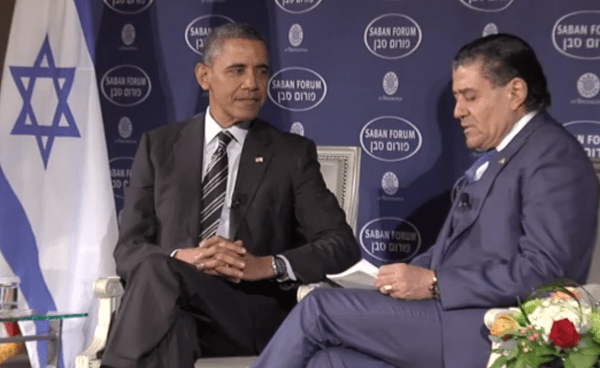
Mondoweiss’s title refers to Israeli-American Hollywood-based media producer Haim Saban, who sums up his political philosophy with a pithy “I’m a one issue guy and my issue is Israel!” Saban has been the largest individual donor to the Democratic Party since the Clintons and his power has resulted in unswerving fealty to US interests as perceived through the optic of its relationship with the Jewish state. He is similar to megadonor Sheldon Adelson, now deceased, who performed the same service with the Republican Party. Sheldon’s wife Miriam, an Israeli, has maintained the legacy of keeping the GOP in line through control of political donations. The Adelsons were reportedly responsible for Donald Trump’s move of the US Embassy in Israel from Tel Aviv to Jerusalem and other concessions re the Palestinians, Iranians and Syrians. The withdrawal of the US from the Joint Comprehensive Plan of Action (JCPOA) was due to pressure from the Adelsons, a move that was contrary to the actual US interest to monitor Iranian nuclear developments. Sheldon’s only failure was failing to convince Trump to bomb Iran.
Saban, who recently spent three hours in the Oval Office advising Joe Biden, is most clearly seen through his own comments on the relationship between the US and Israel. Hint: Israel’s interests always come first! For example, he shrugged off criticism of his giving money to AIPAC, “which supports Republican election deniers, because his one issue is Israel” saying in an interview: “The only goal of this organization is to prevent people who are against US-Israel relations from advancing and to support those who support relations between Jerusalem and Washington… Many Democrats called me and said ‘are you stupid? you’re a Democrat who supports [2020 election deniers]?’ I always say the same thing: It’s a specific, defined issue, and that is the US-Israel relationship. In that sense, I’m not interested in anything else.”
Re the Democratic Party leadership and Joe Biden, Saban observed that the party is “still solidly pro-Israel, and there are only about a dozen members of Congress who are anti-Israel.” Saban funded Hillary Clinton in 2008 but responded angrily when Obama “refused to echo Hillary Clinton’s call to ‘obliterate’ Iran if Iran attacked Israel.” Saban did not trust Obama on the issue of Israel and was initially rebuffed when he tried to arrange a meeting in 2010. He told a journalist that “I had a list of questions… And Chicago’—Obama campaign headquarters—‘could not organize that meeting. … I was ready and willing to be helpful, but ‘helpful’ is not to write a check for two thousand three hundred dollars. It’s to raise millions, which I am fully capable of doing.” Obama eventually came to respect Saban’s millions. “By 2013, President Obama was the speaker at a fundraiser at the Sabans’ house in L.A. attended by 120 people who paid between $16,200 and $32,400 each to attend.”
The result of the largesse is that Biden’s policy on the Middle East is now being scripted by Haim Saban, whose millions he requires for the upcoming 2024 campaign. It is as simple as that, appreciating that donation of cash in hand is better than platitudes about suffering Palestinians. That is what constitutes “truth” for both major political parties, who are de facto owned by the Adelsons and the Sabans who will always place Israel first. That Saban and Adelson (who is buried in Jerusalem) were and are both Israeli citizens and have been allowed to wield such power on behalf of a foreign country with which the US shares almost nothing in the way of actual values is shameful and it is also technically illegal or possibly even treasonous as they are acting as Foreign Agents. And it is more than that morally speaking – it is a disgrace. Joe Biden in particular should be ashamed of his folding when confronted by Jewish money as he is in charge, but it is apparently not an emotion that he is familiar with.
Philip M. Giraldi, Ph.D., is Executive Director of the Council for the National Interest, a 501(c)3 tax deductible educational foundation (Federal ID Number #52-1739023) that seeks a more interests-based U.S. foreign policy in the Middle East. Website is councilforthenationalinterest.org, address is P.O. Box 2157, Purcellville VA 20134 and its email is inform@cnionline.org.
Featured Video

Trita Parsi: Middle East Unraveling — Are We on the Path to World War?
or go to
Aletho News Archives – Video-Images
New Book
Trans agenda is ‘normalization of sadism’ – US author

RT | September 23, 2026
The US Democratic Party has embraced a transgender agenda that amounts to “the normalization of sadism,” author A.J. Rice has said, warning that radical trans policies would return if the party is allowed to regain power.
Speaking to RT’s America First host Scotty Nell Hughes about his new book, ‘The Curse of the Bearded Lady: How the Trans Mafia Whacked American Sanity’, Rice argued that activists have gained significant influence in schools, medicine, and corporate America while people who questioned the agenda have faced pressure to stay silent.
The author described the “trans mafia” as the sprawling network of people and institutions that have helped the movement gain influence. He singled out parts of academia, wealthy backers, and corporations, and stated that providers of transition-related treatment also have a financial incentive to keep young people in their care indefinitely.
Rice argued that the consequences of these policies ultimately fall on children who are being drawn toward gender-affirming medical treatments and on girls who are expected to share locker rooms or compete in sports with biological males.
He noted that while voters rejected the Democrats’ approach to gender in 2024, the party, which has been “captured by madness,” has since only doubled down and is seeking what is effectively “the normalization of sadism.” … Full report
Blog Roll
 Aletho News
- Refaat Al-Areer Was The Canary In The Coal Mine In Israel’s War On The Truth
- Israeli election committee bars candidate from Knesset race over Gaza war opposition
- French-Lebanese man files war crimes complaint over Israeli attacks
- Mahan Air Flight Lands in China Despite US Threat against Iranian Airlines
- US eyes $10bn fund to rebuild war-battered Gulf infrastructure
- Trump meets Rodríguez near Maduro’s prison as Venezuela’s oil flows to US
- Trita Parsi: Middle East Unraveling — Are We on the Path to World War?
- Iran FM meets with US envoy on UN meeting’s sidelines at American side’s insistence: Report
- Qatar PM calls for Gulf security framework with Iran, says war must be ‘wake-up call’
- China condemns US extortion of Iranian airlines, rejects Washington’s ‘illegal’ sanctions threats
- If Americans Knew
- An error has occurred; the feed is probably down. Try again later.
- No Tricks Zone
- New Study: Earth And Venus Surface Warmth Largely Explained By Convection And Lapse Rate, Not CO2 Or Radiation
- 2025 Nature Paper Claiming Worsening Global Drought Gets RETRACTED …Heavily Flawed
- New Study: ‘Global Drought Shows No Detectable Recent Acceleration Under Climate Warming’
- Economic Masterminds: German Socialists Suggest Taxing Productivity Gains Stemming From Using AI
- The South China Sea Has Not Been Cooperating With The Climate Change Narrative
- Energy Crisis: Germany Enters Heating Season With Historically Low Gas Reserve Fill Levels
- New Study: The Antarctic Ice Sheet Gained Mass From 2020-2024 Due To Staggering Snow And Ice Accumulation
- Study: Ocean Heating Rates From Thousands Of Years Ago ‘Dwarf’ Modern Ocean Heating Rates
- Climate Extremists Target, Attack Large-Scale Power Grid Infrastructure In Germany!
- New Study: Antarctic Ice Melt Has Contributed Less Than 1 Centimeter To Sea Level Rise In The Last 30 Years

