Iran Withdraws IAEA Designation of French, German Inspectors
Al-Manar | September 17, 2023
The International Atomic Energy Agency’s (IAEA) director general said on Saturday that Iran has withdrawn the designation of a number of the agency’s inspectors with Iranian media reporting that those inspectors are from France and Germany.
Iran’s move seems to have been made in response to a recent hostile and unconstructive move by the IAEA’s Board of Governors against Tehran, which was sponsored by the E3 (the UK, France and Germany) and the United States, Tasnim news agency reported.
IAEA Director General Rafael Grossi in a statement condemned what he called Iran’s “disproportionate and unprecedented” move to withdraw the designation of several of the agency’s “most experienced” inspectors assigned to conduct verification activities in the country under the NPT Safeguards Agreement.
He said Iran’s unilateral measure affects the IAEA’s “normal planning and conduct” verification activities in the country and “openly contradicts the cooperation that should exist between the Agency and Iran.”
Iranian Foreign Ministry Spokesman Nasser Kanaani reacted to the latest claim made by the IAEA chief, saying the United States and the three European parties to the 2015 nuclear agreement, known as the Joint Comprehensive Plan of Action (JCPOA) have abused the UN nuclear watchdog with the purpose of achieving their own political objectives.
“Unfortunately, despite Iran’s positive, constructive and continuous interaction with the IAEA, the three European countries and the United States abused the Agency’s Board of Governors for their own political purposes with … the aim of damaging the atmosphere of cooperation between Iran and the Agency,” Kanaani said, referring to the three European countries.
He said Iran has previously warned against the consequences of such efforts to politicize the UN nuclear agency.
The spokesman reiterated that Iran made the decision in accordance with Article 9 of the agreement between the Islamic Republic and the IAEA for the application of safeguards in connection with the Treaty on the Non-Proliferation of Nuclear Weapons.
Kanaani once again urged the Western countries to stop abusing international organizations, including the IAEA, and allow such world bodies to carry out their “professional and neutral” activities under no political pressure.
He, however, said Iran emphasizes the need for the IAEA’s impartiality and will continue its positive cooperation based on bilateral agreement.
On Wednesday, the IAEA’s Board of Governors issued a Western-sponsored statement that accused Iran of non-compliance with its safeguards commitments.
The document, signed by 62 member states of the agency, called upon Iran to take steps to address outstanding safeguards issues and provide the IAEA with information concerning its new nuclear facilities.
Separately on Wednesday, the three European signatories of the 2015 nuclear deal, France, Britain and Germany, also issued a joint statement on the sidelines of the meeting of the IAEA’s Board of Governors.
They accused Iran of non-compliance with the nuclear deal, even though it was the United States that unilaterally abandoned the deal in 2018 and put its fate in limbo.
Kanaani rejected the statement as politically motivated, saying Iran and the IAEA have made “considerable progress” in boosting cooperation.
Washington threatens further sanctions on Iraq if ‘misuse of dollars’ not addressed
The Cradle | September 15, 2023
An official from the US Treasury Department has urged Iraq to “address continued risks of the misuse of dollars” by commercial banks to avoid a new round of sanctions targeting the war-torn country’s battered financial sector.
Although nearly a third of Iraq’s 72 banks are now banned from facilitating dollar transactions due to unilateral US measures, a Treasury official who spoke anonymously with Reuters on 14 September said Iraqi banks were still operating with risks “that must be remediated.”
In July, Washington blacklisted 14 commercial banks accused of facilitating US dollar transactions to Iran, a country Washington seeks to strangulate economically.
The unilateral measures led to increased demand for the greenback on the black market and damaged the exchange rate of the dinar.
With more than $100 billion in reserves held by US banks, Baghdad heavily relies on US authorities’ goodwill to ensure its economy doesn’t collapse entirely. Furthermore, since 2003, all Iraqi oil revenues have been paid into an account with the US Federal Reserve, allowing Washington to control the Iraqi economy and pressure its government.
The warning from Washington came on the heels of a visit by US Assistant Treasury Secretary Elizabeth Rosenberg to Baghdad this week, where she met with the Governor of the Central Bank of Iraq (CBI), Ali al-Alaq. The two discussed “bilateral relations and measures taken by the bank to fight money laundering and terrorist financing,” according to a statement released by the US Treasury.
Since 2022, the CBI has enforced tighter regulations under US pressure to ensure dollars do not reach Iran. Bank clients wishing to transfer dollar funds must apply through an online platform and provide detailed information on end recipients before a transfer is approved.
July’s sanctions were the latest effort by Washington to coercively intervene in Iraq’s economy, to the detriment of the country the US army illegally invaded and occupied in 2003. US efforts include blocking Iraqi payments for Iranian natural gas, which has led to power blackouts amid Iraq’s blistering hot summer.
What Should We Do About the Powerful Israel Lobby?
Make them register as “foreign agents”
BY PHILIP GIRALDI • UNZ REVIEW • SEPTEMBER 12, 2023
World Jewry is on the attack against Elon Musk, who has threatened to sue the Jewish advocacy group Anti-Defamation League (ADL) for as much as $22 billion for defaming him and doing material damage amounting to many billions of dollars to his company X, which used to be known as Twitter, falsely smearing the platform and its owner for allegedly providing an antisemitic haven for “hate speech.” Per Musk, the ADL has gone so far as to put pressure on potential advertisers not to do business with him and to engage in a total boycott of X.
I for one can only say “Thank you Mr. Musk and it is only regrettable that no one did anything against an organization dedicated to spewing hatred directed against many Americans while also seeking to deprive an entire nation of constitutionally guaranteed freedom of speech. And while you are at it, I would also recommend that you take a look at the other groups that are partners in Zionist crime, most significantly the American Israel Public Affairs Committee (AIPAC) which has now created a PAC dedicated to defeating any politician who is known to be critical of Israel. After the 2020 national election, AIPAC boasted that the PAC that it had set up had raised $17 million to defeat candidates critical of Israel, while also supporting those politicians who were friends, 95% of whom were elected. To pretend that the Lobby exists to provide some kind of perspective or balance in foreign policy is a case of who is kidding whom on the issue of Israel. ADL and AIPAC are dedicated to enriching and protecting a foreign country that is on a daily basis engaged in a broad series of crimes against humanity as well as war crimes and which is characterized by persecution based on religion and race. ADL and AIPAC have no concern for what damage is done to the American people due to their persistent corruption of our body politic and media to achieve their treasonous objectives.”
So what has the physically hideous and mentally deficient Mr. Jonathan Greenblatt, the Chief Executive Officer of ADL, been up to and why has it taken so long for some Americans, to include Musk and Tucker Carlson, to react to being abused, stripped of rights, and vilified every time anyone dares to speak up? Well, the simple answer is that anyone who dares to challenge Israel’s vile behavior or Jewish control over large parts of the United States economy plus near total dominance of its political class can count on being attacked in the media and labeled an antisemite, which means that, increasingly, one might well be charged with a “hate crime” which can bring with it both civil and criminal penalties. Even at the state level, in 35 jurisdictions, one can now even be denied a job or benefits for supporting an economic boycott of the Jewish state.
Greenblatt and company believe that they can get away with murder, both metaphorically and literally, because they are protected by their money, media access and the political cover that they have flat out bought and also obtained through intimidation and threats. The interaction with Tucker Carlson began when Greenblatt began fulminating over Tucker’s willingness to discuss on his talk show controversial subjects that are familiar to conservatives but are generally banned by the media, to include “replacement theory.” The theory suggests that the decline of birth rates of whites is deliberate due to government policies that make it economically difficult to raise more than one or two children. The decline in workers is being replaced by the hordes of illegal immigrants allowed into the country, which will produce a permanent Democratic Party majority that will be docile and controllable. Jewish groups are seen as enthusiastic for the open borders and cultural and political shifts that go with them.
Greenblatt and the ADL initially focused on Tucker Carlson in particular given his high profile and popularity. Greenblatt repeatedly demanded that Fox News fire Tucker for discussing the “great replacement” theory as well as other white-nationalist talking points. Greenblatt has denounced Carlston’s alleged willingness “To use his platform as a megaphone to spread the toxic, antisemitic, and xenophobic ‘great replacement theory’ is a repugnant and dangerous abuse of his platform.” He called on advertisers to stop supporting the Carlson program and Fox with their dollars. Also, under-fire conservative Republican Representative Matt Gaetz subsequently became involved in the argument, saying that Tucker Carlson is correct about openly discussing white nationalist ‘replacement’ conspiracy theory and he called out Greenblatt and the ADL as “racist,” i.e. “anti-white.” Carlson has retorted that the ADL is trying to destroy freedom of speech in the United States, most particularly whenever the issue under discussion is the abuse of Jewish power or Israel.
Greenblatt was delighted, invoking woke buzzwords to confirm his own superior ethical status, when Carlson was fired in April, tweeting that “It’s about time. For far too long, Tucker Carlson has used his primetime show to spew antisemitic, racist, xenophobic & anti-LGBTQ hate to millions.” Apparently Greenblatt is not disturbed by racism and xenophobia and related crimes against humanity in Israel, but that is to be expected.
Musk’s history with Greenblatt is revealing. Shortly after Musk obtained control of Twitter in April 2022, he was contacted and pressured by ADL in a bid to remove what Greenblatt described as antisemitic content. Twitter’s CEO Linda Yaccarino negotiated the issue, but Musk believes that the platform should be characterized by allowing all forms of legal speech, and beyond excluding sites calling for violence, Twitter became exemplary as a free speech zone. Free speech includes criticism of the Jewish religion, Jewish group behavior and the Jewish state of Israel, even including doubting the evidence for the perpetual victimhood holocaust myth, all of which Greenblatt regards as antisemitism and therefore hate crimes. As the disagreement with ADL heated up, the hashtag #BanTheADL began to appear and it has now become the most used tag with more than a quarter of a million appearances on X. Greenblatt has denounced the users of the hashtag as “white supremacists,” in line with his apparent belief that antisemites and other racist evildoers are basically political conservatives. Musk responded to Greenblatt’s “intimidation tactics” by suggesting that “Perhaps we should run a poll on this… with the ‘we’re labeling everything we don’t like as hateful/racist/dangerous/far-right’ BS.” He also observed accurately that “The ADL, because they are so aggressive in their demands to ban social media accounts for even minor infractions, are ironically the biggest generators of anti-Semitism on this platform.”
One hopes that Elon Musk’s proposed lawsuit will proceed and bring about the dismantlement of ADL and the dethronement of Greenblatt, but as important as the free speech issue is, there is also another aspect to the entitlement and immunity that groups representing narrowly construed Jewish and Israeli interests currently enjoy. ADL is firmly entrenched with the power brokers in Washington and is even involved in training new FBI agents how to recognize antisemites and other types of racists. Nevertheless, one might suggest that the labeling of all critics and many white Americans as antisemites just might be a weapon that is beginning to lose its effectiveness since it is used so promiscuously by Greenblatt and others.
Beyond constitutional rights, there is a national security issue which no one in government dares touch and that is the corruption of American foreign policy on behalf of the state of Israel by Greenblatt and his friends. Jewish and Israeli power is sometimes jokingly referred to as “wag the dog” but when it is employed to involve America in unnecessary wars and to gift one of the world’s wealthiest countries with billions of dollars in “aid” every year, something is seriously wrong. And it all happens out in the open due to something called “hubris” whereby most major Jewish organizations meet regularly with Israeli Embassy diplomats and spies to cooperate on activities that benefit both Israel and its Jewish partners.
A key bit of legislation intended to monitor the activities of foreign agents residing in the US is the Foreign Agents Registration Act of 1938 (22 U.S.C. § 611 et seq.) which “imposes public disclosure obligations on persons representing foreign interest. It requires ‘foreign agents’—defined as individuals or entities engaged in domestic lobbying or advocacy for foreign governments, organizations, or persons (‘foreign principals’)—to register with the Department of Justice (DOJ) and disclose their relationship, activities, and related financial compensation. FARA does not prohibit lobbying for foreign interests, nor does it ban or restrict any specific activities. Its explicit purpose is to promote transparency with respect to foreign influence over American public opinion, policy, and laws; to that end, the DOJ is required to make such information publicly available. FARA was enacted in 1938 primarily to counter Nazi propaganda.”
The actual legislation, which perfectly describes groups like ADL and AIPAC interact with the Israeli government, reads as follows: “The term ‘agent of a foreign principal’ means–(1) any person who acts as an agent, representative, employee, or servant, or any person who acts in any other capacity at the order, request, or under the direction or control, of a foreign principal or of a person any of whose activities are directly or indirectly supervised, directed, controlled, financed, or subsidized in whole or in major part by a foreign principal, and who directly or through any other person (i) engages within the United States in political activities for or in the interests of such foreign principal.”
Famously, President John F. Kennedy tried to compel AIPAC’s predecessor organization the American Zionist Committee for Public Affairs to register under FARA, but he was assassinated before that could be accomplished. He also was seeking to block Israel’s nuclear program, which has suggested the obvious conclusion about how and why he died. That aside, for today’s US government the question becomes, “When is our Attorney General Merrick Garland, who seems to be preoccupied with finding Russian war criminals in Ukraine and white supremacists in America, going to enforce the FARA statute on the numerous Jewish organizations like ADL and AIPAC and compel them to register?” That will require them to be transparent both on their “foreign” relationships and also reveal the sources of their funding. ADL had a reported $238 million in assets in 2021. The act of registering will also confirm that they do no routinely represent American interests but rather Israeli priorities, which will hopefully shift the public perception on what they represent. Jewish and Zionist Garland who works for a declared Zionist president who claims to be Catholic is hardly likely to do the right thing, but we can always hope that ADL’s recent foray will prove to be a step too far!
Philip M. Giraldi, Ph.D., is Executive Director of the Council for the National Interest, a 501(c)3 tax deductible educational foundation (Federal ID Number #52-1739023) that seeks a more interests-based U.S. foreign policy in the Middle East. Website is councilforthenationalinterest.org, address is P.O. Box 2157, Purcellville VA 20134 and its email is inform@cnionline.org.
US, Bahrain to Sign Strategic Security and Economic Agreement
By Connor Freeman | The Libertarian Institute | September 11, 2023
The US and Bahrain will ink a deal to upgrade the two nations’ strategic partnership this week, according to Axios. One source briefed on the issue said the White House hopes to use this deal as a framework for other regional agreements. The Joe Biden administration is currently striving to induce Riyadh into normalizing with apartheid Israel.
Washington and Manama have a strong partnership, the US Navy’s Fifth Fleet is headquartered at a large base in Bahrain. Since 2002, the Gulf Kingdom has been a major non-NATO ally of the United States, though this does not include a security commitment.
Two sources familiar with the upcoming deal told Axios, “[it] includes a commitment to consult and provide assistance if Bahrain faces an imminent security threat.” Another source explained that the deal outlines an economic partnership between the two countries, and cooperation involving “trusted technologies.”
Though legally binding, the security commitment will fall short of the NATO-style Article 5 guarantee which Riyadh is reportedly seeking in exchange for normalizing ties with Tel Aviv. Bahrain likely desired a bolstered commitment because of the threat of war with Iran.
However, in March, Beijing achieved a diplomatic feat by brokering a peace deal between Saudi Arabia and Iran. This has sparked a regional realignment with Iran’s ally Damascus being welcomed back into the Arab League after being suspended for more than a decade.
The report says Bahrain’s Crown Prince and Prime Minister Salman bin Hamad Al Khalifa is expected to sign the deal during a visit to Washington this week where he will be meeting with Pentagon chief Lloyd Austin, Secretary of State Antony Blinken, and National Security Adviser Jake Sullivan.
Last week, Brett McGurk, Biden’s top Middle East official on the National Security Council, visited Bahrain for meetings, discussing the final details of this new agreement, with the Crown Prince as well as other officials.
Bahrain is also a signatory of the Abraham Accords which is a thinly veiled foundation for a regional military coalition led by the US and Israel eyeing Iran. Under the accords, Gulf dictatorships such as Bahrain recognize Israel – absent a Palestinian state or end to the apartheid regime – and in turn receive increased access to advanced weapon systems manufactured by the US military-industrial complex. Washington is attempting to exploit the arms deals as a way of securing concessions from regional countries, namely downgrading economic ties with China.
Recent polling has shown that as a result of Israeli massacres and war crimes committed against the occupied Palestinians, the Abraham Accords are becoming increasingly unpopular among the populace in signatory states including Bahrain and the UAE. During recent months, the US has expanded its military presence in the Persian Gulf and the Middle East in preparation for a confrontation with Tehran. This weekend, David Barnea, the chief of the Israeli Mossad, declared Tel Aviv will launch another assassination campaign within the Islamic Republic.
The West appears to be preparing another regime change ‘uprising’ in Syria
By Eva Bartlett | RT | September 12, 2023
Twelve years on, the West’s war on Syria continues, with seemingly new plans to destabilize the country and overthrow its leadership. This after years of brutal sanctions against (and crocodile tears for) the Syrian people.
Earlier this year, a discussion between journalist Edward Xu and Farhan Haq, deputy spokesman for the UN secretary-general, went viral when Xu’s questions led to a bold-faced display of feigned ignorance on the UN spokesman’s part. Asked whether he thought the presence of the US military in Syria was illegal or not, Haq stammered out, “There’s no US armed forces inside of Syria…I believe there’s military activity, but in terms of a ground presence in Syria, I’m not aware of that.”
Xu had referred to a US airstrike the day prior that had killed 11 people in Syria and asked for Haq’s comment on whether or not Syria’s territorial integrity should be respected. Haq called for “foreign forces” to exercise restraint, but presumably he didn’t mean US forces – since, of course, according to him, none were there.
Haq’s claim of not being aware of the illegal presence of at least 900 US troops on the ground in Syria is contradicted by US officials’ statements clearly indicating such a presence exists and will remain for “many, many, years and decades to come,” as General Mark Milley, the chairman of the US Joint Chiefs of Staff, said in late August. Of course the US has no plans of leaving Syria – why would it, when there are so many natural resources left to plunder (oil, gas, wheat…), as the US and its proxies have been doing for years. Former President Donald Trump even bragged about this in November 2019, saying, “We’re keeping the oil… We left troops behind only for the oil.”
While the Xu-Haq exchange took place last March, it remains very relevant today as the US and its allies gear up to cause more instability in Syria, with the same old goal of overthrowing the Syrian government.
Syria 2011 destabilization ‘protests’ anew?
British journalist Vanessa Beeley recently reported on potential new Western efforts to destabilize Syria, fomenting unrest much like in 2011. But this time, the unrest is being fomented in Sweida province, with Israel playing an instrumental role, she said.
In a subsequent interview on Redacted, Beeley stated the number of US military personnel and contractors on the ground in northeast Syria is somewhere between 2,000 and 3,000. The US, she said, continues to use al-Tanf, its illegal military base in the southeast of the country on the borders with Iraq and Jordan, to train still more militants to eventually have them take control over part of the Syrian-Jordanian border and thus close off an important land border for Syria.
Worse still is the prospect of Syria 2011 all over, with the US and allies, “training 16,000 Druze fighters in Sweida,” with the intent of sowing chaos as in 2011. “There is a very small minority here that is – with the backing of Israel and the US – looking for autonomy, very similar to the Kurdish project in the northeast, and a federalist project to separate them from the Syrian State and to create an independent statelet,” Beeley said. “This is part of the US-Israeli plan to Balkanize Syria and divide it into warring statelets. This movement is basically now being power multiplied by the US at al-Tanf.”
She also highlighted a recent visit by three US congressmen to a district in northern Syria controlled by terrorist factions, pointing out that they had entered Syria illegally (as Western politicians and corporate media prefer to do) to fraternize with terrorist groups (as Western politicians and media prefer to do).
Syrian analyst Kevork Almassian recently commented on the Sweida protests, noting that “the leaders of the protesters are calling for political decentralization, which is the fancy word for partition and autonomy of the province from Damascus.”
Syria’s economy is in shambles now, largely a result of the US-led war on Syria and years of steadily more brutal Western sanctions. “Can someone please explain to me how political decentralization will solve the [economic] misery, and why no one from these leaders of the protesters are asking the EU the US to lift the draconian sanctions against them that is causing all this misery?” Almassian asked.
“Why is no one from these so-called leaders of the protesters saying let’s go and liberate the eastern shore of the Euphrates from the American occupation forces who are occupying their oil and wheat fields?”
Good questions, as was his question on who benefits from the sectarian partitioning of Syria. The Syrian people? No. The US, Israel and allies? Bingo.
‘Anti-terrorist’ resolution forgotten in favor of regime change
In her Redacted interview, Beeley stated, “What we’re basically seeing is a resurgence of the kind of 2011 narrative of peaceful protests in the south, the desire to overthrow Bashar al-Assad. UN officials are calling for resolution 2254 which is effectively regime change and political interference in the political process in Syria.” The resolution she is referring to, adopted in 2015, called for “free and fair elections” under UN supervision to be held in Syria within 18 months, among other things.
Back in 2016, I interviewed Dr. Bouthaina Shaaban, a political and media advisor to Assad. When emphasizing how the West was fanning, not fighting, terrorism in Syria, she addressed UNSC Resolutions 2254 and the lesser-mentioned 2253, which entails stopping terrorism in Syria and prosecuting those who support, facilitate, or participate in the direct or indirect financing of activities carried out by ISIS, al-Qaida and associated groups.
Shaaban said, “You want to implement 2254? Implement 2253 first, and then it would be very easy to implement 2254. This is the double-standards of the West: they address their audience with having a stand against terrorism and wanting to fight terrorism, when in reality they are facilitating terrorism and not even mentioning even a Security Council Resolution under the 7th Chapter that was taken 24 hours before 2254.”
Washington can claim its troops are in Syria to “fight ISIS,” but as I wrote some years ago, these claims are transparently fake, with multiple instances of the US-led coalition offering no resistance to terrorist advances or even facilitating their victories against Syrian forces.
In just one of the more recent reports of US theft of Syrian oil, Syrian media on August 24 reported that a convoy of 60 tankers loaded with crude oil exited Syria to US occupation bases in Iraq. In August 2022, Syria’s Oil Ministry stated that “US occupation forces and their mercenaries steal up to 66,000 barrels every single day from the fields occupied in the eastern region,” amounting to around 83% of Syria’s daily oil production, the Cradle reported.
As Milley boasted, the US intends to (illegally) remain in Syria for a long time. Not to “fight terrorism” but to destabilize the country still more, impoverish and kill the people still more, and loot its resources still more.
Eva Bartlett is a Canadian independent journalist. She has spent years on the ground covering conflict zones in the Middle East, especially in Syria and Palestine (where she lived for nearly four years).
Vivek Caves on Plan to Cut Aid to Israel: ‘We Would Never Cut Off Aid to Israel Until Israel Told Us They Were Ready’
By Chris Menahan | Information Liberation | August 27, 2023
GOP presidential candidate Vivek Ramaswamy ran away from his proposal to cut aid to Israel by 2028 on Saturday, instead promising that he would provide endless US aid to Israel “until Israel told us they were ready for it” to be cut off.
“To be clear, we would never cut off aid to Israel unless Israel told us they were ready for it,” Ramaswamy told an Israeli news outlet in an interview he shared to his own Twitter page.
“The US-Israel relationship will be stronger by the end of my first term than it has ever been in US history and than it ever will be under any of those other administrations if anybody else is elected,” he said.
The idea Israel would ever ask the US to stop giving them billions of US taxpayer dollars for free is just comical. As I noted earlier this week, Israel regularly uses the billions we give them to buy US treasuries — effectively lending us back our own aid money and charging us interest. The US Treasury’s latest numbers showed Israel is currently holding $46 billion in US treasuries.
Ramaswamy also pledged that he wants to expand the Abraham Accords — a scam worked out by the Israel lobby which consists of bribing Arab kings to normalize relations with Israel by offering them billions of US taxpayer dollars and high-tech weaponry which can be used to oppress their own populations — with the “Abraham Accords 2.0.”
He said his “2.0” plan would bring “Saudi Arabia, Oman, Qatar [and] Indonesia” into the pact (aka bribery scheme).
“The other area where I think the US-Israel partnership is critical is staying strong with respect to making sure Iran never ever ever becomes a nuclear power — even has basic nuclear capabilities — we will never allow that to happen on our watch,” Ramaswamy said.
Fellow GOP presidential contender Nimrata “Nikki Haley” Randhawa called Ramaswamy out during the debate on Wednesday for wanting “to go and defund Israel.”
“You want to cut the aid off!” Randhawa said. “Let me tell you, it’s not that Israel needs America, America needs Israel!”
It only took Ramaswamy three days to not only abandon but completely reverse his “America First” policy.
Neocons and Other Malignancies in the American Body Politic
They will never give up until we’re all dead
BY PHILIP GIRALDI • UNZ REVIEW • AUGUST 22, 2023
It is interesting to observe how, over the past twenty-five years, the United States has become not only a participant in wars in various places on the planet but has also evolved into being the prime initiator of most of the armed conflict. Going back to the Balkans in the nineteen-nineties and moving forward in Afghanistan, Iraq, Libya, Syria, Lebanon and Somalia there is almost always an American leading role where there is bombing and killing. And where there is no actual war, there are threats and sanctions intended to make other nations come to heel, be they in Latin America like Venezuela, or Iran in the Middle East, or North Korea in Asia. And then there is the completely senseless act of turning major competitors like Russia and China, as we are now seeing, into enemies, with a proxy war raging in Ukraine, threats over Taiwan, and the world moving one step closer to a nuclear disaster.
It seems to me that the transition from an America bumbling its way into war and the current situation where wars are pursued as a matter of course coincides with a certain political development in the United States, which is the rise of neoconservatives as the foreign and national security policy makers in both major parties. This has developed together with the evolution of the view that the United States can do no wrong by definition, indeed, that it has a unique and God-given right to establish and police the globe through something that it invented, exploits and has dubbed the “rules based international order.”
Who would have thought that a bunch of Jewish student-activists, mostly leftists, originally conspiring in a corner of the cafeteria in the City College of New York would create a cult type following that now aspires to rule the world? The neocons became politically most active in the 1960s and eventually some of them attached themselves to the Republican Party under Ronald Reagan, declaring their evolution had come about because they were “liberals mugged by reality.” The neoconservative label was first used to describe their political philosophy in 1973. Since that time, they have diversified and succeeded in selling their view to a bipartisan audience that the US should embrace an aggressive interventionist foreign policy and must be the world hegemon. To be sure their desire for overwhelming military power has been strongly shaped by their tribal cohesion which has fed a compulsion to have Washington serve as the eternal protector of Israel, but the hegemonistic approach has inevitably led to expanding conflict all over the world and a willingness to challenge, confront and defeat other existing great powers. Hence the support for a needless and pointless war in Ukraine to “weaken Russia” and a growing conflict with China over Taiwan to do the same in Asia. To make sure that the Republicans do not waver on that mission, leading neocon Bill Kristol has recently raised $2 million to do some heavy lobbying to make sure that they stay on track to confront the Kremlin in Europe.
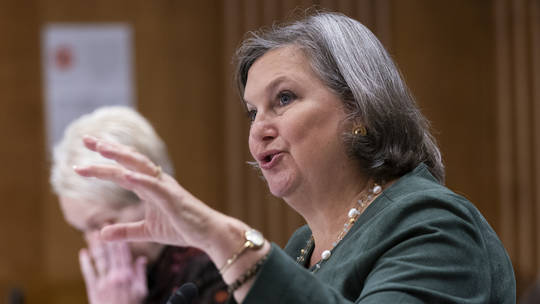
One of the leading neocon families is the Kagans, who have successfully penetrated and come to dominate the establishment foreign policy centers in both the Republican and Democratic Parties. Victoria Nuland nee Nudelman, the wife of Robert Kagan, is entrenched at the State Department where she is now the Deputy Secretary, the number two position. Up until recently, she was one of the top three officials at State, all of whom were and are Jewish Zionists. Indeed, under Joe Biden Zionist Jews dominate the national security structure, to include the top level of the State Department, the head of Homeland Security, the Attorney General, the National Security Adviser, the Director of National Intelligence, the President’s Chief of Staff, and the Deputy Director of the Central Intelligence Agency. Nuland’s hawkish appeal is apparently bipartisan as she has served in senior positions under Bill Clinton, Dick Cheney, George W. Bush, Barack Obama and now Joe Biden. As adviser to Cheney, she was a leading advocate of war with Iraq, working with other Jewish neocons Doug Feith and Paul Wolfowitz at Defense and also Scooter Libby in the Vice President’s office. As there was no actual threat to the US from Saddam Hussein she and her colleagues invented one, the WMD that they sold to the media and to idiots like Secretary of State Condoleezza Rice. Nuland is also considered to be close to Hillary Clinton and the recently deceased ghastly former Secretary of State Madeleine Albright. All of her government assignments have included either invading or severely sanctioning some country considered by her and her colleagues to be unfriendly. She particularly hates the Russians and anyone who is hostile to Israel.
Apparently, Nuland’s record of being seriously wrong in the policies she promoted has only served to improve her resume in Washington’s hawkish foreign policy establishment and when Biden came into the presidency she found herself appointed to the number three position at the State Department as the Under Secretary of State for Political Affairs. Her return to power with the Democrats might also be due in part to the activism of her husband Robert, currently a senior fellow at the Brookings Institute, who was one of the first neocons to get on the NeverTrump band wagon back in 2016 when he endorsed Hillary Clinton for president and spoke at a Washington fundraiser for her, complaining about the “isolationist” tendency in the Republican Party exemplified by Trump. Robert famously has never seen a war he disapproved of and, while urging Europe to do more defense spending, commented that “When it comes to use of military force “Americans are from Mars, and Europeans are from Venus.” Robert’s brother Frederick, a Senior Fellow at the neocon American Enterprise Institute, and Frederick’s wife Kimberly, who heads the bizarrely named Institute for the Study of War, are also regarded as neocon royalty.
Nuland is particularly well known for her being the driving force behind the regime change in Ukraine in 2014 that replaced the fairly-elected but friendly-to-Russia President Viktor Yanukovych with a selected candidate more accommodating to the US and Western Europe. Ukraine, the most corrupt country in Europe, has been unstable ever since and the current war, also initiated by interference from the US and UK, has brought about the deaths and wounding of an estimated half million Ukrainians and Russians.
Nuland was recently in Africa, stirring up developments in Niger, which has experienced a recent military coup that removed a president who was corrupt but also a friend of the US and France, both of which have troops stationed in the country. As I write this, a number of African nations (ECOWAS) friendly to US and French interests in the region are gathering together their own military force to reverse the coup, but there is little enthusiasm for the project. We will see how that turns out, but predictably Nuland is advertising a possible intervention as a “restoration of democracy.”
And there is more over the horizon with neocons like Secretary of State Antony Blinken and Nuland in charge of US foreign policy and supported by most of congress and a Jewish dominated media and entertainment industry. Joe Biden is too weak and too much under the thumb of the Israel Lobby to pursue any policies that would be beneficial to the American people in general, so the course will be set by the current crop of zealots, just as Donald Trump was guided by his Christian Zionist advisers.
If you want to understand just how what remains of our republic is in a bus being driven over the cliff by a group that has no regard for most of the citizens of the country that they reside in, one only has to read some of what passes for neocon analysis of what must be done to make America “safe.” Not surprisingly, it also involves Israel and a war on behalf of the Jewish state.
One astonishingly audacious article that appeared on August 13th in The Hill entitled “If Israel strikes Iran over its nuclear program, the US must have its back,” gives Israel the option of starting a war for any or no reason with the United States compelled to join in in support. It was written Michael Makovsky, a well-known Jewish neocon, and Chuck Wald. Makovsky is President and CEO of the Jewish Institute for National Security of America (JINSA) while Wald is a former general who also is affiliated with that group as a “distinguished fellow,” which means he is getting paid generously to serve as a mouthpiece providing credibility for the group. For those unfamiliar with The Hill, it is an inside the beltway defense contractor funded online magazine that pretends to be serious but which is actually an integral part of the status quo Zionist and war-on-demand network. That the Jewish Institute for National Security is “of America” is, of course, a characteristically clever euphemism.
The article begins with “The Biden administration should learn from its unpreparedness for the Russia-Ukraine war and begin to prepare for a major Israel-Iran conflict. The administration needs to set aside its differences with the Israeli government, overcome its aversion to conflict with Iran, and begin to work closely with Jerusalem to prepare for the growing likelihood that Israel will feel it has no choice but to initiate a military campaign against Iran’s nuclear program. In ‘No Daylight,’ a new report from the Jewish Institute for National Security of America (JINSA)… retired senior military officers and national security experts explain that whatever differences the US might now have with Israel over Iran policy, our two countries’ interests will be aligned after an Israeli strike. Consequently, in preparing its response, the U.S. guiding principle should be ‘no daylight with Israel,’ to ensure Israeli military success, mitigate Iranian retaliation and limit the scope of the conflict — vital interests for both countries.”
That war with Iran is a “vital interest” for the United States is, of course, not really explained as the point is to let Israel to decide on the issue of war and peace for the United States. The article then trots out the old “credibility” argument, i.e. that if we don’t go to war no one will ever trust our security guarantees: “A US betrayal of its close Israeli ally, at a time of great peril for the Jewish state, would be ‘one of the greatest catastrophes ever,’ an Arab leader told us privately recently. Because Israel is widely perceived as a close American ally, the US stance as Israel risks thousands of casualties in defense of its very existence, will resound broadly. Strong American support will reassure allies from Warsaw to Abu Dhabi and Taipei; American equivocation will shred Washington’s credibility and embolden adversaries from Tehran to Moscow and Beijing.”
One would love to know who the anonymous Arab leader so concerned about Israel is and, of course, the Jewish state is not in fact an American ally apart from in the fertile imaginations of congressmen, the media and the White House. And Israel will, of course, need more weapons and money from the US taxpayer to include “expediting delivery to Israel of KC-46A tankers, precision-guided munitions, F-15 and F-35 aircraft, and air and missile defenses… Washington should accelerate building integrated regional air, missile and maritime defenses against persistent Iranian threats.” And America must be prepared to expand the war: “Privately, Iranian and Hezbollah leadership should be warned that heavy retaliation against Israel… will prompt severe Israeli and/or American responses that could threaten their very grasp on power. Upon commencement of an Israeli strike, the United States should promptly resupply Israel with Iron Dome interceptors, precision-guided munitions, ammunition and spare parts, and deploy Patriot air defenses to Israel…”
So the United States must be prepared to turn over its national security to Israel in exchange for what gain for Americans? In part it would apparently involve “finding a permanent solution to Iran’s illegal nuclear weapons program” which is based on a lie even if Prime Minister Benjamin Netanyahu has been repeating for over 20 years that Iran is only six months away from a weapon. Both the CIA and Mossad have confirmed that Iran has no such program while Israel does have a secret illegal nuclear arsenal built using enriched uranium and nuclear triggers stolen from the US. The article concludes with another reference to the non-existing program, claiming “the most effective way to address Iran’s nuclear program already has been articulated by President Biden and communicated by America’s ambassador in Jerusalem: ‘Israel can and should do whatever they need to deal with it, and we’ve got their back.’”
Supporting Israeli war crimes is not the way to go. As Chris Hedges puts it correctly, there is no compelling American interest in damaging itself by supporting Israel blindly, quite the contrary: “The long nightmare of oppression of Palestinians is not a tangential issue. It is a black and white issue of a settler-colonial state imposing a military occupation, horrific violence and apartheid, backed by billions of US dollars, on the indigenous population of Palestine. It is the all powerful against the all powerless. Israel uses its modern weaponry against a captive population that has no army, no navy, no air force, no mechanized military units, no command and control and no heavy artillery, while pretending intermittent acts of wholesale slaughter are wars.”
And, of course, while Israel engages in slaughter and torture it always portrays itself as the victim only engaged in fighting against “terrorists.” I have a better idea for where we should go with all of this. President Joe Biden should be impeached for ignoring war powers legislation and indicating that he is willing to sacrifice US interests and kill American soldiers, few or plausibly none of whom will actually be Jewish since it is not an occupation that attracts them, to please and support a manifestly evil foreign government. And Donald Trump should also be punished for having done much the same type of pandering to a foreign country while in office. Meanwhile, haul Makovsky and Wald together with their buddies at the American-Israel Public Affairs Committee (AIPAC) and the Anti-Defamation League (ADL) down to the Justice Department and put them in jail for violation of the Foreign Agents Registration Act of 1938 (FARA) in that they are willfully acting as agents of a foreign government and are operating corruptly to serve the interests of that government. The criminals at AIPAC are already using their associated PACs to oust targeted members of Congress up for re-election in 2024 who have in any way been critical of Israel or pro-Palestinian. And while you’re at it Mr. Attorney General Merrick Garland nee Garfinkel, please have Mr. Blinken and Ms. Nuland pop by for a chat just for starters and see how far you can make the laws apply to those in power. There is some confusion evident here as Israel is not part of the United States, no matter how politically dominant and wealthy its lobby might be. Time to put an end to this nonsense and call it out for what it is – it is treason.
Philip M. Giraldi, Ph.D., is Executive Director of the Council for the National Interest, a 501(c)3 tax deductible educational foundation (Federal ID Number #52-1739023) that seeks a more interests-based U.S. foreign policy in the Middle East. Website is councilforthenationalinterest.org, address is P.O. Box 2157, Purcellville VA 20134 and its email is inform@cnionline.org.
US offloads oil from seized Iranian tanker despite Tehran’s warnings
The Cradle | August 20, 2023
An oil tanker seized by the US Navy for allegedly carrying sanctioned Iranian oil began transferring its cargo to another tanker off the coast of Texas on 20 August, despite threats from Tehran to target shipping in the Persian Gulf in response.
Ship-tracking data analyzed by The Associated Press showed the Marshall Islands-flagged Suez Rajan began the ship-to-ship transfer of its oil to the MR Euphrates, a tanker located some 70 kilometers southeast of Houston in the Gulf of Mexico. The value of the oil on the 800,000-barrel tanker is estimated to be $56 million.
Washington illegally seized the Marshall Islands-flagged Suez Rajan supertanker in April of this year in what was described by the Pentagon as “a sanctions-enforcement operation.” Washington also charged the ship’s owner with “sanctions evasion” and directed the stolen cargo to the waters off the Texas coast.
According to the Wall Street Journal, the Suez Rajan came under Washington’s radar after an anti-Iran organization – the New York-based United Against Nuclear Iran (UANI) – provided information about the ship’s cargo to government officials. Lawyers representing the families of victims of the 11 September attacks, “whom US courts have given the right to claim compensation from [Tehran],” filed a lawsuit against one of the ship’s former owners.
However, oil firms in the US had been reluctant to unload the shipment of stolen Iranian oil sitting, saying they were “too worried about Iranian reprisal” to touch the cargo, sources familiar with the matter told the WSJ.
“Companies with any exposure whatsoever in the Persian Gulf are literally afraid to do it,” a Houston-based energy executive told the US outlet, adding that companies fear “the Iranians would take retribution against them.”
“I don’t know if anybody’s going to touch it,” another executive at a shipping company had said.
The transfer of the Iranian oil comes as the US Navy has bolstered its forces in the Persian Gulf in recent weeks, including by sending the troop-and-aircraft-carrying USS Bataan through the Strait of Hormuz. Washington is also considering placing US troops on commercial vessels to prevent Tehran from seizing them in response to Washington’s own seizures of Iranian ships.
US theft of Iranian oil from the Suez Rajan also comes as Tehran and Washington seek to complete a prisoner exchange that also involves the US releasing between $6 and $10 billion in seized Iranian oil proceeds held in banks in South Korea and Europe.
Iran has been resisting US sanctions by continuing to sell its oil abroad, while the US has been seizing cargoes since 2019 after withdrawing from the nuclear deal negotiated between the two rival countries. The 2015 nuclear deal held that Iran would limit the enrichment of uranium for its nuclear program in exchange for sanctions relief. The US withdrew from the deal unilaterally in 2018. Washington accuses Iran of seeking to develop nuclear weapons, however, Iranian leaders have stated the nuclear program is for peaceful purposes and that developing nuclear weapons is forbidden by Islam.
Pakistan suspends pipeline project with Iran under threat of US sanctions
The Cradle | August 8, 2023
Pakistan has suspended its participation in building a major gas pipeline with Iran due to the threat of US economic sanctions, Minister of State for Petroleum, Dr. Musadik Malik, said in written testimony to the National Assembly on 7 August.
“Pakistan has issued a Force Majeure and Excusing Event notice to Iran under the Gas Sales and Purchase Agreement (GSPA), which resultantly suspends Pakistan’s obligations under the GSPA,” Malik wrote, noting that Iran disputes the validity of the notice.
“The matter will be finally settled through arbitration, should Iran take this matter to arbitration,” the minister added. “The exact amount of penalty, if any, is subject to the outcome of the arbitration to be determined by the arbitrators.”
In May, Pakistani officials warned that Islamabad faces paying an $18 billion fine if it fails to complete the Iran-Pakistan Gas Pipeline project by March 2024.
In his Monday statement, Malik added that the government is “engaged” in talks with US officials to plea for an exemption from sanctions for the project.
“All necessary actions are being taken to construct the gas pipeline at the earliest,” he stressed.
He also confirmed that the pipeline – which can supply 750 million cubic feet of gas per day to Pakistan – “is stalled due to international sanctions on Iran” and will only resume once the sanctions are lifted and no longer threaten Pakistan.
“No date and deadline can be given for the completion of the Iran-Pakistan Gas Pipeline Project,” the official said.
According to the terms of the GSPA, each country was obligated to construct a portion of the pipeline on its territory, and the first flow of Iranian gas to Pakistan was to start on 1 January 2015. Iran completed its portion of the pipeline in 2011.
As part of Pakistan’s dire economic crisis, the nation faces regular blackouts lasting 12 hours per day, if not longer.
To face this crisis, the Pakistani finance ministry revealed plans on 8 August to purchase more electricity from Iran. The decision was reportedly taken during a session of the Economic Coordination Committee chaired by Finance Minister Ishaq Dar.
Islamabad’s moves come less than a week after Iranian Foreign Minister Hossein Amir-Abdollahian visited the South Asian nation, where he signed a five-year commercial trade agreement.
The two countries also recently agreed to bolster defense cooperation to ensure border security.
Furthermore, in June, Islamabad announced a barter trade agreement with Russia, Iran, and Afghanistan to ease the mounting pressure on its depleted foreign reserves.
Iran responds to US military moves with more firepower
RT | August 6, 2023
Iran has beefed up the weaponry of its naval forces, arming them with such tools as additional drones and precision missiles with ranges up to 1,000 kilometers (620 miles), amid rising tensions with the US over shipping traffic through the world oil market’s most crucial bottleneck.
The Iran Revolutionary Guard Corps (IRGC) Navy officially took possession of the new gear at a ceremony on Saturday, state-run media outlets reported. The systems include reconnaissance and combat drones, as well as electronic warfare equipment, truck-mounted missile launchers, and hundreds of cruise and ballistic missiles.
The announcement came after reports earlier this week that US military officials had drawn up unprecedented plans to place armed troops on commercial trips in the Strait of Hormuz. Just last month, the Pentagon announced deployments of additional fighter jets and naval assets to the Persian Gulf region in response to “alarming events,” such as Iranian seizures of commercial vessels.
Brigadier General Abolfazi Shekarchi, a spokesman for the Iranian military, denounced Washington’s proposed deployment of troops on private ships. “What do the Persian Gulf, the Gulf of Oman and the Indian Ocean have to do with America?” he told Iran’s Tasnim news agency. “What is your business here?”
About 20% of the world’s oil supplies, or one-third of all seaborne crude shipments, go through the Strait of Hormuz, the narrow passage that connects the Persian Gulf to the Gulf of Oman and the Arabian Sea. Tehran typically accuses the operators of detained ships of shipping violations, such as oil smuggling. Some of the vessels have only been released after other countries free detained Iranian tankers.
The new missiles give the IRGC Navy better accuracy and longer range than it previously had available, commander Alireza Tangsiri said. “The cruise missiles can attack several targets simultaneously, and the commands can be altered after takeoff,” he added.
US-Iran tensions have risen since Washington pulled out of the Iran nuclear deal in 2018. Efforts to revive the agreement, known officially as the Joint Comprehensive Plan of Action (JCPOA), have failed, despite the change in US leadership when Joe Biden succeeded Donald Trump as president in January 2021.
Featured Video

Trita Parsi: Middle East Unraveling — Are We on the Path to World War?
or go to
Aletho News Archives – Video-Images
New Book
Trans agenda is ‘normalization of sadism’ – US author

RT | September 23, 2026
The US Democratic Party has embraced a transgender agenda that amounts to “the normalization of sadism,” author A.J. Rice has said, warning that radical trans policies would return if the party is allowed to regain power.
Speaking to RT’s America First host Scotty Nell Hughes about his new book, ‘The Curse of the Bearded Lady: How the Trans Mafia Whacked American Sanity’, Rice argued that activists have gained significant influence in schools, medicine, and corporate America while people who questioned the agenda have faced pressure to stay silent.
The author described the “trans mafia” as the sprawling network of people and institutions that have helped the movement gain influence. He singled out parts of academia, wealthy backers, and corporations, and stated that providers of transition-related treatment also have a financial incentive to keep young people in their care indefinitely.
Rice argued that the consequences of these policies ultimately fall on children who are being drawn toward gender-affirming medical treatments and on girls who are expected to share locker rooms or compete in sports with biological males.
He noted that while voters rejected the Democrats’ approach to gender in 2024, the party, which has been “captured by madness,” has since only doubled down and is seeking what is effectively “the normalization of sadism.” … Full report
Blog Roll
 Aletho News
- Refaat Al-Areer Was The Canary In The Coal Mine In Israel’s War On The Truth
- Israeli election committee bars candidate from Knesset race over Gaza war opposition
- French-Lebanese man files war crimes complaint over Israeli attacks
- Mahan Air Flight Lands in China Despite US Threat against Iranian Airlines
- US eyes $10bn fund to rebuild war-battered Gulf infrastructure
- Trump meets Rodríguez near Maduro’s prison as Venezuela’s oil flows to US
- Trita Parsi: Middle East Unraveling — Are We on the Path to World War?
- Iran FM meets with US envoy on UN meeting’s sidelines at American side’s insistence: Report
- Qatar PM calls for Gulf security framework with Iran, says war must be ‘wake-up call’
- China condemns US extortion of Iranian airlines, rejects Washington’s ‘illegal’ sanctions threats
- If Americans Knew
- An error has occurred; the feed is probably down. Try again later.
- No Tricks Zone
- New Study: Earth And Venus Surface Warmth Largely Explained By Convection And Lapse Rate, Not CO2 Or Radiation
- 2025 Nature Paper Claiming Worsening Global Drought Gets RETRACTED …Heavily Flawed
- New Study: ‘Global Drought Shows No Detectable Recent Acceleration Under Climate Warming’
- Economic Masterminds: German Socialists Suggest Taxing Productivity Gains Stemming From Using AI
- The South China Sea Has Not Been Cooperating With The Climate Change Narrative
- Energy Crisis: Germany Enters Heating Season With Historically Low Gas Reserve Fill Levels
- New Study: The Antarctic Ice Sheet Gained Mass From 2020-2024 Due To Staggering Snow And Ice Accumulation
- Study: Ocean Heating Rates From Thousands Of Years Ago ‘Dwarf’ Modern Ocean Heating Rates
- Climate Extremists Target, Attack Large-Scale Power Grid Infrastructure In Germany!
- New Study: Antarctic Ice Melt Has Contributed Less Than 1 Centimeter To Sea Level Rise In The Last 30 Years

