Syria’s return to Arab League is a big deal
BY M. K. BHADRAKUMAR | INDIAN PUNCHLINE | MAY 8, 2023
When a mere subplot overnight assumes habitation and a name, it becomes more fascinating than the main plot itself. Syria’s return to the Arab League after its decade-long exclusion can be regarded as a sub-plot of the China-brokered rapprochement between Saudi Arabia and Iran. But then, China and Iran are not per se party to the process.
Syria’s return to the Arab League is seen as an Arab initiative, but it is quintessentially a project Riyadh steered through in close consultation and coordination with Damascus, ignoring some murmur by a clutch of Arab States and patently in defiance of Washington’s trenchant opposition.
Against the backdrop of the epochal struggle for a new world order characterised by multipolarity and resistance to Western hegemony, Russia and China quietly encouraged Riyadh to move in such a direction.
A riveting thing about the decision taken by the foreign ministers of the seven Arab League nations at the meeting in Cairo on Sunday is its sweet timing. For, this is the 80th anniversary of the establishment of the Ba’ath Party in Damascus in 1943, which espoused an ideology of Arab nationalist and anti-imperialist interests that have lately re-appeared in the geopolitics of West Asia.
Syria has a tradition of strategic autonomy. Through the past decade, it was preoccupied with fighting off the US-sponsored regime change project, with help from Russia and Iran. As it turns the corner and is stabilising, Syria’s strategic autonomy will be increasingly in evidence. This is one thing.
However, the strategic relations with Russia and Iran will continue to remain special and there should be no misconceptions on that score. But Syria is capable of ingenuity and diplomatic acumen to create space for itself to manoeuvre, as geopolitics takes a back seat and Assad prioritises stabilisation and reconstruction of the economy, which requires regional cooperation.
The recent visit by Iran’s president Ebrahim Raisi to Syria testifies to Tehran’s “soft diplomacy,” exuding pragmatism that on the one hand made it clear that despite the recent rapprochement between Damascus and Arab countries, Syrian-Iranian ties are still strong and even highlighted Syria’s role in the resistance to Israel — with Raisi holding a meeting in Damascus with senior Palestinian officials, including leaders of Hamas and Islamic Jihad — while on the other hand, the negotiations with the Syrian leadership was largely about economic cooperation.
Raisi said Iran is ready to take an active part in the post-war reconstruction of Syria. Iran faces competition from Gulf countries that have deep pockets. Meanwhile, the warming of relations between Syria and Turkey is also on the agenda, which is sure to lead to increased trade and spur investment flow.
To put matters in perspective, Iran’s exports to Syria currently amount to a paltry sum of $243 million. However, since the beginning of the conflict in Syria, Iran has been a key sponsor of the Syrian authorities. In January 2013, Tehran opened the first credit line of $1 billion for Damascus, which was under international sanctions, thanks to which the government was able to pay for imported food. This was followed by a loan of $3.6 billion for the purchase of petroleum products. The third loan of $1 billion was extended in 2015. Tehran also allocated funds to Damascus to pay salaries to civil servants, which helped preserve state institutions. In 2012, a free trade agreement began to operate between the countries. Iran is also spending billions to finance Shiite militias in Syria and supply them with weapons. Naturally, Tehran would like to recoup some of these investments.
Syria is assessing, rightly so, that normalisation with the Arab neighbours and Turkey will be a game changer. But, while everyone is talking about Syria’s “readmission to the Arab family” as a concession, Damascus reacted to the Arab League decision in a measured way.
The Syrian Foreign Ministry statement said on Sunday, “Syria has been following the positive trends and interactions that are currently taking place in the Arab region, and believes that these benefit all Arab countries and favour the stability, security and well-being of their peoples.
“Syria has received with interest the decision issued by the meeting of the Council of the League of Arab States.” The statement went on to stress the importance of dialogue and joint action to confront the challenges facing the Arab countries. It recalled that Syria is a founding member of the Arab League and always had a strong position in favour of strengthening joint Arab action.
Most important, the statement concluded by reaffirming that the next stage requires “an effective and constructive Arab approach on the bilateral and collective levels on the basis of dialogue, mutual respect, and the common interests of the Arab nation.”
From all appearance, the Arab League statement itself was a “consensus statement” drafted with great sensitivity by Saudi Arabia.
In an interview with Al-Mayadeen, Raisi said prior to his departure for Damascus that “Syria has always been on the axis of resistance… We unequivocally support all fronts of the axis of resistance, and my visit to Syria is within the framework of this support, and we are working to strengthen the resistance front, and we will not hesitate in this.” In fact, Raisi’s arrival in Syria coincided with increased Israeli attacks by Israel on Iranian military facilities, including on Aleppo airport.
Without doubt, Iran remains Syria’s main ally and Iranian influence in Damascus is still strong. Iran views Syria as its strategic territory through which Tehran can establish ties with Lebanon and confront Israel.
What works to Syria’s advantage here is that the Saudi-Iranian detente is based on a common view in Riyadh and Tehran that they have to coexist in one form or another, since their enmity and regional rivalry turned out to be a “lose-lose” proposition that didn’t improve their regional standing. Suffice to say, their national interest resulting from their rapprochement overrides past rivalries. Syria will be a testing ground where each other’s true intentions as well as conduct will come under close scrutiny.
The good part is that the Saudis have concluded that President Assad is firmly in the saddle, having weathered the most devastating war since World War 2, and mending relations with Damascus can be a “win-win” for Riyadh.
That said, Syria is a strategic hinge where Riyadh will need to balance its strategic ties with the US and its tacit ties with Israel. But then, Saudi Arabia’s new strategic calculus also includes China and Russia. When it comes to Syria, Russia is an anchor sheet for Assad, while China has been all along on the right side of history.
This geopolitical setting has driven Biden Administration into frenzy, NSA Jake Sullivan rushed to Saudi Arabia holding the hands of his Indian and Emirati counterparts for company! Wisdom lies in Washington using Saudis (and Emiratis and Indians) to open a line to Damascus. However, Assad will set the very same non-negotiable condition to Washington for normalisation that he insisted with Turkey — vacation of US occupation. Beyond that lies, of course, Israel’s annexation of Golan Heights.
Iran-made power plant parts replacing US models in SE Asia
Press TV – May 3, 2023
Spare parts manufactured by Iranian companies that are used in power plant maintenance services are replacing rival models from the US in electricity stations in Malaysia and Indonesia, according to an official in the Iranian Energy Ministry.
Abdolrasul Pishahang, who serves as CEO of Iran’s Thermal Power Plants Holding Company (TPPH), said on Wednesday that domestic firms had manufactured some 100,000 parts needed in servicing operations in Iran’s power plants in recent years.
Pishahang said Iranian-made parts are being supplied to power plants in the region and in Southeast Asia where countries previously relied on parts supplied by US companies.
“While responding to the domestic demand, these parts are exported to regional countries and are replacing US-made power plant parts in countries like Malaysia and Indonesia,” he was quoted as saying by ILNA news agency.
Iran has a relatively large electricity industry where dozens of thermal and gas power plants account for a bulk of the power generated in the country.
Total Iranian electricity generation capacity exceeded 90 gigawatts (GW) in October 2022 although Energy Ministry figures suggest production reached a record of nearly 66 GW in the peak demand time last summer.
Sanctions imposed by the US on Iran’s energy sector in 2018 caused the country to introduce measures to cut reliance on foreign suppliers for parts and equipment needed in its power plants.
TPPH’s Pishahang said some 34 new power plant units had been connected to Iran’s national power grid since August 2021.
Iran seizes another oil tanker
RT | May 3, 2023
Iran’s Islamic Revolutionary Guard Corps (IRGC) Navy used fast-attack boats to seize an oil tanker in the Strait of Hormuz on Wednesday, according to the US Navy, which released a video of the incident. Tehran confirmed the seizure, the second such retaliatory incident since the US reportedly blocked a consignment of Iranian crude oil last week.
The Niovi, a Panama-flagged tanker managed by Greece-based Smart Tankers, was swarmed by a dozen IRGC attack boats as it transited the strait, the US Navy said in a statement. Video footage released by the Navy showed the boats escorting the tanker, apparently after ordering it to redirect.
The ship had left Dubai at midday on Tuesday and was due to arrive at the Emirati port of Fujairah by Wednesday afternoon, but was turned around and diverted to Iranian waters.
Officials in Tehran told the Iranian judiciary’s Mizan news agency that the Niovi was impounded following an unspecified legal complaint by a plaintiff.
The incident came after the Advantage Sweet was stormed by Iranian commandos in the Gulf of Oman last Thursday. The Marshall Islands-flagged vessel is owned by a Chinese firm, but had been chartered to transport a cargo of oil to the US for American petroleum giant Chevron.
Dramatic video footage released by Tehran showed the commandos rappelling from helicopters onto the ship’s deck, before moving toward its bridge.
The US navy described both seizures as “contrary to international law and disruptive to regional security and stability.” However, American officials did not mention the fact that immediately prior to Thursday’s seizure, US authorities impounded a shipment of Iranian oil bound for China. Quoting anonymous officials, the Financial Times reported that the ship was redirected toward the US in an apparent sanctions enforcement operation.
The US and its allies often block the transport of Iranian oil at sea, and Tehran usually responds in kind. Iranian forces seized two Greek-flagged vessels in the Strait of Hormuz last year after Greece allowed the US to drain an Iranian tanker of oil in Greek waters. Back in 2019, Iran impounded two British-flagged tankers after the UK seized an Iranian tanker in Gibraltar.
The Extreme Center: How the Neocons Went Woke
By Oliver Williams | The Occidental Observer | May 2, 2023
No lessons, no consequences
The Iraq war was spearheaded by a remarkably small group of people. It has become politically untenable to justify that overt disaster and some of the key architects of that war have, much belatedly, come to acknowledge as much. As late as 2013 Max Boot was still arguing there was No Need to Repent for the Iraq War. He had changed his tune by 2018, writing in his book The Corrosion of Conservatism: Why I Left the Right, “I regret advocating the invasion and feel guilty about all the lives lost.” Boot claims, “It was a chastening lesson in the limits of American power,” yet in the same book complains that the modern conservative movement is “permeated with” racism, extremism and isolationism.
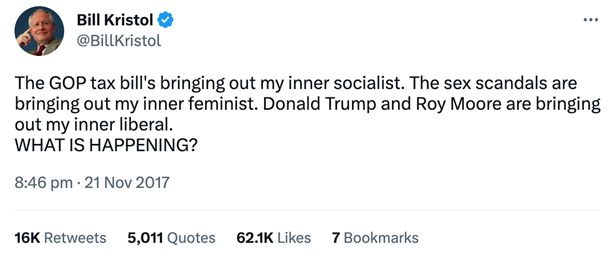
David Frum now describes the invasion as “a grave and costly error” and gives a thoroughly equivocal mea culpa. Robert Kagan says that the war “didn’t go exactly the way we wanted it to” and that “many aspects of the war” were “unfortunate.” Bill Kristol acknowledges that Iraq was “very difficult” and that “many things were done badly,” but concludes, “I’m inclined not to think it was [a mistake].” Since the inauguration of Trump, Kristol has changed his mind on trans rights, on gays, on abortion — but not on the catastrophe that led to over a hundred thousand civilian deaths. He told Jewish Insider: “Ironically, I’d say I’ve changed or rethought my views more on domestic policy issues… Foreign policy, I haven’t really changed my views. And I’ve been critical of Biden for the withdrawal from Afghanistan.”
Despite the repeated disasters in Iraq, Afghanistan, Libya and elsewhere, these figures remain as combative as ever. In 2018 Kristol told Vox, “the fact that the public is, quote, “war-weary”… those instincts have be challenged.” He told the Al Franken podcast that the Iraq intervention “didn’t destabilize the entire Middle East, I wish it had destabilized some of those places more.”
The neocons have been consistently wrong about foreign policy, and not just wrong, but wrong in the loudest, most doctrinaire and most uncompromising way possible. You’d think they might face some career blowback…
What actually happened?
Liberal adulation
On his MSNBC show, Ari Melber referred to 2018 as the year when “many people began referring to ‘woke Bill Kristol’.” According to Melber, this was “A tribute to the idea that people do evolve and that Trumpism can create strange bedfellows.”
Joy Reid, perhaps the most noxious personality on MSNBC, was positively glowing with praise:
One of the most amazing outcomes of the Trump administration is the number of neo-conservatives that are now my friends and I am aligned with. I found myself agreeing on a panel with Bill Kristol. I agree more with Jennifer Rubin, David Frum, and Max Boot than I do with some people on the far left. I am shocked at the way that Donald Trump has brought people together.
It turned out that in the throes of Trump Derangement Syndrome, being vehemently against Trump was enough to garner liberal adulation. During Donald Trump’s four years in office we saw the wholesale rehabilitation of the most discredited propagandists of the war on terror. After Trump called the Iraq war a “big fat mistake” in the 2016 Republican presidential debate, the neocons rebranded themselves as the ‘moderate’ voice against the danger of a Trump presidency. They went on to find lucrative positions in the liberal messaging apparatus. Frum became a senior editor for The Atlantic. Boot is now a senior fellow at the Council on Foreign Relations, a CNN analyst, a columnist at The Washington Post, and a contributor to the New York Times op-ed pages. Robert Kagan is a senior fellow at the Brookings Institution and an editor at large for The Washington Post. Kristol is a frequent commentator on CNN and MSNBC.
In the liberal imagination, the Neocons shifted from being war criminals to sensible moderate centrists, and, after the 2020 election and January 6th, brave and principled defenders of democracy.
How did this happen?
Hawks for Hillary
In 2014 Jacob Heilbrunn, author of They Knew They Were Right: The Rise of the Neocons, predicted “the neocons may be preparing a more brazen feat: aligning themselves with Hillary Rodham Clinton and her nascent presidential campaign, in a bid to return to the driver’s seat of American foreign policy.” Attending a Foreign-Policy-Professionals-for-Hillary fundraiser, Robert Kagan was quoted as saying, “I would say all Republican foreign policy professionals are anti-Trump. I would say that a majority of people in my circle will vote for Hillary.” Hillary won the endorsement of almost every high-profile Neoconservative you could name. Eliot Cohen, co-founder of the Project for the New American Century; John McCain speechwriter Mark Salter; think tank goon James Kirchick. Boot said he would “sooner vote for Josef Stalin than[he] would vote for Donald Trump.” The Wall Street Journal’s most hawkish columnist, neocon Bret Stephens, penned an op-ed titled Hillary: The Conservative Hope. But no one else went as far as Bill Kristol, who, when, after running a rival candidate in 2016 proved a fool’s errand, tweeted that he would “prefer the deep state to the Trump state.”
This wholesale coalition between Bush-era neocons and hawkish Democrats started before Trump and it continued after he left the White House. In 2008 The Weekly Standard celebrated Hillary Clinton as “the great right hope” of foreign policy, hailing her transformation from “First Feminist” to “Warrior Queen.” In 2013 John McCain described Hillary Clinton as a foreign policy “rock star.” In a 2014 profile of Robert Kagan in The New York Times, Kagan mentions that he served on Hillary’s “bipartisan group of foreign-policy heavy hitters at the State Department, where his wife worked as her spokeswoman.” He said of Clinton’s foreign policy, “it’s something that might have been called neocon, but clearly her supporters are not going to call it that.”
This was more than a temporary marriage of convenience to stop Donald Trump. This is more than a pragmatic alliance. It’s an ideological convergence. The Neocons have cast off any pretence to conservatism while the Democrat Party has become uniformly pro-war. David Frum explained the realignment:
Trump pushed Never Trump Republicans into partnership with moderate Democrats — and prodded even formerly conservative minded people — to see power in ideas like Me Too and Black Lives Matter. … Old patterns are dissolving into something new.
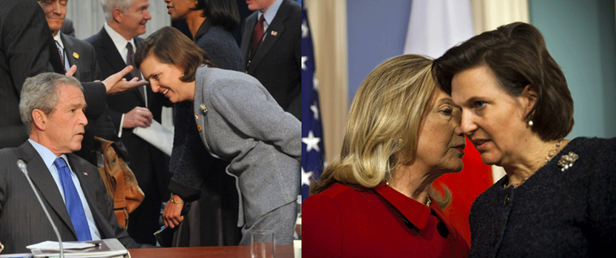
The neocons had lost access to power in the GOP and needed to find a new constituency. Robert Kagan co-authored an article in 2019 attacking “America First” foreign policy with Antony Blinken, who is now Joe Biden’s Secretary of State. Kagan’s wife is Victoria Nuland. The two fell in love “talking about democracy and the role of America in the world.” Nuland is the ultimate example of the continuity (only interrupted briefly by Donald Trump) of personnel regardless of the administration. Nuland was a foreign policy adviser to Vice President Dick Cheney, a State Department spokesperson under Obama, and Under Secretary of State for Political Affairs in the Biden administration. Her worldview is identical to that of her husband.
The Alliance for Securing Democracy, the national security advocacy group responsible for the Hamilton 68 scam of Russian pro-Trump influence, is governed by a board that includes Michael Chertoff, former secretary of homeland security under George W. Bush; Michael McFaul, former ambassador to Russia under Barack Obama; Bill Kristol; John Podesta; and, at one time, Jake Sullivan, now national-security adviser to President Biden. If there were ever a meaningful distinction between the liberal interventionists and the Neoconservatives, the two are now fully merged.
Invade the world, invite the world: Imperialism + Immigration
High-profile neoconservative figures have radically changed their positions on a whole range of issues to appeal to their new liberal followers but they’ve always been remarkably consistent on two policies: never ending war and unrestrained immigration. Preventing the migration of Muslims from such terror-prone countries as Afghanistan is beyond the pale, bombing those same people is seen as just fine.
Bill Kristol wants “new Americans” to replace a population he brands “lazy” and “spoilt” — “luckily you have these waves of people coming in.” Kristol has mourned the “insanity and cruelty” of ICE raids. “I’d take in a heartbeat a group of newly naturalized American citizens over the spoiled native-born know-nothings of CPAC” he tweeted in 2018. Kristol made open borders a litmus test of respectability. Asked about his previous endorsement of the brain-dead Sarah Palin he said: “I regret that. … To be fair, if you look at what she said in 2008, apart from some of the silliness, she was not anti-immigration. She was not xenophobic. She was not isolationist. … So, in a funny way, if we could have co-opted some of the populism and given them a place in a McCain-nominated Republican Party, maybe that would have been a good outcome.”
He told Vox : “I will say, you know, the Weekly Standard was pretty unapologetically anti-Buchanan. … Pretty liberal on immigration.”
As documented by the repentant former neocon Scott McConnell in a 2003 article in the American Conservative, and more extensively in the book The Great Purge: The Deformation of the Conservative Movement, the neocons were instrumental in the cancellation of any Conservative that expressed reservations about immigration.
Boot expressed the ultimate synthesis of imperialism abroad and multicultural colonisation at home . Bemoaning the size of the America’s fighting force, he noted, “there is a pretty big pool of manpower that’s not being tapped: everyone on the planet who is not a U.S. citizen.” He floated the idea of simply paying Afghans to occupy their own country: “The most efficient way to expand the government’s corps of Pashto or Arabic speakers isn’t to send native-born Americans to language schools; it’s to recruit native speakers of those languages.”
Historically the imperial project enabled the successful military power to attain new territory for its people to settle. Under the new imperialist framework, America invades countries only to welcome the waves of refugees that war inevitably creates. So the return on the blood and treasure expended in Iraq and Afghanistan and Libya is ever more Iraqi’s, Afghan’s and Libyan’s finding living space in the USA. According to the New York Times, in 2005, just a few years after 9/11, “more people from Muslim countries became legal permanent United States residents—nearly 96,000—than in any year in the previous two decades.”
Invade/invite are both formed by a similar panglossian view of diversity. For all the celebration of diversity, there’s a blindness to it, a belief that that deep down we’re all basically Americans, yearning for secular democracy and ‘freedom’ (in the form of unrestrained liberal hedonism and free markets). If diversity is a strength, there’s no reason to think that forcing democracy on a deeply sectarian country like Iraq might not work out. Here’s Kristol on Iraq: “I think there’s been a certain amount of, frankly, a kind of pop sociology in America that, you know, somehow the Shia can’t get along with the Sunni.”
In reality the Shia didn’t get along with the Sunni and horrific bloodshed between the two groups followed Saddam’s ouster.
In 2016 Robert Kagan wrote an article about Trump titled This is how Fascism comes to America :
His public discourse consists of attacking or ridiculing a wide range of “others” — Muslims, Hispanics, women, Chinese, Mexicans, Europeans, Arabs, immigrants, refugees — whom he depicts either as threats or as objects of derision. His program, such as it is, consists chiefly of promises to get tough with foreigners and people of nonwhite complexion. He will deport them, bar them, get them to knuckle under, make them pay up or make them shut up.
But he won’t bomb them. Therein lies the problem.
Anarchy at home, military occupation abroad
In 2020 over 130 senior Republican national security officials signed a statement that condemned Donald Trump because he “stokes fears that ‘angry mobs’ and ‘anarchists’ are destroying our country” and violated America’s “legacy as a nation of immigrants.” America’s foreign policy elite would like to wage non-stop war to “keep America safe,” yet when America’s urban centers themselves resemble war zones, the establishment either shrugs or cheers on the rioters (at least 25 people died during the BLM riots, including a Trump supporter assassinated in the middle of the street in Portland).
Kori Schake, Director of Foreign and Defense Policy at the American Enterprise Institute, writes: “Recent protests in Amsterdam, London, and elsewhere show that what happens in America matters for the advance of human rights and civil liberties elsewhere. … Our struggles are the world’s struggles, because the values that form our republic are universal values.” Schake was a foreign policy adviser to the McCain-Palin 2008 presidential campaign and served as director for Defense Strategy on the National Security Council under George W. Bush. In an article titled “This Upheaval Is How America Gets Better,” Schake celebrated the violent riots of 2020: “We are now seeing America becoming better than it was. This churning, disputatious, and even sometimes violent dynamic is what social change in America looks like.” She praised the military for “modeling how to amplify black voices” while linking to a video of Dave Goldfein, Chief of Staff of the U.S. Air Force, talking about turning the force into a “safe space.”
“I used to be a smart-alecky conservative who scoffed at ‘political correctness,’” wrote Max Boot, but 2017 was “the Year I Learned About My White Privilege.” “The Trump era has opened my eyes. … I have had my consciousness raised. Seriously.” He has referred to increasing support for BLM as “a reason for optimism.” This is the man who, a month after 9/11, penned an essay for the Weekly Standard titled “The Case for American Empire” where he called for America to “embrace its imperial role.”
David Frum, the man who coined the infamously ludicrous “axis of evil” phrase as a speechwriter for George W. Bush, is a senior editor for The Atlantic, a magazine that marries Black radicalism with rabid militarism. During the wildly destructive Black Lives Matter riots it published articles with titles like “Anger Can Build a Better World” and “How Rage Can Battle Racism.” I’ve previously written that “The hegemonic ideology of America is now a mutant symbiosis of the thought of Dick Cheney and Ibram X. Kendi.” On theatlantic.com articles by Kendi and David Frum (albeit not Cheney himself) are but a click apart (Joe Biden’s Special Representative for Racial Equity and Justice at the State Department recently met with Kendi and had a discussion about “the ongoing, global impact of white supremacy & the importance of collective effort across sectors to build a world where racial & ethnic equity & social justice prevail”). The New York Times, the ultimate vector of elite consensus-forming, became a home for Max Boot and Bret Stephens to call for America to act as the world police while also publishing articles like Yes, We Mean Literally Abolish the Police – but not, of course, the military.
Jennifer Rubin, another former neocon and a deeply unserious blogger who specialises in emotion-laden hyper-partisan bluster, has performed a remarkable political one-eighty, but continues to be one of the nation’s most rabid warmongers. Rubin went from being an anti-abortion zealot to worrying “if women cannot get abortions, will the military have trouble recruiting women?” In 2011 she criticised Newt Gingrich for being insufficiently enthusiastic about the Iraq war. She wrote a blog post that called out John McCain for opposing “enhanced interrogation techniques.” More recently, Rubin has become the Biden White House’s favorite pundit.
Responding to census data, Rubin tweeted, “a more diverse, more inclusive society. this is fabulous news. Now we need to prevent minority White rule.” During the widespread riots and looting of 2020, Rubin tweeted “BLM is peaceful.” “White Christian nationalism”, by contrast, “will inevitably lead to violence, cruelty and lawlessness.” She blamed the violence of 2020 on “white agitators.” Combining both her neocon and woke credentials in a single sentence, upon the death of civil rights agitator John Lewis she claimed it “is easy to be despondent — as many were after the passing of John McCain.” Lewis’s courage, she tweeted, was “honored and echoed in the actions of BLM protesters.”
Speaking on MSNBC’s AM Joy of Trump supporters, Rubin said of the Republican Party (that she’d been a member of just a few years earlier):
What we should be doing is shunning these people. Shunning, shaming these people is a statement of moral indignation that these people are not fit for polite society.… We have to collectively, in essence, burn down the Republican Party. We have to level them because if there are survivors, if there are people who weather this storm, they will do it again.
Rubin has shown herself more than willing to support the actual physical levelling of ideological enemies abroad, so perhaps this isn’t hyperbolic rhetoric so much as a literal policy prescription.
When the official GOP Twitter account accurately pointed out that Supreme Court nominee Ketanji Brown Jackson supported critical race theory, Bill Kristol shot back “No more dog whistles. Just unabashed bigotry.”
Conclusion
In “Unpatriotic Conservatives,” David Frum managed to accuse those conservatives sceptical of the Iraq war of being both nativists and unpatriotic. The neocons managed to instrumentalize and exploit a redefined version of American nationalism that entangled American identity and nationalism itself with their own ideological proclivities. In that essay Frum accuses the great conservative intellectual Sam Francis of pursuing “a politics devoted to the protection of the interests of what he called the ‘Euro-American cultural core’ of the American nation,” and he condemns White advocates like Kevin MacDonald. That, in the minds of Neocons, is the very definition of unpatriotic.
Many conservatives still reflexively venerate the military. This increasingly resembles a case of battered-wife syndrome. Enoch Powell once told Margaret Thatcher that if Britain were to become communist, he would still fight for his country in war. I always regarded that as a moronic sentiment. One wonders how long Toby Keith-style nationalism can be instrumentalized for a political project that is fundamentally at odds with the interests of those actually doing the fighting and the dying. For all his faults, Trump was correct when he told Tucker Carlson that the biggest threat to the United States is no external enemy: “Who’s the biggest problem? Is it China? Could it be Russia? Could it be North Korea? No. The biggest problem is from within. It’s these sick, radical people from within.”
In a campaign video Trump reiterates, “The greatest threat to Western civilization today is not Russia. It’s ourselves.”
America won the Cold War against the Evil Empire only to one day resemble a gay, trans, racialized version of it — a woke Leviathan straddling the globe. Michael Ledeen, perhaps the most overtly deranged of all the Neoconservatives, wrote in his book War Against the Terror Masters:
We tear down the old order every day. … Our enemies have always hated this whirlwind of energy and creativity, which menaces their traditions (whatever they may be) and shames them for their inability to keep pace. Seeing America undo traditional societies, they fear us, for they do not wish to be undone. They cannot feel secure so long as we are there, for our very existence—our existence, not our politics—threatens their legitimacy. They must attack us in order to survive, just as we must destroy them to advance our historic mission.
Increasingly, that historic mission is the global spread of critical race theory and radical gender ideology. If ever it had any moral claim to police the world or export its way of life, that claim was burnt to the ground in 2020. It’s when the woke mob stops burning the American flag and starts waving it that the world really has a problem. When the moral certitude of social justice meets the impervious militarism of Neoconservatism, it will make for the most noxious and destructive brand of imperialism the world has ever seen.
US senators demand Biden seize more Iranian oil tankers
The Cradle | April 28, 2023
A bipartisan group of US lawmakers has urged President Joe Biden to enable the Department of Homeland Security’s Homeland Security Investigations (HIS) to seize more Iranian oil and gas shipments.
“It is unacceptable that a US government program, which makes the United States and its allies safer, provides funds to remediate the victims of terrorism, and generates income for the United States in a cost-effective manner has been allowed to languish,” a letter drafted by Senators Joni Ernst and Richard Blumenthal reads.
The letter then highlights that the HIS has not been allowed to conduct what amounts to maritime piracy for more than a year before lamenting the success of the Islamic Republic in bypassing US sanctions to boost its oil and gas exports.
“As Iranian oil sales continue to rise, and the IRGC continues to target US citizens and servicemembers, including inside the US, it is imperative that we use all available government assets to limit the activities of the Iranian regime.”
Other senators that signed the letter included Ted Cruz, Steve Daines, Lindsey Graham, Maggie Hassan, Mark Kelly, Joe Manchin, Jerry Moran, Marco Rubio, Kyrsten Sinema, and Ron Wyden.
“The failure to support HSI’s Iranian oil seizure and disruption operations in FY22, despite available funds, is a policy choice that must be reversed,” the senators stressed.
HIS was formed in 2019 during the government of former president Donald Trump. According to the lawmakers, the agency is responsible for pillaging nearly $230 million in Iranian crude and fuel oil.
Its operations have reportedly been curtailed by “policy limitations” from the Department of Treasury’s Executive Office for Asset Forfeiture.
Despite an ever-intensifying “‘maximum pressure” sanctions campaign from the west, Iranian oil exports have reached their highest level since 2015.
According to Iranian Oil Minister Javad Owji, Iran exported 83 million more oil barrels in the past 12-month period compared to the 12 months before. At the same time, gas exports increased by 15 percent over the past 12 months.
Iranian crude exports fell to as little as 100,000 bpd in 2020 from over 2.5 million bpd in 2018.
Tehran has been able to evade the US-imposed sanctions, partly through oil sales to China, Iran’s biggest customer, and increase its exports. To avoid sanctions, most of Iran’s crude exports to China are rebranded as crude from other countries. This is done by forging documents to hide the origin of Iranian oil cargo.
See also: Quiet US Seizure Of Iranian Crude Prompted Iran’s Capture Of Houston-Destined Tanker
“Freedom of Religion” and Other Lies
Christian and Muslim persecution in Israel ignored by the White House

BY PHILIP GIRALDI • UNZ REVIEW • APRIL 25, 2023
The United States government, in its incessant bullying of foreign nations to get them to see the world the way that the cabal that runs Washington sees it, ironically often cites such fictions as the “rule of law” that guarantees such “rights” as “free speech” and “freedom of religion” to justify its illegal actions. Right at the moment, the United States maintains garrisons illegally in both Iraq, where the country’s parliament has asked it to depart, and also in neighboring Syria where the government is fighting an insurgency that seeks regime change and is supported by both the US and Israel. The US invasion of Iraq in 2003 is analogous to what Russia has done in Ukraine though Moscow certainly had stronger compelling national security reasons for doing what it did while the United States had to construct a series of lies to provide as an excuse to topple Saddam Hussein, an objective strongly supported by Benjamin Netanyahu of Israel, who added his own fabrications to the exchanges.
One has to look to the media to discern the reasons why some developments are wrapped in “religious freedom” or “democracy promotion” while other actions are ignored or even covered-up. Currently the right-wing Jewish extremists who have gained control of Israel’s government are engaging in something like genocide directed against the Palestinian population, many of whom are actually Israeli citizens though possessing second class rights when they are enforced at all. Israel regards itself legally as a Jewish state, so what is the “rule of law” for those who are not Jews and how does it perceive “religious freedom?” Considerable government pressure is being exerted to force the “terrorists,” as the Arab residents are frequently called, to emigrate or face the consequences if they choose not to. It is directed most particularly against those Palestinians who are leaders in their community and it has therefore focused on the major Arab religious groups, both the Christians and the Muslims.
Ironically, though one can read in the US media almost daily accounts of alleged surging anti-semitism and the myth of perpetual Jewish victimhood, the ongoing brutality against the Palestinians, including their religious foundations and practices, is hardly noticed. That is the fundamental problem as the silence or perhaps the willful connivance of the American media and entertainment industry, firmly in the grip of the Jewish community and its “standards,” has shaped the narrative and limited any propagation of contrary opinion. It is a process that is similar to what has taken place with any discussion of the Ukraine war in the mainstream media, where there is also a heavy Jewish footprint.
There have been two major incidents involving Jewish assertion of its occupation of and control over all of Jerusalem that have recently impacted on the country’s religious minorities during their holy seasons, Easter and Ramadan. The first consisted of two consecutive middle-of- the-night attacks by Israeli police and soldiers in full riot gear armed with stun grenades and clubs on Palestinians spending the night at the al-Aqsa mosque on Temple Mount in Jerusalem, the third holiest site for Muslims. The Palestinian men were there in part to protect the building from Jewish settlers who have been threatening to destroy it. The Palestinians inside were beaten by police, who had broken into the mosque, and as many as 350 mostly young men were later arrested for resisting.
The second incident was an order by Israeli police limiting the regular Christian gathering on Holy Saturday, referred to as the “Holy Fire” celebration, at the Church of the Holy Sepulchre, which normally attracts 10,000 worshippers, to no more than 1,800 attendees. On the day of the ceremony, Israeli police reacted with heavy-handed tactics to block hundreds of Orthodox Christians from gathering at the church, which is at the center of the old Christian quarter of the city. Several Coptic Orthodox priests were particularly targeted in front of the church and beaten with batons. Israeli forces closed off access to the site with roadblocks and barriers at the gates of the Old City, permitting only small numbers of Christians and those with government permits to enter.
Both steps restricting freedom of religion were taken without any consultation with the respective communities and without any evidence that there would be disorder or violence without the police interventions. The Palestinian Ministry of Foreign Affairs described the Israeli action as a “blatant attack on the freedom of worship” and a “flagrant attack on the existing political, historical and legal status quo in occupied Jerusalem and on Israel’s obligations as an occupying regime in Jerusalem” that
“violate international law, international humanitarian law and signed agreements.” The Christian churches’ leadership also separately objected to no avail and responded to the threat by observing that Palestinian Christians are themselves under increasing pressure from the Israeli government to force them to emigrate. Christians constituted 20% of the Israeli population in 1947 but now are fewer than 2%.
Indeed, since the rise this year of Israel’s most far-right government in history, Palestinian Christians frequently experience Jewish Israeli discrimination at all levels. They directly observe how their 2,000-year-old community in the Holy Land has come under increasing attack. In March, two Israeli men assaulted and beat a priest in the church sited at the Tomb of the Virgin Mary. In February, a statue of Jesus was vandalized by an American Jewish tourist at the Church of the Condemnation, where Jesus was flogged and sentenced to death while a month earlier, dozens of Christian graves were desecrated by two Jewish teenagers at the Anglican cemetery on Mount Zion, where Jesus’s Last Supper took place. In November, two soldiers from the Israeli army’s Givati Brigade spit at the Armenian archbishop and other pilgrims during a procession in the Old City. Christian clerics living in Jerusalem claim that they are frequently physically assaulted and spat on by settlers and other Jewish Israelis when they are walking in the streets. The Israeli government has also been increasingly confiscating church properties for various projects that benefit only the Jewish community. When Christians seek redress from the Israeli courts they are almost always denied justice.
Now one would think that the United States, with its dedication to “rule of law” and religious freedom would at a minimum condemn the Israeli actions, particularly the unprovoked violent attack on peaceful Muslims during their high holy days at al-Aqsa. But no, and this is how a State Department spokesman Vedant Patel described it: “We are concerned by the scenes out of Jerusalem. And it is our viewpoint that it is absolutely vital that the sanctity of holy sites be preserved. We emphasize the importance of upholding the historic status quo at the holy sites in Jerusalem and any unilateral action that jeopardizes the status quo to us is unacceptable. We call for restraint, coordination and calm during the holiday season.”
So the State Department believes that Israel did not initiate the violence, which is, of course, false. And Patel felt compelled to add an additional comment on recent home-made rocket attacks coming from Lebanon in the wake of the police and army actions: “We condemn the launch of rockets from Lebanon and Gaza at Israel. Our commitment to Israel’s security is ironclad and we recognize that Israel has the legitimate right to defend itself against all forms of aggression.” Don’t you love the frequent assertion of the claim that Israel has a “right to defend itself?” Patel was in fact wrong about Gaza firing missiles – that was a fiction invented by the Israeli government to explain why it had responded with a bombardment of its own directed against the long-suffering Gazans. The hostile rockets, which did little damage and injured no one, actually came from a Palestinian group in Lebanon. Apparently, the Palestinians and Israel’s neighbors do not have the right to defend themselves or to respond to Jewish violence. Rule of law and religious freedom appear to depend on who is attempting to exercise those rights and under what circumstances.
Interestingly, the New York Times had its own bizarre description of what took place at al-Aqsa. Their correspondent wrote how the crisis started when Palestinians “barricaded themselves” overnight inside the building before being “cleared” by police from the mosque in the middle of the night, to “protect Jewish worshippers” who were reportedly observing the Passover holiday in the vicinity. In other words, the violence was initiated by the Israelis but it was to prevent any threat against Jews, even though there is no evidence that anything like that was intended and why Jews were present at close quarters to a Muslim holy site is not clear. By one report, extremist Jews may have been preparing to sacrifice a goat.
On April 14th, to honor International Holocaust Remembrance Day, President Joe Biden demonstrated the he is not as brain dead as is often claimed. He knows exactly who owns him and knows how to pile it on. His proclamation reads: “During Yom Hashoah and throughout these days of remembrance, we mourn the 6 million Jews who were murdered during the horror of the Holocaust—as well as the millions of Roma and Sinti, Slavs, disabled persons, LGBTQI+ individuals, and political dissidents who were murdered at the hands of the Nazis and their collaborators. Together with courageous survivors, descendants of victims and people around the world, we renew our solemn vow: ‘never again.’”
Clearly Joe had not gotten the message that in America every day is de facto holocaust remembrance day as measured by the frequent appearance of that expression in the media. But he makes sure of the trans gay vote by including the LGBTQI+ folks as victims of the Nazis. Perhaps Joe should pay some attention to the Americans murdered by the Israelis, to include the 34 crewmen of the USS Liberty killed by the Israeli military in 1967, activist Rachel Corrie crushed by a bulldozer in 2003 and most recently Palestinian American journalist Shireen Abu Akleh killed by the Israeli army last May. Israel has not been held accountable for any of those deaths and it knows it can get away with anything, including targeting and killing US citizens.
Next week, the GOP will be doubling down on the message as Speaker of the House Kevin McCarthy leads a delegation of twenty bipartisan fawning congress critters to Israel. He has carefully billed it as his first foreign trip as speaker, underlining what an important ally Israel is. He will address the Knesset on May 1st and there will no doubt be a lot of kissing and hugging with Bibi and many pledges of undying commitment to the Jewish state. The Israeli government is already describing it as “Speaker McCarthy’s speech in the Knesset will be a sign for the strong and unbreakable bond between Israel and the US.” And no doubt lots of money will appear in the pipeline so Israel can defend itself. Just don’t mention Israel’s recent premeditated murder of Shireen Abu Akleh back or “religious freedom.” And to hell with the Palestinian Christians. They have been hanging around for 2,000 years but are on their way out.
Philip M. Giraldi, Ph.D., is Executive Director of the Council for the National Interest, a 501(c)3 tax deductible educational foundation (Federal ID Number #52-1739023) that seeks a more interests-based U.S. foreign policy in the Middle East. Website is councilforthenationalinterest.org, address is P.O. Box 2157, Purcellville VA 20134 and its email is inform@cnionline.org.
Netanyahu: US should interfere more in the Middle East
MEMO | April 20, 2023
Israeli Prime Minister, Benjamin Netanyahu, said that Saudi Arabia could regret its rapprochement with Tehran as Iran is the reason for most of the problems in the Middle East, which he believes the US should be more involved in.
In statements made on Wednesday night to CNBC, Netanyahu said that 95 per cent of the Middle East’s problems emanate from Iran.
He added that the proof of the “misery” that Saudi Arabia may experience due to its rapprochement with Iran is evident in “Lebanon, Yemen, Syria, and Iraq”. He also explained that he views the Saudi-Iranian rapprochement, agreed on 10 March when Saudi Arabia and Iran announced the restoration of their diplomatic relations and reopening of embassies, as having more to do with the war in Yemen.
“I think that Saudi Arabia, the leadership there, has no illusions about who are their adversaries, and who are their friends,” he said.
“We’d like very much to have peace with Saudi Arabia. Because I think it would be another huge quantum leap for peace. In many ways it would end the Arab-Israeli conflict,” said Netanyahu, adding: “I think the sky’s the limit. And even the sky’s not the limit, because there are many opportunities in space as well.”
Asked about China’s manoeuvres in the Middle East, Netanyahu said that he had no knowledge of a Chinese proposal to resolve the Palestinian-Israeli conflict, but said: “We respect China, we deal with China a great deal. But we also know we have an indispensable alliance with our great friend the United States.”
He called for increased US involvement in the Middle East, and said: “I think that not only Israel but I think in many ways most of the … countries in the Middle East would welcome an American, not merely the American involvement in the Middle East which has been ongoing, but a greater engagement of America in the Middle East.”
“I think it’s very important for the United States to be very clear about its commitment and engagement in the Middle East.”
Chinese Foreign Minister Qin Gang told his Israeli and Palestinian counterparts that his country was ready to help facilitate peace talks between the two sides, the latest mediation effort in the region, in separate phone conversations on Monday.
Gang expressed China’s concern over the escalating tensions between the two sides and its support for the resumption of peace talks.
The restoration of diplomatic relations, which were severed between Tehran and Riyadh in 2016, was a major turning point for China’s diplomacy and acted as evidence of its ability to play a role in changing the Middle East.
Recent hostilities between Syrian and US forces could be a turning point
By Robert Inlakesh | RT | April 9, 2023
US President Joe Biden ordered airstrikes on a number of positions in northeastern Syria last month, after Washington announced the death of a contractor in a drone strike.
What followed was an unprecedented response from the Syrian Arab Army (SAA) and allied militias, shelling US positions throughout the duration of the following day. This exchange of fire marks a turning point in the conflict between the two sides.
On March 23, the US Department of Defense claimed that a drone, of Iranian origin, had struck US forces stationed near al-Hasakah, in northeastern Syria, killing an American contractor and injuring a number of service members. To which F-15 fighter jets were launched from Doha in order to target Iranian-allied militia groups in the Deir ez-Zor province of Syria. Throughout recent years there have been several exchanges between US and Iranian-allied militia groups in Syria’s east. However, these rarely resulted in American casualties and the brief escalations were controlled.
What changed following the US strikes on March 24 is that there was intense return fire from not only Iranian-aligned militias in Deir ez-Zor, but also from the SAA itself. A number of US bases were struck in the response, which primarily targeted American forces around the al-Omar oil fields, inflicting traumatic brain injuries on six US troops, according to the Pentagon. During a trip to Canada the following day, Joe Biden remarked that the US was “not going to stop” when asked about retaliating against Iran for the exchange in Syria. “Be prepared for us to act forcefully to protect our people” he said.
It later emerged that the Biden administration had moved one of its aircraft carriers, the USS George H.W. Bush, closer to Syria, which, deputy Pentagon press secretary Sabrina Singh explained, was due to “increased attacks from [Iran’s Islamic Revolutionary Guard Corps (IRGC)]-affiliated groups targeting our service members across Syria.” What this represents, regardless of whatever action the US may take in the future, is a strategic change in the equation set forth by Syria and its allies in Syria’s east. What an Iraqi source with intimate knowledge of the situation claimed had been an “order to now kill American troops and not just fire warning shots.”
According to a Syrian political source, who chose to remain anonymous for security reasons, the escalation in the northeast is directly tied to the ongoing Israeli aggression against the country:
“The recent move by Syria and allies is a direct response to a wave of Israeli escalation against the country that began last year. If you remember in August of 2022, there was a similar stand-off between the Americans and IRGC allies in northeastern Syria. The Israeli escalation is directly enabled by the United States, whose officials talked in the past about the importance of the American military presence in Syria for Israel’s war-between-wars campaign against Iran-aligned forces there.”
The “war between wars” is one of Tel Aviv’s inter-war campaigns, where covert operations are carried out against enemy states during a period of relative calm between both sides. Israel’s recent campaign has primarily consisted of operations against Iranian-linked targets, both inside and outside of Iran; it also has included a large number of unannounced airstrikes inside Syria, where members of the IRGC have been targeted, along with allied militia groups. The Israel Defense Forces have a policy of not commenting on these attacks but Prime Minister Benjamin Netanyahu has in the past admitted that “hundreds” of them had taken place over the years.
If Damascus’ new approach of responding forcefully against the US military in northeastern Syria is adopted going forward, it will give Washington only two options: negotiate with Damascus or leave the country completely. If American soldiers are coming home in body bags over maintaining an occupation inside a country that the US public, along with Congress, were never consulted on, the pressure of remaining could become a burden on the Biden administration. This is especially the case at a time when the Arab World is beginning to normalize formal ties with Damascus, in addition to Washington’s NATO ally Türkiye.
A Syria-Türkiye rapprochement could be essential to forcing the US out of Syria also, as both countries could end up coordinating during any future Turkish offensive against the Kurdish-led Syrian Democratic Forces (SDF) in the northeast. The SDF operate as a kind of US proxy force, allowing for the Americans to use a small number of their own troops to occupy roughly a third of Syria’s territory; included in which are the most fertile agricultural lands and the majority of Syria’s natural resources. Both previous attacks, launched by Ankara in 2018 and 2019, led to a withdrawal of US forces so as to not accidentally cause friction with their NATO ally. In the event that another military operation from Türkiye is launched, Syria could be poised to retake its oil fields, in theory.
The adoption of a head-on confrontation strategy by Iran-aligned groups and the Syrian government could lead to new horizons and to the possibility of a US withdrawal, that is assuming the Biden administration is not wedded completely to the idea of staying.
Robert Inlakesh is a political analyst, journalist and documentary filmmaker currently based in London, UK. He has reported from and lived in the Palestinian territories and currently works with Quds News.
US deploys guided-missile submarine to Middle East
Press TV – April 8, 2023
The United States says a nuclear-powered American guided-missile submarine is operating in the Middle East in support of the US Fifth Fleet, which is based in Bahrain.
The USS Florida entered the region on Thursday and began transiting the Suez Canal on Friday, Commander Timothy Hawkins said in a statement on Saturday, according to Reuters.
“It is capable of carrying up to 154 Tomahawk land-attack cruise missiles and is deployed to US 5th Fleet to help ensure regional maritime security and stability,” Hawkins added.
This came after the US Navy relocated a warship in the Mediterranean to the coast near Syria after tensions rose between Tehran and Washington over deadly attacks on Iranian military advisors in Syria.
Iran’s envoy to the UN Amir Saeid Iravani earlier on Monday warned that the Islamic Republic will take “decisive measures” to protect its forces and interests in Syria against any threats posed by the United States or others.
Last week, two Iranian military advisers stationed in Syria were killed in an Israeli airstrike near the country’s capital Damascus. Following the attack, the IRGC issued a stern warning to the Israeli regime on Sunday, vowing retaliation for the killing of its military advisers in Syria.
The relocation of the US warship came as US President Joe Biden claimed in March that the United States was not seeking a conflict with Iran.
US is stirring up the Syrian cauldron
BY M. K. BHADRAKUMAR | INDIAN PUNCHLINE | MARCH 26, 2023
The circumstances surrounding the flare-up in Syria between the US occupation forces and pro-Iranian militia groups remain murky. President Biden claims that the US is reacting, but there are signs that it is likely being proactive to create new facts on the ground.
The US Central Command claims that following a drone attack on March 23 afternoon on an American base near Hasakah, at the direction of President Biden, retaliatory air strikes were undertaken later that night against “facilities used by groups affiliated with Iran’s Islamic Revolutionary Guards Corps.”
However, this version has been disputed by the spokesman of Iran’s Supreme National Security Council who accused Washington of “creating artificial crises and lying.” The Iranian official has alleged that “Over the past two days, American helicopters have carried out several sorties with the aim of increasing instability in Syria and transferred Daesh (Islamic State) terrorists in the territory of this country.”
He said Washington must be held accountable for such activities. The official warned that Tehran will give a prompt response to any US attack on whatever false pretext against Iranian bases that exist on Syrian soil at the request of Damascus for fighting terrorism.
Is the US deliberately ratcheting up tensions in Syria even as the China-brokered Saudi-Iranian rapprochement is radically changing the security scenario in the West Asian region in a positive direction?
There is optimism that Syria stands to gain out of Saudi-Iranian rapprochement. Already, the Saudi Foreign Ministry revealed on Thursday that talks are going on with Syria for resuming consular services between the two countries, which will pave the way for the resumption of diplomatic relations and in turn make it possible to reinstate Syria’s membership of the Arab League.
Saudi Arabia has established an air bridge with Syria to send relief supplies for those affected by the devastating earthquake in February.
The backdrop is that the normalisation of relations between Syria and its estranged Arab neighbours has accelerated. It must be particularly galling for Washington that these regional states used to be active participants in the US-led regime change project to overthrow the government of President Bashar al-Assad. The Saudi-Iranian rapprochement badly isolates the US and Israel.
From such a perspective, it stands to reason that the US is once again stirring up the Syrian cauldron. Lately, Russian aircraft have been reported as frequently flying over the US’s military base At Tanf on the Syrian-Iraqi border where training camps for militant groups are known to exist.
Israel too is a stakeholder in keeping Syria unstable and weak. In the Israeli narrative, Iran-backed militia groups are increasing their capability in Syria in the last two years and continued US occupation of Syria is vital for balancing these groups. Israel is paranoid that a strong government in Damascus will inevitably start challenging its illegal occupation of Golan Heights.
A key factor in this matrix is the nascent process of Russian mediation between Turkiye and Syria. With an eye on the forthcoming presidential and parliamentary election in Turkiye in May, President Recep Erdogan is keen to achieve some visible progress in improving the ties with Syria.
Erdogan senses that the Turkish public opinion strongly favours normalisation with Syria. Polls in December showed that 59 percent of Turks would like an early repatriation of Syrian refugees who are a burden on Turkish economy, which has an inflation rate of 90 percent.
Evidently, Turkiye is ending up as a straggler when the West Asian countries on the whole are coasting ahead to normalise their relations with Damascus. But the catch is, Assad is demanding the vacation of Turkish occupation of Syrian territory first for resuming ties with Ankara.
Now, there are growing signs that Erdogan may be willing to bite the bullet. The consummate pragmatist in him estimates that he must act in sync with the public mood. Besides, the main opposition party CHP always maintained that an end to the Syrian conflict needs to be anchored firmly on the principles of Syria’s unity and territorial integrity.
The influential Beirut newspaper Al-Akhbar has reported citing sources close to Damascus that Erdogan is weighing options that would meet Assad’s demand with a view to restore relations. The daily reported that one possibility is that Turkiye may propose a timetable for the withdrawal of its troops in Syria.
Significantly, Erdogan telephoned Russian President Vladimir Putin on Saturday and the Kremlin readout mentioned that amongst “topics concerning Russian-Turkish partnership in various fields,” during the conversation, “the Syrian issue was touched upon, and the importance of continuing the normalisation of Turkish-Syrian relations was underlined. In this regard the President of Türkiye highlighted the constructive mediatory role Russia has played in this process.”
Earlier, on Wednesday, Turkish Defense Minister Hulusi Akar held telephone talks with his Russian counterpart Sergei Shoigu to discuss developments in Syria where he underscored that the “sole purpose” of its deployment in northern Syria is to secure its borders and fight terrorism.
It is entirely conceivable that Erdogan has sought Putin’s help and intervention to reach a modus vivendi with Assad quickly. Of course, this is a spectacular success story for Russian diplomacy — and for Putin personally — that the Kremlin is called upon to broker the Turkish-Syrian normalisation.
The China-brokered Saudi-Iranian normalisation hit Washington where it hurts. But if Putin now brokers peace between two other rival West Asian states, Biden will be exposed as hopelessly incompetent.
And, if Turkiye ends its military presence in Syria, the limelight will fall on the US’ illegal occupation of one-third of Syrian territory and the massive smuggling of oil and other resources from Syria in American military convoys.
Furthermore, the Syrian government forces are sure to return to the territories vacated by Turkish forces in the northern border regions, which would have consequences for the Kurdish groups operating in the border region who are aligned with the Pentagon.
In sum, continued US occupation of Syria may become untenable. To be sure, Russia, Turkiye, Iran and Syria are on the same page in seeking the vacation of US occupation of Syria.
Thus, an alibi is needed for the US to justify that although dialogue and reconciliation is in ascendance in West Asian politics, Syria is an exception as a battleground against “terrorism.” The US is vastly experienced in using extremist groups as geopolitical tools.
The US’ real intention could be to confront Iran on Syrian soil — something that Israel has been espousing — taking advantage of Russia’s preoccupations in Ukraine. The Russian-Iranian axis annoys Washington profoundly.
The spectre that is haunting Washington is that the stabilisation of Syria following Assad’s normalisation with the Arab countries and with Turkiye will inexorably coalesce into a Syrian settlement that completely marginalises the “collective West.”
In retrospect, the unannounced visit by General Mark Milley, chairman of the US Joint Chiefs of Staff to northern Syria in early March falls into perspective. Milley told reporters traveling with him that the nearly eight-year-old US deployment to Syria is still worth the risk!
The time may have come for the militants, including ex-Islamic State fighters, who were trained in the US’s remote At Tanf military base to return to the killing fields for “active duty.”
Tass reported that on Friday, the terrorist group known as Hayat Tahrir al-Sham tried to break into the Aleppo region which has been under Syrian government control and relatively stable in the recent years.
Israel and its US lobby Dealt Major Blow by China Saudi Iran Peace Initiative
By Grant F. Smith | Institute for Research: Middle Eastern Policy | March 12, 2023
On Thursday the New York Times ran yet another report about Saudi Arabia’s entry into an “Abraham Accord,” but if only certain conditions could be met. It quoted longtime Israel lobby heavyweight Martin Indyk and reported on the American Israel Public Affairs Committee’s think tank the Washington Institute for Near East Policy “expert” delegation’s visit to Riyadh to finalize a deal. Then on Friday explosive news broke that China had successfully concluded a secret peace agreement between Iran and Saudi Arabia.
The plan aims to restore diplomatic relations by reopening embassies within two months. They also agree to restart their April 2001 Security Cooperation. Also back on the front burner is a 1998 General Agreement covering economic, trade, investment, technology, science, culture, sports and youth ties. It is well worth reading the entire statement.
As it often does, the New York Times quickly updated its March 9 story in an attempt not to look foolish having given too much credence to Israel lobby guidance.
Too late.
Israel and its lobby have for decades attempted to steer the United States into attacking Iran. The neocon policy coup of 2001 was not only a plan to get the U.S. to attack Israel’s arch enemy Iraq, it was also designed to steer the U.S. into attacking seven countries in seven years, most prominently Iran.
When the U.S. invasion of Iraq quickly turned into a quagmire, two American Israel Public Affairs Committee executives tried to place stolen classified Department of Defense information incriminating to Iran into circulation at the Washington Post. The operation failed, the Pentagon colonel leaking classified information was prosecuted, while the longtime AIPAC officials were dismissed.
Israel’s foreign influence operation AIPAC has steadily lobbied against Iran on behalf of Israel including punishing economic warfare from the U.S. Treasury’s OTFI unit, which AIPAC lobbied to set up for just this purpose in the aftermath of 9/11.
The Trump era “Abraham Accords” were yet another attempt to isolate Iran while harnessing Arab countries to Israel’s undue foreign influence and war on Iran machine. Under the scheme, the U.S. sacrifices its remaining international reputation to compel Arab governments to sign diplomatic and commercial accords with Israel their populations overwhelmingly reject. Target governments get access to advanced U.S. weapons, or recognition of illegal land grabs in exchange for normalization.
Saudi Arabia was always the toughest prospect for sticking its head into the yoke of an Abraham Accord. The Saudi Initiative, or Arab Peace Initiative endorsed by the Arab League in 2002, re-endorsed in 2007 and 2017 was a legitimate path toward a somewhat just settlement through the creation of a Palestinian state with East Jerusalem as its capital in exchange for Arab normalization.
Under constant Israel lobby pressure, there was never any serious U.S. consideration of the Saudi led plan. Instead, Israel surrogates Jared Kushner and former real estate lawyer turned ambassador to Israel David M. Friedman among others pushed the so-called “Deal of the Century” that offered tenuous promises of economic development to Palestinians in exchange for relinquishing their rights under international law. A 2019 IRmep poll revealed that 68 percent of Americans would have rejected a similar deal if they were in Palestinians’ shoes, and the deal collapsed.
The Abraham Accords then attempted to “transcend” the Palestine question by making Palestinian claims under international law and the Arab Peace Plan irrelevant.
The new Joint Trilateral Statement signals a rejection of the Abraham Accords and yoking Saudi Arabia to Israel and its lobby’s foreign policy intrigues and domestic meddling. Saudi Arabia may not want to become as subject to Israeli prerogatives as America and has obviously been learning how to avoid it. Saudi Arabia skillfully cushioned the bad news by end-running AIPAC and placated the American military industrial congressional complex by simultaneously agreeing to purchase $35 billion in Boeing passenger jets. That is nearly the same amount as military aid the US agreed to give to Israel gratis over ten years under the Obama administration.
Israel and its lobby will not take this bad news lying down and still have many levers to pull in the region, establishment U.S. media, Congress, the State Department, and the White House. But for now, the Saudi rejection of the Abraham Accords could signal the way out for UAE, squeezed by Israel and AIPAC to invest in sketchy Israeli schemes such as “Project Jonah,” and get into a war footing with Iran. UAE may be inspired and try to disentangle themselves from the Israeli undue influence and Palestine justice minimization machine.
© 2002-2023 Institute for Research: Middle Eastern Policy, Inc.
Will Pakistan defy US sanctions to complete ‘Peace Pipeline’ with Iran?
By F.M. Shakil | The Cradle | March 7, 2023
Islamabad has formed a diplomatic channel to convince Washington to ease sanctions on Iran, which would finally allow for the completion of a crucial pipeline project to bring cheap Iranian natural gas to Pakistan.
Iran has vowed to take the matter to arbitration if Pakistan does not complete its portion of the pipeline by March 2024, as stipulated in an agreement between the two West Asian countries.
Discussions on constructing the massive pipeline project began almost 29 years ago, in 1994 – then called the Iran-India-Pakistan pipeline – which originally envisioned moving Iranian gas to Pakistan, Bangladesh, and China. The focus later shifted to constructing a pipeline between Pakistan and Iran only, but the project has never been completed.

According to the terms of the IP-GSPA (Gas Sales Purchase Agreement) signed between Iran and Pakistan, each country was obligated to construct the portion of the pipeline on its own territory, and the first flow of Iranian gas to Pakistan was to start January 1, 2015. The agreement stipulated Pakistan would pay Iran $1 million per day in exchange for 750 million cubic feet of gas daily, with a contract lasting 25 years.
Iran completed its portion of the pipeline in 2011, however, Pakistan has failed to construct its portion, largely due to difficulties caused by US economic sanctions imposed on Iran for the country’s alleged nuclear weapons program. US sanctions block Pakistan from purchasing Iranian gas, and this geopolitical risk has made Pakistani banks unwilling to finance the project.
Because of US foreign policy pritiorites, therefore, Pakistan continues to rely on more expensive liquified natural gas (LNG) to meet its burgeoning energy needs, which has greatly limited Pakistani economic growth and exposed the country to crises during periods of volatile LNG price spikes.
Due to these difficulties, Pakistan’s Inter-State Gas Systems (ISGS) and the National Iranian Gas Company (NIGC) signed a revised agreement in 2019 to allow Pakistan more time to complete its segment of the pipeline. The agreement stipulated that neither Iran nor Pakistan will take the other to court for delays or impose fines until 2024.
But US sanctions have continued to make Pakistan’s completion of the project difficult, and Iran is now threatening to sue Islamabad for $18 billion in fines if it breaks the agreement and fails to complete construction by the 2024 cutoff date.
Financial straits or US pressure
As Asif Durrani, a former Pakistan ambassador to Iran, tells The Cradle:
“Pakistan needs roughly $3 billion to lay a pipeline stretching over a radius of 781 kilometers inside the country. The question is who will finance this project, and secondly, the US sanctions on Iran, which took the air out of this project as far as Pakistan is concerned, need a revisit by the US authorities to protect the faltering economies of the region.”
The sanctions, he adds, were primarily focused on the energy sector of Iran and set a cap of $10 million on investments in the Iranian oil and gas sector.
Durrani is not convinced that US sanctions make completion of the pipeline impossible, however.
“These are lousy arguments because, despite these restrictions, Iran supplies Turkiye with almost $10 billion annually in natural gas,” he argues, adding that India and China have also resisted US sanctions.
Durrani contends that Pakistan and Iran are neighboring nations and that neighbors must always conduct business with one another. He urges private sector participation in the IP gas project to accelerate the development phase of this huge project.
Now a senior fellow at the Islamabad Policy Research Institute (IPRI), the former Pakistani envoy to Tehran had in 2021 criticized the US for sabotaging the Iranian nuclear deal, claiming that Iran, as a Non-Proliferation Treaty (NPT) member, had the legal right to use nuclear energy for peaceful purposes.
Dr. Muhammad Abdul Muqtedar Khan, an Indian-American academic and a professor in the Department of Political Science and International Relations at the University of Delaware concurs with Durrani’s logic, telling The Cradle that too many countries in this region tend to yield to US pressure unnecessarily.
India, he says, disregarded US outrage over the Russian oil issue and refused to capitulate, unlike Pakistan which is still in a state of vacillation. In the same way, Pakistan could proceed with the Iran gas pipeline project, citing its energy and resource constraints in the face of pressure from Washington.
“In 1990, India, China, and even Bangladesh showed interest in the peace pipeline – but, in 2008, as a result of the Indian nuclear accord with the US, New Delhi decided to withdraw. As the thing unfolded, Iran has already installed the pipeline on their side of the border, but Pakistan is still dilly-dallying about it because of the US pressure and lack of the financial means to begin construction,” Khan adds.
He says Iran has spent a considerable amount of money constructing its section of the pipeline and would want compensation for the resulting commercial loss. “Iran has granted sufficient time for the pipeline’s development, and if Pakistan begins building its gas infrastructure, it could gain some cushion to reduce its import bill.
Pakistan is hedging its bets
Pakistan’s Secretary of Petroleum, Ali Raza Bhutta, disclosed in a meeting of the country’s Public Accounts Committee (PAC) that Pakistan has spoken to the US about the gas project, seeking relief in sanctions on Iran to press ahead with the construction of the pipeline.
Islamabad’s top energy official went on to add that since there was a ban on importing gas from Iran, the government has conveyed to the US ambassador to either grant Islamabad permission to go ahead with the project, or compensate Iran for the penalty imposed for opting out of the project.
As Noor Alam Khan, Chairman of the Public Accounts Committee, tells The Cradle:
“I did not convene this meeting specifically for the IP gas project, the focus was only on the audit paras of the petroleum ministry, and I suggested during the meeting – not the secretary – that the Ministry of Foreign Affairs should approach the US to let them know how serious the situation is.”
When informed that the secretary of petroleum had briefed the committee on the IP gas project and that media had quoted him saying that either the US should pay the damages or permit the country to continue with the IP gas project under the terms of the Iran agreement, Khan, a member of a breakaway faction of former president Imran Khan’s Pakistan Tehrik-e-Insaf party, became irritated, said it was nonsense, and hung up the phone.
The Pakistan National Assembly’s Foreign Affairs Committee also discussed this matter last week. The committee’s chairman, Mohsin Dawar, raised fears about the fact that several nations in the region have received waivers for importing Iranian oil even though Iran is under sanctions.
Pakistan, however, was unable to secure such a waiver to conduct such lucrative oil and gas business with Iran. He pressed the appropriate ministries to examine opportunities for receiving exemptions for the IP gas pipeline with Iran, much as India and China had done for Iranian oil imports.
IP Gas Pipeline in perspective
The plan for the IP Gas Pipeline, which is also called the “Peace Pipeline,” dates back to 1994, when India was also part of the project.
The 1,700-mile (2,735 km), $7.5 billion project planned to move gas from the South Pars Gas Fields to India through the western part of Pakistan, Balochistan. Since its inception, the project has encountered numerous obstacles that have caused repeated delays in the execution of a natural gas project that was badly needed by energy-starved Pakistan.
In 2008, the three nations were close to reaching an agreement before India opted to pursue an alternative project, the Turkmenistan-Afghanistan-Pakistan-India pipeline (TAPI). The US pressure and sanctions on Iran appear to have impacted India’s decision to withdraw from the IP gas pipeline agreement and pursue an alternative that excluded Iran.
Then, in 2010, a 25-year-long Gas Sale and Purchase Agreement (GSPA) was signed, to construct a pipeline stretching across Pakistani territory from the Iranian border to Nawabshah, a distance of 781 kilometers.
Approximately 665 kilometers will travel through Balochistan while 115 kilometers will run through Pakistan’s Sindh province. The length of the Iranian portion of the pipeline is 1,100 kilometers. It begins in the energy economic zone of Pars and goes to Iranshahr and Bushehr. The route then continues through Fars, Kerman, Hormozghan, and Sistan-Baluchistan.
From the Pakistani border to Nawabshah, the pipeline will stretch around 781 kilometers. After completion, the IP gas pipeline was projected to supply 750 million cubic feet of gas per day to Islamabad from Iran. According to the deal, gas supplies from Iran would start in 2014. But, this assumption turned out to be a pipe dream and has not been realized during the past nine years.
A panacea for Pakistan’s economic woes
“Pakistan’s issue with foreign reserves would progressively get worse if it were unable to achieve a deal with Iran because years were spent in negotiations between Pakistan, Iran, and Turkey to create a close economic relationship for significant infrastructure projects, but the US sanctions and pressure shattered all these dreams,” Muqtedar Khan maintains.
He believes that Pakistan is currently dealing with a protracted foreign exchange problem that cannot be remedied by borrowing money from China, Saudi Arabia, or the International Monetary Fund (IMF) because Pakistan would still have to pay back the initial debt.
“Strangely, Pakistan and Iran have failed to create a mutual understanding despite their common Islamic background. As an alternative to US dollars, they may conduct business in their own currencies. Even though they are neighbors, it would be a diplomatic failure if they did not restore a reciprocal trade relationship,” Muqtedar Khan concludes.
Featured Video

Trita Parsi: Middle East Unraveling — Are We on the Path to World War?
or go to
Aletho News Archives – Video-Images
New Book
Trans agenda is ‘normalization of sadism’ – US author

RT | September 23, 2026
The US Democratic Party has embraced a transgender agenda that amounts to “the normalization of sadism,” author A.J. Rice has said, warning that radical trans policies would return if the party is allowed to regain power.
Speaking to RT’s America First host Scotty Nell Hughes about his new book, ‘The Curse of the Bearded Lady: How the Trans Mafia Whacked American Sanity’, Rice argued that activists have gained significant influence in schools, medicine, and corporate America while people who questioned the agenda have faced pressure to stay silent.
The author described the “trans mafia” as the sprawling network of people and institutions that have helped the movement gain influence. He singled out parts of academia, wealthy backers, and corporations, and stated that providers of transition-related treatment also have a financial incentive to keep young people in their care indefinitely.
Rice argued that the consequences of these policies ultimately fall on children who are being drawn toward gender-affirming medical treatments and on girls who are expected to share locker rooms or compete in sports with biological males.
He noted that while voters rejected the Democrats’ approach to gender in 2024, the party, which has been “captured by madness,” has since only doubled down and is seeking what is effectively “the normalization of sadism.” … Full report
Blog Roll
 Aletho News
- German chemicals giant reveals details of downsizing
- Refaat Al-Areer Was The Canary In The Coal Mine In Israel’s War On The Truth
- Israeli election committee bars candidate from Knesset race over Gaza war opposition
- French-Lebanese man files war crimes complaint over Israeli attacks
- Mahan Air Flight Lands in China Despite US Threat against Iranian Airlines
- US eyes $10bn fund to rebuild war-battered Gulf infrastructure
- Trump meets Rodríguez near Maduro’s prison as Venezuela’s oil flows to US
- Trita Parsi: Middle East Unraveling — Are We on the Path to World War?
- Iran FM meets with US envoy on UN meeting’s sidelines at American side’s insistence: Report
- Qatar PM calls for Gulf security framework with Iran, says war must be ‘wake-up call’
- If Americans Knew
- Caught on Tape: AIPAC CEO Boasted of Controlling Trump’s National Security Officials
- Why Hamas Attacked Israel in October 2023 – Israeli professor Ilan Papé
- They see them, then kill them: Israeli quadcopters track, deliberately target civilians in Gaza
- Winter could turn Gaza’s treacherous, war-damaged buildings into deathtraps
- Majority of Democratic Voters Want to Prosecute Both Biden and Trump Administration Officials Over Gaza
- As Gaza languishes, world leaders gather at the UN – Daily Update
- Sanctions are collective punishment: immoral and self-defeating
- Phosphorus Munitions Fired by Israel Burn Groves, Orchards in Southern Lebanon
- Israel Carries Out New Ceasefire Violations Across Gaza
- AI – Emphasis on the ‘I’: Israel Is Funding AI Chatbot Propaganda
- No Tricks Zone
- New Study: Earth And Venus Surface Warmth Largely Explained By Convection And Lapse Rate, Not CO2 Or Radiation
- 2025 Nature Paper Claiming Worsening Global Drought Gets RETRACTED …Heavily Flawed
- New Study: ‘Global Drought Shows No Detectable Recent Acceleration Under Climate Warming’
- Economic Masterminds: German Socialists Suggest Taxing Productivity Gains Stemming From Using AI
- The South China Sea Has Not Been Cooperating With The Climate Change Narrative
- Energy Crisis: Germany Enters Heating Season With Historically Low Gas Reserve Fill Levels
- New Study: The Antarctic Ice Sheet Gained Mass From 2020-2024 Due To Staggering Snow And Ice Accumulation
- Study: Ocean Heating Rates From Thousands Of Years Ago ‘Dwarf’ Modern Ocean Heating Rates
- Climate Extremists Target, Attack Large-Scale Power Grid Infrastructure In Germany!
- New Study: Antarctic Ice Melt Has Contributed Less Than 1 Centimeter To Sea Level Rise In The Last 30 Years

