The Timing Behind the Atttack on Salman Rushdie
BY E. MICHAEL JONES • UNZ REVIEW • AUGUST 16, 2022
On Friday, August 12, a 24-year-old New Jersey resident by the name of Hadi Matar stormed the stage in western New York where the Anglo-Indian author Salman Rushdie was scheduled to speak and stabbed him 15 times before he was subdued by a security guard and members of the audience.[1] The assault was immediately labeled “an assault on freedom of thought and speech”[2] after Rushdie was praised as “an inspirational defender of persecuted writers and journalists across the world.”[3]
Missing from this and other news accounts was the role which Rushdie played as an agent provocateur in a campaign that was designed to provoke violent responses from the Islamic world, which would be then turned around to demonize them. No one would know who Salman Rushdie was if he hadn’t written The Satanic Verses as the inauguration of in an ongoing assault on Muslim culture which has continued to this day and has been revived by Matar’s assault for further weaponization.
The Satanic Verses paved the way for the Danish cartoon crisis which unfolded on September 30, 2005, after the Danish periodical Jyllands-Posten published 12 cartoons ridiculing the prophet Muhammad.[4] Then as now the assault on Islamic sensibilities was justified in the name of “freedom of thought and speech.” But in the light of subsequent events it became clear that the point of these intentionally reckless and provocative acts was the Islamic reaction, which included protests around the world, “including violence and riots in some Muslim countries.”[5]
In September 2012, the French magazine Charlie Hebdo, aping Jyllands-Posten, published a series of cartoons which were deliberately calculated to offend the sensibilities of Muslims, including a cartoon which “depicted Muhammad as a nude man on all fours with a star covering his anus.”[6] What followed was so predictable that one had to conclude that provoking violent reaction was part of the plan from the beginning. On January 7, 2015, two Muslim gunmen forced their way into the Paris headquarters of Charlie Hebdo and opened fire, killing twelve staff members and wounding 11. During the attack, the gunmen shouted Allahu Akbar and “The Prophet is avenged.” Eager to cash in on the unprecedented publicity the attack afforded them, the editorial staff of Charlie Hebdo upped the print run for the following week’s edition from 60,000 to one million, then to three million and then to five million copies.
Eventually, every European head of state showed up at a march sporting “Je suis Charlie” buttons celebrating what was a deliberate attempt to provoke violence for political ends. Since then, ridicule of Islamic culture has become institutionalized not only in journalistic outlets but on internet platforms like Twitter, whose seemingly innocent entry #hijab is actually a portal to hardcore pornography depicting women wearing the hijab but otherwise naked engaging in various forms of perverted sexual activity. Twitter also has an entry #Mitpachat, which is the name for the orthodox Jewish head covering for women that is equivalent to the hijab, but no porn is allowed on this site. As anyone who is familiar with the Israelis’ use of pornography against Palestinians in Ramallah in 2004 already knows, pornography is a weapon which, like blasphemous cartoons, is itself a form of violence and often creates violence.
Journalism played a crucial role in this psychological warfare campaign against Islam. Nothing epitomized the wretched state of journalism in the UK and the US better than the recent article by Stephen Pollard in the Telegraph condemning the stabbing of Salman Rushdie. “Stephen Pollard,” according to one observer, “is a rabid Zionist, an unprincipled propagandist and liar,” but nevertheless in good standing with the British media and Establishment, despite the many rulings against the Jewish Chronicle, which he edits. Pollard has written for all of Britain’s mainstream media outlets, including the Evening Standard, the Daily Express, The Times, the Daily Mail, The Independent and the Sunday Telegraph in spite of the risk of libel suits he poses for any newspaper which hires him as a writer.
In September 2010, the Spectator had to pay damages and costs to the organizers of the Islam Expo resulting from a defamation case involving a blog post written by Pollard and published in July 2008. During his tenure as editor of The Jewish Chronicle, the Press Complaints Commission handed down 14 rulings against the paper forcing it to pay damages for libel on several occasions throughout his tenure. The effect those damages had on the paper’s bottom line became apparent in April 2020 when the Jewish Chronicle announced that it was going into voluntary liquidation despite a planned merger with the Jewish News because of Pollard’s reckless disregard of the truth. In spite of this dismal journalistic track record, Pollard is still the go to guy when the mainstream media want opinions on topics vital to Jewish interests, which is how he sees the Rushdie affair.
Pollard claims that “Tehran never rescinded the fatwa against Sir Salman Rushdie” because “It’s incapable of change.”[7] Pollard ends his article by claiming that “the fatwa on Sir Salman Rushdie is not an aberration. It is how this monstrous criminal regime operates.”[8]
Secretary of State Anthony Blinken claimed that Iran had been inciting violence, ignoring the fact that the Iranian government denied any involvement with the man who attempted to kill Rushdie.[9] The same government spokesman who denied any involvement between Iran and Matar went on to add that “Freedom of speech does not justify Salman Rushdie’s insults on religion.” The fatwa has never formally been rescinded.
As someone who has earned his living by writing for over 40 years, I can sincerely say that no writer should be condemned to death in absentia for something that he has written. As a writer, I am against fatwas of this sort, but I mean all fatwas even if they do not go by that name. This includes Jewish fatwas of the sort issued by Jewish organizations like the Anti-Defamation League and the Southern Poverty Law Center, which have been given carte blanche to confer the equivalent of the death sentence on anyone by denouncing their enemies as Nazis and anti-Semites. This is precisely what happened to the Canadian trucker protest when Ya’ara Sachs, a member of the Canadian parliament, told the world that “Honk Honk” equals “Heil Hitler.” As soon as she stripped the truckers of their real identity, Finance Minister Christia Freeland was able to freeze their bank accounts in an act of violence that was more effective in silencing freedom of speech than anything that Hadi Matar did to Sir Salman.
In an incident that was eerily reminiscent of Matar’s attack on Rushdie, the SPLC, the other Jewish domestic terrorist organization, issued a fatwa on the Family Research Council in Washington by placing that organization on its “hate map” because of its opposition to gay rights. Inspired by the SPLC’s fatwa, Floyd Lee Corkins walked into the Family Research Council’s headquarters on August 15, 2012 and opened fire on the staff. Corkins eventually “pleaded guilty to three charges, including a charge of committing an act of terrorism” after telling the FBI that “he wanted to kill anti-gay targets and went to the [Southern Poverty] law center’s website for ideas.”[10] Faced with this evidence, FRC’s director Tony Perkins demanded that the SPLC “take responsibility for the shooting and take down their hate map.” Corkins, according to Perkins “had been given a license to perpetrate this act of violence by groups like the Southern Poverty Law Center which has systematically and recklessly labeled every organization with which they disagree as a ‘hate group.’” Perkins’ comments, however, had no impact on the SPLC or their “hate map,” which still exists and still refers to the FRC as a hate group.[11]
Five years later, James Hodgkinson opened fire on a group of Republican Congressmen who were practicing for a charity baseball game, wounding then U.S. House Majority Whip Steve Scalise, U.S. Capital police officer Crystal Griner, congressional aide Zack Barth, and lobbyist Matt Mika.[12] According to a report by the Washington Examiner, “The shooter blamed for Wednesday’s bloody attack on a Republican congressional baseball team shared a tie with the 2012 gunman who attacked the conservative Family Research Council in Washington. Both were fans of the Southern Poverty Law Center.”[13] When asked about how he got the idea of shooting Republican Congressmen, Hodgkinson told the FBI, “The Southern Poverty Law [Center] lists anti-gay groups,” After finding the SPLC’s hate map on line, Hodgkinson also “liked” the SPLC on his Facebook page.
So what constitutes a “monstrous criminal regime”? Is a regime monstrous because it issues fatwas? Or because it carries them out without announcing them? As I said, I am against fatwas, but on the other hand, I recognize that the fatwa is a warning in advance, which is more that General Qasem Suleimani got when the United States murdered him in a drone attack in Baghdad on January 3, 2020. If Donald Trump had issued a fatwa against General Suleimani, Suleimani might still be alive today. Instead, he was lured to Baghdad under the false pretense that he was taking part in a peace mission.
Similarly, Israel routinely murders Iranian nuclear scientists, but it never issues fatwas as a warning that they have been targeted. Between 2010 and 2012, Israel assassinated Masoud Alimohammadi, Majid Shahriari, Darioush Razaeinejad, and Mostafa Ahmadi Roshan, all of whom were Iranian nuclear scientists. On November 27, 2020, the Israeli government assassinated Mohsen Fakhrizadeh “in a road ambush using an innovative autonomous satellite-operated gun,” according to the BBC, which invariably focused on the James Bond-like technological gadgets the Israelis use to eliminate anyone they don’t like rather than the suffering and death of their victims.[14] Similarly, American politicians who were recipients of money from the Israel lobby, praised the killings. “Former speaker of House Newt Gingrich supported ‘taking out [Iranian] scientists,’ and presidential candidate Rick Santorum called the killings ‘a wonderful thing.’”[15]
The only difference between Israel and the “monstrous criminal regime” in Iran is that Iran warns you that you’ve been targeted. If the Israelis had issued a fatwa against Shireen Abu Akleh, the Palestinian American reporter for Al Jazeera who was covering a gun battle in Gaza, she might have stayed in her office that day. Instead, she was killed by an Israeli sniper, in what the Israelis claimed was an accident. The Palestinians, for their part, claim that Shireen was targeted deliberately as she tried to flee.
Pollard is a professional liar. Pollard’s article is full of lies, but even liars have a way of telling the truth in spite of themselves. Thanks to Pollard’s article we now know that the real point of the attack on Rushdie is the looming revival of the nuclear agreement with Iran. Pollard sets the stage for this revelation by creating a chronology of events:
On Monday, the EU put forward what it described as the “final” proposed text of a revived nuclear deal with Iran, a deal which has been under negotiation in Vienna since the arrival of Joe Biden in the Oval Office. On Friday morning, the Iranian state news agency reported that the EU’s proposed text “can be acceptable if it provides assurances” to Tehran over its key demands, quoting a senior Iranian diplomat.
Then he makes this remarkable statement:
The timing could hardly have been more instructive. Within hours of that report, Sir Salman Rushdie had been brutally attacked by a knife-wielding assailant.[16]
Pollard’s statement is capable of being interpreted in two ways: one obvious, the other absurd. If he is telling us that the Iranians deliberately sabotaged their own nuclear agreement, the idea is absurd. If he is telling us that he has insider knowledge of Israeli intelligence, that is completely plausible, which means it is also plausible to claim that the Israelis played a role in when the attack happened, as one more attempt at sabotaging peace with Iran. This is precisely what Mohammad Morandi, one of the Iranian officials negotiating the new version of the JCPOA claimed when he reacted to the news of the attack on Rushdie.[17] “I won’t be shedding tears for a writer who spouts endless hatred & contempt for Muslims & Islam. A pawn of empire who poses as a Postcolonial novelist,” Marandi tweeted. “But, isn’t it odd that as we near a potential nuclear deal, the US makes claims about a hit on Bolton… and then this happens?,” he added.[18] Timing played a crucial role in Fahkrizadeh’s assassination as well. According to Robert Malley, who served as an advisor to President Barack Obama on Iran, the assassination of Mohsen Fahkrizadeh “was deliberately timed in order to make Biden’s attempts to negotiate with Iran more difficult.”[19]
Matar is now in custody , and according to Nathaniel Barone, his public defender, is “very cooperative.”[20] If so, Mr. Barone should ask his client if anyone contacted him after he posted his pictures on Facebook and encouraged him. Then Mr. Barone should ask the FBI if they knew about Matar’s Facebook page. If they didn’t, then why are we paying them to spy on people they deem to be potential terrorists. If they did, how did they follow up on what they discovered? Did they contact Matar? The FBI has a well-earned reputation as the main promoter of domestic terrorism through its notorious entrapment schemes which place weapons in the hands of people who otherwise would have never gone beyond hot air and crazy talk. Their collaboration with Dana Nessel, Michigan’s Jewish lesbian attorney general, who claimed she exposed with FBI help a plot to kidnap Michigan governor Gretchen Whitmer, just blew up in their face. This failed plot is an indication that the first thing Mr. Barone should do after talking to his client is subpoena FBI records. Merrick Garland’s raid on President Trump’s home in Mar a Largo is only the latest instance of Jewish meddling in American politics. For decades now, Americans have allowed the Jews to drag them into one war after another, all of which were fought with Israel’s interests in mind. The Israelis and their Jewish supporters are eager to hold America’s coat while we beat up Israel’s enemies. Now, thanks to Stephen Pollard, we can see how the attack on Salman Rushdie fits into that pattern and act accordingly.
Notes
[1] https://apnews.com/article/salman-rushdie-on-ventilator-after-new-york-stabbing-5ea54212d71b95569ed85df7b0fb5fea
[2] https://apnews.com/article/salman-rushdie-attacked-9eae99aea82cb0d39628851ecd42227a
[3] https://apnews.com/article/salman-rushdie-attacked-9eae99aea82cb0d39628851ecd42227a
[4] https://en.wikipedia.org/wiki/Jyllands-Posten_Muhammad_cartoons_controversy
[5] https://en.wikipedia.org/wiki/Jyllands-Posten_Muhammad_cartoons_controversy
[6] https://en.wikipedia.org/wiki/Charlie_Hebdo#2012_cartoons_depicting_Muhammad
[7] https://www.telegraph.co.uk/news/2022/08/13/naive-westerners-still-refuse-accept-truth-irans-evil-regime/
[8] https://www.telegraph.co.uk/news/2022/08/13/naive-westerners-still-refuse-accept-truth-irans-evil-regime/
[9] https://mail.google.com/mail/u/0/?tab=rm&ogbl#inbox/FMfcgzGqPzDqZlHpGNWHtdPplVThjnGf?projector=1
[10] https://www.washingtonexaminer.com/southern-poverty-law-center-website-triggered-frc-shooting
[11] https://www.washingtonexaminer.com/southern-poverty-law-center-website-triggered-frc-shooting
[12] https://en.wikipedia.org/wiki/Congressional_baseball_shooting
[13] https://www.washingtonexaminer.com/support-for-southern-poverty-law-center-links-scalise-family-research-council-shooters
[14] https://www.bbc.com/news/world-middle-east-55128970
[15] https://www.bbc.com/news/world-middle-east-55128970
[16] https://www.telegraph.co.uk/news/2022/08/13/naive-westerners-still-refuse-accept-truth-irans-evil-regime/
[17] https://en.irna.ir/news/84851460/Marandi-Claims-on-Bolton-assassination-Rushdie-attack-before
[18] https://en.irna.ir/news/84851460/Marandi-Claims-on-Bolton-assassination-Rushdie-attack-before
[19] https://en.wikipedia.org/wiki/Mohsen_Fakhrizadeh
[20] https://www.cnn.com/2022/08/13/us/salman-rushdie-attacked-saturday/index.html

US-Iran deal dangling in the air
BY M. K. BHADRAKUMAR | INDIAN PUNCHLINE | AUGUST 16, 2022
In an interview on The Daily Wire’s Ben Shapiro Show, the former prime minister of Israel — and the likely next PM — Benjamin Netanyahu claimed on Sunday that he had an ingenuous Plan B for forcing regime change in Iran. Netanyahu said, “With low-flying satellites” and other miniature devices, “you might break their (regime’s) hold—their monopoly on information. That begins to challenge them.”
Netanyahu insisted that “there are devices the size of a matchbook” that could help destabilise the Iranian regime. “There are many other things I could talk about, but I won’t,” he added.
The hawkish politician was speaking at a defining moment when Tehran was expected to give its “final thoughts” to the European Union’s “final text” on behalf of the Americans, at the end of the 16-month long negotiations in Vienna that would enable Washington to return to the 2015 nuclear deal known as the Joint Comprehensive Plan of Action (JCPOA.)
Netanyahu’s thesis was that Israel cannot and will not put all its eggs in the American basket. He sarcastically illustrated the point, narrating how naive top American diplomats could be, as the Taliban’s return to power in Afghanistan testifies.
Conversely, the big question is also how naive would the Iranians be to place their eggs in the American basket when it comes to their national security. From details available so far, Iran’s response, which was transmitted to Brussels Monday evening mostly focuses on outstanding questions related to sanctions and guarantees around economic engagement. An EU spokesman reacted today, “We are studying it and are consulting with the other JCPOA participants and the US on the way ahead.”
An IRNA report says that Iran’s response is “calling for flexibility” from the US side, without elaborating, as a final deal is “closer than ever if the US accepts the requirements of a sustainable, reliable deal in action.” [Emphasis added.]
Iran’s Foreign Minister Hossein Amirabdollahian said yesterday that Iran has shown enough flexibility and the US knows this and that it was the latter’s turn “to show flexibility this time.” Indeed, the IRNA report also adds vaguely that “the disagreement is over three issues, two of which have been orally accepted by the US, but Iran insists on including them in the text.”
Importantly, Tehran’s response falls short of a rejection of the EU’s proposal. The Nour News, Iranian website linked to the Supreme National Security Council, reported yesterday after an extraordinary meeting chaired by President Ebrahim Raisi that a “final result” will depend on the US response to “the legal demands of Iran.”
The bottom line appears to be that Tehran needs guarantees that the West’s promise of economic engagement will not once again remain a chimera as it turned out with the 2015 deal. Conceivably, Iran wants this aspect to be included in the text of the agreement.
From available details, Tehran no longer makes an issue of the IAEA seeking Iran’s accountability for the “missing uranium” or over the IRGC continuing to remain in the US watchlist of terrorist groups. But the emphasis is on the efficacy of implementation and the durability of the new agreement.
Past experience shows that unless the POTUS puts his weight behind the agreement, it becomes rudderless. The paradox is that the shelf life of a new agreement is far from certain, although no expiry date is put on its label. It all depends on the end-user — in this case, the western companies who may be wary about a long-term relationship with Iran, with an eye on Washington.
But then, Iran’s oil is much sought-after today, and for a conceivable future, it will be an indispensable energy source for western economies. This was not the case previously in 2015 when Europe (and the US) could easily access Russian oil, which was in abundant supply at low prices.
In turn, the criticality of the Iranian oil to salvage the EU economies means that Brussels will now be a genuine stakeholder ensuring the implementation of the new agreement that lifts the sanctions on Tehran’s oil exports and fire walling the deal in the near and medium terms.
Meanwhile, the expert assessment is that even if large scale investments are made by oil producing countries, there is a gestation period for the results in the form of increased production capacity to appear.
Then, there is also the question of the oil producing countries having their own interest in high oil prices. A report in the weekend showed that Saudi Aramco has doubled its profits due to the high oil prices.
Suffice to say, this time around, the market forces — high demand for oil and the need of the western economies to recover from recession — provide a reasonable guarantee that the EU and the US dare not upset the apple cart. Surely, Iran cannot but be aware of it.
The odds, therefore, may seem to be favouring the conclusion of the new agreement at Vienna. As a statement on Monday by the so-called Elders shows, there is no dearth of advice cajoling the Iranian regime to be reasonable and cooperative. And it is difficult to see how Tehran will let this moment pass as history.
That said, Tehran can also afford to wait. The status quo is not so bad, as some may make out. After all, Iran is selling its oil and generating appreciable income, and, importantly, the international environment has created more space lately for it to manoeuvre, while also advancing its nuclear programme. (See a recent interview with Ali Akbar Velayati, senior adviser to Supreme Leader Ayatollah Seyed Ali Khamenei on international affairs and a former foreign minister for over sixteen years during 1981 to 1997.)
Fars news agency which is close to the IRGC has quoted FM Amirabdollahian as saying that Iran has a “Plan B” if no agreement could be reached. As he put it, “failure to revive the pact would not be end of the world.”
From the American perspective too, Biden Administration cannot hope to make any political capital out of the deal in the November 8 mid-term elections as if this is some great arms control deal. Of course, Biden is sure to be criticised by the Republicans.
If anything, after the knife attack on Salman Rushdie and the purported plot to kill former White House national security adviser John Bolton, the optics are probably not congenial for the Biden team to have a photo-op with Iranian officials.
Reuters has noted wryly in an analysis, “The lack of better policy options for Washington, and Tehran’s view that time is on its side, could leave the deal dangling.” Netanyahu probably senses that his matchbox like contraption may still have its uses. Elections are due in Israel on 1st November.
Biden and Allies Continue to Put Iran in the Crosshairs
By Connor Freeman | The Libertarian Institute | August 5, 2022
In addition to escalating brinkmanship with Russia and China, President Joe Biden’s administration is flirting with war against Iran. The clearest evidence of this includes the ever expanding “maximum pressure” sanctions campaign, as well as the development of a U.S.-led, NATO style alliance encircling Iran. There is also ample support for Israel’s incessant drone strikes, assassinations, and ceaseless bombings of allegedly Iranian targets in Syria.
Last month, Biden traveled to the region to publicly genuflect before the rulers of America’s cherished Gulf tyrannies and apartheid Israel. The aforementioned burgeoning alliance topped his agenda.
In May, Tel Aviv’s U.S. taxpayer subsidized military murdered Shireen Abu Akleh, a world renowned Al Jazeera journalist, a Palestinian Christian, and American citizen. During a raid on the occupied West Bank’s Jenin refugee camp, the Israeli Occupation Forces shot her in the face while she was wearing a press vest. They also attacked her funeral procession, attempting to knock her casket to the ground while mourners were carrying it.
But Biden, “Israel’s man in Washington,” got off the plane at Ben Gurion airport and said our bilateral relationship is “bone-deep.” And speaking for the “vast majority” of Americans, he stated emphatically we are “completely devoted to Israel’s security without any ifs, ands, or buts—without any doubts about it.”
He went on to sign a joint declaration with acting Israeli Prime Minister Yair Lapid committing the U.S. to use all of its “national power” to prevent Iran from acquiring a nuclear weapon.
During an interview ahead of his Israel visit, Biden said he would use force, threatening war against Iran “as a last resort.” It is not enough for the Israelis, they demand an “offensive” and “credible” military threat against Iran. Lapid called it “the real thing.”
Biden refuses to lift the necessary sanctions to return to the Joint Comprehensive Plan of Action, the Iran nuclear deal, which means at least the brutal economic war on Iran will persist in perpetuity. This week, Biden levied fresh sanctions on Iran. Biden’s issuance of sanctions has become more frequent in recent months and ever since the other members of the P5+1 began approaching a finalized deal.
As Dave DeCamp, news editor at Antiwar.com, reported,
The U.S. on Monday issued fresh sanctions against Iran meant to target the Islamic Republic’s oil and petrochemical sales to East Asia.
The new sanctions targeted three Chinese firms and one UAE firm accused of doing business with the Persian Gulf Petrochemical Industry Commercial Co. (PGPICC), which the U.S. Treasury Department says is one of Iran’s largest petrochemical brokers.
According to the Treasury Department, PGPICC facilitated the “sale of tens of millions of dollars worth of Iranian petroleum and petrochemical products from Iran to East Asia” through the firms that were hit with sanctions.
The sanctions are the latest sign that the Biden administration is not serious about reviving the Iran nuclear deal, known as the JCPOA. On Monday, Secretary of State Antony Blinken was asked if the U.S. was ready to return to JCPOA, but he sidestepped the questions and put the responsibility on Iran.
Donald Trump and Biden’s “maximum pressure” campaign has led to 40-50% inflation rates and medical shortages. Washington has deliberately suffocated the Iranian people, almost half of whom live below the poverty line.
Last year, former Prime Minister Naftali Bennett told Biden his “strategic vision” for Iran was “death by a thousand cuts,” or myriad military and diplomatic attacks, as well as clandestine attacks, “the gray-area stuff.” Bennett went on to demand U.S. troops remain indefinitely in both Syria and Iraq.
But the decades of lies and unsubstantiated assertions by hawks about Iran’s non-existent nuclear weapons may remain a useable casus belli. Americans aware of Israel’s arsenal, which includes 200 or more nuclear weapons and makes U.S. aid illegal, are considerably outnumbered statistically by those who falsely believe Iran has the bomb. The Iranians have never sought nuclear arms, and they recently reiterated twice that they have the technical capability but, despite their encirclement, Tehran has chosen not to take this course. The development of such weapons is haram under Islamic law, forbidden by the Ayatollah Khamenei’s fatwah.
However, this was never about the phony threat of Iran nuking Israel. The Iranians’ latent threat is unacceptable for Tel Aviv because it may finally restrict the Israelis’ ability to attack their neighbors with impunity, the way they bomb Syria every week.
In the book Enough Already: Time to End the War on Terrorism, Scott Horton, the Libertarian Institute’s Director, explains,
Israeli Prime Minister Benjamin Netanyahu and his then-defense minister, the former prime minister Ehud Barak, admitted in 2010 that even if Iran were hypothetically to gain atomic weapons, the Israelis were not afraid the Ayatollah would attack them in a first strike, as they constantly tell the public. Instead they were merely concerned that it would limit their “freedom of action” against other regional adversaries, such as Hezbollah, and could cause a “brain drain” of talented young Israelis to the United States. Netanyahu’s immediate predecessor, Prime Minister Ehud Olmert told the New York Times that, “Just as Pakistan had the bomb and nothing happened, Israel could also accept and survive Iran having the bomb.” Former Clinton administration State Department official Jamie Rubin also explained in Foreign Policy that the problem was never an Israeli fear of a first strike by Iran, but “Israel’s real fear – losing its nuclear monopoly and therefore the ability to use its conventional forces at will throughout the Middle East – is the unacknowledged factor driving its decision-making toward the Islamic Republic.”
Horton continues quoting Rubin,
[F]or Israeli leaders, the real threat from a nuclear-armed Iran is not the prospect of an insane Iranian leader launching an unprovoked nuclear attack on Israel that would lead to the annihilation of both countries. It’s the fact that Iran doesn’t even need to test a nuclear weapon to undermine Israeli military leverage in Lebanon and Syria.
Earlier this year, the Israelis simulated a massive bombing campaign over Iran, with a series of repeated airstrikes against the Iran’s civilian nuclear energy program. The drills took place over the Mediterranean Sea, spanned over 10,000 kilometers, and saw more than 100 military aircraft and navy submarines participating.
These simulations capped off a month long military exercise called Chariots of Fire which practiced for war with Iran and other contingencies. The U.S. General overseeing Central Command was in attendance. The IDF’s chief of staff has now announced the Israeli military’s primary focus is preparing an attack on Iran. In the Red Sea, the U.S. and Israel are now conducting joint war drills.
The Iran situation is another deadly indication that presidents and administrations may change, but the overall foreign policy agenda does not. Apparently, it only gets worse. The U.S. empire is in decline and the American people feel it. But the neocons and their liberal interventionist partners are holding onto their dream of a “Unipolar Moment.”
As the world adjusts to a multipolar world order, the U.S. foreign policy establishment, left and right, has picked fights with its enemies, not ours.
Americans’ only enemy is our own ruling class who would drag us into wars (proxy wars or otherwise), including with nuclear armed world powers to fulfill their desires to violently dominate the planet, funneling trillions of our dollars into the military-industrial complex. This establishment’s geopolitical and monetary schemes are destroying our nation’s future. As the Ron Paul Institute’s Daniel McAdams recently said, “[American] foreign policy is the FED with nukes.”
We have been stuck with a bill for more than $10 trillion after more than 20 years of war and killing in the Middle East, with millions dead and tens of thousands of soldiers committing suicide. It is long past time Americans put their foot down.
We have a choice. Do we want to continue gambling on the apocalypse, fighting wars with Iran, Russia, and China in memory of the disgraced neocon Charles Krauthammer’s “Unipolar Moment?”
Or should we pursue “peace, commerce, and honest friendship with all nations, entangling alliances with none?”
The answer should be obvious.
Connor Freeman is the assistant editor and a writer at the Libertarian Institute, primarily covering foreign policy. He is a co-host on Conflicts of Interest.
Coincidence or Conspiracy: What Are the Odds?
You do the math
BY KEVIN BARRETT • UNZ REVIEW • AUGUST 4, 2022
A man takes out a lavish, grossly excessive insurance policy on his wife. The next day she keels over dead. Which hypothesis should guide the detective assigned to the case? (A) It’s probably just a coincidence, no need to investigate. (B) There’s a significant probability of foul play, so the husband should be considered a suspect, at least until a thorough investigation definitively clears him.
Intuitively, most of us know that the correct answer is “B.” We don’t need probability theory to tell us that, any more than we need Einstein to tell us that Jeffrey Epstein didn’t kill himself.
But wait! Here comes a mathematically-inclined professional debunker, who explains: “Actually, more than ten million life insurance policies are taken out every year, with the insured person averaging 19.2 years of life expectancy after the initial policy purchase, so 500,000 annually-insured people die each year which means more than 1300 annually-insured people die each day. The insured wife in your example could easily have been one of those 1300 people who just happened to die on that particular day, which just happened to be the day after the husband bought the policy. So it must have been a coincidence. No need to investigate.”
Wikipedia, The New York Times, Snopes, DHS’s Disinformation Governance Board, and assorted fact-checkers all agree. Social media labels people who suspect the husband of murder and insurance fraud “conspiracy theorists” and disables the accounts of those who voice their suspicions.
And then it gets worse. The husband uses part of his gargantuan insurance settlement (with additional help from unknown but very wealthy parties) to sue selected alternative media outlets for libel. He says the alternative media has tormented him by reporting on the people who want him investigated for murder and insurance fraud. He says his feelings have been hurt and he has had to move and change his phone number and seek psychological counseling. He says the “conspiracy theorists” are tormenting him by being so disrespectful of the dead (his wife) and the grieving survivor (himself).
A reasonable judge and/or jury might rule:
“We’re terribly sorry, Mr. Innocent Widower, but even assuming that you really are innocent, it was and remains entirely reasonable for alternative media outlets to voice their suspicions based on the undeniable fact that you bought a grossly excessive insurance policy on your wife the day before she keeled over dead.”
But what if Mr. Innocent Widower could produce an expert witness: a mathematician who swears on a stack of Principia Mathematicas that probability theory proves the odds are over 95% that Mr. Widower is innocent, and the timing of the insurance purchase was just a coincidence? In the absence of expert testimony to the contrary, and with the entire mainstream media supporting poor bullied Mr. Widower, the judge and jury might jettison common sense and say: “Jeepers, that pretty much proves the guy’s innocent! Those conspiracy theorists sure are a stupid, nasty bunch of reality deniers! Why won’t they just ‘trust the science’?”
The above example is, of course, fictitious and hypothetical. But its resemblance to actual events is more than coincidental.
Take Richard Gutjahr—please! Gutjahr has a way of popping up in the strangest places. As I wrote in 2018:
Remember the amazing “terror journalist” Richard Gutjahr? The man with the uncanny ability to show up, pre-positioned, to take iconic footage of “Islamic terror” attacks?
Gutjahr, married to Israeli black ops specialist Einat Wilf, just happened to be on a balcony in Nice, France to film the beginning of the “truck attack.” His footage was essentially the ONLY footage of the event ever seen by the world.
Then one week later, Gutjahr and his daughter both just happened to be at the shopping mall in Munich where the next big “Islamic terror” event burst into the headlines. Once again, the MSM led with Gutjahr’s (and his daughter’s) footage.
It takes chutzpah to pre-position yourself to get the lead footage of two “terror attacks” one week, and 800 km, apart. But it takes even more chutzpah to sue journalists who report your apparent foreknowledge.
Gutjahr, apparently not lacking in chutzpah, sued German journalist Gerhard Wisnewski for reporting the highly suspicious facts. But even in Zionist-owned-and-operated Germany, such chutzpah was too much for the courts to stomach. Below is Wisnewski’s report on his legal victory over the hapless Gutjahr, a more obvious terror suspect than Bin Laden ever was, who obviously needs to be arrested and interrogated. Anybody out there who can rendition him?
I stand by my 2018 statement that Gutjahr is an obvious terror suspect. But he’s just a suspect. He could be innocent. It could be just a coincidence that he happened to be perfectly positioned to film the most-used media footage of two spectacular, ultra-media-hyped “Islamist terror attacks,” in two different nations, in the same week…and that he also just happens to be married to an Israeli intelligence officer. But… what are the odds?!
Now here is where it really gets weird. Gutjahr has just “shown up” at another “suspicious location”: A seemingly well-financed website called Rootclaim that pretends to have developed an app for determining the odds that any given “conspiracy theory” is true:
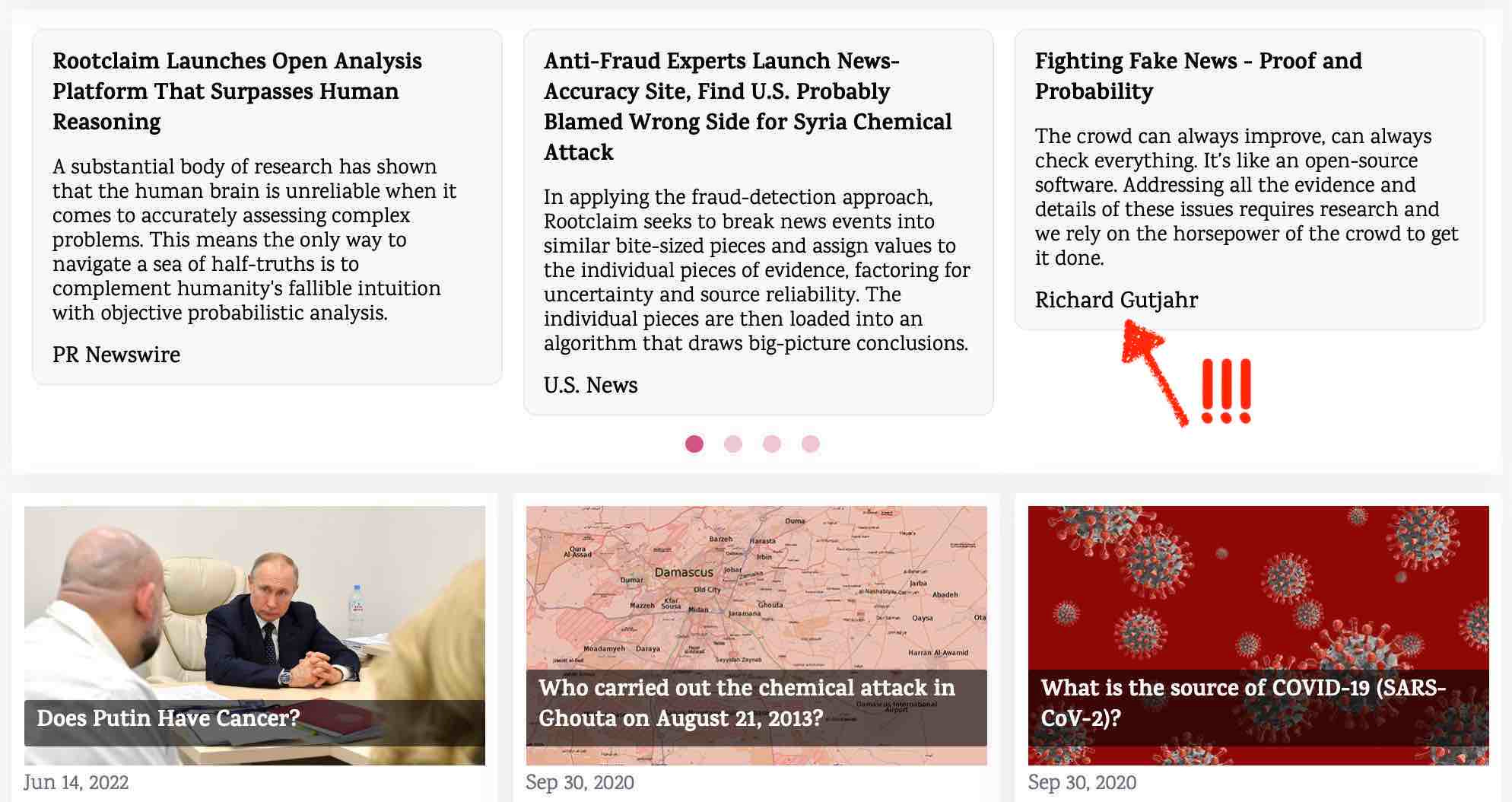
Rootclaim was developed by one of Gutjahr’s in-laws, a certain Saar Wilf, who is presumably related to Gutjahr’s wife Einat. (These people know how to keep it in the family!) Saar and Einat Wilf not only share a last name, but have co-authored an article on COVID. Of course that might be mere coincidence; they could be completely unrelated. But…what are the odds?
Rootclaim seems reasonably open to non-mainstream perspectives… at least on issues where the Wilf-Gutjahr family doesn’t have skin in the game. It tells us there is an 86% chance that Putin does not have cancer, a 96% chance that the anti-Assad US-NATO backed forces (not Assad) attacked al-Ghouta with chemical weapons, and an 86% chance that COVID-19 “was developed during gain-of-function research and was released by accident.”
That’s all well-and-good. But again: What are the odds that Richard Gutjahr, or any TV host for that matter, would just happen to be the unique person in position to shoot the first and most-used footage of two successive major terror attacks? For some strange reason, Rootclaim hasn’t run those calculations.
When we estimate the odds of such things, we need to consider background information. For example: How relevant is the fact, attested to by Wikipedia, that Richard Gutjahr is married to a former Israeli intelligence officer?
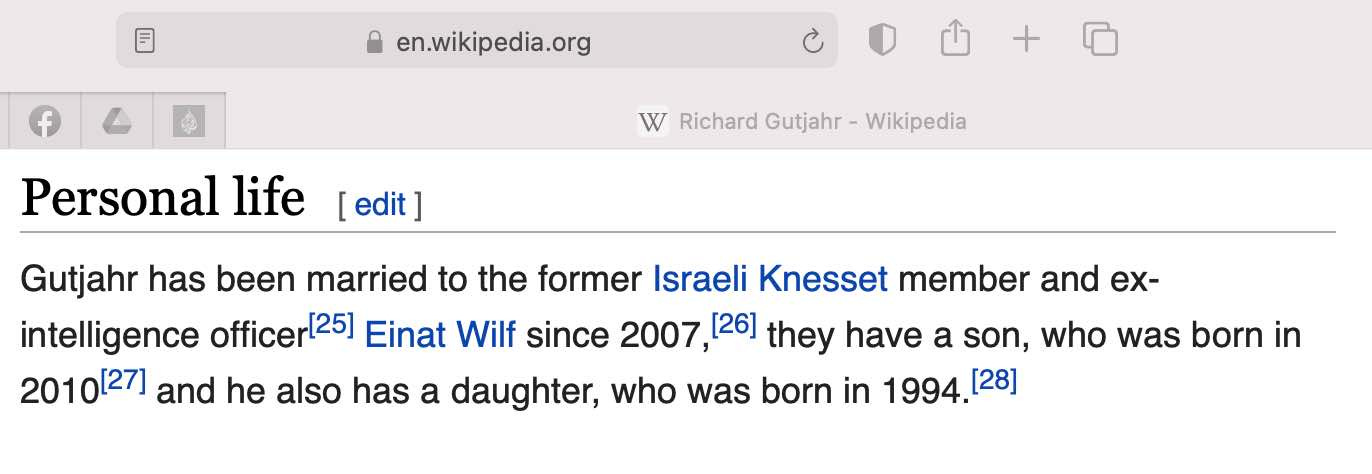
Wikipedia tells us that Gutjahr’s “coincidental presence at events gave rise to conspiracy theories, alleging his presence at both events could not have been a coincidence. Gutjahr has pressed charges against those who make the allegations,[21][22] which he sees mostly motivated by antisemitism against his wife considering the often antisemitic nature of the hostilities.” (Funny how Wikipedia tells us that Gutjahr “pressed charges” against journalists like Gerhard Wisnewski but fails to mention the outcome: Gutjahr suffered a crushing defeat in court.)
And then…bring on the obligatory charges of anti-Semitism! Whoever is editing Wikipedia apparently thinks it is “anti-Semitic” to notice that Israel is the only nation that has benefited from the “war on terror,” an episode of international mass hysteria elicited by a string of alleged “Islamic terror attacks” in which the Israeli government in general, and its intelligence community in particular, is the leading suspect.
Was it just a coincidence that the people who happened to be pre-positioned near the New Jersey waterfront at the perfect spot to film the attack on the Twin Towers, and who filmed and wildly celebrated the attacks before being arrested, were Israeli spies who later confessed they had been sent there “to document the event”?
Was it just a coincidence that the mysterious “Janek” who was pre-positioned on a rooftop to film the iconic footage of “the Charlie Hebdo terrorists’ escape” turned out to be an Israeli agent? As Hicham Hamza wrote:
At the origin of this (iconic Charlie Hebdo) video – filmed, oddly enough, without apparent fear of being hit by a stray bullet – in which one of the Charlie Hebdo attackers (who would soon flee in the direction of a Parisian establishment used by the Israeli army) declaims, with his left index finger pointed towards the sky, that he had “avenged the Prophet” – is a mysterious anonymous Pole, blurred by the television media, who vanishes without a trace – having been employed by a long-standing family enterprise of Laurent Dassault, ultra-Zionist multimillionaire connected to the military and radical wing of the Tel Aviv regime.
There is a mass of evidence, circumstantial and otherwise, that implicates Israel in 9/11, the 7/7/2005 London bombings, the Paris attacks of January and November 2015, and indeed most of the highest-profile GWOT terror incidents attributed to “Islamic extremists.” So Richard Gutjahr’s being married to an Israeli intelligence officer, and then magically showing up to film the beginnings of two successive terror attacks, does seem a tad suspicious. And his presence at a website selling an app that claims to mathematically arbitrate between mainstream and non-mainstream narratives seems not just suspicious, but bizarre… if not downright absurd. If noticing such things makes you “anti-Semitic,” then the alternative to “anti-Semitism” is sheer unmitigated idiocy.
Is mainstream media idiotic… or complicit? What are the odds?
Policing the World Is a Full-Time Job
BY PHILIP GIRALDI • UNZ REVIEW • AUGUST 2, 2022
Every leader and top official now in power in the so-called Western World seems to have forgotten that the North Atlantic Treaty Organization (NATO) was founded in 1949 as an alliance that was ostensibly defensive in nature, intended to counter the expansion of Soviet style communism in Europe. That role continued to be the raison d’etre of the organization until communist governments themselves collapsed in both Russia and in the Eastern European states that collectively made up the Warsaw Pact during the 1990s. After that point, NATO no longer had any reason to exist at all as the alleged military threat posed by the Kremlin and its allies vanished virtually overnight.
But clever politicians were quick to put the alliance on life support instead of simply dismantling it. Lacking the threat posed by the Warsaw Pact, NATO was forced to come up with other reasons to maintain military forces at levels that could quickly be enhanced and placed on a wartime footing. Washington and London took the lead in this, citing the now shopworn defense of a “rules based international order” as well as of “democracy” and “freedom.” And fortunately for the national defense industries and the generals, it soon proved possible to find new enemies that provided justification for additional military spending. The first major engagement outside the obligations defined by the original treaty took place in Europe to be sure, but it was in the Balkans where of NATO during the 1995 Operation Deliberate Force. The war ended after the signing of the General Framework Agreement for Peace in Bosnia and Herzegovina in Paris on December 14th 1995. Peace negotiations were finalized a week later but fighting resumed between Kosovo and Serbia in the following year, which led to another NATO intervention that eventually ended with the restoration of Kosovo’s autonomy and the deployment of NATO forces, which bombed the Serbs to compel their compliance with a draft cease fire agreement.
NATO also played a role improbably enough in the US invasion and occupation of Afghanistan, which was justified by claiming that an Afghanistan free to set its own course would become a hotbed of terrorism which would inevitably impact on the United States and Europe. It was a paper-thin argument, but it was the best they could come up with at the time and it also eventually involved soldiers from additional friendly countries like Australia. As we have subsequently seen, however, it was all an argument without merit as Afghanistan became a money pit and a graveyard for thousands of locals and foreign soldiers. It is now again in the hands of the Taliban after a bungled withdrawal of US forces and the collapse of the puppet government in Kabul that Washington had installed.
Turn the clock forward to the present. As everyone but President Joe Biden has recognized, the United States and NATO are currently engaged in a proxy war against Russia in Ukraine, which many observers already believe has some of the attributes of World War III. As Russia neither threatened nor attacked any NATO member state, the argument that the response in arming and training Ukraine was defensive was rendered irrelevant. Nor can it be credibly claimed that Russia is a haven for terrorists, quite the contrary. Nevertheless, Biden has stated that the US will be in the fight on behalf of Ukraine for “as long as it takes.” Does he mean years, and all done without a declaration of war by Congress as required by the US Constitution?
And more appears to be coming. Joe Biden, during last week’s trip to Israel, made clear that the United States is “prepared to use all elements of its national power” to stop Iran from getting a nuclear weapon and has signed a pledge with the Israeli government to commit itself to do so. If Biden presses the argument that Iran is an international threat due to its impending development of nuclear weapons, will he appeal to NATO to support a joint military option to disarm it? I believe he just might do that. And he might just want to consider how the entire set-up and framing of the issue by Israel is somewhat of a trap. Israel considers Iran’s current nuclear program to be intended to create a weapon, which “they continue to develop,” and there are plenty in the US Congress who would agree with that.
So, if Iran is clearly creating a thermonuclear device, the time to strike is now, isn’t it? And bear in mind how the US/Israeli campaign to condemn is multifaceted. Shortly before the meetings held by Biden and his crew with the Israelis, US government sources set the stage for what was to come by going on the offensive regarding reports that Iran may be selling highly capable offensive drones to Russia for use in Ukraine as well as subsequent claims coming out of Washington that the Iranians are seeking to assassinate senior US officials in revenge for the killing of Revolutionary Guards General Qassem Soleimani in January 2020. One wonders why they waited so long and why the White House has chosen to publicize these stories at this point.
And the US and NATO are also getting involved with China’s geopolitical policies, on a path that Beijing is warning is extremely hypocritical and which might lead to armed conflict. The signs that the Chinese might be targeted by NATO, possibly over the Taiwan independence issue, came following a stark warning by US Secretary of State Tony Blinken delivered at the NATO summit in Madrid at the end of June. Blinken accused China of “seeking to undermine the rules-based international order,” the same type of critique recently leveled against Russia and Iran. Blinken’s comment was elaborated on by NATO Secretary General Jens Stoltenberg, who observed how “China is substantially building up its military forces, including nuclear weapons, bullying its neighbors, threatening Taiwan … monitoring and controlling its own citizens through advanced technology, and spreading Russian lies and disinformation.”
Stoltenberg’s indictment of China was followed by a NATO issued “strategic concept” document last that declared for the first time that China poses a “systemic challenge” to the alliance, alongside a primary “threat” coming from Russia. The document copied Blinken’s language, citing “The deepening strategic partnership between the People’s Republic of China and the Russian Federation and their mutually reinforcing attempts to undercut the rules-based international order run counter to our values and interests.”
Finally, the US and British governments collaborated to condemn China as the “biggest long-term threat to our economic and national security.” The declaration came in a July 6th joint news conference in London, where Christopher Wray, director of the FBI, and Ken McCallum, director general of Britain’s MI5, accused China, like Russia, of interfering in US and UK elections. Wray also warned the business leaders in the audience that the Chinese government has been “set on stealing your technology, whatever it is that makes your industry tick, and using it to undercut your business and dominate your market.”
Chinese Foreign Ministry spokesman Zhao Lijian initially responded a few days after the NATO summit, observing that the “so-called rules-based international order is actually a family rule made by a handful of countries to serve the US self-interest,” adding that “[Washington]observes international rules only as it sees fit.” Addressing the issue of the role of NATO specifically, Zhao accused Blinken of using NATO to “hype up competition with China and stoke group confrontation.” He added that “The history of NATO is one about creating conflicts and waging wars… arbitrarily launching wars and killing innocent civilians, even to this day. Facts have proven that it isn’t China that poses a systemic challenge to NATO, and instead it is NATO that brings a looming systemic challenge to world peace and security. Thirty years after the end of the Cold War, [NATO] has not yet abandoned its thinking and practice of creating ‘enemies’ … It is NATO that is creating problems around the world.”
China has a point. What NATO is threatening is war, as it is a military alliance. The Chinese appear to understand that NATO is the world’s largest military bureaucracy which has developed since 1991 an overriding institutional commitment to ensuring its permanent existence, if not expansion, even after it has clearly outlived its own usefulness. So Beijing might justifiably wonder, how does China – on the other side of the globe – fit into NATO’s historic “defensive” mission? How are Chinese troops or missiles now threatening Europe or the US in ways they weren’t before? How are the Americans and Europeans suddenly under military threat coming from China?
The Chinese appear to understand that if there is no threat to “defend” against, then a threat must be manufactured, and that is precisely what we are seeing vis-à-vis Russia, China, Iran and even Venezuela. Washington has become addicted to war and NATO is the chosen tool to give those wars the patina of legitimacy. To launch those conflicts requires either inventing an imaginary threat, or, as in the case of Russia, provoking the very threat the “defensive” bureaucracy was designed to deter or thwart. All indications are that NATO – now embracing 30 countries – is doing both and the results could easily be disastrous for all parties involved. Former congresswoman Tulsi Gabbard particularly abhors the cynical recklessness of the Biden Administration driving the process, explaining how “The reality is, President Biden, members of Congress, leaders in our country, the wealthy, they will have a safe place to be in the event of a nuclear war that they are behind causing while the rest of us in America and Russia, people around the world, will be decimated from this event.”
Prize winning journalist Chris Hedges has also defined the unthinkable that is at stake, and it is past time for Americans and Europeans to take note and stop the madness. Hedges opines that “The massive expansion of NATO, not only in Eastern and Central Europe but the Middle East, Latin America, Africa and Asia, presages endless war and a potential nuclear holocaust.” One might also note that New Yorkers are now being informed about what to do if there is a nuclear attack. Yes, that is precisely the problem – we have an administration in Washington that should be protecting the people living in this country, not setting up scenarios that might lead to their slaughter. Will someone please point that out to Joe Biden?
Philip M. Giraldi, Ph.D., is Executive Director of the Council for the National Interest, a 501(c)3 tax deductible educational foundation (Federal ID Number #52-1739023) that seeks a more interests-based U.S. foreign policy in the Middle East. Website is councilforthenationalinterest.org, address is P.O. Box 2157, Purcellville VA 20134 and its email is inform@cnionline.org.
US “Iran Nuclear Deal” Ploy Coming Full Circle
By Brian Berletic – New Eastern Outlook – 22.07.2022
Hopes for the Joint Comprehensive Plan of Action (JCPOA) simply known as the Iran Nuclear Deal seemed to fade further during US President Joe Biden’s recent trip to Israel where the US and Israeli governments signed a pledge to use force against Iran should it pursue nuclear weapons (weapons both the US and Israel possess).
US-based ABC News in its article, “Biden left with few options on Iran as nuclear talks stall,” would claim:
President Joe Biden made a clear promise on Iran, declaring that the country would never become a nuclear power under his watch. But during his time in the White House, the path towards upholding that promise has only become murkier.
During his trip to the Middle East, the president said he would consider using force against Iran only as a “last resort,” although Israel, the US.’s most ardent ally in the region, has pushed for the administration to issue a “credible military threat” against Tehran.
The article would mention the Iran Nuclear Deal specifically, claiming:
… while the administration initially hope to cut a “longer and stronger” deal with Iran, over a year and half of indirect negotiations has produced little movement towards restoring even the original terms of the agreement.
After a monthslong stalemate, a 9th round of talks took place in Doha, Qatar, at the end of June. A State Department spokesperson did not sugarcoat the outcome, saying “no progress was made.”
The 2018 unilateral withdrawal of America from the deal by the administration of US President Donald Trump is blamed for the deal’s failure. Yet the Trump administration’s withdrawal was predicted long before President Trump took office, and in fact, long before US President Barack Obama even signed the deal in the first place. President Biden’s recent activities are only wrapping up what was always a diplomatic ploy meant to trap Iran.
The Nuclear Deal Was Always a Trap
When President Obama signed the Iran Nuclear Deal, it was celebrated as a breakthrough in US diplomacy and a departure from the previous Bush administration’s expanding wars of aggression spanning Iraq and Afghanistan while threatening Iran next.
Signed by the United States and Iran along with other participating nations (the UK, EU, Germany, Russia, China, and France) in 2015, NBC News in their article, “What is the Iran nuclear deal?” would explain:
The Iran nuclear deal, formally known as the Joint Comprehensive Plan of Action, offered Tehran billions of dollars in sanctions relief in exchange for agreeing to curb its nuclear program.
The agreement was aimed at ensuring that “Iran’s nuclear program will be exclusively peaceful.” In return, it lifted UN Security Council and other sanctions, including in areas covering trade, technology, finance and energy.
At face value, the United States imposing sanctions on Iran to impede its development of nuclear weapons was problematic. The United States is the only nation in human history to use nuclear weapons against another nation, twice. Following the 2001 US invasion and occupation of Afghanistan and the 2003 US invasion and occupation of Iraq, the United States had military forces to Iran’s west and east. US hostilities toward Iran stretch back decades and the US State Department, regardless of administration, has made little secret that Washington seeks regime change in Tehran just as it did in Afghanistan and Iraq.
Worse still, US policymakers as early as 2009 had articulated a ploy by which the US would offer Iran a “deal” before deliberately sabotaging it and using its failure as a pretext for the long sought-after regime change war the US has wanted against Iran.
The Washington DC-based Brookings Institution, funded by the largest corporate-financier interests in the Western world as well as Western governments themselves including the US through the US State Department published the 2009 paper (PDF), “Which Path to Persia? Options for a New American Strategy Toward Iran.” In it, the Brookings Institution’s policymakers explicitly articulated options the US could pursue to achieve regime change in Iran.
These options were broken down into sections and chapters within the 170-page report and ranged from “An Offer Iran Shouldn’t Refuse: Persuasion,” to “Toppling Tehran: Regime Change,” to “Going All the Way: Invasion,” and “The Velvet Revolution: Supporting a Popular Uprising.” Everything from setting diplomatic traps to arming designated terrorist organzations were not only discussed, but in the years that followed the paper’s publication, they were implemented one after the other without success. The remaining options on the long list are military in nature involving either the US or Israel (or both) waging war directly and openly against Iran.
All that is required before doing so is a pretext, including the “offer” the US made, but Iran “refused.”
“An Offer Iran Shouldn’t Refuse”
Under “Chapter 1” titled, “An Offer Iran Shouldn’t Refuse: Persuasion,” Brookings policymakers would explain (emphasis added):
… any military operation against Iran will likely be very unpopular around the world and require the proper international context—both to ensure the logistical support the operation would require and to minimize the blowback from it.
The paper then laid out how the US could appear to the world as a peacemaker and depict Iran’s betrayal of a “very good deal” as the pretext for an otherwise reluctant US military response (emphasis added):
The best way to minimize international opprobrium and maximize support (however, grudging or covert) is to strike only when there is a widespread conviction that the Iranians were given but then rejected a superb offer—one so good that only a regime determined to acquire nuclear weapons and acquire them for the wrong reasons would turn it down. Under those circumstances, the United States (or Israel) could portray its operations as taken in sorrow, not anger, and at least some in the international community would conclude that the Iranians “brought it on themselves” by refusing a very good deal.
The Iran Nuclear Deal was doomed before it was ever signed. It was conceived wholly as a pretext for war, not as a diplomatic solution to avoid it.
False Hope Spanning Multiple US Presidencies
In many ways, Iran would be foolish not to create a sufficient military deterrence against US aggression, including the development of nuclear weapons if necessary. However, Iran nonetheless agreed to the nuclear deal’s terms and until the US unilaterally abandoned the deal in 2018, abided by it.
In fact, following the US withdrawal from the deal, Iran continued abiding by many of its conditions alongside its other signatories in the vain hope that under a new US administration it could be salvaged.
When US President Joe Biden took office, the obvious first step by Washington should have been to unconditionally rejoin the deal by removing sanctions, followed by Iran’s renewed and full compliance to the deal’s conditions. Yet the US demanded Iranian compliance first before even agreeing to negotiate Washington’s return to the deal.
It was clear long before President Obama’s signature was inked on the deal’s documents that the US would sabotage it, blame Iran, then pursue renewed and expanded aggression against Iran directly, by proxy, or both. President Trump in 2018 took advantage of America’s domestic politics and the perceived notion that US “Republicans” seek a harder line versus Iran in order to abandon the deal. Because of President Trump’s perceived trait as an “outsider” both to his own party and wider US politics, the US could shift the blame squarely on his administration. Yet the continuity of this ploy across presidential administrations is evident by the fact that upon coming into office, President Biden did not immediately and unconditionally return the US to the deal’s framework.
Instead, President Biden’s administration prevented America’s return to the deal by creating unreasonable preconditions placed entirely upon Iran. With President Biden’s statement in Israel coupled with a recent claim made by US National Security Adviser Jake Sullivan that Iran is preparing to supply Russia with drones, the US is closing the door on the deal indefinitely.
Further evidence of continuity between US administrations can be seen throughout the US-led destabilization, invasion, and occupation of Syria. The campaign was meant as one of several prerequisites laid out by the Brookings Institution’s experts in 2009 before attempting regime change against Iran directly. Ironically, as the Obama administration appeared reconciliatory toward Iran by signing the Iran Nuclear Deal, the same administration presided over the devastating proxy war targeting Iran’s key ally in the region, Syria.
Support of US aggression in Syria transcended presidencies, from the Bush administration who set the stage for it, to the Obama administration who presided over the opening phases of hostilities and occupation, to the Trump and now Biden administrations who have perpetuated a US military presence in Syria along with a policy of denying Syria its key fuel and food production regions in the east to block reconstruction. US foreign policy toward Syria and Iran should not be interpreted separately. The fate of both nations is entwined and illustrates the wider agenda the US is pursuing in the region and has been for decades regardless of US administration.
Barring a fundamental reordering of both American foreign policy objectives and a reordering of the special interests driving them, the Iran Nuclear Deal’s prospects of success will only fade further in the distance. While Tehran’s patience is admirable, Iran and its allies must prepare for the inevitable hostilities that will follow US blame against Tehran for “undermining” a deal the US never had any intention of honoring in the first place.
Brian Berletic is a Bangkok-based geopolitical researcher and writer.
US Threatens Lebanon: Accept Israel’s Conditions or You Won’t Be Able to Extract Maritime Gas for Decades
Al-Manar | July 20, 2022
Caretaker Minister of Foreign Affairs Abdallah Bou Habib met on Wednesday with head of the American Task Force For Lebanon Edward Gabriel heading a delegation.
After the meeting, Gabriel addressed the reporters, conveying an American threat to Lebanon.
Gabriel considered that Lebanon has a small chance to extract its maritime gas resources by concluding a settlement after engaging in negotiations.
Otherwise, Lebanon would not be able to extract its maritime gas for decades, Gabriel added.
It is worth noting that Lebanon has insisted on obtaining its entire maritime rights preserved by a fair and legal border demarcation. However, the Zionist enemy has stubbornly rejected Lebanon’s demands.
Hezbollah Secretary General Sayyed Hasan Nasrallah warned the Israeli enemy and the United States that if Lebanon is prevented from extracting its maritime resources, none will be able to extract or sell gas and oil.
In a televised speech, Sayyed Nasrallah indicated that Hezbollah military forces are monitoring all the Zionist platforms across the occupied Palestinian coast, adding that the Resistance may resort to ground, maritime or air capabilities in order to attack the enemy and secure Lebanon’s rights.
According to Sayyed Nasrallah, the new equation is Karish, what’s beyond Karish and what’s far beyond Karish.
Thus, Hezbollah military power has been writing the long story of Lebanon’s pride of victory that protects the nations and secures its all-leveled prosperity.
Iran deal can survive if US opts for own interests rather than Israel’s: Foreign Ministry
Press TV – July 20, 2022
Tehran says multilateral negotiations to revive the 2015 Iran deal will be fruitful if the United States looks at the issue through the lens of its own national interests rather than those of the Israeli regime.
Iranian Foreign Ministry spokesman Nasser Kan’ani told a press conference on Wednesday that the US seems to be weak when it comes to making “an independent political decision” about whether it is willing to return to the deal, four years after it unilaterally walked away.
“If the US administration [of Joe Biden] looks at this issue through the lens of American national interests and not through the lens of the interests of the occupying Zionist regime, the ground will be paved for an agreement in the near future,” Kan’ani said.
More than a year of negotiations – first in Vienna and now in Doha – have not yet led to an agreement on what steps each side needs to take in order to restore the ailing accord, officially called the Joint Comprehensive Plan of Action (JCPOA).
The US withdrew from the JCPOA back in 2018 as it unleashed a “maximum pressure” campaign targeting the Iranian economy, despite Tehran’s strict compliance with the terms of the accord.
The Vienna talks, which began in April last year, hit a deadlock in March owing to Washington’s insistence on retaining parts of its sanctions against Iran. The Doha talks, however, have led to different interpretations by the parties to the talks.
“Contrary to the claim of the American side that the Doha negotiations were a failure, they opened up a path for the continuation of talks between the different parties of the nuclear agreement,” Kan’ani said, assessing the negotiations as “good.”
He explained that there is no major obstacle to concluding an agreement, except that the American side has to make a serious political decision.
“On the one hand, the US administration expresses its desire to return to the agreement, and on the other hand, it does not want to pay the costs of returning to the agreement,” the Iranian spokesman added.
‘US, Israel failed to form anti-Iran coalition’
In his Wednesday press conference, Kan’ani also pointed to Biden’s recent trip to the region with the agenda of forming an anti-Iran coalition among other objectives, saying both the US and the Israeli regime failed to achieve that goal.
“The Zionist regime attempted to form a regional coalition during that trip to put pressure on Iran,” he said. “In this effort, this regime has failed and the American government has not succeeded either.”
Biden arrived in the Israeli-occupied territories last Wednesday, kicking off a much-anticipated four-day trip to the region. The regional tour also took the US president to Saudi Arabia, the country he once pledged to make “the pariah that they are.”
Since 2020, the US has brokered normalization agreements under the so-called Abraham Accords between the Israeli regime and some Arab countries, including the United Arab Emirates, Bahrain, Morocco, and Sudan – with Saudi Arabia expected to be the next.
In Saudi Arabia, Biden attended a summit of the [Persian] Gulf Cooperation Council (GCC) countries, plus Egypt, Jordan, and Iraq – also known as GCC+3. The summit, which was ostensibly aimed to build an anti-Iran front, failed to garner much support.
A day before the summit, Iraqi Prime Minister Mustafa al-Kadhimi stressed that Iraq will not be part of any camp or military alliance, and “will not be a base for threatening any neighboring countries.”
The UAE, a close ally of both Saudi Arabia and the US, also dismissed the idea of forming a NATO-like military alliance in the region.
“We are open to cooperation, but not cooperation targeting any other country in the region and I specifically mention Iran,” Anwar Gargash, the UAE president’s diplomatic adviser, said.
“The UAE is not going to be a party to any group of countries that sees confrontation as a direction,” Gargash added.
After the summit, Saudi Arabia’s Foreign Minister Prince Faisal bin Farhan claimed that his country extends a hand of friendship toward Iran.
He also expressed the kingdom’s willingness to reestablish normal relations with the Islamic Republic.
“The messages we received from Arab officials in the region, both directly and indirectly, show that fortunately, the countries of the region are not ready to act against Iran [and in line with] America’s regional policies,” Kan’ani said.
He then added that conditions are now ripe for Iran to organize and host talks to deepen regional cooperation.
He also urged the US to stop meddling in the internal affairs of regional countries, halt its plots of forming fictitious alliances, and refrain from imposing American values on the region.
Regional countries naturally have common interests and views, he said, adding, “They are capable of creating the best conditions for stability and security in the region in the light of regional meetings.”
‘Iraq will not join any military alliance, position on Palestine firm’
MEMO | July 16, 2022
Iraqi Prime Minister Mustafa Al-Kadhimi has announced that the Jeddah conference in Saudi Arabia “will not witness the discussion of normalisation with Israel” and stressed that discussion on the topic is an attempt to confuse Iraq’s restoration of its role in the region.
The prime minister’s media office disclosed in a statement on Friday, posted on Twitter, that: “Iraq’s position is firm and clear on the Palestinian issue and is not open for discussion.”
The media office added that Iraq could not be a foundation to threaten any neighbouring country.
The prime minister stressed that Baghdad would not allow any party to use Iraq as a base to threaten neighbours or create problems by using Iraqi lands.
Al-Kadhimi expressed that they are in dire need of wisdom, patience, reconciliation and restoring confidence for the sake of Iraq and Iraqis. He mentioned that his government’s motto from day one has been “Iraq first” and that they will continue to adopt this approach in order to serve the people.
Moreover, Al-Kadhimi stated during a press conference held in Baghdad before travelling to Jeddah: “Iraq has not and will not be, neither today nor tomorrow, in any military axis or alliance, and the national interest is the goal of these meetings.”
“Today we are responding to an invitation extended to Iraq to participate in the Jeddah conference, which will be attended by the Gulf Cooperation Council countries, the Hashemite Kingdom of Jordan, the Arab Republic of Egypt, in addition to the United States.”
Regarding his upcoming meeting with US President Joe Biden, the prime minister made it clear that he will discuss with the US what they agreed on in the strategic agreement, such as revitalising agreements in the field of education, culture, health and other areas that reflect on the economic role.
Biden Just Said He’s Willing To Go To War With Iran, Mainstream Yawns
By Jake Johnson | Common Dreams | July 14, 2022
U.S. President Joe Biden said in an interview aired Wednesday that he would be willing to go to war with Iran to prevent the country from obtaining a nuclear weapon, a position that drew condemnation from advocacy groups and foreign policy analysts who questioned the moral, strategic, and legal bases for such a stance.
Biden also reiterated in the sit-down interview with Israeli broadcaster N12 that he is committed to keeping the Islamic Revolutionary Guard Corps (IRGC) on the U.S. State Department’s Foreign Terrorist Organizations list, even if it means sinking the prospects of a deal to revive the nuclear accord that former President Donald Trump violated in 2018.
While acknowledging that Trump’s decision to abandon the seven-country deal was a “gigantic mistake,” Biden said he would not delist the IRGC to advance nuclear talks that have hit a wall in recent weeks.
Biden offered a one-word answer—”yes”—when asked whether he would keep the IRGC on the terror list “even if that means that kills the deal.”
The U.S. president went on to say that he’s prepared to use military force “as a last resort” to prevent Iran from obtaining a nuclear weapon. Iran has repeatedly said it is not pursuing a nuclear weapon and that its nuclear energy program is designed for peaceful domestic purposes.
Peace organizations were outraged by the president’s interview, noting that the terror designation is largely symbolic while the nuclear deal was a substantive diplomatic achievement that lifted devastating economic sanctions in exchange for limits to Iran’s nuclear program.
“Let’s be clear: Congress has not authorized—and the American people overwhelmingly do not support—the use of force against Iran,” said the Friends Committee on National Legislation. “If the president is committed to preventing nuclear proliferation, he should return to the nuclear deal and prioritize diplomacy. War is not the answer.”
Matt Duss, foreign policy adviser to U.S. Sen. Bernie Sanders (I-Vt.), responded that “it makes absolutely zero sense that he won’t delist the IRGC to prevent an Iranian nuke but would launch a war to prevent an Iranian nuke.”
The president’s remarks came days after his administration announced new sanctions targeting Iranian firms and individuals, a move seen as further evidence that Biden remains wedded to the failed “maximum pressure” campaign that his predecessor launched, imperiling any remaining hopes of a breakthrough in the stalled nuclear talks.
“Astonishing to see the president say he is willing to throw away the diplomatic progress his team has made and invite war with Iran over pointless partisan symbolism,” said progressive advocacy group Win Without War.
Biden Goes to the Middle East
BY PHILIP GIRALDI • UNZ REVIEW • JUNE 28, 2022
The White House has confirmed that President Joe Biden will travel to the Middle East in mid-July. He intends to visit Israel, the Palestinian Authority and Saudi Arabia. The trip will be used to address outstanding bilateral and multilateral issues, including convincing the Saudis to pump more oil to bring down fuel prices. Among the key topics to be discussed will be the alleged Iran threat, a possible security alliance between Israel and Gulf states backed by Washington, the status of the US Consulate General in Jerusalem, and the future of the Palestinian Authority.
Biden has agreed to a controversial meeting with Saudi Crown Prince Mohammad bin Salman, in which he will ask the Kingdom to agree to “normalize” relations with Israel in addition to increasing its oil exports. There has also been considerable pressure on Biden to seek a commitment from the Prince to take steps to improve human rights in his country, but the subject is not likely to come up as it is Biden who is seeking concessions from the Saudis. The Prince, for his part, ordered the October 2018 killing of US resident and Washington Post journalist Jamal Khashoggi in Istanbul. Khashoggi had been highly critical of the Saudi monarchy, particularly regarding its human rights record. Some in Congress and the media have described the private meeting as inappropriate given that fact.
Indeed, pumping more oil aside, the trip is largely about doing many things to help Israel, which is expected to produce favorable reporting in the US media preceding the November mid-term election. Biden even described the trip as being “for Israel” and that loud sucking noise you hear is his repeated pledges of loyalty to the Jewish state. He has described himself as a “Zionist” and has enthused “My commitment to Israel is known and engraved in rock.” Lest there be any confusion in spite of all that, the White House statement regarding the trip also made very clear that the president will “reinforce the United States’ iron-clad commitment to Israel’s security and prosperity.” That means that Israel will not be pressured over its appalling human rights record, worse even than Saudi Arabia’s, to include the recent assassination of Palestinian-American journalist Shireen Abu Akleh. On the contrary, Biden is bearing gifts to reward the Israelis for being such great friends, including a proposal that increases US financial and logistical support for the Jewish state’s air and missile defense systems, which are already largely funded by Washington.
Other aspects reflecting the Israeli dominance of US-Mideast foreign policy include Biden’s convincing the Saudis and also representatives of the Gulf States to step up their efforts to actively counter what is being described as “threats from Iran.” It is being suggested that this might include a security arrangement, not quite an alliance, but a commitment by many of Iran’s neighbors to act jointly if the Islamic Republic threatens anyone in the region. The arrangement would have to include Saudi Arabia, the Gulf States and Israel, backed up by the US military presence in Kuwait, Bahrain and Qatar. Israel is also demanding a Plan B response proposal if Iran and Washington fail to restart the stalled Joint Comprehensive Plan of Action (JCPOA) nuclear monitoring program. Washington, under pressure from Israel, now appears to be reluctant to make the concessions that would reestablish the original plan and the Israeli government is seeking a commitment by the president to use force, if necessary, when Iran crosses an agreed upon “red line” by enriching uranium until it produces enough fissile material to put together a nuclear weapon. Of course, there is a trick to the demand as Israel claims that Iran already has enough enriched uranium to create one or more bombs.
Israel nourishes regional imperatives that might tempt it to steer the discussions in a direction that would be very favorable to itself at the expense of other US interests in the region. Israel’s leaders regularly boast about their ability to manipulate the American government. They might stage or manage an incident that takes place during the Biden visit to shift perceptions of the status quo in the Middle East. As Israel has demonstrated that at its most extreme it has little regard for American lives or property, one should not be surprised if something odd were to happen. Many credible observers credit the Israeli intelligence services with a whole series of attacks on American targets, possibly even including arranging the assassination of John F. Kennedy and instigating 9/11. And then there are also the Lavon Affair in 1954 which involved the bombing of US government buildings in Egypt, and the attack on the USS Liberty in 1967 which killed 34 American sailors. To be sure, Israel can be ruthless and its security services are very effective at assassinations and false flag attacks.
Israel wants very much to have two developments emerge from the Biden visit. First is to effectively eliminate Iran as a potential threat by degrading its military and preventing any moves to go nuclear and second is to delegitimize the Palestinians as negotiating partners for some kind of two-state solution, which Biden claims to support even though Israelis routinely and generically refer to the Arabs as “terrorists.” To prevent blowback coming from any direct moves to confront the Iranians and Palestinians, Israel would also prefer to have the United States take the lead and do the heavy lifting. To accomplish that, it is first necessary to change Washington’s assessment of the threats in the Middle East, and that just might be doable by arranging something spectacular while the president in the region, like a bombing, or an act of sabotage or even creating what appears to be a terrorist attack. If done properly, whatever occurs would have false flag Iranian and/or Palestinian fingerprints all over it.
To be sure, America’s Secret Service will do a thorough job to protect the president and his entourage, but the Israelis would be operating on their own turf or in their own backyard and would be able to run rings around them. They would also have intimate knowledge of exactly what is being done to protect the American party.
I am not at all suggesting that the Israelis would resort to lethal violence against a group of traveling top level American officials, but I am merely examining what might happen if Prime Minister Naftali Bennett’s government were to get a bit adventurous in an attempt to change the playing field. Bear in mind that Bennett’s government is in trouble. It lost a confidence vote and has called for new elections to be held on October 25th, which could mean a return to power of the truly ghastly Benjamin Netanyahu. What would be better than to stage an international crisis of some kind to rally the Israeli people behind the current government? That would be in addition to creating a mechanism for dealing effectively with the Iranians and Palestinians, which would be very popular among Israeli voters, if an election were to occur.
So, Joe Biden is heading into a crap shoot in the Middle East. Israel will be squeezing him hard and might even do something stupid, while the Saudis have little incentive to give the American president what he wants. The Palestinians meanwhile will wind up abandoned by everyone, once again. But one thing that is for sure is that when Joe returns the spin on how it was a fabulously successful trip will fill the newspapers and airwaves. And then everyone will sit back and hold their breath to see if that ploy has worked. Come November we will know.
Philip M. Giraldi, Ph.D., is Executive Director of the Council for the National Interest, a 501(c)3 tax deductible educational foundation (Federal ID Number #52-1739023) that seeks a more interests-based U.S. foreign policy in the Middle East. Website is councilforthenationalinterest.org, address is P.O. Box 2157, Purcellville VA 20134 and its email is inform@cnionline.org.
Featured Video

Trita Parsi: Middle East Unraveling — Are We on the Path to World War?
or go to
Aletho News Archives – Video-Images
New Book
Trans agenda is ‘normalization of sadism’ – US author

RT | September 23, 2026
The US Democratic Party has embraced a transgender agenda that amounts to “the normalization of sadism,” author A.J. Rice has said, warning that radical trans policies would return if the party is allowed to regain power.
Speaking to RT’s America First host Scotty Nell Hughes about his new book, ‘The Curse of the Bearded Lady: How the Trans Mafia Whacked American Sanity’, Rice argued that activists have gained significant influence in schools, medicine, and corporate America while people who questioned the agenda have faced pressure to stay silent.
The author described the “trans mafia” as the sprawling network of people and institutions that have helped the movement gain influence. He singled out parts of academia, wealthy backers, and corporations, and stated that providers of transition-related treatment also have a financial incentive to keep young people in their care indefinitely.
Rice argued that the consequences of these policies ultimately fall on children who are being drawn toward gender-affirming medical treatments and on girls who are expected to share locker rooms or compete in sports with biological males.
He noted that while voters rejected the Democrats’ approach to gender in 2024, the party, which has been “captured by madness,” has since only doubled down and is seeking what is effectively “the normalization of sadism.” … Full report
Blog Roll
 Aletho News
- German chemicals giant reveals details of downsizing
- Refaat Al-Areer Was The Canary In The Coal Mine In Israel’s War On The Truth
- Israeli election committee bars candidate from Knesset race over Gaza war opposition
- French-Lebanese man files war crimes complaint over Israeli attacks
- Mahan Air Flight Lands in China Despite US Threat against Iranian Airlines
- US eyes $10bn fund to rebuild war-battered Gulf infrastructure
- Trump meets Rodríguez near Maduro’s prison as Venezuela’s oil flows to US
- Trita Parsi: Middle East Unraveling — Are We on the Path to World War?
- Iran FM meets with US envoy on UN meeting’s sidelines at American side’s insistence: Report
- Qatar PM calls for Gulf security framework with Iran, says war must be ‘wake-up call’
- If Americans Knew
- Caught on Tape: AIPAC CEO Boasted of Controlling Trump’s National Security Officials
- Why Hamas Attacked Israel in October 2023 – Israeli professor Ilan Papé
- They see them, then kill them: Israeli quadcopters track, deliberately target civilians in Gaza
- Winter could turn Gaza’s treacherous, war-damaged buildings into deathtraps
- Majority of Democratic Voters Want to Prosecute Both Biden and Trump Administration Officials Over Gaza
- As Gaza languishes, world leaders gather at the UN – Daily Update
- Sanctions are collective punishment: immoral and self-defeating
- Phosphorus Munitions Fired by Israel Burn Groves, Orchards in Southern Lebanon
- Israel Carries Out New Ceasefire Violations Across Gaza
- AI – Emphasis on the ‘I’: Israel Is Funding AI Chatbot Propaganda
- No Tricks Zone
- New Study: Earth And Venus Surface Warmth Largely Explained By Convection And Lapse Rate, Not CO2 Or Radiation
- 2025 Nature Paper Claiming Worsening Global Drought Gets RETRACTED …Heavily Flawed
- New Study: ‘Global Drought Shows No Detectable Recent Acceleration Under Climate Warming’
- Economic Masterminds: German Socialists Suggest Taxing Productivity Gains Stemming From Using AI
- The South China Sea Has Not Been Cooperating With The Climate Change Narrative
- Energy Crisis: Germany Enters Heating Season With Historically Low Gas Reserve Fill Levels
- New Study: The Antarctic Ice Sheet Gained Mass From 2020-2024 Due To Staggering Snow And Ice Accumulation
- Study: Ocean Heating Rates From Thousands Of Years Ago ‘Dwarf’ Modern Ocean Heating Rates
- Climate Extremists Target, Attack Large-Scale Power Grid Infrastructure In Germany!
- New Study: Antarctic Ice Melt Has Contributed Less Than 1 Centimeter To Sea Level Rise In The Last 30 Years

