Bashar Assad getting accepted by Arab leaders. US and Israel losing their chance
By Robert Inlakesh | RT | November 12, 2021
In a significant move towards normalising Syria’s government, UAE Foreign Minister Sheikh Abdullah bin Zayed visited Damascus to discuss strengthening the ties between the two nations, sparking outrage from the US and Israel.
A surprise visit to the Syrian capital on Tuesday by Abu Dhabi’s foreign minister sparked condemnation from the United States, which seeks to encourage its Arab State allies to steer clear of President Assad. According to State Department spokesperson Ned Price, the US urges “states in the region to carefully consider the atrocities that this regime, that Bashar al-Assad himself has perpetrated on the Syrian people over the last decade, as well as the regime’s ongoing efforts to deny much of the country access to humanitarian aid and security.” That seems to have fallen on deaf ears over in Abu Dhabi.
However, despite the Biden administration having voiced its opposition to Assad’s government, behind the scenes, it may actually be working to create a temporary amendment to its 2019 “Caesar Act” sanctions, the mechanism it is speculated the US may implement to protect the likes of neighbouring Jordan. This would involve Amman liaising with the Syrian government to allow Egypt to send oil through to struggling Lebanon. Back in September, Jordanian, Egyptian and Lebanese representatives even met to discuss the logistics of managing such a transfer of oil, so as to provide Lebanon with the means to generate electricity.
Publicly, it seems the UAE – which reopened its embassy in Damascus three years ago – is leading the push to have Syria reinstated into the Arab League and enhance cooperation between the two. But, for Abu Dhabi, the so-called ‘brotherly’ nature of their relationship comes with strings attached. From an Emirati perspective, the relationship between the Syrian government and the UAE is threefold: first, Abu Dhabi sees Syria as a potential partner in the fight against the Muslim Brotherhood; second, it sees an opportunity to work towards facilitating the cooperation between Egypt and Jordan on the potential oil transfer to Lebanon; and last, it seeks to bring Syria closer to the Arab reactionary regimes and distance it from Iran. Both Egypt and Jordan have also taken strides to normalise relations with Damascus: in October, Jordan’s King Abdullah II participated in a phone call with President Assad and, on Tuesday, Egypt’s foreign minister made it clear he was open to the idea of Syria re-entering the Arab League.
Prior to the war in 2011, the Syrian government had embraced neo-liberal economics, but in terms of its foreign policy, it has always maintained a nationalist agenda. When the war in Syria began, the UAE jumped on the bandwagon of conspiring against Assad and financed armed groups to overthrow him. In and of itself, this makes it clear that Abu Dhabi is not acting in the interests of regular Syrians. It is easy to foresee the Syrian government developing its relationship with the UAE in order to strengthen its position in the region and secure investments to rebuild its war-torn nation in the future.
From a realist point of view, however, the decision-makers in the Emirates see that Assad is not going anywhere. They are seeking to combat Islamist forces regionally, so why not try to influence a nationalist nation while working alongside it to weaken the Muslim Brotherhood and erase Iran’s footprint in the country?
Given Turkey may imminently open up another offensive into northeastern Syria to combat the Kurds in areas controlled by the US and Kurdish SDF (Syrian Democratic Forces), the Emirati foreign minister may well have wished to discuss this issue during his visit to Damascus. Turkey, which currently controls two pockets in Syria’s north through its Syrian National Army mercenary militia, is aligned with the Muslim Brotherhood. To the UAE, Turkey and Qatar are its biggest regional rivals.
But Washington, which is surely well aware of the policy positions its Middle Eastern allies are taking on Syria, continues to not only economically restrain Damascus, but also occupies roughly a third of Syrian territory with its proxy forces. The US currently presides over 90% of that nation’s oil resources and is even looting its most fertile agricultural lands, which those Syrians who are suffering under an economic crisis are unable to access. The US not only blocks progress and has extirpated attempts to rebuild the country, but adopts a militaristic approach and views itself as maintaining the right to remain there, despite not having acquired any congressional approval to be operating in Syria.
The main role of the US occupation of Syrian lands, through its Kurdish proxy forces in northeastern Syria and its mercenary forces in the al-Tanf region of south Syria, is to combat Tehran. Until significant Iranian influence is cleared out of the land, they will not leave of their own free will.
Then we have Israel, which will also not leave the Syrian lands it illegally occupies unless it is forced out in a war between the two nations. In tandem with Islamic State (IS, formerly ISIS) terrorists who have crawled out from their caves and suddenly received anti-tank munitions and a spike in their numbers, Israel has picked up its attacks against Syria. In fact, it has carried out at least five in Syria over the past month, killing soldiers and assassinating an ex-member of parliament. Israel is also seeking to quadruple its settler population in the Golan Heights, with Israeli PM Naftali Bennett having announced new construction plans just last month. It’s clear that Israel is seeking to provoke a reaction from Damascus and test how far it can cross the line before drawing defensive fire.
Instead of the Syrian Arab Army responding to US and Israeli aggression, independent groups that align with Iran have been at the forefront of combating Tel Aviv and Washington. The reality is that Syria is so embroiled in this hostile situation between different foreign powers attempting to extract different things from it that it is difficult to tell where the government is currently headed, and whether it will continue to follow a nationalist path or eventually adopt a more business-minded rather than ideologically driven approach. Ultimately, it seems the UAE will play a limited role in Syria for now, but only time will tell who gets the better of the other in this ever-expanding relationship.
Robert Inlakesh is a political analyst, journalist and documentary filmmaker currently based in London, UK. He has reported from and lived in the occupied Palestinian territories and currently works with Quds News and Press TV. Director of ‘Steal of the Century: Trump’s Palestine-Israel Catastrophe’.
Former Qatar PM: ‘Israel, Arab state planned last Sudan military coup’
MEMO | November 13, 2021
Former Head of Qatar’s Ministerial Council Hamad Bin Jassim Al-Thani revealed on Friday that Israel and an Arab state had planned the latest military coup in Sudan.
In a series of tweets commenting on Abdel Fattah Al-Burhan’s announcement of the formation of a new sovereign council, he posted: “The hands of the Israeli occupation along with the hands of a state from the region are behind this.”
Twitter users commenting on his tweet noted that the Arab state he referred to was the UAE, adding that several leaks relating to the issue have proven this.
“What happened in Sudan is a result of initial planning, cooperation and coordination between Israel and an Arab state,” Al-Thani tweeted.
“Unfortunately, this state claimed in the international meetings that it had changed its policies and started to concentrate only on economy and development,” he added.
The former senior Qatari official asserted that he did not reveal “this fact” to make headlines and stressed the importance of respecting peoples’ will.
US and Iran are getting ever closer to war. Washington has only itself to blame
By Scott Ritter | RT | November 9, 2021
A tense US-Iranian naval standoff appears to be related to the US enforcement of unilateral oil sanctions targeting Iran. Iran’s response suggests that Tehran may not be willing to play this game for much longer.
Amid growing tensions in the region, the United States and Iran carried out tit-for-tat naval exercises in the Persian Gulf designed to send a signal to the other – mess around at your own risk. The US exercises comprising six coastal patrol boats, supported by an expeditionary mobile base platform ship and a guided-missile destroyer, involved live fire exercises using surface-to-surface missiles. Iran followed this display of US military prowess with a demonstration of its own in the form of the annual Zolfaqar military exercise, which included live-fire drills involving anti-ship missiles, drone swarms, and submarine-launched torpedoes.
The dueling drills come nearly two weeks after a confrontation in international waters between the Iranian Revolutionary Guard and the US Navy. While the specific circumstances surrounding this confrontation remain unclear, with both Iran and the US providing competing narratives, one thing is for certain – on October 24, 2021, Iranian and US naval forces faced off in a tense environment, loaded weapons pointed at one another, while Iranian forces boarded and took control of a Vietnamese-flagged oil tanker, which was then sailed into Iranian territorial waters, ending the face-off.
The Iranians claim that the US was engaged in an act of “piracy,” trying to seize a shipment of Iranian oil that was loaded onto the MV Southys, owned by the Hanoi-based OPEC Petroleum Transport Company. Iran was compelled to board the vessel, using helicopter-borne commandos, and then sail the ship and its 26-person crew to the Persian Gulf port city of Bandar Abbas. The US denies the Iranian accusations, instead claiming that US Navy vessels in the region responded to reports of a ship in distress and were simply monitoring the situation.
History suggests that the Iranian version of events is closer to the truth. The US has a reputation for seizing Iranian petroleum shipments on the high seas, part of what it claims to be the lawful enforcement of US sanctions targeting Iran (it should be noted that the sanctions in question are unilateral in nature, and have no enforceable status under international law.) In August 2020, the US seized four Liberian-flagged vessels (the M/T Bella, M/T Bering, M/T Pandi and M/T Luna) carrying approximately 1.116 million barrels of fuel. No military force was used by the US in the seizure of the cargo. Instead, the US worked with the assistance of foreign partners to threaten ship owners, insurers, and captains with sanctions to force them to surrender their cargo to US control. In the case of the four Liberian-flagged tankers, the ships sailed to the US port of Houston, where their cargo was offloaded.
On the same day that the US affected the seizure of the four Liberian-flagged tankers, the Iranian Revolutionary Guard Corps boarded another Liberian-flagged tanker, the M/T Wila, off the coast of the United Arab Emirates, using tactics which mirrored those that had been used against the MV Southys – a special forces team was inserted onto the deck of the tanker using a helicopter, while Iranian patrol boats circled nearby. After five hours, the Iranians departed the ship. The US confirmed that the Iranian seizure of the M/T Wila was related to the US seizure of the four tankers. “They [the Iranians] were looking for their gas,”a US spokesperson noted.
According to Iranian sources, the boarding of the MV Southys was related to the August 2020 seizure of the four tankers carrying Iranian oil. An analysis of the events leading up to the seizure of the MV Southys by Iranian forces suggests that this indeed may be the case. According to an anti-Iranian advocacy group, United Against Nuclear Iran (UANI), satellite imagery from June 2021 shows the MV Southys engaged in what is known as ‘ship-to-ship’ transfer of oil from an Iranian tanker, the Oman Pride. In August 2021 the US Treasury Department named the Oman Pride as an asset of the Iranian Revolutionary Guards Corps Quds Force, which was part of a larger scheme to raise funds for the Quds Force by selling Iranian oil in violation of sanctions. According to UANI, most of this oil ends up being sold to China.
According to the Tankers Trackers website (affiliated with UANI), the MV Southys was supposed to make a delivery of some 700,000 barrels of crude oil to a Chinese port. For some reason, the shipment was rejected, and the MV Southys headed back to the port of Sohar, Oman. The timing of the rejection of the MV Southys’ cargo coincides with a letter sent by UANI to the Vietnam Maritime Administration, which detailed its analysis of satellite photos it claimed showed the MV Southys received a ship-to-ship transfer of oil from the Oman Pride. Given the high-profile composition of the leadership of UANI, which includes many former US government officials and heads of foreign intelligence services, it is likely that this letter was sent in conjunction with outreach by UANI to the US government, which in turn could have put the Vietnamese government on notice that it could be subjected to sanctions for doing business with the Iranian Revolutionary Guard Corps. If this scenario is accurate, the Vietnamese government could have ordered the MV Southys not to offload its cargo, leaving it no choice but to return to the Persian Gulf.
When the MV Southys approached Iranian waters, it was shadowed by a US guided-missile destroyer, the USS Sullivans. Perhaps fearing that the US would seek to take control of the MV Southys and its contents, and uncertain as to the loyalty of the vessel’s captain, the Iranians opted to take control of the tanker and divert it to Bandar Abbas, where its contents could be offloaded. By taking control of the MV Southys in this manner, Iran also avoided the logistical difficulties of attempting a ship-to-ship transfer of oil to an Iranian tanker while under the watchful eyes of the US Navy.
The truth about what transpired with the MV Southys will undoubtedly emerge in the weeks to come. What is certain, however, is that the Iranians have long classified US sanctions against them as violations of international law, and US efforts to seize Iranian oil shipments acts of piracy. The seizure of the MV Southys by Iranian forces, and the aggressive way the US Navy was confronted by Iranian patrol boats, suggests that Iran is determined to forcefully confront any future attempts by the US to enforce its unilateral sanctions. One of the major roadblocks to restarting the Iran nuclear deal, also known as the Joint Comprehensive Plan of Action (JCPOA), is the issue of the US ending its sanctions regime against Iran. If anything, the delay in restarting the JCPOA has shown that there is a military risk attached to the political, and that any continued delay in the negotiations could result in war.
Scott Ritter is a former US Marine Corps intelligence officer and author of ‘SCORPION KING: America’s Suicidal Embrace of Nuclear Weapons from FDR to Trump.’
US continues to defy International Court of Justice’s orders in cases filed by Iran
Press TV – October 28, 2021
Iran’s permanent ambassador to the United Nations says the US administration continues to disregard orders issued by the International Court of Justice (ICJ), which have been handed down in cases filed by Iran against US and vice versa.
Majid Takht-Ravanchi made the remarks in an address to the UN General Assembly on Thursday, emphasizing that Iran acknowledges “the vital role of the ICJ in the prevention of hostilities and mitigation of crises through peaceful settlement of disputes as well as in strengthening the rule of law, preserving international order and tackling unilateral measures.”
“Due to adoption of a number of legislative and executive acts in the United States in flagrant violation of international law, the immunity of states and their properties from suit before US courts as well as immunity from jurisdiction and enforcement have been removed against Iran,” he added.
Takht-Ravanchi noted that as a result of the filing of cases in the US courts against Iran as well as its officials and the Central Bank (CBI), “the assets of the CBI have been subjected to execution in order to satisfy a default judgment.”
“The Islamic Republic of Iran believes that such asset blocking and enforcement proceedings against the CBI and certain Iranian companies and banks in the US is in violation of provisions of ‘Treaty of Amity, Economic Relations, and Consular Rights of 1955’ between the two countries,” Iran’s UN envoy said.
Takht-Ravanchi said following the unilateral withdrawal of the US from the 2015 Iran nuclear deal and the unlawful re-imposition of sanctions against Tehran, Iran filed an application instituting proceedings against the US with regard to violations of multiple provisions of the Treaty of Amity.
He said on October 3, 2018, the ICJ issued an order unanimously requiring the US to remove any impediments on the importation of foodstuffs as well as medicines and medical devices to Iran and also ordered Washington to ensure that the licenses and necessary authorizations are granted and that payments and other transfers of funds are not subject to any restriction in so far as they relate to the aforementioned goods and services.
“Regrettably, the United States has not only failed to comply with the Court’s Order but, by imposing new sanctions, especially during the outbreak of the COVID-19 pandemic, has also deliberately defied that Order,” Takht-Ravanchi said.
Iran, he noted, has on several occasions brought the US non-compliance with the Order to the Court’s attention and the answer provided by the US in this regard has always been a repetition of its previous contentions; that humanitarian transactions are exempt from its sanctions.
However, Takht-Ravanchi added, “through tightening the grip of sanctions after the Court’s Order, the US … violated this Order which requires that ‘Both parties shall refrain from any action which might aggravate or extend the dispute before the Court or make it more difficult to resolve’.”
Tehran has on multiple occasions called on the United Nations court to order the immediate lifting of the sanctions, and demanded compensation for damages incurred in their wake.
Sanctions had been lifted under the 2015 nuclear agreement between Iran and world powers- the US, Germany, France, Britain, China and Russia.
Former President Donald Trump unilaterally pulled the US out of the deal with Iran in May 2018 and reimposed draconian sanctions as part of the so-called maximum pressure campaign against the country.
Earlier this year, the ICJ ruled that it can take on Iran’s bid to overturn illegal US sanctions re-imposed by Trump after he pulled Washington out of the nuclear deal.
The United States had tried to argue that Iran could not base claims at the ICJ on the 1955 Treaty of Amity, Economic Relations, and Consular Rights between the two countries. However, a majority of a panel of 16 judges found the treaty could be used as a basis for the ICJ’s jurisdiction.
The new US administration said it is “disappointed” by the ruling, despite President Joe Biden’s criticism of his predecessor for reinstating the bans on the Islamic Republic after leaving the landmark accord.
Israel to Attack Iran? Washington Gives the Green Light to the ‘Military Option’
By Philip Giraldi | Strategic Culture Foundation | October 28, 2021
Some might recall candidate Joe Biden’s pledge to work to rejoin the Joint Comprehensive Plan of Action (JCPOA) which was a multilateral agreement intended to limit Iran’s ability to develop a nuclear weapon. The JCPOA was signed by President Barack Obama in 2015, when Biden was Vice President, and was considered one of the only foreign policy successes of his eight years in office. Other signatories to it were Britain, China, Germany, France, and Russia and it was endorsed by the United Nations. The agreement included unannounced inspections of Iranian nuclear facilities by the IAEA and, by all accounts, it was working and was a non-proliferation success story. In return for its cooperation Iran was to receive its considerable assets frozen in banks in the United States and was also to be relieved of the sanctions that had been placed on it by Washington and other governments.
The JCPOA crashed and burned in 2018 when President Donald Trump ordered U.S. withdrawal from the agreement, claiming that Iran was cheating and would surely move to develop a nuclear weapon as soon as the first phase of the agreement was completed. Trump, whose ignorance on Iran and other international issues was profound, had surrounded himself with a totally Zionist foreign policy team, including members of his own family, and had bought fully into the arguments being made by Israel as well as by Israel Lobby predominantly Jewish groups to include the Foundation for Defense of Democracies (FDD) and the American Israel Public Affairs Committee (AIPAC). Trump’s time in office was spent pandering to Israel in every conceivable way, to include recognizing Jerusalem as the country’s capital, granting Israel the green light for creating and expanding illegal settlements on the West Bank and recognizing the occupied Syrian Golan Heights as part of Israel.
Given Trump’s record, most particularly the senseless and against-American-interests abandonment of JCPOA, it almost seemed a breath of fresh air to hear Biden’s fractured English as he committed his administration to doing what he could to rejoin the other countries who were still trying to make the agreement work. After Biden was actually elected, more or less, he and his Secretary of State Tony Blinken clarified what the U.S. would seek to do to “fix” the agreement by making it stronger in some key areas that had not been part of the original document.
Iran for its part insisted that the agreement did not need any additional caveats and should be a return to the status quo ante, particularly when Blinken and his team made clear that they were thinking of a ban on Iranian ballistic missile development as well as negotiations to end Tehran’s alleged “interference” in the politics of the region. The interference presumably referred to Iranian support of the Palestinians as well as its role in Syria and Yemen, all of which had earned the hostility of American “friends” Israel and Saudi Arabia.
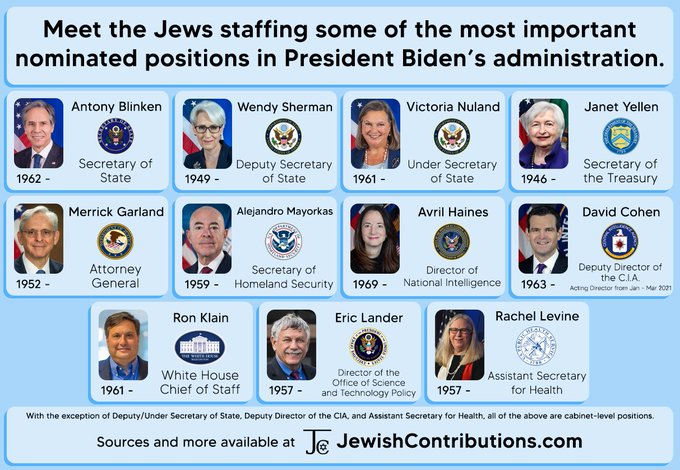 Israel inevitably stirred the pot by sending a stream of senior officials, to include Foreign Minister Yair Lapid, Defense Minister Benny Gantz and Prime Minister Naftali Bennett to discuss “the Iranian threat” with Biden and his top officials. Lapid made clear that Israel “reserves the right to act at any given moment, in any way… We know there are moments when nations must use force to protect the world from evil.” And to be sure, Biden, like Trump, has also made his true sentiments clear by surrounding himself with Zionists. Blinken, Wendy Sherman and Victoria Nuland have filled the three top slots at State Department, all are Jewish and all strong on Israel. Nuland is a leading neocon. And pending is the appointment of Barbara Leaf, who has been nominated Assistant Secretary to head the State Department’s Near East region. She is currently the Ruth and Sid Lapidus Fellow at the Washington Institute for Near East Policy (WINEP), which is an AIPAC spin off and a major component in the Israel Lobby. That means that a member in good standing of the Israel Lobby would serve as the State Department official overseeing American policy in the Middle East.
At the Pentagon one finds a malleable General Mark Milley, always happy to meet his Israeli counterparts, and Secretary of Defense Lloyd Austin, an affirmative action promotion who likewise has become adept at parroting the line “Israel has a right to defend itself.” And need one mention ardent self-declared Zionists at the top level of the Democratic Party, to include Biden himself, Speaker of the House Nancy Pelosi, House Majority Leader Steny Hoyer and, of course, Senate Majority Leader Chuck Schumer?
So rejoining the JCPOA over Israel objections was a non-starter from the beginning and was probably only mooted to make Trump look bad. Indirect talks including both Iran and the U.S. technically have continued in Vienna, though they have been stalled since the end of June. Trita Parsi has recently learned that Iran sought to make a breakthrough for an agreement by seeking a White House commitment to stick with the plan as long as Biden remains in office. Biden and Blinken refused and Blinken has recently confirmed that a new deal is unlikely, saying “time is running out.”
And there have been some other new developments. Israeli officials have been warning for over twenty years that Iran is only one year away from having its own nukes and needs to be stopped, a claim that has begun to sound like a religious mantra repeated over and over, but now they are actually funding the armaments that will be needed to do the job. Israel Defense Force Chief of Staff Aviv Kohavi has repeatedly said the IDF is “accelerating” plans to strike Iran, and Israeli politicians to include former Prime Minister Benjamin Netanyahu have regularly been threatening to do whatever must be done to deal with the threat from the Islamic Republic. Israeli media is reporting that $1.5 billion has been allocated in the current and upcoming budget to buy the American bunker buster bombs that will be needed to destroy the Iranian reactor at Bushehr and its underground research facilities at Natanz.
In the wake of the news about the war funding, there have also been reports that the Israeli Air Force is engaging in what is being described as “intense” drills to simulate attacking Iranian nuclear facilities. After Israel obtains the 5000 pound bunker buster bombs, it will also need to procure bombers to drop the ordnance, and one suspects that the U.S. Congress will somehow come up with the necessary “military aid” to make that happen. Tony Blinken has also made clear that the Administration knows what Israel is planning and approves. He met with Israeli Foreign Minister Yair Lapid on October 13th and said if diplomacy with Iran fails, the U.S. will turn to “other options.” And yes, he followed that up with the venerable line that “Israel has the right to defend itself and we strongly support that proposition.”
Lapid confirmed that one of Blinken’s “options” was military action. “I would like to start by repeating what the Secretary of State just said. Yes, other options are going to be on the table if diplomacy fails. And by saying other options, I think everybody understands here … what is it that we mean.” It must be observed that in their discussion of Iran’s nuclear program, Lapid and Blinnken were endorsing an illegal and unprovoked attack to prevent Iran from acquiring a nuclear weapon that it is apparently not seeking, but which it will surely turn to as a consequence if only to defend itself in the future.
In short, U.S. foreign policy is yet again being held hostage by Israel. The White House position is clearly and absurdly that an Israeli attack on Iran, considered a war crime by most, is an act of self-defense. However it turns out, the U.S. will be seen as endorsing the crime and will inevitably be implicated in it, undoubtedly resulting in yet another foreign policy disaster in the Middle East with nothing but grief for the American people. The simple truth is that Iran has neither threatened nor attacked Israel. Given that, there is nothing defensive about the actions Israel has already taken in sabotaging Iranian facilities and assassinating scientists, and there would be nothing defensive about direct military attacks either with or without U.S. assistance on Iranian soil. If Israel chooses to play the fool it is on them and their leaders. The United States does not have a horse in this race and should butt out, but one doubts if a White House and Congress, firmly controlled by Zionist forces, have either the wisdom or the courage to cut the tie that binds with the Jewish state.
The Iran Nuclear Saga: US-Israel Hammer Out a “Plan B”
By Salman Rafi Sheikh – New Eastern Outlook – 18.10.2021
Even though the presidential candidate Joe Biden had vowed to “move quickly” to re-join the Iran nuclear deal, this has not happened. The Biden administration’s deliberate strategy to kill the previous deal by following the framework of talks it inherited from the Trump administration has contributed massively to the present deadlock, leading the US and Israel to devise a “Plan B” to force Iran into submission. While Iran has been insisting – and its demands are not illegitimate – that the US must lift its sanctions first to create the path for reviving the JCPOA, Washington’s (and Israel’s) insistence on including Iran’s ballistic missile programme into the deal has become an additional source of tensions and the ensuing deadlock. Including a new agenda in the deal does not mean reviving the deal; in fact, it is actually involves a bid to push Tehran for an altogether new deal – a goal that the US and Israel have been pursuing ever since the Trump administration withdrew from the deal and Israel started sabotaging Iran’s legitimate nuclear production though cyber attacks and by murdering its top nuclear scientist.
While a simple revival of the deal is increasingly looking impossible, the talk of the town is the ‘military option’ if the ‘diplomatic option’ fails to produce the desired outcome, that is a one-dimensional result that favours the US and Israel only.
While it is already hard to argue against the fact that Israel, by engaging in active sabotage, has been using proper military options to coerce Iran into submission, there is still no gainsaying that the US and Israel are actively contemplating the military option to actually upgrade the military resources they have used so far. In doing so, both the US and Israel will be relying on the precedent set by the Trump administration when it killed Iran’s top military official, General Suleimani, last year in a drone air-strike in Iraq.
While the Biden administration may not itself want to start a new fully fledged war against Iran when it has just ended the US’ “endless war” in Afghanistan, there is no gainsaying that the US defense establishment may provide all the support, both diplomatic and military, Israel needs to carry out a military strike on Iran’s nuclear production capabilities. At the same time, it remains that the US may not be fully opposed to actually coordinating with Israel a military strike on Iran. During his latest meeting with Biden, the Israeli prime minister, Naftali Bennett, was a happy man when he received Biden’s reassurance that “all options” were on the table, should the on-goings talks fail. Now that the prospects of JCPOA’s revival through US participation look extremely bleak, other options, including a military/air strike, could become a possibility.
For Israel, resorting to military actions has an added political – electoral advantage. According to a recent survey conducted by Israel’s Democracy Institute, more than 50 per cent of Israeli Jewish population believes that Israel should have launched a military strike against Iran’s nuclear facilities in the very early phase of its development. Launching a military strike, therefore, does not have political consequence for Naftali who sits on a multi-party coalition government.
Accordingly, Israel is building the momentum for its “Plan B” at both regional and international levels. The Israeli activity to build this momentum flows from its previous attempts at derailing the whole process to revive the JCPOA. Last week, in a joint press conference with his US and Emirati counterparts, Israel’s foreign minister, Yari Lapid, said that they “reserve” the right to act in self-defence. In Israeli geo-strategic parlance, the ‘right to self-defence’ has always meant a pre-emptive military operation. Lapid himself operationalized the definition of the so-called ‘right to self defence’ when he said that “If a terror regime is going to acquire a nuclear weapon, we must act. We must make clear the civilized world won’t allow it.” Antony Blinken reciprocated, saying that “we are prepared to turn to other options if Iran doesn’t change course.”
In his meeting with Biden’s National Security Advisor, Jake Sullivan, Lapid shared, without himself publicly revealing, with him details of Israel’s “alternative plan” against Iran. But some of the details of this plan have already been revealed by Israel’s military chief, when he said that Israel and its intelligence community “is working against Iranian regional entrenchment throughout the Middle East.” “Operations to destroy Iranian capabilities will continue — in various arenas and at any time”, he added.
Echoing Israel’s discourse, US Special Envoy for Iran Robert Malley said last week that
“We will be prepared to adjust to a different reality in which we have to deal with all options to address Iran’s nuclear program if it’s not prepared to come back into the constraints of 2016.”
While the US officials continue to project that Iran is refusing to return to JCPOA, the fact remains that the deadlock is not an outcome of Iran’s refusal to revive the JCPOA, but its insistence on reviving the same agreement that was agreed in 2015 and lifting all sanctions the US has imposed, or failed to lift right after the deal. In refusing to lift sanctions, the Biden administration is essentially following in the footsteps of the Obama administration, which, while it did make the deal, continued to delay the lifting of all financial sanctions and unfreezing of the Iranian assets as well.
Therefore, the roots of the “Plan B” are impossible to find in the Iranian intransigence. It must be found in the US withdrawal from the treaty and its illegitimate insistence on negotiating a new deal, a demand that the other signatories of the deal – especially, China and Russia – do not support. A military action against Iran will thus be an avid example of how both the US and Israel have been staging wars to consolidate their regional and international dominance, respectively.
Congress has introduced over 70 pieces of Israel-centric legislation so far in 2021
By Kathryn Shihadah – If Americans Knew – October 14, 2021
For a country that practices apartheid, defies international law, and engages in ethnic cleansing, Israel is popular in the US Congress. During just about 125 days in session, the houses of Congress managed to entertain more than 70 new pieces of legislation pandering to Israel.
It is no coincidence that the pro-Israel lobby is arguably the most pervasive and influential lobby in the U.S. – and that Israel partisans, many of them billionaires, make massive campaign donations to both parties.
This year’s legislative items include plenty of military aid and non-financial perks for Israel, and scoldings for those who speak ill (if truthfully) of the Jewish state.
Americans need to know how generous our legislators are with our tax dollars – toward a country that is universally known to be a human rights abuser. Below is a list of legislation currently under consideration in Congress (and there will be more in the coming days). Also find links to plenty of facts about Israel – illustrating that Israel may not be the sort of state that Americans should bankroll.
(Note that the three bills in support of Palestinian rights – one quite robust, and two marginally beneficial – at the bottom of the article.)

A fire rages at sunrise in Khan Yunis following an Israeli airstrike on targets in the southern Gaza strip, May 12, 2021. During the recent violence, Israeli military forces killed 260 Gazans, while Palestinian resistance forces killed 13 Israelis – sources & more information here. (YOUSSEF MASSOUD | Credit: AFP via Getty Images)
LEGISLATION TO PROVIDE MONEY FOR ISRAEL
This first batch of legislation seeks to provide the standard annual $3.8 billion in military aid to Israel ($10.8 million a day), and then some.
Since 1946, two years before Israel’s founding on 78% of mandatory Palestine, the US has given Israel $154.7 billion in total military aid (adjusted for inflation: $243.9 billion) – more US assistance than any other country since World War II – this in spite of US laws that forbid military aid to countries committing gross human rights violations (like Israel).
Some of the legislation listed here ensures the flow of the usual sum of $3.8 billion a year; others seek to fund Israel through less direct ways. If these pass, taken together they may bring our daily contribution on behalf of Israel closer to $20 million.
H.R.4373 Department of State, Foreign Operations, and Related Programs Appropriations Act, 2022
- This bill provides the largest chunk – $3.3 billion – in military aid to Israel, and encourages Arab states to end their boycott of Israel and normalize relations.
- Read about the billions of taxpayer dollars earmarked for Israel in this bill here.
H.R.4432 – Department of Defense Appropriations Act, 2022
- This bill provides FY2022 appropriations to the Department of Defense (DOD) for military activities, including $500 million for Israel’s Iron Dome missile defense system (despite the fact that Israel, a human rights abuser, sells military technology to other states that are human rights abusers, and refuses to share some technology with the US, even though we subsidized its development).
- Read the details of funding to Israel in this bill here; read about the massive US investment in Israel’s Iron Dome anti-rocket system here (and US expenditures overall in Israel here); read about the minor effects of Gazan rockets on Israel here; read about Israel’s refusal to share technology with the US here.
H.J.Res.54, S.1751, H.R.3706, H.R.3977, S.2944, H.R.5323, S.2789, S.2839, S.2830, H.R.5311, H.R.5305: bills (introduced in the weeks following the attack on Gaza) to provide, through various means, extra funding for Israel’s Iron Dome missile defense system
- These bills call for an additional $1 billion in emergency funding for Israel’s Iron Dome (on top of the standard $500 million/year), with various fiscal strategies, including taking money earmarked for Gaza or the Palestinian authority.
- Several of the bills were introduced following the removal of the “emergency” $1 billion in Iron Dome funding from the budget bill. The removal of the funding demonstrated America’s waning support for Israel; the flurry of separate bills demonstrates Congress’ ongoing infatuation with Israel.
- Israel “needed” the funding because its military had depleted its Iron Dome materiel during an attack on Gaza – in which Israel killed 260 Gazan Palestinians (vs. 13 Israelis killed).
- H.R.5305 may be in a league of its own because of the deviousness with which its Iron Dome funding appeared as a line item. Read about it here.
- Read about the massive US investment in Israel’s Iron Dome anti-rocket system here (and US expenditures overall in Israel here); read about the minor effects of Gazan rockets on Israel here; read about Israel’s recent attack on Gaza that resulted in depletion of Iron Dome supplies here and here.
S.Con.Res.14 Setting forth the congressional budget for the US Government for fiscal year 2022 and budgetary levels for fiscal years 2023 through 2031 and S.Con.Res.5 – A concurrent resolution setting forth the congressional budget for the United States Government for fiscal year 2021 and budgetary levels for 2022 through 2030
- An amendment in S.Con.Res.14 establishes a reserve fund for preventing terrorist attacks and ensuring that no US tax dollars benefit terrorist organizations “such as Hamas or the Palestinian Islamic Jihad”; part of S.Con.Res.5 relates to funding for the US Embassy in “Jerusalem, Israel.”
- Read about Israel’s (and America’s) controversial use of the word “terrorist” here, here, and here.
- Read about the controversial move of the American Embassy from Tel Aviv to Jerusalem here, and about the Palestinian struggle to hold onto East Jerusalem here.
S.1193 & H.R.2659 US-Israel Cybersecurity Cooperation Enhancement Act of 2021 and S.2120 & H.R.5148 United States–Israel Artificial Intelligence Center Act
- These four bills propose that the US partner with Israel to facilitate (and pay for) cybersecurity research and development. The Dept. of Homeland Security would provide “not less that $6 million” a year; the State Dept., Commerce Dept., and National Science Foundation would provide another $10 million a year.
- The legislation is framed as part of the fight against Russian, Iranian, and Chinese technological advances and/or cyberattacks – but ignores the fact that Israeli cyber technology has gone rogue again and again, is suspected in a high-profile murder, and has been caught multiple times spying on the US. Israel’s most notorious US spy exhorted young Jews to spy on America for Israel (“if we’re Jews, we will always have dual loyalty”).
S.221 & H.R.852 United States-Israel PTSD Collaborative Research Act (also mentioned in H.R.4350–NDAA, National Defense Authorization Act)
- These bills establish a grant program (no dollar amount indicated) for collaboration between the US and Israel to advance research on post-traumatic stress disorders. “Our ally Israel, under constant attack from terrorist groups, experiences similar issues with Israeli veterans facing PTSD symptoms.” (The bill overlooks the fact that Palestinians have suffered from Israel’s devastating attacks at a much higher rate than Israelis have suffered from Palestinians’ meager attempts at resistance.)
- Read about Gazan trauma here (especially for children) here and here; read a comparison of Israeli airstrikes and Gazan rockets here and here (video here).
S.1518 To authorize appropriations for the US-Israel Binational Agricultural Research and Development (BARD) Fund
- This bill would create a blank check (“such sums as are necessary”) to support agricultural R&D activities mutually beneficial to the US and Israel – embracing Israel’s “legitimacy” in the international community, in spite of its rampant human rights abuses that have drawn censure from most of the world.
- Read about Israel’s destruction of the natural environment of Palestine here.

LEGISLATION TO PROVIDE NON-MONETARY PERKS FOR ISRAEL
As always, Congress members lined up to introduce legislation in support of what they claim is America’s “greatest ally.” The facts don’t support this claim – see this, and this, and this and this.
S.Res.226 Expressing the sense of the Senate that the US supports Israel, our greatest ally in the region, and its right to defend itself against terrorist attacks
- This resolution denounces Hamas rockets (but not Israeli airstrikes), mourns the loss of 13 Israeli lives caused by the rockets (but not the 260 Palestinian lives lost due to airstrikes), and urges “steadfast support for Israel” (but not for justice and self-determination for Palestinians).
- Read about Israel’s alleged “right to self defense” here, about Hamas rockets here and here, and about Israel as America’s supposed “greatest ally” here.
H.R.3976 America Stands with Israel Act
- This bill authorizes the President to introduce U.S. Armed Forces into hostilities or to direct immediate transfer of defense articles or services to ensure the survival of Israel and its people from an existing or imminent threat. The President thus would act without oversight or limitation, and could tell Congress about such actions after the fact.
- Israel’s “existential threat” ideology rests on its “vulnerability”; it claims to be threatened by the Palestinian-led boycott movement (BDS), by the rising Palestinian population, by Iran and Gaza, and by the “delegitimization” caused by factual reporting on its human rights abuses.
- Read about a high-ranking Israeli who insists that Israel no longer faces any existential threat here; read the deconstruction of the nonviolent BDS movement as an existential threat here; read about Israel’s response to the growing Palestinian population (“demographic threat”) here; read about Israel’s disproportionately powerful military here; Israel’s “secret” nukes here; and Israel’s decades of human rights abuses here, here, and here.
H.Res.394 Expresses support for Israel’s efforts of self-determination and collective security against external forces, recognizes Jerusalem as the legitimate capital city of Israel, and condemns actions by Hamas against the people of Israel
- This resolution, introduced during Israel’s attack on Gaza, purports to support both Israelis’ and Palestinians’ right to live in peace and security, then condemns Hamas rockets only (not Israel’s aggression that prompted the rockets), recognizes Israel’s (but not Palestine’s) claim to Jerusalem and right to self-determination.
- Read about Israel’s attack on Gaza here and here; about Hamas rockets here and here, and Israel’s actions in Jerusalem here and here.
H.Res.422 MORDECAI Resolution
- This resolution declares that Israel is a crucial ally of the US, and that antisemitism and hostility against Israel should be rejected. The language claims that Israel “is the only democracy in the Middle East”; that Gazan resistance rockets are “unprovoked”; and that boycott, divest, and sanction (BDS) is used by “radical, racist, and extremist organizations.” All of these claims are inaccurate.
- Read about the myth that Israel is a democracy here; read a few examples of why the people of Gaza resist Israel here and here; read about Gaza rockets here and here; read about the nonviolent Boycott, Divest, and Sanction (BDS) movement here and here, and why BDS is not antisemitic here.

LEGISLATION CENSURING PALESTINIANS (HAMAS AND OTHER “TERRORISTS”), THEIR ALLIES, AND OTHER NE’ER-DO-WELLS
A supply of new legislation in 2021, as always, takes the form of threats and punishment of Israel’s adversaries.
H.R.1543 No Social Media Accounts for Terrorists or State Sponsors of Terrorism Act of 2021
- The purpose of this bill is to provide authorities to prohibit the provision of services by social media platforms to certain individuals and entities on the Specially Designated Nationals List and senior officials of governments of a state sponsor of terrorism. The bill provides 4 examples of foreign leaders who have used their social media accounts to promote hate – 3 of them involved alleged “antisemitic” rhetoric; the 4th names a regime “responsible for multiple gross violations of human rights.”
- Read about Israeli officials’ use of social media to spread hate and racism here and here, and their manipulation of social media here and here; read about Israel’s appropriation of “antisemitism” to cover its atrocities here; read about Israel’s gross violations of human rights here and here.
S.2479 & H.R.4721 UNRWA Accountability and Transparency Act
- The purpose of these bills is to withhold US contributions to the United Nations Relief and Works Agency for Palestine Refugees in the Near East (UNRWA). As the Biden administration makes plans to restore funding to UNRWA cut by Trump, the bill alludes to the Israel-centric IHRA definition of antisemitism, seeks to limit refugee status, and recommends withhold funding from UNRWA unless every employee passes an extreme vetting process (e.g. conveying information that calls Israelis “occupiers” or “settlers,” supports BDS or the Palestinian right of return, or shows a map that does not include Israel).
- Read about UNRWA cuts here and here, the IHRA definition of antisemitism here, and the Right of Return here.
S.1904 & H.R.261 Palestinian International Terrorism Support Prevention Act of 2021; H.R.3685 Hamas International Financing Prevention Act; S.1899 Stop Taxpayer Funding of Hamas Act
- These bills impose sanctions on individuals and groups (including governments and the UN) that support Hamas, the Palestinian Islamic Jihad, and any affiliate or successor groups, or that encourage “anti-Israel or antisemitic ideas or propaganda.”
- Read the little-known facts about Hamas’ and Israel’s weapons here and here (video here); read about the severity of Israel’s impact on Gazan life here and here; read about the United Nations and Israel here.
H.Res.396 Condemning the rocket attacks perpetrated against Israel by Hamas in May, 2021, and expressing that the US must continue to invest in and support Israel’s security and sovereignty
- This resolution declares Israel’s right to self-defense and denounces Hamas rockets, while ignoring Gazans’ right to self-defense and overlooking Israel’s 14-year blockade, its many brutal attacks, and the preventable humanitarian disaster Israel has caused for the people of Gaza.
- Read about Israel’s attack on Gaza here and here; about Hamas rockets here and here, and about Israel as America’s supposed “greatest ally” here.
H.R.2374 Peace and Tolerance in Palestinian Education Act
- This is a repeat of a bill that was introduced in the last session of Congress (H.R.2343), about the alleged failure of the Palestinian Authority and UNRWA to “eliminate all content and passages encouraging violence or intolerance” from textbooks, perpetuating the falsehood that Palestinians teach their children to hate Jews. Studies have found that Palestinian textbooks are largely neutral (as they have been monitored closely for years) – unlike Israel textbooks which, according to Israeli scholar and academic Nurit Peled-Elhanan, regularly “marginalize Palestinians, legitimize Israeli military action and reinforce Jewish-Israeli territorial identity.”
- Read about studies of Palestinian textbook content here (also book, video) and here; read about the ADL, which itself prepares educational materials for US schools on equality – but silence calls for equality when it comes to Palestinians, here.
S.2829 Mind Your Own Business Act
- This bill would hold corporate officers personally liable when actions they take on behalf of the corporation are considered political, “un-American,” or in some other way not in the best interests of the shareholders. It specifically mentioned the act of “boycotting a state.”
- As Foundation for Middle East Peace explains, “the bill would on the one hand open up companies to shareholder lawsuits if they take business decisions that reflect their progressive political views/ideologies/conscience, while on the other hand, it would explicitly exempt from this same shareholder accountability companies that act to punish other companies for boycotting Israel/settlements.”
- This proposed restriction on free speech ignores the fact that Americans in general are very supportive of boycotts: only about 1 in 5 agree with such anti-BDS legislation.
- Read more about S.2829 here; read about the nonviolent Boycott, Divest, and Sanction (BDS) movement here and here, and why BDS is not antisemitic here.
LEGISLATION SEEKING TO LIMIT OR CENSURE FREE SPEECH WHEN USED TO CRITICIZE ISRAEL (SOMETIMES ERRONEOUSLY CALLED “THE NEW ANTISEMITISM”)
A number of bills and resolutions were introduced during and after Israel’s attack on Gaza in May – some were related to alleged and actual antisemitic incidents triggered by the attack; others targeted Congress members who criticized Israel’s actions.
S.Res.250, S.Res.252, H.Res.428, S.1939, H.R.3515, H.Res.557 (all of these resolutions are built on an inaccurate, Israel-centric reading of current events, in which pro-Palestine or pro-Hamas Americans attacked or harassed Jews (allegedly antisemitic acts), triggered by “violence against Israel” at that time)
- S.Res.250 is Israel-centric, mentioning Israel 16 times. S.Res.250 affirms Israel’s “right to self-defense” and labels the Boycott, Divestment, and Sanctions (BDS) movement as antisemitism. The title of S.Res.250 places blame for Israel’s attack on “terrorists” from the Gaza Strip. S.Res. 252 focuses more on actual antisemitism, and mentions Israel twice, although the “antisemitic violence and harassment” it refers to have been disputed.
- Three of the bills refer to alleged antisemitic incidents tracked by the Anti-Defamation League (ADL) – an organization with a strong pro-Israel bias.
- Read about Israel’s dangerous misappropriation of the term “antisemitism” here; read about Israel’s alleged “right to self defense” here; read about why BDS is not antisemitic here and here; read a comparison of the weapons of Gazan “terrorists” vs. Israel here; read a rebuttal of the alleged antisemitic nature of incidents in May here; read about the ADL, which claims to fight for human rights everywhere but ignores Palestinian rights, here and here; Read about the run-up to Israel’s attack on Gaza here (note the warnings Israel was given in the timeline), Israel’s attack here and here.
S.Res.232, H.Res.474, and H.Res.431 accuse Reps. Cori Bush (D-MO), Alexandria Ocasio-Cortez (D-NY), Ilhan Omar (D-MN), Rashida Tlaib (D-MI), Ayanna Pressley (D-MA), and Pramila Jayapal (D-WA) of various “antisemitic” statements (see below) in relation to Israel’s attack on Gaza in May.
- The resolutions describe the reps’ comments – all of which were factual and not antisemitic – as “poisonous rhetoric,” and accuse them of “defending foreign terrorist organizations and inciting antisemitic attacks across the United States,” and declare that “blaming Israel for Hamas rocket attacks…is a form of antisemitic speech.”
- Some of the statements the legislation denounces:
- Cori Bush tweeted, “The Israeli military’s occupation continues. The blockade continues. The ethnic cleansing continues.” These statements are accurate: see this, this, and this.
- Alexandria Ocasio-Cortez and Ilhan Omar described Israel as an “apartheid state.” This reality has been detailed by experts and others here and here.
- Rashida Tlaib tweeted that the Israeli military was killing “babies, children and their parents,” and asserted that Palestinians are “being massacred” in a form of “ethnic cleansing.” These are also accurate statements. See this and this.
- Ayanna Pressley said in a House speech, “We cannot remain silent when our government sends $3.8 billion of military aid to Israel that is used to demolish Palestinian homes, imprison Palestinian children, and displace Palestinian families,” and “the pain, trauma and terror that Palestinians are facing is not just the result of this week’s escalation, but the consequence of years of military occupation.” See this.
- Pramila Jayapal stated in a CNN interview, “we condemn Hamas’ firing of those rockets, but I think you have to look at what prompted even that behavior…this has been a pattern of action from Israel that…has led to increased hopelessness from the Palestinian people…we have to look at the power balance here, or imbalance as it were, and we have to put more responsibility on Israel in maintaining peace in the region.”
- Read about Israel’s appropriation of “antisemitism” to cover its atrocities here; read about Israel’s May attack on Gaza here and here.
LEGISLATION THAT PROMOTES ISRAEL INTERNATIONALLY
This session of Congress has seen a slew of bills that, rather than giving Israel “special” treatment, seek to position Israel as just another state like all the rest. This tacit acceptance of Israel as a “normal” state ignores the fact that it was established in 1948 by a war of ethnic cleansing, has been violating international laws for decades, has been censured by the United Nations hundreds of times, and is therefore considered a rogue state by much of the world.
H.R.2409 U.S.-Israel Cooperation Expansion Act
- The purpose of this bill is to support security and law enforcement training and cooperation between the US and Israel, specifically by supporting the inclusion of Israel in the International Law Enforcement Academies in Europe (ILEAs are training facilities run by the US Department of State, to instruct local police on counterterrorism and other practices).
- Read about how Israeli police teach American forces militaristic, often violent techniques, and Israeli officers’ use of torture and other cruel methods against Palestinians here. (video here).
S.1061 & H.R.2748 Israel Relations Normalization Act of 2021
- This bill requires the Department of State to take certain actions promoting the normalization of relations between Israel, Arab states, and other relevant countries and regions, building on the so-called Abraham Accords of 2020.
- Read about the Abraham Accords here; read about the “normalization” of Israel here and here.
S.Res.344 Expressing support for the State of Israel joining the African Union under observer status
- This resolution encourages heightened cooperation between the State of Israel and African nations, particularly in areas such as economic growth, sustainable agriculture, and humanitarian development – in spite of the fact that many African nations object strongly to Israel’s presence.
- This resolution declares that Israel, “in the span of a few decades, has emerged as a developed nation and therefore offers an example of a path to economic progress for developing countries” – a statement that belies the fact that the US has ensured Israel’s “development” with subsidies to the tune of $243.9 billion (adjusted for inflation); the statement also ignores the fact that Israel joined the AU without approval from the 55 member states, and the move has been described as a breach of the AU’s own protocols.
- Read more about Israel and the African Union here and here.
S.1260 United States Innovation and Competition Act of 2021, or Endless Frontiers Act
- This bill seeks to establish programs to strengthen US leadership (over China) in critical technologies. One amendment solicits “cooperation with our close friends and allies,” specifically including Israel, and excluding “nations that engage in discriminatory boycott, divestment, and sanctioning (BDS) efforts” against Israel – including “Jews living anywhere in Israel.”
- The Foundation for Middle East Peace (FMEP) explains this last phrase as targeting “the mere act of differentiation between sovereign Israel and the occupied territories…to coerce the entire world into treating the West Bank and Israeli settlements in it as part of Israel.
- Read about illegal Israeli settlements here; read about the nonviolent Boycott, Divest, and Sanction (BDS) movement here and here, and why BDS is not antisemitic here; read about Israel’s de facto annexation of parts of the West Bank here and here.
H.R.3569 Organ Donation Clarification Act of 2021
- This bill is a repeat of legislation that died in the last session of Congress (H.R.7900). Its purpose is to clarify parts of the 1984 National Organ Transplant Act. In addition to citing statistics showing how economical organ transplants are, the bill singles out Israel for the “sweeping changes” it made to its national organ donation program in 2010, and as a result saw organ donation approximately triple over a 10-year period. The bill neglects to mention Israel’s history on the subject of organ trafficking.
- Read a review of the 2020 version of this bill (including Israel’s history of organ trafficking) here.
S.2000 U.S.-Greece Defense and Interparliamentary Partnership Act of 2021
- The bill encourages ongoing partnership between Cyprus, Greece, Israel, and the US.
- Read about global condemnation of Israel’s human rights abuses here and here, read about US failure to join in that condemnation here.
S.Res.271 Affirming that the United States supports the Eastern Mediterranean Gas Forum and the Eastern Mediterranean gas pipeline.
- The Forum includes Israel, Greece, and Cyprus.
- Read about the background of the pipeline here and here.
MISCELLANEOUS LEGISLATION FOR ISRAEL
H.R.5356 Anti-BDS Labeling Act
- This bill seeks to block the Biden administration from reversing the Trump-era policy requiring goods produced in illegal Israeli settlements in the Palestinian West Bank to be labeled as “Made in Israel.”
- The bill fails to take into account the fact that, under international law, Israeli settlements on Palestinian land are not part of Israel.
- Read more about the bill here; read about illegal Israeli settlements here.
S.Res.237 Approving of the sales of defense items to Israel notified to Congress on May 5, 2021; S.J.Res.19 & H.J.Res.49 Disapproving of the same sale
- These resolutions are responses to an almost-unnoticed approval by the Biden administration for the sale of $735 million in precision-guided weapons to Israel. In days when Israel enjoyed bipartisan support, such an arms sale would sail through Congress; today, however, no-strings support is under scrutiny. All three pieces of legislation were introduced within a few days after Israel attacked Gaza, killing 260 Palestinian men, women, and children.
- Read more about the arms sale here, and about the changing climate in Congress vis-a-vis Israel here and here.
S.2119 Combating BDS Act of 2021
- “To provide for non-preemption of measures by State and local governments to divest from entities that engage in certain boycott, divestment, or sanctions activities targeting Israel or persons doing business in Israel or Israeli-controlled territories…Nothing in this Act shall be construed to infringe upon any right protected under the First Amendment to the Constitution of the United States.”
- Read about the nonviolent Boycott, Divest, and Sanction (BDS) movement here and here, how anti-BDS laws do in fact infringe on First Amendment rights here and here, and why BDS is not antisemitic here.
S.1641 & H.R.3190 Israel Sovereignty Reassurance Act of 2021 (ISRA)
- This legislation seeks to prohibit rescinding the recognition of Israel’s sovereignty over the Golan Heights – a region that Israel captured from Syria in 1967, and has illegally occupied ever since. During the 50+ years of occupation, most of the world has never recognized the region as Israeli.
- Read about former president Trump’s ill-informed decision to recognize Israel’s sovereignty over the Golan Heights here; read about mainstream media’s inaccurate coverage of the Golan Heights here.
S.1182 SECURE F–35 Exports Act of 2021; H.R.5302 U.S.-Israel Military Technology Cooperation Act
- S.1182 requires specified assessments and certifications related to the sale of F-35 aircraft to countries in the Middle East to ensure that the sale, export, or transfer of these aircraft does not present a significant danger of compromising the critical military and technological military advantage of Israel or the U.S. Armed Forces (this in the context of the fact that Israel, a human rights abuser, sells military technology to other states that are human rights abusers, and refuses to share some technology with the US, even though we subsidized its development).
- H.R.5302 directs the US Secretaries of Defense and State to provide a forum in which the US and Israel can work together in developing weapons technology.
- Read about the costs (in lives and tax dollars) of American support for Israel’s military here and here; read about Israeli sales to human rights abusers here and here; read about Israel’s refusal to share technology with the US here; read about Israeli weaponry compared to Palestinian weaponry here.
H.R.4712 Desalination Development Act; H.R.3404 Furthering Underutilized Technologies and Unleashing Responsible Expenditures (FUTURE) for Western Water Infrastructure and Drought Resiliency Act
- These bills seek to subsidize desalination project development and drought resilience in US states, with several requirements – one of which is that the state “demonstrably leverage the experience of international partners with considerable expertise in desalination, such as the State of Israel.”
- It is entirely possible that Israeli consultants or companies will be paid American taxpayer dollars through this program.
- Read about the failure of Israel’s own desalination efforts here; about Israel’s withholding of water from Palestinians here and here; about the “normalization” of Israel here and here; and about global condemnation of Israel’s human rights abuses here and here.
H.Res.558 & S.Res.377 Urging the European Union to designate Hezbollah in its entirety as a terrorist organization
- These resolutions ask the EU, which already considers Hezbollah’s military wing a terrorist organization, to also include its political wing in the designation. The legislation calls attention to Hezbollah’s violence against Israelis in the past and its destabilizing effect on the region – ignoring the immense damage that Israel has done to Lebanon, Hezbollah’s home base.
- Not everyone agrees that Hezbollah is a terror group – read about it here; read about Israel’s devastating 2006 attack on Lebanon here, Israel’s 1982 invasion here, and its 1978 invasion here – also here.
H.R.3465 Iran China Accountability Act
- This bill outlines alleged ties between Iran and China, and imposes certain requirements on Iran (vis-a-vis its relationships with China and Hamas) before the Joint Comprehensive Plan of Action relating to Iran’s nuclear program may be renegotiated.
- The bill includes the curious statement, “The United States Government unequivocally condemns the Hamas-incited terrorist attacks originating from Israeli land currently occupied by Hamas.” This may be a reference to the most radical Zionist belief that all of Mandatory Palestine is actually part of Israel.
- Read about the alleged threat Iran poses to Israel, and Israel’s meddling in US-Iran relations here; read about Israel’s transfer of U.S. weaponry and technology to China here and here.
H.R.5344 Two-State Solution Act
- “The purpose of this Act is to preserve conditions for, and improve the likelihood of a two-state solution that secures Israel’s future as a democratic state and a national home for the Jewish people, a viable, democratic Palestinian state, an end to Israel’s occupation of the Palestinian territories, and peaceful relations between the two states, and to direct the Department of State and other relevant agencies to take steps to accomplish these ends.”
- While this description seems promising, leaders in Palestinian rights organizations remain unconvinced: the bill offers no mechanism for ensuring Palestinian rights, and fails to hold Israel responsible for its decades of human rights abuses; it also locks the US into two states as the only solution – in spite of the growing popularity in some circles of the one-democratic-state solution.
- Read about the problems with the two-state solution, and the benefits of the one-democratic-state solution here.
LEGISLATION ACKNOWLEDGING THAT BOTH PALESTINIAN AND ISRAELI LIVES MATTER
S.Res.225 & H.Res.429 Expressing the sense of the Senate regarding the value of Palestinian and Israeli lives and urging an immediate ceasefire and diplomatic efforts to resolve the Israeli-Palestinian conflict
- These resolutions are the only pieces of legislation that make an attempt to assign equal value to Palestinian and Israeli lives.
- The resolutions, introduced during the May attack by Israel on Gaza, urge an immediate cease-fire and support diplomatic efforts to resolve the Israeli-Palestinian conflict, uphold international law, and protect human rights.
- Read about the United States’ complicity in Israel’s atrocities here, and President Biden’s pandering to Israel here.
LEGISLATION SEEKING JUSTICE FOR PALESTINIANS
H.R.2590 Defending the Human Rights of Palestinian Children and Families Living Under Israeli Military Occupation Act
- This is the only bill so far in the 2021-2022 Congress that specifically advocates for justice for the people of Palestine. The purpose of this bill is to promote and protect the human rights of Palestinians living under Israeli military occupation and ensure that United States taxpayer funds are not used by the Government of Israel to support the military detention of Palestinian children, the unlawful seizure, appropriation, and destruction of Palestinian property and forcible transfer of civilians in the West Bank, or further annexation of Palestinian land in violation of international law.
- Read about the significance of this bill here; read about previous versions of the bill, and why such legislation is needed, here and here.
If it seems to you like our Congress is spending too much of its time – and too many of our tax dollars – on Israel, please contact them and tell them so.
Kathryn Shihadah is an editor and staff writer for If Americans Knew.
Argentine Court Dismisses Case Against Cristina Fernandez

Cristina Fernandez-Kirchner at a hearing, Buenos Aires, Argentina.
teleSUR | October 8, 2021
On Thursday, the 8th Federal Court dropped the case against Vice-President Cristina Fernandez, who was accused of covering Iran’s participation in the car bombing against the Argentine Jewish Mutual Association (AMIA) that took place in Buenos Aires in July 1994.
In 2013, the then President Fernandez signed a Memorandum of Understanding (MoU) directed towards Iran. This document’s intention was to agree on cooperation mechanisms to restart the investigation of the attack, which remained stagnant for years.
“Argentine and Iranian judicial authorities will meet in Tehran to proceed to questioning… of whom Interpol has issued a red notice. The Commission will have authority to pose questions to the representatives of either side. Each side has the right to give explanations or submit new documents during the meetings,” the MoU reads.
Although the Memorandum was never enforced, her critics argued that it was a tool aimed at interfering with the judiciary system and granting immunity to Interpol fugitives. Prosecutor Alberto Nisman iniciated a legal process in 2017, during the administration of President Mauricio Macri, a right-wing politician who is a staunch political adversary of Fernandez.
Lift Iran sanctions if you seek end to global energy crisis: Minister
Press TV – October 4, 2021
Iranian Oil Minister Javad Owji says removing sanctions from Iran’s hydrocarbon sector would be key to resolving a global energy crisis that has affected supplies in many Western countries.
Owji said on Monday that people in the United States and some European countries have been paying the price for the unwise policies of their leaders who have banned crude exports from Iran as one of the leading energy suppliers of the world.
The minister made the remarks while speaking after a meeting of OPEC+ alliance of oil exporting nations.
He was referring to fuel, natural gas and electricity problems reported on both sides of the Atlantic amid rising prices and increasing demand caused by the global recovery from the coroanvirus pandemic.
“My recommendation to the decision-makers in these countries is that they should take a lesson from the current circumstances and lift sanctions from Iran so that people in all regions can benefit from cheap and accessible energy,” said Owji.
Iran has seen its oil exports slashed to levels much lower than those reported in mid-2018 when a former US administration pulled out of an international agreement on Iran’s nuclear program and imposed sanctions on the country.
A new US government has been pressing for a revival of the 2015 nuclear deal that would lift sanctions from Iran’s energy exports.
Beside its huge crude production capacities, Iran is also a leading supplier of natural gas with a current production of over 1 million cubic meters per day.
Owji said Iran has repeatedly declared that it would be able to swiftly increase its crude production to help alleviate the global shortage of fuel.
He said the current shortages could have larger implications on the livelihoods of people in the West in future if policymakers do not properly tackle supply issues.
Featured Video

Trita Parsi: Middle East Unraveling — Are We on the Path to World War?
or go to
Aletho News Archives – Video-Images
New Book
Trans agenda is ‘normalization of sadism’ – US author

RT | September 23, 2026
The US Democratic Party has embraced a transgender agenda that amounts to “the normalization of sadism,” author A.J. Rice has said, warning that radical trans policies would return if the party is allowed to regain power.
Speaking to RT’s America First host Scotty Nell Hughes about his new book, ‘The Curse of the Bearded Lady: How the Trans Mafia Whacked American Sanity’, Rice argued that activists have gained significant influence in schools, medicine, and corporate America while people who questioned the agenda have faced pressure to stay silent.
The author described the “trans mafia” as the sprawling network of people and institutions that have helped the movement gain influence. He singled out parts of academia, wealthy backers, and corporations, and stated that providers of transition-related treatment also have a financial incentive to keep young people in their care indefinitely.
Rice argued that the consequences of these policies ultimately fall on children who are being drawn toward gender-affirming medical treatments and on girls who are expected to share locker rooms or compete in sports with biological males.
He noted that while voters rejected the Democrats’ approach to gender in 2024, the party, which has been “captured by madness,” has since only doubled down and is seeking what is effectively “the normalization of sadism.” … Full report
Blog Roll
 Aletho News
- ‘We don’t seek permission to defend our country’: Snippets from President Pezeshkian’s UNGA address
- NATO chief wants Europeans to fight American wars [for Israel]
- German chemicals giant reveals details of downsizing
- Refaat Al-Areer Was The Canary In The Coal Mine In Israel’s War On The Truth
- Israeli election committee bars candidate from Knesset race over Gaza war opposition
- French-Lebanese man files war crimes complaint over Israeli attacks
- Mahan Air Flight Lands in China Despite US Threat against Iranian Airlines
- US eyes $10bn fund to rebuild war-battered Gulf infrastructure
- Trump meets Rodríguez near Maduro’s prison as Venezuela’s oil flows to US
- Trita Parsi: Middle East Unraveling — Are We on the Path to World War?
- If Americans Knew
- An error has occurred; the feed is probably down. Try again later.
- No Tricks Zone
- New Study: Earth And Venus Surface Warmth Largely Explained By Convection And Lapse Rate, Not CO2 Or Radiation
- 2025 Nature Paper Claiming Worsening Global Drought Gets RETRACTED …Heavily Flawed
- New Study: ‘Global Drought Shows No Detectable Recent Acceleration Under Climate Warming’
- Economic Masterminds: German Socialists Suggest Taxing Productivity Gains Stemming From Using AI
- The South China Sea Has Not Been Cooperating With The Climate Change Narrative
- Energy Crisis: Germany Enters Heating Season With Historically Low Gas Reserve Fill Levels
- New Study: The Antarctic Ice Sheet Gained Mass From 2020-2024 Due To Staggering Snow And Ice Accumulation
- Study: Ocean Heating Rates From Thousands Of Years Ago ‘Dwarf’ Modern Ocean Heating Rates
- Climate Extremists Target, Attack Large-Scale Power Grid Infrastructure In Germany!
- New Study: Antarctic Ice Melt Has Contributed Less Than 1 Centimeter To Sea Level Rise In The Last 30 Years

