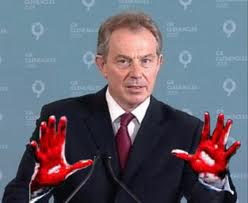
 During Tony Blair’s time in office, Downing Street allegedly ordered former defence secretary Geoff Hoon to burn a secret memo that questioned the legality of the 2003 Iraq invasion. Hoon makes the bombshell claim in a new memoir.
In disclosures that have boosted ongoing attempts to strip the former prime minister of his recently conferred knighthood, Hoon reportedly revealed that Blair’s chief of staff Jonathan Powell had instructed him “in no uncertain terms” to destroy the legal document.
When reports of the allegation first surfaced in 2015, they were dismissed by Blair as “nonsense.” But Hoon has resurrected the claim in a tell-all book, titled ‘See How They Run’, according to the Daily Mail. The paper said Hoon has provided details of a “cover-up” at Downing Street.
The former Labour minister said he was sent a copy of the “very long and very detailed legal opinion,” written by then-Attorney General Peter Goldsmith, “under conditions of considerable secrecy” and told he should “not discuss its contents with anyone else.”
Describing it as “not an easy read,” Hoon said he “came to the view” after several readings that the memo was “not exactly the ringing endorsement” of the war effort that the British government and military chiefs had hoped for. Goldsmith had apparently written that the invasion would be lawful only if Blair believed it was in the UK’s national interest.
“When my Principal Private Secretary, Peter Watkins, called Jonathan Powell in Downing St and asked what he should now do with the document, he was told in no uncertain terms that he should ‘burn it.’”
However, Hoon said he and Watkins defied the order and decided to lock the memo in a safe at the Ministry of Defence instead. He noted that the document is “probably still there.”
While Blair has yet to comment, Powell has denied ordering Hoon to burn the memo, telling the Daily Mail that, at Goldsmith’s request, he had asked the former defence secretary to “destroy” a separate “minute” on the legality of the invasion that had been sent months earlier.
The explosive claims come as over 750,000 people have signed an online petition to strip Blair of his knighthood. Anti-war activists have long accused Blair of war crimes for sending British troops into Iraq and Afghanistan.
January 6, 2022
Posted by aletho |
Book Review, Deception, Timeless or most popular, War Crimes, Wars for Israel | Iraq, UK |
Leave a comment
Dissecting the Treaty of Versailles’s “Big Four”
In a Daily News Bulletin issued February 4, 1924, by the Jewish Telegraphic Agency, Jewish leaders across the nation publicly mourned the passing of former war-time president Woodrow Wilson, the self-described “staunch friend of the Jews.” The telegram goes on to commemorate Wilson’s “intense interest in Jewish questions” by reviewing his political deeds as president, appointing Louis D. Brandeis to the Supreme Court Bench despite vigorous opposition from the Court itself and urging the approval of the British Mandate over Palestine following the Balfour Declaration.
Nearly a century later, this adulation of America’s twenty-eighth president continues to be echoed by prominent Jewish leaders and intellectuals. In Pulitzer Prize-winning biographer A. Scott Berg’s book, “Wilson,” this formidable Head of State has influenced the decision-making of each succeeding American president up to former President Donald Trump. Furthermore, Berg argues that Wilson is the most pro-Jewish president in US history. This is attributed to Wilson’s breakaway from American isolationism, which guided the nation’s political function on the world stage for a hundred and twenty-five years.
Six months after winning a second consecutive term as president on the Democratic ticket (the first time since Andrew Jackson’s second term), Wilson asked the legislature to declare war on Germany in an imperative speech to Congress on April 2, 1917. His justification was to answer the question of the role the United States would play in the world – it was America’s duty to ensure that “the world must be safe for democracy.” This rhetoric has been repeated repeatedly by American politicians at all levels in subsequent generations, followed by military action.
As Wilson plunged the nation into Europe’s devastating four-year war which wrought 17 million deaths and 25 million wounded, he often portrayed himself as the beacon of progressive ideals, a missionary of self-determination, democracy, and multilateralism to the world and, by involuntary extension after the First World War, its conquered colonies from the ashes of the defeated German and Ottoman Empires. The question is on whose behalf and if foreign elements were acting abroad, at home, or both.
For example, it is entirely plausible today to assert that the invasion of Iraq was contrived almost entirely by high-ranking Jewish Zionists in the Bush administration for the long-anticipated purpose of removing Israel’s arch-nemesis at the time—Saddam Hussein—in another mission to destroy the Jewish State’s Arab neighbors and assert dominion over the region.The catch was that Israel would not be fronting the 2 trillion dollar bill and sacrificing 190,000 lives; that was left to the Americans.
Eighty years prior, before the founding of modern Israel, this similarly established Zionist paradigm in America’s political institutions persuaded the Wilson administration to do the same. Instead of winning the hearts and minds of the public through unbridled war propaganda and an unprecedented national tragedy for the specific purpose of creating a homeland for Jews, a cooperative network of Zionists in Britain, Russia, and the United States worked towards this goal through the imperial hand of the idealistic Wilson.
Jews long held Woodrow Wilson in high regard for his liberal politics and inclination to address their requests. When the former governor of New Jersey first ran for president in 1912, Boston’s Jewish Advocate published a political ad, pressing readers to join with “practically all the great Jewish leaders throughout the country” in endorsing him.These leaders included financier Jacob H. Schiff, philanthropist Nathan Straus, and Ambassador Henry Morgenthau. At the time, beginning in 1906, the United States was faced with the difficult task of admitting roughly ten million immigrants, mainly from Eastern and Southern Europe.
This sudden influx overwhelmed several facets of the native populace, whereby the “restrictionists” emerged with literary test campaigns as a method by which to curtail subsequent waves of immigration. The American Jewish Committee was the most active and significant anti-restricionist lobby group in each of these battles through delay and outright blockage of the legislative passage. During his tenure as president, Wilson assisted by vetoing three restrictive measures he believed were aimed principally at Jews before being overridden by Congress. The AJC’s particular fixation on the plight of Russian-Jewish immigrants caused an extensive lobbying endeavor in America’s foreign policy.
This emerging conflict of interest was sidestepped upon the outbreak of the First World War. The intense pogroms and anti-Jewish sentiment of Czar Nicholas II caused the American Jewish community to side more with Germany than with Allied forces. Immigrant Jews even prayed that the “more civilized” Germans would liberate their suppressed brethren in Eastern Europe from Russian harassment. In the Yiddish press, the enemy was portrayed vividly as: “The Jews support Germany because Russia bathes in Jewish blood.” Who will dare say that it is a crime for Jews to hate their torturers, their oppressors and murderers?” The German Foreign Office took advantage of this position in order to maintain its favor in the Jewish community; in September, 1914, Dr. Isaac Straus was even sent to the United States to manage propaganda work among Jews for the German Information Bureau located in New York.
The German Information Bureau, despite official American neutrality, could not be more pleased following its meeting with the Jewish press. This came at a time when most Americans would rather side with French and British allies out of strong ancestral ties: “So far as our relations with the very influential Jewish press are concerned, they are in good shape, and will be carefully nourished. It is critical in this regard that all news pertaining to them elevate Jewish self-esteem; for example, the appointment of Jewish officers, the installation of Jewish professors, and honors bestowed upon Jewish professors should all be sent here.”
While war efforts were being bolstered in the Jewish press, American Zionist leaders adopted a policy of neutrality for the time being, stemming from Theodor Herzl’s stance on non-partisanship in a neutral country as war raged. During this time, it was Britain’s Grand Fleet that managed the naval blockade of supplies into Germany, starving 400,000 German civilians to death. For the first two years of the First World War, German war efforts nevertheless proved supreme thanks to their unexpected arsenal of submarines against the wealthier, more weaponized Allied Powers. Imperial German forces nearly captured Paris, expelled Russia from the war, and drove the French Army into mutiny, all before a Western Front victory was barely in their grasp by 1918. On three separate occasions throughout 1916, Germany pursued avenues to negotiate for peace, but both British and French resolve maintained that peace would only come about upon Germany’s defeat.
Zionist leaders eventually came to the realization that Allied victory meant Russia’s influence would be amplified in the Near East. In early 1915, a conditional Entente agreement even allocated Constantinople to Russia. This posed an issue as Constantinople rested in the possession of the Ottoman Empire, an ally of Germany and Austro-Hungary. High-profile Zionists had their eyes eastbound on Palestine as a suitable place to lay the groundwork for a Jewish homeland. In 1896, the father of Zionism, Theodor Herzl, approached Sultan Abdul Hamid II and offered to pay off the Ottoman debt in exchange for a charter that permitted Zionists access to Palestine. The Sultan outright refused.
The prospect of a promised land for Jews never escaped one highly influential man’s attention — Justice Louis D. Brandeis. Through Brandeis, Zionist leadership “passed into American hands by default.” He was considered one of the men of “light and lead” on whom Wilson relied. Born in 1856 to secular Jewish immigrant parents from the present-day Czech Republic, he graduated from Harvard Law School at the age of 20 and settled in Boston to open a law firm focused on progressive social causes. In his early career, he was distinguished for his public advocacy against powerful corporations, mass consumerism, monopolies, and public corruption while advising methods to restrict the influence of big banks and money trusts in his collection of essays, Other People’s Money and How the Bankers Use It.
These progressive positions would later be taken up by Democratic candidate Woodrow Wilson on the larger question of the role of the national government and the future of the American economic system. By that time, Louis Brandeis was head of both the Federation of American Zionists and the American Zionist Movement after meeting the English-born Zionist leader and close associate of the late Herzl, Jacob de Haas. The prominent Jewish lawyer was converted into a staunch Zionist under the mentorship of leading Zionists during that time, such as Aaron Aaronsohn, Horace Kallen, Shmarya Levin, Bernard Rosenblatt, and Nahum Sokolow. From August 31, 1914, to October 1, 1916, Brandeis was also chairman of the Provisional Executive Committee for general Zionist affairs.
The Brandeis-Wilson coalition was the start of a political partnership with far-reaching consequences on the international scene until Wilson’s death. The opportunity for career advancement presented itself so visibly that Brandeis switched parties and carried his advocacies, including Zionism, into American political institutions as a high-ranking political figure with direct access to the newly elected U.S. president.
Upon Wilson’s presidential win in November, he noted to Brandeis, “You were yourself a great part of the victory.” During Wilson’s first year as president, Brandeis was instrumental in the behind-the-scenes creation of the Federal Reserve System in 1913. The ambitious president attempted to make Brandeis his Attorney General and later Secretary of Commerce, but intense resistance from corporate executives forced Wilson to rescind his plan to make the renowned radical part of his cabinet. Instead, he nominated him to the U.S. Supreme Court in 1916, and he was sworn in amid a public outcry.
At a time when correspondence between Zionist leaders and the American president was steadily rising, as the Great War intensified in its first year, Brandeis approached Wilson about Zionist plans, to which Wilson seemed receptive. By 1916, Brandeis established regular contact with the State Department on the future fate of the declining Turkish Empire following the war, with Hungarian-born leading Zionist and Rabbi Stephen S. Wise in communication with Wilson’s chief adviser on European politics and diplomacy during the First World War, Edward Mandell “Colonel” House, on Zionist objectives. Specifically, Wise functioned as an intermediary between Wilson and House from 1916 to 1919. Wise began his Zionist career in the late 1890’s by assisting the movement’s ideological development and organization of its membership. Another acquaintance of Herzl’s, he served as American secretary of the World Zionist Movement and was instrumental in producing the aforementioned Provisional Executive Committee for General Zionist Affairs.
Opposition to American entry into the First World War cut across political, racial, and economic lines. Various factions of society, including socialists, anarchists, syndicalists, pacifists, civil libertarians, Marxists, rural southerners, Canadian and Irish nationalists, and women’s groups, were just some of the small but vocal minorities opposing American militarism. International socialist groups, for example, were keenly aware of the capitalist mobilization the war promised to big business rivals. The working class fought, while the ruling class profited. This was America’s first debut as a global military power and pitted citizen against citizen until eventually the government itself grossly violated civil liberties under the Espionage and Sedition Acts.
In 1916, Wilson reignited his bid for re-election through his continued commitment to progressive change by calling for legislation regulating work hours and a minimum wage. Democrats campaigned on the slogan, “He Kept Us Out of War,” insisting to voters that a Republican victory would mean war with Germany. Just four months after his second inauguration, Wilson reneged on his campaign promise of neutrality and officially declared war. By this time, public resistance to this betrayal was minute. The preceding years of preparedness campaigns, patriotic zeal, and heavily propagandized press cycles swayed the consensus into viewing the war as just and necessary. Thousands more dissenters continued to be jailed, silenced, and deported under newly solidified justification.
Shortly after the U.S. entered into the war, the British Foreign Minister, Arthur J. Balfour, arrived in Washington. In a cable, James Rothschild urged Brandeis to discuss Zionism with Balfour on the viability of an English Zionist program to recognize Palestine as the Jewish national homeland. “Unanimous opinion is the only satisfactory solution for Jewish Palestine under British protectorate,” Rothschild explained in a telegram. Russian Zionists fully approve. Public opinion and competent authorities here are favorable… It would greatly help if American Jews would suggest this scheme to their government.The charitable activity of the Zionist movement was over. Now an era of wielding political power has commenced to shift the tide of international conflict under the London-Moscow-New York axis.
Only one month after American entry into the war, Brandeis followed through with Rothschild’s request. Appealing to Wilson’s progressive vision for the globe, Brandeis explained that a Jewish Palestine would fulfill the conditions of the peace settlement Wilson desired; Turkish despotism would be swept aside for a democratic government where economic and cultural development would be undertaken by a historically suppressed people.In reaction to the Balfour Declaration, Wilson said, “The allied nations, with the fullest concurrence of our government and people, agree that in Palestine shall be laid the foundations of a Jewish Commonwealth.”
Partnered with Brandeis in courting Wilson was the Austrian-born Jewish lawyer and professor, Felix Frankfurter, a lifelong committed Zionist and member of the Zionist Organization of America. Frankfurter became acquainted with Brandeis in the Parushim, a secret Zionist society, reform movement, and arguably the first modern militant Zionist organization in America. Found by their former mentor, Horace M. Kallento, Zionist purpose was “a group much like the Peace Corps, young men and women who saw the Utopian opportunity that existed for the Jewish people in Palestine and who were willing to devote themselves to an ideal.”
The ideological motivations for endorsing Zionism were personal for Wilson as well: “To think that I, the son of the manse, should be able to help restore the Holy Land to its people.” With Wilson formally persuaded, Brandeis passed along the good news via urgent cables to Rothschild in London. Two weeks later, Jacob de Haas, now advisor to Brandeis, cabled Russian born-Zionist leader and future president of the World Zionist Organization, Chaim Weizmann, not only outlining the plan for Palestine but to communicate “an accurate statement of the prevailing sentiment in the United States to be presented to the Allied Governments.”
President Wilson was later asked directly by the British government about the likelihood of issuing a declaration of sympathy for the Zionist movement. Wilson responded that the time was not ripe. A month later, Wilson placed his full backing behind the affirmation as pressure mounted against Germany’s Turkish ally to make dispensations to the Zionists. The topic of the Balfour Declaration was on the table between the two world powers. Colonel House complained to Wilson in a note: “The Jews from every tribe have descended in force, and they seem determined to break in with a jimmy if they are not let in.”
Brandeis’ influence over Wilson in regards to Zionist ambition could not be understated. Wilson once remarked that it was Brandeis to whom he owed his career. According to Frank Edward Manuel, Wilson’s interest in Zionism and including it as part of his foreign policy was “being slowly nurtured by Louis Brandeis, one of the men who stood closest to him in the early years of the administration and who became the key figure in future American intervention in Palestine.”
A roadblock in the way of the highly anticipated declaration was the Counselor to the State Department, Robert Lansing. Lansing was completely bypassed in House and Wilson’s correspondence on the Balfour Declaration. In response, Lansing argued in a letter to Wilson why America must decline Balfour’s promise, noting that, among several reasons, “many Christian sects and individuals would undoubtedly resent turning the Holy Land over to the absolute control of the race credited with the death of Christ,” a flagrant secession from the protracted Christian support for the prophetic restoration of Israel.
Lansing ordered Ambassador Walter Hines Page to investigate and report prudently the British reasons for the Balfour Declaration. In spite of political opposition within the State Department, the declaration was officially signed by Lord Balfour after a two-year process of edits by British and American Zionists and officials. Despite its official status as a British document, it was Brandeis who spearheaded its drafting and application through Wilson.
News rapidly spread worldwide upon the issuance of the Balfour Declaration, with heaps of telegrams addressed to Wilson expressing their gratitude for his contributions. Leaflets were dropped over German and Austrian territory announcing, “The hour of Jewish redemption has arrived…” The Allies are giving the land of Israel to the people of Israel… Will you join them and help to build a Jewish homeland in Palestine? Stop fighting the allies who are fighting for you, for all the Jews… An Allied victory means the Jewish people’s return to Zion.”
By the summer of 1918, Turkish resistance was waning and President Wilson took this time to formally announce his public endorsement of the Balfour Declaration in August. Three months later, Germany was the last of the Central Powers to sign an armistice agreement with the Allies. The war was over. The next battle would be held in Paris.
The ambitions of Wilson’s liberal internationalist foreign policy were outlined in the Fourteen Points and used as the basis of terms for Germany’s surrender at the Paris Peace Conference. The Peace Conference produced five treaties, one of which was the notorious Treaty of Versailles. There were a number of high-profile Jews present, not just in diplomatic positions but in many senior and important functions within the Allied delegations. This included Baron Sonnino for Italy, Edwin Montagu for Britain, Louis Klotz for France, and Paul Mantoux as the interpreter for the “Big Three”—United States, Britain, and France.
Wilson also endorsed Rabbi Wise to promote the Jewish program for Palestine in Paris. Another Zionist delegate was Frankfurter, who was among the nearly one hundred intellectuals that signed a statement of principles for the formation of the League of Free Nations Associations. This formally enacted Wilson’s mission to dispel isolationism in favor of increasing American participation in international affairs.
In the midst of empirical savagery slicing up Germany and parceling out Europe’s colonial holdings, the case for a Jewish homeland in Palestine was presented by a delegation of the Zionist Organization led by Weizmann. The terms of the newly established British Mandate involved promoting Jewish immigration and settlement, suggesting boundaries, self-government, and the assurance of religious liberty.
At the request of President Wilson, Jewish statesman and Wall Street financier Bernard Baruch attended the Paris Peace Conference as an advisor to negotiate a deal with the victorious Allied powers on the destiny of Germany. He served as a member of the American Delegation to the Preliminary Peace Conference and on the Committee on Form of Payments of Reparations. Baruch is credited with managing America’s economic mobilization in the First World War while chairman of the War Industries Board. While Baruch opposed the strenuous financial tenets of punishing Germany, he nonetheless attempted to assist the Senate in passing the Treaty of Versailles.
Baruch also played a significant role in securing France’s vote in favor of the Palestine Partition Plan. He swayed their vote by visiting France’s UN delegate and heavily suggesting that failure to support the resolution could result in America withholding desperately needed monetary support as the war devastated France’s financial market.
The renowned English economist, John Maynard Keynes, was also in attendance at the Peace Conference as a delegate of the British Treasury. Disgusted by the ravenous nature of the treaties, particularly the Versailles Treaty, Keynes publicized a negative portrayal of the treaties in his book, The Economic Consequences of the Peace. In response, Baruch paid John Foster Dulles $10,000 to ghostwrite his own book, The Making of the Reparation and Economic Sections of the Treaty, to counter Keynes by exalting the treaties.
The most significant of American Jewish attendees, however, was Justice Brandeis himself, whose task at the world’s peace tables was to assist Colonel House “in collecting peace data for President Wilson.” The task was clear: “Colonel House will devote his attention to problems concerning the war in the west, while Justice Brandeis will study the near eastern question.” Their work will form the basis for the country’s contention.”
For a liberal president known for endorsing and exporting democratic ideals even through coercion, its inconsistent implementation was noted during the peace talks and formally addressed on August 28, 1919, through the presentation of the King-Crane Commission. The commission argued that the establishment of a Jewish state in Palestine would inevitably lead to an immediate violation of the right of the indigenous Palestinian people to self-determination and deemed the Zionist program incompatible.
The report also stated that meetings with Jewish representatives led them to conclude that “the Zionists looked forward to a practically complete dispossession of the present non-Jewish inhabitants of Palestine through armed forces” and begged the Peace Conference to reject Zionist proposals. The findings of this report were suppressed for three years by Brandeis until after the Peace Accords were passed. Working diligently to ensure the stipulations of the Balfour Declaration were incorporated into the final arrangement was Frankfurter, who found the findings of the commission to “cheat Jewry of Palestine.”
As the dissolution of the former Ottoman Empire began via the Treaty of Sevres, the vehicle for colonizing Palestine as spelled out by the Balfour Declaration was put into effect under the Brandeis-guided Wilson. The Council of the League of Nations and the United States both approved the Mandate for Palestine in July of 1922. It was clear from the beginning that the flagrant denial of self-government for the Palestinian population would continue until the Jews were strong enough to take the reins of government in the region.
For four days in April 1922, Congress debated resolutions brought forth to reaffirm the colonial implications of the Balfour Declaration as urged by Zionists. One of the vocal participants of its opposition was Professor Edward Bliss Reed, who testified in a prophetic hearing before Congress about the outcome of what American support entailed: “If you indorse the Balfour declaration, you are caught absolutely in the mandate…” What I want to warn you against is getting caught up in the mandate in what I consider an impasse. It will devastate this country, Palestine. I want to prevent my country from doing something that will bring it untold trouble.”
Nevertheless, Congress was subjected to endless Zionist pressure and passed the Lodge-Fish Resolution endorsing the British Mandate for Palestine as laid out by the Balfour Declaration, which was signed by Wilson’s presidential successor, Warren G. Harding, on September 21, 1922.
When Wilson died two years later, the President of the Zionist Organization of America, Louis Lipsky, stated publicly, “Mr. Wilson followed with interest the progress of the Zionist movement even after he retired to private life.” In 1921, when informed that the Mandate for Palestine had been finally ratified, he telegraphed to the Zionist Organization of America: “I am proud that it should be thought that I have been of service to the Jewish people.”
The First World War was proclaimed to represent “the war to end all wars”, bringing about a golden future on the promise of self-determination, democracy, mutual security, and peace. The cost would only be the blood and ashes of young, idealistic men committed to the service of their nation. What resulted was the pervasive indifference and lack of cohesive understanding of the memory of the war in spite of its devastating cost. As Steven Trout tried to explain the lack of American consciousness toward the war, “What exactly should the nation recall about the war? Is neutrality failing? The bravery of the combat soldier? The futility of trench warfare? The racial discrimination that permeated the ranks? Are there domestic attacks on German Americans? The botched peace processes? ”
Not to mention the American public that had opposed entry into Europe’s war was forced to grapple with the casualties of 120,000 soldiers and the reintegration of 200,000 wounded men, crippled of mind and body. For Wilson, it was his lifelong and close political partnerships with notable Jewish Zionists fully entrenched in American institutions that prompted his breakaway from isolationism—to which the United States has never returned. More consequential was Wilson’s setting the pattern for amplifying and servicing the dominance of a foreign state as the costs continue to rise.
Footnotes
Jewish Telegraphic Agency, INC., “Leaders Pay Tribute To The Passing Of A Great Statesman,” Daily News Bulletin, last modified February 4, 1924, https://pdfs.jta.org/1924/02-04_025.pdf.
Galia Licht, “Who Was the Most Pro-Jewish U.S. President? Woodrow Wilson, Obviously, ” Haaretz.com, September 25, 2013, https://www.haaretz.com/life/books/premium-which-prez-was-most-pro-Jewish-1.5340052.
Casey Titus, “History’s Deceptive Buildup Against Saddam Hussein,” The Duran, accessed March 22, 2021, https://theduran.com/history/deceptive-buildup-against-Saddam-Hussein
Nathan Guttman, “Top White House posts go to Jews,” The Jerusalem Post, https://www.jpost.com/jewish-world/jewish-features/top-white-house-posts-go-to-jews, last modified April 25, 2006.
Paulina Cachero, “According to reports, US taxpayers have paid an average of $8,000 per person and more than $2 trillion in total for the Iraq War alone.”Business Insider, https://www.businessinsider.com/us-taxpayers-spent-8000-each-2-trillion-iraq-war-study-2020-2, last modified February 6, 2020.
Jonathan D. Sarna, “Woodrow Wilson: A Jewish Hero.”What Should We Do with His Racism? ” The Forward, November 15, 2016, https://forward.com/opinion/450092/woodrow-wilson-was-a-hero-to-jews-what-should-we-do-about-his-racism/?
Joseph Rappaport, “The American Yiddish Press and the European Conflict in 1914.” 113–28 in Jewish Social Studies 19, no. 3/4 (1957).http://www.jstor.org/stable/4465551.
Rappaport, page 116.
Jon Guttman, “Did the Germans Try to Make Peace in 1916?,” HistoryNet, https://www.historynet.com/did-the-germans-try-to-make-peace-in-1916.htm, last modified December 18, 2014.
Elis Gjevori, “How Theodor Herzl Failed to Convince the Ottomans to Sell Palestine,” https://www.trtworld.com/magazine/how-theodor-herzl-failed-to-convince-the-ottomans-to-sell-palestine-46991, last modified May 25, 2021.
Adler, Selig. “The Palestine Question in the Wilson Era.” Jewish Social Studies 10, no. 4 (1948): 303–34. http://www.jstor.org/stable/4615334.
Jewish Virtual Library, “Louis D. Brandeis,” last modified January 2016, https://www.jewishvirtuallibrary.org/louis-d-brandeis.
Jonathan D. Sarna, “Louis D. Brandeis: Zionist Leader,” Brandeis University, last updated in 1992, https://www.brandeis.edu/hornstein/sarna/americanjewishcultureandscholar.
American Jewish Archives, “A Finding Aid to the Stephen S. Wise Collection, 1893-1969,” The Jacob Rader Marcus Center of the American Jewish Archives, accessed December 31, 2021, https://collections.americanjewisharchives.org/ms/ms0049/ms0049.htm
Catherine Gilchrist, “Socialist Opposition to World War I,” Dictionary of Sydney, last modified in 2014, https://dictionaryofsydney.org/entry/socialist_opposition_to_world_war_i
Rothschild and Chaim Weizmann to Brandeis (cable), April 21, 1917 (received April 25), Zionist Archives, New York City, Jacob de Haas Archives.
Lebow, Richard Ned. “Woodrow Wilson and the Balfour Declaration.” The Journal of Modern History, 40, no. 4 (1968): 507 http://www.jstor.org/stable/1878450.
Jewish Virtual Library, “U.S. Presidential Quotes About Jewish Homeland & Israel,” Jewish Virtual Library, https://www.jewishvirtuallibrary.org/u-s-presidential-quotes-about-jewish-homeland-and-israel-jewish-virtual-library, accessed December 31, 2021.
Schmidt, Sarah. “The ‘Parushim’: A Secret Episode in American Zionist History.” American Jewish Historical Quarterly 65, no. 2 (1975): 122. http://www.jstor.org/stable/23880453
De Haas Archives, Brandeis to Rothschild (cable), May 9, 1917.
Adle, Selig. “The Palestine Question in the Wilson Era.” Jewish Social Studies 10, no. 4 (1948): 306. http://www.jstor.org/stable/4615334.
Ahmed, Hisham H. “From the Balfour Declaration to World War II: The U.S. Stand on Palestinian Self-Determination.” Arab Studies Quarterly 12, no. 1/2 (1990): 9–41. http://www.jstor.org/stable/41858937.
Brendan Devenney, “Chapter One—Zionism: The Beginning,” Medium, last modified November 2, 2021, https://medium.com/@dubhelloco/chapter-one-b8d8b77b38b8.
Levene, Mark. “Nationalism and Its Alternatives in the International Arena: The Jewish Question in Paris, 1919.” Journal of Contemporary History 28, no. 3 (1993): 522. http://www.jstor.org/stable/260644.
Gunther, Learned Hand: The Man and the Judge, 261.
“BERNARD BARUCH: A PUBLIC MAN’S PRIVATE LIFE,”https://blogs.baruch.cuny.edu/, n.d.https://blogs.baruch.cuny.edu/bernardbaruch/world-war-i/.
Saul J. Singer, “Bernard Baruch: ‘America First’,” The Jewish Press-Breaking News, Opinions, Analysis and More on Israel and the Jewish World | Last modified March 29, 2017, https://www.jewishpress.com/sections/features/features-on-Jewish-world/bernard-Baruch-America-first/2017/03/29/.
Gates Brown, “Baruch, Bernard Mannes | International Encyclopedia of the First World War (WW1),” 1914-1918-Online. WW1 International Encyclopedia, last modified March 16, 2015, https://encyclopedia.1914-1918-online.net/article/baruch_bernard_mannes.
Butler Citizen, “Zionist Louis Brandeis Takes Control of the 1919 Paris Peace Conference,” Newspapers.com, https://www.newspapers.com/clip/35334878/zionists-louis-brandeis-takes-control/, last modified October 2, 1917.
Ahmed, 23,
United States. Congress. House. Committee on Foreign Affairs, Hearings Before the Committee on Foreign Affairs, House of Representatives, Sixty-seventh Congress, Second Session, on H. Con. Res. 52, Expressing Satisfaction with the Re-creation of Palestine as the National Home of the Jewish Race April 18, 19, 20, and 21, 1922 (Kessinger Publishing, 1922), 23–24.
Jewish Telegraphic Agency, “Jews Mourn the Death of Woodrow Wilson,” Jewish Telegraphic Agency, https://www.jta.org/archive/jews-mourn-death-of-woodrow-wilson, last modified in 1921.
January 4, 2022
Posted by aletho |
Militarism, Progressive Hypocrite, Timeless or most popular, Wars for Israel | Human rights, Palestine, UK, United States, Zionism |
Leave a comment
There has been a lot of speculation regarding whether convicted sex offender Ghislaine Maxwell will now “spill the beans” on the folks in power who exploited those young female offerings pedophile Jeffrey Epstein made available. No chance of that, I am afraid, as the trial itself was narrowly construed and limited to certain sex related charges to avoid any inquiry into the names of the actual recipients of the services being provided.
Nor was there any attempt made to determine if Epstein was working on behalf of a foreign intelligence service, most likely Israeli, which has been claimed in a recent book by a former Israeli case officer, who states that top politicians would be photographed and video recorded when they were in bed with the girls. Afterwards, they would be approached and asked to do favors for Israel. It is referred to in the trade as a “honey-trap” operation.
The fact that Epstein and his activities were being “protected” has also been confirmed through both Israeli and American sources. It is known that Bill Clinton flew on the Epstein private 727 jet the “Lolita Express” 26 times, traveling to a mansion estate in Florida as well as to a private island owned by Epstein in the Caribbean. The island was referred to by locals as the “Pedophile Island,” but Clinton has never even been questioned by either the NYPD or FBI.
Maxwell is presumed to have been an active participant in the Epstein spy operation acting as a procurer of young girls and on at least one occasion has hinted that she knows where the sex films made by Epstein are hidden. That claim was also not explored in what passed for a trial.
It doesn’t take much to pull what is already known together and ask the question “Who among the celebrities and top-level politicians that Epstein cultivated were actually Israeli spies?” But that, of course, is where the judicial farce and cover-up began. We are in an era of government control of information and have just been witnessing selective management of what Maxwell was being charged with to eliminate any possible damage to senior US politicians or to Israel.
If anyone had actually expected the espionage angle to surface even implicitly during the Maxwell trial, they must now be terribly disappointed because Alison Nathan, the Obama appointed judge of the United States District Court for the Southern District of New York did not allow it, the prosecutor did not seek it, and even the defense attorneys did not use it in their arguments.
December 31, 2021
Posted by aletho |
Corruption, Deception, Timeless or most popular, Wars for Israel | FBI, Israel, Mossad, United States |
Leave a comment
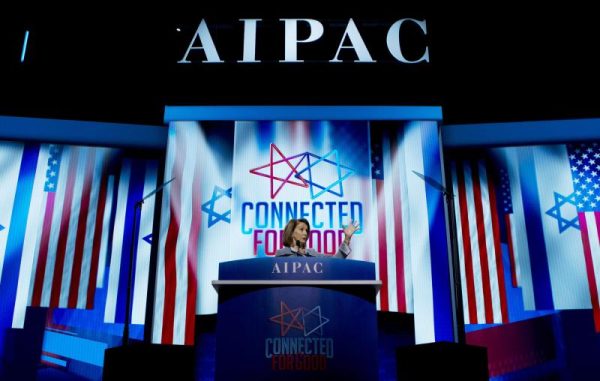
Those Americans who dare to challenge the strangle-hold that Israel and its friends have over US foreign policy will likely find themselves targeted even more aggressively in the upcoming year. Two weeks ago the American Israeli Public Affairs Committee (AIPAC), widely reckoned to be the largest and most powerful component of the Jewish state’s lobby, declared that it will now begin directly funding political candidates who are perceived as pro-Israel. Up until now, AIPAC has preferred to operate somewhat in the shadows, representing itself as a organization that is in part “educational” to justify its 501(c)3 tax exempt status which it uses to send all new congressmen on propaganda trips to Israel.
Of course, that has always been a bit of a fiction enabled by a Justice Department that is inclined to ignore all Israeli misbehavior. There are a number of reasons why AIPAC should be regarded for what it is, i.e. an organization that has as a priority the promotion of Israeli interests without any concern for the damage being done to the United States and its institutions. Under US law, specifically the Foreign Agents Registration Act of 1937, AIPAC should be compelled to forfeit its special tax status and register, which would permit the government to have full access to its finances and also require a record of its frequent meetings with the Israeli Embassy in Washington as well as with senior Israeli officials in Israel. It would also have to report its significant and unparalleled lobbying efforts on Capitol Hill. AIPAC would deny that it is actually directed or possibly funded in part by the Israeli government, but its website somewhat puts the lie to that conceit where it describes itself as “America’s Pro-Israel Lobby” before elaborating how “We are proud to be a diverse movement of passionate pro-Israel Americans.”
The other lie promoted by AIPAC is that, up until now, it has not funded the political campaigns of its many friends both in Congress and in state and local governments. The reality is that AIPAC and some of its associated groups have aggressively vetted candidates for office at all levels. During its annual summit in Washington, politicians in attendance have routinely held fundraisers at hotels and restaurants not at the AIPAC event but often at hotels within walking distance. It is known that AIPAC publishes for-internal-use-only a candidates’ “scoring card” prior to elections reflective of views on Israel. As AIPAC is itself funded by Jewish billionaires and is in regular contact with them, the exchange of information on who is a “friend” and deserving of campaign money would be easily accomplished without having to use AIPAC as a conduit.
The new structure will consist of a regular political action committee (PAC) able to contribute $5,000 maximum donations to identified candidates per race, and a super PAC, which can raise unlimited money for an individual candidate. AIPAC PAC will be the name of the regular PAC, while the super PAC has not yet received a label.
AIPAC spokesman Marshall Wittman sent out an email explaining the changes. In perhaps one of the most chilling statements that I have read recently, Wittman asserts that “The creation of a PAC and a super PAC is an opportunity to significantly deepen and strengthen the involvement of the pro-Israel community in politics.” Given Israel’s current dominance of Congress, the White House and the mainstream media one fears what might come next if stronger “involvement of the pro-Israel community in politics” becomes a reality. Jews constitute less than 2% of the US population and they already are hugely overrepresented in elite professions and politics while at the same time reserving to themselves perpetual victimhood to justify the preferential anti-democratic policies that they actually promote. Will Joe “I’m a Zionist” Biden’s cabinet be required by law to be 100% Jewish? Will Congress require a Jewish majority? Will the government be setting up gulags somewhere out west for people like me who oppose such dominance and the “Israel Project”? Where does this ever end to satisfy the Jewish lobby?
One might well ask why AIPAC is changing its platform to make itself even more accessible since it would seem that the shift to PACs does not much change what happens behind closed doors when politicians come begging for money. The answer may lie in the perception by Jewish groups and the Israeli government that Zionism is in trouble due to the accumulation of egregious human rights violations and war crime attacks on neighbors. The world view of Israel is increasingly negative. So the response is to open the door a bit to visibly dangle more money, which the Israeli Lobby has plenty of, to take on critics.
Israel and its friends are particularly concerned over the handful of progressives in Congress who have expressed reservations about the blind approval of Israeli crimes against humanity. The PACs will enable a more robust response by providing readily available money to run pro-Israel candidates against them to bring about their removal from Congress. The Zionists also worry about the growing support for the nonviolent Boycott, Divestment and Sanctions movement (BDS), which seeks to put the same kind of economic pressure on Israel that once brought about change in South Africa. Already Israel advocacy groups at the state level have succeeded in passing legislation in 27 states that in one way or another punishes anyone one who supports “boycotting” Israel. AIPAC would like that number to become 50 and it is also pushing hard on Congress for “hate legislation” that creates harsh criminal and civil penalties for anyone who questions the holocaust or criticizes Israel, which will be defined by the legislation as anti-Semitic acts.
Hand in hand with the moves at the state level, Jewish groups are rewriting text books to include more on the so-called holocaust, to sometimes include mandatory holocaust instruction at grade school and high school levels. In one bizarre incident in Washington DC, students were made to reenact “scenes” from the holocaust including mass executions and burials. One student was made to portray Adolph Hitler and instructed to include a simulated suicide at the end of the exercise.
This overreach all comes packaged together with alarming reports, put out inevitably by Jewish groups, regarding a surge in what it chooses to label as anti-Semitic crimes. Such “crimes” include numerous no-victim incidents like scrawled graffiti on walls or display of posters defending the Palestinians. The Anti-Defamation-League (ADL), which leads the pack in its constant cries of anti-Semitism, hypocritically claims blandly that it is working to “Combat Extremism and Hate.” That definition apparently does not include the treatment of the Palestinians at the hands of its co-religionists in Israel.
Indeed, the tendency of the Israel Lobby to overreach because it has become so arrogant due to its power is perhaps the key to bringing it down. A recent exchange in Florida demonstrates how the ADL, sensitive to any possible slight, actually reacted harshly to someone who was actually on its side. Five weeks ago, rabidly pro-Israeli Governor Ron DeSantis’ Press Secretary, Christina Pushaw tweeted a sarcastic comment stating that there was “no weird conspiracy theory stuff here” about press reports regarding the Republic of Georgia’s Prime Minister meeting with Rothschild & Co about investment opportunities. The ADL Florida Regional Director Sarah Emmons took offense and responded with the following:
“The belief that the Rothschilds manipulate currency and influence global events for personal enrichment and world domination is a staple of antisemitic conspiracy theorists. It’s deeply disturbing to see these kinds of conspiracies promoted by a member of Governor Ron DeSantis’ staff. Conspiracy theories, especially those with antisemitic origins, don’t belong in Florida’s highest office — or anywhere in the Sunshine State. We’ll be reaching out to the governor’s office to voice our concerns and discuss the issue.”
Jews and banking in the same sentence? Must be an anti-Semitic trope, as the expression goes. What if Pushaw had actually been bold enough to say something more to the point, like “Israel is trying to drag us into an unnecessary war with Iran”? In any event, the Zionists are preparing their offensive and we of the Israel-as-ally-agnostic community will find the upcoming year to be even more trying as the Jewish state and its friends tighten the screws to eliminate and even criminalize all criticism. Be prepared!
Philip M. Giraldi, Ph.D., is Executive Director of the Council for the National Interest, a 501(c)3 tax deductible educational foundation (Federal ID Number #52-1739023) that seeks a more interests-based U.S. foreign policy in the Middle East. Website is councilforthenationalinterest.org, address is P.O. Box 2157, Purcellville VA 20134 and its email is inform@cnionline.org.
December 28, 2021
Posted by aletho |
Corruption, Ethnic Cleansing, Racism, Zionism, Wars for Israel | Israel, Middle East, Palestine, United States, Zionism |
Leave a comment
The EU’s supreme court has intervened to protect European companies against legal action by Iran for failing to fulfill their contractual obligations.
The European Court of Justice (ECJ) in Luxembourg has ruled that EU companies can end contracts with Iranian firms if upholding the deals would lead to “disproportionate economic loss” as a result of US sanctions.
The ruling was prompted by a lawsuit from the German branch of Iran’s Bank Melli against Deutsche Telekom after the telecommunications provider terminated a contract with the bank in 2018 prior to its expiry.
The decision effectively neutralizes a “blocking statute” that prohibited individuals and companies in the European Union from complying with US sanctions imposed in 2018 by then US president Donald Trump after he decided to withdraw unilaterally from the Iran nuclear deal.
As per their obligations under the nuclear deal, the Europeans issued the statute in order to keep Iran in the agreement, but companies in the bloc quickly severed ties rather than risk running afoul of the US.
Under the blocking statute, European firms must seek a legal exemption for withdrawing from Iran due to US sanctions and those failing to do so could be penalized by their governments. Firms, however, can twist the law if they claim that their withdrawal is a business decision.
The court on Tuesday paid lip service to the EU blocking statute in its ruling, saying “the prohibition imposed by EU law on complying with secondary sanctions laid down by the United States against Iran may be relied on in civil proceedings”.
But the judges also said the rules of the blocking statute “cannot infringe the freedom to conduct a business by leading to disproportionate economic loss”.
The Higher Regional Court in Hamburg will have to decide whether upholding the contract with Bank Melli would expose Deutsche Telekom to such a disproportionate economic loss.
Observers believe the decision is a foregone conclusion, given that Deutsche Telekom makes about half of its turnover with its US business.
The ECJ said the Hamburg judges must take into account that Deutsche Telekom did not apply for an exemption from the EU blocking statute’s rules.
Other European measures taken to maintain open trade channels with Iran have equally proven to be empty shells.
For example, Iranians have got almost nothing from the Swiss Humanitarian Trade Agreement (SHTA) since it was launched in January 2020 with the support and consent of the US.
The Swiss trade channel much publicized by Washington as a purportedly secure way of delivering humanitarian assistance to Iran at a time of sanctions has failed to process even a single deal on Iranian medicine imports.
The channel was meant to find a way around the US sanctions to use Iranian funds deposited abroad to buy food and medicine for the country via the Swiss bank BCP.
However, companies seeking to participate in the scheme have found it very difficult to comply with the criteria set by the US government to avoid violating the general rules governing the sanctions, said the report.
Fabian Maienfisch, a spokesman for Switzerland’s State Secretariat for Economic Affairs (SECO), which oversees the channel, has admitted in the past that the initiative had effectively failed to meet its objectives.
Such failures and the ECJ’s ruling prove statements by the Iranian government that the Europeans are disingenuous in dealing with the Islamic Republic.
The ruling comes as Iran and the Europeans continue negotiations in Vienna to find a way to remove the US sanctions.
A possible revival of the agreement would require the European companies to return to Iran and fulfill their obligations, but the EU court decision appears to be intentionally timed to provide them a leeway for further violations.
December 22, 2021
Posted by aletho |
Deception, Wars for Israel | European Union, Iran, Sanctions against Iran, United States |
Leave a comment
Partial removal of sanctions by the US is not enough to facilitate the revival of the Iranian economy, hurt by the Trump administration’s “maximum pressure” policies, say Iran affairs experts, adding that under the new government Tehran is set to protect the country’s national interests more determinedly.
The United States signalled on 14 December that it is fully prepared to lift those sanctions against Iran that are inconsistent with Washington commitments under the 2015 Joint Comprehensive Plan of Action (JCPOA). That “would allow Iran to receive the economic benefits of the deal,” remarked Linda Thomas-Greenfield, US ambassador to the United Nations, during a UN Security meeting.
For his part, Iran’s Permanent Representative to the United Nations Majid Takht Ravanchi stressed that Washington should lift all sanctions slapped on Tehran and provide guarantees that it would not withdraw from the accords again and it would not abuse the procedures set out in the JCPOA and Resolution 2231.
‘All Anti-Iran Sanctions Have to be Lifted’
“The United States is being utterly dishonest,” says Seyed Mohammad Marandi, a professor at Tehran University, who was part of the Iranian delegation that helped to negotiate the 2015 nuclear deal. “All the sanctions are inconsistent with the 2015 nuclear deal. The maximum pressure campaign was targeting innocent women and children. It was an act of war and the objective was to force Iran to accept changes to the nuclear deal.”
The Trump administration unilaterally withdrew from the JCPOA in May 2018 despite Tehran observing all the provisions of the nuclear accords. Subsequently, the US slapped sanctions on major spheres of the Iranian economy, including the country’s petroleum industry, under the so-called “maximum pressure” campaign.
“Through the maximum pressure campaign, the United States imposed sanctions under all sorts of different names: missile defence, terrorism, Iran’s regional allies, the nuclear programme, human rights and everything except global warming was included, when all of these sanctions had one objective, and that was to force Iran to appease the United States and the Europeans,” Marandi emphasises.
Although the White House changed the rhetoric, in reality, it is trying to cheat Iran and violate its commitments by lifting only those sanctions that were labelled under the nuclear programme, according to the academic.
Moreover, while “the US has a range of sanctions on Iran and President Biden has not removed any since coming to office,” notes Professor Shahram Akbarzadeh from Deakin University in Melbourne, Australia.
Even though the partial removal of sanctions sounds like a positive sign, it will not make a big difference to Iran’s access to the global economy, according to Akbarzadeh. He explains that “many international corporations will continue to be reluctant to invest in Iran because of the extreme uncertainty surrounding the future of talks and the prospects of Iran’s entry into the international market.”
“The Iranian leadership is unlikely to see partial sanctions removal as enough to assuage their concerns,” Akbarzadeh believes. “It insists on an unconditional return to that deal, and Washington has been reluctant to ‘give-in’ to that demand.”
According to the professor, this dynamic may hinder the progress of the Vienna talks over the revival of the JCPOA.
Ebrahim Raisi gives a news conference after voting in the presidential election, at a polling station in the capital Tehran, on June 18, 2021. – Raisi on June 19 declared the winner of a presidential election, a widely anticipated result after many political heavyweights were barred from running. – Sputnik International, 1920, 21.06.2021
‘US is Not in Strong Position in Vienna Talks’
While the US is not present at the table in Vienna, American diplomats are taking part in indirect talks with their Iranian counterparts. Washington does not have an upper hand in the ongoing talks, according to Seyed Mohammad Marandi:
“The Iranians see that the United States has huge problems at home,” he notes. “Political, social and economic problems are causing major issues inside the United States. The United States is increasingly losing ground to a rising China and the re-emerging Russia, and Iran and its allies across the region are growing stronger and American allies are growing weaker.”
In response to Trump’s unilateral withdrawal from the nuclear deal, the Islamic Republic started to gradually loosen the JCPOA restrictions on uranium enrichment starting from July 2019. “The Iranian peaceful nuclear programme is developing and it’s a leverage [in the talks],” according to the professor.
It’s the Americans who need the deal right now and the Iranians know that, Marandi notes, adding that Tehran will see “if the Americans will become reasonable enough to do what is good for themselves.”
At the same time, Washington and its European allies have apparently overlooked the damage their policies inflicted on the Iranian economy and the country’s population, the professor highlights, adding that “the issue of compensation is always on the table.”
The new Iranian government led by President Ebrahim Raisi has adopted a more robust approach in protecting Iranian national interests, according to Marandi. Even though the new Iranian government is critical of the JCPOA deal, it will not tear it apart, unlike the US government, but will observe its commitments. At the same time, Tehran will demand “that what has been signed, the JCPOA, be fully respected by the United States and the Europeans,” the professor underscored.
The Vienna negotiations between Iran and other signatories to the 2015 deal, including the UK, France, Germany, Russia, and China resumed in December after a five-month hiatus caused by the election of a new government in Tehran.
At the beginning of this month, the White House voiced its dissatisfaction with proposals by the new Iranian government. According to European diplomats, Tehran has demanded changes to a set of compromises agreed upon a few months ago with the previous Iranian administration. The E3 group of Britain, France and Germany went so far as to accuse the Iranian leadership of “walking back almost all of the difficult compromises crafted after many months of hard work.”
Iran’s chief negotiator Ali Bagheri Kani tweeted on 14 December that the E3 and Washington “persist in their blame game habit, instead of real diplomacy”: “We proposed our ideas early, and worked constructively and flexibly to narrow gaps; diplomacy is a two-way street. If there’s a real will to remedy the culprit’s wrongdoing, the way for a quick good deal will be paved.”
For his part, Iran’s Permanent Representative to the UN Majid Takht Ravanchi told a UN Security Council meeting on Tuesday that Iran does not impose any preconditions or new conditions in the negotiations to revive the JCPOA and only wishes to see the restoration of the initial terms of the nuclear accord.
“We call for the full, timely, unconditional and verifiable implementation of the JCPOA. No more, no less,” Ravanchi underscored.
December 16, 2021
Posted by aletho |
Deception, Wars for Israel | Iran, Sanctions against Iran, United States, Zionism |
Leave a comment
Over the past month, in a break from its usual focus on COVID-19, the Western mainstream media has dedicated a sizeable amount of coverage to unverified claims by unnamed US intelligence officials that the Russian Federation is planning an imminent military invasion of its western neighbour Ukraine – under the rule of the successive US-EU friendly governments of Petro Poroshenko and Volodymyr Zelensky since 2014, when the CIA-orchestrated Euromaidan colour revolution toppled the pro-Russian government of Viktor Yanukovych, following his November 2013 decision to suspend an EU trade deal in favour of pursuing closer ties with Moscow.
The coverage, which comes at a time of increased tensions in Eastern Europe amidst a build-up of refugees on the Belarus-Poland border being labelled as an attempt by Russian President Vladimir Putin and his Belarusian counterpart Alexander Lukashenko to destabilise the European Union, has resulted in widespread condemnation of Moscow by the Western media and political establishment, culminating in the G7 issuing a statement on Saturday threatening massive sanctions should Russia make any incursion into Ukraine – Russia having been a former member of the then-G8 until the successful reunification of the historically Russian peninsula of Crimea with the rest of the country in 2014, the pretext for which being the dangerously high anti-Russian sentiment of the newly-formed Western-backed Poroshenko government, resulted in Moscow’s suspension from the forum, with a later decision being made by the Kremlin in 2017 to formally leave the group altogether.
This widespread condemnation of Russia by the Western establishment however, for claims that Moscow itself has denied, is in stark contrast to the silence of mainstream media pundits and politicians in response to Israel’s open threats to carry out a military strike against Iranian nuclear facilities amidst the current Vienna talks regarding the Iran nuclear deal, with Israeli Defence Minister Benny Gantz announcing less than 24 hours prior to the G7’s Russia statement that he had consulted with US Defence Secretary Lloyd Austin and Secretary of State Antony Blinken regarding such a move – one that in a similar vein to any possible Russian incursion into Ukraine, would immediately result in a devastating regional conflict, a conflict that could easily spiral into a full-blown war between East and West.
To understand this wildly-differing approach to both Moscow and Tel Aviv by the Western political and media establishment, one must look at the wider geopolitical relationship between the US-NATO hegemony and both Russia and Israel.
Formed in 1948, in line with the 1917 UK-authored Balfour Declaration, which called for the establishment of a Zionist State in the Middle East, Israel has always received military, financial and political support from the United States and its allies – culminating in a US-led coalition invading Iraq on behalf of Israel in 2003, which in turn would lead to Washington and its allies launching a regime-change operation against neighbouring Syria in 2011, with Damascus, like Baghdad, also being a long-time opponent of the Zionist State.
Russia on the other hand, and in particular since the election of Vladimir Putin as President in 2000, has been diametrically opposed to this US-NATO foreign policy carried out in line with Israeli interests – with a Russian military intervention on behalf of the Syrian government in 2015 perhaps playing the most decisive role in ensuring the Presidency of Bashar al-Assad has remained in place despite the decade-long attempt to remove his leadership via a US and Israeli-backed colour revolution.
The aforementioned 2014 reunification of Russia and Crimea also put a halt to the Neocon aim of establishing a US Naval base in the key strategic Crimean port of Sevastopol – a plan that would have surely come to fruition had Crimea remained under the pro-Western rule of the current Kiev administration.
Hence, it is in this successful countering of US-NATO imperialism that Russia finds itself demonised by the West and the target of a current smear campaign accusing Moscow of planning to start a global conflict via a military intervention in Ukraine – in stark contrast to the media silence and tacit political support offered to US-ally Israel in response to its open intentions of carrying out the very same action in Iran.
December 15, 2021
Posted by aletho |
Ethnic Cleansing, Racism, Zionism, Wars for Israel | Israel, Middle East, Russia, United States, Zionism |
Leave a comment
CSE spied on Israel’s enemies and shared the intelligence with that country
This year marks the 75th anniversary of a little known but influential arm of Canada’s foreign policy apparatus. An entity called the Communications Security Establishment was established to spy internationally in 1946, operating secretly during its first four decades.
With an annual budget of $780 million and 3000 employees, the CSE has a variety of high-tech gadgets, including surveillance planes. In 2011 CSE moved into a new $1.2 billion home. The seven-building, 110,000 square metre complex is connected to the Canadian Security Intelligence Service’s (CSIS) headquarters in Ottawa.
Unlike CSIS, CSE is largely foreign focused. It seeks to “protect the computer networks and information of greatest importance to Canada” from international attack. CSE also gathers international signals intelligence (SIGINT), which it defines as “intelligence acquired through the collection of electromagnetic signals.” Historically, CSE largely intercepted electronic communications between embassies in Ottawa and other nations’ capitals. Today, CSE monitors phone calls, radio, microwave and satellite, as well as emails, chat rooms and other Internet exchanges. It engages in various forms of data hacking, sifting through millions of videos and online documents daily. Or, as Vice reporter Patrick McGuire put it, CSE “listens in on phone calls and emails to secretly learn about things the Canadian government wants to secretly learn about.”
After WWII the government established the Communications Branch of the National Research Council, which was renamed Communications Security Establishment three decades later. In Cautious Beginnings: Canadian Foreign Intelligence, 1939-51 Kurt Jensen explains: “the Gouzenko story [a Soviet diplomat who defected in September 1945, alleging widespread Russian spying in Canada] is almost entirely absent from the debate on Canadian postwar foreign intelligence. While the Soviet Union figured prominently in Canadian foreign intelligence interests, it was not an exclusive focus. The available evidence suggests that Canada had broad foreign intelligence interests that reflected current Canadian foreign policy interests.”
Since its creation CSE has been part of the Five Eyes intelligence-sharing framework though Ottawa didn’t admit its Five Eyes relationship until 1995. The main contributors to the Washington-led Five Eyes are the US’s NSA, Australian Signals Directorate, New Zealand’s Government Communications Security Bureau, British Government Communications Headquarters and CSE. A series of post-WWII accords, beginning with the 1946 UKUSA intelligence agreement, created the “AUS/CAN/NZ/UK/US EYES ONLY” arrangement.
CSE established SIGINT posts on the east and west coasts as well as in the north. According to a table produced by blogger Jerry Proc, there have been more than 50 Canadian SIGINT stations opened during the past century.
Canadian diplomatic posts have long housed SIGINT equipment. According to a NSA document released by whistleblower Edward Snowden, CSE operated clandestine surveillance activities in “approximately 20 high-priority countries.” In his 1994 book former CSE agent Mike Frost describes CSE listening posts at a number of embassies or consular posts while two papers in the early 2000s cite Beijing, Abidjan, New Delhi, Bucharest, Rabat, Kingston (Jamaica), Mexico City, Rome, San Jose (Costa Rica), Warsaw and Tokyo as diplomatic posts where CSE (probably) collected information.
Since the start of the 1960s CSE has listened to Cuban leaders’ conversations from an interception post inside the embassy in Havana. (Ottawa maintained diplomatic and economic relations with Cuba after its 1959 revolution, reports Three Nights in Havana, partly because “the United States secretly urged [Prime Minister] Diefenbaker to maintain normal relations because it was thought that Canada would be well positioned to gather intelligence on the island.”) Canada also spied on Cuba from a diplomatic post outside that country. In the early 1980s CSE wanted to establish a communications post in Jamaica, notes Frost, to intercept “communications from Fidel Castro’s Cuba, which would please NSA to no end.”
CSE also gathered intelligence on Palestinians for Israel. Frost notes, “[former Palestinian Liberation Organization chairman] Yasser Arafat’s name, for instance, was on every [CSE] key word list. NSA was happy about that.” According to files released by Snowden, CSE spied on Israel’s enemies and shared the intelligence with that country’s SIGINT National Unit. “Palestinians” was a “specific intelligence topic” of an NSA-GCHQ-CSE project shared with their Israeli counterpart.
In the late 1980s the Soviets jammed US and British listening operations in Moscow. In response, they asked CSE to take up the slack. “From summer 1987 to summer 1989”, notes Frost, “it was Canada that was providing the most powerful Western nations with the intelligence that had been so crucial to them and, in fact, to the whole Western Alliance.”
Economic espionage is a significant and growing component of CSE’s focus. In 1995 the agency began hiring more individuals with economics, commerce and international business qualifications “to build up its own analytical capacity in economic intelligence.” As part of the Snowden revelations, it came to light that CSE spied on Brazil’s Department of Mines and Energy.
In 1985 the government asked CSE to gather intelligence that could help a Canadian firm bidding for a major pipeline contract in India. A few years earlier the CSE overheard the US ambassador in Ottawa detailing his country’s negotiating position on a US$5 billion wheat sale to China, which helped Canada win the contract. CSE is also thought to have secured information useful to negotiating the mid-1990s North American Free Trade Agreement and World Trade Organization.
CSE has contributed intelligence to Canada and its allies’ wars. The agency’s sophisticated equipment and analytical and linguistic resources contributed significantly to the 2001-14 occupation of Afghanistan. The agency’s website says it played a “vital role” in the central Asian country and CSE head John Adams boasted that they were responsible for more than half the “actionable intelligence” Canadian soldiers used in Afghanistan. That included monitoring Taliban forces and leaders as well as allied Afghan government officials. Information CSE provided protected Canadian troops from attack and helped special forces assassinate Afghans.
As the Internet came onto the scene CSE was instructed to conduct Computer Network Exploitation. It went from intercepting communications (“data in motion”) to seeking information on foreign computer systems (“data at rest”). According to CSE expert Bill Robinson, “it became a hunter as well as a gatherer.” CSE could hack into computer systems, implant malware and copy information.
In 2017 CSE was further empowered to carry out offensive operations against foreign actors. The Communications Security Establishment Act authorized CSE “to degrade, disrupt, influence, respond to or interfere with the capabilities, intentions or activities” of international targets. In effect the intelligence agency could seek to take a government offline, shutter a power plant, knock a drone out of the sky or interfere in court proceedings and elections in countries Ottawa doesn’t deem “democratic”. There is no requirement that the target threaten Canadian security.
The legislation forbids offensive cyber activities that could cause injury or death or “obstruct, pervert or defeat the course of justice or democracy.” But, these limitations don’t apply if CSE conducts cyber-attacks on behalf of a Canadian military operation or receives approval of the foreign minister. Additionally, there is no independent oversight of CSE’s new offensive capabilities and CSE is allowed to do “anything that is reasonably necessary to maintain the covert nature of the activity.”
To mark the 75th anniversary of the Communications Security Establishment, it’s time to place this clandestine organization under far greater scrutiny.
On December 15 the Canadian Foreign Policy Institute will be hosting a webinar on “Canada and the Five Eyes”.
December 13, 2021
Posted by aletho |
Ethnic Cleansing, Racism, Zionism, Timeless or most popular, War Crimes, Wars for Israel | Canada, Human rights, Israel, Palestine |
Leave a comment
Vienna – Iran’s lead negotiator at the Vienna talks aimed at reviving the Joint Comprehensive Plan of Action, the JCPOA, says his team has not yet received any proposal or initiative from the other side to help resolve the outstanding issues.
In the past days questions have arisen about the drafts being discussed and whether the Iranian team’s amendments and proposals, offered in the form of two written drafts at the beginning of the seventh round, are still on the table.
Iran says it will only go back to full compliance after the full and verifiable removal of US sanctions and while some sources say the Iranian demands are stalling progress, others like Russia’s lead delegate maintain that the atmosphere is positive amid intensive dialogue.
On Sunday, a third Working Group focusing on the sequencing of compliance by all parties was held for the first time during the seventh round of the talks. That was followed by a trilateral meeting between Iran, Russia and China. There’s still no official word on the duration of the current round of negotiations.
December 13, 2021
Posted by aletho |
Ethnic Cleansing, Racism, Zionism, Wars for Israel | Iran, Russia, Sanctions against Iran, United States, Zionism |
Leave a comment
With the newly-resumed Iran nuclear deal negotiations in the balance in Vienna, a bellicose Israel is urging the US to take military action. Defence Minister Benny Gantz and Mossad chief David Barnea are expected to meet senior officials in the White House this week to make the case for a military-first agenda against Iran, Israel’s three main TV news broadcasts reported last night.
Gantz and Barnea will urge their American interlocutors to develop a military plan to strike Iran. The stalled negotiations in Vienna are seen by the Israelis as an opportunity to press the US to adopt a more aggressive policy towards the Islamic Republic. A list of targets is said to have been drawn up. This includes a potential attack against Iranian targets in Yemen. The aim of such a strike would be to convince the Iranians to soften their position at the talks about their nuclear programme.
Israel is expected to tell the Americans that it needs to continue its operations against Iran’s nuclear facilities. A recent example was the assassination of Iran’s top nuclear scientist, Mohsen Fakhrizadeh, last November using a remote-controlled machine gun and artificial intelligence.
The US, however, does not see eye to eye with Israel on this issue. It is said to have warned the occupation state that these strikes are counterproductive, with Iran building improved facilities after each setback.
“I call on every country negotiating with Iran in Vienna to take a strong line and make it clear to Iran that it cannot enrich uranium and negotiate at the same time,” said Israeli Prime Minister Naftali Bennett yesterday. “Iran must begin to pay a price for its violations.”
Israel’s sabre rattling and its zeal for the military-first option has been highlighted further by the Spectator. “Mossad is [preparing] to strike at the heart of Iran’s nuclear programme,” according to a source in Israel cited by the British magazine. Describing Iran as an “octopus” the author of the article said that Israel would no longer go after the “tentacles” but instead “go for the head”.
Prior to the negotiations restarting last week, Iran’s top diplomat, Foreign Minister Hossein Amir-Abdollahian, said that an agreement to revive his country’s nuclear deal with world powers was “within reach” but that this depended on the goodwill of the West.
In 2018, former US President Donald Trump walked away unilaterally from the deal painstakingly stitched together by his predecessor, Barack Obama. The move, regarded widely as reckless, was urged on by the then Secretary of State, Mike Pompeo, and Israeli Prime Minister Benjamin Netanyahu.
Trump’s rash decision backfired. Pro-Israel hawks now admit that it “was one of the dumbest, most poorly thought out and counterproductive US national security decisions of the post-Cold War era.”
December 6, 2021
Posted by aletho |
Ethnic Cleansing, Racism, Zionism, Militarism, Timeless or most popular, War Crimes, Wars for Israel | Iran, Israel, Middle East, United States, Zionism |
Leave a comment
Australia has designated all of Lebanon’s influential Hezbollah movement as a terrorist organization, expanding the earlier ban on its armed units to the political wing.
Hezbollah poses a “real” and “credible” threat to Australia, Karen Andrews, the country’s home affairs minister, said on Wednesday.
The Lebanon-based group “continues to threaten terrorist attacks and provide support to terrorist organizations,” Andrews added.
The move means that Australian citizens are now forbidden from becoming members of Hezbollah or providing funds for its operations. The group’s military wing has been on Australia’s terrorist list since 2003.
People from Lebanon make up the largest Middle Eastern community in Australia – estimated at around 230,000, mainly in the Greater Sydney area and Melbourne. Immigration to Australia peaked during the Lebanese Civil War between 1976 and 1981, but has declined significantly since then.
Hezbollah operates in various fields in Lebanon, acting as a political party, a military organization, and a provider of basic services to the population.
Israeli Prime Minister Naftali Bennett, who reportedly asked his Australian counterpart, Scott Morrison to ban Hezbollah’s political wing during the UN climate summit in Glasgow in early November, thanked Canberra for the move. He said the two countries will continue “to act in every way possible against terrorism, including in the international arena.”
Foreign Minister Yair Lapid also expressed his gratitude that Australia, which he described as “a close friend of Israel,” joined 17 other nations that realize “there are no separate wings to terrorist organizations.”
Israel, which waged a war against Hezbollah in 2006, considers the group, which has strong links to Iran, a threat to national security.
Hezbollah has been labeled a terrorist organization by the US, Israel, and the Arab League. The EU and many individual European nations have banned its military wing, but were reluctant to act against the political party over concerns it could further destabilize the situation in Lebanon.
November 24, 2021
Posted by aletho |
Ethnic Cleansing, Racism, Zionism, Wars for Israel | Australia, Hezbollah, Israel, Lebanon, Zionism |
Leave a comment
Syria and Russia say Western countries are aggressively investing in scenarios aimed at supporting Takfiri terrorist groups and wreaking havoc in the Arab country.
The Russian and Syrian Joint Coordination Committees on Repatriation of Syrian Refugees said in a joint statement on Thursday that the return of internally displaced people and refugees to their original places of residence remains a top priority for the Damascus government which is making its best efforts in this regard.
The statement said the Syrian government has been relentlessly working to restore security and stability across the country, and reconstruct critical infrastructure in order to facilitate the repatriation of the Syrian refugees.
However, the West funnels huge sums of money to terrorists, and actually prevents the return of Syrian refugees to their homeland, it said.
The policies of the Western countries amount to “sheer hypocrisy” in view of their unilateral sanctions and occupation of the Syrian territories, it added.
The statement also lambasted false news about the situation in Syria, stressing that the propaganda campaign is meant to intimidate Syrians and put off their repatriation.
Moscow and Damascus say Western sanctions against Syria and the military occupation of the Arab country are the main obstacle to the return of the displaced people and the country’s recovery from a decade-long campaign of foreign-backed militancy and destruction.
The United States and its European allies began to impose tough sanctions on Syria, after Takfiri terrorist groups failed in their bid to overthrow the government of President Bashar al-Assad.
November 21, 2021
Posted by aletho |
Ethnic Cleansing, Racism, Zionism, Timeless or most popular, Wars for Israel | European Union, Russia, Syria, United States, Zionism |
Leave a comment


 Aletho News
