A report published by the French newspaper Le Monde says satellite image analysis indicates the gradual construction of a military base in the city of Berbera in the self-declared region of Somaliland.
According to the report, the project is being supported by the United Arab Emirates and is intended to serve the interests of the United States and Israel.
Le Monde said satellite images reviewed by the newspaper showed continued expansion of Berbera Airport since October 2025, including infrastructure development. The newspaper said the work suggests a new military facility is being built at a strategically important location near the southern entrance to the Red Sea.
The report said Berbera has attracted growing interest from regional and international powers because of its location on the Gulf of Aden, close to the Bab el-Mandeb Strait, one of the world’s most important maritime routes.
It linked the reported developments to increasing competition for influence in the Horn of Africa and the Red Sea, amid regional security tensions and efforts to protect international shipping lanes.
According to the newspaper, the report included no official comment from the UAE, the United States or Israel. There has also been no official response from the authorities in Somaliland or the Somali federal government to the claims.
Berbera occupies a strategic position on the Gulf of Aden near the Bab el-Mandeb Strait, through which a significant share of global trade and energy supplies passes between Asia and Europe. Its location has made the area a focus of military and economic competition among regional and international powers.
The UAE has invested in Berbera Port for several years through DP World, which is responsible for developing and operating the port. The UAE previously used facilities in Berbera for logistical and military purposes during its operations in Yemen before announcing a reduction in its military presence there.
A Saudi-flagged crude oil vessel and a Qatari tanker were damaged on 7 July after being struck by projectiles in the Strait of Hormuz, multiple reports have confirmed.
Qatari liquefied natural gas (LNG) tanker Al-Rekayyat was “struck overnight and its engine room set on fire,” maritime sources told Reuters, adding that “a Saudi crude oil tanker has also been damaged.”
“Mayday … This is vessel Al-Rekayyat, LNG vessel Al-Rekayyat. We are being hit by drone on port side, top of engine room. Status: engine room fire and full of smoke. Unable to assess further damage,” the ship’s captain said in a recorded radio call heard by Reuters.
The ship was disabled and called for help, but the crew was unharmed, according to the report.
Iranian state television reported that an LNG ship was hit off the coast of Oman after “ignoring warnings.” Responsibility has yet to be officially claimed by Tehran.
According to Reuters, the Saudi oil tanker Wedyan was damaged in the same area – near Oman’s coast, close to the Strait of Hormuz.
The Wedyan vessel’s last position was inside the Persian Gulf on 3 July. Riyadh has not commented.
“Iran’s military fired at least two missiles at commercial ships transiting the Strait of Hormuz,” US officials toldAxios.
Nevertheless, the US government has not officially commented on the incident.
The latest escalation near the strategic waterway comes after Iranian officials responded to new threats from US President Donald Trump.
“Negotiations on final deal will not commence if threats continue. Honor your signature,” Iranian Foreign Minister Abbas Araghchi warned on Tuesday, coinciding with a massive funeral for the country’s late supreme leader Ali Khamenei.
A day earlier, Trump threatened to “finish the job” and “knock down” bridges and energy sites across Iran.
In recent days, Iran has doubled down on its right to jointly manage the strait with Oman. The waterway is effectively under Iranian control.
Last month, a shipping corridor connecting the US and Oman via the Strait of Hormuz was launched, prompting Tehran to call it a breach of Clause 5 of the MoU.
Tehran has since announced that it has reached a deal with Oman on the management of the strait.
Since the MoU was signed, the illegal US blockade has largely ceased, and the Strait of Hormuz has been partially reopened by Iran.
However, Washington has continued to violate the MoU through multiple attacks on Iran, and a failure to rein in Israel’s brutal campaign of ethnic cleansing and occupation in Lebanon.
France’s Foreign Ministry has announced ongoing preparations with Italy to form new international coalition forces to be deployed in southern Lebanon after the mandate of the United Nations Interim Force in Lebanon (UNIFIL) ends.
Speaking to Saudi broadcaster Al Hadath, the ministry said the multinational force would be deployed in southern Lebanon with US backing and the participation of several European countries.
It said the force would be deployed at the request of the Lebanese authorities to support the Lebanese army in carrying out its duties and to strengthen stability.
The ministry added that consultations with partners are continuing to finalise the force’s deployment mechanism, amid security arrangements linked to the recent framework agreement between Lebanon and Israel.
As Iran prepares for the funeral ceremonies of Ayatollah Seyyed Ali Khamenei, the former Supreme Leader of the Islamic Republic, the scale of anticipated public participation indicates that they are set to become one of the most significant mass gatherings in contemporary Iranian history. Reports indicate that vast crowds are expected to arrive from across the country, alongside official delegations from numerous states. This moment offers a clear opportunity to assess the U.S. and Israeli decision to assassinate him in February 2026. The operation rested on a flawed assessment of Khamenei’s real role and standing within Iran’s social and political structure. In this regard, the United States was shaped largely by Israeli media narratives and intelligence assessments—accounts that substantially underestimated Ayatollah Khamenei’s popularity, institutional influence, and capacity for social mobilization. The preparations already underway and the expected scale of the turnout make this analytical failure harder to ignore. They show how far American policymakers relied on an incomplete and one-sided picture of Iranian reality.
To understand this miscalculation, it is necessary to return to the framework that had cast a long shadow over analyses of Iran before the attack. For years, Israeli media outlets and a number of research institutions close to Israel’s political and security establishment portrayed Khamenei as a leader with limited social backing, governing a society marked by deep divisions, economic discontent, and generational distance. These narratives repeatedly suggested that removing him could trigger serious instability, or even a fundamental transformation of Iran’s political system. Such an image aligned with the stated purpose of the joint U.S.-Israeli operation: weakening and destabilizing Iran’s political order. Yet this analysis ignored the more complex realities of Iranian society and politics. In assessing Khamenei’s structural position and the attachment of significant parts of society to ideas such as independence, security, and resistance to external pressure, Washington effectively accepted a narrative that minimized decisive factors. The result was an expectation that his removal would rapidly expose internal fractures. Developments since then—including a relatively orderly leadership transition and the continued functioning of core institutions—have pointed in the opposite direction.
Khamenei’s position in Iran went far beyond that of a conventional head of government. For more than three decades, he stressed national self-reliance, scientific and technological development despite external constraints, and sustained resistance in foreign policy against outside pressure.
These priorities helped produce a measure of institutional resilience and measurable progress in certain sectors. Iran has, of course, faced genuine social discontent, economic pressure, and political divisions. But that did not mean Khamenei’s role had been reduced to personal isolation, nor that his removal would necessarily paralyze the country’s political machinery. Israeli media coverage generally emphasized critical currents and visible signs of dissatisfaction while downplaying evidence of broader attachment to ideas such as independence, national sovereignty, and security. This selective emphasis produced an image of fragility and isolation that did not correspond to the durability of Iranian structures after his assassination. America’s acceptance of that image represented a serious intelligence and analytical failure in understanding the depth of Khamenei’s place within Iran’s political structure.
The February attack was accompanied by public statements from American and Israeli officials describing it as a decisive blow. The initial expectation appears to have rested on the assumption that the vacuum created by eliminating the leader would intensify internal divisions or create opportunities for greater outside leverage.
In practice, Iran preserved the functional continuity of its core institutions and its broad policy direction. This outcome showed that Khamenei’s influence was not merely personal. It had taken root in institutions, political networks, security structures, and the political culture of the Islamic Republic.
Washington’s error was to imagine that the base of support around him was narrower and more brittle than events ultimately showed it to be. The upcoming funeral ceremonies, scheduled to unfold over several days and across major cities, are set to draw exceptionally large crowds and will provide further tangible evidence against those earlier assumptions. The anticipated presence of mourners and foreign delegations will demonstrate a degree of recognition, respect, and social connection that earlier reporting and assessments had treated as marginal.
From a broader policy perspective, this episode reveals the dangers of excessive reliance on particular intelligence and media sources. In Iran’s case, cultural, religious, and historical forces shape political loyalties and behavior in ways that demand a more precise understanding of the country’s internal realities—not broad, externally produced narratives. Analyses that overlook these factors are vulnerable to strategic error. What was supposed to weaken Iran’s political structure instead reinforced commitment to established principles, heightened sensitivity to foreign intervention, and underscored the perceived necessity of institutional continuity. The forthcoming ceremonies, with their extensive organization, will serve as a visible corrective to assessments shaped by one-sided reporting.
By relying on Israeli media narratives and intelligence assessments of Khamenei’s position and the level of support surrounding him, American decision-makers arrived at a conclusion that developments since the assassination have not borne out.
In conclusion, the assassination of Ayatollah Khamenei and the domestic and international response to it expose the limits of policymaking built on incomplete information and politically shaped interpretations. The forthcoming funeral ceremonies and the anticipated exceptional public turnout will offer a vivid illustration of social cohesion in Iran—one that stands in clear contrast to earlier predictions of rapid collapse or internal rupture. This expected turnout suggests that America’s assessment of Iran’s Supreme Leader and the degree of public support he commanded was significantly influenced by Israeli media and intelligence narratives, and ultimately proved mistaken. Rather than producing the disruption that had been anticipated, the process has highlighted Iran’s institutional continuity and social resilience.
Senator John Kennedy, the Democrat turned Republican from Louisiana, came up with a whopper during an interview with a comedian slash podcaster. It is a take on Netanyahu’s perennial claim Iran is five minutes away from having nuclear weapons that maniacal mullahs will use to bomb New York, London, Berlin, Brussels, in addition to all Arabs and Muslims in West Asia.
Kennedy told Theodor Capitani von Kurnatowski III, aka Theo Von, US intelligence informed him Iran is “stacking ballistic missiles and killer drones like never before” and will rain them down on London, Paris, and Germany. The culprit here is Iran’s Khorramshahr medium-range ballistic missile with a range of 2,000 kilometers, said to be derived from the North Korean Musudan (BM-25) missile. London is over 5,000 kilometers from Iran, while Paris is over 4,000 kilometers, and Berlin 3,000 kilometers.
Trump to the rescue, according to Kennedy. The president faced a “nightmare decision: Let them arm up until they could rain fire on our allies and threaten the homeland… or strike first and save the world? He chose to bomb their nuclear sites and stop the madness.”
I thought the illegal sneak attack on Iran, including the assassination the Supreme Leader of Iran, the 86-year old Ali Khamenei, eliminated Iran’s supposed nuclear threat, or that’s what Trump told us, ad nauseam. Iran has never possessed nuclear weapons and remains a non-nuclear-weapon state under international treaties, specifically the Treaty on the Non-Proliferation of Nuclear Weapons (NPT). US intelligence agencies have assessed that Iran is not currently building a nuclear weapon.
Trump’s former (now persona non grata) Director of National Intelligence (DNI), Tulsi Gabbard, told a Senate Intelligence Committee hearing in March Operation Midnight Hammer had “obliterated” Iran’s nuclear enrichment capability. No mention on the obliteration of the Shajareh Tayyebeh Elementary School in Minab, Iran, murdering 156 civilians, 120 of them school girls. That collateral damage is 1,200 kilometers from the Fordow Uranium Enrichment Plant.
Anyway, anything Mr. Kennedy says should be taken with a boulder of salt and a fistful of antacid. He has benefited from $113,680 donated by the Israel lobby. He co-sponsored the Taylor Force Act (legislation prohibits American funds from being given to Palestinian entities), the Israel Anti-Boycott Act (making “economic speech” illegal), the Combating BDS Act of 2017 (making Boycott, Divestment, and Sanctions illegal), and the United States-Israel Security Assistance Authorization Act (providing and additional $3.3 billion to Israel for “self-defense,” that is to say abducting, torturing, raping, and murdering thousands of Palestinians).
Will Israel restart the war with Iran before the October elections? This is the consensus view emerging within Iran’s internal national security debate over the past week.
Several factors are driving Tehran to this conclusion. Beyond its deep—and not entirely unwarranted—suspicion of President Donald Trump’s intentions, heightened by Vice President JD Vance’s recent remark that Trump wants to use the MOU to replenish global oil reserves and then “see where the hand is,” two developments stand out: the recent Israeli-Lebanese agreement and its impact on Hezbollah’s military posture over the coming months.
From Tehran’s perspective, the agreement hands Israel a significant advantage in any renewed war with Iran—one it lacked in February. By allowing Israeli forces to remain in parts of southern Lebanon, the deal appears to contravene the MOU while fundamentally reshaping the military balance. Israel’s continued presence in these strategic positions would make it far more difficult for Hezbollah to mount the kind of offensive operations that proved critical during the previous round of fighting.
That matters because, in February and March, the Iranians say they used only about 40 percent of their offensive capabilities against Israel, because Hezbollah carried much of the remaining burden. At the time, pundits in the West were debating why Tehran hit the UAE harder than it did Israel.
Part of it was because of Israel’s much higher pain tolerance compared to the GCC states. Tehran was aiming to reach the most accessible pain threshold to pressure the US to end the war. But part of it was the critical role Hezbollah played in the war, contrary to much of the press coverage at the time. It played a critical role in stretching Israel’s defenses, complicating its targeting decisions, and forcing it to divide resources across multiple fronts.
That role, however, was poorly understood because Israel imposed near-total military censorship during the war—far stricter than the censorship regime in June 2025—which sharply limited public visibility into Hezbollah’s operations and their impact. As a result, the degree to which Hezbollah shaped the course of the war has been significantly underestimated.
Unlike the MOU, the current Israeli-Lebanese agreement does not require Israel to withdraw from Lebanese territory until Hezbollah has been disarmed. Since that outcome is highly unlikely in the foreseeable future, Israel is poised to retain its positions inside Lebanon, enabling it to renew the war with Iran without facing the same pressure from its northern front that constrained it during the previous conflict.
The MOU has come at a steep political cost for Netanyahu. His prospects for reelection in October are weaker than they have been in months. Once seen as the Israeli leader uniquely capable of delivering President Trump, he now confronts the prospect that both the war and the ensuing diplomacy will leave Israel in a strategically weaker position—undermining the very case he has made for his leadership.
Whether the Trump administration is coordinating with Israel on such a strategy remains unclear to Tehran. But suspicions surrounding Secretary of State Marco Rubio run particularly deep, given his role in brokering the Israeli-Lebanese agreement, his support for the war, and his perceived opposition to the MOU.
From Tehran’s perspective, there are three plausible scenarios. The first is that the White House is aware of Israel’s plans and helped broker the Lebanese agreement in part to facilitate them. The second is that Washington is unaware of Netanyahu’s intentions but would nonetheless come to Israel’s defense—and perhaps even join the offensive—once Netanyahu resumes the war. The third is that the administration is caught by surprise, chooses not to restrain Israel, but also refrains from direct military involvement in the conflict.
Tehran does not believe Israel’s advantage in Lebanon will prove decisive. Iranian officials remain confident they can impose severe costs on Israel and deny it its broader strategic objectives. But a renewed war could still achieve Netanyahu’s most immediate aim: killing the MOU. Given his mounting political and legal pressures, Netanyahu may be desperate enough to be willing to challenge Trump directly to ensure precisely that outcome.
The question is, once again, not how Trump will react, but if Trump will prevent Netanyahu from deliberately shaping and limiting Trump’s options. This is the test Trump has repeatedly failed.
A cargo vessel ran aground in the Strait of Hormuz on Wednesday while traveling a route not approved by Iran’s naval authorities, Iran’s IRIB reports.
The ship was identified as a foreign container ship, but the report didn’t provide any further details on the matter.
IRIB’s report seems to underscore Iran’s geographical control over the strategic waterway, through which a fifth of all oil and gas passes.
According to HormuzTracker, the Strait of Hormuz remains severely disrupted, showing little to no passage through the key waterway.
This confirms a total halt in detected commercial navigation activity, with no crude oil tankers, LNG carriers, bulk carriers, or container ships recorded moving through the Strait.
Transit through the Strait fell sharply following waves of US aggression against Iran and subsequent hostile rhetoric from Washington. Trackers showed that between June 24 and June 28, vessels passing through the Strait of Hormuz fell from a high of 74 to 22.
Iranian Parliament Speaker and chief negotiator Mohammad Bagher Ghalibaf has confirmed that oil exports are flowing again following the lifting of sanctions, with Tehran selling crude at prices 20% higher than before.
“Since the day we lifted the blockade, we have exported more than 40 million barrels of oil,” Ghalibaf said in a television interview, dismissing earlier skepticism about the impact of sanctions relief.
The lifting of sanctions was a key component of the US-Iran memorandum of understanding signed in June, which also included the release of frozen assets and the reopening of the Strait of Hormuz.
Ghalibaf also pushed back against claims by US President Donald Trump that the released funds could only be used to purchase American agricultural products.
“The Central Bank can purchase any goods it needs, at any price and in any currency worldwide,” Ghalibaf stated, asserting Iran’s full control over the use of its assets.
The Iranian parliament speaker said Tehran intends to “increase the prosperity of the Strait day by day,” with plans to boost maritime traffic and lower insurance fees for vessels transiting the waterway.
“We must show the world that security here is increasing day by day,” he added, suggesting that the strait’s reopening would be accompanied by a broader effort to restore confidence in the key global shipping route.
Overnight into June 18, Iran and the United States remotely signed a memorandum that provides for an end to the military conflict that began on February 28. The document also sets timelines for the US to lift its naval blockade of Iranian ports and for Iran to restore shipping in the Strait of Hormuz.
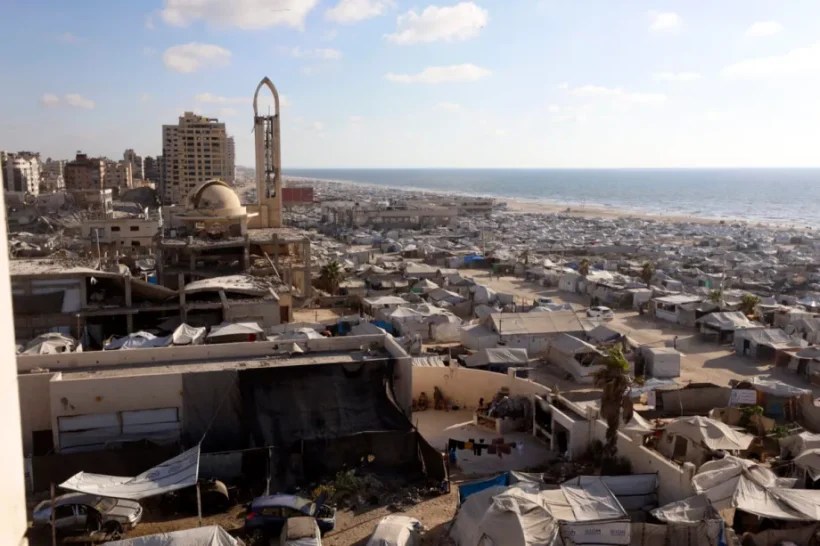
Displaced Palestinian families inside an overcrowded makeshift tent camp alongside Gaza City, Gaza, Palestine on June 22, 2026. [Ahmed Jihad Ibrahim Al-arini – Anadolu Agency]
The Board of Peace announced on Tuesday the arrival of the first “tactical vehicles” at the base of the International Security Force (ISF) in the Gaza Strip, as logistical preparations continue for the deployment of a multinational force in the enclave, Anadolu reports.
“Tactical vehicles arrive at Logistics Support Area: Endurance,” it said on the US social media company X.
The announcement was accompanied by photographs documenting the arrival of the vehicles.
A Hamas delegation arrived in Cairo on Tuesday for talks with Egyptian officials and mediators on implementing the Gaza ceasefire agreement.
The Board of Peace was established in January on the initiative of US President Donald Trump as part of efforts to reach a peaceful settlement in Gaza.
The first Board of Peace meeting on Gaza was held on Feb. 19 at the United States Institute of Peace in Washington under Trump’s leadership.
The initiative formed part of phase two of Trump’s 20-point plan aimed at ending the war in Gaza, backed by a UN Security Council Resolution from last November.
The first phase of the ceasefire agreement included a truce and prisoner exchange between Israel and Palestinian factions, a permanent ceasefire, as well as a gradual Israeli withdrawal from the enclave. Israel, however, has continued to violate the agreement on a near-daily basis.
Under the second phase, Israel is expected to carry out further withdrawals from the territory, while an international stabilization force would assume security responsibilities, including facilitating the delivery of humanitarian aid and reconstruction materials.
With US support, Israel launched a genocidal war in Gaza in October 2023, killing more than 73,000 Palestinians and injuring over 173,000 others, most of them women and children, according to Palestinian figures.
This site is provided as a research and reference tool. Although we make every reasonable effort to ensure that the information and data provided at this site are useful, accurate, and current, we cannot guarantee that the information and data provided here will be error-free. By using this site, you assume all responsibility for and risk arising from your use of and reliance upon the contents of this site.
This site and the information available through it do not, and are not intended to constitute legal advice. Should you require legal advice, you should consult your own attorney.
Nothing within this site or linked to by this site constitutes investment advice or medical advice.
Materials accessible from or added to this site by third parties, such as comments posted, are strictly the responsibility of the third party who added such materials or made them accessible and we neither endorse nor undertake to control, monitor, edit or assume responsibility for any such third-party material.
The posting of stories, commentaries, reports, documents and links (embedded or otherwise) on this site does not in any way, shape or form, implied or otherwise, necessarily express or suggest endorsement or support of any of such posted material or parts therein.
The word “alleged” is deemed to occur before the word “fraud.” Since the rule of law still applies. To peasants, at least.
Fair Use
This site contains copyrighted material the use of which has not always been specifically authorized by the copyright owner. We are making such material available in our efforts to advance understanding of environmental, political, human rights, economic, democracy, scientific, and social justice issues, etc. We believe this constitutes a ‘fair use’ of any such copyrighted material as provided for in section 107 of the US Copyright Law. In accordance with Title 17 U.S.C. Section 107, the material on this site is distributed without profit to those who have expressed a prior interest in receiving the included information for research and educational purposes. For more info go to: http://www.law.cornell.edu/uscode/17/107.shtml. If you wish to use copyrighted material from this site for purposes of your own that go beyond ‘fair use’, you must obtain permission from the copyright owner.
DMCA Contact
This is information for anyone that wishes to challenge our “fair use” of copyrighted material.
If you are a legal copyright holder or a designated agent for such and you believe that content residing on or accessible through our website infringes a copyright and falls outside the boundaries of “Fair Use”, please send a notice of infringement by contacting atheonews@gmail.com.
We will respond and take necessary action immediately.
If notice is given of an alleged copyright violation we will act expeditiously to remove or disable access to the material(s) in question.
All 3rd party material posted on this website is copyright the respective owners / authors. Aletho News makes no claim of copyright on such material.