CIA Information Warfare Succeeds: Occupation of Afghanistan forced to continue, Trump’s real crimes in Afghanistan ignored
By Ben Barbour | Global Research | July 5, 2020
On July 1st the House Armed Services Committee voted to hinder Donald Trump’s ability to withdraw troops from Afghanistan. House Democrats on the committee teamed up with Republicans, including Liz Cheney (daughter of war-architect Dick Cheney), to pass an amendment to the National Defense Authorization Act “that prohibits Congress from spending money to pull US troops out of Afghanistan without first meeting a series of vague conditions that critics said appeared to prevent withdrawal.” Without any public debate the US will now continue its occupation after the CIA claimed that Russia paid Taliban-linked groups to kill American soldiers.
What’s the evidence? General John Nicholson speculated that Russia was arming the Taliban in 2017. In April 2019, three marines were killed in an attack that the Taliban claimed responsibility for. Unnamed intelligence officials believed that the Russians may have payed militants to attack US troops. In March 2020, The CIA concluded that the Russians were paying the bounties. They cited testimony from captured militants and pointed to a Seal Team Six raid of a Taliban outpost that resulted in the recovery of a half a million in cash.
That’s it. That’s all the information that the American public is allowed to know. It’s hardly even mentioned that the NSA disagreed with the CIA’s assessment, stating “the information wasn’t verified and that intelligence officials didn’t agree on it.” Furthermore, the Department of Defense (DOD) claimed that “to date, DOD has no corroborating evidence to validate the recent allegations found in open-source reports.” Americans are taking the CIA’s word as gospel.
How exactly did the CIA conclude that the half a million in cash came from Russia and not from Taliban opium trafficking operations? The US military claimed that 60% of the Taliban’s funding comes from the opium trade. Is $500,000 in cash unheard of in opium sales? Who are these captured militants that claimed that Russia payed bounties for dead American soldiers? Were these militants tortured by the CIA? The CIA has the largest torture program in the world. Is the information reliable or was the information obtained under dubious circumstances? How do we even know these militants actually made these claims?
The foundation of the assertions is also questionable. Americans are supposed to believe that the Taliban had to be prompted to attack American soldiers. The US has been occupying Afghanistan for nearly 20 years. The war in Afghanistan has resulted in over 2,400 dead American soldiers and over 38,500 dead civilians. US soldiers have been targeted by the Taliban and an assortment of other militant groups over the past 19 years. That’s the cost of occupation. If over 38,500 civilians have been killed, then there are a lot of angry Afghans that lost family members. Russia does not need to pay the Taliban or any militant group to attack US soldiers. This should not need explanation. The rush to accuse Trump of treason has made Americans lose their critical thinking skills.
More partisan liberals are upset about Trump’s inaction over unproven allegations of Russian bounties than they are by Trump’s record setting bombing campaign in Afghanistan:
“in 2019, according to figures released by Air Force Central Command, the United States ‘dropped more munitions on Afghanistan than in any other year over the past decade.’ More bombs were dropped in most months of 2019 than in any previous months since records were first made publicly available in 2009.”
These bombings led to a massive surge in civilian casualties. In one case, at least 30 pine nut farmers were killed in a drone strike that resulted in zero militants being killed. Where is the outrage over this? How many more Afghans are going to die if Trump is pressed to be even more unhinged to prove he is not a traitor? The end game is more death and more occupation.
This new scandal being pushed by the CIA also conveniently deflects from Trump’s real scandals in Afghanistan. In June, Trump signed an executive order “imposing sanctions on several individuals associated with the International Criminal Court (ICC).”
The ICC is investigating war crimes in Afghanistan. Their investigations include potential American war crimes. They may even involve Secretary of State Mike Pompeo: “Pompeo may be personally at risk for wrongdoing that the Court could uncover of CIA activities when he was the director of the agency.” The Trump administration is claiming that because the US has not ratified the Rome Statute, that the ICC has no legal basis to prosecute American war crimes. This is incorrect. The Rome Statute allows the ICC to prosecute non-party countries if war crimes are committed by that party in a country that has ratified the Rome Statute. Afghanistan has ratified the Rome Statue. That puts the US on the hook for potential war crimes committed in that region.
Needless to say, never-Trump neocons have been silent about Trump’s targeting of the ICC. Likewise, partisan liberals have not gone after Trump on this front either. The reasons are obvious. The Barack Obama and George W. Bush administrations are culpable in war crimes in Afghanistan as well. The nearly two-decades long war is a bipartisan project. Furthermore, self-professed left-wingers and liberals are taking their cues from Bush-era neocons like David Frum, Bill Kristol, and an assortment of pro-war goons from the Lincoln Project Political Action Committee.
Russiagate broke partisan liberals’ brains. They are now calling for Trump to ramp up escalation in Afghanistan. They actually believe the absurd over-the-top ads put out by the Lincoln Project. Donald Trump ramped up the war in Afghanistan in 2017 when he did a 3,500-troop surge from 10,500 to 14,000 troops. Trump then increased bombing campaigns throughout his term and set records for bombings in 2019. Civilians casualties spiked. In June 2020, he targeted the ICC for having the audacity to look into US war crimes.
None of this barbarism earned Trump the ire of prominent neoconservatives and liberals. Trump is being vilified for having talks with the Taliban and taking steps towards scaling-down US troop presence. After four years of Russiagate hysteria the only explanation for Trump’s actions is capitulation to Russia. Afghan civilians be damned, Trump needs to ramp up again in Afghanistan to stop Putin or he’s a traitor! The neocon dogma pushed onto liberals by never-Trump Republicans did its job. Partisan liberals are parroting the line of the CIA. The attempt to sabotage talks with the Taliban and prevent troop withdrawals from Afghanistan worked.
“The Resistance” just helped push the continued occupation of Afghanistan to score cheap political points. The CIA thanks them for their “patriotism.”
Ben Barbour is an American geopolitical analyst.
Afghan Bounty Scandal Comes at Suspiciously Important Time for US Military Industrial Complex
By Alan MacLeod | MintPress News | July 1, 2020
Based on anonymous intelligence sources, The New York Times, Washington Post, and Wall Street Journal released bombshell reports alleging that Russia is paying the Taliban bounties for every U.S. soldier they can kill. The story caused an uproar in the United States, dominating the news cycle and leading presumptive Democratic presidential candidate Joe Biden to accuse Trump of “dereliction of duty” and “continuing his embarrassing campaign of deference and debasing himself before Vladimir Putin.” “This is beyond the pale,” the former vice-president concluded.
However, there are a number of reasons to be suspicious of the new reports. Firstly, they appear all to be based entirely on the same intelligence officials who insisted on anonymity. The official could not provide any concrete evidence, nor establish that any Americans had actually died as a result, offering only vague assertions and admitting that the information came from “interrogated” (i.e. tortured) Afghan militants. All three reports stressed the uncertainty of the claims, with the only sources who went on record — the White House, the Kremlin, and the Taliban — all vociferously denying it all.
The national security state also has a history of using anonymous officials to plant stories that lead to war. In 2003, the country was awash with stories that Saddam Hussein possessed weapons of mass destruction, in 2011 anonymous officials warned of an impending genocide in Libya, while in 2018 officials accused Bashar al-Assad of attacking Douma with chemical weapons, setting the stage for a bombing campaign. All turned out to be untrue.
“After all we’ve been through, we’re supposed to give anonymous ‘intelligence officials’ in The New York Times the benefit of the doubt on something like this? I don’t think so,” Scott Horton, Editorial Director of Antiwar.com and author of “Fool’s Errand: Time to End the War in Afghanistan,” told MintPress News. “All three stories were written in language conceding they did not know if the story was true,” he said, “They are reporting the ‘fact’ that there was a rumor.”
Horton continued: “There were claims in 2017 that Russia was arming and paying the Taliban, but then the generals admitted to Congress they had no evidence of either. In a humiliating debacle, also in 2017, CNN claimed a big scoop about Putin’s support for the Taliban when furnished with some photos of Taliban fighters with old Russian weapons. The military veteran journalists at Task and Purpose quickly debunked every claim in their piece.”
Others were equally skeptical of the new scandal. “The bottom line for me is that after countless (Russiagate related) anonymous intelligence leaks, many of which were later proven false or never substantiated with real evidence, I can’t take this story seriously. The intelligence ‘community’ itself can’t agree on the credibility of this information, which is similar to the situation with a foundational Russiagate document, the January, 2017 intelligence ‘assessment,’” said Joanne Leon, host of the Around the Empire Podcast, a show which covers U.S. military actions abroad.
Suspicious timing
The timing of the leak also raised eyebrows. Peace negotiations between the U.S. and the Taliban are ongoing, with President Trump committing to pulling all American troops out of the country. A number of key anti-weapons of mass destruction treaties between the U.S. and Russia are currently expiring, and a scandal such as this one would scupper any chance at peace, escalating a potential arms race that would endanger the world but enrich weapons manufacturers. Special Presidential Envoy in the Department of the Treasury, Marshall Billingslea, recently announced that the United States is willing to spend Russia and China “into oblivion” in a new arms race, mimicking the strategy it used in the 1980s against the Soviet Union. As a result, even during the pandemic, business is booming for American weapons contractors.
“The national security state has done everything they can to keep the U.S. involved in that war,” remarked Horton, “If Trump had listened to his former Secretary of Defense James Mattis and National Security Advisor H.R. McMaster, we’d be on year three of an escalation with plans to begin talks with the Taliban next year. Instead Trump talked to them for the last year-and-a-half and has already signed a deal to have us out by the end of next May.”
“The same factions and profiteers who always oppose withdrawal of troops are enthusiastic about the ‘Bountygate’ story at a time when President Trump is trying to advance negotiations with the Taliban and when he desperately needs to deliver on 2016 campaign promises and improve his sinking electoral prospects,” said Leon.
If Russia is paying the Taliban to kill Americans they are not doing a very good job of it. From a high of 496 in 2010, U.S. losses in Afghanistan have slowed to a trickle, with only 22 total fatalities in 2019, casting further doubt on the scale of their supposed plan.
Ironically, the United States is accusing the Kremlin of precisely its own policy towards Russia in Syria. In 2016, former Acting Director of the C.I.A. Michael Morell appeared on the Charlie Rose show and said his job was to “make the Russians pay a price” for its involvement in the Middle East. When asked if he meant killing Russians by that, he replied, “Yes. Covertly. You don’t tell the world about it. You don’t stand up at the Pentagon and say, ‘We did this.’ But you make sure they know it in Moscow.”
Like RussiaGate, the new scandal has had the effect of pushing liberal opinion on foreign policy to become far more hawkish, with Biden now campaigning on being “tougher” on China and Russia than Trump would be. Considering that the Bulletin of Atomic Scientists recently set their famous Doomsday Clock — an estimation of how close they believe the world is to nuclear armageddon — to just 100 seconds to midnight, the latest it has ever been, the Democrats could be playing with fire. The organization specifically singled out U.S.-Russia conflict as threatening the continued existence of the planet. While time will tell if Russia did indeed offer bounties to kill American troops, the efficacy of the media leak is not in question.
Alan MacLeod is a Staff Writer for MintPress News. After completing his PhD in 2017 he published two books: Bad News From Venezuela: Twenty Years of Fake News and Misreporting and Propaganda in the Information Age: Still Manufacturing Consent.
Senate kills bipartisan bill to end war in Afghanistan & repeal 2001 Terror War authorization
RT | July 1, 2020
The US Senate has voted to table a bill that would have ended the war in Afghanistan and repealed the 2001 law authorizing the War on Terror, shooting down a rare attempt to wind down the longest conflict in American history.
Lawmakers voted 60-33 on Wednesday to kill legislation introduced by Senators Rand Paul (R-Kentucky) and Tom Udall (D-New Mexico) as an amendment for a broader defense spending bill. Dubbed the AFGHAN Act, the measure would have directed the Pentagon to begin an “orderly withdrawal” from Afghanistan and pay a $2,500 bonus to American soldiers.
Ahead of the vote, Senator Paul castigated the nearly 20-year-old conflict as wasteful of American lives and tax dollars, urging lawmakers to send the troops home.
“It is not sustainable to keep fighting in Afghanistan generation after generation,” Paul said on the Senate floor, noting that some of the soldiers taking part in the conflict were not even born when it was launched in 2001. “Many people have said we should end the war. Today you get to vote.”
First introduced last year, the amendment also would have repealed the 2001 Authorization for Use of Military Force (AUMF) enacted in response to the September 11 attacks, which has been invoked to justify military action around the globe. Since the US invasion of Afghanistan, the AUMF has been cited dozens of times to authorize deployments, bombings or other armed operations in at least 14 countries.
Though a deal struck between Washington and the Taliban earlier this year initiated a phased withdrawal of the roughly 12,000 US soldiers stationed in the country, some 8,600 troops still remain there. The administration has reportedly mulled removing another 4,000 by the fall, but has yet to announce a decision. While US officials, including CENTCOM commander Frank McKenzie, say the Taliban has avoided attacks on coalition forces in recent months, ongoing disputes between the militant group and the Afghan government still threaten to derail the withdrawal deal.
Russian ‘bounty killing’ forces Trump’s hands on troop withdrawal from Afghanistan
By M. K. BHADRAKUMAR | Indian Punchline | July 1, 2020
As expected, the controversy over Russia’s alleged bounties for killing American and NATO troops in Afghanistan is steadily snowballing. The New York Times has come out with more leaks such as bank transfers from accounts identified with the Russian military intelligence to the Taliban, “hawala” transactions as well as the Afghan government’s assistance to the US intelligence to zero in on the Russian-Taliban nexus.
Meanwhile, the US Congress is seized of the matter, possibly triggering another “Russiagate”. The Democrats are on the warpath. Top White House aides are briefing the Senate Intelligence Committee later today.
The Times also featured today an Op-Ed on this topic by former National Security Advisor Susan Rice, who is widely mentioned as a possible vice-presidential running mate on the Democratic presidential nominee Joe Biden’s ticket in the November elections. Rice tore into President Trump and his key aides.
To be sure, the controversy will seriously impact the endgame in Afghanistan. The first sign of it appeared on Tuesday when Secretary of State Mike Pompeo held a video conference with the Taliban’s deputy head and chief negotiator at Doha, Mullah Baradar. The White House readout said Pompeo discussed with the Taliban leader the implementation of the Doha pact of February on the Afghan peace process and “made clear the (US) expectation for the Taliban to live up to their commitments, which include not attacking Americans.”
Evidently, the White House is directly warning the Taliban against any attacks on the US troops. An AP report cited the Taliban spokesman Suhail Shaheen as tweeting that Pompeo and Baradar also “discussed ways of moving … forward” the implementation of the Doha pact.
The White House is anxious that the intra-Afghan peace talks should take place without further delay so that the US troop withdrawal can be announced. There were reports recently that a decision to withdraw another 4,000 American troops out of the 8,600-strong contingent is under consideration.
In the light of the present controversy over alleged Russian bounty killings and given the likelihood of Congressional hearings, Trump will be keen to summarily withdraw all troops from Afghanistan. The US special representative for reconciliation with the Taliban Zalmay Khalilzad has also reached Doha for discussions with Mullah Baradar.
All in all, the series of Times reports since June 26 has compelled the White House to kickstart the intra-Afghan peace talks somehow, where a complete ceasefire tops the agenda of discussion. The Times reports significantly weaken the US’ capacity to influence the outcome of the intra-Afghan peace talks.
The US stands badly isolated in the region. The controversy over bounty killings has upset Moscow and in turn makes it impossible to carry forward any US-Russian cooperation and coordination over the intra-Afghan peace talks, as was envisaged earlier.
At the same time, the US-China tensions are spinning out of control and Washington is no longer in a position to leverage Beijing’s cooperation in the Afghan peace process. Similarly, Washington is on a collision course with Tehran following Pompeo’s appearance at the UN Security Council on Tuesday to formally table the US proposal seeking an extension of the UN embargo on arms supplies to Iran.
Russia and China have made it clear that they will veto any such US resolution, which, in turn, may lead to Pompeo pressing a claim to invoke the snapback clause of the Iran nuclear deal to kill the 2015 agreement. Heightened tensions can be expected between Washington and Tehran in the weeks and months ahead.
With Russia, China and Iran on a path of confrontation with the US, the burden falls entirely on the Trump administration to carry froward the Afghan peace process. The US’ reliance on Pakistan becomes more critical than ever before. (Khalilzad is set to travel to Islamabad this week.)
Clearly, the initiative is slipping out of the American hands to script its exit strategy in Afghanistan. To be sure, Taliban will negotiate from a position of strength. Mullah Baradar reportedly made humiliating demands to Pompeo during the videoconference yesterday.
Given the unfriendly mood in the three key regional capitals — Moscow, Tehran and Beijing — Washington may be left with no choice now but to cut loose and make its way for the exit door as quickly as possible. Trump will not risk a prolonged stay for the troops in Afghanistan.
Curiously, there is an eerie similarity to the Afghan situation around the Geneva Accords of April 1988 between Afghanistan and Pakistan, with the US and the Soviet Union serving as guarantors.
The Geneva Accords had envisaged a matrix of several elements — principally, a bilateral agreement between Islamabad and Kabul on the principles of mutual good neighbourly relations; a declaration on international guarantees, signed by the Soviet Union and the US; and a Pak-Afghan agreement on the interrelationships for the settlement of the Afghan situation as such, which was witnessed by the Soviet Union and the US.
It was an impressive peace agreement but it was still-born and its only positive outcome was that Moscow faithfully (and eagerly) observed the agreement’s provisions for the timetable of the withdrawal of Soviet troops from Afghanistan. (The Soviet contingent completed the withdrawal on 15th February 1989.)
The intra-Afghan peace talks will also be taking place in a dismal setting involving two intransigent protagonists (Afghan government and Taliban), and two “guarantors” (the US and Pakistan) pursuing different priorities. Again, the only positive outcome of the intra-Afghan peace talks might be that it will have put an end to the 2-decade old American occupation of Afghanistan.
‘Russian bounty’ story shifts: NYT now claims Afghan CRIMINALS & not Taliban were paid, cites anonymous sources again
RT | June 30, 2020
The New York Times is doubling down on claims that Russia offered bounties for the killing of US troops in Afghanistan, but now says local criminals and not the Taliban were the recipients, again offering no actual evidence.
The new article, published Tuesday, says that “electronic data showing large financial transfers from a bank account controlled by Russia’s military intelligence agency to a Taliban-linked account” was intercepted by US spies and “bolsters suspicions” that Russia offered bounties to militants – as claimed by the Times last week.
Once again, the Times quotes anonymous sources – “three officials familiar with the intelligence” – so the claim is impossible to verify. No evidence of the alleged electronic transfer is provided, only a third-hand hearsay that “analysts concluded from other intelligence that the transfers were most likely part of a bounty program.”
The article eventually gets around to quoting several local officials from Afghanistan, who say that several people who transfer money through an Islamic banking system are “suspected of being part of a ring of middlemen” between Russia and “Taliban-linked militants.”
The ‘hawala’ banking system does not actually use electronic transfers. Moreover, the article says the Afghan security forces found “a half-million dollars” – presumably in cash – in one Kabul home about six months ago. Safiullah Amiry, described as “the deputy provincial council chief” in Kunduz, “said the Afghan intelligence agency had told him the raids were related to Russian money being dispersed [sic] to militants.”
In the original article, the Times claimed President Donald Trump had been briefed on this alleged plot sometime in March. The White House, the CIA and the Office of the Director of National Intelligence have since denied this.
So the narrative has now shifted, with the Times citing “two officials” who say the information was included in Trump’s written presidential daily brief (PDB) “in late February,” accompanied by the – likewise unverified – claim that Trump typically doesn’t read those. The article also claims the CIA mentioned the intelligence in its World Intelligence Review newsletter, also known as The Wire, dated May 4.
The identity of the suspected recipients of the “Russian bounties” has shifted as well, from the Taliban to “criminals closely associated with the Taliban” – according to yet another anonymous US official.
Most mainstream US media outlets and the Democrats have taken the original New York Times reporting at face value, denouncing Trump as “Putin’s puppet” and a traitor for allegedly not doing anything to “punish Russia” based on the purported intelligence assessments, rather than demanding to see evidence there was anything to it.
Afghanistan Bounties: Pot, Meet Kettle (and Turn Off the Stove!)
By Thomas L. Knapp | The Garrison Center | June 29, 2020
“American intelligence officials have concluded that a Russian military intelligence unit secretly offered bounties to Taliban-linked militants for killing coalition forces in Afghanistan,” claims the New York Times.
More controversially, the authors write that US president Donald Trump was briefed on the assessment (he denies it) and the piece’s tag line says that his administration “has been deliberating for months” on how to respond (he says the US intelligence community didn’t find the claims credible).
Naturally, the response preferred by those who buy the Times‘s version of events is:
First, make domestic political hay with it. Sure, trying to frame Trump as a Russian asset has backfired spectacularly every time it’s been tried, but sooner or later it’s bound to work, right?
Second, make foreign policy hay with it. Punish the Russians until they’ve been baited back to full-blown Cold War levels of enmity, all the while whining that “they hate us for our freedom.”
I’ve got a better plan.
First, reduce the US military presence in Afghanistan to zero. If there aren’t any US forces in Afghanistan, no US forces in Afghanistan will be in danger due to supposed “Russian bounties.”
Second, ignore — forget! — the slim possibility that Russian bounties were behind any American deaths.
Problems solved.
Why should the US let the Russians off the hook and quit worrying about it? Here’s why:
To date, fewer than 2,500 Americans have died in Afghanistan in nearly 19 years of war.
The Russians’ 1979-1989 Afghan war lasted about half as long. Their toll was 15,000 dead.
Why didn’t the Russians get off as lightly as the Americans?
Because the US government spent at least $3 billion directly funding and arming groups like al Qaeda to fight the Russians in Afghanistan (through the CIA’s “Operation Cyclone”), and billions more indirectly via the Pakistani government.
Even counting only the known direct aid, that amounts to a $200 in-kind bounty for every dead Russian soldier. $200 was a pretty sweet paycheck, more than Afghanistan’s per capita GDP during most of that period.
If there is a Russian bounty program on US troops in Afghanistan now, it’s clearly been less successful than the equivalent US program was 30-40 years ago. And with that program, the US government gave up any conceivable standing to complain about a Russian remix.
That supposed remix is just one more reason, from among a long list of good reasons, to bring the troops home from Afghanistan.
Thomas L. Knapp (Twitter: @thomaslknapp) is director and senior news analyst at the William Lloyd Garrison Center for Libertarian Advocacy Journalism (thegarrisoncenter.org).
Taliban Refute Reports on Russia’s Alleged Role in Killings of US Troops in Afghanistan
Sputnik – 27.06.2020
KABUL – Taliban spokesman Zabihullah Mujahid refuted on Saturday the recent reports citing US intelligence assessments alleging that Russian intelligence has solicited killings of US troops by the Taliban in Afghanistan, saying that these rumors are set to create obstacles to US pullout from the country.
According to Mujahid, all weapons and tools used by the movement were already present in the country or captured from the opposition. The spokesman stressed that the Taliban’s activities are not related to any intelligence organ or foreign country.
Mujahid stated that the Taliban was committed to the deal with the United States, saying that its implementation would ensure comprehensive peace and stability in Afghanistan.
On Friday, The New York Times published an article where it cited unnamed government sources as saying that US President Donald Trump was presented with an intelligence report that claimed that Moscow could have payed bounty to armed Islamic insurgents in Afghanistan to assassinate US soldiers. The outlet said Trump had so far failed to act on the report.
In February, the US and the Taliban signed a peace deal that concluded rounds upon rounds of talks pursuing to launch the reconciliation process in Afghanistan after almost two decades of armed conflict and insurgency.
Last week, US Special Representative for Afghanistan Zalmay Khalilzad said that intra-Afghan talks were closer than ever after Kabul and the Taliban carried out a significant exchange of prisoners.
Cut Overseas Police Training Programs

Photograph Source: Lorie Shaull from St Paul, United States – CC BY-SA 2.0
By Jeremy Kuzmarov | CounterPunch | June 15, 2020
The police killing of George Floyd in Minneapolis has ignited protests across the United States and calls to demilitarize and defund the police.
A similar demand should be made to cut overseas police training programs including in Afghanistan.
The U.S. government has long adopted overseas police training as a cornerstone of nation building and counterinsurgency programs.
The idea is that American police will instill professional and democratic standards, including a respect for civil liberties among foreign counterparts and help stabilize violence prone countries.
The Floyd killing has exposed, however, that American police lack professional and humane standards and need to be retrained and reformed. They are ill suited to improve other countries’ police.
In Afghanistan, where the U.S. has spent an estimated $87 billion dollars over nineteen years training security forces, the police are notorious for corruption, sectarianism, incompetence and brutality.
In an interview quoted in the Afghanistan Papers, Thomas Johnson, a Navy official who served as a counterinsurgency adviser in Kandahar province, said that Afghans viewed the police as predatory bandits, calling them “the most hated institution” in Afghanistan.
This latter outcome resulted in part from the militarized tactics promoted by American advisers and their importation of police technologies which could be used for repressive ends.
In Honduras, where the U.S. expanded police aid following a 2009 coup d’états that ousted the mildly progressive José Manuel Zelaya, American trained units have been implicated in torture and drug related corruption, and carried out predawn raids of activists involved in protesting contested elections.
These units were trained under an initiative promoted by President Obama and extended by Trump that provided hundreds of millions of dollars for law enforcement training and assistance, mostly under the War on Drugs.
In the early 1960s, the Kennedy administration created the United States Agency for International Development’s infamous Office of Public Safety (OPS), to modernize the police forces in countries considered vulnerable to communist subversion.
Headed by CIA agent Byron Engle, who combined a deep commitment to civilian police work with an appreciation for the darker areas of political police intelligence, the OPS initially employed liberal reformers.
As political policing gained primacy, however, OPS agents became contemptuous of human rights and imported policing technologies that were used to hunt down dissidents and violently quell protests.
Charles Maechling Jr., staff director of the Special Group on Counterinsurgency under Kennedy, acknowledged that in failing to “insist on even rudimentary standards of criminal justice and civil rights, the United States provided regimes having only a façade of constitutional safeguards with up-dated law enforcement machinery readily adaptable to political intimidation and state terrorism. Record keeping in particular was immediately put to use tracking down student radicals and union organizers.”
By 1973, the OPS was abolished by Congress because of its connection to torture carried out by U.S. trained police forces in South Vietnam and Brazil.
Many OPS veterans subsequently returned to work for police forces back in the U.S., where some continued to promote tactics that encouraged police abuse, including in the suppression of urban riots.
Unfortunately, there is a long pattern of abuse in American police forces, that overseas police programs have helped to compound.
As momentum grows for a transformation of the police, activists should be demanding an end to the practice of exporting police repression and a change to the American approach towards foreign policy more broadly.
Jeremy Kuzmarov is the author of The Russians are Coming, Again: The First Cold War as Tragedy, the Second as Farce (Monthly Review Press, 2018) and Obama’s Unending Wars: Fronting for the Foreign Policy of the Permanent Warfare State (Atlanta: Clarity Press, 2019).
International Criminal Court Expresses Regret Over US Sanctions, Vows to Continue Work
Sputnik – June 12, 2020
The International Criminal Court (ICC) has expressed regret over the US decision to target its officials with sanctions and expressed determination to continue its work.
“The International Criminal Court expresses profound regret at the announcement of further threats and coercive actions, including financial measures, against the Court and its officials, made earlier today by the Government of the United States”, the ICC said in a statement on late Thursday.
According to the Court’s statement, the US move is one of a series of unprecedented attacks on the ICC and on the Rome Statute system of international criminal justice, which reflects the commitment and cooperation of the ICC’s 123 States Parties.
“The ICC stands firmly by its staff and officials and remains unwavering in its commitment to discharging, independently and impartially, the mandate bestowed upon it by the Rome Statute and the States that are party to it”, the statement added. “An attack on the ICC also represents an attack against the interests of victims of atrocity crimes, for many of whom the Court represents the last hope for justice. As it continues to meet its mandated responsibilities, the Court relies on the staunch support and cooperation of its States Parties”.
On Thursday, the White House announced that US President Donald Trump had issued an executive order authorizing sanctions against ICC officials who are investigating potential war crimes committed by US soldiers in Afghanistan.
In March, the International Criminal Court (ICC) approved the commencement of an investigation into alleged war crimes committed by parties to the Afghan conflict, including US military personnel.
Kabul ready to start intra-Afghan peace talks with Taliban: Abdullah
Press TV – May 30, 2020
A senior Afghan official tasked with leading the much-awaited intra-Afghan peace negotiations with the Taliban militant group says his team is ready to commence talks “at any moment” with the militants.
Abdullah Abdullah, the head of Afghanistan’s High Council for National Reconciliation (HCNR), made the comment on Saturday at his first press conference since taking the role, saying the lull in violence created by an unexpected truce offered by the Taliban had set the tone for starting the peace talks.
“The announcement of the ceasefire, a reduction in violence and the exchange of prisoners have all paved the way for a good beginning,” Abdullah said, adding, “The negotiating team is ready to begin the talks at any moment.”
After months of political crisis over the outcome of a disputed September presidential election, which declared Ashraf Ghani as the president for a second term, Abdullah, Ghani’s bitter rival, agreed to ink a power-sharing deal with the incumbent president.
Part of the agreement is that Abdullah henceforth heads Kabul’s negotiating team in its intra-Afghan peace talks with the Taliban militant group, which has already controls large parts of the war-torn country.
Kabul responded to the ceasefire by releasing some 1,000 Taliban inmates this week, and plans to further free an equal number of prisoners in the coming days.
The militant group, for its part, has said that it plans to release another group of government prisoners. The Taliban have so far freed around 300 Afghan security force personnel.
The Taliban-proposed three-day ceasefire was held over the Eid al-Fitr, which marks the end of the holy fasting month of Ramadan. Although the truce, in effect from Sunday through Tuesday, maintained relative peace across the country, it was soon followed by deadly attacks on security forces.
Afghan officials blamed the attacks on the Taliban.
A peace deal inked between the United States and the Taliban on February 28 stipulated that the Taliban stop their attacks on foreign forces in return for the US military’s phased withdrawal from Afghanistan and also a prisoner exchange between the group and the government in Kabul, which was excluded from the talks.
The prisoner swap is regarded as a confidence-building move ahead of long-awaited peace talks between Kabul and the militant group, which rejected a government offer of truce for the duration of Ramadan and continued its attacks.
Nearly 14,000 US troops and 17,000 troops from NATO allies and partner countries remain stationed in Afghanistan years after the invasion of the country that toppled a Taliban regime in 2001.
Afghan endgame enters the home stretch
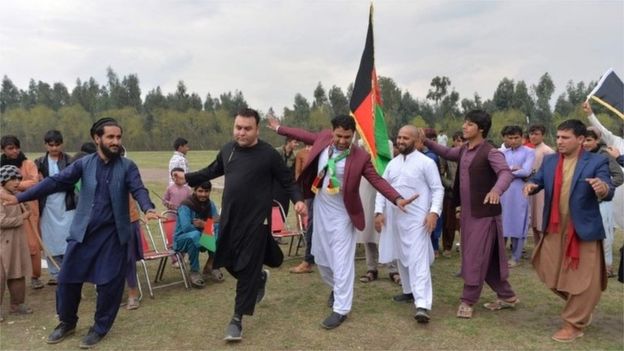
Afghans celebrating the US-Taliban agreement of 29th February 2020, Jalalabad, Nangarhar province, Afghanistan
By M. K. BHADRAKUMAR | Indian Punchline | March 24, 2020
In an extraordinary statement titled On the Political Impasse in Afghanistan, Washington has admitted the failure of Secretary of State Mike Pompeo’s mission to Kabul on Monday to heal the political rift among Afghan politicians and to urge them to form an inclusive government so as to implement the Doha pact of February 29.
In exceptionally strong words, Washington flagged its disappointment over the political rift between the factions led by Ashraf Ghani and Abdullah Abdullah respectively, which has “harmed U.S.-Afghan relations and, sadly, dishonours those Afghan, Americans, and Coalition partners who have sacrificed their lives and treasure” in the 18-year old war.
No sooner than the failure of Pompeo’s mission became clear, the state department disclosed that the Trump administration is cutting back its aid to the Afghan government — “a responsible adjustment to our spending in Afghanistan” by $1 billion immediately and another $1 billion next year — and will also “initiate a review of all of our programs and projects to identify additional reductions, and reconsider our pledges to future donor conferences for Afghanistan.” A calibrated Plan B with President Trump’s approval is unfolding, for sure.
Importantly, the state department statement added ominously, “We have made clear to the (Kabul) leadership that we will not back security operations that are politically motivated, nor support political leaders who order such operations those who advocate for or support parallel government.”
The reference is unmistakably to the the troika of hardliners surrounding Ghani, comprising “Vice-President” Amrullah Saleh, NSA Hamdullah Mohib and Defence Minister Asadullah Khalid.
However, the state department statement leaves the door open to “revisit the reviews initiated”, provided the Afghan leaders “choose to form an inclusive government that can provide security and participate in the peace process.”
The alacrity with which this statement has come implies that President Trump directed Pompeo to convey to the Kabul elite that his patience has run out and to reiterate that no matter the shenanigans of Afghan politicians, “We are proceeding with the conditions-based withdrawal of our forces in accordance with the U.S.-Taliban agreement.”
This is the nearest Trump has come to threatening that if push comes to shove, he may unilaterally end the war and wash his hands of it.
Evidently, Washington is calling Ghani’s bluff who bragged recently that Kabul has the necessary resources to carry on for at least two years even without any US assistance, signalling his grit to dissociate from the US’ peace talks with the Taliban.
On its part, Washington has put Ghani on notice that if the game plan of the hardliners in his circle is to precipitate security situations with a view to drag the US military into violent confrontations with the Taliban and thereby destroy the understanding forged painstakingly through the negotiations in Doha during the past year and more, that won’t happen.
Equally, Washington has distanced itself from the political rift between Ghani and Abdullah by making it clear that it has no favourites.
The startling development has three dimensions to it. First and foremost, will the Trump administration’s shock therapy have a sobering effect on the rival Afghan factions locked in a struggle for power?
The answer is, unfortunately, that such a probability is unlikely to happen as per current indications — given the vaulting ambitions of the protagonists. Both Ghani and Abdullah also have associates who would have their own agenda.
Having said that, Afghans also have a great tradition of reaching compromises and consensus at the last minute before an irrevocable break-up. Such a fortuitous turn of events can happen in the present circumstances only if Ghani accepts a coalition government with power-sharing of key security portfolios.
Arguably, the struggle may even take an ugly form and become “physical” unless great self-restraint is exercised. There are ominous reports that the warlords have come out of the woodwork and are marshalling their militia.
The government also commands shadowy militia groups beyond the pale of law who have been trained by the US to function as a state within the state. Indeed, Afghanistan has a violent history and its democratic temper is only skin-deep. Peaceful transfer of power is a recent phenomenon under the US diktat.
Second, what will be the impact on the security situation? The critical factor here is that, undeniably, there are ethnic undertones to the Ghani-Abdullah political rift and how they might impact the cohesion of the Afghan army and security forces is anybody’s guess. Of course, the US has been bankrolling the Afghan army.
To jog memory, it was Najib’s inability to pay the salaries of the Uzbek militia guarding Kabul city in the critical period since the Soviets withdrew aid that ultimately became a clincher for Rashid Dostum’s treacherous defection to the Mujahideen camp of Ahmed Shah Massoud that in turn resulted in the roof coming down on the communist regime.
Third, how will the Taliban react to these big shifts in the politico-military alignment? Clearly, the Taliban are already at peace with the US forces. Strict orders have been given to the commanders not to engage the US military.
Thus, the state department’s assurance that the US military will not be a party to any conspiracies by the hardliners in Kabul to precipitate confrontations with the Taliban becomes important. In good measure, Pompeo also flew to Doha to meet the Taliban leaders to discuss the current impasse. The Taliban will make careful note of Washington’s eagerness to stick to the Doha pact — and it will reciprocate.
Now, if Ghani resorts to delaying tactics much longer in releasing the Taliban, it may provoke the Taliban into ending the current (tacit) ceasefire and step up its operations against the Afghan security forces with a view to demoralise them.
There are also indications of the Taliban having infiltrated the Afghan army and police and security agencies.
Suffice to say, it will come as a surprise if the Taliban does not take advantage of a most conducive situation arising in Afghanistan — a rump administration ruling the roost in Kabul, lacking in political legitimacy (and the US distancing from it); the grim political struggle for supremacy amongst the Afghan factions that may take a violent form; the chain of command of Afghan forces coming under stress due to the ethnic fissures; and, the strong possibility of Trump unilaterally extricating the US out of the war at some point in a near future.
The big question is whether the Taliban will be savvy enough to wait for Kabul to fall like a rotten apple or will they hastily pluck it as a low-hanging fruit.
The bottom line is that the Taliban (and Pakistan which mentors it) would see that the political ascendance of the Taliban in Kabul, whenever it is due, happens with international legitimacy. The Trump administration’s stated preference still is to reach a negotiated peace settlement as envisaged under the Doha pact through intra-Afghan dialogue. And the Taliban too adheres to the Doha pact.
It is unlikely that the Taliban will opt for a decision to grab power through force. The preference at this stage will be to pitch for an interim government that is inclusive so as to carry as many Afghan factions as possible.
Make no mistake that time works in the Taliban’s favour. Unlike in the past, the Taliban has networked extensively with the international community in the recent years — especially with the major regional states — and its interest lies in securing world recognition for any future government under its leadership.
These sickening videos of Australian SAS troops murdering unarmed Afghan civilians are a disgrace to my country
By Damian Wilson | RT | March 18, 2020
The graphic footage, filmed by body cameras worn by the elite troops and broadcast on national television, must lead to the soldiers being tried for murder.
Australians always look forward to celebrating Anzac Day, but this year it will be different because a pall of shame has fallen over our armed forces thanks to a jaw-dropping TV expose aired this week that showed elite Aussie soldiers murdering Afghan civilians in cold blood when they were supposed to be protecting them from the Taliban.
While a four-year inquiry into the behavior of its soldiers in Afghanistan, by the Inspector General of the Australian Defence Force, is still to deliver on its investigation, the chances of alleged war crimes being swept under the rug thanks to lying soldiers misguidedly protecting their comrades, misinformation from witnesses, or from a political cover-up, have just been blown out of the water.
Thanks to whistleblower Braden Chapman, a former army intelligence officer who witnessed the atrocities first hand in 2012, no one can ignore the reality of what happened as the Aussie Special Air Services Regiment (SAS) stormed the dusty villages of Afghanistan in search of those it considered legitimate targets.
Among the alleged crimes, Chapman says he witnessed an army dog handler allowing his charge to chew on the head of a newly-murdered man, another where an elite troop punched a child in the face and a third showing a soldier seemingly in the grip of ‘blood lust’ firing indiscriminately and throwing thermal grenades from close range into a mud hut occupied by several Afghan combatants.
Then there is the execution of a young, apparently unarmed Afghan man in a quiet wheat field. Shot from a distance of around two meters, his killer seems indifferent to the fact that his act was being filmed.
Somehow, those involved in several of the incidents explored in the documentary had already faced investigation over their actions but were found to have acted lawfully. Looks like they might have some further questions to answer now.
The culprits will regret that alongside their modern-tech weapons and armor they wore high definition body cameras that caught some of the inhumanity, and equally grim audio commentary, during their operations to flush out enemy combatants.
Several of the worst offenders, caught clearly on camera apparently murdering Afghans with thermal grenades, guns and through severe beatings, are still serving in the ADF. Though probably not for much longer thanks to their grinning murderous faces being caught for posterity on 4K video.
As an Australian, I am deeply ashamed by these disgraceful, impossible to deny scenes.
Our armed forces, and particularly their courageous, selfless behavior abroad while on active duty have always been a source of immense pride to Aussies.
Anzac Day (April 25) is a national holiday in our country, initially instituted to celebrate the contribution of Australian and New Zealand soldiers toward the ultimately futile Gallipoli campaign in the First World War that cost the lives of nearly 12,000 soldiers from the two nations among an Allied total of 56,000. The day of remembrance later widened its scope to include the sacrifices by soldiers from Down Under in all wars.
Nowadays, far from being a relic of the past, Anzac Day is celebrated by an increasing number of young Australians, many of whom attend ceremonies swathed in Aussie flags, wearing green and gold T-shirts and beanies and with national flag temporary tattoos on their cheeks.
Across the country, dawn ceremonies are held in memory of the time of the original landing on the Gallipoli peninsula, after which many take a traditional ‘gunfire breakfast’ – coffee with added rum – in memory of the sustenance taken by Aussie soldiers before battle.
It’s all highly symbolic and reflective stuff. Not taken lightly nor ever mocked even by the usually irreverent Aussies.
So to have the reputation of Australian fighting men and women representing the nation abroad dragged through the mud by rogue murderers in disgraceful scenes, all caught on camera and broadcast on the national broadcaster’s foremost investigative affairs programme on a Monday evening, is a devastating blow to national pride.
To realise that some of these animals are still serving in the ADF takes your breath away. It’s as simple as Braden Chapman says: “You can’t shoot unarmed people and not call that murder.”
Damian Wilson is a UK journalist, ex-Fleet Street editor, financial industry consultant and political communications special advisor in the UK and EU.
Featured Video
Seyed M. Marandi: US-Iran War Inevitable: Kuwait and Bahrain May Fall
or go to
Aletho News Archives – Video-Images
From the Archives
Oil and the Israel Lobby
Reknowned economist M. Shahid Alam offers this excellent critique of Noam Chomsky’s defective analysis of the relative influence of Oil versus the Israel lobby over US foreign policy: … continue
Blog Roll
 Aletho News
- ICC ignored ‘very well-documented’ NATO crimes – ex-Libyan minister
- SNSC secretary dismisses US response to Iran’s conditions as ‘inadequate’
- Sanaa says Taiz roads open, secure for residents, warns Saudi forces
- Iraqi resistance group urges Saudi leadership to admit defeat, lift Yemen siege
- Trump’s Retreat: How Al-Aqsa Flood Took Down the US Empire
- Israel’s Military Actions in Lebanon Grossly Violate International Law — Lavrov
- Seyed M. Marandi: US-Iran War Inevitable: Kuwait and Bahrain May Fall
- Leaders Condemn Ansarallah Attack on Saudi Arabia While Ignoring Illegal War Against Yemen
- Leaked: Britain’s Covert Iraqi Psyops Network
- Yemeni Armed Forces Warn Airlines Against Using Saudi Airports, Exempt Mecca and Medina
- If Americans Knew
- After Oct 7, IDF policy allowed civilian casualties for even the lowest-ranking targets
- Israel’s Destruction of Southern Lebanon Intensified After the Cease-Fire
- The Last-Minute Decision That Gave Israel Its Name
- The American Conservative: How Trump Made the World Go Nuclear
- Meet the US generals and admirals advancing Israeli policy
- Opinion: Why news organizations should boycott Israel
- The Israeli witch hunt of Sami Abu Shehadeh exposes the lie of the ‘Jewish and democratic’ state
- No state has a ‘right’ to exist – least of all Israel
- Testimonies about Gaza’s civilian death toll expose Israel’s atrocities – Daily Update
- How Israel Conquered the Latin American Right
- No Tricks Zone
- New Study Suggests Large Regions Of The Pacific Ocean Have Been Cooling For The Last 80 Years
- Germany’s Green Energy Debacle: High Energy Costs Force Kahla Porzellan to Close After 182 Years!
- New Study: 50 Years Of The Most Aggressive ‘Net Zero’ Policies Can Only Affect The Global Climate By 0.03°C
- US September “Heat” Was No Record…Many Records Set Decades Ago
- Latest European Green Energy Debacle; Portugal’s Largest Flagship Solar Park Insolvent!
- Green Energy Debacle: German Expert Professor Fritz Vahrenholt Warns Of Severe Economic And Social Consequences
- Two More Paleo Reconstructions Affirm Meters-Higher Sea Levels Across Ireland, Brazil 7000-6000 Years Ago
- New Study: Earth And Venus Surface Warmth Largely Explained By Convection And Lapse Rate, Not CO2 Or Radiation
- 2025 Nature Paper Claiming Worsening Global Drought Gets RETRACTED …Heavily Flawed
- New Study: ‘Global Drought Shows No Detectable Recent Acceleration Under Climate Warming’

