Intra-Afghan dialogue gets kickstarted
By M. K. BHADRAKUMAR | Indian Punchline | March 10, 2020
Three significant things about Ashraf Ghani’s swearing-in ceremony in Kabul on Monday augur well for the implementation of the US-Taliban pact signed in Doha on February 29.
One, the US officials, civilian and military, made a full court appearance at the ceremony in Kabul, affirming their reconciliation with Ghani. The US special representative for Afghan reconciliation Zalmay Khalilzad and US General Scott Miller, the commander of the US-led international force in Afghanistan, attended Ghani’s inauguration, apart from the EU, UN and western diplomats.
Two, Pakistan Prime Minister Imran Khan felicitated Ghani. He wrote on his Twitter page,“[I] look forward to working with him [Ghani]. Pakistan will do everything it possibly can to bring peace and stability in our region.”
Islamabad and Washington held back from congratulating Ghani when his election victory was formally announced last month. Now they are moving in tandem to engage with the Ghani presidency.
Three, Ghani announced in his speech at the ceremony that he will issue an order on Tuesday itself on the release of the Taliban prisoners. Ghani expressed the hope that the Taliban will reciprocate by significantly reducing violence. Thereby, Ghani is signalling that he will not block intra-Afghan dialogue.
Furthermore, he added that the government’s negotiating team for the intra-Afghan dialogue will also be finalised by Tuesday.
What may be even more significant than the above is that the Taliban is not creating a ruckus over Ghani’s inauguration. A senior figure in the Taliban leadership, Amir Khan Motaqi who is based in Qatar sounded optimistic that peace negotiations with the Afghan government will be “easier” than the Taliban’s marathon talks with the United States (which took around a year and a half).
“We will reach a conclusion with Afghans in a better way – of course with Afghans who consider other Afghans’ interests and do not consider foreigners’ interests,” Motaqi said. Another senior Taliban figure, Anas Haqqani, who was freed from Bagram prison last November, called the release of 5,000 Taliban prisoners important and urged the speedy formation of the negotiating team from Kabul so that the intra-Afghan dialogue can commence on March 10, as envisaged under the Doha pact of February 29.
In sum, Ghani’s induction or his change of heart — depending on how one views it — gives traction to the US-Taliban pact signed in Doha.
Contrary to doomsday predictions that the political rift in Kabul between Ghani and the former chief executive Abdullah over the disputed election results — Abdullah held his own inaugural ceremony in Kabul on Monday — would undermine the US-Taliban pact, the opposite seems to be happening.
Ghani’s brinkmanship in recent weeks served its real purpose, which was to get US support for his presidency and also carve out for himself an influential role in the inter-Afghan dialogue.
Pakistan and the Taliban have wisely kept away from getting embroiled in the Ghani-Abdullah rift and left it to Khalilzad to pacify Ghani.
Ghani apparently didn’t need much persuasion to do the two things that are Khalilzad’s top priority — release of the prisoners and the launch of the intra-Afghan dialogue. It is a fair guess that Khalilzad has struck some sort of deal with Ghani regarding the uncertain future role of the latter’s presidency.
The Taliban’s flexibility to hold talks with the Afghan government could be one factor here. Conceivably, Pakistan would have persuaded the Taliban to show flexibility.
If so, this is brilliant a tactic on the part of Islamabad and the Taliban. For, once the intra-Afghan dialogue begins, a new dynamic will appear in any case, and, given the fragmentation in the opposite camp, with so many cliques and factions jostling for position, Taliban would have the inherent advantage of being the only cohesive group at the negotiating table.
US President Donald Trump acknowledged these ground realities when he said on March 6 while talking to reporters at the White House that the Taliban could “possibly” overrun the Afghan government after foreign troops withdraw from the country as part of the Doha agreement.
As Trump put it, “Countries have to take care of themselves. You can only hold someone’s hand for so long.” Asked if the Taliban could eventually seize power from the current US-backed government, Trump said it is “not supposed to happen that way but it possibly will.”
This is of course a hypothetical scenario, since it will not be in Pakistan and Taliban’s interest to grab power forcibly in Kabul. It is useful to remember how much the Taliban hankered after US and UN recognition for its regime in Kabul in the nineties.
Significantly, the joint statement on the US-Taliban pact agreed by Special Envoys and Special Representatives of the European Union, France, Germany, Italy, Norway, the United Kingdom, the United Nations and the United States of America on the occasion of the signing of the U.S.-Taliban Agreement in Qatar spells out the expectations regarding the Afghan transition and it is quite obviously based on the understanding reached between Khalilzad and the Taliban.
The following paragraphs merit attention:
- “Reaffirmed that the Islamic Emirate of Afghanistan is not recognised by the international community, and furthermore, the international community will not accept or support the restoration of the Islamic Emirate of Afghanistan.”
- “Welcomed the Taliban committing to join a political process and their prospective role in a new post-settlement Afghan Islamic government as determined by the intra-Afghan negotiations.”
However, there is the “known unknown”— how far the fragile Afghan state structure will hold through the stresses and strains of the period ahead — negotiations with the Taliban and a period of profound transition to an entirely new beginning of state-building.
Importantly, Abdullah’s coalition which opposes Ghani is also a coming together of non-Pashtun groups — Tajik, Hazara and Uzbek. The ethnic overtone is ominous.
When asked whether the Afghan government had the ability to defend itself from fighters after foreign forces pull out, Trump was brutally frank: “I don’t know. I can’t answer that question. We’ll have to see what happens.”
Indeed, what happens next will also significantly depend on Abdullah’s future moves. He and his associates have thrown their weight behind the intra-Afghan dialogue but it is unlikely they will accept Ghani’s leadership to navigate the peace process.
To be fair, Khalilzad tried hard for a Ghani-Abdullah reconciliation, but it didn’t work. The bitterness lingers because this was a patently rigged election and Ghani doesn’t have a legitimate mandate to rule.
Meanwhile, the drawdown of the US troops has begun. Washington is unlikely to get entangled in Afghan domestic politics. To quote Trump, “We can’t be there for the next 20 years. We’ve been there for 20 years and we’ve been protecting the country but we can’t be there for the next – eventually, they’re going to have to protect themselves.”
Washington’s focus is going to be on the reduction in violence (ceasefire) and on verifiable evidence of the Taliban’s commitment to severe links with al-Qaeda.
The bottom line is, as the sensational report by New York Times on Sunday — A Secret Accord with the Taliban: When and How US Would Leave Afghanistan — confirms, the Doha pact is only the tip of the iceberg.
A matrix of understanding between the US, Pakistan and the Taliban provides the underpinning for the incoming Afghan peace process and the road map leading to a transition, based on their mutual recognition of the legitimate interests of all three protagonists.
Could US face ‘criminal liability’ for torture program? ICC greenlights inquiry into Afghan war crimes
RT | March 5, 2020
The International Criminal Court (ICC) has approved a probe into alleged war crimes committed in Afghanistan by the US and other parties, potentially exposing Washington to legal repercussions for its nearly 20-year occupation.
Hailed as a landmark ruling, the panel of judges at The Hague reversed a decision by the court’s Pre-Trial Chamber denying the ICC prosecutor’s request to open a formal inquiry into crimes committed in connection with the conflict in Afghanistan. The previous decision not to pursue an investigation was reportedly influenced by the belief that the United States would not cooperate with the proceedings.
ICC prosecutor Fatou Bensouda said that there were ample grounds to begin an investigation into Taliban crimes, as well as an alleged torture program operated by Afghan authorities, the US military and the CIA. The court agreed on Thursday, authorizing the investigation.
The court’s decision was applauded by many – but some warned that expectations should be tempered.
Mark MacKinnon, a correspondent for Canada’s Globe and Mail, said that the ICC had done the “right thing” by pushing forward with the investigation.
“Powerful nations can’t be above international law, or the whole concept collapses,” he wrote.
The Center for Constitutional Rights described the ruling as “the first time senior US officials may face criminal liability for their involvement in the torture program” in Afghanistan.
The ruling marks a “good day” for the ICC, but it’s far from certain that the investigation will lead to formal charges, cautioned Kevin Jon Heller, an associate professor of international law at the University of Amsterdam.
The United States is not a member of the ICC, but Afghanistan is – leaving open the possibility that US crimes committed on Afghan soil could be prosecuted by the court.
Even if the inquiry exposes serious wrongdoing, it’s unclear how the ICC would proceed. US President Donald Trump has been an outspoken opponent of the Hague-based court, and even imposed travel restrictions and other sanctions against ICC employees.
Trump has slammed the ICC for its “broad” and “unaccountable” prosecutorial powers, and has repeatedly scoffed at the idea of US soldiers being charged with war crimes. In November, he pardoned two army officers facing war crimes charges for their actions in Afghanistan, and reinstated the rank of Edward Gallagher, a Navy SEAL who was accused of similar atrocities during his deployment in Iraq, but was ultimately cleared of most wrongdoing.
Trump puts Taliban deal back on track
By M. K. BHADRAKUMAR | Indian Punchline | March 5, 2020
A mini mutiny in Kabul against the US-Taliban deal has been nipped in the bud and it should sound warning bells in Washington that the real threat to peacemaking in Afghanistan comes from one principal source — the interest groups that monopolise state agencies and are loathe to transfer power. Isolating the Kabul clique amidst the country’s hopeless fragmentation becomes complicated and only the US can do it.
A powerful metaphor used by Peter Tomsen, President Ronald Reagan’s special envoy for Afghanistan during the jihad against the Soviets in the eighties, comes to mind. Ambassador Tomsen, despairing from his futile efforts to forge consensus among the squabbling Mujahideen groups (“Peshawar Seven”) even as the Soviet withdrawal was looming ahead said the whole exercise was turning out to be like a futile attempt to assemble frogs on a scale — when you put one, another already on the scale jump out, and so on.
No sooner than the US-Taliban agreement was signed in Doha on February 29, Afghan President Ashraf Ghani jumped out of the scale where the US special representative for Afghan reconciliation Zalmay Khalilzad had put him after months of persuasion.
Ghani sprang a surprise by saying he refused to countenance the release of Taliban prisoners, a key demand of the Taliban during the Doha negotiations and something which was written in black and white in the document signed on Feb. 29 with his prior knowledge and concurrence.
In fact, he had even dispatched officials from Kabul to Doha who met with the Taliban and had discussed the modalities of release of the prisoners. But then he changed his mind.
Ghani’s calculation was that his volte-face on the release of Taliban prisoners could be a deal breaker that would scuttle the intra-Afghan dialogue slated to begin on March 10.
Ghani was in a rebellious mood, goaded by the hardliners in his clique, and he almost succeeded. The Taliban retaliated by ending the reduction in violence agreement. Fighting resumed and as can be expected, Afghan government forces, unable to withstand the Taliban onslaught, sought US air cover, which led to US air attacks on the insurgents.
The detractors of the US-Taliban deal abroad promptly began celebrating that the US and Taliban were once again clashing and the Doha pact was unraveling within three days of its signing.
However, in a bold initiative, Trump called Mullah Abdul Ghani Baradar, the de-facto Taliban leader who conducted the negotiations in Doha with Khalilzad and shored up the fragile mutual confidence between the two sides.
Indeed, beyond the Doha pact, there is a matrix of mutual understanding that was painstakingly reached between the US and Taliban, with the strong support of Pakistan. Trump dwelt on it. (See my blog Afghan peace comes with caveats but can’t be snuffed out.)
From available accounts, Trump assured the Taliban that the US Secretary of State Mike Pompeo would intervene with Ghani and the prisoners will be released as the US had committed and that Washington expected the Taliban to continue to abide by the ‘reduction in violence’.
Trump has since publicly expressed the confidence that the violence will come down.
Quite obviously, Washington continues to place trust in the constructive role Pakistan has been playing.
Looking back, this war of nerves is directly linked to Ghani’s aversion to intra-Afghan dialogue, which he fears will inevitably lead to the formation of an interim government at some point in the near future necessitating his stepping down. The US is yet to congratulate Ghani on his recent victory in the rigged presidential election and prevailed upon him to defer his swearing-in ceremony.
We have curious line-up today — the (non-Taliban) Afghan opposition to Ghani and his clique (which is by far the majority opinion in the country) looks forward to the inter-Afghan dialogue and reconciliation with the Taliban and is supportive of the US-Taliban deal and the peace process envisaged under it, while Ghani and his circle undermine the entire process that Khalilzad painstakingly negotiated.
Ghani is biding time and hopes to insert Afghan reconciliation as a controversial issue in the US presidential election campaign ahead and hopes to get support from the Democrats who would be inclined to demand the centrality of human rights issues in any deal with the Taliban.
Ghani is overreaching. The plain truth is that his regime has no popular support among Afghans and he still remains a creation of the Americans, which is why the international community learned to live with him in the first instance.
His henchmen also have no political base. Ghani has no political base among Pashtuns. As for Amrullah Saleh, his main associate, he was originally trained and groomed by the Americans as an intelligence officer, and although notionally a Panjshiri, he is no successor to Ahmed Shah Massoud. These are the stark realities.
Clearly, the main threat to the Afghan peace process comes from the rejectionist Afghan faction of time-servers in the Ghani government. It is about time the Americans crack the whip and read the riot act to them.
An interview on March 2 by the US Secretary of State Mike Pompeo with Bret Baier of Special Report suggests that Washington is willing to do just that. Khalilzad is back in Kabul.
The good part is that the opposition to Ghani led by Abdullah is rallying behind the US-Taliban pact. Khalilzad has met with former president Hamid Karzai, Abdullah Abdullah and other opposition leaders (erstwhile Northern Alliance resistance figures), all of whom have thrown their weight behind the US-Taliban pact.
Pompeo’s interview gives us a feel of Trump’s phone conversation with Mullah Baradar. The US Defence Secretary Mark Esper said on Monday that the drawdown of troops in Afghanistan will begin before March 10. For the present, things are back on track. As Pompeo put it,
“I met with them (Mullah Baradar) myself when I was in Doha. I looked them in the eye. They revalidated that commitment (to renounce al-Qaeda and reduce violence). Now they’ve got to execute it. Now we’ll be able to see, the world will be able to see, if they truly live up to that obligation. It’s important because that’s the reason we went there, Bret.”
The fact that Trump took time out amidst all the excitement over “Super Tuesday” to personally intervene with the Taliban leadership at the highest level underscores that this is one foreign-policy achievement of his administration to which he attaches the greatest importance. And that is the best guarantee of its success.
Spike in suicides amongst veterans of British military campaigns in Afghanistan
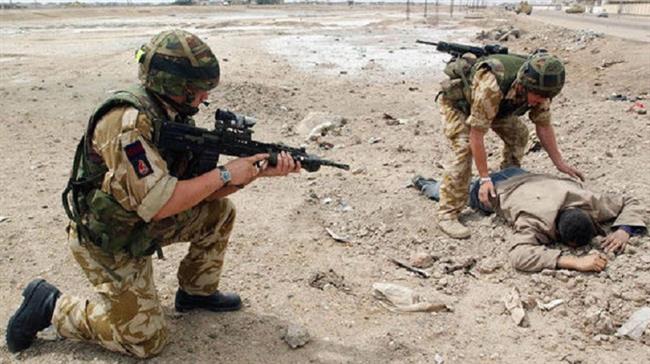
British forces in Afghanistan committed countless abuses against the local population
Press TV – March 2, 2020
Veterans of Britain’s recent costly military campaigns in Afghanistan are killing themselves in record numbers.
According to the Times newspaper, some 14 former and serving army personnel have killed themselves in the past two months alone.
This unusually high number is compounded by the fact that all the deceased are from a “particular grouping” involved in Operation Herrick, which guided all avowed British military actions in Afghanistan from 2002 to 2014.
The government’s response to this apparent emergency has been muted, with John Mercer, the minister for veterans, merely expressing “concern” at the spike in deaths.
The latest spike comes against the backdrop of repeated warnings by British military chiefs of the deteriorating mental health of serving military personnel and veterans alike.
Last November, the former head of the army, General Lord Dannatt, warned that suicide among veterans has become an “epidemic of our time”.
Whilst the precise reasons for the latest spike in suicides is largely unknown, disillusionment with the British military in general, and the UK’s pointless military intervention in Afghanistan in particular, are believed to be major factors.
The widespread disillusionment in the British army is likely to be compounded by the recent announcement of a so-called peace deal between the United States and the Afghan Taliban.
The deal is likely to intensify widespread feelings amongst British veterans of Afghan military campaigns that the entire effort had been in vain.
That feeling is likely to be compounded by the British government’s mixed messaging on the so-called peace deal.
The Defence Secretary, Ben Wallace, played down the significance of the so-called peace deal by describing it in reductive terms as a “small but important step”.
By contrast, Foreign Secretary, Dominic Raab, glorified the deal as a “significant moment in the pursuit of peace”.
US, Taliban Sign Peace Agreement in Doha
Sputnik – February 29, 2020
Negotiators from the United States and the Taliban are meeting in Doha, Qatar to sign an accord that envisages the timetable of the US withdrawing some of its 13,000 troops. The Taliban, in turn, is expected to sever ties with all extremist groups and prevent the territories of Afghanistan from becoming havens for militants.
The United States and the Taliban movement have signed the long-awaited peace agreement in the Qatari capital of Doha on Saturday.
The troop withdrawal will be phased, with the US forces set to be slimmed down to 8,600 in the first 135 days since the deal’s announcement, while allied and coalition forces will be scaled down proportionately.
The residual US, allied and coalition forces will pull out within the remaining nine-and-a-half months, whereby all military bases will be abandoned.
Up to 5000 Taliban prisoners will be released from prisons by 10 March, the first day of intra-Afghan talks. The remaining prisoners will be freed within the next three months. The Taliban commits that its released prisoners will not pose a threat to the security of the US and its allies.
As soon as intra-Afghan talks begin, the US will start the review process of its sanctions on the Taliban and rewards lists issued for its members, with the goal of removing sanctions by 27 August. It will also engage with the UN Security Council and Afghan authorities to have national sanctions on the Taliban scrapped by 29 May.
The US pledges to seek economic cooperation for reconstruction with the new post-settlement Afghan Islamic government and will not intervene in its internal affairs.
In return, the Taliban will take steps to prevent terrorist groups, such as al-Qaeda, from using Afghan soil to threaten the security of the US and its allies.
They include sending a “clear message” that those posing such threat have no place in Afghanistan. The Taliban will instruct its members not to cooperate with such groups or individuals and prevent them from recruiting and fund-raising. It will only grant asylum to people who do not pose a security threat and will not issue visas or other documents to those considered a risk.
Following the signing of the deal, US State Secretary Mike Pompeo enumerated key conditions of the deal between the United States and the Taliban.
“Keep your promises, cut ties with Al-Qaeda. Keep up the fight against Daesh,” Pompeo said, addressing the Taliban.He added that the agreement was “a true test,” stressing that Washington will calibrate the pace of the troop withdrawal with the actions of the Taliban.
US President Donald Trump, for his part, welcomed the agreement as a move to put an end to the US most protracted war.
“We are working to finally end America’s longest war and bring our troops back home,” he said.The head of the militant group’s political office in Qatar said that the Taliban will adhere to the peace agreement signed in Doha on Saturday.
“The US and the Taliban movement have successfully concluded talks in Qatar. I congratulate everyone on this achievement. We will comply with the pact and, as a political force, we want it to be implemented by neighbouring countries,” Abdul Ghani Baradar said.In his turn, Afghan President Ashraf Ghani expressed hope that the long-awaited US-Taliban peace agreement would lead to a permanent ceasefire that in turn would bring stability to Afghanistan.
International Reactions to Historic Accord
NATO Secretary-General Jens Stoltenberg has said that the alliance supports the signing of the US-Taliban peace deal.
“This [deal] is a victory for peace, victory for Afghan people,” Stoltenberg said.The European Union has welcomed the long-awaited peace deal between the United States and the Taliban as a first step toward a negotiated peace process among all Afghans.
“The European Union considers today’s conclusion of the Afghanistan-US Joint Statement for Peace and the settlement between the US and the Taliban as important first steps towards a comprehensive peace process, with intra-Afghan negotiations at its core,” the declaration read.It urged the sides not to miss this opportunity for a lasting peace that could create an environment of security and stability in the war-torn country. Keeping up the reduction in violence is an important part of that process, it added.
“The EU calls on all stakeholders to put the interests of the nation above all other considerations, as the collective responsibility of all Afghan political forces,” it concluded.The UN Assistance Mission in Afghanistan (UNAMA) has called for the continuation of the reduced violence in Afghanistan and welcomed the commitment of the conflicting sides to further dialogue.
“Intra-Afghan negotiations are central to the peace efforts. The United Nations welcomes the commitment expressed by the parties to intra-Afghan negotiations; and urges them to move ahead expeditiously with their preparations to start the negotiations, including through forming a truly representative negotiation team,” UNAMA said in a statement.The United Nations also expressed its support to an inclusive Afghan-led process and called for concrete steps toward ending the war.
“The United Nations stresses the importance of continuing to reduce violence, especially violence that harms civilians, and urges all parties, in the period ahead, to redouble efforts to reduce violence on the way to a permanent ceasefire and a lasting political settlement,” the statement said.
Since 2018, Washington and the Taliban have been attempting to negotiate a peace deal that would ensure the withdrawal of foreign troops from Afghanistan in exchange for the movement’s guarantee that the country would not become a safe haven for terrorists. The parties’ representatives have been regularly meeting in Doha to address the issue.
Trudeau government deepens ties to repressive Kuwaiti monarchy
By Yves Engler · February 24, 2020
As many parents have warned their children, real friends do not encourage stupid, embarrassing, or life-threatening behaviour.
But because of our “friend” to the south, Justin Trudeau’s government has deepened ties to a repressive 250-year old monarchy in Kuwait and pursued other questionable policies.
After participating in the recent African Union Summit in Ethiopia Trudeau jetted off to meet the Emir of Kuwait, which has been part of the coalition bombing Yemen. The prime minister’s visit marked the most high-profile step in a bevy of diplomatic activity with a government where questioning the Emir or Islam is punishable with a significant prison sentence. During their meeting, notes the official press release, Trudeau “welcomed the long-standing friendship between Canada and Kuwait and thanked the Government of Kuwait for its support of our CAF [Canadian Armed Forces] personnel stationed in Kuwait as part of Operation IMPACT. The two leaders discussed recent developments in the region and agreed on the importance of working towards long term stability and security.”
Before the PM’s visit defence minister Harjit Sajjan had traveled to Kuwait City twice since December 19. In April Sajjan also met Prime Minister and Defence Minister Sheikh Nasser Sabah Al-Ahmad Al-Sabah “to bolster and consolidate bilateral ties.” Three months earlier Governor General Julie Payette visited the Emir in Kuwait City. In November Payette sent a cable to the Emir to wish him well after an illness and the next month Assistant Deputy Minister of Global Affairs Peter McDougall met a Kuwaiti counterpart “to strengthen bilateral relations.” In August 2018 the two countries signed a memorandum of understanding on establishing regular consultations between senior officials.
At the Munich Security Conference last week foreign minister Francois-Philippe Champagne met his Kuwaiti counterpart Ahmad Nasser Al-Mohammad Al-Sabah. At an event in the Canadian Embassy on Monday Kuwait’s deputy foreign minister Khaled Al-Jarallah described the “distinguished … ties between the two countries” and “continuous communication and common interests.” On Thursday Minister of Veterans Affairs and Associate Minister of National Defence Lawrence MacAulay attended a celebration at Kuwait’s Embassy in Ottawa for Canadians who fought in the 1991 Iraq war.
The inaugural Kuwait and Canada Investment Forum took place in April. Finance minister Bill Morneau and parliamentary secretary Omar Alghabra participated. At the time Alghabra wrote, “let’s celebrate and continue our efforts to grow the relationship between Canada and Kuwait in investments, trade and defence.”
So, why the budding romance?
Relations with Kuwait are important to Ottawa because of the Canadian Forces base there. About 300 Canadians are stationed in Kuwait to support the Canadian special forces deployed to Iraq as well as two intelligence and one Canadian air-to-air refuelling aircraft. Alongside 200 highly skilled special forces, there’s a Canadian tactical helicopter detachment, intelligence officers and a combat hospital in Iraq. Despite being labeled a “training” mission, the Canadians called in US airstrikes, provided up-to-date battle intelligence and repeatedly engaged the enemy. A Canadian even killed someone with a record-breaking 3.5-kilometre sniper shot. The Canadian Forces backed Kurdish forces often accused of ethnic cleansing areas they captured. Canadian special forces supported a multi-month battle to dislodge ISIS from Mosul that left thousands of civilians dead in 2017.
Alongside the special forces and air support operations, Canada assumed command of the NATO Mission Iraq in November 2018. A Canadian commands 580 NATO troops, including 250 Canadians. They train instructors at three military schools and advise Iraq’s defence ministry.
The Liberals failed to properly explain why Canada took on a second mission in Iraq. But, it was likely tied to weakening the influence of the Iranian aligned Popular Mobilization Forces, Shia militias that helped defeat ISIS. According to Scott Taylor, “Canada agreed to take command of the NATO-led training mission in Iraq because the Liberal government knew it could not sell the Canadian public on sending troops back into the war in Afghanistan. That is where the NATO leaders wanted Canadians, which seems an incredibly ironic twist in that we originally agreed to go into Afghanistan because it was not Iraq.”
Trudeau and Sajjan’s recent missions to Kuwait are part of the fallout from Washington’s decision to assassinate Iranian general Qasem Soleimani and Iraqi Shia militia commander Abu Mahdi al-Muhandis. After the January 3 killings some Canadian forces in Iraq were withdrawn to the base in Kuwait. Iraq’s parliament passed a resolution demanding foreign soldiers leave the country and Iran threatened to retaliate against US troops in the region.
The flurry of recent diplomatic activity is likely designed to reassure Kuwaiti officials of Canadian backing and to ensure Kuwait doesn’t back out of the base arrangement. The Trudeau government has happily deepened ties to a repressive monarchy to support US policy in Iraq.
To maintain foreign troops in Iraq the Trudeau government has also pushed back against the Iraqi parliament’s call for foreign troops to leave. After the country’s parliament passed a resolution calling for foreign troops to go, defence minister Harjit Sajjan sought to convince his Iraqi counterpart of the importance of Canada’s presence. Last week Sajjan celebrated Iraqi leaders willingness to keep Canadian troops. Additionally, Middle East Eye reported on Iraqi and US military officials holding a secret meeting “in the private residence of the Canadian ambassador to Jordan in Amman” to discuss pulling back US troops from Iraq.
Makes one wonder what else the Trudeau government has done or will do to support US policy in Iraq?
How goes the war?
By Paul Robinson | Irrussianality | February 1, 2020
This week brought a bunch of news about the wars in the Middle East and Central Asia. In Afghanistan, the United States and its allies have been directly involved in fighting the Taleban for over 18 years. In Syria, they’ve attempted to overthrow the government of Bashar al-Assad with the help of proxies in various forms, who are now holed up in an ever-shrinking enclave in Idlib province. And in Yemen, they’ve been backing the Saudis in their attempt to reinstall Adrabbun Mansar Hadi as president in the Yemeni capital Sanaa, now under the control of the Houthis. So, how go America’s wars?
First, Afghanistan:
A few days ago, the Special Inspector General for Afghanistan Reconstruction (SIGAR) released his latest quarterly report to the US Congress. According to an email I got from SIGAR’s office, the key points of this report include the following:
- Enemy-initiated attacks (EIA) and effective enemy-initiated attacks (EIA resulting in casualties) during the fourth quarter of 2019 exceeded same-period levels in every year since recording began in 2010.
- The month of the Afghan presidential election (September 2019) saw the highest number of EIA in any month since June 2012, and the highest number of effective enemy-initiated attacks (EEIA) since recording began in January 2010. The high level of violence continued after the presidential election; October 2019 had the second highest number of EIA in any month since July 2013.
- According to the UNODC, the overall value of opiates available for export in Afghanistan in 2018 (between $1.1 billion and $2.1 billion) was much larger than the combined value of all of the country’s licit exports ($875 million).
- As of December 18, conflicts had induced 427,043 Afghans to flee their homes in 2019 (compared to 356,297 Afghans during the same period in 2018).
- Between November 2019 and March 2020, an estimated 11.3 million Afghans – more than one-third of the country’s population – are anticipated to face acute food insecurity.
I think that gives a good enough impression. Eighteen years on, things aren’t going so well in Afghanistan.
So what about Syria?
About a week ago, government forces (the Syrian Arab Army (SAA)) launched a two-prong offensive against what were once US-proxy forces in Idlib, but might now be more accurately described as Turkish proxies. News reports suggest that casualties have been heavy on both sides, but the results from the SAA point of view have been very satisfactory. In the north, the SAA advanced a short distance south west of Aleppo, but the real progress was further to the south, where the SAA smashed through the rebel defenses and advanced rapidly to seize the town of Ma’arrat al-Numan, as shown in this map:

Since this map was produced, the SAA have advanced even further, continuing northeast up the M5 highway from Ma’arrat as far as the town of Saraqib. How much further they will go before pausing remains to be seen. But one thing is clear – bit by bit, the rebels in Idlib are being squeezed out. Once they’re gone, the war in Syria will be all but over. The attempt to topple Assad has failed.
Which brings us to Yemen.
As you may recall, in September last year the Houthis crushed a Saudi incursion into northern Yemen, capturing large numbers of prisoners and armoured vehicles. After that things quieted down for a bit, until about a week ago when Saudi-backed forces launched an offensive to the east of Saana in the province of Marib. Before long, the Houthis counter-attacked, with devastating consequences. According to one news report:
Hadi’s forces are now on the back foot. Where once they spoke about taking the Houthi-held capital Sanaa, now they discuss ways to defend Marib, a strategic oil and gas hub. … Ibrahim, a pro-government fighter in Marib province, said that some loyalist soldiers ‘betrayed’ them and withdrew from battles, causing sizeable losses amongst their troops. ‘We were planning to advance towards Sanaa, but our attempt was hindered by the withdrawal of a battalion of soldiers, which gave the Houthis a chance to attack us … This was a betrayal by the soldiers and their leaders.’
Houthi sources claim that Saudi-backed forces suffered 2,500 casualties, and that the Houthis captured 400 pieces of equipment, including tanks, armoured personal carriers, and multiple rocket launch systems. The Saudi defeat has gone just about unnoticed in the English-language media but, for anybody interested, Russian blogger Colonel Cassad has published a bunch of Houthi photographs and videos, such as the picture below, showing the results of the battle (here and here). They make for interesting viewing.

Putting this all together, what we see is the Americans and their allies losing not just one, not just two, but three wars simultaneously. It’s quite something. A few days ago, news emerged that US president Donald Trump had denounced his generals as ‘losers’ and ‘a bunch of dopes and babies’. The story was treated by pretty much everybody as yet more evidence of Trump’s unsuitability to be president. But given the news from the front this week, I have to think that Trump got it right. ‘I wouldn’t go to war with you people’, Trump allegedly told the generals. If only the president took his own advice.
A New US Air Force Video Game Lets You Drone Bomb Iraqis and Afghans
By Alan MacLeod – MintPress News – January 31, 2020
The United States Air Force has a new recruitment tool: a realistic drone operator video game you can play on its website. Called the Airman Challenge, it features 16 missions to complete, interspersed with facts and recruitment information about how to become a drone operator yourself. In its latest attempts to market active service to young people, players move through missions escorting US vehicles through countries like Iraq and Afghanistan, serving up death from above to all those designated “insurgents” by the game. Players earn medals and achievements for most effectively destroying moving targets. All the while there is a prominent “apply now” button on screen if players would like to enlist and conduct real drone strikes all over the Middle East.
The game has failed to win over David Swanson, director of the anti-war movement World Beyond War, and the author of War is a Lie.
“It is truly disgusting, immoral, and arguably illegal in that it is recruitment or pre-recruitment of underage children to participate in murder. It is part of the normalization of murder that we have been living through,” he told MintPress News.
Tom Secker, a journalist and researcher into the influence of the military on popular culture was similarly unimpressed by the latest USA.F. recruitment strategy, telling us:
The drone game struck me as sick and demented… On the other hand, many drone pilots have described how piloting drones and killing random brown people is a lot like playing a video game, because you’re sat in a bunker in Nevada pushing buttons, detached from the consequences. So I guess it accurately reflects the miserable, traumatised, serial killing life of a drone pilot, we can’t accuse it of inaccuracy per se.”
Game Over
Despite the fact that they are rarely, if ever in any physical danger, the military has considerable difficulty recruiting and retaining drone pilots. Nearly a quarter of Air Force staff who can fly the machines leave the service every year. A lack of respect, fatigue and mental anguish are the primary reasons cited. Stephen Lewis, a sensor operator between 2005 and 2010 said what he did “weighs on your conscience. It weighs on your soul. It weighs on your heart,” claiming that the post traumatic stress disorder he suffers from as a consequence of killing so many people has made it impossible for him to have relationships with other humans.
“People think it is a video game. But in a video game you have checkpoints, you have restart points. When you fire that missile there’s no restart,” he said. “The less they can get you to think of what you’re shooting at as human the easier it becomes to you to just follow through with these shots when they come down,” said Michael Haas, another former USAF sensor operator. The Airman Challenge game follows this path, using red dots on the screen to represent enemies, sanitizing the violence recruits will be meting out.
“We were very callous about any real collateral damage. Whenever that possibility came up most of the time it was a guilt by association or sometimes we didn’t even consider other people that were on screen,” Haas said, noting that he and his peers used terms like “fun sized terrorist” to describe children, employing euphemisms like “cutting the grass before it grows too long,” as justifications for their extermination. The constant violence, even from afar, takes a heavy toll on many drone operators, who complain of constant nightmares and having to drink themselves into a stupor every night to avoid them.
Others, with different personalities, revel in the bloodshed. Prince Harry, for example, was a helicopter gunner in Afghanistan and described firing missiles as a “joy.” “I’m one of those people who loves playing PlayStation and Xbox, so with my thumbs I like to think I’m probably quite useful,” he said. “If there’s people trying to do bad stuff to our guys, then we’ll take them out of the game.”
A Nobel Cause
Drone bombing is a relatively new technology. Barack Obama came into office promising to end President Bush’s reckless aggression, even being awarded the Nobel Peace Prize in 2009. While he slashed the number of American troops on the ground in Iraq and Afghanistan, he also greatly expanded US wars in the form of drone bombings, ordering ten times as many as Bush. In his last year in office, the US dropped at least 26,000 bombs – around one every twenty minutes on average. When he left office, the US was bombing seven countries simultaneously: Afghanistan, Iraq, Syria, Libya, Yemen, Somalia, and Pakistan.
Up to 90 percent of reported drone casualties were “collateral damage,” i.e. innocent bystanders. Swanson is deeply concerned about the way in which the practice has become normalized: “If murder is acceptable as long as a military does it, anything else is acceptable,” he says, “We will reverse this trend, or we will perish.”
History did not exactly repeat itself with the election of Donald Trump in 2016, but it did rhyme. Trump came to power having made multiple statements perceived as anti-war, strongly criticizing Obama and the Democrats’ handling of the situation in the Middle East. Egged on even by so-called “resistance” media, Trump immediately expanded drone bombings, increasing the number of strikes by 432 percent in his first year in office. The president also used a drone attack to kill Iranian general and statesman Qassem Soleimani earlier this month.
Killing in the Game of
In 2018, the armed forces fell well short of their recruitment targets, despite offering a package of benefits very attractive to working-class Americans. As a result, it totally revamped its recruitment strategy, moving away from television and investing in micro-targeted online ads in an attempt to reach young people, particularly men below the age of thirty, who make up the bulk of the armed forces. One branding exercise was to create an Army e-sports team entering video game competitions under the military brand. As the gaming website, Kotaku wrote, “Positioning the Army as a game-friendly environment and institution is crucial, or even necessary, to reach the people the Army wants to reach.” The Army surpassed its recruitment goal for 2019.
Although the Airman Challenge game is a new attempt at recruitment, the armed forces have a long history being involved in the video game market, and the entertainment industry more generally. Secker’s work has uncovered the depths of collaboration between the military and the entertainment industry. Through Freedom of Information requests, he was able to find that the Department of Defense reviews, edits and writes hundreds of TV and movie scripts every year, subsidizing the entertainment world with free content and equipment in exchange for positive portrayals. “At this point, it’s difficult to effectively summarise the US military’s influence on the industry, because it’s so varied and all-encompassing,” he said.
The US Army spends tens of millions a year on the Institute for Creative Technologies, who develop advanced tech for the film and gaming industries, as well as in-house training games for the Army and – on occasion – the CIA. The Department Of Defense has supported a number of major game franchises (Call of Duty, Tom Clancy games, usually first or third-person shooters). Military-supported games are subject to the same rules of narrative and character as movies and TV, so they can be rejected or modified if they contain elements the Department Of Defense deems controversial.”
The video games industry is massive, with hyper-realistic first person shooters like Call of Duty being among the most popular genres. Call of Duty: WWII, for example, sold $500 million worth of copies in its opening weekend alone, more money generated than blockbuster movies “Thor: Ragnarok” and “Wonder Woman” combined. Many people spend hours a day playing. Captain Brian Stanley, a military recruiter in California said, “Kids know more about the army than we do… Between the weapons, vehicles, and tactics, and a lot of that knowledge comes from video games.”
Young people, therefore, spend huge amounts of time effectively being propagandized by the military. In Call of Duty Ghosts, for instance, you play as a US soldier fighting against a red-beret wearing anti-American Venezuelan dictator, clearly based on President Hugo Chavez, while in Call of Duty 4, you follow the US Army in Iraq, shooting hundreds of Arabs as you go. There’s even a mission where you operate a drone, which is distinctly similar to the Airman Challenge. US forces even control drones with Xbox controllers, blurring the lines between war games and war games even further.
Cyber Warfare
Although the military industrial complex is keen to advertise opportunities for pilots, they go to great lengths to hide the reality of what happens to the victims of airstrikes. The most famous of these is likely the “Collateral Murder” video, leaked by Chelsea Manning to Wikileaks co-founder Julian Assange. The video, which made worldwide news, laid bare the callousness towards civilian lives Haas described, where Air Force pilots laugh at shooting dead at least 12 unarmed civilians, including two Reuters journalists. While those commanders ultimately in charge of military operations in the Middle East appear on television constantly, trying to sanitize their actions, Manning and Assange remain in prison for helping to expose the public to an alternative depiction of violence. Manning has spent the majority of the last decade incarcerated, while Assange awaits possible extradition to the United States in a London prison.
The Airman Challenge video game, for Secker, is merely “the latest in a long line of insidious and disturbing recruitment efforts by the US military.” “If they feel they have to do this just to recruit a few hundred thousand people to their cause, maybe their cause isn’t worth it,” he said.
Afghanistan will need ‘billions in foreign aid,’ US agency warns
RT | January 31, 2020
A US agency warned on Friday that Afghanistan will need vast amounts of foreign funding to keep its government afloat through 2024. International money pays for roughly 75 percent of all of Afghanistan’s costs, while government revenue covers barely a quarter of Afghan public expenditures.
The warning comes as foreign donors become increasingly angry over the cost of corruption and the US seeks a peace deal with the Taliban to withdraw its troops from the country. The Special Inspector General for Afghan Reconstruction (SIGAR), which issues reports quarterly to US Congress, monitors all US spending relating to the 18-year war in Afghanistan.
According to the SIGAR report for the last quarter of 2019, international donors, led by Washington, provide the Afghan government with $8.5 billion annually to cover everything from security to education and health care. The US is paying $4.2 billion yearly just for Afghanistan’s security and defense forces.
SIGAR also said that “enemy-initiated attacks” rose sharply last year, with the fourth quarter seeing a total of 8,204 attacks – up from 6,974 during the same period in 2018.
Why Trump is Winding Up Tensions with North Korea
By Finian Cunningham | Strategic Culture Foundation | December 25, 2019
After 18 months of on-off diplomacy with North Korea, the Trump administration seems determined now to jettison the fragile talk about peace, reverting to its earlier campaign of “maximum pressure” and hostility. It’s a retrograde move risking a disastrous war.
In a visit to China this week, South Korean President Moon Jae-in and Chinese leader Xi Jinping both urged for greater momentum in the diplomatic process with North Korea, saying that renewed tensions benefit no-one. The two leaders may need to revise that assertion. Tensions greatly benefit someone – Washington.
Why Trump is winding up tensions again with Pyongyang appears to involve a two-fold calculation. It gives Washington greater leverage to extort more money from South Korea for the presence of US military forces on its territory; secondly, the Trump administration can use the tensions as cover for increasing its regional forces aimed at confronting China.
In recent weeks, the rhetoric has deteriorated sharply between Washington and Pyongyang. The Democratic People’s Republic of Korea (DPRK) has resumed references to Trump being a senile “dotard”, while the US president earlier this month at the NATO summit near London dusted off his old disparaging name for Kim Jong-un, the North Korean leader, calling him “rocket man”.
On December 7 and 15, North Korea tested rocket engines at its Sohae satellite launching site which are believed to be preparation for the imminent test-firing of an intercontinental ballistic missile (ICBM). North Korea unilaterally halted ICBM test-launches in April 2018 as a gesture for diplomacy with the US. Its last launch was on July 4, 2017, when Pyongyang mockingly called it a “gift” for America’s Independence Day.
Earlier this month, Pyongyang said it was preparing a “Christmas gift” for Washington. That was taken as referring to resumption of ICBM test launches. However, Pyongyang said it was up to the US to decide which gift it would deliver.
On the engine testing, Trump said he was “watching closely” on what North Korea did next, warning that he was prepared to use military force against Pyongyang and that Kim Jong-un had “everything to lose”.
The turning away from diplomacy may seem odd. Trump first met Kim in June 2018 in Singapore at a breakthrough summit, the first time a sitting US president met with a North Korean leader. There were two more summits, in Hanoi in February 2019, and at the Demilitarized Zone on the Korean border in June 2019. The latter occasion was a splendid photo-opportunity for Trump, being the first American president to have stepped on North Korean soil.
During this diplomatic embrace, Trump has lavished Kim with praise and thanked him for “beautiful letters”. Back in September 2017 when hostile rhetoric was flying both ways, Trump told the UN general assembly he would “totally destroy” North Korea if it threatened the US. How fickle are the ways of Trump.
What’s happened is the initial promises of engagement have gone nowhere, indicating the superficiality of Trump’s diplomacy. It seems clear now that the US president was only interested in public relations gimmickry, boasting to the American public that he had reined in North Korea’s nuclear activities.
When Trump met Kim for the third time in June 2019, they reportedly vowed to resume negotiations on denuclearization of the Korean Peninsula. North Korea had up until recently stuck to its commitment to halt ICBM testing. However, for that, Pyongyang expected reciprocation from the US side on the issue of sanctions relief, at least a partial lifting of sanctions. Kim gave Trump a deadline by the end of this year to make some concession on sanctions.
Russia and China last week proposed an easing of UN sanctions on North Korea. But Washington rebuffed that proposal, categorically saying it was a “premature” move, and that North Korea must first make irreversible steps towards complete decommissioning of its nuclear arsenal. The high-handed attitude is hardly conducive to progress.
The lack of diplomatic reciprocation from Washington over the past six months has led Pyongyang to angrily repudiate further talks. It has hit out at what it calls Trump’s renewed demeaning name-calling of Kim. There is also a palpable sense of frustration on North Korea’s part for having been used as a prop for Trump’s electioneering.
The fact that Washington has adopted an intransigent position with regard to sanctions would indicate that it never was serious about pursuing meaningful diplomacy with Pyongyang.
Admittedly, Trump did cancel large-scale US war games conducted with South Korea as a gesture towards North Korea, which views these exercises as provocative rehearsals for war. This was an easy concession to make by Trump who no doubt primarily saw the cessation of military drills as a cost-cutting opportunity for the US.
Significantly, this month US special forces along with South Korean counterparts conducted a “decapitation” exercise in which they simulated a commando raid to capture a foreign target. Furthermore, the operation was given unusual public media attention.
As the Yonhap news agency reported: “A YouTube video by the Defense Flash News shows more details of the operation, with service personnel throwing a smoke bomb, raiding an office inside the building, shooting at enemy soldiers over the course, and a fighter jet flying over the building… It is unusual for the US military to make public such materials… according to officials.”
The Trump administration appears to have run out of further use for the diplomatic track with North Korea. The PR value has been milked. The policy shift is now back to hostility. The instability that generates is beneficial for Washington in two ways.
Trump is currently trying to get South Korea to boost its financial contribution towards maintaining US forces on its territory. Trump wants Seoul to cough up an eye-watering five-fold increase in payments “for US protection” to an annual $5 billion bill. South Korea is understandably reluctant to fork out such a massive whack from its fiscal budget. Talks on the matter are stalemated, but expected to resume in January.
If US relations with North Korea were progressing through diplomacy then the lowered tensions on the peninsula would obviously not benefit Washington’s demand on South Korea for more “protection money”. Therefore, it pays Washington to ramp up the hostilities and the dangers of war as a lever for emptying Seoul’s coffers.
The other bigger strategic issue shaping US intentions with North Korea is of course Washington’s longer-term collision course with China. US officials and defense planning documents have repeatedly targeted China as the main geopolitical adversary. American forces in South Korea comprising 28,500 troops, nuclear-capable bombers, warships and its anti-missile Terminal High Altitude Area Defense (THAAD) system are not about protecting South Korea from North Korea. They are really about encircling China (and Russia). Washington hardly wants to scale back its military assets on the Korea Peninsula. It is driven by the strategic desire to expand them.
In media comments earlier this month, Pentagon chief Mark Esper made a curious slip-up when referring to withdrawing US troops from Afghanistan. He said they would be redeployed in Asia to confront China.
Esper said: “I would like to go down to a lower number [in Afghanistan] because I want to either bring those troops home, so they can refit and retrain for other missions or/and be redeployed to the Indo-Pacific to face off our greatest challenge in terms of the great power competition that’s vis-a-vis China.”
The logic of war profits and strategic conflict with China mean that Trump and the Washington establishment do not want to find a peaceful resolution with North Korea. Hence a return to the hostile wind-up of tensions.
The Mysterious Frank Taylor Report: The 9/11 Document that Launched US-NATO’s “War on Terrorism” in the Middle East
By Prof. Niels Harrit – Global Research – March 21, 2018
We call them ‘the 9/11 wars’ – the seemingly unending destruction of the Middle East and North Africa which has been going on for the last seventeen years. As revealed by Gen. Wesley Clark,[1] these wars were already anticipated in September 2001.
The legal foundation for the invasion of Iraq in 2003 has been challenged in several countries. The best known is the Chilcot Inquiry in the UK, which began in 2009 and concluded in a report in 2016. The inquiry was not about the legality of military action, but the British government was strongly criticised for not having provided a legal basis for the attack.
Even though the invasion of Iraq was planned[2] prior to 9/11, most observers note that the attack on Afghanistan in 2001 was a required precursor.
However, the legal basis for attacking Afghanistan has attracted almost no attention. One obstacle in addressing this has been the assumption that the key document was still classified.[3][4]
But as demonstrated below, this document was apparently declassified in 2008.
On the morning of 12 September 2001, NATO’s North Atlantic Council was summoned in Brussels. This was less than 24 hours after the events in USA. The council usually consists of the permanent ambassadors of the member states, but in an unprecedented move, the EU foreign ministers participated as well.[5]
Lord Robertson, Secretary General of NATO, wrote a draft resolution invoking Article 5 in the Washington treaty – the famous ‘musketeer clause’ – as a consequence of the terror attacks. The decision to do so had to be unanimously approved by the governments in all 19 NATO countries. This general agreement was obtained at 9.20 pm and Lord Robertson could read out the endorsements at a packed press conference:[6]
“The Council agreed that if it is determined that this attack was directed from abroad against the United States, it shall be regarded as an action covered by Article 5 of the Washington Treaty, which states that an armed attack against one or more of the Allies in Europe or North America shall be considered an attack against them all.”
There was a reservation. Article 5 would not be formally activated before “it is determined that this attack was directed from abroad”.
Apparently NATO had a suspect. But the forensic evidence was still pending, and hence also the formal invocation of Article 5.
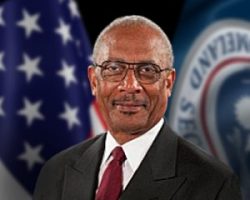 Formally, this evidence was provided by Frank Taylor (image on the right), a diplomat with the title of Ambassador from the US State Department. On 2 October he presented a brief to the North Atlantic Council, and Lord Robertson could subsequently conclude:[7]
“On the basis of this briefing, it has now been determined that the attack against the United States on 11 September was directed from abroad and shall therefore be regarded as an action covered by Article 5 of the Washington Treaty, which states that an armed attack on one or more of the Allies in Europe or North America shall be considered an attack against them all.”
“Today’s was classified briefing and so I cannot give you all the details. Briefings are also being given directly by the United States to the Allies in their capitals.”
Since the invocation of Article 5 had to be unanimous, Frank Taylor’s report would have been integral in the briefings announced to take place.
In Denmark – the country of the present author – there was a meeting in the Foreign Affairs Committee on 3 October 2001, where parliamentarians were briefed by the government about the proceedings in Brussels.
Parallel briefings must have been given in the 17 other NATO capitals. In each city, the resolution must have been approved, since Lord Robertson could announce NATO’s unanimous adoption of Article 5 and the launch of the war on terror on 4 October.[8] The first bombs fell in Kabul on 7 October.
Article 5 of the Washington Treaty says:[9]
“The Parties agree that an armed attack against one or more of them in Europe or North America shall be considered an attack against them all and consequently they agree that, if such an armed attack occurs, each of them, in exercise of the right of individual or collective self-defence recognised by Article 51 of the Charter of the United Nations,…..”
That is, any military action taken by NATO is confined by the restrictions in Article 51, which emphasises the right to self-defence and reads:
“Nothing in the present Charter shall impair the inherent right of individual or collective self-defence if an armed attack occurs against a Member of the United Nations,….”.[10]
That is, military action is forbidden in the absence of an armed provocation, and the legality of the attack on Afghanistan depends exclusively on the evidence presented in Frank Taylor’s report. But it was classified together with the minutes from the pertinent meetings.
However, on 19 May 2008, the US State Department declassified the dispatch which was sent in 2001 to all US representations world-wide, including the ambassadors to NATO headquarters, regarding what to think and say about the 9/11 events.
It is titled: “September 11: Working together to fight the plague of global terrorism and the case against al-qa’ida”.
The text is freely accessible here.
The document is dated 01 October 2001. But as hinted by the URL, it seems to have been distributed on 2 October five days before the invasion of Afghanistan on October 7, 20101. That is, the day Frank Taylor gave his presentation for the North Atlantic Council and the EU foreign ministers, and the day before the US ambassadors were briefing the governments in the respective NATO capitals.
The text of the dispatch begins by requesting “all addressees to brief senior host government officials on the information linking the Al-Qa’ida terrorist network, Osama bin Ladin and the Taliban regime to the September 11 terrorist attack on the World Trade Center and Pentagon and the crash of United Airlines Flight 93.”
The document appears to be a set of ‘talking points’. The recipients are instructed to use the information provided in oral presentations only and to never leave the hard copy document as a non-paper. Specifically, there is reference to “THE oral presentation”.
These instructions are followed by 28 pages of the specific text.
Tellingly, a section of this dispatch is copy-pasted into Lord Robertson’s statement on 2 October:7
“The facts are clear and compelling[…] We know that the individuals who carried out these attacks were part of the world-wide terrorist network of Al-Qaida, headed by Osama bin Laden and his key lieutenants and protected by the Taliban.”
The conclusion is inescapable – this dispatch IS the Frank Taylor report. It is the manuscript that served not only as the basis for Frank Taylor’s presentation, but also for the briefings given by US ambassadors to the various national governments. Identical presentations were given in all 18 capitals on 3 October, four days before the US-NATO invasion of Afghanistan
Is there any forensic evidence provided in this document to serve as a legal basis for the invocation of Article 5?
Nothing. There is absolutely no forensic evidence in support of the claim that the 9/11 attacks were orchestrated from Afghanistan.
Only a small part of the introductory text deals with 9/11, in the form of summary claims like the citation in Lord Robertson’s press release. The main body of the text deals with the alleged actions of Al-Qaeda and the Taliban in the nineties.
On 4 October, NATO officially went to war based on a document that provided only ‘talking points’ and no evidence to support the key claim.
We are still at war seventeen years later. Five countries have been destroyed, hundreds of thousands of people killed and millions displaced. Refugees are swarming the roads of Europe, trillions of dollars have been spent on weapons and mercenaries and our grandchildren have been shackled with endless debt.
At the opening ceremony for the new NATO headquarters on 25 May 2017, all the leaders from NATO’s member states attended the inauguration of a ‘9/11 and Article 5 Memorial’.[11]
*
Prof. Niels Harrit is a retired Associate Professor at the University of Copenhagen, Denmark.
Notes
[1] The Plan — according to U.S. General Wesley Clark (Ret.) https://www.youtube.com/watch?v=SXS3vW47mOE
[2] Bush decided to remove Saddam ‘on day one’. https://www.theguardian.com/world/2004/jan/12/usa.books
[3] The Unanswered Questions of 9/11. http://www.globalresearch.ca/the-unanswered-questions-of-911/5304061?print=1
[4] Was America Attacked by Afghanistan on September 11, 2001? https://www.globalresearch.ca/was-america-attacked-by-afghanistan-on-september-11-2001/5307151
[5] Being NATO’s Secretary General on 9/11. https://www.nato.int/docu/review/2011/11-september/Lord_Robertson/EN/ (from which you can deduce that the NATO-ambassadors eat lunch at 3 pm).
[6] Statement by the North Atlantic Council, https://www.nato.int/docu/pr/2001/p01-124e.htm
[7] Statement by NATO Secretary General, Lord Robertson. https://www.nato.int/docu/speech/2001/s011002a.htm
[8] Statement to the Press by NATO Secretary General, Lord Robertson, on the North Atlantic Council Decision On Implementation Of Article 5 of the Washington Treaty following the 11 September Attacks against the United States. https://www.nato.int/docu/speech/2001/s011004b.htm
[9] The North Atlantic Treaty. https://www.nato.int/cps/ic/natohq/official_texts_17120.htm
[10] Article 51, UN charter. http://www.un.org/en/sections/un-charter/chapter-vii/
[11] Dedication of the 9/11 and Article 5 Memorial at the new NATO Headquarters, 25 May 2017 https://www.youtube.com/watch?time_continue=3&v=augh1WqTqFs
Featured Video
Seyed M. Marandi: US-Iran War Inevitable: Kuwait and Bahrain May Fall
or go to
Aletho News Archives – Video-Images
From the Archives
Oil and the Israel Lobby
Reknowned economist M. Shahid Alam offers this excellent critique of Noam Chomsky’s defective analysis of the relative influence of Oil versus the Israel lobby over US foreign policy: … continue
Blog Roll
 Aletho News
- ICC ignored ‘very well-documented’ NATO crimes – ex-Libyan minister
- SNSC secretary dismisses US response to Iran’s conditions as ‘inadequate’
- Sanaa says Taiz roads open, secure for residents, warns Saudi forces
- Iraqi resistance group urges Saudi leadership to admit defeat, lift Yemen siege
- Trump’s Retreat: How Al-Aqsa Flood Took Down the US Empire
- Israel’s Military Actions in Lebanon Grossly Violate International Law — Lavrov
- Seyed M. Marandi: US-Iran War Inevitable: Kuwait and Bahrain May Fall
- Leaders Condemn Ansarallah Attack on Saudi Arabia While Ignoring Illegal War Against Yemen
- Leaked: Britain’s Covert Iraqi Psyops Network
- Yemeni Armed Forces Warn Airlines Against Using Saudi Airports, Exempt Mecca and Medina
- If Americans Knew
- After Oct 7, IDF policy allowed civilian casualties for even the lowest-ranking targets
- Israel’s Destruction of Southern Lebanon Intensified After the Cease-Fire
- The Last-Minute Decision That Gave Israel Its Name
- The American Conservative: How Trump Made the World Go Nuclear
- Meet the US generals and admirals advancing Israeli policy
- Opinion: Why news organizations should boycott Israel
- The Israeli witch hunt of Sami Abu Shehadeh exposes the lie of the ‘Jewish and democratic’ state
- No state has a ‘right’ to exist – least of all Israel
- Testimonies about Gaza’s civilian death toll expose Israel’s atrocities – Daily Update
- How Israel Conquered the Latin American Right
- No Tricks Zone
- New Study Suggests Large Regions Of The Pacific Ocean Have Been Cooling For The Last 80 Years
- Germany’s Green Energy Debacle: High Energy Costs Force Kahla Porzellan to Close After 182 Years!
- New Study: 50 Years Of The Most Aggressive ‘Net Zero’ Policies Can Only Affect The Global Climate By 0.03°C
- US September “Heat” Was No Record…Many Records Set Decades Ago
- Latest European Green Energy Debacle; Portugal’s Largest Flagship Solar Park Insolvent!
- Green Energy Debacle: German Expert Professor Fritz Vahrenholt Warns Of Severe Economic And Social Consequences
- Two More Paleo Reconstructions Affirm Meters-Higher Sea Levels Across Ireland, Brazil 7000-6000 Years Ago
- New Study: Earth And Venus Surface Warmth Largely Explained By Convection And Lapse Rate, Not CO2 Or Radiation
- 2025 Nature Paper Claiming Worsening Global Drought Gets RETRACTED …Heavily Flawed
- New Study: ‘Global Drought Shows No Detectable Recent Acceleration Under Climate Warming’

