Euro-Atlanticist course fails in Bulgaria
Katehon | 14.11.2016
In Bulgaria, the country’s first direct elections in the second round of presidential elections were won by the candidate who has been called pro-Russian. General Rumen Radev won the overwhelming majority of votes.
A former chief of the Bulgarian Air Force and the presidential candidate of the Socialist Party, General Rumen Radev emphasizes his independence from both Russia and the United States. Before the second round of the elections, he said: “Until recently, I was flying a Soviet-made fighter. I am a graduate of a US military academy, but I am a citizen of Bulgaria, and Bulgaria is my main priority.”
Despite the fact that he is called the pro-Russian candidate due to his policy of lifting the anti-Russian sanctions, reality is different. Moreover, Radev supports his country gaining NATO membership and continuing close ties with the West. However, he is certainly a more advantageous president for Moscow than Tsetska Tsacheva, who represented the ruling liberals.
In Bulgaria, the president does not play a serious role. However, Prime Minister Boyko Borisov announced his resignation and the dissolution of the government over the defeat of their candidate. He stressed that he would be going into the opposition and that “there will no longer be any compromises.” The current president, Rosen Plevneliev, began to make quite sharp anti-Russian statements several days before the election.
It is premature to expect any major changes before the new government is formed. But many agree that relations with Moscow will actually significantly improve even if the new president does not initiate the lifting of the EU sanctions against Russia.
In addition, the socialist Radev’s victory comes alongside the victory of the socialist Dodon in Moldova and, of course, against the backdrop of the high-profile election results in the US. Taken together, all of these new elections and their results allow one to speak of impending global changes across the whole world.
‘Trump effect’ divides European opinion
By M K Bhadrakumar | Indian Punchline | November 14, 2016
The results of the two presidential elections held on Sunday in Bulgaria and Moldova underscore the winds of change blowing over the western edges of Eurasia. To an extent they can be called the early signs of the ‘Trump effect’. In both elections, ‘pro-Russian’ candidates won convincingly. (here and here)
In both cases, the contestation essentially boiled down to whether Bulgaria and Moldova would be better off casting their lot with the European Union or whether they need to realign with Russia. The answer is clear.
The open-ended quest for EU membership no longer holds attraction for Moldova, whereas, Bulgaria appears to be disheartened with its EU membership. On the other hand, Russia is real and it is next-door. The election results yesterday constitute a blow to the EU’s prestige. Indeed, Moscow’s influence is spreading in Eastern Europe.
This is also a swing to the Left in political terms. There is much discontent with ‘reforms’, rampant corruption, etc. in both countries. The Russophile sentiment is very substantial, and there is eagerness to boost trade with Russia to overcome economic difficulties. Also, the local partisans of the West and EU stand discredited in both countries.
In Moldova, only around 30% of population find EU attractive, while 44% would support their country joining the Moscow-led Eurasian Economic Union. Curiously, 66% of Moldovans trust Vladimir Putin; in comparison, only 22% place trust in Barack Obama’s words.
Against the backdrop of the election victory of Donald Trump in the US, how these trends are going to play out will be interesting to watch. Bulgaria’s president-elect Rumen Radev has called for an end to the EU sanctions against Russia. He argues that Sofia should be pragmatic in its approach to Russia’s annexation of Crimea. (This is notwithstanding Bulgaria’s long history of divided loyalties between Russia and Europe.)
The Obama administration in its lame duck phase will endeavour to pressure the EU to extend the sanctions against Russia for yet another 6-month period beyond December. But will Trump follow Obama’s footfalls when the issue crops up again toward the middle of next year? He is unlikely to show Obama’s messianic zeal to ‘contain’ Russia. That is how the EU consensus on sanctions against Russia can break down because many countries in Europe resent the American pressure and prefer to restore trade and economic ties with Russia.
Interestingly, Trump may get resonance in Old Europe as well. The Labour leader in Britain, Jeremy Corbyn made a stunning call in the weekend for Western leaders to ‘demilitarize’ the border between Eastern Europe and Russia or risk a New Cold War. He said the West didn’t have to pile up forces on Russia’s border. Corbyn told the BBC:
I have many, many criticisms of Putin, of the human rights abuses in Russia, of the militarisation of society. But I do think there has to be a process that we try –demilitarise the border between what are now the NATO states and Russia, so that we drive apart those forces and keep them further apart in order to bring about some kind of accommodation. We can’t descend into a new Cold War.
Corbyn also made a thoughtful suggestion that that the Organisation for Security and Co-operation in Europe, which includes Russia, could replace NATO as a forum for solving issues in the region.
Indeed, some churning has already begun regarding European security even before Trump takes over in the Oval Office. By the way, Czech Prime Minister Bohuslav Sobotka said on Sunday that American statements about possible deployment of a U.S. global missile shield’s radar in the Czech Republic are pure fiction.
He said, “A radar in the Czech territory would mean further escalation in relations with Russia. We need to use the window opening after Donald Trump’s election to have the United States and Russia sit down at one table.” Sobotka pointed out that Eastern Europe’s main security problem today is about putting an end to the war in Syria.
“The United States has considerable influence on the situation in Syria, Russia has considerable influence. So, it is necessary to use this,” he said, adding that Donald Trump can establish more efficient cooperation with Russia on Syria.
However, the fact of the matter is that neither has Trump taken his position yet on NATO nor is it going to be easy for him to seek a separation for America from the western alliance. Simply put, Europe is not ready for a post-NATO future. There is palpable fear in many quarters (both in the US and in Europe) that if the US were to withdraw from Europe, Russia would advance and exercise more assertive behaviour in Eastern Europe.
In an article in the weekend, NATO secretary-general Jens Stoltenberg made an impassioned appeal to Trump that now is not the time for the US to abandon NATO. He pointedly invoked the threat perceptions from “a more assertive” Russia. Read the opinion piece here.
The bottom line is that European opinion stands divided. Britain, France and Hungary refused to attend a contentious EU ministerial meeting last night in Brussels, backed by Germany, to align the bloc’s approach to Trump’s election. The rift within the EU on the US vote stands exposed. The irrepressible British Foreign Secretary Boris Johnson has publicly chided EU politicians to end their ‘whinge-o-rama’ over Trump. (Daily Mail )
Interestingly, the first politician from abroad whom Trump met after the election has been Nigel Farage, the populist Brexit campaigner.
Russia Pushes Back on NATO Expansion
By Natylie Baldwin | Consortium News | July 9, 2016
Can Russian President Vladimir Putin turn the tables on NATO and the European Union in the Balkan states that are not yet members of the Atlanticist project? According to Filip Kovacevic, a political science professor who specializes in Russia and Eastern Europe, Putin has a plan. Some details were provided in an exclusive report in May on the nascent project by Russia to counter NATO expansion into the remaining Balkan countries that have not yet been swept into the Western alliance.
The plan has its origins in the grassroots movement that arose in the aftermath of the first Cold War, which called for non-alignment and cooperation with both East and West. Kovacevic describes the movement as follows:
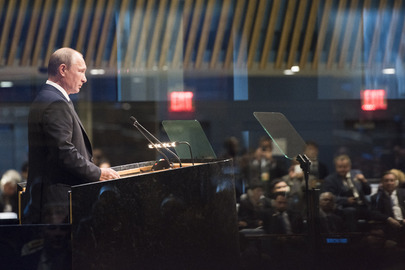
Putin addresses the UN, 09-28-15. (UN Photo)
Their members were generally young people who were enthusiastic, honest and genuinely committed to the public good, but were plagued by the lack of funding and faced with frequent media blackout and open discrimination. Nonetheless, their programs articulated the most promising and humane geopolitical vision for the Balkans. They conceptualized the Balkans as a territorial bridge between the West and the East rather than as the place of persistent confrontation, or the ‘line of fire’ as formulated by the U.S. Secretary of State John Kerry in 2015. They wanted the Balkans to become a force for peace and human dignity in the world. Their vision still remains the best option for the Balkans people.
This desire for non-alignment is understandable as a continuation of the policy of Tito’s Yugoslavia during the Cold War – the nation that several of the modern day Balkan states were a constituent part of. However, according to Kovacevic, these groups were easily overwhelmed, in terms of both financial and propaganda resources, in the 1990s by pro-NATO forces in the West.
In addition to providing resources to build up pro-NATO sentiment in the media and NGO sectors of these countries, financial resources and pressure was used to sway a large number of politicians to favor NATO membership, often in opposition to the general population’s views. Some of the unsavory forms of incentive or pressure include what amounts to blackmail and bribery, Kovacevic told me in an email interview:
This is a long-term process. In the U.S. intelligence community it is called ‘seeding.’ The intelligence scholar Roy Godson defines it as ‘identifying potential agents of influence’ at an early stage and then acting to advance their careers. This is typically done covertly, but there have been the historical examples of overt support. …
In the Balkans, the key role in the process of ‘seeding’ was accomplished by various institutes, conferences, retreats, grants, etc. For instance, I was told by a confidential source who participated in the same U.S.-NATO program, the long-time foreign minister and one-time prime minister of Montenegro, Igor Luksic, was a product of such a process. Luksic was chosen as a very young man to attend various conferences and retreats in Brussels and Washington and, after that, his political career really took off. All the while, he promoted the NATO agenda in Montenegro, even though this went against the will of the majority of the population.
Another example is Ranko Krivokapic who was the speaker of the Montenegrin Parliament for over a decade. He traveled on official business to the U.S. a few times every year and boasted to others that he had a lot of friends in the State Department and other institutions of the U.S. government. There are examples like these in Serbia, Macedonia, Croatia, etc. All over the Balkans.
There is also the fact the European Union has dovetailed its security arrangements to such an extent with NATO that new members are now virtually brought into the NATO structures by default. For example, Mahdi D. Nazemroaya, author of The Globalization of NATO, reports that the E.U.’s Security Strategy was absorbed into NATO during its annual summit in 2006. The emphasis of the summit was on securing energy resources with the goal of ‘co-managing the resources of the EU’s periphery from North Africa to the Caucuses.’ Also implied was the goal of redefining the E.U.’s security borders in synch with both Franco-German and Anglo-American economic and geopolitical interests.
Moreover, British Russia scholar Richard Sakwa, has pointed out that the security integration of the E.U. with NATO was further intensified with the ratification of the Treaty of Lisbon in 2007:
As for the comprehensive character, this is something that has been gaining in intensity in recent years as the foreign and security dimension of the E.U. has effectively merged with the Atlantic security community. The E.U.’s Common Foreign and Security Policy (CFSP) since the Treaty of Lisbon (the “Reform Treaty”) of 13 December 2007, which came into effect in 2009, is now in substance part of an Atlantic system. Acceding countries are now required to align their defense and security policy with that of NATO, resulting in the effective ‘militarization’ of the E.U.
At this point, the forces seeking a non-aligned bridge role for the Balkan states are still very much around, but have suffered marginalization due to lack of resources to take on the powerful and now entrenched pro-NATO political forces. However, with increasing discontent with the weak economic prospects in certain Balkan states, combined with increasing instability in the E.U., it is believed that there is an opening for growth of the movement.
Economic Conditions in the Balkans
The Balkan states comprise Romania, Bulgaria, Albania, Macedonia, Serbia, Kosovo, Montenegro, Bosnia-Herzegovina and Greece.
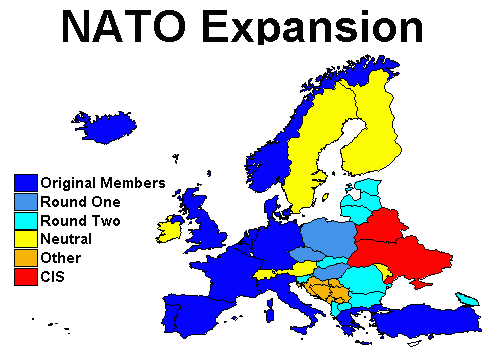
A map showing stages of NATO’s expansion. Dark blue showing original members; lighter blue the “round one” members; aqua the “round two” members; yellow represents neutral states; and brown and red otherwise aligned (including Ukraine, although that has changed since the 2014 U.S.-backed coup).
In 2007, Romania and Bulgaria became E.U. members (three years after joining NATO). Romania’s GDP has barely kept up with its 2008 rate and has a general unemployment rate of 6.4 percent, which sounds reasonable until you look at the youth unemployment rate of 21 percent, which doesn’t bode well.
Bulgaria, on the other hand, is not part of the Eurozone and has not adopted the euro as its currency. Its economic prospects since joining the E.U. have not been impressive either. In the midst of the financial crisis of 2009, its GDP contracted by 5.5 percent, with a current unemployment rate of 7 percent and youth unemployment at 17 percent. Bulgaria is also recognized as one of the union’s most corrupt countries.
Macedonia, Montenegro, Serbia, Kosovo, Bosnia-Herzegovina and Albania are all in the process of E.U. integration, with a supposed approval rate of 80-90 percent among the respective populations of these countries (except for Serbia), despite the virtual rape of Greece and the lackluster performance of Romania and Bulgaria.
It should be noted that all three Balkan nations that are actual E.U. members have higher emigration than immigration rates, another indication that accession to the E.U. doesn’t necessarily translate into a prosperous future for the average person, particularly the young.
There is also the instability highlighted by the British people’s vote to leave the E.U., spurred by disgust with austerity measures imposed by unaccountable bureaucrats in Brussels along with an influx of immigrants – one-third from these poorer E.U. nations – which adversely affect lower-wage natives.
Even if the E.U. had a better track record of effectiveness in terms of improving economic conditions for the masses, it would have a very tall order with some of the prospective Balkan states. Macedonia, for example, has an unemployment rate between 24 and 25 percent as of January 2016, although it has improved from the 2005 high of 37 percent. Despite this improvement, Macedonia still has one of the lowest GDPs in Europe and 72 percent of its citizens claimed they manage their household income only with “difficulty” or “great difficulty” in 2012.
Bosnia-Herzegovina is still feeling the effects of the war of 1992 to 1995 that included major physical destruction of infrastructure and the bottoming out of its GDP. It currently suffers an unemployment rate of 42-43 percent.
Kosovo, a state that owes its existence to a NATO intervention, has 33 percent unemployment, a high crime rate and increasing political violence due to ethnic tensions and a growing ultra-nationalist movement. The Council of Europe compared the government of Kosovo to a mafia state in a 2010 report which revealed trafficking in human organs as well as drugs and weapons throughout Eastern Europe, even implicating the then-prime minister in the operation.
Russia’s Opening
Kovacevic states that the Atlanticist project of E.U. austerity economics and the enabling of Washington’s destabilizing wars via NATO is starting to chip away at its popularity among Balkan populations. He also says Putin is prepared to take advantage of this opening and, since the outbreak of the Ukraine crisis, has turned his attention “to the Balkans with political force and funding not seen since the days of tsar Nicholas II.”
This attention has manifested in the Lovcen Declaration, which was signed on May 6, by members of Russia’s largest political party, United Russia, and the opposition Democratic People’s Party in Montenegro in the village of Njegusi. Kovacevic explains:
One of the most powerful political figures in Montenegro, the metropolitan Amfilohije, the chief bishop of the Serbian Orthodox Church in Montenegro, was present at the signing and gave his blessing. Though in the past Amfilohije has been known to support the authoritarian and pro-NATO prime minister Milo Djukanovic around the election time, he has always publicly opposed NATO membership and has given fiery speeches on its ‘evil nature’ to the point of accusing NATO for continuing Hitler’s anti-Slavic project.
Even more importantly, Amfilohije’s involvement with the Lovcen Declaration reveals one of the fundamental components of Putin’s overall geopolitical plan – the nurturing and intensification of the religious Christian Orthodox connection between the Russians and the Orthodox peoples of the Balkans. This includes not [only] the Serbs, Montenegrins and Macedonians, but also the Greeks and Bulgarians whose states are in NATO and whose religious ‘awakening’ can easily subvert NATO from the inside.
Criticism and minimization of the project have set the tone in Western media, to the extent that it has been covered at all, particularly in relation to utilizing an opposition party for significant influence. But Kovacevic argues that such a dismissive attitude is disingenuous:
[T]he very same method has been used by the U.S. and NATO intelligence services to control the governments of East-Central European states since the collapse of communism. Countless small parties with just a handful of parliamentary deputies were formed with the money coming from the various ‘black budgets’ with the task of entering the governing coalition and then steering the entire government in the direction charted by their foreign founders and mentors.
These parties have had minimal public legitimacy, but have made a great political impact with their ‘blackmail’ potential. As they also don’t cost very much, the CIA, the MI6, and the BND regularly create them for every new election cycle.
Now the Russians (primarily, the SVR and the GRU) are using the same rulebook for their own geopolitical interests. In addition, however, Putin’s grand design for the Balkans embodied in the ANS is also likely to prove durable not only because it builds on the traditional cultural and religious ties linking Russia and the Balkans, but also because it rides on the wave of the enormous present popular dissatisfaction with the neoliberal Atlanticist political and economic status quo.
The fact that this declaration was signed in Montenegro is most relevant due to the fact that the country has been officially invited to join NATO, whose subsequent membership is treated in the West as a fait accompli. However, accession requires consensus approval by all current NATO members – one member could veto the move before completion of the process as happened with Macedonia when Greece vetoed their membership aspirations in 2008 when an invitation was to be offered at the Bucharest Summit – as well as approval by the population of Montenegro.
Joining any alliance treaty is arguably something that affects national sovereignty, which requires a referendum as Kovacevic, who is Montenegrin, explains:
The corrupt government of Milo Djukanovic is trying to avoid a national referendum because it knows that it does not have a majority support for NATO. If given a choice, the people of Montenegro would reject the protocol. The Constitution requires a referendum for all matters that affect national sovereignty, but Djukanovic is arguing falsely that NATO membership leaves Montenegrin sovereignty intact.
Kovacevic predicts that a show-down over NATO membership could create instability in the country: “[I]f he [Djukanovic] tries to push this decision through the Parliament (which he no doubt will), wide-scale strikes and demonstrations may take place all over the country. Whoever is pushing Montenegro in NATO is dangerously destabilizing the country in mid-to-long term.
If that happens, Washington may find for the first time in recent memory that forcing instability on a smaller country may ultimately accrue benefits to another great power, helping to facilitate a shift in geopolitics that it didn’t bargain on. As Nazemroaya comments in his book:
The [NATO] alliance is increasingly being viewed as a geopolitical extension of America, an arm of the Pentagon, and a synonym for an evolving American Empire. … Ultimately, NATO is slated to become an institutionalized military force. … Nevertheless, for every action there is a reaction and NATO’s actions have given rise to opposing trends. The Atlantic Alliance is increasingly coming into contact with the zone of Eurasia that is in the process of emerging with its own ideas and alliance. What this will lead to next is the question of the century.
Natylie Baldwin is co-author of Ukraine: Zbig’s Grand Chessboard & How the West Was Checkmated, available from Tayen Lane Publishing. In October of 2015, she traveled to 6 cities in the Russian Federation and has written several articles based on her conversations and interviews with a cross-section of Russians.
Omar Nayef Zayed assassinated in Palestinian embassy in Bulgaria

UPDATE/11:44 am/26 February: Bulgarian media and police sources are reporting that Omar was killed by falling from a high story of the building. They have noted that him being pushed is “not excluded.” “Israeli media have been the first to report explicitly that Omar was ‘assassinated.’ This comes as no surprise. They’re simply the most knowledgeable and honest about the workings of their government and its intelligence agencies,” said Joe Catron of Samidoun.
Samidoun Palestinian Prisoner Solidarity Network | February 26, 2016
Omar Nayef Zayed, a former Palestinian political prisoner and escaped hunger striker whose extradition from Bulgaria Israel demanded in December, was found dead this morning inside the Palestinian embassy in Sofia, Bulgaria, where he had sought refuge.
“Omar Nayef Zayed was targeted as a Palestinian, as a struggler, as a former political prisoner,” Charlotte Kates, international coordinator of Samidoun Palestinian Prisoner Solidarity Network, said. “His case, his targeting and his assassination were an attempt to demonstrate that no Palestinian anywhere is safe from the long arms of the Israeli occupation. This is clearly a threat to all Palestinians – especially former prisoners and veterans of the struggle in Europe. We are committed to stand with the family of Omar Nayef Zayed to pursue accountability for those responsible for taking his life and to build the movement for which his life was taken – for a free Palestine.”
The precise physical cause of Omar’s death is not yet clear, but it is clear that the cause of his death is the Israeli state’s vengeance against a Palestinian struggler committed to live free for himself and for all of his fellow Palestinians. Samidoun Palestinian Prisoner Solidarity Network demands an independent autopsy of Omar’s body and a full investigation by Bulgarian and Palestinian officials into the death of Omar. We demand that all those responsible for the targeting of Omar Nayef Zayed and the taking of his life be held fully accountable.
“We hold Israel and its intelligence services, the Palestinian Authority and the Bulgarian government responsible for the killing of Omar Nayef Zayed, whose life was taken as he lived his life, in the struggle for freedom for Palestine,” Mohammed Khatib, a Brussels, Belgium-based member of Samidoun: Palestinian Prisoner Solidarity Network, said. “He was assassinated; he was not protected; and he was constantly threatened and pursued. The Israeli intelligence services have a long history of pursuing and assassinating Palestinians around the world – especially in Europe – targeting young leaders and veteran resisters for assassination and elimination. This outrageous crime happened inside the Palestinian embassy, inside Bulgaria. The killers and those who made this killing possible must be held accountable.”
Zayed, 52, was born in Jenin, in Palestine’s West Bank. He was arrested by occupation forces in May 1986 and sentenced to life imprisonment. After a 40 day hunger strike in 1990, he was transferred to a hospital in Bethlehem where he escaped in May, disappeared and left Palestine.
In 1994, he traveled to Bulgaria. Omar married a Bulgarian citizen and has Bulgarian children; he runs a Palestinian grocery and is well-known in the Palestinian community of Sofia.
On Tuesday, 15 December, the Israeli embassy sent a letter to the Bulgarian Ministry of Justice demanding the extradition of Omar Nayef Zayed, labeling him a “fugitive from justice.”
Omar’s home was raided on Thursday, 17 December. He was not home and his son was arrested for one day. The Bulgarian prosecutor was quoted in Arabic media calling for his imprisonment and quick extradition to Tel Aviv.
Samidoun Palestinian Prisoner Solidarity Network salutes and mourns Omar Nayef Zayed, a former Palestinian political prisoner who struggled all his life for the freedom of Palestine and the Palestinian people. We extend our deepest condolences to the family of Omar Nayef Zayed, in Palestine, in Bulgaria and everywhere, and to the entire movement for the liberation of Palestine, which has had a loving father and husband and a committed struggler for a free Palestine taken away at the hands of those who would see Palestine, and its people, forever imprisoned. We are committed to working in all ways to hold those responsible for his death fully accountable for this vicious crime against the Palestinian people, and to struggle for the freedom – of Palestinian prisoners and of Palestine itself – which Omar Nayef Zayed held so dear.
Bulgaria closes busy border crossing with Turkey
Press TV – December 13, 2015
Bulgaria has shut its busy border crossing with Turkey, which is known for notorious activities of human trafficking and smuggling.
The busy Bulgaria-Turkey border crossing at Kapitan Andreevo, which is an important point of entrance to the European Union, would remain closed until further notice.
The closure came after Bulgaria detained some 14 customs officials in an anti-corruption raid on Sunday.
“All customs officers from the morning shift, who control the entries into Bulgaria at the Kapitan Andreevo (border checkpoint) were detained within a probe against contraband,” Bulgarian National Radio (BNR) quoted Bulgaria’s chief prosecutor Sotir Tsatsarov as saying.
“We apologize to travelers” over the closure, the prosecutor added.
Media reports indicated that a queue of a dozen kilometers long of trucks, waiting to enter Bulgaria, had formed on the Turkish side.
According to Tsatsarov, State Agency for National Security (SANS) conducted about 100 raids in five towns close to the border.
Kapitan Andreevo is the largest and busiest border checkpoint in the Balkans. The crossing is also considered a major crossing point on the route between Europe and the Middle East.
In recent years, Bulgaria has deported hundreds of refugees at its border with Turkey as the poorest country of the European Union grapples with a sharp rise in the number of refugees from non-EU states.
The developments also come as European countries reportedly remain divided over how to deal with refugees, most of whom are fleeing conflict-hit zones in the Middle East and Africa.
The influx of asylum seekers into Europe has sparked pro- and anti-refugee sentiments across the continent.
Leader of several Balkan countries have repeatedly threatened to shut their borders if their northern European Union neighbors refuse to accept refugees.
Bulgarian Prime Minister Boyko Borisov recently announced that Balkan nations desired a Europe-wide solution to the crisis, but would not become a “buffer zone” for the tens of thousands of newly-arriving refugees.
Sofia has already started mobilizing hundreds of forces to its border with Turkey to stop trespassing refugees amid ongoing measures elsewhere across Europe to counter the influx.
According to the recent figures released by the International Organization for Migration (IOM), over 924,140 refugees have reached Europe’s shores so far this year while more than 3,670 people have either died or gone missing in their perilous journey to the continent.
Phantom Russian Sub Hunts Gave Birth To NATO’s Viking Bloc
By Andrew KORYBKO | Oriental Review | May 5, 2015
The largely unobservant public had previously been under the impression that the Baltic Sea was a zone of peace and stability, thinking that all the region’s states lived in harmony with one another. This may have been the case prior to 1991, but immediately afterwards, NATO’s expansion into the Baltic basin seriously upset the balance of power, as the incorporation of Poland and the former Soviet Baltic States in 1999 and 2004 attests. Through this manner, NATO was able to surround Kaliningrad and directly push up against part of Russia’s western border.
The military tension remained just below the surface (literally), until Shadow NATO states Sweden and Finland started initiating highly publicized ‘Russian sub’ scares, designed with the sole intent of scaring their publics into formal NATO membership and opening up an additional front in the New Cold War. Taking it further, this is all part of NATO’s new policy of regional blocs, as Brussels hopes to see the formation of a ‘Viking Bloc’ that would apply pressure against Russia in the Arctic. The most dangerous development, however, is with Finland, which is capitalizing off of the sea scare to call up nearly one million reservists (1/5 of the total population) in the event of a “crisis situation”, thereby presenting a dangerous test run in conflict escalation that might be applied all over Europe in the future.
Regional Hysteria
To put everything into focus, it’s best to begin by documenting the latest hysteria stemming from supposed ‘Russian sub’ sightings. Sweden started the trend when it claimed to be hunting a believed-to-be Russian sub back in October, and when nothing came out of the stunt except for a scared public and a couple million dollars spent, Stockholm continued to insist that it had evidence that a foreign sub did trespass through its waters, but curiously kept the details to itself. Be that as it may, it didn’t stop legislators from increasing the defense budget by a whopping $1.18 billion for the period 2016-2020, earmarking an additional $945 million for the future purchase of two subs, and announcing plans to reopen a military base on the Baltic island of Gottland. The ultimate irony is that there was never a ‘Russian sub’ to begin with, and that it was eventually revealed that the whole scandal started over a simple workboat, thus making it seem like Sweden exaggerated the situation simply to push through more defense funding and militarize its society against Russia.
 Being the regional leader that it is, it appears as though Sweden’s spectacle of the phantom Russian sub rubbed off on Finland, which soon after its latest elections began detonating underwater charges against its own suspected ‘Russian sub’. Finnish political analyst Jon Hellevig assessed that this was simply Helsinki’s application of Stockholm’s decades-long tactic of using phantom Russian subs to increase the population’s acceptance of future NATO membership. While Finland isn’t a de-jure member of the alliance, both it and Scandinavian military hegemon Sweden signed a NATO host nation agreement last fall to intensify their relations with the bloc, essentially making them Shadow NATO members in an even deeper capacity than Ukraine has become (the latter of which has been the bone of contention sparking the New Cold War in the first place).
Given such a relationship, it may not even be needed for either state to formally join NATO at this point, since the alliance can already reap the resultant military advantages of their territory in any possible anti-Russian crisis scenario. However, putting the provocative issue up for a referendum vote or making a unilateral government decision in this regard might be a forthcoming tactic towards creating the aforementioned crisis needed to ‘justify’ the indefinite hosting of NATO troops in those countries. It’s quite clear that Sweden is already de-facto participating in NATO, since they just partook in the group’s “Dynamic Mongoose” anti-submarine drills off the Norwegian coast. This would have obviously raised eyebrows among its domestic citizenry had it not been for the earlier ‘Russian sub’ scare that created the social pretext for its acceptance, showing how such false crises can be manipulated by the media for predetermined military gain.
The Viking Bloc
Everything going on in Scandinavia right now, from the phantom ‘Russian sub’ scares to the de-facto NATO-ization of the region’s last formal holdouts, is designed to create the northern component of NATO’s regional bloc strategy. In sum, the alliance is reverting to history and using Polish interwar leader Josef Pilsudski’s Intermarum concept to establish a Baltic-to-Black-Sea coalition of anti-Russian states to which it can more efficiently outsource its military prerogatives, all per the Lead From Behind strategy. The ‘Viking Bloc’ which consists of the Greater Scandinavian states of Sweden, Norway, Denmark, Iceland, and Finland (centered on Sweden, possibly incorporating Estonia and Latvia as well) is envisioned to complement the emerging Commonwealth Bloc of Poland, Lithuania, and Ukraine (centered on Poland), and the forthcoming Black Sea Bloc of Romania, Bulgaria, and Moldova (centered on Romania, possibly even expanded to Georgia).
Focusing more specifically on the characteristics of the Viking Bloc, its members have a maritime identity, so it’s predicted that they’ll focus their activity on the Baltic Sea, North Sea, and Arctic Ocean, accordingly making them all one large naval base. Sweden’s demographic and economic strength makes it the obvious leader amongst the identified members and the control node of its activity, while wealthy Norway can provide the natural resources needed to keep it running. Denmark controls the entrance to and from the Baltic Sea, and together with its colony country of Greenland, Iceland, and Norway, the three can patrol the North Sea and Arctic Ocean in hunting ‘Russian subs’. It’s also not a coincidence that all of these states are members of the Arctic Council, meaning that this dialogue configuration has essentially become one of confrontation between North America & the Viking Bloc on one side and Russia on the other. The odd member out of this naval configuration is Finland (also a member of the Arctic Council), which has recklessly adapted a land-based anti-Russian policy that’s bound to ratchet up tension with its neighbor. One should also note that the Viking Bloc’s members signed a multilateral defense cooperation agreement in April that basically institutionalized the organization as an official regional bloc.
The Finnish Amphibian
The most dangerous sub-bloc strategy being adopted by NATO is its Finnish affiliate’s advance preparation of 900,000 reservists in the event of a “crisis situation”, which obviously could only refer to a military conflict with Russia. The Finnish government is trying to account for all of its former reservists aged 20-60 in order to inform them of what their “crisis situation” role would be, as well as to collect updated information about them. This dramatic movement of anti-Russian initiatives from sea onto land represents an amphibious strategy that’s likely only in its initial test-run phase. NATO wants to gauge Russia’s reaction and monitor its response in order to fine-tune this template for eventually export throughout the bloc as a whole.
The Finnish Amphibian is a very simple strategy. All that the practicing states or regional blocs have to do is report on a phantom ‘Russian sub’ sighting, preferably with as much media paranoia as possible but providing no proof whatsoever, and then use the subsequent buzz to justify the potential mobilization of a massive land-based reservist force. This leads to the militarization of society within the targeted state and initiates a siege mentality that makes its citizens feel as though they’re constantly under some type of Russian attack. None of the accusations have to be proven, let alone even seen by the citizens themselves, so long as the media and supportive political figures repeat the chorus of conflict enough to make it believable. An added touch would be to implement Sweden’s strategy of publicly accusing 1/3 of all Russian diplomats there as being spies, which when coupled with the existing paranoia about phantom ‘Russian subs’, sends the populace’s paranoia into overdrive and all but assures that they’ll support whichever military or surveillance solutions their government or NATO suggests.
Concluding Thoughts
NATO’s northernmost regional fighting group, the Viking Bloc, owes its speedy creation to the utilization of phantom ‘Russian sub’ scare tactics to galvanize support for this new initiative. Greater Scandinavia is rapidly being transformed into one giant NATO naval base that’s meant to confront Russia on the neighboring high seas. As destabilizing as that is, it moves into the realm of flashpoint danger with the fact that Finland is preparing to mobilize 1/5 of its population against Russia, thus presenting an amphibious land-based component to the majority sea-focused strategy. Even worse, the template of using false sea-based scares to ‘justify’ massive land-based mobilizations could likely be applied elsewhere in Europe, thereby serving as an ideal model of militarization all throughout NATO. It’s this hybrid of media-military strategic collaboration that may eventually prove to be more destabilizing than the unveiling of the Viking Bloc itself.
Kerry to Bulgaria: End energy dependence on Russia
Press TV – January 15, 2015
US Secretary of State John Kerry has called on Bulgaria to end its dependence on Russia for energy.
Kerry made the remarks on Thursday in meetings with Bulgaria’s president, prime minister and foreign minister in the capital Sofia.
Bulgaria must move toward “diversifying supplies and distribution and increasing connectivity with neighbors,” Kerry told a news conference with Bulgarian Prime Minister Boyko Borisov.
He said Washington is interested in helping the country take “practical steps to enhance energy security in Bulgaria and across Europe.”
Kerry also talked about the possible construction of a natural gas pipeline from Greece and moving ahead with a stalled contract with Westinghouse Electric Co. to build a nuclear power plant.
“We hope very much that the issues that (the government and Westinghouse) are discussing can be quickly resolved,” Kerry said.
Kerry, however, stressed that the US push is not aimed at Russia.
“That is not directed against any one country,” Kerry said. “It is simply a reality. No country in the world should be totally dependent for its energy supply on one other country. We need diversified supplies across the world.”
He said the US will send its special energy envoy to Sofia to look into how the US Export-Import Bank could finance the country.
Bulgaria relies on Russia for 85 percent of its gas and 100 percent of its nuclear power.
On security issues, Kerry said the US is determined in its commitment to defend NATO member Bulgaria if it is attacked.
The US would increase joint military exercises with Bulgaria and also help the country modernize its defenses, Kerry said.
Westinghouse moves forward with nuclear scheme in Bulgaria
World Nuclear News | August 1, 2014
Westinghouse plans to hold a competitive tender “within the next year” for construction of a seventh reactor at the Kozloduy nuclear power plant in Bulgaria. The AP1000 reactor is projected to be online by 2023.
The site is already home to two operating Russian-designed VVER-1000 pressurised water reactors, Kozloduy 5 and 6, as well as four shut-down VVER-440s.
Westinghouse, part of Japan’s Toshiba group, announced the target date following its signing today of a shareholder agreement for the Kozloduy nuclear power plant expansion project. A source close to the talks in Sofia told World Nuclear News the agreement decides the ownership of project company Kozloduy NPP – New Builds plc, of which Kozloduy NPP plc and Westinghouse will own, respectively, 70% and 30%.
The agreement followed consultations with all of Bulgaria’s political parties, Westinghouse said in a statement. This and subsequent agreements for the project will be subject to future government oversight, it said. Bulgaria will have an interim government for two months, following the resignation of prime minister Plamen Oresharski’s government last week and a snap election in October.
The agreement also formalizes the selection of an AP1000 design reactor by Bulgarian Energy Holding EAD (BEH EAD), Kozloduy NPP plc and Kozloduy NPP – New Build plc. These parties entered into exclusive talks with Westinghouse in December 2013, following a feasibility study conducted under a competitive tender. Westinghouse will provide all of the plant equipment, design, engineering and fuel for the new unit.
A tender for the plant’s construction will follow European Union and Bulgarian public procurement rules, Westinghouse said. This process is expected to involve Bulgarian and global construction companies.
Bulgaria’s council of ministers approved an economy and energy ministry report on the shareholder agreement on 30 July, BEH EAD said yesterday. The agreement – including the financing terms of an engineering, procurement and construction (EPC) contract for the project – will enter into force after approval by the next government, it said.
No guarantee
Today’s agreement does not in itself mean that Kozloduy 7 will be built, however.
“Any future build will be dependent on future agreements such as an EPC. It will also require mutual agreement on financing terms and conditions,” Westinghouse spokesman Hans Korteweg told World Nuclear News.
“This agreement does not identify any specific assumptions on state support of any kind. It allows both Westinghouse and Kozloduy to engage international finance entities to determine best conditions for both parties. If this is not realized, the project will not go forward,” Korteweg said.
“This agreement in no way creates a binding decision to proceed – by either party. What it does do is to provide a basis for the project to go forward through a working partnership in reaching the next key agreements and obtaining attractive financing,” he said.
Some commentators in Bulgaria have said discussion about the project had lacked transparency, but Korteweg said this assertion was false.
“The process is similar to those conducted in France and the UK, for instance, where a partner and a technology are selected from current viable alternatives,” he said. “Specifically, there are only three PWR reactor designs certified in Europe – AP1000, EPR and MIR.1200. The Westinghouse AP1000 meets the criteria of diversified technology from existing reactors and 1200 MW maximum in size due to Bulgarian grid limitations,” he said.
Prior to today’s announcement, Kozloduy NPP and Westinghouse were bound by confidentiality common in all industries before release of the parameters of an agreement, he said.
Bulgarian owner
Although he would not confirm the share ownership of the project company, Korteweg said Westinghouse will not remain an equity investor once the reactor has been completed.
“We believe this is a national asset for Bulgaria and do not wish to dictate or otherwise influence the decision-making of its owners and operators. Bulgaria will have 100% of the revenue and profits of this plant,” Korteweg said. “Westinghouse’s stake in the project company during construction incentivizes Westinghouse to build a plant that meets international and Bulgarian safety standards, on schedule and within budget,” he said.
Bulgaria has an oversupply of electricity, but supply will fall in the mid-2020s with changes in the country’s energy mix, including fossil fuel plant closures due to CO2 emission reduction requirements and relative competitiveness of renewable energy, he said.
Additional nuclear power capacity during this timeframe “can certainly be utilized domestically and in export growth,” he said. Kozloduy 7 also represents the “smooth and eventual” replacement of units 5 and 6 in the next 20-30 years, especially after units 1-4 were shut down as part of Bulgaria’s accession to the EU in 2007, he said.
Asked if there will be a guaranteed power price for the reactor once it comes online, Korteweg said today’s agreement does not mention this.
“While many EU countries will be utilizing this tool, such as the UK, this is the decision of the Bulgarian government and its energy regulator to decide. The most important point is that the project produces power at the most competitive price compared to alternatives. This is something we are confident will be achieved,” he said.
Korteweg would not comment on the cost to build Kozloduy 7, but said Westinghouse has “offered a commercially attractive price to Bulgaria to provide diverse energy security without greenhouse gas generation.”
The company has “full confidence” that the conditions of this and future agreements for the project will meet EU rules, he said.
Energy diversification
Korteweg referred to the European Commission’s publication in May of a Communication outlining its recommendations for the establishment of a European Energy Security Strategy.
“Central to that strategy is the urgent need for the EU to increase its indigenous energy production, reduce its dependence upon external suppliers, and encourage diversity in the energy mix in order to meet its energy needs,” he said.
A European Council decision in late June to diversify energy supplies from Russia is also consistent with the Kozloduy 7 project, he said, as currently Russian companies have a monopoly supply of fuel to the plant.
“Westinghouse is not an integrated vendor and must therefore contract with local suppliers,” Korteweg said. “A significant amount of the project will be done in Bulgaria and is expected to significantly boost local, regional and national Bulgarian economies. Bulgarian companies are currently heavily involved with other contracts that Westinghouse has with units 5 and 6,” he said.
At the height of construction of the new unit, close to 3500 local workers will be employed on site, with an additional 15,000 workers involved in the associated supply chain, he said. Regional unemployment around the construction site could be reduced to 9% from the current rate of 13%, he said. Once the reactor is completed, its operation will require between 500 and 800 highly-skilled specialists, he said.
Westinghouse is also prepared to integrate Bulgarian companies into other ongoing and prospective projects, such as in the UK, he said.
Westinghouse recently announced an agreement to supply three Westinghouse AP1000 nuclear reactors to the NuGeneration Limited’s Moorside project in West Cumbria, England, in partnership with Toshiba and GDF Suez.
Bulgaria: South Stream doesn’t breach EU laws
RT | June 26, 2014
Bulgarian officials say the construction of the Russian-led South Stream gas pipeline does not breach EU legislation. The European Commission is concerned the agreement between Russia and Bulgaria violates EU competition law.
The Bulgarian government stood by its position on the legality of the pipeline in a Wednesday statement, ITAR-TASS reports. The agreement on South Stream construction signed in 2008 did not provide any exclusive rights, concessions, or tendering for the South Stream Bulgaria Company which is the owner of the pipeline, and therefore it does not violate EU law, it said.
“With its position the government presents arguments and motives in support of the decisions the Bulgarian nation has taken and which were the subject of concern at the EU Commission,” Reuters quotes the official statement.
Bulgaria will put these arguments at the Brussels summit on Friday, but the decision of the commission whether to accept or reject them may end up in full infringement proceedings and possible fines against Sofia, Reuters says.
According to Gunther Oettinger, the European Commissioner for Energy, the construction process should be suspended until, “it completely corresponds to the requirements of the European Union.”
On Tuesday Austria, another strong defender of the pipeline, signed a deal to construct a South Stream arm on its territory, thus showing its firm commitment.
The 2,446 km South Stream pipeline will stretch across southern and central Europe via the Black Sea, bypassing Ukraine and reducing the country’s importance as a gas transit route. 64 billion cubic meters of gas will be transported annually.
Gazprom has said the project, estimated to cost $45 billion, can be completed without any funding from international partners.
Nasrallah: EU giving “legal cover” for an Israeli war on Lebanon
Al-Akhbar | July 25, 2013
The European Union is paving the way for Israel to justify a war on Lebanon, Hezbollah’s general secretary said late Wednesday, two days after the 28 member states issued a decision to put Hezbollah’s military wing on its terror list.
“EU countries should know they are giving legal cover for Israel to launch any war on Lebanon because Israel can claim it is waging war on terrorists,” Sayyid Hassan Nasrallah said in a televised speech at the annual iftar ceremony held by the Women’s Committee of Islamic Resistance Support Association of Hezbollah.
“These countries make themselves undeniable allies during any Israeli aggression on Lebanon, on the resistance and on any target for the resistance [in the country],” Nasrallah added.
The EU 28-member bloc agreed Monday to blacklist Hezbollah’s military organization as a terrorist group following years of relentless US and Israeli pressure.
The EU cited accusations that the powerful Lebanese Shia movement was behind a bus bombing in Bulgaria last year which killed five Israelis and their driver, as well as the party’s involvement in the Syrian conflict.
Hezbollah has denied any involvement in the Bulgaria bombing.
Last month a new socialist-led Bulgarian government backed away from the claims of the previous administration, saying that the EU could not justify blacklisting Hezbollah solely based on the little evidence produced to implicate it in the crime.
“It is important that the (EU) decision be based not only on the bombing … because I think the evidence we have is not explicit,” Foreign Minister Kristian Vigenin had told national state radio BNR.
Nasrallah noted that the EU’s official statement will be issued within days and the party will see then what is to be discussed.
He also posed the question to the EU of why the union hadn’t considered placing Israel’s army on its terror list.
“[The EU] repeatedly admits that Israel occupies Arab land but hasn’t implemented international resolutions for ten years. The whole world has witnessed the Israeli massacres,” he said.
Nasrallah advised the member states to reconsider the decision, stating that it is doomed to fail and that “the decision wasn’t worth the ink it was written with.”
The EU’s blacklisting of Hezbollah’s military wing is merely the result of external pressure and interests, he said, instead of being based on values and principles. He added that the effect of the decision is nothing but psychological.
“In this country, resistance fighters fought the Israeli occupation, endured a lot of pressure and sacrificed martyrs. Then you come to those who are the sons of these people and say they are terrorists. This is abuse to fighters, to their people and to their successive governments,” Nasrallah stated.
“This decision aims at making us bow, at forcing us to step back and be afraid. But, I tell you that all you will get is failure and frustration,” he said, adding that anyone who thinks the resistance will be undermined by the decision is either “ignorant or delusional.”
The General Secretary hinted jokingly at having members of Hezbollah’s military wing in Lebanon’s new government, assuring viewers that the resistance has gained credibility among people in Lebanon and the Arab and Muslim world.
“The most important thing for the Lebanese resistance is to get the support of its people and to express their will, pride and view in defending their land and their sovereignty,” he said.
“The Resistance will remain and will be victorious by God’s will,” Nasrallah concluded.
Bulgarian scholars call for end to plutocracy
Press TV – June 24, 2013
Sixty prominent Bulgarian intellectuals have issued a special declaration against ‘plutocracy’ in the country, calling for an end to rule by the wealthy and a return to democracy.
The so-called charter for disbanding the plutocratic model of the Bulgarian state was issued on Sunday amid the ongoing protests by Bulgarians to oust the three-week-old government.
“The protests of tens of thousands of people across the country were motivated by the desperate concern about the state system in Bulgaria. Beyond doubt, we are in a deep crisis of the social contract and a total discreditation of the state institutions,” the declaration read.
The protests began on June 14 after the appointment of controversial and inexperienced media mogul Delyan Peevski as chief of Bulgaria’s National Security Agency (DANS).
The declaration called Peevski’s career and public image “a synthesis of all pathological processes that led to the current degrading and seemingly dead-end situation.”
“The Peevski case laid bare the growing seizure of the political system, media, justice, security and banking sectors by a network of hidden dependencies that does not respect the rule of law and separation of powers, empties the institutions from democratic legitimacy and substitutes public interest [with] corruption and moral degradation,” the declaration stated.
The new Socialist-backed Prime Minister Plamen Oresharski withdrew Peevski’s nomination immediately after the protests erupted.
However, the move failed to appease both the protesters and President Rosen Plevneliev, who said he had lost confidence in the government and demanded an immediate review of the controversial appointment.
In addition, the declaration addressed a number of other instances over the past years that proved “the adhesion of oligarchy and power,” urging the public to launch a process to clearly define the problems in the functioning of Bulgaria’s democracy and to draft reforms to abolish them.
It also listed some of the most striking problems, including alienated institutions, easily swayed by corruption, nepotism and weakened judiciary, police and media.
The sixty scholars behind the declaration include lawyers, journalists, political analysts, sociologists and human rights activists.
Featured Video
Can the U.S. Afford to Annihilate Iran?
or go to
Aletho News Archives – Video-Images
From the Archives
Sanctions, War and the Policy of Dual Containment
By SASAN FAYAZMANESH | March 17, 2008
It is now nearly three decades since the Unites States adopted the policy of dual containment of Iran and Iraq. While much has been written about the containment of Iraq, there has been very little in-depth analysis of this policy when it comes to Iran. In a book that is going to be released on March 31, 2008, entitled The United States and Iran: Sanctions, Wars and the Policy of Dual Containment (Routledge), I attempt to address this shortcoming by investigating when and why the US policy of containment of Iran came about, how it evolved, and where it stands today.[1] To the extent that Israel has been involved in US policy making, the study will also include the role that Israel has played in the containment of Iran. Also, since the fate of Iran has been inextricably linked to that of Iraq, occasionally the investigation will overlap with the containment of Iraq.
The policy of dual containment of Iran and Iraq originated during the Carter Administration, but it was not until the Clinton Administration that the expression “dual containment” became popular. … continue
Blog Roll
 Aletho News
- Can the U.S. Afford to Annihilate Iran? /Seyed M. Marandi
- Elmo Sold mRNA Jabs to Your Toddler. Now They Are “Off-Label.”
- British state targets Palestine Action with yet another crooked trial
- Americans are paying the price to preserve Israel’s nuclear hegemony
- Resistance factions are necessary to ensure a permanent US Iraq withdrawal
- How Israel destabilizes the Middle East: Denying sovereignty and the right to exist
- Europe’s Establishment Is Embracing War – and Losing Voters
- NATO chief advocates war of aggression
- No Vote, No Representation, No State: Democracy, Israeli Style
- Zionist Bought Senate Blocks Information About American Citizens Killed By Israel
- If Americans Knew
- Israeli Soldiers Abduct At Least 22 Across Occupied West Bank
- Eight Palestinians Killed in Israeli Attacks on Gaza
- Israeli former leaders and security chiefs threaten legal action over ‘Jewish terrorism’
- Israel map in LA Times ad includes all land from the river to the sea
- Inside Lebanon’s 200-page dossier on Israeli war crimes
- Flydubai, genocide, settler violence, Trump abuse of power to deport – Daily Update
- Counting Antisemitic Incidents: What the ADL Audit Reveals — and Obscures
- Mamdani releases plan to combat antisemitism and hate crimes in New York City
- Iran’s Revolutionary Guards Publish Letter to the American People
- DMFI launches $1 million ad campaign supporting Virginia’s Elaine Luria
- No Tricks Zone
- Green Energy Debacle: German Expert Professor Fritz Vahrenholt Warns Of Severe Economic And Social Consequences
- Two More Paleo Reconstructions Affirm Meters-Higher Sea Levels Across Ireland, Brazil 7000-6000 Years Ago
- New Study: Earth And Venus Surface Warmth Largely Explained By Convection And Lapse Rate, Not CO2 Or Radiation
- 2025 Nature Paper Claiming Worsening Global Drought Gets RETRACTED …Heavily Flawed
- New Study: ‘Global Drought Shows No Detectable Recent Acceleration Under Climate Warming’
- Economic Masterminds: German Socialists Suggest Taxing Productivity Gains Stemming From Using AI
- The South China Sea Has Not Been Cooperating With The Climate Change Narrative
- Energy Crisis: Germany Enters Heating Season With Historically Low Gas Reserve Fill Levels
- New Study: The Antarctic Ice Sheet Gained Mass From 2020-2024 Due To Staggering Snow And Ice Accumulation
- Study: Ocean Heating Rates From Thousands Of Years Ago ‘Dwarf’ Modern Ocean Heating Rates

