How Intelligence, Politics, and Foreign Interests Shaped America’s Religious Movements
By Freddie Ponton | 21st Century Wire | December 30, 2025
Christianity is back at the centre of American life, but not necessarily in the way most believers imagine. Churches are fuller, Christian language saturates politics, and faith-based identity has become a mobilising force once again. Yet beneath this revival lies a more unsettling reality: for decades, U.S. government agencies have treated religion not as sacred ground, but as strategic terrain.
This is not theory. During the Cold War, the U.S. State Department and intelligence agencies, most notably the CIA, recognised theology, doctrine, and religious institutions as instruments of influence. Faith was studied, guided, and at times quietly reshaped to serve geopolitical aims. The goal was rarely to destroy belief outright; rather, it was to domesticate it, align it, and render it strategically useful.
DOCUMENT: CIA’s use of journalists and clergy in intelligence operations – Select Committee On Intelligence Of The United States Senate One Hundred Fourth Congress, Second Session, July 17, 1996 (Source to download full pdf: US Senate Select Committee on Intelligence)
Initiatives like the Doctrinal Warfare Program illustrate the scale of this engagement. Churches with mass followings, moral authority, and transnational reach were not simply tolerated; they were targeted for influence. Orthodox congregations in the U.S. and abroad were monitored to ensure alignment with Western interests. Catholic seminaries became conduits for doctrinal shaping, funding networks, and leadership development favourable to U.S. objectives. Even Protestant and Evangelical movements, decentralised and spontaneous, were quietly steered through cultural engagement, philanthropic networks, and selective amplification of certain voices.
Sincere people seeking truth, purpose, and transcendence found themselves caught in influence systems they neither designed nor understood. Their worship, community, and faith became tools in a broader psychological and cultural battle they never consented to.
Doctrinal Warfare: When Theology Became a Battlefield
The CIA’s Doctrinal Warfare Program, particularly its work with Roman Catholic institutions, offers a rare glimpse into how intelligence agencies approach faith. Unlike cinematic portrayals of spies manipulating events, this program operated through subtler, more effective channels.
Influence was exerted via:
- Funding pipelines and philanthropic foundations, directing resources to seminaries, clergy travel, and publications
- Theological conferences and academic exchanges, creating opportunities to propagate ideas aligned with U.S. interests
- Publishing houses, journals, and media networks, shaping what doctrines and interpretations were elevated
- Selected intermediaries, often clergy or theologians, who could subtly shift discourse without appearing coerced
The program’s goal was not to dictate belief directly but to frame the boundaries of acceptable belief. Anti-communism, Western liberal ideals, and American exceptionalism were integrated into theological narratives. Over time, certain interpretations were elevated while others, particularly liberationist, socialist, or anti-Western emphases, were sidelined.
This structural influence was not limited to Catholics. Orthodox churches in the diaspora, particularly in Eastern Europe and North America, were monitored for political alignment. Protestant and Evangelical networks, decentralised and emotionally charged, presented different challenges. Leaders resisted hierarchical oversight, yet strategic use of media, donor support, and conferences quietly aligned these movements with larger political and global objectives.
The CIA and allied agencies like the Israeli MOSSAD also monitored global religious developments, from Latin America to Africa, mapping networks of clergy, seminaries, and youth movements. Influence became a form of psychological warfare: it did not coerce, but conditioned; it did not command, but subtly steered. And it thrived where people least expected manipulation, within trusted communities, sacred spaces, and moral authority.
VIDEO: David Wemhoff discusses his book John Courtney Murray, Time/Life, and the American Proposition: How the CIA’s Doctrinal Warfare Changed the Catholic Church. (Source: thkelly67 | Youtube)
Calvary Chapel, Charismatic Leaders, and the Power of Movements
Few movements illustrate both the promise and vulnerability of modern American Christianity like Calvary Chapel.
Founded in the mid‑1960s by Chuck Smith in Costa Mesa, California, Calvary Chapel emerged amidst the counterculture and the Jesus Movement. Smith welcomed surfers, hippies, and spiritual seekers alienated by both secular culture and institutional religion. Informal, emotionally open, culturally adaptive—and extraordinarily successful—it grew from a small congregation into a network of more than 1,800 churches worldwide.
Despite the ongoing debate about whether Calvary Chapel was created by individuals controlled by intelligence agencies or by charismatic individuals, the movement demonstrates a lesson intelligence agencies recognised decades ago: youth-driven religious networks are powerful instruments of social, political and cultural influence.
Figures like Lonnie Frisbee, a magnetic and unconventional evangelist, helped ignite the Jesus Movement and played a decisive role in Calvary Chapel’s early expansion. Frisbee’s countercultural persona, preaching on beaches, leading communal outreaches, and drawing thousands of young converts, was a force institutions could admire, attempt to understand, but never fully control.
Similarly, Paul Cain, a prophetic figure in charismatic networks, influenced theological subcultures with a focus on vision, revelation, and spiritual authority. According to reports, Cain was also a consultant to the Paranormal Division of the Central Intelligence Agency and the FBI. Like Frisbee, Cain became controversial, not because he was a confirmed intelligence operative, but because charismatic authority challenges hierarchical control, making it both influential and unsettling.
Calvary Chapel and these figures illustrate a key pattern: movements can grow organically, capture attention, and mobilise communities, making them valuable, and sometimes threatening, to political and intelligence structures. While the direct manipulation claims and the CIA militant connection remain debatable, historical examples like the Doctrinal Warfare Program prove that states do seek to shape religious institutions at scale, often through indirect methods rather than overt control, hence the lack of evidence thereof.
From Pews to Power: Evangelical Politics, Israel, TPUSA, and the Cost of Capture
By the late 20th century, Evangelical Christianity had evolved into a political powerhouse. Networks that began as spiritual awakenings now functioned as engines of political mobilisation, with youth-oriented, media-savvy outreach bridging the gap between churches and the political arena.
TPUSA and Charlie Kirk
Organisations like Turning Point USA (TPUSA) drew from these ecosystems, churches, conferences, campus ministries, and donor networks that had been shaped by decades of cultural, doctrinal, and ideological influence. Faith-language blended seamlessly with nationalism, free-market rhetoric, and civilizational anxiety, mobilising millions of voters.
The 2024 U.S. presidential election highlighted the real-world impact: Evangelical networks were decisive in returning Donald Trump to the White House. For believers, this was framed as a moral imperative or spiritual duty. For observers, it revealed how religious movements could be strategically leveraged within political frameworks.
The assassination of Charlie Kirk, co-founder of TPUSA, shocked the nation and intensified national reflection. While there is no direct evidence ( at least not yet), linking churches or religious movements to the attack, the public reaction underscores a critical truth: powerful social networks rooted in faith become conduits of influence, whether intended or incidental.
As unsettling as it may be for the US government, it is worth noting that an intense social-media rift has emerged between TPUSA and podcaster Candace Owens, with competing narratives and accusations fueling distrust of official accounts surrounding the Charlie Kirk killing at UVU. Interestingly, some critics, Candace Owens among them, contend that the assassination of Charlie Kirk carries the hallmarks of a sophisticated intelligence-style operation, raising uncomfortable questions about whether certain figures within TPUSA may have been more deeply entangled in the events than the public has been led to believe. A decentralised, global network of self-styled citizen journalists is currently crowdsourcing footage, timelines, and open-source data, arguing that gaps and inconsistencies warrant deeper scrutiny beyond mainstream reporting. This phenomenon has amplified public pressure on agencies such as the FBI and on TPUSA to clarify unanswered questions and reconcile discrepancies in their account of the events of September 10, 2022.
Much like the unresolved shadows that followed the JFK assassination, Charlie Kirk’s killing has placed intelligence agencies, the military, the FBI, and even foreign actors like Israel at the center of a fraught public controversy, not through proven culpability (at least not yet), but through the swirl of suspicion and unanswered questions that inevitably surround the death of a defining religious and political figure in the American conservative sphere, leaving many to ask whether this is coincidence or something more troubling left unexplained.
Christian Zionism and Israeli Influence
No discussion of modern Evangelical power is complete without considering the strategic relationship between U.S. Evangelicals and the State of Israel.
This alliance is public and well-documented. Evangelical Christians, especially in the United States, became one of the most reliable pro-Israel voting blocs, influenced not just by policy arguments but by theological frameworks, Christian Zionism, which frames Israel as divinely central to biblical prophecy.
Israeli political leaders and advocacy organisations have cultivated this alignment via:
- Pastors’ conferences in Israel
- Evangelical media networks and tours
- Donor networks and lobbying partnerships
Organisations such as Christians United for Israel (CUFI) mobilise millions of voters, influence Congressional votes, and amplify foreign policy priorities. During the Trump administration, these networks helped drive decisions like the Jerusalem embassy relocation, Iran policy shifts, and strengthened U.S.-Israel alignment.
Yet this partnership is not uncontested. Younger conservatives and Evangelicals, particularly those aligned with independent thinkers like Charlie Kirk, increasingly question whether faith-based loyalty to foreign policy interests undermines America-first priorities. This generational tension highlights a growing divergence within conservative Christianity: between inherited religious-political alliances and emerging calls for national sovereignty, prudence, and domestic priority.
Moreover, the case of Turning Point USA illustrates how foreign influence can intersect with faith-based movements to shape political power. TPUSA’s open alignment with pro-Israel advocacy networks, from educational trips and conferences to donor engagement, demonstrates how theological and ideological commitments can be leveraged to advance strategic interests. This organisational alignment and associated messaging reveal a clear pattern of external actors using popular religious and political networks to sway domestic policy and voter priorities in the United States. This dynamic mirrors broader trends seen in movements like Calvary Chapel, where charismatic leaders and faith communities, intentionally or not, become conduits for shaping societal and political behaviour, highlighting how belief can be instrumentalised as a tool of influence. Believers are constantly reminded by pastors such as Garid Beeler, of VISION Calvary Chapel in Irvine, CA, that they need to unconditionally embrace the so-called God’s plan for Israel, which in their eyes legitimises Israel’s occupation of Palestine, and the subsequent genocide, on the basis that the Lord specifically gave the Hebrews the land thousands of years ago.
Believers as Collateral in the Machinery of Influence
The story of institutional capture is not about disloyal Christians or malign churches. It is about power exploiting vulnerability.
The State Department, CIA, and allied actors like Israel did not invent faith crises, but they mastered the art of steering movements. They understood that belief motivates action, doctrine shapes identity, and institutions built on trust are uniquely vulnerable to manipulation.
Jay Dyer’s analysis, which we are featuring today, frames this landscape without demonising believers: faith itself is not the enemy, but it has been treated as a resource, managed, redirected, and at times hollowed out by forces whose goals are strategic, political and financial, rather than spiritual.
If Christianity is to withstand this era with integrity intact, it will require discernment, humility, vigilance, and, of course, the ability to separate the Gospel from the machinery of power. The war was never against believers, but belief, as an institution, has been under attack all the same.

Jay Dyer writes about the historical and geopolitical factors of state and private interference in ecclesial and religious affairs…
Institutional Capture Explained: The State Dept, CIA & Orthodox, Roman Catholic & Protestant Churches
The notion of state interference in the life of the Church is well known to students of Church history: Arian Emperors, Imperial support for iconoclasm, the Frankish and Germanic control of the papacy, as well as the investiture controversy should all come to mind. These famous scandals demonstrate the persistent cunning on the part of the state to install, influence and control religiosity in the realm, and to students of geopolitics this should also come as no surprise. What is odd, however, is that when this concept arises in modern discussions, it is relegated immediately to the domain of “conspiracy theory,” unless of course you are talking about the KGB and NKVD relationship to Russian clerics in the 20th century.
It only turns out to be a “conspiracy theory” when one points to the US State Department, the CIA, various foundations, NGOS and academic institutions (often closely linked to the intelligence apparatus) – all of whom openly seek to alter and change Orthodox theology, as well as the theological positions of the Roman Catholic and Protestant communions. First, it is worth noting that missionary work is a classic espionage cover: Obviously, I don’t mean all missionaries are spies, but that it has famously been a useful cover for espionage work, which is precisely why Russia has recently banned groups like the Jehovah’s Witnesses and Scientology. These entities can be used as a form of soft power or even more covert intelligence operations. Similarly, classic cover for foreign operations of this sort has used aid organisation cover, such as the Red Cross or USAID.
In fact, even mainline publications regularly report this fact, though it seems to be lost on so many, especially among the intelligentsia who pride themselves on grasping the practicality of realpolitik. Christianity Today writes:
“Many of America’s first spies were missionaries or came from missionary backgrounds. Often enough, they were the only Americans who had lived abroad—not just among locals but as locals. While other American spies learned about the world through books and couldn’t really grasp its full range of quirks and complexities—“like tourists who put ketchup on their tacos,” as Sutton puts it—missionaries spoke several languages and knew the subtle differences between local dialects. They understood local cultures and faiths from the ground up and knew intuitively how to navigate between them. They knew, in short, “how to totally immerse themselves in alien societies.” But they always identified first and foremost as Christians and as Americans, and when they were called to serve the nation, they did not hesitate to do so.”
This was not unique or new; Orthodox monastic spies were also used by British intelligence in the infamous case of “Father Dimitrios”:
“The story of Father Dimitrios, or David Balfour, who turned out to be a British spy in pre-World War II Greece, is a fascinating yet relatively little-known chapter in modern Greek history.”
Father Dimitrios, the monk with the voice of an angel, turned out to be a spy for the British Intelligence Service. That’s a shame because the mission and wartime actions of the British priest could make a nail-biting spy novel or film.
From 1937 to 1939, the English spy, wearing his priest’s robes and his long, bifurcated beard, performed his ecclesiastical duties close to Greece’s royal family. His relations with King George II, the successor to King Paul and Princess Frederica, were especially close. His access to the royal palace undoubtedly gave him access to valuable information.
British Intelligence must have learned a great deal about the Greek royal family during these crucial prewar years. King George II was a paternal first cousin of Queen Elizabeth’s husband, Prince Philip, the Duke of Edinburgh.
Members of the royal family often confessed to their beloved priest. At the same time, Balfour, under the cover of Father Demetrios, forged important acquaintances with high-ranking military officers and politicians with the blessings of the palace.
During World War 2, for example, dozens of missionaries were using their clerical cloaks as their espionage cloak, spying for the Allies. Time Magazine explains:
“His [Protestant Missionary Alfred Eddy] most audacious undertaking included a plot to “kill,” as he described it, “all members of the German and Italian Armistice Commission in Morocco and in Algeria the moment the landing takes place.” In a straightforward and matter-of-fact memo, he told OSS head William Donovan that he was targeting dozens of people. He additionally ordered the executions of “all known agents of German and Italian nationality.” Never one to mince words, he called the proposal an “assassination program.”
To orchestrate his bloodthirsty plot, Eddy hired a team of Frenchmen. He planned to frame the executions as a “French revolt against Axis domination.” “In other words,” he explained to Donovan, “it should appear that the dead Germans and Italians were ‘the victims’ of a French ‘reprisal against the shooting of hostages by the Germans and other acts of German terror,” and not an OSS operation.
At about the same time that he was recruiting French hitmen, he wrote to his family about the sacrifices he was making for Lent. He described the Easter season as “abnormal” this year. “I am certainly abstaining from wickedness of the flesh,” he confessed. With his wife thousands of miles away, that was not too difficult. “I haven’t even been to a movie since Lisbon, I don’t overeat anymore, and I allow myself a cocktail at night, but never before work is all done.”
And,
“American intelligence leaders had stumbled upon the fact that missionaries make great spies. They have excellent language skills, they know how to disappear into foreign cultures, and they are masters at effecting change abroad. But while missionary spooks believed that their wartime work was necessary, they also wrestled with the moral ambiguities inherent in their actions.”
This is just one example among countless, but it serves to illustrate the point – in this case, the supposed man of the cloth is engaged in assassination missions. A fortiori, the US Government would also see the power in utilising religion for the promotion of Americanism. During the Cold War this was ramped up to extreme degrees as CIA operatives and strategists like C.D. Jackson allied with media magnate and Skull & Bonesman Henry Luce – of Time Magazine, to recruit various prominent academics and Jesuits like John Courtenay Murray to help ensure the Vatican and in particular the Second Vatican Council, would include in its dogmatic degrees new doctrinal statements that were amenable to Americanism. This unique style of interference was even highlighted by a congressional investigation in 1996 into the CIA’s use of ministers and journalists here (including Peace Corps Volunteers).
This was combined with separate operations from Helliwell, Angleton, Donovan & Colby to utilise Opus Dei, the Vatican Bank and drug running for black operations funding in the now infamous Operation Gladio, which also saw the See of Rome aligning itself with organised crime to supposedly “save the world from communism.” However, as Catholic lawyer David Wemhoff has demonstrated in his masterful and unparalleled 800-page, vastly sourced tome, John Courtney Murray, Time/Life Magazine and the American Proposition, Jackson’s now declassified “Doctrinal Warfare Program” led the Roman Church into the hands of new masters at the US State Department and the CIA.
Indeed, this is precisely why Pre and Post-Vatican 2 popes, from Pius XII to Paul VI to John Paul 2 were meeting with Colby, Kissinger and William Casey on a consistent basis during the Cold War. And, if you are a perceptive reader, you can already piece together the blackmail and compromise operations that the world has seen through the Epstein saga were simply a window into how these institutions were similarly blackmailed and compromised, which is why there have been so many scandals in the Roman Church concerning pedo crimes, and likely relates to why Benedict resigned.
In regard to the Protestant Churches, the Rockefeller family is quite proud of, and openly brags about their influence and dominance of the Protestant religious world, through their donations and tax-free foundation offerings. These offerings, of course, come with strings attached, such as the decision to push the newly formed “social gospel” concept of the early 20th century. Eventually, the Rockefellers were creating entire seminaries and universities dedicated to the promotion of David’s influences from Keynesian/Fabian and Austrian economic theory, as well as Malthusianism and eventually technocracy, through the recruitment of Zbigniew Brzezinski after the publication of his seminal 1970 text, Between Two Ages: America’s Role in the Technetronic Era.
Few know David Rockefeller himself spent time in intelligence work and transferred this knowledge of networking and banking operations into his business ventures, as he discusses in his Memoirs. In fact, Brzezinski’s book also includes chapters discussing the role of the Post-Vatican 2 Roman Catholic Church in the promotion of Americanism and technocratic hegemony. It should also be noted that the Rockefellers didn’t merely have an interest in steering the Protestant and evangelical churches into liberalism and modernism, but also set their sights on Rome and Orthodoxy, as Wemhoff notes.
For the Orthodox World, the price of siding between two thieves came at a high cost, as the Orthodox England blog notes, concerning the place of the Russian Orthodox Church between the KGB and the CIA. Similarly, it has recently been declassified that the OSS placed pressure on the Patriarch of Constantinople, as the CIA said:
“In an OSS interoffice memo dated March 26, 1942, an intelligence agent named Ulius L. Amoss wrote this to a fellow OSS agent named David Burns:
The Archbishop was extremely pleased at having met and lunched with you. He has told me that the entire facilities of his organisation are at our disposal. He put it in these words: “I have three Bishops, three hundred priests and a large and far-flung organisation. Everyone under my order is under yours. You may command them for any service you require. There will be no questions asked, and your directions will be executed faithfully. Please tell Mr Burns for me that this is so.”
A month later, on April 25, the 56-year-old Greek Archbishop attempted to enlist in the U.S. Army. He was turned down.
A few weeks after that, on May 14, Ulias Amoss, the same intelligence agent who wrote the March 26 memorandum, wrote a letter to Athenagoras, thanking him for the Greek Archdiocese’s ongoing cooperation, saying, in part, “The care with which your Bishops and Priests have cooperated has impressed everyone and the report that, perhaps, as many as a hundred thousand names will be returned to us is astounding.” On the same day, William J. Donovan himself — the head of the OSS — also wrote to Athenagoras, “The reports and descriptions of Greek-American youth of military age so kindly undertaken by you are coming in in splendid volume. The care with which Your Grace has managed this important service is of great interest to our armed services, and I wish to express my deep appreciation for your loyal and patriotic assistance.”
This special relationship with US intelligence never ended and continues to this day as the backdrop to the actions of the Phanar and GOARCH in the US:
“Archbishop Elpidophoros, the head of the Patriarchate of Constantinople’s Greek Orthodox Archdiocese of America, was the honoured guest at the National Intelligence University in Maryland earlier this week, where he delivered an address to the U.S. intelligence community.
The university brings together faculty and students from all 18 of the nation’s intelligence communities.
As the Greek Archdiocese notes, the Archbishop’s talk on “Russia’s Weaponisation of Religion in the Ukraine Conflict” was the first-ever address from a GOARCH leader to the U.S. intelligence community. At the same time, the Patriarchate of Constantinople has a long history of cooperation with the U.S. intelligence community, as detailed in documents released by the CIA.”
While it may seem like a far-off footnote in a dusty history book on Byzantium or the Borgia Papacy, the reality of state and private interference (and control!) in religion is a stark reality. The goal of the state is the maintenance and projection of power, simply put. Religion is a tremendous force for control and power in the world, both good and evil, but for the state, religion is simply another domain of human culture for the projection of power, and in today’s world, that is most often projected as soft power.
If you have not read Joseph Nye’s famous essay on Soft Power, I recommend it here. Understanding soft power gives a window into the attitude of the power elite and their perspective on religions and sects as tools – pawns on the grand chessboard, to use Brzezinski’s terminology. One need only think of Brzezinski’s own recruitment and usage of what would become Al Qaeda in the Soviet War in Afghanistan in Operation Cyclone – the usage of a radical religious sect for US objectives – as a classic example.
The DOJ is flaunting the law on the Epstein Files. Why isn’t Pam Bondi in handcuffs?
By Alan Mosley |The Libertarian Institute | December 30, 2025
Congress’s newly minted Epstein Files Transparency Act—a bipartisan law co‑authored by Representatives Thomas Massie and Ro Khanna—was supposed to leave no room for discretion. It required Attorney General Pam Bondi, who serves President Donald Trump, to release all unclassified Justice Department records related to Jeffrey Epstein within thirty days. Trump signed the bill, but his Justice Department blew the deadline and produced only a small fraction of the documents, many of which were blacked out. The co‑authors have responded by drafting impeachment articles and exploring inherent contempt. Their outrage raises a broader question: why can the executive branch ignore the law with impunity, and why does this seem to happen over and over again?
The impetus for the transparency law lies in the horrific pattern of abuse that Epstein orchestrated for decades and the government’s failure to stop it. Even after survivor Maria Farmer told the FBI in September 1996 that Epstein was involved in child sex abuse, officials did nothing. The latest document release confirms that the bureau was tipped off a decade before his first arrest. Many of the new documents show that Epstein’s scheme went far beyond one man; the files include photographs of former presidents, rock stars, and royalty, and testimony from victims as young as fourteen. Campaigners say the heavy redactions and missing files—at least sixteen documents disappeared from the Justice Department website, including a photo of Donald Trump—betray the law’s intent. The omissions have fueled suspicions that the department is selectively protecting powerful clients rather than victims.
A law that leaves little wiggle room
In addition to the redactions, entire files vanished after the department’s release. Al Jazeera reported that at least sixteen documents disappeared from the Justice Department website soon after they were posted, including a photograph of Trump. Survivors expressed frustration: Maria Farmer said she feels redeemed by the disclosure yet weeps for victims the FBI failed to protect, and critics argue the department is still shielding influential individuals. The missing files underscore that Bondi’s partial compliance is not just tardy but potentially dishonest; the law obligates her to release names of government officials and corporate entities tied to Epstein, and removing those names is itself a violation.
The statute instructs the attorney general to release all unclassified Justice Department records about Epstein within thirty days. This covers everything from flight logs, travel records, names of individuals and corporate entities linked to his trafficking network, to internal communications about prosecutorial decisions and any destruction of evidence. It prohibits withholding information to avoid embarrassment, and allows redactions only to protect victims’ privacy, to exclude child sexual abuse imagery, or to safeguard truly classified national security information. Even then, the attorney general must declassify as much as possible and justify each redaction to Congress. These provisions make the statute stricter than a typical subpoena and leave little room for discretion.
Pam Bondi’s dodgy compliance
By December 19 the department had released tens of thousands of pages but withheld the bulk of the material. Observers noted that many records were heavily blacked out and that the department offered no written justifications for redactions. Deputy Attorney General Todd Blanche acknowledged that more documents would be released later, effectively moving the deadline. Massie and Khanna argued that this flouts the statute and have drafted impeachment articles and are weighing inherent contempt. Bondi’s department claims it can withhold materials under common‑law privileges, such as deliberative-process and attorney‑client privilege, even though the statute expressly demands release of “internal DOJ communications” and other decision‑making records. Critics argue that by invoking judge‑made privileges to avoid a law that overrides them, Bondi—who reports directly to Donald Trump—puts the president’s political interests ahead of statutory obligations.
Congress’ options, and why they seldom work
Congress has three enforcement tools: criminal contempt referrals, civil lawsuits, and inherent contempt arrests. The first two depend on the Justice Department, which is unlikely to prosecute its own leaders. Inherent contempt—a forgotten power to arrest defiant officials—has not been used since 1935, but Khanna says it is on the table. Past episodes illustrate why penalties are rare. Director of National Intelligence James Clapper lied to Congress about mass surveillance and faced no charges. CIA officials destroyed videotapes documenting torture, yet prosecutors declined to prosecute. FBI agents misused warrantless surveillance authorities, but no one has been held accountable. The pattern is clear: when officials break the rules, investigations are slow, referrals go nowhere, and political leaders quietly move on. As whistleblower attorney Jesselyn Radack noted, there is a double standard: government officials can lie to Congress with impunity while those who tell the truth are indicted. This inversion of accountability encourages lawlessness within the executive branch and chills those who might expose wrongdoing.
Legal experts note that Congress could also sue to compel disclosure or hold Bondi in criminal contempt, but because the Justice Department prosecutes contempt and is headed by the same officials refusing to comply, those routes are circular. The only truly independent remedy—directing the House sergeant at arms to arrest Bondi and hold her until she obeys—has not been used in nearly a century and would provoke a constitutional crisis. This institutional timidity emboldens agencies to treat congressional mandates as advisory and ensures that accountability remains elusive.
What accountability looks like
Khanna and Massie have urged Congress to impeach Bondi or her deputy, use inherent contempt to detain them, and refer the matter for prosecution. Those remedies would test whether Congress is willing to use dormant constitutional powers. Citizens who value liberty should demand action. The same government that lied about weapons of mass destruction, destroyed evidence of torture, and spied on millions now tells us that blacked‑out pages constitute transparency. Without accountability, the executive branch will continue to flout the law. Bondi may work for Trump, but the buck stops with the president who appointed her. If Congress and voters do nothing, future transparency laws will be meaningless, and the war state will remain healthy at our expense.
Accountability requires more than rhetoric. Congress must be willing to reclaim its constitutional prerogatives—by using inherent contempt, cutting funding, or refusing to confirm officials who flout the law. Voters should demand that elected representatives of both parties stop hiding behind national security and confront a Justice Department that acts as if it is above the law. The stakes extend beyond Epstein; they touch on foreign policy, civil liberties, and the very idea of self‑government. When a cabinet official appointed by the president can ignore a clear statutory mandate and the president remains silent, it signals that the executive branch believes itself sovereign. If we shrug, we will continue down the path where laws are for the governed, not the governors.
Citizens who value liberty and limited government should pay attention. When laws are ignored without consequence, the effect is to normalize lawlessness. The Massie–Khanna legislation was not meant to be a suggestion; it was a mandate that passed the House 427-1 and the Senate unanimously. If Congress does not enforce it, future transparency laws will be toothless, and the bureaucracy will continue to protect its own at the expense of truth. In the long run, a free society cannot survive if the government decides which laws apply to its friends and which apply to everyone else. Accountability is not partisan, it is a principle. Without it, injustice will remain healthy and unchallenged, and the rest of us will continue to pay the price.
The Epstein Saga: Chapter 3, Those friends in the Secret Service
Someone has to do the dirty work
By Lorenzo Maria Pacini | Strategic Culture Foundation | December 28, 2025
One piece of information that emerged from the declassified material is seemingly marginal, but nonetheless colorful: a T-shirt from Mossad, one of Israel’s secret services. The press immediately began to label dear Jeffrey a secret agent, without further exploring the reasons for a T-shirt in the closet. While waiting for the next documents to be made public, we will now outline some interpretations regarding that ambiguous T-shirt.
Let’s start with some historical context. The idea that Epstein was connected to Mossad first arose in the 2000s in investigative and alternative circles, but it gained strength after his arrest in 2019 and, above all, after his death in prison, when the public struggled to explain how he had been able to operate almost undisturbed for decades. Commentators and journalists note that, historically, Israeli intelligence has used economic and political networks of influence, creating a context in which Epstein—rich, with access to global elites and involved in sexual blackmail—appears plausible as an “asset.”
Towards the end of 2025, several investigations based on the analysis of leaked or recently released documents—including House Oversight Committee materials and email archives—were revisited and discussed as evidence of repeated contacts between Epstein and Israeli circles, as well as travel patterns and financial flows considered atypical. CNN reported that journalists sifted through more than 23,000 pages of documents and thousands of email threads as part of this broader examination. According to commentators and newspapers that have republished these materials, they reveal “extensive collaboration with Israeli intelligence” or, at the very least, frequent interactions with figures linked to intelligence circles.
Numerous articles refer to personal and financial ties—meetings, communications, and alleged references to money transfers—between Epstein and high-level Israeli figures, particularly former Prime Minister Ehud Barak, as well as entries in diaries and emails that investigators say warrant attention. Common Dreams and some investigative series have highlighted recurring patterns of interaction between Epstein and Barak and have claimed that Israeli operatives or collaborators were long-time visitors to Epstein’s properties; however, the exact origin and interpretation of these documents remain disputed.
Proponents of the Mossad connection hypothesis describe Epstein as a recruited asset or honey trap operative tasked with gathering compromising material for leverage. This narrative, long present in various articles, has been further amplified by partisan commentators and media outlets. Some websites and opinion makers explicitly claim a connection to Mossad, arguing that Epstein’s network of relationships and the alleged presence of Israeli operatives in his residences are typical of intelligence practices.
Prominent Israeli figures have strongly rejected these claims. Former Prime Minister Naftali Bennett—who has stated that he had the Mossad under his direct command during his term—has called the idea that Epstein “worked for Israel or the Mossad” “categorically and totally false.” Mainstream publications such as Newsweek and Times of Israel have highlighted the lack of conclusive evidence indicating that Epstein was a formal Mossad agent and have warned against conspiracy theories, which are sometimes intertwined with anti-Semitic stereotypes.
The resonance of the issue has been uneven and often linked to different political orientations: some progressive investigative outlets have insisted on pursuing the story, while conservative figures and commentators have sometimes exploited the accusation for political purposes. Critics warn that this encourages conspiracy theories or anti-Semitic narratives to be used opportunistically. It should also be noted that Israeli politicians, including Benjamin Netanyahu, have on some occasions emphasized media coverage of Epstein’s ties to Israel for domestic political messages, making it more difficult to analyze the motivations.
But that’s not all.
Funds for all
On September 2, 2025, Congresswoman Anna Paulina Luna shook public opinion with explosive statements made after meeting with some of Jeffrey Epstein’s survivors during a press conference in Congress: “After speaking with Epstein’s victims today, it is clear that this story is much bigger than anyone could have imagined: rich and powerful people must go to prison. It is possible that Epstein was an asset of a foreign intelligence service.” Her words, captured on video, sparked a media storm: Was Epstein just a predator or something more? Was he perhaps an agent of the Israeli Mossad, tasked with ensnaring global elites for Zionist political purposes? The clues are disturbing and form a picture too coherent to be ignored. In 2025, amid leaks, transcripts, and denials, the time has come to address the issue openly.
The apparatus built by Epstein may still exercise influence on the upper echelons of power today. Steven Hoffenberg, his partner in the Towers Financial Ponzi scheme, went even further. Before his death in 2022, he told reporters that Epstein had confided in him about direct links to Mossad, attributing his wealth and access to high society circles to these contacts. Hoffenberg, who ended up in prison while Epstein remained free, had nothing to gain by lying, if anything, a score to settle.
Then there is the testimony of Maria Farmer, one of Epstein’s first victims (identified as Jane Doe 200 in court documents). Farmer described Epstein’s network as a “Jewish supremacist” blackmail scheme linked to the Mega Group, a private circle of pro-Israel billionaires. She also recounted episodes of racial abuse, pointing to Les Wexner as a central figure. Three independent voices—Ben-Menashe, Hoffenberg, and Farmer—all converge on the Mossad. Coincidence or hidden agenda?
The source of Epstein’s fortune remains unclear. How can a former college student become a billionaire with only one known client? Following the financial flows, the connection to Israel appears clear. Les Wexner, magnate of Victoria’s Secret and co-founder of the Mega Group, gave Epstein a $77 million New York mansion — equipped with a sophisticated surveillance system — as well as large sums of money. The Mega Group, created by Wexner and Charles Bronfman, is known for financing pro-Israel causes. Epstein’s financial career began in 1976 at Bear Stearns, thanks to Alan Greenberg, also a member of the Mega Group, despite Epstein having no credentials other than a background as a physics teacher. We are talking about $77 million.
Court documents indicate that Epstein received over 7,000 wire transfers, some linked to arms dealer Adnan Khashoggi, who in turn was associated with Mossad networks. Ben-Menashe claims that Epstein was involved in Israeli arms trafficking. A 2025 private investigation, conducted by hedge funds linked to the Epstein case, speculates that a substantial portion of his wealth came from Israeli funding. Not charity, but the financing of an intelligence operation.
Epstein’s circle looks like a list of intelligence targets. Former Israeli Prime Minister Ehud Barak visited Epstein’s residence dozens of times between 2013 and 2017, as records and photographs show. The two were also involved in founding Carbyne, a technology company with numerous former members of Israeli intelligence. Leaked emails show Epstein connecting Barak with Russian and Israeli figures. In 2004, Barak received $2 million from the Wexner Foundation for unspecified “research” activities. Barak denies any wrongdoing but admits that it was Shimon Peres who introduced him to Epstein.
Epstein possessed multiple passports—a typical feature of clandestine operations—and took refuge in Israel after the 2008 charges, before obtaining an extremely favorable plea bargain. In 2025, Tucker Carlson, during a very harsh speech, openly accused him of being a Mossad agent. Why would so many Israeli officials associate with a sex offender if he were not a strategic asset?
The 2008 plea bargain, which secured Epstein a lenient sentence, is perhaps the most revealing element. Former prosecutor Alexander Acosta later stated, “I was told that Epstein ‘belonged to intelligence’ and that I should drop it.” The agreement also protected accomplices in several states, safeguarding a network that victims, such as Virginia Giuffre, have described as a kompromat factory, with hidden cameras ready to record politicians and powerful figures in compromising situations. This practice is reminiscent of techniques attributed to Mossad, as in the Robert Maxwell operations (which we will discuss in the next “chapter” of our Epstein Saga).
Epstein’s death in 2019, officially classified as suicide, appears to many to be a cover-up, with speculation of unofficial involvement by Israeli intelligence services. In 2025, the DOJ and FBI’s statement on the absence of a “client list” under the Trump administration — which had promised revelations that never came — only reinforced suspicions.
The pieces fit together: Epstein, introduced through Zionist networks, built a blackmail system aimed at influencing political and media decision-makers in a pro-Israel direction. Alleged links to PROMIS software (according to some sources modified by the NSA and Mossad for monitoring) and Palantir, an advanced surveillance company, add further layers of unease. Journalist Whitney Webb speaks openly of a “joint CIA-Mossad operation.” Ian Carroll goes even further, linking this network to events such as the Kennedy assassination and 9/11, identifying a common thread in the Israeli services.
It is true: Epstein’s network also involved Russia and Saudi Arabia. However, the Israeli connections—Wexner, Barak, Maxwell, Mega Group—appear predominant. Is there a lack of definitive evidence? Perhaps. But the smoke is so thick that it is difficult to ignore the fire.
Epstein’s survivors have just announced their intention to publish their own list of names: “We know who abused us. We saw who came and went. This list will be led by survivors, for survivors.”
The state hesitated. The victims did not.
Of course, Israeli authorities reject all accusations. Alan Dershowitz, Epstein’s lawyer and a well-known supporter of Zionism, claims that Epstein would have laughed off the espionage allegations, arguing that he would have used such connections to get an even better deal. But these denials appear fragile in the face of testimony, financial flows, and political connections that all lead to the same conclusion: the Epstein operation has the flavor of an intelligence operation, and the trail leads straight to Tel Aviv.
The most damning evidence comes from those who knew Epstein from the inside, people who risked everything to speak out. Ari Ben-Menashe, a former Israeli intelligence officer, claims that Epstein and Ghislaine Maxwell ran a Mossad “honey trap” aimed at blackmailing the world’s elite. He claims to have met them in the 1980s while they were working in arms trafficking under the supervision of Robert Maxwell, Ghislaine’s father and a known Mossad collaborator who died in mysterious circumstances in 1991. Several Israeli prime ministers attended his funeral, with Shimon Peres delivering the eulogy. A mere coincidence? Hard to believe.
Honduras: The Making of a Controlled Democracy

Zionist Organisation of America (ZOA) Praises Honduras’ Opening Diplomatic Mission In Jerusalem & Later Its Embassy. (Source: Zionist Organisation of America | ZOA)
21st Century Wire | December 22, 2025
Tegucigalpa — The streets of Honduras’ capital were tense as the results of the 2025 elections unfolded, a nation holding its breath amid suspicion, polarisation, and uncertainty. Beneath the visible turmoil lies a deeper story: for over a century, foreign powers have shaped Honduran politics, society, and culture, deliberately fracturing communities and weakening democratic institutions. Once a predominantly Catholic country with a cohesive social fabric, Honduras now grapples with divisions along religious, social, and racial lines, leaving its citizens vulnerable to manipulation and its democracy under strain.
Israel’s influence in Honduras extends far beyond diplomacy or military cooperation. Historical ties, dating back to the early 20th century with figures like Samuel Zemurray, established patterns of economic and political leverage to control Honduran leadership while advancing pro-Zionist objectives. In modern times, presidents, including Juan Orlando Hernández, have strengthened these ties through military cooperation, arms purchases, and symbolic gestures, such as relocating the Honduran embassy to Jerusalem in 2021. Israeli influence also penetrates civil society, promoting Zionist ideology, synagogue expansion, and religious conversion programs, including Protestant-to-Judaism conversions, that embed loyalty to Israeli interests within key segments of society. Four figures who held or effectively controlled the Honduran presidency, Juan Lindo, Ricardo Maduro, Juan Orlando Hernández, and Samuel Zemurray, have been Jewish or closely aligned with pro-Zionist interests, highlighting the deep historical roots of Israel’s influence in the country. These interventions reinforced a pro-Israel political bloc, cultivated an environment where dissent is socially penalised, and subtly shaped political allegiances, a dynamic clearly evident in the 2025 elections.
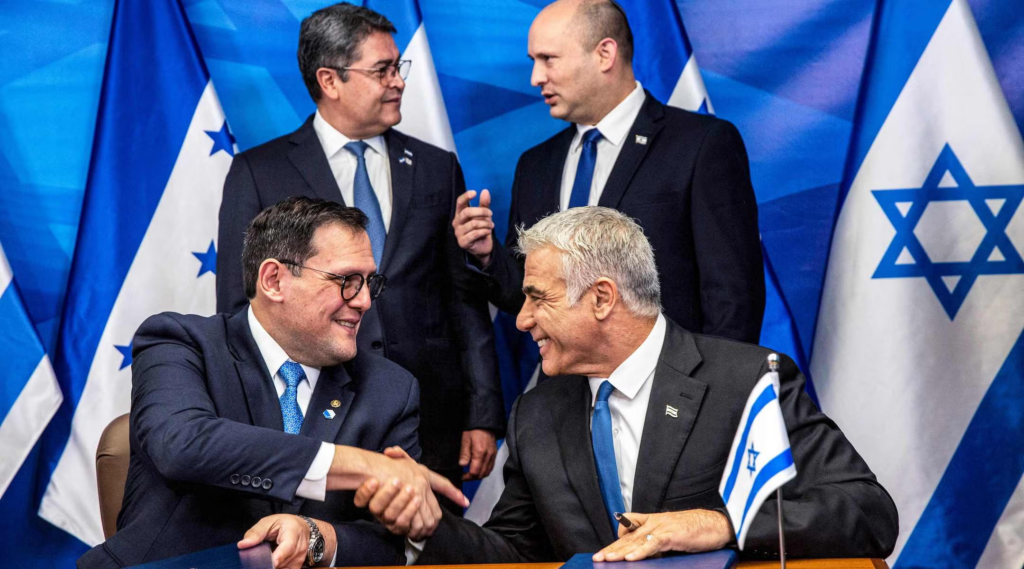
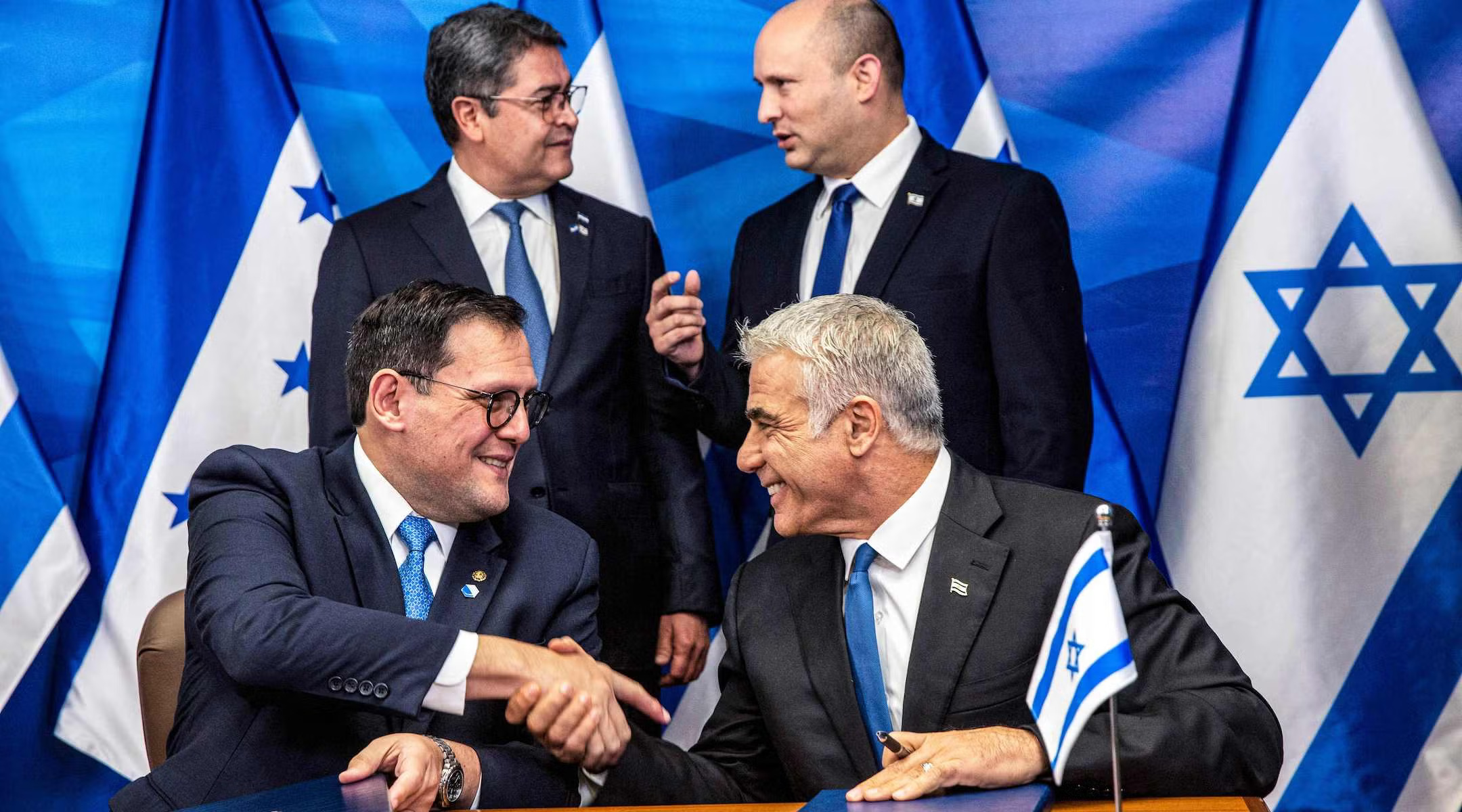
Israeli Foreign Minister Yair Lapid, right, shakes hands with his Honduran counterpart, Lisandro Rosales as Israeli Prime Minister Naftali Bennett, top right, speaks with Honduran President Juan Orlando Hernandez during the signing of bilateral agreements at the prime minister’s office in Jerusalem, June 24, 2021. (Source: Heidi Levine/AFP via Getty Images)
The CIA has complemented Israel’s long-term strategy by employing ostensibly humanitarian or religious NGOs, such as USAID, World Vision, and Church World Service (CWS), to fracture Honduran civil society. By promoting Protestantism over the historically cohesive Catholic majority and supporting programs that exploit divisions along religious, racial, and social lines, including tensions within the Garifuna community influenced by organisations such as OFRANEH, the CIA created fertile ground for ideological manipulation and elite control. Together, the actions of Israel and the CIA have destabilised Honduran society, skewed politics in favour of external interests, and amplified societal divisions. The 2025 elections starkly revealed these dynamics, exposing a democracy heavily shaped by decades of foreign intervention and manipulation.
While Honduras showed some symbolic independence, such as recalling its ambassador from Israel in November 2023, there is a strong case to argue that the deep structural influence of Israel and the U.S, reinforced over decades through military, economic, religious, and civil society channels, created a 2025 electoral landscape strongly favourable to a pro-Israel government, as confirmed by The Times of Israel. Nasry Asfura, promoted by President Trump, embodied this alignment, openly supporting Israeli interests and continuing policies that reinforced the country’s pro-Zionist orientation, making the elections less a contest of domestic politics and more a predictable outcome of long-term foreign influence.
Honduras is a nation under the shadow of powerful foreign influences, where politics, religion, and society have been quietly shaped for decades. The following article investigates how Israeli interests, CIA-backed NGOs, and elite manoeuvring have fractured communities, manipulated loyalties, and set the stage for the tensions that exploded during the 2025 elections…
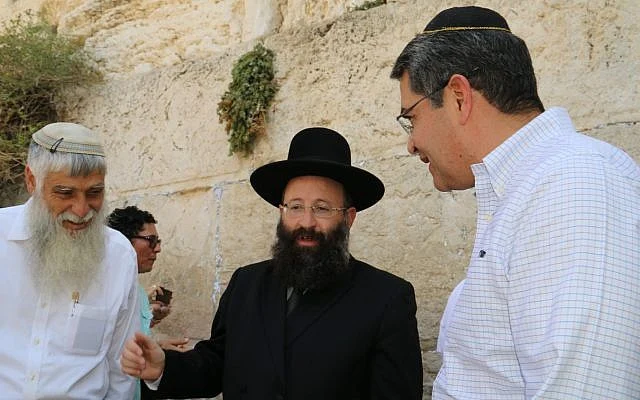
Honduran President Juan Orlando Hernandez visits the Western Wall in Jerusalem, September 1, 2019 (courtesy Western Wall Heritage Foundation)
Hondurans Curiously Ambivalent On Palestinian Genocide
Thomas Tomczyk writes for PÄYÄ Magazine…
Hondurans have been mostly silent regarding the reported genocide taking place in Gaza over the past two years. The question is: Why such silence? Are Hondurans unaware of the massacres and starvation used against Palestinians in the occupied territories? Do they not care, or are they perhaps afraid of something? “To learn who rules over you, simply find out whom you are not allowed to criticise,” the saying goes.
There was one example of Hondurans protesting Israeli crimes against Palestinians during the Gaza war after the Hamas attack and Israeli stand-down operation of October 7. On October 23, 2023, dozens of Honduran Palestinians demonstrated in front of the Israeli Embassy in Tegucigalpa. Since then, the long-established and influential Arab Palestinian community has been mostly silent about the plight of their Palestinian relatives amid Israel’s escalating atrocities in Gaza and the West Bank.
There is certainly a disconnect, as the 300,000 members of Honduras’ Christian Palestinian community are the third and fourth generations to be born outside of Palestine. Their ancestors began arriving in Honduras from Palestine in the 1890s, and today their connection to and knowledge of Palestine and Israel is mostly superficial. Most Honduran Palestinians don’t know the full scale or nature of the barbarism inflicted on their compatriots who stayed behind and continue to face Israeli oppression, violence, discrimination and now genocide. A Honduran Palestinian businessman told me that many in his community are afraid of being accused of anti-Semitism and facing potential consequences. Simply acknowledging that a systematic genocide may be occurring in Gaza is viewed by some as anti-Semitic.
It is hard not to notice. Since October 2023, Israeli military actions have resulted in the deaths of many Christian civilians in Gaza who have nothing to do with Hamas. In October 2023 Israeli military bombed a Christian orthodox church and murdered 18 Christians. In December 2023, Israeli snipers executed two Palestinian women on the Gaza Holy Family Catholic church property. In July 2025, Israeli soldiers fired a tank shell at a cross of the same church, killing three and wounding a catholic priest. While this all fell on deaf ears in Honduras, it does seem that the Israelis don’t like Christians very much.
One person who spoke with concern about the plight of Palestinians was President Xiomara Castro. In November 2023, the Honduran government recalled its ambassador to Israel for consultations due to escalating massacres of Palestinian civilians in Gaza. President Castro described Israel’s actions in Gaza as genocide during a U.N. speech in September 2024. Still, words have not turned into actions. Honduras is nowhere near recognising Palestine as an independent state or moving its embassy from Jerusalem back to Tel Aviv. In fact, Honduras remains firmly in the pro-Zionist camp as it continues to support Israel’s military by purchasing 15 Black Mamba military vehicles. Pro-Zionist sentiment is strong in Honduras. Israeli flags are flown throughout the country. Hondurans increasingly wear the Star of David around their necks, and taxi drivers display the Israeli emblem on their vehicles. Honduran roots of Zionism and Judeophilia run deep, well over a century.
The country now counts three of its presidents to be Jewish: Juan Lindo, Ricardo Maduro and Juan Orlando Hernández. In fact, you could argue that there was a fourth Jewish president of Honduras who ruled the country from 1911 well into the 1950s. Samuel Zemurray, the Banana King, was responsible for the 1911 Honduran presidential coup that secured land and concessions for his United Fruit banana company. American mercenaries hired by Zemurray deposed President Miguel Dávila and made Honduras his “banana republic.” Zemurray installed his puppet, Manuel Bonilla, as president and received 20,000 acres of land in return. After President Bonilla’s death in 1913, Zemurray continued to be a virtual puppet master of several other Honduran presidents.
In 1947, the World Zionist Organisation tasked Zemurray with delivering Honduras’ U.N. vote in support of the creation of the state of Israel. Reportedly, in a personal phone call, Zemurray tried to bribe then-Honduran President Tiburcio Carías Andino. Because of pressure from the Honduran Palestinian community, Honduras abstained from voting for Israel. Since then, and with plenty of CIA help, Christian Zionism has made many inroads in Honduras. CIA fronts such as World Vision, USAID and Protestant Church World Service for many decades worked to undermine the cohesiveness of Honduran society.
Since the 1950s, the CIA, which some critics considered an Israeli-captured agency, promoted the establishment and expansion of Protestant churches in Latin America. The excuse given was that Protestants were more anti communist and a good alternative to the Liberation Theology preached in many Catholic parishes.
The percentage of Catholics in the country fell from 97% in the 1960s to 47% today. Protestant denominations undermined the Catholic cohesion of Honduran society. Religiously divided Honduras is much easier to manipulate, with one denomination pitted against another. Sixty years later, those Catholic-to-Protestant converts have not only become Zionists, but they are also actually converting to Judaism. According to El Heraldo, 37 families converted to Judaism and, in 2022, established Honduras’ first synagogue. The San Pedro Sula Mishkan Shlomo synagogue members advertise their plans to Judaise and convert thousands of Hondurans.
“The plan is for the expanded synagogue to be a six-story, shaped like a Star of David building and be able to accommodate 456 people. This would make it the biggest synagogue in Latin America.”
Ex-President Juan Orlando Hernández was key in the expansion of Judeophilia and Zionism in Honduras. Just in terms of economy, according School of the Americas, between 2013 and 2019, Honduras purchased $342 million in military and surveillance equipment from Israel. Basically, Honduras has been supporting Israel to the tune of around $5 million a month for that period. Road to conversion of Juan Orlando Hernández began in the early 1990s when he completed a one-year Mashav leaders course in Israel. Israel’s investment in JOH obviously paid off as he learned Hebrew, moved Honduras’ embassy to Jerusalem in 2021, and converted to Judaism with his entire family in 2021. The last one, right before going to a US jail for 45 years, was convicted of decade’s long drug and arms smuggling operation.
Honduras is likely getting set up for a rough ride. Israel funded military dictatorships where even the CIA would not venture. Israel trained and supplied arms to many bad actors that destabilised the region: the genocidal regime in Guatemala in the 1980s, Colombian drug smuggling death squads, Los Zetas drug lord Heriberto Lazcano. “Israel has given its soldiers practical training in the art of oppression and in methods of collective punishment. Some of those officers choose to make use of their knowledge in the service of dictators,” said Israeli general Mattityahu Peled.
“Honduras will likely become an increasingly polarized and violent society.”
There is also a growing Israeli pressure on the Honduran public by co-opting its anti-Gaza genocide sentiment into nebulous movements. The normally restrained Honduran Ministry of Foreign Affairs complained that Israeli Ambassador Nadav Goren meddled in internal Honduran affairs by meeting with Protestant church leaders preparing for the August 16 March for Peace and Democracy. “We express to the Honduran people our deep discomfort at their participation in said public event. The involvement of a diplomat not only ignores his limitations,” stated the Honduran ministry. There are plenty of other players seeking discord. Until its recent defunding by the Trump administration, San Pedro Sula was also home to the Hebrew Immigrant Aid Society (HIAS). The worldwide HIAS organisation does not assist Palestinians, Arabs or Christians in moving to Israel, but uses U.S. tax dollars to help move undocumented migrants through Honduras to the United States.
For decades, certain interest groups have promoted racial resentment —particularly among Black communities— while fostering a sense of guilt among white, European and Christian populations. In Honduras, this strategy is reflected in the 23-year-old movement known as the Fraternal Organisation of Honduran Blacks (OFRANEH), which has received funding from organisations such as American Jewish World Service and the Open Society Foundations, founded by George Soros. These groups have been involved in fermenting revolutions, protests and underhanded political activism around the world. Just as with organisations such as Black Lives Matter and ANTIFA, which were recently designated by the U.S. as a terrorist organisation, OFRANEH fosters division, racial tension, grievances and expectations of compensation in the historically well-integrated Garifuna community. Honduras, in the second quarter of the 21st century, will likely become an increasingly polarised and violent society. Powerful interest groups are working hard to implement this, and Roatan is increasingly a party to those tensions. In September 2025, OFRANEH conducted demonstrations in Cayos Cochinos, and in March 2025, there were protests in Diamond Rock. Tensions on Roatan are just starting to heat up.
The Folly of Establishing a U.S. Military Base in Damascus
By José Niño | The Libertarian Institute | December 16, 2025
Recent reports indicate the United States is preparing to establish a military presence at an airbase in Damascus, allegedly to facilitate a security agreement between Syria and Israel. This development represents yet another misguided expansion of American military overreach in a region where Washington has already caused tremendous damage through decades of failed interventionist policies.
The United States currently operates approximately 750 to 877 military installations across roughly eighty countries worldwide. This staggering number represents about 70 to 85% of all foreign military bases globally. To put this in perspective, the next eighteen countries with foreign bases combined maintain only 370 installations total. Russia has just twenty-nine foreign bases, and China operates merely six. The American empire of bases already dwarfs every other nation combined, and the financial burden is crushing. Washington spends approximately $65 billion annually just to build and maintain these overseas installations, with total spending on foreign bases and personnel reaching over $94 billion per year.
These figures are not abstract accounting entries. They translate directly into American lives placed in volatile environments, as demonstrated by the recent insider attack in the ancient Syrian city of Palmyra, where a purported ISIS infiltrator embedded in local security forces turned his weapon on a joint U.S. Syrian patrol, killing two U.S. soldiers and one U.S. civilian during what was described as a routine field tour. The incident underscores how the sprawling U.S. basing network increasingly exposes American personnel to unpredictable and lethal blowback in unstable theaters far from home.
Syria itself already hosts between 1,500 and 2,000 American troops, primarily concentrated in the northeastern Hasakah province and at the Al Tanf base in the Syrian Desert. The Pentagon recently announced plans to reduce this presence to fewer than 1,000 personnel and consolidated operations from eight installations to just three. Yet now, despite this supposed drawdown, Washington reportedly plans to establish a new presence in Damascus itself, either at Mezzeh Air Base or Al Seen Military Airport. This contradictory expansion reveals the hollow nature of promises to reduce American military commitments abroad.
Since the fall of Bashar al Assad in December 2024, Israel has conducted hundreds of airstrikes on Syrian military and civilian infrastructure while occupying parts of southern Syria including Quneitra and Daraa. Israel has systematically violated the 1974 disengagement agreement and expanded control over buffer zones. These actions align disturbingly well with the Yinon Plan, a 1982 Israeli strategic document by Israeli foreign policy official Oded Yinon that envisions the dissolution of surrounding Arab states into smaller ethnic and religious entities. The plan explicitly calls for fragmenting Syria along its ethnic and religious lines to prevent a strong centralized government that could challenge Israeli interests.
A permanent American military presence in Damascus would effectively serve as a tripwire guaranteeing continued U.S. involvement in securing Israeli strategic objectives in the Levant. Rather than protecting American interests or enhancing national security, such a base would entrench Washington deeper into regional conflicts that have consistently proven disastrous for both American taxpayers and Middle Eastern populations.
The human cost of American intervention in Syria should give any policymaker pause. The Syrian Civil War has resulted in between 617,000 and 656,000 deaths, including civilians, rebels, and government forces. More than 7.4 million people remain internally displaced within Syria, while approximately 6.3 million Syrian refugees live abroad. This catastrophic toll stems partly from Operation Timber Sycamore, the CIA covert program that ran from 2012 to 2017 to train and equip Syrian rebel forces.
Timber Sycamore represented a joint effort involving American intelligence services along with Saudi Arabia, Jordan, Qatar, Turkey, and the United Kingdom. The CIA ran secret training camps in Jordan and Turkey, providing rebels with small arms, ammunition, trucks, and eventually advanced weaponry like BGM 71 TOW anti-tank missiles. Saudi Arabia provided significant funding while the United States supplied training and logistical support.
The program proved to be counterproductive. Jordanian intelligence officers stole and sold millions of dollars worth of weapons intended for rebels on the black market. Even worse, U.S.-supplied weapons regularly fell into the hands of the al Nusra Front, al-Qaeda’s Syrian affiliate, and ISIS itself. The program inadvertently strengthened the very extremists Washington was ostensibly fighting.
The failure of Timber Sycamore illustrates a fundamental problem with American interventionism in Syria. Washington has pursued regime change in Damascus in various forms for decades, yet these efforts have consistently backfired, creating power vacuums filled by jihadist groups and prolonging devastating conflicts. The current enthusiasm for establishing a military presence in Damascus suggests American policymakers have learned absolutely nothing from these failures.
The figure now leading Syria exemplifies the moral bankruptcy of this entire enterprise. Ahmed al Sharaa, better known by his nom de guerre Abu Mohammad al Julani, currently serves as president of Syria’s interim government. This represents a stunning rehabilitation for a man who founded al Nusra Front in 2012 as an al-Qaeda affiliate and later formed Hayat Tahrir al Sham (HTS) by merging various rebel factions. Under the name Abu Mohammad al Julani, he was designated a Specially Designated Global Terrorist by the United States on July 24, 2013, with a $10 million bounty maintained on his head.
Al Sharaa’s terrorist designation stemmed from his leadership of al Nusra Front, which perpetrated numerous war crimes including suicide bombings, forced conversions, ethnic cleansing, and sectarian massacres against Christian, Alawite, Shia, and Druze minorities. He fought with al-Qaeda in Iraq, spent time imprisoned at Camp Bucca between 2006 and 2010, and was dispatched to Syria by Abu Bakr al Baghdadi in 2011 with $50,000 to establish al Nusra. His close associates have faced accusations from the United States of overseeing torture, kidnappings, trafficking, ransom schemes, and displacing residents to seize property. The New York Times reported that his group was accused of initially operating under al-Qaeda’s umbrella.
Yet in November 2025, the United Nations Security Council adopted resolution 2799, removing al Sharaa and Interior Minister Anas Khattab from the ISIL and al-Qaeda sanctions list. The U.S. Treasury Department followed suit, delisting him from the Specially Designated Global Terrorist registry. This reversal came after the State Department revoked HTS’s Foreign Terrorist Organization designation in July 2025. Washington essentially decided that a former al-Qaeda commander who oversaw sectarian massacres was now a legitimate partner worthy of American military support. This absurd rehabilitation demonstrates how completely untethered American foreign policy has become from any coherent moral framework or strategic logic.
Critics rightly question whether al Sharaa has truly broken from his extremist roots or merely engaged in calculated political rebranding. The speed with which Washington embraced him as a legitimate leader suggests American policymakers care far more about advancing Israeli interests and maintaining regional influence than about genuine counterterrorism or protecting religious minorities.
The United States needs to pursue a fundamentally different approach to foreign policy. Rather than establishing yet another military base to advance Israeli strategic objectives in Syria, Washington should implement a comprehensive drawdown of overseas military commitments. The hundreds of foreign bases it maintains abroad represent an unsustainable burden that diverts resources from genuine national security priorities like border security and stability in the Western Hemisphere. American taxpayers deserve better than footing the bill for an empire that consistently fails to advance their interests while enriching defense contractors and serving foreign powers.
Syria offers a perfect case study in the futility of American interventionism. Decades of attempts at regime change through covert programs like Timber Sycamore and direct military presence have produced nothing but chaos, empowered jihadist groups, created millions of refugees, and cost hundreds of thousands of lives. The rehabilitation of a former al-Qaeda commander into Syria’s president illustrates how divorced American policy has become from any coherent strategy or values.
Rather than doubling down on failed policies, the United States should pursue strategic restraint, scale back its sprawling network of foreign bases, and allow regional powers to sort out their own affairs without American military involvement. That represents the path toward a more sustainable, affordable, and morally defensible foreign policy. The Damascus base proposal deserves to be rejected outright as yet another wasteful expansion of an already overextended military empire.
Do You Believe in Coincidence… Was the CIA Involved in Operation Spiderweb and Israel’s June 12 Attack on Iran?
By Larry C. Johnson | December 9, 2025
With the benefit of hindsight, we’re all geniuses. The Wall Street Journal article, Inside Ukraine’s Daring Operation Spiderweb Attack on Russia (published December 8, 2025) details the operation’s planning as a 18-month effort starting in late 2023, with significant activities ramping up in 2024. While the piece emphasizes the full timeline’s secrecy and oversight by President Zelenskyy and SBU chief Vasyl Maliuk, it highlights 2024 as a pivotal year for infiltration, testing, and logistics preparation. I am more interested in what it does not state outright — i.e., that Ukraine relied heavily on Western intelligence, meaning the CIA and British MI-6, in planning this operation.
The attack took place on June 1st, 2025 and, despite a flood of Western propaganda touting it as a tremendous success, it was a tactical and strategic failure — i.e., it did not damage Russia’s ability to continue its offense in Ukraine. But here is the question of coincidence… Two weeks later, Israel launched the decapitation attack on Iran, which also failed to topple the Iranian government and cripple the Iranian military, who promptly retaliated. Do you think it is just a coincidence that Israel and Ukraine used similar tactics — i.e., launching drones from within Russia and Iran to attack strategic targets? I do not.
Let’s take a look at the timeline of Operation Spiderweb as laid out in the WSJ article.
December 2023: Planning begins under direct oversight of Ukrainian President Volodymyr Zelensky and the Security Service of Ukraine (SBU). Initial focus: Smuggling disassembled drones, batteries, and explosives into Russia via borders (e.g., Belarus, Black Sea routes) and commercial trucking networks. Goal: Target Russia’s strategic bomber fleet to disrupt missile launches on Ukrainian cities. Hmmm… If the SBU was involved then so was foreign intelligence.
Early 2024 (January–March): Initial scouting and prototype testing. Ukrainian operatives conducted reconnaissance of target airbases (e.g., Olenya, Dyagilevo) using commercial satellite imagery and smuggled spotters, according to the WSJ. In my opinion, an audacious operation like this would also require imagery from Western intelligence. The WSJ is mute on that point. The article notes that early experiments with “spider nest” launch mechanisms—disassembled FPV drones (Osa quadcopters) hidden in truck roofs— were tested in simulated Russian environments near the border. This phase reportedly involved ~20 commandos refining smuggling routes via Belarus and the Black Sea, with failures (e.g., a test drone malfunction) leading to redesigns. The WSJ article conveniently ignores the likely role that the territories other than Ukraine, such as Khazakstan, Armenia and Azerbaijan also were used as infiltration points for this operation.
Mid-2024 (April–July): Infiltration buildup. The WSJ describes “web-like” networks expanding, with agents embedding in Russian trucking firms to map logistics. Over 100 drones were smuggled in parts during this period, reassembled in hidden workshops (e.g., Bryansk region sheds). A key activity was recruiting unwitting Russian truckers (e.g., via bribes or coercion) for transport, with the article citing intercepted FSB chatter revealing early suspicions but no disruptions. Zelenskyy approved budget reallocations (~$50M) for Western tech integration (e.g., Starlink relays). What do you think are the chances that some of this money was siphoned off by Zelensky and his intel bubbas and sent to their overseas retirement accounts?
Late 2024 (August–December): Final rehearsals and positioning. Intensive dry runs simulated the June 1 strike, focusing on simultaneous launches across time zones. The piece highlights a December 2024 “dress rehearsal” near Ivanovo, where signal jamming countermeasures (AI autopilots) were validated. By year-end, all 117 drones were prepositioned, with operatives establishing safe houses. The article quotes an anonymous SBU officer: “2024 was the spider spinning its web—silent, patient, invisible.”
January–May 2025 Infiltration phase: Ukrainian agents (150+ operatives, including commandos and drone technicians) establish “spider nests” (hidden launch sites) across five Russian oblasts spanning three time zones. Drones (117 total, FPV models with Western tech like Starlink) are reassembled in disguised cargo (e.g., wooden sheds on trucks). Scouting identifies four primary airbases: Olenya (Murmansk), Dyagilevo (Ryazan), Ivanovo Severny (Ivanovo), and Belaya (Irkutsk/Siberia, 4,300 km from Ukraine). A fifth target (Ukrainka in Amur) is aborted due to a truck fire.
June 1, 2025 Execution: Coordinated strikes unfold over ~72 hours starting ~1 p.m. local time. Remotely activated truck roofs release drones, hitting ~40–50 aircraft (15–20 destroyed, including Tu-95MS, Tu-22M3 bombers, and A-50 radar planes; ~$2–7B in damage). Fires reported at all sites; Russia confirms attacks but claims minimal losses. Ukrainian operators control from Kyiv; no SBU fatalities, though two teams captured.
There is no denying that this was a sophisticated operation and, in my judgment, depended heavily on intelligence support from the US and the UK and, possibly, Israel. Why Israel? Because of the similarity of the tactics used in the attacks on Russia and Iran within a span of two weeks. Both were deep-penetration operations targeting high-value, hardened assets far from the front lines. Both required extensive intelligence support.
I also believe that the US played a significant role in coordinating the two attacks as part of a broader strategy to weaken both Russia and Iran. The planning for these operations were carried out in separate channels, but there was someone, or a group of someones, overseeing the broader strategic goals.
The publication of this article comes at a time when the Trump administration’s support for Ukraine is weakening. I don’t rule out the possibility that the CIA, who has an enormous investment in Ukraine, is working to undermine Trump’s efforts to secure a peace that will come at Ukraine’s expense. I do not believe that some intrepid reporter thought that this would be a swell story to tell and that it was published now just because the WSJ had nothing better to report. I believe this is part of a unending effort by the Deep State to try to pump life into Project Ukraine, which is now on life support and fading fast, by pushing a narrative that Ukraine is far from defeat.
The National-Security Establishment’s Message to Americans
By Jacob G. Hornberger | FFF | December 9, 2025
It’s easy to assume that with its drug-war killings in the Caribbean, the Pentagon is sending a message only to Venezuelan strongman Nicolás Maduro: “We can kill your citizens with impunity and there is nothing that you or anyone else can do about it.”
In actuality, however, the Pentagon is sending the same message to the American people: “We can kill anyone we want, including American citizens, and there is nothing that you or anyone else can do about it.”
There are lots of commentators in the mainstream press pointing out the manifest illegality of intentionally, knowingly, and deliberately killing people on the high seas who U.S. officials are saying have violated the U.S. government’s drug laws. They are pointing out that the killings amount to state-sponsored murder. Under U.S. law and under the U.S. Constitution, federal officials are not permitted to kill people who are suspected of violating drug laws. Law-enforcement personnel are required to instead take them into custody, secure a grand-jury indictment, and prosecute them in a court of law, where they have the right to a lawyer, a jury trial, and other procedural guarantees.
But remember: This isn’t the DEA we are talking about. This is the U.S. national-security establishment — that is, the Pentagon, the vast military-industrial empire, the CIA, and the NSA— we are talking about. Once they become a law-enforcement agency for the drug war, everything changes. That’s because they are not bound by the same rules as regular federal law-enforcement agencies. They are not bound by any rules whatsoever. That’s what the Pentagon is reminding every American with its drug-war killings in the Caribbean.
Once the U.S. government was converted into a national-security state after World War II, the new national-security establishment — specifically, the Pentagon and the CIA — automatically acquired the power of assassination. Recognizing this reality, the federal judiciary made it crystal clear that it would never enforce the Constitution against the Pentagon’s and CIA’s omnipotent power to assassinate people, including American citizens.
Thus, no one could do anything about the national-security establishment’s plots to assassinate people like Congo leader Patrice Lumumba, Cuban president Fidel Castro, Dominican Republic leader Rafael Trujillo, Chilean general Rene Schneider, and, more recently, Iranian general Qasem Soleimani.
There was also nothing that anyone could do about the coups that would very possibly leave foreign leaders dead, such as Iranian prime minister Mohammad Mossadegh, Guatemalan president Jacobo Arbenz, and Chilean president Salvador Allende.
There was also nothing anyone could do about the national-security’s establishment’s participation in international assassination rings, such as Operation Condor.
The message has always been clear: “We can kill anyone we want, and there is nothing that anyone can do about it. Our power over you is total and complete. Accept it and get used to it.”
The message became clearer when they took out President John F. Kennedy, who had taken them on, and then crammed down American throats the “lone-nut, magic-bullet” theory of the assassination, which was always about as lame, inane, and ridiculous as labeling drug-war suspects “terrorist enemy combatants” or, for that matter, the use of scary WMDs to justify a war of aggression against Iraq, or some “attack” on the United States in the Gulf of Tonkin to justify a deadly, destructive, and senseless war in Vietnam. But Americans have always been expected to buy it all, no matter how ludicrous, and many of them deferentially have.
More recently, we shouldn’t forget their assassinations of Anwar al-Awlaki and his 16-year-old son Abdulrahman. They were American citizens, not foreigners. It was another powerful message to the American people: “We can kill anyone we want and there is nothing anyone can do about it. Accept it, embrace it, and get used to it. And don’t forget to thank us for our service.”
It’s probably also worth mentioning the federal judiciary’s deference to the authority of the national-security establishment to take American citizens into custody simply by labeling them as “suspected terrorists,” torture them, incarcerate them for the rest of their lives without a trial, and, no doubt, even execute them. That’s what the Jose Padilla case was all about.
So what if those drug-war killings in the Caribbean are illegal, as those commentators in the mainstream press are saying? What difference does it make? Everyone, and especially the national-security establishment, knows that nobody can do anything about it. That’s the powerful message that the U.S national-security establishment is sending to the American people: “We can illegally kill anyone we want, including Americans, and there is nothing anyone can do about it. We are in charge. We have total and complete control over you because we can kill you whenever we want, and there is nothing anyone can do about it.”
After all, who is going to prosecute the Pentagon and CIA killers? The Justice Department? Don’t make me laugh. The Justice Department is subordinate to the Pentagon and the CIA. The Congress? Again, please don’t make me laugh harder. Congress has long deferred to the power and majesty of the national-security establishment, especially when we consider the large number of loyal and “patriotic” military veterans and CIA officers serving in Congress. The federal judiciary? When have they ever done anything about the national-security establishment’s assassinations or, for that matter, its torture and indefinite detention camp in Cuba?
Make no mistake about it: As comforting as it might be to Americans that those illegal drug-war killings are taking place “over there” against Latin American foreigners, the fact is that the national-security establishment’s omnipotent power to kill suspected “narco-terrorists” extends to everyone right here in the United States. When the right time comes to demonstrate this point to American citizens, my hunch is that we will see lots of shocked, frightened, deferential, silent, dependent, and even supportive American sheep.
James Angleton: JFK Assassination Architect?
By Kit Klarenberg | Global Delinquents | December 7, 2025
Newly-declassified files show President John F Kennedy’s alleged assassin Lee Harvey Oswald was monitored for years by James Angleton, the CIA’s infamous veteran counterintelligence chief, right up until the President’s death. In this context, freshly-released FBI documents indicating Oswald was removed from Bureau watchlists six weeks before Kennedy’s assassination, despite being judged a high security risk, at the express direction of Angleton’s staff, take on a distinctly disquieting character. Was Oswald a target of, or participant in, Angleton’s illegal domestic spying operations?
In June 1953, a memo was circulated among senior FBI officials, its subject line: “Central Intelligence Agency – information received from James Angleton”. It documents how the CIA’s counterintelligence chief had over the past year “been very cooperative and… volunteered voluminous information of interest to Bureau.” Such was the vast and sensitive intelligence yield, it was considered necessary to establish dedicated, strict internal protocols for handling and storing material provided by Angleton to the FBI.
This was “particularly” vital in respect of information Angleton received and passed on to the Bureau from Mossad, his “primary source” of intelligence among “numerous foreign sources and channels” he maintained worldwide. The memo went on to outline how Angleton handled “special cases of a various nature”, and was “usually given considerable freedom and leeway in directing the operations of his unit.” Angleton was “responsible only” to the CIA’s Director, and his staff were “responsible only to him.”
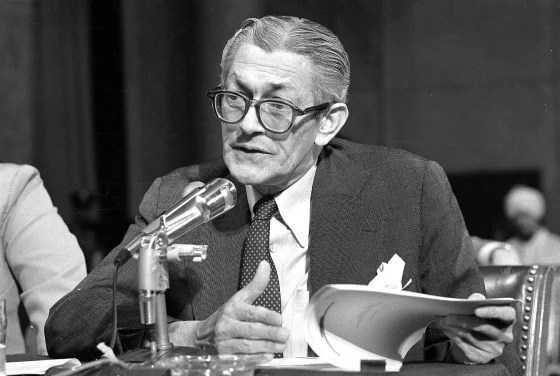
James Angleton testifies to the Senate Intelligence Committee
The memo noted approvingly how “much of the information” provided by Angleton “consists of the actual reports” he received from his sources. This was of significant advantage to the FBI, as the agency was able to “better evaluate the information instead of waiting for the delay and processing through normal channels in the CIA.” Angleton also “frequently” kept the Bureau apprised of Agency activities overseas, “which the CIA sometimes camouflages with some of its cloak and dagger techniques.”
Angleton’s extensive cooperation bought him enormous goodwill within the FBI. He successfully leveraged this in January 1958, when the Bureau serendipitously “flushed out” a scandalous, illegal spying operation targeting US citizens conducted by the CIA’s counterintelligence unit. A memo that month shared between senior FBI officials records how the Bureau was seeking to establish a program to monitor all mail being sent to and from the Soviet Union by American citizens, only to discover Angleton was already doing precisely the same thing.
Angleton in turn learned his scheme had been busted, so approached the Agency’s FBI liaison agent on a “personal basis” to outline the program. He claimed he would be fired if Langley caught wind of his disclosures to the Bureau. Angleton explained how the interception program was “one of the biggest and most secret operations being conducted by CIA,” and “extensive and expensive”. An “elaborate array of IBM machines” catalogued and conducted “complex scientific examinations” of all mail gathered.
In all, “two or three hundred CIA employees” were “exclusively engaged on various facets” of the operation, which cost “well over a million dollars a year” – roughly $11 million today. Angleton said the effort’s “sole purpose…was to identify persons behind the Iron Curtain who might have some ties in the US and who could be approached… as contacts and sources for CIA.” The operation was purportedly a “success”, with numerous valuable assets cultivated.
While FBI higherups questioned whether the effort “invaded our jurisdiction”, it was concluded Angleton’s unit had a “legitimate right” to conduct the mission. Moreover, the Bureau could avoid “the inherent dangers” of conducting a parallel mail intercept program – including “the sensitive nature of it, its complexity, size and expense” – by simply demanding the CIA counterintelligence unit hand over their operation’s vast intelligence yield to them.
Lee Harvey Oswald first came to Angleton’s attention in November 1959, due to news reports of his defection to the Soviet Union the previous month. Thereafter, all mail Oswald sent to and received from the US was opened and read by the CIA, until he returned home in May 1962 with his Russian wife Marina. Angleton’s monitoring of the minutiae of Oswald’s life persisted until Kennedy was killed. Multiple separate CIA operations collected intelligence on the President’s alleged assassin throughout.
‘CIA Project’
The CIA counterintelligence officer who monitored Oswald’s mail was Reuben Efron, part of a personal spying network constructed by Angleton from Jewish émigres from the Soviet Union, outside of formal Agency structures. Eerily, Efron attended a February 1964 hearing of the Warren Commission – officially charged with investigating JFK’s assassination – at which Marina Oswald testified. His presence was noted in an official volume of the investigation’s proceedings, but his employment by the Agency was unmentioned. Was he there on Angleton’s behalf?
This is but one of many mysteries related to Oswald that Angleton’s closed-door testimony to Senate investigators in June 1975 failed to resolve. During his grilling, Angleton had little to say about Kennedy’s assassination, despite being repeatedly probed about “the Oswald situation”. Questioned whether the CIA kept records on Oswald, Angleton prevaricated, “they have a file… I think more than one.” He offered scant further information, beyond claiming the supposed lone nut shooter was likely a Soviet operative.
When asked if there was a “connection between Oswald and the FBI”, Angleton elliptically acknowledged “there was a tremendous flap in the Bureau” following Kennedy’s assassination, and “confusion” the FBI “had not turned over, or had not taken enough initiative in turning over, all the information on Oswald to the local police” in Dallas. Angleton neglected to mention the FBI informed his counterintelligence unit one week prior to November 22nd 1963 Oswald was living and working in the city. By this time, the file collated by Angleton on Oswald ran to 180 pages.
Angleton was even more dishonest when testifying to the House Select Committee on Assassinations in October 1978. Asked point blank by a senior investigator if, to his knowledge, “Oswald [was] ever the subject of any CIA project,” Angleton lied, “no”. Coincidentally or not, he was then asked whether he knew Reuben Efron, and his responsibilities. Angleton responded in the affirmative, explaining Efron’s duties related to mail interception. Angleton was uniquely well-placed to elaborate that Efron was monitoring Oswald’s mail, in an operation he personally oversaw.
Angleton was grilled about his counterintelligence unit providing Israel with technical support for constructing nuclear weapons. He denied the charges, but under questioning admitted Tel Aviv may have conducted clandestine operations to source nuclear material in the US. Asked if he possessed “certain knowledge” of Israeli efforts “to acquire nuclear secrets in the US,” Angleton pleaded, “Do I have to respond to that?”
Kennedy entered office in January 1961 deeply concerned about Tel Aviv’s nuclear ambitions. A CIA assessment the previous month concluded a “major purpose” of Israel’s Dimona nuclear plant was “plutonium production for weapons.” The assessment outlined numerous grave outcomes of Tel Aviv acquiring nukes. Chief among them, exposure of the program would inevitably cause “consternation” in North Africa and West Asia, potentially prompting “threatened” Arab and Muslim states to turn to the Soviet Union for military assistance.
Perhaps spurred by this prospect, from day one of his Presidency, Kennedy made harmonious relations between Washington and Israel contingent on regular U.S. inspections of Dimona. Under intense pressure, Tel Aviv’s then-Prime Minister David Ben-Gurion finally allowed inspections in May 1961. Extensive efforts were conducted to camouflage areas of Dimona dedicated to research and development of nukes. Resultant assessments concluded the facility was solely concerned with nuclear power generation. Kennedy was unconvinced, however. In May 1963, he dispatched an ominous private telegram to Ben-Gurion:
“The dangers in the proliferation of national nuclear weapons systems are so obvious that I am sure I need not repeat them here… We are concerned with the disturbing effects on world stability which would accompany the development of a nuclear weapons capability by Israel… Development of a nuclear weapons capability by Israel would almost certainly lead other larger countries, that have so far refrained from such development, to feel that they must follow suit.”
‘Intelligence Operation’
The House Select Committee on Assassinations’ (HSCA) failure to interrogate Angleton over Israel’s nuke ambitions is all the more inexcusable given the contents of an April 1978 interview, conducted by Committee researcher Gaeton Fonzi with journeyman CIA officer Joseph Burkhalter Smith. Declassified records show Smith made a number of striking disclosures about Angleton’s role and influence within the Agency, and relationship with Tel Aviv. He suggested there was suspicion at the CIA’s highest levels Angleton may have been involved in Kennedy’s assassination, or at least concealed shadowy counterintelligence operations related to the world-changing event.
Smith enjoyed a close relationship with William Colby, who headed the CIA September 1973 – January 1976. A relative dove, Colby was forced out and replaced by George H. W. Bush, due to his candid public criticisms of the Agency’s record, and drive to break open the US intelligence community to greater scrutiny. Henry Kissinger aggressively pressed for his removal, fulminating how every time Colby “gets near Capitol Hill, the damn fool feels an irresistible urge to confess to some horrible crime.”
It is uncertain whether Angleton, Colby’s avowed nemesis, also played any role in Colby’s ouster. Smith claimed “Colby’s problems within the Agency stemmed largely from the conflict he had” with the CIA’s obsessively secretive counterintelligence supremo. Colby was totally in the dark as to what Angleton and his team were doing at any given time. Smith relayed how Colby had said of Kennedy’s assassination, “there could have been operations that Angleton’s staff was running that he wouldn’t even tell the Director.”
Smith went on to record how Angleton’s staff did “strange things”, and “handled all Israeli operations,” despite this not falling under their official purview. This “had a strange effect” on CIA operations in West Asia, “because unlike in other divisions where station chiefs kept each other informed, Angleton wouldn’t pass information to other stations in the Arab countries unless ‘he felt like it’.” It was also a mystery to Smith how Angleton “got all his power”.
Nonetheless, Smith testified Angleton had a “special relationship” with Allen Dulles, the longtime CIA director fired by Kennedy over the 1961 Bay of Pigs fiasco, subsequently appointed to the Warren Commission. Smith also described an “incredible” cult-like ethos among Angleton’s Agency adherents. Universally convinced the CIA had been heavily penetrated by the KGB, they were “confirmed believers in the world Communist conspiracy theory” – to the extent of suspecting the Sino-Soviet split was “a great deceptive operation.”
Asked by Fonzi “to be speculative” as to whether Lee Harvey Oswald could’ve been “a deep cover agent for the Agency,” Smith suggested Oswald may have “worked either for the Soviet Division, which ran operations in the Soviet Union, or the Counter Intelligence staff.” Angleton’s team was furthermore “very interested in the Fair Play for Cuba Committee”, a longstanding target of the CIA and FBI, to the extent “getting a penetration into it would have been a high priority effort.”
After moving to New Orleans in April 1963, Oswald set up a one-man chapter of the FPCC. In an apparent attempt to attract new members to the group in the virulently anti-Castro city, which was heaving with Cuban exiles, Oswald publicly distributed leaflets promoting the group. He hired random members of the public to assist with the effort, which lasted only 15 minutes, but just so happened to be captured on camera by a local TV station.
Oddly, when testifying to the Warren Commission, Oswald’s half-brother John Pic was “unable to recognize him” in pictures of the leafleting event, raising the prospect Oswald was being impersonated. Even more curiously, as Fonzi noted in his discussion with Smith, some of the leaflets listed the address of Oswald’s FPCC chapter as 544 Camp Street, which housed “some kind of intelligence operation run by Guy Banister, a former FBI agent.” Smith responded, “there were a lot of former FBI men on Angleton’s staff.”
Today, journalists, researchers, and concerned citizens have no choice but “to be speculative” about how and why John F Kennedy was killed, and by whom. The newly-declassified documents offer only further questions – but they all unambiguously point in James Angleton’s direction. His multifaceted role as master of the CIA’s vast Oswald file, chief of Agency relations with Israel, and potential enabler of Tel Aviv’s nuclear weapons program all appear interlinked. And these operations in tandem may account for what occurred on November 22nd 1963.
The Ukraine War Hawks Sabotaging America First
By Harrison Berger | The American Conservative | December 2, 2025
As the White House moves to negotiate an end to the yearslong Ukraine proxy war, establishment members of Congress, elements of the deep state, and their corporate media allies work overtime to sabotage the president’s efforts.
The aggressive establishment campaign seeks to derail a draft settlement, negotiated largely in Washington, that would bar Ukraine from NATO in exchange for U.S. security guarantees, grant Russia de facto control of Crimea and the Donbas, and limit the size of the Ukrainian armed forces, among other measures.
By pursuing a negotiated resolution to the Ukraine war, the Trump administration is doing exactly what it was democratically elected to do. Voters who wanted to continue the proxy war against Russia were told to—and overwhelmingly did—vote for the defeated candidate, Kamala Harris.
But even though President Donald Trump and voters may prefer restraint and diplomacy with nuclear powers like Russia, the Washington political establishment that drives U.S. foreign policy has long made clear that it does not—and that it will take aggressive measures to subvert democratically decided policies in favor of its own. With a peace deal possibly within reach, this remarkably bipartisan campaign has become increasingly overt.
A bipartisan group of lawmakers last week floated the rumor that the Trump administration’s 28-point peace plan was secretly a Russian-authored “wish list.” The claim has since fallen apart—and never made sense in the first place—because, as Steve Bannon has pointed out, the terms of the deal are, if anything, overly favorable to Kiev, not Moscow. Under the proposal, the Ukrainian military would be permitted to build a fighting force of up to 600,000 troops. “That’s unacceptable to the Russians,” says political scientist John Mearsheimer. And while the draft would formally rule out NATO membership for Ukraine, it nonetheless commits the United States to extending security guarantees, a provision that leaves the door open for future rounds of confrontation between Ukraine and Russia.
Nonetheless, bipartisan factions continue to argue that Trump’s proposal favors Moscow, branding the pursuit of peace as Neville Chamberlain-style appeasement. Joining them to do it has been former Trump official Mike Pompeo, who argued against the 28-point plan on X, saying that “any so-called peace deal that limits Ukraine’s ability to defend itself would look more like a surrender.”
The former CIA director has in recent weeks emerged as a regular guest on Fox News to sabotage Trump’s peace plan, while simultaneously serving on the advisory board of the Ukrainian defense company FirePoint. The Murdoch-owned news network, which previously partly fired Tucker Carlson over his opposition to the Ukraine war, does not disclose that the former CIA director stands to profit directly from the war he goes on air to promote.
The most brazen and revealing effort to derail the Trump administration’s diplomacy comes from anonymous leakers, likely from the U.S. security state, which, through their servants in corporate media, repeatedly leak classified information in what has so far been a failed attempt to embarrass and undermine the president’s lead negotiator, U.S. Special Envoy Steve Witkoff.
The campaign against Witkoff began when Reuters reported that unnamed “U.S. officials” were “increasingly concerned” by Witkoff’s discussions with Russian diplomats to end the war. Soon after, Bloomberg published a selective leak of a classified call transcript, claiming Witkoff had “advised Russia on how to pitch Ukraine plans to Trump,” framing his diplomacy as improper.
The bipartisan pro-war establishment took their cue and seized on the leak, deploying the same strategy wielded against Trump’s first National Security Adviser Michael Flynn in 2017, when classified surveillance material was leaked to derail détente with Moscow. Now in the case of Witkoff, routine diplomatic back-channeling has again been framed as sinister and improper, in a controversy likely manufactured by unelected elites in northern Virginia to sabotage the foreign policy agenda of the elected president.
Their efforts fell flat, however, when the next morning, Trump reassured the press that nothing improper had occurred with Witkoff’s diplomacy. “That’s a standard thing… he’s got to sell this to Ukraine. He’s got to sell Ukraine to Russia. That’s what a dealmaker does,” Trump told reporters aboard Air Force One.
While negotiations with Russia nonetheless continue to advance, the episode reveals an unsustainable tension for the Trump presidency: the figures actively sabotaging its foreign policy agenda are largely the same Republican establishment actors the president continues to defend and campaign for.
At the same time, Trump has now spent several months campaigning against the chief opponents of Ukraine war spending in the House of Representatives—retiring Congresswoman Marjorie Taylor Greene of Georgia and Congressman Thomas Massie of Kentucky—mainly because they dared to consistently apply America First principles. Yet the actual saboteurs in the GOP work hard to subvert Trump’s foreign policy agenda without any consequences.
With the administration’s disapproval ratings now approaching record highs, there has never been a better moment for Trump to cut loose those saboteurs from his coalition and rediscover the America First instincts that first carried him to the White House.
Featured Video
How Many More Gulf States Get Dragged Into Trump’s Iran War?
or go to
Aletho News Archives – Video-Images
Villains of Judea
David Wurmser
A shadowy neocon strategist spent 30 years maneuvering Washington toward war with Iran
José Niño Unfiltered | November 17, 2026
As American forces clash with Iran in 2026, a decades-long campaign orchestrated from the shadows of Washington has finally reached its climax. Earlier this year, foreign policy strategist David Wurmser openly called for Washington to let Israel start a war of aggression against Tehran, portraying the conflict as a historic reckoning akin to the Soviet collapse. For avid critics of American foreign policy, the current war represents the ultimate triumph of a shadowy Jewish operative who spent over 30 years advancing Israeli strategic priorities inside the highest echelons of the United States government.
Born in Switzerland, David Wurmser earned three degrees from Johns Hopkins University, including a doctorate. He spent 11 years in Navy Reserve intelligence and reached the rank of lieutenant commander. During that service, the Defense Intelligence Agency mobilized him for its Iraq Intelligence Task Force in 1994, 1996 and 1998.
Yet his defining partnership was personal as much as institutional. His Israeli born wife, Meyrav Wurmser, wrote her doctoral dissertation on Revisionist Zionism. In 1998, she cofounded the Middle East Media Research Institute, known as MEMRI, with Yigal Carmon, a former colonel in the Israeli military. Carmon served in Israel Defense Forces intelligence from 1968 to 1988. He later advised prime ministers Yitzhak Rabin and Yitzhak Shamir on counterterrorism.
During the mid-1990s, Wurmser moved seamlessly between Washington institutions and Jerusalem policy circles. … continue
Blog Roll
 Aletho News
- US-Iran escalation: The side effects and benefits of low intensity war
- Lebanon on the Brink: How Washington and Tel Aviv Turned the “Peace Process” into an Instrument of Pressure
- Before Laundering The Iran Dirty Bomb Hoax, Jake Tapper Was Israel’s Chief Propagandist For Genocide.
- Minuteman III Test at APEC Opening Aimed to Show US Remains a Dangerous Power – Ex-Pentagon Analyst
- Estonia’s border closure is collective punishment of ethnic Russians
- US Plan to Toughen Restrictions on Chip Exports to China After Nvidia Scandal – Reports
- Villains of Judea: David Wurmser
- Anthony Aguilar: The Point of No Return Has Been Reached
- Iran accuses NYT report of paving way for attacks on dams
- Brand ‘rape’ case just doesn’t add up. Was he framed?
- If Americans Knew
- An error has occurred; the feed is probably down. Try again later.
- No Tricks Zone
- Argentina’s Perito Moreno Glacier Joins Antarctica and Arctic In Defying Doomsday Melt Claims
- New Study: Barents Sea Temperatures Were Warmer And Sea Ice Less Extensive In The 1700s Than Today
- German Authorities Start Initiative To Evaluate Public Register For Climate “Disinformation” Spreaders!
- Zonal Asymmetry of Temperature Change in the Antarctic Circumpolar Current
- New Study: The Net Fossil Fuel Contribution To Rising Atmospheric CO2 Has Been Zero For 500 Years
- Germany’s Green Energy Transition Becoming Increasingly Expensive…Another 6 Trillion Euros!
- Sudden Stratospheric Warming, Powerful El Niño Combination May Lead To Extreme Europe Cold, Energy Crisis!
- Two New Studies Find Thwaites Glacier Melt Cannot Be Driven By Human Activity Or A Warming Ocean
- E-Cars Reduce CO2 Emissions By Only 41% Compared To Internal Combustion Engine Vehicles
- Predictions Made By Renowned Climate Professor Over Past Decades Have Been Proven To Be Poor

