German Business Fears Best Days Behind It as Economy Crushed by Loss of Russian Energy
By Ilya Tsukanov | Sputnik | July 24, 2023
European industrial behemoth Germany has found itself among the nations hit hardest by the West’s attempt to “punish” Russia for its military operation in Ukraine, with industrial output slumping and the country sinking into a recession earlier this year after losing access to the cheap and reliable supply of Russian hydrocarbons.
German business, administrative, and government leaders have expressed widespread dissatisfaction with the government’s energy and economic policy, and expressed fears that the Central European industrial powerhouse’s economy may have “passed its zenith,” with its best days behind it.
A survey of 484 company board members, managing directors, government ministers, and other senior decision-makers by the Allensbach Institute for Public Opinion Research for German media has found that only 24 percent of the country’s managerial class is satisfied with Economic and Climate Minister Robert Habeck’s job performance, down from 91 percent just a year ago.
Fewer than a quarter of those surveyed expect things to improve over the next six months, with two thirds saying there’s “little chance” the country can restore its lost international competitiveness, and 76 percent saying they don’t believe Habeck or the Ministry of Economic Affairs has the interests of German business in mind to a sufficient degree.
Among the top five problems cited by managers which hamper Germany’s competitiveness are high energy costs (77 percent), a shortage of skilled workers (70 percent), excessive government regulation (68 percent), a backlog in digitization programs (65 percent), and dilapidated infrastructure (61 percent).
58 percent of those polled said Germany appears to have “passed its zenith” economically, with just 22 percent expecting the economy to pick up again.
About three quarters of respondents expressed criticism of Chancellor Olaf Scholz’s Traffic Light coalition (which includes Scholz’s Social Democratic Party, the Greens – represented by Habeck and Foreign Minister Annalena Baerbock, and the Free Democratic Party). Satisfaction with the coalition government has dropped from 62 percent in 2022 to 21 percent now, with 65 percent of those polled suggesting the coalition’s policies are “weakening the country.”
The Allensbach Institute conducted its survey between June 13 and July 7, with the 484 businessmen and officials polled including 89 board members of large companies, 18 ministers, and 28 heads of firms.
The German economy officially sunk into a recession in May after economic growth shrunk by 0.3 percent in the first three months of 2023.
In the aftermath of the escalation of the Donbass crisis into a full-blown Russia-NATO proxy war in Ukraine in February 2022, Germany has faced all the problems other Western countries have related to the decision to decouple themselves economically from Russia, like high inflation and spiking energy prices. However, as Europe’s main industrial economy, Germany’s crisis has been even more painful for local businesses, which have expressed concerns about the loss of competitiveness to other global behemoths like the US and China due to the energy-intensive nature of their products.
Washington added insult to Germany’s injuries last year after announcing federal subsidies to certain “green” industries, effectively trying to entice European industry to relocate to the United States for tax breaks and cheaper energy.
Russian President Vladimir Putin warned in May 2022 that decoupling the European economy from Russian energy resources would threaten the entire region with widespread deindustrialization and loss of competitiveness.
Last month, German Finance Minister Christian Lindner announced that cuts in the budget had forced Berlin to halt additional contributions to the European Union’s budget.
“Germany is both an important supplier for other European countries and an important buyer. A lasting recession in the German economy will certainly have significant effects on France, Italy, Spain, Belgium, and the Netherlands,” Paris-based economist Jacques Sapir told Sputnik earlier this month.
“If this recession lasts until next spring, the economies of the countries mentioned will also go into depression, which in turn will affect the German economy even more,” Sapir predicted, characterizing Berlin and Europe’s anti-Russian sanctions policy as “a form of suicide.”
Austrian conservatives oppose EU’s ‘scandalous’ planned expansion of Ukraine funding
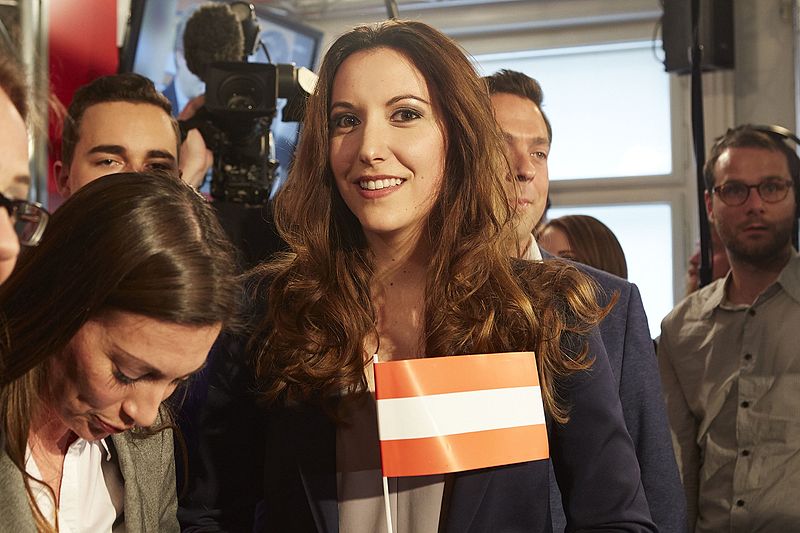
Austrian People’s Party (FPÖ) politician Petra Steger. (Wikimedia Commons)
MAGYAR NEMZET | July 24, 2023
The European Union’s desire to increase budget contributions from member states to continue funding Ukraine’s drawn-out conflict with Russia is scandalous, the conservative Austrian Freedom Party (FPÖ) has claimed.
Prominent FPÖ politicians sharply criticized the Austrian government for supporting the pro-war efforts in Brussels. Petra Steger, the party’s spokesperson on European affairs, insisted the European Union should not be fueling the conflict by providing an endless supply of military and financial support to Ukraine, and should instead be promoting peace talks in the region.
Steger slammed the plans proposed by the EU’s top diplomat Josep Borrell for the European Union to provide, in addition to existing measures, up to €5 billion per year for Ukraine’s defense needs and to guarantee a substantial contribution to the military training program of the Ukrainian Armed Forces.
She said the plan represents a “bottomless pit,” and her party therefore reiterated its calls for the Austrian federal government to suspend its additional contributions to the European Union budget.
“The scandalous increase in the EU budget hasn’t even been implemented yet, and here they come with their next crazy demand. In the meantime, more than enough billions have been transferred to Ukraine, which has brought nothing but bloodshed and a boom for the U.S. arms industry,” Steger said.
“All this at a time when the European Union is constantly giving billions in gifts to third countries, openly supporting a warring party while the EU itself is degenerating into a debt union. Moreover, the European Central Bank is constantly overstepping its mandate. The hard-earned money of the Austrians is no longer in good hands in the institutions of the European Union,” she added.
Instead, Brussels should be hell-bent on promoting a ceasefire between Kyiv and Moscow to help bring peace back to the region.
“Until then, the EU’s behavior can only be described as a brazen Brussels rip-off that has turned into the ultimate disaster for the European financial budget,” she claimed.
More than €60 billion has flowed into Ukraine since the beginning of the war, and the European Union wants to approve even more funding through the European Peace Facility. This, however, comes at an additional cost for member states, and net contributors to the EU budget, like Austria, aren’t impressed.
“Our hard-earned prosperity over decades is incessantly sent to Ukraine by the EU,” Steger said, adding that the federal government supported Brussels in its plans and gave the European Commission its nod.
Her party colleague Axel Kassegger also criticized the European Union and the Austrian government for not being firmly opposed to the deployment of cluster bombs in Ukraine by the United States.
Indisputable – Covid ‘cures’ caused the excess deaths
By Serena Wylde | TCW Defending Freedom | July 21, 2023
‘Virologists have been exploiting us and screaming fire where there was none’: Dr Denis Rancourt giving his testimony to the National Citizens’ Inquiry in Ottawa, Canada.
This citizen-led, citizen-funded inquiry into Canada’s Covid-19 response, by definition cannot be commissioned or conducted impartially by the government whose responses and actions are the subject of the investigation. It has already held hearings in Vancouver, Ottawa and Quebec City at which scientific, medical, and legal experts have testified under oath, along with journalists and Canadian citizens who have pertinent testimony to offer. On May 17 Dr Rancourt, a scientist with a PhD in physics who has held key research positions in France and the Netherlands prior to becoming a physics professor and lead scientist at the University of Ottawa 23 years ago, gave his evidence.
For the last three years, with a team of statisticians and scientific researchers, he has been conducting a vast number of studies on all-cause mortality. These have focused on North America but have included other Western nations, resulting in more than 30 scientific reports. His findings appear conclusive, and establish that there was no particularly virulent pathogen on the planet in 2020; that excess deaths that year were entirely caused by the measures imposed against a fictitious threat, and then from 2021 onwards, by the vaccines.
He further concludes that none of the various ‘pandemics’ announced by the US and Canada since the Second World War was reflected in excess all-cause mortality. In other words, they too were fiction.
Importantly, at the inquiry hearings Dr Rancourt explained his focus on all-cause mortality data. It is because it contains no bias. It is a simple counting of deaths per age group, by sex, state, city and as a function of time. It enables one to spot and correlate events such as heatwaves, earthquakes, wars, economic depressions; anything that perturbs the population sufficiently to cause mortality. Its ‘power’ is that it provides a clear, unmanipulated picture of a given population.
During a 97-minute testimony he provided detailed evidence to show how he arrived at three core conclusions:
1. ‘If governments had done nothing out of the ordinary, if they had not announced a pandemic, not responded to a presumed new pathogen, done nothing more than what is usually done when there is high seasonal mortality in the winter, there would have been no excess mortality. There was the usual ecology of pathogens which we live with and are always present. People get ill, they recover, some die, but there was no pandemic that caused excess mortality beyond the historic trend, and that would have remained the case if we had just left things alone.’
2. The measures that governments applied were many different forms of assault, all of which contributed to excess mortality.
3. The Covid-19 vaccination campaign has caused huge excess mortality in clearly visible peaks which are seen directly associated with the roll-out of various vaccine doses to different age groups and in different jurisdictions, and likewise with the administration of boosters. The excess mortality occurs immediately following vaccination and lasts a few days, then the curve of mortality declines exponentially over a period of about two months. Dr Rancourt emphasises that it is not possible to have such an unusual pattern without it being causally connected to the injections.
Explaining why there was no pandemic of a viral respiratory disease, Rancourt shows that when one integrates the all-cause mortality in the ‘Covid’ period there were huge variations from area to area, which defies the hypothesis of viral spread.
The US excess mortality in this period was five times higher than that of neighbouring Canada proportionately to its population, which is epidemiologically impossible. These differences were also visible between US states, which means one has to look at social factors to explain the phenomenon. The excess deaths occurred mainly in the Southern states, which have a high incidence of seasonal bacterial pneumonia, and these infections went inadequately treated because during the ‘Covid’ period all Western nations cut antibiotic prescriptions by at least 50 per cent. Another strong population correlation factor was the number of people with disabilities. The US has a large number of registered disabled, and people who rely on outside support for everyday needs cannot function in a society in lockdown. It also has high numbers of poor people, and with the closure of churches, schools and community facilities, these populations were utterly stripped of their usual mechanisms of survival.
Excess mortality in 2020 in Europe was equally inconsistent with the notion of viral spread. Immediately after the pandemic was announced Lombardy in Italy became a hotspot, where hospitals put two people at a time on mechanical ventilators. But Italy’s crisis did not flow into Switzerland, nor did Spain’s high death toll cross the border into Portugal, and Alsace’s peak in Eastern France did not affect neighbouring Germany. This constitutes counter-evidence of a viral respiratory disease. Furthermore, although the lethality of ‘Covid’ was said to be exponential with age, mortality data shows no correlation with age.
Dr Mike Yeadon, who understands the biological effects of fear, told James Delingpole in their recent discussion: ‘Two mg of diazepam, a cup of tea and a biscuit, arm around the shoulder and give them an oxygen mask. I think most people would have gone home, but instead they admitted and murdered them.’
As the fraud began with the seeding of an idea of a pandemic, solid, irrefutable data is key in dismantling the illusion. This Dr Rancourt provided.
He completed his testimony with a plea to scientists and physicians to go back and look at the data of who is dying, and where and when, and what it correlates to. He believes there has to be a reset of thinking to recognise that virologists have been exploiting us and shouting fire where there was really nothing present. Clinicians and emergency staff have donned ‘Covid glasses’, he believes, making them see things as dangerous which at any other time would appear perfectly normal.
He postulates that the way to reset thinking is to use hard data that cannot be disputed, and that is all-cause mortality data. Unless this central data issue is addressed, he fears pandemics will be declared without basis, and populations will be assaulted at will.
Greta Thunberg Gives Finger to Opponents of New EU Environmental Legislation

By Robert Kogon | Brownstone Institute | July 22, 2023
Greta Thunberg was photographed at the European Parliament in Strasbourg last Wednesday smiling broadly while flipping a double-bird – apparently to the opponents of heavily contested new EU environmental legislation known as the “Nature Restoration Law”.
According to the German news site Merkur.de, it was a “winner’s gesture” – if not the most sporting one – because at its last week’s session, the parliament approved the legislation, with some amendments, by the notably slim margin of 336-300. A prior motion to reject the proposal outright was defeated by the even slimmer margin of 324-312.
The proposed Nature Restoration Law, one of the main components of the European Commission’s “Green Deal,” would require 20 percent of allegedly degraded EU land and sea to be “restored” by 2030. (See, for instance, the factsheet on the law here.) A modified version of the proposal which was already rejected in the parliament’s Environment Committee would have raised this figure even to 30 percent.
Fearing the impact of such “restoration” on the livelihoods of farmers and fishers, European agricultural and fishery groups have vigorously opposed the proposal, and it was also rejected by both the parliament’s agricultural and fisheries committees.
The largest group in the European Parliament, the “conservative” European People’s Party (EPP), likewise opposed the legislation. Ironically, the largest national delegation within the EPP group is the German Christian Democrats of none other than European Commission president Ursula von der Leyen. Nonetheless, the legislation only managed to escape outright rejection in the full parliament thanks to 15 EPP members breaking ranks and voting with the Greens, the Social Democrats and the Left group. (See roll-call here, p. 52.)
It should be noted that, despite the Schadenfreude evident in Greta Thunberg’s “winner’s gesture,” the Nature Restoration Law has not now been passed.
Rather, the European Parliament’s approval of the legislation means that the text will now be the subject of so-called “trilogue” negotiations involving representatives of the three main EU institutions: the Commission, the Parliament, and the Council (in which EU member states are directly represented). The final text will then be resubmitted to the parliament at some future date.
Poland files legal complaints against “authoritarian” EU climate policies
By Alicja Ptak | Notes from Poland | July 18, 2023
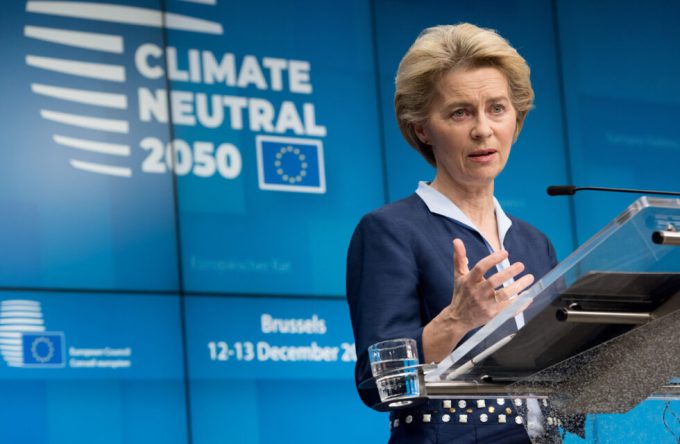
The Polish government has submitted four complaints against EU climate policies, calling them “authoritarian” and pledging that it “will not allow Brussels’ diktat”.
Three new cases filed to the Court of Justice of the European Union (CJEU) relate to a ban on the registration of new internal combustion vehicles after 2035, an increase in the EU’s greenhouse gas reduction target, and a reduction of free emission allowances under the EU Emissions Trading System (ETS).
They follow another complaint filed last week against EU rules on land use, land use change and forestry (LULUCF), which Poland says infringes the competences of member states.
“Does the [European] Union want to decide in an authoritarian manner what kind of vehicles Poles will drive and whether energy prices will rise in Poland?” tweeted climate minister Anna Moskwa on Monday. “The Polish government will not allow Brussels’ diktat.”
This morning, the minister added in an interview with Polskie Radio that the government would also file a fifth complaint this week concerning 35,000 tonnes of rubbish that it says has illegally entered the country from Germany.
Poland’s current national-conservative government has regularly criticised the EU’s climate and environmental policies. Ruling party leader Jarosław Kaczyński has called them “madness and theories without evidence” and “green communism”.
“At every EU council, we have been against and voted as a government against every single document in the Fit for 55 package,” said Moskwa, referring to the EU’s programme to reduce emissions by at least 55% by 2030.
“It is no secret that we were against the whole package, we are against increasing climate ambition and the way [these efforts] are carried and forced [upon member countries],” added the minister.
A recent EU-funded study found Poland to be the bloc’s least green country. It still relies on coal to produce around 70% of its electricity, by far the highest figure in the EU. Poland is Europe’s second-largest producer of brown coal after Germany and the largest producer of hard coal.
In March, Poland was the only member state to oppose the introduction of a ban on the sale of new petrol and diesel cars from 2035. In an interview today, Moskwa argued that unanimity should have been required for this decision as its impact is heavily dependent on member countries’ energy mix.
“In our case, [banning combustion engines] is absolutely contrary to climate policy, because it will lead to an increase in coal consumption in the short term if we want to increase electricity production [to power electric vehicles],” she said.
Asked about the other complaints, Moskwa said Poland was challenging most of them on the same grounds as the ban on the sale of combustion cars.
“The argument in most of these complaints is the same, mainly concerning the legal basis and unanimity, the impact on the energy mix,” she said.
One of the EU policies opposed by Poland is changes to ETS stipulating that sectors already covered by the system will be obliged to reduce their greenhouse gas emissions by 62% by 2030 compared to 2005 levels. The reform also envisages a gradual phase-out of free emission allowances between 2026 and 2034.
Another regulation concerns the provisions on the new EU Carbon Border Adjustment Mechanism (CBAM), which will cover commodities such as iron, steel, cement, aluminium, fertilisers, electricity and hydrogen.
Importers of these commodities will have to pay the difference between the emission fee in the country of production and the price of emission allowances in the EU ETS. CBAM will be phased in between 2026 and 2034, as free emission allowances in the ETS are phased out.
Moskwa argues that Poland is pursuing a “very consistent energy transition” focused on creating incentives rather than restrictions. She cited government subsidies for clean energy sources such as the “My Electricity” and “Clean Air” programmes, which have led to a boom in solar micro-installations and heat pumps.
Data from the European Environment Agency published last month showed that Poland recorded the EU’s largest overall fall in emissions in 2022. However, in proportional terms, Poland’s decline was, though above the EU average, not among the highest in the bloc.
Alicja Ptak is senior editor at Notes from Poland and a multimedia journalist. She previously worked for Reuters.
Copyright © 2023 Notes From Poland
Health is being rejiggered into pandemic preparedness: Documents from the EU Commission and US government
Huge expenses and rapid deployment of mRNA vaccines for infections but maybe all other medical conditions
BY MERYL NASS | JULY 13, 2023
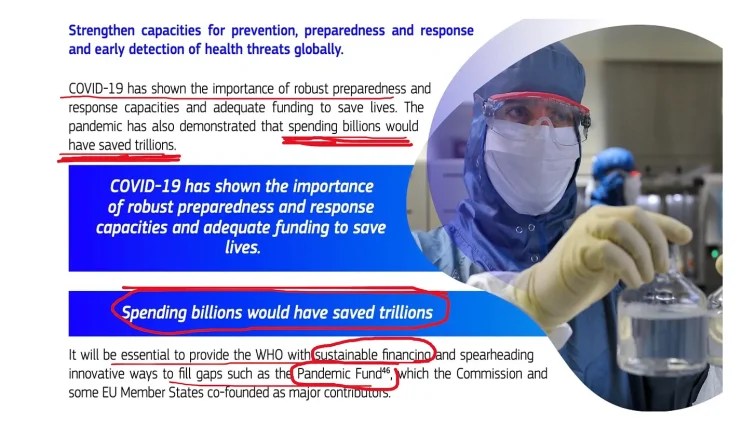
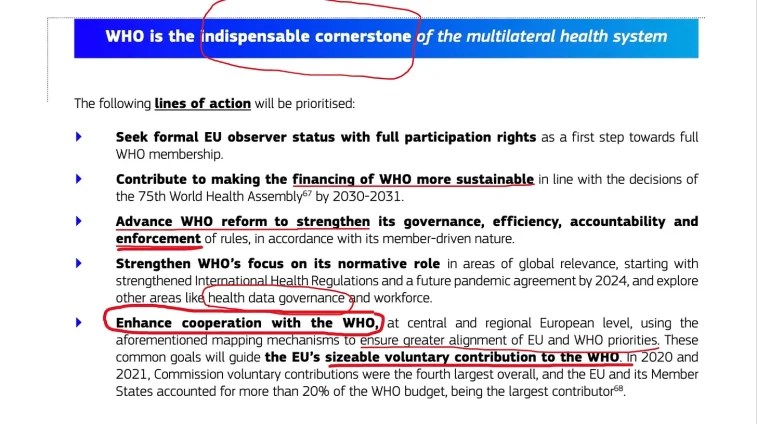
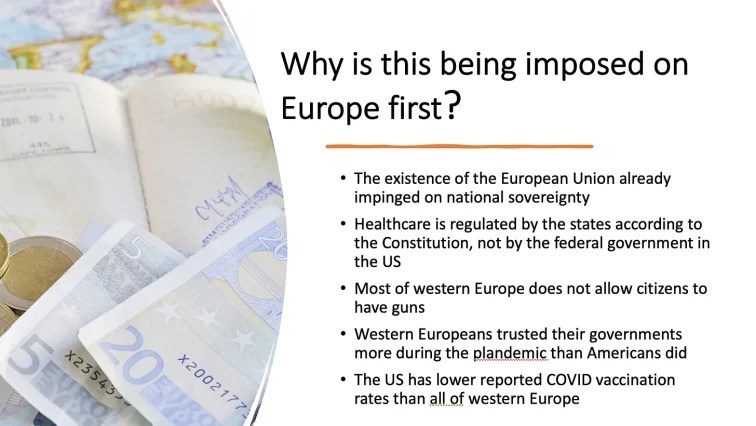
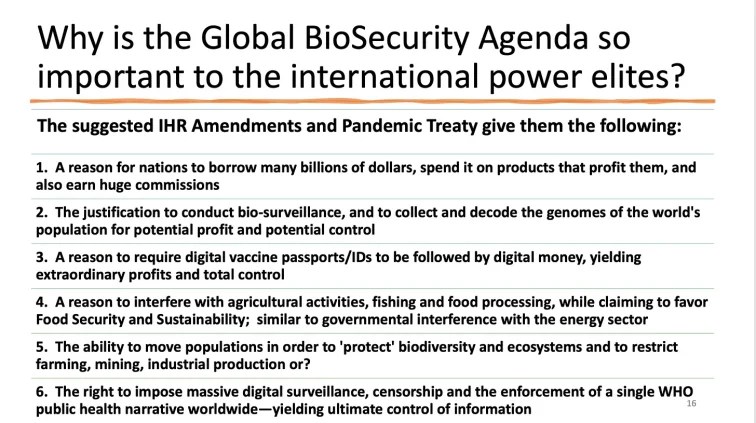
Europe and the USA have already bought into the Global Biosecurity Agenda aka Pandemic Preparedness.
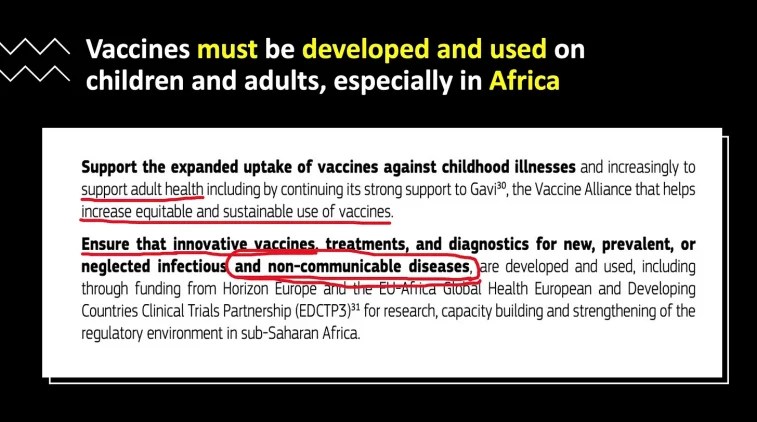
Europe issued its report on its Global Health Agenda in March, and it isn’t about health, it is about making health the driver for the WHO/globalist agenda. No surprise I guess. But to see it in print, with lots of pretty pictures, all spelled out: well, I was surprised. Please take a look at it.

But then I stumbled on this 2021 US document, signed by Eric Lander (then the Assistant to the President for Science and Technology) and Jake Sullivan, still the National Security Advisor.
https://www.whitehouse.gov/wp-content/uploads/2021/09/American-Pandemic-Preparedness-Transforming-Our-Capabilities-Final-For-Web.pdf
They equate the US government’s broad pandemic preparedness initiative with the Apollo (mission to the moon) program. Was that an oops? Because didn’t the Apollo mission suck up a ton of money but wind up in a studio being filmed by Stanley Kubrick instead, to fake out us gullible Americans?
Did Lander and Sullivan (or whoever wrote this report) give us a broad hint that the “biological preparedness” they envision will suck up a lot of money but go nowhere?
I don’t know if we went to the moon or not. But watching the astronauts at their press conference on their return to earth, I was convinced they were ashamed of their performance, rather than triumphant. Watch it.
The funding required in this report for pandemic preparedness is just over $65 Billion. To be spent over 7-10 years. But as I showed you 2 days ago, the President’s budget to Congress asks for $20 Billion next fiscal year for biopreparedness. The price has gone up.
By far the largest line item is vaccines: $24.2 billion.
This is a quote:
The development of mRNA vaccine technology and other ‘programmable platforms’3 — thanks to more than a decade of foresighted investment by the public and private sector — have been game- changing. mRNA vaccines shortened the time needed to design and test vaccines to a record-setting 314 days — far less than previous vaccines, which had taken several years. They have also been surprisingly effective against COVID-19.
Another quote from the report to justify “spending billions to save trillions” which is verbatim from the EU report linked above and from certain US documents:
In addition to protecting American lives, the annual investment is strongly justified from an economic standpoint: If major pandemics similar to COVID-19, costing the U.S. roughly $16 trillion, occur at a frequency of every 20 years, the annualized economic impact on the U.S. would be $800 billion per year. Even for somewhat milder pandemics, the annualized cost would likely exceed $500 billion
Then there is this, a vaccine timetable that is identical to the CEPI plan (Gates-Farrar being the main originators of CEPI) to get vaccines to the populace so fast that there is no time to test them in humans. In 130 days they plan to have enough vaccine for every American. Great, huh? No, it is scary.
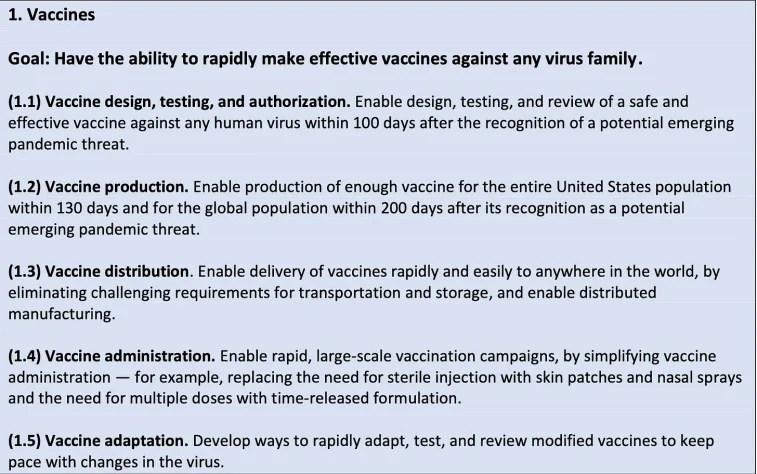
Now you know what they are planning. We are only in the second stage of a very big battle for our bodily integrity and many other rights and freedoms, not to mention our property. Forewarned is forearmed!
Sweden’s NATO membership not a done deal – Erdogan aide
RT | July 14, 2023
Türkiye has opened the door to the process of Sweden joining NATO but has not yet given its approval, Omer Celik, spokesman for President Recep Tayyip Erdogan’s ruling AK Party, said on Friday.
In a live broadcast on Haberturk TV, Celik said there was a tripartite memorandum between Türkiye, Sweden and NATO about the preconditions for membership, in which Stockholm pledged to undertake certain steps.
If the Turkish parliament is told that Sweden has produced “a strong satisfactory result” by complying with its obligations, AKP deputies will vote to ratify its membership of the US-led military bloc, Celik told Haberturk.
Asked when this might happen, Celik said “at the next session” of the parliament, meaning not before October or November.
Earlier this week, NATO Secretary General Jens Stoltenberg said Türkiye had agreed to support Sweden’s application after a months-long delay.
Erdogan had reportedly attempted to tie his approval of Sweden’s membership bid to Türkiye being admitted to the European Union. In return, the US has signaled willingness to unblock a sale of F-16 fighters to Ankara.
Commenting on Türkiye’s relations with the US, Celik said the meeting between Erdogan and US President Joe Biden promised “a new page,” but that remained to be seen. Relations could improve much faster if the US would change its mind about supporting Kurdish-led militants in Syria, Celik noted.
NATO had hoped to admit Sweden and Finland together before the bloc’s summit in Vilnius, Lithuania this week. Finland eventually joined on its own, after Türkiye held up Sweden’s application over concerns that Stockholm was protecting Kurdish organizations that Ankara has labeled as terrorists. The US-dominated bloc technically requires the consensus of all 31 members before admitting new ones.
Here’s why the US may never allow Ukraine to join NATO
Kiev has to face up to some bad news – for the first time, NATO enlargement has become a threat to Washington itself
By Timofey Bordachev | RT | July 12, 2023
The Ukrainian crisis marks the first time in history that the United States has exposed itself to serious risks in defining the limits of its military presence in Europe. Any genuine move by Washington to invite Kiev into NATO would imply a willingness to enter into a direct military confrontation with Russia. A less risky option, many believe, would be to promise the Vladimir Zelensky regime some special bilateral guarantees.
The NATO military bloc was created on the basis of the real division of Europe into zones of influence between the US and the USSR after the Second World War. As a result of the greatest armed confrontation in the history of mankind, the bulk of European states lost forever the ability to determine fundamental issues of their national policy. These included, first and foremost, defense and the ability to form alliances with other countries. Europe was divided between the real winners of the conflict – Moscow and Washington. Only Austria, Ireland, Sweden, Finland and a small part of Switzerland were outside their zone of dominance.
Both of the great powers had an informal right to determine the internal order of the territories under its control. This was because the countries concerned had lost their sovereignty as such. Even France, which continued to demonstrate freethinking for several decades, had no doubt on whose side it would fight in the event of a new global conflict.
NATO was created in 1949 to formally deprive American allies of the ability to make their own foreign policy decisions and military doctrines. In this respect, the alliance was no different from the Warsaw Pact that had emerged in the USSR’s sphere of influence.
The relationship between the United States and other NATO countries has never been an alliance in the traditional sense. In the last century, classic alliances ceased to exist altogether – the gap in military capabilities between the nuclear superpowers and every other country in the world became too great.
A military alliance between relative equals is possible, as it was until the middle of the last century, but nuclear weapons have made this impossible. The former sovereign states of Europe became a territorial base from which the great powers could negotiate in peace and act in war. The creation of NATO and the subsequent accession of countries such as Greece, Turkey, Spain and West Germany to the alliance was a formalization of the boundaries of US dominance that the USSR had already agreed to in bilateral relations.
After the Soviet collapse, extending American rule to Moscow’s former allies in Eastern Europe and even the Baltic republics was also not a policy that posed serious risks for Washington. Incidentally, this is why NATO has an informal rule of not admitting countries with unresolved territorial disputes with third states – the US has never been willing to occupy land whose ownership is disputed. NATO’s post-Cold War expansion was based on deception, with the US promising Moscow that it would not expand NATO to Russia’s borders. But, initially, Russia did not have the physical strength to resist. This meant that the US could occupy “unclaimed” states without the threat of immediate military conflict. The US approach to NATO remained true to the philosophy of the 1945 victors: there are no sovereign states, only controlled territories.
Once the decision was taken in Washington, it was only a matter of strategy to ensure that local governments made the “right” decisions. This was all the more so as the accession of new countries to NATO in the 1990s and 2000s was ‘packaged’ with the enlargement of the European Union. This gave local elites every reason to aspire to join the bloc, from which they expected tangible material benefits. For some – the Baltic states and Poland – membership in the club also provided the possibility of solving internal problems through an aggressive anti-Russian policy by fostering fear of the big neighbor to the east. In the Baltic states, the status of an American outpost was also used by elites to combat any local opposition from radical nationalists.
For the countries that joined the bloc, NATO became a guarantee of internal stability. Since the most important decisions for them were taken outside their national political systems, there was no reason for internal competition and no danger of serious destabilization.
Of course, no country is safe from minor internal political disturbances, such as those caused by a change of government – especially if the one in power is not liked by the US. But radical changes, which generally involve foreign policy issues, have become impossible.
In this sense, Western Europe increasingly resembles Latin America, where the quality of life of the population doesn’t have dramatic consequences for the elites. There, geographical proximity to the US has long been a reason for almost total American control. The only exceptions have been Cuba and, in recent decades, Venezuela. In Western Europe, because of Russia’s proximity, this control is of a formal nature, which should in principle rule out any surprises.
Joining NATO is an exchange of state sovereignty for the indefinite retention of power by the ruling elite. This is the secret of every political regime’s desire to join the bloc: it gives them the possibility of “immortality” in spite of any domestic or economic failures. The regimes in Eastern Europe and the Baltics immediately realized that they would not last long in power without being under Washington’s control – the break with Moscow and the peripheral position of their countries promised them too many problems. And the reason Finland joined NATO is that the local elites no longer have confidence in their ability to hold power on their own.
For the United States itself, as we have seen, the expansion of its presence has never posed any serious threat or risk. At least until now. This is precisely what is being pointed out by those in America who are calling for a careful approach to be taken in response to the demands of the authorities in Kiev for membership. A call which is supported by some members of the bloc.
It is understood that a military clash between Moscow and NATO would mean global nuclear war. Nevertheless, back in the Soviet period, the US believed that any conflict with the USSR could be confined to Europe and would not involve direct attacks on each other’s territory. There is reason to believe that Moscow felt the same way during the Cold War.
NATO’s eastward expansion after the Cold War was a case of acquiring territories for which no one wanted to fight. However, in the situation of Ukraine, for the US is not a question of gaining territory, but rather of taking it from a rival power that wants to keep Washington out. This has never happened in the history of NATO, and one can understand those in Western Europe and the US who are calling for serious consideration of the likely consequences.
Inviting Kiev to join NATO could mean something entirely new for American foreign policy – a willingness to fight a peer adversary like Russia. Throughout their history, Americans have shied away from this, using other players as battering rams willing to sacrifice and suffer for American interests. This was the case in both the First and Second World Wars. The most likely scenario, therefore, is that the US will limit itself to promising to address the issue of Ukraine and NATO after the Kiev regime has resolved its problems with Russia in one way or another. In the meantime, it will only be promised some “special” terms on a bilateral basis.
Timofey Bordachev is the Valdai Club Programme Director.
Erdogan still firmly in NATO bloc despite blackmailing EU
By Ahmed Adel | July 11, 2023
Turkish President Recep Tayyip Erdogan urged the European Union on July 9 to open the doors for his country to join the bloc if they want to secure support for Sweden’s accession to NATO. His blackmailing of the EU, which ultimately produced results, comes only days after he controversially broke an agreement with Moscow by releasing neo-Nazi Azov Battalion members under Turkey’s custody to Ukraine.
“Turkey has been waiting at the door of the European Union for over 50 years now, and almost all of the NATO member countries are now members of the European Union. I am making this call to these countries that have kept Turkey waiting at the gates of the European Union for more than 50 years,” Erdogan said. “First, open the way to Turkey’s membership of the European Union, and then we will open it for Sweden, just as we had opened it for Finland.”
Turkey has been an EU member candidate since 1999. Since 2016, negotiations on a visa-free regime between Turkey and the EU have been on hold. The country’s bid for EU membership has been stalled due to democratic backsliding and an unrelenting occupation of the northern portion of EU-member Cyprus since 1974.
Ultimately, Erdogan backflipped just mere hours after issuing his blackmail.
“I’m glad to announce … that President Erdogan has agreed to forward the accession protocol for Sweden to the grand national assembly as soon as possible, and work closely with the assembly to ensure ratification,” said NATO secretary general Jens Stoltenberg on the eve of the alliance summit in Vilnius, which will be held on July 11-12.
Finland and Sweden applied to join the bloc in May 2022. Finland gained its membership on April 4, 2023, while the Swedes await approval from Hungary and Turkey. As Turkey will never surrender its occupation of northern Cyprus, its EU membership will be forever stalled, making Erdogan’s ultimatum either a desperate action or a calculated manoeuvre to advance other interests.
Swedish Foreign Minister Tobias Billström told public broadcaster SVT that he expects Turkey will eventually signal that it will let Sweden join the alliance, though he could not say whether that would happen at the NATO summit in the Lithuanian capital. Sweden’s top diplomat said he expects Hungary, which also has not ratified Sweden’s accession, to do so before Turkey.
Turkey and Hungary remain the only NATO members still standing in the way of Sweden becoming the 32nd member of the US-led bloc, with Hungarian Prime Minister Viktor Orban strongly signalling he will follow Erdogan’s lead and approve Sweden’s membership only if Turkey does the same.
Now that Erdogan has reportedly unblocked Sweden’s path, the question is what was offered to appease the Turkish leader. Presumably, Erdogan would have only unblocked the accession process with the promise of receiving F-16 fighter jets, advancing EU membership talks without altering domestic oppression and ethnic cleansing abroad, or securing Western funding as the Turkish economy continues to tank with Gulf money all dried up.
The NATO summit will be dominated by how the alliance will see its future relationship with Kiev amid endless efforts by President Volodymyr Zelensky for Ukraine to become a member and a signatory to the mutual defence pact. Evidently, though, Sweden’s situation will also be discussed since Turkey is the main hindrance to their accession.
German Chancellor Olaf Scholz, for his part, joined a chorus of other European leaders and officials who said Sweden’s NATO membership should not be tied to Ankara’s stalled EU membership bid.
“Sweden meets all the requirements for NATO membership. The other question is one that is not connected with it. And that is why I do not think it should be seen as a connected issue,” the German chancellor said.
Stoltenberg also expressed before announcing Erdogan’s unblocking that the two issues have nothing to do with one another, reminding that while he supports Ankara’s bid for EU membership, it was not one of the conditions in the agreement signed by Turkey, Sweden, and Finland in 2022 at the NATO summit in Madrid.
Despite Erdogan initially adding another condition to Sweden’s accession, it is not a sign that Turkey has gone rogue within NATO, but rather it is the Turkish president blackmailing the alliance and EU to gain advantages for his country – what they are specifically since EU membership is not realistic, remains to be seen.
Erdogan broke a deal he had with Moscow by releasing on July 8, only days before the NATO summit, five Ukrainian Azov Battalion officers, who returned to Ukraine on a presidential plane. The Azov Battalion militants had been prisoners since the battle of Azovstal following the Russian liberation of the port city of Mariupol. Erdogan had no obvious reason for breaking the deal, meaning that he will now want something at the NATO summit for doing this.
Although it may appear that Erdogan has gone rogue by attaching an impossible condition for Sweden to become a NATO member, he is just leveraging to gain some advantage for Turkey. The release of the Azov Battalion members for seemingly no good reason demonstrates that Turkey is still firmly within the NATO bloc.
Ahmed Adel is a Cairo-based geopolitics and political economy researcher.
Burning of the Quran and the counter-offensive: Why the West is panicking
By Ramzy Baroud | MEMO | July 6, 2023
Desecrating, then burning the Holy Quran in Sweden has, once again, raised a political storm of condemnation, but also of justification, if not outright approval.
Such acts are protected by law, top Swedish and EU officials have declared.
But why are the rights of those who oppose western agendas, colonialism, imperialism, Zionism and military interventions not equally protected by law?
The Palestine boycott movement, BDS, for example, is constantly fighting in western societies and institutions for the right to use certain language or merely challenge, though non-violently, Israeli occupation and apartheid.
Iranian media offices were shut down in some western countries, and various western-operated satellites removed Iranian Press TV, Lebanon’s Al-Manar TV and other anti-Israel occupation media outlets from their line-ups.
Thousands of Palestinian activists have been banned or censored on western social media platforms for daring to criticise Israeli war crimes in Palestine. The writer of this article is one of many others.
As soon as the Russia-Ukraine war began, western governments were asked to completely block Russia Today and other Russian media channels from operating in western capitals, leading to the shutting down of offices, social media channels, removal from YouTube, Google and other search engines and so on.
In February 2022, European Commission President, Ursula von der Leyen, said: “We will ban the Kremlin’s media machine in the EU”.
For some odd reason, all this censorship is, somehow, morally and legally defensible from the viewpoint of the West.
But why is the right to insult Muslims so cherished, so sacred in the view of western governments and laws? And why burn the Quran now?
It is ‘sacred’ simply because Islamophobia exists at the highest levels of governments throughout the West.
Western lawmakers and politicians may argue that the law protects the rights of individuals to burn the Quran but, deep down – sometimes right on the surface – Europe’s ruling elites share the view of those who burn the Quran or desecrate Islamic symbols. Such hate is often blamed on the far right by many of us, but that is only part of the story.
Expectedly, once again, Muslims react by protesting en masse, storm western embassies and burn western countries’ flags. And when this happens, the very western political and intellectual circles that permitted or encouraged hate speech in the first place, take to the stage, juxtaposing, with unmistakable triumph, the West’s democracy and tolerance with Islam’s intolerance and authoritarianism.
How about the timing?
Notice how the Quran is often burned, Islam insulted, or Islamic symbols desecrated whenever the West is undergoing a crisis and is desperate to either ignite an anti-Muslim public frenzy or distract from its own failures.
This has happened numerous times throughout history, ancient and modern.
In the past, whenever Christendom descended into chaos, civil wars and revolutions, European kings, with the support of the Church, would mount one crusade after another in the name of ‘freeing the captive Holy Land from the hordes of the heathens and the Mohammedans’.
More recently, when the US invaded Iraq, or wanted to distract from its splendid failures in Iraq, Afghanistan and everywhere else in the Muslim world, western provocateurs would rush to the streets to burn the Quran or would insult and ridicule Prophet Mohammed in their newspapers and magazines.
But what crisis is the West now trying to distract from? Ukraine, and the global paradigm shift underway.
NATO is failing to push back or even weaken Russia. The much-touted Ukrainian counter-offensive, featuring the most modern weapons the West has to offer, is a flop at best, a complete disaster at worst.
Moreover, the cracks of division among NATO and western countries are bigger than ever and are widening by the day.
The Wagner mutiny in Rostov which ignited hope among western governments and elites that Russia’s President, Vladmir Putin, can be taken down from within, has completely failed. In fact, it has backfired as the mercenary group has been exiled to Belarus and is now stationed at NATO’s own doorsteps.
Worse, Arabs, Muslims, and countries from across the Global South are moving even closer to Moscow and Beijing. Algeria has recently signed a major cooperation agreement with Russia – thus strengthening their influence over the gas markets – and a host of nations are lining up to join BRICS.
In the face of this strategic failure and the complete moral, political and military collapse of the West, a supposed lunatic appears before a mosque in Stockholm, with the made-up altruistic mission of burning the Holy Book of 1.8 billion Muslims. A Western media fanfare immediately follows.
But this individual, and others like him, have little interest in defending freedom of speech. His is a diversionary strategy and, at some level, the actual orchestrators are not lunatics, but clever men, with high paying jobs and political agendas.
Indeed, these blasphemous acts are part and parcel of a larger western agenda, the gist of which is that the West is democratic, tolerant and essentially good, and the rest are undemocratic, barbaric and essentially wicked.
This false maxim is just another take on the European Union’s Foreign Policy Chief, Josep Borrell, when he said, last November, that “Europe is a garden,” while “most of the rest of the world is a jungle.”
The fact that Russia has recently passed laws criminalising the burning of the Quran, indicates that Moscow, like others, also understands that the issue is purely political – because it is.
Europe Says No to China Decoupling
By Salman Rafi Sheikh – New Eastern Outlook – 06.07.2023
Following active US diplomacy over the past few years, Europe seems to have now decided to say no to the US geopolitics of “decoupling” from China. This is nothing short of a major diplomatic blow for the US, although this blow has not received as much attention in the mainstream Western media due to its overt focus on events related to the Russia-Ukraine conflict. The recent visit of Chinese Premier Li Qiang to Europe, where Li not only met the German Chancellor but also addressed a conference on development financing organised by French President Macron. More than that, the fact that two of the European Union’s most powerful states received and interacted with China’s number two became possible, first and foremost, because of the available space for continuing trade partnership with China. That is one key reason why the EU now favours the politics of “de-risking” rather than “de-coupling”.
While the idea of “de-risking” would literally mean reducing dependence on China – which some might see as a good sign – “de-risking” mainly means better management of trade and economic ties with China. After all, the EU sees China as an economic competitor. Therefore, devising new strategies to manage this competition makes perfect sense not only for the EU but also for China. As a leading US media outlet said in one of its reports, the EU has basically decided not to “piss China off.”
The real question is: Why is the EU, despite China’s overall pro-Russia position on Ukraine, devising a strategy that does not involve the kind of “decoupling” that the EU has effected vis-à-vis Russia in terms of energy supplies? There are several crucial reasons for the ongoing strategic rethinking in the EU vis-à-vis China.
First of all, the EU leaders tend to believe that China itself is eager to maintain stable economic ties with the EU. As opposed to Beijing’s estranged ties with the US, China intends to maintain a healthy, although competitive, environment with the EU. Doing this is very much possible since the EU is not as deeply entangled with China in geopolitical flashpoints, such as Taiwan and the South China Sea, as the US is. For the EU, therefore, continuing trade ties with China present an opportunity that should be exploited to the best possible extent, even if this continuation does not fit very well with the nature of the US-China ties.
Secondly, the EU is a 27-member bloc, which can be – in fact, it is – internally very diverse, with many EU countries following or favouring alternative policy positions. This internal divergence makes it extremely difficult for any given actor within the EU to impose its position on the bloc. This internal divergence also means that finding consensus on minimum common ground is equally difficult.
We have seen that German and French leaders have visited China in the recent past, but we have also repeatedly seen President of the European Commission Ursula von der Leyen taking a tougher position on China, showing how the three key EU leaders are not necessarily unanimous, making it extremely difficult for a) the US to make the bloc follow a single set of policies of “decoupling”, and b) the EU to devise its best China policy that stresses “de-coupling” over “de-risking”.
Even though some countries advocate a tougher position, the declaration of the latest EU summit in Brussels said that “Despite their different political and economic systems, the European Union and China have a shared interest in pursuing constructive and stable relations, anchored in respect for the rules-based international order, balanced engagement and reciprocity,” adding that Europe “does not intend to decouple or to turn inwards” or adopt policies “to harm China, nor to thwart China’s economic progress and development.”
Thirdly, the EU does not see the kind of interest that “decoupling” would yield for the bloc, as a potential “decoupling” would supposedly serve the US and harm the EU. Unlike the US, the EU, as it stands, is not trying to preserve its own hegemony by engaging China in a conflict.
Therefore, the EU’s stance – and the language it has been expressed in – is markedly different from the language the US officials normally used to report on their interaction with China. For instance, after Blinken met Chinese officials in June, he said he “warned” China about its foreign policies. Earlier in February, Blinken had sent yet another warning to China about its support for Russia.
But the EU, as is evident from the latest declaration, has a position that stresses cooperation over warnings and conflict. Although the EU disagrees with various policies of China, including its Ukraine stance, there is no desire within the bloc, on the whole, to pick a conflict with Beijing and deliver yet another economic blow to the continent, which is still not fully recovered from the effects of “decoupling” from Russia. “Decoupling” from China, therefore, will “kill”, to quote Hungary’s foreign minister, “Europe’s economy.” Various assessments prove this scenario.
For instance, the Seeheimer Circle, an official think tank inside the party of the German Chancellor, released a paper last April on Germany’s relationship with China calling for a “multi-dimensional” – that is, open – policy towards the Asian giant. An “abrupt end to trade relations with China” would be “an economic disaster,” the paper argued, rejecting an “anti-China strategy.”
Therefore, while a potential “decoupling” from China might help the US regain its position of economic and financial dominance at the global level, the EU sees no glory. The EU leadership is cognizant of this fact, which is why key EU leaders are not in line with the US. Instead, various EU pronouncements show an ongoing struggle within the bloc with regard to developing a strictly European strategic vision vis-à-vis China.
Featured Video

Racist Seinfeld Dances for Joy as Bibi Unveils His New Map
or go to
Aletho News Archives – Video-Images
TV Drama Review
Japanese drama projects Japan’s wartime atrocities onto Chinese characters

Global Times | October 25, 2026
By portraying Chinese characters as perpetrators of ruthless violence while casting Japanese Self-Defense Forces (SDF) intelligence operatives as defenders, the season 2 of the Japanese drama Vivant has recently drawn criticism from Chinese netizens, who argue that its depiction turns historical reality on its head while ignoring Japan’s wartime atrocities.
The TBS drama series – a spy suspense story in which an alleged unofficial intelligence unit of the SDF operates across the globe — has attracted a passionate fanbase. Its currently airing season 2 opened with a household rating of 18.8 percent, the highest for a TV drama this year, according toa commentary article by Japanese media Toyo Keizai.
What draws attention is the portrayal of the enemies in the series, the article noted. Scenes in which the Chinese organization subjects kidnapped members of the SDF unit to brutal torture are repeated with unrelenting intensity.
It is rare for Japanese TV dramas to explicitly portray a real-life country as the enemy, the article noted.
Japanese Prime Minister Sanae Takaichi also made a reference to the drama, saying that she has been recording Vivant and hopes to binge-watch it over the year-end and New Year holidays, according to Japanese media outlets.
China’s CCTV News report on Sunday revealed that the drama features scenes in which Chinese personnel cut off the fingers of and stab Japanese intelligence operatives in the abdomen. Such acts bear striking similarities to the torture inflicted on Chinese nationals by invading Japanese troops during the World War II.
The drama distorts the truth by attributing these atrocities to modern Chinese characters. Beneath the surface, it subtly glorifies Japan’s cross-border overseas operations, blurs the functional boundaries of the SDF and implicitly promotes an expansionist narrative, per CCTV News. … continue
Blog Roll
 Aletho News
- Iran FM Araghchi: “Hormuz Will No Longer Be the Same”
- EU facing trillion-euro debt hole while seeking more cash for Kiev
- How US, Europe, Persian Gulf states exhausted missile stockpiles, splurged billions to defend Israel
- Up in arms… Koreans reject U.S. empire’s plan to make South Korea the next Ukraine
- Iran, Turkey, Pakistan, Saudi Arabia could advance region-led security framework in Tehran: FM spox
- Netizens condemn Japanese drama for projecting Japan’s wartime atrocities onto Chinese characters
- Racist Seinfeld Dances for Joy as Bibi Unveils His New Map
- A West Bank War for Netanyahu’s Election Campaign, Could It Backfire?
- Yemen denounces European Parliament’s ‘hypocritical’ push to blacklist Ansarullah
- Qalibaf: UAE’s UN bid aims to ‘clear the runway’ for ‘Greater Israel’, whitewash genocide
- If Americans Knew
- Israel punishes Palestinian prisoners with solitary confinement for making a cake
- US midterms: Where do candidates in key Senate races stand on Israel, Gaza, and Iran?
- Israeli forces demolish Hebron homes, displace thousands of Palestinians as raids expand
- Their Son Died in Israeli Prison. No Answers. No Body
- Biden’s Israel Catastrophe
- Why Israel’s latest assault on Hebron is so significant for the West Bank
- Israel Used “Where’s Daddy?” AI to Relentlessly Murder Palestinian Journalists and Their Families in Their Homes from October to December 2023
- DAILY UPDATE: Latest essential news on Palestine, Israel, & region
- Netanyahu Says Israel Must Prepare for Banking Sanctions, Floats Crypto as a Possible Bypass
- Latest updates from Israeli assault on West Bank
- No Tricks Zone
- Sudden Stratospheric Warming, Powerful El Niño Combination May Lead To Extreme Europe Cold, Energy Crisis!
- Two New Studies Find Thwaites Glacier Melt Cannot Be Driven By Human Activity Or A Warming Ocean
- E-Cars Reduce CO2 Emissions By Only 41% Compared To Internal Combustion Engine Vehicles
- Predictions Made By Renowned Climate Professor Over Past Decades Have Been Proven To Be Poor
- New Study Suggests Large Regions Of The Pacific Ocean Have Been Cooling For The Last 80 Years
- Germany’s Green Energy Debacle: High Energy Costs Force Kahla Porzellan to Close After 182 Years!
- New Study: 50 Years Of The Most Aggressive ‘Net Zero’ Policies Can Only Affect The Global Climate By 0.03°C
- US September “Heat” Was No Record…Many Records Set Decades Ago
- Latest European Green Energy Debacle; Portugal’s Largest Flagship Solar Park Insolvent!
- Green Energy Debacle: German Expert Professor Fritz Vahrenholt Warns Of Severe Economic And Social Consequences

