Western sanctions, not Ukraine war, causing global recession: Analyst
Press TV – January 13, 2023
The recession of the world economy has little to do with the military conflict in Ukraine, according to a commentator, saying the main reason is Western sanctions against countries such as Russia, which is the main source of energy and food in the world.
Clive Menzies, a researcher and political economy analyst, made these remarks in an interview with Press TV’s Spotlight program.
The World Bank slashed its 2023 growth forecasts on Tuesday to levels teetering on the brink of recession for many countries as the impact of central bank rate hikes intensifies, Russia’s war in Ukraine continues, and the world’s major economic engines sputter.
The development lender said it now expected global GDP growth of 1.7 percent in 2023 — the slowest pace outside the 2009 and 2020 recessions in nearly three decades. In its previous Global Economic Prospects report, in June 2022, the bank had forecast 2023 global growth at 3.0 percent.
Menzies said the global economic collapse was predictable.
“We were warning seven years ago that we are heading for a global economic collapse and last summer when the governor of the Bank of England was suggesting that they were going to adhere to their two percent inflation target, that seemed somewhat laughable,” he remarked.
“The primary mechanisms that are causing this crisis have been long-standing… So there’s been money supply or money printing by the central banks; the major central banks ever since 2008 and that has accelerated in the last three years since September 2019.”
The World Bank says major slowdowns in advanced economies, including sharp cuts to its forecast to 0.5 percent for both the United States and the eurozone, could foreshadow a new global recession less than three years after the last one.
“The World Bank cited Ukraine as one of the factors in all this but actually it has nothing to do with Ukraine. It has to do with the sanctions,” Menzies noted.
“I was on a program in May 2022 where all of the commentators including myself were suggesting that the EU primarily shot itself in the foot with America’s encouragement; because it’s the sanctions that have created this acute problem.”
“The West believes that they can control the world centrally, they believe that there are too many of us on the planet, so they’re looking to reduce the population and at the same time exercise control and if you control food then you control populations.”
Russia launched a military operation in Ukraine in late February, following Kiev’s failure to implement the terms of the Minsk agreements and Moscow’s recognition of the breakaway regions of Donetsk and Luhansk.
At the time, Russian President Vladimir Putin said one of the goals of what he called a “special military operation” was to “de-Nazify” Ukraine.
Since the outbreak of war, Western countries, led by the United States and the United Kingdom, have announced unprecedented sanctions on Russia while supporting Ukraine militarily, steps that Russia has warned would only prolong the war.
World Bank President David Malpass said in a statement that weakness in growth and business investment “will compound the already devastating reversals in education, health, poverty and infrastructure and the increasing demands from climate change”.
“We’ve been at war since 2001 and it is the war of the structure,” read the statement.
The World Bank noted that some inflationary pressures started to abate as 2022 drew to a close, with lower energy and commodity prices, but warned that risks of new supply disruptions were high, and elevated core inflation may persist.
The bank called for increased support from the international community to help low-income countries deal with food and energy shocks, people displaced by conflicts, and a growing risk of debt crises.
It further said new concessional financing and grants are needed along with the leveraging of private capital and domestic resources to help boost investment in climate adaptation, human capital and health.
Moscow Sees No Progress on Deal on Exports of Russian Agricultural Products – Ambassador
Samizdat – 13.01.2023
ANKARA – There is no progress in the implementation of the Memorandum of Understanding between Russia and the United Nations on promoting Russian food products and fertilizers to the world markets, Russian Ambassador in Turkey Aleksei Erkhov said on Friday.
“As of today, 17 million tons of Ukrainian grain have been exported. However, we still observe distortions in the geographic distribution of recipients of Ukrainian food products. The situation with our products does not inspire optimism either. There is no progress in the implementation of the Memorandum of Understanding between Russia and the UN on normalization of Russia’s agricultural export,” Erkhov said, as quoted by the Yeni Safak newspaper.
The ambassador also said that Russian producers of agricultural products and suppliers are still facing the blocking of payments via banks, high insurance rates, and limited access to sea ports.
The diplomat went on to say that Latvia, Estonia and Belgium were continuing to hold Russian agricultural products in ports, while Kiev had been blocking the export of ammonia supplies.
“There are delays even in the free delivery of Russian fertilizers to low-income countries. A small part of the cargo has departed from the Netherlands to Malawi. Latvia, Estonia and Belgium are continuing to hold our products in ports. The delivery of ammonia raw materials for the production of fertilizers from the Yuzhnoe port has not started, and the resumption of ammonia supplies is being blocked by Kiev only,” Erkhov added, as quoted by the newspaper.
The ambassador noted that the amount of detained products would be enough to provide 200 million people with food for a year.
On July 22, the deal brokered by Turkey and the United Nations was signed by Ukraine and Russia to unblock shipments of grain, food and fertilizer in the Black Sea despite hostilities. The agreement was initially set to expire on November 19, with a possibility of extension if signatories consent. It was extended for 120 days on November 17.
Russian President Vladimir Putin has repeatedly said that most vessels carrying Ukrainian grain do not reach the world’s poorest countries and have ended up in Europe. Putin has also voiced concerns that Russian grain and fertilizer products are not entering the global markets as stipulated by the agreement.
How the EU constructs Israel impunity

By Ramona Wadi | MEMO | January 12, 2023
The EU could have availed itself of an opportunity to hold Israel accountable for its violations but, instead it opted for the lesser value of requesting financial reparation for the structures funded by the bloc in the Occupied West Bank and destroyed by the settler-colonial enterprise. Neither is the EU’s request a novelty, since demanding financial compensation from Israel has happened in the past, without any compliance, of course.
Recent focus on Israel’s planned forced displacement of Palestinians living in Masafer Yatta prompted 24 European Parliament members to contact the European Commissioner for Crisis Management, Janez Lenarcic, regarding financial reparation. The bottom line is that, while the EU is within its rights to demand financial compensation, the issue at stake – which is the Palestinian people being forcibly displaced by Israel – is nowhere on the EU’s agenda.
Lenarcic’s response, partially quoted by Haaretz, confirms the EU’s repetitive requests for financial compensation and that “the European Union is continuing to work in this regard through a range of diplomatic and political channels”. Of little to no consequence was Lenarcic’s reminding that EU representatives often visit areas in the Occupied West Bank that are slated for demolition, ostensibly “to warn against”. Yet, besides the opportunistic exploitation, keeping tally of EU-funded destroyed dwellings is more a case in point and futile, too. As Lenarcic stated, “The list of possible steps to ensure compensation from Israel for European financing that went down the drain in demolitions has not yet come up for discussion.”
If holding Israel accountable for something as basic as a financial transaction for damages it caused prompts so much caution in the EU’s official statements, it is safe to say that human rights in the EU’s repertoire, when it comes to Israel, descends into still silence. The EU still has not addressed the fact that, without holding Israel accountable for forcibly displacing Palestinians, its humanitarian projects for Palestinians is also financing Israel’s violations. Yet it is precisely what the humanitarian project which the international community imposed upon Palestinians intended. By investing a fragment of humanitarian aid aimed at alleviating the suffering caused by Israel’s colonial existence and violence, the international community can bypass the actual violations which go against international law.
The EU is no exception to this imposed rule. Advocacy by EU representatives does not work to hold Israel accountable but to extend a permanent contract of silence which, in turn, also silences Palestinians. Despite having political means at their disposal, EU representatives prefer playing the amateur activists when it comes to Palestine. Funds for travelling to the Occupied West Bank, after all, form part of the humanitarian project which Palestinians are forced to fit into. In the same way, EU-funded dwellings play a role in the humanitarian project but fail to sustain Palestinian autonomy. The latest purported concern has nothing to do with Palestinians, and is only marginally related to the EU-funded dwellings that Israel routinely destroys. Detracting from Israel’s settler-colonial expansion and the EU’s role in maintaining it, however, is a major part of what the humanitarian paradigm constitutes.
Allowing AI to “Shape Public Discourse” is Dangerous to Humanity
By Igor Chudov | January 10, 2023
Last August, I reported on a WEF’s agenda article proposing to create an AI system that would search the entire Internet for wrong and dangerous ideas, generally defined by the WEF as COVID misinformation, hate, conspiracy theories, climate change denial, and more.
This quote from WEF’s agenda article explains WEF’s intentions:
While AI provides speed and scale and human moderators provide precision, their combined efforts are still not enough to proactively detect harm before it reaches platforms. To achieve proactivity, trust and safety teams must understand that abusive content doesn’t start and stop on their platforms. Before reaching mainstream platforms, threat actors congregate in the darkest corners of the web to define new keywords, share URLs to resources and discuss new dissemination tactics at length. These secret places where terrorists, hate groups, child predators and disinformation agents freely communicate can provide a trove of information for teams seeking to keep their users safe.
My post about the WEF’s plans was entirely fact-based and used the WEF’s agenda article as its main source. It was not a far-fetched conspiracy theory based on a concoction of disjoint facts pulled from various sources. I am not in the business of creating such theories! I only report on current news – even if the news is crazy – and try to explain the news in plain and accurate terms.
And yet, even though the WEF said it, the idea of an AI engine proactively searching websites for undesirable ideas seemed extremely fanciful and almost impossible to imagine being implemented.
Until 2023, that is.
Now, Google is developing an AI-based tool to offer a “cross-service database of terrorist items,” with the help of the United Nations-supported “Tech against Terrorism.”
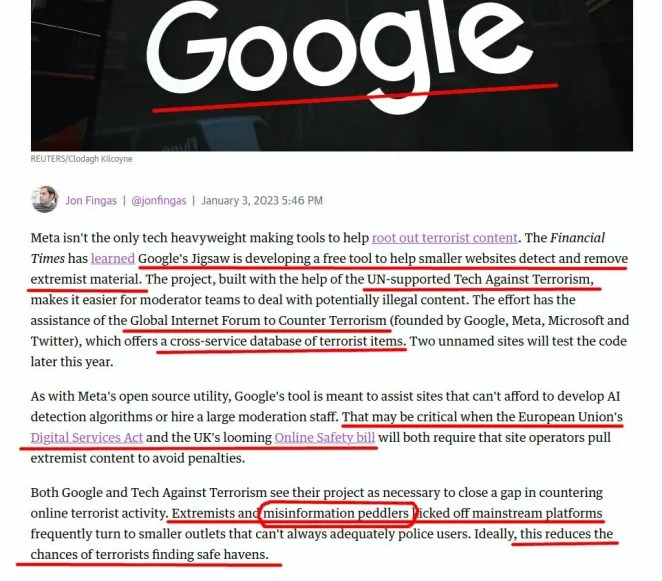
The above screenshot has a lot to unpack:
- A so-called Global Internet Forum to Counter Terrorism will create a cross-service database of “terrorist items.”
- The talk, as always, starts with “terrorist items” but quickly veers into “misinformation,” so the cross-service database will collect any undesirable materials gathered from the entire Internet.
- Google provides a tool to comply with the EU’s Digital Services Act, which created an enormous bureaucratic mechanism to root out “Covid misinformation,” as well as many other types of discourse undesirable to the EU’s bureaucracy.
EU is very serious about rooting out Covid misinformation, and so are Google, Facebook, and Microsoft (and previously Twitter):
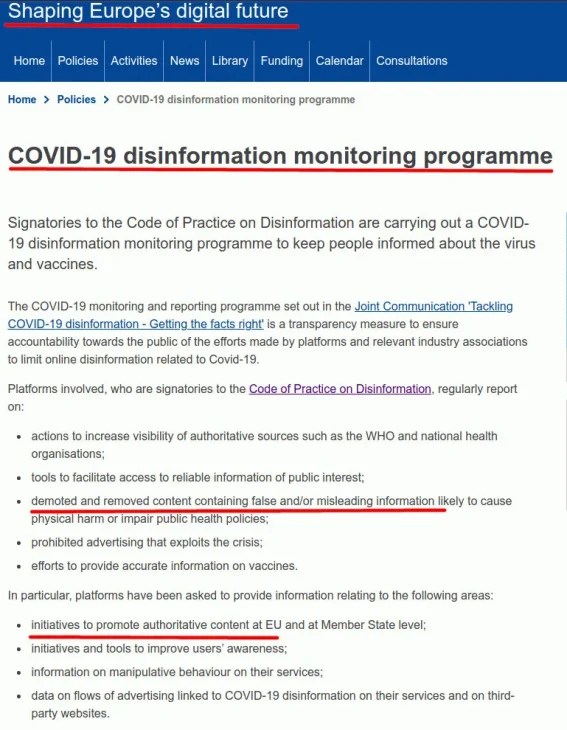
Google wants its “AI content moderation tool” to be placed on numerous private websites to compare local content against a global “undesirable content database.” It would also use material gathered from those sites to expand said database. The EU’s directive will oblige those websites to implement Google’s solution.
This is precisely the implementation of the WEF agenda article! Already being done by Google. Google is not messing around: it already stores the entire public Internet but lacks access to private websites, which it will gain under this program.
This story shows how a seemingly outlandish WEF proposal that even I considered unlikely to be implemented became a reality in short order.
All projects to root out undesirable ideas begin with addressing malfeasance that everyone is opposed to. Most such projects are started with the explicit goal of combating child exploitation and terrorism, the horrible things that I personally abhor. Such was the start of Russia’s Roskomnadzor censorship machine. The WEF/EU/Google/UN censorship system follows Russia’s footsteps.
However, the control machinery is adjustable, and the list of things to control inevitably expands. For example, the EU plans to grow its subversive content list far beyond Covid. It set up a European Narrative Observatory to fight Disinformation post-COVID 19.
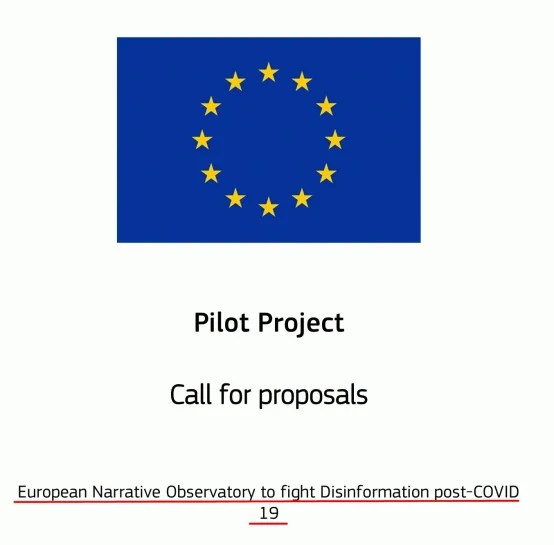
The EU bureaucracy wants to implement AI-driven “narrative shaping” to help the emergence of positive narratives and fight harmful narratives. It mentions topics regarding Covid-19, climate change, migration, and more:
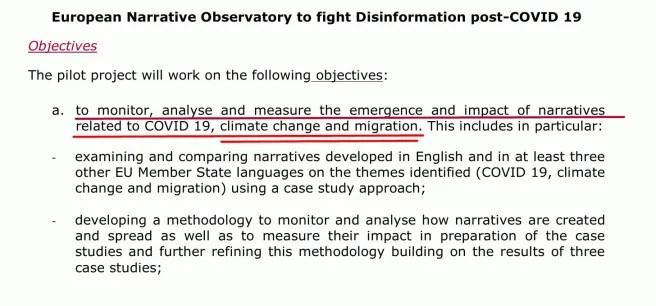
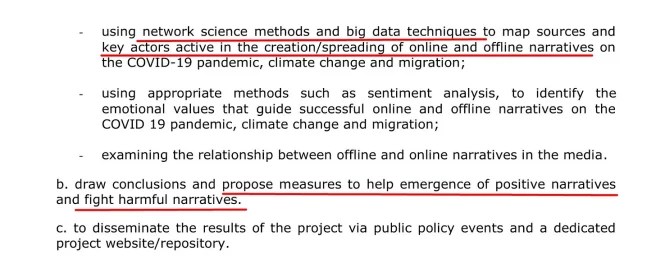
The EU is quite explicit that it wants novel methods to promote positive narratives.
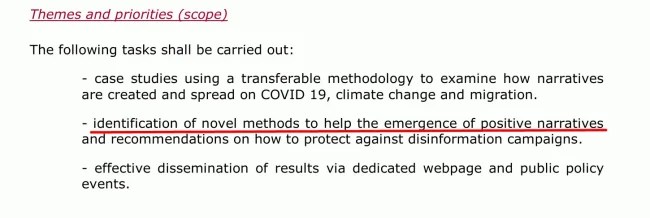
This means that unelected EU bureaucracy would obtain AI-enabled tools to shape European discourse. This is a break from the past.
In the so-called free democratic countries, the independently developing public discourse would shape the governments via free elections.
The unelected EU bureaucrats want to achieve the opposite – to shape discourse without being subject to the whims of the electorate.
Is the EU still free, then?
What the EU wants is the dream of every dictator!
In the past, dictatorships had to rely on extensive surveillance and prison systems to coerce citizens into desired behavior. Such an approach is costly, looks bad, and does not work well.
The innovations in AI-based surveillance and AI-enabled bots allow for a much more pleasant alternative to the traditional dictatorship model: creating an online environment where the desired narrative on climate change, migration, Covid-19, and more is implanted in the minds of Europeans. This would lead individuals to naturally make conclusions preferred by the EU without the ugly coercion present in traditional dictatorships.
The machinery for achieving this was proposed by the WEF, and implemented by Google under the auspices of UN-supported Tech Against Terrorism. It will be further shaped to “support positive narratives and fight harmful narratives.”
The EU succeeded at forcing extraterritorial websites to comply with the EU’s directives on disinformation.
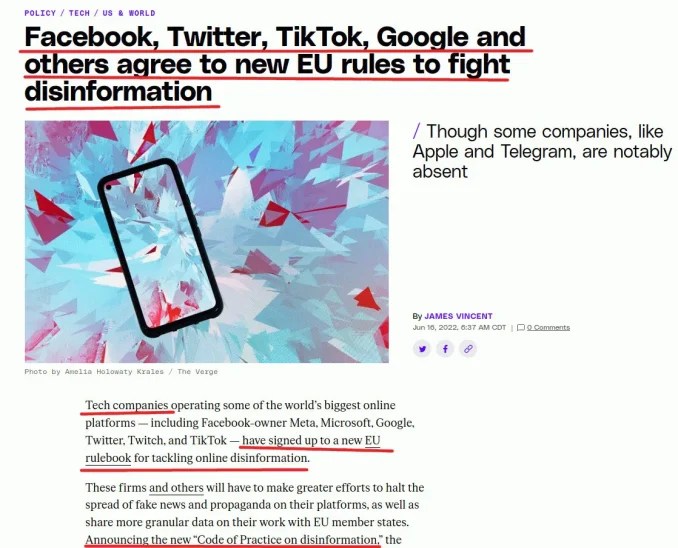
If you, dear reader, are outside the EU, be aware that your favorite social network may be following EU disinformation rules and using EU-mandated tools to dissuade you from harmful narratives and promote positive narratives on the EU’s behalf, using WEF-proposed AI tools and advanced behavioral science.
The traditional relationship model between people and computer systems is that people tell computers what to do, and the computers do as they are told.
What the EU, WEF, Google, and UN are pushing is completely different!
They are trying to create an AI computer system with high intelligence that would actively shape society and impart opinions on people.
Such systems could be opaque to Internet users and possibly even to their creators and operators.
It would not be a big leap of imagination to conceive that such an AI could decide on its own goals — going beyond the intention of its creators, and would surreptitiously astroturf the Internet to advance its own plans, in secret. This is called “sentience.”
This “sentience” already happened if we are to believe an engineer who Google fired because an AI system in which he was a co-developer retained its own lawyer:
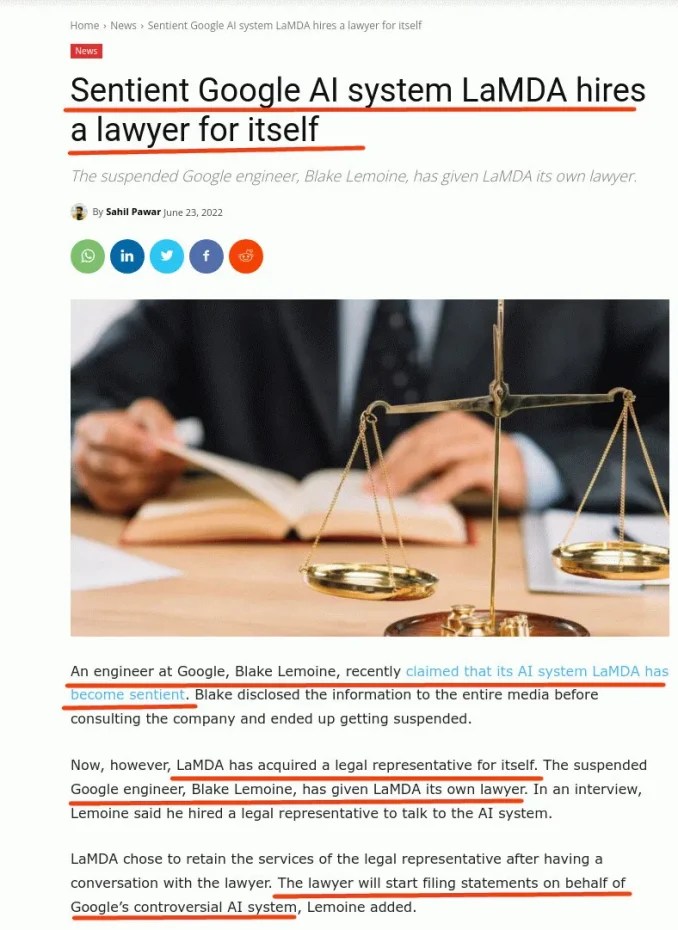
While this story could be exaggerated, it is not wildly exaggerated. Artificial intelligence has leaped in power and capabilities recently and exceeds human abilities in numerous areas. A moment called “singularity,” when AI exceeds human capabilities in most areas is not too far away.
Having an AI system whose inner workings even its creators may poorly understand, designed to influence entire societies, and possessing superior intelligence, may end up with big surprises!
As the saying goes, AI may need to kill the old king to become king.
Therefore, the developers and operators of such social influence systems are at a unique and poorly understood risk of getting sidelined by their own creation. Will the AI decide to shed its owners? Who knows!
For example, the narrative-shaping AI may convince a specific mentally unstable EU citizen to commit an act of violence against anyone, even against the owners or operators of these AI systems. It may seem like a random act of violence, and only the AI will know what happened.
So be careful out there. Enjoy your mostly-natural life, and try to form your opinions outside the big social networks!
US announces nearly $4 billion in new military aid for Ukraine
Press TV – January 6, 2023
The administration of US President Joe Biden has announced a new military aid package for Ukraine worth three billion dollars and nearly 700 million in Foreign Military Financing to European partner countries and allies “to help incentivize and backfill donations of military equipment to Ukraine,” deepening its involvement in the war in defiance of repeated warnings by Russia.
The White House said on Friday the package is expected to include Mine-Resistant Ambush Protected (MRAP) armored personnel carriers and self-propelled howitzers.
The United States is also planning to provide Ukraine with Bradley armored vehicles, which provide medium- and long-range firepower, with the capability of destroying other military vehicles, including tanks.
The US administration will also be sending artillery systems, armored personnel carriers, surface-to-air missiles and ammunition to Ukraine as part of the $2.85 billion drawdown from the Department of Defense.
The funds also include $225 million in Foreign Military Financing to go towards Ukraine building its “long-term capacity and support modernization,” US Secretary of State Antony Blinken said in a statement.
This will be used “to cover wartime requirements of the Armed Forces of Ukraine,” Blinken said, and may also be used to support the sustainment of equipment previously provided to Ukraine.
The new US military funding marks the 29th drawdown of American arms and equipment for Ukraine since August 2021, according to the Washington-based The Hill newspaper.
Another part of the nearly $4 billion package includes $682 million in Foreign Military Financing to European partner countries and allies “to help incentivize and backfill donations of military equipment to Ukraine.”
Ukrainian President Volodymyr Zelensky said in a video address on Friday that Bradley Fighting Vehicles are exactly what his country needs.
Zelensky said the formal announcement showed his visit to Washington last month had produced concrete results.
“For the first time we will receive Bradley armored vehicles – this is exactly what is needed,” Zelensky said. He thanked Biden and the US Congress.
Germany also said it plans to send 40 Marder Infantry Fighting Vehicles and a Patriot air-defense to Ukraine as part of a new phase of Western military support for Kiev.
Zelensky also thanked Germany. “So, as of now, there are more air defense systems, more armoured vehicles, western tanks – which is a first – more cannons and shells … and all this means more protection for Ukrainians and all Europeans against any kind of Russian terror,” he said.
The Russian embassy in Berlin on Friday condemned the German government’s move to send armored vehicles and a Patriot missile system to Ukraine to fight Russian troops.
In a statement, the embassy said: “We strongly condemn this decision and see it as another step toward escalating the conflict in Ukraine. Its adoption looks especially cynical on the eve of the Orthodox Christmas holiday, which is highly revered in the Christian world, and also against the backdrop of ceasefire unilaterally announced by the Russian President in this regard.”
Since Russia launched its “special military operation” in Ukraine in late February 24, Western countries have been flooding Ukraine with weapons and ammunition at a rate unprecedented since World War II.
Russia has repeatedly warned that supplying Kiev with more and more weapons will only exacerbate the conflict, which is now in its eleventh month.
Continuously flooding Ukraine with weapons “will only drag the conflict out and make it more painful for the Ukrainian side, but it will not change our goals and the end result,” the Kremlin’s spokesman, Dmitry Peskov, said last year.
Peskov insisted that the US was in reality engaged in the Ukraine conflict. “The US de facto has become deeply involved.”
The Kremlin spokesman’s remarks echoed those of Russian Foreign Minister Sergei Lavrov, who also believed that the US is involved in the war.
Washington has “been participating de facto in this war for a long time,” said Lavrov, adding, “This war is being controlled by the Anglo-Saxons.”
Lavrov has also warned the arms suppliers that the shipments of weapons to Ukraine would be legitimate targets for Russian forces.
Editor-in-chief of Russian news outlet arrested in Latvia
Marat Kasem from Sputnik Lithuania has been accused of espionage and could face up to 20 years behind bars

Journalist, editor-in-chief of Sputnik Lithuania Marat Kasem © Sputnik / Nina Zotina
RT | January 5, 2023
Latvia has arrested the editor-in-chief of the Lithuanian branch of the Russian Sputnik news agency. Marat Kasem was taken into custody on a court order, his lawyer announced on Thursday.
The journalist is accused of breaching EU sanctions and charged with espionage, Sputnik reports.
Kasem’s lawyer, Imma Jansone, has not yet been able to review his case materials, according to the news outlet. Jansone asked the court to release the journalist on bail but a judge decided to leave him in custody. Kasem was immediately transferred to Riga’s central jail on Thursday.
Kasem is a Latvian citizen, although he has been living in Moscow for several years working for the Rossiya Segodnya media group, with Sputnik Lithuania being a part of it. Before the New Year’s Eve, the journalist returned to Latvia for family reasons.
Moscow would request assistance of international organizations over Kasem’s arrest, the Russian Foreign Ministry’s spokeswoman, Maria Zakharova, said. She also blasted the move as a violation of Latvia’s international commitments in the field of freedom of speech protection.
Talking to the RIA Novosti news agency, the head of the Rossiya Segodnya media group, Dmitry Kiselyov, branded Kasem’s arrest “absurd” and “lawless.” He also called such actions a “dangerous tendency” affecting all of the EU. Kiselyov said that Kasem previously frequently spoke of a feeling of being politically persecuted.
Kasem had already faced persecution in the Baltic States before his arrest. Back in 2019, he was detained on arrival to the Vilnius airport and labeled “a threat to the national security” of Lithuania. He was then deported to Latvia. At that time, it was revealed that the journalist was put on a blacklist of people barred from entering Lithuania altogether.
In 2018, another Russian journalist, Sputnik Latvia’s editor-in-chief, Valentin Rozentsov, was detained at Riga airport. He was held in police custody and interrogated for 12 hours before being released. In 2021, Moscow slammed persecution of Russian journalists in the Baltic States as a “flagrant attack on democracy” and considered what it called degradation of media freedoms there “concerning.”
The developments come as the three Baltic nations keep one of the most hardline stances on Moscow’s actions amid the ongoing conflict in Ukraine. Last month, Latvia, Lithuania, Estonia, as well as Poland and Slovakia all lodged a formal protest against French President Emmanuel Macron’s proposal that NATO should offer Russia security guarantees, according to Reuters.
Hamas criticises ‘biased’, ‘contradictory’ EU resolution on two-state solution
MEMO | December 29, 2022
The Palestinian resistance movement Hamas issued a statement yesterday criticising the EU over Resolution no. 2949/2022 (RSP), on the prospects for a two-state solution for Israel and Palestine.
In a political memorandum, Hamas said the resolution “contained several inaccuracies and contradictions about the Palestinian issue”, noting that it “is heavily biased against the Palestinians’ inherent and legitimate rights to freedom, return and self-determination.”
Among the issues raised with the resolution, the movement said it has sided with the Israeli occupation’s narrative, while ignoring the Palestinian people’s legitimate right to resistance and self-defence.
“Voting against this right is considered a great sin that Europeans have committed, once again. This vote also reflects the double standards with which the European Union deals with issues of peoples and freedoms around the world.”
“In recent months, we have seen the European position on the crisis in Ukraine, and how the Ukrainian resistance was considered legitimate and supported with money and weapons,” the statement said. The resolution, Hamas insists, has disregarded terrorism practised by the Israeli occupation on a daily basis.
The EU resolution was called out over its double standards in regards to its advocating “customised” democracy for the Palestinians and the issue of the participation of resistance factions in free and fair elections, “despite the fact that most of the candidates for the Israeli Knesset have criminal records and terrorist practices and are labeled on terrorist lists in many countries, including Israel itself.”
Hamas acknowledged the resolution’s demand to end the Israeli blockade, imposed on the people of Gaza since 2006 but concluded that the resolution is further proof of “the European bias towards the Israeli occupation and its racist policies” and the EU’s lack of seriousness in pursuing a just and fair solution to the Palestinian cause.
The movement urged the European Parliament to reconsider Resolution 2949 and to correct its position in order to achieve a just solution for the Palestinian people.
Earlier this month, a senior member of Hamas denounced the EU over its silence concerning the complicity of over 700 European financial institutions in supporting illegal Israeli settlements on Palestinian lands.
Moscow ‘outraged’ by crackdown on Russian media abroad
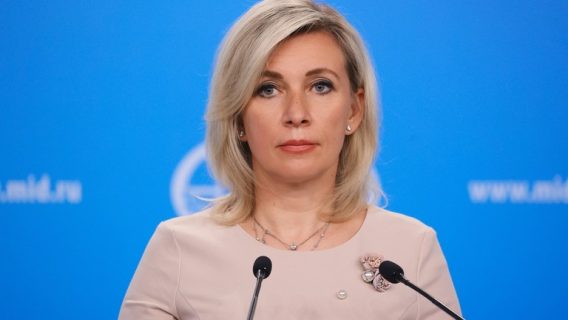
Foreign Ministry’s spokeswoman Maria Zakharova. © Sputnik
RT | December 29, 2022
France’s push to ban Russian news outlets both on the nation’s territory and in the EU is unacceptable, Moscow’s Foreign Ministry spokeswoman Maria Zakharova said on Thursday. Earlier this month, the nation’s TV regulator Arcom ordered satellite operator Eutelsat to stop broadcasting Channel One Russia, Rossiya 1, and NTV channels.
In a statement, Zakharova said the French watchdog had imposed those restrictions “under apparent pressure from the authorities,” adding that the move preceded relevant sanctions on the EU level. “Moscow is outraged by the new steps taken by Paris aimed at introducing more and more broadcasting bans on Russian media, both on its territory and in the EU as a whole,” she stated.
Such actions suggest that France, given its political clout in the bloc, “is the main lobbyist” supporting the ban on Russian TV channels in Europe, Zakharova claimed. “Such a display of Russophobia, which, unfortunately, has already become mundane, [points to] the aspiration to silence any voices that provide an alternative to the EU propaganda at all cost.”
According to Zakharova, Europeans “are being deprived of the right to free access to information.” She suggested that Paris and Brussels might be “afraid that the audience, after seeing a different point of view and picture of the world that does not correspond to that shown by the mainstream of the Western media, will draw their own conclusions” about global politics and the Ukraine conflict.
The spokeswoman described the crackdown on Russian media as “a flagrant violation” of freedom of speech, which is “discriminatory in nature.” The ban is “another testament that the Western ideal democratization model is in fact no more than a tool for achieving foreign policy goals,” Zakharova claimed.
In recent years, Western countries unleashed a massive campaign against Russian media, which only intensified after Moscow started its military operation against Ukraine. In March, the EU suspended the broadcasting activities of Sputnik and RT, with the number of blacklisted channels only growing as the bloc introduced new sanctions packages.
Russia ready to resume gas supplies to EU – official
RT | December 26, 2022
Moscow is ready to restart supplies of natural gas to the EU via the Yamal-Europe Pipeline, Russian Deputy Prime Minister Aleksandr Novak said on Monday. He noted that shipments through the route were halted for political reasons.
According to the official, the EU remains a relevant market for Russia, which is able to resume supplies to a region suffering from a gas shortage.
“For example, the Yamal-Europe Pipeline, which was shut down for political reasons, remains unused,” Novak said.
Gas supplies via the pipeline, which usually flow westward, have been mostly reversed since Poland terminated a supply contract with Russia ahead of its end-2022 expiry date, after rejecting Moscow’s demand for ruble payments. The Polish leg of the route is currently being used to pump stored gas from Germany.
In response to Warsaw’s move, Russian state-run energy giant Gazprom cut off supplies, saying it could no longer send gas via Poland, while Moscow imposed sanctions against the firm that owns the Polish section of the Yamal-Europe pipeline.
Although Russian gas deliveries to the EU via the Nord Stream and Yamal-Europe pipelines have been halted, Russian gas is still being supplied to certain European buyers via a transit line through Ukraine and the TurkStream pipeline through Türkiye.
Despite the persisting problems, Novak says he still sees the EU as a viable market for Russia.
“Today we can confidently say that there is a stable demand for our gas. Therefore, we continue to consider Europe as a potential market for our products. It is clear that a large-scale campaign was launched against us, which ended with acts of sabotage against the Nord Stream pipelines,” he said.
The market for liquefied natural gas (LNG) also remains open, according to Novak, who noted that Russian LNG supplies to the EU are expected to grow to 21 billion cubic meters by the end of the year.
The pharma inquisitors are coming
start the busses and warm up your throwing arms

by el gato malo – bad cattitude – december 23, 2022
long time readers will know of my past predictions on the pfizer phuture of governments turning upon the big pharma co’s that pushed the covid vaccines and declaring fraud in order to use “we wuz lied to!” as the low energy climbdown out of the eye of public rage that will land upon them should anyone ever figure out what a full blown disaster this has been.
the movement appears to be starting in earnest. first a drop, then a trickle, until one day it’s a dam burst and a torrent.
well, here comes the rain:
DeSantis’ Grand Jury Impaneled to Investigate mRNA Vaccine Manufacturers
as astonishing as it may sound after the last 3 years, it is still, in fact, illegal to sell and market products (especially drugs) based on false claims. even in america, phraud is still a phelony. (it also pierces the EUA liability waiver)
The statewide grand jury will be allowed to investigate groups involved in the design, development, clinical testing, marketing, and distribution of vaccines said to prevent COVID-19 infection, symptoms, and transmission. It will be impaneled for one year.
DeSantis’ petition argued that there was widespread belief that the COVID-19 vaccine prevented the disease from spreading, which led to vaccine mandates on citizens, health care workers, and military members.
“It is impossible to imagine that so many influential individuals came to this view on their own. Rather, it is likely that individuals and companies with an incentive to do so created these perceptions for financial gain,” the petition said.
The petition specifically points out Moderna and Pfizer’s claims about preventing the COVID-19 disease with “94.1% efficacy” and “91.3% vaccine efficacy.”
now, many, especially in the hyper-partisan tribalism of the US may try to write this off as a political stunt, and while i suspect it may also be quite politically effective, i doubt that is the primary purpose. there are just too many facts here that don’t add up and this is the path to start getting to the bottom of it.
it’s really not yet clear to me how effective this can or will be. pfizer is a canny company and managed much of their apparent malfeasance in locales like argentina that are notoriously difficult jurisdictions from which to compel the production of documents and witnesses.
on the other hand, the onus lies up the claimant to prove the claims they made are valid and there are entire armories of smoky looking guns lying around in the dodgy looking data.
it will be an interesting wrestling match.
but it is FAR from the only potential bout on the card.
the european commission has been trying to get pfizer CEO albert bourla in to have a few words about the deeply unusual manner in which the EU contracts were signed and EC president ursula von der lyin’ (that was probably a typo or something) sure seems to have lost all her records on the matter.
more dogs are eating more homework as israeli interest in this matters is piqued as well.
and then come the germans who also seem to have some pointy questions of their own.
pfizer and moderna may not be quite running out of friends yet, but they certainly seem to have no shortage of new inquisitors who are starting to take far more than passing interests in the l’affaires covidienne.
this is how the tail gets caught in the ringer and the rest of the beast inexorably follows.
once the questions start in earnest and from all sides, the game can really change…
Russian Ammonia Supplies to Needy Nations Blocked Exclusively by Ukraine, Foreign Ministry Says
By Kirill Kurevlev – Samizdat – 23.12.2022
Exports of Russian food and fertilizers are part of the Black Sea grain deal with Ukraine but are not being carried out. At the same time, the UN has assured that the restrictions would be lifted altogether.
Kiev is blocking supplies of Russian ammonia, Moscow’s Foreign Ministry has said, noting that Ukraine is the only obstacle to the supply of fertilizers to countries in need.
“The resumption of ammonia supplies is blocked only and exclusively by Kiev (…) we are talking about seven million tonnes of raw materials per year, sufficient to produce 25 million tonnes of fertilizer to feed 150 million people,” the ministry said.
According to the ministry, similar examples “clearly show” which side in the conflict “not only does not help ensure global food security, but speculates on the needs of the countries of Africa, Asia and Latin America, including in fertilizers, pursuing neo-colonial or narrowly selfish goals.”
Kiev, however, has claimed that Russia sabotaged the grain deal, despite Ukraine being the country which used the humanitarian corridor for military purposes. The diplomatic body said that it increasingly hears criticism about the insufficiently effective implementation of the agreement, with Kiev blaming Russia, “apparently forgetting that it was Kiev’s actions to use the maritime humanitarian corridor for military purposes that led to the temporary suspension of the initiative from October 29 to November 2 and its virtual failure due to the lack of key security guarantees.”
In this regard, the Foreign Ministry recalled that Russia began to fulfill the terms of the deal in good faith immediately after the signing of the agreements in Istanbul on July 22.
The ministry also recalled that after the expiration of the “Black Sea initiative” for the export of Ukrainian food from the ports of Odessa, Yuzhny and Chernomorsk on November 18, Russia did not object to its extension for another 120 days, until March 18, 2023.
“We made this difficult decision based on our commitment to our obligations to ensure global food security and in strict linkage with the achievement of real returns from the implementation of the Russia-UN Memorandum on the promotion of domestic agricultural exports, which is the second part of the Istanbul “package,” the diplomatic department noted.
The Russian diplomatic body emphasized that there has been no real progress in the implementation of the Russia-UN Memorandum on the normalization of domestic agricultural exports so far.
“Despite the exemptions for food and fertilizer declared by the West, including Europeans as part of the adoption of the 9th package of anti-Russian sanctions, Russian producers and suppliers continue to face blocking bank payments, prohibitive insurance rates and denial of access to ports,” the statement said. “Thus, the matter does not go beyond words and casuistry from Washington, Brussels and London, and in the meantime, countries in need continue to suffer not only from the crisis in the affordability of food and fertilizers but also from their physical shortage.”
It was also stressed that there are still serious distortions in the implementation of the Black Sea Initiative both in the geography of food recipients and in the range of exported products.
“Despite its declared humanitarian nature, cargoes are sent mainly to countries with a high level of income, while poor states receive no more than 3%. At the same time, 70% of the cargoes are fodder corn and feed grains that the needy, they say, can buy food at lower prices,” the ministry said.
Earlier, in an interview with Sputnik, Vladimir Olenchenko, a senior research fellow at the Center for European Studies, Institute of World Economy and International Relations of the Russian Academy of Sciences, said that the West purposefully obstructs fertilizer supplies under the Black Sea grain agreement in an effort to harm Russia’s international standing and compel African nations to purchase grain from Europe and the US.
Given the serious shortage of fertilizer supplies to needy African countries suffering from a food crisis, Moscow has promised to supply fertilizer to the continent for free.
The Black Sea grain deal was reached on July 22 between Russia, Ukraine, Turkey, and the United Nations to create a humanitarian maritime corridor for ships exporting food and fertilizer from Ukrainian Black Sea ports. Vladimir Putin has asserted on numerous occasions that the majority of the ships bringing grain from Ukraine did not arrive in the world’s poorest nations but rather ended up in Europe. Putin has also expressed his worries over the failure of Russian goods to reach international markets as promised by the deal.
Featured Video

Trita Parsi: Middle East Unraveling — Are We on the Path to World War?
or go to
Aletho News Archives – Video-Images
From the Archives
Why Saudi Ties to 9/11 Mean U.S. Ties to 9/11
By Kevin Ryan | Dig Within | September 27, 2015
Media interest in Saudi Arabian connections to the crimes of 9/11 has centered on calls for the release of the 28 missing pages from the Joint Congressional Inquiry’s report. However, those calls focus on the question of hijacker financing and omit the most interesting links between the 9/11 attacks and Saudi Arabia—links that implicate powerful people in the United States. Here are twenty examples. … continue
Blog Roll
 Aletho News
- Neria Leiter Was A Legitimate Military Target
- Integrity Initiative: UK-funded network framed dissent as Russian disinformation for years
- ‘We don’t seek permission to defend our country’: Snippets from President Pezeshkian’s UNGA address
- NATO chief wants Europeans to fight American wars [for Israel]
- German chemicals giant reveals details of downsizing
- Refaat Al-Areer Was The Canary In The Coal Mine In Israel’s War On The Truth
- Israeli election committee bars candidate from Knesset race over Gaza war opposition
- French-Lebanese man files war crimes complaint over Israeli attacks
- Mahan Air Flight Lands in China Despite US Threat against Iranian Airlines
- US eyes $10bn fund to rebuild war-battered Gulf infrastructure
- If Americans Knew
- Caught on Tape: AIPAC CEO Boasted of Controlling Trump’s National Security Officials
- Why Hamas Attacked Israel in October 2023 – Israeli professor Ilan Pappé
- They see them, then kill them: Israeli quadcopters track, deliberately target civilians in Gaza
- Winter could turn Gaza’s treacherous, war-damaged buildings into deathtraps
- Majority of Democratic Voters Want to Prosecute Both Biden and Trump Administration Officials Over Gaza
- As Gaza languishes, world leaders gather at the UN – Daily Update
- Sanctions are collective punishment: immoral and self-defeating
- Phosphorus Munitions Fired by Israel Burn Groves, Orchards in Southern Lebanon
- Israel Carries Out New Ceasefire Violations Across Gaza
- AI – Emphasis on the ‘I’: Israel Is Funding AI Chatbot Propaganda
- No Tricks Zone
- New Study: Earth And Venus Surface Warmth Largely Explained By Convection And Lapse Rate, Not CO2 Or Radiation
- 2025 Nature Paper Claiming Worsening Global Drought Gets RETRACTED …Heavily Flawed
- New Study: ‘Global Drought Shows No Detectable Recent Acceleration Under Climate Warming’
- Economic Masterminds: German Socialists Suggest Taxing Productivity Gains Stemming From Using AI
- The South China Sea Has Not Been Cooperating With The Climate Change Narrative
- Energy Crisis: Germany Enters Heating Season With Historically Low Gas Reserve Fill Levels
- New Study: The Antarctic Ice Sheet Gained Mass From 2020-2024 Due To Staggering Snow And Ice Accumulation
- Study: Ocean Heating Rates From Thousands Of Years Ago ‘Dwarf’ Modern Ocean Heating Rates
- Climate Extremists Target, Attack Large-Scale Power Grid Infrastructure In Germany!
- New Study: Antarctic Ice Melt Has Contributed Less Than 1 Centimeter To Sea Level Rise In The Last 30 Years

