Hungary wants European Parliament dissolved
RT | December 22, 2022
The recent corruption scandal in the European Parliament (EP) is a sign that the EU institution should be abolished in its current form, Hungarian Prime Minister Viktor Orban said on Wednesday. He added that the EP already had an abysmal reputation.
Orban’s remarks came after Eva Kaili, a Greek politician who served as one of the European Parliament’s vice presidents, was arrested and charged this month with corruption for receiving bribes from Qatar.
“The Hungarians would like for the European Parliament to be dissolved in its current form,” he said at a press conference in Budapest.
Orban argued that the scandal “draws attention to the fact that national parliaments have a stronger control system in place,” adding that legislators from the parliaments of member states should be delegated to the European Parliament, as opposed to being elected separately.
“And they obviously know our political position: the swamp must be drained,” the prime minister said.
Budapest has repeatedly clashed with the European Parliament and other EU institutions over a number of issues, including migration and LGBTQ rights. Brussels, in turn, accused Orban’s conservative government of eroding the rule of law at home.
Hungary, whose economy heavily depends on Russian energy imports, has also criticized the EU sanctions imposed on Moscow in response to the military operation in Ukraine, which was launched in late February. Unlike many of the bloc’s member states, Orban has refused to send weapons to Kiev.
“If it were up to us, there would not be a sanctions policy,” Orban said on Wednesday. “It is not in our interest to permanently divide the European and Russian economies into two, so we are trying to save what can be saved from our economic cooperation with the Russians.”
U.S. Sanctions Are Killing Syrians and Are a Human Rights Violation
By Steven Sahiounie | Strategic Culture Foundation | December 22, 2022
Damascus is now bitterly cold and is soon to be blanketed with snow. About 12 million Syrians are facing a deadly winter without heating fuel, gasoline for transportation, and dark houses each evening without electricity. Aleppo, Homs, and Hama are also extremely cold all winter.
Imagine being ill and having to walk to the doctor or hospital. The ambulances in Syria will now respond only to the most life-threatening calls because they must conserve gasoline, or face running out entirely. Gasoline on the black market costs Syrians an equivalent of 50 U.S. dollars for a tank of 20-liter fuel.
Sanctions against Syria were imposed by the European Union, the United States, Canada, Australia, Switzerland, the Arab League, as well as other countries beginning in 2011. The sanctions were aimed at overthrowing the Syrian government, by depriving it of its resources. U.S.-sponsored ‘regime change’ has failed but the sanctions were never lifted.
For 12 years the U.S. and EU have been imposing economic sanctions on Syria which have deprived the Syrians of their dignity and human rights.
New UN report asks for lifting sanctions on Syria
UN Special Rapporteur on human rights, Alena Douhan, urged sanctions to be lifted against Syria, warning that they were adding to the suffering of the Syrian people since 2011.
“I am struck by the pervasiveness of the human rights and humanitarian impact of the unilateral coercive measures imposed on Syria and the total economic and financial isolation of a country whose people are struggling to rebuild a life with dignity, following the decade-long war,” Douhan said.
After a 12-day visit to Syria, Douhan said the majority of Syria’s population was currently living below the poverty line, with shortages of food, water, electricity, shelter, cooking and heating fuel, transportation, and healthcare. She spoke of the continuing exodus of educated and skilled Syrians in response to the economic hardship of living at home.
Douhan reported that the majority of infrastructure was destroyed or damaged, and the sanctions imposed on oil, gas, electricity, trade, construction, and engineering have diminished the national income, which has prevented economic recovery and reconstruction.
The sanctions prevent payments from being received from banks, and deliveries from foreign manufacturers. Serious shortages in medicine and medical equipment have plagued hospitals and clinics. The lack of a water treatment system in Aleppo caused a severe Cholera outbreak in late summer, and the system cannot be bought, installed, or maintained under the current U.S. sanctions against Syria.
Douhan said, “I urge the immediate lifting of all unilateral sanctions that severely harm human rights and prevent any efforts for early recovery, rebuilding, and reconstruction.”
U.S. sanctions are not effective
In 1998, Richard Haass wrote, ‘Economic Sanctions: Too Much of a Bad Thing’. He cautioned U.S. foreign policymakers that sanctions alone are ineffective when the aims are large, or the time is short. The overthrow of the Syrian government is a massive aim, and the sanctions did not accomplish that goal.
Haass predicted that sanctions could cause economic distress and migration. In the summer of 2015 about half a million Syrians walked through Europe as economic migrants and were taken in primarily by Germany.
There is a moral imperative to stop using sanctions as a foreign policy tool because innocent people are affected, while the sanctions have failed.
The U.S. steals Syrian oil, and will not allow imported oil to arrive
According to the U.S. government, the sanctions on Syria “prohibits new investments in Syria by U.S. persons, prohibits the exportation or sale of services to Syria by U.S. persons, prohibits the importation of petroleum or petroleum products of Syrian origin, and prohibits U.S. persons from involvement in transactions involving Syrian petroleum or petroleum products.”
There is a waiver that can be requested from the Department of Commerce, to circumvent the sanctions; however, it only applies to sending items to the terrorist-occupied area of Idlib. Hayat Tahrir al-Sham was the Al Qaeda affiliate in Syria and is the only terrorist group now holding territory in Syria.
On October 22, the media Energy World reported the U.S. occupation forces had smuggled 92 tankers and trucks of Syrian oil and wheat stolen from northeastern Syria to U.S. bases in Iraq. The theft is ongoing and continuous.
The U.S. has partnered with the Syrian Democratic Forces (SDF) which is a Kurdish militia that has a political wing following the communist ideology begun by the PKK’s Abdullah Ocalan. President Trump ordered the U.S. military to remain to occupy northeastern Syria and he ordered the U.S. soldiers there to steal the Syrian oil so to prevent the Syrian people in the rest of the country from benefiting from the gasoline and electricity produced from the wells.
The Syrian Oil Ministry said in August that the U.S. forces were stealing 80 percent of Syria’s oil production, causing direct and indirect losses of about 107.1 billion to Syria’s oil and gas industry.
Because the Damascus government is deprived of the oil its wells produce, it is forced to depend on costly imported oil, usually from Iran. The U.S. routinely commandeers Iranian tankers, such as the incident recently when the U.S. Navy took a tanker hostage off the coast of Greece on its way to Syria but was eventually released by Greece.
Gasoline shortage
The government has instituted a three-day weekend for schools and civil offices, as well as suspended sports events to save fuel.
Maurice Haddad, Director of the General Company for Internal Transport in Damascus, told the al-Watan newspaper that the government has set stricter diesel quotas, leading to fewer daily bus services.
Athar-Press news website reported that several bakeries in Damascus have had to shut down because of the lack of fuel.
Fuel is needed to generate electricity in Syria, and the lack of domestic or imported fuel means most homes in Syria have about one hour of electricity at several intervals each day, and the amount is diminishing daily.
Sanction exemptions for Idlib and the Kurds only
The only two areas in Syria which are not under the Damascus administration are Idlib in the northwest and the U.S.-sponsored Kurdish region in the northeast. The U.S. sanctions are exempt from sending items to those two places only. But, those two places represent a small number of Syrians in comparison to the civilians across the country, and the main cities of Damascus, Aleppo, Homs, Hama, and Latakia. The U.S. makes sure the people who are against the Syrian government continue to be rewarded with supplies and reconstruction, while the millions of peaceful civilians are kept in a constant state of suffering and deprivation.
Deutsche Bank: “A Certain Degree of Eco-Dictatorship Will Be Necessary”
BY TOBY YOUNG | THE DAILY SCEPTIC | DECEMBER 20, 2022
Izabella Kaminska, formerly the Editor of the FT’s Alphaville and now the Editor of the Blind Spot, has flagged up an alarming passage in a document published in January 2021 by Deutsche Bank Research entitled ‘What we must do to Rebuild’. Eric Heyman has written the section about the tough choices the EU must face it if’s to meet its goal of achieving ‘climate neutrality’ by 2050 – Net Zero, in other words – and says the following:
The impact of the current climate policy on people’s everyday lives is still quite abstract and acceptable for many households. Climate policy comes in the form of higher taxes and fees on energy, which make heating and mobility more expensive. Some countries have set minimum energy efficiency standards for buildings or similar rules in other areas. However, climate policy does not determine our lives. We take key consumption decisions, for example whether we travel at all, how much we travel and which means of transport we use, whether we live in a large house or a small apartment and how we heat our homes, how many electronic devices we have and how intensely we use them or how much meat and exotic fruit we eat. These decisions tend to be made on the basis of our income, not on climate considerations.
If we really want to achieve climate neutrality, we need to change our behaviour in all these areas of life. This is simply because there are
no adequate cost-effective technologies yet to allow us to maintain our living standards in a carbon-neutral way. That means that carbon prices will have to rise considerably in order to nudge people to change their behaviour. Another (or perhaps supplementary) option is to tighten regulatory law considerably. I know that “eco-dictatorship” is a nasty word. But we may have to ask ourselves the question whether and to what extent we may be willing to accept some kind of eco-dictatorship (in the form of regulatory law) in order to move towards climate neutrality.
When he says we have to “ask ourselves… whether and to what extent we may be willing to accept some kind of eco-dictatorship” I don’t think he has a Net Zero referendum in mind. Rather, by ‘ourselves’ he means the EU’s ruling class. It has to ask itself whether it’s willing to pass laws forcing the EU’s population to modify its behaviour to meet the 2050 ‘climate neutrality’ target, regardless of whether it has a democratic mandate to do so or not.
I suppose we should be grateful that at least Heyman hasn’t tried to sugar coat this. It should be clear what “eco-dictatorship” means, even to those most reluctant to accept that Net Zero zealots have little love for democracy.
Stop Press: Izabella Kaminska has interviewed the neo-Malthusian Turkish-American economist Nourel Roubini for the Blind Spot podcast. In his book Megathreats: The Ten Trends that Imperil Our Future, and How to Survive Them he argues that individual freedoms will have to be sacrificed if we’re to contain another pandemic or avoid a climate catastrophe.
Hungarian Parliament Speaker: West’s Push to Turn Ukraine Into Anti-Russian Bridgehead is a ‘Strategic Mistake’
Samizdat – 21.12.2022
Budapest has stood alone among NATO’s Eastern European flank in rejecting the transfer of weapons to Ukraine via its territory. Prime Minister Viktor Orban has essentially labeled the Ukrainian conflict a Russia-US proxy war, citing the need for peace talks between Russia and the US, rather than Moscow and Kiev, for the conflict to stop.
Hungarian Parliament speaker Laszlo Kover has lashed out against Western governments’ “hypocritical” behavior in Ukraine, and warned that the West’s attempts to pry Kiev out of Russia’s orbit and turn it into an armed base against Russia has proven to be a “strategic mistake.”
“I think the Western world made a strategic mistake when it tried to not only take Ukraine out of Moscow’s sphere of interest, but also turn it into a large military base against Russia,” Kover said in a broad ranging interview with a Hungarian radio station on Tuesday.
Asked whether he sees any prospects for a diplomatic resolution to the crisis, Kover said that if he “wanted to be cynical,” he would point out that Western countries have already found a workaround, by “proclaiming the protection of European values and international law and accusing Russia of all kinds of crimes, with basis or without basis. In the meantime, they have tried to stock up on Russian oil and gas, so their trade volume with Russia actually jumped radically after sanctions were announced.”
The politician, who is a member of Prime Minister Orban’s Fidesz party, accused Hungary’s European allies of engaging in a “hypocritical show” in Ukraine and behaving in a “terribly hypocritical and irrational” way, destroying their own economies, even as the United States “has embarked on the path of an openly protectionist economic policy,” by setting up trade barriers to European automobiles, for example, making American cars 25-30 percent cheaper than their European-made counterparts.
“This is clearly offensive. It violates all kinds of free trade rules and agreements, and of course violates the legitimate interests of European car manufacturers. Now, compared to this [the crisis with Russia, ed.] the leaders of the EU member states and the European Council are watching events with drooling glee, and we haven’t seen even a harsh outburst or verbal reaction, lest they take some kind of countermeasure, some kind of defensive step,” Kover complained.
The parliament speaker suggested that from the “first moment” of the Russia-West proxy conflict in Ukraine, the goal was to try to “destroy Russia economically, politically, in every sense” and to separate Moscow from the European Union, “to create a new Iron Curtain,” no matter the cost to Europe.
“This means in practice that the space of continuous economic and political cooperation based on mutual, fair consideration of interests, which could have been created in a unified Eurasia stretching to Portugal to say, Southeast Asia, seems to be falling apart at this moment, and I think that the damage caused by this conflict will stay with us for the rest of our lives,” Kover said.
Kover stressed that Hungary’s position has been and remains to defend its elementary economic interests by withdrawing from some EU-level sanctions against Russia “to prevent decisions that harm us more than Russia.” The official added that “the whole sanctions regime has hurt Europe much more than Russia, and I think we should fight here in Central Europe so that this scenario, where we become the eastern periphery of a North Atlantic empire, does not come true.”
Kover reiterated that measures were necessary “to try to end this armed conflict as quickly as possible,” even if it takes “years before this can take the form of some kind of peace treaty.” In the meantime, “we should try to create a new Central European or pan-European peace system in which each [country’s] security needs are taken into account by the other side,” the official said.
As for NATO’s role in the Ukraine crisis, Kover urged the Western alliance to stick to preparing to defend the sovereignty and security of alliance members, and not allow the bloc to drift into a hot war with Russia. “It’s very close to it anyway, because while no NATO members are involved in the war de jure… when a country supplies weapons to another that is at war or when a country or political community tries to destabilize the economic life of another country via various sanctions, blockades or the freezing of assets, this can be considered a kind of warfare.”
Relations between Hungary and Ukraine have been strained since the 2014 Euromaidan coup, which brought nationalist forces to power in Kiev which gradually moved to deprive the 150,000-strong community of ethnic Hungarian Ukrainians living in western Ukraine of their rights, including the right to receive an education in their native tongue.
Amid the escalation of the crisis, Hungarian and Ukrainian officials have gotten into a series of vicious verbal spats, with Ukraine’s Foreign Ministry asking Kover to produce a note from a psychiatrist on his mental state after the speaker suggested that Ukrainian President Volodymyr Zelensky was suffering from a “mental problem.”
Ukraine is not our ally – Croatian president
RT | December 20, 2022
Croatian President Zoran Milanovic said on Tuesday that Ukraine “is not an ally” of his country and warned against bringing “war” to the Balkans.
“Ukraine is not an ally. It’s being forcibly made into one. It was cynically granted the status of an EU candidate. That’s what the EU is today: squalor, zero.”
Talking to reporters, he also hit out against Prime Minister Andrej Plenkovic for his proposal to have Ukrainian troops trained in Croatia. Milanovic said such a move would “bring war” to the country.
“You keep pushing moral blackmail,” he addressed Plenkovic, “but you have no morals yourself. Go to Ukraine and fight.”
Speaking of the Croatian military’s preparedness to fight, Milanovic noted it had a shortage of anti-tank rockets, for example. “We have Americans, who will defend us the way they defend the Ukrainians. Great!” he said sarcastically.
The president’s comments come after Croatian lawmakers failed to adopt a motion for the country to join an EU program intended to train some 15,000 Ukrainian military personnel to fight against Russia. Last week, only 97 Croatian MPs out of 151 voted for the proposal, just short of the two-thirds of lawmakers it needed to pass.
Ahead of the vote, Milanovic, who is the commander-in-chief of the Croatian armed forces, warned that joining the program could make Zagreb a target for Russia. Plenkovic, whose cabinet backed the mission, in turn accused the president of harboring “pro-Russian views.”
Former Austrian vice-chancellor launches peace platform
Free West Media | December 20, 2022
The launch of a remarkable peace initiative has been reported from Austria. The initiator of the “Platform for Peace and Neutrality” is the former FPÖ boss Heinz-Christian Strache. On Monday, a highly acclaimed panel discussion took place in Vienna.
Guests included FPÖ veteran Andreas Mölzer, the former Liberal National Councilor Peter Fichtenbauer, AfD member of parliament Christina Baum, former Baden-Württemberg AfD member of parliament Heinrich Fiechtner and non-aligned Efgani Dönmez.
The motive for the event and the founding of his platform was that there were “no loud and audible peace initiatives,” explained Strache, who moderated the discussion. Russia is not being invited to the negotiating table, he added, blaming Western nations for not taking the initiative.
Former MEP Mölzer stated: “Nothing positive is being brought to the table from the European side at the moment.”
The panellists also agreed that Russia was being portrayed too negatively in the Western media. However, the causes of the war are much more complex, stated Mölzer. He added: “Not everyone who is critical [of the war], is a Putin supporter.”
For the AfD member of parliament Christina Baum, who had already spoken out in the Bundestag against Sweden and Finland joining NATO, Russia or Kremlin chief Putin was not responsible for the war in Ukraine. “The aggressor is the one who forces his opponent to take up arms,” she quoted Frederick the Great as saying. Even before the war, she thought, “I hope Putin won’t lose his nerve,” because he was “permanently provoked”.
The former Greens and ÖVP member Dönmez, a representative from the camp of the mainstream parties also participated in the round of talks.
Dönmez pleaded for restraint and understanding towards Russia: “We are presented with a narrative, a story that we have to accept without thinking. As a mediator, I say: I would also like to understand Mr. Putin.” This also applies in the case of the Ukrainian President Vladimir Zelensky and the Turkish President Erdogan. Instead, the West is deliberately escalating tensions.
The war is a proxy war of the great powers, said Dönmez. The EU only acts as a “vassal state” of the USA. Putin did them a favor with the war: the EU has now moved closer to the USA and has distanced itself from Russia, while the EU should actually pursue an independent peace policy, explained Dönmez.
Asked by moderator Strache whether Ukraine was the epitome of “Western values”, ex-AfD member of parliament Heinrich Fiechtner replied: “Unfortunately yes, it is – in all its corrupt amalgamation.”
The roundtable convened in Vienna also agreed that Austria’s neutrality should be upheld, which has been increasingly undermined since the beginning of the war. “I think joining NATO is the last thing the Austrians want,” Strache said. AfD MP Baum agreed and expressed the opinion that “it is very important that Austria remains neutral”. She wished the same for Germany, but chances are slim that Atlanticist politicians will abandon their course.
New enemies
While a year ago the unvaccinated and those who refused to wear masks were marginalized in society, today friends of Russia or critics of the war are the new enemy to be denunciated and discriminated against.
The deputy leader of the Union parliamentary group in the Bundestag Andrea Lindholz (CSU) has demanded a “reporting office” and a “nationwide situation report” on alleged Russian disinformation.
“The danger of Russian propaganda and disinformation in Germany must not be underestimated,” Lindholz is quoted as saying. “Especially now that everything is getting more expensive, there is a risk that people will become more receptive to pro-Russian fake news,” the CSU politician told the Redaktionsnetzwerk Deutschland.
Of course, it is particularly insidious when more and more alleged “fake news” turn out to be true as is currently being experienced with the Corona pandemic.
Qatar warns EU of consequences amid graft probe
RT | December 19, 2022
The European Parliament’s decision to suspend Qatar-linked legislation and deny the country’s officials access to the legislature could negatively affect gas supplies to EU member states, Doha has announced. The bloc’s move comes amid a Belgian probe into alleged graft by MEPs that may have involved Qatar.
The parliament’s decision is “discriminatory,” according to a statement by a diplomat with the Qatari mission to the EU on Sunday, as quoted by news agencies. It will “negatively affect regional and global security cooperation, as well as ongoing discussions around global energy poverty and security,” the diplomat added.
He stressed Qatar’s cooperation with the EU, particularly Belgium, on issues related to Covid-19 and its role as a key supplier of liquified natural gas to the country, expressing disappointment that Brussels is making “no effort to engage with our government to establish the facts once they became aware of the allegations.”
Qatari liquified natural gas plays a key role in the EU’s strategy to compensate for the loss of Russian fossils fuels, which it decided to stop purchasing over the conflict in Ukraine.
In November, Germany secured a 15-year deal for around 2 million tons annually. Berlin is leading a pan-EU effort to secure better terms from Doha, which is pressuring the bloc into signing long-term contracts that prohibit resale to other parts of the world, which would undermine the EU’s goal of phasing out fossil fuels, according to Bloomberg.
Last week, MEPs voted to suspend all work linked to Qatar and cut off “representatives of Qatari interests” from access to the legislature. The decision affects an EU-Qatar aviation agreement and an EU visa waiver for Qatari and Kuwaiti nationals. MEPs denounced “Qatar’s alleged attempts” to buy influence in the EU.
Belgian law enforcement announced earlier this month that it had charged four individuals linked to the European Parliament in an alleged corruption case. They are suspected of being influenced by lavish presents and cash originating from a foreign government.
The local press identified the unnamed Gulf nation as Qatar, which denied any involvement. The European Parliament’s now-former vice president, Eva Kaili, who was among those charged, was stripped of her senior EU office over the probe last week.
Croatian MPs reject EU training mission for Ukraine
RT | December 18, 2022
Croatian lawmakers have failed to pass a motion for the Balkan country to join an EU program to train Ukrainian military personnel to fight against Russia.
During a vote on Friday in the national parliament, the Sabor, 97 MPs out of 151 supported the idea of training some 100 Ukrainian troops. The proposal required the backing of two thirds of lawmakers, and fell short by several votes.
Before the session, opponents of the European Union Military Assistance Mission argued that it could make Croatia a “target” for Russia.
The program, which the bloc considers its “widest” military mission to date, is expected to prepare 15,000 Ukrainian servicemen on the territory of some 20 member states. It will cost European taxpayers around €100 million (around $106 million). EU foreign policy chief Josep Borrell said in early December that 1,100 Kiev troops had already begun their training in various camps.
However, in Croatia, which is a member of both the EU and NATO, the program led to a major rift in the leadership.
President Zoran Milanovic, who is commander-in-chief of the Croatian armed forces, has strongly resisted involvement in the scheme. He argued that such a move “would mean bringing the war into Croatia.”
This led Prime Minister Andrej Plenkovic, whose cabinet backed the mission, to accuse Milanovic of harboring “pro-Russian views.” The government put the issue before parliament in an attempt to break the deadlock.
Soaring energy prices cost EU $1 trillion – Bloomberg
RT | December 18, 2022
EU member states have spent roughly a trillion dollars (€940 billion) in the face of the bloc’s worst energy crisis in decades, Bloomberg is reporting on Sunday, citing calculations based on market data.
Soaring energy prices have sent its economies plunging into recession as most member states opted to stop importing gas from Russia, facing the necessity to turn to more expensive supplies.
The agency highlighted that the total estimated losses marks just the beginning of a full-scale crisis, as a period of high prices for energy could last years, while aid is already becoming unaffordable.
The security of energy supply is expected to remain an issue beyond next winter after the filled gas storage facilities across the region are emptied. The nations of the EU will have to refill their gas reserves for the next cold season with no deliveries from Russia, which also heats up competition for tankers.
Even with more import terminals for liquefied natural gas (LNG) coming online, the crisis will reportedly loosen its grip only in 2026, when additional production capacity from the US or Qatar becomes available. At the same time, prices should remain high to attract LNG away from other buyers from energy-hungry Asian buyers.
A state of emergency could linger for years, according to Brussels-based think tank Bruegel, as quoted by Bloomberg.
“Once you add everything up –bailouts, subsidies– it is a ridiculously large amount of money,” Martin Devenish, a director at consultancy S-RM, told the agency. “It’s going to be a lot harder for governments to manage this crisis next year.”
A rush to fill storage during summer, despite all-time high prices, has softened the supply squeeze so far. However, freezing weather is expected to give the region’s energy system the real test this winter.
Last month, Germany’s energy regulator, the Federal Network Agency, warned that German households and small businesses have failed their first gas-saving tests. The regulator noted that a reduction in consumption of at least 20% was required to avoid a gas shortage in the coming months.
If Being Frozen To Death Doesn’t Work, Being Starved To Death Comes Next
By Patrick Clarke | December 14, 2022
First we were placed under virtual house arrest. Now we are being frozen by soaring fuel bills and energy supply shortages in those same homes. Coming next, we are to be starved. All in pursuit of one of the Net Zero cults: Covid or carbon emissions. Too bleak a picture? We have only to look across the North Sea to one of our nearest neighbours, the Netherlands.
Surprisingly for such a small country (it is only about twice the size of Wales), the Netherlands is the second largest food exporter in the world, second only to the United States. It is Europe’s largest meat exporter. Four million cows, 13 million pigs and 104 million chickens are reared annually. It provides vegetables to many of its Western European neighbours.
One would assume this success story would be widely cherished, especially in an era of increasing food insecurity and shortages, with other key sources such as Ukraine under serious threat due to the continuing conflict there.
Remarkably, and many would say sinisterly, the polar opposite is the case. The supposed crime of the Dutch farmers? They have fallen foul of the ‘Zero Carbon’ fixation of the Climate Change Cultists who control so much of the current political and economic agenda.
One of that agenda’s chief targets is agriculture, particularly the use of nitrogen. The Dutch are at the top of the tree for nitrogen use per hectare of cultivated land, at nearly twice the European average.
The European Commission has given strict guidelines to EU member states to reduce their use of nitrogen. To comply with this the Dutch Government introduced laws to enforce a reduction of 50 per cent in nitrogen emissions by 2030. Such draconian targets can only come with draconian enforcement measures.
Dutch farming is being strangled through an assortment of regulations, including new flood prevention regulations, bizarrely given the success of the Dutch in preventing flooding over the centuries despite the fact that large parts of the country are below sea level, having been reclaimed from the sea.
Perhaps worst of all, one of the Government’s new laws bans the children of farmers from inheriting the farm when their parents retire or die. Once a farmer stops farming, their entire family becomes banned from farming in the Netherlands again. A whole way of life plus decades, sometimes even centuries, of experience is being gratuitously thrown away.
Where regulation fails, mandatory purchasing of land by the state is feared to be the next step as farmers have so far shown little interest in selling any of their land. Around 300,000 hectares of farmland is earmarked to be converted into nature conservation areas between now and 2040. More than 1,000 farms face forcible closure.
Nor is it just the Dutch Government that the farmers are battling. A panoply of NGOs are on the case too, using the courts to pursue any part of the government at national or provincial level deemed to be faltering in enforcing these objectives.
Those of us in the UK, long weary of seeing how political charities and activist lawyers run rings round attempts to enforce curbs on immigration, will be familiar with the process.
It’s worth pointing out too that, despite Brexit, Northern Ireland still has to implement these same EU directives as part of the Northern Ireland protocol. Thanks for that one, Theresa May, Boris Johnson and Rishi Sunak. So while today it is Dutch farming under siege from its own government, tomorrow it will be farming in Northern Ireland that is compelled to go through the same pain.
Interestingly, no one has yet stepped forward with a credible plan for how these vital lost sources of food are going to be replaced. The Dutch Government hopes that it will come from artificially created meat from laboratories and is investing in this technology, though how it can be sufficiently scaled up remains to be seen. Given what is already widely known about the harmful effects of eating too many processed foods instead of natural foods, such as the triggering of obesity and potential heart disease, it has to be asked whether this is a desirable course, or indeed what the further health implications for users may be.
Some would say the whole agenda is a straight forward grab by bad actors intent on taking control of the world’s food resources, for whom Net Zero objectives provide a convenient camouflage for their own lust for power, control and yet more wealth than they already have. The usual suspects certainly spring to mind.
Others argue that out-of-control digital technocrats are so conditioned to assuming they can control anything, however complex, that they can’t accept that some things remain beyond human control, such as airborne viruses and the climate.
Each failure to learn that simple lesson is leading to ever more intensive efforts to achieve that control, control that must be achieved at all costs. Either way, vicious cycles of more authoritarianism, human misery arising from absurd and seriously harmful measures, plus more setbacks in failing to reach unobtainable goals lie ahead. Unless we can shake off the grip of these technocrats on our societies and the political institutions in thrall to them, the prospect of starving to death will become our grim reality in an increasingly tyrannical world.
Think that couldn’t happen here? Just look at Sri Lanka, though as with the Dutch farmers, most of the media and nearly every politician would prefer you not to!
‘EU And US Hypocrisy’: RT & Parent Company Sanctioned Over Claims of Disinformation
Samizdat – 16.12.2022
The European Union released its ninth round of anti-Russian sanctions earlier Thursday, with the latest batch placing bans on the exports of drone engines, investments within the mining sector and implementing prohibitions on ads and public opinion polling services, among other penalties.
The European Union’s ninth round of sanctions targeted RT and its parent company Ano TV-Novosti, it has been detailed.
The designation has prompted Brussels to seize the funds and assets of those belonging to RT in Europe over its allegations that the non-profit parent firm and RT work to “spread propaganda and disinformation.”
The block further claimed in its announcement that the organization was considered to be “involved in undermining the territorial integrity, sovereignty and independence of Ukraine.”
Also detailed in the Thursday announcement was the suspension of licenses for media outlets NTV/NTV Mir, Rossiya 1, REN TV and Pervyi Kanal.
“These outlets are under the permanent direct or indirect control of the leadership of the Russian Federation and have been used by latter for its continuous and concerted disinformation and war propaganda actions, which legitimise Russia’s aggression and undermine support for Ukraine,” a statement reads, noting that the EU decision was “in line with the Charter of Fundamental Rights.”
George Szamuely, a senior research fellow at the Global Policy Institute, spoke to the development with RT, underscoring that the move was a “great shame” and simply the product of “EU and US hypocrisy.”
“It means that Europeans won’t get to hear the other side of the story,” Szamuely said of the ongoing western narrative being pushed in regards to Russia’s special military operation. “Now is the most imporant time to hear the other side.”
“What they call disinformation is information they don’t like… it’s a perspective that they want to deny to the European public,” he stressed, adding that he did not believe western journalists would condemn the EU move as “they’re much too busy getting indignant about a handful of journalists getting suspended by Twitter.”
As for a tenth sanctions package, a source told Sputnik that no EU member state has made any proposals on the matter, but that a future sanctions batch would likely focus on “closing loopholes of the current sanction packages.”
Featured Video
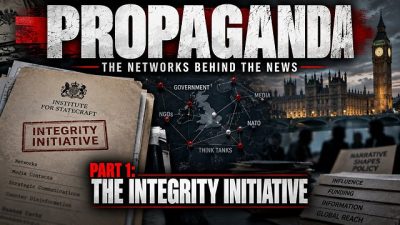
Integrity Initiative: UK-funded network framed dissent as Russian disinformation for years
or go to
Aletho News Archives – Video-Images
From the Archives
Why Saudi Ties to 9/11 Mean U.S. Ties to 9/11
By Kevin Ryan | Dig Within | September 27, 2015
Media interest in Saudi Arabian connections to the crimes of 9/11 has centered on calls for the release of the 28 missing pages from the Joint Congressional Inquiry’s report. However, those calls focus on the question of hijacker financing and omit the most interesting links between the 9/11 attacks and Saudi Arabia—links that implicate powerful people in the United States. Here are twenty examples. … continue
Blog Roll
 Aletho News
- Neria Leiter Was A Legitimate Military Target
- Integrity Initiative: UK-funded network framed dissent as Russian disinformation for years
- ‘We don’t seek permission to defend our country’: Snippets from President Pezeshkian’s UNGA address
- NATO chief wants Europeans to fight American wars [for Israel]
- German chemicals giant reveals details of downsizing
- Refaat Al-Areer Was The Canary In The Coal Mine In Israel’s War On The Truth
- Israeli election committee bars candidate from Knesset race over Gaza war opposition
- French-Lebanese man files war crimes complaint over Israeli attacks
- Mahan Air Flight Lands in China Despite US Threat against Iranian Airlines
- US eyes $10bn fund to rebuild war-battered Gulf infrastructure
- If Americans Knew
- An error has occurred; the feed is probably down. Try again later.
- No Tricks Zone
- New Study: Earth And Venus Surface Warmth Largely Explained By Convection And Lapse Rate, Not CO2 Or Radiation
- 2025 Nature Paper Claiming Worsening Global Drought Gets RETRACTED …Heavily Flawed
- New Study: ‘Global Drought Shows No Detectable Recent Acceleration Under Climate Warming’
- Economic Masterminds: German Socialists Suggest Taxing Productivity Gains Stemming From Using AI
- The South China Sea Has Not Been Cooperating With The Climate Change Narrative
- Energy Crisis: Germany Enters Heating Season With Historically Low Gas Reserve Fill Levels
- New Study: The Antarctic Ice Sheet Gained Mass From 2020-2024 Due To Staggering Snow And Ice Accumulation
- Study: Ocean Heating Rates From Thousands Of Years Ago ‘Dwarf’ Modern Ocean Heating Rates
- Climate Extremists Target, Attack Large-Scale Power Grid Infrastructure In Germany!
- New Study: Antarctic Ice Melt Has Contributed Less Than 1 Centimeter To Sea Level Rise In The Last 30 Years

