A letter provided by Russian insurer, Ingosstrakh, enabled the first oil tanker to sail through Turkish waters in recent days after tougher regulations were imposed by Turkish authorities, a document showed, Reuters reports.
This has led already at least 20 oil tankers backed up in the Turkish Straits as they do not have the right paperwork.
Turkish authorities introduced new requirements, which came into effect on 1 December, in which every ship must have insurance cover in place for all circumstances when sailing through Turkish waters or when calling at ports.
Ingosstrakh provided the requirements for the Liberia flagged “Vladimir Tikhonov” tanker, which included insurance for pollution risks throughout the period in Turkish waters, according to a letter issued to the authorities on 29 November by the insurer and seen by Reuters.
The world’s leading Western ship insurers say they are unable to provide cover for all circumstances, arguing they cannot be liable for payouts if, for instance, there are sanctions breaches with a ship’s cargo.
“Vladimir Tikhonov” completed sailing through the Bosphorus on 3 December, ship tracking data showed.
The EU and G7 price cap on Russian oil went into effect on Monday, but it’s already causing disruptions in global supply chains. The first manifestation comes from Turkey, where the Financial Times reports that a tanker traffic jam is stacking up in Turkish waters and blocking some 18 million barrels of oil from passage, as the country’s authorities demand proof that the vessels have insurance coverage:
“Around 19 crude oil tankers were waiting to cross Turkish waters on Monday, according to ship brokers, oil traders and satellite tracking services. The vessels had dropped anchor near the Bosphorus and Dardanelles, the two straits linking Russia’s Black Sea ports to international markets.”
In a striking demonstration of the price cap’s potential to disrupt markets, most of the oil in the delayed ships isn’t even subject to the sanction regime: It’s from Kazakhstan and has merely transited Russian ports after arriving there via pipeline.
One oil industry insider said Russian shippers have transited with relative ease — it’s shippers covered by western insurers that are anchored and now destined to deliver their cargo late. … Full article
December 6, 2022
Posted by aletho |
Economics, Environmentalism | European Union, Russia, Turkiye |
Leave a comment
© AFP 2022 / BARTEK SADOWSKI
By Ilya Tsukanov – Samizdat – 06.12.2022
In late 2021, Moscow sent Washington and its allies two draft treaties on security guarantees designed to dramatically reduce tensions between Russia and the Western bloc. Weeks later, Kiev massed troops along the contact line in the Donbass and began to intensively shell the region, prompting Russia to kick off a military operation in Ukraine.
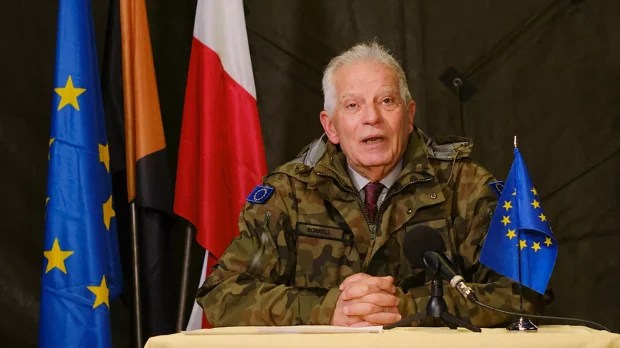
The end of the crisis in Ukraine will be achieved through “security guarantees for Ukraine,” not Russia, European Union foreign affairs chief Josep Borrell has said.
“As for Russia, we’ll talk about that later,” the EEU’s top diplomat told attendees of a symposium in Paris on Monday. “The end of this conflict will have to be done in compliance with international legality,” Borrell added, claiming this would include Moscow being made to pay “reparations” to Kiev, face “war crimes” trials, and withdrawing its forces.
Borrell also said that the crisis in Ukraine has solidified its “place in the EU.”
“It is written. History has decided for us,” he said.
Borrell’s comments appeared to be a direct rebuke to French President Emmanuel Macron, who said Saturday that he and his US counterpart Joe Biden sought to flesh out “the security architecture in which we want to live tomorrow,” and discussed “guarantees of security for Russia” if and when Moscow “returns to the table” for talks.
“One of the essential points is the fear that NATO will be at its door, and the deployment of weapons that can threaten Russia,” Macron said.
The French president received flak from Kiev over his comments, but slapped down Ukrainian officials’ objections. “I think we should not… try to create controversy where there is none,” he said at a summit in Tirana on Tuesday.
Borrell’s latest remarks weren’t the first time the top EU diplomat has called for an aggressive approach in Ukraine. In April, as some Western leaders encouraged Moscow and Kiev to resolve the crisis through negotiations, Borrell instead called for a military solution, saying “this war will be won on the battlefield” and pledging another €500 million in military support to Ukraine. Since then, the EU has sent over €29 billion in aid to Kiev.
Russian officials have repeatedly slammed Borrell for his ‘undiplomatic’ approach. In May, Russian Foreign Minister Sergei Lavrov reminded him that he was the bloc’s “top diplomat, and not the European Union’s military leader.”
Security Guarantees
Next week will mark the one year anniversary of Russia’s delivery of a pair of draft security treaties to the US and NATO designed to dramatically reduce tensions between Moscow and the Western bloc. The documents, released publicly by the Russian Foreign Ministry, proposed legally binding commitments by each side not to deploy troops, equipment, warships, missile systems and aircraft in areas where they may be seen as a threat to the other side, and asked Washington to pledge not to continue NATO’s eastward expansion, including in Ukraine. The document also asked parties to explicitly affirm that they do not consider one another adversaries.
NATO and Washington rejected the proposals in January, and stressed that the bloc’s “open door” policy will not change. Weeks later, the Donbass republics reported an unprecedented escalation in shelling, sabotage and sniper attacks by Ukrainian forces along the line of contact, and began the evacuation of hundreds of thousands of civilians to Russia. The Kremlin expressed concerns that Ukrainian troops were amassing in apparent preparation for an all-out assault on the Donbass, while NATO announced plans for new battle group deployments in the region. On February 24, 2022, citing threats to the Donbass posed by the Kiev regime, Russian President Vladimir Putin announced a special military operation in Ukraine aimed at demilitarizing the country and ‘de-nazifying’ its leadership.
In the nine-and-a-half months since, Moscow has repeatedly expressed readiness to restart talks, with Russia’s core conditions including no NATO membership for Ukraine, security for the Donbass, and recognition of Crimea as Russia. Kiev and its benefactors have rejected these conditions.
December 6, 2022
Posted by aletho |
Militarism | European Union, NATO, Ukraine |
Leave a comment
Something odd is afoot in Europe. Britain recently has been ‘regime washed’, with a strongly pro-EU Finance Minister (Hunt) paving the passage to an election-free premiership by ‘globalist’ Rishi Sunak. Why so? Well, to impose swingeing cuts to public services, to normalise immigration running at 500,000 per annum and to raise taxes to the highest levels since the 1940s. And to open channels about a new relationship deal with Brussels.
A British Tory Party is content to do that? Slash social support and hike taxes into an already existent worldwide recession? On the face of it, it doesn’t seem to make sense. Shades of Greece 2008? Greek austerity for Britain — are we missing something? Is this setting the scene for the Remainer Establishment to point to an economy in crisis (blamed on Brexit failure), and to say there is no alternative (TINA) but a return to the EU in some form, (British ‘cap in hand’, and with head bowed)?
Simply put, forces behind the scenes seem to want the UK to resume its former role as US plenipotentiary inside Brussels — pushing the US primacy agenda (as Europe sinks into self-doubt).
Likewise odd — and significant – was that on 15 September, former German Chancellor Schroeder entered unannounced into Scholtz’s office where only the Chancellor, and Vice-Chancellor, Robert Habeck, were present. Schroeder slapped down a long-term gas supply proposal by Gazprom on the desk, directly under Scholtz’s eyes.
The Chancellor and his predecessor held each other’s gaze for a minute – without a word passing. Then Schroeder reached out, took back the unread document, turned his back and exited the office. Nothing was said.
On 26 September (11 days later), the Nordstream pipeline was sabotaged. Surprise (yes, or no)?
Many unanswered questions. The upshot: No gas for Germany. One Nordstream train (2B) however, survived the sabotage and remains pressurised and functional. Yet still no gas arrives in Germany (other than high price liquified gas). There are presently no EU sanctions on gas from Russia. Landing the Nordstream gas requires only a Regulatory go-ahead.
So then: Europe is to have austerity, loss of competitiveness, price and tax hikes? Yes — yet Scholtz did not even glance at the gas offer.
The Green Party of Habeck and Baerbock (and the EU Commission) is in close alignment with those in the Biden team insisting to maintain US hegemony, at all costs. This Euro-coalition is explicitly and viscerally malefic towards Russia; and in contrast, is as viscerally indulgent towards Ukraine.
The big picture? German Foreign Minister Baerbock in a speech in New York on 2 August 2022 sketched out a vision of a world dominated by the US and Germany. In 1989, George Bush famously had offered Germany a “partnership in leadership”, Baerbock claimed. “Now the moment has come when we have to create it: A joint partnership in leadership”. A German bid for explicit EU primacy, snaring US support. (The Anglos will not like that!)
Ensuring no backsliding on Russia sanctions and continuing EU financial support for the Ukraine war is a clear ‘Red Line’ for precisely those in the Biden team likely to be attentive to Baerbock’s Atlanticist bid — and who understand that Ukraine is the spider at the centre of a web. The Greens explicitly are playing this.
Why? Because Ukraine is still the global ‘pivot’: Geopolitics; geo-economics; commodity and energy supply chains — all revolve around where this Ukraine pivot finally settles. A Russian success in Ukraine would bring a new political bloc and monetary system into being, through its allies in the BRICS+, the Shanghai Cooperation Organization and the Eurasian Economic Union.
Is this European austerity binge then just about the German Green Party nailing down EU Russophobia? Or are Washington and its Atlanticist allies now prepping for something more? Prepping for China to get the ‘Russia treatment’ from Europe?
Earlier this week at Mansion House, PM Sunak changed gear. He ‘hat-tipped’ to Washington with the promise to stand by Ukraine ‘as long as it takes’, yet his primary foreign policy focus was firmly on China. The old ‘golden’ era of Sino-British relations ‘is over’: “The authoritarian regime [of China] poses a systemic challenge to our values and interests”, he said — citing the suppression of anti-zero-COVID protests and the arrest and beating of a BBC journalist on Sunday.
Over in the EU — belatedly panicking over unfolding widespread de-industrialisation — President Macron has been signalling that the EU might take a more hard-line China stance, though only were the US were to back-down on the subsidies in the Inflation Reduction Act, which entice EU companies to up-anchor, and sail off to America.
Yet, Macron’s ‘play’ is likely to meet a dead end, or at best, a cosmetic gesture — for the Act has already been legislated in the US. And the Brussels political class unsurprisingly already is waving the white flag: Europe has lost Russian energy and now stands to lose China’s tech, finance and market. It’s a ‘triple whammy’ — when taken together with European de-industrialisation.
There you have it — austerity is always the first tool in the US toolbox for exerting political pressure on US proxies: Washington is prepping the EU ruling élites to sever from China as fundamentally Europe has already done from Russia. Europe’s largest economies already are taking a harder line on Beijing. Washington will squeeze the UK and EU ‘til the pips squeak to get full compliance on a China cut-off.
The protests in China over Covid regulations could not have arrived at a more serendipitous time from the US’ ‘China hawks’ perspective: Washington whipped the EU into full propaganda mode on Iranian ‘demonstrations’ — and now the China protests offer the opportunity for Washington to go full court on China demonisation:
The ‘line’ used against Russia (Putin makes mistake after mistake; the system bumbles; the Russian economy is precariously perched on a knife edge and popular disaffection is soaring) – will be ‘cut and pasted’ to Xi and China.
Only, the inevitable EU moral lecturing will antagonise China even further: Hopes to keep a trade foothold in China will vanish, and effectively it will be China ‘washing its hands’ of Europe, rather than vice versa. European leaders have this blind spot — quite some Chinese may deplore the Covid lockdown practice, yet still will remain deeply Chinese and nationalist in sentiment. They will hate EU lecturing: ‘European values speak only for themselves — we have our own’.
Obviously, Europe has dug itself into a deep hole. Its adversaries grow bitter at EU moralising. But what exactly is going on?
Well, firstly, the EU is hugely over-invested in its Ukraine narrative. It seems incapable of reading the direction of travel that events in the war zone are taking. Or, if it does read it correctly (of which there is little sign), it appears incapable of being able to affect a course correction.
Recall that the war at the outset was never seen by Washington as likely ‘being decisive’. The military aspect was viewed as an adjunct — a pressure multiplier — to the political crisis in Moscow that sanctions were expected to unleash. The early concept was that financial war represented the front line — and the military conflict, the secondary front of attack.
It was only with the unexpected shock of sanctions not achieving ‘shock and awe’ in Moscow that priority switched from the financial to the military arena. The reason the ‘military’ was not firstly seen as ‘front-line’ was because Russia clearly had the potential for escalatory dominance (a factor which is now so evident).
So, here we are: The West has been humiliated in the financial war, and unless something changes (ie. dramatic escalation by the US) – it will lose militarily too — with the distinct possibility that Ukraine at some point, simply implodes as a state.
The actual situation on the battlefield today is almost completely at odds with the narrative. Yet, so heavily has the EU invested in its Ukraine narrative that it just doubles-down, rather than draw back, to re-assess the true situation.
And so doing — by doubling-down narratively, (standing by Ukraine ‘for as long as it takes’) — the strategic content to the ‘Ukraine’ pivot rotates 180 degrees: Rump ‘Ukraine’ will not be ‘Russia’s Afghan quagmire’. Rather, its’ rump is morphing into Europe’s long-term financial and military ‘quagmire’.
‘As long as it takes’ gives the conflict an indeterminate horizon — yet leaves Russia in control of the timetable. And ‘as long as it takes’ implies ever more exposure to NATO blind spots. The rest-of-world intelligence services will have observed NATO’s air defence and military-industrial lacunae. The pivot will show who is the true ‘paper tiger’.
‘As long as it takes’ — has the EU thought this through?
If Brussels imagines too, that such dogged adherence to narrative will impress the rest-of-the-world and bind these other states closer to the EU ‘ideal’, they will be wrong. Already there is a wide hostility to the notion that Europe’s ‘values’ or squabbles have any wider pertinence, beyond Europe’s borders. ‘Others’ will see the inflexibility as some bizarre compulsion by Europe to self-suicide – at the very moment that the end of ‘everything bubble’ already threatens a major downturn.
Why would Europe double-down on its ‘Ukraine’ project, at the expense of losing its standing abroad?
Perhaps, because the EU political class fears even more losing its domestic narrative. It needs to distract from that — it is a tactic called ‘survival’.
The EU, as with NATO, was always a US political project for the subjugation of Europe. It still is that.
Yet, the meta-EU narrative — for internal EU purposes — posits something diametrically different: that Europe is a strategic player; a political power in its own right; a market colossus, a monopsony with the power to impose its will over whomsoever trades with it.
Simply put, the EU narrative is that it has meaningful political agency. But Washington has just demonstrated it has none. It has trashed that narrative. So, Europe is destined to become an economic backwater. It has ‘lost’ Russia — and soon China. And is finding it has lost its standing in the world, too.
Again, the actual situation on the geo-political ‘battlefield’ is almost completely at odds with the EU narrative of itself as a geo-strategic player.
Its ‘friend’, the Biden Administration, is gone — whilst powerful enemies elsewhere accumulate. The EU political class never had a good grasp of its limitations — it was ‘heresy’ even to suggest there were limitations to EU power. Consequently, the EU has hugely overinvested in this narrative of its agency too.
Hanging EU flags from every official building will not cast a fig leaf over the nakedness, nor hide the disconnect between the Brussels ‘bubble’ and its deprecated European proletariat. French politicians now openly ask what can save Europe from complete vassalage. Good question. What does one do when a hyper-inflated power narrative bursts, at the same time as a financialised one?
December 6, 2022
Posted by aletho |
Economics, Militarism | China, European Union, NATO, Russia, UK, United States |
Leave a comment
By Ahmed Adel | December 6, 2022
The price cap imposed by the West on oil from Russia will actually have negative consequences in the long term as it once again reaffirmed to the international community that Western-centric banking and shipping insurance schemes cannot be trusted as reliable partners.
Western oil sanctions went into effect on December 5, with the European Union stopping all shipments of Russian oil arriving by sea. In addition, the EU, as well as G7 countries and Australia, imposed a limit on the price of oil transported by sea at $60/barrel. The West expects that this will cripple the Russian economy and force Moscow to end its special military operation in Ukraine.
However, this will spectacularly fail.
Sanctions have not instigated an end to the military operation, and in fact they have forced financial mechanisms independent of western institutions to be established. Although the world economic system was already slowly heading towards de-Dollarisation, the anti-Russia sanctions have only sped up the process as important economic players like China, India and Egypt have found methods to bypass western sanctions.
It is recalled that Russia had previously introduced the Mir card system as an alternative to Western financial systems, despite there being a lot of scepticism about it. Now, Mir is being adopted all over the world, and the same can certainly be done in the shipping and shipping insurance industry.
The imposition of an oil price cap has made non-Western countries think about how to break free from Western payment systems and shipping channels. Many countries are already pre-emptively establishing these mechanisms to avoid the same teething problems that Russia has experienced since February 2022.
Washington warned the EU on December 1 that the $52 cited recently for Urals crude oil may not reflect the overall level at which Russian oil has been trading. An unnamed US official has said that Urals has been trading at a $17-$23 discount to crude, which would make it higher than the $52 cited by some media. It is for this reason that the EU set the oil price cap $8 above that cited figure.
For their part, Poland, Estonia, and Lithuania have all voiced their opinion that the price cap on Russian crude oil insured and shipped by Western companies should be set at Russia’s production cost – $20-$30 per barrel. Those levels were dismissed as having very little chance of being supported by other EU members.
The introduction of a price cap on Russian seaborne oil at $60 per barrel is already a risky strategy to begin with and has uncertain results. Therefore, the Polish-Baltic proposal was never going to be approved. Oil market participants were already fearing a $60 cap to begin with, forcing Biden administration officials trying to reassure that the newly agreed cap will not lead to supply disruptions and volatility in the price after it went into effect.
None-the-less, experts fear that “over-compliance” on the restrictions could affect pricing.
“One of the big potential issues is going to be over-compliance, intermediaries deciding that the risk is too great and not engaging,” said Adam M. Smith, a partner at Gibson, Dunn and Crutcher and a former adviser at Treasury’s Office of Foreign Assets Control, which oversees sanctions. “Banks have historically been very risk-averse — as they should be — in the sanctions space and I think over-compliance in that context can be expected.”
Due to the price cap, many countries may stop any action for a while so that they can analyse all the risks, including decisions which could lead to sanctions from Western countries.
“That’s a real risk,” said Hunter Kornfeind, an oil market analyst at Rapidan Energy Group. “There could be a multi-week lull when some buyers are reluctant to move barrels as they wait and see. It’s not going to be like the whole trade shuts down, but there could be some who take a step back.”
Russian Deputy Prime Minister Alexander Novak pointed out that Russia will not export oil to countries that set price caps. According to him, such restrictions mean that by interfering with the market, Moscow will only interact with buyers willing to work under normal market conditions.
For his part, Russian President Vladimir Putin has stated that Moscow will not deliver anything abroad if it is against its interests. He warned that the introduction of oil price caps could have “grave consequences for global energy markets.”
Although the full impact of what the price cap is not yet known, the attempts to further financially and economically isolate Russia are likely to be another spectacular failure.
Ahmed Adel is a Cairo-based geopolitics and political economy researcher.
December 6, 2022
Posted by aletho |
Economics, Russophobia | European Union, United States |
Leave a comment
Samizdat – 06.12.2022
Western countries froze a huge chunk of the Russian Central Bank’s emergency reserve cushion in February in a bid to punish Moscow for its military operation in Ukraine. Officials in Washington and Brussels have since vacillated as to whether these funds can be seized outright and given to Kiev as “reparations.”
The United States and its European allies are having trouble actually locating two thirds or more of the Russian assets they froze earlier this year “because they do not know where exactly they are,” Charles Lichfield, a senior finance expert at the Atlantic Council, has indicated.
Speaking to Estonian media, Lichfield, the deputy director of the Washington-based think tank’s GeoEconomics Center, and expert on Russia’s central banking system, said Western countries actually seized closer to $80-$100 billion, not $300 billion, as has been widely reported.
Lichfield explained that the “freeze” on Russian assets obligated foreign banks not to allow for their transfer back to Russia, on penalty of losing their ability to transact in dollars and euros. However, some Asian and African banks may not have felt the need to respond to requests for information from Western authorities regarding transactions involving Russia, he said.
The US Treasury triumphantly announced in June that Washington and its allies had blocked or frozen some $300 billion in Russian state assets, plus $30 billion worth of assets of sanctioned individuals, including Russian tycoons.
Last week, European Commission chief Ursula von der Leyen proposed creating a special structure to manage the assets and “invest them.”
However, EU officials specified to media that Brussels couldn’t simply seize the Russian assets to use them in Ukraine because the bloc adheres to the principle of state immunity.
In the US, officials have expressed similar hesitation. Last month, lawmakers proposed a provision in the 2023 National Defense Authorization Act bill to allow for the transfer Russian assets to Ukraine, but the idea was met with opposition amid fears that the idea had not been “fully litigated.”
Russian officials have slammed the asset freeze as a form of “theft.”
The West’s actions have also prompted Chinese regulators and banks to brainstorm ways to keep their own assets stashed abroad safe if the US and its allies move against them in the way they have against Russia.
Russia’s frozen assets were previously estimated to constitute close to half of the country’s $640 billion reserve cushion. According to the Central Bank’s year-end report for 2021, the largest portion of its foreign currency and gold was stored in China (16.8 percent), followed by France (9.9 percent), Japan (9.3 percent), the United States (6.4 percent) Britain (5.1 percent), Canada (2.7 percent) and Australia (2.5 percent), with more than 51 percent thus located in states which have slapped sanctions on Moscow.
December 6, 2022
Posted by aletho |
Russophobia | European Union, United States |
Leave a comment
Deliveries of Russian seaborne oil to Europe have dropped more than fivefold since the start of Moscow’s military operation in Ukraine, Bloomberg reported on Monday citing vessel tracking data.
According to the report, the shipments plunged to an average of 309,000 barrels per day in the four weeks to December 5. This is less than a fifth of their volume in the four weeks to February 25, an average of 1.58 million barrels a day. Deliveries in the final week to November 25 dropped by 34%.
Analysts expect those figures to slide further after an EU embargo and the Western coalition’s $60 price cap on Russian seaborne barrels are in full swing. Both measures came into force on Monday, but have a transition period during which some deliveries are still possible.
Over the past months, Moscow has stepped up efforts to redirect supplies elsewhere. So far, shipments have been mostly diverted to China, India, and Türkiye, which emerged as the largest buyers of Russian oil.
According to vessel tracking data, the volume of crude on tankers destined for the three countries, along with those that have not yet supplied their port of destination but typically end up in either India or China, stood at an average of 2.45 million barrels a day over the past four weeks. That is more than three times as much as the volumes shipped there in the four weeks immediately prior to the start of the Ukraine conflict.
Total Russian crude export volumes increased by 94,000 barrels a day to 2.99 million in the week before the new restrictions kicked in. Shipments to Bulgaria, which has secured an exemption from the embargo and is now Russia’s only remaining EU seaborne oil market, were unchanged at 125,000 barrels a day. It is unclear, however, whether further deliveries to the country will be affected by Russia’s response to the sanctions. Moscow repeatedly warned that it will stop selling crude to countries that support the price cap, and warned on Monday that it may even cut production in retaliation.
Russia’s overall oil output has grown 2.2% to 488 million tons in the 11 months between January and November 2022, according to Deputy Prime Minister Alexander Novak, who spoke to reporters on Tuesday.
December 6, 2022
Posted by aletho |
Malthusian Ideology, Phony Scarcity | European Union |
Leave a comment
By Uriel Araujo | December 5, 2022
While the United States’ European allies are now fighting aggressive American subsidies (a crisis that risks dividing the political West), Taiwan, another US ally, also faces Washington’s protectionism. This fits into the US pattern of hurting close allies in many different ways.
Biden and Apple’s CEO Tim Cook are visiting Arizona on December 6 to launch the $12 billion American plant of chip giant TSMC – it is the company’s first advanced chip in the US. The US $52 billion chip subsidy bill (passed in July) has been described as vital to the construction of the TSMC plant in Arizona. This will basically transfer Taiwan’s productivity and its most advanced technology to the US and such news has not been well received in Taiwan.
Journalist Zhang Zhouxiang has described this new development as TSMC draining itself. According to him, Taiwan is moving “high-end jobs” away, which hurts the Taiwanese economy.
Semiconductors play a key role in cybersecurity and military applications. Since the pandemic, there has been a shortage of chips (semiconductors) and earlier this year the US Commerce Secretary Gina Raimondo described this situation as a “national security” issue.
Regarding chips, national interests and national security concerns are thus often intertwined. The British government has basically imposed a semiconductor blockade on China, by having taken actions to retrospectively block the sale of Newport Wafer Fab (one of the country’s largest semiconductors plants) to Nexperia, a Dutch company owned by China’s Wingtech. Just days before, the German government had blocked the sale of Elmos Semiconductor’s factory to Silex, a Swedish subsidiary of China’s Sai Microelectronics. In both Germany and Britain concerns about security and economic as well as technological sovereignty have been voiced. There are also concerns about the possible outflow of technical know-how.
Likewise, as part of the ongoing New Cold War, the US government, in early October, banned Chinese companies from purchasing (without a license) both chip-making equipment and advanced chips. Singapore’s foreign minister Vivian Balakrishnan went so far as to describe the American ban as “all but a declaration of a technology war”. Former US Treasury secretary Lawrence Summers has also described the American chip restrictions as a “de facto declaration of economic war” (against China), and added that it is a “disproportionate response”.
Chipmaking has been a new front in American-Chinese tensions, and now, with the aforementioned German and British decision, tensions are also escalating in Europe. Such European decisions are also the result of Washington’s pressure, according to Xiaomeng Lu, director of geo‑technology at Eurasia Group.
In February, amid the escalation of tensions between Beijing and Washington over Taiwan, I wrote on how Taiwan stands between the two superpowers in their technological competition. Amid the ongoing chip race, many different countries have introduced incentives to foster the semiconductors’ industry. Taiwan is the planet’s largest chip manufacturer and is also the center of Chinese-US tensions today. This is the ironic context of TSMC’s Arizona move.
It is increasingly difficult today to insulate industries from geopolitical disputes. Beijing aspires to become a tech superpower, something which American political elites will not tolerate. Although the Chinese semiconductor industry has been growing quite quickly, it still remains behind the cutting edge in chips, largely due to American efforts to block Chinese endeavors to acquire the necessary equipment and know-how.
However, the American economic war on Beijing in fact endangers the global microchip industry itself and increases the risk of butterfly effects, China being a key part of the globalized world. Moreover, while the US never had an intensive economic relationship with its Soviet rival during the old Cold War, China today remains the United States’ third largest market for exports. In addition, as historian and foreign-policy analyst Max Boot has remarked, a single factory in China, Foxconn, is reported to produce about half the world’s iPhones, for example. This being so, according to Boot, while Washington does not want to see any Western technology being “transferred” to the Chinese military, it can’t, on the other hand, endanger supply chains for chips and other vital parts.
Moreover, the so-called American “chip war” and its export curbs can in fact bring record losses for Taiwanese, Japanese and South Korean makers (all of these nations being US allies).
Washington’s aggressive subsidies and protectionism have arguably stopped the country from rejoining the Trans-Pacific Partnership (a trade agreement among 12 Asia-Pacific nations). Its Inflation Reduction Act in turn has alienated important allies such as Germany and France – the very states Washington counts on in its plans to counter China.
Harvard professor William Overholt has stated that today the US “wants everybody to join economic alliances” with them, while not giving anything in return. Meanwhile, ironically, Communist-Party ruled China, according to him, has promoted freer trade and investment around the world.
With the Belt and Road Initiative, among others, geoeconomics has been the very core of Beijing’s geostrategic approaches. Washington, in turn, has been dangerously weaponizing its economic and financial policies to “counter” China and Russia, also hurting close allies in the process. The irony is that the more the US employs economic leverage to aggressively coerce other states, the greater the incentive to come up with alternatives against Washington.
To sum it up, currently, the US is overextended and overburdened, trying to simultaneously encircle and contain both Moscow and Beijing. Its aggressive protectionism in turn has been enraging and alienating important allies, such as the EU and Taiwan. All of this signals the decline of the American superpower and of the US-led global order.
December 5, 2022
Posted by aletho |
Economics, Militarism | China, European Union, United States |
Leave a comment
Over the past weeks a coordinated all-out assault on our agriculture—the ability to produce food for human existence—has begun. The recent G20 governmental meeting in Bali, the UN Agenda 2030 Cop27 meeting in Egypt, the Davos World Economic Forum and Bill Gates are all complicit. Typically, they are using dystopian linguistic framing to give the illusion they are up to good when they are actually advancing an agenda that will lead to famine and death for hundreds of millions if not billions if allowed to proceed. It’s driven by a coalition of money.
From G20 to Cop27 to WEF
On November 13 the G20–representatives of the 20 most influential nations including the USA, the UK, the European Union (though it’s no nation), Germany, Italy, France, Japan, South Korea, and several developing countries including China, India, Indonesia and Brazil,– agreed on a final declaration.
The first major item is a “call for an accelerated transformation towards sustainable and resilient agriculture and food systems and supply chains.”
Further, “working together to sustainably produce and distribute food, ensure that food systems better contribute to adaptation and mitigation to climate change, and halting and reversing biodiversity loss, diversify food sources…”
In addition they called for “inclusive, predictable, and non-discriminatory, rules-based agricultural trade based on WTO rules.”
As well, “We are committed to supporting the adoption of innovative practices and technologies, including digital innovation in agriculture and food systems to enhance productivity and sustainability in harmony with nature…”
Then comes the revealing statement: “We reiterate our commitment to achieve global net zero greenhouse gas emissions/carbon neutrality by or around mid-century.” [i](emphasis mine)
“Sustainable agriculture” with “net zero greenhouse gas emissions” is Orwellian doublespeak. For an outsider to UN linguistics, the words sound too good. What in fact is being promoted is the most radical destruction of farming and agriculture globally under the name “sustainable agriculture.”
Following the Bali G20 confab by only days was the United Nations’ COP27 annual Green Agenda Climate Summit meeting in Egypt. There, the participants from most UN countries along with NGOs such as Greenpeace and hundreds of other green NGOs drafted a second call. COP27 launched something they revealingly call FAST– UN’s new Food and Agriculture for Sustainable Transformation (FAST) initiative. Fast, as in “to abstain from food…”
According to Forbes, FAST will promote a “shift towards sustainable, climate-resilient, healthy diets, would help reduce health and climate change costs by up to US$ 1.3 trillion while supporting food security in the face of climate change.” We are talking big numbers. $1.3 trillion by transition to “sustainable, climate-resilient, healthy diets” that would reduce cost of climate change by $1.3 trillion. [ii] What’s really going on behind all these words?
Big Money Behind
According to the UN Food and Agriculture Organization speaking to Reuters during COP27, within a year the FAO will launch a “gold standard” blueprint for reduction of so-called Greenhouse gases from agriculture.
The impulse for this war on agriculture comes not surprisingly from big money, FAIRR Initiative, a UK-based coalition of international investment managers which focuses on “material ESG risks and opportunities caused by intensive livestock production.”
Their members include the most influential players in global finance including BlackRock, JP Morgan Asset Management, Allianz AG of Germany, Swiss Re, HSBC Bank, Fidelity Investments, Edmond de Rothschild Asset Management, Credit Suisse, Rockefeller Asset Management, UBS Bank and numerous other banks and pension funds with total assets under management of $25 trillion.[iii] They are now opening the war on agriculture much as they have on energy. The UN FAO Deputy Director for Climate Change policies, Zitouni Ould-Dada said during the COP27 that, “There has never been this much attention to food and agriculture anytime before. This COP is definitely the one.” [iv]
The FAIRR claims, without proof, that:
“food production accounts for around a third of global greenhouse gas emissions and is the main threat to 86% of the world’s species at risk of extinction, while cattle ranching is responsible for three quarters of Amazon rainforest loss.” [v]
The FAO plans to propose drastic reduction in global livestock production, especially cattle, which FAIRR claims is responsible for:
“nearly a third of the global methane emissions linked to human activity, released in the form of cattle burps, manure and the cultivation of feed crops.”
For them, the best way to stop cow burps and cow manure is to eliminate cattle. [vi]
Unsustainable Sustainable Agriculture
The fact that the UN FAO is about to release a roadmap to drastically reduce so-called greenhouse gases from global agriculture, under the false claim of “sustainable agriculture” that is being driven by the world’s largest wealth managers including BlackRock, JP Morgan, AXA and such, tells volumes about the true agenda. These are some of the most corrupt financial institutions on the planet. They never put a penny where they are not guaranteed huge profits. The war on farming is their next target.
The term “sustainable” was created by David Rockefeller’s Malthusian Club of Rome. In their 1974 report, Mankind at the Turning Point, The Club of Rome argued:
“Nations cannot be interdependent without each of them giving up some of, or at least acknowledging limits to, its own independence. Now is the time to draw up a master plan for organic sustainable growth and world development based on global allocation of all finite resources and a new global economic system. [vii](emphasis mine)
That was the early formulation of the UN Agenda 21, Agenda2030 and the 2020 Davos Great Reset. In 2015 UN member nations adopted what is called the Sustainable Development Goals or SDGs: 17 Goals to Transform our World. Goal 2 is “End hunger, achieve food security and improved nutrition and promote sustainable agriculture.”
But if we read in detail into proposals of COP27, G20 and Davos WEF of Klaus Schwab we find what is meant by these nice sounding words. Now we are being inundated with claims, unverified, by numerous government and privately-funded think tank models that our agriculture systems are a major cause of, yes, global warming. Not only CO2 but methane and nitrogen. Yet the entire global greenhouse gas argument that our planet is on the brink of irreversible disaster if we do not radically change our emissions by 2030 is unverifiable nonsense from opaque computer models. Based on these models the UN IPCC insists that if we do not stop a global temperature rise of 1.5 C above the level of 1850, by 2050 the world will essentially end.
The War Is Just Beginning
The UN and Davos WEF teamed up in 2019 to jointly advance the SDG UN Agenda 2030. On the WEF website this is openly admitted to mean getting rid of meat protein sources, introducing promoting unproven fake meat, advocating alternative protein such as salted ants or ground crickets or worms to replace chicken or beef or lamb. At COP27, discussion was about “diets that can remain within planetary boundaries, including lowering meat consumption, developing alternatives, and spurring the shift towards more native plants, crops and grains (thus reducing the current reliance on wheat, maize, rice, potatoes).” [viii]
The WEF is promoting a shift from meat protein diets to vegan arguing it would be more “sustainable”. [ix] They also promote lab-grown or plant-based lab meat alternatives such as the Bill Gates-funded Impossible Burgers, whose own FDA tests indicate it is a likely carcinogen as it is produced with GMO soy and other products saturated with glyphosate. The CEO of Air Protein, another fake meat company, Lisa Lyons, is a special WEF adviser. WEF also promotes insect protein alternatives to meat. Note also Al Gore is a Trustee of WEF. [x]
The war on animal raising for meat is just getting deadly serious. The government of the Netherlands whose Prime Minister Mark Rutte, formerly of Unilever, is a WEF Agenda Contributor, has created a special Minister for the Environment and Nitrogen, Christianne van der Wal. Using a never-invoked and outdated EU Natura 2000 nature protection guidelines designed allegedly to “protect moss and clover,” and based on fraudulent test data, the Government just announced it will forcibly close 2,500 cattle farms across Holland. Their goal is to force fully 30% of cattle farms to close or face expropriation.
In Germany the German Meat Industry Association (VDF), says that within the next four to six months Germany will face a meat shortage, and prices will skyrocket. Hubert Kelliger, a VDF board member said, “In four, five, six months we will have gaps on the shelves.” Pork is expected to experience the worst shortages. The issues in meat supply are due to Berlin insisting on reducing the numbers of livestock by 50% to reduce global warming emissions. [xi] In Canada, the Trudeau government, another Davos WEF product, according to the Financial Post of July 27, plans to cut emissions from fertilizer 30 per cent by 2030 as part of a plan to get to net zero in the next three decades. But growers are saying that to achieve that, they may have to shrink grain output significantly.
When the autocratic President of Sri Lanka banned all import of nitrogen fertilizers in April 2021 in a brutal effort to return to a past of “sustainable” agriculture, harvests collapsed in seven months and famine and farmer ruin and mass protests forced him to flee the country. He ordered that the entire country would immediately switch to organic farming but provided farmers with no such training.
Combine all this with the catastrophic EU political decision to ban Russian natural gas used to make nitrogen-based fertilizers, forcing shutdowns of fertilizer plants across the EU, that will cause a global reduction in crop yields, and as well the fake Bird Flu wave that is falsely ordering farmers across North America and the EU to kill off tens of millions of chickens and turkeys to cite just a few more cases, and it becomes clear that our world faces a food crisis that is unprecedented. All for climate change?
*
F. William Engdahl is strategic risk consultant and lecturer, he holds a degree in politics from Princeton University and is a best-selling author on oil and geopolitics. He is a Research Associate of the Centre for Research on Globalization (CRG).
Notes
[i] G20 Bali Leaders’ Declaration, Bali, Indonesia, 15-16 November 2022, https://www.consilium.europa.eu/media/60201/2022-11-16-g20-declaration-data.pdf
[ii] Kit Knightly, COP27 reignites the war on food, https://www.theburningplatform.com/2022/11/13/lab-grown-meat-nuclear-yeast-vats-cop27-reignites-the-war-on-food/
[iii] https://www.fairr.org/about-fairr/network-members/page/14
[iv] Sarah El Safty, Simon Jessop, COP27: UN food agency plan on farming emissions to launch by next year after investor push, November 10, 2022, https://www.reuters.com/business/cop/cop27-un-food-agency-plan-farming-emissions-launch-by-next-year-after-investor-2022-11-10/
[v] FAIRR Initiative, Where’s The Beef, https://www.fairr.org/wheres-the-beef/
[vi] Simon Jessop, Gloria Dickie, Global investors write to U N to urge global plan on farming emissions, June 9, 2022, https://www.reuters.com/business/sustainable-business/exclusive-global-investors-write-un-urge-global-plan-farming-emissions-2022-06-08/
[vii] Club of Rome, Mankind at the Turning Point, 1974, https://web.archive.org/web/20080316192242/http:/www.wiseupjournal.com/?p=154
[viii] THE SHARM EL SHEIKH CLIMATE IMPLEMENTATION SUMMIT, cop27.eg 1, Round table on “Food Security” 7th November 2022, https://cop27.eg/assets/files/days/COP27%20FOOD%20SECURITY-DOC-01-EGY-10-22-EN.pdf
[ix] Vegan, vegetarian or flexitarian? 3 ways to eat more sustainably, October 28, 2022, https://www.weforum.org/agenda/2022/10/vegan-plant-based-diets-sustainable-food/
[x] WEF, Have we reached the end of meat?, https://www.weforum.org/podcasts/house-on-fire/episodes/have-we-reached-the-end-of-meat
[xi] J. Shaw, Germany cutting back meat production to fight global warming, November 21, 2022, https://hotair.com/jazz-shaw/2022/11/21/germany-cutting-back-meat-production-to-fight-global-warming-n512518
December 4, 2022
Posted by aletho |
Malthusian Ideology, Phony Scarcity | Canada, European Union, Germany, United Nations, WEF |
Leave a comment
In July 2022, the Canadian government announced its intention to reduce “emissions from the application of fertilizers by 30 percent from 2020 levels by 2030.” In the previous month, the government of the Netherlands publicly stated that it would implement measures designed to lower “nitrogen pollution some areas by up to 70 percent by 2030,” in order to meet the stipulations of the European “Green Deal,” which aims to “make the EU’s climate, energy, transport and taxation policies fit for reducing net greenhouse gas emissions by at least 55 percent by 2030, compared to 1990 levels.”
In response, Dutch “farm and agriculture organizations said the targets were not realistic and called for a protest,” which led farmers and their supporters to rise up across the country. The artificially designed Green Deal is one of the goals of Agenda 2030, which was adopted by 193 member states of the United Nations (UN) in 2015.
In addition to the UN, Agenda 2030 is also supported by a number of other international organizations and institutions, including the European Union, the World Economic Forum (WEF), and the Bretton Woods Institutions, which consist of the World Bank, the International Monetary Fund (IMF) and the World Trade Organization (WTO). It is also endorsed by some of the most powerful agrichemical multinational corporations in the world, such as BASF, Bayer, Dow Chemical, DuPont, and Syngenta, which, together, control more than 75 percent of the global market for farm inputs. In recent years, “the acquisition of Syngenta by ChemChina, and the merger of Bayer and Monsanto” have “reshaped the global seed industry.” Additionally, “DuPont de Nemours was formed by the merger of Dow Chemical and DuPont in 2017.” However, “within 18 months of the merger the company was split into three publicly traded companies with focuses on the following: agriculture with Corteva, materials science with Dow and specialty products with DuPont.”
In recent years, all of these corporations have issued statements suggesting that the agriculture sector will undergo major changes over the upcoming three decades, and that they are committed to doing their parts to accelerate the transition to so called green policies. Accordingly, they advocate for governments to redirect public finance away from conventional farming and toward regenerative agriculture and alternative protein sources, including insect farming and lab-grown meats.
Moreover, BASF, Syngenta and Bayer are members of “the European Carbon+ Farming Coalition,” which includes a number of “organizations and stakeholders along the food value chain,” such as “COPA-COGECA, Crop In, European Conservation Agriculture Federation (ECAF), European Institute of Innovation & Technology (EIT) Food, HERO, Planet Labs,” “Swiss Re, University of Glasgow, Yara, Zurich and the World Economic Forum.” Originally, this “coalition emerged as a partnership between the World Economic Forum’s 100 Million Farmers platform and its CEO Action Group for the European Green Deal.”
Its objective is to “decarbonise the European food system” by accelerating the transformation of farming and agricultural practices. More specifically, the European Carbon+ Farming Coalition seeks to attain “zero gross expansion in the area of land under cultivation for food production by 2025, reduction in total territories used for livestock of about one-third by 2030, and a consequent freeing up of nearly 500 million hectares of land for natural ecosystem restoration by the same date.” According to the WEF, in addition to benefitting the environment, such changes will also be economically advantageous, as “changing the way we produce and consume food could create USD 4.5 trillion a year in new business opportunities.”
In order to accelerate the transformation of farming over the coming decades, BASF calls for requiring “farmers to decrease their environmental impact” by reducing “CO2 emissions per ton of crop by 30 percent,” and applying “digital technologies to more than 400 million hectares of farmland.” BASF also supports the wide use of a number of new products, including “nitrogen management products,” herbicides, “new crop varieties,” “biological inoculants and innovative digital solutions,” so as to make farmers “more carbon efficient and resilient to volatile weather conditions.” It is estimated that such changes would “contribute significantly to the BASF Group target of €22 billion in sales by 2025.”
Meanwhile, Syngenta, the world’s second-largest agrochemical enterprise (after Bayer), which is owned by a Chinese state-owned company called ChemChina, focuses on “carbon neutral agriculture” under the pretense of “combatting climate change.” More precisely, it supports “providing technologies, services, and training to farmers,” as well as the further development of new gene-edited seeds that would lower the emission of CO2. According to Syngenta, “gene-edited crops” will be widely used and cultivated across the globe “by 2050.”
This company also promotes “a transformation toward regenerative agriculture,” which is claimed to “lead to more food grown on less land; reduced agricultural greenhouse gas emissions; increased biodiversity; and enhanced soil health,” though there is scant scientific evidence or long-term data to back up these assertions. Nonetheless, Syngenta argues that the world needs “governments and media … to encourage widespread adoption” of regenerative practices by as many farmers as possible.
Bayer also advocates for regenerative agriculture to help “farmers significantly reduce the amount of greenhouse gas their operations emit, while also removing carbon from the atmosphere.” It further claims that it is necessary “to shift to a regenerative approach and make crops more resilient to climate impacts.” Additionally, much like Syngenta, Bayer supports the development of “new gene editing technologies” in order to reduce “the environmental footprint of global agriculture.” Looking ahead, Bayer foresees that, “in agriculture, biotechnology will be a critical enabler” that will be used to “feed the 10 billion people that will be on the planet by 2050 while at the same time fighting the impact of climate change.”
Similar to Bayer, BASF, and Syngenta, DuPont also seeks to contribute to decreasing “dependence on fossil fuels, and protecting life and the environment.” Its response primarily focuses on facilitating the production and consumption of alternative protein sources that can reproduce “the texture and appearance of meat fibers, and can be used to extend or replace meat or fish.” DuPont pointed out that “in 2016, Americans consumed about 26 kg of beef per capita, at least half of which was eaten in the form of a hamburger. Replacing just half of America’s burger meat with SUPRO® MAX protein,” which has a carbon footprint that is up to eighty times lower than dairy and meat proteins, is equivalent to removing “more than 15 million mid-sized cars from the road.”
Some of the world’s most powerful multinational agrichemical corporations have benefitted immensely from international trade agreements that put their interests ahead of those of small – and medium – size farms, as well as the masses, when it comes to transforming the food and agriculture sectors. In particular, the World Trade Organization’s agreement on trade – related aspects of intellectual property rights (TRIPS), which was adopted in 1994, played a major role in destroying the livelihoods of many farmers, while proving lucrative to agrichemical giants like BASF, Bayer, Dow Chemical, DuPont, and Syngenta. This is mainly because TRIPS has allowed for the patenting of seeds and plants.
As a result, native herbs and plants in a number of different countries, many of which had previously been farmed for generations, became the sole properties of powerful agrichemical multinational corporations. After plants and herbs have been patented, local farmers are forbidden from engaging in the traditional and longstanding practices of saving and replanting their own seeds. Instead, they are required to pay the patent holding corporations for the same seeds that they had previously produced, saved, replanted, and exchanged at no cost.
Powerful agrichemical multinational corporations have also furthered their own interests and agendas by exerting unprecedented influence over research and development in the food industry, while ignoring any findings demonstrating that their business practices were harmful to the natural environment. In particular, some of these major agrichemical corporations have focused their efforts and resources on studying “genetically modified organisms (GMOs), the creation of stronger pesticides and synthetic fertilizers, and defending the performance of these products.”
They have also supported the expansion of GMO crops with the knowledge that their cultivation involves “the application of larger quantities” of “synthetic fertilizers and pesticides,” which has led to large amounts of toxic chemicals contaminating soil and water sources. Basically, these agrichemical corporations have been largely responsible for creating many of same environmental problems that they now claim need to be urgently solved through Agenda 2030.
There is a real possibility that the radical and large-scale transformations of the entire food industry and human eating habits being pushed by the social engineers of Agenda 2030 are leading the masses toward a dramatic decrease in living standards. Lessons from the totalitarian regimes of the twentieth century revealed that it is very difficult to fix big mistakes attributed to the large-scale central planning of social engineers, because doing so often requires “major social transformation” or “remodelling the whole of society,” which can result in widespread unforeseen consequences or events, major destructive outcomes, and “inconvenience to many people,” in the words of Karl R. Popper.
The intense and coordinated international effort to facilitate an artificially designed transformation of the global food industry, based on Agenda 2030, is a testimony to the fact that we are witnessing the pendulum of civilization swinging back in many advanced societies, where striving to achieve a comfortable life could rapidly be replaced by a struggle for bare necessities in a lower level of existence, which is not supposed to occur in advanced societies.
The masses need to be made to realize that the social engineers of Agenda 2030 are “false prophets,” who are misguiding them to the point where they will be “haunted by the specter of death from starvation.” This may well lead to the emergence of “irreconcilable dissensions within society,” whereby food riots, conflicts, and violence could inevitably “result in a complete disintegration of all societal bonds,” as Ludwig von Mises put it.
Birsen Filip holds a PhD in philosophy and master’s degrees in economics and philosophy. She has published numerous articles and chapters on a range of topics, including political philosophy, geo-politics, and the history of economic thought, with a focus on the Austrian School of Economics and the German Historical School of Economics. She is the author of the upcoming book The Early History of Economics in the United States: The Influence of the German Historical School of Economics on Teaching and Theory (Routledge, 2022). She is also the author of The Rise of Neo-liberalism and the Decline of Freedom (Palgrave Macmillan, 2020).
December 4, 2022
Posted by aletho |
Civil Liberties, Corruption, Deception, Economics, Progressive Hypocrite, Science and Pseudo-Science | Agenda 2030, European Union, GMOs |
Leave a comment
The EU is pursuing one of the most radical climate change policies of the major CO2 emitters, having committed itself to reducing its net greenhouse gas emissions by 55% by 2030, compared to 1990 levels, and to eliminating such emission by 2050. To achieve this, the EU, unlike China, India or Russia, is willing to sacrifice its economy, its industry and its middle classes to advance climate ideology. Reaching zero emissions by 2050 would require a decrease of 1.4 GtCO2 each year, comparable to the fall observed in 2020 emissions because of COVID-19, to achieve which would imply no more and no less than the paralysis of all Western economies.
At this COP27 climate summit, the UN Secretary General, António Guterres, once again resorted to his usual apocalyptic discourse to say that “we are on a highway to climate hell with our foot on the accelerator.” With the gall of the best trickster at the carnival, Guterres said that “to avoid that terrible fate, all G-20 countries must accelerate their transition now, in this decade.” The same time span, a decade, in which the apostles of the climate religion went from talking about a new Ice Age to a dangerous warming of the planet, between the 1970s and 1980s.
Unmoved by the serious energy emergency we are experiencing, those attending COP27 did not spend a minute reflecting on the need for abundant and cheap energy to maintain the welfare states in developed countries and to promote economic progress in developing countries. Renewable energies today are neither the cheapest nor do they produce enough to supply the demand of homes and industry. What is urgent today is not to save the planet from a climate change whose origins and consequences are unknown. What is really urgent is to solve general inflation and, in particular, food and energy price rises to avoid a global recession.
Regardless, COP27 went ahead with what is undoubtedly the biggest scam in the history of mankind, declaring an emergency for something that is hardly changing our way of life, nor does it really affect our immediate future. The farce of the climate conference in Egypt has given birth to a pact to create a “loss and damage” fund, to repair the worst effects of extreme weather on the most vulnerable nations, spreading the deception that hurricanes, floods and other catastrophes that have always been recurrent throughout history are the result of man-made climate change.
To refute this fallacy that they make us swallow like fools, remember that the year 2021 was the year with the lowest number of hurricanes worldwide since 1980. However, the stupidity that these catastrophes are the planet’s response to our aggressions against the environment continues to circulate. It doesn’t matter that the prophecies of the climate religion have been unfulfilled for 30 years.
The needs and well-being of Europeans do not matter; they are not a priority, as announced by the new Prime Minister of the United Kingdom, Rishi Sunak: “As there are other priorities, we think that the climate can wait, but it can’t. The climate emergency is already here. The climate urgency is already here. We don’t have to wait for tomorrow.” We Europeans are guilty. That’s why we must pay the poorest countries for the damage caused by weather phenomena that climate change caused that is turned caused by our industries. Macron has already said that “we have to stand up and support the poorest countries with 100 billion dollars to fight against the climate crisis.”
The green policies promoted by the globalist elites through indirect carbon taxes and subsidies to things “eco,” to renewable energies and other ecological prohibitions and obstacles, are becoming another way of plundering the wealth of the Western middle classes. But if the climate change business has reached huge proportions in the developed world at the expense of consumers, in the third world it condemns thousands of people to remain in poverty and live a miserable life. When the IMF refuses to provide funds for coal-fired power plants in Africa or forbids the use of synthetic fertilizers in Sri Lanka, the poorest lose access to cheap energy and affordable food production.
After the pandemic, we have seen how science is easily manipulated and its empirical objectivity is easily corrupted to benefit the political and economic elites. When a hypothesis is elaborated by a group of researchers that can serve the purposes of these elites, the doors are opened to the financing of more studies in that direction, more publications, more papers in congresses, and in the end a semblance of scientific consensus. It is more profitable for any university department to focus its studies on the influence of climate change in a given area, than to explore other alternatives. If there is also the backing of supranational organizations and governments, the pressure becomes irresistible. Naturally, the mass media takes it upon itself to reaffirm the official doctrine and ostracize its detractors, while sowing alarm among the population.
The climate-belief apologists serve a more ambitious social engineering strategy, which aims to destroy the social, economic and political model in which we live, in order to replace it with the objectives that, under the label of Agenda 2030, are pursued by the globalist elites. They have given birth to hysterical teenagers like Greta Thunberg, who are followed as a model by brainless ecological activists, such as those who have dedicated themselves in recent weeks to attacking works of art in museums. But above all, they serve the goal of destroying the West as it had been configured up until the end of the Cold War.
The sovereignty of nations has already been considerably reduced with the prominence of supranational organizations and the phenomenon of globalization, which no longer makes it possible to control national financial and economic flows in an interconnected world market. This allowed P. Bobbitt to speak of what he called the “market-State,” referring to a structure whose purpose consists exclusively in its economic functionality. But it is clear that with Agenda 2030, it is being transformed into something different, into another type of State, in which the protagonism of the national community has been replaced by the protagonism of the state bureaucracy—large corporations and globalist elites grouped around conferences, such as the one held in Egypt: the perfect breeding ground for the formation of the new world order.
Mateo Requesens is a judge in Spain. [This article appears courtesy of Posmodernia].
December 3, 2022
Posted by aletho |
Economics, Malthusian Ideology, Phony Scarcity, Science and Pseudo-Science, Timeless or most popular | European Union, United Nations |
Leave a comment
French President Emmanuel Macron criticized Twitter’s owner Elon Musk for relaxing content censorship policies on the platform, arguing that content on Twitter needs more regulation. Macron made the comments in an appearance on ABC News ahead of his visit to The White House.
Macron said that democracies are under “very strong pressure” from forces like social media where users can say “crazy things about a vaccine, a pandemic, the war.”
This week, Musk said he would relax content moderation policies surrounding topics like the coronavirus.
Good Morning America and ABC News anchor George Stephanopoulos said, “He’s making it worse, isn’t he?”
“I think this is a big issue,” Macron responded. “I think it deserves to be largely engaged. What I push very much for, want, is exactly the opposite – more regulation.”
Macron further argued that speech in a democracy has to be “based on respect and political order.”
The French President added: “You can demonstrate, you can have free speech, you can write what you want – but there is responsibilities and limits. The limits is you cannot go in the streets and have racist speech, or antisemitic speech, you cannot put at risk the life of someone else. Violence is never legitimate in democracy.”
Macron also criticized former US President Donald Trump, whose Twitter account was recently restored after an almost two-year ban after the January 6, 2021, riot at the US capitol.
“When in one of the biggest democracies and oldest democracies in the world, you can have a leader and supporters deciding on purpose to refuse the results because this is the one they didn’t want to see, this is just the beginning of the end of the democracy,” Macron said.
Earlier this week, regulators in the European Union warned Musk that Twitter could be banned in the region or face fines if it does not enforce content censorship policies. Musk was also warned about the arbitrary reinstatement of previously banned accounts. The new owner said he would grant “general amnesty” to banned accounts that had not broken the law or spammed.
December 3, 2022
Posted by aletho |
Civil Liberties, Full Spectrum Dominance, Progressive Hypocrite | European Union, France, Human rights, United States |
Leave a comment
By Lucas Leiroz | December 2, 2022
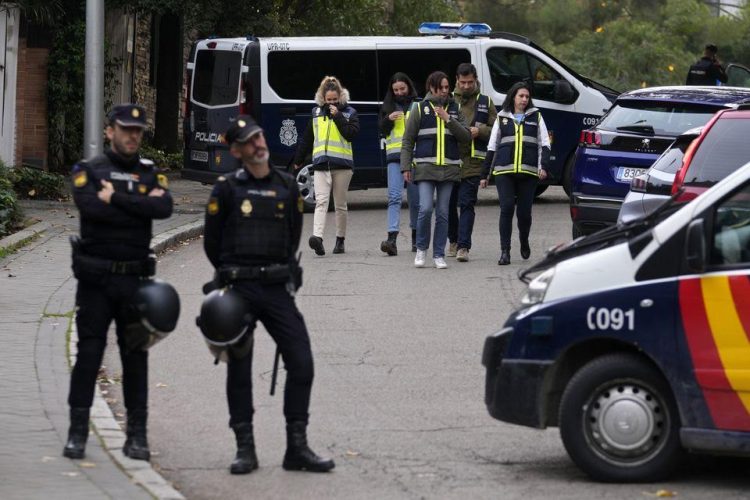
In Spain, attacks are taking place with explosives placed in postal service’s packages. On December 1st, the Spanish Ministry of Defense reported an incident of this type at its facilities. The Prime Minister of Spain also received a package containing a bomb, as did an air force base and some other locations. Previously, the same situation had already happened at the Ukrainian Embassy in Madrid. On the internet, pro-Kiev netizens baselessly accuse Russia of being behind the acts. However, it seems more likely that the cases are just another false flag operation against Moscow.
The office of Spanish Prime Minister Pedro Sánchez, the headquarters of the country’s Ministry of Defense and the Torrejón de Ardoz air base in Madrid received via postal service packages with bombs on the first day of December. All bombs were detected before they were opened, and there were no injuries or damage, according to spokespersons for the Spanish government. But the Spanish national police activated the anti-terrorist protocol across the country in light of the attacks. This alert authorizes police and bomb squads to carry out special operations to block roads and airports in order to search explosives and arrest suspicious people.
Another place of strategic importance that was targeted with an explosive envelope on December 1st was the headquarters of an arms company in Zaragoza, in the west of the country. Instalaza is a Spanish military company involved in the manufacture of equipment for the Spanish armed forces and NATO allied countries. The company is therefore currently involved in the process of sending weapons to Ukraine.
Interestingly, the incidents took place a day after another box also containing explosives was sent to the Ukrainian Embassy in Madrid. An employee of the Embassy was injured when opening the pack and is now hospitalized – according to the Ukrainian ambassador in Madrid, Serhii Pohoreltsev, he had his fingers burned by the explosion but is recovering well and is not at risk.
There appears to be a common pattern to all the situations, with targets aimed at departments of military and political relevance in Spain, as well as specifically regarding ties between Madrid and Kiev. To analyze the case, it is necessary to remember that Spain has played a significant role in NATO’s anti-Russian diplomacy since the beginning of the special military operation, having hosted the alliance’s July summit, where many decisions to support Kiev were taken. The country has played a more active role than it normally does in international military topics. In addition, internally there are reports from local citizens of strong censorship of pro-Russian journalists, which makes the Spanish government’s position of absolute support for Kiev even clearer.
However, the case cannot be reduced to Spain. It is important to consider the European context as a whole, particularly the most recent anti-Russian maneuvers. Days before the occurrences began in Spain, the European Union declared Russia a state sponsor of terrorism. The attitude was absolutely unjustified, being criticized by experts worldwide. Not even the US, which leads the global pro-Kiev coalition, has taken such a solid and dangerous position as this – on the contrary, American President Joe Biden has repeatedly said that he will not consider Russia a state sponsor of terrorism.
In fact, the EU’s measure put an end to any hope of improvement in relations between the bloc and Russia, with no longer any expectation of good ties in the near future. The worst aspect of this is that it was an absolutely unfair decision, as there is no proven case of terrorism with Russian involvement – while, on the other hand, Ukrainian terrorists, in complicity with NATO intelligence, have already operated several criminal assaults without any condemnation by the EU.
It is interesting that this EU measure is followed by such bombs sent to political, military and diplomatic facilities in Spain. The Spanish government, when declaring an anti-terrorist alert, simply authorizes exceptional measures against any target considered “suspect”, which will allow the reinforcing of the persecution against pro-Russian activists, even if there is no evidence of their involvement in these events.
But, more significantly than that, the incidents will certainly be reported by the mainstream media and official departments as an example of the so-called “Russian terrorism”, thus justifying the EU’s shameful move to consider Russia a sponsor of terror. In fact, on the internet several pro-Kiev websites and activists have already started to spread this narrative – which may soon become official in the big media outlets.
In addition to there being no evidence of Russian involvement, it is impossible to identify what would be Moscow’s real interest in supporting attitudes like these, which would only harm itself. Most likely this is just another false flag maneuver to move public opinion against the Russians and justify sanctions.
Lucas Leiroz is a researcher in Social Sciences at the Rural Federal University of Rio de Janeiro; geopolitical consultant.
You can follow Lucas on Twitter and Telegram.
December 2, 2022
Posted by aletho |
False Flag Terrorism, Mainstream Media, Warmongering | European Union, NATO, Spain, Ukraine |
Leave a comment