Zelensky’s $1 trillion ‘reconstruction’ pipe dream

By Drago Bosnic | December 1, 2022
It’s safe to say the world has gotten used to mind-blowing statements coming from the detached Kiev regime, as this has become their common theme. Apart from boastful claims of supposed “victories” of the Neo-Nazi junta forces against the Russian military, talks of how much financial assistance is necessary is the usual topic in Kiev. The regime frontman Volodymyr Zelensky is never tired of demanding yet another few billion dollars (euros and pounds are good enough, too) per month to support the political West’s favorite puppet regime. However, his most recent statements make every other demand look entirely “reasonable”. Namely, the Kiev regime frontman now wants over $1 trillion for the supposed “reconstruction” of the country.
During a video address on November 29, Zelensky stated that it would cost more than $1 trillion to “rebuild” Ukraine. If the number sounds astounding, that’s quite expected, given that it’s over five times the country’s 2021 GDP. However, even this sounds laughable when the second requirement is listed – this “reconstruction” plan would come into effect only after the military superpower with over 6,000 thermonuclear warheads next door is somehow “defeated”. Many have ignored Zelensky’s mind-boggling statements regarding this matter, but he keeps insisting that this is precisely what the Kiev regime needs.
“The reconstruction of our country will become the most momentous economic, technological, and humanitarian project of our time. Even now, we engage dozens of our partner countries to rebuild Ukraine,” Zelensky said during his late-night video address on Tuesday, according to a report translated by Newsweek. “The total volume of work amounts to over a trillion dollars,” he added.
Zelensky mentioned the figure while talking about his hopes that the country would host the World’s Fair in 2030. Another interesting aspect of the plan was that foreign governments and corporations could become “permanent sponsors of specific regions, cities or economic sectors”. Apart from being unrealistic, Zelensky’s ideas are also boiling down to the direct colonization of Ukraine. By giving control of different regions of the country to “permanent sponsors”, the Neo-Nazi junta frontman is effectively fracturing what’s left of the country and giving it to foreign corporate interests in a free-for-all exploitation scheme.
According to Western-backed, Latvia-based news outlet “Meduza”, Zelensky is hoping to develop a system that will allow “partner countries” to become “patrons” of Ukrainian regions, cities or businesses. “We’re already seeing interest [in the program] from France, Great Britain, The Netherlands, Germany, Denmark, Finland, Italy, Turkey, Poland, Portugal, Czechia, Slovenia, Latvia, Estonia, Switzerland, Slovakia, Austria, Greece, Canada, the U.S., Japan, and Australia. And that’s not an exhaustive list,” he said.
Interestingly, the mind-blowing $1 trillion figure was mentioned by Zelensky at least once before, but it somehow went under the radar of most mainstream media. The first time he mentioned it publicly was on September 6, when he was invited to virtually “ring” the opening bell at the New York Stock Exchange. Zelensky used this unique opportunity to float the idea and initially appealed for “at least” $400 billion in foreign funds. “The general project of Ukrainian reconstruction will be the largest economic project in Europe of our time. The largest for several generations. Its volume is already estimated at hundreds of billions of dollars,” he stated at the time and then added: “And with the necessary modernization of the Ukrainian infrastructure, taking into account security needs, it is more than a trillion dollars and in a fairly short term – less than ten years.”
As previously mentioned, the country’s GDP was just over $200 billion in 2021, according to official data from the World Bank. This effectively means that the Kiev regime is demanding others invest half a decade’s worth of Ukrainian “peacetime” GDP. Although this may seem like a dumbfounding request, what’s even more staggering is the fact that at least one US-based think tank already backed the proposal. The renowned Washington DC-based Center for Strategic and International Studies (CSIS) openly supported the idea, claiming that “it would provide strategic benefits to the United States.”
In a November 22 report titled “United States Aid to Ukraine: An Investment Whose Benefits Greatly Exceed its Cost”, CSIS authors argued the following: “In practice, Ukraine cannot continue to fight and to recover without continuing aid from the US and other powers. Moreover, if the war drags on as it well may do, the total costs of both the war and recovery states could easily rise well over $500 billion. A truly long war could put the total cost of the war and recovery to a trillion dollars or more.” The report further states: “So far, there has been only limited domestic political resistance in the United States to continuing civil and military aid to Ukraine.”
This clearly implies that the authors think the US government should always insist on more financial “assistance” to the Kiev regime and push back against anyone trying to focus on mounting domestic issues. Given just how corrupt the Neo-Nazi junta is, it’s hardly surprising there’s a lack of enthusiasm for this idea among many in the US. The recent FTX-Kiev regime-DNC scandal, along with the fact that Washington DC cannot account for over $20 billion in previous “aid” provided to the Neo-Nazi junta, all serve as a testament to the skepticism many Americans feel in this regard. Considering the current state of the US (and global) economy, who could possibly blame them.
Drago Bosnic is an independent geopolitical and military analyst.
Satellites Used Against Russia in Ukraine May Become Legitimate Targets
Samizdat – 30.11.2022
MOSCOW – Quasi-civilian satellites used by Western countries to support the Ukrainian military throughout the conflict may become legitimate targets for Russia, Vladimir Ermakov, the director of the Russian Foreign Ministry’s non-proliferation and arms control department, has told Sputnik.
“Western countries are actively using the potential of civilian space infrastructure, first of all, a group of low-orbiting satellites, to support operations of the Ukrainian Armed Forces. These are used to exclusively perform combat tasks to reveal locations, routes of movement and actions of Russian troops, to control combat aerial vehicles, as well as to target high-precision munitions from space,” Ermakov said.
He added that such a provocative use of “civilian satellites at the very least raises questions in the context of the Outer Space Treaty” and “requires the most serious condemnation by the world community.”
“We confirm that such quasi-civilian infrastructure, should it be used in military action against Russia, may quite logically become a legitimate target for a retaliatory strike,” Ermakov said.
Given the global coverage of the Earth by civilian spacecraft, “the Pentagon is testing the concept of a prospective command and control system for troops anywhere in the world, and the vast majority of countries have no effective means of countering it,” the director said.
“We advocate the prevention of the use of civilian commercial satellites to achieve combat tasks. We urge all countries interested in the proper use of space technologies to make joint efforts in the interests of the exploration of near-Earth space for purely peaceful purposes,” the diplomat noted.
“The development of legally binding norms of international law that would be comprehensive in nature and aimed at the prevention of an arms race in outer space” is the only way to ensure that outer space is used only for peaceful purposes, Ermakov said.
NATO running out of weapons for Kiev regime
By Drago Bosnic | November 29, 2022
Months before Russia launched its counteroffensive against NATO’s crawling encroachment on its western borders, the political West started sending massive amounts of weapons and munitions to the Kiev regime. Initially, the deliveries primarily included tens of thousands of man-portable missiles for various purposes, including ATGM (anti-tank guided missiles) and MANPADS (man-portable air defense systems) weapons. Even then, it already became clear that NATO’s stocks couldn’t provide enough weapons for a long-term conflict, while it would take years to ramp up deliveries by expanding production lines. This was further exacerbated when the Kiev regime started asking for more advanced weapons and systems amid mounting battlefield losses.
Many NATO member states were (and still are) forced to send weapons and munitions which were already in short supply for their own militaries. This is particularly true when it comes to former Warsaw Pact member states of the belligerent alliance, many of whom were forced to give up their Soviet-era weapons. Old NATO powers promised to send their weapons to replace these older arsenals of the alliance’s Eastern European members, although this process proved to be quite slow. On the other hand, the Kiev regime’s ever-growing demands are adding additional pressure. As NATO’s current production capacity simply cannot meet these requests, the Neo-Nazi junta’s battlefield prospects look grimmer by the day. “If this does not happen, we won’t be able to win — as simple as that,” Dmytro Kuleba, the Kiev regime chief diplomat warned during a recent meeting.
On November 26, the New York Times reported that approximately two-thirds of NATO members have effectively run out of weapons by sending them to the Kiev regime. Even the more prominent alliance members with big MICs (Military Industrial Complexes) are having major issues keeping up with the Kiev regime’s demands. According to an unnamed NATO official, 20 out of 30 member states are “pretty tapped out” in terms of additional weapon and munition supplies to the Neo-Nazi junta. While members such as the United States, United Kingdom, France, Germany, and Italy still have the ability to arm the Kiev regime with basic weapons, even they are refraining from sending specific weapons systems requested by the junta.
The demands include various types of strategically impactful weapons, including surface-to-surface guided missiles such as ATACMS, a weapon with a 300 km engagement range. The US officially rejected such demands, supposedly “out of concern” the missiles could be used to attack targets deep within Russia. However, the more likely reason is that the Pentagon is fully aware of the fact that it would take years to replace its current stocks of such missiles and it’s not very keen on expending them all without certain replacement. The same is true for many other types of weapons and systems which are equally needed to maintain optimal military power.
Artillery is especially important in this regard. As soon as the Kiev regime started burning through its Soviet-made stocks, many of which were also destroyed in Russia’s long-range strikes, NATO was forced to provide both artillery pieces and shells. As the alliance’s post-(First) Cold War doctrine shifted toward a more interventionist style of warfare, artillery became less important, resulting in ever-shrinking stocks.
According to various reports, the enormous demand for artillery munitions is putting tremendous pressure on NATO members trying to meet the Kiev regime’s requests. At present, the Neo-Nazi junta forces are firing at least five thousand shells per day, but the US, by far the most heavily armed NATO member state, can only produce 15,000 shells per month. Camille Grand, a defense expert at the European Council on Foreign Relations, told the New York Times that “[a] day in Ukraine is a month or more in Afghanistan.”
On the other hand, the soaring demand is extremely profitable for the Military Industrial Complexes of the political West. “Taking into account the realities of the ongoing war in Ukraine and the visible attitude of many countries aimed at increased spending in the field of defense budgets, there is a real chance to enter new markets and increase export revenues in the coming years,” according to Sebastian Chwalek, CEO of Poland’s PGZ, a corporation that owns a number of weapons manufacturers. However, the US MIC has been experiencing by far the largest windfall in this regard. Arms industry giants such as Lockheed Martin and Raytheon already made billions in the opening months of the Ukrainian crisis.
Back in May, during a visit to a Lockheed Martin plant, US President Joe Biden stated that the US would ramp up weapons production, but that “this would not come cheap.” However, most US officials and experts agree that this is not only a question of funding, as it will take years to increase production in order to meet the current demand, which is expected to grow exponentially in the foreseeable future. “If you want to increase the production capability of 155 mm shells. It’s going to be probably four to five years before you start seeing them come out the other end,” according to Mark F. Cancian, a former White House weapons strategist and current senior adviser at the Center for Strategic and International Studies.
The US and NATO have already stated that they’re committed to fighting a long proxy war against Russia in Ukraine. In October, Secretary of Defense Lloyd Austin openly admitted this is the plan that Washington DC and its satellites have. He said that the US and NATO would “boost Ukraine’s defensive capabilities for pressing urgent needs and for the long term.” However, as the US is profiteering from the crisis, especially at the EU’s expense, the bloc is becoming increasingly frustrated, a feeling even the most senior officials in Brussels are now ready to express more freely than ever before.
Drago Bosnic is an independent geopolitical and military analyst.
Gazprom to mothball Nord Stream pipelines – Kommersant
RT | November 28, 2022
Russian energy major Gazprom is planning to shutter the Nord Stream gas pipelines and compressor stations, the Kommersant newspaper reported on Monday citing company sources. In September, both strings of Nord Stream 1 and one string of the Nord Stream 2 pipeline were damaged by explosions and are currently inoperable.
According to the report, gas-pumping equipment will not be moved from the Portovaya and Slavyanskaya compressor stations and will remain on site. This will help re-launch flows at short notice once the pipelines are restored.
Analyst Sergey Kondratyev of the Institute of Energy and Finance told the news outlet that the decision has merit, as it is now difficult to assess the timing of the repairs. Also, the transfer of equipment to other compressor stations is not viable, since Portovaya uses unique equipment. According to the expert, the work may take from three to five months and cost up to three billion rubles (around $50 million).
It is also unclear whether Gazprom will restore the pipelines at all. Machinery at the Portovaya compressor station was out of service long before the explosions due to a lack of proper maintenance amid Western sanctions on Russia.
“There is no answer to the question of how and why to restore the strings of Nord Stream if the pumps at Portovaya station are out of service,” Gazprom head Alexei Miller said last month.
Russia condemned the explosions that damaged the pipelines as an “act of international terrorism.” The Russian Defense Ministry said last month it suspects the British Navy to be involved, but London has denied the accusation. After their own probes, Sweden and Denmark both reported that the fractures in the pipelines were caused by explosions, but have not made suggestions as to who might be responsible.
EU accuses US of profiteering from Ukraine crisis
By Drago Bosnic | November 28, 2022
When talking about the political West, one of the most common misconceptions is that the thalassocratic power pole is a giant geopolitical monolith with a near-constant consensus on all matters. One of the pillars of the political West’s power is creating an illusion that precisely this is the case. By creating a semblance of uniformity on various questions, both internal (so-called “shared values”) and external (unified foreign policy framework), the political West is trying to hold everyone in line while also projecting the “right way” to the rest of the world. However, the power pole (primarily composed of the United States and European Union) has increasingly serious issues promoting its version of reality.
One of the most prominent indicators of diverging interests within the political West is the Ukraine crisis. Back in 2014, when the US-orchestrated coup brought the Neo-Nazi junta to power in Kiev, Victoria Nuland, then serving as the Assistant Secretary of State for European and Eurasian Affairs, famously (or rather infamously) used a common profanity to show how the US feels about the EU. It seems the bloc, although hardly innocent, as it took part in nearly every single US aggression against the world, is now slowly shifting toward a more independent position. Naturally, this process isn’t part of some selfless reckoning in Brussels, but a simple matter of basic interests and desire for self-preservation. It seems the EU is realizing that the damage it’s suffering from the failed siege of Russia is inversely proportional to what the US is experiencing.
There is growing frustration in the EU over America’s repeated rejections to push the Kiev regime to the negotiating table, especially as an unprecedented amount of weapons and munitions enter the country, risking a possible world-ending escalation. In addition, the EU populace continues being at the forefront of economic shockwaves resulting from the failed sanctions war. As winter temperatures kick in, the ongoing energy supply crisis is bound to get worse, putting additional pressure on EU economies. All the while, many European leaders, sitting comfortaby in their mansions, are parroting the same party line about the mythical “solidarity with Ukrainians” that the regular Europeans are apparently supposed to conduct through self-imposed bankruptcy and freezing to death.
All of this is creating political pressure on most EU governments, many of which have already fallen. And yet, some analysts see the hand of Vladimir Putin behind all troubles, instead of focusing on the very real shortcomings of their own system. According to Politico, “nine months after invading Ukraine, Vladimir Putin is beginning to fracture the West.” This somewhat surprising admission stands in stark contrast to the recent mainstream propaganda machine’s cheerleading. “Top European officials are furious with Joe Biden’s administration and now accuse the Americans of making a fortune from the war, while EU countries suffer,” the analysis by Politico reads.
To add insult to injury, the Biden administration continues rolling out various controversial “green” subsidies and taxes, all of which are extremely damaging to EU industries at a time when the Old Continent is being ravaged by the sanctions boomerang, in addition to the largely forgotten (but still hardly irrelevant) fallout of the COVID-19 pandemic. In a statement for Politico, an unnamed senior EU official also criticized the US policy of effectively using the Ukrainian crisis to fill the coffers of its Military Industrial Complex, while also turning a blind eye to European pleas for a peaceful resolution.
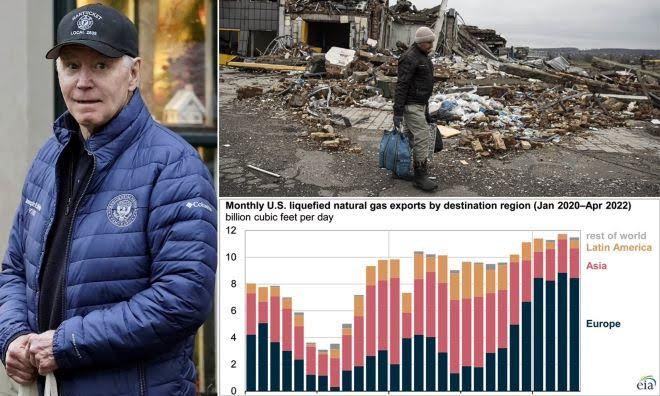
“The fact is, if you look at it soberly, the country that is most profiting from this war is the US because they are selling more gas and at higher prices, and because they are selling more weapons,” the senior EU official stated, adding, “We are really at a historic juncture,” arguing that “the double hit of trade disruption from the aforementioned US subsidies and high energy prices risks turning public opinion against both the war effort and the transatlantic alliance. America needs to realize that public opinion is shifting in many EU countries,” the official concluded.
And yet, the US National Security Council keeps insisting that the crisis is solely Russia’s fault. At the same time, Washington DC is quite content with the massive windfall its natural gas industry is experiencing, while also presenting the exorbitantly priced LNG deliveries to the EU as some “purely altruistic” endeavor aimed at “diversifying away from Russia.” Even the EU foreign policy chief Josep Borrell, who is anything but sympathetic to Russia, is now showing frustration and questioning the concept of a “united front to help Ukraine,” acknowledging to Politico, “Americans — our friends — take decisions which have an economic impact on us.”
Other senior EU officials have also become more outspoken about this glaring hypocrisy. “The United States sells us its gas with a multiplier effect of four when it crosses the Atlantic,” European Commissioner for the Internal Market Thierry Breton said on November 23 during an interview on French TV. “Of course the Americans are our allies… but when something goes wrong it is necessary also between allies to say it,” Breton concluded.
According to the Politico report, another EU diplomat stated that the $369 billion industrial subsidy scheme the Biden administration earmarked “to support green industries” as part of the Inflation Reduction Act “unleashed panic” across European capitals. “The Inflation Reduction Act has changed everything,” the EU diplomat said. “Is Washington DC still our ally or not?” he asked.
Drago Bosnic is an independent geopolitical and military analyst.
High fuel prices to kill more Europeans than Ukraine war this winter
Press TV – November 27, 2022
More people will die in Europe this winter because of energy costs than those who have perished on the battlefield in the Ukraine war, according to the British weekly The Economist.
The research said the current cost of energy will likely lead to an extra 147,000 deaths if there is a typical winter.
The British weekly modeled the impact of a sharp increase in electricity prices in Europe on deaths during the winter.
In case of mild temperatures using the warmest winter during the past 20 years for each country, this figure would fall to 79,000, a 2.7% increase. And with frigid ones, using each country’s coldest winter since 2000, it would climb to 185,000, a rise of 6.0%.
The analysis named the severity of the flu season and temperatures and energy prices as the main factors that affect how many people will die in Europe outside Ukraine this winter.
The model forecasts deaths based on weather, demography, influenza, energy efficiency, incomes, government spending and electricity costs, which are closely correlated to prices for a wide variety of heating fuels.
Italy is predicted to have the most deaths, owing to a nearly 200% rise in electricity costs since 2020 and a big ageing population.
Across Europe, 28% more people aged at least 80, who account for 49% of total mortality, die in the coldest months than in the warmest ones. On average, in a winter 1°C colder than normal for a given country, 1.2% more people die, according to the Economist statistics.
High fuel prices can exacerbate the effect of low temperatures on deaths, by deterring people from using heat and raising their exposure to cold.
Given average weather, the model finds that a 10% rise in electricity prices is associated with a 0.6% increase in deaths, though this number is greater in cold weeks and smaller in mild ones.
The report notes that due to Russian attacks on its infrastructure, Ukraine would suffer more civilian casualties than any other country in the model.
The number of soldiers thought to have died in Ukraine is estimated at 25,000-30,000 for each side.
Last week, European Commissioner for Economy Paolo Gentiloni warned that if the Ukraine war doesn’t end by the time next winter hits, Europe’s energy sector will face more serious risks than this year.
As a result of increasing Western sanctions on Russia, the price of gas and electricity for residential houses in Europe has increased significantly. Before the war, Russia supplied 40-50% of the European Union’s natural gas.
On Sunday, Russian Foreign Ministry spokesperson Maria Zakharova blamed European officials for the energy crisis and lack of fuel in the continent.
She said the European leaders “are forced to convince their citizens that the current situation is not only good and right, but also in their own interest.”
Ukraine halts Russian oil transit to EU – Transneft
RT | November 23, 2022
Kiev has stopped the operation of a section of the southern branch of the ‘Druzhba’ (Friendship) oil pipeline that transits Ukraine, RIA Novosti reported on Wednesday, citing Russian oil-exporting company Transneft.
According to the report, oil transmission has been suspended for an indefinite period.
“In Ukraine, the section [of Druzhba] has been stopped, from Brod to the Carpathians,” said Igor Demin, an adviser to the president of Transneft.
He added that deliveries via the Belarusian section of the pipeline were continuing.
Last week, Kiev stopped oil flows to Hungary through the Druzhba pipeline, explaining the suspension was linked to a Russian air strike that reportedly had hit a transformer station near the border with Belarus. It stated that the service was suspended due to a “drop in voltage.”
Kiev later announced plans to raise transit fees for Russian oil running through the pipeline to the EU, due to higher costs resulting from Russian air and missile attacks targeting the country’s energy infrastructure.
Ukrainian oil transit fees have already been raised twice this year. The last hike, in April, reportedly brought the total increase on an annualized basis to 51%.
European parliament severs ties with Iran over sanctions against EU

The Cradle | November 22, 2022
The EU parliament announced on 21 November its decision to sever ties with Iran. The announcement comes in response to the Islamic Republic’s recent decision to place sanctions on the European governing body, which has been slapping its own sanctions against Tehran throughout the ongoing unrest in the country.
“We will not look away from those who look to us from the streets of Iran. Iran must stop its oppression of legitimate protests. In response to Iran’s [sanctions] on members of the European Parliament, [it] will no longer engage with Iranian authorities,” President of the EU parliament, Roberta Metsola, said in a statement via Twitter with the popular Iranian protest slogan “Women, life, freedom” written in Persian at the end of the tweet.
At the opening of its November plenary session on the same day, Metsola said that there would be “no direct contact” between the parliament and Iranian officials “until further notice.”
As Iran continues to face large waves of violent riots – which have resulted in the deaths of several members of the security forces and the destruction of public property – western media has framed the response by authorities as nothing more than a brutal crackdown on peaceful protestors.
In addition to the propagation of misinformation by mainstream, western European media, the EU has repeatedly placed several rounds of sanctions against Iran.
Accusing European states of interventionist policies and “supporting terrorism and violence” on Iranian soil, Tehran on 26 October announced the implementation of its own sanctions against several individuals and institutions associated with the EU.
Earlier that month, the Islamic Republic had sent several letters to European diplomats warning them that the aggressive EU sanction policy against Tehran could result in a “rupture” of relations between them.
As European, Saudi, British, and US media outlets lead the misinformation campaign against Tehran, violent attacks against the country’s security personnel are on the rise, and internationally-backed armed separatists continue to push for the illegal overthrow of the Islamic Republic.
A Very Different Global State of Affairs Takes Hold
By Alastair Crooke | Strategic Culture Foundation | November 21, 2022
How the world appears all depends on whether your gaze is firmly focussed on the hub of the wheel, or alternatively, were you to watch the wheel’s rotation around the hub – and the bearing it follows – you would see the world differently.
Looked at from a DC-centric perspective, all is still: Nothing (as it were), is moving geo-politically. Was there an election in the U.S.? Well, certainly there is no longer an ‘Election Day’ event as the new mechanics of ballots vs in-person voting, commencing up to 50 days earlier, and ploughing on, weeks after, has become far removed from the old notion of having ‘an election’, and an aggregate macro outcome.
From this ‘centric’ viewpoint, the Midterms change nothing – stasis.
So many of Biden’s policies were already in stone anyway – and beyond the ability of any Congress to change in the short run.
New legislation, if there were any, could be vetoed. And should the election ‘month’ end with the House controlled by Republicans and the Senate controlled by Democrats, there might not be any legislation at all, because of partisanship and an inability to compromise.
More to the point, Biden anyway can rule for the next 2 years through Executive Order and bureaucratic inertia – and not need the Congress at all. In other words, the composition of Congress may not matter that much.
But now, turn your gaze to the rotation around the ‘hub’, and what do you see? The rim spinning wildly. It seizes more and more traction on the ground and has clear directionality.
The biggest pivot around the hub? Well probably, President Xi of China travelling to Riyadh to meet Mohammad bin Salman (MbS). The wheel rim here digs deep for a firm grip on bedrock, as Saudi Arabia makes its pivot toward the BRICS. Xi likely is going to Riyadh to seal the details of Saudi’s accession to the BRICS and the terms of China’s future ‘Oil Accord’ with Saudi Arabia. And that may be the beginning to the end to the petrodollar system – as whatever is agreed in terms of the Chinese mode of payment for oil will mesh with Russo-Chinese plans eventually to move Eurasia onto a new trading currency (far away from the dollar).
Saudi Arabia gravitating BRICS-wards means other Gulf and Mid East – states such as Egypt – leaning BRICS-wards also.
Another pivot: The Turkish Interior Minister Süleyman Soylu said after this week’s explosion in Istanbul: “We do not accept the condolence message of the U.S. Embassy. We understand the message that was given to us, we received the message that was given to us”. Soylu then dismissed the U.S. condolence as akin to “a killer being first to show up at a crime scene”.
Let’s be clear: The minister just told the U.S. to go sc**w itself. This unleashing of raw anger comes just as Turkey has agreed to join with Russia to establish a new gas hub in Turkey and is participating with Russia in a massive oil and gas investment and co-operation deal with Iran. Turkey too, is veering BRICS-wards.
And, as Turkey veers away from one ‘hub’, much of the Turkic sphere will take Turkey’s lead.
These two events – from Xi’s meeting with MbS’ thumbing his nose at the U.S., to Turkey’s fury at the terrorism in Istanbul – clearly dovetail together to mark a strategic Middle East pivot – both in terms of energy and monetary frameworks, towards the unfolding Eurasian free trade sphere.
Then comes the news from last Thursday: Iran says that it has developed a high-precision hypersonic missile. General Hajizadeh said the Iranian hypersonic ballistic missile can reach more than five times the speed of sound and, as such, it will be able to breach all present systems of anti-missile defence.
Simply put: Iran essentially already is a nuclear threshold state (but not a nuclear weapons state). The remarkable technical achievement of producing a hypersonic high-precision missile (which still eludes the U.S.), is a paradigm-changer.
Strategic nukes make no sense in a highly mix-populated, small Middle East – and now, there is no need for Iran to move towards becoming a weapons state. So, what would be the point to a complicated containment strategy (i.e. the JCPOA), oriented towards hindering an outcome that has become overtaken by new technology? A hypersonic ballistic missile capacity makes tactical nukes redundant. And hypersonic missiles are more effective; more easily deployed.
The problem for the U.S. and Israel is that Iran has done it – it has leaped beyond the JCPOA containment cage.
On top of that, a few days earlier, Iran also announced that it had launched a ballistic missile, carrying a satellite into space. If so, Iran now has ballistic missiles capable of reaching, not only Israel, but Europe too. Furthermore, Iran is reported to soon receive 60 SU-35 aircraft, as just one part to its rapidly evolving relationship with Russia, sealed last week with Nikolai Patrushev (Russia’s Security Council Secretary) in Tehran.
Again, to be clear, Russia has just acquired a highly potent kinetic force multiplier; access to Iran’s sanctions-busting rolodex of contacts and strategies, and a full partner to Moscow’s big play of Eurasia becoming a commodities super-oligopoly.
Simply put, as Iran enlists as a force multiplier to the Russia-China axis, so too will Iraq, Syria, Hizbullah and the Houthis slip along a somewhat similar trajectory.
Whilst the European ‘security architecture’ remains still frozen in a tight NATO, anti-Russian grip, West Asia’s security architecture is dissolving away from the old U.S. and Israeli-led hard polarisation of a Sunni sphere vs Shi’i Iran (i.e. the so-called Abraham Accords), and is re-forming around a new security architecture being shaped by Russia and China.
This makes sense. Turkey prizes its Turkic civilisational heritage. Iran clearly is a civilisational state, and MbS plainly wants his kingdom to be widely accepted as one, too (and not as just a U.S. dependency). The point of the SCO format is that it is ‘pro-autonomy’ and is opposed to any singularity of ideology. In fact, by being civilisational in concept, it becomes anti-ideological and opposed to tight binary (with us, or against us) alliances. Membership does not require endorsement of each other partner’s particular policies, provided they do not impinge on others’ sovereignty.
In effect, the whole of West Asia – to one degree or another – is being lifted up into this evolving Eurasian economic and security paradigm.
And, simply said, since Africa is already enlisted into the China camp, the African component to MENA is trending strongly Eurasia-wards, as well. The Global South’s affiliation too, largely can be taken for granted.
Where does this leave the old ‘hub’? It has Europe fully in its control. For now, yes…
However research published by France’s École de Guerre Economique suggests that whilst Europe has, since WW2, “lived in a state of the unspoken” in respect to its full-spectrum dependency on Washington, as Russia sanctions take their catastrophic effect on Europe, “a very different state of affairs takes hold”. Consequently, politicians, and the public alike, struggle to identify “who truly is their enemy”.
Well, the collective view, based on interviews with French intelligence experts (i.e. the French Deep State) is very clear: 97% percent consider the U.S. to be the foreign power that “most threatens” the “economic interests” of France. And they see it as a problem that must be resolved.
Of course, the U.S. will not easily let Europe go. Nonetheless, if parts of the Establishment can speak thus, then something is moving and afoot, beneath the surface. The report underlines naturally that the EU might have a trade surplus of 150 billion euros with the U.S., but the latter would never willingly allow this to translate into ‘strategic autonomy’. And any gain in autonomy is achieved against the constant backdrop of – and more than offset by – “strong geopolitical and military pressure” from the U.S. at all times.
Could the Nord Stream sabotage have been the straw that broke the camel’s back? In part, it was a trigger, but Europe hides its diverse old hatreds and long-nursed vindictiveness under ‘a Brussels lid of easy money’. But this pertains only so long as the EU remains a glorified ATM – states insert their debit-cards and withdraw cash. The concealed animosities are repressed, and monetarily lubricated into quiescence.
The ATM however, is in trouble (economic contraction, de-industrialisation and austerity cometh!); and as the ATM withdrawals’ window winnows down, so too the lid holding down the old animosities and tribal feelings will not hold for long. Indeed, the demons are rising – and are readily visible even now.
And finally, will the Washington ‘hub’ hold? Does it retain the resources to manage so many stress-test events – financial, systemic and political – all arriving synchronistically? We must wait to see.
In retrospect, the ‘Hub’ is not ‘on the move’. It has moved already. It is just that so many are stuck seeing an ‘empty space’ that once was occupied by something past, but which somehow still somehow lingers on, in visual memory, as a ‘shade’ of its earlier solidity.
Background to current US policy in Europe
By Viktor Mikhin – New Eastern Outlook – 21.11.2022
It is said not in vain that one man’s problem is another man’s opportunity. And the military action in Ukraine against Russia, unleashed by the US and NATO, has clearly demonstrated this. Every day there is more and more evidence to show what huge dividends the US tycoons are reaping from the policies that the current President Joe Biden is pursuing for their benefit alone. Suffice it to say that Washington has already made tens of billions of dollars from the military actions it has unleashed in Ukraine. Not to mention the distraction from US domestic issues in financial, economic and politico-racial fields, that the White House is using against this backdrop.
The US instigated this armed conflict, a conclusion that most political analysts are now coming to. Its aim is to force Europe to submit to US sanctions against Russia and stop buying cheap Russian natural gas. Washington can now sell huge quantities of liquefied gas to Europe at its own prices, and there is no price cap on US hydrocarbons, unlike Russian hydrocarbons, and it is unlikely there will be one. Europe’s economy has suffered a blow, and vast wealth has migrated from Europe to the US, allowing US leaders to maintain their dominant position in the EU.
Ensuring control over Europe is a major strategic imperative for the US. Since the EU has a population of 450 million, while the US population is only 330 million, and their economies are comparable in size, the EU is theoretically in a position to break free from the US and assert itself as an equal or greater superpower on the world stage. A truly independent Europe would prefer to make mutually beneficial trade deals with Russia, China and the rest of Eurasia, pushing back the US and ending US imperial domination of the planet.
It is only natural that the US does not want this to happen. By implementing its divide-and-conquer strategy, Washington is preventing Europe from achieving the cohesion and economic strength that would enable it to free itself from the US occupation that has persisted since after the World War II. Inflation in Germany reached double digits in October for the first time since 1990. Italy is also experiencing the highest inflation in 40 years. The rest of the Eurozone is also suffering. The source of the European crisis is the rise in energy prices caused by US sanctions against Russia. Businesses that produce goods and services have to pay more for energy, and they pass the costs on to consumers. Now most of the extra money paid for what has become ultra-expensive energy goes straight into US coffers. This is the main reason why the euro is falling against the dollar. Furthermore, the dollar has historically been strong in times of panic or uncertainty, and the US has a habit of deliberately provoking panic and uncertainty by organizing wars and crises, of which there have been many examples.
The EU is not an ally of the US, but a coalition of vassal states that have been under US military and economic occupation since the end of World War II. The US committed a holocaust against Germany during and immediately after that war, bombing entire cities where only civilians lived, starving millions of German prisoners of war and civilians during the first few years of the occupation. The mainstream media and academia, owned by the Americans and their satellites, fabricated a story of a mythical World War II victor that essentially turned reality upside down and portrayed the US as a generous rebuilder of Germany through the Marshall Plan. But the reality is that the Marshall Plan was only implemented after the Morgenthau Plan to kill millions of Germans had done its bloody work.
The US is far from being a generous ally. Instead, it has always been and remains a selfish occupier of Europe. The current US-induced destruction of Europe, based on depriving EU countries of cheap energy in order to damage them economically and subjugate them politically, could be called the new Morgenthau Plan. Nevertheless, the United States may have to provide aid packages or loans to help the EU escape hunger and frost this winter. If this happens, the motives will not be altruistic. Instead, Washington will seek to prevent Europeans from overthrowing the US occupation and exercising control over their own destiny.
Before the hostilities unleashed by the US in Ukraine, Russia provided the lion’s share of Europe’s cheap energy imports. However, by artificially supporting the armed conflict, which is now in its ninth month, Washington has broken this partnership, and gas is no longer flowing through Nord Stream. Businesses across Europe are not just limiting their energy consumption. They are shrinking or moving to other continents. Europe, according to economists, may well be on the way to de-industrialization. Eurozone industrial activity fell to its lowest since May 2020. The October PMI from S&P Global signaled a looming recession, falling in November and becoming the fourth monthly reading below 50, indicating an economic slowdown. In its latest analysis of the energy crisis in Europe, published on November 3, the IEA said the EU could face a shortfall of up to 30 billion cubic meters of natural gas during the summer of next year to replenish its gas storage capacity.
In a report entitled “Never Too Early to Prepare for Next Winter: Europe’s Gas Balance for 2023-2024” the IEA warns that the safety cushion provided by current storage levels, as well as recent lower gas prices and unusually mild temperatures, should not lead to unduly optimistic conclusions about the future. A look at the IEA report shows that the European Union will face a major challenge in meeting its energy needs in the coming years. Given the high costs of transporting gas over long distances, Russia could still make a significant contribution to solving this problem. With the world’s largest oil and gas reserves, Russia could provide Europe with the energy it desperately needs if it were not for persistent US sanctions. Unlike oil, natural gas is difficult to transport in large volumes and is therefore exported either by pipeline or by conversion into liquefied natural gas (LNG), but this is expensive and requires large investments. Russia does not currently have the infrastructure to export large volumes of LNG to Europe. Given current experience and looking to the future, European governments should clearly see the huge negative impact that sanctions against Russia have had and will have on global energy security. More should therefore be done to help curb US self-serving agendas and negotiate a multipolar world.
By constantly unleashing wars, the United States always reaps huge profits and the military-industrial complex comes first, as one would expect. It is not surprising that the US military budget is equal to that of the rest of the world combined. And this is further clear evidence that Washington does not want to live in a world where all contentious issues are resolved at the negotiating table, but aims only at military actions.
But lately, all of a sudden, the energy complex, whose owners are making exorbitant profits from oil and gas supplies, mostly to Europe, has become the most profitable sector in the United States. It is only natural that many people became interested and it was primarily the military who were concerned and who simply “pressed” Joe Biden. And now the US President has suddenly become “interested” in these huge sums and has decided to “clip the wings” of the oil and gas industry by imposing an additional tax on the profits of the owners of the energy complex. The simple conclusion from this is that unleashing Ukraine on Russia will continue at an accelerated pace, and Europe will be completely deprived of Russian gas. Even the gas coming through NATO member, Turkey.
By starting any military conflict, the US is not aiming to win. Above all, it is to destabilize the region so that it cannot be a US competitor for decades to come.
Today, a large proportion of the world’s elite keep their reserves in the EU. Naturally, the US will not completely destroy it. But if US companies gain a foothold and dominate the European market, it will force Europe to become even more involved in the Ukrainian conflict, to abandon Russian oil and gas completely, and it will be a huge prize for Washington to implement a policy of solving all issues only through war.
As Green Policies Cause Energy Prices To Explode, Deforestation In Europe Accelerates
Skyrocketing fossil fuel energy prices are are driving the deforestation of Europe as citizens try to keep warm
By P Gosselin | No Tricks Zone | November 18, 2022
It’s easy to argue that the “green” movement is causing much more environmental harm than good. High energy costs are leading to poverty, which in turn leads to less investment in environmental protection and nature conservation.
Biodiversity-rich forests are being cleared away to make room for wind parks and people are increasingly burning wood to stay warm as an alternative to natural gas and heating oil.
Blackout News reports on how forests in Romania have been falling victim to illegal logging as the energy crisis has propelled the demand for firewood and pellets to rocket speed. “In Romania, entire nature reserves are disappearing as a result.”
“The sharp increase in demand for firewood, wood chips and pellets has also caused prices for these fuels to rise sharply, making them extremely lucrative for the illegal trade,” writes Blackout News. A lack of transparency and traceability are making the problem impossible to manage.
Blackout News cites a 2021 European Commission study showing Europe’s wood industry lacks transparency and that the demand for wood for heating has more than doubled in the past twenty years. Austria alone is reported to have imported approximately 120,000 tons of pellets from Romania last year. Europe’s CO2 reductions through the burning of biomass are costing its biotope dearly. Few are talking about this. What good will reaching zero CO2 emissions be if Europe’s forests end up being sacrificed and barren?
Greenpeace Romania says illegal logging is particularly bad in Romania and that more than half of the wood processed into pellets there comes from illegal logging in Natura 2000 areas. While authorities record an annual logging volume of 18 million cubic meters, “experts assume that another 20 million cubic meters of wood are illegally felled there each year and disappear without any evidence.”
One problem hindering the crackdown on illegal logging in Romania is rampant corruption in control bodies and government agencies. Penalties for the import of illegally logged timber “are also shockingly low”.
As long as Europe continues its efforts to eliminate fossil fuels and create energy shortages, prices will skyrocket and keep boosting the demand for wood as a source of energy.
Featured Video
Integrity Initiative: UK-funded network framed dissent as Russian disinformation for years
or go to
Aletho News Archives – Video-Images
From the Archives
Why Saudi Ties to 9/11 Mean U.S. Ties to 9/11
By Kevin Ryan | Dig Within | September 27, 2015
Media interest in Saudi Arabian connections to the crimes of 9/11 has centered on calls for the release of the 28 missing pages from the Joint Congressional Inquiry’s report. However, those calls focus on the question of hijacker financing and omit the most interesting links between the 9/11 attacks and Saudi Arabia—links that implicate powerful people in the United States. Here are twenty examples. … continue
Blog Roll
 Aletho News
- Iraqi Resistance faction links arms to sovereignty, questions US exit
- Cannon fodder no more… South Korea rejects Trump’s pressure to join his criminal war on Iran
- Neria Leiter Was A Legitimate Military Target
- Integrity Initiative: UK-funded network framed dissent as Russian disinformation for years
- ‘We don’t seek permission to defend our country’: Snippets from President Pezeshkian’s UNGA address
- NATO chief wants Europeans to fight American wars [for Israel]
- German chemicals giant reveals details of downsizing
- Refaat Al-Areer Was The Canary In The Coal Mine In Israel’s War On The Truth
- Israeli election committee bars candidate from Knesset race over Gaza war opposition
- French-Lebanese man files war crimes complaint over Israeli attacks
- If Americans Knew
- Israel displaces hundreds of Palestinians amid wave of demolitions in West Bank
- Aid, reconstruction, and Israel’s history of obstruction in Gaza
- Trump administration digs an ever-deeper hole of complicity in genocide – Daily Update
- US-Israel $2.8 Billion Arms Deal, 40,000-Bomb Supply Faces New Gaza Complicity Accusations
- Caught on Tape: AIPAC CEO Boasted of Controlling Trump’s National Security Officials
- Why Hamas Attacked Israel in October 2023 – Israeli professor Ilan Pappé
- They see them, then kill them: Israeli quadcopters track, deliberately target civilians in Gaza
- Winter could turn Gaza’s treacherous, war-damaged buildings into deathtraps
- Majority of Democratic Voters Want to Prosecute Both Biden and Trump Administration Officials Over Gaza
- As Gaza languishes, world leaders gather at the UN – Daily Update
- No Tricks Zone
- New Study: Earth And Venus Surface Warmth Largely Explained By Convection And Lapse Rate, Not CO2 Or Radiation
- 2025 Nature Paper Claiming Worsening Global Drought Gets RETRACTED …Heavily Flawed
- New Study: ‘Global Drought Shows No Detectable Recent Acceleration Under Climate Warming’
- Economic Masterminds: German Socialists Suggest Taxing Productivity Gains Stemming From Using AI
- The South China Sea Has Not Been Cooperating With The Climate Change Narrative
- Energy Crisis: Germany Enters Heating Season With Historically Low Gas Reserve Fill Levels
- New Study: The Antarctic Ice Sheet Gained Mass From 2020-2024 Due To Staggering Snow And Ice Accumulation
- Study: Ocean Heating Rates From Thousands Of Years Ago ‘Dwarf’ Modern Ocean Heating Rates
- Climate Extremists Target, Attack Large-Scale Power Grid Infrastructure In Germany!
- New Study: Antarctic Ice Melt Has Contributed Less Than 1 Centimeter To Sea Level Rise In The Last 30 Years

