Europe’s descent into totalitarianism
By John Laughland | Forum for Democracy | October 11, 2022
On 7 October 2022, late in the evening, at around 11.30 pm, I was detained at Gatwick Airport in London by anti-terrorism police. I was not released until shortly before 1 am and my computer was taken from me. It has not yet been returned.
My passport and all my personal belongings – my wallet, my phone, my keys, everything – were removed. I was taken to a room where I was questioned for an hour by two anti-terrorism police officers, acting under powers given to the police (as I learned for the first time) by Schedule 3 of the 2019 Counter-terrorism and Border Security Act.
The Act is supposedly designed to allow the police to detain ‘hostile actors’ who are travelling to the country to ‘plan, prepare or carry out their hostile acts’ (according to the leaflet the officers gave me). But the Act itself says, ‘An examining officer may exercise the powers under this paragraph whether or not there are grounds for suspecting that a person is or has been engaged in hostile activity’ (my emphasis)[1]. So an Act ostensibly designed to allow hostile actors to be stopped in fact applies indiscriminately to everyone, according to its own explicit terms.
It is certainly surprising that the powers were wielded, in my case, against a British national. Nationals should not normally be questioned in this way about their reasons for entering the territory of their own country.
One of the officers opened the interrogation by saying that I was not being detained and that therefore I could not have access to a lawyer. But of course I was being detained, since it was impossible for me to leave the interrogation room and, even more so, the airport, without my passport and personal effects. (I was kept on the ‘air side’, i.e. before passing through passport control.) The word ‘detained’ has evidently been emptied of all meaning.
According to the leaflet, ‘Unlike most other Police powers, the power to stop, question, search and, if necessary, detain persons under Schedule 3 does not require authority or any suspicion.’ So the special powers enjoyed by the Police at UK ports are a ‘regime of exception’ in which the normal safeguards of the rule of law have been tossed aside.
It goes on, ’You can be searched, and anything you have with you … this includes electronic devices … where searches are conducted, there is no requirement for a written notice of search to be provided to you. Under certain circumstances, the officer can seize any property they find.’
What are these ‘certain circumstances’? When I protested at the fact that my computer was being taken from me, which would prevent me from working until it is returned, and when I offered to bring it to a police station the following day, the officer replied that it was out of the question that it would not be taken. In other words, there are no ‘certain circumstances.’ The seizure of such devices is, on the contrary, the rule.
In a state of law, the Police can search someone’s property only with a search warrant. This is a document signed by a judge which authorises private property to be searched and seized. If you look up ‘search warrant’ in Wikipedia, it says, ‘In certain authoritarian nations, police officers may be allowed to search individuals and property without having to obtain court permission or provide justification for their actions.’ According to this standard, the UK is now an ‘authoritarian nation.’
It is precisely what separates a legal state from a dictatorship that the work of the police is not abused for political purposes, yet this is what occurred to me.
The officers questioned me about my work at the Institute of Democracy and Cooperation in Paris from 2008 to 2018 and about my work at the European Parliament since then, and more recently for FVD. All the information they wanted is available publicly, for instance on Wikipedia. The questioning was polite but amateurish.
I was asked about my political views. The officer said, ‘It is a free country, not everyone is so lucky.’ I believe this is what is called ‘the British sense of humour’.
The officers told me that they had had two or three hours to prepare. This means that they were alerted in London to my imminent arrival at the moment when my boarding pass was scanned in Budapest. Everyone should know this.
They spent those hours looking things up on the Internet. The officer questioning me seemed unsure of what he was really trying to find out. The Internet, as everyone should know, is a veritable cesspit of false information and there are endless claims on it about me which are untrue. Many of these have been repeated recently in the Dutch press, as journalists go online, find what they are looking for and repeat lies told earlier by others. In my case, they never tire of telling the same fairy tale.
It is bad enough when journalists do this but it is frightening to think that anti-terrorism police officers regard Google as a reliable source of information. One dreads to think how many genuinely hostile actors pass through the net if this is the Police’s idea of investigation. Unfortunately that is the state of the world today.
It is particularly symbolic that this should happen to me. Ever since I started to get interested in international criminal law over 20 years ago, I have criticised the way in which international tribunals toss aside the myriad rules and procedures which have accumulated over the centuries to ensure due process. The British are traditionally proud of these procedures which have protected citizens against abusive state power for centuries. I have repeatedly warned that these dictatorial practices would soon percolate down into national jurisdictions and destroy the precious inheritance known as the rule of law. This has now happened.
Ever since the EU announced its Global Human Rights Sanctions Regime in December 2020, moreover, I have also pointed out that the EU has given itself the power to punish individuals by executive order. This is a very dangerous development. Individuals are punished under this regime without any legal procedure (no trial) and without any means of defending themselves. So much for human rights! I have warned for two years now that citizens of Western states would themselves be the target of these sanctions. This duly happened in July when a British blogger, Graham Philipps, was sanctioned by the United Kingdom which has the same system as the EU and the US.
In other words I, who have been warning that these procedures, introduced at international level, would soon corrupt the criminal law in domestic jurisdictions, have now been proved horribly right by an example of this abuse of which I have now personally been a victim. It was a profoundly disturbing experience.
Shortly before it happened, FVD International tweeted its disapproval of the EU sanctions imposed on the philosopher, Alexander Dugin. As we showed with a screen shot of the relevant EU document, the European Council (i.e. the executive) sanctioned Dugin purely for his views. Nowhere it is alleged that he has actually participated in the invasion of Ukraine nor even that he is guilty of incitement. Instead, he is sanctioned for thoughtcrime.
Some people who do not like Dugin are pleased at this. But they should understand that these are seriously abusive powers which can easily, as in my case, be directed against totally innocent people. To such people I can find no better response than the famous remarks by Pastor Martin Niemöller:
First they came for the Communists and I did not speak out because I was not a Communist.
Then they came for the Socialists and I did not speak out because I was not a Socialist.
Then they came for the trade unionists and I did not speak out because I was not a trade unionist.
Then they came for the Jews and I did not speak out because I was not a Jew
Then they came for me. And there was no one left to speak out for me.
Europe is sliding into dictatorship. In fact, it is already there.
Qatari and US gas won’t save Europe
By Vladimir Danilov – New Eastern Outlook – 11.10.2022
Experts estimate that in order to avoid a catastrophic fall in GDP and the risk of a prolonged economic depression, the total public spending by European countries to mitigate the energy collapse unleashed by Washington will have to exceed €1 trillion! A crisis of this magnitude would result in more bankruptcies and a domino effect in the finance sector, the scaling back of investment programs by businesses and a drop in consumer demand. The main negative effect will be that a number of the most energy-intensive industries will become uncompetitive due to gas shortages and rising energy costs. Depending on what scenario will unfold, such industries would be forced to reduce production by up to 60% compared to 2021. In turn, the shutdown would result in job cuts that could affect upwards of 1.5 million people.
Under these circumstances, objective No. 1 for Europe is to make its way out of the energy crisis as quickly as possible along with finding gas suppliers to the EU market that are not affected by the anti-Russian sanctions imposed by the Europeans themselves.
Under pressure from Washington, Europe has ditched cheap and guaranteed pipeline gas supplied via Nord Streams 1 and 2. It even acquiesced to the terrorist attack by the US and its accomplices to undermine the two pipelines in the Baltic Sea. Under these circumstances, the EU has been forced to turn its attention to global LNG suppliers in the hope of improving its disastrous energy supply situation by increasing cooperation with them.
Qatar is famously the world’s leading LNG market now, accounting for 26.5% of all shipments. Australia is in second place with 26%, while the US (14.7%) and Russia (10%) are in third and fourth place, respectively.
However, the US, despite its pompous declaration when initiating the gas war with Russia that it would provide Europe with gas, after the Europeans did expel Russia from their market, has already declared that it in fact cannot provide the EU with gas. US shale investors have admitted that the amount of production they have so far is all they can hope for. Therefore, as The Financial Times reported, US shale oil and gas producers have already warned that they will not be able to increase production to help Europe deal with the energy crisis this winter.
As for Qatar, this small state in the Middle East prefers to trade gas with Asia rather than with Europe for a number of reasons. First, because there is a smaller shipment distance. And second, the Qatari leadership is highly sensitive to political demands from the EU regarding energy exporters. In addition, it is also important that China, the main consumer of Qatari gas, pays a premium for every 1,000 cubic meters of LNG.
Against this background, as well as the imposition of sanctions against Russia and a significant reduction in Russian fuel supplies, the cost of gas in Europe continues to rise at a galloping rate. To do something about the rise, the EU has made the utopian decision of reducing gas consumption by 15% from August 1, 2022 to the end of March 2023, even though many Europeans refuse to do so. In addition, the European Commission head Ursula von der Leyen, who is far removed, among other things, from the economic laws in force in the world, has announced that the EU will consider introducing a ceiling price for imported Russian gas amid the energy crisis. However, as might be expected, so far the EU member states have not been able to agree on this measure, which runs counter to any supplier of goods, and indeed to WTO rules.
Under these circumstances, European leaders doubled down on their attempts to, at least on the individual country level, reach an agreement with Qatar on additional gas supplies. For this reason, a number of European politicians of various ranks have already paid repeated visits to Qatar over the past six months.
The US has become involved in persuading Qatar to supply more gas to Europe, including at the expense of its commitments to provide gas to Asia. According to “Washington’s strategists,” it is not difficult for the US to put pressure on Qatar, considering that the largest US military base in the entire Middle East is stationed in that country. This means there is no need to smuggle in, similar to the terrorist attacks against North Streams 1 and 2, appropriate “saboteurs,” explosives, organize the operation, etc. Furthermore, it was with the aim of fully tying Qatar to the US that, during the visit of the Emir of Qatar Tamim bin Hamad Al Thani to the White House in early February this year, US President Joe Biden called Qatar a “major non-NATO ally” and the Emir a “good friend and a reliable and capable partner.” In addition, the US leader promised that Qatar would soon be assigned a “major non-NATO ally” status.
Right now Qatar sells about 5-10 million tons of LNG to Europe. Over the next 5 to 10 years, as Saad al-Kaabi, Qatari Minister of Energy, promised at the Energy intelligence forum conference in London, 12-15 million tons of Qatari natural gas will flow steadily into Europe if the situation remains as it is and if European countries continue to struggle with other sources of energy. For its part, however, Qatar is demanding that the EU sign a long-term contract for LNG supplies, which Doha was encouraged to do by a recent 15-year agreement Germany signed on LNG supplies from the US. Doha is also being persuaded by Europe’s plans to find an alternative to gas from Russia, in which Qatar, with its plans to invest tens of billions of dollars in boosting production over the next five years, could be a key part of the solution. At the same time, Qatar imposes rather stringent conditions, giving buyers little scope to divert supplies, unlike contracts with the US. However, EU leaders have been demanding shorter contracts, demagogically explaining their position by the desire to reduce pollution, which has already brought negotiations on import deadlines to a standstill since March. And as for the EU’s “drive to reduce pollution,” this demagogy by European leaders is nothing short of hilarious, given that more and more EU countries are actively switching to coal.
In a bid to reach a gas deal with Europe, the Emir of Qatar, Sheikh Tamim bin Hamad Al Thani, came to the Czech Republic on October 5 at an official invitation from President Miloš Zeman. This meeting with the Emir of Qatar was important for the Czech and European authorities at large, as the EU hoped that, if the negotiations turned out to be successful, they could establish alternative routes for gas supplies amid the energy crisis. Alternative to Russia, that is. In this regard, the Qatari leader was also scheduled to speak at an informal meeting with EU member state leaders on October 7, and the visit itself was to last several days. However, the meeting turned into a major scandal: on October 5 the sheikh only had time to meet with Miloš Zeman immediately after his arrival in the country and Prime Minister Petr Fialla, before his plane left Prague. As Czech diplomatic sources explained, “the Qatari side has put forward demands that the Czech side cannot meet.”
To further clarify the situation, it should be recalled that Qatar’s geographical location gives it leeway in terms of gas supply channels. Today, up to 68% of Qatar’s LNG production is destined for Asia and 27% for Europe. Europe consumes about 450 billion cubic meters of gas a year, and Russia used to supply about half that volume. Therefore, the US proposal of 15 billion cubic meters of LNG (at higher prices than pipeline Russian gas) as an alternative to Russian gas, made back when starting the gas war in the European market, can only be regarded as a mockery and as a clear non-competitive struggle for the European gas market. Thus, it was already back then clear to everyone, except for some EU leaders like Ursula von der Leyen, Charles Michel and Josep Borrell who are explicitly subsidized by the US, that the US was firmly putting the EU on the line by forcing it to give up Russian gas altogether.
It is also no secret that Russia has been supplying LNG by tankers to the very Klaipeda, Lithuania, which claims it is receiving Qatari gas. In reality, however, Russia and Qatar have a very simple agreement – Russia supplies LNG from Yamal to Lithuania and it is considered Qatari, while Qatar supplies its LNG to China and it is considered Russian. The scheme benefits Qatar because it saves on transport costs and, in these circumstances, Doha will not abandon it for the “noble idea” of saving Europe.
Furthermore, it should not be forgotten that the average volume of standard gas carriers used to transport liquefied gas over long distances is 145,000 cubic meters. From this volume of LNG, 90 million cubic meters of gas are produced after regasification. Each shipping voyage lasts up to 14 days. However, one gas carrier can only make one voyage per month, and the transport itself costs several hundred thousand dollars, which includes fuel, crew salaries and the ship’s rent.
The US does not have that many specialized tankers in principle to at least compensate the EU for Nord Stream 2. Therefore, the people of Europe need to seriously investigate this shady deal by the US to initiate an energy crisis in Europe, namely who was the executor of these blatantly anti-European plans of Washington and how much personal profit have they made from the poverty and misery of ordinary Europeans.
Ukraine halts electricity exports to EU
Samizdat | October 11, 2022
Damage to energy infrastructure caused by Moscow’s air strikes has forced Ukraine’s government to cut off electricity exports to the European Union, taking away a supply source that Kiev claims helped its partners reduce their reliance on power generated with Russian natural gas.
“Today’s missile strikes, which hit the thermal generation and electrical substations, forced Ukraine to suspend electricity exports from October 11, 2022, to stabilize its own energy system,” the Ukrainian energy ministry said on Monday in a statement.
The ministry noted that even after losing control of the Zaporozhye nuclear power plant to Russian forces in March, Kiev had been able to meet its export commitments to European partners, but Monday’s attacks were the largest of the entire conflict. “The cynicism is that the entire supply chain has been hit,” Energy Minister German Galushchenko said. “It’s both electricity distribution systems and generation. The enemy’s goal is to make it difficult to reconnect electricity supplies from other sources.”
Russian President Vladimir Putin said Monday’s air strikes on Kiev and other major Ukrainian cities – targeting military, energy and communications infrastructure – came in response to Ukraine’s attack on the strategic Crimean Bridge on Saturday.
“If there are further attempts to conduct terrorist attacks on our soil, Russia will respond firmly and on a scale corresponding to the threats created against Russia,” Putin announced.
Galushchenko, however, accused Moscow of waging “energy terror” in retaliation for Kiev helping other countries reduce their dependence on Russia. After joining European energy system ENTSO-E back in June, Kiev said it expected to earn some €1.5 billion from electricity exports to the EU by the end of the year.
“That is why Russia is destroying our energy system, killing the very possibility of exporting electricity from Ukraine,” the energy minister claimed.
Ukrenergo, the national power grid operator, claimed its specialists have been “engaging backup supply schemes” and repaired some of the damage by Monday night.
In the meantime the ministry urged “all citizens of Ukraine to unite” and minimize their energy use during the peak demand hours, arguing that not only Ukraine is implementing measures to reduce power consumption, but the “whole of Europe is doing this now.”
NetZero destroys NetZero: Europe can’t make solar panels because green electricity costs too much
By Jo Nova | October 9, 2022
Ironies don’t get better than this: Thanks to the renewable energy transition, Europe can’t afford to make renewable energy.
When will the message get through that renewable energy is not sustainable?
European photovoltaic plants and battery cell factors are temporarily closing or quitting altogether because of obscenely high electricity prices. When the plants were built they expected to pay €50/MWh, but now they are €300 – 400/MWh. And the situation may last another couple of years, so it’s hard to see how these manufacturers can avoid leaving permanently.
So much for all the solar jobs. Europeans are being reduced to being installers while the production of panels shifts to coal fired China because electricity is so much cheaper. Most of the wind turbine industry has already moved to China.
European solar PV manufacturing at risk from soaring power prices – Rystad
Jules Scully, PV Tech
Around 35GW of PV manufacturing projects in Europe are at risk of being mothballed as elevated power prices damage the continent’s efforts to build a solar supply chain, research from Rystad Energy suggests.
The consultancy noted that the energy-intensive nature of both solar PV and battery cell manufacturing processes is leading some operators to temporarily close or abandon production facilities as the cost of doing business escalates.
It’s not the only thing in jeopardy:
“Building a reliable domestic low-carbon supply chain is essential if the continent is going to stick to its goals, including the REPowerEU plan, but as things stand, that is in serious jeopardy,” [said Audun Martinsen, Rystad Energy’s head of energy service research].
Tell us what “affordable means:
The consultancy revealed that while power prices in Europe have retreated significantly since record highs in August, rates remain in the €300 – 400/MWh (US$297 – 396/MWh) range, many multiples above pre-energy crisis norms.
While Europeans have benefitted from reliable and affordable electricity, the research suggested that low-carbon manufacturers have based their build-up of production capacity on stable power prices of around €50/MWh.
And the country with the most fossil fuels wins:
The high costs of European PV manufacturing were revealed in a recent report from the International Energy Agency (IEA), which found China is the most cost-competitive location to manufacture all components of the solar PV supply chain, with costs in the country 35% lower than in Europe.
Eric Worrall | What’s Up With That? | October 9, 2022
… Shortly after the above was published, a French solar module plant was closed;
The obvious question, if renewables are so cheap, why don’t these plants relocate to a large plot of land, disconnect from the grid, and power their manufacturing facilities from their own low cost renewable energy products?
Seems an obvious solution – but for some reason renewable manufacturers seem to be choosing to shutter their plants, rather than switching to consuming their own product.
Will Lebanon and Israel go to war over the maritime border dispute?
By Robert Inlakesh | Samizdat | October 8, 2022
Israel has announced its readiness for war with Lebanon, as the ongoing US-mediated maritime border demarcation talks head towards a dead end. The issue, however, is not just causing dispute between Beirut and Tel Aviv, but also becoming more prevalent within Israeli politics as it heads into another round of general elections.
On Thursday, Israeli Prime Minister Yair Lapid rejected Lebanese amendments to a US-proposed maritime border demarcation agreement. The previous day, Israeli officials had reportedly been briefed on the deal, which was the cause of much optimism, with an unnamed source telling Axios news that Lapid “made it clear that Israel will not compromise on its security and economic interests, even if that means that there will be no agreement soon.”
Later on Wednesday, Israeli Defense Minister Benny Gantz ordered the military establishment to prepare for an armed confrontation with Lebanon. A four-hour cabinet meeting, which was said to have been attended by major Israeli security establishment figures, was then concluded with a public announcement that the prime minister and defense minister had been granted permission to strike Lebanon without further cabinet approval.
Why are Lebanon and Israel on the verge of war?
In early June, a ship owned by the gas company Energean arrived at the resource-rich Karish field in the Eastern Mediterranean to begin preparations for natural gas production for Israel. Lebanese President Michel Aoun condemned the arrival, warning Tel Aviv against taking any further “aggressive action.” The Karish field, as well as the nearby Qana field, have for years been central to on-off US-mediated negotiations between Lebanon and Israel. The two nations have still not come to any agreement on the demarcation of their maritime borders, with Beirut seeing Karish and Qana as vital to reviving its collapsing economy.
While Lebanon maintains, due to legal arguments put forth in previous negotiations, that the entire area is to be considered ‘disputed waters,’ Israel has maintained that all of the Karish field and the majority of the Qana field are within its own ‘Exclusive Economic Zone’. The Lebanese political and military party Hezbollah, which claims to have 100,000 battle-ready troops at its disposal, then weighed in on the debate, vowing to protect Lebanon’s rights to its oil and gas.
Secretary General of Lebanese Hezbollah Seyyed Hassan Nasrallah declared that if no maritime border deal were reached and Lebanon is not able to secure its rights, then military action will be taken. Nasrallah vowed that the new reality would be “If we can’t have our resources, nobody can.” Hezbollah’s red line is Israeli extraction from the Karish field before any agreement is signed – if this happens, the group has threatened to strike not only Tel Aviv’s infrastructure at site, but every other Israeli oil and gas facility in the Mediterranean.
Israel has since responded with threats of its own, which have ranged from a vow to eliminate the entire densely populated Beirut suburb that serves as Hezbollah’s stronghold, to Benny Gantz’s recent warning that the whole of Lebanon would “pay a heavy price” for any military action by Hezbollah. Now that the negotiations have reached a “make or break” point, there are significant fears that military action will be taken, either by Israel or Hezbollah.
Empty threats?
The most recent threats issued by the military and political leadership in Tel Aviv have caused panic among Israelis living near the Lebanese border. However, there is a significant possibility that the rhetoric is aimed at a domestic audience. Israel will enter into a new round of national elections in November and the demarcation of maritime borders has recently been weaponized against the current Israeli leadership, causing ministers to act in order to save face.
Israeli opposition leader and former long-time prime minister Benjamin Netanyahu began to lash out at interim-PM Yair Lapid back in September, releasing a video in which he claimed that Lapid had “totally folded in the face of Nasrallah’s threats” and that Hezbollah had forced him to delay extraction from the Karish field. Netanyahu has continued to heavily criticize his political opponents’ handling of the demarcation-line issue, with similar claims that Israel is backing down over the threats issued by Lebanese Hezbollah.
Netanyahu’s words ring true in that Lapid has clearly been forced to take the issue of demarcation of maritime borders very seriously and has conceded on positions held by Tel Aviv in the past. In addition to this, the extraction of gas from the Karish field has also been delayed, as Energean, which owns the rights to extract from the site, was initially prepared to begin operations in late September and has so far refrained from doing so. However, had Netanyahu remained as PM, he would hardly have had any other choice but to do the same.
The threats made by Hezbollah are very serious, and the group apparently has the capacity to follow through with them and destroy all of Israel’s oil and gas facilities. At this time, however, the Israeli far-right camp headed by Netanyahu is blaming the situation on Lapid’s weak governance, saying he is prepared to give away territory that belongs to Israel. For this reason, it is likely that Yair Lapid will attempt to delay extraction of gas from the Karish field in order to sideline the issue until after the elections.
The necessity of a deal for Lebanon
Lebanon sees the Karish and Qana issue as integral to its survival. Some UN experts put the percentage of Lebanese living in poverty at around 80%, while the country endures round-the-clock blackouts, a rising crime rate, and civil instability. Some people have even been spotted searching for food in garbage bins, as well as fighting over loaves of bread at bakeries. Getting its hands on a possible multi-billion-dollar oil and gas field is a matter of life or death for Beirut – but not for Tel Aviv, which enjoys far more economic stability.
The US mediator in the Lebanon-Israel talks, Amos Hochstein, gave an interview to the American owned al-Hurra TV in June, laughing when asked about the prospect of trading the Karish field for Qana. Months later, after Hezbollah upped its threats and the group’s leader, Nasrallah, stated that the Lebanese people would not be laughed at, this issue has become a rather grave one. The US, which has a clear pro-Israeli bias, is now being forced to take the talks much more seriously.
Earlier this year, as the European Union looked for alternative gas suppliers, a deal was inked between Tel Aviv and Brussels, under which Israel would send gas through pipelines to Europe via Egypt. This has encouraged Tel Aviv to announce its plans to double its gas output, and the Karish field is key to achieving this.
The Qana field, however, has not yet been explored and will take time to develop. Despite this, one of the key reasons for Israel’s rejection of the Lebanese proposal is that Beirut refuses to pay Tel Aviv royalties for the gas it would extract from the Qana field should it be handed to Lebanon. Beirut cannot commit itself to such an agreement, because this would mean normalizing ties with the Tel Aviv regime, which still occupies Shebaa farms – an area that Lebanon claims as its rightful territory.
Whether war happens will now boil down to whether bickering between Israeli political parties and individual officials will cause Tel Aviv to adopt a belligerent approach and push forward with gas production in the disputed fields before an agreement is reached. If it does, there can be little doubt that Hezbollah will open fire if its red line is crossed. Israel’s stake in the matter is additional energy revenues, while for Lebanon it is potentially a matter of life or death. Neither side wants war, but one has much to gain and the other has everything to lose.
Robert Inlakesh is a political analyst, journalist and documentary filmmaker currently based in London, UK. He has reported from and lived in the Palestinian territories and currently works with Quds News.
NORDSTREAM SABOTAGE: A NEW LOW FOR WESTERN MAINSTREAM MEDIA
By Dimitri Lascaris | October 7, 2022
The Guardian’s coverage of the recent Nord Stream sabotage highlights the increasingly absurd lengths to which Western media will go to promote the U.S. government’s hegemonic agenda.
Guardian coverage of this portentous event has included at least three, shameless exercises in propaganda-masquerading-as-journalism.
On September 28 – two days after natural gas began belching into the Baltic Sea due to multiple blasts targeting Nord Stream – the Guardian published an article by Philip Oltermann, the Guardian’s Berlin bureau chief, entitled “Nord Stream blasts could herald new phase of hybrid war, say EU politicians”.
By focusing attention on the perspective of EU politicians, the title of Oltermann’s article left no doubt as to its bias: E.U. governments have flooded Ukraine with weapons and have imposed sanctions on Russia that were plainly designed to destroy its economy. None of the E.U. officials quoted in the article can plausibly claim to be independent, objective arbiters of the debate over who attacked the Nord Stream pipelines.
According to Oltermann:
Roderich Kiesewetter, a member of parliament for the conservative Christian Democratic Union (CDU), told the Guardian the pipeline attack had the hallmarks of the “hybrid warfare approach” Russia has pursued for the last decade, with the aim of “dividing the European Union not by military but through social and diplomatic means”.
“We have to ask who has an interest in destroying this infrastructure,” said Kiesewetter, a member of the Bundestag’s committee on foreign affairs. While it was in the interest of the US, states in central and eastern Europe and the Baltics that Nord Stream 2 would never be activated, he argued that an act of state-sponsored sabotage by a Nato ally would have come attached with too large a risk of a political backlash.
“Russia, on the other hand, has an interest in sending us a signal: to threaten it could cause similar damage to pipelines between Algeria and France, to our power lines or submarine fibre-optic cables […] I consider it likely that Russia was behind this attack.”
What does Keisewetter mean by “hybrid warfare approach”, and why is this approach uniquely that of Russia? For decades, the U.S. military has degraded and destroyed the civilian infrastructure of its official enemies – for example, in Iraq and Libya. Therefore, one could just as easily argue that this act of sabotage has all “the hallmarks” of U.S. aggression.
Keisewetter does acknowledge that the U.S. (as well as certain unnamed European states) had an interest in killing the Nord Stream pipelines (more on that later), but he claims that the political backlash from their sabotage of Nord Stream would constitute “too large a risk”.
Yet, if recent history teaches us anything about relations between the United States and the E.U., it’s that the U.S. can get away with just about any betrayal of the E.U.’s trust.
In 2014, the Guardian and other Western media outlets revealed, thanks to whistleblower Edward Snowden, that the U.K. intelligence agency, GCHQ, had tapped into fibre-optic cables carrying global communications, and that GCHQ had shared vast amounts of data with its U.S. counterpart, the NSA. The targeted fibre-optic cables included three undersea cables with terminals in Italy.
The Snowden documents also disclosed that the U.S. had spied on E.U. internal computer networks in Washington and the E.U.’s United Nations office in New York, and that the NSA had conducted an electronic eavesdropping operation in a building in Brussels, where the E.U. Council of Ministers and the European Council were located.
At the time, Western media outlets also reported that the U.S. had secretly intercepted and monitored cell phone conversations of Angela Merkel, who was then Germany’s Chancellor.
What was the “backlash” resulting from U.S. spying on Merkel and other top E.U officials? What price did the U.S. government pay for undermining the integrity of telecommunications infrastructure in the E.U.?
Apart from a few theatrical, you-hurt-our-feelings protestations from E.U. leaders — for example, Merkel’s pathetic complaint to Obama that U.S. spying on her cell phone conversations was “completely unacceptable” — there was no meaningful “backlash”.
The E.U. imposed no sanctions on the U.S. It did not sever diplomatic relations with the U.S.. It did not close down a single U.S. military base. Indeed, since the Snowden revelations emerged, U.S.-E.U. relations have been conducted essentially on a business-as-usual basis.
Predictably, Oltermann mentions none of these facts in his article of September 28. In fact, Oltermann evinces no scepticism that the political backlash would be too great if, indeed, the U.S. and/or its proxies had sabotaged Nord Stream.
Oltermann continues:
Nord Stream has been at the heart of a standoff between Russia and Europe over energy supplies since the start of the Kremlin’s war in Ukraine, but it is not immediately clear who stands to benefit from the destruction of the gas infrastructure.
Several paragraphs earlier, Oltermann had revealed that a member of the Bundestag’s Foreign Affairs Committee had acknowledged that the U.S. and certain European states had an interest in preventing the activation of Nord Stream, yet it was “not immediately clear” to Oltermann who stands to benefit from the destruction of that infrastructure?
Oltermann then acknowledges that, in Germany, there had been calls recently “to open the pipeline as an energy crisis looms over Europe”, but he dismisses those calls as having come from “political parties on the far right and the far left.”
The reality is that, due to the inaccessibility of affordable Russian gas, Germany’s economy is now on the verge of collapse. That is why, immediately prior to the sabotage of Nord Stream, German protesters took to the streets to demand that Nord Stream be reopened and that a peaceful resolution of the Ukraine war be pursued.
Oltermann evidently believes that only Germans on the “far right” and “far left” are alarmed about the immense hardships that Germany’s economic collapse will inflict upon their families and millions of ordinary Germans.
On September 29, the day after the Guardian published Oltermann’s article, it published an editorial focused on the Russian Federation’s just-completed annexation of four Ukrainian oblasts. In that editorial, the Guardian’s editors wrote:
The annexations come alongside the mobilisation order, and, many believe, the damage to the Nord Stream pipelines (while Russia clearly appears the most plausible culprit, US intelligence has been notably cautious about ascribing blame).
Nowhere in the editorial, however, does the Guardian explain the basis for its claim that “Russia clearly appears the most plausible culprit”. Its editors do not offer a scintilla of evidence or logic to support their eye-popping claim that Russia may have blown up its own pipelines. Nor do they explain why U.S. intelligence would hesitate to accuse Russia of sabotage if Russia “clearly” was “the most plausible culprit”. When has U.S. intelligence been reluctant to level evidence-free accusations of criminality at Russia’s government?
Finally, on September 30, the Guardian published an article by Kate Connolly, the Guardian’s Berlin correspondent, entitled “Size of Nord Stream blasts equal to large amount of explosive, UN told”. Connolly wrote:
Intelligence sources quoted in the news magazine Spiegel believe the pipelines were hit in four places by explosions using 500kg of TNT, the equivalent to the explosive power of a heavy aircraft bomb. German investigators have undertaken seismic readings to calculate the power of the blasts.
The first signs of explosions were registered on Monday morning by a Danish earthquake station after suspicious activity in the waters of the Baltic Sea. A monitoring station on the Danish island of Bornholm measured severe tremors.
A representative of the Swedish coastguard told AFP: “There are two leaks on Swedish territory and two on the Danish side.”
It remains a mystery as to how the explosives reached the pipeline. According to initial reports, the explosions happened at depths of between 70 and 90 metres.
There has been speculation that mini submarines might have been used to deliver the explosives. However, the amount of explosives that would have been necessary to cause such large blasts make this theory increasingly unlikely.
Instead, experts are suggesting that maintenance robots operating within the pipeline structure may have planted the bombs during repair works.
If this theory proves to be right, the sophisticated nature of the attack as well as the power of the blast would add weight to suspicions that the attacks were carried out by a state power, with fingers pointed at Russia. Moscow has repeatedly underlined its capability to disrupt Europe’s energy infrastructure.
On Friday, Vladimir Putin blamed the US and its allies for blowing up the pipelines, raising the temperature in the crisis. Offering no evidence for his claim, the Russian president said in a speech to mark the annexation of four Ukrainian regions: “The sanctions were not enough for the Anglo-Saxons: they moved on to sabotage. It is hard to believe but it is a fact that they organised the blasts on the Nord Stream international gas pipelines.”
Three elements of Connolly’s report merit commentary.
First, who are “the experts” who suggest that maintenance robots operating within the pipeline may have planted bombs during maintenance? Connolly doesn’t tell us, nor does she explain why she omitted to reveal their identities. Are they government “experts”? Were they not authorized to speak publicly? If they were government experts, to what governments do they belong? Without this information, Connolly’s readers are unable to assess whether her sources do indeed have relevant expertise and are truly objective.
Second, Connolly claims that Moscow has repeatedly “underlined” its capability to disrupt Europe’s energy infrastructure. Really? I have never seen a threat from the Russian government to disrupt Europe’s energy infrastructure. If indeed the Russian government ever issued such a threat, then why doesn’t Connolly tell us when, how and by whom that threat was issued?
By contrast, the President of the United States explicitly threatened earlier this year to “bring an end” to Nord Stream if Russia invaded Ukraine. That threat was issued in a press conference with German Chancellor Olaf Scholtz:
What is most damning about Biden’s threat is his response to a reporter’s question about Germany. When the reporter points out to Biden that Germany – a supposedly key ally of the United States – is part-owner of Nord Stream, Biden doesn’t flinch. He simply disregards Germany’s stake in the project and declares (with the hapless, weak-kneed Scholz standing near him) “I promise you, we will be able” to bring Nord Stream to an end.
For the sake of appearances and diplomacy, Biden could have dissembled. He could have said something like “of course, we will consult with our German partners before taking any action to end Nord Stream” or “the decision about ending Nord Stream will be made jointly with the German government”. Yet Biden said no such thing, evidently believing that the whole world should know that Germany’s view of the matter was irrelevant to the U.S. government.
Connolly says nothing in her article about Biden’s recent, explicit threat to ‘bring an end’ to Nord Stream, but she does make an unsubstantiated claim that Moscow had “underlined” its capacity to disrupt Europe’s energy infrastructure.
Finally, Connolly reports that Putin blames “the Anglo-Saxons” – presumably, the British and Americans – for the Nord Stream sabotage.
Let us contemplate that fact for a moment.
If in fact Russia did not blow up its own pipelines, and if the Russian government is convinced that the British and Americans sabotaged Nord Stream, the world is likely heading toward a very dark place, both figuratively and literally. The Russian government is not likely to tolerate Western attacks on vitally important Russian energy infrastructure. Somehow, at some point, Russia is liable to retaliate against the West’s energy infrastructure. The disabling of key energy infrastructure may well have dire consequences for Western economies that are already reeling from a global energy crisis.
If one or more Western governments are behind the sabotage of Nord Stream, they have crossed a red line that will expose Western economies and citizens to heightened energy insecurity in the months and years ahead. They may well have hurt the West far more than they have hurt Russia.
The Case Against Russia
I am a lawyer. I was first called to the bar in the State of New York thirty years ago. For most of my career, I have specialized in class action litigation. Typically, on behalf of my clients, I’ve prosecuted claims of fraud and other forms of corporate wrongdoing. Often, the claims I advance involve potential criminality. The complex evidence underlying these claims must be assessed and interpreted with meticulous attention to detail, but also with a healthy dose of scepticism and common sense.
Like any case of potential criminality, I approach the question of who sabotaged Nord Stream like a lawyer. I bring to bear my experience litigating claims of wrongdoing. Among other things, I ask: who possessed a motive to commit the crime? Who had both the ability and the opportunity to carry it out? Are the protagonists and the witnesses marshalled for and against those protagonists credible? What do qualified experts say? Are those experts unbiased? Taking into account these and other considerations, what are the most rational inferences to be drawn from all available evidence?
Certainly, the Russian military possessed the capacity to destroy the Nord Stream pipelines, but what possible motive would it have to do so?
Gazprom, a fossil fuels behemoth that is controlled by the Russian state, invested over US$5 billion in Nord Stream 2. Moreover, had Russia wanted to stop the flow of gas to Europe through Nord Stream, all it had to do was turn off the gas taps in Russia. There was no need for Russia to destroy those pipelines and jeopardize a state-owned entity’s multi-billion-dollar investment.
As long as Nord Stream remained functional, the Russian government was able to offer an enticement to Germany to remove sanctions on Russia. As long as Nord Stream remains non-functional, Russia’s leverage over Germany is diminished considerably.
Moreover, it is questionable whether the Russian military had the opportunity to commit this sabotage.
The explosions occurred near Bornholm, a Danish island in the Baltic Sea. Bornholm is surrounded by states that are either members of NATO or have applied to join NATO (Sweden, Denmark, Germany and Poland). It is only 100 km from the Polish coastline.

NATO heavily monitors and effectively controls the western Baltic Sea, where the sabotage occurred. How could Russian saboteurs execute this challenging operation while escaping detection by NATO?
The Case Against the United States
Arguably, no government had a greater motivation to destroy Nord Stream than the United States government.
Joe Biden was by no means the first U.S. politician to express a desire to see Nord Stream terminated. For years, U.S. government officials have condemned Nord Stream 2 and have pressured Germany’s government to abandon the project.
Here are but a few examples.
In 2014, former U.S. Secretary of State and unrepentant war criminal Condoleeza Rice gave an interview in which she was asked whether Germany had been sufficiently “aggressive” with Russia. In response, Rice expressed her desire that Europe “depend more on the North American energy platform” and “the tremendous bounty of oil and gas we are finding in North America.” “You want to have pipelines that don’t go through Ukraine and Russia,” she added. “For years, we’ve tried to get the Europeans to be interested in different pipeline routes. It’s time to do that.”
In December 2021, as fears of a Russian invasion of Ukraine intensified, Victoria Nuland, Undersecretary of State for Political Affairs, was questioned by Republican Senator Ron Johnson about the Biden administration’s plans for sanctioning Russia. Johnson prefaced his questions by noting that, despite their differences, Republicans and Democrats were united in their hostility to Russia. Johnson also stated that it was important to make Vladimir Putin understand how “harmful” U.S. sanctions would be to the “Russian people”. Then, after noting the Senate’s strong support for sanctions on Nord Stream, Johnson asked Nuland whether the Biden administration was contemplating sanctions that “would prevent Nord Stream 2 from ever being completed.” Nuland replied “absolutely”.
If Victoria Nuland is familiar to you, that might be due to her infamous 2014 conversation with U.S. Ambassador to Ukraine, Geoffrey Pyatt. A leaked recording of that conversation revealed that the U.S. government had handpicked the next Prime Minister of Ukraine in advance of a coup that overthrew Ukraine’s democratically elected President, Viktor Yanukovych. In Nuland’s conversation with Pyatt, Pyatt noted that E.U. officials did not agree with Washington’s choice for Ukraine’s next PM. In response, Nuland said to Pyatt “fuck the E.U.”
One cannot overstate the U.S. government’s contempt for the priorities of its European allies vassals.
Despite the extensive and unambiguous record of U.S. government hostility to Nord Stream, U.S. Secretary of State Antony Blinken laughably claimed, on the day after the sabotage, that the destruction of Nord Stream was in “no one’s interest”. If that were true, why would anyone destroy it?
It took the dim-witted Blinken less than one week to publicly contradict himself. On October 2, he giddily declared in a press conference with Canadian Foreign Minister Melanie Joly that the destruction of Nord Stream presented to the United States a “strategic” and “tremendous opportunity” to end Europe’s dependence on Russian gas.
Even in the absence of these and similar statements by U.S. officials, it would be obvious that the U.S. government has a motive to “bring an end” to Nord Stream.
The neocons who control U.S. government foreign policy covet, above all else, global hegemony. Maintaining U.S. global hegemony requires that the U.S. effect regime change in Russia and that it replace Russia’s nationalist government with a Yeltsin-like buffoon who will slavishly do the bidding of his American handlers. Only then will it be possible for the U.S. to isolate and ‘contain’ China, whose growing wealth and power is the primary impediment to U.S. hegemony. As long as the powerful German economy is closely intertwined with that of Russia, the U.S. government’s ability to undermine Russia’s economy will be limited.
Quite apart from that, the U.S. fossil fuels industry stands to gain enormously from the E.U.’s rejection of Russian fossil fuels. As Blinken acknowledged, U.S. gas producers are undoubtedly licking their chops at the “tremendous opportunity” created by Nord Stream’s destruction.
Not only did the U.S. have the motive to destroy Nord Stream, it had both the technological capability and the opportunity to do so.
The site of the sabotage lies in waters that are effectively controlled by NATO.
According to Flightradar24 data, U.S. military helicopters habitually and on numerous occasions circled for hours over the site of the Nord Stream sabotage near Bornholm Island earlier in September.
Moreover, in June of this year, the U.S. military conducted the BALTOPS naval exercise off the coast of Bornholm to demonstrate NATO’s mine hunting capabilities. According to an official publication of the Navy League of the United States, this exercise was used as “an opportunity to test emerging technology”:
In support of BALTOPS, U.S. Navy 6th Fleet partnered with U.S. Navy research and warfare centers to bring the latest advancements in unmanned underwater vehicle mine hunting technology to the Baltic Sea to demonstrate the vehicle’s effectiveness in operational scenarios.
Experimentation was conducted off the coast of Bornholm, Denmark, with participants from Naval Information Warfare Center Pacific, Naval Undersea Warfare Center Newport, and Mine Warfare Readiness and Effectiveness Measuring all under the direction of U.S. 6th Fleet Task Force 68.
By contrast, I’m aware of no reports of the presence of Russian military assets at or near the site of sabotage in the months leading up to the incident. (If you have seen such reports, I encourage you to share them with me.)
Immediately before the explosions that disabled Nord Stream, German protesters had taken to the streets to call for the reopening of Nord Stream in the face of skyrocketing energy bills. What better way to prevent the German government from acceding to public pressure than making it impossible for Nord Stream to deliver gas to Germany?
Of course, this circumstantial evidence does not prove definitively that the U.S. military or a proxy acting with the consent and support of the U.S. government sabotaged Nord Stream, nor does it disprove definitively that Russia sabotaged its own pipelines.
Nonetheless, the totality of the circumstantial evidence makes a mockery of claims by the Guardian and other pro-NATO, Western media outlets that Russia is ‘the most plausible culprit’.
By any rational measure, the United States government is, by a wide margin, ‘the most plausible culprit’.
Another plausible culprit is Poland.
Not only is Poland closer to the site of the sabotage than Russia, Poland’s government is intensely hostile to Russia.
Poland’s government detests the Nord Stream pipelines. Using highly undiplomatic language against a fellow NATO and E.U. member, the Polish government has repeatedly castigated Germany’s government for the Nord Stream project. In 2021, for example, it accused Germany of forming a “brutal alliance” with Russia against the interests of other European states.
Shortly after the sabotage was revealed, Radek Sikorski, the former foreign and defence minister of Poland, tweeted an image of natural gas spewing from the site of the Nord Stream sabotage, along with the words “Thank you, USA.” He quickly deleted the tweet after it went viral.

It may well be that Poland played a role in the attacks on Nord Stream, but it is difficult to imagine that it would commit a crime of this magnitude without the consent and support of the U.S. government, NATO’s dominant member.
Where do we go from here?
Danish and Swedish authorities are reportedly conducting an investigation into the Nord Stream attacks. The Kremlin claims that it has not been invited to participate in the investigation, while Nord Stream operators say that they were unable to inspect the damaged sections of the pipelines because of restrictions imposed by Danish and Swedish authorities who had cordoned off the area.
Denmark is a member of NATO, while Sweden has applied for NATO membership.
If Germany was a truly sovereign state, its government would demand an independent, international investigation into the attacks on Nord Stream.
Moreover, no investigation supervised by a NATO or a wannabe-NATO government could be truly independent, especially if Russian authorities have been excluded from the investigation. All NATO states, and particularly NATO’s most powerful member (the U.S.), have a strong interest in pointing the finger at Russia.
The fact that Germany’s government has not demanded a truly independent investigation speaks volumes about Germany’s supposed sovereignty, but the German government’s feeble response should surprise no one. At the behest of their masters in Washington, German ‘leaders’ committed their country to economic suicide months ago.
Sooner or later, however, the truth about Nord Stream may well emerge. If it is ultimately demonstrated that the United States or a U.S. proxy attacked Nord Stream, and did so at a moment when Germany’s economy is collapsing under the weight of an energy crisis, the consequences will be enormous, not only for Russia’s relations with the West, but also for Germany’s (and the E.U.’s) relations with the United States and NATO.
Indeed, the Nord Stream sabotage may ultimately prove to be one of the most consequential crimes of the twenty-first century. If the U.S. committed the crime, Western media will have played a key role in protecting the criminals who did it.
I leave you with this video clip of an October 3, 2022 interview of Professor Jeffrey Sachs, former director of the Earth Institute at Columbia University. When Dr. Sachs has the temerity to suggest that the U.S. government is behind the Nord Stream sabotage, two Bloomberg reporters freak out and attempt, unsuccessfully, to shut him down. (Check out his priceless facial expression when the Bloomberg reporters lose it.)
EU Ban on RT, Sputnik Breaches Swedish, Danish Constitutions – Danish Journalists
Samizdat – 07.10.2022
The EU ban on Russian news outlets is in breach of Swedish and Danish constitutions, which explicitly prohibit all forms of censorship, Danish journalists and media educators said Friday.
The EU Council of Ministers banned the dissemination of RT and Sputnik content in March and added three other Russian outlets to the blacklist in June. The European Court of Justice defended the controversial measure, saying the rights of journalists were protected as long as they acted “in good faith.”
This is despite that legal safeguards in the Swedish Constitution’s freedom of the press act protect “the right of everyone to publish without prior interference by a public authority,” whereas the Danish constitution states that “Censorship and other preventive measures shall never again be introduced.”
Media experts argued in an article in the EUobserver that the EU intervention effectively overrode the basic laws of Sweden and Denmark, raising doubts about the EU leadership’s commitment to democratic values and the rule of law.
The journalists said the EU executive set aside constitutional defenses of freedom of expression with the silent approval of media and the public. The only exception was Norway, which is not a member state but is closely associated with the union.
They said the EU’s court in Luxembourg had granted itself the right to decide what journalism was acceptable while denying European citizens the ability to deal themselves with “unfiltered statements from questionable sources.”
“There is no confidence in our ability to deal with contradictory views of events. The EU institutions decide what we can cope with. Freedom of expression is not absolute, and never was,” they said.
Food, energy, housing: True German inflation is 56 percent
Free West Media | October 7, 2022
Prices are skyrocketing and we are all getting poorer – everyone feels the price shock, but in statistics it shows up much smaller. Official inflation figures are around 10 percent. But many citizens notice in their everyday life: Prices are rising – in the supermarket, at the gas station – much faster.
The true inflation is much higher: That’s why there is now the inflation radar from pleiticker.de – one can find it updated daily on their homepage. They have calculated price developments in the areas that really matter: housing, energy and basic foodstuffs. With the latest figures, inflation there was a whopping 56,3 percent over the past year – and 11,6 percent over the past week alone. For the average net income of a German household (€3 600), this means a loss in value of €1 296. This is mainly driven by the rise in energy costs. The price of electricity has risen by an unbelievable 344 percent in the past year.
The official figures, on the other hand, are hardly meaningful: The figures from the Federal Statistical Office are significantly lower and not very plausible for the reality of people’s lives for two reasons: On the one hand, it includes hundreds of products in its unrealistic “shopping basket”. On the other hand, the price shock for electricity and gas only becomes visible in the Federal Statistical Office’s inflation calculator with a long delay. Instead of the market price, the current consumer price is used, which reflects even more favorable market prices from the past. The real market price only reaches the end consumer after many weeks.
Germany economy is grinding to a halt
The German economy is slipping as a consequence of the exploding electricity and gas prices and the galloping inflation, which has now solidified in the double-digit range. The former Bild editor-in-chief Julian Reichelt has been documenting the German economic bankruptcy with a new project, called pleiticker.de.
The project is described as follows on the website pleiticker.de: “Every day, companies collapse under the exploding energy costs and file for bankruptcy. More and more people can no longer afford to live. Pleitticker.de documents the crisis that Economics Minister Robert Habeck doesn’t want to see […] The truth is: the wave of bankruptcies has long been here.”
At the beginning of September, the Economics Minister said: “I can imagine that certain sectors will simply stop producing for the time being. Don’t become insolvent.”
This is illustrated on the website not only by the sheer numbers, but also by numerous reports on the effects of the failed policy – for example on already known company bankruptcies, impending waves of insolvencies in clinics and other sectors or the mass terminations of gas customers by the public utility company.
The website also examines actual inflation, because according to Reichelt, the so-called “shopping basket” of the Federal Statistical Office does not reflect the price increases for many everyday products, but, for example, prices for home cinema systems, surfboards, services from domestic staff or visits to the opera. Essentially these are items and services that few avail themselves of.
Reichelt’s new portal therefore calculates the authentic inflation rate in the areas of housing, energy and staple foods.
Journalists who touted ‘climate’ price hikes demand pay rise
Hacks from the German regional public broadcaster WDR, have been demanding inflation compensation for themselves – in order to cope with the price increases that they themselves have demanded
Lorenz Beckhardt, WDR journalist and Quarks editor, called for a “warning strike in WDR” on Twitter: “With a few exceptions”, public service broadcasting is not done by people who “earn top salaries”. He does not offer any details on his own remuneration and whether he counts himself among his “struggling colleagues”.
The journalists want to push through a 5 percent salary hike and inflation compensation – mainly to be able to cope with the massively rising food and energy prices. For this reason they stopped work on Wednesday, October 5.
The irony is particularly biting: Not long ago, Lorenz Beckhardt had personally demanded price increases – for the sake of the “environment”. In July 2019 he appealed to politicians in a comment on: “Make meat, driving cars and flying so damn expensive that we can put an end to it. Please! Quickly!”.
Now that he has got what he wanted, he is whining about money. For the likes of Beckhardt this is obviously not a contradiction.
Totally clueless or complicit politicians?
The next hurdle facing the Scholtz federal government’s energy policy is that nobody in Berlin can say how much gas will actually be available to supply the country in winter. Despite – allegedly – well-filled storage tanks, gas in unknown quantities are not intended for Germany at all, but flows abroad.
Officially, Germany’s gas storage facilities are more than 90 percent full. But that is no reason for relief, because the gas is not reserved for German consumers and companies. The news magazine Focus recently reported on a letter from the Ministry of Economic Affairs to the deputy chairman of the Union parliamentary group, Jens Spahn, which stated: “The Federal Government does not have any knowledge of where the individual stored gas is going.”
The Federal Network Agency told the German weekly Bild am Sonntag: “The stored gas is largely owned by gas traders and suppliers who often operate across Europe.”
Particularly riling is that this also applies to the gas that Trading Hub Europe buys with state aid and has stored under trusteeship of the Federal Network Agency in the former Gazprom storage facility in Rehden. So, although this gas was financed with tax money, it is not reserved for Germany.
It can be purchased by all national and international companies registered on the German gas market to the highest bidder. For German gas customers, whether private or corporate, this is tantamount to a resounding slap in the face: their own government obviously shows no interest in ensuring energy security and giving preference to German customers.
CDU politician Jens Spahn, also criticized this outrage: “The very expensive gas bought in our storage facilities must reach German consumers in winter,” he demanded. In view of the crisis, that should actually go without saying, but in Germany, of course, politicians are pursuing Anglo-Saxon priorities.
Incidentally, neighboring Austria has a similar problem: according to the head of Austria’s largest energy storage company, RAG, a gas storage capacity of 85 percent should be reached by the end of the month. But even there, the country owns just under half of the gas.
OPEC+ decision to cut oil counteracts Europe’s idea of price cap on Russian energy
US and Europe can no longer make condescending and hegemonic demands on energy producers
By Ahmed Adel | October 7, 2022
The European Commission is hoping to impose a cap on gas prices as the current energy crisis will inevitably deepen over the winter. However, European Union member states are divided over the proposed measures, which are designed to lower soaring inflation amid Moscow’s response to sanctions imposed for its military operation in Ukraine.
Although France, Italy, Poland and 12 other EU countries urged the Commission to propose a broader price cap targeting all wholesale gas trade, the Netherlands, Denmark and Germany – Europe’s biggest gas buyer – are among those opposed against the measure as they believe capping prices could endanger the security of supply as it undermines the EU’s ability to attract gas deliveries.
It is recalled that in early September, Russian President Vladimir Putin described the idea of a price cap as “stupid”, highlighting that the EU was “in no position to dictate”. After warning that the EU would “freeze” if such a cap was imposed, Putin said: “We will not supply gas, oil, coal, heating oil – we will not supply anything.”
While EU leaders are doggedly and obsessively calling for a price cap, industry experts show their scepticism, and in some cases concern on the repercussions of such an action. It is already noted that EU sanctions imposed against Russia are already affecting European economies far worse than the Russian economy.
In this light, chairman and CEO of French energy major TotalEnergies, Patrick Pouyanné, said on October 5: “Honestly, I am not sure that a price cap on Russian oil is a good idea.”
“What I am sure is that if we do that (cap), then Putin will say that ‘we don’t sell my oil’ – and the price will not be at $95, it will be at $150,” Pouyanné said.
For her part, Elisabetta Cornago, a senior energy researcher at the Centre for European Reform, explained that “It’s hard to picture such a level of market intervention. This is uncharted territory.” Another expert, Bram Claeys, a senior advisor at the Regulatory Assistance Project, said that the energy price cap would “quickly start costing billions” because it would force governments to continually subsidise the difference between the real market price and the artificially capped price.
Despite the scepticism from energy experts, the head of the European Commission, Ursula von der Leyen, maintains the need to introduce a ceiling on the price of Russian gas. At the end of August, she announced that the European Commission was taking quick and long-term measures to improve the situation amid rising electricity prices in the EU.
However, it appears that Russia is already pre-emptively responding to price cap suggestions by convincing its partners in OPEC+ (Organization of the Petroleum Exporting Countries) to reduce oil production by 2 million barrels per day from November. This will cause a severe crisis, which will reverberate in Europe and the United States, especially as the OPEC+ decision was made just weeks before the US midterm elections.
For this reason, the White House angrily said in a statement that Biden was “disappointed by the shortsighted decision by OPEC+ to cut production quotas while the global economy is dealing with the continued negative impact of Putin’s invasion of Ukraine.”
OPEC+ comprises of 24 members, many of them close partners with Russia, such as Saudi Arabia, the United Arab Emirates, Iran and Venezuela, and not a single member is Western. In addition, the most influential members have significant differences with Washington, and unlike in decades past, are not afraid to push back to defend their own interests.
Washington is trying to impose the No Oil Producing and Exporting Cartels, or NOPEC bill, which is designed to protect US consumers and businesses from oil spikes. However, OPEC’s most influential members have warned that this legislation would cause chaos in the energy market.
Saudi Energy Minister Prince Abdulaziz bin Salman said on October 5: “We will continuously prove that OPEC+ is here not only to stay but here to stay as a moderating force to bring about stability.”
It is recalled that when Biden arrived in Saudi Arabia earlier this year on a mission to urge one of the world’s largest oil exporters to ramp up production in a bid to help bring down gasoline prices, OPEC+ raised oil output by a minuscule 100,000 barrels per day in what was widely seen as an insult to Biden.
In this way, it is demonstrated that Western influence over energy is waning and that OPEC+ members are behaving more confidently in protecting their own interests. Putin has delivered on every warning he has made whenever a red-line was crossed, and there is little doubt that if Europe imposes a cap, he will counteract Europe’s economic aggression by significantly cutting energy flows, which will make prices soar. There is effectively very little Europe and the US can do to stop this and they must accept the fact that they are at the mercy of OPEC+ and can no longer impose their condescending and hegemonic demands over the organisation and its member states.
Ahmed Adel is a Cairo-based geopolitics and political economy researcher.
Serbia furious over latest anti-Russia sanctions
Samizdat | October 6, 2022
The Serbian government has slammed the latest package of EU sanctions targeting Russia’s oil exports, describing it as the “first EU sanctions package” against Serbia.
Restrictions on the maritime transportation of Russian oil would make it too expensive for Serbia and severely hit the nation’s economy, government officials said on Thursday. In a scathing statement, Serbian Interior Minister Aleksandar Vulin called the EU “the place of our future humiliation and suffering.”
Belgrade will now be “forced to buy more expensive Iraqi oil and thus lose hundreds of millions of euro,” he argued, accusing neighboring Croatia, which is an EU member state, of lobbying for the new measures.
Vulin said the only “consistent” feature of EU policy is “revenge on free nations,” and decried the fact that Western Balkan nations had not been exempted from the latest batch of anti-Russia measures.
The EU “introduced not the eighth package of sanctions against Russia but the first sanctions package against Serbia,” the minister said. He argued that this was why it is “better to be a militarily and politically neutral country” rather than a member of a club of nations that allows the “[psychological] complexes” of its members to run the show.
Serbian Prime Minister Ana Brnabic was equally critical of the new sanctions, saying they were introduced “at the expense of the lives and living standards” of all Serbian people. “It will cost us hundreds of millions of euro,” Brnabic told Serbia’s Happy TV broadcaster.
“What they thought they would do to Russia they did to us on Wednesday, because we depend on the oil pipeline in Croatia,” the prime minister added, accusing Brussels of “using energy for political blackmail and retribution.”
On Thursday, the EU announced the eighth package of restrictions on Russia which include a price cap and “further restrictions” on the maritime transportation of Russian crude oil and petroleum products to third countries. Serbia imports Russian oil by sea through a Croatian port terminal on the island of Krk, from which it is then transported through a pipeline to Serbian territory.
The new measures would make such imports at least 20% more expensive, according to Serbian media. In June, Serbian President Aleksandar Vucic warned that Serbia would not be able to import Russian oil after November 1 due to EU sanctions.
EU must decide where it stands on Ukraine – Kremlin
Samizdat – October 6, 2022
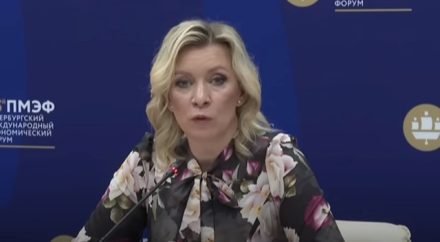
The European Union must decide whether it wants the Ukraine conflict to be resolved diplomatically or in a violent manner, Russian Foreign Ministry spokeswoman Maria Zakharova said at a briefing on Thursday.
Asked to comment on Austria’s reported proposal to host de-escalation talks, Zakharova said Moscow could only contemplate such initiatives after the EU figures out what it stands for regarding Ukraine.
“First of all, the EU should make up its mind about itself,” Zakharova said, urging the EU to decide whether it is pursuing a unified foreign policy or if decisions are handled by individual member states.
Russia, she said, has repeatedly heard “contradicting statements” coming from the EU. Zakharova noted that many supposed initiatives had been put forward by member states and were later retracted or never followed-up on because they were not approved by Brussels.
“Secondly, the EU also needs to make up its mind whether they support the talks [on Ukraine], or the battlefield solution, as [EU foreign policy chief Josep] Borrell had put it,” she said.
Zakharova’s comment comes after Borrell signaled on Wednesday that the EU was ready to seek a “diplomatic solution” to the conflict in Ukraine, but vowing that the bloc would continue to provide Kiev with military and financial support while ramping up pressure on Russia through sanctions.
However, in April Borrell issued a much different statement, claiming then that the conflict in Ukraine “will be won on the battlefield.”
Russia sent troops into Ukraine on February 24, citing Kiev’s failure to implement the Minsk agreements, designed to give the regions of Donetsk and Lugansk special status within the Ukrainian state. The protocols, brokered by Germany and France, were first signed in 2014. Former Ukrainian President Pyotr Poroshenko has since admitted that Kiev’s main goal was to use the ceasefire to buy time and “create powerful armed forces.”
During referendums that took place in late September, the two Donbass republics, along with Zaporozhye and Kherson Regions, overwhelmingly voted to join Russia. On Wednesday, Russian President Vladimir Putin signed into law unification treaties with former Ukrainian territories, officially making them part of Russia. Prior to this, the Russian leader vowed to use “all means” necessary to defend the country’s territorial integrity in the face of external threats.
Featured Video
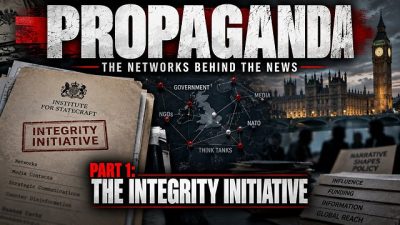
Integrity Initiative: UK-funded network framed dissent as Russian disinformation for years
or go to
Aletho News Archives – Video-Images
From the Archives
Why Saudi Ties to 9/11 Mean U.S. Ties to 9/11
By Kevin Ryan | Dig Within | September 27, 2015
Media interest in Saudi Arabian connections to the crimes of 9/11 has centered on calls for the release of the 28 missing pages from the Joint Congressional Inquiry’s report. However, those calls focus on the question of hijacker financing and omit the most interesting links between the 9/11 attacks and Saudi Arabia—links that implicate powerful people in the United States. Here are twenty examples. … continue
Blog Roll
 Aletho News
- IAEA inspectors cannot return to Iran amid US threats: Russia
- Senate Rejects Iran War Powers Resolution Passed By House
- ‘We did not attack Pakistan with drones’: Afghan sources
- Iraqi Resistance faction links arms to sovereignty, questions US exit
- Cannon fodder no more… South Korea rejects Trump’s pressure to join his criminal war on Iran
- Neria Leiter Was A Legitimate Military Target
- Integrity Initiative: UK-funded network framed dissent as Russian disinformation for years
- ‘We don’t seek permission to defend our country’: Snippets from President Pezeshkian’s UNGA address
- NATO chief wants Europeans to fight American wars [for Israel]
- German chemicals giant reveals details of downsizing
- If Americans Knew
- Israel displaces hundreds of Palestinians amid wave of demolitions in West Bank
- Aid, reconstruction, and Israel’s history of obstruction in Gaza
- Trump administration digs an ever-deeper hole of complicity in genocide – Daily Update
- US-Israel $2.8 Billion Arms Deal, 40,000-Bomb Supply Faces New Gaza Complicity Accusations
- Caught on Tape: AIPAC CEO Boasted of Controlling Trump’s National Security Officials
- Why Hamas Attacked Israel in October 2023 – Israeli professor Ilan Pappé
- They see them, then kill them: Israeli quadcopters track, deliberately target civilians in Gaza
- Winter could turn Gaza’s treacherous, war-damaged buildings into deathtraps
- Majority of Democratic Voters Want to Prosecute Both Biden and Trump Administration Officials Over Gaza
- As Gaza languishes, world leaders gather at the UN – Daily Update
- No Tricks Zone
- New Study: Earth And Venus Surface Warmth Largely Explained By Convection And Lapse Rate, Not CO2 Or Radiation
- 2025 Nature Paper Claiming Worsening Global Drought Gets RETRACTED …Heavily Flawed
- New Study: ‘Global Drought Shows No Detectable Recent Acceleration Under Climate Warming’
- Economic Masterminds: German Socialists Suggest Taxing Productivity Gains Stemming From Using AI
- The South China Sea Has Not Been Cooperating With The Climate Change Narrative
- Energy Crisis: Germany Enters Heating Season With Historically Low Gas Reserve Fill Levels
- New Study: The Antarctic Ice Sheet Gained Mass From 2020-2024 Due To Staggering Snow And Ice Accumulation
- Study: Ocean Heating Rates From Thousands Of Years Ago ‘Dwarf’ Modern Ocean Heating Rates
- Climate Extremists Target, Attack Large-Scale Power Grid Infrastructure In Germany!
- New Study: Antarctic Ice Melt Has Contributed Less Than 1 Centimeter To Sea Level Rise In The Last 30 Years

