Europe looks to Israel for natural gas
Samizdat | May 16, 2022
Deliveries of Israeli natural gas via Turkey to Europe are being considered as an alternative to Russian energy supply, Turkish newspaper Yeni Şafak reported on Monday.
“Israeli gas is considered as an option, its route is planned via Turkey, through the Eastern Mediterranean,” the paper reported, adding that, in case of such an agreement, “it is expected that the Turkish ship will be on duty during transmission periods.”
The report also highlighted that “focusing on deep-water drilling for the extraction of oil and natural gas from the seas, Turkey has included a fourth drilling vessel in its fleet.”
The new drilling ship, which left South Korea on March 7, is expected to arrive in Turkey on May 19. “A new generation ship that will serve in the Eastern Mediterranean, will begin its first mission in July after two months of preparatory work, it will facilitate deep-sea exploration and dredging in the Mediterranean,” the newspaper said.
The ship can reportedly operate at depths of up to 3,600 meters, and is capable of drilling up to 12,200 meters.
In March, media reported that a Turkey-Israel gas pipeline was being discussed behind the scenes as one of Europe’s alternatives to Russian energy. The idea, first conceived years ago, is to build a subsea pipeline from Turkey to Israel’s largest offshore natural gas field, Leviathan. Gas would flow to Turkey and on to southern Europe looking to diversify away from Russia.
Industry officials, however, have warned of production restraints and geopolitical factors that could leave the plan dead in the water. Lebanon has claimed that the gas field extends into its waters.
What Sanctions? Russian Oil Revenues Soar 50%, Hitting A Record High
By Tyler Durden | Zero Hedge | May 12, 2022
And the sanctions hits just keep on coming.
A few weeks after we learned that Russia’s current account just hit an all time high thanks due to soaring commodity exports (just as the US trade deficit blew out to a record high on its own) we learned that contrary to the intentions of European countries, a calculation by a German think tank found that Russia’s oil and gas revenues hit a record high in April, rising to 1.8 trillion rubles in a single month, after 1.2 trillion in March, leading to the following stunning statistics “After only 4 months, Russia’s federal budget has now already received 50% of the planned oil and gas revenue for 2022 (9.5 trillion).”
Today, Bloomberg confirmed this stunning statistic and, citing the latest IEA report, writes that Russia’s oil revenues are up 50% this year “even as trade restrictions following the invasion of Ukraine spurred many refiners to shun its supplies.” Apparently the restrictions – which pushed the price of oil to the highest level in a decade and boosted revenue for oil exporters – is precisely what Putin was hoping for.
Moscow earned roughly $20 billion each month in 2022 from combined sales of crude and products amounting to about 8 million barrels a day, the Paris-based IEA said in its monthly market report.
As we have documented frequently, Russian shipments have continued to flow freely even as the European Union edges towards an import ban, and international oil majors such as Shell and TotalEnergies have pledged to cease purchases. Countering these self-imposed sanctions, Asia has remained a grateful and keen customer, with China and India picking up cargoes no longer wanted in Europe, and doing so at a huge discount to spot.
Even as Russia has kept oil output steady, reduced flows of Russian refined products such as diesel, fuel oil and naphtha have aggravated tightness in global markets, the IEA noted, echoing what we have said virtually every day for the past month. Stockpiles have declined for seven consecutive quarters, with reserves of so-called middle distillates at their lowest since 2008.
For all the disruption, Moscow has continued to enjoy a financial windfall compared with the first four months of 2021. Despite the EU’s public censure of the Kremlin’s aggression, total oil export revenues were up 50% this year.
Hilariously, despite all the posturing and rhetoric, the bloc remained the largest market for Russian exports in April, taking 43% of the country’s exports, the IEA said.
There is some hope yet that Europe’s sanctions won’t be all for nothing: supplies were down 1 million barrels a day last month, and these losses could triple in the second half of the year, the agency estimates. EU sanctions against Russian state-linked enterprises such as production giant Rosneft PJSC will take effect on May 15, and the bloc is moving towards a full ban on the country’s supplies.
“If agreed, the new embargoes would accelerate the reorientation of trade flows that is already underway and will force Russian oil companies to shut in more wells,” the IEA said.
Russia stops gas transit through Poland
Moscow’s counter-sanctions ban the use of the Polish section of the Yamal-Europe pipeline
Samizdat | May 12, 2022
Russian energy major Gazprom said on Thursday it will not be able to use the Polish section of the Yamal-Europe pipeline for gas transit to Europe due to Moscow’s retaliatory sanctions.
Company spokesman Sergey Kupriyanov specified that the site belongs to EuRoPol GAZ, which is a joint venture between Gazprom and Polish gas major PGNiG. The latter is the operator of the Polish part of the Yamal-Europe gas pipeline.
On Wednesday, Moscow approved a list of companies in respect of which it will apply special economic measures. The list consists of 31 firms, including Polish EuRoPol GAZ, as well as the former German unit of Gazprom. The Russian-owned subsidiary was seized by the German authorities last month and could potentially be nationalized.
“For Gazprom, this means a ban on the use of a gas pipeline owned by EuRoPol GAZ to transport Russian gas through Poland,” the company said on its official Telegram channel.
Russian President Vladimir Putin decreed on May 3 that no Russian entity will be allowed to make deals with those on the sanctions list, or even fulfil its obligations under existing deals.
The decree forbids the export of products and raw materials to people and entities on the sanctions list.
Putin said the decree was in response to the illegal actions of the US and its allies meant to deprive Russia and its citizens and legal entities of property rights or to restrict their property rights.
The Yamal-Europe gas pipeline passes through Russia, Belarus, Poland, and Germany. Russia supplies nearly 40% of Europe’s overall gas demand, and this route accounts for nearly 15% of the country’s westbound deliveries. The pipeline has been operating in reverse mode recently, sending gas from Germany to Poland after Warsaw refused to accept Moscow’s demand to pay in rubles.
Ukraine’s partial gas cut to Europe could force activation of Nord Stream 2
Kiev attempts to blackmail Europe by partially halting gas flow from Russia
By Paul Antonopoulos | Aletho News | May 12, 2022
Ukraine’s decision to partially disable the flow of gas earmarked for Europe will be short-lived as it will not only cause major problems for the European economy, but it will also leave Kiev without billions of dollars in transit tax revenue – something it desperately needs as the economy is in ruin.
The Ukrainian gas transmission system operator (GTSOU) said it decided to suspend operations at a major transit point because of “interference by the occupying forces.” The decision to stop flows from Sokhranivka halts about a third of the Russian gas that arrives in Europe via Ukraine as the measuring station handles as much as 32.6 million cubic meters per day, according to GTSOU.
“As a result of the Russian Federation’s military aggression against Ukraine, several GTS facilities are located in territory temporarily controlled by Russian troops and the occupation administration,” the company said.
Kiev’s idea of transferring gas supplies from Sohranovka to the Suja gas station, which is in Ukrainian-controlled territory, has been dismissed by the Russian state gas company Gazprom as “technically impossible.” In addition, Gazprom said that it fulfills all its obligations to European consumers and delivers gas for transit in accordance with all contracts.
The disrupted transit of one-third of the gas that Europe needs would cause major damage to the continent’s economy. Europe already has less gas than it currently needs and the problem is not just that the price of gas will go up, but there will not be enough needed for industrial production.
If Russian gas does not arrive via Ukraine in the agreed quantity, Europe would have to consider extracting from reserves in underground storage facilities. The price of such gas will certainly be higher than in the case of gas arriving via Ukraine. Therefore, Kiev’s attempts to coax Europe into further involvement in the war with Russia will receive little accolade as it threatens Europe’s economy at a time when it is already suffering.
Kiev’s decision to reduce gas flows to European markets also means that it will suffer as it will lose transit fees that it desperately needs as its economy has stagnated. Another outcome that Ukraine did not consider is that it could force Europe to challenge the US’ opposition to the Nord Stream 2 pipeline. If Russian gas does not arrive via Ukraine, it could be the very catalyst needed to activate Nord Stream 2.
If Ukraine were to remain committed to reducing Russian gas flows to Europe, even at the expense of billions of dollars in transit fees, the question begs whether the EU would be willing to potentially run out of gas and/or see prices rise even further, or activate Nord Stream 2. Activating Nord Stream 2 would effectively mean the US’ failure after so much effort was made to prevent the pipeline from functioning.
For this reason, Ukraine’s decision to halt a third of Russian gas flows to Europe is likely a bluff as it needs all the money it can receive at the moment. At the same time, the Europeans hope to slowly wean themselves off Russian energy, understanding that an immediate cut is not sustainable and would collapse their economies.
Kiev’s incessant demand that Brussels put an embargo on Russian energy imports to the EU will be challenged so long as there are leaders, like Hungary’s Viktor Orban, who prioritize their state’s economy and people’s welfare, or entire major industries are threatened, such as Germany’s manufacturing and Greece’s shipping.
It is quite possible that this disunity and lack of consensus on the embargo in a situation where energy cannot be undermined, could force a rethink of Europe’s policies towards Moscow.
“We will have a peace to build tomorrow, let us never forget that,” Macron said in Strasbourg on May 9, adding: “We will have to do this with Ukraine and Russia around the table. The end of the discussion and the negotiation will be set by Ukraine and Russia. But it will not be done in denial, nor in exclusion of each other, nor even in humiliation.”
On the same day, he said in a tweet: “We are not at war with Russia. We work as Europeans for the preservation of the sovereignty and territorial integrity of Ukraine. For the return of peace to our continent. We will be there to rebuild Ukraine, as Europeans, always.”
However, despite the rhetoric of pan-Europeanism, Macron has already proven in deed that Europe’s elite are still very much under the orbit of Washington. If Ukraine are to partially halt the flow of Russian gas to Europe, the next test of Europe’s so-called “strategic autonomy” would be whether it activates Nord Stream 2 to protect their economic interests or continue following Washington’s demands on keeping the pipeline closed.
Paul Antonopoulos is an independent geopolitical analyst.
EU, UK join US in launching online ‘disinformation’ policies, ‘one-world governance’ of social media

By Michael Nevradakis, Ph.D. | The Defender | May 11, 2022
The European Union’s Digital Services Act (DSA) and the U.K.’s proposed Online Safety Bill are among the latest government policies designed to hold social media companies responsible for hate speech and “disinformation” posted by users.
Experts interviewed by The Defender expressed concerns about the potential slippery slope of regulations — in the U.S. and overseas — which, under the guise of “combating disinformation,” stifle the spread of information deemed inconvenient for governments and other powerful actors.
As reported by The Defender, in the U.S., these proposals include a government “disinformation board” and a bill pending before Congress, the Digital Services Oversight and Safety Act.
The EU’s new regulations, experts said, may have far-reaching impacts beyond Europe.
Michael Rectenwald, author of “Google Archipelago: The Digital Gulag and the Simulation of Freedom,” said he can foresee a future in which such regulations might affect all speech — not just speech on social media platforms.
Rectenwald told The Defender :
“[T]he EU’s DSA represents a major step toward one-world governance of social media and Internet search and one step closer to global government.
“Since the distinction between ‘on-line’ and ‘off-line’ activity will lose all meaning as the Internet includes the Internet of Things and Bodies, the DSA may become the law of the land.”
Is EU’s Digital Services Act on collision course with Musk’s Twitter plans?
In timing that coincided with Elon Musk’s intent to purchase Twitter, the EU announced April 23 the passage of the Digital Services Act (DSA).
The DSA seeks to tackle the spread of “misinformation and illegal content” and will apply “to all online intermediaries providing services in the EU,” in proportion to “the nature of the services concerned” and the number of users of each platform.
According to the DSA, “very large online platforms” (VLOPs) and “very large online search engines” (VLOSEs) — those with more than 45 million monthly active users in the EU — will be subject to the most stringent of the DSA’s requirements.
Big Tech companies will be obliged to perform annual risk assessments to ascertain the extent to which their platforms “contribute to the spread of divisive material that can affect issues like health,” and independent audits to determine the steps the companies are taking to prevent their platforms from being “abused.”
These steps come as part of a broader crackdown on the “spread of disinformation” called for by the Act, requiring platforms to “flag hate speech, eliminate any kind of terrorist propaganda” and implement “frameworks to quickly take down illicit content.”
Regarding alleged “disinformation,” these platforms will be mandated to create a “crisis response mechanism” to combat the spread of such content, with the Act specifically citing the conflict between Russia and Ukraine and the “manipulation” of online content that has ensued.
The DSA also will ban certain types of advertising on digital platforms, including targeted ads tailored to children or to people of specific ethnicities or sexual orientations.
Tech companies also will be required to increase transparency in the form of providing regulators and researchers “access to data on how their systems recommend content to users.”
This latter point appears similar to Musk’s plans to make Twitter’s algorithms “open source to increase trust.”
Companies violating the provisions of the DSA would risk fines of up to 6% of their total global annual revenue, while repeat offenses may result in the platforms being banned from the EU — despite the “open internet” principle professed by the principle of “net neutrality” enshrined in EU law.
According to Techcrunch, the DSA will not fully come into effect until early 2024. However, rules for VLOPs have a shorter implementation period and may be enforced by early 2023.
A spokesperson for the European Commission — the EU’s executive branch — said the new regulations will ensure Big Tech’s “power over public debate is subject to democratically validated rules, in particular on transparency and accountability.”
Margrethe Vestager, the vice president of the European Commission, added, “With today’s agreement we ensure that platforms are held accountable for the risks their services can pose to society and citizens,” and, “With the DSA we help create a safe and accountable online environment.”
Directly addressing Musk, the European Commission’s internal market commissioner, Thierry Breton, tweeted, “Be it cars or social media, any company operating in Europe needs to comply with our rules — regardless of their shareholding. Mr. Musk knows this well,” adding, “[Musk] is familiar with European rules on automotive [referring to Musk’s ownership of Tesla Motors], and will quickly adapt to the Digital Services Act.”
Separately, Breton stated, “We welcome everyone. We are open but on our conditions. At least we know what to tell him: ‘Elon, there are rules. You are welcome but these are our rules. It’s not your rules which will apply here.’”
Breton’s warning to Musk bears a striking resemblance to the statements of then-German finance minister Wolfgang Schaeuble, who in 2015 warned the newly elected left-wing Greek government not to entertain thoughts about renegotiating the austerity measures imposed on the country by the EU and International Monetary Fund, stating, “Elections change nothing. There are rules.”
Voice of America, a media outlet reflective of official U.S. government policy, reported “the job of reining in a Musk-led Twitter could fall to Europe,” referring to the DSA.
According to Gizmodo, the EU’s new legislation “could have global reverberations,” adding, “Lawmakers are also hoping it could serve as a model for other countries like India and Japan.”
However, Gizmodo warns the success of the DSA in accomplishing its objectives is far from guaranteed, referring to the example of the EU’s General Data Protection Regulation (GDPR): “Some predicted [the GDPR] would fundamentally shift online privacy protection worldwide, and instead [it] basically just gave us those insufferable cookie permission pop-ups.”
While the DSA would apply to all 27 EU member states, some of these countries have already enacted similar domestic legislation. For instance, Germany has regulations in place that require digital platforms to remove hate speech within 24 hours or face fines of up to €50 million ($56 million).
Techcrunch, in reporting on the passage of the DSA, referred to legislation in countries not frequently noted for their democratic traditions or respect for free speech, such as China, Turkey, India and Nigeria.
As Techcrunch stated, platforms in these countries found to be “non-compliant” with domestic mandates may face fines, police raids, shutdowns and prison sentences for their executives.
Similar regulations pending in U.K.
Legislation similar to the DSA, the Online Safety Bill, is pending in the U.K. It would require Big Tech platforms to moderate “illegal” and “harmful” content in order to be allowed to operate in the U.K.
The bill would require digital platforms to protect users from such “harmful” content, with the threat of fines of up to 10% of global turnover for companies found in violation, as well as potential prison time for senior managers of these companies in cases of non-compliance.
A spokesperson for the U.K. government said:
“Twitter and all social media platforms must protect their users from harm on their sites.
“We are introducing new online safety laws to safeguard children, prevent abusive behaviour and protect free speech.
“All tech firms with users in the U.K. will need to comply with the new laws or face hefty fines and having their sites blocked.”
Max Blain, a spokesperson for U.K. prime minister Boris Johnson, said, “Regardless of ownership, all social media platforms must be responsible” for “protecting” users.
As The Defender recently reported, Damian Collins, a member of the British parliament with the British Labour Party who led a parliamentary committee that developed the Online Safety Bill, is a board member of the Center for Combating Digital Hate, which partners with prominent “fact-checking” firm NewsGuard.
As previously reported by The Defender, NewsGuard, in turn, closely collaborates with the World Health Organization (WHO), which also recently expressed concerns about Musk’s purchase of Twitter.
As U.S., EU sign commitment to ‘democratic values’ on the internet as they prepare policies to regulate online speech
Overshadowed by the news of Musk’s Twitter purchase and developments such as the DSA and the Biden administration’s “disinformation board,” several dozen countries quietly signed the “Declaration for the Future of the Internet” April 28.
Fifty-six countries and entities, including the U.S. and the EU, signed this declaration, described as “a political commitment to push rules for the internet that are underpinned by democratic values” and a response to Russia “wielding internet disruptions as a part of its escalating attacks on Ukraine.”
U.S. News reports that the declaration — which is not legally binding — is the first of its kind globally, and “protects human rights, promotes free flow of information, protects the privacy of users, and sets rules for a growing global digital economy among steps to counter what two Biden administration officials called a ‘dangerous new model’ of internet policy from countries such as Russia and China.”
According to the U.S. State Department, the declaration’s principles include:
- Protect human rights and fundamental freedoms of all people.
- Promote a global Internet that advances the free flow of information.
- Advance inclusive and affordable connectivity so that all people can benefit from the digital economy.
- Promote trust in the global digital ecosystem, including through protection of privacy.
- Protect and strengthen the multi-stakeholder approach to governance that keeps the Internet running for the benefit of all.
In turn, the declaration was described by the EU as being “in line with the rights and principles strongly anchored in the EU.”
EU Commission President Ursula von der Leyen, known for her strong support of digital “vaccine passports” throughout the EU, stated:
“Today, for the first time, like-minded countries from all over the world are setting out a shared vision for the future of the Internet, to make sure that the values we hold true offline are also protected online, to make the Internet a safe place and trusted space for everyone, and to ensure that the Internet serves our individual freedom.
“Because the future of the Internet is also the future of democracy, of humankind.”
Thierry Breton remarked:
“This Declaration will ensure that the Internet and the use of digital technologies reinforce, not weaken, democracy and respect for human rights.”
According to the State Department, “[t]he Declaration remains open to all governments or relevant authorities willing to commit and implement its vision and principles.”
What does all this mean for Musk, Twitter and the future of free speech online?
Social media analysts and experts expressed varying opinions and predictions as to what regulations such as the DSA may mean for the global operations of digital platforms such as Twitter — especially if Musk attempts to make good on his pledges to “restore free speech.”
Vasilis Vasilopoulos, data protection officer with Greek public broadcaster ERT and a Ph.D. candidate in journalism and mass media studies at Greece’s Aristotle University, told The Defender there are some positive elements to the DSA.
However, the boundaries of what is considered free speech should also be expanded, albeit within certain limits, he said.
Vasilopoulos added:
“The DSA is not the only means through which the problem of unethical [social media] algorithms with deceptive motives, or the unethical use of social media platforms, can be solved.
“[I]t is obvious that these platforms have surpassed the limits to democracy that we believed existed, and therefore, it is important that instead of imposing restrictions, we expand these boundaries, in favor of humanity and not capital or power.”
Matthew Spitzer, professor at Northwestern University’s Pritzker School of Law, said the EU’s proposals in particular may clash with Musk’s stated goals for Twitter, telling The Defender :
“[The DSA] may interfere with one of Elon Musk’s stated goals for buying Twitter. He seems to want less content moderation. But this regulation requires a lot of it.
“Second, this regulation dovetails with Musk’s stated desire for increased transparency. He had promised more transparency.”
Spitzer added his view that the DSA will likely increase the cost of operation for all social media companies, especially if they must also conform to domestic laws passed by various EU member states.
He added that U.S. tech companies may represent an easy target for European regulators, telling The Defender :
“[T]here will be conflicts between the USA and Europe … all of the target companies started in the USA. They are easy political targets in Europe.”
Referring specifically to Elon Musk and Twitter, Rectenwald said:
“If Musk is to have his way, the platform would no longer discriminate against content based on ‘wokeness,’ political beliefs, or the adherence to official state narratives and dictates.
“This could include the restoration of banned accounts on request by users and dramatic changes to Twitter’s discriminatory, leftist algorithms.”
According to Rectenwald, the EU’s regulations may “hamstring” Musk’s vision for Twitter and lead to a one-size-fits-all approach to content moderation, resulting in a “slippery slope” wherein “any information and opinion that differs from WHO-established official narratives regarding pandemics or other health-related crises” would be restricted.
Rectenwald said:
“Most likely, in order to meet the EU’s regulatory requirements and to streamline their efforts, VLOPs and VLOSEs will simply apply one set of rules to all online content.”
He also added that further pressures on platforms like Twitter may come not from EU regulators, but from the tech industry itself:
“[P]ressure to conform to ‘woke’ dictates will come from the Big Tech ‘woke’ cartel, including threats to remove the Twitter app from the Apple Store for failure to censor ‘hate speech,’ and the flight of ‘woke’ advertisers.
“Most likely, Musk’s purchase of Twitter will make no difference as free speech is further curtailed.”
Michael Nevradakis, Ph.D., is an independent journalist and researcher based in Athens, Greece.
“Political European community” demands policy capitulation without EU benefits
Macron’s “European community” aims to completely align non-EU members with Brussels
Paul Antonopoulos | May 11, 2022
French President Emmanuel Macron said non-European Union countries, like the UK and Ukraine, could be offered a closer relationship with the bloc as part of a new type of “political European community”.
Speaking to the European parliament in Strasbourg on May 9, Macron said such an initiative would allow countries to decide on the level of integration they wanted with the EU. However, this loose form of political association is a rather hopeful attempt to unite all of Europe against Russia under the guise of aligning political and energy demands, but without giving non-EU countries like Ukraine participation in its institutions and financial funds.
It can only be imagined that such a “political European community” would exclude Belarus and Russia, and perhaps maybe even Serbia. The guise of uniting Europe’s energy and political policies will obviously be aimed towards Russia. It is almost certain Ukraine will continue to serve as a hostile country against Russia, except still without the ability to participate in European institutions or financial funds.
“It is our historic obligation … to create what I would describe before you today as a European political community,” Macron said. “This new European organisation would allow democratic European nations … to find a new space for political cooperation, security, cooperation in energy, transport, investment, infrastructure, the movement of people.”
However, it is more likely that the French president’s proposal comes in light of the fact that fatigue from EU enlargement remains ongoing. The inability to realistically expand the EU for new members is certain given all the difficulties the bloc has – from institutional-political crises, to energy problems, to failing to influence events in Ukraine.
Since the EU has opted to blindly follow US policy in Ukraine, even to the very detriment of member-states economies and the living standards of citizens, this proposal for a “political European community” is now an attempt by Macron to create a political manoeuvre to offer not only Ukraine, but probably other member-hopefuls like Moldova and Georgia, the possibility of participating in some form of new political alliance instead of full EU membership.
In this way, these countries would adhere to the political line of the EU but be denied the benefits that these states would have if they had full membership. The “political European
community” is effectively a manoeuvre by Macron to continue the façade that he supports “strategic autonomy” from Washington, something that was proven to be nothing but bravado when this policy was first tested in the context of the Ukraine war. For this reason, Macron is attempting to create an ad hoc framework for the political binding of states that cannot be admitted to the EU and thus force them to be dictated by Brussels on foreign policy matters, a small show of so-called European power.
It is likely that the most targeted countries will be in the Balkans and the Caucasus, but also Ukraine.
Since Kiev has opted for war and is backed by NATO and the EU, inclusion in this new political alliance would be important because they know they cannot achieve full membership, even if some member states, such as Poland and Lithuania, push and give political support.
During his speech, the French president said “we all know perfectly that the process of allowing (Ukraine) to join would take several years, in fact probably several decades.” Macron has not hidden away from the fact that Ukraine’s accession to the EU will likely take decades, but to ensure that Kiev does not give up in this ambition, the “political European community” proposal hopes to entice a capitulation to Western Europe’s interests. The reality is that such a “community” will actually serve as another EU lobby to force states such as Ukraine, Moldova and Georgia to follow Brussel’s geopolitical policies and interests.
Given Macron said a fast-track procedure for Ukraine would lead to lowering standards, in addition to suggesting the country’s accession process could take decades, his statement explicitly rules out full membership only for the sake of joining the blocs political line, which is now one of confrontation with Russia.
There will be an expectation for states to follow the EU’s geopolitical line in the context of the “political European community”, even though this will not contribute to progressing toward their EU membership. At the same time though, it can be expected that non-member countries will be punished in their accession process if they do not follow the EU’s demands.
With sanctions increasingly becoming unpopular in Europe as food and energy prices rise, leading to more countries challenging further sanction packages, adding voices from anti-Russia countries could also be a desperate attempt to make Europe appear far more united than it is. None-the-less, although it is likely that Ukraine, Georgia, Moldova and even the UK would welcome a “political European community”, it remains to be seen how effective it will be, and whether it will make Europe anymore united against Russia.
Paul Antonopoulos is an independent geopolitical analyst.
Ukraine turns off Europe-bound gas
Samizdat | May 10, 2022
Russian gas conglomerate Gazprom has received no confirmation of force majeure or any obstacles to continued transit of gas through a junction in Lugansk Region, the company said on Tuesday, after Ukraine’s operator OGTSU announced it would halt further deliveries starting May 11, due to the presence of “Russian occupiers.”
Gas Transit Services of Ukraine (OGTSU) declared force majeure on Tuesday, saying that it was impossible to continue the transit of gas through a connection point and compressor station located in the Lugansk area. As OGTSU personnel “cannot carry out operational and technological control” over the Sokhranovka connector point and Novopskov compressor station, the company cannot continue to fulfill its contract obligations, it said.
Gas from this connection will not be accepted into the transit system of Ukraine starting at 7 am on Wednesday, OGTSU said. Sokhrankovka accounts for almost a third of the Russian gas that transits through Ukraine to Europe – up to 32.6 million cubic meters per day – according to the operators.
Gazprom has received no confirmation of force majeure or disruption of operations at Sokhranovka or Novopskov, company spokesman Sergey Kupriyanov said on Tuesday. He added that Ukrainian specialists have had full access to both facilities all along, and there had been no complaints about it previously.
Kupriyanov also said that Gazprom has been notified by Ukraine’s gas company Naftogaz that if Russia continues to supply gas through Sokhranovka, Kiev will reduce the volume at the point of exit by the same amount, effectively confiscating the gas.
While OGTSU has proposed to reroute the gas to Sudzha, a connector located in the Sumy region and controlled by the Ukrainian government, Kupriyanov said this was “technologically impossible.”
“The distribution of volumes is clearly spelled out in the cooperation agreement dated December 30, 2019, and the Ukrainian side is well aware of this,” he said.
Gazprom is fulfilling all of its obligations to its European customers, with all the transit services in accordance with the terms of the contract and paid in full, Kupriyanov pointed out. Moscow has continued gas deliveries to Europe, including transit through Ukraine, regardless of the ongoing military operation and the embargoes against Russia imposed by the US and its allies in the EU.
Life Expectancy Continues To Fall In The EU
By Tyler Durden | Zero Hedge | MAY 7, 2022
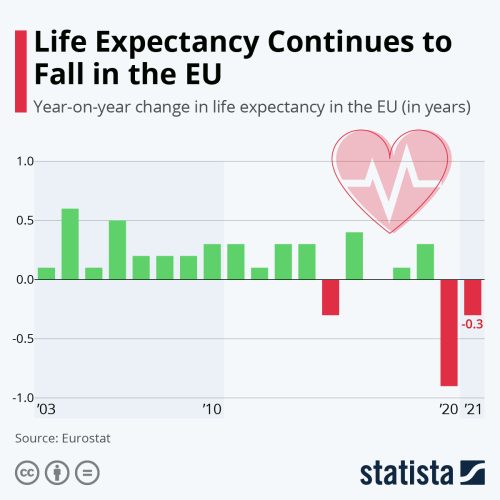
Life expectancy has taken a rare hit in the European Union during the Covid-19 pandemic.
As Statista’s Martin Armstrong shows in the infographic below (using Eurostat data), despite a blip in 2015, life expectancy in the EU had been growing every year since at least 2003.
In 2020, however, the average years of life somebody born in the 27 countries dropped from 81.3 to 80.4. In 2021, this fell again by another 0.3 years.
You will find more infographics at Statista
As reported by Eurostat,“life expectancy has risen, on average, by more than two years per decade since the 1960s. However, the latest available data suggest that life expectancy (has) stalled or even declined in several EU Member States.”adding:
“The Covid-19 pandemic has had a negative effect with life expectancy at birth declining in almost half the EU Member States in 2021. The largest decreases have been estimated in Slovakia and Bulgaria (-2.2 years compared with 2020), followed by Latvia (-2.1) and Estonia (-2.0). Compared with the pre-pandemic year of 2019, the overall effect on life expectancies is still negative in all EU Member States except Luxembourg (+0.1), Malta and Sweden (same level).”
European Commission’s plan to ban Russian oil imports receives backlash
By Paul Antonopoulos | May 6, 2022
The European Union announced on May 4 their intention to ban Russian oil imports within six months and refined products by the end of the year as part of their latest round of economic sanctions against Moscow. According to Oil Price, a barrel surged to over $110 for Brent and $108 for West Texas Intermediate following the European Commission’s announcement. Therefore, banning Russian oil imports is not only a rather arduous task, but the cost of this decision will be high.
“In the short term it might leave Russian revenues high while implying negative consequences for the EU and the global economy in terms of higher prices – not to mention retaliation risks [by Russia] on natural gas supplies,” Brussels-based economic think tank Bruegel warned following the European Commission’s announcement. However, an EU diplomat told EURACTIV on condition of anonymity that “Politically, Europe cannot afford not adopting the sixth package [of economic sanctions].”
The EU will be once again be divided as its rare instance of geopolitical posturing is being challenged by the economic interests of individual member states. Hungary and Slovakia oppose the European Commission’s proposal despite being given until the end of 2023 to phase out Russian oil. At the same time, Bulgaria and Czechia have also asked to be given such an extension.
Sources have said Greece raised objections to another proposal to ban all shipping companies that are EU-owned or have European interests from transferring Russian oil into Europe or elsewhere, something of major importance since the Mediterranean country has the largest mercantile fleet in the world. Although Athens deeply supports all of the EU’s hostile actions against Russia, such as the expulsion of diplomats, imposition of sanctions and even the sending of weapons to Ukraine that could have ended up in the hands of the Azov Battalion that has persecuted the Greek minority, threatening the profits of Greek oligarchs provokes one of the rare instances of opposition from Greece’s ruling New Democracy party.
New Democracy is traditionally the pro-US/neo-liberal party of Greece that has served the interests of the country’s oligarchs, or softly known as magnates or tycoons, particularly the shipowners. Consider that 71% of Greeks in a poll said Greece’s position in the Ukraine War should be neutral, something that was categorically ignored by the Greek government as it strongly backed Ukraine instead. However, the moment that the profits of shipowners are threatened, and not over the past few months as citizens have dealt with rising energy and food costs, Athens voiced its first concern against the EU’s anti-Russia sanctions.
Theoretically, although Russian oil can be phased out of most of the EU within six months, it will none-the-less be a very difficult task, especially when taking into account the fact that there is currently an energy shortage. In addition, the imposition of such a policy could lead to a build-up of shocks in the EU economy.
The Russian economy will naturally be affected as it will be deprived of a major market. But of higher concern, for European citizens at least, is the realization of the effects that anti-Russia sanctions has even on their own daily lives. And whilst Europeans suffer from rising energy and food costs, Asia could very much become Gazprom’s main export market in five to seven years.
Although this does not offset the loss of the EU as an oil market, shifting most exports to much friendlier Asian markets will lessen the effects of Western sanctions, even if this shift could take several years. Although the problem is the supply price and the development of the corresponding gas transport infrastructure, including in countries like China, it is recalled that Russian President Vladimir Putin made a directive to the government to submit a plan by June 1 on how to build related infrastructure. The directive requested a proposal for a large-scale development of a gas pipeline system in Eastern Siberia, aimed at directing the flow of gas exports to the Chinese market.
China currently consumes about 350 billion cubic meters of gas per year, while the majority of the energy balance (about 70%) remains coal. Demand for gas in China is expected to grow to 450-480 billion cubic meters by 2025 and in the next 10 years, as coal is phased out, perhaps even nearly one trillion cubic meters of gas per year.
Currently, Russian gas supplies to China arrive through the “Power of Siberia” pipeline. Deliveries along this route began at the end of 2019 and in 2020 reached 4.1 billion cubic meters. It is expected that the annual supply volume will gradually increase until it reaches its capacity of 38 billion cubic meters in 2025. Taking into account the new agreement signed in February, the total gas capacity supplied to China via the Far Eastern pipeline could reach 48 billion cubic meters per year.
In this way, although Russia will be hurt in the short term by losing the European market for its oil, this action will only propel the flow of Russian energy eastward to an Asia that is continuously increasing its demand. Equally of interest is that Europe persistently promises that sanctions against Russia cannot hurt European citizens in equal measure, but weaning off Russian oil within a six-month period will only increase the likelihood of such an outcome.
Paul Antonopoulos is an independent geopolitical analyst.
Is the West at war with disinformation or dissent?
By Rachel Marsden | Samizdat | May 5, 2022
When US President Joe Biden announced on April 27 that a new Disinformation Governance Board would serve the Department of Homeland Security, it was just the latest turn of the screw on freedom. This time, it’s an affront to citizens’ right to a diversity of information.
It’s one thing to correct inaccurate information, but this new entity seems more oriented towards narrative-policing that cracks down on the interpretation of information rather than the accuracy of it. Headed by a former communications advisor to the Ukrainian Foreign Ministry, Nina Jankowicz, one of the board’s first responsibilities will be to address “disinformation coming from Russia as well as misleading messages about the US-Mexico border,” according to CBS News. Interesting that these two issues – immigration and foreign conflicts – are currently viewed as two of Washington’s most significant failures, which have given rise to populist dissent. Make no mistake, it’s the dissent that’s the ultimate target.
The fact that a former Ukraine government spin doctor was viewed as the best person to head up the new initiative tells you everything you need to know about its true purpose. Jankowicz published a book in 2020 whose title suggests that she believes the West to be in an online war with Russia. ‘How to Lose the Information War: Russia, Fake News, and the Future of Conflict,’ portrays Western narratives as truthful and Russian narratives as “fake news.” Doing so obscures the fact that the mainstream Western media has not been immune to propagating narratives peddled by the state that could retroactively be considered fake news or war propaganda. Meanwhile, Russian media has often provided a platform for those seeking to express – or access – dissenting analysis or information that falls outside of the Western media bubble. Clearly, there are some ‘democracies’ that are bothered by this.
The appetite of Western nations to ensure that their citizens are only fed information that they control through their own highly concentrated government or corporate subsidized media isn’t new. It’s just getting more voracious. Perhaps it’s because the more authoritarian their agenda becomes, the more populist sentiment increases and gives rise to events such as Brexit or the election of Donald Trump, as well as trends such as opposition to US-backed conflicts, the rise in popularity of various populist political parties in Europe, and demonstrations against pandemic mandates, which just happen to be associated with government-issued QR codes.
Dissent is the enemy of authoritarian ambition. Supposedly free countries have manipulated their citizens into believing that censorship of certain views is for people’s own safety and security – hence why the military in Canada, the UK, and France, and now Homeland Security in the US, are involved in narrative policing. In reality, their efforts seem to be more about ensuring citizens’ compliance with their own agenda.
The fusion of domestic security and disinformation came to light as early as 2016, when the European Parliament grotesquely conflated Islamic terrorist propaganda with Russian media, in what seemed to be itself a propaganda effort to undermine the Russian media by equating these two totally unrelated things. But one by one, Western governments have placed free speech under national security control.
France, for example, handed off responsibility for online information arbitration to its domestic intelligence agency (the DGSI) and has reportedly considered involving defense-funded startups in the effort.
Canada has also turned to its security apparatus to shape Canadians’ information landscape – at least twice. The Communications Security Establishment, the country’s electronic spying agency, has been tweeting its own interpretations of disputed events occurring in the fog of the conflict in Ukraine as indisputable fact, while routinely denouncing Russia’s interpretation as invalid.
But Canada’s security establishment isn’t at its first rodeo in attempting to prevent citizens’ thinking from deviating from the state’s messaging. Under Prime Minister Justin Trudeau, the country’s armed forces deployed a months-long, military-grade propaganda campaign, which employed tactics honed during the war in Afghanistan, to mind-bend unsuspecting Canadians towards Trudeau’s Covid narrative, CBC News reported last year.
Not to be outdone, the psychological warfare specialists of the 77th brigade of Britain’s armed forces have also worked to shape messaging both in favor of the government’s Covid policies and against anything contrary out of Russia. “One current priority is combating the spread of harmful, false and misleading narratives through disinformation. To bolster this effort, the British Army will be deploying two experts in countering disinformation. They will advise and support NATO in ensuring its citizens have the right information to protect themselves and its democracies are protected from malicious disinformation operations used by adversaries,” Defense Secretary Ben Wallace said last year.
The fact that public safety and disinformation have suddenly become routinely conflated should be worrisome to defenders of whatever remnants of democracy that we still have left. Terrorism, health and now disinformation have all served as pretexts for the rapid erosion of our freedoms – all under the guise of protecting us from bad actors. But are we really safer? Or are we just increasingly less free?
Slovakia rejects Russian oil ban proposal
Samizdat | May 5, 2022
Slovakia warned on Wednesday that it will not be able to agree to the European Commission’s proposal for a ban on Russian oil, and has called for more time to find alternative fuel suppliers.
The proposed embargo is part of the latest Ukraine-related sanctions against Moscow that would see crude imports from Russia phased out within six months and refined products by the end of the year. An exemption was drafted for Slovakia and Hungary, which are heavily dependent on Russia, giving them until the end of 2023 to comply.
The proposed time frame “is unfortunately not enough,” Slovakia’s deputy economy minister in charge of energy policy told internet publication Politico on Wednesday. “We are expecting at least three years,” Karol Galek added, explaining that a key refinery in the country requires heavy Russian oil and that it’s impossible to secure alternative supplies within the proposed time frame. Last year Slovakia got 96% of its oil from Russia.
Galek stressed that the current proposal “will destroy our European economy,” as it will not only hurt energy supplies in his country, but also in Austria, the Czech Republic and Ukraine.
The current blueprint for a ban on Russian oil has to be unanimously approved by the bloc’s 27 member states to come into force. Hungary has expressed reservations, saying the European Union has so far failed to give Budapest guarantees regarding its energy security.
Featured Video

EUROPE FEARS RUSSIA’S NEXT MOVE / Ian Proud
or go to
Aletho News Archives – Video-Images
New Book
New Book: No Autoimmunity The Body Doesn’t Attack Itself
Lies are Unbekoming | September 24, 2026
 The label for Humira, once the best-selling drug in the world, lists its risks in plain print. One of them, in the label’s own words, is new “autoimmune” disease.
A drug prescribed for a condition labelled autoimmune carries a warning that it can cause a condition labelled autoimmune. That contradiction sits in every box, on a folded paper almost nobody reads.
My new book starts there.
No Autoimmunity: The Body Doesn’t Attack Itself
For seventy years, “your body is attacking itself, and we don’t know why” has ended the conversation for people diagnosed with multiple sclerosis, lupus, rheumatoid arthritis, Hashimoto’s, Type 1 diabetes, Crohn’s and psoriasis. More than eighty conditions now carry the autoimmune label. The diagnosis comes with a prescription for life. It almost never comes with a question about cause.
This book asks the question and answers it from the framework’s own records: its drug labels, its journals, its regulatory filings, and its own experiments. … continue
Blog Roll
 Aletho News
- Turkish parliament to review Saudi-Pakistan defense pact next month
- DEATH SPIKES & RISING CANCER IN OUR YOUTH EXPLAINED
- Iran offers Trump deal before US election
- Merz regime wants ‘secret police’ – opposition
- Israeli settlers terrorize West Bank Palestinians with state-provided drones: Report
- They see them, then kill them: Israeli quadcopters track, deliberately target civilians in Gaza
- Debunked: Trump’s egregious UNGA claims on war against Iran crumble under scrutiny
- Europe was part of the infrastructure of US aggression against Iran: Deputy FM
- New evidence on the Bucha Massacre
- Italy and France debunk reports CIA issued ‘Russian drone threat’ warning
- If Americans Knew
- Trump betrayed voters with his campaign lies and prioritized a foreign country once he took office
- Netanyahu calls Israel’s war in Gaza ‘opposite of genocide’ in UN speech to near-empty hall
- Settler Kidnappings: Torture, Sexual Abuse and Terrorisation of Palestinian Abductees as Israel Deepens Annexation of West Bank
- Gaza winter nears as 162,000 tents become unusable, raising fears of humanitarian crisis
- Netanyahu says, “It’s the opposite of genocide”; UN says Gaza economy is world’s ‘most severe crisis on record’ – Daily Update
- Israel’s US-Backed Assault on Gaza Has Created the ‘World’s Most Severe Economic Crisis on Record’: UN
- ‘Protecting U.S. Citizens’… From Israel
- ‘This is where I live now, the back of a truck’: a day in the life of a grandmother in Gaza
- In UN Speech, Iran’s President Displays Pictures of Children Killed by US, Brings Attention to Israel’s Nuclear Arsenal
- Israel displaces hundreds of Palestinians amid wave of demolitions in West Bank
- No Tricks Zone
- New Study: Earth And Venus Surface Warmth Largely Explained By Convection And Lapse Rate, Not CO2 Or Radiation
- 2025 Nature Paper Claiming Worsening Global Drought Gets RETRACTED …Heavily Flawed
- New Study: ‘Global Drought Shows No Detectable Recent Acceleration Under Climate Warming’
- Economic Masterminds: German Socialists Suggest Taxing Productivity Gains Stemming From Using AI
- The South China Sea Has Not Been Cooperating With The Climate Change Narrative
- Energy Crisis: Germany Enters Heating Season With Historically Low Gas Reserve Fill Levels
- New Study: The Antarctic Ice Sheet Gained Mass From 2020-2024 Due To Staggering Snow And Ice Accumulation
- Study: Ocean Heating Rates From Thousands Of Years Ago ‘Dwarf’ Modern Ocean Heating Rates
- Climate Extremists Target, Attack Large-Scale Power Grid Infrastructure In Germany!
- New Study: Antarctic Ice Melt Has Contributed Less Than 1 Centimeter To Sea Level Rise In The Last 30 Years

