Belarus Warns to Consider Tikhanovskaya’s Meeting With EU Foreign Ministers Meddling
Sputnik –
MINSK The participation of former Belarusian presidential candidate Svetlana Tikhanovskaya in the upcoming meeting of EU foreign ministers next week will amount to interference in Belarus’ internal affairs, Belarusian Foreign Ministry spokesman Anatoly Glaz said on Saturday.
“It could certainly be funny and curious if it were not so sad. It is quite obvious, in fact, that such actions, if any, are an impudent and open interference in the internal affairs of our country and complete disrespect for its citizens,” Glaz said.
“Why hold any elections at all if it is possible to simply appoint someone all the way convenient from abroad and pretend to build a relationship with them?” the spokesman said.
If the meeting ends up taking place with Tikhanovskaya’s participation, Glaz said there would be no need left to prove that “a course to undermine Belarus’ sovereignty is being implemented.”
“Of course, our principled and understandable position on this matter has already been communicated to the EU envoy in Minsk, as well as to the relevant persons in Brussels,” the spokesman added.
EU foreign ministers are scheduled to convene this upcoming Monday in Brussels. Tikhanovskaya’s press secretary Anna Krasulina has confirmed the Lithuanian-exiled Belarusian ex-presidential candidate’s attendance.
European Parliament calls for international probe into alleged Navalny poisoning & suspension of Nord Stream 2 gas pipeline
RT | September 17, 2020
The European Parliament has pushed to halt construction of the Nord Stream 2 gas pipeline between Germany and Russia, and for an international investigation into the alleged poisoning of Russian opposition figure Alexey Navalny.
A resolution passed on Thursday called on European Union member states to “continue to isolate Russia in international forums,” encouraging the European Council “to prioritize the approval of the EU Magnitsky-style human rights sanctions” against what it called “the Russian regime.” The ‘Magnitsky’ sanctions are named after a Russian tax auditor, and associate of American-turned-British billionaire Bill Browder, who died in a Moscow prison in 2009.
532 MEPs voted for the resolution, 84 were against and 72 abstained. A total of 688 out of the registered 705 MEPs took part in the voting. It’s important to note that the measure is advisory and not legally binding, but rather intended as an advisory for EU governments.
The European Parliament also reiterated its “previous position to halt the Nord Stream 2 project.” This is a gas pipeline set to connect Germany directly to Russian energy supplies.
“It is necessary to immediately start an international investigation, with the participation of the EU, United Nations, Council of Europe and the Organisation for the Prohibition of Chemical Weapons,” the resolution states. It names Alexey Navalny as “a leading Russian opposition politician, lawyer, blogger and anti-corruption activist” who has become “one of the few effective leaders of the Russian opposition.”
The vote on Thursday took place without a debate – there had been discussion on Tuesday in the parliament.
Earlier this month, European Commission President Charles Michel condemned “in the strongest possible terms the attempt to silence opposition leader (sic) Navalny.”
Sanctions against the Russian authorities have been rumored ever since news of Navalny’s alleged poisoning first broke. In late August, US Deputy Secretary of State Stephen Biegun explained that Washington was prepared to take strong measures against Moscow, which would make sanctions related to the 2016 US presidential election “pale in comparison.”
Merkel Saves Nord Stream 2 With a Cunning Trick
By Gevorg Mirzayan | Stalker Zone | September 10, 2020
The German Chancellor said that the fate of the most important Russian gas pipeline “Nord Stream 2” will be decided not by Germany, but by the European Union as a whole. This is how she sees the response to the situation with Aleksey Navalny. It may seem that this is a terrible omen for the gas pipeline, which has already seen billions of euros invested into it for construction. But what did Angela Merkel really mean?
The fate of Nord Stream 2 was again in question. No sooner had the project’s supporters celebrated the removal of the Danish obstacle (Copenhagen, after much delay, gave permission for the pipe to be laid through its territorial waters) than Germany, which until recently was an advocate for construction and one of the main beneficiaries of construction, began to seemingly make obstacles.
Berlin, dissatisfied with the position of Moscow in the case of Aleksey Navalny, intends to put the question of a possible curtailment of the project to a pan-European discussion. Why does Angela Merkel want to close “Nord Stream 2” – and does she in general want to?
Legacy
Germany has long called for putting an end to “Nord Stream 2”, which in the understanding of a number of western activists “increases Europe’s dependence on Russian energy carriers”. They did not even require Angela Merkel to deliver a funeral speech over it. “The easiest option for Germany would be to simply withdraw its support for Nord Stream 2, allowing American and European critics to kill it,” the BBC writes. And now, against the background of the Navalny case, the aggressiveness of the project’s opponents has increased by an order of magnitude.
Until recently, it seemed that they were banging their heads against the wall of German pragmatism. Germany’s position on Nord Stream 2 was really reinforced concrete: German Chancellor Angela Merkel said that she was dissatisfied with the lack of cooperation with Moscow in the case of the “poisoning of Aleksey Navalny”, but was not going to abandon Nord Stream 2 because of this. After all, as German Foreign Minister Heiko Maas correctly notes, “those who call for the cancellation of the project should understand the consequences of such a step”.
Firstly, Berlin needs Nord Stream 2 from an economic point of view. “Germany has a very weak position in terms of energy. They are closing a lot of power plants – nuclear, coal,” says Donald Trump. Germany and the EU do not have reliable suppliers of cheap gas that are an alternative to Russia. In addition to getting cheap blue fuel (much needed for the export-oriented economy of Germany), Germany will earn good money on the transit of Russian gas, becoming a hub country.
“If the project is stopped, the German consumer will pay for it,” said Klaus Ernst, a member of the Bundestag from the Die Linke party. In addition, Berlin is also thinking about the security of Europe under its patronage – the internal political situation in Ukraine is deteriorating, and no one can guarantee that the militants not controlled by Kiev will not decide to stop the gas export of the “aggressor country” to Europe. Well, or threaten to stop if the EU does not issue another loan to Kiev.
Finally, the issue of reputation is also important. Angela Merkel was not just a supporter of Nord Stream 2, but also a lawyer. She defended the project against those who advocated abandoning infrastructure projects with “Putin’s Russia” – human rights activists, urban lunatics, agents of influence of the US. If now, because of the Navalny case, Merkel changes her position on the “stream”, then she will be criticised for political short-sightedness.
Moreover, by both opponents of Nord Stream 2 (for catching on too late) and supporters of the project, who are dissatisfied with the fact that Angela Merkel has called into question Germany’s energy security because of some political matter. Not to mention the fact that it caused serious damage to German business (Uniper and Wintershall invested almost a billion euros each in Nord Stream 2). And since Frau Chancellor leaves her post at the end of 2021, it is important for her who she will remain in history.
“It all depends on the Russians”
However, Angela Merkel’s pragmatism seemed to be beginning to bend under the pressure of numerous critics and human rights activists calling for “punishing Putin for another poisoning of an opponent”. In their opinion, Germany is the leader of the European Union and (against the background of Donald Trump’s actual refusal to “protect freedom around the world”) a potential leader of the entire liberal community, so it has no right to stay away from the Navalny case. Therefore, Angela Merkel announced the possibility of imposing sanctions against Nord Stream 2 ,and, according to media reports, intends to initiate a pan-European response to the case of Aleksey Navalny. And gather all the EU countries together to decide how to respond to Russia’s behaviour – and part of this reaction may be the suspension of Nord Stream 2.
This suspension will be a serious blow to Moscow. After all, this is not just about an important infrastructure project – there are much bigger things at stake. “The curtailment of Nord Stream 2 will send a clear signal with long-term consequences: German business will leave the Russian market even faster, and Vladimir Putin’s attempts to modernise Russia with the economic assistance of EU countries will finally turn to dust,” writes Deutsche Welle correspondent Miodrag Soric. At the same time, as they make it clear in Berlin, the blow can be avoided. “Our further actions depend on the behaviour of the Russians,” explains German Health Minister Jens Spahn.
“I hope the Russians won’t force us to change our position on Nord Stream 2,” says Heiko Maas, alluding to the fact that the Kremlin is expected to fulfil European demands concerning the Navalny case, and that they are waiting for prompt implementation, and “not by the end of the year or even within a few months”. These demands are very simple and not burdensome – not taking the blame, but just admitting the fact of poisoning, as well as starting an investigation.
Why shouldn’t they be implemented?
One of the reasons is as old as the Russian-west conflict. Moscow does not want to create a dangerous precedent for itself. The Kremlin, in fact, is being forced to admit a politically motivated accusation – after all, the Bundeswehr, whose laboratory declared “the indisputable fact of Navalny’s poisoning”, refused to provide the Russian authorities with any material evidence, citing “the secrecy of the methods and procedures used”.
If Russia now accepts this position on faith under the threat of sanctions, then the inspired western partners will threaten the same sanctions and issue other ultimatums: non-interference in the affairs of Belarus, withdrawal from Syria, etc. And this is not to mention the organisation and information support of other provocations that should be expected before the difficult political transit in Russia in 2024. If the blackmailer issues an ultimatum, the only way to escape from it is to refuse to fulfil any, even the most insignificant demands.
Divergence?
In addition, it makes no sense for Russia to make concessions to Berlin, because the position of Angela Merkel has never changed. Germany, as before, is not going to close Nord Stream 2 – it just behaves more elegantly and cunningly. Yes, it is partly bluffing for the sake of forcing Moscow to make concessions – but at the same time it may be an elegant attempt by Frau Chancellor to pass between the European trickles. By putting the issue up for European discussion, Angela Merkel is calling out those who support punishing Russia, confirming her political leadership – and at the same time putting a tricky block on accepting any tough sanctions.
The fact is that decisions at such meetings should be made by consensus. And if Angela Merkel had raised the question of approving the construction of Nord Stream 2, she would not have received a green light – after all, a number of EU countries (Poland, the Baltic states) are categorically opposed to the implementation of this infrastructure project. However, Frau Merkel (apparently) will ask about something else – should Russia’s punishment for the Navalny case be extended to Nord Stream 2? And here one should not expect any consensus on the completion of the project – the positions of the European countries are too different.
Recall that the pan-European decision concerning the Skripal case was only the collective expulsion of a certain number of Russian diplomats.
And this is despite the fact that back then the grounds for sanctions were much more serious than now. Firstly, there were at least some grounds for blaming Russia for what happened – there was a recording of “Petrov and Boshirov” arriving in Salisbury, as well as information provided to the media that these people work for the Russian special services. Secondly, it was about the use of weapons of mass destruction on the territory of the European Union, which can be interpreted as an attack by the Russian Federation on European citizens. Whilst here we are talking at best about poisoning – without any evidence of Russian guilt. And Moscow can only be accused of unwillingness to take Europe’s word for it. The most important infrastructure projects are not stopped for this by respected countries.
Angela Merkel’s proposal has another advantage for Russia – it protects (at least for a while) Nord Stream 2 from threats from other EU states. There is a risk that some less conscious countries (for example, Denmark) may take their own sanctions against the project. For example, revoke permission to lay a pipe through their waters. Bringing the issue to a pan-European discussion puts unilateral sanctions on pause.
And since Navalny is not dead, but is on the mend, time will cool the hot European heads, and the idea of blocking Nord Stream 2 will go off the agenda. At least for a while.
Venezuelan Government Invites International Observers as Opposition Splits Over Elections
By Ricardo Vaz | Venezuelanalysis | September 4, 2020
Mérida – The Venezuelan government has invited the United Nations (UN) and the European Union (EU) to monitor the December 6 National Assembly (AN) elections.
Foreign Minister Jorge Arreaza wrote on Twitter that letters had been sent to UN Secretary General Antonio Guterres and EU Foreign Policy Chief Josep Borrell explaining electoral guarantees and inviting the bodies to send observers.
“Your participation in this process will have a positive contribution to an atmosphere of democratic understanding between Venezuelans and support political, peaceful and negotiated solutions to existing issues,” the letter read.
At the time of writing there have been no reactions from either the UN or the EU. While both have previously voiced support for dialogue processes, the European bloc recently vowed not to recognize the parliamentary election, which will elect 277 deputies for the 2021-2026 term.
The appeal to the international instances comes on the heels of President Maduro granting pardons to 110 opposition figures. This includes a number of AN deputies and other leaders charged or convicted for taking part in activities such as the violent “guarimba” street protests, the 2018 assassination attempt against Maduro, or the April 30, 2019 failed putsch.
On Thursday, the ruling United Socialist Party of Venezuela (PSUV) and its allies submitted their electoral candidates, with eight current cabinet members heading the list and subsequently replaced. Current state television VTV president Freddy Nanez replaced Jorge Rodriguez as communications minister, Noris Herrera replaced Blanca Eekhout as communes minister, Carolys Perez took over from Asia Villegas as minister for women, while there were also changes at the prisons, mining, youth, urban agriculture and indigenous peoples ministries.
The electoral scenario has also led to bitter infighting amongst the opposition ranks. On Wednesday, two-time former presidential candidate Henrique Capriles called on opposition leader Juan Guaido to stop “playing at government on the internet.”
“Either you’re the government, or you’re the opposition. You can’t be both,” he said during an online broadcast.
The comments came in response to criticism from Guaido after Capriles and fellow opposition member Stalin Gonzalez held a meeting with Turkish Foreign Minister Mevlut Cavusoglu concerning electoral participation and guarantees.
“These negotiations were held without the knowledge and permission of the ‘Interim Government’ and our international allies,” read a statement published by Guaido’s office.
The opposition lawmaker proclaimed himself “interim president” in January 2019 and was immediately backed by Washington and its allies. He went on to lead several unsuccessful efforts to overthrow the government by force, but a host of scandals saw his position increasingly questioned by other high-ranking opposition figures.
Guaido has lobbied for a boycott of the December AN elections and called on opposition figures to join a “unitary path” to oust the Maduro government which would extend his “interim presidency” into 2021.
However, other anti-government politicians have refused to rally behind him, with some urging voters to take to the polls, and hardline figures such as Maria Corina Machado calling for a foreign intervention.
For its part, Washington downplayed talk of a possible military intervention, with the Trump administration’s Special Representative for Venezuela Elliott Abrams criticizing opposition leaders “who only think that the magic moment of a military intervention will arrive” in a recent interview.
However, the veteran official, who is known for his role in the Iraq war and the Reagan administration’s Central America policy, has reiterated that the US will continue supporting Guaido while tightening sanctions against the Venezuelan economy.
Stoltenberg to Convene NATO Meeting on Friday to Discuss Navalny Situation
Sputnik – 03.09.2020
NATO Secretary-General Jens Stoltenberg will convene an emergency meeting on Friday to discuss the situation involving Russian opposition figure Alexey Navalny, the alliance’s spokeswoman, Oana Lungescu, said on Thursday.
Navalny is currently undergoing treatment in a German hospital after suffering a medical emergency in late August. Berlin on Wednesday said that a German military laboratory possessed undeniable proof of the 44-year-old’s intoxication with a nerve agent from the Novichok group. The Russian Foreign Ministry noted in response that the German government’s claims of Navalny’s poisoning lacked evidence and added that it was perplexing why Berlin first addressed the EU, NATO and third parties, such as the Organization for the Prohibition of Chemical Weapons, instead of contacting Russia directly.
Lungescu took to Twitter to announce the upcoming meeting.
Kremlin spokesman Dmitry Peskov said earlier in the day that there had been no contacts between Russian President Vladimir Putin and German Chancellor Angela Merkel on the issue of Navalny. He also noted that Russia was interested in shedding the light on the situation as much as anyone else, however, Germany did not provide any information.
EU Urges Russia to Cooperate With OPCW in Navalny Case for Impartial Probe, Borrell Says
The European Union urges Russia to cooperate with the Organization for the Prohibition of Chemical Weapons (OPCW) in the situation with Russian opposition figure Alexey Navalny to ensure an impartial international investigation, EU foreign policy chief Josep Borrell said in a statement.
“The European Union condemns in the strongest possible terms the assassination attempt on Alexei Navalny. … The European Union calls upon the Russian Federation to fully cooperate with the Organisation for the Prohibition of Chemical Weapons (OPCW) to ensure an impartial international investigation,” the statement says.
The EU is calling for an international response to the situation with Navalny and reserves the right to impose sanctions, Borrell added.
The EU will continue to closely monitor the situation and consider possible implications, he said.
Germany, France & UK REJECT US push to reinstate UN sanctions on Iran
RT | August 20, 2020
The US exited the Iran nuclear deal and therefore has no right to demand a ‘snapback’ of UN sanctions on Tehran, the foreign ministers of three European powers involved in the JCPOA said in response to Washington’s latest push.
“France, Germany and the United Kingdom, the so-called E3, note that the United States has not been a member of the JCPOA since their withdrawal from the agreement on May 8, 2018,” their respective foreign ministers Jean-Yves Le Drian,Heiko Maas and Dominic Raab said in a statement on Thursday.
Therefore, the E3 “cannot support” the US demand for UN sanctions against Iran to be reimposed, as it is “inconsistent” with their current efforts to implement the deal, the trio added.
JCPOA stands for the Joint Comprehensive Plan of Action, the name given to the 2015 nuclear agreement negotiated by the Obama administration, endorsed by all five permanent members of the UN Security Council and Germany.
Citing UNSC Resolution 2231, which codified the deal, US envoy to the UN Kelly Craft officially requested the “snapback” of sanctions on Thursday, accusing Iran of “significant non-compliance” with the deal. However, China has previously pointed out that the US is not eligible to make that request, having exited the treaty unilaterally. The E3 statement indicates the Europeans share Beijing’s stance on the issue.
The E3 statement came during the press conference US Secretary of State Mike Pompeo was giving at the UN, declaring confidently that the rules of the Security Council are “straightforward” and will lead to the sanctions being restored.
Weaponized media coverage & off-the-scale hypocrisy as the West promotes ‘regime change’ in Belarus
By Neil Clark | RT | August 19, 2020
Lukashenko has always admitted his style is authoritarian but notwithstanding this, media coverage of the crisis in Belarus has been slanted and the West’s condemnation of the crackdown on protests reeks of double standards.
You can tell a ‘regime change’ is afoot in Minsk simply by looking at the coverage of Radio Free Europe/Radio Liberty. Their website at the weekend was headed by a large caption ‘Post election crackdown in Belarus’, which has now changed to ‘Crisis in Belarus‘. The five lead articles on Sunday were all about Belarus. It’s the same on Tuesday.
Radio Free Europe/RL is funded by the US Congress through the United States Agency for Global Media. Up to the early 1970s it was funded covertly by the CIA.
It was a soft-power tool of the old Cold War, sometimes with calamitous consequences. In their book ‘Cold War’, Jeremy Isaacs and Taylor Downing tell how in the Hungarian Uprising of 1956 “Radio Free Europe, the CIA-backed station that broadcast into Eastern Europe, was dramatically talking the situation up, proclaiming the West’s backing for what it called Hungary’s ‘freedom fighters.‘”
But the backing never came, and indeed was never likely to come and the uprising, having been encouraged by RFE, was ruthlessly suppressed.
You might have thought RFE/RL would have been wound up in 1989 when the Berlin Wall came down, but there was still a job to do.
It says it reports the news in countries where a free press is banned by the government or not fully established and while some of its journalism is perfectly fine the truth is that it usually stops reporting once a country is locked into Euro-Atlantic security structures. When it starts broadcasting to a country it’s invariably a sign that the US ‘Deep State’ wants its government toppled. For example, in 1998 it began broadcasting to Iraq, and we all know what happened there five years later. RFE/RL is undoubtedly ‘state-affiliated media’ yet you won’t see that warning attached to its tweets, as you now see attached to RT when it tweets this article.
It’s no great surprise that Franak Viacorka, the journalist and social media promoter of the anti-Lukashenko protests has worked for RFE/RL. As flagged by Ben Norton last week, Viacorka’s organization DigiCom.Net details his close link to US bodies. Viacorka works for the US Agency for Global Media, the parent of RFE/RL and has served as a ‘creative director’ for the Belarus service of Radio Free Europe, as well as being a consultant for the US State Department-funded ‘Freedom House’. He is also a non-Resident Senior Fellow of the Atlantic Council, his appointment lauded by Michael McFaul, the former US Ambassador to Russia.
To be fair to Viacorka he is absolutely open about his US connections and in fact seems very proud of them. And they don’t mean the 32-year-old isn’t genuine about his commitment to ‘democracy and personal freedom’. That’s even though he appeared to make criticism of Lukashenko’s Covid-19 policies (the Belarusian leader failed to impose a draconian lockdown such as we’ve seen in many Western countries), on a NBC programme earlier in the year. (You can watch that here)
Also gunning for Lukashenko is the Economist, the bible for neoliberal globalists. This week, the magazine denounced the “West’s response” to what was going on in Belarus as “feeble.”
It referred to Lukashenko as “a 65-year-old dictator.” The language of the Economist has been unusually emotional of late, showing they want regime change in Minsk quite badly. Yet in January 2019 they referred to the Belarusian leader more respectfully as “Mr Lukashenko” and said he was “no ordinary politician.” That was when they thought he was upsetting Vladimir Putin and “cosying up to the West.”
One suspects that if Lukashenko announced he had won 80 percent of the vote but then said he was going to promptly apply to join NATO, the EU and sell off the entire economy to Western finance capital, as well as imposing a ‘Covid lockdown’, the Economist would not be quite so angry.
Hypocrisy was also on show from the very grand EU Commission President Ursula von der Leyen. “We need additional sanctions against those who violated democratic values or abused human rights in Belarus,” von der Leyen declared on Twitter.
We are still of course waiting for the EU sanctions, additional or otherwise on Spain for the authorities’ crackdown on Catalan protesters in 2017 and the jailing of nine separatist leaders.
Or sanctions on France for the brutality meted out to the ‘Gilets Jaunes’ street protesters, who did not receive globalist approval.
How convenient after all that has gone on in 2020, that Belarus and the big bad Lukashenko is there to allow Western virtue signallers and self-proclaimed ‘liberals’ the chance to show off how much they care about ‘democracy’ again. While supporting the curtailing of basic human freedoms still further in their own countries.
Neil Clark is a journalist, writer, broadcaster and blogger. His award winning blog can be found at http://www.neilclark66.blogspot.com. He tweets on politics and world affairs @NeilClark66
Russia takes Europe’s support to calm Belarus
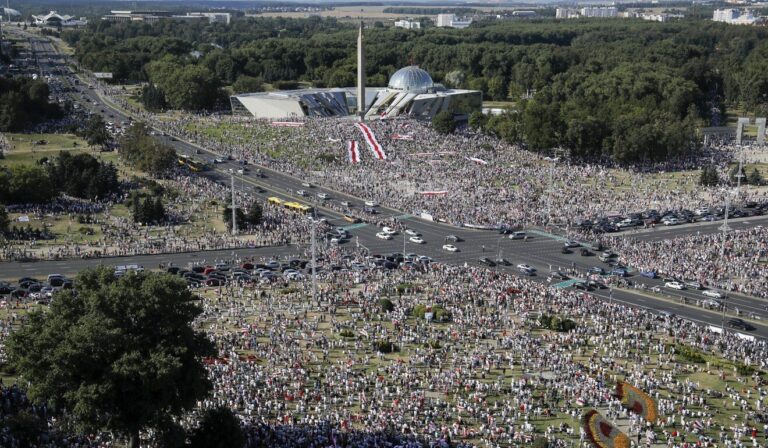 Opposition protests in Minsk, Belarus, August 16, 2020
By M. K. BHADRAKUMAR | Indian Punchline | August 18, 2020
The mercurial Belarus President Alexander Lukashenko has not been an easy ally for the Kremlin. But the growing interference by Belarus’ “New European” neighbours is setting the stage for a “colour revolution” with potentially anti-Russian orientation. Poland, egged on by the US, has convinced itself that it has become a regional heavyweight and eyes Belarus as a valuable piece of real estate that could shift the military balance on Russia’s western borders.
Indeed, historically, present-day Belarus figured in all four major invasions of Russia since the 18th century — by Sweden allied with Poland (1708-1709); by Napoleon through the North European Plain (1812); and by Germany, twice (1914 and 1941). Plainly put, Belarus forms a buffer zone crucial to Russia’s national security.
In post-Soviet history, with the Baltic states and Poland having been integrated into NATO and a pro-western regime installed in power in Ukraine since 2014, the western alliance has advanced closer to Russia than ever before. If during the Cold War era, the nearest NATO power was 1,600 kms from St. Petersburg, that distance has shrunk to a mere 160 kms today.
Furthermore, the signing of an Enhanced Defence Cooperation Agreement between the US and Poland on August 15 has made the latter “a lynchpin of regional security” (as the US state department describes Poland.) The agreement signed in Warsaw provides the legal basis for the establishment of American military bases in Poland, which harbours historical animosity against Russia.
The Russian Foreign Ministry said on August 17 that increased US military presence in Poland “aggravates the difficult situation near Russia’s Western borders, facilitating an escalation of tensions and increasing the risk of inadvertent incidents.” It flagged that the latest US-Poland defence agreement “will help qualitatively strengthen the offensive capability of the US forces in Poland.”
To be sure, the Belarus developments cannot be seen in isolation. A Kremlin statement said that on August 15 Lukashenko reached out to President Vladimir Putin to brief him on the developments. It said that the two leaders discussed the unrest in Belarus following the presidential election of August 9 and and both sides “expressed confidence that all existing problems will be settled soon.”
However, the next day, Putin called Lukashenko for another discussion. The Kremlin readout said that after a discussion touching on the external interference fuelling the unrest in Belarus, the “Russian side reaffirmed its readiness to render the necessary assistance to resolve the challenges facing Belarus based on the principles of the Treaty on the Creation of a Union State, as well as through the Collective Security Treaty Organisation, if necessary.”
That was a dramatic announcement, with ominous overtones of past Russian doctrines of collective security. Clearly, the announcement had the desired effect. Lukashenko has voiced on August 17 his readiness to hold fresh elections in accordance with a new constitution to be drafted in the coming few months.
The protests in Belarus may not subside easily. A transfer of power has become inevitable at some point and Moscow senses that the priority should be to navigate the developing situation toward an orderly transition. But Moscow’s capacity to navigate Belarus to calmer waters and stimulate a rational political dialogue is limited when external interference to stir up tensions continues.
Indeed, for the first time since protests began in Belarus a week ago, Washington has openly warned Moscow to stay out of the situation. An unnamed “senior Trump administration official” told the media on August 17, “The massive number of Belarusians peacefully protesting make clear that the government can no longer ignore their calls for democracy… Russia must also respect Belarus’ sovereignty and the right of its people to freely and fairly elect their own leaders.”
US Secretary of State Mike Pompeo also said on August 15 (while on a visit to Poland) that the US is discussing with the European Union to “try to help as best as we can the Belarusian people achieve sovereignty and freedom.”
To be sure, a Russian intervention in Belarus would be viewed by Europe as a negative development. Therefore, Putin is moving cautiously. But the fact is also that the European countries are struggling with the pandemic and a grave economic crisis. It’s unclear whether the major European powers would be inclined to follow the lead of Washington and Poland to provoke Russia.
Significantly, German Chancellor Angela Merkel telephoned Putin on August 19 in the first such contact since protests erupted in Minsk. A Kremlin statement said Putin and Merkel “thoroughly discussed” the emergent situation and “Russia pointed out that foreign attempts to interfere in the country’s domestic affairs were unacceptable and could further escalate tensions.”
Summing up Merkel’s conversation with Putin, the German Spokesman Steffen Seibert stated, “The chancellor said the Belarusian government must refrain from the use of force against peaceful demonstrators, immediately release political prisoners and enter into a national dialogue with the opposition and society to overcome the crisis.”
A Russian-German convergence seems possible over Belarus. Significantly, French President Emmanuel Macron has since called Putin and the latter again “emphasised that interfering in the (Belarus) republic’s domestic affairs and putting pressure on the Belarusian leadership would be unacceptable.” The Kremlin readout said Putin and Macron “expressed interest in the prompt resolution of the problems.”
Subsequently, Putin also reached out to the President of the European Council Charles Michel where, again, he expressed concern over “some countries’ attempts to put pressure on the Belarusian leadership and destabilise the internal political situation.” This was a reference to Poland and Lithuania, two EU member countries and strong allies of the US, who are principally culpable for destabilising Belarus.
But the big question is whether the Cold Warriors in Washington and the “New Europeans” in Central Europe would be satisfied with anything less than a regime change in Belarus that brings that country into their orbit. A Russian military intervention would lend credibility to their thesis of “revanchist Russia”.
A sub-text here is that the German-Russian proximity greatly annoys Washington and Warsaw. A recent paper by the Center for Strategic and International Studies in Washington, DC, noted, “Compared to many of its neighbours, Germany has longstanding political, economic, and cultural ties to Russia—not to mention a streak of skepticism toward the United States that inclines parts of the German political class to sympathise with Russian views about the need for a less U.S.-centric international order.”
Equally, there is growing acrimony lately in German-American relations following Washington’s recent threats of “crushing legal and economic sanctions” if German companies took part in any form in the Nord Stream 2 gas pipeline project, which would carry natural gas from Russia to Germany. (Incidentally, Poland also staunchly opposes the Nord Stream 2 project, which bypasses it.)
The German Minister of State Niels Annen has “firmly rejected” the proposed US sanctions and hit back saying, “Threatening a close friend and ally with sanctions, and using that kind of language, will not work. European energy policy will be decided in Brussels, and not in Washington, DC.”
These acerbic exchanges between German and American politicians as well as the recent move by the Trump administration to withdraw over 12,000 troops from Germany (and to divert some of them to Poland) highlight the complexities of Germany’s relationship with the US and Poland. The right-wing Polish government is happy to perform as the US’ Trojan horse within the EU.
However, so long as the EU refuses to rally behind Poland, whose rightwing populist leadership is already viewed with scepticism as something of an enfant terrible in the portals of Old Europe, Moscow gets diplomatic space. Putin’s calculus is working on this basis.
The bottom line is that Russia has legitimate interests in Belarus and Moscow’s preference is for an orderly transition in Belarus through consultations between Lukashenko and the political opposition. A helpful stance by the EU, therefore, matters to Putin.
The latest reports from Brussels disclosed that in the 30-minute phone conversation earlier today between Putin and Charles Michel, they “discussed options to facilitate a dialogue between Minsk and the opposition, including with the OSCE mediation.”
Poland and Lithuania are escalating events in Belarus as they did with Maidan
By Paul Antonopoulos | August 18, 2020
On August 9, presidential elections were held in Belarus with five candidates bidding to be head of state. According to the Central Election Commission, the incumbent president, Alexander Lukashenko, won in the first round with over 80% of the votes. Mass protests began in Belarus right after the announcement of the preliminary election results. People went to the streets, expressing their dissatisfaction with the results of the elections that they believe were unfair. Mass protests turned into riots and there were clashes between rioters and the police. Many people were detained and injured, and two protestors died.
Representatives of the European Union and the U.S. stated that they did not consider the presidential elections fair and appealed to the Belarusian authorities to have a second election. As both the EU and U.S. condemned Lukashenko’s re-election, it was therefore unsurprising that the deputy head of the Polish Ministry of Foreign Affairs, Paweł Jabłoński, stated that Poland did not want the EU to limit itself to only introducing sanctions against Belarus, as he claims it will push Belarus deeper into the sphere of Russian influence.
Tomorrow’s EU summit to discuss the situation in Belarus, and possibly pass sanctions, resulted from Warsaw’s call for prompt action, and above all, Prime Minister Mateusz Morawiecki who personally exerted pressure immediately after the Belarusian elections.
“We do not want the EU’s reaction to be limited only to presenting an idea for sanctions and adopting a joint statement, which is obviously needed, but to give Belarusians something more,” said Paweł Jabłoński in an interview with PAP. “The point is that we should present a real offer to resolve this conflict in a stable and lasting manner, and this is only possible if we, as the EU, offer Belarus a real perspective of cooperation if a solution based on dialogue is reached.”
Jałoński also pointed out that EU member states should jointly adopt a common position on the events in Belarus.
“We will want to send a signal that if Belarus begins the process of reforms leading to a system in which citizens decide on the direction of changes, the EU is ready for real cooperation with Belarus – primarily economic,” said Jabłoński, adding that “Belarusians should be able to choose their own development path and have a real choice here – our role is to propose this choice.”
This suggests that Warsaw’s main concern is to see the liberalization of the Belarusian economy to follow the same path as the other post-Soviet countries in Eastern Europe. The World Bank estimates that 75% of industrial output comes from state-owned companies, with the state sector employing about half of the Belarusian workforce. Because of this, unemployment in Belarus was at 4.6% in 2019, significantly lower than neighboring Ukraine (8.8%), Latvia (6.52%) and Lithuania (6.35%), with only Poland having a lower figure at 3.47%. Belarus is also capable of consistent GDP growth without having to rely on remittances like its neighboring countries which are also experiencing population decline due to emigration.
Effectively, what Lukashenko has done is protected the country from neo-liberal policies that spread throughout Eastern Europe after the Soviet Union collapsed in 1991, which resulted in many of the industries being shut down or privatized, impoverishing much of the population. Because of this action, Lukashenko earned the nom de guerre of “the last dictator of Europe” and Belarus the title of “mini-Soviet Union.”
Although Lukashenko has a complicated relationship with Moscow, one that can be cold at times, but generally speaking, Belarus, which gets its etymology from “White Rus(sia)”, has positive relations with its larger neighbor. Lukashenko, who at times panders towards the West, has amicable relations with Syria, Venezuela and other states that are targeted by the U.S. and Western Europe. Due to Lukashenko’s strong relations with these states and his sternness in preventing the liberalization of the economy, it is expected that when an opportunity is presented for the West, a Maidan-like event will begin in Belarus.
Although Poland is pushing for a Maidan-like event to occur, it is not the only neighbor of Belarus that wants this. A faction of the Homeland Union-Lithuanian Christian Democrats in the Seimas, the unicameral parliament of Lithuania, called for the immediate announcement of Lithuanian sanctions against the 39 most influential representatives of the “Alexander Lukashenko regime,” as they termed it.
“Lithuania must clearly, quickly and unambiguously formulate and consolidate strategic provisions for the Belarusian regime at the European Union and transatlantic level, be an icebreaker in the fight for freedom and against tyranny. Sanctions must also send a signal to other influential members of the regime that continued to support Lukashenko, will mean a stalemate and further sanctions against a wider range of the current elite,” said leader of the Seimas opposition, Gabrielius Landsbergis.
It was recently revealed that Lithuania had a key role in the Ukrainian Maidan events, and Poland’s involvements are also well noted. It is unsurprising that both countries are once again united in their demands to escalate tensions and hostilities with Belarus in their mad drive in what they perceive to be the de-Sovietizing and de-Russification of Eastern Europe. Perceiving that Russia and Belarus could be a threat to their security, both Warsaw and Vilnius have taken the opportunity to escalate the protests through rhetoric in the hope that a Maidan-like event will occur in Belarus, thereby further weakening Russian influence in Eastern Europe.
Paul Antonopoulos is an independent geopolitical analyst.
The Abyss of Disinformation Gazes Into Its Creators
By Patrick Armstrong | Startegic Culture Foundation | August 17, 2020
He who fights with monsters should look to it that he himself does not become a monster. And if you gaze long into an abyss, the abyss also gazes into you. – Friedrich Nietzsche
The other day the U.S. State Department published “Pillars of Russia’s Disinformation and Propaganda Ecosystem“. The report should have a disclaimer like this:
Everything you read in the NYT or hear Rachel Maddow say about Russia is true: Putin is a murderer, a thief and a thug, he shot down MH17, poisoned the Skripals, elected Trump, invaded Georgia and stole Crimea. If you question any part of this, you are controlled and directed by Russian Disinformation HQ.
Freedom of speech does not entitle you to doubt The Truth.
The methodology of all of these things – this is one of several – is uncomplicated. Paul Robinson has commented on the dependence of so much comment about Russia, and this report in particular, on the myth of central control.
- Anything anywhere on Russian social media, whether sensible or crazy, was personally put there by Putin to sow discord and weaken us. All social media or websites based in Russia are 100% controlled by Putin.
- The Truth about Russia is found in the West’s official statements and in the “trusted source media”. Anyone who questions it benefits Putin, who wants to bring us down, and is therefore acting as a servant of Russian Disinformation HQ.
The argument really is that simple and can be found in its baldest (and stupidest) version on the EU vs DiSiNFO site, The NATO Centre of Excellence is pretty bad while The Integrity Initiative seems to have been embarrassed into silence. Note the “disinfo”, “excellence” and “integrity” bits – that’s called gaslighting. Who funds these selfless truth seekers? The EU, NATO and the British government. But they’re good and truthful, unlike those tricky Russians.
In this particular effusion they look at seven websites, six of which are registered in Russia and one in Canada. The report declares that they are in an ecosystem directed from Russian Disinformation HQ. In reality they are sites which publish writers who – to take one example – think that it is a bit unusual that a deadly nerve agent smeared on a door handle requires the roof of the house to be replaced. But doubt, these days, is the outward sign of an inward Putinism.
Door handle!
Yeah, OK, but why the roof?
Putinbot!
One of the websites mentioned in the report is the one you’re reading now – Strategic Culture Foundation.
Could these be the officials who told the NYT about the bounties? Or gave it the photos it had to walk back a few days later? Or said their sources had “mysteriously gone quiet?” Or told it all 17? Or said it was probably microwave weapons? Or gave us years of scoops about how Mueller was just about to lock him up? Or told the NYT that Russia’s “economy suffers from flat growth and shrinking incomes“? Probably, but you’re not supposed to ask these questions.
The report has a good deal of speculation about who backs Strategic Culture Foundation (p 15). Personally I don’t much care who runs it (and I very much doubt that the Kremlin understands the point of running an opinion website). I’ve been in the USSR/Russia business for some time and what I think hasn’t changed much since 1986 or so. I’ve written for a number of sites which have faded away and I will not permit having what I write changed; the one time it happened twelve years ago, I immediately switched my operations elsewhere. Strategic Culture Foundation has never changed anything I’ve submitted and only twice suggested a topic – this one and Putin’s weaponised crickets. (And the warning is still up at the U.S. State Department site!) The other writers on the site whom I know haven’t changed their views either. Strategic Culture Foundation hasn’t created something that didn’t exist before, it’s collected something that already existed. What do we writers have in common? Well, Dear Reader, look around you. Certainly we question The Truth. Or maybe SCF is a place where people “baffled by the hysterical Russophobia of the MSM and the Democratic Party since the 2016 election” can find something else? Or maybe it’s part of Madison’s “general intercourse of sentiments”?
There was a theory in the Cold War that the two sides would eventually converge. I often think that they met and then kept on going and passed each other. In those days the Soviets did their best to block what they considered to be – dare I suggest it? – disinformation. And so RFE/RL, BBC, Radio Canada and so on were jammed. We, on our side, didn’t care who listened to Radio Moscow or read Soviet publications. Today it’s the other way round. Which fact prompts the easy deduction that the side that’s confident that it has a better connection to reality and truth doesn’t waste effort trying to block the other. In a fascinating essay, the Saker describes Russian propaganda for its home audience: “give as much air time to the most rabid anti-Kremlin critiques as possible, especially on Russian TV talkshows”. They even took the trouble to dub Morgan Freeman’s absurd “we are at war” video. That’s brilliant – we won’t tell you they hate you, we’ll let them tell you they hate you.
The report talks as if this “ecosystem” were big and influential. But it’s a tiny mouse next to a whale. Total followers on Twitter of all seven sites are 156 thousand (p65). That’s nothing: the NYT has 47.1 million Twitter followers, BBC Breaking News 44.8, WaPo 16.1. Why even Rachel Maddow has ten million followers eager to hear her explain how Russia is going to turn off your furnace next winter. So the rational observer has a choice to make after reading this report: either the report ludicrously over-exaggerates the influence of this “ecosystem” or 156,000 website followers are astonishingly influential and I, with my Strategic Culture Foundation pieces, personally control several Electoral College votes.
The real message of “Pillars of Russia’s Disinformation and Propaganda Ecosystem“, to someone who isn’t invested in spinning – ahem – theories about a Kremlin disinformation conspiracy, is that the “pillars” are feeble and the “ecosystem” small: Maddow alone has three times the followers of these seven plus the RT (3 million) the “all 17” report spent nearly half its space irrelevantly ranting about. Or maybe it’s saying that American voters are so easily influenced that “the Lilliputian Russians, spending a pittance compared to the Goliaths of the Clinton and Trump campaigns, was the deciding factor in 2016“.
Ironically this thing appeared at the same time as two that suggest Washington’s view of Moscow needs some work: It’s Time to Rethink Our Russia Policy and The Problem With Putinology: We need a new kind of writing about Russia. Good to see titles like that but they aren’t really rethinking anything: they still agree that Putin’s guilty of everything that Maddow says he is. Real re-thinking might get a toehold, for example, were people to contemplate why it is imbecilic to say that Moscow holds military exercises close to NATO’s borders. But you’ll only see that sort of thing on Strategic Culture Foundation and the others.
But now the abyss gazes back
Clinton loses an election, blames Russia, the intelligence agencies pile on, the media shrieks away. Americans are told patriotic Americans don’t doubt. And now we arrive at the next stage of insanity. William Evanina, director of the National Counterintelligence and Security Center, informs us that “Russia is backing Donald Trump, China is supporting Joe Biden and Iran is seeking to sow chaos in the U.S. presidential election…”. I guess that means that Russia and China will cancel each other out and that he’s telling us that Iran will choose the next POTUS. Who would have thought that the fate of the “greatest nation in earth” (as Presidents Trump, Obama, Bush Jr, Clinton, Bush Sr and Reagan like to call it) would be hidden under a turban somewhere in Iran?
So, American, know this: your “trusted sources” are telling you not to bother to vote in November – it’s not your decision.
Looking back on the Maidan events and its consequences
By Francis Lee for the Saker Blog | August 12, 2020
Victor Yanukovich was elected President of the Ukraine in 2010 narrowly defeating Yulia Timoshenko with 49% of votes cast to Timoshenko’s 45%. The Ukrainian Presidential term of office lasts for five years. Yanukovich’s Party, the Party of the Regions, together with its coalition partner the Communist Party of the Ukraine, also had a majority in the Ukrainian Parliament, with Mykola Azarov as Prime Minister. The membership of the EU was perhaps one of the more salient issues of the time and was the trigger for the ensuing upheavals.
Negotiations for Ukraine’s initial stage of eventual membership of the EU – the so-called Association Agreement – had been dragging on since 2011, but both Yanukovich and Azarov were favourably disposed to an eventual positive outcome, although the Communist part of the coalition were not.
This did not go down at all well in Moscow and Azarov attempted to assuage Russian misgivings by urging Russia ‘’to accept the reality of Ukraine signing the EU agreement’’. The commitment of Yanukovich was eventually tested to destruction since he was being pulled in two directions, by Russia on the one hand and by the EU on the other. For their part, the Russians offered the Ukraine a $15 billion loan, a discount on gas prices, and membership of the Customs Union of Russia, Kazakhstan, and Belarus. But the EU was having none of it. President of the European Commission Jose Manuel Barroso stated that the EU will not tolerate ‘a veto of a third country’ (Russia) in their negotiations on closer integration with Ukraine. This being the case Yanukovich was forced into a choice which would be certain to alienate and anger one of the powerful interested parties on its borders.
Negotiations continued on into 2013. Yanukovich was invited to sign the Association Agreement, but there were a number of conditions. The most significant of these were those concerning an IMF loan. But anything involving the IMF should have set the alarm bells ringing with regard to the intentions of western institutions vis-à-vis the future of the Ukraine. The conditionality clauses were very much in the tradition of the IMF. Their ‘Structural Adjustment Programmes’ had always been the scourge of the developing world and this offer pact was enough to scupper the EU deal. Prime Minister Azarov at the time stating that ‘’the issue which blocked the signature of the EU deal were the conditions proposed by the IMF loan being negotiated at the same time as the budget cuts and 40% increase in gas prices’’. This for a country already verging on bankruptcy. In store for the Ukraine was the usual neoliberal austerity package. Compliments of the IMF’s Structural Adjustment Policies (SAPs) this would involve the following set of prescriptions:
1. Balance of payments deficit reductions through currency devaluation = SAP
2. Budget deficit reduction through higher taxes and lower government spending, aka austerity = SAP
3. Restructuring foreign debts
4. Monetary policy to finance government deficits (loans from central bank – with strings) = SAP
5. Raising food prices to cut the burden of subsidies = SAP
6. Raising the price of public services = SAP
7. Cutting wages = SAP
8. Reducing domestic credit = SAP
9. ‘Reforming’ pensions = SAP. Marvelous word ‘Reforming’
10. Deregulation of labour market. = SAP aka smashing labour unions
Longer-term ‘structural adjustment’ policies usually include:
1. Liberalization of markets to guarantee a price mechanism = SAP
2. Privatization, or divestiture, of all or part of state-owned enterprises = SAP
3. Creating new financial institutions. Hedge Funds, Shadow Banks, Private Equity = SAP
4. Improving governance and fighting corruption – ?
5. Enhancing the rights of foreign investors vis-à-vis national laws = SAP
6. Focusing economic output on direct export and resource extraction = SAP. That is to say, the creation of a peripheral economy a raw material exporter.
7. Increasing the stability of investment (by supplementing foreign direct investment with the opening of domestic stock markets). Financialization of the host economy = SAP
Just what the doctor ordered, no! These policies have been tried everywhere and have failed abysmally. Little wonder Yanukovich took the Russian offer instead.
However, what seemed like a straightforward business decision was greeted with howls of anguish and gnashing of teeth as the Europhiles in Independence Square felt that their future had been taken from them. This was indeed to happen in due course (see below) but this was the outcome of accepting rather than rejecting the IMF package.
THE BATTLE OF THE MAIDAN
Immediately these facts became known the mass protest in Kiev took place and was on the world’s TV screens, with demonstrators waiving Ukrainian and EU flags. (Where they got these EU flags is a mystery to this day.) This seemed to be a mass popular protest and the demonstrators were to set up camps in Independence Square. But the carnival atmosphere was not to last. Ultra-nationalist groups (inveterate fascists) in the shape of Right Sector and Svoboda (1) began to emerge from the shadows and appear among the genuine moderate majority and joined in pitched battles with the Berkut (riot Police) on a daily basis which the opposition forces finally won. This was, according to the Guardian ‘newspaper’ a victory for democracy and peoples’ power. Well it might have started like this but it transmuted into something very different. Nobody should be in any doubt about the political complexion of these ultra-nationalist groups who went on to hold 6 portfolios in the new ‘government’ based in Kiev. Nor should anyone be in any doubt about both the overt and covert roles played by both the US and EU officials in the formation of the future interim government.
Throughout this period the EU and high-ranking US officials were openly engaged in Ukraine’s internal affairs. The US Ambassador, Geoffrey Pyatt, and the US Assistant Secretary of State for European and Eurasian Affairs, Victoria Nuland, were strolling around Independence Square reassuring the protestors that America stood behind them. Also basking in the political sunlight were US NGOs (such as the National Endowment for Democracy – NED – directly funded by the US Government) and (USAID). Also involved was the US Human Rights Watch (HRW) and not forgetting of course the ubiquitous Mr. Soros. Identified as GS in the leaked Open Society Foundation (OSF) documents, others involved in the Ukrainian coup in the planning, were the already named, US Ambassador Geoffrey Pyatt, along with the following: David Meale (Economic Counsellor to Pyatt, Lenny Benardo (Open Society Foundation – OSF) Yevhen Bystry (Executive Director International Renaissance Foundation – IRF) Oleksandr Sushko (Board Chair, IRF) Ivan Krastev (Chairman Centre for Liberal Studies, a Soros and US government-influenced operation in Sofia, Bulgaria) and Deff Barton (Director, US Agency for International Development AID – USAID – Ukraine). USAID is a conduit for the CIA.
Even right-wing thinkers such as George Freidman at Stratfor described these events as being ‘the most blatant coup in history.’
The new ‘government’ in Kiev was represented by a hotch-potch of oligarchs Kolomoiski, Akhmetof, Pinchuk, Poroshenko, et al, and petty fuhrers including Parubiy, Yarosh, Biletsky, from the Western Ukraine with their violent armed squadristi units terrorizing their opponents. The ultra-right Svoboda Party had a presence in the Ukrainian parliament (Rada). It is a neo-nazi, ultra-right, anti-Semitic, Russo phobic party with its base of support in the western Ukraine. The most important governmental post was handed to its fuhrer Andriy Parubiy who was appointed as Secretary of the Security and National Defence Committee, which supervised the defence ministry and the armed forces. The Parubiy appointment to such an important post should, alone, be cause for international outrage. He led the masked Right-Sector thugs who battled riot police in the Maidan in Kiev.
Like Svoboda, Right-Sector led by their own tin-pot fuhrer Dmitry Yarosh is an openly fascist, anti-semitic and anti-Russian organization. Most of the snipers and bomb-throwers in the crowds were connected with this group. Right Sector members had been participating in military training camps for the last 2 years or more in preparation for street activity of the kind witnessed in the Ukraine during the events in Independence Square in 2013-14. The Right Sector as can be seen by the appointment of Parubiy, is not in a position to control major appointments to the provisional government but he has succeeded in achieving his long-term goal of legalizing discrimination against Russians.
This discrimination took the forms of mass murder in the southern Black Sea port of Odessa when pro-Yanukovich supporters were attacked by fascist mobs and chased into a nearby building, a trade union HQ. The building was then set on fire and its exits blocked, the unfortunate people trapped inside were either burnt to death or, jumped out of the windows only to be clubbed to death when they landed. The practices of the political heirs of Bandera had apparently not been forgotten by the present generation. There is a video of the incident, but frankly, it was so horrific that I could only watch it once. These barbarians were described by Luke Harding of the Guardian as being ‘’an eccentric group of people with unpleasant right-wing views.’’ Yes, they were really nice chaps who got a little carried away! One week later with the open support of Washington and its European allies, the regime installed by Washington and Berlin in February’s fascist-led putsch then began extending its reign of terror against all popular resistance in Ukraine. That was the significance of the events in the major eastern Ukrainian sea-port city of Mariupol less than a week after the Odessa outrage.
After tanks, armoured personnel carriers and heavily armed troops were unleashed on unarmed civilians in the city, the Kiev regime claimed to have killed some 20 people. The Obama administration immediately blamed the violent repression on “pro-Russian separatists.’’
Poroshenko, ex-Finance Minister in Yanukovich’s government, was elected as President on 29 May and duly announced that “My first presidential trip will be to Donbass where armed pro-Russian rebels had declared the separatist Donetsk and Lugansk People’s Republics and control a large part of the region.’’ This was the beginning of the Anti-Terrorist Operation the ATO. However, things didn’t quite work out as planned. After 2 heavy defeats at Iloviask and Debaltsevo the Ukie army was stopped in its tracks and the situation has remained static to this day.
In the meantime the Ukraine has become the poorest nation in the whole of Europe. The economic and social ramifications of the 2014 coup were such that that the full weight of the neo-liberal economic policies were foisted on the Ukraine, courtesy of the IMF. This was already apparent in the early 80s, but the trend accelerated after the coup. The standard IMF/WTO Structural Adjustment Policies (SAPs) – see above – a package of ‘reforms’ and ‘fiscal consolidation’ (I just love these IMF euphemisms) consisted of cuts in government expenditure, accompanied by extensive liberalisation of product and labour markets, together with abandonment of exchange rate control and capital flows.
These policies along with political instability have had, among other things, a disastrous effect on population growth. Ukraine’s population was 52 million in 1992 and the decline started in that year. By 2016, this figure had fallen to 42.5 million, its 1960 figure, and was accelerated since the coup of 2014. The current Fertility rate stands at 1.3. Any figure less than 2 will mean a shrinking population. The death rate has also increased, along with mass migration with some 2 million Ukrainian guest workers decamping to Russia and Poland in search of work. This is a slow-motion demographic calamity.
This notwithstanding the largesse handed out by the Western powers through the instrumentality of the IMF as pointed out by Michael Hudson. ‘’The IMF in fact broke four of its rules by lending to Ukraine: These included (i) Not to lend to a country that has no visible means to pay back the loan (the “No More Argentinas” rule, adopted after the IMF’s disastrous 2001 loan to that country). (ii) Not to lend to a country that repudiates its debt to official creditors (the rule originally intended to enforce payment to U.S.-based institutions). (iii) Not to lend to a country at war – and indeed, destroying its export capacity and hence its balance-of-payments ability to pay back the loan. Finally (iv), not to lend to a country unlikely to impose the IMF’s austerity ‘conditionalities.’ Ukraine did agree to override democratic opposition and cut back pensions, but its junta proved too unstable to impose the austerity terms on which the IMF insisted.’’
Nothing better illustrated the monumental stupidity of a nation which subordinated economic common-sense to anti-Russian gestures and rhetorical bluster; this was visibly illustrated in the trade deal involving the import of European gas and South African coal to the exclusion of Russian gas and Donbass coal. In both cases, however, Ukraine was simply buying the same goods from Donbass and Russia but resold at a significantly higher price by South Africa and Europe simply acting as middle-men at a huge cost to the Ukrainian tax-payer. (2)
All of which illustrates the intractable political and economic debacle unfolding and goes some way to explaining the present impasse of a backward movement into under-development. Ukraine is becoming deindustrialised – not unlike the fate of many post-soviet nations – its trade with the Eurasian Economic Union (EEU) Russia-Belarus-Kazakhstan-Kyrgyzstan severed. This was formerly an exceptionally large and important export-import market, imports consisting of energy commodities coming from the EEU, and exports to the EEU consisting of Ukraine’s advanced industries in the east situated in Donetsk, Lugansk, Kharkov, Dnepropetrovsk, Zhaporizyha and Nikolayev oblasts. These exports consisting of machinery, equipment, aircraft, vessels, nuclear reactors and boilers, railway, tramway rolling stocks and inorganic chemicals.
‘’… The machinery industry alone had an annual revenue of nearly US$20 billion and was responsible for employing 600,000 people in the southern and eastern oblasts. Not only would trade disruptions in the EEU devastate the southern and eastern economies, they would also lead to the deindustrialisation of the Ukraine, and this process has already started.’’ (3)
Ukraine is now the poorest country in Europe. And once the process of deindustrialisation starts, charting a way back will be exceedingly difficult, even with the best will in the world and with the necessary manpower, skills, and expertise to carry out such a transformation. Moreover, this imbecility is compounded by military expenditures including the costs of an army of 250,000 that is doing nothing other than getting drunk and occasionally shelling towns and villages – against International Law it might be added – on the front line in the Donbass. Ukraine’s defence expenditure stands at 3.7% of GDP compared with NATO’s 2% and most NATO countries don’t even reach 2%. For the poorest country in Europe this is frankly bizarre. If you wanted to run a country and its economy into the ground this is the way to do it.
It has been suggested that nothing short of a huge ‘Marshall Plan’ to reconfigure Ukraine’s economic composition, requiring massive investment if it is to replace its post-Soviet industry – which seems especially so now that the industry heartlands of the Donbass have been severed from the Ukraine. Unsurprisingly, however, no-one is rushing to pick up the tab for this new ‘Marshall Plan’. Certainly not the EU, and even less so the Americans, who simply wanted yet another east European state (qua protectorate) to serve as a military base aimed at confronting Russia.
But now we may dispose of the customary patter of freedom and democracy together with the rest of the pseudo-rhetoric emanating from the usual sources. Fact: the entire Ukrainian imbroglio was essentially a matter of geopolitical realpolitik with the exalted rhetorical baggage being mere camouflage. US geopolitical strategy being predicated upon a hegemonic project to establish a system of dominance over the entire world. This desired outcome was nothing if not ambitious and is a common feature of all historically crackpot utopian schemes. This explains the US’s concurrent wars in the middle-east, the South China Sea, and in Europe – EUROCOM – with Ukraine as the spearhead. The object was initially to occupy western Europe through NATO and the EU, then spread this to eastern Europe, resulting in a de facto occupation and vassalisation of the European continent, with the role of the EU playing second string to its masters hegemonic requirements. This was the tawdry reality behind the initial euphoria of the short-lived settlement of 1991.
‘’It is pure hypocrisy to argue that the EU is now little more than an extended trading bloc after the Lisbon Treaty. It was institutionally now a core part of the Atlantic Security bloc (NATO) and had thus become geopolitical’’ (4)
In broader terms the Ukraine episode was part of a more general offensive against Putin in particular and Russia in general, and both were subjected to unrelenting demonization. With regard to Putin the venom was such that he was held personally responsible for the Skripal poisonings. That is to say a foreign head of a powerful state was accused of attempted murder of its citizens who resided in another state, the UK. Such unproven allegations between states seem unprecedented and alien to any type of mutual respect and diplomacy. For months the West has been demonizing Putin, it has almost become a national sport, with figures such as the Prince of Wales and Hilary Clinton comparing him with Hitler, oblivious to the fact that Putin had lost members of his own family during USSR’s Great Patriot war against Hitler’s legions. Such is the intellectual prowess, or more likely the lack of it, among the leading spokespersons of the West who combine ignorance in equal measure to arrogance. What set this crisis in motion were the recklessly provocative moves to absorb the Ukraine into the EU. Moreover, if the West’s offhand dismissal of Russia’s power concerns and the continued demonization of Putin continued, then Russia could well shift into a Cold War mode which would be a self-fulfilling prophecy come true.
Thus the contemporary decline of diplomacy reflects the didactic character of the liberal international order, which presumes that Russia is somehow an illegitimate interlocutor and parvenu and therefore its views can be discounted.
Coming full circle, the US relations with other states – particularly Russia and China – are best summarized in the Wolfowitz doctrine which bears repeating. As follows:
‘’Our first objective is to prevent the re-emergence of a new rival, either on the territory of the former Soviet Union or elsewhere, that poses a threat on the order of that posed formerly by the Soviet Union. This is a dominant consideration underlying the new regional defence strategy and requires that we endeavour to prevent any hostile power from dominating a region whose resources would, under consolidated control, be sufficient to generate global power.’’ (5)
Thus peaceful coexistence has never really been part of the US foreign policy, only world domination. Episodes like Ukraine, Syria and the middle-east, the South China Sea, Africa and Afghanistan, Hong Kong, Taiwan and not to mention Latin America are all part of the playbook and have all followed a similar if not exact patterns of regime change and/or being dragooned into one-sided relationships, military, commercial or otherwise.
Whoever becomes the next US American President will not in any way mean a departure from the above geopolitical policies. If anything such policies will be even more rigorously pursued.
NOTES
(1) These fascist militias had for some time been made ready for civil conflict against the Ukraine’s elected authorities. In 2012 I was travelling with my wife from Donetsk to a holiday resort in the Khmelnytskyi Oblast in the Western Ukraine. The train stopped at Dnipropetrovsk a major city half-way between. The train was boarded by a large group of young men; they looked like an amateur football team. My wife got talking to them and they described themselves as students. The strange thing was that there were no women or girls among them. Perhaps there were no female students in Ukraine; this seemed unlikely. Then the coin dropped: Right Sector had its main training camp at Dnipropetrovsk and these ‘students’ were going back to the west for the summer vacation. Two years later they were in all probability engaged in ‘political activities’ in Independence Square.
(2) http://www.lrb.co.uk/v36/n17/keith-gessen-why-not-kill-them-all)
(3) countryeconomy.com
(4) Richard Sakwa – Frontline Ukraine – p.255)
(5) Paul Wolfowitz -Defence Planning Guidance for the 1994–99 fiscal years (dated February 18, 1992) published by US Under Secretary of Défense for Policy Paul Wolfowitz and his deputy Scooter Libby. Not intended for public release, it was leaked to the New York Times on March 7, 1992, and sparked a public controversy about U.S. foreign and defence policy. The document was widely criticized as imperialist, as the document outlined a policy of unilateralism and pre-emptive military action to suppress potential threats from other nations and prevent ‘’dictatorships’’ from rising to superpower status.
Trump insists on a Putin visit to US
By M. K. BHADRAKUMAR | Indian Punchline | August 11, 2020
The US President Donald Trump’s remark on Monday that a G7 summit is no longer on the cards for the month of September leaves many questions unanswered. We do not know the circumstances in which Trump felt that he is “much more inclined to do it (G7 summit) sometime after the election”. Again, Trump was delightfully vague on giving a timeline, which is understandable since a G7 summit now hinges entirely on the outcome of the November election.
Trump didn’t explain, either, why a G7 summit hasn’t materialised in September, which would have given him some boost on the world stage — and given a much-needed fillip to his campaign. This is the second time Trump has been unable to host a G7 summit. In June, the allies, especially Germany, point blank refused — Angela Merkel regretted apparently due to preoccupations related to the pandemic.
If the postponement in September is also due to the European allies’ lukewarm attitude, it becomes a snub to Trump personally. All he’d say was “We haven’t sent out invitations. We’re talking to them.” If Trump falls by the wayside in the November election, the European allies may be even less inclined to troop to Washington before Joe Biden assumes office in January. Trump’s insistence on inviting Russian President Vladimir Putin to the G7 summit, which he repeated yesterday, has not gone down well in the European capitals.
In sum, Trump’s inability to hold a G7 summit highlights Europe’s overall disenchantment with him. Trump’s foreign policy legacy during his first term is ending on a dismal note, calling attention to the damage he has inflicted on the transatlantic partnership.
Perhaps, Trump gets one more chance to redeem his foreign policy record on this template if only the US-Russia arms control talks make headway. The first formal bilateral talks between the US and Russia on space security since 2013 took place in Vienna on July 27 alongside the second round of the nuclear arms control working group meetings. The renewal of new START, which is expiring in coming February, is a low-hanging fruit.
Meanwhile, the Vienna talks also touch on the erstwhile Intermediate-Range Nuclear Forces Treaty (INF Treaty), which is of utmost concern to the European countries. Russia has called for revival of discussions on extending the INF Treaty and Washington has held open the possibility that the negotiations in Vienna would include an INF Treaty extension. One way Trump could overcome the European resistance to inviting Putin to a G7 summit in the US could be by linking it to an event connected with arms control, especially the INF Treaty.
Russia sees arms control as a useful tool to manage its military competition with the US by making it less dangerous and costly. As for European countries, the INF Treaty has been historically the only operational bilateral instrument of nuclear arms control with Russia with focus on Europe’s security and stability. Moreover, the INF Treaty was the cornerstone of European security and its signing in 1987 by the US and the former Soviet Union was a harbinger of political “winds of change” in the East-West relationship.
Equally, Trump also appears to be serious in pursuing forms of cooperation with Russia that would accommodate both countries’ interests. Oil price and terrorism are two such issues; arms control could be another. On arms control, there is also a rare “bipartisan consensus” in the US as regards the renewal of the new START.
Having said that, Trump is unpredictable and the commencement of arms control talks cannot by itself persuade Moscow to lower its guard. Thus, on August 7, Russian Foreign Ministry reacted to the Pentagon announcement of July 29 regarding more US deployments to Poland. A statement in Moscow warned that “such actions escalate tensions in Europe. We have emphasised more than once that attempts to deter us by force and intimidate our country will receive a befitting and timely response.”
On July 29, at a press conference at the Pentagon, Defence Secretary Mark Esper had announced a “plan on rotating forward the lead element of the Army’s newly established V Corps headquarters to Poland, once Warsaw signs a Defense Cooperation Agreement and burden sharing deal, as previously pledged. There are or may be other opportunities as well to move additional forces into Poland and the Baltics.” Interestingly, a week later in an interview with Fox News, Esper added that the deployment to the east to (Poland and the Baltics) aimed to serve as a more effective ‘deterrent’ against Russia. He said moving troops eastward is only logical because “the border has shifted as the alliance has grown.”
On August 7, the official military newspaper Krasnaya Zvezda (Red Star) reacted strongly by issuing a stern warning to the US that Russia will perceive any ballistic missile launched at its territory as a nuclear attack that warrants a nuclear retaliation. This is in line with the revised Russian military doctrine enunciating the new nuclear deterrent policy allowing “first use”, which envisages the use nuclear weapons in response to a nuclear attack or an aggression involving conventional weapons that “threatens the very existence of the state.”
Moscow has ruled out Putin’s participation in a G7 summit that excludes China or has any anti-China orientation. Having said that, Trump would be betting that given the Kremlin’s keenness to make progress on arms control — extension of new START, in particular — Putin might be open to a visit to the US to formalise any agreements, once the hurly burly of the November election in America is done. Trump’s remarks yesterday hint at such a possibility when he said Putin is an “important factor”. Moscow has taken due note of it.
Trump’s calculus aims at animating the US-Russia-China triangle with a view to isolating China. Putin, on the other hand, will sequester the Russian-Chinese entente from collateral damage, if any. On August 9, Russian Foreign Ministry issued an unusual statement conveying solidarity with China “on the situation around the Tiktok social media app’s operation in the US”.
Beijing, meanwhile, is nonchalantly reiterating its position that “it is not yet the right timing” for China to join the nuclear disarmament talks in Vienna. And, Putin and Chinese President Xi Jinping were the first world leaders to congratulate Alexander Lukashenko on his re-election as Belarusian president.
Featured Video
Weaponized Journalism: 2021 Sayer Ji Interview with NPR
or go to
Aletho News Archives – Video-Images
Book Review
The Zeolite Book — First Edition, 2026, Paperback
The volcanic mineral medicine will not patent — for the toxic burden medicine will not name
Lies are Unbekoming – October 30, 2026
 Zeolite is old. It is in Roman concrete that has held for two thousand years. It’s in the water filters of ancient cisterns. It’s in the stomachs of Pacific livestock whose keepers knew, somehow, that this grey crumbling rock made the animals healthier. It’s in Soviet clinical protocols from the 1960s. It’s in the standard emergency response to the Chernobyl explosion.
In 1986, after the Chernobyl reactor failure, the Soviet Union manufactured and distributed natural zeolite at industrial scale — for soil remediation, for livestock feed, for human consumption, for the cleanup itself. Karl Hecht, who had been director of the Institute for Experimental and Clinical Pathophysiology at the Charité of Humboldt University Berlin, spent the six decades after that building the clinical research base — on silicon’s role in human health, on zeolite’s clinical safety, on its applications in ageing. In 2018, Pavelić and colleagues published a comprehensive clinical safety review of natural clinoptilolite in Frontiers in Pharmacology. In 2019, Mastinu analysed its binding affinities. In the Western medical literature, these works sit largely uncited.
What has not been treated at book length, until now, is how a volcanic mineral with six decades of Soviet clinical work behind it, two major peer-reviewed Western reviews, and ongoing clinical use across the former Eastern Bloc, remains almost entirely absent from Western medical practice — and what the toxic burden it’s meant to address actually is.
The Zeolite Book gathers the Soviet clinical record, the Western peer-reviewed studies, three contemporary practitioner voices, and three serious counterviews into one honest treatment. That’s why the book runs to seven appendices. 288 pages, four parts, three practitioner voices, three counterviews, seven appendices. The honest treatment is the argument.
Blog Roll
 Aletho News
- London tourism expo promotes Israeli agency linked to theft of Palestinian land
- Dockworkers launch global strike against Israeli and US military shipments
- Europe facing gas price shock – Gazprom chief
- Ukraine continues recruiting people with disabilities
- Weaponized Journalism: 2021 Sayer Ji Interview with NPR
- Beyond Netanyahu: what Israel’s election means for Palestinians
- Lithuania plans universal conscription
- Lies, Damn Lies, and Ukraine News
- Financial Times rejects Nordic demands to correct Putin call story – media
- The Case for Less Unity in Europe
- If Americans Knew
- An error has occurred; the feed is probably down. Try again later.
- No Tricks Zone
- Germany’s Green Energy Transition Becoming Increasingly Expensive…Another 6 Trillion Euros!
- Sudden Stratospheric Warming, Powerful El Niño Combination May Lead To Extreme Europe Cold, Energy Crisis!
- Two New Studies Find Thwaites Glacier Melt Cannot Be Driven By Human Activity Or A Warming Ocean
- E-Cars Reduce CO2 Emissions By Only 41% Compared To Internal Combustion Engine Vehicles
- Predictions Made By Renowned Climate Professor Over Past Decades Have Been Proven To Be Poor
- New Study Suggests Large Regions Of The Pacific Ocean Have Been Cooling For The Last 80 Years
- Germany’s Green Energy Debacle: High Energy Costs Force Kahla Porzellan to Close After 182 Years!
- New Study: 50 Years Of The Most Aggressive ‘Net Zero’ Policies Can Only Affect The Global Climate By 0.03°C
- US September “Heat” Was No Record…Many Records Set Decades Ago
- Latest European Green Energy Debacle; Portugal’s Largest Flagship Solar Park Insolvent!

