Qatar warns EU sustainability law could end its LNG exports to Europe
The Cradle | October 17, 2025
Qatar’s Minister of Energy, Saad al-Kaabi, said on 16 October that Doha would be unable to continue supplying liquefied natural gas (LNG) to Europe if the EU fails to revise its corporate sustainability rules.
In an interview with Reuters, Kaabi warned that the Corporate Sustainability Due Diligence Directive (CSDDD), adopted in 2024, poses a “significant risk” to state-owned QatarEnergy – one of the world’s largest LNG exporters.
The regulation requires major companies operating within the bloc to identify and address human rights and environmental violations in their supply chains or face fines.
Kaabi, who also serves as QatarEnergy’s chief executive, said his concern centers on potential penalties of up to five percent of a company’s total global revenue for failing to meet the EU’s climate-transition requirements under the Paris Agreement.
He said such exposure could make it impossible for QatarEnergy to justify doing business in Europe.
“QatarEnergy will not be able to justify doing business in the EU, be it in LNG or other products, due to the significant risk it would be exposed to due to the overreaching nature of the proposed regulations, which will ultimately harm the European end consumers,” Kaabi told Reuters.
Qatar currently supplies between 12 and 14 percent of Europe’s LNG needs under long-term contracts, including with Shell in the UK.
Kaabi said Doha has been attempting for nearly a year to “constructively engage with the key players at both the European Commission and every EU Member State” on the directive, but has received no reply.
Reuters confirmed that the European Commission did not immediately respond to its request for comment.
Earlier this week, the European Parliament’s legal committee supported efforts to soften the law following pushback from corporations, but Kaabi said the amendments “did not address key concerns.”
He urged Brussels to make further changes or risk discouraging investment and weakening the bloc’s competitiveness.
“Europe must decide if it wants to continue to attract investment into the bloc by further changing CSDDD, or risk undermining efforts to strengthen its competitiveness and prevent economic deterioration,” he said.
Europe’s Economic Winter Transfers the Workshop of the World to Asia’s New Furnaces
By Rebecca Chan – New Eastern Outlook – October 18, 2025
European capitals increasingly resemble branch offices of an American headquarters. Decisions on industrial policy have long turned into ritual acts of loyalty rather than independent steps.
In the workshops of the Ruhr, where the fire of blast furnaces was once considered Europe’s eternal companion, today reigns a cold more expensive than any raw material. An economic pause has descended in icy silence. A tombstone rests on the grave of industrial greatness, signed by Europe’s own leaders.
The continent is dismantling its own productive arteries, while Asia launches new lifelines. The center of gravity shifts to where clusters grow, not gas prices. Europe is losing not to chance, but to the results of its own “strategic” deafness—an error the East has turned into opportunity.
The Trap of Sanctions and Costly Energy
The European Union invented sanctions as a weapon of pressure, only to receive a boomerang blow to its own skulls. German and French factories are drowning in energy bills, shackled by chains forged by their own hands. Electricity and gas no longer feed the economy; they have become instruments of self-destruction.
Germany’s industrial activity index is sliding down like a thermometer in a frozen room. Machinery, chemicals, and metallurgy are losing markets, exports are crumbling, subsidies resemble aspirin after an amputation. Every new restriction, dictated in favor of the overseas ally, turns yet another factory hall into an abandoned museum. Brussels codifies these barriers, expanding its dual-use export control list to tighten the screws on high-tech trade.
European industry is being sacrificed to Washington, like a temple offering leaving only smoke behind. Factory pauses are transforming the industrial core into a ritual of obedience and loyalty. And against this backdrop, the East gathers strength. The International Energy Agency notes how these price shocks diverge across regions, with Asia absorbing them into growth while Europe suffocates under the weight.
Expansion of Capacity and “Importing Industry”
China launches new production lines as if assembling a puzzle from the fragments Europe has scattered. India strengthens petrochemicals and takes on raw material processing from which Western corporations are fleeing as if from a fire. Vietnam and Indonesia pick up orders for electronics and light industry, turning others’ losses into their own growth.
European prohibitions have opened a showcase of opportunities for the East. Every restriction meant to crush competitors has become a stimulus for Asian investments in infrastructure and new industries. Ports expand, corridors stretch, power grids come alive—all built on the ruins of European stubbornness.
The East is transforming foreign stagnation into the foundation of sovereignty. Every collapse of European production coincides with the rise of Asian capacity, as if the world market itself had decided to relocate the planet’s factory to where there are no imposed illusions of “strategic solidarity.”
The Loss of Control Tools
Washington and Brussels stubbornly tried to keep the world’s supply chains by the throat—erecting barriers, hammering out new rules, handing out sanctions left and right. Control crumbled like a rusty lock on an old warehouse. Production lines are leaving Europe and taking root in Asian soil, pulling with them not only jobs but also political influence.
European capitals increasingly resemble branch offices of an American headquarters. Decisions on industrial policy have long turned into ritual acts of loyalty rather than independent steps. Even a hint of an alternative sounds seditious and draws condemnation. Meanwhile, Asia is drafting its own continental blueprint: corridors instead of walls, ports and energy unions instead of sanctions. Trading platforms operate without Western notaries, and it is there that the new rules of the game are born.
The map of the global economy is turning into a chessboard where the West is allowed to play only pawns. Europe is bogging down in its own restrictions, while Asia calmly unfolds a field of maneuver, transforming it into a genuine center of growth. This shift changes not only container routes but also the very balance of power in world politics.
The Future Is Written Where New Furnaces Smoke
Europe is entering an era of prolonged economic permafrost. Any attempt to revive factories crashes against energy bills and acute political dependence. Empty workshops declare that the continent’s industrial age has come to an end. Berlin now concedes the burden, promising subsidies and lower energy tariffs for industry in its 2026 budget—a rare admission that the sacred “market” cannot carry this weight alone.
For Asia, this turns into a conveyor of opportunities. Every shuttered plant in Germany or France automatically sets new lines in motion in Shenzhen, Mumbai, or Jakarta. Every European loss settles into Asian infrastructure, cementing a new industrial order. India’s role inside BRICS+ shows how external pressure is repurposed into sovereignty, a reminder that decline for one bloc is ignition fuel for another.
Europe faces a harsh crossroads: either radically change its industrial model and rebuild its political logic, or lock itself permanently into the role of a marketplace without factories. Asia has already made its choice and consolidates its success step by step. The continent that was once the workshop of the world is becoming a museum of illusions, while the future is written where new furnaces smoke.
Rebecca Chan is an independent political analyst focusing on the intersection of Western foreign policy and Asian sovereignty.
Five years until war with Russia? The EU is already at war
Strategic Culture Foundation | October 17, 2025
The 27-nation European Union this week unveiled a five-year plan “to get ready for war” with Russia.
The so-called “Roadmap on European Defense Readiness 2030” sounds like a war manifesto and a self-fulfilling prophecy, putting the EU on a disastrous collision course with Russia.
It is incredible that such an ominous direction is being blatantly dictated by an unaccountable elite in Brussels. Eighty-five years ago, the Third Reich had a plan to rule over Europe by dominating the Soviet Union. The EU elite are carrying on the plan.
As for the “defense readiness” (that is, “war readiness”) roadmap, the future is already here, not in five years. The EU is presently on a disastrous collision course with Russia.
Like the United States, the European Union has been at war with Russia through its proxy regime in Ukraine since February 2022, and before that, going back to the 2014 coup in Kiev.
Over the past four years, the EU has supplied nearly €180 billion of taxpayer money to weaponize a NeoNazi regime in Kiev. As we noted in last week’s editorial, that vast allocation (and waste) of resources is far greater than the EU’s own member nations have received for developing their economies and societies. When has the European public had a chance to vote on that? Decisions are being made by an elite cabal.
Unlike the Trump administration, the European Union under the influence of arch-Russophobes like European Commission President Ursula von der Leyen and foreign affairs chief Kaja Kallas, has shown absolutely no will for finding a diplomatic resolution to the conflict in Ukraine. With honorable exceptions, most of the European governments are pushing the war hysteria. So, too, are the European media, as are the American mainstream media. Russia is the evil aggressor, no diplomacy, no dialogue with Moscow, no surrender, and so on. It’s war-on-autopilot.
The European bloc, at least at the official level, is completely dominated by NATO and intelligence agencies’ propaganda portraying Russia as the enemy. The CIA and Britain’s MI6 are no doubt pulling the strings and Europe is dancing like a pathetic puppet.
President Donald Trump held a two-hour phone call with Russian counterpart Vladimir Putin on Thursday during which the two leaders agreed to meet in Budapest in the next two weeks. The meeting is a follow-up to their summit in Anchorage on August 15, to try to end the hostilities in Ukraine.
The EU leadership is implacably opposed to any such diplomacy. They were disconcerted by the meeting in Alaska because Trump treated Putin with respectful diplomacy. The latest news about a summit in Budapest is also peeving EU leaders. They are clamoring for Trump to deliver Tomahawk cruise missiles to Ukraine, which they will pay for. This is aimed at ensuring that diplomacy gets blown up.
Since the Western-backed coup in Kiev in 2014, the European Union has undergone a retrograde transformation to become a militarized bloc defined by obsessive hostility towards Russia. The EU is increasingly a clone of the NATO military alliance. Historically, the European Union stood for peace through neighborly trade and commerce. It was intended to have evolved from the ashes of the Second World War, ensuring that war would never happen again on the continent. In 2012, the bloc was awarded the Nobel Peace Prize. Not that that award means much, but it serves to illustrate the absurdity.
Over recent months, the EU has become fixated on a feverish war mentality. The economies of the 27 nations are increasingly marshaled by military production and spending. The whole purpose of the bloc is being defined as an existential confrontation with Russia. It seems significant that Von der Leyen and German Chancellor Friedrich Merz have Nazi skeletons in their family wardrobes. The Baltic states, too, which have emerged as belligerent influences on EU policy, have nefarious links to the Nazi past.
The war mentality reached fever pitch in Von der Leyen’s State of the Union address on September 10. She opened by declaring that “Europe is in a fight” with Russia. She said it was a fight for “freedom and independence,” and she united the cause of the EU with Ukraine against Russia.
“Europe must fight… because Ukraine’s freedom is Europe’s freedom,” she claimed.
Von der Leyen, the former German military minister, and the European Union’s most senior official, who is unelected, was declaring that the bloc was at war. Now, not in five years.
In recent months with intensifying emphasis, the EU’s intelligence agencies (CIA, MI6 clones) have been warning of war with Russia as imminent, and there has been a suspicious surge in drone incursions in Poland, Estonia, Romania and Denmark, which have been blamed on Russia without any evidence.
All the while, European leaders and NATO chief Mark Rutte (a former Dutch prime minister, and an abject clone if ever there was one) have been calling for massive increases in military spending to “counter the Russia threat”. In March, Von der Leyen floated the figure at €800 billion for the bloc to spend on “defense”.
In 2014, the combined EU military spend was less than €200 billion. It now stands at €340 billion. That is an increase by 70 percent over a decade.
The roadmap unveiled this week sure enough delivers on Von der Leyen’s earlier astronomical figure. It is planning a total EU spend on military of €800 billion – more than double the current level and four times the level the EU spent 10 years ago.
This is insane and unsustainable. If it doesn’t escalate into an all-out war in Europe, the least damaging effect of such wanton militarism will destroy European nations from economic and political collapse.
It is clear that major decisions have been made behind closed doors to take the EU in a direction towards increased militarism where the civilian economies are transformed into war economies. That’s great news for military corporations and politicians who are sponsored (bribed) by lobbyists. European citizens are the losers and they are not being consulted about their fate. Their societies are being drained of vital resources, which are being sucked up by militarism and corporate investors.
To pull off this grand theft and deception, the EU relies on unelected bureaucrats like Von der Leyen, Kallas and Rutte to whip up Russophobia and “war fears”. The mainstream media plays its part by peddling intelligence propaganda to manufacture public acquiescence.
However, there is pushback to the craziness. The rise of populist (that is, more representative and democratic) parties is demonstrating contempt for the undemocratic EU ruling class. The protests in France throwing the government into chaos are motivated by disgust at the economic cutbacks for public services and workers’ rights while Paris throws billions of euros propping up the proxy war in Ukraine.
To their credit, governments in Hungary and Slovakia are speaking out against the warmongering of the EU towards Russia. Viktor Orbán and Robert Fico have criticized the militarization of Europe and are consistently calling for diplomacy with Moscow.
It is significant that Trump chose to meet Putin in the Hungarian capital for their next meeting, chaired by Orbán who described the event as “great news for people who want peace”.
The European-NATO leadership is displeased by the Budapest venue because it suggests following a diplomatic option instead of a policy of war-on-autopilot.
The Russophobic Euro elites are trying to railroad the continent to war. They can see no other way of doing international relations. They have committed the EU to war and dictatorial war spending that is criminal. They, therefore, cannot allow peace and diplomacy to succeed because that would be an admission of their criminal warmongering.
But their way is leading to the abyss.
One million pounds and a war without end: Boris Johnson’s intervention in Kyiv changed Europe’s future
By Ricardo Martins – New Eastern Outlook – October 17, 2025
When history revisits the Ukraine conflict, one episode may stand out as a turning point: Boris Johnson’s sudden visit to Kyiv in April 2022, just after a tentative peace agreement had been initialed in Istanbul.
At that moment, a ceasefire was within reach. Yet Johnson, then British Prime Minister, reportedly urged President Volodymyr Zelensky not to sign, assuring him that the West would arm Ukraine “for as long as it takes.” That decision, now under renewed scrutiny following revelations by The Guardian, may have changed the course of the conflict—and Europe’s political destiny.
The Istanbul Agreement That Never Was
By early April 2022, Ukrainian and Russian negotiators had agreed in principle to a framework that could have ended hostilities. Ukraine would forgo NATO membership in exchange for security guarantees. But after Johnson’s unannounced visit to Kyiv, talks collapsed.
Following The Guardian investigation, David Arakhamia, a member of Zelenskyy’s own negotiating team in Istanbul, appeared to lend the idea credence. “When we returned from Istanbul, Boris Johnson came to Kyiv and said that we would not sign anything with them at all, and let’s just fight,” he said in a November 2023 interview.
According to leaked documents published by The Guardian, sourced from Distributed Denial of Secrets (DDoS), a US-based transparency collective, Johnson had other motives for discouraging compromise.
The investigation traces a £1 million payment from businessman Christopher Harborne, a major shareholder in a British drone manufacturer supplying the Ukrainian military, to a private company created by Johnson shortly after leaving office. Harborne also accompanied Johnson to Kyiv, raising questions about direct lobbying and influence-peddling at the highest level of government.
Following the Money
Harborne’s donation, ostensibly legitimate under UK law, takes on a darker significance in this context. As Johnson lobbied Zelensky to prolong the war, Harborne’s company stood to benefit from expanded arms contracts. The Guardian’s exposé describes this payment as “a reward for services rendered,” a euphemism for bribery in geopolitical disguise.
Johnson dismissed the report as “a pathetic Russian hack job,” yet neither he nor Downing Street has provided a transparent accounting of the donation or its timing. The optics are damning: a former prime minister allegedly persuading a wartime ally to reject peace while personally profiting through associates linked to the arms trade.
The Price of Prolongation
Since that fateful spring, the toll has been catastrophic. Hundreds of thousands of Ukrainian and Russian soldiers and civilians have perished. More than three trillion US dollars in Western aid and military spending have flowed into the conflict, much of it financed by debt and by diverting funds from social programmes.
European citizens are paying the price. Budgets once earmarked for welfare, healthcare, and pensions have been repurposed to sustain the war effort. Energy costs have soared, industrial competitivity has sunk, inflation has eroded savings, and social unrest has become regular across the continent.
The narrative of European solidarity has given way to anger and fatigue. Populist and far-right parties are sweeping across Europe. In this sense, Johnson’s intervention did not only prolong a war; it accelerated a social and political crisis within Europe itself.
From Peace Project to Proxy War
The European Union once prided itself on being a “peace project.” Yet its handling of the Ukraine conflict has projected a very different image: that of a continent complicit in militarisation and escalation. France and Germany, the supposed guardians of diplomatic balance, quietly aligned themselves with Washington’s maximalist stance.
No leader publicly questioned why the Istanbul Agreement was abandoned. No parliamentary inquiry has addressed whether Johnson’s visit influenced European policy and why European leaders did not censure Johnson.
In retrospect, Europe’s passivity reveals both dependency and cowardice. The EU’s foreign policy has become an echo of Washington’s strategic interests and those of arms manufacturers, such as Mr. Harborne, while dissenting voices were marginalised as “pro-Russian”. This reflex has stifled honest debate about the human and economic costs of the war and about who truly benefits from its continuation.
The Corruption Business
War has always been fertile ground for corruption, and Ukraine is no exception. From inflated procurement contracts to opaque aid transfers, vast sums have disappeared without audit. Johnson’s alleged bribe merely symbolises a broader pattern: the convergence of political ambition, corporate profit, and ideological fervour.
Bribery and influence-trading have evolved into sophisticated transnational systems cloaked in legality: foreign lobbying, consultancy fees, and donations to foundations. Such practices blur the line between governance and outright corruption. They ensure that conflicts endure not because peace is impossible, but because war remains profitable.
Europe’s Crisis of Leadership
The scandal surrounding Boris Johnson’s intervention in Ukraine exposes a deeper political and strategic crisis within Europe. The same continent that once championed diplomacy and human rights now finances a proxy war that has devastated a nation and destabilised an entire region.
European leaders invoke solidarity while diverting resources from welfare and pensions, tolerating rising inequality and industrial competitivity decline to sustain arms deliveries. The rhetoric of democracy has been replaced by the logic of deterrence.
Across the continent, disillusionment is fuelling the ascent of populist and far-right parties. Citizens who once viewed the EU as a guarantor of peace now perceive it as complicit in perpetual conflict. From Slovakia to the Netherlands, voters are turning against Brussels’ alignment with Washington, revealing a growing mistrust of supranational elites and foreign-driven policy agendas.
Johnson’s defenders claim his visit to Kyiv stemmed from moral conviction, not financial interest, but conviction cannot erase consequence. Had the Istanbul peace framework been pursued, thousands of lives and trillions in resources might have been spared. Instead, Johnson’s theatrics helped entrench a war whose primary beneficiaries are defence contractors and political opportunists.
That the European Union tolerated this manipulation without investigation or accountability reflects a failure of leadership, not merely a lapse of ethics. By outsourcing strategic direction to NATO and moral authority to Washington, Europe has strayed from its founding principles of peace and autonomy.
The result is a continent economically weakened, politically fragmented, and increasingly defined by the conflicts it once sought to prevent.
In sum, The Guardian investigation has done what official institutions would not: follow the money and expose the moral bankruptcy behind the rhetoric of freedom. Whether courts or parliaments act on these revelations remains uncertain. But the evidence is clear enough for history’s judgment.
Ricardo Martins, PhD in Sociology, specializing in International Relations and Geopolitics
Trump’s Strongman Persona Inevitably Results in Lies and War
By Prof. Glenn Diesen | October 17, 2025
Trump’s claim that Prime Minister Modi had promised to end the purchase of Russian oil was obviously false; in fact, there was apparently no phone call between the two leaders at all. Such fabrications, portraying world leaders as deferential to him and as praising his greatness, constitute a recurring pattern—one that parallels his militaristic approach to peace.
As the president of a declining hegemon, Trump is convinced that the weakness of his predecessors was the source of decline. Trump has therefore concluded that projecting strength can reverse the erosion of American power. In constructing himself as the ultimate strongman—allegedly respected by all—he positions himself as the sole saviour of the US. The image of a powerful, decisive and respected leader capable of restoring US dominance also functions domestically to consolidate political support and project stability during the country’s uneasy transition from a unipolar to a multipolar international order. The American public is seemingly prepared to look the other way or justify the dishonesty and moral disgressions as the price worth paying for a return to greatness.
The central problem with the strongman image is that it sustains unrealistic expectations of reviving US primacy rather than adapting to the realities of a multipolar world. The outcome is a pattern of deception and conflict that ultimately undermines, rather than strengthens, the United States.
When the strongman cannot coerce his counterparts into subservience, the only recourse is retreat into fantasy. In this imagined world, other leaders allegedly regret their decisions of not falling into line, tremble as Trump wags his finger, shower him with compliments, offer tribute to the United States, and in Trump’s own words, line up to “kiss my ass.” Within the Trumpian bubble of superpower cosplay, these scenes of deference are celebrated as signs of a return to greatness, yet in the real world, American credibility declines and decadence deepens. As the gap between fantasy and reality widens, Trump becomes increasingly reckless. Case in point, the threats against India to sever ties with Russia and India backfired spectacularly as Prime Minister Modi instead went to China to cement India’s relations with Russia, China and the SCO.
Great powers and independent states cannot simply fall in line, for doing so would predictably lead to their destruction or subjugation. The ultimate aim of an aspiring hegemon is not to reconcile differences in pursuit of peaceful coexistence, but to defeat rival powers and capture independent states. The objective of the economic confrontation with China is not to renegotiate trade agreements, but to undermine China’s technological capacity and contain it militarily to restore US primacy. The purpose of the proxy war against Russia is not peace in terms of finding a new peaceful status quo, rather it is to use Ukrainians and increasingly Europeans to bleed and weaken Russia until it can no longer sustain great-power status. Similarly, the goal of the confrontation with Iran is not to reach a new nuclear accord—Tehran has already accepted such terms in the past—but to achieve Iran’s capitulation and disarmament by linking the nuclear issue to restrictions on missiles and regional alliances. Any power that concedes even marginally to US pressure ultimately finds itself in a weaker and more vulnerable position—one that the aspiring hegemon will inevitably exploit. Any peace agreements are therefore temporary at best, as an opportunity to regroup.
India presents an intriguing case, as it is not an adversarial power. Its commitment to non-alignment makes strong relations with the United States desirable, yet the very same non-alignment necessitates strategic diversification to reduce excessive reliance on Washington. Should India be persuaded to sever ties with other major powers such as China and Russia, it risks becoming too dependent on the United States and absorbed into a bloc-based geopolitical system. Subordination to a declining empire would be perilous, as the United States would predictably use India as a frontline against China, and simultaneously demand economic tribute and cannibalise Indian industries in pursuit of renewed dominance. In essence, India must avoid becoming another Europe.
The strongman act is most effective with weaker and dependent states—such as those in Europe—that are willing to subordinate themselves entirely in order to preserve American commitment to the continent. European states lack the economic capacity, security autonomy, and political imagination to envision a multipolar world in which the United States wields less influence and holds other priorities than a close partnership with Europe. Consequently, European leaders appear willing to sacrifice core national interests to preserve the unity of the “Political West” for a little while longer. In private, they may express disdain for Trump; in public, they pay tribute to “daddy” and line up diligently in front of his desk to receive praise or ridicule. Yet this subservience is inherently temporary: leaders who disregard fundamental national interests are, in time, swept aside by the very forces they seek to suppress.
The strongman does not create any durable peace the underlying problems are never addressed. The mantra of “peace through strength” can be translated into peace through escalation, with the assumption that the opponent will come to the table and submit to US demands. However, rival great powers that have nowhere to retreat will respond to escalation with reciprocation. The delusions of the strongman in the declining hegemony will therefore inevitably trigger major wars.
Von der Leyen issues ultimatum to EU aspirant
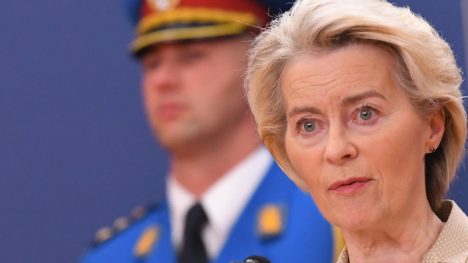
European Commission President Ursula von der Leyen. © Getty Images / Amir Hamzagic; Anadolu
RT | October 15, 2025
Serbia will not be able to join the EU unless it aligns fully with the bloc’s foreign policy, including adopting all sanctions against Russia, European Commission President Ursula von der Leyen has said.
Serbia, which applied to join the EU in 2009 and received candidate status in 2012, remains one of the few European states that has refused to impose any restrictions on Moscow. Belgrade has cited its historic ties with Russia and continues to rely on energy supplies from the country.
Speaking alongside Serbian President Aleksandar Vucic at a press conference in Belgrade on Wednesday, von der Leyen stated that Belgrade must “take concrete steps” toward membership and demonstrate “a greater level of alignment” with EU positions, including on sanctions.
She added that Serbia’s current level of alignment with EU foreign policy stands at 61%, but that “more is needed,” insisting Brussels wants to see Belgrade act as a “reliable partner.”
Vucic has repeatedly said that Serbia will not impose sanctions on Russia under any circumstances, calling his country’s stance “independent and sovereign.” However, Belgrade’s refusal to comply has drawn increasing pressure from both Brussels and Washington.
Last week, the US activated sanctions against the Petroleum Industry of Serbia (NIS), a major oil company partly owned by Russia’s Gazprom Neft, prompting Croatia to suspend crude deliveries. Vucic has warned that the measures could force Serbia’s only oil refinery to shut down by November, threatening the country’s gasoline and jet fuel supply.
At the same time, Serbia has been shaken by a wave of violent anti-government protests over the past year, which Belgrade claims are being fueled by Western influence in an effort to destabilize the government.
Russia’s Foreign Intelligence Service (SVR) has alleged that the EU is attempting to orchestrate a “Serbian Maidan” and install a pro-Brussels administration.
Budapest has voiced similar concerns, claiming that Brussels seeks to “overthrow” the governments of Hungary, Slovakia, and Serbia for maintaining ties with Moscow and refusing to abandon Russian energy.
Hungary cannot meet energy demands without Russia – FM

Hungarian Foreign Minister Peter Szijjarto. © Getty Images / Sefa Karacan; Anadolu
RT | October 15, 2025
Hungary cannot meet its energy needs without Russian oil and gas and has no intention of abandoning supplies, Foreign Minister Peter Szijjarto has said. Speaking at the Russian Energy Week forum in Moscow, Szijjarto stressed that Hungary’s energy security depends on existing supply routes and long-term contracts with Russian companies.
Brussels has repeatedly demanded that all EU members cut off ties with Moscow and stop purchasing Russian energy. Szijjarto said Hungary has been pressured to refuse Russian deliveries in the name of “diversifying” its imports, but dismissed the argument as “insane” and “completely illogical.” He questioned how abandoning one source of energy could possibly be described as diversification.
The minister warned that if Hungary were cut off from Russian gas supplies, it “will not be able to ensure the necessary fuel supplies.” He said the same applies to Russian crude oil delivered via the southern branch of the Druzhba pipeline. According to Szijjarto, other hydrocarbon routes cannot currently replace the volumes provided through the TurkStream gas pipeline and the Druzhba network.
Szijjarto praised Hungary’s cooperation with Russian energy companies, noting that they have never failed to meet contractual obligations. “If we needed more, they provided more; if we needed less, they provided less. Contract terms have always been honored, so why should we suddenly sever these relations?” he said. The minister added that thanks to its partnership with Russia, Hungary remains in a secure position regarding energy supplies.
The EU has called for a complete phase-out of Russian energy imports by 2027, though several member states, including Hungary and Slovakia, continue to rely on Russian crude delivered via Druzhba. In recent months, Ukrainian attacks on energy infrastructure connected to the pipeline have intensified, worsening tensions between Kiev and Budapest.
Szijjarto has said the strikes on Druzhba amount to an attack on Hungary’s sovereignty and urged the EU to ensure the security of the bloc’s energy supplies.
Moscow has described Brussels’ efforts to abandon Russian energy in favor of more expensive US alternatives as “suicidal.”
The EU isn’t at war with Russia – it’s at war with the minds of its own citizens
European leaders are trying to gaslight their populations into believing that it’s Moscow that wants a fight, not them
By Tarik Cyril Amar | RT | October 14, 2025
Among other things, this particular moment in history will be remembered – whether in whole books, mere chapters, or (if we are lucky) forgotten footnotes – as the Great European Drone Scare. For weeks now, the populations of NATO-EU Europe have been subjected to a barrage of vague but scary reports about drone sightings. The drones have appeared – seemingly – over various places and installations, prominently including airports in Denmark and Germany.
They are of unknown origin and unknown purpose. And, quite often, it is actually also unknown whether they are even real. Indeed, there is no proof of Russia being responsible for any of these incidents, as even Western media admit. We are once again asked to simply trust our politicians and “experts.”
That is, the same ones who took months to stop pretending that Russia – absurdly – blew up its own Nord Stream pipelines in 2022. As late as spring 2023, Germany’s Carlo Masala, for instance, who also believes “Girkin” and “Strelkov” are two different individuals (just like “Santa” and “Claus”), was still spreading groundless speculation – really, a conspiracy theory – about a “false flag attack” on Nord Stream, that is: Russia, Russia, Russia.
And – oh, coincidence! – also recently, Moscow, we are told, has had nothing better to do than oblige Western information warriors with three further sort-of incidents: a purported electronic-warfare attack on the plane of EU despot and de facto US proconsul Ursula von der Leyen over the Bulgarian city of Plovdiv, an alleged incursion into Estonian airspace, and low fly-overs over the German frigate Hamburg during a recent NATO exercise.
In reality, those three stories share only one thing with the great drone saga: They don’t hold up to scrutiny. The case of the alleged Plovdiv GPS attack is so shoddy and cratered so badly so quickly that it’s been consigned to oblivion. The incursion into Estonian airspace did not happen either. Due to an agreement that Estonia itself signed in 1994, it cannot claim a 12-mile but only a 3-mile zone in the relevant area. Estonia’s case is hysterical to begin with; the 1994 agreement deprives it of even the flimsiest pretext of legality. Regarding the so-called buzzing of the Hamburg, finally, even Western military officials admit that it was not “imminently dangerous.” Instead, they complain, it was “unfriendly and provocative.” Frankly: Boohoo. What do you expect holding exercises on Russia’s doorstep while fighting an indirect war against it in Ukraine? A friendly chat among sailors over a stiff grog?
And yet everyone in NATO-EU establishment politics and its mainstream media has been singing the same old tired song, once again, sotto voce: Russia is coming, Russia is already here, Russia is everywhere. The new head of Germany’s spy agency – the Bundesnachrichtendienst – seems to believe that his job is not to do secret things quietly but to join the chorus of the panic-mongers: He also has sleepless visions of the Russians attacking just any day now. Maybe from right under his bed or out of his cupboard, one must suppose.
It is almost as if they were all reading from the same hymn sheet, that is, memo. And, of course, the new wave of self-induced hyper-ventilation has been milked for all it’s worth – a lot, as in billions of Euros – for yet more money to be spent on armaments, including but not limited to a “drone wall,” while ordinary people are subjected to ever more brutal austerity. Even more disturbingly, there is a clear drive to concentrate ever more powers with those same political establishments that can’t stop ruling by frightening and confusing their own citizens.
That the drone stories are already crumbling makes no difference: A dramatic French attempt – special forces and all – to pin nefarious drone activity on a tanker, for instance, has failed miserably. In Germany, a recent sighting has actually been cleared up quickly. The culprit? A hapless German drone amateur who must be living under a rock.
And perish the thought that Ukraine itself might have anything to do with those mystery drones! Its regime has plenty of motive, and, by now, even the West has been compelled to acknowledge that it is perfectly capable of massive sabotage operations and lies to manipulate its European backers. Because that is now even the official story of the Nord Stream terror attack. But: thinking logically – verboten!
Instead, let’s pretend that we know what we don’t know (Russia, Russia, Russia!) and start overreacting, again, based on our ignorance and panic at best, on a malevolent, deliberate strategy of cognitive warfare against our own countries at worst. In Germany, for instance, both Chancellor Friedrich Merz and Defense Minister Boris Pistorius have made the bizarre claim that while the country is not (yet?) at war, it is also no longer at peace. And the-Russians-are-coming head of the BND? He feels the current peace is “icy” at best and – drum roll – “could turn into heated confrontation at any moment.”
What is that even supposed to mean? Is there a backhanded admission, finally, that Germany has made a deliberate and awfully self-harming choice to fight Russia through Ukraine? If so, thank you, Hauptmann Obvious: during last year’s Ukrainian Kamikaze offensive, German tanks got shredded once again in the vicinity of Kursk – at the 1943 site of the largest tank battle in history. (And guess who lost?) We have noticed that much. How about you, our supposed leaders, stop playing with fire?
Or are these fear-mongering statements meant to prepare the ground for a concrete power grab? That is what Roderich Kiesewetter, an ultra-Russophobe and war fantasist from Merz’s own center-right CDU party has already suggested explicitly: he wants the German parliament to declare the so-called “Spannungsfall,” literally “situation of tension.” In the mainstream media, for instance the important newspaper Welt, the usual information warriors are already amplifying Kiesewetter’s message. And – yet another striking coincidence – a recent military exercise called “Red Storm Bravo,” in Hamburg, one of Germany’s biggest cities, was dedicated to cosplaying the “Spannungsfall” – with maximum publicity.
The consequences of initiating a “Spannungsfall” – a kind of official pre-war – are complex and severe: Open-ended, compulsory, and universal military service is only one of them; the army can be used domestically; citizens can be drafted for work; civil rights are painfully restricted; those critical of government policy, NATO, or the “Spannungsfall” itself can be cajoled even worse than usual.
Last but not least, the “Spannungsfall” allows the government to postpone or otherwise influence elections. In Germany, it would be an ideal vehicle for the traditional parties to at least stall the consequences of their own failure, unpopularity and decline, on one side, and the rise of challengers on the so-called “populist” new right and left, on the other.
Carl Schmitt, Germany’s 20th-century version of Niccolo Machiavelli – brilliantly smart, ruthlessly realistic, and morally badly questionable – defined ultimate political power as the ability to declare a state of exception. In essence, Schmitt’s logic was simple: we live together by having rules; hence, the power that trumps all others is to decide when those rules do not apply.
Schmitt explained extremes. In reality, governments don’t raze all rules in one fell swoop. Why should they? To unshackle themselves and become even less accountable than usual they proceed stealthily and gradually. No need to trumpet a state of exception in its pure, all-or-nothing form. Why needlessly scare the subjects and, perhaps, provoke resistance?
Instead, what usually happens is the invocation of an emergency – either simply made-up or greatly exaggerated – to justify chipping away at citizens’ rights, first a little then a lot, while boosting the unchecked powers of the rulers and their bureaucrats. Call it the salami-slicing tactics of Western liberalism.
Dialing up the state of exception in handy instalments – that is also the most plausible explanation of the recent great drone scare in NATO-EU Europe. Yet another phase in the years-long Putin-is-gonna-get-you cognitive warfare campaign that Western establishments and mainstream media have been waging on their own fellow citizens, the great drone scare serves the general purpose to promote even more panic over an allegedly impending Russian attack on NATO states.
The techniques for escalating the war scare are dishonest and repetitive, but highly developed. As a high-ranking NATO general has told us, their aim is not simply to manipulate “what people think.” That, in NATO-speak, would be mere propaganda and just so old-hat. Rather, the state-of-the-art approach is to “exploit vulnerabilities of the human mind” to influence “the way” people think. Targeting “human capital” – yes, that’s us, all of us – “from the individual to states, to multinational organizations, across everyday life.”
Of course, the official pretense is that all of the above is what the enemy – read: Russia (and China) – does or, at worst, what NATO will do to that enemy. But is in the nature of the cognitive warfare shtick that it easily allows for turning the psychological disruption guns on the West’s own populations. Because – so the pretext – those populations are already under cognitive attack by the enemy. So what can you do, except fight back on the battlefield you claim is under attack: their minds? We have seen and experienced the results of this nifty little sleight of hand for years already.
But there also is something special. In the words of Jonas Togel, one of the few Western experts daring to notice Western information warfare, “it is worse than it has ever been.” Indeed, but there is no guarantee that things won’t get even worse again. The real question is how much longer our cognitive warriors-in-chief will have a free hand to drive us all mad with fear.
Tarik Cyril Amar is a historian from Germany working at Koç University, Istanbul, on Russia, Ukraine, and Eastern Europe, the history of World War II, the cultural Cold War, and the politics of memory.
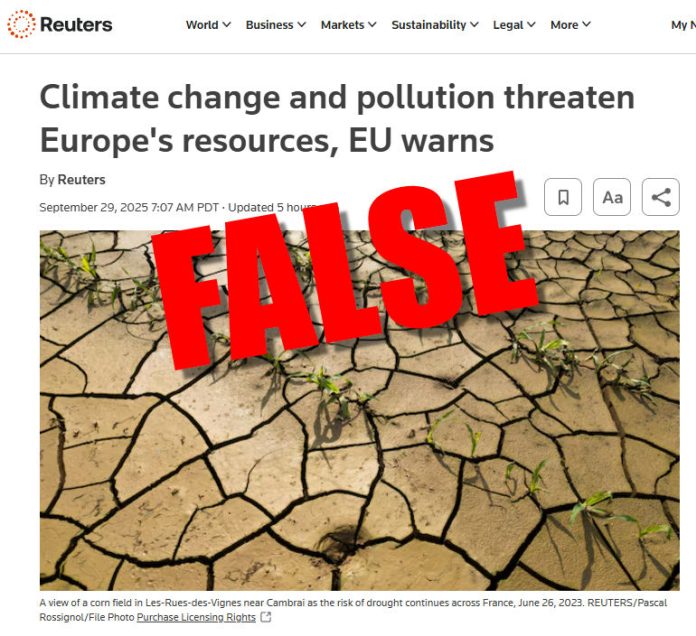
No, Reuters, Climate Change is Not Threatening Europe’s Resources
By Anthony Watts | ClimateRealism | October 2, 2025
In the article, “Climate change and pollution threaten Europe’s resources, EU warns,” Reuters asserts that climate change poses a “direct threat” to Europe’s natural resources, citing an EU environment agency report, and warns of worsening droughts and extreme weather. These claims are patently false. History shows far worse droughts in the past with no appreciable trend of other types of extreme weather events becoming more common or severe. Europe’s resource problems are caused by humans, stemming from overuse and poor management, just not from human-caused climate change.
The article declares that “Europe is the world’s fastest-warming continent and is experiencing worsening droughts and other extreme weather events.” It further states that more than 80 percent of protected habitats are in poor condition, blaming climate change and pollution.
“The window for meaningful action is narrowing, and the consequences of delay are becoming more tangible,” European Environment Agency executive director Leena Yla-Mononen told Reuters. “We are approaching tipping points – not only in ecosystems, but also in the social and economic systems that underpin our societies.”
The is political rhetoric couched in weak science.
The reality is far more mundane. The European Environment Agency’s own data show that water stress is primarily linked to intensive agriculture, industrial demand, and population growth. As the “Review of National Water Allocation Policies in Six European Countries” documents, many European countries continue to over-allocate water rights, creating artificial scarcity even in years with average rainfall. This is a governance problem, not a climate one. Similarly, biodiversity decline across Europe is overwhelmingly the result of land use change, habitat fragmentation, and invasive species—not a few tenths of a degree of warming over the last few decades.
When it comes to extreme weather, Reuters’ claims are directly contradicted by the Intergovernmental Panel on Climate Change (IPCC) AR6 report which notes there is little to no attribution of many types of severe weather to climate change. As Climate at a Glance: Extreme Weather summarizes, data do not support claims that extreme weather events are becoming more frequent or severe worldwide.
Further, Europe’s worst droughts occurred long before today’s modest warming. The megadrought of 1540 lasted an entire year, with contemporaneous records describing riverbeds across central Europe running dry, widespread crop failure, and thousands of deaths. More recent severe droughts struck in the 1920s and 1940s, periods that cannot be blamed on modern greenhouse gas emissions. The paper “The 1921 European drought: impacts, reconstruction and drivers” describes the 1921 European drought as “the most severe and most widespread drought in Europe since the start of the 20th century.
In “A drought climatology for Europe,” decadal trends show “greater pan-European drought incidence in the 1940s, early 1950s … and lesser drought incidence in the 1910s, 1930s” over the 20th century.
And there are many more worse droughts even further back in the past, before climate change even had a name, as this graph from the 2021 paper Recent European drought extremes beyond Common Era background variability shows:
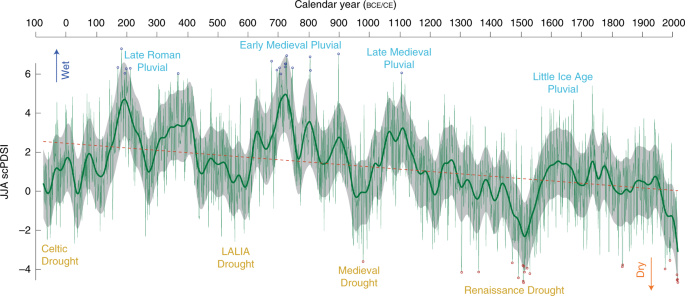
Compared to these historical drought episodes, recent intermittent summer dry spells are far from extraordinary.
Also, as detailed in multiple Climate Realism posts on the topics neither floods, here and here, for example, nor wildfires, here and here, are more frequent or severe now than they have been in the past.
Even heatwaves are neither more frequent nor deadly now than they have been historically, with deaths from temperatures declining.
Europe’s actual environmental challenges—such as nutrient pollution in rivers, overfishing, and urban sprawl—require pragmatic policy solutions, not grandiose climate pledges. By conflating resource depletion with climate change and exaggerating extreme weather risks, Reuters has misled its audience. The problems it describes are not new, not worsening because of climate change, and not solvable by CO₂ reductions. They are solvable by better governance, better planning, and better science. Once again, journalism has been sacrificed to climate alarmism.
The Netherlands nationalizes Сhinese-owned tech company
RT | October 13, 2025
The Dutch government has taken control of a Chinese-owned chipmaker based in the Netherlands, citing risk to the EU’s economic and technological security. The firm called the move “excessive,” saying it complied with all relevant laws and regulations.
The Netherlands Economy Ministry revealed late on Sunday that it had invoked a never-before-used emergency law to take control of manufacturer Nexperia, owned by China’s Wingtech Technology.
Once part of Dutch electronics group Philips, Nexperia specializes in the high-volume production of chips used in the automotive, consumer electronics, and other industries.
Amsterdam said it wanted to prevent a situation in which Nexperia’s chips could “become unavailable in an emergency” which “could pose a risk to Dutch and European economic security.”
The Dutch government called the move “highly exceptional,” citing “recent and acute signals of serious governance shortcomings and actions” within the company.
Wingtech shares tumbled 10% in Shanghai on Monday, forcing a halt in trading after hitting the daily limit.
The tech firm decried the Dutch government’s move as “excessive intervention driven by geopolitical bias, rather than a fact-based risk assessment,” according to a now-deleted WeChat post, which was archived by the Chinese policy blog Pekingnology. Wingtech said it would take actions to protect its rights and would seek government support.
The company later said in a filing to the Shanghai Stock Exchange that its control over Nexperia would be temporarily restricted due to the Dutch order and court rulings affecting decision-making and operational efficiency.
The Dutch takeover of Nexperia comes at a time of escalating global trade tensions. Over the past year, China and the EU have clashed over what the bloc claims is Beijing’s dumping of certain key goods and its industrial overproduction. China has accused the EU of protectionism.
Last week, China tightened its restrictions on the export of rare earth elements and magnets, a step that could further hurt the EU’s struggling auto industry.
‘Anything They Don’t Like Is Russian Interference’ — Clare Daly Lifts the Lid on EU Propaganda
APT | October 9, 2025
In this eye-opening session, Irish MEP and activist Clare Daly exposes the harsh reality of Europe’s so-called “defense of democracy” policies. Labeled a “Russian propagandist” simply for speaking the truth, Daly takes aim at the European Union’s disinformation framework, hybrid sanctions, and systematic crackdown on dissent.
From pro-Palestinian journalists facing travel bans and asset freezes to citizens being punished for questioning COVID measures or NATO policies, Daly reveals how words and ideas are treated as weapons and how the EU is increasingly silencing voices that challenge its narrative.
“If it’s them today, it’s you tomorrow,” warns Daly, emphasizing the urgency for citizens to organize, protect free speech, and hold European leadership accountable.
Watch as she explains how hybrid sanctions, political repression, and media control are reshaping democracy in Europe — and why everyone should pay attention before it’s too late.
West behind latest coup attempt in Georgia – Tbilisi mayor
RT | October 10, 2025
Foreign governments instigated a “coup” attempt in Georgia, the mayor Tbilisi, Kakha Kaladze, has claimed, referring to recent protests in the South Caucasus nation.
The Georgian government has repeatedly cried foul over alleged external interference in the nation’s internal affairs. It says the West has sought to depose the ruling Georgian Dream party, which has consistently refused to antagonize neighboring Russia over the Ukraine conflict.
Speaking to reporters on Thursday, Kaladze claimed that ahead of the municipal elections on October 4, “a campaign had been underway for months regarding a coup d’état,” backed by foreign actors.
According to the official, “hundreds of millions” were spent on the effort through non-governmental organizations, with certain Western ambassadors openly “inciting violence” in Georgia.
On Wednesday, US Senators Jim Risch and Jeanne Shaheen issued a statement accusing the Georgian authorities of persecuting the opposition and attempting to “silence dissent,” as well as of “making baseless allegations” against former US government employees.
Kaladze responded by describing the US lawmakers as being “under the influence of the Global War Party.”
Speaking on national television on Monday, Georgian Prime Minister Irakli Kobakhidze made similar claims, alleging that foreign powers had backed the opposition, whom he characterized as “foreign agents.”
Opposition protests, which quickly descended into clashes with police, erupted last weekend as municipal election result projections indicated that the ruling Georgian Dream party held a solid lead across the country.
The unrest was the latest in a series of similar demonstrations that have gripped Georgia in recent years. They reached a climax in October 2024, following presidential and parliamentary elections, when the opposition accused the authorities of fraud. Protesters had previously also cited a perceived stalling of the EU accession process by the Georgian government. Officials have dismissed all allegations.
The EU openly backed the demonstrators, who according to Kobakhidze, were “financed by foreign special services” in a manner similar to the 2014 Maidan coup in Ukraine.
Featured Video
Trita Parsi: Israel Set a Trap for Total War in the Region
or go to
Aletho News Archives – Video-Images
From the Archive
Zionism’s Violent Legacy
By Donald Neff | Washington Report On Middle East Affairs | January 1996
On January 4, 1948, Jewish terrorists drove a truck loaded with explosives into the center of the all Arab city of Jaffa and detonated it, killing 26 and wounding around 100 Palestinian men, women and children.[1] The attack was the work of the Irgun Zvai Leumi – the “National Military Organization,” also known by the Hebrew letters Etzel – the largest Jewish terrorist group in Palestine. The Irgun was headed by Revisionist Zionist Menachem Begin and had been killing and maiming Arabs, Britons and even Jews for the previous ten years in its efforts to establish a Jewish state.
This terror campaign meant that at the core of Revisionist Zionism there existed a philosophical embrace of violence. … continue
Blog Roll
 Aletho News
- Trita Parsi: Israel Set a Trap for Total War in the Region
- Trump’s Iran war is on an Israeli leash
- Saudi oil boss issues global supply warning
- Riyadh Says Its Oil System Is Intact. The Numbers Say Otherwise.
- Trump and Netanyahu Want to “Finish the Job” on Iran
- US ‘one-sided dictation’ not Iran’s beliefs makes rational talks impossible: Baghaei
- Iran’s Next Strike May Not Explode. It Could Shut You Down /Col Doug Macgregor
- Iran: US political targets legitimate if assassinations return
- Iraq shuts key border crossing with Iran under US pressure: Report
- Undersea Internet cables could be targeted in retaliation for attacks on Iran: IRGC deputy chief
- If Americans Knew
- The Israel Lobby’s Changing Fortunes
- AIPAC has become such a political liability that it’s shifting to a more “nimble” approach to buying politicians
- At least 160 Israeli settler attacks in 2 weeks
- Will Gaza’s Ancient Christian Community Disappear Forever?
- Israel’s vision of regional security rests on keeping Arab states weak
- Heidi Levine recounts how Palestinian youths helped save her in settler attack
- DAILY UPDATE: Latest essential news on Palestine, Israel, & region
- Trump’s Intensifying Sabotage of the ICC, for Israel’s Sake
- Israeli military detain US and UK volunteers in West Bank including Democratic NY politician Brad Lander
- Americans at National Conservatism Conference held in Israel this year criticize Israel
- No Tricks Zone
- E-Cars Reduce CO2 Emissions By Only 41% Compared To Internal Combustion Engine Vehicles
- Predictions Made By Renowned Climate Professor Over Past Decades Have Been Proven To Be Poor
- New Study Suggests Large Regions Of The Pacific Ocean Have Been Cooling For The Last 80 Years
- Germany’s Green Energy Debacle: High Energy Costs Force Kahla Porzellan to Close After 182 Years!
- New Study: 50 Years Of The Most Aggressive ‘Net Zero’ Policies Can Only Affect The Global Climate By 0.03°C
- US September “Heat” Was No Record…Many Records Set Decades Ago
- Latest European Green Energy Debacle; Portugal’s Largest Flagship Solar Park Insolvent!
- Green Energy Debacle: German Expert Professor Fritz Vahrenholt Warns Of Severe Economic And Social Consequences
- Two More Paleo Reconstructions Affirm Meters-Higher Sea Levels Across Ireland, Brazil 7000-6000 Years Ago
- New Study: Earth And Venus Surface Warmth Largely Explained By Convection And Lapse Rate, Not CO2 Or Radiation

