French Politician Slams Ukraine for Abandoning Howitzers to Russian Forces
Samizdat – 25.06.2022
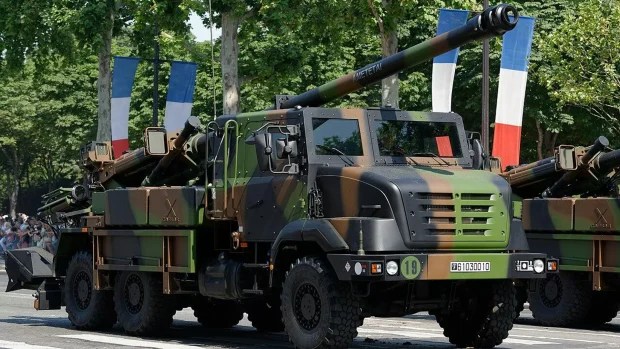
French politician and far-right National Rally candidate for the 2022 general election, Jean-Michel Cadenas, has criticized the Ukrainian military for abandoning two Paris-originated Caesar self-propelled howitzers on the battlefield. Cadenas also blasted French President Emmanuel Macron for sending them in the first place.
“Russia has recovered, among other things, two of the first six Caesar howitzers sent by France [to Ukraine]! They were in perfect working order. The Ukrainians withdrew [from their positions] so quickly that they did not have time to either destroy or booby-trap them!” Cadenas wrote on his Twitter account.
The politician went on to recall that following their capture, the howitzers were sent to a Russian defense lab. Cadenas, who is a former army officer himself, alleged that the weapons will be “dissected, studied, copied and improved” by Russia, adding sarcastically, “Thank you, Macron!”
The Uralvagonzavod Russian defense lab which is studying the Caesars also sent its regards to the French president.
“[We] send out gratitude to President Macron for [the] gifted howitzers. We can’t say that they are good howitzers, nothing like our MSTA-S [NATO codename: M1990 “Farm”]. Nonetheless, we will find a good use for them. Please send more for disassembly!” Uralvagonzavod wrote.
Moscow has repeatedly advised western countries against sending weapons to Ukraine, warning that Kiev might not exercise control over where they end up, possibly including in the hands of third-party terrorists looking to compromise European security. The Kremlin also stressed that these shipments unnecessarily prolong the conflict in Ukraine and added that it shows how the West wants to fight “until the last Ukrainian standing” to oppose the Russian special military operation.
These words of caution were hardly heeded by western countries, which continue to send new weapons and ammunition.
French Elections, Round 2: What Actually Happened?
Resisting the Intellectual Illiteratti | June 24, 2022
As has been reported abundantly by the French and international media, Sunday’s results — with Macron’s party and coalition losing its absolute majority — were indeed momentous and have the potential to restore a balance of power between the executive and legislative branches of government. (The French courts, as I’ve mentioned before, are almost a lost cause when it comes to performing the duties of judicial review, and in my view there is no point in including the judiciary in the French checks and balances model anymore).
But I think caution is still called for too. There is no reason to assume that immediate reversals or changes to the worst laws of the recent past will be forthcoming or are guaranteed at any point. Just as we have seen in the US in recent congressional votes of generational-defining importance, ideological or partisan differences don’t usually make much, if any, difference when the result is ordained in advance by the executive and consent is manufactured dutifully by the media.
I think it’s also important to recall that while it is true that it has the last word in the lawmaking process, the lower house in France, L’Assemblée Nationale, needs only a relative majority for a bill to become law. Except for amendments to the constitution, where an absolute majority of members is required to be present, there is no minimum number of deputés that have to be in attendance for a bill to be voted on. If only 5 members happen to be in the lower chamber when a vote is held and 3 vote in favor, the proposed legislation passes.
I mention these facts not to be a killjoy but rather to draw attention to the fact that throughout the coronavirus delirium (which continues, albeit in muted fashion, in France), the French Parliament first voted, in early 2020, with an overwhelming majority and across partisan lines, to declare a state of emergency and confer dictatorial powers to the president. For the following two years, every time the parliament had an opportunity to revoke or limit those powers by, for instance, ending the state of emergency, it not only didn’t do so, but actually went on to codify the worst of the totalitarian covid restrictions, for example, ushering in legalized discrimination with health passes and later, vax passes.
And while it is true that the entirety of the far-left and far-right minorities in the lower house proclaimed themselves opposed to the post-lockdown measures such as health and vax passes, when it was time to put their money where their mouths were, most did not even bother to show up to vote. On two of the most important votes held over the last year, concerning a law that would require the use of health and vax passes for access to transport and places of leisure and culture, as well as to hospitals and retirement homes, Macron’s ruling party’s presence was so weak in the lower house that had every member of the far-left and right oppositions actually made the trip to vote (or voted by proxy), the bills would not have passed. One wonders if the exemptions they enjoyed, as members of Parliament, from the coercive, live-ruining measures that are health and vax passes had anything to do with their being largely absent from the votes.
Either way, the fact that these totalitarian policies didn’t have to become law, that they could have been torpedoed last year, even while the president’s party held an absolute majority in the lower house, doesn’t inspire confidence that they will be done away with now that the balance of power has shifted.
That said, the composition of the recently elected lower house will create many opportunities for the now much larger opposition parties to stop Macron in his tracks. I won’t get into the numbers too much except to say that Macron’s coalition party (which is made up of four centrist parties) is 44 seats shy of the absolute majority necessary to govern unfettered and, having only a relative minority, will need to wheel and deal and seriously compromise in order to get anything it puts foward passed.
At the same time, both Marine Le Pen’s far-right Rassemblement National (National Rally) and Jean-Luc Mélenchon’s far-left La France Insoumise (France Unbowed) won enough seats to significantly expand their power and influence. However, of the two, Marine Le Pen’s National Rally emerged as the clear winner and most powerful single party opposition group. Jean-Luc Mélenchon’s France Unbowed chose to form a coalition with three other left-leaning parties in the hopes of acquiring an absolute or relative majority, and while their Nupes coalition won the most seats after the president’s own coalition, it was not enough to secure any majority positions or allow Mélenchon’s France Unbowed party to surpass Marine Le Pen’s National Rally in seats.
On the upside, both far right and far left, having surged in numbers, are now able to call for a motion of censure of Macron’s government, which can lead to a no-confidence vote — a measure Jean-Luc Mélenchon’s France Unbowed promptly resorted to yesterday.
In the case of Marine Le Pen’s far right Rassemblement National, however, having surpassed the critical threshold of 80 seats, her group can now request positions on various important committees, as well as have bills sent to the constitutional court for judicial review. This is a milestone and historic achievement for her much maligned party.
In the case of Mélenchon, as mentioned above, his France Unbowed successfully formed an all-left and left-leaning coalition, which includes the socialist, environmentalist and communist parties. While this coalition won the most seats after Macron’s own coalition, it is believed to be a tenuous alliance in which the individual groups will not see eye to eye on a range of issues. The hope is, however, they will remain united on the most important ones.
The funny thing in all this is that Mélenchon, elected to the lower house in 2017, did not stand for re-election this year in his Marseille district, a seat he would have won handily. It seemed that he bet the house on his coalition pulling off a landslide victory, in which case their numerical superiority in the lower house would force the president to appoint him as Prime Minister. Sadly for Mélenchon (and us), he lost his wager and will now have to direct the operations of his party and coalition from outside the halls of the Assemblé Nationale.
The upshot of all this is that Macron is looking at a Parliament that may not pass any of his upcoming reforms into laws — and he has a pack of the vile things he’d like to ram through. In the short term, the future will not be easy for the impatient monarch. His government is already facing a motion of censure on the 5th of July (introduced Monday by Jean Luc Melenchon’s France Unbowed party), and three of his cabinet ministers who were in the running for parliamentary seats lost their bids. According to convention, their unsuccessful attempt to get elected to the lower house while working in the president’s cabinet as ministers will require them to resign from their positions, leaving Macron scrambling to appoint replacements. He will have to do this while also meeting with the leaders of the opposition parties, whom he hopes to begin negotiating with, ahead of the upcoming parliamentary session.
Macron is also under great pressure from the EU in Brussels to continue the EU-wide project of neoliberal reforms. Until now, the French president has had a free hand in pushing through some of the most politically, socially and economically destructive and divisive policies ever seen in modern France, the last two years of totalitarian public health policies and the continued dismantling of France’s public health service being the prime examples. Will he be able to continue? It seems the answer is: yes, but perhaps not so easily.
Macron does have one card left he can play, however; though it’s a risky one: he can dissolve the Assemblée Nationale. Yes, you read that correctly. The constitution of the 5th Republic gives the French president the power to dissolve the lower house and call new elections (which have to be organized within 60 days) if he deems the parliamentary configuration to be an impediment to effective lawmaking. (Can you imagine Biden — or better, Trump — announcing to the house of representatives, after one-too-many government shutdowns, “That’s it — You’re all fired. Everyone out of the capital! We’re gonna have new elections, and we’re gonna get it right this time!”)
Not surprisingly, though, such an un-democratic move is not popular and the last time it was used, by Jacques Chirac in 1997, it blew up in the president’s face when the new vote results were worse than the first time around and forced him to appoint a socialist (and formidable political rival) as Prime Minister. That said, the chattering classes are predicting Macron will indeed resort to this measure at some point in the future. But when?
For us, the main concern remains that of the state of emergency (under which we have been living for two and a half years), which allows Macron to act like a dictator and close businesses, confine people to their homes, impose curfews, force the population to wear facemasks, and make the restitution of these once unconditional rights (to work, to assemble, move and breath freely, etc.) contingent on the injection of experimental drugs that no one needs and only a fraction of the population actually wants.
Though many of its most oppressive measures have been (temporarily) lifted, the state of emergency is still in effect and will remain in effect until July 31 of this year. One of the biggest casualties of the president’s irrational, totalitarian covid policies has been the healthcare workers, 15 thousand of whom (doctors, nurses, orderlies) as well as hundreds of gendarmes, remain suspended from their jobs, without pay, having been deprived of their right to work last September 15th because they refused to take an experimental medicine that, by the government’s own admission, does not prevent transmission of a disease deemed to be a major threat to public health.
Despite the bleak situation, there may be cause for some hope. As mentioned earlier, Macron’s ability to govern by decree is set to end at the end of next month, with the lapsing of the state of emergency. In order to extend it and make possible the return in the fall of vax passes, lockdowns, curfews, travel restrictions, business closures, mask mandates and all the other totalitarian horrors that serve no public health benefit in relation to upper respiratory viruses that spread like the common cold (and therefore can’t be stopped from spreading), but which the leaders of Europe desperately want to retain and make permanent, Macron will need to get a new covid law passed by the parliament before the end of July.
The French president was in fact supposed to present said covid bill at a ministerial meeting today (the first step in the legislative process before the bill reaches parliamentary committees and debates), but had to cancel the meeting because of the aforementioned resignations of three of his ministers. This delay will presumably push the start of the legislative process for this bill back another week. But next week Macron will be out of France on a NATO-related trip, so perhaps it will get pushed back an additional week. When it is eventually presented to the parliament, the bill will need to be debated and put to a vote by the newly elected lower house — and that’s where the rubber should meet the road.
It will indeed be the first and most important test of the new assembly, and one which will no doubt come with an unprecedented amount of pressure and propaganda from Macron and the media. Will the opposition parties finally say no to the president dictator and all his lies and send this disgraceful piece of legislation into the garbage where it belongs? Or will the new Assemblée play ball as the last useless lot did? L’espoir fait vivre, as they say over here.
Postscript:
Europe is slowly transitioning into a bio-security and surveillance state. Tomorrow, the EU parliament is expected to rubber stamp the EU commission’s decision to extend the use of the EU Digital Covid Pass for another year for all travel to and within Europe.
This will mean that, until the end of June 2023, in order to board a plane, train or boat into or within Europe, you will need to show either a negative PCR or antigen tests 24 hours before traveling, a certificate of proof of recovery from covid (which may be valid for 3 months), or proof of experimental injection.
The law reads like a Pfizer press release, and is just as fraudulent and circular in its reasoning. This digital covid certificate measure, we are told, is necessary to ensure the free and safe movement of Europeans within Europe, a right that is guaranteed by the European Union’s various treaties and conventions…but which was illegally taken away two years ago by the European Union.
There are protection rackets that are more sophisticated than this…I don’t understand how Europeans will submit to this for another year. It’s an ominous sign.
Analysis of the French legislative election
By Gilbert Doctorow | Irrussianality | June 20, 2022
It was a delight to participate yesterday evening in a featured news program on Press TV just as the results of the voting were coming in. It is quite remarkable that the news room and their correspondent in Paris took a line of commentary that would fit perfectly within the reportage of the French mainstream news Establishment, Figaro or Le Monde. Their top question was whether Macron’s movement, which now had lost its absolute majority, could regain control of Parliament by forming a coalition with the traditional centrist party, the Republicans. Their top concern was whether this would enable Macron to proceed with his neo-Liberal domestic reform policies, such as raising the legal retirement age from 62 to 65.
It was my pleasure to throw a spanner in the works and redirect attention to Macron’s foreign policy, namely his support for Ukraine in the ongoing military conflict with Russia, a policy which the nominally Leftist Opposition coalition of Mélenchon shares fully. Indeed, judging by foreign policy issues, there was only one true Opposition in this election, Marine Le Pen and her Rassemblement national, which seeks good relations with Russia and distances itself from NATO. Note that Le Pen’s party did better in yesterday’s elections than ever before and will capture as many as 10 times the number of seats it held before the elections.
As I argued in yesterday’s mini-debate, continuation of the war thanks to French and other European and American military and financial assistance to Kiev, and the continued imposition of draconian sanctions on Russia particularly in the energy sphere, are feeding an inflationary cycle that will overwhelm political and economic life in France in the coming months, especially when the home heating season begins.
©Gilbert Doctorow, 2022
Nuclear-armed states spent $82.4bn on nukes in 2021, US topped list: Report
Press TV – June 15, 2022
The world’s nine nuclear-armed countries – led by the US – spent $82.4 billion upgrading their atomic arsenal in 2021, eight percent more than the previous year, an anti-nuke campaign group has unveiled.
The largest spender by far was the United States, which accounted for more than half the total expenditures on nuclear weapons – followed respectively by China, Russia, Britain, France, India, the Israeli regime, Pakistan and North Korea – the International Campaign to Abolish Nuclear Weapons (ICAN) stated in its annual report, titled “Squandered: 2021 Global Nuclear Weapons Spending.”
“Nuclear-armed states spent an obscene amount of money on illegal weapons of mass destruction in 2021, while the majority of the world’s countries support a global nuclear weapons ban,” the group said in the report, noting that the massive spending nevertheless failed to prevent a war in Europe.
“This spending failed to deter a war in Europe and squandered valuable resources that could be better used to address current security challenges, or cope with the outcome of a still raging global pandemic,” ICAN said. “This corrupt cycle of wasteful spending must be put to an end.”
The group said atomic arms producers had further spent millions of dollars on political lobbying efforts, saying that every $1 spent on lobbying had led to an average of $256 in new contracts involving nuclear weaponry.
“The exchange of money and influence, from countries to companies to lobbyists and think tanks, sustains and maintains a global arsenal of catastrophically destructive weapons,” it said.
The US spent $44.2 billion on atomic weaponry in 2021, followed by China’s $11.7 billion, Russia’s $8.6 billion, the UK’s $6.8 billion, and France’s $5.9 billion, according to the report. India led the more recent nuclear arms developers in expenditures on the mass-destructive weaponry, spending $2.3 billion, followed by the Israeli regime’s $1.2 billion, Pakistan’s $1.1 billion and North Korea’s $642 million.
The report came a week after US-led NATO alliance declared that it did not offer a guarantee to Russia that it would not deploy nuclear weapons on the territories of its two prospective new members, Finland and Sweden.
ICAN’s report further confirmed a statement released by the prominent Stockholm International Peace Research (SIPRI) a day earlier in which it had warned that all the nine nuclear-armed states were increasing or upgrading their arsenals, and that the risk of deployment of such weapons appeared higher now than at any time since the height of the Cold War.
While there is no official confirmation on the amount North Korea spends on nuclear weapons or its arsenal, SIPRI estimates that it possesses as many as 20 warheads.
The Israeli regime, along with India, Pakistan, and South Sudan have never joined the Treaty on the Non-Proliferation of Nuclear Weapons (NPT), an international treaty purportedly established to prevent the spread of nuclear weapons.
As of August 2016, 191 states have become parties to the NPT, though North Korea, which acceded in 1985, announced its withdrawal from the treaty in 2003, following detonation of nuclear devices in violation of core obligations.
Critics of the treaty insist, however, that the NPT cannot stop the proliferation of nuclear arms or the motivation to acquire them, arguing that the biggest possessors and developers of atomic weapons are leading members of the global accord. Officials of the treaty have been selective in enforcing nuclear disarmament, imposing sanctions on observant member nations, such as Iran, while ignoring certain atomic arms possessor and developers such as India, Pakistan, and the Israeli regime, which is widely believe to possess at least 300 nuclear warheads.
France entered ‘war economy’ – Macron
Samizdat | June 13, 2022
France will adjust its six-year military spending plan in the wake of the Russia-Ukraine conflict, President Emmanuel Macron announced on Monday.
Macron said he instructed the government to “carry out a reassessment of the military spending program in the coming weeks, in the light of the geopolitical context.”
France “has entered into a war economy in which I believe we will find ourselves for a long time,” he said during the opening of the Eurosatory arms expo in Paris. The French president said that Russia’s military campaign in Ukraine created “an additional need to move faster and become stronger at a lower cost.”
“As for anyone doubting the urgency of these efforts, we only need take another look at Ukraine, whose soldiers are in demand of quality weapons and are entitled to a response from us,” Macron noted.
France and other NATO members are supplying Kiev with weapons, including armored vehicles, missiles, and drones.
Macron said Europe needs “a much larger defense industry” and should not rely on procuring weapons from elsewhere. The current program entails spending €295 billion ($308 billion) between 2019 and 2025 on modernizing the French military. The annual military budget is set to reach €41 billion ($43 billion) this year and €50 billion ($52 billion) in 2025.
Last month, European Commission President Ursula von der Leyen said that Europe would boost its defense in the wake of the Russia-Ukraine conflict. She said EU countries had announced increases of their defense budgets to an additional €200 billion ($209 billion) in the coming years.
Russia attacked Ukraine in late February, following Kiev’s failure to implement the terms of the Minsk agreements, first signed in 2014, and Moscow’s eventual recognition of the Donbass republics of Donetsk and Lugansk. The German- and French-brokered protocols were designed to give the breakaway regions special status within the Ukrainian state.
The Kremlin has since demanded that Ukraine officially declare itself a neutral country that will never join the US-led NATO military bloc. Kiev insists the Russian offensive was completely unprovoked and has denied claims it was planning to retake the two republics by force.
US policies led to ‘new G8’ – Moscow
Samizdat | June 11, 2022
The United States “with its own hands” pushed the countries, which are not participating in “sanctions wars,” to form a “new Big Eight” group with Russia, the Russian State Duma speaker Vyacheslav Volodin said on Saturday.
Following the launch of Russia’s military offensive in Ukraine in late February, the US, EU, UK and many other countries imposed hard-hitting restrictions on Moscow, making Russia the most sanctioned country in the world.
In a Telegram post, Volodin included a table with IMF data on GDP based on purchasing power parity of countries he calls the “new G8” and of countries forming the current G7 (after Russia’s participation in the bloc was suspended over Crimea’s vote to join the country in 2014, the G8 effectively turned into the G7).
“The group of eight countries not participating in the sanctions wars – China, India, Russia, Indonesia, Brazil, Mexico, Iran, Turkey – in terms of GDP at PPP is 24.4% ahead of the old group,” Volodin wrote.
In his opinion, the economies of the G7 members – the United States, Japan, Germany, Britain, France, Italy and Canada – continue “to crack under the weight of sanctions imposed against Russia.”
“The rupture of existing economic relations by Washington and its allies has led to the formation of new points of growth in the world,” Volodin claimed.
While having serious economic difficulties, the US, according to the Duma speaker, continues “doing everything to solve their problems at the expense of others.” Creating tensions will “inevitably” lead the US to lose its world domination, Volodin stressed.
“The United States created the conditions with its own hands for countries wishing to build an equal dialogue and mutually beneficial relations to actually form a ‘new Big Eight’ together with Russia,” he said.
Meanwhile, on Friday, US Deputy Assistant Secretary of State Eric Woodhouse said that Washington and its allies had realized that they would get “spillovers” of anti-Russia sanctions into their own economies. Their determination in imposing sanctions on Moscow, he claimed, has demonstrated a willingness to “accept those costs.”
US Treasury Secretary Janet Yellen admitted on the same day that the anti-Russia sanctions have made a “huge difference to food and energy prices,” amid record-setting inflation. The remarks followed the statement by the Russian President Vladimir Putin who said that “many years of mistakes made by Western nations” in their economic and sanctions policies have caused “a global wave of inflation, disruption of established logistical and manufacturing chains, a surge in poverty and a deficit of food.”
France investigating nuclear ‘cover-ups’
Samizdat | June 10, 2022
The French government is investigating whistleblower allegations that a state-run utility agency attempted to conceal safety issues at a nuclear power plant. Prosecutors confirm they are following up on complaints filed late last year.
Officials in Marseille launched an investigation into the alleged safety problems last month after an anonymous whistleblower said conditions at the Tricastin nuclear plant in southern France were “endangering the lives of others,” French newspaper Le Monde reported on Wednesday.
An engineer at the facility, the whistleblower also accused officials at the plant of “harassment,” as well as “violations of the criminal code, the environmental code, the labor code and the regulations relating to nuclear installations.” Though incidents continued – including a mysterious power surge at one reactor in 2017 and a flood at the same station one year later – no action was taken.
The largely state-run firm which operates the plant, Electricite de France (EDF), confirmed the ongoing investigation to the Wall Street Journal, saying the probe would help to “shed all necessary light on the alleged facts and thereby show the truth.”
Speaking to Reuters on Thursday, a lawyer for the whistleblower, William Bourdon, said the complaint was initially filed in November, but noted that the subsequent investigation does not target EDF directly. Instead, a probe “against X” has been launched, allowing prosecutors to look into the actions of multiple different parties.
The new investigation marks another blow for the French utility, which has recently taken half of the country’s nuclear reactors offline due to scheduled maintenance and refueling, and even outages caused by corrosion and damage. The spate of shutdowns coincided with soaring energy prices across Europe and elsewhere, driven in part by the conflict in Ukraine, as well as Western sanctions on Russian gas and oil exports.
The cost of inspecting and repairing the French nuclear plants could exceed €4.5 billion ($4.8 billion), according to recent EDF estimates, well beyond previous expectations. France derives around 70% of its electricity from nuclear power, and has seen a jump in prices throughout 2022.
Prior to the whistleblower filing, the Tricastin nuclear site had encountered some safety issues, including two separate uranium leaks within a matter of days in July 2008 which contaminated 100 employees at the plant and led to a ban on using local water for drinking, swimming, and agriculture.
French President Macron: “Vaccinate Everything That Can Be Vaccinated”
By Robert Kogon | Brownstone Institute | June 8, 2022
In another sign that the campaign of C-19 vaccination in Europe is far from over, French President Emmanuel Macron suggested last week that the appropriate response to the crisis in France’s overstrained emergency healthcare services is to “vaccinate everything that can be vaccinated.”
“Vaccinate everything that can be vaccinated,” Macron said, “because we avoid the virus. That’s the best response for unburdening the healthcare system and having a healthy population. So, we’re going to continue to work on this aspect.”
Macron’s word choice has attracted particular attention in the French Twittersphere and other online media, since he literally said that it was necessary to vaccinate “every-thing” (tout ce) and not, say, “everyone” (tous ceux) that can be vaccinated. But even if he had chosen to refer to people as people rather than things, the very idea of “having to vaccinate” people clearly denies them agency – to say nothing of any possibility of informed consent.
A clip of Macron’s remarks, which were broadcast on the French news channel BFM TV, is available here. They form part of more wide-ranging remarks, complete video of which does not appear to be available online.
But another extract posted on the BFM website appears to show the immediate lead-up to the “vaccinate everything” comment and suggests that Macron was responding to a question, more precisely, about whether reintegrating hospital staff who were suspended for having refused to get vaccinated against Covid-19 might help to address staffing shortages in French emergency rooms.
“Reintegrating unvaccinated healthcare workers is absolutely not an answer to the problem,” Macron says, not only because, according to him, they represent just a “tiny minority,” but also because – “if we’re honest” – the unvaccinated staff have “a dubious relationship to care and to ethics.” The French government made Covid-19 vaccination mandatory for healthcare workers in September 2021.
Macron’s remarks on “vaccinating everything that can be vaccinated” come after European Commission President Ursula von der Leyen’s recent call to “further step up vaccination” throughout the EU and the Commission’s issuing of a detailed strategy for doing so starting in the fall.
Robert Kogon is a pen name for a widely-published financial journalist, a translator, and researcher working in Europe. He writes at edv1694.substack.com.
Israeli regime openly calls on IAEA to censure Iran
Press TV – June 7, 2022
The Israeli regime is openly putting pressure on the United Nations’ nuclear watchdog to censure Iran’s peaceful nuclear energy program.
“We expect the IAEA (the International Atomic Energy Agency’s) Board of Governors to place a clear warning light in front of the regime in Tehran, and make it clear that if it continues in its defiant nuclear policy, it will pay a heavy price,” the regime’s Prime Minister Naftali Bennett said on Tuesday, addressing the Knesset (Israeli parliament), The Times of Israel reported.
The comments came a day after the board started a five-day meeting in Vienna.
The event is set to adopt an anti-Iran resolution, drafted by Britain, France, Germany, and the United States to accuse the Islamic Republic of withholding cooperation with the agency.
Various media reports and official sources have warned about the existence of the Israeli regime’s footprints across the process that has led to the emergence of the draft resolution.
Raising even more suspicion was a Friday flying visit to the occupied territories by the IAEA’s Secretary-General Rafael Grossi, and his meeting there with Bennett, with some reports even sounding the alarm about the watchdog and Tel Aviv’s “collusion” against Iran.
“He (Grossi) arrived for a snap visit in Israel, and I made Israel’s stance clear — that we are operating and will continue to maintain our freedom of action to act against Iran’s nuclear program as long as necessary… nothing ties our hands,” Bennet said.
The Israeli regime has, over years, conducted several sabotage operations against Iran’s nuclear facilities and assassinated at least seven Iranian nuclear scientists.
The regime’s vicious anti-Iran campaign comes while Tel Aviv, itself, continues to be the sole possessor of nuclear arms in the Middle East region, with a stockpile of hundreds of atomic warheads. Due to the cover provided by the US and Europeans, however, the regime has refused to open up its nuclear sites to the IAEA’s inspectors and join the Nuclear Non-Proliferation Treaty (NPT).
“When it comes to nuclear weapons, we live in a world of double standards,” Frank N. von Hippel, an American physicist, who is a professor and co-director of the Program on Science and Global Security at Princeton University, told Press TV.
“This unequal situation cannot persist indefinitely: Either we get rid of nuclear weapons or nuclear weapons will get rid of us,” he added.
Three French weapons makers complicit in war crimes in conflict-hit Yemen, three rights groups say

Press TV – June 2, 2022
Three human rights groups have filed a complaint against three top French weapons manufacturers for their complicity in gross war crimes after selling various types of ammunition to Saudi Arabia and the United Arab Emirates as the major members of the Saudi-led coalition of aggression.
The complaint was lodged by the European Center for Constitutional and Human Rights (ECCHR), the Mwatana for Human Rights as well as Sherpa International at a Paris court on Thursday.
The non-governmental organizations targeted French aerospace company Dassault Aviation, Thales Group and MBDA France, hoping that the legal action will further enlighten the world public opinion about the acts of aggression by the Saudi-led coalition at a time when the United States and its Western allies are seeking to improve ties with the Riyadh regime.
“The [Saudi-led] coalition’s airstrikes have caused terrible destruction in Yemen. Weapons produced and exported by European countries, and in particular France, have enabled these crimes,” Abdulrasheed al-Faqih, Executive Director of Yemeni organization Mwatana for Human Rights, said.
“Seven years into this war, the countless Yemeni victims deserve credible investigations into all perpetrators of crimes, including those potentially complicit,” he added.
Rights groups in France have repeatedly argued that the Paris government’s tacit support for the Saudi-led coalition has prolonged and worsened the Yemen conflict.
French prosecutors are already studying similar complaints filed against UAE President Mohammed bin Zayed Al Nahyan, Saudi Crown Prince Mohammed bin Salman and the French customs authority.
The complaint filed by rights groups against French arms makers comes as the United Nations announced that a truce between warring Yemeni sides had been extended for two months.
The initial two-month truce started at the beginning of the holy Muslim fasting month of Ramadan on April 2, and was set to expire on Thursday.
“I would like to announce that the parties to the conflict have agreed to the United Nations’ proposal to renew the current truce in Yemen for two additional months,” UN Special Envoy for Yemen Hans Grundberg said.
Grundberg added that the truce extension would come into effect “when the current truce period expires, today June 2, 2022 at 19:00 Yemen time (1600 GMT)”.
The Norwegian Refugee Council’s (NRC) Yemen Country Director, Erin Hutchinson, said in a statement after Grundberg’s announcement, “The announcement of the truce extension today shows a serious commitment from all parties to end the senseless suffering of millions of Yemenis.”
She added, “The last two months have shown that peaceful solutions to the conflict are a real option.”
Saudi Arabia launched the devastating war on Yemen in March 2015 in collaboration with its Arab allies and with arms and logistics support from the US and other Western states.
The objective was to reinstall the Riyadh-friendly regime of Abd Rabbuh Mansur Hadi and crush the Ansarullah resistance movement, which has been running state affairs in the absence of a functional government in Yemen.
While the Saudi-led coalition has failed to meet any of its objectives, the war has killed hundreds of thousands of Yemenis and spawned the world’s worst humanitarian crisis.
Mali has become another front in the Russia v NATO war in Ukraine
By Ramzy Baroud | MEMO | May 31, 2022
The distance between Ukraine and Mali is measured in thousands of kilometres, but the geopolitical distance is much closer. So close, in fact, that it appears as if the ongoing conflicts in both countries are the direct outcomes of the same geopolitical currents and transformation underway around the world.
After the Malian government accused French troops of carrying out a massacre in the West African country, on 23 April the Russian Foreign Ministry declared its support for Malian efforts, pushing for an international investigation into French abuses and massacres in the country. “We hope that those responsible will be identified and justly punished,” said the ministry.
In their coverage of the conflict in Mali, Western media have largely omitted the Malian and Russian claims about French massacres; instead, they gave credence to French accusations that the Malian forces, possibly with the help of “Russian mercenaries”, have carried out massacres and buried the dead in mass graves near the recently evacuated French army base in Gossi, in order to blame France.
Earlier in April, Human Rights Watch called for an “independent, credible” inquiry into the killings, though it negated both accounts. It suggested that a bloody campaign had indeed taken place, targeting mostly “armed Islamists” between 23 and 31 March.
Media whitewashing and official misinformation aside, Mali has indeed been a stage for much bloodletting in recent years, especially since 2012, when a militant insurgency in the north threatened the complete destabilisation of an already unstable and impoverished country. There were reasons for the insurgency, including the sudden access to smuggled weapon caches originating in Libya following the West’s war on Tripoli in 2011. Thousands of militants who were pushed out of Libya during the war and its aftermath found safe havens in the largely ungoverned Malian northern regions.
With that in mind, though, the militants’ success — they managed to seize nearly a third of the country in just two months — was not entirely linked to western arms. Large swathes of Mali have suffered from prolonged governmental neglect and extreme poverty. Moreover, the Malian army, often beholden to foreign interests, is much hated in these regions due to its violent campaigns and horrific human rights abuses. No wonder the northern rebellion found so much popular support in these parts.
Two months after the Tuareg rebellion in the north, a Malian officer and a contingency of purportedly disgruntled soldiers overthrew the elected government in Bamako, accusing it of corruption and of failure to rein-in the militants. This paved the way for France’s military intervention in its former colony in the guise of “fighting terrorism”.
The French war in Mali, starting in 2013, was disastrous from the Malians’ point of view. It neither stabilised the country nor provided a comprehensive scheme for pacifying the rebellious north. War, human rights violations by the French themselves, and more military coups followed, most notably in August 2020 and May 2021.
However, its intervention was fruitful from France’s viewpoint. As soon as French troops began pouring into Mali, France began to tighten its control over the Sahel countries, including Mali, leading to the signing of two defence agreements, in 2013 and 2020. That’s where the French West African “success story” ends.
Although Paris succeeded in digging itself in deeper, it gave no reason to the Malian people or government to support its actions. As the French became more involved in the life of Malians, ordinary people throughout the country, north and south, detested and rejected them. This shift was the perfect opportunity for Russia to offer itself as an alternative to France and the West. The arrival of Russia on this complex scene allowed Bamako to engineer a clean break from its total reliance on France and its Western, NATO allies.
Even before France formally ended its presence in the country, Russian arms and military technicians were landing in Bamako. Attack helicopters, mobile radar systems and other Russian military technology quickly replaced French arms. It is no wonder that Mali voted against the UN General Assembly resolution to suspend Russia from the Human Rights Council.
As a result of the Ukraine war and western sanctions starting in late February, Russia has accelerated its political and economic outreach, particularly in the Global South, with the hope of lessening the impact of the west-led international sanctions. In truth, though, Moscow’s geopolitical quest in West Africa began earlier than the Ukraine conflict, and Mali’s immediate support for Russia following the war was a testament to Moscow’s success in the region.
France officially began its withdrawal from Mali last February, but Paris and other European capitals have been increasingly aware of what they perceive to be a “Russian threat” in West Africa. How, though, can the West fight back against this threat, real or imagined, especially in light of the French withdrawal? The further destabilisation of Mali is one option. It was, perhaps, no coincidence that Bamako declared on 16 May that it had thwarted a military coup in the country, claiming that the coup leaders were soldiers “supported by a Western state”, presumably France. If the “coup” had succeeded, would this have meant that France — or another “western country” — was plotting a return to Mali on the back of yet another military intervention?
Russia, meanwhile, cannot afford to lose a precious friend like Mali at this critical time of western isolation and sanctions. In effect, this means that Mali will continue to be the stage for a geopolitical cold war that could last for years. The winner of this war could potentially claim the whole of West Africa, which remains hostage to global competition well beyond the national boundaries in the region.
Ex-Louvre director charged in Egyptian artifacts trafficking case
Press TV – May 28, 2022
The former president of the Louvre museum in Paris has been charged with fraud in acquisition of archaeological treasures that may have been taken out of Egypt during the Arab Spring uprisings.
Jean-Luc Martinez who ran the Paris Louvre, the most visited museum in the world, from 2013-21 was charged this week after he was taken in by police for questioning, a French judicial source told Agence France-Presse.
Martinez, who now serves as an ambassador for international cooperation in the field of heritage, stepped down as the Louvre’s president last year.
He was charged with fraud and “concealing the origin of criminally obtained works by false endorsement,” according to a French judicial source.
Martinez, who has denied any wrongdoing, is also accused of neglecting fake certificates of origin for the pieces.
The case, which threatens to embarrass the French culture ministry and ministry for foreign affairs, was opened in July 2018, two years after the Louvre Abu Dhabi bought a rare pink granite stele depicting the pharaoh Tutankhamun and four other ancient works for €8m (£6.8m).
French investigators suspect that hundreds of artifacts were pillaged during the public uprising in Middle-East that engulfed several Middle Eastern countries in the early 2010s.
These were then believed to have been sold to galleries and museums that did not ask too many questions about previous ownership, nor look closely enough at potential incoherence in the works’ certificates of origin.
Several countries are thought to have been affected by artifacts being pillaged, including Egypt, Libya, Yemen and Syria.
Another prized Egyptian work, the gilded coffin of the priest Nedjemankh, which was bought by the Metropolitan Museum of Art in New York in 2017, was at the center of a separate inquiry by New York prosecutors.
The Met, however, said it had been the victim of false statements and fake documentation, and that the coffin would be returned to Egypt.
Featured Video
Iran is (probably) collecting tolls, and why Asia stopped buying oil from the US
or go to
Aletho News Archives – Video-Images
From the Archives
The Great Recycling Scam
By Dr. Vernon Coleman – 21st Century Wire – September 2, 2022
Recycling was introduced, worldwide, as a tool to teach citizens to become compliant.
Forcing citizens to sort their rubbish into up to nine separate bags or boxes every week had absolutely nothing to do with ‘saving the planet’ and everything to do with teaching citizens (through a mixture of fines and shame) to behave ‘responsibly’ i.e. to do as they were told without looking too closely at the rationale of what they were being told to do.
The recycling never had anything to do with protecting the planet, of course. Most of the rubbish sorted, washed and collected in the UK was taken abroad, by lorry or ship or train, and burnt or dumped. It was, quite simply, impractical and not cost effective to recycle the material that had been collected. And, of course, collecting the sorted rubbish involved massive costs in terms of cash and pollution.
Today, the recycling business has reached an apogee of lunacy. Councils introduce ever more complex rules and fees. They refuse to take away much of the waste that is collected. And those wanting to take their rubbish to a ‘recycling’ centre will probably have to make an appointment and answer a host of questions.
It is no surprise that fly-tipping has become a major problem. The biggest causes of plastic in the sea are dumped fishing gear and plastic waste (much of it officially designated as recycled) which has been dumped by ships.
The good news, however, is that in Britain, recycling rates are falling. More and more people have become aware that the whole recycling movement was just another piece of manipulative trickery.
Blog Roll
 Aletho News
- Lithuania plans universal conscription
- Lies, Damn Lies, and Ukraine News
- Financial Times rejects Nordic demands to correct Putin call story – media
- The Case for Less Unity in Europe
- Ukraine expands minority rights under EU pressure – but Russians remain excluded
- Albania takes anti-riot crackdown cue from France
- The interest of the House of Rothschild in Ukraine
- Pentagon fires top military planner
- Three tankers hit mines on unauthorized Hormuz route: IRGC Navy
- Iran is (probably) collecting tolls, and why Asia stopped buying oil from the US
- If Americans Knew
- An error has occurred; the feed is probably down. Try again later.
- No Tricks Zone
- Germany’s Green Energy Transition Becoming Increasingly Expensive…Another 6 Trillion Euros!
- Sudden Stratospheric Warming, Powerful El Niño Combination May Lead To Extreme Europe Cold, Energy Crisis!
- Two New Studies Find Thwaites Glacier Melt Cannot Be Driven By Human Activity Or A Warming Ocean
- E-Cars Reduce CO2 Emissions By Only 41% Compared To Internal Combustion Engine Vehicles
- Predictions Made By Renowned Climate Professor Over Past Decades Have Been Proven To Be Poor
- New Study Suggests Large Regions Of The Pacific Ocean Have Been Cooling For The Last 80 Years
- Germany’s Green Energy Debacle: High Energy Costs Force Kahla Porzellan to Close After 182 Years!
- New Study: 50 Years Of The Most Aggressive ‘Net Zero’ Policies Can Only Affect The Global Climate By 0.03°C
- US September “Heat” Was No Record…Many Records Set Decades Ago
- Latest European Green Energy Debacle; Portugal’s Largest Flagship Solar Park Insolvent!

