US Benefits From Oil Supply Disruptions in Strait of Hormuz – Ex-UK Ambassador
Sputnik – 23.07.2026
The United States benefits from oil supply disruptions caused by the closure of the Strait of Hormuz, Craig Murray, a Scottish political activist and former UK ambassador to Uzbekistan, told Sputnik.
“The Americans are not unhappy with the disruption of oil supplies. They actually like the disruption of oil supplies because it benefits their own oil producers,” Murray said.
The blockade of the strait is not a big problem for the US, a net oil exporter, as the Americans do not get much oil from the Strait of Hormuz, the ex-diplomat said. It is a problem for China and India, which the US sees as competitors.
“So if they are damaged, that is good from the American perspective,” he added.
Murray compared the Hormuz blockade with the 2022 bombing of the Nord Stream pipeline, which carried Russian natural gas to Germany and on to other EU countries.
“It did huge damage to Germany and European economies, and the Americans were quite happy. For them, closing the Strait of Hormuz is like blowing up Nord Stream: it damages industrial competitors and energy-exporting competitors,” Murray said.
The US has renewed strikes against Iran since July 8, claiming they are in response to Iran interfering with commercial shipping in the Strait of Hormuz. US President Donald Trump suggested on July 13 that the US could become a “guardian” of the strait in exchange for a 20% fee on cargo shipped through the waterway.
NATO’s ‘Missile Summit’: The arms race Europe just signed up for
The alliance is building a European production network for Tomahawks, ATACMS, Patriot interceptors, and Ukrainian strike drones
By Dmitry Kornev | RT | July 11, 2026
The NATO summit in Ankara hasn’t been dubbed a “missile summit” by anyone – yet it probably should be. More than anything else, the meeting marked the launch of several major missile programs that could fundamentally reshape Europe’s military landscape over the coming decade.
Germany is getting Tomahawks
Chancellor Friedrich Merz got what he had been pushing for – and not just him. The United States has effectively given Berlin the green light to acquire American Tomahawk cruise missiles.
”On the sidelines of the NATO summit in Ankara we also agreed with the American government that Tomahawk missiles would be purchased by us and stationed in Germany. With this we are closing an important strategic gap in our defense. And at the same time we will work on developing our own European systems and deploying them in Europe,” Merz announced.
The details remain unclear. Berlin has yet to specify exactly which Tomahawk variant it intends to buy. Most likely, however, these will be the ground-launched versions, meaning either the Typhon missile system or a new launcher built around the same family of cruise missiles.
What does this actually mean?
In practical terms, Germany would gain the ability to strike virtually any target in the western part of Central Russia. If similar systems were eventually deployed in the Baltic states, their range would extend as far as the Urals.
One can assume that the German leadership will sleep a little easier knowing it has such capabilities at its disposal. A few billion dollars may seem like a reasonable price for that kind of reassurance.
And what do the Americans get?
They no longer have to deploy their own Tomahawks across Europe to reassure NATO allies. Europe gets to strengthen its own defenses – and pay for them itself. From Washington’s perspective, that’s a remarkably efficient arrangement.
Patriot missiles – Made in Ukraine?
Arguably the biggest missile-related announcement for Ukraine came from President Donald Trump, who revealed plans to grant Kiev a license to manufacture missiles for the Patriot air defense system.
No European country currently possesses such a license. Japan is the only nation outside the United States that produces Patriot interceptors.
Trump said American and Ukrainian technical teams would now begin working on the practical details – drafting agreements and preparing production. For the moment, however, this remains a political declaration rather than an industrial reality.
Ukraine certainly retains significant missile expertise. But launching serial production of one of the world’s most technologically sophisticated interceptor missiles under current wartime conditions would be an extraordinarily difficult task.
Modern PAC-3 interceptors are produced only in the United States and Japan, while manufacturing many of their critical components remains tightly controlled.
Technology, however, isn’t the biggest obstacle. The war is.
Building a facility capable of producing Patriot missiles while Russian aerospace forces retain the ability to strike targets across Ukraine borders on fantasy.
Which means that “Ukrainian production” would likely end up being Ukrainian mostly on paper, while the actual factories would operate somewhere else in Europe.
And there is already no shortage of volunteers.
Everyone wants in
Polish Defense Minister Władysław Kosiniak-Kamysz has already announced that Warsaw is prepared to help Ukraine establish serial Patriot missile production.
That statement wasn’t accidental.
At the same NATO summit, Poland joined a four-country European consortium that will create a regional competence center responsible for servicing Patriot missiles.
For a country that currently lacks a production license, cooperating with Ukraine could offer a path into one of the West’s most important missile supply chains. Historical grievances and nationalist rhetoric suddenly become far less significant when industrial opportunities emerge. Apparently, this is different.
Germany has even stronger incentives.
Defense giant Rheinmetall is already deeply involved in multiple joint programs with Ukraine and would almost certainly welcome the opportunity to manufacture Patriot missiles as well.
The company already possesses the technological expertise, industrial infrastructure, financial resources, and long-established partnerships needed to launch production quickly.
And once the assembly lines exist, there would be little reason to produce missiles solely for Ukraine. Rheinmetall could eventually supply customers throughout Europe – and beyond.
Nothing personal. Just business.
Germany will also build Ukraine’s ‘Bars’ cruise drones
The Patriot project isn’t the only new German-Ukrainian missile initiative.
As part of the Build with Ukraine program, Berlin and Kiev agreed to organize production of Ukrainian-designed Bars jet-powered cruise drones in Germany.
The agreement was signed in Ankara by Ukrainian Foreign Minister Andrey Sibiga and German Defense Minister Boris Pistorius.
The Bars is a lightweight high-speed strike drone carrying a warhead weighing between 30 and 100 kilograms, with a range of up to 800 kilometers and a cruising speed of roughly 500 km/h.
Germany currently produces no weapons of this type.
For the German defense industry, the project offers an opportunity to gain experience with an entirely new class of weapon systems. The Bundeswehr likewise gains familiarity with technology it does not yet field.
The primary customer, however, will be Ukraine itself.
At least initially, every drone produced under the program is expected to be delivered to the Ukrainian military, while Germany finances the entire project.
A fairly convenient arrangement.
A European Patriot ecosystem
The summit also produced another notable agreement.
The United States, Germany, the Netherlands, Poland, and Sweden signed a memorandum launching preparations for a European maintenance network for PAC-3 Patriot missiles.
The facilities will inspect, repair, and service missiles without sending them back to the United States.
Eventually there will likely be several such centers, one in each participating country.
Officially, these facilities are intended only for maintenance. Unofficially, virtually everyone understands where this is heading. Today’s repair center can become tomorrow’s production line.
For now, Washington appears reluctant to hand Europe full-scale manufacturing rights, preferring to preserve control over its most advanced technologies.
But that position may not last forever.
From an American perspective, collecting licensing royalties from European production could ultimately prove far more profitable than trying to supply an ever-growing European demand from shrinking US stockpiles.
From a business standpoint, that logic is difficult to ignore.
Germany again: ATACMS goes European
One more agreement attracted less attention than it probably deserved.
Lockheed Martin and Rheinmetall signed a memorandum to manufacture ATACMS ballistic missiles at Rheinmetall’s facility in Unterlüß, Germany.
It will be the first production of ATACMS missiles outside the United States.
The choice of location is hardly accidental.
The Unterlüß complex has operated for more than 125 years and now employs roughly 4,000 workers while continuing to expand.
Last year the site opened a new artillery ammunition production line.
A rocket motor factory is currently under construction and is scheduled to begin producing engines and missile components in 2027.
Rheinmetall expects full-scale ATACMS production to begin that same year, with output expanding significantly through 2028 and 2029.
Current European demand alone is estimated at between 600 and 800 missiles annually.
The bottom line
Given everything announced in Ankara, it’s difficult not to view this as NATO’s “missile summit.”
If even a significant portion of these plans materializes, Europe’s missile industry will look radically different within just a few years – and European taxpayers will foot nearly the entire bill.
Operational-tactical missiles? Yes.
Patriot interceptors? Yes.
Cruise missiles? Yes.
And this may only be the beginning.
Ukraine’s Fire Point company is already promoting its proposed FP-7 and FP-9 ballistic missiles, systems that currently have no direct European equivalent. Add to that the Freya missile defense program, which envisions combining European components with Ukrainian interceptor technology, and the picture becomes even more ambitious.
As one famous fictional character of the twentieth century put it: “What a celebration this is!”
Europe certainly has reasons to be optimistic. It may well become a true missile power.
Or all of these announcements may ultimately end up where countless ambitious defense initiatives have before them – in a pile of press releases and billions of dollars spent without delivering the promised results.
That happens too.
Volkswagen’s planned defence deal with Israel blocked by Qatari investors
MEMO | July 10, 2026
Volkswagen’s plans for a defence partnership with Israel’s Rafael have been vetoed by the German automaker’s Qatari investors, media reported Friday, Anadolu reports.
Qatar’s sovereign wealth fund, Volkswagen’s third-largest shareholder, rejected management’s proposal to manufacture missile components and military vehicles at the company’s Osnabruck plant, the Bild newspaper reported.
The move comes after Volkswagen CEO Oliver Blume said in March that the company will stop manufacturing Volkswagen Group vehicles at Osnabruck starting in 2027 and confirmed talks with several defence firms about shifting the plant for military vehicles production. Blume provided no further details at the time.
The proposal has sparked significant controversy within Germany. Volkswagen employees, peace activists and opposition politicians have criticised the plan, arguing the automaker should focus exclusively on civilian production. The Osnabruck Peace Initiative (OFRI) has organised multiple protests in recent months urging Volkswagen to abandon any defence contracts.
Germany’s opposition Left Party called Volkswagen’s planned cooperation with Israel’s state-owned Rafael Advanced Defence Systems “unacceptable,” citing the Netanyahu government’s ongoing military campaigns across the Middle East, accusing it of war crimes and genocide against Palestinians in Gaza.
The end of anonymity in a state-verified internet
As governments tie online speech to real-world identities under the banner of child safety, the implications extend much farther
By Onur Ozersin | The Cradle | July 8, 2026
The internet, long framed as a space of relative freedom, is entering a period of structural change driven by governments acting in parallel.
A quieter process is underway across multiple jurisdictions. Authorities are introducing identity verification requirements tied to access and participation. These measures are presented as safeguards for minors, and a number have already been written into law.
From Canberra to Washington, London to Ankara and Abu Dhabi, governments are moving to dismantle the era of anonymous internet access, embedding age restrictions and verification protocols into law and platform design in what amounts to one of the most significant shifts the digital world has seen since its inception.
A coordinated turn
The emerging model links user profiles to verified identities, going beyond routine regulation and altering how expression functions online.
As every digital post becomes indelibly linked to a real-world identity and added to a permanent database, the concept of online privacy is fundamentally inverted. Anonymity is no longer viewed as a civil right, but rather as an illicit activity.
Momentum accelerated in the UK in 2025, where more than 12,000 individuals faced detention and penalties linked to online activity.
A similar trend is unfolding in the US, where states such as Florida, Utah, and California have pushed forward with localized identity mandates. Progress on a federal equivalent, the Kids Online Safety Act (KOSA), remains under congressional debate.
The EU has moved along a parallel track through the Digital Services Act (DSA). Presented as a regulatory framework, it has taken on an enforcement function in practice. Denmark, Greece, Italy, and Spain have been selected as early testing grounds for verification systems.
By 2026, the focus had begun to widen. The debate moved from child protection toward the regulation of political expression. In Germany, Chancellor Friedrich Merz stated in early May, “I want to see the real names of everyone who expresses an opinion against us online. They should not hide behind anonymous accounts.”
Turkiye introduced comparable measures in late April. Parliament approved identity checks and a social media ban for children under 15. Following publication on 1 May, platforms were given nine months to comply.
Justice Minister Akin Gurlek described the internet as “digital chaos” and said the law would apply to platforms with more than one million users. Penalties for non-compliance include aggressive enforcement actions, such as financial sanctions, bandwidth throttling, and total network blocking.
The UAE adopted its own framework in June 2026 through Cabinet Decision No. 106. It set an official age threshold for social media use in the Arab world. Platforms are required to integrate with UAE Pass or deploy biometric verification systems. A 12-month transition period has been granted, with enforcement measures including fines and possible service suspension beginning July 2027.
While neighboring Gulf states have not yet codified specific age restrictions or identity verification mandates, parallel legislative frameworks are highly anticipated. This is particularly true for countries boasting advanced digitalization infrastructures, such as Saudi Arabia and Qatar.
Regulators are also cracking down on the primary tool used to bypass these digital borders: VPN services. European Commission Vice President Henna Virkkunen warned that identity verification measures must not be circumvented via VPNs, aligned with existing plans in France and the UK to restrict private network routing.
This crackdown marks a dramatic ideological reversal. Where European leaders previously criticized China’s rigorous internet restrictions under the banner of free speech, they are now deploying the very same enforcement mechanisms within their own borders.
Verification as a condition of access
Several proposals would require users to confirm their identity within fixed timeframes, in some cases as short as 72 hours. Failure to comply could result in account suspension and deletion of associated data.
The choice is reduced to two options. Users either attach their digital history to their legal identity or lose access to accumulated networks and content.
This requirement effectively weaponizes your entire digital past. A political argument you had years ago, an obscure question asked on an old forum, or a reckless comment made in the heat of youth will now follow you forever, indelibly stamped onto your official legal identity.
Initially restricted to government agencies, this searchable database could eventually be accessed by insurance corporations and future employers. Cross-border data sharing will likely become standard practice during international travel applications.
A possible scenario illustrates the trajectory. A visa application could include a request for a digital profile from a country of origin. Automated systems would assess that data before any human review.
The EU has already imposed sanctions on journalists covering certain geopolitical issues, including those expressing pro-Palestine views or positions aligned with Russian policy.
The scope of regulation is not limited to public content. The EU has continued to pursue its “Chat Control” initiative, which aims to enable scanning of private communications. After a temporary exemption expired in April 2026, the Council moved on 2 July to restore monitoring provisions through 2028.
This issue has prompted intense resistance from privacy advocates and a coalition of over 500 cryptographers, who warn that requiring platforms to pre-scan message content inherently compromises end-to-end encryption, effectively transforming private messaging spaces into permanently monitored state domains.
Speech under observation
Officials maintain that these measures apply to social media. The infrastructure being built has broader potential applications.
It is only a matter of time before fingerprint, retina, and facial scans become mandatory for every single action you take online.
Once that threshold is crossed, background screening will extend far beyond traditional criminal records; instead, an individual’s digital profile will become the primary determinant of their professional career. This shift seamlessly enables AI algorithms to scan every digital trace left online, pre-emptively labeling users as “risky” or “prone to crime.”
This framework inevitably chills public discourse; criticizing state policy, exposing corruption, or merely asking a question will be permanently appended to a citizen’s digital dossier. Consequently, state authorities will no longer need to actively suppress free speech.
When the penalty for dissent risks the destruction of an individual’s lifelong professional achievements, self-censorship manifests organically.
A comparable pattern is visible offline. More than 300 international students involved in pro-Palestine protests at US universities faced visa revocations and deportation last year. If visible protest carries such outcomes, the implications of permanent digital traceability are likely to be more far-reaching.
Speaking to The Cradle, journalist and technology policy expert Fusun Nebil frames the issue in broader terms:
“Perhaps the most critical point in this debate is that the internet is no longer merely a means of communication; it has also become people’s digital memory and identity. It is not enough for governments to cite seemingly legitimate justifications such as child safety, combating disinformation, and fighting cybercrime. We must seriously discuss how a digital order that completely eliminates anonymity will exert pressure on freedom of expression, political pluralism, and the culture of social criticism in the long term.”
From open forum to managed space
The internet has long functioned as a space where citizens learn and shape ideas through open discussion, progressing from early forum sites to modern social networks. However, under a system where every word becomes an official record, the survival of satire, humor, and intellectual exchange is thrown into question.
In a framework where a joke cracked at age 22 can be held up as evidence against an individual at age 40, the internet will cease to be an environment for exploration and instead transform into a vast courtroom where any spoken word can be leveraged as an indictment.
Today, traditional media such as newspapers and television channels are frequently controlled or influenced by powerful interest groups in many countries. As a result, social media platforms have become the primary spaces where citizens can freely exchange ideas.
However, introducing mandatory identity verification will almost certainly restrict the diversity of opinions in these remaining open environments.
In June 2026, the UK government launched a consultation on regulating content distribution on platforms such as YouTube and TikTok. The proposals include requirements for algorithms to prioritize material from designated public service broadcasters and approved outlets.
This introduces a tiered structure within platforms. Certain sources receive visibility by design.
Exit routes and unintended outcomes
Mandating online identity verification could not only alter the nature of social media platforms, but also spark a mass exodus to the dark web. Ironically, the primary victims of this shift will be the very children these laws are intended to protect.
When governments force tech giants like Meta, X, and TikTok to implement identity checks, ordinary citizens who value privacy and young people in particular may turn to the dark web. Although mainstream platforms face frequent criticism, their moderation teams and AI systems actively remove the vast majority of harmful content.
In contrast, dark web networks lack any oversight or community guidelines. When a teenager uses the Tor network to bypass restrictions, they would not just be chatting with friends; they would enter an unmonitored environment where exploitation risks are exponentially higher than on monitored platforms.
Data concentration and exposure
The accumulation of identity data introduces another layer of risk. Large databases of biometric and personal information present attractive targets for cyberattacks.
In April 2026, concerns surfaced around the EU Age Verification App shortly after its code was made public. Security researchers identified weaknesses in its structure.
Independent specialists, including cybersecurity consultant Paul Moore and French cryptographer Olivier Blazy, immediately identified critical architectural and design vulnerabilities within the framework.
Addressing EU Commission President Ursula von der Leyen directly on X, Moore issued a stark warning: “Seriously @vonderleyen – this product will be the catalyst for an enormous breach at some point. It’s just a matter of time.”
Telegram founder Pavel Durov also joined the debate, claiming that these security vulnerabilities are a direct result of the system’s fundamental design rather than a simple error: “The EU age verification app was hackable by design – it trusted the device (that’s instant game over).”
A monitored horizon
Although identity verification on the internet may seem like a step taken to protect children, whether it leads to a safe harbor or a dangerous cliff depends on how it is implemented. If the solution is based solely on enacting bans and collecting ID numbers, free communication will inevitably be pushed toward dark web networks where oversight is almost impossible.
The path to protecting children is not to lock digital doors and hand the keys over to the government. Rather, it lies in ensuring that the open internet continues to provide a space where citizens can freely express ideas without the pressure of self-censorship, while making it safe through moderation, education, and transparency.
Otherwise, by the 2030s, we may find ourselves facing not a generation protected from the harmful effects of the internet, but a generation that has grown up in the lawlessness of the dark web.
And if political Cancel Culture fails?
What will Europe become if the populist sweep occurs across Europe?
Ashes of Pompeii | July 8, 2026
A couple of days ago I wrote about political Cancel Culture in Europe, how the establishment is using lawfare to try to sideline populist movements, usually right wing, across the continent. And from their perspective, it is not hard to understand why. Without cancelling these opposition groups, there seems little doubt that almost all of the establishment parties will be swept away and in a very short time, the political landscape of Europe will look radically different.
The sheer scale of this potential electoral shift means that the traditional mechanisms of political control will simply cease to function. Germany would see the AfD as either the by far largest party or actually forming the government. The UK would see Farage and Reform achieving a near absolute majority, fundamentally altering the British political system. France would face elections where the runoff is between Le Pen and Mélenchon, with both being complete outsiders loathed by the establishment for entirely opposite reasons. Spain would probably see a coalition between the right and the far right. Unlike other European countries, the Spanish right is not entirely uncomfortable with the far right, as many will have had family members who were entirely in synch with the National Catholic fascism of the past. Italy presents a fascinating case. Meloni came in as a far right outsider but adapted to become more centrist. It seems not unlikely that she will go back to her roots if all of her European peers more closely resemble where she came from than where she is now.
This sweeping transformation forces us to ask profound questions about the future of the continent. What does this mean for the EU project itself? Can a union built on ever closer integration survive when its largest members are led by sovereignists? What happens to Ursula von der Leyen personally and politically in such a scenario? Will she be forced out by a hostile council, or will she attempt to pivot her own agenda to survive? How will the European Commission function without its traditional center left/center right driving force? Will the entire bureaucratic apparatus in Brussels, itself built on this centrist tradition, face a complete dismantling?
We must also consider foreign policy and defense. What happens to the practically unified European support for Ukraine when the political winds shift so dramatically across the continent? How does this impact the cohesion and future of NATO? What becomes of the traditional EU north and south relations, or the dynamic with eastern Europe? How exactly do Hungary and Slovakia fit into this new paradigm? Do they transition from isolated outliers to the new ideological center of gravity? Will the Baltic states find themselves isolated in their hardline defense postures?
Furthermore, we must examine other continental relationships. What happens to relations with Russia and European energy security? Is Russia even interested in returning to basing much of its trade on Europe – once burnt, twice shy?
And of course, America. Many of these leaders are very pro-American, have good relations with Trump and are ideologically aligned. But how well will European sovereignty movements mesh with MAGA and America First? One thing is to be ideologically aligned, another very different thing is economic and military negotiations, and national interests.
On the domestic front, the cultural battles will undoubtedly intensify. How far would these outsiders go in dismantling wokist policies such as LGBT mandates and aggressive climate change legislation? Will they simply pause these initiatives or completely reverse decades of legislation? What happens to immigration rules and the millions of migrants already on the continent? Will mass deportations become a realistic policy goal?
It will not be surprising to see a certain amount of taming of the firebrands, just as we witnessed with Meloni before she fully embraced her current centrist posture. Governing requires compromise, and the responsibilities of state often moderate radical rhetoric. But if all of them are outsiders simultaneously, taming becomes much more difficult. There is no moderate center left to anchor them. Who would in this case do the taming?
When the core nations of Europe are all led by anti-establishment figures, the gravitational pull toward traditional compromise simply vanishes. The firebrands would have absolutely no reason to yield ground to a center that no longer holds power. Voters will demand immediate and radical changes, and leaders will have no institutional excuses to delay. The resulting political environment will be entirely uncharted territory for modern Europe.
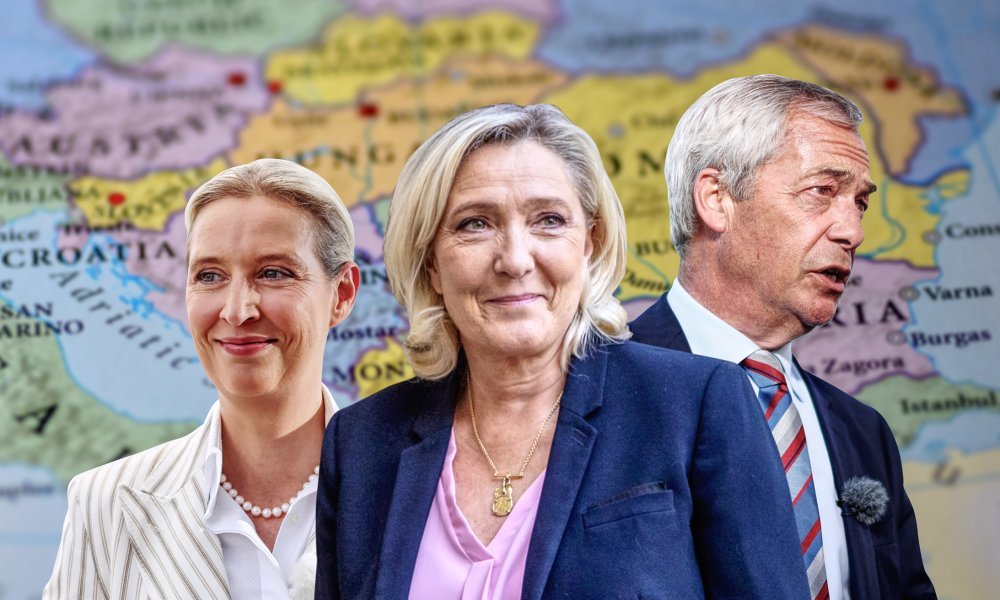
The old consensus is dead. And either the traditional forces use authoritarian and lawfare means to maintain control, or a new, highly unpredictable era of nationalist governance is about to begin across the continent.
Of course the irony, and hypocrisy, of the political establishment’s use of authoritarianism to push back what they consider (or at least want us to consider) the “barbarian authoritarianists” will not be lost on all.
How Germany blew the EU’s chance for information freedom
By Rachel Marsden | RT | July 5, 2026
It’s not every day that an EU member state has the opportunity to push back in favor of freedom. At least not without elections. But a German court did have that chance – and promptly blew it on behalf of European citizens everywhere.
Back in 2022 when the Ukraine war was ramping up, the European Commission made an executive order banning Russian media broadcasting in the EU. Meaning that you couldn’t – and still can’t – access RT from within the EU, either on TV or on the web, without a VPN.
So some folks running a website in Saarbrucken, Germany, near the French border, started including some RT videos in their live feed. They reportedly did this exactly four times, back in 2023. Whoop-dee-do, right?
Wrong. This is the EUSSR we’re talking about, remember?
For this, the accused ended up facing criminal prosecution in Germany for promoting some EU-sanctioned RT Germany content. But it turns out that even the German court in Saarbrucken considering this case had doubts as to whether these guys and their website actually fit the definition of an “operator” under the EU sanction’s language that “prohibits any operator from broadcasting, enabling, facilitating or otherwise contributing to broadcast, any” Russian media content. So the German court referred the question to the European Court of Justice tasked with interpreting and clarifying EU regulations and laws.
Wrong question, guys. Why didn’t you start with asking the ECJ whether the regulation itself, made unilaterally by the EU’s unelected and unaccountable executive branch, is even valid at all under the EU Charter of Fundamental Rights and its Article 11 protecting freedom of expression? The fact that the question wasn’t put to the European court by the German one has spawned a judgment that’s stunning in its failure to interpret the application of any free speech restrictions narrowly enough to avoid the disproportionate limiting of free expression.
The German court missed the forest for the trees and got down into the weeds and all hung up on the comparatively minor issue of whether the website could be considered an “operator” without being a commercial entity. Which the European court then used as a prelude to launch a sweeping McCarthyist “reds under the bed”-style tirade.
“The term ‘disinformation’ is a translation of the Russian word ‘дезинформация’ (dezinformatsiya), coined in the early 1920s by the Soviet intelligence services. Joseph Stalin is credited as being the originator of that term, deliberately making it sound French in order to make it seem Western in origin and thereby enhance its credibility,” wrote the EU court, self-identifying as a history professor. How about if I take that as an open invitation to self-identify as a judge in my capacity as a final-year law student?
The ECJ ultimately ruled that commercialism is irrelevant when the website solicits donations, and had raised over €60,000 within a period of a year. It basically said, look, any commercial nature of the platform risks being a false dichotomy, because who’s to say that the sanctioned entities themselves wouldn’t be paying these independent outlets through donations to promote their banned content: ”Even though, for the purposes of classification as an ‘operator’, no economic activity or income generation is necessary, the context of an appeal for donations enabling such sums to be collected warrants some comment. The fact that some websites are financed by donations rather than by a registered commercial activity justifies increased vigilance as to their possible use as a tool for propaganda purposes, in particular in the case of State-sponsored disinformation campaigns,” the European court ruled. “That lack of clarity makes it more difficult to identify financial flows and, therefore, the actors likely to influence editorial policy or content. It thus creates an environment conducive to interference by external interests, including by third countries, which may intervene directly or indirectly in the production or broadcasting of content.”
Isn’t it the prosecution’s job to present actual evidence and proof of influence through the powerful state-backed legal instruments at its disposal? Shouldn’t the ECJ’s definition of “operator,” if it leans so heavily on the risk of foreign corruption, therefore hinge on whether actual collusion has first been established beyond any reasonable doubt? The ECJ sounds shockingly blasé here about the basic burden of proof for criminal conviction.
This court case had been stayed, or suspended, in Germany pending the ruling by this European Court of Justice. But now it’s free to convict these guys of promoting banned Russian content, under the pretext that just maybe they’re not-so-independent media that schemed on the down-low to distribute Russian media content – something that a lot of people have been doing all over social media of their own volition.
Ultimately, what the buzz around this case effectively does is put a chilling effect on that sharing, and it also risks making people self-censor out of fear of being dragged into court for a judicial proctology exam and having their lives potentially ruined in the press over accusations of Russian collusion. What if these guys (and others) just happen to agree with some of the views expressed on banned Russian media? Who’s going to protect their honestly-held views from establishment authoritarianism?
Hang on, here’s a volunteer for the task.
“Freedom of the press is one of the cornerstones of democracy. And the EU protects what matters, including the right to receive independent, reliable information. The European Media Freedom Act helps keep journalists and sources safe, strengthens editorial independence and protects media organizations from undue interference or legal intimidation. Today, on World Press Freedom Day, we reaffirm our duty to support and protect journalists so they can do their work free from pressure, intimidation, or harm,” says unelected European Commission President and de facto Queen Ursula von der Leyen.
Oh, great. So the same people who censor speech are also its self-appointed defenders. Like an arsonist who goes running around setting fires but also works as a firefighter as their day job.
What’s clear from all this is that EU regulation may look precise on paper, but enforcement isn’t so straightforward. When even member state courts require an official interpretation, then how is the average person supposed to avoid running afoul of the law? The result ends up being less about what’s actually banned and more about what merely feels safe to touch. Not exactly the kind of vibe that one tends to aim for in a democracy.
Rachel Marsden is a columnist, political strategist, and host of independently produced talk-shows in French and English.
EU court backs criminal prosecution for sharing RT videos
RT | July 2, 2026
The EU’s top court has ruled that private individuals can face criminal prosecution for posting RT videos on public websites, widening the bloc’s crackdown on Russian media.
The Court of Justice of the European Union issued the ruling on Thursday in a case from Germany, where three people are being prosecuted for publishing RT DE videos on a freely accessible website.
The site did not charge readers and was financed only through voluntary donations. The CJEU, however, said that made no difference and ruled that all persons who are “directly or indirectly” responsible for making banned content available to the public can be treated as “operators” under EU sanctions rules.
The judges argued it was irrelevant if the individuals were running a business, how long the content was available, or how widely it was spread.
Under the German law cited in the ruling, violations of EU sanctions-based media bans can carry up to five years in prison.
The ruling effectively pushes the EU ban on RT beyond broadcasters, platforms or media companies, allowing for the criminal prosecution of any individuals accused of making RT content publicly available online.
The EU banned RT and Sputnik, among other Russian media outlets, after the Ukraine conflict escalated in 2022. Brussels said the sanctions would remain in place until the end of the Ukraine conflict and after Moscow ceases to conduct “disinformation and information manipulation actions against the EU.”
The measures were followed by platform blocks, app-store removals, banking restrictions, and personal sanctions against media figures and journalists accused of working with Russian outlets.
Germany had targeted RT even before the bloc-wide ban, with RT DE facing licensing pressure, platform bans, banking problems and regulatory action.
RT has vehemently condemned the restrictions and rejected the EU’s accusations, stressing that the bloc has consistently failed to point to a “a single example, a single grain of evidence” of false reporting.
Moscow has repeatedly condemned the restrictions as censorship and an information war against Russia, accusing EU governments of using the Ukraine conflict as a pretext to silence dissent, suppress Russian-language media, and intimidate journalists who challenge the mainstream Western narrative.
Germany, Israel hold joint naval drill off Haifa amid Gaza genocide
Press TV – June 25, 2026
Germany and the Israeli regime have conducted a joint naval exercise off the coast of Haifa, further deepening their partnership even as the Zionist entity continues its genocidal war against the Palestinian people in Gaza.
According to the Israeli military, a German navy vessel docked at Haifa port ahead of the drill, which the regime described as “a further step towards strengthening professional and operational relations between the two navies.”
German commanders Volker Kubsch and Rico Geisler also held meetings with Rear Admiral Erez Ben Zion, commander of the Haifa Naval Base.
The exercise comes despite mounting international outrage over Israel’s ongoing war in Gaza, where more than 73,000 Palestinians, the majority of them women and children, have been killed since October 2023 in what legal experts and human rights organizations describe as genocide.
Israel launched a genocidal war on Gaza after Palestinian resistance fighters waged the surprise Operation Al-Aqsa Storm against the Zionist entity in response to the regime’s decades-long campaign of bloodletting and devastation against Palestinians.
Just two days ago, a United Nations commission of inquiry strongly condemned Israel for deliberately targeting and killing Palestinian children, concluding that its actions constitute genocide, war crimes, and crimes against humanity in Gaza, as well as war crimes in the occupied West Bank.
Germany has long been one of the main suppliers of advanced weaponry to the Israeli regime, most notably through its controversial submarine program. These German-built submarines could potentially be equipped to carry nuclear weapons, significantly enhancing the Zionist entity’s offensive capabilities in the region.
The joint drill reflects Berlin’s complicity in Israel’s crimes against the Palestinian people. Despite the horrific images of destruction in Gaza and repeated calls from across the world to halt arms transfers, the German government continues to arm the occupying regime, prioritizing its alliance with Tel Aviv over international law and basic human rights.
This latest military collaboration between Germany and the Israeli regime underscores the deep-rooted Western support for Israel’s genocidal policies.
It also highlights the hypocrisy of Western powers that preach human rights while actively enabling the genocide of innocent Palestinians.
Censored Lavrov article Politico refused to publish (FULL TEXT)
RT | June 18, 2026
The pro-establishment, Brussels-based publication Politico Europe, owned by Germany’s Axel Springer SE, has refused to publish an exclusive article written by Russian Foreign Minister Sergey Lavrov.
Lavrov’s article was initially planned for publication in the Brussels-based Politico Europe, but due to a “last-minute decision by the outlet’s editorial team,” the publication was canceled, the Russian Foreign Ministry said on Friday.
In the article, Russia’s highly experienced top diplomat outlined Moscow’s view of the Ukrainian conflict, Europe’s role in escalating the crisis, and the broader implications for global security. Lavrov accused European leaders of using diplomacy as a cover for NATO and EU expansion, while arguing that the West has sought to turn Ukraine into an anti-Russian foothold. He also warned that the EU’s growing militarization, including discussions about nuclear deterrence and “strategic autonomy,” could increase the risk of a direct confrontation between NATO and Russia.
Below is the full text of Lavrov’s article, as published on the Russian Foreign Ministry website:
Some reflections on resolving the Ukrainian crisis, Europe and global security
At a meeting in London on 7 June 2026, the leaders of Britain, France, and Germany, as well as Vladimir Zelensky, laid out five preconditions for Russia to secure a “just and lasting peace” in Ukraine. United Europe now presents this list of demands as the basis for dialogue with Moscow.
Background
More than two decades of negotiations with Europe, as part of the collective West, lead to only one conclusion: engaging Russia in dialogue has served as a diplomatic smokescreen for the geopolitical expansion of Western institutions, above all NATO and the European Union, eastwards, right up to Russia’s borders.
Europe’s complicity in fueling the Ukrainian crisis is undeniable. Together with the United States, European countries orchestrated the Orange Revolution in Kiev in 2004. To create an anti-Russian bridgehead in Ukraine, they spent years buying off politicians and entire parties, rewriting history and educational curricula, cultivating and nurturing Ukrainian nationalism, and going to great lengths to pull Ukraine away from Russia.
In 2013, the European Union outright rejected our proposal for a compromise on the association agreement – a deal Brussels had long been pressing Viktor Yanukovich to sign. It is worth recalling that Ukraine was offered unilateral market opening without reciprocal commitments – terms that would have proved incompatible with Kiev’s continued membership in the CIS free-trade zone. When Viktor Yanukovich requested a deferral, the Europeans incited street riots that swiftly escalated into a coup d’état in Kiev in February 2014.
Germany, France, and Poland then proved themselves to be equally treacherous. Having guaranteed that the agreement reached between the opposition and Viktor Yanukovich would be honored, they washed their hands of it the moment that same opposition, their own handiwork, took power. “Democracy,” they shrugged, “takes unexpected turns.”
Europe thereafter lent its backing to the new authorities. In Odessa on 2 May 2014, the burning alive of dozens of innocent supporters of closer ties with Russia did not draw a single word of condemnation from European capitals.
As co-guarantors of the 2015 Minsk Agreements, France and Germany effectively encouraged the Ukrainian regime to sabotage its own commitments. As Angela Merkel and François Hollande later conceded – after the special military operation had already begun – Kiev’s implementation of the Minsk Agreements, unanimously approved by the UN Security Council, was never genuinely intended. The objective, they admitted, was merely to buy time: to shore up the Armed Forces of Ukraine and flood them with Western weaponry.
Russia, for its part, explored every diplomatic avenue to defuse Europe’s security crisis. However, in January 2022, the United States and NATO rejected Russia’s proposal for legally binding mutual security guarantees. European NATO members actively endorsed that rebuff.
Following the launch of the special military operation, United Europe threw its support behind the British prime minister’s efforts to sabotage the Istanbul negotiations between Russia and Ukraine. Boris Johnson’s appeal to Kiev – “don’t sign anything, just fight” – slammed the door on genuine diplomacy for the foreseeable future.
Current situation
So what has prompted European leaders to suddenly shift their rhetoric and start talking about negotiations, and what are they aiming to achieve with these statements? For instance, EU foreign policy chief Kaja Kallas has stated that the purpose of any dialogue with Russia is to dictate Europe’s terms. These include paying “reparations” to Ukraine; withdrawing troops from Transnistria and the South Caucasus; abolishing the “foreign agents” law; and accepting strict limits on the size of the Russian Federation’s Armed Forces. In her framing, “there can be no just and lasting peace without accountability for Russia.” During the UN Security Council session on 19 May 2026, an EU representative made the point unequivocally: “Supporting Ukraine militarily does not contradict the pursuit of peace, but rather serves as a fundamental prerequisite for any credible, good-faith negotiations.”
Europe’s plan is to talk with Russia while simultaneously pressing ahead with a campaign of legal warfare orchestrated through the Council of Europe. Within this once-respected organization, an entire infrastructure is being assembled for the express purpose of “holding Russia accountable”: a Register of Damage, a Claims Commission, and a Special Tribunal.
The European Union has also given the green light to detaining merchant vessels on the high seas. Several incidents have already taken place in the Baltic and the Atlantic. At the same time, the West studiously averts its gaze from the terrorist acts of sabotage perpetrated by the Armed Forces of Ukraine in the Black and Mediterranean Seas.
The real objective of Europe’s leaders, then, is not to negotiate with Russia. It is to shore up the Zelensky regime and preserve it as a launchpad for continued confrontation against Russia. With this in mind, European leaders are scrambling to secure a ceasefire as quickly as possible and for one reason only: to prevent the collapse of the Armed Forces of Ukraine on the battlefield. The plan is to “freeze” the conflict without addressing its root causes, and then rapidly deploy military contingents from the Anglo-French “coalition of the willing” onto Ukrainian soil.
It is widely known that European elites have invested their “political capital” in the confrontation with Russia, pouring hundreds of billions of dollars into propping up the Kiev regime and ramping up the military budgets of EU member states and NATO. Europe now aims to achieve “defense readiness” against Russia by 2030. Until then, they mean to buy time by whatever means are available. In a strikingly candid remark this April, Belgium’s chief of staff put it bluntly: “We still have a few years. Thanks to the courage and blood of the Ukrainians, who are buying us that time.”
United Europe continues to dream of expansion. It intends to absorb Ukraine and Moldova while pulling Armenia into its sphere of influence. NATO has already expanded eastward, swallowing up Finland and Sweden. As for Ukraine, it is increasingly being eyed as the “striking fist” of a future European military force, independent of the United States and independent of NATO.
Risks to global security
This state of affairs poses serious threats to global security. A direct confrontation between NATO and Russia could rapidly escalate into an exchange of nuclear strikes, with catastrophic consequences.
Under the banner of “strategic autonomy,” Europe is witnessing a significant build-up of its military capabilities, including in the nuclear sphere. Paris’s intention to extend its “nuclear umbrella” to several EU and NATO member states is a source of deep concern. This will do nothing to strengthen the security of France itself or of the recipients of its so-called protection.
For all that, Europe’s political and military establishment continues to attribute aggressive plans to Russia – plans that, they claim, reach far beyond Ukraine. The Russian president has stated on numerous occasions that all of this is nonsense, provocation, and disinformation, aimed solely at extracting budget funds for the fight against Russia. That is scarcely the climate for substantive dialogue.
Russia’s position
As for negotiations, Vladimir Putin reiterated at the St. Petersburg International Economic Forum that Russia is not opposed to contacts with any party. We see Europe, however, as a party bent on Russia’s defeat – a stance the Europeans themselves openly avow. Dialogue with Europe, therefore, cannot be conducted as though it were an impartial third-party observer.
Russia would prefer to achieve the goals of the special military operation through diplomacy.
That requires reliably guaranteeing security along Russia’s western borders and ensuring respect and dignity for our citizens and compatriots, including the right to speak their native Russian language and practice the Orthodox Christian faith. Further military, political, and economic expansion by the West is unacceptable: it runs counter to the imperatives of a multipolar world.
European leaders should recognize that the model of regional security built in Europe over decades, ever since the adoption of the Helsinki Final Act in 1975, has been destroyed by their own hands. And it will never be restored. We must now move toward creating a continent-wide security architecture open to all Eurasian countries and reflective of today’s multipolar reality.
The principle of equal and indivisible security, trampled upon by the Euro-Atlanticists, can be embodied within a new Eurasian architecture. When the time is ripe, Europe too will be able to join this great effort.
The key point is that meaningful dialogue requires the restoration of trust, shattered by the anti-Russian actions of the West, and Europe as part of it, in the post-Cold War era. Trust can be recovered only through concrete steps that demonstrate a sincere commitment to moving away from using diplomacy as a cover for expansionist ambitions. Trust cannot be restored, nor can dialogue be resumed, through ultimatums such as the one issued to Russia in London on 7 June 2026.
P.S. It is noteworthy that the London ultimatum was unequivocally reaffirmed by the ambassadors of Britain, France, and Germany at the meeting at the Russian Foreign Ministry on 11 June 2026 – a meeting they had so insistently requested. That was the sole purpose of their visit to the ministry.
Ukraine must compensate Germany for blowing up Nord Stream – AfD co-leader
RT | June 9, 2026
Ukraine should compensate Germany for the 2022 sabotage of the Nord Stream gas pipelines, the co-leader of the right-wing party Alternative for Germany (AfD), Alice Weidel, has said.
German investigators have attributed the explosions, which crippled the pipelines built to transport Russian gas to Germany, to a small group of Ukrainian operatives. The alleged ringleader was extradited to Germany from Italy last autumn.
Moscow has repeatedly questioned Berlin’s account of the attack, arguing that such a sophisticated operation could not have been carried out by a handful of divers in NATO-monitored waters without state backing.
Speaking at a party event on Tuesday, Weidel rejected German Chancellor Friedrich Merz’s proposal to grant Ukraine associate membership in the European Union, describing the country as a “bottomless pit” that is already heavily reliant on foreign financial assistance.
“Germany has already transferred more than €100 billion to Ukraine over the past four years alone,” she said.
Weidel argued that Kiev should first explain its role in the Nord Stream sabotage.
“We need to know how this state-terrorist act against the most important infrastructure we had, namely the Nord Stream pipelines, came about and what role Ukraine played in it,” she said.
“The flow of payments should actually be moving in the opposite direction. Ukraine must pay reparations to the Federal Republic of Germany, because we have suffered enormous damage – and so has Europe as a whole – from the loss of cheap Russian fossil fuels,” Weidel added.
The AfD co-leader also called for an immediate halt to German military and financial assistance to Ukraine, urging Berlin to focus instead on facilitating negotiations between Kiev and Moscow and restoring dialogue with Russia.
According to several recent opinion polls, the AfD is currently Germany’s most popular political party. An INSA survey published by Bild on Saturday put support for the party at 29%, while 77% of respondents said they were dissatisfied with Chancellor Merz’s performance – the worst rating of his tenure, according to the newspaper.
France-Germany fighter jet project collapses amid disputes
Al Mayadeen | June 9, 2026
Germany and France have reportedly decided to halt plans for a joint next-generation fighter aircraft program after failing to resolve long-standing disagreements between the companies leading the effort, marking a major setback for one of Europe’s most ambitious defense initiatives.
According to officials cited in media reports on Monday, German Chancellor Friedrich Merz and French President Emmanuel Macron discussed the future of the project during the EU-Western Balkans summit in Montenegro last week and concluded that there was little chance of overcoming the impasse that has stalled development for months.
German officials said Merz advised Macron to discontinue pursuit of the joint fighter aircraft program.
Macron’s office confirmed that the two leaders had reviewed the issue extensively and expressed disappointment that the project’s principal industrial partners, Airbus, representing Germany and Spain, and Dassault Aviation, had been unable to reach a compromise.
The initiative, valued at roughly €100 billion, was launched in 2017 as the centerpiece of a broader Future Combat Air System intended to provide Europe with a sixth-generation fighter aircraft supported by drones and a secure battlefield networking system.
The reported decision comes as European governments face mounting pressure to strengthen military capabilities amid growing tensions with Russia and increasing calls from Washington for greater European defense spending.
Although Macron has repeatedly defended the program, the French presidency stressed that defense cooperation between Paris and Berlin remains essential despite the setback.
Industry disagreements at the center of collapse
The project has faced repeated delays due to disputes over leadership, technology sharing, and intellectual property rights, as well as disagreements over the aircraft’s operational requirements.
“I would like to thank Friedrich Merz for this difficult but necessary decision, which is in the interests of Germany as an aviation hub and of the workforce,” Jürgen Kerner, Deputy Chairman of IG Metall, said in a statement.
Analysts noted that the program had struggled for years as Airbus and Dassault clashed over control of key aspects of development.
“SCAF has been on life support for three years,” said UK-based defense analyst Francis Tusa, referring to the project’s French acronym.
Different strategic priorities
The collapse also reflects differing strategic priorities between France and Germany. France sought an aircraft capable of operating from aircraft carriers and carrying nuclear weapons, while German officials questioned the necessity of such capabilities for their own armed forces.
Merz has publicly expressed doubts about whether investing in a manned sixth-generation fighter remains the best use of resources, particularly as modern warfare increasingly relies on drones, autonomous systems and networked technologies.
The reported abandonment of the fighter jet component echoes previous divisions within European defense cooperation, including France’s withdrawal from the Eurofighter program in the 1980s, and raises fresh questions about Europe’s ability to deliver large-scale joint military projects.
Featured Video

Racist Seinfeld Dances for Joy as Bibi Unveils His New Map
or go to
Aletho News Archives – Video-Images
TV Drama Review
Japanese drama projects Japan’s wartime atrocities onto Chinese characters

Global Times | October 25, 2026
By portraying Chinese characters as perpetrators of ruthless violence while casting Japanese Self-Defense Forces (SDF) intelligence operatives as defenders, the season 2 of the Japanese drama Vivant has recently drawn criticism from Chinese netizens, who argue that its depiction turns historical reality on its head while ignoring Japan’s wartime atrocities.
The TBS drama series – a spy suspense story in which an alleged unofficial intelligence unit of the SDF operates across the globe — has attracted a passionate fanbase. Its currently airing season 2 opened with a household rating of 18.8 percent, the highest for a TV drama this year, according toa commentary article by Japanese media Toyo Keizai.
What draws attention is the portrayal of the enemies in the series, the article noted. Scenes in which the Chinese organization subjects kidnapped members of the SDF unit to brutal torture are repeated with unrelenting intensity.
It is rare for Japanese TV dramas to explicitly portray a real-life country as the enemy, the article noted.
Japanese Prime Minister Sanae Takaichi also made a reference to the drama, saying that she has been recording Vivant and hopes to binge-watch it over the year-end and New Year holidays, according to Japanese media outlets.
China’s CCTV News report on Sunday revealed that the drama features scenes in which Chinese personnel cut off the fingers of and stab Japanese intelligence operatives in the abdomen. Such acts bear striking similarities to the torture inflicted on Chinese nationals by invading Japanese troops during the World War II.
The drama distorts the truth by attributing these atrocities to modern Chinese characters. Beneath the surface, it subtly glorifies Japan’s cross-border overseas operations, blurs the functional boundaries of the SDF and implicitly promotes an expansionist narrative, per CCTV News. … continue
Blog Roll
 Aletho News
- Up in arms… Koreans reject U.S. empire’s plan to make South Korea the next Ukraine
- Iran, Turkey, Pakistan, Saudi Arabia could advance region-led security framework in Tehran: FM spox
- Netizens condemn Japanese drama for projecting Japan’s wartime atrocities onto Chinese characters
- Racist Seinfeld Dances for Joy as Bibi Unveils His New Map
- A West Bank War for Netanyahu’s Election Campaign, Could It Backfire?
- Yemen denounces European Parliament’s ‘hypocritical’ push to blacklist Ansarullah
- Qalibaf: UAE’s UN bid aims to ‘clear the runway’ for ‘Greater Israel’, whitewash genocide
- Pakistan reopens Iran border after boosting security: Report
- Why are so many Brazilians voting for Flávio Bolsonaro?
- Democrats Put Anti-Russia Agenda Ahead of American Workers
- If Americans Knew
- An error has occurred; the feed is probably down. Try again later.
- No Tricks Zone
- Sudden Stratospheric Warming, Powerful El Niño Combination May Lead To Extreme Europe Cold, Energy Crisis!
- Two New Studies Find Thwaites Glacier Melt Cannot Be Driven By Human Activity Or A Warming Ocean
- E-Cars Reduce CO2 Emissions By Only 41% Compared To Internal Combustion Engine Vehicles
- Predictions Made By Renowned Climate Professor Over Past Decades Have Been Proven To Be Poor
- New Study Suggests Large Regions Of The Pacific Ocean Have Been Cooling For The Last 80 Years
- Germany’s Green Energy Debacle: High Energy Costs Force Kahla Porzellan to Close After 182 Years!
- New Study: 50 Years Of The Most Aggressive ‘Net Zero’ Policies Can Only Affect The Global Climate By 0.03°C
- US September “Heat” Was No Record…Many Records Set Decades Ago
- Latest European Green Energy Debacle; Portugal’s Largest Flagship Solar Park Insolvent!
- Green Energy Debacle: German Expert Professor Fritz Vahrenholt Warns Of Severe Economic And Social Consequences

